EP2286797B2 - Trockenpulverzusammensetzung mit von einer Nebendüse gemahlenen Partikeln für die Lungeninhalation - Google Patents
Trockenpulverzusammensetzung mit von einer Nebendüse gemahlenen Partikeln für die Lungeninhalation Download PDFInfo
- Publication number
- EP2286797B2 EP2286797B2 EP10181354.1A EP10181354A EP2286797B2 EP 2286797 B2 EP2286797 B2 EP 2286797B2 EP 10181354 A EP10181354 A EP 10181354A EP 2286797 B2 EP2286797 B2 EP 2286797B2
- Authority
- EP
- European Patent Office
- Prior art keywords
- particles
- jet
- bar
- milling
- active
- Prior art date
- Legal status (The legal status is an assumption and is not a legal conclusion. Google has not performed a legal analysis and makes no representation as to the accuracy of the status listed.)
- Expired - Lifetime
Links
Images

Classifications
-
- A—HUMAN NECESSITIES
- A61—MEDICAL OR VETERINARY SCIENCE; HYGIENE
- A61K—PREPARATIONS FOR MEDICAL, DENTAL OR TOILETRY PURPOSES
- A61K9/00—Medicinal preparations characterised by special physical form
- A61K9/0012—Galenical forms characterised by the site of application
- A61K9/007—Pulmonary tract; Aromatherapy
- A61K9/0073—Sprays or powders for inhalation; Aerolised or nebulised preparations generated by other means than thermal energy
- A61K9/0075—Sprays or powders for inhalation; Aerolised or nebulised preparations generated by other means than thermal energy for inhalation via a dry powder inhaler [DPI], e.g. comprising micronized drug mixed with lactose carrier particles
-
- A—HUMAN NECESSITIES
- A61—MEDICAL OR VETERINARY SCIENCE; HYGIENE
- A61K—PREPARATIONS FOR MEDICAL, DENTAL OR TOILETRY PURPOSES
- A61K31/00—Medicinal preparations containing organic active ingredients
- A61K31/33—Heterocyclic compounds
- A61K31/395—Heterocyclic compounds having nitrogen as a ring hetero atom, e.g. guanethidine or rifamycins
- A61K31/435—Heterocyclic compounds having nitrogen as a ring hetero atom, e.g. guanethidine or rifamycins having six-membered rings with one nitrogen as the only ring hetero atom
- A61K31/47—Quinolines; Isoquinolines
- A61K31/473—Quinolines; Isoquinolines ortho- or peri-condensed with carbocyclic ring systems, e.g. acridines, phenanthridines
-
- A—HUMAN NECESSITIES
- A61—MEDICAL OR VETERINARY SCIENCE; HYGIENE
- A61K—PREPARATIONS FOR MEDICAL, DENTAL OR TOILETRY PURPOSES
- A61K31/00—Medicinal preparations containing organic active ingredients
- A61K31/33—Heterocyclic compounds
- A61K31/395—Heterocyclic compounds having nitrogen as a ring hetero atom, e.g. guanethidine or rifamycins
- A61K31/55—Heterocyclic compounds having nitrogen as a ring hetero atom, e.g. guanethidine or rifamycins having seven-membered rings, e.g. azelastine, pentylenetetrazole
-
- A—HUMAN NECESSITIES
- A61—MEDICAL OR VETERINARY SCIENCE; HYGIENE
- A61K—PREPARATIONS FOR MEDICAL, DENTAL OR TOILETRY PURPOSES
- A61K31/00—Medicinal preparations containing organic active ingredients
- A61K31/33—Heterocyclic compounds
- A61K31/395—Heterocyclic compounds having nitrogen as a ring hetero atom, e.g. guanethidine or rifamycins
- A61K31/55—Heterocyclic compounds having nitrogen as a ring hetero atom, e.g. guanethidine or rifamycins having seven-membered rings, e.g. azelastine, pentylenetetrazole
- A61K31/551—Heterocyclic compounds having nitrogen as a ring hetero atom, e.g. guanethidine or rifamycins having seven-membered rings, e.g. azelastine, pentylenetetrazole having two nitrogen atoms, e.g. dilazep
- A61K31/5513—1,4-Benzodiazepines, e.g. diazepam or clozapine
-
- A—HUMAN NECESSITIES
- A61—MEDICAL OR VETERINARY SCIENCE; HYGIENE
- A61K—PREPARATIONS FOR MEDICAL, DENTAL OR TOILETRY PURPOSES
- A61K31/00—Medicinal preparations containing organic active ingredients
- A61K31/70—Carbohydrates; Sugars; Derivatives thereof
- A61K31/715—Polysaccharides, i.e. having more than five saccharide radicals attached to each other by glycosidic linkages; Derivatives thereof, e.g. ethers, esters
- A61K31/726—Glycosaminoglycans, i.e. mucopolysaccharides
- A61K31/727—Heparin; Heparan
-
- A—HUMAN NECESSITIES
- A61—MEDICAL OR VETERINARY SCIENCE; HYGIENE
- A61K—PREPARATIONS FOR MEDICAL, DENTAL OR TOILETRY PURPOSES
- A61K9/00—Medicinal preparations characterised by special physical form
- A61K9/0012—Galenical forms characterised by the site of application
- A61K9/007—Pulmonary tract; Aromatherapy
- A61K9/0073—Sprays or powders for inhalation; Aerolised or nebulised preparations generated by other means than thermal energy
- A61K9/008—Sprays or powders for inhalation; Aerolised or nebulised preparations generated by other means than thermal energy comprising drug dissolved or suspended in liquid propellant for inhalation via a pressurized metered dose inhaler [MDI]
-
- A—HUMAN NECESSITIES
- A61—MEDICAL OR VETERINARY SCIENCE; HYGIENE
- A61K—PREPARATIONS FOR MEDICAL, DENTAL OR TOILETRY PURPOSES
- A61K9/00—Medicinal preparations characterised by special physical form
- A61K9/14—Particulate form, e.g. powders, Processes for size reducing of pure drugs or the resulting products, Pure drug nanoparticles
- A61K9/16—Agglomerates; Granulates; Microbeadlets ; Microspheres; Pellets; Solid products obtained by spray drying, spray freeze drying, spray congealing,(multiple) emulsion solvent evaporation or extraction
-
- A—HUMAN NECESSITIES
- A61—MEDICAL OR VETERINARY SCIENCE; HYGIENE
- A61K—PREPARATIONS FOR MEDICAL, DENTAL OR TOILETRY PURPOSES
- A61K9/00—Medicinal preparations characterised by special physical form
- A61K9/14—Particulate form, e.g. powders, Processes for size reducing of pure drugs or the resulting products, Pure drug nanoparticles
- A61K9/16—Agglomerates; Granulates; Microbeadlets ; Microspheres; Pellets; Solid products obtained by spray drying, spray freeze drying, spray congealing,(multiple) emulsion solvent evaporation or extraction
- A61K9/1605—Excipients; Inactive ingredients
- A61K9/1617—Organic compounds, e.g. phospholipids, fats
-
- A—HUMAN NECESSITIES
- A61—MEDICAL OR VETERINARY SCIENCE; HYGIENE
- A61K—PREPARATIONS FOR MEDICAL, DENTAL OR TOILETRY PURPOSES
- A61K9/00—Medicinal preparations characterised by special physical form
- A61K9/14—Particulate form, e.g. powders, Processes for size reducing of pure drugs or the resulting products, Pure drug nanoparticles
- A61K9/16—Agglomerates; Granulates; Microbeadlets ; Microspheres; Pellets; Solid products obtained by spray drying, spray freeze drying, spray congealing,(multiple) emulsion solvent evaporation or extraction
- A61K9/1605—Excipients; Inactive ingredients
- A61K9/1617—Organic compounds, e.g. phospholipids, fats
- A61K9/1623—Sugars or sugar alcohols, e.g. lactose; Derivatives thereof; Homeopathic globules
-
- A—HUMAN NECESSITIES
- A61—MEDICAL OR VETERINARY SCIENCE; HYGIENE
- A61K—PREPARATIONS FOR MEDICAL, DENTAL OR TOILETRY PURPOSES
- A61K9/00—Medicinal preparations characterised by special physical form
- A61K9/14—Particulate form, e.g. powders, Processes for size reducing of pure drugs or the resulting products, Pure drug nanoparticles
- A61K9/16—Agglomerates; Granulates; Microbeadlets ; Microspheres; Pellets; Solid products obtained by spray drying, spray freeze drying, spray congealing,(multiple) emulsion solvent evaporation or extraction
- A61K9/1682—Processes
- A61K9/1694—Processes resulting in granules or microspheres of the matrix type containing more than 5% of excipient
-
- A—HUMAN NECESSITIES
- A61—MEDICAL OR VETERINARY SCIENCE; HYGIENE
- A61K—PREPARATIONS FOR MEDICAL, DENTAL OR TOILETRY PURPOSES
- A61K9/00—Medicinal preparations characterised by special physical form
- A61K9/48—Preparations in capsules, e.g. of gelatin, of chocolate
- A61K9/50—Microcapsules having a gas, liquid or semi-solid filling; Solid microparticles or pellets surrounded by a distinct coating layer, e.g. coated microspheres, coated drug crystals
-
- B—PERFORMING OPERATIONS; TRANSPORTING
- B02—CRUSHING, PULVERISING, OR DISINTEGRATING; PREPARATORY TREATMENT OF GRAIN FOR MILLING
- B02C—CRUSHING, PULVERISING, OR DISINTEGRATING IN GENERAL; MILLING GRAIN
- B02C19/00—Other disintegrating devices or methods
- B02C19/06—Jet mills
Definitions
- pMDIs pressurised metered dose inhalers
- DPIs dry powder inhalers
- the size of the active particles is of great importance in determining the site of the absorption in the lung.
- the particles In order for the particles be carried deep into the lungs, the particles must be very fine, for example having a mass median aerodynamic diameter (MMAD) of less than 10 ⁇ m.
- MMAD mass median aerodynamic diameter
- Particles having aerodynamic diameters greater than about 10 ⁇ m are likely to impact the walls of the throat and generally do not reach the lung.
- Particles having aerodynamic diameters in the range of about 5 ⁇ m to about 2 ⁇ m will generally be deposited in the respiratory bronchioles whereas smaller particles having aerodynamic diameters in the range of about 3 to about 0.05 ⁇ m are likely to be deposited in the alveoli and to be absorbed into the bloodstream.
- Fine particles that is those with an MMAD of less than about 10 ⁇ m tend to be increasingly thermodynamically unstable due to their high surface area to volume ratio, which provides an increasing surface free energy with this decreasing particle size, and consequently increases the tendency of particles to agglomerate and the strength of the agglomerate.
- agglomeration of fine particles and adherence of such particles to the walls of the inhaler are problems that result in the fine particles leaving the inhaler as large, stable agglomerates, or being unable to leave the inhaler and remaining adhered to the interior of the device, or even clogging or blocking the inhaler.
- the metered dose (MD) of a dry powder formulation is the total mass of active agent present in the metered form presented by the inhaler device in question.
- the MD might be the mass of active agent present in a capsule for a Cyclohaler (trade mark), or in a foil blister in an Aspirair (trade mark) device.
- the emitted dose is the total mass of the active agent emitted from the device following actuation. It does not include the material left inside or on the surfaces of the device.
- the ED is measured by collecting the total emitted mass from the device in an apparatus frequently referred to as a dose uniformity sampling apparatus (DUSA), and recovering this by a validated quantitative wet chemical assay.
- DUSA dose uniformity sampling apparatus
- the FPD value is obtained by interpretation of the stage-by-stage active agent recovery quantified by a validated quantitative wet chemical assay where either a simple stage cut is used to determine FPD or a more complex mathematical interpolation of the stage-by-stage deposition is used.
- the fine particle fraction may also be defined as the FPD divided by the MD and expressed as a percentage.
- FPF(MD) the FPF of MD
- FPF(MD) (FPD/MD) x 100%.
- Actuation of an inhaler refers to the process during which a dose of the powder is removed from its rest position in the inhaler. That step takes place after the powder has been loaded into the inhaler ready for use.
- the tendency of fine particles to agglomerate means that the FPF of a given dose can be highly unpredictable and a variable proportion of the fine particles will be administered to the lung, or to the correct part of the lung, as a result. This is observed, for example, in formulations comprising pure drug in fine particle form. Such formulations exhibit poor flow properties and poor FPF.
- the particles of such a powder should be large, preferably larger than about 40 ⁇ m.
- Such a powder may be in the form of either individual particles having a size of about 40 ⁇ m or larger and/or agglomerates of finer particles, the agglomerates having a size of about 40 ⁇ m or larger.
- the agglomerates formed can have a size of as much as about 100 ⁇ m and, with the addition of the additive material, those agglomerates are more likely to be broken down efficiently in the turbulent airstream created on inhalation. Therefore, the formation of unstable agglomerates of particles in the powder may be favoured compared with a powder in which there is substantially no agglomeration.
- US 4 895 726 discloses the co-micronisation of an active agent (fenofibrate)with a solid surfactant, wherein the co-micronisation may be carried out in a single step, advantageously in an accelerated air-jet mill.
- this is possible using both active dry powder inhaler devices and passive dry powder inhaler devices.
- the present invention seeks to optimise the preparation of particles of active agent used in the dry powder composition by engineering the particles making up the dry powder composition and, in particular, by engineering the particles of active agent. It is proposed to do this by adjusting and adapting the milling process used to form the particles of active agent.
- a method for making composite active particles for use in a pharmaceutical composition for pulmonary inhalation comprising a two-step milling process comprising, firstly, jet milling active particles on their own; and secondly, jet milling these active particles in the presence of particles of additive material and, optionally, air or a compressible gas or fluid, wherein the additive material comprises an amino acid, a metal stearate or a phospholipid, wherein the additive material is milled on its own prior to the step of co-milling with the active particles.
- mechanofusion is a dry coating process designed to mechanically fuse a first material onto a second material.
- the first material is generally smaller and/or softer than the second.
- the mechanofusion and cyclomixing working principles are distinct from alternative milling techniques in having a particular interaction between an inner element and a vessel wall, and are based on providing energy by a controlled and substantial compressive force.
- mechanofusion is used here to encompass any process which operates in such a manner, and applies in a rotational vessel a controlled and substantial compressive force.
- Food processor type mixers are not considered useful for the processes required in the present invention. Such mixers do not provide the necessary compressive forces. They include conventional mixing blades and these are not arranged with a small enough gap between the blades and the vessel wall.
- the mechanofusion driven vessel such as a MechanoFusion system (Hosokawa Micron Ltd)
- they are subject to a centrifugal force and are pressed against the vessel inner wall.
- the powder is compressed between the fixed clearance of the drum wall and an inner element with high relative speed between drum and element.
- the inner wall and the element together form a gap or nip in which the particles are pressed together.
- the particles experience very high shear forces and very strong compressive stresses as they are trapped between the inner drum wall and the inner element.
- the particles are pressed against each other with enough energy to locally heat and soften, break, distort, flatten and wrap the additive particles around the core particle to form a coating.
- the energy is generally sufficient to break up agglomerates and some degree of size reduction of both components may occur.
- this compression process produces little or no milling (i.e. size reduction) of the drug particles, especially where they are already in a micronised form (i.e. ⁇ 10 ⁇ m), the only physical change which may be observed is a plastic deformation of the particles to a rounder shape.
- Ball milling is a suitable milling method for use in the prior art co-milling processes. Centrifugal and planetary ball milling are especially preferred methods. Alternatively, a high pressure homogeniser may be used in which a non-compressible fluid containing the particles is forced through a valve at high pressure producing conditions of high shear and turbulence. Such homogenisers may be more suitable than ball mills for use in large scale preparations of the composite active particles.
- Suitable homogensiers include EmulsiFlex high pressure homogenisers which are capable of pressures up to 4000 bar, Niro Soavi high pressure homogenisers (capable of pressures up to 2000 bar), and Microfluidics Microfluidisers (capable of pressures up to 2750 bar).
- the milling step may, alternatively, involve a high energy media mill or an agitator bead mill, for example, the Netzsch high energy media mill, or the DYNO-mill (Willy A. Bachofen AG, Switzerland).
- Jet mills are capable of reducing solids to particle sizes in the low-micron to submicron range.
- the grinding energy is created by gas streams from horizontal grinding air nozzles. Particles in the fluidized bed created by the gas streams are accelerated towards the centre of the mill, colliding with slower moving particles.
- the gas streams and the particles carried in them create a violent turbulence and as the particles collide with one another they are pulverized.
- jet milling has not been considered attractive for co-milling active and additive particles, processes like mechanofusion and cyclomixing or equivalent being clearly preferred.
- the collisions between the particles in a jet mill are somewhat uncontrolled and those skilled in the art, therefore, considered it unlikely for this technique to be able to provide the desired deposition of a coating of additive material on the surface of the active particles.
- segregation of the powder constituents occurred in jet mills, such that the finer particles, that were believed to be the most effective, could escape from the process.
- composite particles of active and additive material can be produced by co-jet milling these materials.
- the resultant particles have excellent characteristics which lead to greatly improved performance when the particles are dispensed from a DPI for administration by inhalation.
- co-jet milling active and additive particles can lead to further significant particle size reduction.
- the composite active particles exhibit an enhanced FPD and FPF, compared to those disclosed in the prior art.
- compositions which are made by simple blending of similarly sized particles of active material with additive material are made by simple blending of similarly sized particles of active material with additive material.
- simple blending means blending or mixing using conventional tumble blenders or high shear mixing and basically the use of traditional mixing apparatus which would be available to the skilled person in a standard laboratory.
- co-jet milling can be used to produce sufficiently complete coatings of additive material, which have now been observed to substantially improve the dispersion of the powders from an inhaler.
- the jet milling process can also be adjusted to tailor the composite particles to the type of inhaler device to be used to dispense the particles.
- the inhaler device may be an active inhaler device, such as Aspirair (trade mark) or it may be a passive device.
- co-jet milling process may optionally also be arranged so as to significantly mill the active particles, that is, to significantly reduce the size of the active particles.
- the co-jet milling of the present invention may even, in certain circumstances, be more efficient in the presence of the additive material than it is in the absence of the additive material. The benefits are that it is therefore possible to produce smaller particles for the same mill, and it is possible to produce milled particles with less energy.
- Co-jet milling should also reduce the problem of amorphous content by both creating less amorphous material, as well as hiding it below a layer of additive material.
- the impact forces of the co-jet milling are sufficient to break up agglomerates of drug, even micronised drug, and are effective at distributing the additive material to the consequently exposed faces of the particles.
- This is an important aspect of the present invention. It has been shown that if the energy of the process is not sufficient to break up the agglomerates of drug (for example, as will be the case when one uses a conventional blender), the additive material merely coats the agglomerates and these agglomerates can even be compressed, making them even more difficult to disperse. This is clearly undesirable when one is seeking to prepare a dry powder for administration by inhalation.
- Fine particles of active material suitable for pulmonary administration have often been prepared by milling in the past.
- critical size a minimum size, referred to as the "critical size”
- Critical sizes are specific to particular mills and sets of milling conditions.
- manufacture of fine particles by milling can require much effort and there are factors which consequently place limits on the minimum size of particles of active material which can be achieved, in practice, by such milling processes.
- the present invention consequently relates to the provision of a high-energy impact process that is effective in producing improvements in the resultant drug powders.
- the processes of the present invention do not need to be carried out in a closed system. Even where the additive material being co-jet milled is leucine, there is no observed loss of additive material or reduction in coating where the jet milling is not carried out in a closed system. Rather, in one embodiment of the invention, the method of the present invention is carried out in a flow-through system, without any loss in performance of the resultant composite particles. This is an economically important feature, as it can significantly increase the rate of production of the powders of the invention.
- 90% by mass of the additive particles jet-milled are initially less than 20 ⁇ m in diameter. More preferably, 90% by mass of the additive particles jet-milled are initially less than 10 ⁇ m in diameter, and most preferably less than 5 ⁇ m in diameter or less than 3 ⁇ m in diameter.
- the active agent is heparin (fractionated and unfractionated), apomorphine, clobozam, clomipramine or glycopyrrolate.
- additive particles and “particles of additive material” are used interchangeably herein.
- the additive particles comprise one or more additive materials (or FCAs).
- the additive particles consist essentially of the additive material.
- additive materials usually consist of physiologically acceptable material, although the additive material may not always reach the lung.
- the additive particles may not always reach the lung.
- the additive particles may not always reach the lung.
- the additive particles are attached to the surface of carrier particles, they will generally be deposited, along with those carrier particles, at the back of the throat of the user.
- the additive material includes one or more amino acids.
- Amino acids are physiologically acceptable and give acceptable release of the active particles on inhalation
- the additive material may comprise an amino acid.
- the additive material may comprise one or more of any of the following amino acids: leucine, isoleucine, lysine, valine, methionine, and phenylalanine.
- the additive may be a salt or a derivative of an amino acid, for example aspartame or acesulfame K.
- the additive particles consist substantially of an amino acid, more preferably of leucine, advantageously L-leucine.
- the D-and DL-forms may also be used.
- leucine has been found to give particularly efficient dispersal of the active particles on inhalation.
- the additive material may include one or more water soluble substances. This helps absorption of the additive material by the body if it reaches the lower lung.
- the additive material may include dipolar ions, which may be zwitterions.
- a spreading agent as an additive material, to assist with the dispersal of the composition in the lungs.
- Suitable spreading agents include surfactants such as known lung surfactants (e.g. ALEC, Registered Trade Mark), which comprise phospholipids, for example, mixtures of DPPC (dipalmitoyl phosphatidylcholine) and PG (phosphatidylglycerol).
- the phospholipids used in accordance with the invention may have acyl substituents on the phosphatidyl groups.
- the acyl groups may comprise identical or different, saturated or unsaturated acyl radicals, generally C14-22, especially C16-20, acyl radicals.
- the phospholipids may comprise, by way of acyl radicals, the saturated radicals palmitoyl C16:0 and stearoyl C18:0 and/or the unsaturated radicals oleoyls C18:1 and C18:2.
- Suitable surfactants include, for example, dipalmitoyl phosphatidylethanolamine (DPPE), dipalmitoyl phosphatidylinositol (DPPI).
- Further exemplary phospholipids include 1-palmitoyl-2-oleoyl-SN-glycero-3-phosphoglycerol (POPG), phosphoglycerides such as disteroylphosphatidylcholine, diarachidoylphosphatidylcholine dibehenoylphosphatidylcholine, diphosphatidyl glycerol, short-chain phosphatidylcholines, long-chain saturated phosphatidylethanolamines, long-chain saturated phosphatidylserines, long-chain saturated phosphatidylglycerols, long-chain saturated phosphatidylinositols.
- POPG 1-palmitoyl-2-oleoyl-SN-glycero-3-phosphoglycerol
- the additive material may comprise a phospholipid.
- Lecithin has been found to be a good material for the additive material.
- the additive material may comprise a metal stearate, for example, sodium stearyl fumarate or sodium stearyllactylate.
- the additive material comprises a metal stearate.
- the additive material comprises magnesium stearate.
- the additive material may include or consist of one or more surface active materials, in particular materials that are surface active in the solid state, which may be water soluble or water dispersible, for example lecithin, in particular soya lecithin, or substantially water insoluble.
- surface active materials include: phosphatidylcholines, phosphatidylethanolamines, phosphatidylglycerols and other examples of natural and synthetic lung surfactants.
- the additive material comprises an amino acid, a metal stearate or a phospholipid.
- the additive material comprises one or more of L-, D- or DL- forms of leucine, isoleucine, lysine, valine, methionine, phenylalanine, or Aerocine, lecithin or magnesium stearate.
- the additive material comprises leucine and preferably l-leucine.
- Excipient materials may be included in powders for administration by pulmonary inhalation for a number of reasons.
- the inclusion of particles of excipient material of an appropriate size can enhance the flow properties of the powder and can enhance the powder's handleability.
- Excipient material is also added to powder formulations as a diluent. It can be very difficult to accurately and reproducibly administer a very small amount of powder. Where low doses of drug are required, this can pose a problem and so it can be desirable to add a diluent to the powder, to increase the amount of powder to be dispensed.
- the carrier particles Preferably at least about 90% by weight of the carrier particles have a diameter between from about 40 ⁇ m to about 180 ⁇ m.
- the relatively large diameter of the carrier particles improves the opportunity for other, smaller particles to become attached to the surfaces of the carrier particles and provides good flow and entrainment characteristics and improved release of the active particles in the airways to increase deposition of the active particles in the lung.
- the carrier particles to be added to the composite active particles of the present invention are relatively large particles of an excipient material, such as lactose.
- the size of the carrier particles used in a dry powder formulation can be influential on segregation.
- the 3-component system comprises the composite active particles made according to the present invention, together with fine excipient particles.
- excipient particles have a particle size of 30 ⁇ m or less, preferably 20 ⁇ m or less and more preferably 10 ⁇ m or less.
- the excipient particles advantageously have a particle size of 30 to 5 ⁇ m.
- the active device causes turbulence within the blister, capsule or other powder storage means. This means that even powders with fine excipient particles can be extracted. Furthermore, the presence of the composite active particles means that the agglomerates formed from the fine particles are not so stable that they are not broken up upon actuation of the inhaler device. Thus, it has been surprisingly found that compositions comprising the composite active particles of the present invention and fine particles of an inert excipient material, such as lactose, can be efficiently dispensed using an active inhaler device.
- an inert excipient material such as lactose
- Co-jet milling the fine excipient particles with the additive material results in coating of the additive material on the surfaces of the excipient particles.
- This coating can further reduce the cohesiveness of the 3-component system and can further enhance deagglomeration upon actuation of the inhaler device.
- compositions comprising fine carrier particles are poor unless they are pelletised (e.g. as is done in the AstraZeneca product OXIS (registered trade mark).
- fine lactoses e.g. Sorbolac 400 with a particle size of 1 to 15 ⁇ m
- these beneficial properties are achieved without the need to resort to pelletisation, which has its own disadvantages of being difficult to do and generally decreasing FPFs.
- different grinding and injection pressures may be used in order to produce particles with different coating characteristics.
- the invention also includes embodiments where different grinding and injection pressures are combined, to produce composite particles with desired properties, that is, to engineer the particles.
- Co-jet milling may be carried out at grinding pressures between 0.1 and 12 bar. Varying the pressure allows one to control the degree of particle size reduction. At pressures in the region of 0.1-3 bar, more preferably 0.5 - 2 bar and most preferably 1-2 bar, the co-jet milling will primarily result in blending of the active and additive particles, so that the additive material coats the active particles. On the other hand, at 3-12 bar, and preferably 5-12 bar, the co-jet milling will additionally lead to particle size reduction.
- the jet milling is carried out at a grinding pressure of between 0.1 and 3 bar, to achieve blending of the active and additive particles.
- a grinding pressure of between 0.1 and 3 bar
- the resultant particles have been shown to perform well when dispensed using passive devices. It is speculated that this is because the particles are larger than those produced by co-jet milling at higher pressures and these relatively larger particles are more easily extracted from the blister, capsule or other storage means in the passive device, due to less cohesion and better flowability. Whilst such relatively large particles are easily extracted from the blister or capsule in an active device, they may result in throat deposition.
- the jet milling is carried out at a grinding pressure of between 3 and 12 bar, to achieve a reduction of the sizes of the active and additive particles.
- the co-jet milling at these relatively high pressures can produce extremely small composite active particles having an MMAD of between 3 and 0.5 ⁇ m.
- These fine particle sizes are excellent for deep lung deposition, but they really need to be dispensed using an active inhaler device, as the powder formulations comprising such fine particles are actually rather "sticky". As discussed below, this stickiness may not pose a problem for active devices and is actually thought to be advantageous as it can slow the extraction of the powder so that the composite active particles travel more slowly in the powder plume generated by the device, thereby reducing throat deposition.
- the co-jet milling processes according to the present invention can also be carried out in two or more stages, to combine the beneficial effects of the milling at different pressures and/or different types of milling or blending processes.
- the use of multiple steps allows one to tailor the properties of the co-jet milled particles to suit a particular inhaler device, a particular drug and/or to target particular parts of the lung.
- the additive material may also be milled on its own prior to the co-milling step. This milling may be conducted in a jet mill, a ball mill, a high pressure homogeniser or alternative known ultrafine milling methods.
- the particles of additive material are preferably in a form with 90% of the particles by mass of diameter ⁇ 10 ⁇ m, more preferably ⁇ 5 ⁇ m, more preferably ⁇ 2 ⁇ m, more preferably ⁇ 1 ⁇ m and most preferably ⁇ 0.5 ⁇ m,
- This two-step process produces better results than simply co-jet milling the active material and additive material at a high grinding pressure.
- Experimental results discussed below show that the two-step process results in smaller particles and less throat deposition than simple co-jet milling of the materials at a high grinding pressure.
- the particles produced using the two-step process discussed above subsequently undergo mechanofusion or an equivalent compressive process.
- This final mechanofusion step is thought to "polish" the composite active particles, further rubbing the additive material into the particles. This allows one to enjoy the beneficial properties afforded to particles by mechanofusion, in combination with the very small particles sizes made possible by the co-jet milling.
- all of the particles are of a similar size distribution. That is, substantially all of the particles are within the size range of about 0 to about 50 ⁇ m, of about 0 to about 20 ⁇ m, of about 0 to 10 ⁇ m, of about 0 to 5 ⁇ m or of about 0 to 2 ⁇ m.
- a pharmaceutical dry powder composition for pulmonary inhalation comprising composite active particles made by a method according to the first aspect of the invention.
- the composite active particles have a diameter of not more than 10 ⁇ m, advantageously not more than 5 ⁇ m, preferably not more than 3 ⁇ m, even more preferably not more than 2.5 ⁇ m, even more preferably not more than 2 ⁇ m and more preferably not more than 1.5 ⁇ m, or even not more than 10 ⁇ m.
- the FPF(ED) will be between 60 and 99%, more preferably between 70 and 99%, more preferably between 80 and 99% and even more preferably between 90 and 99%.
- the FPF(MD) it is desirable for the FPF(MD) to be at least 40%.
- the FPF(MD) will be between 40 and 99%, more preferably between 50 and 99%, more preferably between 60 and 99%, and more preferably between 70 and 99% and even more preferably between 80 and 99%.
- the resultant dry powder formulation has a reproducible FPF(ED) of at least 70%.
- the FPF(ED) will be at least 80%, more preferably the FPF(ED) will be at least 85%, and most preferably the FPF(ED) will be at least 90%.
- the dry powder formulation has a reproducible FPF(MD) of at least 60%.
- the FPF(MD) will be at least 70%, more preferably the FPF(MD) will be at least 80%, and most preferably the FPF(MD) will be at least 85%.
- Co-jet milling has surprisingly been found to be capable of significantly reducing the median primary particle size of active particles (for example, from 3 or 2 ⁇ m to 1 ⁇ m), while also allowing good aerosolisation from a delivery device. This further reduction in primary particle size is considered to be advantageous for delivery of systemically targeted molecules to the deep lung.
- the benefit here is to co-jet mill active particles with additive particles in order to reduce primary particle size while still achieving a reduction in the level of powder cohesion and adhesion by coating the particles for additive material.
- NTI Next Generation Impactor
- the in-vitro testing was performed using an Aspirair (trade mark) device, which is an active inhaler device.
- the formulations were composed of one or more of the following constituents:
- micronised clobozam 1.01g was weighed out, and then gently pressed through a 300 ⁇ m metal sieve, using the rounded face of a metal spatula. This formulation was recorded as "3A”.
- micronised clobozam was then combined with 0.50g of magnesium stearate in the MechanoFusion system.
- the material was processed at a setting of 20% power for 5 minutes, followed by a setting of 80% power for 10 minutes. This material was recorded as "5A”. After blending, this powder was rested overnight, and then was gently pushed through a 300 ⁇ m metal sieve with a spatula. This material was recorded as "5B”.
- micronised clobozam 9.5g was then combined with 0.50g of micronised L-leucine in the MechanoFusion system.
- the material was processed at a relatively low speed setting of 20% power for 5 minutes. This process was intended only to produce a good mix of the components. This material was recorded as "6A".
- a batch of re-condensed leucine (also referred to as "Aerocine”) was produced by subliming to vapour a sample of leucine in a tube furnace, and re-condensing as a very finely dispersed powder as the vapour cooled. This batch was identified as "8A”.
- micronised clobozam 9.5g was combined with 0.50g of Aerocine in the MechanoFusion system. The material was processed at a setting of 20% power for 5 minutes. 7.00g of this powder was then fed into the AS50 spiral jet mill, set with an injector pressure of about 7 bar and a grinding pressure of about 5 bar. The resulting material was recovered and recorded as "9A".
- the mean ED was 1965 ⁇ g, with an RSD (relative standard deviation) of 2.8%. This material consequently demonstrated excellent through life dose reproducibility.
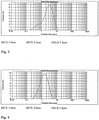
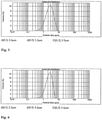
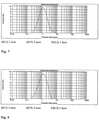
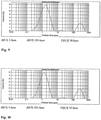
- the results of particle size testing by Malvern of these powdered materials are provided in the following figures.
- the particle size distributions indicate the level of size reduction obtained by the co-milling.
- the results of dispersion testing of these powdered materials are provided in the Figures 1A to 7B .
- the particle size distributions indicate both the level of size reduction obtained by the co-milling, and the level of dispersion efficiency at varied pressures.
- the d(50) and d(97) plots provide a further indication of this dispersibility of the powders as a function of pressure.
- a number of foil blisters were filled with approximately 2mg of the following formulations:
- the co-jet milled formulations once again exhibited exceptional FPFs when it is dispensed using an active dry powder inhaler device.
- "12A” was produced as a repeat of "10A”, but excluding the mechanofused pre-blend (to show it was not required).
- a number of foil blisters were filled with approximately 2mg of formulation 12A.
- life dose uniformity was tested by firing 30 doses, with the emitted doses collected by DUSA. Through life dose uniformity results are presented in the graph in Figure 2 .
- the mean ED was 389 ⁇ g, with an RSD of 6.1% and the through life delivery of this drug-lactose formulation was very good.
- formulations "11B”, “10A” and “2C” were fired from an Aspirair and plume and vortex behaviour recorded on digital video. The images were studied in light of the above differences in throat deposition.
- Figure 4 shows the particle size distribution of the raw material apomorphine.
- Figure 5 shows the particle size distribution of the raw material clobozam.
- Figure 6 shows the particle size distribution of the clobozam formulation comprising 95% clobozam and 5% mechanofused magnesium stearate.
- Figure 8 shows the particle size distribution of the clobozam formulation comprising 95% clobozam and 5% co-jet milled leucine.
- Figure 10 also shows the particle size distribution of the apomorphine formulation comprising 75% lactose, 20% apomorphine and 5% co-jet milled leucine.
- the size distribution is low (d(50) 1.8 to 1.6), when compared to the particle size distribution of the micronised lactose which comprises 75% of the composition.
- size reduction is not detectable with respect to pure apomorphine, although it should be noted that this comprises only 20% of the powder composition.
- mechanofusion of active particles increased the throat deposition substantially.
- Mechanofusion has previously been associated with improvement in dispersibility from a passive device, and reduced throat deposition.
- mechanofusion with magnesium stearate gives slightly lower throat deposition than mechanofusion with leucine.
- the throat deposition appears especially high for mechanofused formulations containing leucine. It is speculated that this could be due to an agglomerating affect during mechanofusion specific to leucine and not magnesium stearate, or an electrostatic effect specific to leucine.
- co-jet milling produces materials which, in comparison, give very low throat deposition, low device deposition and excellent dispersion from an active device.
- This co-jet milling also produces a significant further size reduction, for example, d(50) changes from about 2.6 ⁇ m to about 1 ⁇ m for clobozam.
- d(50) changes from about 2.6 ⁇ m to about 1 ⁇ m for clobozam.
- FPF(ED) are 90 to 96%. This excellent performance was obtained for leucine, Aerocine and magnesium stearate, and for 3 different formulations, including 2 different active agents, with or without lactose diluent.
- throat deposition difference is related to the powder lifetime within the vortex, with a longer lifetime giving reduced throat deposition.
- Lower aerosol concentration at the plume front, lower momentum of aerosol plume (with lower cloud density and smaller particle size) and greater opportunity to be de-agglomerated are possible contributors to this improvement.
- lower powder density in the cyclone appears to lead to better dispersion.
- the co-milling of active particles with additive particles has yielded reduced device/blister retention compared to formulations prepared without additive particles.
- Mechanofusion was shown to give significantly greater blister retention than co-jet milling.
- the worst blister retention was seen for mechanofused clobozam with magnesium stearate (13%). This appears related to the dusting nature of such formulations.
- the mechanofused powders spread and flow more easily, which facilitates higher degrees of contact with the surfaces in bulk powder contact.
- the co-milled powders however are heavily agglomerated, so contact with surfaces is much reduced, and dust residues are also much less.
- the device retention also appears greater for mechanofused than co-jet milled powders for clobozam.
- Clomipramine hydrochloride was obtained in powdered form. Force control agents leucine and magnesium stearate were used.
- Twelve formulations were produced from the original powder, using the Hosokawa AS50 jet mill. Either the pure drug was passed through the mill or a blend of drug with 5% w/w of a force control agent added. The mill was used with a range of parameters. Primarily, these were injector air pressure, grinding air pressure and powder feed rate.
- Formulation 14 The pure clomipramine hydrochloride was passed through the microniser three times, each time with an injector air pressure of 8 bar, grinding air pressure of 1.5 bar and powder feed rate of ⁇ 1g/min. Malvern (dry powder) particle size measurement gave a d(50) of 1.2 ⁇ m.
- This pre-micronised clomipramine hydrochloride was then blended in a pestle with a spatula with 5% micronised 1-leucine. This blend was then micronised with an injector air pressure of 7 bar, grinding air pressure of 1 bar and powder feed rate of ⁇ 1 g/min. Malvern (dry powder) particle size measurement gave a d(50) of 1.38 ⁇ m.
- Formulation 20 The pure clomipramine hydrochloride was micronised with an injector air pressure of 7 bar, grinding air pressure of 1 bar and powder feed rate of ⁇ 10 g/min. Malvern (dry powder) particle size measurement gave a d(50) of 3.5 ⁇ m.
- Formulation 22 The pure clomipramine hydrochloride was micronised with an injector air pressure of 7 bar, grinding air pressure of 3 bar and powder feed rate of ⁇ 10 g/min. Malvern (dry powder) particle size measurement gave a d(50) of 1.6 ⁇ m.
- Formulation 23 The clomipramine hydrochloride was pre-blended in a pestle with a spatula with 5% micronised l-leucine. This blend was micronised with an injector air pressure of 7 bar, grinding air pressure of 5 bar and powder feed rate of ⁇ 10 g/min. Malvern (dry powder) particle size measurement gave a d(50) of 1.8 ⁇ m.
Landscapes
- Health & Medical Sciences (AREA)
- Life Sciences & Earth Sciences (AREA)
- Engineering & Computer Science (AREA)
- Bioinformatics & Cheminformatics (AREA)
- Public Health (AREA)
- Pharmacology & Pharmacy (AREA)
- Epidemiology (AREA)
- Medicinal Chemistry (AREA)
- Animal Behavior & Ethology (AREA)
- General Health & Medical Sciences (AREA)
- Chemical & Material Sciences (AREA)
- Veterinary Medicine (AREA)
- Molecular Biology (AREA)
- Pulmonology (AREA)
- Otolaryngology (AREA)
- Biophysics (AREA)
- Dermatology (AREA)
- Food Science & Technology (AREA)
- Medicinal Preparation (AREA)
- Pharmaceuticals Containing Other Organic And Inorganic Compounds (AREA)
- Acyclic And Carbocyclic Compounds In Medicinal Compositions (AREA)
Claims (8)
- Verfahren zur Herstellung von Verbundwirkstoffteilchen zur Verwendung in einer pharmazeutischen Zusammensetzung zur pulmonalen Inhalation, wobei das Verfahren einen aus zwei Schritten bestehenden Mahlvorgang umfasst, bei dem erstens Wirkstoffteilchen für sich allein in einer Strahlmühle vermahlen werden; und zweitens diese Wirkstoffteilchen in Gegenwart von Teilchen von Additivmaterial und gegebenenfalls Luft oder einem komprimierbaren Gas oder Fluid in der Strahlmühle vermahlen werden, wobei das Additivmaterial eine Aminosäure, ein Metallstearat oder ein Phospholipid umfasst, wobei das Additivmaterial vor dem Schritt des gemeinsamen Vermahlens mit den Wirkstoffpartikeln für sich allein vermahlen wird.
- Verfahren nach Anspruch 1, wobei der erste Schritt unter einem hohen Mahldruck und der zweite Schritt vorzugsweise unter einem niedrigeren Mahldruck erfolgt.
- Verfahren nach Anspruch 3, wobei der Schritt des Vermahlens des Additivmaterials für sich allein in einer Strahlmühle, Kugelmühle oder einem Hochdruckhomogenisator ausgeführt wird.
- Verfahren nach Anspruch 3 oder Anspruch 4, wobei die Teilchen von Additivmaterial vor dem Schritt des gemeinsamen Vermahlens in einer Form vorliegen, bei der 90 Masse-% der Teilchen einen Durchmesser von weniger als 10 µm, vorzugsweise weniger als 5 µm, stärker bevorzugt weniger als 2 µm, stärker bevorzugt weniger als 1 µm und am stärksten bevorzugt weniger als 0,5 µm haben.
- Verfahren nach einem der Ansprüche 1-5, wobei das Verfahren ferner einen Kompressionsverabeitungsschritt nach dem Schritt des gemeinsamen Vermahlens umfasst.
- Verfahren nach Anspruch 6, wobei der Kompressionsverabeitungsschritt Mechanofusion beinhaltet.
- Verfahren nach einem der Ansprüche 1-7, wobei das Additivmaterial ein oder mehrere von Leucin, Isoleucin, Lysin, Valin, Methionin, Phenylalanin oder Lecithin umfasst, und vorzugsweise wobei das Additivmaterial Leucin, stärker bevorzugt L-Leucin oder Magnesiumstearat umfasst.
- Verfahren nach einem der vorhergehenden Ansprüche, wobei das Strahlmahlen bei Temperaturen unterhalb Raumtemperatur, vorzugsweise unter 10°C und stärker bevorzugt unter 0°C erfolgt.
Applications Claiming Priority (6)
| Application Number | Priority Date | Filing Date | Title |
|---|---|---|---|
| GBGB0321607.4A GB0321607D0 (en) | 2003-09-15 | 2003-09-15 | Manufacture of pharmaceutical compositions |
| GB0321612A GB0321612D0 (en) | 2003-09-15 | 2003-09-15 | Devices and pharmaceutical compositions for enhancing dosing efficiency |
| GB0321608A GB0321608D0 (en) | 2003-09-15 | 2003-09-15 | Methods for preparing pharmaceutical compositions |
| GB0409133A GB0409133D0 (en) | 2004-04-23 | 2004-04-23 | Methods for preparing pharmaceutical compositions |
| EP04768542A EP1663155B1 (de) | 2003-09-15 | 2004-09-15 | Trockenpulverzusammensetzung mit co-strahlgemahlenen teilchen zur pulmonalen inhalation |
| PCT/GB2004/003996 WO2005025536A2 (en) | 2003-09-15 | 2004-09-15 | Dry powder composition comprising co-jet milled particles for pulmonary inhalation |
Related Parent Applications (2)
| Application Number | Title | Priority Date | Filing Date |
|---|---|---|---|
| EP04768542.5 Division | 2004-09-15 | ||
| EP04768542A Division EP1663155B1 (de) | 2003-09-15 | 2004-09-15 | Trockenpulverzusammensetzung mit co-strahlgemahlenen teilchen zur pulmonalen inhalation |
Publications (4)
| Publication Number | Publication Date |
|---|---|
| EP2286797A2 EP2286797A2 (de) | 2011-02-23 |
| EP2286797A3 EP2286797A3 (de) | 2012-05-23 |
| EP2286797B1 EP2286797B1 (de) | 2018-03-14 |
| EP2286797B2 true EP2286797B2 (de) | 2022-01-26 |
Family
ID=34317561
Family Applications (3)
| Application Number | Title | Priority Date | Filing Date |
|---|---|---|---|
| EP04768488A Withdrawn EP1670438A2 (de) | 2003-09-15 | 2004-09-15 | Trockenpulverzusammensetzung mit einem benzodiazepin zur pulmonalen inhalation |
| EP04768542A Revoked EP1663155B1 (de) | 2003-09-15 | 2004-09-15 | Trockenpulverzusammensetzung mit co-strahlgemahlenen teilchen zur pulmonalen inhalation |
| EP10181354.1A Expired - Lifetime EP2286797B2 (de) | 2003-09-15 | 2004-09-15 | Trockenpulverzusammensetzung mit von einer Nebendüse gemahlenen Partikeln für die Lungeninhalation |
Family Applications Before (2)
| Application Number | Title | Priority Date | Filing Date |
|---|---|---|---|
| EP04768488A Withdrawn EP1670438A2 (de) | 2003-09-15 | 2004-09-15 | Trockenpulverzusammensetzung mit einem benzodiazepin zur pulmonalen inhalation |
| EP04768542A Revoked EP1663155B1 (de) | 2003-09-15 | 2004-09-15 | Trockenpulverzusammensetzung mit co-strahlgemahlenen teilchen zur pulmonalen inhalation |
Country Status (10)
| Country | Link |
|---|---|
| US (5) | US8182838B2 (de) |
| EP (3) | EP1670438A2 (de) |
| JP (1) | JP2007505832A (de) |
| AU (1) | AU2004271783A1 (de) |
| CA (1) | CA2539041A1 (de) |
| DK (1) | DK1663155T3 (de) |
| GB (1) | GB0321607D0 (de) |
| PL (1) | PL1663155T3 (de) |
| PT (1) | PT1663155E (de) |
| WO (2) | WO2005025541A2 (de) |
Families Citing this family (74)
| Publication number | Priority date | Publication date | Assignee | Title |
|---|---|---|---|---|
| PT2283817T (pt) | 2000-11-30 | 2016-08-22 | Vectura Ltd | Método de fabrico de partículas para utilização numa composição farmacêutica |
| AU2002220857A1 (en) * | 2000-11-30 | 2002-06-11 | Vectura Limited | Particles for use in a pharmaceutical composition |
| US20120321717A1 (en) * | 2003-04-14 | 2012-12-20 | Vectura Ltd. | Devices and pharmaceutical compositions for enhancing dosing efficiency |
| GB0327723D0 (en) | 2003-09-15 | 2003-12-31 | Vectura Ltd | Pharmaceutical compositions |
| GB0321607D0 (en) * | 2003-09-15 | 2003-10-15 | Vectura Ltd | Manufacture of pharmaceutical compositions |
| GB0425758D0 (en) * | 2004-11-23 | 2004-12-22 | Vectura Ltd | Preparation of pharmaceutical compositions |
| GB0426301D0 (en) * | 2004-11-30 | 2004-12-29 | Vectura Ltd | Pharmaceutical formulations |
| US20070104763A1 (en) * | 2005-11-10 | 2007-05-10 | Navinta Llc | Composition of fentanyl citrate oral solid transmucosal dosage form, excipient and binding material therefore, and methods of making |
| DE102005059602A1 (de) * | 2005-12-14 | 2007-06-21 | Boehringer Ingelheim Pharma Gmbh & Co. Kg | Verfahren zur Mikronisierung |
| GB0613161D0 (en) * | 2006-06-30 | 2006-08-09 | Novartis Ag | Organic Compounds |
| GB0716907D0 (en) | 2007-08-31 | 2007-10-10 | Archimedes Dev Ltd | Pharmaceutical powder compositions |
| US8418523B2 (en) * | 2008-03-03 | 2013-04-16 | Keith Lueck | Calibration and accuracy check system for a breath tester |
| US20110224232A1 (en) * | 2008-05-06 | 2011-09-15 | Board Of Regents, The University Of Texas System | Treatment of Pulmonary Fungal Infection With Voriconazole via Inhalation |
| US20100196286A1 (en) * | 2008-12-01 | 2010-08-05 | Armer Thomas A | Inhalation delivery methods and devices |
| WO2010074753A1 (en) | 2008-12-23 | 2010-07-01 | Map Pharmaceuticals, Inc. | Inhalation devices and related methods for administration of sedative hypnotic compounds |
| US9925282B2 (en) | 2009-01-29 | 2018-03-27 | The General Hospital Corporation | Cromolyn derivatives and related methods of imaging and treatment |
| WO2010111132A2 (en) | 2009-03-27 | 2010-09-30 | Bend Research, Inc. | Spray-drying process |
| AU2010238646A1 (en) * | 2009-04-24 | 2011-12-15 | Merck Sharp & Dohme Corp. | Agglomerate formulations including active pharmaceutical agents with targeted particle sizes |
| GB0921481D0 (en) * | 2009-12-08 | 2010-01-20 | Vectura Ltd | Process and product |
| EP2592939A1 (de) | 2010-07-16 | 2013-05-22 | Kraft Foods Global Brands LLC | Verfahren und vorrichtungen für die zubereitung von getränken aus pulvern mit erhöhter dispersionsfähigkeit |
| EP2611529B1 (de) | 2010-09-03 | 2019-01-23 | Bend Research, Inc. | Sprühtrocknungsverfahren |
| PT2611530T (pt) | 2010-09-03 | 2019-05-09 | Bend Res Inc | Aparelho de secagem por pulverização e métodos de utilização do mesmo |
| US8815294B2 (en) | 2010-09-03 | 2014-08-26 | Bend Research, Inc. | Pharmaceutical compositions of dextran polymer derivatives and a carrier material |
| EP2618924A1 (de) | 2010-09-24 | 2013-07-31 | Bend Research, Inc. | Hochtemperatur-sprühtrocknungsverfahren und verfahren |
| TW201304822A (zh) | 2010-11-15 | 2013-02-01 | Vectura Ltd | 組成物及用途 |
| TW201306847A (zh) | 2010-11-30 | 2013-02-16 | Vectura Ltd | 組成物及用途 |
| DE102011102614A1 (de) * | 2011-05-27 | 2012-11-29 | Roland Nied | Verfahren zum Betrieb einer Strahlmühle sowie Strahlmühle |
| WO2013036881A2 (en) | 2011-09-07 | 2013-03-14 | Syphase, Llc | Dry powder inhalation device |
| US20130064803A1 (en) * | 2011-09-14 | 2013-03-14 | Naidu Lp | BIO-REPLENISHMENT (BioRep) FOR COGNITIVE HEALTH |
| US10478505B2 (en) | 2011-09-23 | 2019-11-19 | The Regents Of The University Of California | Edible oils to enhance delivery of orally administered steroids |
| SMT202000008T1 (it) | 2012-01-23 | 2020-03-13 | Sage Therapeutics Inc | Formulazione di steroide neuroattivo comprendente un complesso di allopregnanolone e solfobutil eter beta-ciclodestrina |
| ITMI20120092A1 (it) * | 2012-01-26 | 2013-07-27 | Micro Macinazione S A | Compositi di inclusione farmaco-carrier preparati con processo di attivazione meccano-chimica mediante mulini a getto di fluido ad alta energia |
| WO2013128283A2 (en) | 2012-02-28 | 2013-09-06 | Iceutica Holdings Inc. Bvi | Inhalable pharmaceutical compositions |
| GB201205632D0 (en) * | 2012-03-30 | 2012-05-16 | Vectura Ltd | Method and apparatus |
| WO2014028398A2 (en) | 2012-08-13 | 2014-02-20 | The Regents Of The University Of California | Mitigation of epileptic seizures by combination therapy using benzodiazepines and neurosteroids |
| PL2887944T3 (pl) | 2012-08-21 | 2022-02-21 | Sage Therapeutics, Inc. | Allopregnanolon do leczenia lekoopornego stanu padaczkowego |
| US9855276B2 (en) | 2012-10-25 | 2018-01-02 | The General Hospital Corporation | Combination therapies for the treatment of Alzheimer's disease and related disorders |
| ES2973320T3 (es) | 2012-11-30 | 2024-06-19 | Univ California | Alopregnanolona para tratar, reducir o mitigar los síntomas de la depresión posparto |
| WO2014106727A1 (en) * | 2013-01-03 | 2014-07-10 | Vectura Limited | Inhaler and formulation |
| LT2948148T (lt) * | 2013-01-28 | 2020-12-28 | Incozen Therapeutics Pvt. Ltd. | Autoimuninių, kvėpavimo ir uždegiminių sutrikimų gydymo būdai, įkvėpiant roflumilasto n-oksidą |
| GB201307659D0 (en) | 2013-04-26 | 2013-06-12 | Korea Coast Guard Commissioner | Preparation of drug particles by micronisation |
| US9393202B2 (en) * | 2013-04-26 | 2016-07-19 | Chiesi Farmaceutici S.P.A | Particle size reduction of an antimuscarinic compound |
| US10525005B2 (en) | 2013-05-23 | 2020-01-07 | The General Hospital Corporation | Cromolyn compositions and methods thereof |
| US20160235667A1 (en) * | 2013-10-02 | 2016-08-18 | Vectura Limited | Method and apparatus for making compositions for pulmonary administration |
| AU2014340182B2 (en) | 2013-10-22 | 2019-05-23 | The General Hospital Corporation | Cromolyn derivatives and related methods of imaging and treatment |
| JOP20200195A1 (ar) | 2014-09-08 | 2017-06-16 | Sage Therapeutics Inc | سترويدات وتركيبات نشطة عصبياً، واستخداماتها |
| SG11201700536XA (en) | 2014-09-09 | 2017-02-27 | Vectura Ltd | Formulation comprising glycopyrrolate, method and apparatus |
| AU2015338717B2 (en) | 2014-10-31 | 2018-12-20 | Glaxosmithkline Intellectual Property Development Limited | Powder formulation |
| US9968125B2 (en) | 2015-01-09 | 2018-05-15 | Philip Morris Products S.A. | Nicotine—diketopiperazine microparticle formulations and methods of making the same |
| DK3346990T3 (da) | 2015-09-09 | 2020-06-02 | Vectura Ltd | Fremgangsmåde til stråleformaling |
| US11224594B2 (en) | 2015-09-16 | 2022-01-18 | Philip Morris Products S.A. | Nicotine formulations and methods of making and using the same |
| US9585835B1 (en) * | 2015-09-16 | 2017-03-07 | Sansa Corporation (Barbados) Inc. | Inhalable nicotine formulations and methods of making and using the same |
| US10149844B2 (en) | 2015-09-16 | 2018-12-11 | Philip Morris Products S.A. | Inhalable nicotine formulations, and methods of making and using thereof |
| US20170071248A1 (en) | 2015-09-16 | 2017-03-16 | Sansa Corporation (Barbados) Inc. | System and Method for Controlling the Harshness of Nicotine-Based Dry Powder Formulations |
| US20180344648A1 (en) * | 2015-11-30 | 2018-12-06 | Piramal Enterprises Limited | Clobazam tablet formulation and process for its preparation |
| RU2766155C2 (ru) | 2016-03-08 | 2022-02-08 | Сейдж Терапьютикс, Инк. | Нейроактивные стероиды, их композиции и применения |
| EP3506894B1 (de) | 2016-08-31 | 2023-08-23 | The General Hospital Corporation | Macrophagen/mikroglia bei nervenentzündungen im zusammenhang mit neurodegenerativen erkrankungen |
| IT201600098452A1 (it) * | 2016-09-30 | 2018-03-30 | Micro Macinazione Sa | Apparecchiatura per la micronizzazione di materiale polveroso con capacita’ di prevenire incrostazioni |
| GB201700727D0 (en) | 2017-01-16 | 2017-03-01 | Teva Pharma | Inhalers and airflow adaptors therefor |
| WO2018183528A1 (en) * | 2017-03-28 | 2018-10-04 | Concentrx Pharmaceuticals, Inc. | Devices and methods for delivering dry powder medicaments |
| WO2019017995A1 (en) * | 2017-07-20 | 2019-01-24 | Aztherapies, Inc. | FORMULATIONS OF CROMOLYNE SODIUM POWDER AND IBUPROFEN |
| JP2021529771A (ja) | 2018-07-02 | 2021-11-04 | ザ ジェネラル ホスピタル コーポレイション | クロモリンナトリウムおよびα−ラクトースの粉末製剤 |
| KR20210038583A (ko) * | 2018-07-24 | 2021-04-07 | 보드 오브 리전츠, 더 유니버시티 오브 텍사스 시스템 | 초고속 동결에 의해 표면 변성된 치료적 활성 입자의 조성물 |
| WO2020055824A1 (en) * | 2018-09-10 | 2020-03-19 | Board of Regents, The University of the Texas System | Dry powder formulation of caveolin-1 peptides and methods of use thereof |
| WO2020055812A1 (en) | 2018-09-10 | 2020-03-19 | Lung Therapeutics, Inc. | Modified peptide fragments of cav-1 protein and the use thereof in the treatment of fibrosis |
| US12383528B2 (en) | 2018-12-10 | 2025-08-12 | The General Hospital Corporation | Cromolyn esters and uses thereof |
| WO2020217143A1 (en) * | 2019-04-23 | 2020-10-29 | Glenmark Pharmaceutical Limited | Inhalable dry powder composition comprising gly copyrronium, indacaterol and fluticasone |
| JP2023520580A (ja) | 2020-04-06 | 2023-05-17 | ザ ジェネラル ホスピタル コーポレイション | コロナウイルス誘発炎症状態の処置方法 |
| CN116171149A (zh) * | 2020-09-03 | 2023-05-26 | 菲利普莫里斯生产公司 | 喷雾干燥的低吸湿性活性粉末组合物 |
| WO2022146914A1 (en) | 2020-12-28 | 2022-07-07 | The General Hospital Corporation | Cromolyn derivatives and uses thereof |
| CN119278026A (zh) | 2022-03-31 | 2025-01-07 | 好利安科技有限公司 | 吸入复合材料和基于载体的制剂组合 |
| KR20250053839A (ko) | 2022-06-21 | 2025-04-22 | 호비온 사이언티아 리미티드 | 당과 지질 복합입자를 포함하는 흡입용 결정형 약학 조성물 및 제조방법 |
| US20250387327A1 (en) | 2022-07-04 | 2025-12-25 | Hovione Scientia Limited | Dry powder inhaler pharmaceutical composition of coated crystalline dry powder for inhalation |
| CN119680703B (zh) * | 2025-01-08 | 2025-10-28 | 浙江工业大学 | 一种大环内酯类抗生素发酵废弃物残留抗生素降解的方法 |
Citations (10)
| Publication number | Priority date | Publication date | Assignee | Title |
|---|---|---|---|---|
| US4895726A (en) † | 1988-02-26 | 1990-01-23 | Fournier Innovation Et Synergie | Novel dosage form of fenofibrate |
| WO1997003649A1 (en) † | 1995-07-24 | 1997-02-06 | Co-Ordinated Drug Development Ltd. | Improvements in and relating to powders for use in dry powder inhalers |
| WO2000061108A1 (en) † | 1999-04-14 | 2000-10-19 | Glaxo Group Limited | Pharmaceutical aerosol formulation |
| EP1048295A2 (de) † | 1999-04-27 | 2000-11-02 | SHERMAN, Bernard Charles | Arzneizusammensetzungen enthaltend co-mikronisiertes Fenofibrat |
| WO2001089492A1 (en) † | 2000-05-19 | 2001-11-29 | Astrazeneca Ab | Novel composition |
| WO2002000197A1 (en) † | 2000-06-27 | 2002-01-03 | Vectura Limited | Method of making particles for use in a pharmaceutical composition |
| WO2002043701A2 (en) † | 2000-11-30 | 2002-06-06 | Vectura Limited | Method of making particles for use in a pharmaceutical composition |
| DE10061932A1 (de) † | 2000-12-13 | 2002-10-24 | Pharmatech Gmbh | Wirkstoffhaltige Mikropartikel und Verfahren zur Herstellung der Mikropartikel durch Abrasion |
| WO2004089374A1 (en) † | 2003-04-14 | 2004-10-21 | Vectura Ltd | Pharmaceutical compositions comprising apomorphine for pulmonary inhalation |
| WO2004093848A2 (en) † | 2003-04-14 | 2004-11-04 | Vectura Ltd | Dry power inhaler devices and dry power formulations for enhancing dosing efficiency |
Family Cites Families (31)
| Publication number | Priority date | Publication date | Assignee | Title |
|---|---|---|---|---|
| US4374082A (en) * | 1981-08-18 | 1983-02-15 | Richard Hochschild | Method for making a pharmaceutical and/or nutritional dosage form |
| US5457100A (en) * | 1991-12-02 | 1995-10-10 | Daniel; David G. | Method for treatment of recurrent paroxysmal neuropsychiatric |
| GB9501841D0 (en) | 1995-01-31 | 1995-03-22 | Co Ordinated Drug Dev | Improvements in and relating to carrier particles for use in dry powder inhalers |
| US5747002A (en) * | 1995-04-05 | 1998-05-05 | Genentech, Inc. | Preparation of sodium chloride aerosol formulations |
| US6284282B1 (en) * | 1998-04-29 | 2001-09-04 | Genentech, Inc. | Method of spray freeze drying proteins for pharmaceutical administration |
| DK1283036T3 (da) * | 1998-11-13 | 2008-03-25 | Jagotec Ag | Törpulver til inhalation |
| GB9827145D0 (en) * | 1998-12-09 | 1999-02-03 | Co Ordinated Drug Dev | Improvements in or relating to powders |
| IT1309592B1 (it) * | 1999-03-05 | 2002-01-24 | Chiesi Farma Spa | Particelle veicolo modificate da utilizzarsi nella preparazione diformulazioni farmaceutiche sotto forma di polimeri per inalazione e |
| AU778896B2 (en) * | 1999-07-26 | 2004-12-23 | Sk Biopharmaceuticals Co., Ltd. | Transnasal anticonvulsive compositions and modulated process |
| PE20011227A1 (es) * | 2000-04-17 | 2002-01-07 | Chiesi Farma Spa | Formulaciones farmaceuticas para inhaladores de polvo seco en la forma de aglomerados duros |
| GB0009469D0 (en) * | 2000-04-17 | 2000-06-07 | Vectura Ltd | Improvements in or relating to formalities for use in inhaler devices |
| GB0009468D0 (en) * | 2000-04-17 | 2000-06-07 | Vectura Ltd | Improvements in or relating to formulations for use in inhaler devices |
| US6610271B2 (en) * | 2000-05-10 | 2003-08-26 | University Of Kentucky Research Foundation | System and method for intranasal administration of lorazepam |
| US6514482B1 (en) * | 2000-09-19 | 2003-02-04 | Advanced Inhalation Research, Inc. | Pulmonary delivery in treating disorders of the central nervous system |
| AU2002220857A1 (en) * | 2000-11-30 | 2002-06-11 | Vectura Limited | Particles for use in a pharmaceutical composition |
| PT2283817T (pt) | 2000-11-30 | 2016-08-22 | Vectura Ltd | Método de fabrico de partículas para utilização numa composição farmacêutica |
| US6805853B2 (en) * | 2001-11-09 | 2004-10-19 | Alexza Molecular Delivery Corporation | Delivery of diazepam through an inhalation route |
| DE10130449A1 (de) * | 2001-06-23 | 2003-01-09 | Martin Schmidt | Inhalierbare Sedativa und Hypnotika für den medizinischen Gebrauch |
| WO2003072080A1 (en) * | 2002-02-22 | 2003-09-04 | Advanced Inhalation Research, Inc. | Inhalable formulations for sustained release |
| US20030164436A1 (en) * | 2002-03-01 | 2003-09-04 | Rooker Alexander T. | Display support |
| HUE031167T2 (hu) * | 2002-03-20 | 2017-07-28 | Civitas Therapeutics Inc | A levodopa pulmonális bejuttatása |
| US7062126B2 (en) * | 2002-06-07 | 2006-06-13 | Kersey Alan D | Tunable optical filter having large diameter optical waveguide with bragg grating and being configured for reducing the bulk modulus of compressibility thereof |
| US7405207B2 (en) * | 2002-06-17 | 2008-07-29 | Epigenesis Pharmaceuticals, Inc. | Nebulizer formulations of dehydroepiandrosterone and methods of treating asthma or chronic obstructive pulmonary disease using compositions thereof |
| US20040121003A1 (en) * | 2002-12-19 | 2004-06-24 | Acusphere, Inc. | Methods for making pharmaceutical formulations comprising deagglomerated microparticles |
| US20120321717A1 (en) * | 2003-04-14 | 2012-12-20 | Vectura Ltd. | Devices and pharmaceutical compositions for enhancing dosing efficiency |
| US20060147389A1 (en) * | 2004-04-14 | 2006-07-06 | Vectura Ltd. | Devices and pharmaceutical compositions for enhancing dosing efficiency |
| US7032748B2 (en) | 2003-05-28 | 2006-04-25 | Conklin William M | Portable dispensers for fastening means |
| NZ545484A (en) * | 2003-09-15 | 2009-09-25 | Vectura Ltd | Pharmaceutical compositions for treating premature ejaculation by pulmonary inhalation |
| US20060292081A1 (en) | 2003-09-15 | 2006-12-28 | Vectura Limited | Methods for preparing pharmaceutical compositions |
| GB0321607D0 (en) * | 2003-09-15 | 2003-10-15 | Vectura Ltd | Manufacture of pharmaceutical compositions |
| GB0425758D0 (en) * | 2004-11-23 | 2004-12-22 | Vectura Ltd | Preparation of pharmaceutical compositions |
-
2003
- 2003-09-15 GB GBGB0321607.4A patent/GB0321607D0/en not_active Ceased
-
2004
- 2004-09-15 EP EP04768488A patent/EP1670438A2/de not_active Withdrawn
- 2004-09-15 JP JP2006525904A patent/JP2007505832A/ja active Pending
- 2004-09-15 PT PT04768542T patent/PT1663155E/pt unknown
- 2004-09-15 US US10/571,146 patent/US8182838B2/en active Active
- 2004-09-15 EP EP04768542A patent/EP1663155B1/de not_active Revoked
- 2004-09-15 WO PCT/GB2004/003942 patent/WO2005025541A2/en not_active Ceased
- 2004-09-15 EP EP10181354.1A patent/EP2286797B2/de not_active Expired - Lifetime
- 2004-09-15 CA CA002539041A patent/CA2539041A1/en not_active Abandoned
- 2004-09-15 DK DK04768542.5T patent/DK1663155T3/da active
- 2004-09-15 AU AU2004271783A patent/AU2004271783A1/en not_active Abandoned
- 2004-09-15 WO PCT/GB2004/003996 patent/WO2005025536A2/en not_active Ceased
- 2004-09-15 PL PL04768542T patent/PL1663155T3/pl unknown
- 2004-09-15 US US10/571,884 patent/US20070081948A1/en not_active Abandoned
-
2011
- 2011-12-27 US US13/337,596 patent/US20120138056A1/en not_active Abandoned
-
2015
- 2015-12-15 US US14/970,261 patent/US20160158150A1/en not_active Abandoned
-
2018
- 2018-02-23 US US15/903,345 patent/US11103448B2/en not_active Expired - Fee Related
Patent Citations (10)
| Publication number | Priority date | Publication date | Assignee | Title |
|---|---|---|---|---|
| US4895726A (en) † | 1988-02-26 | 1990-01-23 | Fournier Innovation Et Synergie | Novel dosage form of fenofibrate |
| WO1997003649A1 (en) † | 1995-07-24 | 1997-02-06 | Co-Ordinated Drug Development Ltd. | Improvements in and relating to powders for use in dry powder inhalers |
| WO2000061108A1 (en) † | 1999-04-14 | 2000-10-19 | Glaxo Group Limited | Pharmaceutical aerosol formulation |
| EP1048295A2 (de) † | 1999-04-27 | 2000-11-02 | SHERMAN, Bernard Charles | Arzneizusammensetzungen enthaltend co-mikronisiertes Fenofibrat |
| WO2001089492A1 (en) † | 2000-05-19 | 2001-11-29 | Astrazeneca Ab | Novel composition |
| WO2002000197A1 (en) † | 2000-06-27 | 2002-01-03 | Vectura Limited | Method of making particles for use in a pharmaceutical composition |
| WO2002043701A2 (en) † | 2000-11-30 | 2002-06-06 | Vectura Limited | Method of making particles for use in a pharmaceutical composition |
| DE10061932A1 (de) † | 2000-12-13 | 2002-10-24 | Pharmatech Gmbh | Wirkstoffhaltige Mikropartikel und Verfahren zur Herstellung der Mikropartikel durch Abrasion |
| WO2004089374A1 (en) † | 2003-04-14 | 2004-10-21 | Vectura Ltd | Pharmaceutical compositions comprising apomorphine for pulmonary inhalation |
| WO2004093848A2 (en) † | 2003-04-14 | 2004-11-04 | Vectura Ltd | Dry power inhaler devices and dry power formulations for enhancing dosing efficiency |
Non-Patent Citations (7)
Also Published As
| Publication number | Publication date |
|---|---|
| PT1663155E (pt) | 2012-02-15 |
| GB0321607D0 (en) | 2003-10-15 |
| WO2005025536A2 (en) | 2005-03-24 |
| EP1663155A2 (de) | 2006-06-07 |
| US20180177721A1 (en) | 2018-06-28 |
| JP2007505832A (ja) | 2007-03-15 |
| EP1670438A2 (de) | 2006-06-21 |
| PL1663155T3 (pl) | 2012-04-30 |
| US20060257491A1 (en) | 2006-11-16 |
| CA2539041A1 (en) | 2005-03-24 |
| WO2005025536A9 (en) | 2005-08-11 |
| DK1663155T3 (da) | 2012-03-26 |
| WO2005025536A8 (en) | 2006-12-28 |
| US8182838B2 (en) | 2012-05-22 |
| US20120138056A1 (en) | 2012-06-07 |
| US20160158150A1 (en) | 2016-06-09 |
| EP2286797B1 (de) | 2018-03-14 |
| EP1663155B1 (de) | 2011-11-30 |
| US11103448B2 (en) | 2021-08-31 |
| EP2286797A3 (de) | 2012-05-23 |
| WO2005025541A3 (en) | 2005-05-12 |
| WO2005025541A2 (en) | 2005-03-24 |
| US20070081948A1 (en) | 2007-04-12 |
| EP2286797A2 (de) | 2011-02-23 |
| AU2004271783A1 (en) | 2005-03-24 |
| WO2005025536A3 (en) | 2005-05-12 |
Similar Documents
| Publication | Publication Date | Title |
|---|---|---|
| US11103448B2 (en) | Manufacture of pharmaceutical compositions | |
| US9642800B2 (en) | Dry powder inhaler formulations comprising surface-modified particles with anti-adherent additives | |
| EP1617820B1 (de) | Trockenpulverinhalatoren und trockenpulverformulierungen zum erhöhen der dosierleistung | |
| CA2589453C (en) | Pharmaceutical formulations | |
| HK1154510A (en) | Dry powder composition comprising co-jet milled particles for pulmonary inhalation | |
| HK1092068A1 (en) | Dry powder composition comprising co-jet milled particles for pulmonary inhalation | |
| HK1092068B (en) | Dry powder composition comprising co-jet milled particles for pulmonary inhalation | |
| CA2589514E (en) | Dry powder inhaler formulations comprising surface-modified particles with anti-adherent additives | |
| HK1080006B (en) | Dry power inhaler devices and dry power formulations for enhancing dosing efficiency | |
| HK1080006A (en) | Dry power inhaler devices and dry power formulations for enhancing dosing efficiency |
Legal Events
| Date | Code | Title | Description |
|---|---|---|---|
| PUAI | Public reference made under article 153(3) epc to a published international application that has entered the european phase |
Free format text: ORIGINAL CODE: 0009012 |
|
| AC | Divisional application: reference to earlier application |
Ref document number: 1663155 Country of ref document: EP Kind code of ref document: P |
|
| AK | Designated contracting states |
Kind code of ref document: A2 Designated state(s): AT BE BG CH CY CZ DE DK EE ES FI FR GB GR HU IE IT LI LU MC NL PL PT RO SE SI SK TR |
|
| PUAL | Search report despatched |
Free format text: ORIGINAL CODE: 0009013 |
|
| REG | Reference to a national code |
Ref country code: HK Ref legal event code: DE Ref document number: 1154510 Country of ref document: HK |
|
| AK | Designated contracting states |
Kind code of ref document: A3 Designated state(s): AT BE BG CH CY CZ DE DK EE ES FI FR GB GR HU IE IT LI LU MC NL PL PT RO SE SI SK TR |
|
| RIC1 | Information provided on ipc code assigned before grant |
Ipc: A61K 31/473 20060101ALI20120418BHEP Ipc: A61K 9/14 20060101AFI20120418BHEP |
|
| 17P | Request for examination filed |
Effective date: 20121123 |
|
| 17Q | First examination report despatched |
Effective date: 20130719 |
|
| GRAP | Despatch of communication of intention to grant a patent |
Free format text: ORIGINAL CODE: EPIDOSNIGR1 |
|
| STAA | Information on the status of an ep patent application or granted ep patent |
Free format text: STATUS: GRANT OF PATENT IS INTENDED |
|
| RIC1 | Information provided on ipc code assigned before grant |
Ipc: A61K 9/14 20060101AFI20171024BHEP Ipc: A61K 31/727 20060101ALI20171024BHEP Ipc: A61K 31/473 20060101ALI20171024BHEP |
|
| INTG | Intention to grant announced |
Effective date: 20171114 |
|
| GRAS | Grant fee paid |
Free format text: ORIGINAL CODE: EPIDOSNIGR3 |
|
| GRAA | (expected) grant |
Free format text: ORIGINAL CODE: 0009210 |
|
| STAA | Information on the status of an ep patent application or granted ep patent |
Free format text: STATUS: THE PATENT HAS BEEN GRANTED |
|
| AC | Divisional application: reference to earlier application |
Ref document number: 1663155 Country of ref document: EP Kind code of ref document: P |
|
| AK | Designated contracting states |
Kind code of ref document: B1 Designated state(s): AT BE BG CH CY CZ DE DK EE ES FI FR GB GR HU IE IT LI LU MC NL PL PT RO SE SI SK TR |
|
| REG | Reference to a national code |
Ref country code: GB Ref legal event code: FG4D |
|
| REG | Reference to a national code |
Ref country code: CH Ref legal event code: EP Ref country code: AT Ref legal event code: REF Ref document number: 978164 Country of ref document: AT Kind code of ref document: T Effective date: 20180315 |
|
| REG | Reference to a national code |
Ref country code: IE Ref legal event code: FG4D |
|
| REG | Reference to a national code |
Ref country code: DE Ref legal event code: R096 Ref document number: 602004052475 Country of ref document: DE |
|
| REG | Reference to a national code |
Ref country code: ES Ref legal event code: FG2A Ref document number: 2671546 Country of ref document: ES Kind code of ref document: T3 Effective date: 20180607 |
|
| REG | Reference to a national code |
Ref country code: SE Ref legal event code: TRGR |
|
| REG | Reference to a national code |
Ref country code: NL Ref legal event code: MP Effective date: 20180314 |
|
| PG25 | Lapsed in a contracting state [announced via postgrant information from national office to epo] |
Ref country code: CY Free format text: LAPSE BECAUSE OF FAILURE TO SUBMIT A TRANSLATION OF THE DESCRIPTION OR TO PAY THE FEE WITHIN THE PRESCRIBED TIME-LIMIT Effective date: 20180314 Ref country code: FI Free format text: LAPSE BECAUSE OF FAILURE TO SUBMIT A TRANSLATION OF THE DESCRIPTION OR TO PAY THE FEE WITHIN THE PRESCRIBED TIME-LIMIT Effective date: 20180314 |
|
| REG | Reference to a national code |
Ref country code: AT Ref legal event code: MK05 Ref document number: 978164 Country of ref document: AT Kind code of ref document: T Effective date: 20180314 |
|
| PG25 | Lapsed in a contracting state [announced via postgrant information from national office to epo] |
Ref country code: GR Free format text: LAPSE BECAUSE OF FAILURE TO SUBMIT A TRANSLATION OF THE DESCRIPTION OR TO PAY THE FEE WITHIN THE PRESCRIBED TIME-LIMIT Effective date: 20180615 Ref country code: BG Free format text: LAPSE BECAUSE OF FAILURE TO SUBMIT A TRANSLATION OF THE DESCRIPTION OR TO PAY THE FEE WITHIN THE PRESCRIBED TIME-LIMIT Effective date: 20180614 |
|
| REG | Reference to a national code |
Ref country code: FR Ref legal event code: PLFP Year of fee payment: 15 |
|
| PG25 | Lapsed in a contracting state [announced via postgrant information from national office to epo] |
Ref country code: RO Free format text: LAPSE BECAUSE OF FAILURE TO SUBMIT A TRANSLATION OF THE DESCRIPTION OR TO PAY THE FEE WITHIN THE PRESCRIBED TIME-LIMIT Effective date: 20180314 Ref country code: PL Free format text: LAPSE BECAUSE OF FAILURE TO SUBMIT A TRANSLATION OF THE DESCRIPTION OR TO PAY THE FEE WITHIN THE PRESCRIBED TIME-LIMIT Effective date: 20180314 Ref country code: NL Free format text: LAPSE BECAUSE OF FAILURE TO SUBMIT A TRANSLATION OF THE DESCRIPTION OR TO PAY THE FEE WITHIN THE PRESCRIBED TIME-LIMIT Effective date: 20180314 Ref country code: EE Free format text: LAPSE BECAUSE OF FAILURE TO SUBMIT A TRANSLATION OF THE DESCRIPTION OR TO PAY THE FEE WITHIN THE PRESCRIBED TIME-LIMIT Effective date: 20180314 |
|
| PG25 | Lapsed in a contracting state [announced via postgrant information from national office to epo] |
Ref country code: AT Free format text: LAPSE BECAUSE OF FAILURE TO SUBMIT A TRANSLATION OF THE DESCRIPTION OR TO PAY THE FEE WITHIN THE PRESCRIBED TIME-LIMIT Effective date: 20180314 Ref country code: CZ Free format text: LAPSE BECAUSE OF FAILURE TO SUBMIT A TRANSLATION OF THE DESCRIPTION OR TO PAY THE FEE WITHIN THE PRESCRIBED TIME-LIMIT Effective date: 20180314 Ref country code: SK Free format text: LAPSE BECAUSE OF FAILURE TO SUBMIT A TRANSLATION OF THE DESCRIPTION OR TO PAY THE FEE WITHIN THE PRESCRIBED TIME-LIMIT Effective date: 20180314 |
|
| REG | Reference to a national code |
Ref country code: DE Ref legal event code: R026 Ref document number: 602004052475 Country of ref document: DE |
|
| PLBI | Opposition filed |
Free format text: ORIGINAL CODE: 0009260 |
|
| PG25 | Lapsed in a contracting state [announced via postgrant information from national office to epo] |
Ref country code: PT Free format text: LAPSE BECAUSE OF FAILURE TO SUBMIT A TRANSLATION OF THE DESCRIPTION OR TO PAY THE FEE WITHIN THE PRESCRIBED TIME-LIMIT Effective date: 20180716 |
|
| PLAX | Notice of opposition and request to file observation + time limit sent |
Free format text: ORIGINAL CODE: EPIDOSNOBS2 |
|
| 26 | Opposition filed |
Opponent name: TEVA UK LIMITED Effective date: 20181214 |
|
| PG25 | Lapsed in a contracting state [announced via postgrant information from national office to epo] |
Ref country code: DK Free format text: LAPSE BECAUSE OF FAILURE TO SUBMIT A TRANSLATION OF THE DESCRIPTION OR TO PAY THE FEE WITHIN THE PRESCRIBED TIME-LIMIT Effective date: 20180314 |
|
| PG25 | Lapsed in a contracting state [announced via postgrant information from national office to epo] |
Ref country code: SI Free format text: LAPSE BECAUSE OF FAILURE TO SUBMIT A TRANSLATION OF THE DESCRIPTION OR TO PAY THE FEE WITHIN THE PRESCRIBED TIME-LIMIT Effective date: 20180314 |
|
| PG25 | Lapsed in a contracting state [announced via postgrant information from national office to epo] |
Ref country code: MC Free format text: LAPSE BECAUSE OF FAILURE TO SUBMIT A TRANSLATION OF THE DESCRIPTION OR TO PAY THE FEE WITHIN THE PRESCRIBED TIME-LIMIT Effective date: 20180314 |
|
| PLBB | Reply of patent proprietor to notice(s) of opposition received |
Free format text: ORIGINAL CODE: EPIDOSNOBS3 |
|
| REG | Reference to a national code |
Ref country code: BE Ref legal event code: MM Effective date: 20180930 |
|
| PG25 | Lapsed in a contracting state [announced via postgrant information from national office to epo] |
Ref country code: LU Free format text: LAPSE BECAUSE OF NON-PAYMENT OF DUE FEES Effective date: 20180915 |
|
| PG25 | Lapsed in a contracting state [announced via postgrant information from national office to epo] |
Ref country code: BE Free format text: LAPSE BECAUSE OF NON-PAYMENT OF DUE FEES Effective date: 20180930 |
|
| PG25 | Lapsed in a contracting state [announced via postgrant information from national office to epo] |
Ref country code: TR Free format text: LAPSE BECAUSE OF FAILURE TO SUBMIT A TRANSLATION OF THE DESCRIPTION OR TO PAY THE FEE WITHIN THE PRESCRIBED TIME-LIMIT Effective date: 20180314 |
|
| PG25 | Lapsed in a contracting state [announced via postgrant information from national office to epo] |
Ref country code: HU Free format text: LAPSE BECAUSE OF FAILURE TO SUBMIT A TRANSLATION OF THE DESCRIPTION OR TO PAY THE FEE WITHIN THE PRESCRIBED TIME-LIMIT; INVALID AB INITIO Effective date: 20040915 |
|
| PGFP | Annual fee paid to national office [announced via postgrant information from national office to epo] |
Ref country code: SE Payment date: 20210929 Year of fee payment: 18 |
|
| PUAH | Patent maintained in amended form |
Free format text: ORIGINAL CODE: 0009272 |
|
| STAA | Information on the status of an ep patent application or granted ep patent |
Free format text: STATUS: PATENT MAINTAINED AS AMENDED |
|
| 27A | Patent maintained in amended form |
Effective date: 20220126 |
|
| AK | Designated contracting states |
Kind code of ref document: B2 Designated state(s): AT BE BG CH CY CZ DE DK EE ES FI FR GB GR HU IE IT LI LU MC NL PL PT RO SE SI SK TR |
|
| REG | Reference to a national code |
Ref country code: DE Ref legal event code: R102 Ref document number: 602004052475 Country of ref document: DE |
|
| PGFP | Annual fee paid to national office [announced via postgrant information from national office to epo] |
Ref country code: ES Payment date: 20211001 Year of fee payment: 18 |
|
| REG | Reference to a national code |
Ref country code: SE Ref legal event code: NAV |
|
| PG25 | Lapsed in a contracting state [announced via postgrant information from national office to epo] |
Ref country code: ES Free format text: LAPSE BECAUSE OF FAILURE TO SUBMIT A TRANSLATION OF THE DESCRIPTION OR TO PAY THE FEE WITHIN THE PRESCRIBED TIME-LIMIT Effective date: 20220126 |
|
| P01 | Opt-out of the competence of the unified patent court (upc) registered |
Effective date: 20230418 |
|
| PGFP | Annual fee paid to national office [announced via postgrant information from national office to epo] |
Ref country code: IT Payment date: 20230921 Year of fee payment: 20 Ref country code: IE Payment date: 20230927 Year of fee payment: 20 Ref country code: GB Payment date: 20230927 Year of fee payment: 20 |
|
| PGFP | Annual fee paid to national office [announced via postgrant information from national office to epo] |
Ref country code: FR Payment date: 20230925 Year of fee payment: 20 Ref country code: DE Payment date: 20230927 Year of fee payment: 20 |
|
| PGFP | Annual fee paid to national office [announced via postgrant information from national office to epo] |
Ref country code: CH Payment date: 20231004 Year of fee payment: 20 |
|
| REG | Reference to a national code |
Ref country code: DE Ref legal event code: R071 Ref document number: 602004052475 Country of ref document: DE |
|
| REG | Reference to a national code |
Ref country code: CH Ref legal event code: PL |
|
| REG | Reference to a national code |
Ref country code: GB Ref legal event code: PE20 Expiry date: 20240914 |
|
| PG25 | Lapsed in a contracting state [announced via postgrant information from national office to epo] |
Ref country code: GB Free format text: LAPSE BECAUSE OF EXPIRATION OF PROTECTION Effective date: 20240914 |
|
| REG | Reference to a national code |
Ref country code: IE Ref legal event code: MK9A |
|
| PG25 | Lapsed in a contracting state [announced via postgrant information from national office to epo] |
Ref country code: GB Free format text: LAPSE BECAUSE OF EXPIRATION OF PROTECTION Effective date: 20240914 |
|
| PG25 | Lapsed in a contracting state [announced via postgrant information from national office to epo] |
Ref country code: IE Free format text: LAPSE BECAUSE OF EXPIRATION OF PROTECTION Effective date: 20240915 |
|
| PG25 | Lapsed in a contracting state [announced via postgrant information from national office to epo] |
Ref country code: IE Free format text: LAPSE BECAUSE OF EXPIRATION OF PROTECTION Effective date: 20240915 |
|
| PG25 | Lapsed in a contracting state [announced via postgrant information from national office to epo] |
Ref country code: SE Free format text: LAPSE BECAUSE OF NON-PAYMENT OF DUE FEES Effective date: 20220916 |