EP2286896A2 - Katalysator zur nox-entfernung aus abgas von autos mit magermotoren oder verbrennungsöfen - Google Patents
Katalysator zur nox-entfernung aus abgas von autos mit magermotoren oder verbrennungsöfen Download PDFInfo
- Publication number
- EP2286896A2 EP2286896A2 EP09746788A EP09746788A EP2286896A2 EP 2286896 A2 EP2286896 A2 EP 2286896A2 EP 09746788 A EP09746788 A EP 09746788A EP 09746788 A EP09746788 A EP 09746788A EP 2286896 A2 EP2286896 A2 EP 2286896A2
- Authority
- EP
- European Patent Office
- Prior art keywords
- nox
- catalyst
- metal
- exhaust gas
- support
- Prior art date
- Legal status (The legal status is an assumption and is not a legal conclusion. Google has not performed a legal analysis and makes no representation as to the accuracy of the status listed.)
- Withdrawn
Links
Images


Classifications
-
- B—PERFORMING OPERATIONS; TRANSPORTING
- B01—PHYSICAL OR CHEMICAL PROCESSES OR APPARATUS IN GENERAL
- B01D—SEPARATION
- B01D53/00—Separation of gases or vapours; Recovering vapours of volatile solvents from gases; Chemical or biological purification of waste gases, e.g. engine exhaust gases, smoke, fumes, flue gases, aerosols
- B01D53/34—Chemical or biological purification of waste gases
- B01D53/46—Removing components of defined structure
- B01D53/54—Nitrogen compounds
- B01D53/56—Nitrogen oxides
-
- B—PERFORMING OPERATIONS; TRANSPORTING
- B01—PHYSICAL OR CHEMICAL PROCESSES OR APPARATUS IN GENERAL
- B01D—SEPARATION
- B01D53/00—Separation of gases or vapours; Recovering vapours of volatile solvents from gases; Chemical or biological purification of waste gases, e.g. engine exhaust gases, smoke, fumes, flue gases, aerosols
- B01D53/34—Chemical or biological purification of waste gases
- B01D53/92—Chemical or biological purification of waste gases of engine exhaust gases
- B01D53/94—Chemical or biological purification of waste gases of engine exhaust gases by catalytic processes
- B01D53/9404—Removing only nitrogen compounds
- B01D53/9409—Nitrogen oxides
- B01D53/9413—Processes characterised by a specific catalyst
- B01D53/9422—Processes characterised by a specific catalyst for removing nitrogen oxides by NOx storage or reduction by cyclic switching between lean and rich exhaust gases (LNT, NSC, NSR)
-
- B—PERFORMING OPERATIONS; TRANSPORTING
- B01—PHYSICAL OR CHEMICAL PROCESSES OR APPARATUS IN GENERAL
- B01D—SEPARATION
- B01D53/00—Separation of gases or vapours; Recovering vapours of volatile solvents from gases; Chemical or biological purification of waste gases, e.g. engine exhaust gases, smoke, fumes, flue gases, aerosols
- B01D53/34—Chemical or biological purification of waste gases
-
- B—PERFORMING OPERATIONS; TRANSPORTING
- B01—PHYSICAL OR CHEMICAL PROCESSES OR APPARATUS IN GENERAL
- B01D—SEPARATION
- B01D53/00—Separation of gases or vapours; Recovering vapours of volatile solvents from gases; Chemical or biological purification of waste gases, e.g. engine exhaust gases, smoke, fumes, flue gases, aerosols
- B01D53/34—Chemical or biological purification of waste gases
- B01D53/74—General processes for purification of waste gases; Apparatus or devices specially adapted therefor
- B01D53/86—Catalytic processes
- B01D53/88—Handling or mounting catalysts
-
- B—PERFORMING OPERATIONS; TRANSPORTING
- B01—PHYSICAL OR CHEMICAL PROCESSES OR APPARATUS IN GENERAL
- B01D—SEPARATION
- B01D2255/00—Catalysts
- B01D2255/20—Metals or compounds thereof
- B01D2255/202—Alkali metals
- B01D2255/2022—Potassium
-
- B—PERFORMING OPERATIONS; TRANSPORTING
- B01—PHYSICAL OR CHEMICAL PROCESSES OR APPARATUS IN GENERAL
- B01D—SEPARATION
- B01D2255/00—Catalysts
- B01D2255/20—Metals or compounds thereof
- B01D2255/207—Transition metals
- B01D2255/20707—Titanium
-
- B—PERFORMING OPERATIONS; TRANSPORTING
- B01—PHYSICAL OR CHEMICAL PROCESSES OR APPARATUS IN GENERAL
- B01D—SEPARATION
- B01D2255/00—Catalysts
- B01D2255/20—Metals or compounds thereof
- B01D2255/207—Transition metals
- B01D2255/20746—Cobalt
-
- B—PERFORMING OPERATIONS; TRANSPORTING
- B01—PHYSICAL OR CHEMICAL PROCESSES OR APPARATUS IN GENERAL
- B01D—SEPARATION
- B01D2255/00—Catalysts
- B01D2255/90—Physical characteristics of catalysts
- B01D2255/91—NOx-storage component incorporated in the catalyst
-
- B—PERFORMING OPERATIONS; TRANSPORTING
- B01—PHYSICAL OR CHEMICAL PROCESSES OR APPARATUS IN GENERAL
- B01D—SEPARATION
- B01D2258/00—Sources of waste gases
- B01D2258/01—Engine exhaust gases
- B01D2258/012—Diesel engines and lean burn gasoline engines
Definitions
- the present invention relates to a catalyst for removing NOx from exhaust gas, and more particularly to a catalyst for removing NOx using metal titanate.
- Korean Patent No. 10-0408502 discloses an NOx adsorption/storage agent comprising Mordenite having platinum/rhodium/cobalt supported thereon, platinum-supported alumina, and barium oxide, to increase the net catalytic performance.
- This agent exhibits an NOx removal efficiency of about 82% at about 300 ⁇ 500 °C but there is no mention about changes in activity with reaction time at the corresponding temperature or poisoning problems by SOx.
- Ba typically reacts with SOx to form a stable material such as Ba (SO 4 ) , poisoning problems by SOx make it difficult to actually use the above agent.
- US Patent Nos. 5,758,489 and 6,296,822 B1 disclose a catalyst for adsorbing/storing NOx, which is less sensitive to SOx by using lithium
- US Patent No. 0,216,254 A1 discloses the use of a trap comprising a cerium-zirconium composite oxide to avoid SOx problems
- US Patent No. 6,296,822 B1 discloses the use of an aluminum-ceria composite as a support for decreasing effects of SOx.
- the catalysts proposed to date are still insufficient in terms of high-temperature stability, and thus the activity thereof severely may deteriorate with operating time.
- an NOx adsorption/storage agent may react with SOS thus forming a stable sulfate compound, and thus it is impossible to actually use such an agent.
- barium that imparts an NOx adsorption/storage function may react with an active support such as alumina, undesirably deteriorating the function of the support, consequently losing the ability itself to adsorb/store NOx.
- sulfur contained in a small amount in fuel is converted into SOx in engine exhaust gas, and then reacts with an alkaline metal oxide such as barium oxide necessary for NOx adsorption/storage, thus producing barium sulfate, which is known to be more stable than a nitrate compound to thus make it difficult to be desorbed even in a high-temperature reductive atmosphere.
- an alkaline metal oxide such as barium oxide necessary for NOx adsorption/storage
- barium sulfate which is known to be more stable than a nitrate compound to thus make it difficult to be desorbed even in a high-temperature reductive atmosphere.
- sulfur regeneration requires a high temperature of 700 °C or more. At this temperature, the added alkali may evaporate or may easily react with A1203 serving as an active support or SOx, thus causing the adsorption/storage agent to lose activity.
- NOx generated from stationary sources such as hot burners or incinerators has been treated by methods of selectively reducing NOx to N 2 in the presence of a catalyst such as V 2 O 5 /TiO 2 using ammonia as a reducing agent.
- a catalyst such as V 2 O 5 /TiO 2
- ammonia as a reducing agent
- an object of the present invention is to provide a novel catalyst for removing NOx, which exhibits superior NOx adsorption/storage ability.
- Another object of the present invention is to provide a method of preparing such a novel catalyst for removing NOx which exhibits superior NOx adsorption/storage ability.
- a further object of the present invention is to provide a novel catalyst for removing NOx, which has high resistance to SOx poisoning.
- Still a further object of the present invention is to provide a catalyst for removing NOx, which continues to have stable activity even at a high temperature of 500 ⁇ 700 °C and exhibits a high ability to remove NOx even at a low temperature of 500 °C or less.
- Yet another object of the present invention is to provide the use of metal titanate as a support of a catalyst for oxidizing and reducing NOx.
- Still another object of the present invention is to provide the use of metal titanate as a catalyst for adsorbing/storing NOx.
- Still another object of the present invention is to provide a method of removing NOx from a stationary emission source.
- the present invention provides a catalyst for removing NOx in which one or more selected from the group consisting of noble metals and transition metals are supported on metal titanate.
- the catalyst for removing NOx also referred to as an NOx storage-reduction catalyst
- the catalyst for removing NOx is not theoretically limited but may comprise a metal titanate support which solely functions to adsorb and store NOx, and a noble or transition metal supported thereon and functioning to oxidize or reduce NO.
- titanate of metal titanate indicates a layered titanate structure, and an example thereof is represented by M 2/n Ti 2 O 5 , wherein M is a metal cation component selected from the alkali or alkali earth metal group of the periodic table, which is contained to balance the charge of the layered structure, and n is the oxidation state of the cation.
- the cation component may be typically used alone or in combinations of two or more. In the latter case, for example, M x Ti 2 O 5 may be represented by (A a B b ,C c ..,)Ti 2 O 5 .
- A, B, C represent a metal cation such as K + , Na + , Ba 2+ , Mg 2+ , Sr 2+ etc.
- a, b, c etc. represent the mol of the metal cation component per 2.0 mol of the Ti component.
- the metal of the metal titanate that serves as the support of the catalyst for treating NOx and the adsorption/storage agent may comprise one or more selected from among alkali metals and alkali earth metals.
- the metal may comprise one or more selected from among K, Li, Na, Ca, Ba, Mg, Ca, and Sr.
- the metal titanate is K2Ti2O5.
- metal titanate used as the support may be prepared by reacting a metal precursor with a titanium precursor in various states.
- the support may be prepared by burning a composite of an aqueous mixture, a slurry mixture containing an organic solvent or a homogeneous mixture of solid powders at high temperature, in which the burning temperature may be set to 300 ⁇ 1500 °C , preferably 750 ⁇ 1,200 °C .
- the metal titanate for example, K2Ti2O5 may be prepared from a potassium (K) starting material such as KN03, K2CO3, KOH or K2SO4, and a titanium (Ti) starting material such as anatase and rutile Ti02, Ti(OH)4 or titanium alkoxide, or alternatively by synthesizing another alkali metal or alkali earth metal with a Ti intermediate.
- K potassium
- Ti titanium
- the preparation procedure may be initiated using a sol-gel process in an aqueous solution, or may be performed using thermal hydrolysis or by homogeneously mixing powders of two components and then burning the mixture at high temperature, but is not limited thereto.
- K2CO3 and anatase Ti02 may be mixed in an aqueous solution or ethanol or the other solvents and then stirred or ball milled thus obtaining a homogenous mixture, which is then dried and burned at about 300 ⁇ 1500 °C , preferably 750 ⁇ 900 °C for about 1 - 20 hours, preferably 8 - 15 hours, yielding K2Ti2O5 powders.
- the powders thus obtained may be used after further milling using a ball mill or may be used unchanged.
- the metal titanate is used as a main component of the support, and a noble metal and/or a transition metal may be supported on the support, thus preparing a catalyst.
- the noble metal and/or transition metal supported on the metal titanate support are not theoretically limited but function to oxidize NOx to NO 2 so as to aid adsorption/storage and may participate in reduction of the adsorbed/stored NO2 to N 2 , and noble metal components such as platinum, gold, palladium and rhodium or transition metal components such as cobalt, iron, cerium, copper, nickel and manganese may be used alone or in combinations thereof as a doping component. Particularly useful is platinum or rhodium among noble metal components, or cobalt or copper among transition metal components.
- supporting the metal component on the metal titanate support may be performed using typical ion exchange, deposition, precipitation, adsorption, impregnation or the like.
- the supporting metal is a noble metal
- such a noble metal may be supported in an amount of 0.01 - 10 wt%, preferably 0.1 ⁇ 1 wt% based on the support
- the transition metal may be supported in an amount of 1 - 40 wt%, preferably 3 - 20 wt% based on the support.
- an aspect of the present invention provides a method of removing NOx from exhaust gas by adsorbing/storing NOx using a catalyst comprising metal titanate.
- NOx may be removed in a manner of adsorbing/storing NOx of exhaust gas discharged from automobile engines, stationary engines, incinerators and boilers, selectively reducing the NOx adsorbed/stored on the catalyst using a reducing agent under fuel-rich conditions having low oxygen concentration to thus be converted into N 2 , desorbing it, and regenerating the catalyst.
- the adsorption/storage of NOx may be carried out at 150 - 700 °C , and the selective reduction may be performed at 150 - 750 °C .
- the reducing agent used in the selective reduction may include one or more selected from among hydrogen, CO, and hydrocarbons.
- metal titanate used for the catalyst support may include one or more alkali or alkali earth metal cation components contained to balance the charge of the titanate structure.
- the catalyst may be metal titanate itself, and is not theoretically limited but may include a noble metal or a transition metal able to oxidize NOx to N0 2 in order to aid the adsorption/storage of NOx.
- the metal titanate-based catalyst according to the present invention has high NOx adsorption/storage ability, and in particular may exhibit high and stable adsorption/storage ability in the wide temperature range (150 - 700 °C ) .
- the maximum adsorption capacity thereof may be about 3 mmol/g-cat, which is about three times higher than about 0.8 mmol/g-cat of Ba which is a typical NOx adsorption/storage catalyst. Such performance depends on the superior NOx adsorption/storage ability of metal titanate.
- NOx adsorbed/stored on the catalyst may be easily reduced to H2O and N2 using a reducing agent such as a hydrocarbon, hydrogen or CO at a stoichiometric air-to-fuel ratio of an automobile or under fuel-rich conditions having low oxygen concentration and be purified.
- a reducing agent such as a hydrocarbon, hydrogen or CO at a stoichiometric air-to-fuel ratio of an automobile or under fuel-rich conditions having low oxygen concentration and be purified.
- the adsorbed/stored catalyst may be separately collected and treated under additional reducing conditions and be thus regenerated or repetitively used.
- the reduction of stored NOx to N2 depends on the type and amount of supported metal in the medium/low-temperature range (typically 150 - 450 °C ).
- the medium/low-temperature range typically 150 - 450 °C
- a noble metal such as Pt
- almost all of NOx is converted into N2 and H2O under temperature conditions lower than about 350 °C .
- 2 wt% Pt nearly complete reduction may take place under temperature conditions lower than about 150 °C .
- a noble metal does not need any more, and NOx reduction may efficiently occur when using only a transition metal such as Co or Cu, and is much more economical compared to when a typically known Pt-Ba/A1203 system is used.
- the catalyst according to the present invention has very high resistance to sulfur oxide, and also excellent high-temperature stability.
- A1203 or BaO easily forms sulfates such as Al 2 (SO 4 ) 3 or BaSO 4 in the presence of SOx and is considered to be weakly resistant to sulfur.
- metal titanate according to the present invention has no reactivity of forming sulfates with SOx. For this reason, even when SOx is at a very high concentration (100 ppm or more), the operation of the catalyst according to the present invention may be stable without severely deteriorating the reactive activity thereof. This is because some SOx adsorbed onto the surface of the catalyst under fuel-lean conditions may be reduced to H2S under fuel-rich conditions and be thus desorbed. When the severely poisoned catalyst is reduced at 700 °C , it may be completely regenerated without incurring structural damage.
- the catalyst for removing NOx according to the present invention may be applied to purify the exhaust gas of lean-burn engines at high operating temperature and also of diesel engines having a high sulfur content and a low exhaust gas temperature (200 - 500 °C ). Based on the high-temperature stability and sulfur resistance, the catalyst according to the present invention may be applied to stationary sources such as burners or incinerators which have a high exhaust gas temperature or high sulfur content.
- an aspect of the present invention provides the use of the catalyst, comprising metal titanate and a noble metal or transition metal supported thereon, which is provided in the form of being supported on the surface of a monolithic structure such as a honeycombed structure or being incorporated into a monolithic structure, in order to remove NOx from the exhaust gas.
- the present invention pertains to a novel catalyst for treating NOx in such a manner that the NOx of exhaust gas in a fuel-lean state having high oxygen concentration combusted under lean-burn conditions is removed by adsorption/storage using a catalyst, the NOx adsorbed/stored on the catalyst is reduced to N2 using a reducing agent such as hydrogen under fuel-rich conditions having low oxygen concentration and desorbed, and the catalyst is regenerated.
- This catalyst is prepared by supporting one or more selected from among noble metals such as platinum, palladium and rhodium and transition metals such as cobalt and copper on metal titanate containing an alkali or alkali earth metal cation.
- the catalysts disclosed in the present invention enable the adsorption/storage of NOx in a wider temperature range (150 ⁇ 550 °C ) compared to when using conventional catalysts proposed to date, and may have a storage capacity of 3 mmol/g-cat which is evaluated to be at least three times higher than that of such conventional catalysts.
- the catalyst Upon operation through fuel-lean and fuel-rich conditions in alternation using the above catalyst, the catalyst is active and stable not only at a low temperature of about 200 °C but also at a high temperature of 700 °C .
- this catalyst does not form a sulfate with the SOx of exhaust gas and becomes stable to SOx. Thereby, this catalyst system can economically and efficiently remove NOx from the exhaust gas of gasoline lean-burn engines or diesel engines. Also, this catalyst can be employed when treating NOx-containing gas emitted from stationary burners.
- a catalyst was prepared in the same manner as in Example 2, with the exception that 7 wt% Co and 1 wt% Pt were supported using a mixture solution of Co(CH3COO)2.xH2O and H2PtCl6.xH2O, instead of supported Co.
- the temperature of a reactor was increased from room temperature to 480 °C at a rate of 2 °C /min while passing He gas containing 900 ppm NO, 10% 02 and 0 - 66.6 ppm S02 through the catalyst bed prepared in Example 2.
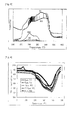
- the results are shown in FIG. 4 . From this, it can be seen that the NOx adsorption/storage performance is almost the same up to about 30 ppm SO2, and then slightly decreases at about 66 ppm. This catalyst can be seen to exhibit very stable NOx adsorption ability even in the presence of SO2 at a very high concentration.
- a catalyst was prepared in the same manner as in Example 2, with the exception that 5.0 wt% Cu was supported on K2Ti2O5 prepared in Example 2 using Cu(NO3)2.xH2O, instead of Co.
- the prepared catalyst was dried at 105 °C overnight and burned at 850 °C for 10 hours.
- the results are shown in FIG. 5 .
- the gas components in the feed under lean and rich conditions are as follows. Lean Rich NO 400ppm 400ppm 02/H2 10 % 02, He balanced 3% H2, He balanced
- a catalyst was prepared as in Example 5, placed into a reactor and pretreated by adding 1,500 ppm S02 to an oxygen-containing air stream at 570 °C for 8 hours.
- the catalyst poisoned with S02 in this way was then subjected to a lean-rich cycling test under the same conditions as in Example 5.
- the test results showed that the average NOx removal efficiency is reduced to 70% but the removal efficiency with time does not change and the catalyst activity is stable throughout.
- the catalyst was regenerated while allowing nitrogen gas containing 3% H2 to flow at 750 °C , and then subjected to a lean-rich cycling test.
- the results showed that the average removal efficiency stays at 83% which is close to the activity of the catalyst of Example 5 which was not been poisoned with sulfur.
- the catalyst poisoned with high-concentration sulfur can be seen to be regenerated.
- K1.2Cs0.8Ti2O5 was prepared in the same manner as in Example 1, with the exception that part of 8.65 g of K2(CO3).xH2Owas substituted to CsNO3.xH2O so that K and Cs were added at an equivalent ratio of about 1.2 : 0.8.
- the NOx adsorption/storage test was performed as in Example 1. The results showed that NOx is adsorbed/stored in an amount of 2.5 ⁇ 2.8 mmol/g-cat in the temperature range of 200 ⁇ 600 °C , and that maximum adsorption/storage performance is represented at 450 °C unlike Example 1.
- K1.6Co0.2Ti2O5 was prepared in the same manner as in Example 1, with the exception that part of 8.65 g of K2(C03).xH2O was substituted to Co(NO3)2.xH2O so that K and Co were added at an atomic ratio of about 1.6 : 0.2.
- This catalyst was subjected to an NOx adsorption/storage test. The results showed that NOx is adsorbed/stored in an amount of 2.8 - 3.1 mmol/g-cat in the temperature range of 200 ⁇ 600 °C , and that maximum adsorption/storage performance is represented at 470 °C .
Landscapes
- Engineering & Computer Science (AREA)
- Chemical & Material Sciences (AREA)
- Environmental & Geological Engineering (AREA)
- Analytical Chemistry (AREA)
- Biomedical Technology (AREA)
- Health & Medical Sciences (AREA)
- General Chemical & Material Sciences (AREA)
- Oil, Petroleum & Natural Gas (AREA)
- Chemical Kinetics & Catalysis (AREA)
- Combustion & Propulsion (AREA)
- Catalysts (AREA)
- Exhaust Gas Treatment By Means Of Catalyst (AREA)
- Exhaust Gas After Treatment (AREA)
Applications Claiming Priority (2)
| Application Number | Priority Date | Filing Date | Title |
|---|---|---|---|
| KR1020080045760A KR101098247B1 (ko) | 2008-05-16 | 2008-05-16 | 희박연소 조건에 있는 자동차나 소각로 배기 가스로부터낙스를 제거하기 위한 촉매 |
| PCT/KR2009/002602 WO2009139609A2 (ko) | 2008-05-16 | 2009-05-16 | 희박연소 조건에 있는 자동차나 소각로 배기 가스로부터 낙스를 제거하기 위한 촉매 |
Publications (2)
| Publication Number | Publication Date |
|---|---|
| EP2286896A2 true EP2286896A2 (de) | 2011-02-23 |
| EP2286896A4 EP2286896A4 (de) | 2012-06-27 |
Family
ID=41319189
Family Applications (1)
| Application Number | Title | Priority Date | Filing Date |
|---|---|---|---|
| EP09746788A Withdrawn EP2286896A4 (de) | 2008-05-16 | 2009-05-16 | Katalysator zur nox-entfernung aus abgas von autos mit magermotoren oder verbrennungsöfen |
Country Status (4)
| Country | Link |
|---|---|
| US (1) | US20110195007A1 (de) |
| EP (1) | EP2286896A4 (de) |
| KR (1) | KR101098247B1 (de) |
| WO (1) | WO2009139609A2 (de) |
Cited By (2)
| Publication number | Priority date | Publication date | Assignee | Title |
|---|---|---|---|---|
| CN102240557A (zh) * | 2011-05-12 | 2011-11-16 | 南京工业大学 | 一种处理工业废气的含镍铁锰复合氧化物催化剂及其制备方法 |
| CN102513123A (zh) * | 2011-11-17 | 2012-06-27 | 南京工业大学 | 一种处理工业废气的稀土钙钛矿型催化剂及其制备方法、应用 |
Families Citing this family (8)
| Publication number | Priority date | Publication date | Assignee | Title |
|---|---|---|---|---|
| KR101361458B1 (ko) * | 2011-11-29 | 2014-02-12 | 현대자동차주식회사 | 수동적 암모니아/scr용 암모니아 생성 삼원 촉매의 제조 방법 및 이에 의해 제조된 삼원 촉매 |
| KR101438885B1 (ko) * | 2012-05-09 | 2014-09-05 | 현대자동차주식회사 | 질소산화물의 암모니아 전환용 촉매 및 이의 제조방법 |
| US8815197B2 (en) | 2012-10-05 | 2014-08-26 | Peerless Mfg. Co. | Method for urea decomposition and ammonia feed to a selective catalytic reduction system |
| WO2014055858A1 (en) * | 2012-10-05 | 2014-04-10 | Combustion Components Associates, Inc. | Selective catalytic reduction system |
| KR101593332B1 (ko) | 2014-11-07 | 2016-02-11 | 김종혁 | 소각로용 정화촉매 |
| CN110252313A (zh) * | 2019-06-20 | 2019-09-20 | 武汉科林精细化工有限公司 | 一种宽温干法烟气脱硝剂及其制备方法 |
| CN110833832B (zh) * | 2019-11-07 | 2022-07-26 | 上海纳米技术及应用国家工程研究中心有限公司 | 铬铁基一氧化氮常温常压高效治理催化剂的制备方法及其产品和应用 |
| KR102250799B1 (ko) * | 2021-01-22 | 2021-05-12 | 주식회사 쿠킴 | 미세먼지 방지 항균필터, 이를 포함하는 마스크와 그 제조방법 |
Family Cites Families (14)
| Publication number | Priority date | Publication date | Assignee | Title |
|---|---|---|---|---|
| US5758489A (en) | 1996-06-13 | 1998-06-02 | Ford Global Technologies, Inc. | Sulfur tolerant Pt/lithium NOx traps |
| US5830421A (en) | 1996-07-03 | 1998-11-03 | Low Emissions Technologies Research And Development Partnership | Material and system for catalytic reduction of nitrogen oxide in an exhaust stream of a combustion process |
| KR100408502B1 (ko) | 1996-07-23 | 2004-02-14 | 삼성전기주식회사 | 자동차배기가스정화용촉매 |
| US6296822B1 (en) | 2000-03-29 | 2001-10-02 | Ford Global Technologies, Inc | Process for manufacturing nox traps with improved sulfur tolerance |
| JP4548968B2 (ja) * | 2000-06-05 | 2010-09-22 | 株式会社日本自動車部品総合研究所 | セラミック担体およびセラミック触媒体 |
| JP2004515338A (ja) * | 2000-11-06 | 2004-05-27 | コーニング インコーポレイテッド | 排ガスを浄化するための触媒 |
| JP2003144926A (ja) * | 2001-11-19 | 2003-05-20 | Hitachi Ltd | 内燃機関の排ガス浄化触媒、浄化方法及び浄化装置 |
| US20030118960A1 (en) * | 2001-12-21 | 2003-06-26 | Balmer-Millar Mari Lou | Lean NOx aftertreatment system |
| JP3758601B2 (ja) | 2002-05-15 | 2006-03-22 | トヨタ自動車株式会社 | 吸蔵還元型NOx浄化用触媒 |
| JP4039128B2 (ja) | 2002-06-04 | 2008-01-30 | 株式会社日立製作所 | 内燃機関の排ガス浄化触媒と排ガス浄化方法及び排ガス浄化装置 |
| JP4746264B2 (ja) * | 2003-11-17 | 2011-08-10 | 三井金属鉱業株式会社 | 内燃機関の排気ガス浄化触媒および排気ガス浄化装置 |
| KR20090016737A (ko) * | 2005-03-29 | 2009-02-17 | 얀마 가부시키가이샤 | 배기가스 정화장치 |
| CN101076404B (zh) * | 2005-06-27 | 2010-05-12 | 揖斐电株式会社 | 蜂窝结构体 |
| US7631488B2 (en) * | 2006-10-27 | 2009-12-15 | Postech Foundation | Oxidation catalyst for removing fine soot particulates from exhaust gases and method of removing fine soot particulates using the same |
-
2008
- 2008-05-16 KR KR1020080045760A patent/KR101098247B1/ko not_active Expired - Fee Related
- 2008-05-16 US US12/993,035 patent/US20110195007A1/en not_active Abandoned
-
2009
- 2009-05-16 EP EP09746788A patent/EP2286896A4/de not_active Withdrawn
- 2009-05-16 WO PCT/KR2009/002602 patent/WO2009139609A2/ko not_active Ceased
Cited By (2)
| Publication number | Priority date | Publication date | Assignee | Title |
|---|---|---|---|---|
| CN102240557A (zh) * | 2011-05-12 | 2011-11-16 | 南京工业大学 | 一种处理工业废气的含镍铁锰复合氧化物催化剂及其制备方法 |
| CN102513123A (zh) * | 2011-11-17 | 2012-06-27 | 南京工业大学 | 一种处理工业废气的稀土钙钛矿型催化剂及其制备方法、应用 |
Also Published As
| Publication number | Publication date |
|---|---|
| EP2286896A4 (de) | 2012-06-27 |
| KR20090119610A (ko) | 2009-11-19 |
| WO2009139609A2 (ko) | 2009-11-19 |
| KR101098247B1 (ko) | 2011-12-23 |
| US20110195007A1 (en) | 2011-08-11 |
| WO2009139609A3 (ko) | 2010-03-11 |
Similar Documents
| Publication | Publication Date | Title |
|---|---|---|
| EP2286896A2 (de) | Katalysator zur nox-entfernung aus abgas von autos mit magermotoren oder verbrennungsöfen | |
| US8507404B2 (en) | Regenerable sulfur traps for on-board vehicle applications | |
| JP4757027B2 (ja) | 窒素酸化物素酸化物を接触還元するための触媒 | |
| JP3741303B2 (ja) | 排ガス浄化用触媒 | |
| US10260395B2 (en) | Nitrous oxide removal catalysts for exhaust systems | |
| US7389638B2 (en) | Sulfur oxide/nitrogen oxide trap system and method for the protection of nitrogen oxide storage reduction catalyst from sulfur poisoning | |
| JP4740217B2 (ja) | 窒素酸化物を接触還元する方法 | |
| EP1307279A2 (de) | Gegen sox unempfindliche stickoxidfallekatalysatoren und verfahren zu ihrer herstellung und verwendung | |
| JP2003236343A (ja) | 排気ガスの浄化方法および低温脱硝装置 | |
| US9084967B2 (en) | Oxygen adsorbent based on lanthanoide oxysulfate, method for producing it, and exhaust gas purifying catalyst containing it | |
| JP5163955B2 (ja) | 排ガス浄化用触媒 | |
| WO2002020153A1 (en) | Nox absorbing agent and absorption reduction type catalyst for removing nox | |
| JP2004223381A (ja) | メタン選択型脱硝触媒用担体、その製造方法およびメタン選択型脱硝触媒 | |
| JPH10165819A (ja) | 排気ガス浄化用触媒及びその使用方法 | |
| JP4352586B2 (ja) | 排ガス浄化触媒を有する内燃機関 | |
| CN100391598C (zh) | 一种净化内燃机尾气的NOx储存-还原催化剂 | |
| JP3721112B2 (ja) | 窒素酸化物を接触還元する方法とそのための触媒 | |
| JP2002295241A (ja) | 船舶排気ガスの浄化方法および浄化装置 | |
| JP2001190931A (ja) | メタン含有排ガスの浄化方法 | |
| JP5051009B2 (ja) | NOx吸蔵還元型触媒 | |
| JP2000297627A (ja) | 排ガス浄化用触媒及び排ガス浄化システム | |
| JP2006102628A (ja) | 硫黄酸化物吸収材とその製造方法及び排ガス浄化装置 | |
| JP4822049B2 (ja) | 排ガス浄化用触媒、及びそれを用いた排ガス浄化方法 | |
| Eguchi et al. | Catalytically Promoted NO x Sorption by ZrO2-Based Oxides | |
| JP3579745B2 (ja) | 排気ガス浄化方法 |
Legal Events
| Date | Code | Title | Description |
|---|---|---|---|
| PUAI | Public reference made under article 153(3) epc to a published international application that has entered the european phase |
Free format text: ORIGINAL CODE: 0009012 |
|
| 17P | Request for examination filed |
Effective date: 20101213 |
|
| AK | Designated contracting states |
Kind code of ref document: A2 Designated state(s): AT BE BG CH CY CZ DE DK EE ES FI FR GB GR HR HU IE IS IT LI LT LU LV MC MK MT NL NO PL PT RO SE SI SK TR |
|
| AX | Request for extension of the european patent |
Extension state: AL BA RS |
|
| DAX | Request for extension of the european patent (deleted) | ||
| A4 | Supplementary search report drawn up and despatched |
Effective date: 20120529 |
|
| RIC1 | Information provided on ipc code assigned before grant |
Ipc: B01D 53/94 20060101AFI20120522BHEP |
|
| 17Q | First examination report despatched |
Effective date: 20160314 |
|
| STAA | Information on the status of an ep patent application or granted ep patent |
Free format text: STATUS: EXAMINATION IS IN PROGRESS |
|
| STAA | Information on the status of an ep patent application or granted ep patent |
Free format text: STATUS: THE APPLICATION IS DEEMED TO BE WITHDRAWN |
|
| 18D | Application deemed to be withdrawn |
Effective date: 20161025 |