EP2290000B1 - Klebstoffzusammensetzung auf biologischer Basis - Google Patents
Klebstoffzusammensetzung auf biologischer Basis Download PDFInfo
- Publication number
- EP2290000B1 EP2290000B1 EP09011087A EP09011087A EP2290000B1 EP 2290000 B1 EP2290000 B1 EP 2290000B1 EP 09011087 A EP09011087 A EP 09011087A EP 09011087 A EP09011087 A EP 09011087A EP 2290000 B1 EP2290000 B1 EP 2290000B1
- Authority
- EP
- European Patent Office
- Prior art keywords
- acid
- adhesive
- oil
- dimer
- composition
- Prior art date
- Legal status (The legal status is an assumption and is not a legal conclusion. Google has not performed a legal analysis and makes no representation as to the accuracy of the status listed.)
- Active
Links
Images
Classifications
-
- C—CHEMISTRY; METALLURGY
- C09—DYES; PAINTS; POLISHES; NATURAL RESINS; ADHESIVES; COMPOSITIONS NOT OTHERWISE PROVIDED FOR; APPLICATIONS OF MATERIALS NOT OTHERWISE PROVIDED FOR
- C09J—ADHESIVES; NON-MECHANICAL ASPECTS OF ADHESIVE PROCESSES IN GENERAL; ADHESIVE PROCESSES NOT PROVIDED FOR ELSEWHERE; USE OF MATERIALS AS ADHESIVES
- C09J167/00—Adhesives based on polyesters obtained by reactions forming a carboxylic ester link in the main chain; Adhesives based on derivatives of such polymers
- C09J167/06—Unsaturated polyesters having carbon-to-carbon unsaturation
-
- C—CHEMISTRY; METALLURGY
- C09—DYES; PAINTS; POLISHES; NATURAL RESINS; ADHESIVES; COMPOSITIONS NOT OTHERWISE PROVIDED FOR; APPLICATIONS OF MATERIALS NOT OTHERWISE PROVIDED FOR
- C09J—ADHESIVES; NON-MECHANICAL ASPECTS OF ADHESIVE PROCESSES IN GENERAL; ADHESIVE PROCESSES NOT PROVIDED FOR ELSEWHERE; USE OF MATERIALS AS ADHESIVES
- C09J167/00—Adhesives based on polyesters obtained by reactions forming a carboxylic ester link in the main chain; Adhesives based on derivatives of such polymers
- C09J167/08—Polyesters modified with higher fatty oils or their acids, or with natural resins or resin acids
-
- C—CHEMISTRY; METALLURGY
- C08—ORGANIC MACROMOLECULAR COMPOUNDS; THEIR PREPARATION OR CHEMICAL WORKING-UP; COMPOSITIONS BASED THEREON
- C08K—Use of inorganic or non-macromolecular organic substances as compounding ingredients
- C08K5/00—Use of organic ingredients
- C08K5/04—Oxygen-containing compounds
- C08K5/10—Esters; Ether-esters
- C08K5/101—Esters; Ether-esters of monocarboxylic acids
- C08K5/103—Esters; Ether-esters of monocarboxylic acids with polyalcohols
-
- C—CHEMISTRY; METALLURGY
- C08—ORGANIC MACROMOLECULAR COMPOUNDS; THEIR PREPARATION OR CHEMICAL WORKING-UP; COMPOSITIONS BASED THEREON
- C08L—COMPOSITIONS OF MACROMOLECULAR COMPOUNDS
- C08L91/00—Compositions of oils, fats or waxes; Compositions of derivatives thereof
- C08L91/005—Drying oils
-
- Y—GENERAL TAGGING OF NEW TECHNOLOGICAL DEVELOPMENTS; GENERAL TAGGING OF CROSS-SECTIONAL TECHNOLOGIES SPANNING OVER SEVERAL SECTIONS OF THE IPC; TECHNICAL SUBJECTS COVERED BY FORMER USPC CROSS-REFERENCE ART COLLECTIONS [XRACs] AND DIGESTS
- Y10—TECHNICAL SUBJECTS COVERED BY FORMER USPC
- Y10T—TECHNICAL SUBJECTS COVERED BY FORMER US CLASSIFICATION
- Y10T428/00—Stock material or miscellaneous articles
- Y10T428/28—Web or sheet containing structurally defined element or component and having an adhesive outermost layer
- Y10T428/2852—Adhesive compositions
Definitions
- the present invention is directed to a bio-based composition and adhesive.
- Adhesives are compounds in a liquid or semi-liquid state that can adhere or bond items together. Adhesives are usually derived from fossil fuel, i.e. non-regenerative resources. Because of rising oil prizes and environmental concerns, there is an increased demand for bio-based materials. Bio-based materials, such as polyesters polyols prepared by the polycondensation of plant-derived dicarboxylic acids and plant-derived diols have been employed in adhesive products because of their good technical properties and their sustainability as a renewable resource. However, in view of practical applications, the viscoelastic properties of these polymers need to be optimised by a cross-linking treatment. This cross-linking step is generally performed by treating the polyester with an isocyanate compound.
- WO-2004/056901-A1 discloses an adhesive comprising polyisocyanate and a polyol comprising at least one dimer fatty acid and/or dimer fatty diol and the use as wood adhesive.
- JP-2008-195819 discloses a polyester-based self-adhesive composition containing a chain-extended polyester which is produced by chain extending the polyester consisting of a dicarboxylic acid and diol by an isocyanate compound.
- the polyester-based self-adhesive can be prepared with a dicarboxylic acid and a diol which are both originated from plants.
- the plant-derived dicarboxylic acid may be a dimer acid and the plant-derived diol may be a dimer diol.
- the problem underlying the present invention is to provide a bio-based adhesive composition exhibiting a high optical transparency and good adhesive characteristics.
- the present invention is directed to a bio-based adhesive obtainable by reacting
- the fatty alcohol has from 14 to 22 carbon atoms.
- dimer of a fatty alcohol refers to the dimerisation product of mono- or polyunsaturated fatty alcohols.
- the dimer of a fatty alcohol is obtainable by hydrogenation of a dimer of oleic acid, linoleic acid, palmitoleic acid, linolenic acid, eleostearic acid, ricinoleic acid, vernolic acid, licanic acid, myristoleic acid, margaroleic acid, gadoleic acid, eicosadienoic acid and/or erucic acid.
- Dimers of a fatty alcohol are commercially available for example from Croda (trade name PRIPOL 2033) or Cognis (SOVERMOL 908).
- Both PRIPOL 2033 and SOVERMOL 908 are high purity, fully hydrogenated, and distilled aliphatic dimer alcohols. These products appear as colorless, clear viscous liquids. Their properties can be summarized as follows:
- component a1) is present in a concentration of 30 mol% to 55 mol%, preferably in a concentration of 40 mol% to 46 mol%.
- the fatty acid has from 18 to 22 carbon atoms.
- dimer of a fatty acid refers to the dimerisation product of mono- or polyunsaturated fatty acids and/or esters thereof.
- the fatty acid is selected from the group consisting of oleic acid, linoleic acid, palmitoleic acid, linolenic acid, eleostearic acid, ricinoleic acid, vernolic acid, licanic acid, myristoleic acid, margaroleic acid, gadoleic acid, eicosadienoic acid and/or erucic acid.
- Dimers of a fatty acid are commercially available.
- dimers of oleic acid or linoleic acid are available from Croda (Gouda, The Netherlands) under the trade name PRIPOL 1009, or Cognis (Düsseldorf, Germany) under the trade names EMPOL 1008 or EMPOL 1016.
- PRIPOL 1009 and EMPOL 1008 are high purity, fully hydrogenated, and distilled aliphatic dimer acids. These products appear as colorless to light colored, clear viscous liquids. Their properties can be summarized as follows:
- component a2) is present in a concentration of 45 mol% to 70 mol%, preferably in a concentration of 54 mol% to 60 mol%.
- component a) is present in a concentration of 80 wt% to 99 wt%, preferably in a concentration of 90 wt% to 97.5 wt%.
- the epoxidized fatty acid ester as a cross-linking agent is an epoxidized triglyceride, more preferably an epoxidized triglyceride of natural oils.
- the triglyceride is a triglyceride of linseed oil, soybean oil, castor oil, palm kernel oil, sunflower oil, corn oil, cottonseed oil, perilla oil, rapeseed oil, olive oil, canola oil, palm oil, coconut oil, rice bran oil, safflower oil, sesame oil, tall oil, and/or mixtures thereof.
- the number of epoxy groups in the epoxidized fatty acid ester is in the range of 2 to 6.
- Triglycerides are the main component of natural oils and are composed of three fatty acids groups connected by a glycerol centre. Epoxidized triglycerides can be found as such in nature, for instance in Vernonia plants or can be conveniently synthesized from more common unsaturated oils by using a standard epoxidation process.
- Epoxidized triglycerides are commercially available.
- ELO epoxidized linseed oil
- DEHYSOL B316 SPEZIAL epoxidized linseed oil
- Arkema King of Prussia, Pennsylvania
- An exemplary structure of an epoxidized triglyceride of linseed oil is as follows:
- Epoxidized soybean oil (ESBO) is commercially available from Cognis (Düsseldorf, Germany) under the trade name DEHYSOL D82, or from Arkema (King of Prussia, Pennsylvania) under the trade name VIKOFLEX 7170.
- DEHYSOL B316 SPEZIAL and DEHYSOL D82 Chemical nature Epoxidized linseed oil Epoxidized soybean oil Iodine Value (DIN 53241) 0 - 7 g I/100g 0 - 2.5 g I/100g Acid Value (DIN EN ISO 2114) 0 - 1 mg KOH/g 0 - 0.3 mg KOH/g Epoxy Oxygene (Q-C 1038) 8.5 - 10 % 6.5 - 7.0 % Refractive Index at (DIN 51423) 1.475 - 1.479 1.471 - 1.474 Density at 25°C (DIN 51757) 1.028 - 1.040 g/ CM 3 0.993 - 0.999 g/cm 3
- component b) is present in a concentration of 1 wt% to 20 wt%, preferably in a concentration of 2.5 wt% to 10 wt%.
- the adhesion force of the inventive bio-based composition or adhesive can be fine-tuned by varying the concentration of the epoxidized fatty acid ester as a cross-linking agent.
- the composition or adhesive is suitable for a wide range of potential applications.
- the adhesion force can be adjusted to be moderate, preferably below 100 cN/20mm, for temporal surface protection or the adhesion force can be adjusted to be high, preferably from 500 to 2,000 cN/20mm, for permanent bonding and joining applications.
- the epoxidized fatty acid ester as a cross-linking agent is used in a concentration of 2.5 wt% to 7.5 wt%, more preferably 3 wt% to 7 wt%, in particular 4 wt% to 6 wt%. These ranges allow to prepare adhesive compositions with higher adhesion power such as from 500 to 2,000 cN/200mm for use in permanent bonding and joining applications.
- the epoxidized fatty acid ester as a cross-linking agent is used in a concentration of 8 wt% to 15 wt%, more preferably 8.5 wt% to 10.5 wt%. These ranges allow preparing adhesive compositions with moderate adhesion power such as below 100 cN/200mm for use in temporal surface protection.
- the adhesive (or adhesion) strength was measured by a 180°C peel test. This type of testing determines the force that is necessary to tear a strip of a tape from a standard surface at a constant speed. The result is the force referred to the width of the tape.
- Samples for the peel test were prepared as follows. At first, the biobased adhesive composition is coated on a carrier film (for instance PET) and cured as described in Examples 6 to 13. Then, 2 cm wide, 10 cm long pieces of adhesive tapes are cut and placed on a table (the adhesive face on top). Half of the tape length is then covered with a second strip of plastic film (this film should be identical to the carrier film on which the adhesive composition has been previously coated).
- this assembly is turned upside down and the free adhesive domain is applied manually on the reference surface (for instance AB steel).
- the reference surface for instance AB steel.
- a two kg cylinder is rolled twice on the tape in order to ensure a good contact between the adhesive and the reference surface.
- a dwell time of 15 minutes is observed prior to performing the peeling test.
- the peel test is performed on a Zwick Z005 testing machine with a constant peeling speed of 300 mm/min.
- a1) further contains a trimer of a fatty alcohol.
- a1) contains 0.05 mol% to 20 mol%, more preferably 0.1 mol% to 10 mol%, in particular 0.2 mol% to 5 mol% of a trimer of a fatty alcohol.
- trimer of a fatty alcohol refers to the trimerisation product of mono- or polyunsaturated fatty alcohols.
- the trimer of a fatty alcohol is obtainable by hydrogenation of a trimer of oleic acid, linoleic acid, palmitoleic acid, linolenic acid, eleostearic acid, ricinoleic acid, vernolic acid, licanic acid, myristoleic acid, margaroleic acid, gadoleic acid, eicosadienoic acid and/or erucic acid.
- a1) further contains a saturated hydrocarbon diol possessing an aliphatic chain containing 3 to 10 carbon atoms. Typical examples of such diols are 1,3-propanediol, 1,9-nonanediol or 1,10-decanediol.
- a1) contains 0.05 mol% to 50 mol%, more preferably 2 mol% to 20 mol%, in particular 5 mol% to 15 mol% of the saturated hydrocarbon diol.
- the saturated hydrocarbon diol is preferably derived from renewable resources. For instance, 1,3-propanediol is obtained from the conversion of biomass sugars by fermentation and catalytic processing, and 1,10-decanediol is a renewable resource derived from castor oil.
- a1) further contains glycerol.
- a1) contains 0.02 mol% to 20 mol%, more preferably 1 mol% to 15 mol%, in particular 3 to 11 mol% of glycerol.
- Glycerol is one of the main components of natural oils and may serve as a branching agent in the present invention.
- a2) further contains a trimer of a fatty acid.
- a2) contains 0.05 mol% to 20 mol%, more preferably 0.5 mol% to 15 mol%, in particular 1 to 10 mol% of a trimer of a fatty acid. The use of a trimer of a fatty acid allows to enhance the functionality of the polymer and to facilitate the subsequent cross-linking process.
- trimer of a fatty acid refers to the trimerisation product of mono- or polyunsaturated fatty acids and/or esters thereof.
- Trimers of a fatty acid are obtain as by-products during the dimerization fatty acids, for example oleic acid or linoleic acid, and can be isolated by distillation.
- Such trimer acids are commercially available for example from Croda under the trade name PRIPOL 1017 (mixture: 75 wt% dimer acid / 25 wt% trimer acid) or PRIPOL 1040 (mixture: 25 wt% dimer acid / 75 wt% trimer acid), and from Cognis (EMPOL 1045 or EMPOL 1043).
- PRIPOL 1040 and EMPOL 1045 are fully hydrogenated trimer acids with a polybasic acid content typically more than 70%, and are useful in applications where branching is desired. Their properties can be summarized as follows:
- a2) further contains a saturated hydrocarbon dicarboxylic acid possessing an aliphatic chain containing from 3 to 10 carbon atoms.
- dicarboxylic acids are succinic acid, sebacic acid, or azelaic acid.
- a2) contains 0.05 mol% to 50 mol%, more preferably 5 mol% to 25 mol%, in particular 10 to 20 mol% of a saturated dicarboxylic acid.
- the saturated hydrocarbon dicarboxylic acid is preferably derived from renewable resources.
- succinic acid is produced by fermentation of sugars, and azelaic acid is obtained industrially by ozonolysis of oleic acid.
- Renewable azelaic acid is commercially available from Cognis (Düsseldorf, Germany) under the trade names Emerox 1110 or Emerox 1144.
- the adhesive has a glass transition temperature (Tg) of less than or equal to -20 °C.
- Tg glass transition temperature
- the glass transition temperature is determined using Differential Scanning Calorimetry. For the DSC analysis, the samples were first cooled to -100°C and then heated up to 50°C (heating ramp + 10°C/min) in a nitrogen atmosphere.
- the adhesive has a number of free carboxylic acid groups in the range of 1 to 150 mg KOH/g and a number of free hydroxyl groups in the range of 1 to 150 mg KOH/g.
- the acid value is defined as the number of mg of potassium hydroxide required to neutralize the free fatty acids in 1 g of sample, and was measured by direct titration with a standard potassium hydroxide solution.
- the hydroxyl value is defined as the number of mg of potassium hydroxide equivalent to the hydroxyl content of 1 g of sample, and is measured by acetylation followed by hydrolysation of excess acetic anhydride. The acetic acid formed is subsequently titrated with an ethanolic potassium hydroxide solution.
- the invention is directed to a method for preparing the bio-based adhesive, comprising reacting in a solvent
- the polycondensate is obtainable by reacting the dimer of a fatty alcohol and the dimer of a fatty acid at 160°C to 250°C, more preferably at 170°C to 190°C, in particular at about 180°C.
- the reaction can be performed without solvent if the viscosity of the polyester remains low, i.e. if the molecular weight of the polyester remains low (typically lower than 30,000 g/mol).
- the advantage of performing the reaction without solvent, i.e. in bulk, is that the carbon footprint of the inventive bio-based composition or adhesive can be further lowered.
- the polycondensate is obtainable by reacting the dimer of a fatty alcohol and the dimer of a fatty acid in a solvent, more preferably in an aromatic hydrocarbon solvent, in particular an aromatic hydrocarbon solvent having a boiling point higher than 110°C.
- the aromatic hydrocarbon solvent is preferably toluene or xylene, most preferably xylene.
- the solvent is used in a concentration of 0 to 8 wt%, preferably 0 to 4 wt%, more preferably 1 to 3 wt%, in particular about 2 wt%.
- a vacuum is applied during the polycondensation reaction in order to facilitate the extraction of water and to speed up the reaction.
- the polycondensation reaction is conducted in the presence of a polymerization catalyst.
- a polymerization catalyst Such catalysts are well known in the art and can be for instance dibutyltin oxide, titanium tetrabutoxide, 1,5,7-triazabicyclo[4.4.0]dec-5-ene (TBD), 1,5-diazabicyclo[4.3.0]non-5-ene (DBN), 1,8-diazabicyclo[5.4.0]undec-7-ene (DBU).
- the polycondensation catalyst is present in a concentration of 0.01 mol% to 0.1 mol%.
- a1) further contains a trimer of a fatty alcohol, a saturated hydrocarbon diol, and/or glycerol; and/or a2) further contains a trimer of a fatty acid and/or a saturated hydrocarbon dicarboxylic acid.
- the method for preparing the bio-based adhesive comprises reacting the polycondensate and the epoxidized fatty acid ester as a cross-linking agent in a solvent, wherein the solvent is an aromatic hydrocarbon solvent.
- the aromatic hydrocarbon solvent is preferably toluene or xylene.
- the method for preparing the bio-based adhesive comprises reacting the polycondensate and the epoxidized fatty acid ester as a cross-linking agent in a solvent, wherein the concentration of polycondensate and epoxidized fatty acid ester is 20 to 99 wt%.
- a catalyst is used in the reaction between polycondensate and epoxidized fatty acid ester as a cross-linking agent.
- Suitable catalysts for this ring-opening polymerization belong to the class of strong Lewis acids and are well known in the art.
- the catalyst is selected from the group consisting of sodium carbonate, organo metallic compounds such as lithium neodecanoate, a zinc complex, tertiary amines, hexadecyltrimethylammonium bromine, or triphenyl phosphine oxide.
- Zinc complex catalysts are commercially available from King Industries, Inc. (Norwalk, Connecticut) under the tradename NACURE XC-9206. It is advantageous to employ a reaction catalyst in order to ensure a rapid and complete curing of the epoxy-carboxyl system.
- the method for preparing the bio-based adhesive comprises reacting the polycondensate and the epoxidized fatty acid ester as a cross-linking agent in a solvent, and using said reaction mixture as a coating solution.
- said coating solution is laminated on a sheet or a film.
- the invention is directed to the use of the adhesive for laminating a sheet or a film.
- the sheet or film is preferably fossil-based or bio-based. It is possible to obtain a fully bio-based tape structure by laminating the bio-based adhesive composition onto a bio-based carrier film.
- the fossil-based plastic sheet or film is preferably made from poly(ethylene terephthalate) (PET), polyethylene (PE), polyvinyl chloride (PVC), and/or polypropylene (PP).
- PET poly(ethylene terephthalate)
- PE polyethylene
- PVC polyvinyl chloride
- PP polypropylene
- the bioplastic sheet or film is preferably made from cellulose, starch, and/or polylactic acid (PLA).
- the sheet or film is made from poly(ethylene terephthalate), polyethylene, polypropylene, cellulose, starch and/or polylactic acid.
- Cellulose-based films are commercially available for example from Innovia Films under the trade name NatureFlex.
- Polylactic acid-based films are commercially available for example from Nordenia Technologies.
- a modified-PLA film with enhanced temperature resistance is used.
- the bio-based adhesive of the present invention shows a high miscibility, high compatibility and a similar refractive index between the base polymer and the cross-linking agent allowing the production of an adhesive sheet or film having a high optical transparency.
- Example 1 Synthesis of a linear polyester based on a dimer fatty acid and a dimer fatty diol
- PRIPOL 1009 (133 g, 229.79mmol), PRIPOL 2033 (130.37 g, 227.22 mmol) and xylene (26.34 g, 30.5 ml) were weighed into a 1 l I cylindrical glass jacketed reactor vessel.
- the reactor was fitted with an Allihn reflux condenser and a Dean-Stark type condenser to collect the water created during the polycondensation reaction.
- the set-up was continuously flushed with inert gas (nitrogen) to limit oxidation and facilitate transport of water vapor.
- inert gas nitrogen
- the catalyst dibutyltin oxide was introduced in the reaction mixture (0.1 mol%). The temperature was then maintained at 180°C for 16 hours in order to complete the polymerization. The polymer was discharged from the reactor and left to cool.
- the resulting polyester had a glass transition temperature (Tg) of -50.4°C (determined by Differential Scanning Calorimetry), a weight average molecular weight (Mw) of 85000 g/mol (determined by Gel Permeation Chromatography), and an acid value of 1.8 mg KOH/g.
- Example 2 Bulk (solvent-free) synthesis of a linear polyester based on a dimer fatty acid and a dimer fatty diol
- PRIPOL 1009 150.77 g, 260.46 mmol
- PRIPOL 2033 (112.63 g, 196.28 mmol) were weighed into a 1 I cylindrical glass jacketed reactor vessel. The polycondensation was then performed as described in Example 1. The resulting polyester had a glass transition temperature (Tg) of -51.2°C, a weight average molecular weight (Mw) of 14156 g/mol (determined by Gel Permeation Chromatography), and an acid value of 31.5 mg KOH/g.
- Tg glass transition temperature
- Mw weight average molecular weight
- Example 3 Synthesis of a linear polyester based on a dimer fatty acid, a dimer fatty diol and succinic acid as a co-monomer
- Example 4 Bulk synthesis of a branched polyester using a trimer fatty acid as a branching agent
- PRIPOL 1009 (131.17 g, 226.61 mmol), PRIPOL 2033 (112.81 g, 196.60 mmol) and PRIPOL 1040 (19.41 g, 25.32 mmol) were weighed into a 1 l cylindrical glass jacketed reactor vessel.
- the reactor was fitted with an Allihn reflux condenser and a Dean-Stark type condenser to collect the water created during the polycondensation reaction.
- the set-up was continuously flushed with inert gas (nitrogen) to limit oxidation and facilitate transport of water vapor.
- inert gas nitrogen
- the catalyst dibutyltin oxide was introduced in the reaction mixture (0.1 mol%). The temperature was then maintained at 180°C for 16 hours. Subsequently, the polymer was discharged from the reactor and left to cool.
- the resulting polyester had a glass transition temperature (Tg) of -50°C (determined by Differential Scanning Calorimetry), a weight average molecular weight (Mw) of 21844 g/mol (determined by Gel Permeation Chromatography), and an acid value of 27.95 mg KOH/g.
- Example 5 Bulk synthesis of a branched polyester using glycerol as a branching agent
- PRIPOL 1009 (163.9 g, 283.15 mmol)
- PRIPOL 2033 (96.7 g, 168.52 mmol)
- glycerol (2.79 g, 30.79 mmol)
- the polymerization was conducted as described in example 1.
- the resulting polymer had a weight average molecular weight of 12,599 g/mol.
- Example 6 Adhesive composition using epoxidized linseed oil (ELO) as a cross-linking agent
- the dry thickness of the adhesive layer was 40 ⁇ m.
- the adhesive strength as measured by a 180° peel test to panels after double rolling of a two kg cylinder on the tape and a subsequent dwell time of 15 minutes, was 1435 cN/20mm from AB Steel, 1520 cN/20mm from acrylonitrile butadiene styrene (ABS), and 1178 cN/20mm from polypropylene (PP).
- Example 7 Adhesive composition using epoxidized linseed oil (ELO) as a cross-linking agent
- the dry thickness of the adhesive layer was 28 ⁇ m.
- the adhesive strength as measured by a 180° peel test to panels after double rolling of a two kg cylinder on the tape and a subsequent dwell time of 15 minutes, was 282.46 cN/20mm from AB Steel, 335.48 cN120mm from acrylonitrile butadiene styrene (ABS), and 49.25 cN/20mm from polypropylene (PP).
- Example 8 Adhesive composition using epoxidized linseed oil (ELO) as a cross-linking agent
- the dry thickness of the adhesive layer was 28 ⁇ m.
- the adhesive strength as measured by a 180° peel test to panels after double rolling of a two kg cylinder on the tape and a subsequent dwell time of 15 minutes, was 643.3 cN/20mm from AB Steel, 619.58 cN/20mm from acrylonitrile butadiene styrene (ABS), and 438.49 cN/20mm from polypropylene (PP).
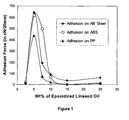
- Example 8 was repeated whereby the concentration of epoxidized linseed oil was increased in a step-wise manner from 2.5 wt% to 25 wt%.
- the effect of the concentration of the cross-linking agent on the adhesion force of the bio-based adhesive composition on various substrates (AB Steel, ABS, and PP) is shown in Figure 1 .
- a maximal adhesion is obtained for a concentration of epoxidized linseed oil of 5 wt%.
- Example 10 Adhesive composition using epoxidised soybean oil (ESBO) as a cross-linking agent
- the dry thickness of the adhesive layer was 28 ⁇ m.
- the adhesive strength as measured by a 180° peel test to panels after double rolling of a two kg cylinder on the tape and a subsequent dwell time of 15 minutes, was 415.60 cN/20mm from AB Steel, 375.73 cN/20mm from acrylonitrile butadiene styrene (ABS), and 227.14 cN/20mm from polypropylene (PP).
- Example 11 Adhesive composition using epoxidised castor oil (ECO) as a cross-linking agent
- Example 12 Coating of the bio-based composition on a cellulose-based carrier film
- An adhesive composition was prepared as described in Example 8, and was subsequently roll-coated manually at room temperature with an approximative speed of 50 cm/s on a 45 ⁇ m-thick cellulose film (trade name "NatureFlex 45NK"). After a curing time of 15 minutes at 155°C, a tacky film suitable for pressure sensitive adhesive (PSA) applications was obtained.
- PSA pressure sensitive adhesive
- Example 13 Coating of the bio-based composition on a polylactic acid (PLA)-based carrier film
- An adhesive composition was prepared as described in Example 8, and was subsequently roll-coated manually at room temperature with an approximative speed of 50 cm/s on a 50 ⁇ m-thick PLA film (TK29505 from Nordenia Technologies). After a curing time of 15 minutes at 155°C, a tacky film suitable for pressure sensitive adhesive (PSA) applications was obtained.
- PSA pressure sensitive adhesive
- Example 14 Superior optical appearance of the bio-based adhesive compositions
- the adhesive compositions of Examples 6 to 11 displayed an excellent transparency. This excellent transparency results from a good miscibility of the base polymer with the cross-linking agent and a similar refractive index between the base polymer and the cross-linking agent, as shown in Table 1 for the bio-based compositions A and B.
- Adhesive composition A was prepared by mixing 18.86 g of Polymer 1 (as prepared in Example 1) with 1 g of Dehysol B316 Spezial, 222 mg of Nacure XC-9206 and 8.51 g of Xylene.
- the solid base of this coating composition (expressed in wt% of adhesive relative to the total solution) was 50 wt%.
- a 80 ⁇ m adhesive layer (wet thickness) was roll-coated manually at room temperature with an approximative speed of 50 cm/s on a 50 ⁇ m thick polyethylene terephtalate (PET) film, and this bilayer stack was dried and cured in an oven at 155°C for 15 minutes.
- Adhesive composition B was prepared by mixing 18.86 g of Polymer 1 (as prepared in Example 1) with 1 g of Dehysol D82, 222 mg of Nacure XC-9206 and 8.51 g of Xylene. The solid base of this coating composition (expressed in wt% of adhesive relative to the total solution) was 50 wt%. Once the solution had been homogenised, a 80 ⁇ m adhesive layer (wet thickness) was roll-coated manually at room temperature with an approximative speed of 50 cm/s on a 50 ⁇ m thick polyethylene terephtalate (PET) film, and this bilayer stack was dried and cured in an oven at 155°C for 15 minutes.
- PET polyethylene terephtalate
- petroleum-based isocyanate cross-linking agents generally have a higher refractive index and a limited miscibility with the base polyester. This results in a moderate transparency or in a hazy appearance of the cured adhesive compositions, as shown in Table 1 for comparative compositions C and D.
- Adhesive composition C was prepared by mixing 18.86 g of Polymer 1 (as prepared in Example 1) with 1 g of toluene diisocyanate and 8.51 g of Xylene. The solid base of this coating composition (expressed in wt% of adhesive relative to the total solution) was 50 wt%. Once the solution had been homogenised, a 80 ⁇ m adhesive layer (wet thickness) was roll-coated manually at room temperature with an approximative speed of 50 cm/s on a 50 ⁇ m thick polyethylene terephtalate (PET) film, and this bilayer stack was dried and cured in an oven at 130°C for 5 minutes.
- PET polyethylene terephtalate
- Adhesive composition D was prepared by mixing 18.86 g of Polymer 1 (as prepared in Example 1) with 1 g of a trifunctional isocyanate and 8.51 g of Xylene. The solid base of this coating composition (expressed in wt% of adhesive relative to the total solution) was 50 wt%. Once the solution had been homogenised, a 80 ⁇ m adhesive layer (wet thickness) was roll-coated manually at room temperature with an approximative speed of 50 cm/s on a 50 ⁇ m thick polyethylene terephtalate (PET) film, and this bilayer stack was dried and cured in an oven at 130°C for 5 minutes. Table 1.
Landscapes
- Chemical & Material Sciences (AREA)
- Chemical Kinetics & Catalysis (AREA)
- Organic Chemistry (AREA)
- Oil, Petroleum & Natural Gas (AREA)
- Adhesives Or Adhesive Processes (AREA)
Claims (15)
- Zusammensetzung auf biologischer Basis umfassenda) ein Polykondensat vona1) einem Dimer von einem Fettalkohol, unda2) einem Dimer von einer Fettsäure,undb) einen epoxidierten Fettsäureester als Vernetzungsmittel,
wobei das Polykondensat und der epoxidierte Fettsäureester miteinander reagieren können. - Klebstoff auf biologischer Basis erhältlich durch Umsetzen vona) einem Polykondensat vona1) einem Dimer von einem Fettalkohol, unda2) einem Dimer von einer Fettsäure,undb) einem epoxidierten Fettsäureester als Vernetzungsmittel.
- Zusammensetzung oder Klebstoff nach Anspruch 1 oder 2, wobeia1) außerdem ein gesättigtes Kohlenwasserstoffdiol, das 3 bis 10 Kohlenstoffatome enthält, ein Trimer von einem Fettalkohol und/oder Glycerin enthält; und/odera2) außerdem eine gesättigte Kohlenwasserstoffdicarbonsäure, die 3 bis 10 Kohlenstoffatome enthält, und/oder ein Trimer von einer Fettsäure enthält.
- Zusammensetzung oder Klebstoff nach einem der Ansprüche 1 bis 3, wobei der Fettalkohol 14 bis 22 Kohlenstoffatome aufweist.
- Zusammensetzung oder Klebstoff nach einem der Ansprüche 1 bis 4, wobei das Dimer oder Trimer von einem Fettalkohol erhältlich ist durch Hydrierung eines Dimers oder Trimers von Ölsäure, Linolsäure, Palmitoleinsäure, Linolensäure, Elaeostearinsäure, Ricinolsäure, Vernolsäure, Licansäure, Myristoleinsäure, Margaroleinsäure, Gadoleinsäure, Eicosadiensäure, und/oder Erucasäure.
- Zusammensetzung oder Klebstoff nach einem der Ansprüche 1 bis 5, wobei die Fettsäure 18 bis 22 Kohlenstoffatome aufweist.
- Zusammensetzung oder Klebstoff nach einem der Ansprüche 1 bis 6, wobei die Fettsäure ausgewählt ist aus der Gruppe bestehend aus Ölsäure, Linolsäure, Palmitoleinsäure, Linolensäure, Elaeostearinsäure, Ricinolsäure, Vernolsäure, Licansäure, Myristoleinsäure, Margaroleinsäure, Gadoleinsäure, Eicosadiensäure und/oder Erucasäure.
- Zusammensetzung oder Klebstoff nach einem der Ansprüche 1 bis 7, wobei der epoxidierte Fettsäureester ein epoxidiertes Triglycerid ist.
- Zusammensetzung oder Klebstoff nach Anspruch 8, wobei das Triglycerid ein Triglycerid von Leinöl, Sojaöl, Rizinusöl, Palmkernöl, Sonnenblumenöl, Maisöl, Baumwollsamenöl, Perillaöl, Rapsöl, Olivenöl und/oder Canolaöl, Palmöl, Kokosnußöl, Reisöl, Safloröl, Sesamöl, Tallöl und Mischungen davon ist.
- Zusammensetzung oder Klebstoff nach einem der Ansprüche 1 bis 9, wobei die Anzahl der Epoxygruppen in dem epoxidierten Fettsäureester im Bereich von 2 bis 6 liegt.
- Klebstoff nach einem der Ansprüche 2 bis 9 mit einer Glasübergangstemperatur (Tg) von weniger als oder gleich -20°C.
- Klebstoff nach einem der Ansprüche 2 bis 10 mit einer Anzahl von freien Carboxylgruppen im Bereich von 1 bis 150 mgKOH/g.
- Verfahren zum Herstellen des Klebstoffs auf biologischer Basis nach den Ansprüchen 2 bis 12, umfassend das Umsetzen in einem Lösungsmittel vona) einem Polykondensat vona1) einem Dimer von einem Fettalkohol, unda2) einem Dimer von einer Fettsäure,undb) einem epoxidierten Fettsäureester als Vernetzungsmittel.
- Verwendung des Klebstoffs nach einem der Ansprüche 2 bis 12 zum Laminieren einer Folie oder eines Films.
- Verwendung nach Anspruch 14, wobei die Folie oder der Film aus Poly(ethylenterephthalat), Polyethylen, Polyvinylchlorid, Polypropylen, Cellulose, Stärke und/oder Polymilchsäure gefertigt ist.
Priority Applications (3)
| Application Number | Priority Date | Filing Date | Title |
|---|---|---|---|
| EP09011087A EP2290000B1 (de) | 2009-08-28 | 2009-08-28 | Klebstoffzusammensetzung auf biologischer Basis |
| US13/392,616 US20120156484A1 (en) | 2009-08-28 | 2010-06-02 | Bio-Based Adhesive Composition |
| PCT/EP2010/003348 WO2011023255A1 (en) | 2009-08-28 | 2010-06-02 | Bio-based adhesive composition |
Applications Claiming Priority (1)
| Application Number | Priority Date | Filing Date | Title |
|---|---|---|---|
| EP09011087A EP2290000B1 (de) | 2009-08-28 | 2009-08-28 | Klebstoffzusammensetzung auf biologischer Basis |
Publications (2)
| Publication Number | Publication Date |
|---|---|
| EP2290000A1 EP2290000A1 (de) | 2011-03-02 |
| EP2290000B1 true EP2290000B1 (de) | 2012-05-23 |
Family
ID=41508723
Family Applications (1)
| Application Number | Title | Priority Date | Filing Date |
|---|---|---|---|
| EP09011087A Active EP2290000B1 (de) | 2009-08-28 | 2009-08-28 | Klebstoffzusammensetzung auf biologischer Basis |
Country Status (3)
| Country | Link |
|---|---|
| US (1) | US20120156484A1 (de) |
| EP (1) | EP2290000B1 (de) |
| WO (1) | WO2011023255A1 (de) |
Families Citing this family (19)
| Publication number | Priority date | Publication date | Assignee | Title |
|---|---|---|---|---|
| WO2008144703A2 (en) * | 2007-05-21 | 2008-11-27 | Avery Dennison Corporation | Pressure sensitive adhesives made from renewable resources and related methods |
| US9441112B2 (en) * | 2011-01-20 | 2016-09-13 | Kansas State University Research Foundation | Pressure sensitive adhesives, coatings, and films from plant oils |
| DE102011005956A1 (de) * | 2011-03-23 | 2012-09-27 | Tesa Se | Haftklebemasse mit mindestens einem aliphatischen amorphen Copolyester |
| WO2012154909A2 (en) * | 2011-05-10 | 2012-11-15 | Sun Chemical Corporation | Cold foil adhesives used in food & non food packaging applications |
| EP2567996B1 (de) * | 2011-09-07 | 2014-03-12 | Nitto Europe N.V | Haftklebstoff auf Polykondensatbasis, der Furan-Einheiten enthält |
| MX350094B (es) * | 2011-12-07 | 2017-08-25 | Adhesivos sensibles a la presion a base de aceite vegetal. | |
| JP6088291B2 (ja) * | 2012-03-16 | 2017-03-01 | 日東電工株式会社 | 粘着剤組成物、及び、粘着シート |
| IN2014DN08733A (de) * | 2012-04-09 | 2015-05-22 | Avery Dennison Corp | |
| WO2014089323A1 (en) * | 2012-12-05 | 2014-06-12 | Avery Dennison Corporation | Pressure sensitive adhesives prepared from maleated vegetable oils and expoxidized vegetable oils |
| EP2853573A1 (de) | 2013-09-25 | 2015-04-01 | Nitto Denko Corporation | Hautfreundlicher Klebstoff |
| EP2957303A1 (de) | 2014-06-20 | 2015-12-23 | Nitto Denko Corporation | Härtbare Zusammensetzung und Hauthaftkleber |
| EP2957611A1 (de) | 2014-06-20 | 2015-12-23 | Nitto Denko Corporation | Ablösbare Klebstoffzusammensetzung |
| CN105254866B (zh) * | 2015-11-13 | 2017-03-22 | 四川大学 | 端羧基含磷共聚酯及制备方法和由其组成的无卤阻燃生物基压敏胶及应用 |
| FI127441B (en) * | 2016-02-03 | 2018-06-15 | Teknologian Tutkimuskeskus Vtt Oy | Bio-based mineral oil barrier coatings and films |
| TWI662060B (zh) | 2016-12-02 | 2019-06-11 | 美商片片堅俄亥俄州工業公司 | 含聚矽氧之聚酯、含其之塗料組合物及由其形成的塗層 |
| JP7215157B2 (ja) * | 2017-12-29 | 2023-01-31 | 三菱ケミカル株式会社 | ポリエステル系粘着剤組成物、ポリエステル系粘着剤、粘着フィルム、耐熱粘着フィルム用粘着剤組成物、マスキング用耐熱粘着フィルム、マスキング用耐熱粘着フィルムの使用方法 |
| WO2021055815A1 (en) | 2019-09-18 | 2021-03-25 | Iowa State University Research Foundation, Inc. | Biosolvents useful for improved asphalt products utilizing recycled asphalt pavement or other brittle asphalt binders such as vacuum tower bottom |
| CN115038766B (zh) * | 2020-01-30 | 2024-06-28 | Dic株式会社 | 粘合带 |
| JP7714901B2 (ja) * | 2021-04-16 | 2025-07-30 | 三菱ケミカル株式会社 | 接着剤組成物およびフラットケーブル形成用接着剤組成物 |
Family Cites Families (3)
| Publication number | Priority date | Publication date | Assignee | Title |
|---|---|---|---|---|
| GB0229844D0 (en) | 2002-12-23 | 2003-01-29 | Ici Plc | Adhesive |
| GB0307246D0 (en) * | 2003-03-28 | 2003-04-30 | Avecia Bv | Aqueous pigmented coating composition with improved open-time comprising crosslinkable oligomer(s) and dispersed polymer(s) |
| JP5129488B2 (ja) | 2007-02-13 | 2013-01-30 | 日東電工株式会社 | ポリエステル系粘着剤組成物 |
-
2009
- 2009-08-28 EP EP09011087A patent/EP2290000B1/de active Active
-
2010
- 2010-06-02 US US13/392,616 patent/US20120156484A1/en not_active Abandoned
- 2010-06-02 WO PCT/EP2010/003348 patent/WO2011023255A1/en not_active Ceased
Also Published As
| Publication number | Publication date |
|---|---|
| EP2290000A1 (de) | 2011-03-02 |
| US20120156484A1 (en) | 2012-06-21 |
| WO2011023255A1 (en) | 2011-03-03 |
Similar Documents
| Publication | Publication Date | Title |
|---|---|---|
| EP2290000B1 (de) | Klebstoffzusammensetzung auf biologischer Basis | |
| EP2439224B1 (de) | Polyesterbasierte Haftmittel mit einem Heterobizyklus | |
| EP2788446B1 (de) | Druckempfindliche haftstoffe auf basis von pflanzenöl | |
| EP2567996B1 (de) | Haftklebstoff auf Polykondensatbasis, der Furan-Einheiten enthält | |
| JP7534875B2 (ja) | ラミネート用接着剤 | |
| JP7502913B2 (ja) | ラミネート用接着剤 | |
| KR101879009B1 (ko) | 내후성 접착제 조성물 | |
| US9902886B2 (en) | Pressure-sensitive adhesive composition and pressure-sensitive adhesive sheet | |
| JP6339380B2 (ja) | ポリエステル樹脂組成物およびその積層体 | |
| CN113316624A (zh) | 来自植物油或动物脂的紫外线辐射固化的压敏粘合剂 | |
| TW201739798A (zh) | 嵌段共聚物於黏著劑的用途 | |
| KR102765326B1 (ko) | 바이오-기반 폴리에스테르 폴리올을 포함하는 핫멜트 접착제 조성물 | |
| US20170009103A1 (en) | Pressure-sensitive adhesives based on carboxylic acids and epoxides | |
| EP2460864B1 (de) | Dienophilmodifizierte Fettsäurezusammensetzung und Klebstoff | |
| KR102726588B1 (ko) | 재생 가능한 원료를 기반으로 한 포장 접착제 | |
| TWI741209B (zh) | 具有低含量的單體二異氰酸酯的反應性黏合劑 | |
| KR101976763B1 (ko) | 핫멜트 접착제 조성물 | |
| EP2821454B1 (de) | Ungesättigte lichthärtbare klebstoffzusammensetzung auf biologischer basis | |
| EP2623537A1 (de) | Enzymkatalysierte Polykondensatverfahrensproduktion und Haftzusammensetzung | |
| HK40057661A (en) | Ultraviolet radiation-cured pressure sensitive adhesives from plant oils or animal fats |
Legal Events
| Date | Code | Title | Description |
|---|---|---|---|
| PUAI | Public reference made under article 153(3) epc to a published international application that has entered the european phase |
Free format text: ORIGINAL CODE: 0009012 |
|
| AK | Designated contracting states |
Kind code of ref document: A1 Designated state(s): AT BE BG CH CY CZ DE DK EE ES FI FR GB GR HR HU IE IS IT LI LT LU LV MC MK MT NL NO PL PT RO SE SI SK SM TR |
|
| AX | Request for extension of the european patent |
Extension state: AL BA RS |
|
| REG | Reference to a national code |
Ref country code: DE Ref legal event code: R079 Ref document number: 602009007137 Country of ref document: DE Free format text: PREVIOUS MAIN CLASS: C08L0067080000 Ipc: C09J0167060000 |
|
| 17P | Request for examination filed |
Effective date: 20110826 |
|
| RIC1 | Information provided on ipc code assigned before grant |
Ipc: C09J 167/06 20060101AFI20111010BHEP Ipc: C09J 167/08 20060101ALI20111010BHEP Ipc: C08L 67/08 20060101ALI20111010BHEP |
|
| GRAP | Despatch of communication of intention to grant a patent |
Free format text: ORIGINAL CODE: EPIDOSNIGR1 |
|
| GRAS | Grant fee paid |
Free format text: ORIGINAL CODE: EPIDOSNIGR3 |
|
| GRAA | (expected) grant |
Free format text: ORIGINAL CODE: 0009210 |
|
| AK | Designated contracting states |
Kind code of ref document: B1 Designated state(s): AT BE BG CH CY CZ DE DK EE ES FI FR GB GR HR HU IE IS IT LI LT LU LV MC MK MT NL NO PL PT RO SE SI SK SM TR |
|
| REG | Reference to a national code |
Ref country code: GB Ref legal event code: FG4D |
|
| REG | Reference to a national code |
Ref country code: CH Ref legal event code: EP Ref country code: CH Ref legal event code: NV Representative=s name: BOVARD AG |
|
| REG | Reference to a national code |
Ref country code: AT Ref legal event code: REF Ref document number: 559085 Country of ref document: AT Kind code of ref document: T Effective date: 20120615 |
|
| REG | Reference to a national code |
Ref country code: IE Ref legal event code: FG4D |
|
| REG | Reference to a national code |
Ref country code: DE Ref legal event code: R096 Ref document number: 602009007137 Country of ref document: DE Effective date: 20120719 |
|
| REG | Reference to a national code |
Ref country code: NL Ref legal event code: VDEP Effective date: 20120523 |
|
| REG | Reference to a national code |
Ref country code: LT Ref legal event code: MG4D Effective date: 20120523 |
|
| PG25 | Lapsed in a contracting state [announced via postgrant information from national office to epo] |
Ref country code: CY Free format text: LAPSE BECAUSE OF FAILURE TO SUBMIT A TRANSLATION OF THE DESCRIPTION OR TO PAY THE FEE WITHIN THE PRESCRIBED TIME-LIMIT Effective date: 20120523 Ref country code: FI Free format text: LAPSE BECAUSE OF FAILURE TO SUBMIT A TRANSLATION OF THE DESCRIPTION OR TO PAY THE FEE WITHIN THE PRESCRIBED TIME-LIMIT Effective date: 20120523 Ref country code: LT Free format text: LAPSE BECAUSE OF FAILURE TO SUBMIT A TRANSLATION OF THE DESCRIPTION OR TO PAY THE FEE WITHIN THE PRESCRIBED TIME-LIMIT Effective date: 20120523 Ref country code: IS Free format text: LAPSE BECAUSE OF FAILURE TO SUBMIT A TRANSLATION OF THE DESCRIPTION OR TO PAY THE FEE WITHIN THE PRESCRIBED TIME-LIMIT Effective date: 20120923 Ref country code: NO Free format text: LAPSE BECAUSE OF FAILURE TO SUBMIT A TRANSLATION OF THE DESCRIPTION OR TO PAY THE FEE WITHIN THE PRESCRIBED TIME-LIMIT Effective date: 20120823 Ref country code: SE Free format text: LAPSE BECAUSE OF FAILURE TO SUBMIT A TRANSLATION OF THE DESCRIPTION OR TO PAY THE FEE WITHIN THE PRESCRIBED TIME-LIMIT Effective date: 20120523 |
|
| REG | Reference to a national code |
Ref country code: AT Ref legal event code: MK05 Ref document number: 559085 Country of ref document: AT Kind code of ref document: T Effective date: 20120523 |
|
| PG25 | Lapsed in a contracting state [announced via postgrant information from national office to epo] |
Ref country code: GR Free format text: LAPSE BECAUSE OF FAILURE TO SUBMIT A TRANSLATION OF THE DESCRIPTION OR TO PAY THE FEE WITHIN THE PRESCRIBED TIME-LIMIT Effective date: 20120824 Ref country code: LV Free format text: LAPSE BECAUSE OF FAILURE TO SUBMIT A TRANSLATION OF THE DESCRIPTION OR TO PAY THE FEE WITHIN THE PRESCRIBED TIME-LIMIT Effective date: 20120523 Ref country code: HR Free format text: LAPSE BECAUSE OF FAILURE TO SUBMIT A TRANSLATION OF THE DESCRIPTION OR TO PAY THE FEE WITHIN THE PRESCRIBED TIME-LIMIT Effective date: 20120523 Ref country code: SI Free format text: LAPSE BECAUSE OF FAILURE TO SUBMIT A TRANSLATION OF THE DESCRIPTION OR TO PAY THE FEE WITHIN THE PRESCRIBED TIME-LIMIT Effective date: 20120523 Ref country code: PT Free format text: LAPSE BECAUSE OF FAILURE TO SUBMIT A TRANSLATION OF THE DESCRIPTION OR TO PAY THE FEE WITHIN THE PRESCRIBED TIME-LIMIT Effective date: 20120924 |
|
| PG25 | Lapsed in a contracting state [announced via postgrant information from national office to epo] |
Ref country code: BE Free format text: LAPSE BECAUSE OF FAILURE TO SUBMIT A TRANSLATION OF THE DESCRIPTION OR TO PAY THE FEE WITHIN THE PRESCRIBED TIME-LIMIT Effective date: 20120523 |
|
| PG25 | Lapsed in a contracting state [announced via postgrant information from national office to epo] |
Ref country code: NL Free format text: LAPSE BECAUSE OF FAILURE TO SUBMIT A TRANSLATION OF THE DESCRIPTION OR TO PAY THE FEE WITHIN THE PRESCRIBED TIME-LIMIT Effective date: 20120523 Ref country code: EE Free format text: LAPSE BECAUSE OF FAILURE TO SUBMIT A TRANSLATION OF THE DESCRIPTION OR TO PAY THE FEE WITHIN THE PRESCRIBED TIME-LIMIT Effective date: 20120523 Ref country code: SK Free format text: LAPSE BECAUSE OF FAILURE TO SUBMIT A TRANSLATION OF THE DESCRIPTION OR TO PAY THE FEE WITHIN THE PRESCRIBED TIME-LIMIT Effective date: 20120523 Ref country code: DK Free format text: LAPSE BECAUSE OF FAILURE TO SUBMIT A TRANSLATION OF THE DESCRIPTION OR TO PAY THE FEE WITHIN THE PRESCRIBED TIME-LIMIT Effective date: 20120523 Ref country code: AT Free format text: LAPSE BECAUSE OF FAILURE TO SUBMIT A TRANSLATION OF THE DESCRIPTION OR TO PAY THE FEE WITHIN THE PRESCRIBED TIME-LIMIT Effective date: 20120523 Ref country code: CZ Free format text: LAPSE BECAUSE OF FAILURE TO SUBMIT A TRANSLATION OF THE DESCRIPTION OR TO PAY THE FEE WITHIN THE PRESCRIBED TIME-LIMIT Effective date: 20120523 Ref country code: RO Free format text: LAPSE BECAUSE OF FAILURE TO SUBMIT A TRANSLATION OF THE DESCRIPTION OR TO PAY THE FEE WITHIN THE PRESCRIBED TIME-LIMIT Effective date: 20120523 |
|
| PG25 | Lapsed in a contracting state [announced via postgrant information from national office to epo] |
Ref country code: PL Free format text: LAPSE BECAUSE OF FAILURE TO SUBMIT A TRANSLATION OF THE DESCRIPTION OR TO PAY THE FEE WITHIN THE PRESCRIBED TIME-LIMIT Effective date: 20120523 Ref country code: IT Free format text: LAPSE BECAUSE OF FAILURE TO SUBMIT A TRANSLATION OF THE DESCRIPTION OR TO PAY THE FEE WITHIN THE PRESCRIBED TIME-LIMIT Effective date: 20120523 |
|
| PG25 | Lapsed in a contracting state [announced via postgrant information from national office to epo] |
Ref country code: MC Free format text: LAPSE BECAUSE OF NON-PAYMENT OF DUE FEES Effective date: 20120831 |
|
| PLBE | No opposition filed within time limit |
Free format text: ORIGINAL CODE: 0009261 |
|
| STAA | Information on the status of an ep patent application or granted ep patent |
Free format text: STATUS: NO OPPOSITION FILED WITHIN TIME LIMIT |
|
| PG25 | Lapsed in a contracting state [announced via postgrant information from national office to epo] |
Ref country code: ES Free format text: LAPSE BECAUSE OF FAILURE TO SUBMIT A TRANSLATION OF THE DESCRIPTION OR TO PAY THE FEE WITHIN THE PRESCRIBED TIME-LIMIT Effective date: 20120903 |
|
| 26N | No opposition filed |
Effective date: 20130226 |
|
| REG | Reference to a national code |
Ref country code: FR Ref legal event code: ST Effective date: 20130430 |
|
| REG | Reference to a national code |
Ref country code: IE Ref legal event code: MM4A |
|
| REG | Reference to a national code |
Ref country code: DE Ref legal event code: R097 Ref document number: 602009007137 Country of ref document: DE Effective date: 20130226 |
|
| PG25 | Lapsed in a contracting state [announced via postgrant information from national office to epo] |
Ref country code: IE Free format text: LAPSE BECAUSE OF NON-PAYMENT OF DUE FEES Effective date: 20120828 Ref country code: BG Free format text: LAPSE BECAUSE OF FAILURE TO SUBMIT A TRANSLATION OF THE DESCRIPTION OR TO PAY THE FEE WITHIN THE PRESCRIBED TIME-LIMIT Effective date: 20120823 |
|
| PG25 | Lapsed in a contracting state [announced via postgrant information from national office to epo] |
Ref country code: FR Free format text: LAPSE BECAUSE OF NON-PAYMENT OF DUE FEES Effective date: 20120831 |
|
| PG25 | Lapsed in a contracting state [announced via postgrant information from national office to epo] |
Ref country code: MT Free format text: LAPSE BECAUSE OF FAILURE TO SUBMIT A TRANSLATION OF THE DESCRIPTION OR TO PAY THE FEE WITHIN THE PRESCRIBED TIME-LIMIT Effective date: 20120523 |
|
| GBPC | Gb: european patent ceased through non-payment of renewal fee |
Effective date: 20130828 |
|
| PG25 | Lapsed in a contracting state [announced via postgrant information from national office to epo] |
Ref country code: TR Free format text: LAPSE BECAUSE OF FAILURE TO SUBMIT A TRANSLATION OF THE DESCRIPTION OR TO PAY THE FEE WITHIN THE PRESCRIBED TIME-LIMIT Effective date: 20120523 |
|
| PG25 | Lapsed in a contracting state [announced via postgrant information from national office to epo] |
Ref country code: LU Free format text: LAPSE BECAUSE OF NON-PAYMENT OF DUE FEES Effective date: 20120828 Ref country code: SM Free format text: LAPSE BECAUSE OF FAILURE TO SUBMIT A TRANSLATION OF THE DESCRIPTION OR TO PAY THE FEE WITHIN THE PRESCRIBED TIME-LIMIT Effective date: 20120523 |
|
| PG25 | Lapsed in a contracting state [announced via postgrant information from national office to epo] |
Ref country code: HU Free format text: LAPSE BECAUSE OF FAILURE TO SUBMIT A TRANSLATION OF THE DESCRIPTION OR TO PAY THE FEE WITHIN THE PRESCRIBED TIME-LIMIT Effective date: 20090828 Ref country code: GB Free format text: LAPSE BECAUSE OF NON-PAYMENT OF DUE FEES Effective date: 20130828 |
|
| PG25 | Lapsed in a contracting state [announced via postgrant information from national office to epo] |
Ref country code: MK Free format text: LAPSE BECAUSE OF FAILURE TO SUBMIT A TRANSLATION OF THE DESCRIPTION OR TO PAY THE FEE WITHIN THE PRESCRIBED TIME-LIMIT Effective date: 20120523 |
|
| REG | Reference to a national code |
Ref country code: DE Ref legal event code: R082 Ref document number: 602009007137 Country of ref document: DE Representative=s name: GRUENECKER PATENT- UND RECHTSANWAELTE PARTG MB, DE Ref country code: DE Ref legal event code: R081 Ref document number: 602009007137 Country of ref document: DE Owner name: NITTO DENKO CORP., IBARAKI, JP Free format text: FORMER OWNERS: NITTO DENKO CORP., IBARAKI, OSAKA, JP; NITTO EUROPE N.V., GENK, BE Ref country code: DE Ref legal event code: R081 Ref document number: 602009007137 Country of ref document: DE Owner name: NITTO BELGIUM N.V., BE Free format text: FORMER OWNERS: NITTO DENKO CORP., IBARAKI, OSAKA, JP; NITTO EUROPE N.V., GENK, BE |
|
| REG | Reference to a national code |
Ref country code: CH Ref legal event code: PFA Owner name: NITTO DENKO CORPORATION, BE Free format text: FORMER OWNER: NITTO DENKO CORPORATION, BE |
|
| REG | Reference to a national code |
Ref country code: CH Ref legal event code: PFA Owner name: NITTO DENKO CORPORATION, BE Free format text: FORMER OWNER: NITTO DENKO CORPORATION, BE |
|
| PGFP | Annual fee paid to national office [announced via postgrant information from national office to epo] |
Ref country code: CH Payment date: 20230903 Year of fee payment: 15 |
|
| PGFP | Annual fee paid to national office [announced via postgrant information from national office to epo] |
Ref country code: DE Payment date: 20230830 Year of fee payment: 15 |
|
| REG | Reference to a national code |
Ref country code: DE Ref legal event code: R119 Ref document number: 602009007137 Country of ref document: DE |
|
| REG | Reference to a national code |
Ref country code: CH Ref legal event code: PL |
|
| PG25 | Lapsed in a contracting state [announced via postgrant information from national office to epo] |
Ref country code: CH Free format text: LAPSE BECAUSE OF NON-PAYMENT OF DUE FEES Effective date: 20240831 |
|
| PG25 | Lapsed in a contracting state [announced via postgrant information from national office to epo] |
Ref country code: DE Free format text: LAPSE BECAUSE OF NON-PAYMENT OF DUE FEES Effective date: 20250301 |