EP2290209A2 - Ansaugkrümmersauerstoffregelung - Google Patents
Ansaugkrümmersauerstoffregelung Download PDFInfo
- Publication number
- EP2290209A2 EP2290209A2 EP10008814A EP10008814A EP2290209A2 EP 2290209 A2 EP2290209 A2 EP 2290209A2 EP 10008814 A EP10008814 A EP 10008814A EP 10008814 A EP10008814 A EP 10008814A EP 2290209 A2 EP2290209 A2 EP 2290209A2
- Authority
- EP
- European Patent Office
- Prior art keywords
- mass flow
- oxygen
- egr
- engine
- fresh air
- Prior art date
- Legal status (The legal status is an assumption and is not a legal conclusion. Google has not performed a legal analysis and makes no representation as to the accuracy of the status listed.)
- Withdrawn
Links
- QVGXLLKOCUKJST-UHFFFAOYSA-N atomic oxygen Chemical compound [O] QVGXLLKOCUKJST-UHFFFAOYSA-N 0.000 title claims abstract description 159
- 239000001301 oxygen Substances 0.000 title claims abstract description 159
- 229910052760 oxygen Inorganic materials 0.000 title claims abstract description 159
- 239000007789 gas Substances 0.000 claims abstract description 120
- 238000000034 method Methods 0.000 claims abstract description 36
- 238000002485 combustion reaction Methods 0.000 claims abstract description 27
- 239000000446 fuel Substances 0.000 claims description 36
- 230000008859 change Effects 0.000 claims description 8
- 238000006073 displacement reaction Methods 0.000 claims description 7
- 230000000153 supplemental effect Effects 0.000 claims description 3
- 238000011217 control strategy Methods 0.000 description 20
- 238000004364 calculation method Methods 0.000 description 9
- 238000012545 processing Methods 0.000 description 7
- 230000001133 acceleration Effects 0.000 description 6
- 230000000875 corresponding effect Effects 0.000 description 6
- 230000001276 controlling effect Effects 0.000 description 4
- 238000010586 diagram Methods 0.000 description 4
- 230000008878 coupling Effects 0.000 description 3
- 238000010168 coupling process Methods 0.000 description 3
- 238000005859 coupling reaction Methods 0.000 description 3
- 230000007423 decrease Effects 0.000 description 3
- 239000000203 mixture Substances 0.000 description 3
- 230000000994 depressogenic effect Effects 0.000 description 2
- 230000000694 effects Effects 0.000 description 2
- 238000012804 iterative process Methods 0.000 description 2
- 230000008569 process Effects 0.000 description 2
- 230000001052 transient effect Effects 0.000 description 2
- 239000004215 Carbon black (E152) Substances 0.000 description 1
- 230000033228 biological regulation Effects 0.000 description 1
- 230000015572 biosynthetic process Effects 0.000 description 1
- 230000001010 compromised effect Effects 0.000 description 1
- 230000002596 correlated effect Effects 0.000 description 1
- 238000013500 data storage Methods 0.000 description 1
- 230000003111 delayed effect Effects 0.000 description 1
- 238000013461 design Methods 0.000 description 1
- 230000002349 favourable effect Effects 0.000 description 1
- 229930195733 hydrocarbon Natural products 0.000 description 1
- 150000002430 hydrocarbons Chemical class 0.000 description 1
- 238000005259 measurement Methods 0.000 description 1
- 238000012986 modification Methods 0.000 description 1
- 230000004048 modification Effects 0.000 description 1
- 230000036284 oxygen consumption Effects 0.000 description 1
- 230000003134 recirculating effect Effects 0.000 description 1
- 230000009467 reduction Effects 0.000 description 1
- 230000004044 response Effects 0.000 description 1
- 230000026676 system process Effects 0.000 description 1
- 238000011144 upstream manufacturing Methods 0.000 description 1
Images


Classifications
-
- F—MECHANICAL ENGINEERING; LIGHTING; HEATING; WEAPONS; BLASTING
- F02—COMBUSTION ENGINES; HOT-GAS OR COMBUSTION-PRODUCT ENGINE PLANTS
- F02D—CONTROLLING COMBUSTION ENGINES
- F02D41/00—Electrical control of supply of combustible mixture or its constituents
- F02D41/0025—Controlling engines characterised by use of non-liquid fuels, pluralities of fuels, or non-fuel substances added to the combustible mixtures
- F02D41/0047—Controlling exhaust gas recirculation [EGR]
- F02D41/0065—Specific aspects of external EGR control
- F02D41/0072—Estimating, calculating or determining the EGR rate, amount or flow
-
- F—MECHANICAL ENGINEERING; LIGHTING; HEATING; WEAPONS; BLASTING
- F02—COMBUSTION ENGINES; HOT-GAS OR COMBUSTION-PRODUCT ENGINE PLANTS
- F02D—CONTROLLING COMBUSTION ENGINES
- F02D41/00—Electrical control of supply of combustible mixture or its constituents
- F02D41/0002—Controlling intake air
- F02D41/0007—Controlling intake air for control of turbo-charged or super-charged engines
-
- F—MECHANICAL ENGINEERING; LIGHTING; HEATING; WEAPONS; BLASTING
- F02—COMBUSTION ENGINES; HOT-GAS OR COMBUSTION-PRODUCT ENGINE PLANTS
- F02D—CONTROLLING COMBUSTION ENGINES
- F02D41/00—Electrical control of supply of combustible mixture or its constituents
- F02D41/0025—Controlling engines characterised by use of non-liquid fuels, pluralities of fuels, or non-fuel substances added to the combustible mixtures
- F02D41/0047—Controlling exhaust gas recirculation [EGR]
- F02D41/005—Controlling exhaust gas recirculation [EGR] according to engine operating conditions
- F02D41/0052—Feedback control of engine parameters, e.g. for control of air/fuel ratio or intake air amount
-
- F—MECHANICAL ENGINEERING; LIGHTING; HEATING; WEAPONS; BLASTING
- F02—COMBUSTION ENGINES; HOT-GAS OR COMBUSTION-PRODUCT ENGINE PLANTS
- F02D—CONTROLLING COMBUSTION ENGINES
- F02D41/00—Electrical control of supply of combustible mixture or its constituents
- F02D41/02—Circuit arrangements for generating control signals
- F02D41/14—Introducing closed-loop corrections
- F02D41/1438—Introducing closed-loop corrections using means for determining characteristics of the combustion gases; Sensors therefor
- F02D41/1444—Introducing closed-loop corrections using means for determining characteristics of the combustion gases; Sensors therefor characterised by the characteristics of the combustion gases
- F02D41/1454—Introducing closed-loop corrections using means for determining characteristics of the combustion gases; Sensors therefor characterised by the characteristics of the combustion gases the characteristics being an oxygen content or concentration or the air-fuel ratio
- F02D41/1458—Introducing closed-loop corrections using means for determining characteristics of the combustion gases; Sensors therefor characterised by the characteristics of the combustion gases the characteristics being an oxygen content or concentration or the air-fuel ratio with determination means using an estimation
-
- F—MECHANICAL ENGINEERING; LIGHTING; HEATING; WEAPONS; BLASTING
- F02—COMBUSTION ENGINES; HOT-GAS OR COMBUSTION-PRODUCT ENGINE PLANTS
- F02M—SUPPLYING COMBUSTION ENGINES IN GENERAL WITH COMBUSTIBLE MIXTURES OR CONSTITUENTS THEREOF
- F02M26/00—Engine-pertinent apparatus for adding exhaust gases to combustion-air, main fuel or fuel-air mixture, e.g. by exhaust gas recirculation [EGR] systems
- F02M26/02—EGR systems specially adapted for supercharged engines
- F02M26/04—EGR systems specially adapted for supercharged engines with a single turbocharger
- F02M26/05—High pressure loops, i.e. wherein recirculated exhaust gas is taken out from the exhaust system upstream of the turbine and reintroduced into the intake system downstream of the compressor
-
- F—MECHANICAL ENGINEERING; LIGHTING; HEATING; WEAPONS; BLASTING
- F02—COMBUSTION ENGINES; HOT-GAS OR COMBUSTION-PRODUCT ENGINE PLANTS
- F02M—SUPPLYING COMBUSTION ENGINES IN GENERAL WITH COMBUSTIBLE MIXTURES OR CONSTITUENTS THEREOF
- F02M26/00—Engine-pertinent apparatus for adding exhaust gases to combustion-air, main fuel or fuel-air mixture, e.g. by exhaust gas recirculation [EGR] systems
- F02M26/45—Sensors specially adapted for EGR systems
- F02M26/46—Sensors specially adapted for EGR systems for determining the characteristics of gases, e.g. composition
-
- F—MECHANICAL ENGINEERING; LIGHTING; HEATING; WEAPONS; BLASTING
- F02—COMBUSTION ENGINES; HOT-GAS OR COMBUSTION-PRODUCT ENGINE PLANTS
- F02M—SUPPLYING COMBUSTION ENGINES IN GENERAL WITH COMBUSTIBLE MIXTURES OR CONSTITUENTS THEREOF
- F02M26/00—Engine-pertinent apparatus for adding exhaust gases to combustion-air, main fuel or fuel-air mixture, e.g. by exhaust gas recirculation [EGR] systems
- F02M26/45—Sensors specially adapted for EGR systems
- F02M26/46—Sensors specially adapted for EGR systems for determining the characteristics of gases, e.g. composition
- F02M26/47—Sensors specially adapted for EGR systems for determining the characteristics of gases, e.g. composition the characteristics being temperatures, pressures or flow rates
-
- F—MECHANICAL ENGINEERING; LIGHTING; HEATING; WEAPONS; BLASTING
- F02—COMBUSTION ENGINES; HOT-GAS OR COMBUSTION-PRODUCT ENGINE PLANTS
- F02D—CONTROLLING COMBUSTION ENGINES
- F02D41/00—Electrical control of supply of combustible mixture or its constituents
- F02D41/0025—Controlling engines characterised by use of non-liquid fuels, pluralities of fuels, or non-fuel substances added to the combustible mixtures
- F02D41/0047—Controlling exhaust gas recirculation [EGR]
- F02D41/0065—Specific aspects of external EGR control
- F02D41/0072—Estimating, calculating or determining the EGR rate, amount or flow
- F02D2041/0075—Estimating, calculating or determining the EGR rate, amount or flow by using flow sensors
-
- F—MECHANICAL ENGINEERING; LIGHTING; HEATING; WEAPONS; BLASTING
- F02—COMBUSTION ENGINES; HOT-GAS OR COMBUSTION-PRODUCT ENGINE PLANTS
- F02D—CONTROLLING COMBUSTION ENGINES
- F02D41/00—Electrical control of supply of combustible mixture or its constituents
- F02D41/02—Circuit arrangements for generating control signals
- F02D41/14—Introducing closed-loop corrections
- F02D41/1438—Introducing closed-loop corrections using means for determining characteristics of the combustion gases; Sensors therefor
- F02D41/1444—Introducing closed-loop corrections using means for determining characteristics of the combustion gases; Sensors therefor characterised by the characteristics of the combustion gases
- F02D41/1454—Introducing closed-loop corrections using means for determining characteristics of the combustion gases; Sensors therefor characterised by the characteristics of the combustion gases the characteristics being an oxygen content or concentration or the air-fuel ratio
-
- F—MECHANICAL ENGINEERING; LIGHTING; HEATING; WEAPONS; BLASTING
- F02—COMBUSTION ENGINES; HOT-GAS OR COMBUSTION-PRODUCT ENGINE PLANTS
- F02D—CONTROLLING COMBUSTION ENGINES
- F02D41/00—Electrical control of supply of combustible mixture or its constituents
- F02D41/02—Circuit arrangements for generating control signals
- F02D41/18—Circuit arrangements for generating control signals by measuring intake air flow
- F02D41/187—Circuit arrangements for generating control signals by measuring intake air flow using a hot wire flow sensor
-
- F—MECHANICAL ENGINEERING; LIGHTING; HEATING; WEAPONS; BLASTING
- F02—COMBUSTION ENGINES; HOT-GAS OR COMBUSTION-PRODUCT ENGINE PLANTS
- F02N—STARTING OF COMBUSTION ENGINES; STARTING AIDS FOR SUCH ENGINES, NOT OTHERWISE PROVIDED FOR
- F02N2300/00—Control related aspects of engine starting
- F02N2300/20—Control related aspects of engine starting characterised by the control method
- F02N2300/2008—Control related aspects of engine starting characterised by the control method using a model
-
- Y—GENERAL TAGGING OF NEW TECHNOLOGICAL DEVELOPMENTS; GENERAL TAGGING OF CROSS-SECTIONAL TECHNOLOGIES SPANNING OVER SEVERAL SECTIONS OF THE IPC; TECHNICAL SUBJECTS COVERED BY FORMER USPC CROSS-REFERENCE ART COLLECTIONS [XRACs] AND DIGESTS
- Y02—TECHNOLOGIES OR APPLICATIONS FOR MITIGATION OR ADAPTATION AGAINST CLIMATE CHANGE
- Y02T—CLIMATE CHANGE MITIGATION TECHNOLOGIES RELATED TO TRANSPORTATION
- Y02T10/00—Road transport of goods or passengers
- Y02T10/10—Internal combustion engine [ICE] based vehicles
- Y02T10/12—Improving ICE efficiencies
-
- Y—GENERAL TAGGING OF NEW TECHNOLOGICAL DEVELOPMENTS; GENERAL TAGGING OF CROSS-SECTIONAL TECHNOLOGIES SPANNING OVER SEVERAL SECTIONS OF THE IPC; TECHNICAL SUBJECTS COVERED BY FORMER USPC CROSS-REFERENCE ART COLLECTIONS [XRACs] AND DIGESTS
- Y02—TECHNOLOGIES OR APPLICATIONS FOR MITIGATION OR ADAPTATION AGAINST CLIMATE CHANGE
- Y02T—CLIMATE CHANGE MITIGATION TECHNOLOGIES RELATED TO TRANSPORTATION
- Y02T10/00—Road transport of goods or passengers
- Y02T10/10—Internal combustion engine [ICE] based vehicles
- Y02T10/40—Engine management systems
Definitions
- This invention relates to internal combustion engines, particularly a truck diesel engine that has exhaust gas recirculation control.
- Diesel engines are powerplants of many trucks that are presently being manufactured in North America.
- EGR exhaust gas recirculation
- a two-stage turbocharger comprises high- and low-pressure turbines in series flow relationship in the exhaust system that operate high- and low-pressure compressors in series flow relationship in the intake system to develop boost is one example of a turbocharger.
- a single-stage stage turbocharger has only a single turbine and a single compressor.
- U.S. published application 2008/0078176 describes a strategy for control of an EGR valve that establishes a desired EGR set-point based on several parameters, including engine speed, indicated engine torque, and mass flow rate of fresh air entering the intake system.
- the EGR valve is controlled by a duty-cycle signal that is based on the EGR set-point. Changes in the EGR set-point change the duty cycle of the duty signal through a controller, typically a PID (proportional-integral-derivative) controller embodied as a virtual controller in the processing strategy.
- PID proportional-integral-derivative
- the strategy of U.S. published application 2008/0078176 for control of turbocharger boost establishes a desired boost set-point based on several parameters, including engine speed and indicated engine torque.
- the boost set-point is processed by a control strategy for controlling the turbocharger, specifically controlling the position of the vanes of a variable geometry turbocharger (VGT). Vane position is typically controlled by an actuator to which a duty-cycle signal based on boost set-point is applied.
- the duty-cycle signal may also be developed by a PID controller in the boost control strategy.
- the EGR valve is modeled in such a way that for certain prevailing conditions that bear on mass flow rate through the EGR valve, such as exhaust gas temperature and pressure differential between the valve inlet and outlet, a correlation between mass flow rate through the valve and the extent to which the EGR valve is open is defined.
- the control system uses the correlation between flow rate through the EGR valve and the extent to which the EGR valve is open to define an adjustment for the valve opening that will adjust the mass flow through the EGR valve in a way that seeks to null out the boost discrepancy.
- the control system of U.S. published application 2008/0078176 performs feed-forward adjustment of the mass flow rate of recirculated exhaust gas in a direction of adjustment that seeks to null out the difference between desired boost set point and actual boost.
- the system processes the data representing the difference between the data representing actual mass flow rate through the engine cylinders and the data representing the expected mass flow rate through the engine cylinders to develop a feed-forward adjustment signal that is applied to the EGR valve to cause the adjustment.
- the above described method controls the ratio of EGR gas to fresh air that can be disrupted during transient conditions such as during vehicle acceleration and deceleration.
- EGR contains a variable amount of oxygen, somewhere from 0% to 21%.
- the assumption that EGR does not contain oxygen presents a limitation for further reducing emissions.
- the present inventor recognizes the need for an engine control system for a diesel engine that more closely controls combustion and fuel/air mixtures to provide for reduced emissions and enhanced engine efficiency.
- the present inventor recognizes the need for an excess oxygen control algorithm that attempts to accurately monitor and precisely control excess oxygen available for combustion in a diesel engine.
- the present invention provides an engine control algorithm that calculates and controls the precise amounts of EGR and fresh air to be delivered into an engine intake manifold to best reduce emissions.
- This algorithm works as an enhancement to known EGR control strategies such as that disclosed in U.S. published application 2008/0078176 , herein incorporated by reference.
- a mass flow rate of oxygen from fresh air is derived from the measured mass flow rate of fresh air, because the percentage of oxygen in fresh air is known.
- the mass flow rate of EGR gas is measured by the EGR valve position and pressure drop across the valve.
- the mass flow rate of EGR can be determined by the calculated difference between the total mass air flow through the engine and the mass flow of fresh air.
- the oxygen content of the EGR gas can be either measured by the exhaust gas 02 sensor or determined in an iterative process as the difference between the total mass flow of oxygen, and the product of the fuel rate and the stoichiometric ratio of mass oxygen to mass fuel (3.51).
- the oxygen mass flow rate of the EGR gas can be calculated as the product of the oxygen fraction and the mass flow of EGR gas.
- the amount of total oxygen flow rate delivered to the intake manifold of the engine is the sum of the oxygen flow rate from the fresh air and the oxygen flow rate from the EGR gas.
- the accelerator When the accelerator is depressed or released, a changed amount of fuel is delivered into the engine.
- the engine control sets a mass air flow rate and the EGR valve is adjusted according to the pre-set relationship programmed into the control, such as described in U.S. published application 2008/0078176 .
- this relationship ignores the amount of oxygen present in the EGR gas to estimate the excess oxygen present in the intake manifold for combustion in the engine.
- the oxygen contribution of the EGR gas is determined and the set point of the mass flow rate of fresh air is reset such that the total oxygen into the intake manifold is maintained at optimal values according to values pre-programmed into the engine control.
- the algorithm of the present invention can cooperate with existing engine control algorithms, particularly algorithms that control the amount of EGR gas delivered into the engine intake manifold.
- the algorithm of the present invention provides as an output, the set-point for mass flow rate of fresh air for engine control that is used as an input for existing EGR control algorithms, such as described in U.S. published application 2008/0078176 .
- the method of the present invention for an engine having a fresh air inlet and an exhaust gas recirculation (EGR) circuit provides the steps of:
- the step of establishing the ideal excess oxygen ratio R is based on a known amount of fuel delivery to the engine and a preferred ratio of mass of oxygen to mass of fuel occurring in combustion.
- the step of establishing a mass flow of EGR gas can be based on a map or look up table of values that depend on engine speed and indicated torque.
- the step of determining a mass flow of EGR oxygen in the mass flow of EGR gas can comprise the steps of: measuring the oxygen content in the mass flow of EGR gas; and measuring the mass flow of EGR gas.
- the step of determining a mass flow of EGR oxygen in the mass flow of EGR gas can comprise the steps of: determining a total mass flow rate of intake manifold air equal to the sum of the mass flow of fresh air and the mass flow of EGR, determining the mass flow rate of exhaust oxygen as the difference between the desired total mass flow of oxygen, and the product of the fuel rate and the stoichiometric ratio of mass oxygen to mass fuel (3.51), determining the fraction of 02 in the exhaust gas by dividing the mass flow rate of exhaust oxygen by the total mass flow rate of intake manifold air, and multiplying the fraction of 02 by the mass flow of EGR gas.
- the step of determining a mass flow of EGR oxygen in the mass flow of EGR gas can comprise the steps of: determining a total mass flow rate of intake manifold air from engine speed, engine displacement and density of intake manifold air, measuring mass flow of fresh air from a sensor, subtracting mass flow of fresh air from said total mass of intake manifold air to determine mass flow of EGR gas, determining the mass flow rate of exhaust oxygen as the difference between the desired total mass flow of oxygen, and the product of the fuel rate and the stoichiometric ratio of mass oxygen to mass fuel (3.5 1), determining the fraction of 02 in the exhaust gas by dividing the mass flow rate of exhaust oxygen by the total mass flow rate of intake manifold air, and multiplying the fraction of 02 by the mass flow of EGR gas.
- the step of re-adjusting the EGR valve to change the measured mass flow of fresh air in the direction toward the adjusted mass flow of fresh air is further defined in that a set-point signal for the adjusted mass flow of fresh air is an output value that is produced to be an input value into another, supplemental algorithm for adjusting the EGR valve.
- the method steps are repeated rapidly, many times per second.
- Principles of the invention can be embodied in an engine control strategy without the inclusion of additional mechanical devices, making implementation of the inventive strategy cost-effective. Moreover, the favorable effect on tailpipe emissions can make a meaningful contribution toward compliance with applicable laws and regulations.
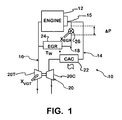
- Figure 1 is a general schematic diagram of a motor vehicle engine system
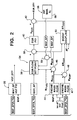
- Figure 2 is a schematic diagram illustrating principles of a strategy of the present invention
- FIG. 3 is a schematic view of the intake manifold oxygen control of the present invention.
- Figure 4 is a method flow diagram of the invention.
- Figure 5 is a graph plot useful in explaining the results of the strategy of the present invention.
- FIG. 1 shows an exemplary internal combustion engine system 10 comprising an engine 12 containing cylinders in which combustion occurs, an intake system 14 including an intake manifold 15, through which charge air can enter engine 12, and an exhaust system 16 through which exhaust gasses resulting from combustion of air-fuel mixtures in the cylinders exit.
- An EGR system 18 provides for exhaust gas to be recirculated from exhaust system 16 to intake system 14.
- Engine system 10 is representative of a turbocharged diesel engine comprising a turbocharger 20 that has turbine 20T in exhaust system 16 operating a compressor 20C in intake system 14.
- a charge air cooler 22 is downstream of compressor 20C.
- EGR system 18 comprises an EGR cooler 24 through which exhaust gas passes before reaching an EGR valve 26 that is controlled by a duty-cycle signal applied to an electric actuator of the valve to set the extent to which the EGR valve is open.
- An engine control strategy 30 is shown in Figure 2 .
- This strategy includes a turbocharger control strategy 32, a basic EGR control strategy 34 and an added intake manifold oxygen control strategy 56 of the present invention.
- the control strategies 32 and 34 are embodied in one or more processors of an engine control system as algorithms for processing data, such as described in U.S. published application 2008/0078176 , herein incorporated by reference.
- the turbocharger and/or the basic EGR control strategy could alternately be as described in U.S. Patents 7,353,648 ; 6,973,382 or 6,401,700 all herein incorporated by reference.
- the control strategy can include modeling EGR valve 26 such that for certain prevailing conditions, such as exhaust gas temperature and pressure differential across the valve, that bear on mass flow rate through the valve, a correlation between mass flow rate through the valve and the extent to which the valve is open is defined. In this way, the percent open position of the EGR valve 26 can measure the EGR gas mass flow rate.
- the strategy comprises a further map, or look-up table, containing data values for a parameter representing the extent to which EGR valve 26 is open. Each data value corresponds to a particular position of a movable valve element, such as a valve pintle, relative to a seat on which the movable element seats when closing the EGR valve to flow. The farther the movable element moves away from the seat, the more the valve opens.
- a parameter that is indicative of pressure drop across EGR valve 26 is also utilized in this implementation of the strategy to develop the data value for EGR gas mass flow rate.
- the difference between exhaust backpressure (EBP), as measured by a suitable sensor at an exhaust manifold , and manifold absolute pressure (MAP), as measured by a MAP sensor at intake manifold 15, may be used to approximate pressure drop across the EGR valve 26.
- EBP exhaust backpressure
- MAP manifold absolute pressure
- data storage in the processors of the control system may be populated with data defining data values for X EGR each correlated with a respective pair of data values for differential pressure and mass flow rate.
- the general turbocharger control strategy is designated by the reference numeral 32.
- Vanes of turbine 20T are positioned by a duty cycle signal VGT_DTY applied to an actuator that sets vane position.
- Strategy 32 seeks to position the vanes so that compressor 20C develops boost corresponding to a desired boost set-point represented by a parameter MAP_SP(N,TQ).
- the control system uses engine speed N and indicated engine torque TQ to select an appropriate data value for MAP_SP(N,TQ) from a map for processing by strategy 32.
- Strategy 32 contains a closed-loop controller that compares a data value for actual boost, parameter MAP, with the desired set-point to develop an error signal that is processed to create a value for VGT_DTY that will secure correspondence of actual boost to the desired set-point.
- the basic EGR control strategy is designated by the reference numeral 34.
- a desired set-point for EGR is represented by a parameter EGR_SP which, like the boost set-point, depends on engine speed N and indicated engine torque TQ, with the control system selecting an appropriate data value for EGR_SP from a map or look up table for processing by strategy 34.
- Indicated engine torque is proportional to the area within the P-V (cylinder pressure-volume) diagram. It is essentially the useful torque being produced by the engine, corresponding to the torque at the clutch for propelling the vehicle plus torques used for other purposes such as operating a torque converter and engine-driven accessories like alternators and fuel pumps, and overcoming engine rotating friction.
- a portion of the processing designated by the reference numeral 36 processes not only EGR_SP but also data representing engine fueling, parameter M fuel , and the mass flow rate of fresh air entering intake system 14, parameter MAF.
- a data value for MAF is calculated in any suitably appropriate way, such as by converting an MAF sensor 60 ( Figure 3 ) output into a corresponding data value.
- the result of processing 36 is used as one input to an algebraic summing function 38 that provides output data X EGR to an EGR PID controller 40 that in turn provides an input to another algebraic summing function 42. It is the output of summing function 42 that sets the duty cycle signal EGR_DTY applied to the actuator of EGR valve 26.
- Strategy 34 comprises a suitably appropriate algorithm 44 that develops a data value for actual mass flow rate through engine 12, represented by a parameter M eng .
- the data value for M eng is an input to an algebraic summing function 46.
- Actual mass flow is a function of several variables shown here as boost (MAP), air temperature (MAT), volumetric efficiency (Vol eff), and engine displacement (Displ). It is data values for those parameters that are processed by algorithm 44 to develop the data value for M eng .
- Strategy 34 further comprises a suitably appropriate algorithm 47 that develops a data value for mass flow rate through engine 12 that is based on the same variables processed by algorithm 44 except for MAP. Instead of using MAP, algorithm 47 uses desired boost set-point MAP_SP(N,TQ). The result provided by algorithm 47 is represented by a parameter M eng * . The data value for M eng * is an input to an algebraic summing function 48.
- Summing function 48 calculates the difference between M eng and K eng * .
- the difference is represented by a parameter ⁇ M ENG that is one of several inputs for a boost coupling algorithm 50.
- This algorithm performs calculations that yield a data value for a parameter ⁇ X EGR that is subtracted by summing function 42 from the data value for X EGR provided by EGR PID controller 40.
- Summing function 46 calculates the mass flow rate through EGR valve 26, represented by a parameter ⁇ M ENG , by subtracting from the data value for M eng the data values for MAF and M fuel .
- the data value for M EGR is another input to algorithm 50. It is also subtracted by summing function 38 from the data value calculated by processing 36. [0046]Additional inputs for algorithm 50 are parameters ⁇ P the pressure across the EGR valve and p density.
- boost coupling strategy 50 provides little or no adjustment of EGR via ⁇ X EGR because the data value for ⁇ X EGR is small or zero.
- the EGR mass flow rate error input to EGR PID controller 42 provides closed-loop control of EGR that continually forces the EGR rate toward the set-point EGR_SP.
- boost coupling strategy 50 provides adjustment of EGR via ⁇ X EGR because the data value for ⁇ X EGR has now become significant.
- EGR PID controller 42 still provides a closed-loop component to control of EGR by virtue of ⁇ X EGR , but the additional component provided by ⁇ X EGR is quickly reflected in EGR_DTY because it is not delayed by the slower response that is inherent in the compromised design of the PID controller.
- EGR valve 26 In a motor vehicle powered by engine system 10, a sudden depression of the acceleration pedal by the driver will cause EGR valve 26, if open, to be promptly operated in the direction of closing, quickly reducing the mass flow rate of exhaust gas through the EGR valve. The immediate effect is a corresponding reduction in exhaust gas being introduced into the engine cylinders. Because engine fueling is being quickly increased to accelerate the engine, the quickly reduced amount of EGR facilitates the ensuing in-cylinder combustion processes and turbocharger operation toward more quickly nulling out the boost discrepancy as the engine accelerates.
- a sudden deceleration like that resulting from release of the accelerator, will quickly drop the desired boost set-point.
- the control strategy causes EGR valve 26 to be promptly operated in its opening direction to quickly increase the mass flow rate of exhaust gas through the EGR valve so that more exhaust gas is introduced into the engine cylinders.
- the quickly increased amount of EGR can limit NO x formation during the deceleration.
- the present invention adds an intake manifold oxygen control strategy 56, including a suitably appropriate algorithm 58, for more precisely controlling the excess oxygen ratio during combustion, to maintain as closely as possible ideal combustion, particularly during transients such as acceleration or deceleration.
- FIG 3 illustrates the strategy in more detail.
- the basic EGR control strategy 34 of Figure 2 is summarized in a single box.
- the intake system 14 is shown allowing fresh air to pass into the intake manifold 15 and into the cylinders of the engine 12.
- the exhaust gas output from the engine 12 enters exhaust system 16.
- Some of the exhaust from the engine 12 enters exhaust gas recirculation system 18 to be delivered through the cooler 24 and the EGR valve 26 to the intake system 14.
- the remainder of the exhaust gas is delivered into the exhaust system 18 and downstream into the turbine 20T ( Figure 1 ) and then into exhaust gas treatment devices (not shown), and out of the vehicle tailpipe.
- An MAF sensor 60 is located within the intake system 14 and upstream of the EGR entry into the intake system 14.
- the MAF sensor outputs a signal corresponding to the actual mass flow rate of fresh air into the intake system 14.
- An oxygen sensor 62 is present in the exhaust system 16.
- the oxygen sensor issues a signal corresponding to oxygen content of the exhaust gas to the engine control module (ECM) and the signal is used for engine control, as is known.
- ECM engine control module
- the oxygen signal is also used to calculate the oxygen content of the EGR gas, used in the strategy 56.
- the exhaust gas from the engine 12 that does not pass into the EGR system 18 passes by the oxygen sensor 62.
- the algorithm 58 of the current invention uses the oxygen sensor 62 to detect the amount of oxygen present in the exhaust gas, and the exhaust gas passing through the EGR channel 18.
- the control strategy 56 can include modeling EGR valve 26 such that for certain prevailing conditions, such as exhaust gas temperature and pressure differential across the valve, that bear on mass flow rate through the valve, a correlation between mass flow rate through the valve and the extent to which the valve is open is defined, as EGR % open. In this way, the percent open position of the EGR valve 26 can measure the EGR gas mass flow rate.
- the strategy comprises a further map, or look-up table, containing data values for a parameter representing the extent to which EGR valve 26 is open. Each data value corresponds to a particular position of a movable valve element, such as a valve pintle, relative to a seat on which the movable element seats when closing the EGR valve to flow. The farther the movable element moves away from the seat, the more the valve opens.
- a parameter that is indicative of pressure drop across EGR valve 26 shown as ⁇ P is also utilized in this implementation of the strategy to develop the data value for EGR gas mass flow rate.
- the difference between exhaust backpressure (EBP), as measured by a suitable sensor at an exhaust manifold , and manifold absolute pressure (MAP), as measured by a MAP sensor at intake manifold 15, may be used to approximate pressure drop across the EGR valve 26.
- EBP exhaust backpressure
- MAP manifold absolute pressure
- the stoichiometric ratio of mass oxygen to mass fuel is 3.51. Knowing the desired amount of oxygen to be combusted in the engine, and using the EGR oxygen composition data of the gas inside EGR channel 18 and the settings of the valve 26, the algorithm 58 of the present invention calculates the exact amount of fresh air needed to be delivered into the intake manifold 15.
- the strategy 56 then controls an MAF set-point utilized by the basic EGR control strategy 34.
- the MAF set-point is compared to a measured MAF from the sensor 60 at a summing function 59 and the difference represents a error signal input to strategy 34.
- the MAF set-point is maintained by adjusting the EGR mass flow by controlling the EGR valve 26.
- the algorithm 58 is based on the following relationships.
- R MFR_02_IntMan / MFR_02_Theory.
- R MFR_O2_IntMan / 3.51(Fuel_Rate).
- the excess oxygen ratio (R) is specified and controlled.
- intake manifold oxygen (MFR_O2_IntMan), and hence (R) can be varied by manipulating the EGR valve.
- MFR_O2_IntMan intake manifold oxygen
- the MAF sensor and exhaust O 2 sensor provide feedback.
- the oxygen content of exhaust gas is less than the oxygen content of intake because some O 2 is consumed by combustion.
- the fuel rate is known so oxygen consumption can be estimated.
- MFR_O2_Exh MFR_O2_IntMan - [Fuel_Rate(3.51)], where MFR_02_IntMan is the O 2 flow rate in the intake manifold.
- the oxygen concentration in EGR gas is the same as the oxygen concentration in the exhaust pipe.
- the O 2 fraction in the EGR can be measured by the O 2 sensor in the exhaust gas (percent oxygen).
- the EGR flow rate can be calculated.
- MFR_EGR (Total Engine flow rate) - (MAF).
- MFR_O2_EGR MFR_EGR (Measured exhaust O 2 percent).
- Intake manifold flow rate is the sum of fresh air flow rate and EGR flow rate.
- MFR_O2_IntMan MFR_O2_Fresh + MFR_O2_EGR.
- Mass O 2 0.21(mass air)(32/29).
- Mass flow rate O 2 0.21(mass flow rate of air)(32/29).
- MAF set-point (total engine flow) - (desired EGR).
- MFR_O2_IntMan_SP R_SP(3.51)(Fuel_Rate).
- MFR_O2_Fresh_SP (MFR_O2_IntMan_SP) - ( MFR_O2_EGR).
- MAF_SP (MFR_O2_Fresh_SP)/0.23.
- a method of the present invention for an engine having a fresh air inlet and an exhaust gas recirculation (EGR) circuit provides the steps of
- the step of determining the mass flow of EGR oxygen in the mass flow of EGR gas, step 116, can include the steps of determining the mass flow of EGR gas (MFR_EGR), step 128 and then determining the Oxygen content of the EGR gas, step 130.
- MFR_EGR mass flow of EGR gas
- the step of determining a mass flow of EGR oxygen in the mass flow of EGR gas can comprise the steps of: measuring the oxygen content in the mass flow of EGR gas using the oxygen sensor 62, step 130; and measuring the mass flow of EGR gas using the pressure drop across the EGR valve and the EGR valve percentage open data and a map or look up table, step 128.
- a second method of the present invention provides the same steps as the first method except that the steps of determining a mass flow of EGR oxygen in the mass flow of EGR gas can comprise the steps of estimating a mass flow of EGR oxygen in the mass flow of EGR gas by an iterative process.
- the step of estimating a mass flow of EGR oxygen in the mass flow of EGR gas can comprise the steps of: measuring the total engine mass flow and estimating the oxygen content in the exhaust gas.
- the total engine mass flow is a function of engine displacement, engine RPM, and intake manifold air density, which depends on intake manifold pressure or boost and volumetric efficiency, and temperature. These parameters can be determined or calculated in the engine control module using applicable sensors on the engine.
- the exhaust flow is substantially equal to the total engine mass flow.
- the mass flow of EGR gas can be calculated using the pressure drop across the EGR valve and the EGR valve percentage open data and a map or look up table, or by the calculation set forth below.
- the 02 content in the exhaust (O2_Exh) is multiplied by the mass flow of the EGR gas (MFR_EGR) to derive an estimated mass flow of ERG 02 (MFR_O2_EGR).
- MFR_EGR mass flow of ERG 02
- This estimated MFR_O2_EGR is used in step 116 of Figure 4 to be added to the MFR_O2_Fresh wherein the remaining steps remain the same.
- the steps are repeated rapidly, many times per second.
- the estimated 02 content will be corrected over the many iterations of the method steps.
- a third method of the present invention for an engine having a fresh air inlet and an exhaust gas recirculation (EGR) circuit provides the same steps as either the first or second methods except that to determine a mass flow of EGR gas, different steps are used.
- the different steps include the following steps. Using engine speed, engine displacement and density of air into the intake manifold, the total mass air flow through the engine that includes both mass flow of fresh air and mass flow of EGR gas is calculated. Rather than measuring mass flow of EGR gas, a mass flow of EGR gas to be delivered to the intake manifold is calculated as the difference between total mass air flow through the engine and the measured mass flow of fresh air by the MAF sensor.
- the step of using engine speed, engine displacement and density of air into the intake manifold is further defined in that the density of air into the intake manifold can be a function of temperature, pressure or turbocharger boost and volumetric efficiency. These parameters can be transmitted by sensors and/or calculated in the engine control unit (ECU).
- ECU engine control unit
- Figure 5 illustrates a modeled result of the strategy 56 of the present invention.
- Figure 4 illustrates the occurrence of a transient and the effect on excess oxygen ratio in the engine.
- the vehicle accelerator is depressed and fuel mass flow rate increases from 25 lbs/hr to 40 lbs/hr.
- the EGR flow rate decreases because more O 2 is consumed by the combustion process.
- the O 2 contributed by EGR gas decreases.
- the MAF_SP is increased and the measured MAF increases to match the fuel rate increase and also the MAF_SP increases to compensate for the depletion of O 2 contributed by the EGR gas.
Landscapes
- Engineering & Computer Science (AREA)
- Chemical & Material Sciences (AREA)
- Combustion & Propulsion (AREA)
- Mechanical Engineering (AREA)
- General Engineering & Computer Science (AREA)
- Analytical Chemistry (AREA)
- Physics & Mathematics (AREA)
- Fluid Mechanics (AREA)
- Exhaust-Gas Circulating Devices (AREA)
- Output Control And Ontrol Of Special Type Engine (AREA)
Applications Claiming Priority (1)
| Application Number | Priority Date | Filing Date | Title |
|---|---|---|---|
| US12/550,628 US8010276B2 (en) | 2009-08-31 | 2009-08-31 | Intake manifold oxygen control |
Publications (2)
| Publication Number | Publication Date |
|---|---|
| EP2290209A2 true EP2290209A2 (de) | 2011-03-02 |
| EP2290209A3 EP2290209A3 (de) | 2011-10-12 |
Family
ID=43416451
Family Applications (1)
| Application Number | Title | Priority Date | Filing Date |
|---|---|---|---|
| EP10008814A Withdrawn EP2290209A3 (de) | 2009-08-31 | 2010-08-24 | Ansaugkrümmersauerstoffregelung |
Country Status (5)
| Country | Link |
|---|---|
| US (1) | US8010276B2 (de) |
| EP (1) | EP2290209A3 (de) |
| JP (1) | JP2011052693A (de) |
| CN (1) | CN102003296A (de) |
| BR (1) | BRPI1006333A2 (de) |
Cited By (2)
| Publication number | Priority date | Publication date | Assignee | Title |
|---|---|---|---|---|
| FR3041382A1 (fr) * | 2015-09-23 | 2017-03-24 | Renault Sas | Procede de commande d'un moteur a combustion interne de vehicule automobile |
| EP2581590B1 (de) * | 2011-10-12 | 2019-05-08 | IFP Energies nouvelles | Verfahren zur steuerung eines abgasrückführventils |
Families Citing this family (24)
| Publication number | Priority date | Publication date | Assignee | Title |
|---|---|---|---|---|
| US20080078176A1 (en) * | 2006-10-02 | 2008-04-03 | International Engine Intellectual Property Company | Strategy for control of recirculated exhaust gas to null turbocharger boost error |
| JP5249898B2 (ja) * | 2009-09-29 | 2013-07-31 | 富士通株式会社 | エンジン制御プログラム、方法及び装置 |
| GB2475316B (en) * | 2009-11-16 | 2016-03-16 | Gm Global Tech Operations Inc | Method for controlling the level of oxygen in the intake manifold of an internal combustion engine equipped with a low pressure EGR system |
| US20120138026A1 (en) * | 2010-12-07 | 2012-06-07 | Detroit Diesel Corporation | Method of diagnosing a low boost in a diesel engine |
| GB2487386A (en) * | 2011-01-19 | 2012-07-25 | Gm Global Tech Operations Inc | Method for managing transition between rich and lean engine modes |
| US9074542B2 (en) * | 2011-07-20 | 2015-07-07 | General Electric Company | Method and system for controlling an engine during tunneling operation |
| EP2623755A3 (de) * | 2012-01-31 | 2017-04-19 | International Engine Intellectual Property Company, LLC | Änderung eines Sauerstoffkonzentrationseinstellwerts |
| US9790877B2 (en) * | 2012-12-26 | 2017-10-17 | Doosan Infracore Co., Ltd. | Method and apparatus for controlling EGR |
| JP2014169684A (ja) * | 2013-03-05 | 2014-09-18 | Denso Corp | 内燃機関のegr制御装置 |
| US9309838B2 (en) | 2013-08-20 | 2016-04-12 | Ford Global Technologies, Llc | Methods and systems for indicating water at an oxygen sensor based on sensor heater power consumption |
| US9181887B2 (en) * | 2013-10-11 | 2015-11-10 | Ford Global Technologies, Llc | Methods and systems for an oxygen sensor |
| US9328679B2 (en) | 2013-10-11 | 2016-05-03 | Ford Global Technologies, Llc | Methods and systems for an oxygen sensor |
| US9518529B2 (en) * | 2013-10-11 | 2016-12-13 | Ford Global Technologies, Llc | Methods and systems for an intake oxygen sensor |
| US9683497B2 (en) * | 2013-10-25 | 2017-06-20 | Ford Global Technologies, Llc | Methods and systems for adjusting engine airflow based on output from an oxygen sensor |
| KR101534723B1 (ko) * | 2013-12-26 | 2015-07-07 | 현대자동차 주식회사 | 산소센서의 열화 진단 장치 및 방법 |
| EP3032054B1 (de) * | 2014-12-10 | 2017-03-29 | C.R.F. Società Consortile per Azioni | Brennkraftmaschine mit elektronisch gesteuertem hydrauliksystem zur variablen betätigung von einlassventilen, mit einer vorrichtung zum auffüllen des systems mit fluid |
| DE202015002555U1 (de) * | 2015-04-02 | 2016-07-05 | GM Global Technology Operations LLC (n. d. Gesetzen des Staates Delaware) | Abgasrückführungsvorrichtung |
| DK178748B1 (en) * | 2015-05-12 | 2016-12-19 | Man Diesel & Turbo Filial Af Man Diesel & Turbo Se Tyskland | A large turbocharged two-stroke self-igniting internal combustion engine with an egr control system |
| US10221798B2 (en) * | 2015-12-01 | 2019-03-05 | Ge Global Sourcing Llc | Method and systems for airflow control |
| DE102016203061A1 (de) * | 2016-02-26 | 2017-08-31 | Robert Bosch Gmbh | Verfahren und Vorrichtung zum Betreiben eines Verbrennungsmotors mit Abgasrückführung |
| DE112018000548B4 (de) * | 2017-03-30 | 2024-05-29 | Cummins Inc. | Motorsteuerungen mit direkter Regelung des Zylinderinnen-Sauerstoffs |
| US10415484B2 (en) * | 2017-08-25 | 2019-09-17 | Rolls-Royce Corporation | Engine control system |
| DE102017222593A1 (de) | 2017-12-13 | 2019-06-13 | Volkswagen Aktiengesellschaft | Verfahren und Steuervorrichtung zum Bestimmen eines Soll-Saugrohrdrucks einer Verbrennungskraftmaschine |
| US11927157B1 (en) | 2023-02-06 | 2024-03-12 | International Engine Intellectual Property Company, Llc | Heat exchanger cleaning system and method |
Citations (5)
| Publication number | Priority date | Publication date | Assignee | Title |
|---|---|---|---|---|
| US6401700B2 (en) | 1999-12-09 | 2002-06-11 | International Engine Intellectual Property Company, L.L.C. | Closed loop diesel engine EGR control including event monitoring |
| US6973382B2 (en) | 2004-03-25 | 2005-12-06 | International Engine Intellectual Property Company, Llc | Controlling an engine operating parameter during transients in a control data input by selection of the time interval for calculating the derivative of the control data input |
| US7117078B1 (en) * | 2005-04-22 | 2006-10-03 | Gm Global Technology Operations, Inc. | Intake oxygen estimator for internal combustion engine |
| US20080078176A1 (en) | 2006-10-02 | 2008-04-03 | International Engine Intellectual Property Company | Strategy for control of recirculated exhaust gas to null turbocharger boost error |
| US7353648B2 (en) | 2004-12-14 | 2008-04-08 | International Engine Intellectual Property Company, Llc | Robust EGR control for counteracting exhaust back-pressure fluctuation attributable to soot accumulation in a diesel particulate filter |
Family Cites Families (60)
| Publication number | Priority date | Publication date | Assignee | Title |
|---|---|---|---|---|
| US4926331A (en) | 1986-02-25 | 1990-05-15 | Navistar International Transportation Corp. | Truck operation monitoring system |
| US4809177A (en) | 1987-08-14 | 1989-02-28 | Navistar International Transportation Corp. | Multiplexed electrical wiring system for a truck including driver interface and power switching |
| US5017916A (en) | 1989-03-09 | 1991-05-21 | Navistar International Transportation Corp. | Shift prompter/driver information display |
| US5018087A (en) | 1989-11-03 | 1991-05-21 | Navistar International Transportation Corp. | Programming signal source and calibration data for a speedometer/tachometer with calibration switches |
| US5365436A (en) | 1993-01-14 | 1994-11-15 | Navistar International Transportation Corp. | Electronic management system for heavy-duty trucks |
| CA2119542C (en) | 1993-09-30 | 2003-09-16 | Robert D. Dannenberg | Programming response to electronically-controlled gauges |
| JP3518203B2 (ja) * | 1996-11-14 | 2004-04-12 | トヨタ自動車株式会社 | Egr装置付き内燃機関 |
| US6016459A (en) | 1998-06-23 | 2000-01-18 | Navistar International Transportation Corp | Electronic engine control system having net engine torque calculator |
| CA2345080C (en) | 1998-10-02 | 2009-09-08 | International Truck And Engine Corporation | Vehicle anti-lock brake systems assembly verification system |
| CA2651874A1 (en) | 1998-11-05 | 2000-05-11 | International Truck And Engine Corporation | Land vehicle communications system and process for providing information and coordinating vehicle activities |
| US6263269B1 (en) | 1998-12-23 | 2001-07-17 | International Truck And Engine Corporation | Configuration programming of input/output connections for network modules in a multiplexed vehicle communication system |
| US6272402B1 (en) | 1999-07-15 | 2001-08-07 | Navistar International Transportation Corp. | Remote interface modules with programmable functions |
| US6430485B1 (en) | 2000-07-06 | 2002-08-06 | International Truck Intellectual Property Company, L.L.C. | Wireless interface adaptor for remote diagnosis and programming of vehicle control systems |
| US6724102B1 (en) | 2000-07-27 | 2004-04-20 | International Truck Intellectual Property Company, Llc | Programmable matrix controller for correlating electric devices in a motor vehicle with switches of a switch module |
| US6313742B1 (en) | 2000-08-09 | 2001-11-06 | International Truck & Engine Corp | Method and apparatus for wheel condition and load position sensing |
| US6431304B1 (en) | 2001-01-31 | 2002-08-13 | International Truck Intellectual Property Company, L.L.C. | Three axis adjustable automotive foot controls |
| US6907445B2 (en) | 2001-02-12 | 2005-06-14 | International Truck Intellectual Property Company, Llc | Consistent application programming interface for communicating with disparate vehicle network classes |
| US6618665B2 (en) | 2001-03-29 | 2003-09-09 | International Engine Intellectual Property Company, Llc | Cold start pulse width compensation |
| US6584391B2 (en) | 2001-07-23 | 2003-06-24 | International Engine Intellectual Property Company, Llc | Engine torque calculation |
| US6725147B2 (en) | 2001-10-31 | 2004-04-20 | International Engine Intellectual Property Company, Llc | System and method for predicting quantity of injected fuel and adaptation to engine control system |
| US6857418B2 (en) | 2002-10-15 | 2005-02-22 | International Engine Intellectual Property Company, Llc | Fuel injection timing compensation based on engine load |
| US6947822B2 (en) | 2002-10-28 | 2005-09-20 | International Engine Intellectual Property Company, Llc | Control of multiple electronically controlled components |
| US6698409B1 (en) | 2002-12-09 | 2004-03-02 | International Engine Intellectual Property Company, Llc | Engine speed-based modification of exhaust gas recirculation during fueling transients |
| US6842676B2 (en) | 2003-03-10 | 2005-01-11 | International Engine Intellectual Property Company, Llc | Method for updating an electronic service tool |
| US6654678B1 (en) | 2003-03-10 | 2003-11-25 | International Engine Intellectual Property Company, Llc | Torque-based low idle governor |
| US7047953B2 (en) | 2003-03-17 | 2006-05-23 | International Engine Intellectual Property Company, Llc | Method and apparatus for determining a valve operator position |
| US6934619B2 (en) | 2003-10-06 | 2005-08-23 | International Engine Intellectual Property Company, Llc | Engine transient detection and control strategy |
| US6801846B1 (en) | 2003-10-24 | 2004-10-05 | International Engine Intellectual Property Company, Llc | Exhaust gas control in an engine having a two-stage turbocharger |
| US6850832B1 (en) | 2003-10-24 | 2005-02-01 | International Engine Intellectual Property Company, Llc | Map-scheduled gains for closed-loop control of fuel injection pressure |
| JP3925485B2 (ja) * | 2003-11-06 | 2007-06-06 | トヨタ自動車株式会社 | 内燃機関のNOx排出量推定方法 |
| US7191591B2 (en) | 2003-11-06 | 2007-03-20 | International Engine Intellectual Property Company, Llc | Attenuation of engine harshness during lean-to rich transitions |
| US7058502B2 (en) | 2003-11-20 | 2006-06-06 | International Engine Intellectual Property Company, Llc | Torque speed control authority for an engine having an all-speed governor |
| US6947832B2 (en) | 2004-02-10 | 2005-09-20 | International Engine Intellectual Property Company, Llc | Error integrator for closed-loop fault detection in an engine control system |
| US7130736B2 (en) | 2004-02-10 | 2006-10-31 | International Engine Intellectual Property Company, Llc | Engine speed stabilization using fuel rate control |
| DE602004012986T2 (de) * | 2004-06-15 | 2009-06-04 | C.R.F. Società Consortile per Azioni, Orbassano | Verfahren und Einrichtung zur Bestimmung der Ansaugluftmenge einer Brennkraftmaschine basierend auf der Messung der Sauerstoffkonzentration in einem der Brennkraftmaschine zugeführten Gasgemisch |
| US20050284441A1 (en) | 2004-06-23 | 2005-12-29 | Zhengbai Liu | Strategy for fueling a diesel engine by selective use of fueling maps to provide HCCI, HCCI+CD, and CD combustion modes |
| US6957640B1 (en) | 2004-06-23 | 2005-10-25 | International Engine Intellectual Property Company, Llc | Strategy for fueling a diesel engine by selective use of fueling maps to provide HCCI+RVT, HCCI+VVT, and CD+RVT combustion modes |
| US6990951B1 (en) | 2004-07-12 | 2006-01-31 | International Engine Intellectual Property Company, Llc | Torque control strategy for a diesel engine during lean-rich modulation using independent fuel injection maps |
| US6985808B1 (en) | 2004-09-13 | 2006-01-10 | International Engine Intellectual Property Company, Llc | Transient compensation of EGR and boost in an engine using accelerator pedal rate data |
| US6993428B1 (en) | 2004-09-22 | 2006-01-31 | International Engine Intellectual Property Company, Llc | Detecting leakage of engine exhaust gas using exhaust mass flow measurement |
| US7200485B2 (en) | 2004-09-23 | 2007-04-03 | International Engine Intellectual Property Company, Llc | Transient speed-and transient load-based compensation of fuel injection pressure |
| US6988029B1 (en) | 2004-09-23 | 2006-01-17 | International Engine Intellectual Property Company, Llc | Transient speed- and transient load-based compensation of fuel injection control pressure |
| JP4186899B2 (ja) * | 2004-09-30 | 2008-11-26 | 株式会社日立製作所 | 排気還流制御装置 |
| US7013212B1 (en) | 2004-10-27 | 2006-03-14 | International Engine Intellectual Property Company, Llc | Air management strategy for auto-ignition in a compression ignition engine |
| US7631489B2 (en) | 2005-02-22 | 2009-12-15 | International Engine Intellectual Property Company Llc | Strategy for selectively bypassing a DPF in a hybrid HCCI combustion engine |
| US7171957B2 (en) | 2005-03-03 | 2007-02-06 | International Engine Intellectual Property Company, Llc | Control strategy for expanding diesel HCCI combustion range by lowering intake manifold temperature |
| US7530220B2 (en) | 2005-03-10 | 2009-05-12 | International Engine Intellectual Property Company, Llc | Control strategy for reducing fuel consumption penalty due to NOx adsorber regeneration |
| MX2007011284A (es) | 2005-03-15 | 2008-03-18 | Llc Internat Engine Intellectu | Control remoto de operacion del motor en un vehiculo automotor. |
| US7000393B1 (en) | 2005-04-14 | 2006-02-21 | International Engine Intellectual Property Company, Llc | System and method for relieving engine back-pressure by selectively bypassing a stage of a two-stage turbocharger during non-use of EGR |
| US7184877B1 (en) | 2005-09-29 | 2007-02-27 | International Engine Intellectual Property Company, Llc | Model-based controller for auto-ignition optimization in a diesel engine |
| US7277791B2 (en) | 2005-10-19 | 2007-10-02 | International Engine Intellectual Property Company, Llc | Strategy for detecting use of a block heater and for modifying temperature-dependent variables to account for its use |
| EP2292913B1 (de) * | 2005-12-20 | 2015-11-11 | BorgWarner Inc. | Steuerung zur Abgasrückführung in turboaufgeladenen Brennkraftmaschinen |
| US7289899B2 (en) | 2006-02-28 | 2007-10-30 | International Engine Intellectual Property Company, Llc | Method and system for calculating brake torque produced by a turbocharged engine |
| US7461627B2 (en) | 2006-04-27 | 2008-12-09 | International Engine Intellectual Property Company, Llc | Hybrid combustion in a diesel engine |
| US20080154478A1 (en) | 2006-12-20 | 2008-06-26 | International Engine Intellectual Property Company, Llc | System and method for indicating quality of motor oil in a vehicle whose engine has an exhaust aftertreatment device that requires occasional regeneration |
| US7698888B2 (en) | 2007-02-06 | 2010-04-20 | International Engine Intellectual Property Company, Llc | System and method for calculating loading of a diesel particulate filter by windowing inputs |
| US7433776B1 (en) | 2007-04-18 | 2008-10-07 | International Engine Intellecutal Property Company, Llc | System and method for quantizing fuel dilution of engine motor due to post-injection fueling to regenerate an exhaust aftertreatment device |
| US8150576B2 (en) | 2007-06-25 | 2012-04-03 | International Engine Intellectual Property Company Llc | Engine glow plug diagnosis using crankshaft sensor data |
| JP4719784B2 (ja) * | 2007-11-30 | 2011-07-06 | 日立オートモティブシステムズ株式会社 | エンジンの制御装置および制御方法 |
| US7536992B1 (en) | 2008-03-27 | 2009-05-26 | International Engine Intellectual Property Company, Llc | Engine speed controller having PI gains set by engine speed and engine speed error |
-
2009
- 2009-08-31 US US12/550,628 patent/US8010276B2/en active Active
-
2010
- 2010-08-24 EP EP10008814A patent/EP2290209A3/de not_active Withdrawn
- 2010-08-31 JP JP2010208502A patent/JP2011052693A/ja active Pending
- 2010-08-31 CN CN2010102761530A patent/CN102003296A/zh active Pending
- 2010-08-31 BR BRPI1006333-1A patent/BRPI1006333A2/pt not_active IP Right Cessation
Patent Citations (5)
| Publication number | Priority date | Publication date | Assignee | Title |
|---|---|---|---|---|
| US6401700B2 (en) | 1999-12-09 | 2002-06-11 | International Engine Intellectual Property Company, L.L.C. | Closed loop diesel engine EGR control including event monitoring |
| US6973382B2 (en) | 2004-03-25 | 2005-12-06 | International Engine Intellectual Property Company, Llc | Controlling an engine operating parameter during transients in a control data input by selection of the time interval for calculating the derivative of the control data input |
| US7353648B2 (en) | 2004-12-14 | 2008-04-08 | International Engine Intellectual Property Company, Llc | Robust EGR control for counteracting exhaust back-pressure fluctuation attributable to soot accumulation in a diesel particulate filter |
| US7117078B1 (en) * | 2005-04-22 | 2006-10-03 | Gm Global Technology Operations, Inc. | Intake oxygen estimator for internal combustion engine |
| US20080078176A1 (en) | 2006-10-02 | 2008-04-03 | International Engine Intellectual Property Company | Strategy for control of recirculated exhaust gas to null turbocharger boost error |
Cited By (3)
| Publication number | Priority date | Publication date | Assignee | Title |
|---|---|---|---|---|
| EP2581590B1 (de) * | 2011-10-12 | 2019-05-08 | IFP Energies nouvelles | Verfahren zur steuerung eines abgasrückführventils |
| FR3041382A1 (fr) * | 2015-09-23 | 2017-03-24 | Renault Sas | Procede de commande d'un moteur a combustion interne de vehicule automobile |
| EP3147491A1 (de) * | 2015-09-23 | 2017-03-29 | Renault S.A.S. | Steuerungsverfahren eines verbrennungsmotors eines kraftfahrzeugs |
Also Published As
| Publication number | Publication date |
|---|---|
| EP2290209A3 (de) | 2011-10-12 |
| CN102003296A (zh) | 2011-04-06 |
| BRPI1006333A2 (pt) | 2012-07-24 |
| US20110054763A1 (en) | 2011-03-03 |
| US8010276B2 (en) | 2011-08-30 |
| JP2011052693A (ja) | 2011-03-17 |
Similar Documents
| Publication | Publication Date | Title |
|---|---|---|
| US8010276B2 (en) | Intake manifold oxygen control | |
| CN101627204B (zh) | 在涡轮增压的压缩点火发动机系统中控制排气再循环 | |
| EP2102710B1 (de) | Strategie zur steuerung von rezirkuliertem abgas zum ausnullen des turbolader-boost-fehlers | |
| EP2292915B1 (de) | Steuerung zur Abgasrückführung in turboaufgeladenen Brennkraftmaschinen | |
| US9909490B2 (en) | Methods and systems for boost control | |
| JP3995239B2 (ja) | エンジンのegrシステムの制御方法 | |
| JP4534514B2 (ja) | ディーゼル機関の制御装置 | |
| EP2198141B1 (de) | Abgasrückführungsvorrichtung und verfahren zur kalkulation der abgasrückführungsflussrate für einen verbrennungsmotor | |
| RU2563441C1 (ru) | Устройство управления для дизельного двигателя с турбонаддувом | |
| JP5310709B2 (ja) | 内燃機関の制御装置 | |
| US7140360B2 (en) | System for controlling exhaust emissions produced by an internal combustion engine | |
| WO2017189094A1 (en) | Physics-based vehicle turbocharger control techniques | |
| CN110382847A (zh) | 根据排气背压运行具有具备可变涡轮几何形状的废气涡轮增压器的内燃机的方法 | |
| JP2009150267A (ja) | 過給機付き内燃機関の制御装置 | |
| JP5397408B2 (ja) | 内燃機関の排気還流制御装置 | |
| WO2018142510A1 (ja) | 内燃機関の吸気制御方法及び吸気制御装置 | |
| JP2014159756A (ja) | 内燃機関の制御装置 | |
| US11933234B2 (en) | Supercharging pressure control method and supercharging pressure control device for internal combustion engine | |
| JP2005240673A (ja) | 内燃機関の制御装置 | |
| JP6513440B2 (ja) | 可変容量型ターボチャージャーの制御装置 | |
| JP2002021645A (ja) | 内燃機関の排気再循環制御装置 |
Legal Events
| Date | Code | Title | Description |
|---|---|---|---|
| PUAI | Public reference made under article 153(3) epc to a published international application that has entered the european phase |
Free format text: ORIGINAL CODE: 0009012 |
|
| AK | Designated contracting states |
Kind code of ref document: A2 Designated state(s): AL AT BE BG CH CY CZ DE DK EE ES FI FR GB GR HR HU IE IS IT LI LT LU LV MC MK MT NL NO PL PT RO SE SI SK SM TR |
|
| AX | Request for extension of the european patent |
Extension state: BA ME RS |
|
| PUAL | Search report despatched |
Free format text: ORIGINAL CODE: 0009013 |
|
| AK | Designated contracting states |
Kind code of ref document: A3 Designated state(s): AL AT BE BG CH CY CZ DE DK EE ES FI FR GB GR HR HU IE IS IT LI LT LU LV MC MK MT NL NO PL PT RO SE SI SK SM TR |
|
| AX | Request for extension of the european patent |
Extension state: BA ME RS |
|
| RIC1 | Information provided on ipc code assigned before grant |
Ipc: F02M 25/07 20060101ALI20110908BHEP Ipc: F02B 37/12 20060101ALI20110908BHEP Ipc: F02D 21/08 20060101ALI20110908BHEP Ipc: F02D 41/00 20060101AFI20110908BHEP |
|
| 17P | Request for examination filed |
Effective date: 20120328 |
|
| 17Q | First examination report despatched |
Effective date: 20141127 |
|
| STAA | Information on the status of an ep patent application or granted ep patent |
Free format text: STATUS: THE APPLICATION IS DEEMED TO BE WITHDRAWN |
|
| 18D | Application deemed to be withdrawn |
Effective date: 20150303 |