EP2290410B1 - Flüssiglinse und Herstellungsverfahren dafür - Google Patents
Flüssiglinse und Herstellungsverfahren dafür Download PDFInfo
- Publication number
- EP2290410B1 EP2290410B1 EP10171910.2A EP10171910A EP2290410B1 EP 2290410 B1 EP2290410 B1 EP 2290410B1 EP 10171910 A EP10171910 A EP 10171910A EP 2290410 B1 EP2290410 B1 EP 2290410B1
- Authority
- EP
- European Patent Office
- Prior art keywords
- membrane
- lens
- optical fluid
- elastomer
- fluidic lens
- Prior art date
- Legal status (The legal status is an assumption and is not a legal conclusion. Google has not performed a legal analysis and makes no representation as to the accuracy of the status listed.)
- Active
Links
Images


Classifications
-
- G—PHYSICS
- G02—OPTICS
- G02B—OPTICAL ELEMENTS, SYSTEMS OR APPARATUS
- G02B3/00—Simple or compound lenses
- G02B3/12—Fluid-filled or evacuated lenses
-
- G—PHYSICS
- G02—OPTICS
- G02B—OPTICAL ELEMENTS, SYSTEMS OR APPARATUS
- G02B13/00—Optical objectives specially designed for the purposes specified below
-
- G—PHYSICS
- G02—OPTICS
- G02B—OPTICAL ELEMENTS, SYSTEMS OR APPARATUS
- G02B13/00—Optical objectives specially designed for the purposes specified below
- G02B13/001—Miniaturised objectives for electronic devices, e.g. portable telephones, webcams, PDAs, small digital cameras
-
- G—PHYSICS
- G02—OPTICS
- G02B—OPTICAL ELEMENTS, SYSTEMS OR APPARATUS
- G02B26/00—Optical devices or arrangements for the control of light using movable or deformable optical elements
- G02B26/02—Optical devices or arrangements for the control of light using movable or deformable optical elements for controlling the intensity of light
-
- G—PHYSICS
- G02—OPTICS
- G02B—OPTICAL ELEMENTS, SYSTEMS OR APPARATUS
- G02B26/00—Optical devices or arrangements for the control of light using movable or deformable optical elements
- G02B26/08—Optical devices or arrangements for the control of light using movable or deformable optical elements for controlling the direction of light
-
- G—PHYSICS
- G02—OPTICS
- G02B—OPTICAL ELEMENTS, SYSTEMS OR APPARATUS
- G02B3/00—Simple or compound lenses
- G02B3/12—Fluid-filled or evacuated lenses
- G02B3/14—Fluid-filled or evacuated lenses of variable focal length
-
- G—PHYSICS
- G02—OPTICS
- G02F—OPTICAL DEVICES OR ARRANGEMENTS FOR THE CONTROL OF LIGHT BY MODIFICATION OF THE OPTICAL PROPERTIES OF THE MEDIA OF THE ELEMENTS INVOLVED THEREIN; NON-LINEAR OPTICS; FREQUENCY-CHANGING OF LIGHT; OPTICAL LOGIC ELEMENTS; OPTICAL ANALOGUE/DIGITAL CONVERTERS
- G02F1/00—Devices or arrangements for the control of the intensity, colour, phase, polarisation or direction of light arriving from an independent light source, e.g. switching, gating or modulating; Non-linear optics
- G02F1/01—Devices or arrangements for the control of the intensity, colour, phase, polarisation or direction of light arriving from an independent light source, e.g. switching, gating or modulating; Non-linear optics for the control of the intensity, phase, polarisation or colour
- G02F1/13—Devices or arrangements for the control of the intensity, colour, phase, polarisation or direction of light arriving from an independent light source, e.g. switching, gating or modulating; Non-linear optics for the control of the intensity, phase, polarisation or colour based on liquid crystals, e.g. single liquid crystal display cells
- G02F1/133—Constructional arrangements; Operation of liquid crystal cells; Circuit arrangements
- G02F1/1333—Constructional arrangements; Manufacturing methods
Definitions
- the following description relates to an optical lens, and more particularly, to a varifocal fluidic lens and a method of manufacturing the same.
- An example of a digital convergence product is a mobile communication device, in which an image pickup device such as a digital camera or a digital camcorder is coupled to the mobile communication device in addition to an apparatus having functions including: games, music playback, broadcast reception, and internet browsing.
- an image pickup device such as a digital camera or a digital camcorder
- other similar image pickup devices may be mounted on other types of mobile electronic device such as laptop computers or personal digital assistants (PDA).
- PDA personal digital assistants
- Such mobile electronic devices having an image pickup device have become increasingly compact and slim line.
- other digital electronic devices for example, MP3 players, moving picture players or digital multimedia broadcasting (DMB) televisions are commonly mounted on the mobile communication device in addition to the image pickup device.
- DMB digital multimedia broadcasting
- demands for an image pickup device which are increasingly compact and slim line continually grow.
- a wafer-level image pickup device is a small-sized camera module newly invented to satisfy such demands for miniaturization, slimness and economic efficiency.
- a focal length of a lens needs to be changed.
- a fluidic lens also called a liquid lens.
- the fluidic lens is formed by injecting an optical fluid into a membrane.
- the fluidic lens changes a thickness of a lens portion of a membrane, that is, a curvature of a lens by applying a predetermined force to optical fluid filled in a membrane.
- Such a liquid lens can be fabricated to have a small structure, and is suitable for use as a varifocal optic lens used in a wafer-level image pick device.
- WO 2009/010562 A1 discloses an optical device with a deformable membrane including an anchoring area on a support helping to contain a constant volume of liquid in contact with one of its faces, a substantially central area, configured to be deformed reversibly from a rest position, and an actuation mechanism displacing the liquid in the central area stressing the membrane in at least one area situated strictly between the central area and the anchoring area.
- a fluidic lens of a wave-level image pick up device and a method of manufacturing the same, the fluidic lens capable of offering an auto-focusing function, a zoom function and a close up function.
- a fluidic lens and a method of manufacturing the same, which exhibits the improved durability by preventing optical fluid from being absorbed or penetrated to a membrane.
- a fluidic lens in one general aspect, includes a transparent optical fluid; and a membrane.
- the membrane includes an inner membrane of a transparent elastomer and an outer membrane of a Poly DiMethyl Siloxane (PDMS) elastomer.
- PDMS Poly DiMethyl Siloxane
- a fluidic lens in another general aspect, there is provided a fluidic lens.
- the fluidic lens includes a transparent substrate, a spacer frame disposed on the transparent substrate, a double film structure membrane attached to the spacer frame, a transparent optic fluid disposed in an inner space defined by the space frame between the transparent substrate and the membrane.
- the inner space includes a lens portion and a driving portion.
- the spacer frame includes partitions which partition an upper portion of the inner space into the driving portion and the lens portion. A lower portion of the inner space is open throughout the entire transparent substrate and is not partitioned.
- the transparent optic liquid is filled in the inner space.
- a method of manufacturing fluidic lens is provided.
- the method is as follows.
- a first membrane including a Poly DiMethyl Siloxane (PDMS) elastomer is formed on a first subsidiary substrate and a second membrane includes a transparent elastomer and is formed on a second subsidiary substrate.
- An oxygen plasma treatment is performed on exposed surfaces of the first membrane and the second membrane.
- the exposed surface of the first membrane is attached to the exposed surface of the second membrane facing the exposed surface of the first membrane.
- the second subsidiary substrate is removed from the second membrane.
- a spacer frame, which defines an inner space of the fluidic lens is attached on a surface of the second membrane exposed by removing the second subsidiary substrate from the second membrane.
- Optical fluid is injected into the inner space and a transparent substrate is attached on an exposed surface of the spacer frame.
- the first subsidiary substrate is removed from the first membrane.
- a affinity of the second membrane with respect to the optical fluid is lower than a affinity of the first membrane with respect to the optical fluid.
- a fluidic lens has a configuration in which a transparent membrane having elasticity is attached to a frame filled with optical fluid.
- the pressure produced by the flowing optical fluid is transferred to the optical membrane (specifically, all or part of the membrane which corresponds to a lens portion of the liquid lens), causing the shape (i.e., curvature) of the membrane to be changed.
- a profile of the membrane corresponding to a lens portion that is, a curvature of a lens surface, is changed, thereby adjusting a traveling path of an incident beam.
- the fluid lens may be alone used or added to an imaging optical system of an image pickup device.
- the fluidic lens is capable of changing its focal distance by itself.
- the focal distance of the image pickup device is changed using the fluidic lens.
- the change in focal length enables the image pickup device to have variable focus functions such as an auto-focus function, a zoom function and a close up function.
- a membrane used in a fluidic lens may beneficially have transparency, high elasticity and superior chemical stability.
- materials satisfying these requirements include a transparent silicon elastomer such as a Poly DiMethyl Siloxane (PDMS) elastomer, a Poly Methyl Phenyl Siloxane (PMPS) elastomer and a fluro-silicon elastomer.
- PDMS Poly DiMethyl Siloxane
- PMPS Poly Methyl Phenyl Siloxane
- fluro-silicon elastomer fluro-silicon elastomer.
- these silicon elastomers are generally susceptible to heat.
- the glass transition temperature Tg of an elastomer should be as high as possible for use in a membrane of a fluidic lens which requires a high glass transition temperature Tg.
- the membrane should to be non-tacky to prevent contamination and damage (e.g. tears) due to adhesion of foreign substances.
- a PDMS elastomer may be used as the silicon elastomer as it satisfies the above requirements.
- a PDMS membrane has high elasticity and transparency and is chemically stable due to its low surface tension and nonionic and non-polar properties. That is, the PDMS membrane is chemically stable not only at a high temperature but also provides heat resistance, weather resistance (ultraviolet rays and ozone), and oxidative stability.
- the PDMS membrane has a high glass transition temperature Tg and has a non-tacky characteristic, the PDMS is prevented from being contaminated or torn due to adhesion of foreign substances.
- Membranes made of the above elastomers are porous.
- a lens surface of a membrane of the fluidic lens becomes convex (expands) due to the pressure from the optical fluid.
- the optical fluid may be absorbed by or penetrate into the porous membrane.
- the temperature of the optical fluid exceeds a critical level or if the optical fluid is in contact with the membrane for a long period of time in a hermetic space, the optical fluid may permeate into the porous membrane. Accordingly, when using a porous silicon elastomer (including a PDMS membrane) as a membrane of a fluidic lens, the permeation or penetration of an optical fluid should be prevented.
- the optical fluid used in a fluidic lens should be transparent, non-volatile and chemically stable.
- the optical fluid should have the following physical and chemical properties.
- the optical fluid may have a low viscosity, resulting in superior mobility.
- the viscosity of a liquid affects the flow speed thereof.
- a slow flow speed causes the optical fluid to respond slowly to a driving signal, and makes it difficult to precisely control the flow of the optic fluid.
- a pressing member such as an actuator applies a pressure to an optical fluid of a driving unit
- a higher viscosity of the optical fluid increases the time required for the optical fluid in a lens portion to deform a lens surface, that is, it increases a response time.
- an optical fluid having a high viscosity may cause overshooting in which the lens surface is deformed more than expected due to the actual pressure applied on the optical fluid.
- a fluidic lens may use an optic fluid having as low viscosity as possible.
- a specific value of required viscosity of the optic fluid may vary according to the size of a fluidic lens and/or a force required to deform a lens portion.
- the required viscosity of the optic fluid may depend on the area or the intensity of driving force of an actuator serving as a pressing member which is used to apply a pressure to a portion other than the lens portion.
- the optical fluid may have a viscosity of 1000 cP or less to achieve a response time of 10 ms or below and prevent overshooting.
- the optical fluid should be thermally stable within an operational temperature range (e.g., 30°C to 85°C) of an image pickup device (or a mobile electronic device using the image pickup device) having a fluidic lens.
- an operational temperature range e.g., 30°C to 85°C
- the optical fluid should remain
- the optical fluid should be thermally stable within an operational temperature range (e.g., 30°C to 85°C) of an image pickup device (or a mobile electronic device using the image pickup device) having a fluidic lens.
- the optical fluid should remain liquefied within an operational temperature range of an image pickup device. Otherwise, the optical lens may be damaged.
- the change in the volume or viscosity of the optical fluid according to temperature change should not be significant within the operation temperature range of the image pickup device. If the volume and viscosity change significantly according to temperature, the performance of the fluidic lens is degraded and the fluidic lens can not be controlled with precision.
- the optical fluid should be physically and chemically stable with respect to a membrane.
- the optical fluid should not permeate or penetrate into a membrane, in particular, a porous membrane.
- the optical fluid should not deform a surface of a membrane. If a surface of the membrane wrinkles, the optic performance of the fluidic lens is degraded.
- the optic liquid should have predetermined properties. These properties of the optical fluid are determined by a affinity to materials constituting the membrane.
- Silicon oil remains liquefied in a temperature range of about -55°C to 200°C.
- silicon oil shows no significant change in its viscosity according to temperature, compared with other materials.
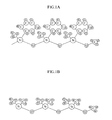
- FIGS. 1A and 1B are views respectively showing a molecular structure vary but the content of phenyl groups may not be small (e.g., 20 % or more) In the DMS oil, only methyl groups are attached to the silicon element.
- a methyl group attached in a siloxane chain of the DMS oil has a lower molecular weight and a small dipole moment than those of other organic groups such as a hydroxy group, a vinyl group and a carboxyl group.
- DMS oil has a higher mobility than other silicon oil.
- the DMS oil has a higher degree of polymerization (represented by the number of -O-Si- which is a basic unit of silicon oil) than other silicon oil at the same viscosity, resulting in a high molecular weight of a unit polymer.
- DMS oil has a degree of polymerization of 190 but MPS oil having a phenyl content of 44% has a degree of polymerization of 17. This indicates that, the DMS oil has a polymer molecular size ten or more times larger than those of MPS oil at the same viscosity of 500 Cp.
- an example of silicon oil having a superior mobility and a high degree of polymerization may include dimethylsiloxane based silicon oil containing a great amount of methyl groups.
- the dimethyl based silicon oil containing a great amount of methyl group indicates silicon oil having a methyl group content of 80% among organic groups attached to siloxane chains, which is in terms of the total number of functional groups.
- most groups attached to a siloxane chain are methyl groups, so that the physical property and chemical property are very similar to those of DMS oil.
- DMS oil or dimethylsiloxane based silicon oil has a large molecular size at a low viscosity of, e.g., 1000 cP or less.
- a fluidic lens using such oil supports rapid response time and prevents overshooting.
- DMS oil or dimethylsiloxane based silicon oil has a great degree of polymerization, a fluidic lens using such oil does not permeate or penetrate into a membrane.
- a fluidic lens using MPS oil has a penetration at a lens sag of 30 ⁇ m, in which the term 'sag' (see 'd' in FIG. 3C ) denotes the difference in height between highest and lowest points of a fluidic lens when the fluidic lens becomes convex. Therefore, a larger sag indicates a greater pressure applied to a membrane by optical fluid.
- a fluidic lens using DMS oil instead of MPS oil does not penetrate even at a pressure causing a lens sag of 70 ⁇ m
- the specific size of the sag causing penetration of optical fluid may vary according to the shape of a fluidic lens in detail, according to the size of a lens portion and/or the pressure applied by an actuator and the area of a driving portion to which the pressure is applied.
- DMS oil or dimethylsiloxane based silicon oil is used as optical fluid in a porous membrane such as a PDMS membrane, permeation or penetration of optical fluid into the membrane is prevented.
- DMS oil or dimethylsiloxane based silicon oil has a molecular structure similar to that of a PDMS membrane, in which most groups attached to a siloxane chain are methyl groups. Accordingly, the affinity between the optical fluid and the membrane is very high.
- a contact portion of the membrane may wrinkle and the wrinkled portion of the membrane may roughen the surface of a lens. Accordingly, if the DMS oil makes contact with the PDMS membrane, a spherical lens having a superior profile is not easily obtained and the optical performance of the fluidic lens is degraded.
- the exemplary membrane may be formed using a PMPS elastomer instead of a PDMS elastomer. That is, a PMPS membrane is used with DMS oil instead of using the PDMS membrane, so that penetration of optical fluid is prevented while obtaining a spherical lens with a superior profile.
- a PMPS membrane different from a PDMS membrane, a PMPS membrane has a low glass transition temperature Tg and has a tacky characteristic. Accordingly, if a fluidic lens having a PMPS membrane attached thereto is exposed to the air, the fluidic lens may be contaminated. In addition, alien substances attached to the membrane may cause the membrane to become ripped or may complicate the cleaning of the membrane.
- MPS oil may be used instead of DMS oil as an optical fluid.
- an optical fluid formed using the MPS oil may easily permeate or penetrate into a porous membrane.
- the MPS oil shows a significant change in viscosity with temperature, compared with DMS oil. For example, when varying the temperature from 20°C to 0°C, the viscosity of the DMS oil increases from 3000 cP to 5000 cP i.e. by almost two times, but the viscosity of the MPS oil increases from 3000 cP to 80000 cP i.e. by over twenty times.
- the exemplary fluidic lens uses a membrane having a double film structure in which an anti-wrinkle layer is provided at an inner surface of the PDMS membrane making contact with DMS oil, thereby applying merits of DMS oil and a PDMS membrane to the fluidic lens.
- the inner membrane is required to have a superior interfacial bonding property with respect to the PDMS membrane serving as an outer membrane and must prevent incident light from being reflected or scattered on an interface between the inner membrane and outer membrane.
- the anti-wrinkle layer may be formed using an elastomer having a molecular structure similar to that of the PDMS membrane.
- the anti-wrinkle layer serving as an inner membrane may be formed using a PMPS elastomer, a Poly Methyl incident light from being reflected or scattered on an interface between the inner membrane and outer membrane.
- the anti-wrinkle layer may be formed using an elastomer having a molecular structure similar to that of the PDMS membrane.
- the anti-wrinkle layer serving as an inner membrane may be formed using a PMPS elastomer, a Poly Methyl Vinyl Siloxane (PMVS) elastomer or a fluoro-silicon elastomer.
- PMPS elastomer, the PMVS elastomer or the fluoro-silicon elastomer allows the inner membrane to be easily bonded to the PDMS membrane.
- a PMPS elastomer, a PMVS elastomer or a fluoro-silicon elastomer has a low affinity with DMS oil.
- a PMPS elastomer and a PMVS elastomer contain a Phenyl group content of 20% or above and a Vinyl group content of 20% or above, respectively, and each contain a Methyl group content of 80% or below, the affinity of the PMPS elastomer and the PMVS membrane with respect to DMS oil is very low. Therefore, the PMPS elastomer or the PMVS elastomer allows the fluidic lens to be formed in a complete spherical lens without causing the PDMS membrane to be wrinkled.
- an exemplary fluidic lens having a double elastomer membrane including a PDMS membrane and a PMPS membrane and DMS oil interposed in the double elastomer membrane will be described.
- the configuration of a membrane and optical fluid provided in a fluidic lens has been described above and will be omitted to avoid redundancy. The following description will be made in relation to the configuration of the fluidic lens.
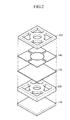
- FIG. 2 is an exploded perspective view showing an exemplary fluidic lens
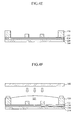
- FIG. 3A is a plan view showing the fluidic lens shown in FIG. 2
- FIG. 3B is a cross sectional view taken along line X-X' and showing the fluidic lens of FIG. 2 when a driving force is not applied to the fluidic lens
- FIG. 3C is a cross section view taken along line X-X' and showing the fluidic lens of FIG. 2 when a driving force is applied to the fluidic lens.
- FIGS. transparent polymer substrate.
- the substrate 110 allows the fluidic lens 100 to be fixed to another module of an image pickup device and serves as a bottom portion of the spacer frame 120 to seal the optical fluid 125.
- the substrate 110 and the membrane 130 are disposed opposite to each other with the spacer frame 120 interposed therebetween.
- a fluidic lens may be sealed in the space defined by the optical membrane 130 of the fluid lens 100, or the optical membrane may be implemented on each surface of the spacer frame that defines the inner space of the fluidic lens.
- the spacer frame 120 defines the inner space of the fluidic lens 100 that can be filled with optical fluid 125.
- the spacer frame 120 may be formed using opaque materials such as silicon (Si), but the material forming the spacer frame 120 is not limited thereto.
- the inner space is divided into a lens portion and a driving portion by the spacer frame 120. In more detail, an upper portion of the inner space is divided into the lens portion and the driving portion by the spacer frame 120 and a lower portion of the inner space is not divided over the entire transparent substrate.
- the optical fluid 125 can freely flow in the lower portion of the inner space.
- the lens portion is filled with the optical fluid 125 and serves as a lens through which incident light passes.
- the driving portion transfers a driving force capable of changing the profile of a portion (a lens surface) of the membrane 130 covering the lens portion.
- a predetermined pressure is applied downward onto the driving portion, that is, when a pressure (F) is applied by an actuator 140
- the optical fluid 125 in the driving portion moves to the lens portion.
- the inflow of optical fluid increases the amount of optical fluid in the lens portion, thereby causing the lens portion to bulge upward. That is, the lens portion is deformed in the form of a convex lens having a sag of 'd'.
- the deformed shape of the lens portion that is, the size of the sag 'd' may arbitrarily be controlled by adjusting the pressure of the actuator 140.
- the lens portion is located in the middle of the inner space defined by the spacer frame 120, and the driving portion surrounds the lens portion. Since the driving portion is disposed to surround the lens portion, if a driving force (F) is applied to the driving portion, the optical fluid is equally introduced from all directions to the lens portion. Accordingly, the lens portion is deformed in the form of an almost spherical lens, and the fluidic lens 100 offers superior optical performance.
- the driving portion may be divided into another number of sections. For example, the driving portion may be divided into four or more sections having several pairs of sections disposed symmetrically with respect to the lens portion.
- the optical fluid 125 is filled in the inner space defined by the spacer frame 120.
- the optical fluid 125 is formed using a silicon oil which has a low viscosity and is made of a unit polymer having a great molecular weight.
- the optical fluid 125 is formed using a transparent silicon oil that has a degree of polymerization of 50 at a viscosity of 1000 cP or below, the fluidic lens 100 offers a response time required in an image pickup device.
- the optical fluid 125 may be formed using a DMS oil and a dimethylsiloxane based silicon oil containing a great amount of methyl groups.
- the silicon oil may be heated for one hour or more at a temperature greater than 150°C, thereby obtaining an optical fluid having a desired high degree of polymerization. Silicon oil is volatilized through heating to form, so that silicon oil has a high degree of polymerization.
- the membrane 130 is attached to an upper surface of the spacer frame 120 to seal the optical fluid 125 in the inner space defined by the spacer frame 120.
- the membrane 130 has a double elastomer film structure including an inner membrane 132 and an outer membrane 134. Since the outer membrane 134 is externally exposed and may
- the membrane 130 is attached to an upper surface of the spacer frame 120 to seal the optical fluid 125 in the inner space defined by the spacer frame 120.
- the membrane 130 has a double elastomer film structure including an inner membrane 132 and an outer membrane 134. Since the outer membrane 134 is externally exposed and may contact foreign substances, the outer member 134 is formed using a PDMS having a non-tacky property.
- the inner membrane 132 prevents the PDMS outer membrane 134 from being wrinkled due to contact with the optical fluid 125 such as a DMS oil. Accordingly, the inner membrane 132 enables the lens surface of the PDMS outer membrane 134 to have a profile in a spherical shape so that the fluidic lens 100 has superior optical performance.
- the inner membrane 132 may be formed using a transparent elastomer having a small affinity with the optical fluid 125.
- the inner membrane 132 may be formed using a PMPS elastomer, a PMVS elastomer or a fluoro-silicon elastomer.
- the membrane 130 may be provided in the form of a sheet or may be divided into a plurality of sections to seal the driving portion and the lens portion of the spacer frame 120. In the latter case, the membrane 120 may seal the lens portion but may not necessarily seal the driving portion. For example, when the actuator 140 is formed using a polymer, the membrane 120 may not necessarily cover the driving portion.
- the actuator 140 is disposed on a portion of the membrane 130 to correspond to the driving portion.
- a plurality of actuators may be respectively disposed to correspond to the number of the driving portions.
- the actuator 140 may be bonded to the membrane 130 through a bonding member.
- the actuator 140 receives a driving force and exerts pressure on the optical fluid 125 corresponding to the driving portion so that optical fluid 125 corresponding to the driving portion flows to the lens portion.
- the membrane 130 on the lens portion bulges pressure member that applies pressure on the optical fluid 125 of the lens portion.
- a micro-pump may be also used to move the optical fluid 125 to the lens portion.
- the actuator 140 may be provided in various types using various materials.
- the actuator 140 is formed using any actuator generally know in the art.
- the actuator 140 may be an Electrode Active Polymer (EAP) actuator which is very thin and consumes low power or a relaxor ferroelectric polymer actuator made of a copolymer such as P(VDF-TrFE-CFE) which is poly(vinylidene fluoride-trifluoroethylene-clorofluoroethylene) and P(VDF-TrFE-CFTE) which is poly(vinylidene fluoride-trifluoroethylene-clorotrifluoroethylene).
- EAP Electrode Active Polymer
- P(VDF-TrFE-CFE) which is poly(vinylidene fluoride-trifluoroethylene-clorofluoroethylene
- P(VDF-TrFE-CFTE) which is poly(vinylidene fluoride-trifluoroethylene-clorotrifluoroethylene
- the fixing frame 150 disposed on the actuator 140 securely fixes the membrane 130 and/or the actuator 140 to the spacer frame 120.
- the fixing frame 150 may have a planar shape that exposes at least the lens portion and the actuator 140.
- the fixing frame 150 may have a planer shape identical to the space frame 120 divided into the driving portion and the lens portion. There are no particular restrictions on the material of the fixing frame 150.
- the fixing frame 150 may be formed using silicon.
- the outer membrane 134 is formed using a PDMS elastomer
- the inner membrane 132 is formed using a PMPS elastomer
- the optical fluid 125 is formed using DMS oil, but it is obvious to those of ordinary skill in the art that materials forming the outer membrane 134, the inner membrane 132 and the optical fluid 125 are not limited thereto.
- a PDMS elastomer layer 134 having a predetermined thickness is formed on a first subsidiary substrate 210.
- the first subsidiary substrate 210 may be formed using a rigid wafer.
- an anti-stiction coating 220 may be formed on the first subsidiary substrate 210 before the PDMS elastomer layer 134 is formed.
- the anti-stiction coating 220 may be formed using a photoresist (PR) or polytetrafluoroethylene (PTFE), for example Teflon®.
- the method of forming the PDMS elastomer layer 134 on the first subsidiary substrate 210 is not limited.
- the anti-stiction coating 220 is formed using PR or PTFE on the first subsidiary substrate 210.
- a liquid PDMS elastomer is dispensed on the anti-stiction coating 220 to a thickness greater than a desired thickness.
- the liquid PDMS elastomer is flattened in a desired thickness through a spin coating process, which is achieved by rotating the first subsidiary substrate 210, and/or using an applicator.
- the liquid PDMS elastomer having a desired thickness is subject to a thermal treatment or a hardening process at a predetermined temperature, for example, 110°C for a predetermined time, for example, one hour, thereby obtaining a solidified PDMS elastomer layer 134.
- a PMPS elastomer layer 132 having a predetermined thickness is formed on a second subsidiary substrate 310.
- the second subsidiary substrate 310 may be formed using any material.
- the second subsidiary substrate 310 may be formed using a PolyEthylen Teriphthalate (PET) film.
- PET PolyEthylen Teriphthalate
- an anti-stiction coating 320 may be formed on the second subsidiary substrate 310 so that the second subsidiary substrate 310 is easily separated from the PMPS elastomer layer 132 in the following process.
- the anti-stiction coating 320 may be formed using PR or PTFE.
- the method of forming the PMPS elastomer layer 132 on the second subsidiary substrate 310 is not limited, and may be identical to the method of forming the PDMS elastomer layer 134 on the first subsidiary substrate 210.
- the PDMS elastomer layer 134 and the PMPS elastomer layer 132 are subject to an oxygen plasma treatment, which is performed at an operation power of 50 W or below for 30 sec or above.
- bonding surfaces of the PDMS elastomer layer 134 and the PMPS elastomer layer 132 are subject to a surface treatment so that the PDMS elastomer layer 134 and the PMPS elastomer layer 132 are permanently bonded to each other.
- the oxygen plasma treatment generates Si-O free radicals that are excited from combustion of carbon components of a methyl group contained in the PDMS elastomer and the PMPS elastomer. In this case, if the bonding surfaces treated with oxygen plasma are bonded to each other, a permanent bonding is achieved between the PDMS elastomer 134 and the PMPS elastomer 132.
- the second subsidiary substrate 310 is removed.
- the anti-stiction layer 320 is removed together with the second subsidiary substrate 310.
- the PDMS elastomer layer 134 and the PMPS elastomer layer 132 bonded to each other remain on the first substrate 210 and the anti-stiction layer 220 stacked up against each other.
- a spacer frame 120 formed using silicon is prepared, and respective attaching surfaces of the PMPS elastomer layer 132 and the spacer frame 120 are subject to an oxygen plasma treatment at an operation power of 50 W or below for 30 sec or above, so that the PMPS elastomer layer 132 and the spacer frame 120 are permanently bonded to each other.
- the oxygen plasma treatment has been performed, as shown in FIG. 4E , the spacer frame 120 is attached on the PMPS elastomer layer 132.
- the inner space defined by the spacer frame 120 is filled with the optical fluid 125, for example, a DMS oil.
- a glass substrate 110 is attached to the spacer frame 120 to keep the optical fluid 125 in an air-tight state.
- an oxygen plasma treatment is performed on the PMPS elastomer layer 132, to which the spacer frame 120 is attached.
- the oxygen plasma treatment is performed to evenly distribute the optical fluid 125 in the inner space, and in the oxygen plasma treatment, Si-O radicals of the PDMS elastomer.
- a sealant is coated on the spacer frame 120 to a predetermined thickness, and the glass substrate 110 is attached to the spacer frame 120.
- the attaching of the glass substrate 110 may be achieved through a press bonding at a vacuum state. Then, the sealant is cured through ultraviolet curing or thermal curing. The first subsidiary substrate 210 and the anti-stiction layer 220 are removed, and the actuator 140 and the fixing frame 150 are sequentially attached to the PDMS elastomer layer 134, thereby completing the fluidic lens 100 as shown in FIG. 2 .
Landscapes
- Physics & Mathematics (AREA)
- General Physics & Mathematics (AREA)
- Optics & Photonics (AREA)
- Nonlinear Science (AREA)
- Mathematical Physics (AREA)
- Chemical & Material Sciences (AREA)
- Crystallography & Structural Chemistry (AREA)
- Mechanical Light Control Or Optical Switches (AREA)
- Lens Barrels (AREA)
Claims (14)
- Fluidische Linse (100), die Folgendes umfasst:ein transparentes optisches Fluid (125); undeine Membran (130), dadurch gekennzeichnet, dass die Membran (130) Folgendes umfasst:eine innere Membran (132), die ein transparentes Elastomer beinhaltet, wobei die innere Membran mit dem genannten optischen Fluid in Kontakt ist, undeine äußere Membran (134), die ein
Polydimethylsiloxan-(PDMS)-Elastomer beinhaltet,wobei eine Affinität der inneren Membran mit Bezug auf das optische Fluid geringer ist als eine Affinität der äußeren Membran mit Bezug auf das optische Fluid. - Fluidische Linse (100) nach Anspruch 1, wobei das optische Fluid (125) Dimethylsiloxan-(DMS)-Öl oder Siliziumöl auf der Basis von Dimethylsiloxan mit einem Methylgruppengehalt von 80 % unter den an den Siloxanketten angelagerten organischen Gruppen beinhaltet.
- Fluidische Linse (100) nach Anspruch 1 oder 2, wobei die innere Membran (132) ein Polymethylphenylsiloxan-(PMPS)-Elastomer, ein Polymethylvinylsiloxan-(PMVS)-Elastomer oder ein Fluorsilizium-Elastomer beinhaltet.
- Fluidische Linse (100) nach Anspruch 3, wobei das Polymethylphenylsiloxan-(PMPS)-Elastomer einen Phenylgruppengehalt von 20 % oder darüber hat und das Polymethylvinylsiloxan-(PMVS)-Elastomer einen Vinylgruppengehalt von 20 % oder darüber hat, wobei die genannten jeweiligen Gehalte eine Fraktion der Gesamtzahl von funktionellen Gruppen ausdrücken, die an die Siliziumatome in den Siloxanketten der genannten Elastomere angelagert sind.
- Fluidische Linse (100) nach einem der Ansprüche 1-4, wobei das optische Fluid (125) Siliziumöl mit einer Viskosität von 100 cP bis 2000 cP beinhaltet.
- Fluidische Linse (100) nach einem der Ansprüche 1-5, wobei die innere Membran (132) und die äußere Membran (134) jeweils eine Dicke von 10 µm bis 100 µm haben.
- Fluidische Linse (100) nach einem der Ansprüche 1-6, wobei die fluidische Linse Folgendes umfasst:einen Linsenabschnitt und einen Antriebsabschnitt undein Stellglied (140), das sich im Antriebsabschnitt befindet und das optische Fluid (125) in Bewegung versetzt.
- Fluidische Linse nach einem der Ansprüche 1-7, die ferner Folgendes umfasst:ein Substrat (110), einen Abstandsrahmen (120) und einen Befestigungsrahmen (150);wobei die Membran (130) sich zwischen dem Abstandsrahmen und dem Befestigungsrahmen befindet und das optische Fluid (125) sich zwischen der Membran und dem Substrat befindet.
- Fluidische Linse (100) nach Anspruch 8, wobei:das transparente optische Fluid (125) sich in einem Innenraum befindet, der durch den Abstandsrahmen (120) zwischen dem Substrat (110) und der Membran (130) definiert ist; der Innenraum einen Linsenabschnitt und einen Antriebsabschnitt umfasst;das Stellglied (140) sich auf einem Abschnitt der Membran befindet, der dem Antriebsabschnitt entspricht; undder Befestigungsrahmen (150) sich auf dem Stellglied befindet.
- Fluidische Linse (100) nach Anspruch 9, wobei sich der Linsenabschnitt an einem mittleren Abschnitt des Innenraums befindet und der Antriebsabschnitt den Linsenabschnitt umgibt.
- Fluidische Linse (100) nach Anspruch 9 oder 10, wobei der Abstandsrahmen (120) Abtrennungen umfasst, die einen oberen Abschnitt des Innenraums in den Antriebsabschnitt und den Linsenabschnitt unterteilen, wobei ein unterer Abschnitt des Innenraums nicht abgetrennt ist.
- Verfahren zum Herstellen einer fluidischen Linse (100), wobei das Verfahren Folgendes beinhaltet:Bilden einer ersten Membran (134), die ein Polydimethylsiloxan-(PDMS)-Elastomer beinhaltet, auf einem ersten Nebensubstrat (210) und Bilden einer zweiten Membran (132), die ein transparentes Elastomer beinhaltet, auf einem zweiten Nebensubstrat (310);Durchführen einer Sauerstoffplasmabehandlung auf exponierten Flächen der ersten Membran und der zweiten Membran;Anfügen der exponierten Fläche der ersten Membran an die exponierte Fläche der zweiten Membran;Entfernen des zweiten Nebensubstrats von der zweiten Membran;Anfügen eines einen Innenraum definierenden Abstandsrahmens (120) auf einer durch Entfernen des zweiten Nebensubstrats exponierten Fläche der zweiten Membran;Injizieren eines optischen Fluids (125) in den Innenraum und Anfügen eines transparenten Substrats (110) auf einer exponierten Fläche des Abstandsrahmens; undEntfernen des ersten Nebensubstrats von der ersten Membran;wobei eine Affinität der zweiten Membran mit Bezug auf das optische Fluid geringer ist als eine Affinität der ersten Membran mit Bezug auf das optische Fluid.
- Verfahren nach Anspruch 12, wobei die Sauerstoffplasmabehandlung bei einer Energie von 50 W oder darunter für 30 Sek. oder länger durchgeführt wird.
- Verfahren nach Anspruch 12 oder 13, das ferner anschließend das Durchführen einer Wärmebehandlung des Polydimethylsiloxan-(PDMS)-Elastomers bei einer Temperatur von 110°C eine Stunde lang zum Bilden der ersten Membran (134) beinhaltet.
Applications Claiming Priority (1)
| Application Number | Priority Date | Filing Date | Title |
|---|---|---|---|
| KR1020090081633A KR101680300B1 (ko) | 2009-08-31 | 2009-08-31 | 액체 렌즈 및 그 제조방법 |
Publications (2)
| Publication Number | Publication Date |
|---|---|
| EP2290410A1 EP2290410A1 (de) | 2011-03-02 |
| EP2290410B1 true EP2290410B1 (de) | 2013-10-30 |
Family
ID=42946328
Family Applications (1)
| Application Number | Title | Priority Date | Filing Date |
|---|---|---|---|
| EP10171910.2A Active EP2290410B1 (de) | 2009-08-31 | 2010-08-04 | Flüssiglinse und Herstellungsverfahren dafür |
Country Status (3)
| Country | Link |
|---|---|
| US (1) | US8427755B2 (de) |
| EP (1) | EP2290410B1 (de) |
| KR (1) | KR101680300B1 (de) |
Families Citing this family (67)
| Publication number | Priority date | Publication date | Assignee | Title |
|---|---|---|---|---|
| EP3328048B1 (de) | 2008-05-20 | 2021-04-21 | FotoNation Limited | Aufnahme und verarbeitung von bildern mittels monolithischer kamera anordnung mit heterogenem bildwandler |
| US11792538B2 (en) | 2008-05-20 | 2023-10-17 | Adeia Imaging Llc | Capturing and processing of images including occlusions focused on an image sensor by a lens stack array |
| US8866920B2 (en) | 2008-05-20 | 2014-10-21 | Pelican Imaging Corporation | Capturing and processing of images using monolithic camera array with heterogeneous imagers |
| EP2192425A1 (de) * | 2008-11-26 | 2010-06-02 | Samsung Electronics Co., Ltd. | Linse mit variabler Brennweite und Verfahren zu deren Herstellung |
| EP2502115A4 (de) | 2009-11-20 | 2013-11-06 | Pelican Imaging Corp | Aufnahme und verarbeitung von bildern mittels eines monolithischen kameraarrays mit heterogenem bildwandler |
| CN103004180A (zh) | 2010-05-12 | 2013-03-27 | 派力肯影像公司 | 成像器阵列和阵列照相机的架构 |
| US8878950B2 (en) | 2010-12-14 | 2014-11-04 | Pelican Imaging Corporation | Systems and methods for synthesizing high resolution images using super-resolution processes |
| US8305456B1 (en) | 2011-05-11 | 2012-11-06 | Pelican Imaging Corporation | Systems and methods for transmitting and receiving array camera image data |
| US20130265459A1 (en) | 2011-06-28 | 2013-10-10 | Pelican Imaging Corporation | Optical arrangements for use with an array camera |
| KR101852030B1 (ko) | 2011-08-25 | 2018-04-25 | 삼성전자주식회사 | 마이크로 소자의 웨이퍼 레벨 보호 구조물과 이를 포함하는 마이크로 소자 및 이들의 제조방법 |
| WO2013043751A1 (en) | 2011-09-19 | 2013-03-28 | Pelican Imaging Corporation | Systems and methods for controlling aliasing in images captured by an array camera for use in super resolution processing using pixel apertures |
| CN104081414B (zh) | 2011-09-28 | 2017-08-01 | Fotonation开曼有限公司 | 用于编码和解码光场图像文件的系统及方法 |
| US9412206B2 (en) | 2012-02-21 | 2016-08-09 | Pelican Imaging Corporation | Systems and methods for the manipulation of captured light field image data |
| US9210392B2 (en) | 2012-05-01 | 2015-12-08 | Pelican Imaging Coporation | Camera modules patterned with pi filter groups |
| EP2873028A4 (de) | 2012-06-28 | 2016-05-25 | Pelican Imaging Corp | Systeme und verfahren zur erkennung defekter kamera-arrays, optischer arrays und sensoren |
| US20140002674A1 (en) | 2012-06-30 | 2014-01-02 | Pelican Imaging Corporation | Systems and Methods for Manufacturing Camera Modules Using Active Alignment of Lens Stack Arrays and Sensors |
| CN107346061B (zh) | 2012-08-21 | 2020-04-24 | 快图有限公司 | 用于使用阵列照相机捕捉的图像中的视差检测和校正的系统和方法 |
| EP2888698A4 (de) | 2012-08-23 | 2016-06-29 | Pelican Imaging Corp | Eigenschaftsbasierte hochauflösende bewegungsschätzung aus mit einer arrayquelle aufgenommenen niedrigauflösenden bildern |
| WO2014052974A2 (en) | 2012-09-28 | 2014-04-03 | Pelican Imaging Corporation | Generating images from light fields utilizing virtual viewpoints |
| US9143711B2 (en) | 2012-11-13 | 2015-09-22 | Pelican Imaging Corporation | Systems and methods for array camera focal plane control |
| US9462164B2 (en) | 2013-02-21 | 2016-10-04 | Pelican Imaging Corporation | Systems and methods for generating compressed light field representation data using captured light fields, array geometry, and parallax information |
| US9253380B2 (en) | 2013-02-24 | 2016-02-02 | Pelican Imaging Corporation | Thin form factor computational array cameras and modular array cameras |
| US9774789B2 (en) | 2013-03-08 | 2017-09-26 | Fotonation Cayman Limited | Systems and methods for high dynamic range imaging using array cameras |
| US8866912B2 (en) | 2013-03-10 | 2014-10-21 | Pelican Imaging Corporation | System and methods for calibration of an array camera using a single captured image |
| US9519972B2 (en) | 2013-03-13 | 2016-12-13 | Kip Peli P1 Lp | Systems and methods for synthesizing images from image data captured by an array camera using restricted depth of field depth maps in which depth estimation precision varies |
| US9888194B2 (en) | 2013-03-13 | 2018-02-06 | Fotonation Cayman Limited | Array camera architecture implementing quantum film image sensors |
| US9124831B2 (en) | 2013-03-13 | 2015-09-01 | Pelican Imaging Corporation | System and methods for calibration of an array camera |
| US9106784B2 (en) | 2013-03-13 | 2015-08-11 | Pelican Imaging Corporation | Systems and methods for controlling aliasing in images captured by an array camera for use in super-resolution processing |
| WO2014153098A1 (en) | 2013-03-14 | 2014-09-25 | Pelican Imaging Corporation | Photmetric normalization in array cameras |
| WO2014159779A1 (en) | 2013-03-14 | 2014-10-02 | Pelican Imaging Corporation | Systems and methods for reducing motion blur in images or video in ultra low light with array cameras |
| US9497429B2 (en) | 2013-03-15 | 2016-11-15 | Pelican Imaging Corporation | Extended color processing on pelican array cameras |
| US9445003B1 (en) | 2013-03-15 | 2016-09-13 | Pelican Imaging Corporation | Systems and methods for synthesizing high resolution images using image deconvolution based on motion and depth information |
| WO2014150856A1 (en) | 2013-03-15 | 2014-09-25 | Pelican Imaging Corporation | Array camera implementing quantum dot color filters |
| US10122993B2 (en) | 2013-03-15 | 2018-11-06 | Fotonation Limited | Autofocus system for a conventional camera that uses depth information from an array camera |
| EP4604059A3 (de) | 2013-03-15 | 2025-09-17 | Adeia Imaging LLC | Systémes et procédés d'imagerie stéréo á l'aide des réseaux de caméras |
| EP2781939B1 (de) | 2013-03-18 | 2015-11-04 | poLight AS | Verformbare Kunststofflinse |
| WO2015048694A2 (en) | 2013-09-27 | 2015-04-02 | Pelican Imaging Corporation | Systems and methods for depth-assisted perspective distortion correction |
| US9426343B2 (en) | 2013-11-07 | 2016-08-23 | Pelican Imaging Corporation | Array cameras incorporating independently aligned lens stacks |
| US10119808B2 (en) | 2013-11-18 | 2018-11-06 | Fotonation Limited | Systems and methods for estimating depth from projected texture using camera arrays |
| EP3075140B1 (de) | 2013-11-26 | 2018-06-13 | FotoNation Cayman Limited | Zeilenkamerakonfigurationen mit mehreren zeilenkameras |
| US10089740B2 (en) | 2014-03-07 | 2018-10-02 | Fotonation Limited | System and methods for depth regularization and semiautomatic interactive matting using RGB-D images |
| FR3018927B1 (fr) * | 2014-03-20 | 2017-09-08 | Wavelens | Dispositif optique a membrane deformable a temps de reponse reduit |
| US9521319B2 (en) | 2014-06-18 | 2016-12-13 | Pelican Imaging Corporation | Array cameras and array camera modules including spectral filters disposed outside of a constituent image sensor |
| CN113256730B (zh) | 2014-09-29 | 2023-09-05 | 快图有限公司 | 用于阵列相机的动态校准的系统和方法 |
| US9942474B2 (en) | 2015-04-17 | 2018-04-10 | Fotonation Cayman Limited | Systems and methods for performing high speed video capture and depth estimation using array cameras |
| WO2018097287A1 (ja) * | 2016-11-28 | 2018-05-31 | コニカミノルタ株式会社 | 撮像光学系、レンズユニット、及び撮像装置 |
| US10482618B2 (en) | 2017-08-21 | 2019-11-19 | Fotonation Limited | Systems and methods for hybrid depth regularization |
| CN209375770U (zh) * | 2018-01-25 | 2019-09-10 | 台湾东电化股份有限公司 | 光学系统 |
| JP2021521483A (ja) * | 2018-04-19 | 2021-08-26 | オプトチューン コンシューマー アーゲー | 光学ズーム装置 |
| KR20210108455A (ko) * | 2018-12-28 | 2021-09-02 | 옵토튠 컨슈머 아게 | 조정 가능한 광학 배율을 포함하는 렌즈 |
| WO2021055585A1 (en) | 2019-09-17 | 2021-03-25 | Boston Polarimetrics, Inc. | Systems and methods for surface modeling using polarization cues |
| WO2021071995A1 (en) | 2019-10-07 | 2021-04-15 | Boston Polarimetrics, Inc. | Systems and methods for surface normals sensing with polarization |
| EP4066001B1 (de) | 2019-11-30 | 2026-03-04 | Intrinsic Innovation LLC | Systeme und verfahren zur transparenten objektsegmentierung unter verwendung von polarisationshinweisen |
| JP7462769B2 (ja) | 2020-01-29 | 2024-04-05 | イントリンジック イノベーション エルエルシー | 物体の姿勢の検出および測定システムを特徴付けるためのシステムおよび方法 |
| US11797863B2 (en) | 2020-01-30 | 2023-10-24 | Intrinsic Innovation Llc | Systems and methods for synthesizing data for training statistical models on different imaging modalities including polarized images |
| WO2021243088A1 (en) | 2020-05-27 | 2021-12-02 | Boston Polarimetrics, Inc. | Multi-aperture polarization optical systems using beam splitters |
| CN112014912B (zh) * | 2020-09-25 | 2022-06-28 | 肇庆学院 | 一种基于pdms凝胶的自适应透镜及其制备方法 |
| US12020455B2 (en) | 2021-03-10 | 2024-06-25 | Intrinsic Innovation Llc | Systems and methods for high dynamic range image reconstruction |
| US12069227B2 (en) | 2021-03-10 | 2024-08-20 | Intrinsic Innovation Llc | Multi-modal and multi-spectral stereo camera arrays |
| US11954886B2 (en) | 2021-04-15 | 2024-04-09 | Intrinsic Innovation Llc | Systems and methods for six-degree of freedom pose estimation of deformable objects |
| US11290658B1 (en) | 2021-04-15 | 2022-03-29 | Boston Polarimetrics, Inc. | Systems and methods for camera exposure control |
| US12067746B2 (en) | 2021-05-07 | 2024-08-20 | Intrinsic Innovation Llc | Systems and methods for using computer vision to pick up small objects |
| US12175741B2 (en) | 2021-06-22 | 2024-12-24 | Intrinsic Innovation Llc | Systems and methods for a vision guided end effector |
| US12340538B2 (en) | 2021-06-25 | 2025-06-24 | Intrinsic Innovation Llc | Systems and methods for generating and using visual datasets for training computer vision models |
| US12172310B2 (en) | 2021-06-29 | 2024-12-24 | Intrinsic Innovation Llc | Systems and methods for picking objects using 3-D geometry and segmentation |
| US11689813B2 (en) | 2021-07-01 | 2023-06-27 | Intrinsic Innovation Llc | Systems and methods for high dynamic range imaging using crossed polarizers |
| US12293535B2 (en) | 2021-08-03 | 2025-05-06 | Intrinsic Innovation Llc | Systems and methods for training pose estimators in computer vision |
Family Cites Families (28)
| Publication number | Priority date | Publication date | Assignee | Title |
|---|---|---|---|---|
| JPH06308303A (ja) | 1993-04-19 | 1994-11-04 | Kanagawa Kagaku Gijutsu Akad | 可変焦点レンズ及びその駆動装置 |
| JPH0749404A (ja) | 1993-08-05 | 1995-02-21 | Nippondenso Co Ltd | 可変焦点レンズ |
| JP4078575B2 (ja) * | 1998-06-26 | 2008-04-23 | 株式会社デンソー | 可変焦点レンズ装置 |
| US20020181844A1 (en) | 2000-06-28 | 2002-12-05 | Vaganov Vladimir I. | Optical switch |
| US7646544B2 (en) * | 2005-05-14 | 2010-01-12 | Batchko Robert G | Fluidic optical devices |
| US7672059B2 (en) * | 2000-10-20 | 2010-03-02 | Holochip Corporation | Fluidic lens with electrostatic actuation |
| US7453646B2 (en) * | 2004-03-31 | 2008-11-18 | The Regents Of The University Of California | Fluidic adaptive lens systems and methods |
| AU2005267561A1 (en) * | 2004-03-31 | 2006-02-02 | The Regents Of The University Of California | Fluidic adaptive lens |
| US7359124B1 (en) * | 2004-04-30 | 2008-04-15 | Louisiana Tech University Research Foundation As A Division Of The Louisiana Tech University Foundation | Wide-angle variable focal length lens system |
| KR100672373B1 (ko) | 2005-04-22 | 2007-01-24 | 엘지전자 주식회사 | 액체 렌즈 및 그의 제조방법 |
| US7697214B2 (en) * | 2005-05-14 | 2010-04-13 | Holochip Corporation | Fluidic lens with manually-adjustable focus |
| WO2007017089A1 (en) | 2005-07-25 | 2007-02-15 | Carl Zeiss Smt Ag | Projection objective of a microlithographic projection exposure apparatus |
| US7256943B1 (en) * | 2006-08-24 | 2007-08-14 | Teledyne Licensing, Llc | Variable focus liquid-filled lens using polyphenyl ethers |
| KR20080043106A (ko) * | 2006-11-13 | 2008-05-16 | 삼성전자주식회사 | 광학렌즈 및 그 제조방법 |
| US8027096B2 (en) * | 2006-12-15 | 2011-09-27 | Hand Held Products, Inc. | Focus module and components with actuator polymer control |
| KR100847802B1 (ko) | 2007-01-04 | 2008-08-06 | (주) 비앤피 사이언스 | 비구면 액체 렌즈 및 그 제조 방법 |
| WO2008082025A1 (en) | 2007-01-04 | 2008-07-10 | Bnp Science | Liquid lens module and a method for producing the same |
| US7369321B1 (en) * | 2007-01-16 | 2008-05-06 | University Of Central Florida Research Foundation, Inc. | Variable-focus liquid lens |
| CN101715561B (zh) | 2007-02-12 | 2011-12-07 | 珀莱特公司 | 具有可变焦距的柔性透镜组件 |
| EP2206013A4 (de) * | 2007-05-31 | 2011-07-20 | Artificial Muscle Inc | Optische systeme mit nachgiebigen elektroaktiven materialien |
| FR2919073B1 (fr) * | 2007-07-19 | 2010-10-15 | Commissariat Energie Atomique | Dispositif optique a moyens d'actionnement d'une membrane deformable compacts |
| FR2919074B1 (fr) | 2007-07-19 | 2010-10-22 | Commissariat Energie Atomique | Dispositif optique a membrane deformable par actionnement electrostatique |
| JP2009175536A (ja) | 2008-01-25 | 2009-08-06 | Olympus Corp | 可変焦点液体レンズ及びそのレンズの製造方法 |
| JP5493609B2 (ja) | 2008-09-18 | 2014-05-14 | ソニー株式会社 | 液体レンズ、及び撮像装置 |
| TWI378265B (en) * | 2008-09-26 | 2012-12-01 | Nat Univ Tsing Hua | Package structure for liquid lens |
| FR2938349B1 (fr) * | 2008-11-07 | 2011-04-15 | Commissariat Energie Atomique | Dispositif optique a membrane deformable a actionnement perfectionne |
| KR101573504B1 (ko) * | 2008-11-10 | 2015-12-01 | 삼성전자 주식회사 | 마이크로 셔터 디바이스 및 그 제조방법 |
| EP2192425A1 (de) | 2008-11-26 | 2010-06-02 | Samsung Electronics Co., Ltd. | Linse mit variabler Brennweite und Verfahren zu deren Herstellung |
-
2009
- 2009-08-31 KR KR1020090081633A patent/KR101680300B1/ko active Active
-
2010
- 2010-05-26 US US12/787,787 patent/US8427755B2/en active Active
- 2010-08-04 EP EP10171910.2A patent/EP2290410B1/de active Active
Also Published As
| Publication number | Publication date |
|---|---|
| KR101680300B1 (ko) | 2016-11-28 |
| KR20110023630A (ko) | 2011-03-08 |
| EP2290410A1 (de) | 2011-03-02 |
| US8427755B2 (en) | 2013-04-23 |
| US20110051255A1 (en) | 2011-03-03 |
Similar Documents
| Publication | Publication Date | Title |
|---|---|---|
| EP2290410B1 (de) | Flüssiglinse und Herstellungsverfahren dafür | |
| US8599490B2 (en) | Liquid lens | |
| JP5971913B2 (ja) | 光学装置 | |
| US8254034B1 (en) | Fluidic adaptive lens with a lens membrane having suppressed fluid permeability | |
| KR101403676B1 (ko) | 광학 렌즈 및 그 제조방법 | |
| KR101458563B1 (ko) | 가변 초점 렌즈 | |
| KR101804473B1 (ko) | 가변초점 렌즈 구조체 및 그 제조방법 | |
| US9250367B2 (en) | Fluidic variable focal length optical lens and method for manufacturing the same | |
| EP2270555B1 (de) | Optische Flüssiglinse mit einem elastichen Pufferfilm | |
| Rasti et al. | Dielectric elastomer stack actuator-based autofocus fluid lens | |
| Wang et al. | Design, fabrication and testing of a micromachined integrated tunable microlens | |
| Liang et al. | Tunable lens driven by dielectric elastomer actuator with ionic electrodes | |
| KR101675108B1 (ko) | 가변 초점 렌즈 및 그 제조방법 | |
| Yang et al. | Miniaturized variable-focus lens fabrication using liquid filling technique | |
| US7561341B2 (en) | Lens, method of manufacturing the lens, and camera having the lens | |
| Yang et al. | Low voltage piezoelectricity actuating variable focus plano-convex liquid lens module fabrication | |
| Draheim et al. | 10 Piezoelectrically Actuated Tunable Microlenses |
Legal Events
| Date | Code | Title | Description |
|---|---|---|---|
| PUAI | Public reference made under article 153(3) epc to a published international application that has entered the european phase |
Free format text: ORIGINAL CODE: 0009012 |
|
| AK | Designated contracting states |
Kind code of ref document: A1 Designated state(s): AL AT BE BG CH CY CZ DE DK EE ES FI FR GB GR HR HU IE IS IT LI LT LU LV MC MK MT NL NO PL PT RO SE SI SK SM TR |
|
| AX | Request for extension of the european patent |
Extension state: BA ME RS |
|
| 17P | Request for examination filed |
Effective date: 20110824 |
|
| RAP1 | Party data changed (applicant data changed or rights of an application transferred) |
Owner name: SAMSUNG ELECTRONICS CO., LTD. |
|
| RIC1 | Information provided on ipc code assigned before grant |
Ipc: G02B 3/14 20060101AFI20120920BHEP Ipc: G02B 13/00 20060101ALI20120920BHEP |
|
| GRAP | Despatch of communication of intention to grant a patent |
Free format text: ORIGINAL CODE: EPIDOSNIGR1 |
|
| INTG | Intention to grant announced |
Effective date: 20130528 |
|
| RIN1 | Information on inventor provided before grant (corrected) |
Inventor name: LEE, SEUNG-WAN Inventor name: CHOI, SEUNG-TAE Inventor name: LEE, JEONG-YUB |
|
| GRAS | Grant fee paid |
Free format text: ORIGINAL CODE: EPIDOSNIGR3 |
|
| GRAA | (expected) grant |
Free format text: ORIGINAL CODE: 0009210 |
|
| AK | Designated contracting states |
Kind code of ref document: B1 Designated state(s): AL AT BE BG CH CY CZ DE DK EE ES FI FR GB GR HR HU IE IS IT LI LT LU LV MC MK MT NL NO PL PT RO SE SI SK SM TR |
|
| REG | Reference to a national code |
Ref country code: GB Ref legal event code: FG4D |
|
| REG | Reference to a national code |
Ref country code: CH Ref legal event code: EP |
|
| REG | Reference to a national code |
Ref country code: AT Ref legal event code: REF Ref document number: 638641 Country of ref document: AT Kind code of ref document: T Effective date: 20131115 |
|
| REG | Reference to a national code |
Ref country code: IE Ref legal event code: FG4D |
|
| REG | Reference to a national code |
Ref country code: DE Ref legal event code: R096 Ref document number: 602010011295 Country of ref document: DE Effective date: 20131224 |
|
| REG | Reference to a national code |
Ref country code: NL Ref legal event code: VDEP Effective date: 20131030 |
|
| REG | Reference to a national code |
Ref country code: AT Ref legal event code: MK05 Ref document number: 638641 Country of ref document: AT Kind code of ref document: T Effective date: 20131030 |
|
| REG | Reference to a national code |
Ref country code: LT Ref legal event code: MG4D |
|
| PG25 | Lapsed in a contracting state [announced via postgrant information from national office to epo] |
Ref country code: SE Free format text: LAPSE BECAUSE OF FAILURE TO SUBMIT A TRANSLATION OF THE DESCRIPTION OR TO PAY THE FEE WITHIN THE PRESCRIBED TIME-LIMIT Effective date: 20131030 Ref country code: IS Free format text: LAPSE BECAUSE OF FAILURE TO SUBMIT A TRANSLATION OF THE DESCRIPTION OR TO PAY THE FEE WITHIN THE PRESCRIBED TIME-LIMIT Effective date: 20140228 Ref country code: FI Free format text: LAPSE BECAUSE OF FAILURE TO SUBMIT A TRANSLATION OF THE DESCRIPTION OR TO PAY THE FEE WITHIN THE PRESCRIBED TIME-LIMIT Effective date: 20131030 Ref country code: BE Free format text: LAPSE BECAUSE OF FAILURE TO SUBMIT A TRANSLATION OF THE DESCRIPTION OR TO PAY THE FEE WITHIN THE PRESCRIBED TIME-LIMIT Effective date: 20131030 Ref country code: HR Free format text: LAPSE BECAUSE OF FAILURE TO SUBMIT A TRANSLATION OF THE DESCRIPTION OR TO PAY THE FEE WITHIN THE PRESCRIBED TIME-LIMIT Effective date: 20131030 Ref country code: LT Free format text: LAPSE BECAUSE OF FAILURE TO SUBMIT A TRANSLATION OF THE DESCRIPTION OR TO PAY THE FEE WITHIN THE PRESCRIBED TIME-LIMIT Effective date: 20131030 Ref country code: NL Free format text: LAPSE BECAUSE OF FAILURE TO SUBMIT A TRANSLATION OF THE DESCRIPTION OR TO PAY THE FEE WITHIN THE PRESCRIBED TIME-LIMIT Effective date: 20131030 Ref country code: NO Free format text: LAPSE BECAUSE OF FAILURE TO SUBMIT A TRANSLATION OF THE DESCRIPTION OR TO PAY THE FEE WITHIN THE PRESCRIBED TIME-LIMIT Effective date: 20140130 |
|
| PG25 | Lapsed in a contracting state [announced via postgrant information from national office to epo] |
Ref country code: CY Free format text: LAPSE BECAUSE OF FAILURE TO SUBMIT A TRANSLATION OF THE DESCRIPTION OR TO PAY THE FEE WITHIN THE PRESCRIBED TIME-LIMIT Effective date: 20131030 Ref country code: LV Free format text: LAPSE BECAUSE OF FAILURE TO SUBMIT A TRANSLATION OF THE DESCRIPTION OR TO PAY THE FEE WITHIN THE PRESCRIBED TIME-LIMIT Effective date: 20131030 Ref country code: AT Free format text: LAPSE BECAUSE OF FAILURE TO SUBMIT A TRANSLATION OF THE DESCRIPTION OR TO PAY THE FEE WITHIN THE PRESCRIBED TIME-LIMIT Effective date: 20131030 Ref country code: ES Free format text: LAPSE BECAUSE OF FAILURE TO SUBMIT A TRANSLATION OF THE DESCRIPTION OR TO PAY THE FEE WITHIN THE PRESCRIBED TIME-LIMIT Effective date: 20131030 |
|
| PG25 | Lapsed in a contracting state [announced via postgrant information from national office to epo] |
Ref country code: PT Free format text: LAPSE BECAUSE OF FAILURE TO SUBMIT A TRANSLATION OF THE DESCRIPTION OR TO PAY THE FEE WITHIN THE PRESCRIBED TIME-LIMIT Effective date: 20140228 |
|
| PG25 | Lapsed in a contracting state [announced via postgrant information from national office to epo] |
Ref country code: EE Free format text: LAPSE BECAUSE OF FAILURE TO SUBMIT A TRANSLATION OF THE DESCRIPTION OR TO PAY THE FEE WITHIN THE PRESCRIBED TIME-LIMIT Effective date: 20131030 |
|
| REG | Reference to a national code |
Ref country code: DE Ref legal event code: R097 Ref document number: 602010011295 Country of ref document: DE |
|
| PG25 | Lapsed in a contracting state [announced via postgrant information from national office to epo] |
Ref country code: CZ Free format text: LAPSE BECAUSE OF FAILURE TO SUBMIT A TRANSLATION OF THE DESCRIPTION OR TO PAY THE FEE WITHIN THE PRESCRIBED TIME-LIMIT Effective date: 20131030 Ref country code: PL Free format text: LAPSE BECAUSE OF FAILURE TO SUBMIT A TRANSLATION OF THE DESCRIPTION OR TO PAY THE FEE WITHIN THE PRESCRIBED TIME-LIMIT Effective date: 20131030 Ref country code: RO Free format text: LAPSE BECAUSE OF FAILURE TO SUBMIT A TRANSLATION OF THE DESCRIPTION OR TO PAY THE FEE WITHIN THE PRESCRIBED TIME-LIMIT Effective date: 20131030 Ref country code: IT Free format text: LAPSE BECAUSE OF FAILURE TO SUBMIT A TRANSLATION OF THE DESCRIPTION OR TO PAY THE FEE WITHIN THE PRESCRIBED TIME-LIMIT Effective date: 20131030 Ref country code: SK Free format text: LAPSE BECAUSE OF FAILURE TO SUBMIT A TRANSLATION OF THE DESCRIPTION OR TO PAY THE FEE WITHIN THE PRESCRIBED TIME-LIMIT Effective date: 20131030 |
|
| PLBE | No opposition filed within time limit |
Free format text: ORIGINAL CODE: 0009261 |
|
| STAA | Information on the status of an ep patent application or granted ep patent |
Free format text: STATUS: NO OPPOSITION FILED WITHIN TIME LIMIT |
|
| PG25 | Lapsed in a contracting state [announced via postgrant information from national office to epo] |
Ref country code: DK Free format text: LAPSE BECAUSE OF FAILURE TO SUBMIT A TRANSLATION OF THE DESCRIPTION OR TO PAY THE FEE WITHIN THE PRESCRIBED TIME-LIMIT Effective date: 20131030 |
|
| 26N | No opposition filed |
Effective date: 20140731 |
|
| REG | Reference to a national code |
Ref country code: DE Ref legal event code: R097 Ref document number: 602010011295 Country of ref document: DE Effective date: 20140731 |
|
| PG25 | Lapsed in a contracting state [announced via postgrant information from national office to epo] |
Ref country code: SI Free format text: LAPSE BECAUSE OF FAILURE TO SUBMIT A TRANSLATION OF THE DESCRIPTION OR TO PAY THE FEE WITHIN THE PRESCRIBED TIME-LIMIT Effective date: 20131030 |
|
| PG25 | Lapsed in a contracting state [announced via postgrant information from national office to epo] |
Ref country code: LU Free format text: LAPSE BECAUSE OF FAILURE TO SUBMIT A TRANSLATION OF THE DESCRIPTION OR TO PAY THE FEE WITHIN THE PRESCRIBED TIME-LIMIT Effective date: 20140804 Ref country code: MC Free format text: LAPSE BECAUSE OF FAILURE TO SUBMIT A TRANSLATION OF THE DESCRIPTION OR TO PAY THE FEE WITHIN THE PRESCRIBED TIME-LIMIT Effective date: 20131030 |
|
| REG | Reference to a national code |
Ref country code: CH Ref legal event code: PL |
|
| PG25 | Lapsed in a contracting state [announced via postgrant information from national office to epo] |
Ref country code: CH Free format text: LAPSE BECAUSE OF NON-PAYMENT OF DUE FEES Effective date: 20140831 Ref country code: LI Free format text: LAPSE BECAUSE OF NON-PAYMENT OF DUE FEES Effective date: 20140831 |
|
| REG | Reference to a national code |
Ref country code: IE Ref legal event code: MM4A |
|
| REG | Reference to a national code |
Ref country code: FR Ref legal event code: ST Effective date: 20150430 |
|
| PG25 | Lapsed in a contracting state [announced via postgrant information from national office to epo] |
Ref country code: IE Free format text: LAPSE BECAUSE OF NON-PAYMENT OF DUE FEES Effective date: 20140804 Ref country code: FR Free format text: LAPSE BECAUSE OF NON-PAYMENT OF DUE FEES Effective date: 20140901 |
|
| PG25 | Lapsed in a contracting state [announced via postgrant information from national office to epo] |
Ref country code: SM Free format text: LAPSE BECAUSE OF FAILURE TO SUBMIT A TRANSLATION OF THE DESCRIPTION OR TO PAY THE FEE WITHIN THE PRESCRIBED TIME-LIMIT Effective date: 20131030 |
|
| PG25 | Lapsed in a contracting state [announced via postgrant information from national office to epo] |
Ref country code: BG Free format text: LAPSE BECAUSE OF FAILURE TO SUBMIT A TRANSLATION OF THE DESCRIPTION OR TO PAY THE FEE WITHIN THE PRESCRIBED TIME-LIMIT Effective date: 20131030 Ref country code: GR Free format text: LAPSE BECAUSE OF FAILURE TO SUBMIT A TRANSLATION OF THE DESCRIPTION OR TO PAY THE FEE WITHIN THE PRESCRIBED TIME-LIMIT Effective date: 20140131 Ref country code: MT Free format text: LAPSE BECAUSE OF FAILURE TO SUBMIT A TRANSLATION OF THE DESCRIPTION OR TO PAY THE FEE WITHIN THE PRESCRIBED TIME-LIMIT Effective date: 20131030 |
|
| PG25 | Lapsed in a contracting state [announced via postgrant information from national office to epo] |
Ref country code: TR Free format text: LAPSE BECAUSE OF FAILURE TO SUBMIT A TRANSLATION OF THE DESCRIPTION OR TO PAY THE FEE WITHIN THE PRESCRIBED TIME-LIMIT Effective date: 20131030 Ref country code: HU Free format text: LAPSE BECAUSE OF FAILURE TO SUBMIT A TRANSLATION OF THE DESCRIPTION OR TO PAY THE FEE WITHIN THE PRESCRIBED TIME-LIMIT; INVALID AB INITIO Effective date: 20100804 |
|
| PG25 | Lapsed in a contracting state [announced via postgrant information from national office to epo] |
Ref country code: MK Free format text: LAPSE BECAUSE OF FAILURE TO SUBMIT A TRANSLATION OF THE DESCRIPTION OR TO PAY THE FEE WITHIN THE PRESCRIBED TIME-LIMIT Effective date: 20131030 |
|
| PG25 | Lapsed in a contracting state [announced via postgrant information from national office to epo] |
Ref country code: AL Free format text: LAPSE BECAUSE OF FAILURE TO SUBMIT A TRANSLATION OF THE DESCRIPTION OR TO PAY THE FEE WITHIN THE PRESCRIBED TIME-LIMIT Effective date: 20131030 |
|
| P01 | Opt-out of the competence of the unified patent court (upc) registered |
Effective date: 20230530 |
|
| PGFP | Annual fee paid to national office [announced via postgrant information from national office to epo] |
Ref country code: DE Payment date: 20250708 Year of fee payment: 16 |
|
| PGFP | Annual fee paid to national office [announced via postgrant information from national office to epo] |
Ref country code: GB Payment date: 20250710 Year of fee payment: 16 |