EP2290696A2 - Substrat épitaxial pour dispositif semi-conducteur, dispositif semi-conducteur et procédé de fabrication d'un substrat épitaxial pour dispositif semi-conducteur - Google Patents
Substrat épitaxial pour dispositif semi-conducteur, dispositif semi-conducteur et procédé de fabrication d'un substrat épitaxial pour dispositif semi-conducteur Download PDFInfo
- Publication number
- EP2290696A2 EP2290696A2 EP10172363A EP10172363A EP2290696A2 EP 2290696 A2 EP2290696 A2 EP 2290696A2 EP 10172363 A EP10172363 A EP 10172363A EP 10172363 A EP10172363 A EP 10172363A EP 2290696 A2 EP2290696 A2 EP 2290696A2
- Authority
- EP
- European Patent Office
- Prior art keywords
- composition
- barrier layer
- group iii
- iii nitride
- layer
- Prior art date
- Legal status (The legal status is an assumption and is not a legal conclusion. Google has not performed a legal analysis and makes no representation as to the accuracy of the status listed.)
- Granted
Links
Images



Classifications
-
- H—ELECTRICITY
- H10—SEMICONDUCTOR DEVICES; ELECTRIC SOLID-STATE DEVICES NOT OTHERWISE PROVIDED FOR
- H10D—INORGANIC ELECTRIC SEMICONDUCTOR DEVICES
- H10D30/00—Field-effect transistors [FET]
- H10D30/40—FETs having zero-dimensional [0D], one-dimensional [1D] or two-dimensional [2D] charge carrier gas channels
- H10D30/47—FETs having zero-dimensional [0D], one-dimensional [1D] or two-dimensional [2D] charge carrier gas channels having two-dimensional [2D] charge carrier gas channels, e.g. nanoribbon FETs or high electron mobility transistors [HEMT]
- H10D30/471—High electron mobility transistors [HEMT] or high hole mobility transistors [HHMT]
- H10D30/475—High electron mobility transistors [HEMT] or high hole mobility transistors [HHMT] having wider bandgap layer formed on top of lower bandgap active layer, e.g. undoped barrier HEMTs such as i-AlGaN/GaN HEMTs
- H10D30/4755—High electron mobility transistors [HEMT] or high hole mobility transistors [HHMT] having wider bandgap layer formed on top of lower bandgap active layer, e.g. undoped barrier HEMTs such as i-AlGaN/GaN HEMTs having wide bandgap charge-carrier supplying layers, e.g. modulation doped HEMTs such as n-AlGaAs/GaAs HEMTs
-
- H—ELECTRICITY
- H10—SEMICONDUCTOR DEVICES; ELECTRIC SOLID-STATE DEVICES NOT OTHERWISE PROVIDED FOR
- H10D—INORGANIC ELECTRIC SEMICONDUCTOR DEVICES
- H10D62/00—Semiconductor bodies, or regions thereof, of devices having potential barriers
- H10D62/80—Semiconductor bodies, or regions thereof, of devices having potential barriers characterised by the materials
- H10D62/85—Semiconductor bodies, or regions thereof, of devices having potential barriers characterised by the materials being Group III-V materials, e.g. GaAs
- H10D62/852—Semiconductor bodies, or regions thereof, of devices having potential barriers characterised by the materials being Group III-V materials, e.g. GaAs being Group III-V materials comprising three or more elements, e.g. AlGaN or InAsSbP
-
- H—ELECTRICITY
- H10—SEMICONDUCTOR DEVICES; ELECTRIC SOLID-STATE DEVICES NOT OTHERWISE PROVIDED FOR
- H10D—INORGANIC ELECTRIC SEMICONDUCTOR DEVICES
- H10D62/00—Semiconductor bodies, or regions thereof, of devices having potential barriers
- H10D62/80—Semiconductor bodies, or regions thereof, of devices having potential barriers characterised by the materials
- H10D62/85—Semiconductor bodies, or regions thereof, of devices having potential barriers characterised by the materials being Group III-V materials, e.g. GaAs
- H10D62/8503—Nitride Group III-V materials, e.g. AlN or GaN
Definitions
- the present invention relates to an epitaxial substrate that has a multi-layer structure composed of a group III nitride semiconductor, and more particularly, to a multi-layer structured epitaxial substrate for electronic devices and a method of manufacturing the same.
- HEMT high electron mobility transistor
- 2DEG high-concentration two-dimensional electron gas
- a base substrate of the substrate for HEMT device for example, a single crystal (heterogeneous single crystal) having a composition different from that of a group III nitride, such as silicon and SiC, is used in some cases.
- a buffer layer such as a strained superlattice layer and a low-temperature growth buffer layer is typically formed as an initial growth layer on the base substrate. Therefore, the most basic configuration of a substrate for HEMT device using a base substrate formed of heterogeneous single crystal is obtained by epitaxially forming a barrier layer, a channel layer and a buffer layer on a base substrate.
- a spacer layer having a thickness of approximately 1 nm is provided between the barrier layer and the channel layer in some cases.
- the spacer layer is composed of, for example, AlN.
- a cap layer composed of an n-type GaN layer or a superlattice layer is formed on the barrier layer in some cases.
- the HEMT device that has a low dependence on the piezo polarization effect, is capable of generating two-dimensional electron gas at high concentration almost only by spontaneous polarization, and has the structure with small strains, such as the HEMT device in which a channel layer is formed of GaN and a barrier layer is formed of InAlN (for example, see “ Can InAlN/GaN be an alternative to high power/high temperature AlGaN/GaN devices?", F. Medjdoub, J. -F. Carlin, M. Gonschorek, E. Feltin, M. A. Py, D. Ducatteau, C. Gaquiere, N. Grandjean, and E. Kohn, IEEE IEDM Tech. Digest in IEEE IEDM 2006, p. 673 ).
- One of the above-mentioned problems is to improve ohmic contact characteristics between a source electrode or a drain electrode and a barrier layer.
- the present invention is directed to an epitaxial substrate for semiconductor device.
- a semiconductor device having ohmic contact characteristics between a barrier layer and an electrode being in ohmic contact therewith, which are more improved compared with a conventional case.
- an object of the present invention is to provide an epitaxial substrate for semiconductor device that is capable of achieving a semiconductor device having excellent ohmic contact characteristics and satisfactory device characteristics.
- FIG. 1 is a schematic cross-sectional view schematically showing the configuration of a HEMT device 10 according to a first preferred embodiment of the present invention.
- the HEMT device 10 has the configuration in which a substrate 1, a buffer layer 2, a channel layer 3 and a barrier layer 5 are formed by lamination.
- the buffer layer 2, the channel layer 3 and the barrier layer 5 are preferred examples of layers that are epitaxially formed (details thereof are described below) using the metal organic chemical vapor deposition method (MOCVD method).
- MOCVD method metal organic chemical vapor deposition method
- the laminated structure formed by laminating the substrate 1, the buffer layer 2, the channel layer 3 and the barrier layer 5 is also referred to as an epitaxial substrate 10A. Note that ratios of respective layers in FIG. 1 do not reflect actual ones.
- MOCVD metal-organic chemical vapor deposition
- LPE liquid phase growth methods
- different growth methods may be used in combination.
- any substrate may be used as the substrate 1 as long as a nitride semiconductor layer having excellent crystallinity can be formed thereon, without any particular limitation.
- a 6H-SiC single crystal substrate is preferably used as an example, and a substrate composed of sapphire, Si, GaAs, spinel, MgO, ZnO, ferrite or the like may be used.
- the buffer layer 2 is formed of AlN to have a thickness of approximately several hundreds of nm, for making crystal quality of the channel layer 3 and the barrier layer 5 that are formed thereon excellent.
- the buffer layer 2 is preferably formed to have a thickness of 200 nm.
- the barrier layer 5 is described below in detail.
- a source electrode 6, a drain electrode 7 and a gate electrode 8 are further provided on the barrier layer 5.
- the source electrode 6 and the drain electrode 7 are multi-layer metal electrodes formed of Ti/Al/Ni/Au each having thickness of approximately ten and several nm to hundred and several tens of nm.
- the source electrode 6 and the drain electrode 7 have ohmic contact with the barrier layer 5.
- the gate electrode 8 is a multi-layer metal electrode formed of Pd/Au each having thickness of approximately ten and several nm to hundred and several tens of nm.
- the gate electrode 8 has schottky contact with the barrier layer 5.
- the metal used for the source electrode 6 and the drain electrode 7 is not limited to the multi-layer metal formed of Ti/Al/Ni/Au as long as excellent ohmic contact can be obtained with respect to the semiconductor epitaxial substrate according to the present invention and, for example, Ti/Al/Pt/Au or Ti/Al can be used.
- the metal used for the gate electrode 8 is not limited to Pd/Au as long as excellent schottky contact can be obtained with respect to the semiconductor epitaxial substrate according to the present invention and, for example, Pd/Ti/Au or Ni/Au can be used.
- an interface I between the channel layer 3 and the barrier layer 5 becomes a heterojunction interface, and thus a two-dimensional electron gas region 3e in which two-dimensional electron gas is present at high concentration is formed at the interface I (more specifically, at the portion of the channel layer 3 in the vicinity of the interface) by the spontaneous polarization effect and piezo polarization effect.
- the formation is made such that the interface I has a mean roughness within a range of 0.1 nm to 3 nm and a surface of the barrier layer 5 for forming the interface I has a mean square roughness within a range of 0.1 nm to 3 nm.
- a flat interface may be formed exceeding the above-mentioned range, which is not practical considering cost and manufacturing yield.
- the formation is made such that the interface I has a mean roughness within a range of 0.1 nm to 1 nm and the surface of the barrier layer 5 has a mean square roughness within a range of 0.1 nm to 1 nm in a field of view of 5 ⁇ m ⁇ 5 ⁇ m.
- the barrier layer 5 is formed so as to have a gradient composition but not to have a uniform composition in a depth direction (thickness direction) from a surface 5a.
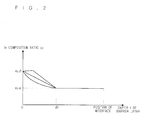
- FIG. 2 is a graph schematically showing the distribution of the In composition ratio of the barrier layer 5 in the depth direction.
- the barrier layer 5 has a uniform In composition ratio x2 from a portion (hereinabelow, also referred to as a base portion) apart from the surface in the depth direction by a distance d1 or more to a position of the interface I.
- the distance d1 may be appropriately determined in accordance with the thickness of the barrier layer 5, which is at least 6 nm or more.
- the In composition ratio x2 has different values in accordance with the distance d while changing continuously.
- the In composition ratio in the near-surface portion is larger than the In composition ratio in the portion (that is, base portion) other than the near-surface portion.
- the barrier layer 5 is referred to have a gradient composition in the range where the barrier layer 5 is apart from the surface 5a by zero to the distance d1, including the case where the In composition ratio may take an In composition ratio larger than x2 ⁇ in the near-surface portion.
- the ratio x2 ⁇ /x2 ⁇ is also referred to as a grading rate.
- the barrier layer 5 having the gradient composition in the near-surface portion by appropriately adjusting a susceptor temperature and a flow amount of source gas in forming the barrier layer 5.
- the ohmic contact characteristics between the source electrode 6 or the drain electrode 7 and the barrier layer 5 are more improved compared with a conventional case. For example, there is achieved a HEMT device whose contact resistance is reduced to approximately a half of that of a conventional HEMT device that does not have the gradient composition.
- the HEMT device 10 that includes the two-dimensional electron gas region 3e in which two-dimensional electron gas is present at a higher concentration compared with a conventional case and has a suppressed internal stress due to strains. Specifically, two-dimensional electron gas concentration of 2 ⁇ 10 13 /m 2 or more is achieved. Note that the mobility of two-dimensional electron gas in the HEMT device 10 is approximately 300 to 400 cm 2 /Vs.
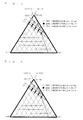
- FIGS. 3, 4 , 5 and 6 are diagrams in which the relationship between the two-dimensional electron gas concentration and the composition of the barrier layer 5 is mapped on a ternary phase diagram with three components of InN, AlN and GaN being vertices. Note that for the sake of simplification of the diagrams, in FIGS. 3 to 6 , mapping of data that does not affect the identification of the composition range is omitted.
- the composition of the channel layer 3 corresponding to each diagram is as follows:
- Mapping results shown in FIGS. 3 to 6 lead to a fact that the two-dimensional electron gas concentration in the two-dimensional electron gas region 3e is equal to or more than 2 ⁇ 10 13 /cm 2 when the barrier layer 5 selects the composition in the range surrounded by five straight lines expressed by the expressions described below in the ternary phase diagrams. More specifically, it suffices that the composition at least of the base portion satisfies the composition ranges indicated by the straight lines below, and further, that the near-surface portion satisfies those composition ranges.
- the epitaxial substrate 10A that is manufactured so as to satisfy the above-mentioned composition range, it has been confirmed from the results of X-ray diffraction measurement that the strains of the barrier layer 5 in an in-plane direction are 1% or less.
- the above indicates that, in the HEMT device 10 in which the channel layer 3 and the barrier layer 5 are formed with the composition satisfying the above-mentioned composition range, the strains due to the internal stress are suppressed and the two-dimensional electron gas region 3e having a concentration of 2 ⁇ 10 13 /cm 2 or more that is higher compared with a conventional case is formed at the interface I between both layers.
- mapping results shown in FIGS. 3 to 6 lead to a fact that the two-dimensional electron gas concentration in the two-dimensional electron gas region 3e is 3 ⁇ 10 13 /cm 2 or more when the barrier layer 5 has the composition in the range surrounded by five straight lines expressed by expressions described below in a ternary phase diagram.
- the two-dimensional electron gas region 3e having a concentration of 3 ⁇ 10 13 /cm 2 or more that is higher compared with a conventional case is formed at the interface I between both layers.
- the discussion regarding the above-mentioned composition range does not exclude a fact that the channel layer 3 and the barrier layer 5 contain impurities.
- the channel layer 3 and the barrier layer 5 may contain oxygen atoms in the concentration range of 0.0005at% (1 ⁇ 10 17 /cm 3 ) or more to 0.05at% (1 ⁇ 10 19 /cm 3 ) or less, or may contain carbon atoms in the concentration range of 0.0010at% (2 ⁇ 10 17 /cm 3 ) or more to 0.05at% (1 ⁇ 10 19 /cm 3 ) or less.
- the concentrations of oxygen atoms and carbon atoms may be smaller than respective lower limits of the above-mentioned ranges, which is not practical considering cost and manufacturing yield.
- the concentrations of oxygen atoms and carbon atoms exceed respective upper limits of the above-mentioned ranges, the cristallinity of each layer deteriorates to such an extent that device characteristics deteriorate, which is not desirable.
- the mobility of two-dimensional electron gas hardly changes in the range where 0 ⁇ y1 ⁇ 0.1. This is considered to result from the fact that the crystallinity of the channel layer does not deteriorate significantly along with an increase in AlN mole fraction and the fact that the mobility deterioration accompanying alloy diffusion (which occurs in a case of mixed crystal material) does not occur considerably due to a relatively small AlN mole fraction.
- the mobility of two-dimensional electron gas starts decreasing in the range where y1>0.1, which changes more gradually compared with the specific resistance and the drain leakage current.
- the epitaxial substrate 10A can be manufactured with a known MOCVD reactor. Specifically, there is used an MOCVD reactor configured such that a reactor is capable of being supplied with a metal organic (MO) source gas (TMI, TMA and TMG) for In, Al and Ga, an ammonia gas, a hydrogen gas and a nitrogen gas.
- MO metal organic
- a 6H-SiC substrate that has (0001) plane orientation and a diameter of two inches is prepared as the substrate 1, and the substrate 1 is placed on a susceptor provided in the reactor of the MOCVD reactor.
- the inside of the reactor is replaced with vacuum gas, and then, an atmosphere in hydrogen/nitrogen mixed flow state is formed while maintaining a pressure inside the reactor at a predetermined value of 5 kPa to 50 kPa (for example, 30 kPa). After that, the temperature of the substrate is raised through susceptor heating.
- the susceptor temperature reaches a predetermined temperature of 950°C to 1,250°C (for example, 1,050°C), which is a buffer layer forming temperature, Al source gas and NH 3 gas are introduced into the reactor, to thereby form an AlN layer serving as the buffer layer 2.
- a predetermined temperature of 950°C to 1,250°C for example, 1,050°C
- Al source gas and NH 3 gas are introduced into the reactor, to thereby form an AlN layer serving as the buffer layer 2.
- the channel layer forming temperature T1 is a value determined in the temperature range where 950°C ⁇ T1 ⁇ 1,250°C in accordance with a value of an AlN mole fraction y1 of the channel layer 3.
- the pressure in reactor when forming the channel layer 3 is not particularly limited, and can be appropriately selected from the range of 10 kPa to an atmospheric pressure (100 kPa).
- the susceptor temperature is maintained at a predetermined barrier layer forming temperature T2 (°C), and then a nitrogen gas atmosphere is formed in the reactor.
- the barrier layer forming temperature T2 is determined in the range of 650°C or more to 800°C or less in accordance with the In composition ratio.
- the pressure in reactor is set to be maintained at a predetermined value of 1 kPa or more and 30 kPa or less (for example, 10 kPa).
- the HEMT device 10 that has a small ohmic contact resistance and a small gate leakage current (excellent schottky contact characteristics) is achieved. This is the effect resulting from the increased surface flatness of the barrier layer 5 owing to a reduced pressure in reactor.
- ammonia gas and metal organic source gas that has a flow rate corresponding to the composition of the barrier layer 5 are introduced into the reactor such that a so-called V/III ratio takes a predetermined value of 3,000 or more and 20,000 or less, and then the In x2 Al y2 Ga z2 N layer serving as the barrier layer 5 is formed to have a predetermined thickness.
- the In x2 Al y2 Ga z2 N layer is formed so as to have the composition of In x2 ⁇ Al y2 ⁇ Ga z2 ⁇ N that satisfies Expressions (1) to (5), to have the gradient composition in the near-surface portion, and to have the composition of In x2 ⁇ Al y2 ⁇ Ga z2 ⁇ N on the surface 5a.
- the range of the growth rate of the barrier layer 5 is preferably 0.01 to 0.1 ⁇ m/h.
- the formation is made such that the interface I between the channel layer 3 and the barrier layer 5 has a mean roughness of 0.1 nm to 1 nm and the surface of the barrier layer 5 has a mean square roughness of 0.1 nm to 1 nm in a field of view of 5 ⁇ m ⁇ 5 ⁇ m.
- the formation of the gradient composition portion is achieved by adjusting a flow rate of source gas in accordance with the gradient composition while maintaining the barrier layer forming temperature T2 constant.
- the formation thereof is also enabled by varying the barrier layer forming temperature T2 while maintaining the flow rate constant.
- nitrogen gas is used for bubbling gas formed of metal organic source and carrier gas in manufacturing the barrier layer 5. That is, the atmosphere gas other than source gas is only nitrogen gas. Accordingly, a nitrogen partial pressure in reactor increases, whereby the reaction between In and nitrogen can be caused to progress in a highly activated state even in a temperature range of 800°C or less where the decomposition rate of an ammonia molecule is relatively low. As a result, even in a case where the barrier layer 5 is composed of a nitride containing In, it is possible to form the barrier layer 5 in a stable manner.
- the electronic structure of the barrier layer 5 can be maintained in an ideal state, whereby the generation of two-dimensional electron gas is achieved at high concentration in the two-dimensional electron gas region 3e. Note that it is not preferable to intentionally mix hydrogen gas into the atmosphere in manufacturing the barrier layer 5 because this causes a decrease in concentration of two-dimensional electron gas.
- Manufacturing of the epitaxial substrate 10A is completed after the formation of the barrier layer 5.
- the HEMT device 10 is manufactured using this. Note that the steps thereafter are achieved by a known technique.
- the device isolation step of removing portions that become boundaries between respective devices by etching so as to have a depth of approximately 400 nm by the photolithography process and the RIE method. This device isolation step is required for obtaining a large number of HEMT devices 10 from one epitaxial substrate 10A, which is not necessary for the present invention inherently.
- an SiO 2 film is formed on the epitaxial substrate 10A to have a predetermined thickness (for example, 10 nm), and then by the photolithography process, the SiO 2 film only in the positions where the source electrode 6 and the drain electrode 7 are to be formed is removed by etching, thereby forming an SiO 2 pattern layer.
- a predetermined thickness for example, 10 nm
- the source electrode 6 and the drain electrode 7 formed of Ti/Al/Ni/Au are respectively formed in the expected formation positions thereof by the vacuum deposition method and the photolithography process. Then, in order to obtain excellent ohmic characteristics of the source electrode 6 and the drain electrode 7, heat treatment is performed for several tens of seconds (for example, 30 seconds) in the nitrogen gas atmosphere at a predetermined temperature of 650°C to 1,000°C (for example, 700°C).
- the SiO 2 film in the position where the gate electrode 8 is to be formed is removed from the SiO 2 pattern layer by the photolithography process, and then the gate electrode 8 formed of Pd/Au is formed in the expected formation position by the vacuum deposition method and the photolithography process.
- the gate electrode 8 is formed as a metal pattern having schottky characteristics.
- the HEMT device 10 is obtained.
- the barrier layer of the epitaxial substrate is caused to have the gradient composition in the near-surface portion, with the result that there is obtained a HEMT device whose ohmic contact characteristics between the barrier layer and the electrode being in ohmic contact therewith are improved compared with a conventional case.
- the contact resistance is reduced to approximately a half of that of a conventional case by setting the grading rate x2 ⁇ /x2 ⁇ to 1.05 or more and 1.1 or less.
- an epitaxial substrate is manufactured by determining a composition of a barrier layer so as to satisfy the composition range determined by Expressions (6) to (10), there is achieved a HEMT device in which a two-dimensional electron gas region having a concentration of 3 ⁇ 10 13 /cm 2 or more is formed.
- FIG. 7 is a schematic cross-sectional diagram schematically showing the configuration of a HEMT device 20 according to a second preferred embodiment of the present invention.
- the HEMT device 20 has the configuration in which a spacer layer 4 is interposed between the channel layer 3 and the barrier layer 5 of the HEMT device 10 according to the first preferred embodiment.
- Constituent elements other than the spacer layer 4 are the same as those of the HEMT device 10 according to the first preferred embodiment, and thus detailed description thereof is omitted.
- the laminated structure in which the substrate 1, the buffer layer 2, the channel layer 3, the spacer layer 4 and the barrier layer 5 are formed by lamination is also referred to as an epitaxial substrate 20A.
- the spacer layer 4 that has a bandgap larger than any barrier layer 5 is formed.
- the discussion regarding the above-mentioned composition range does not exclude the fact that the spacer layer 4 contains impurities.
- the spacer layer 4 may contain those in a similar concentration range as well.
- the two-dimensional electron gas region 3e in which two-dimensional electron gas is present at high concentration is formed at the interface between the channel layer 3 and the spacer layer 4 (more specifically, in the portion in the vicinity of the interface of the channel layer 3). If the composition ranges of the channel layer 3 and the barrier layer 5 of the HEMT device 20 are determined in the same manner as the HEMT device 10 according to the first preferred embodiment, two-dimensional electron gas equal to that of the HEMT device 10 having the corresponding composition is generated also in the two-dimensional electron gas region 3e of the HEMT device 20.
- the mobility higher than that of the HEMT device 10 according to the first preferred embodiment is achieved.
- the mobility of approximately 1,000 to 1,400 cm 2 /Vs, which is three times larger than that of the HEMT device 10, is achieved.
- the spacer layer 4 is formed to have a thickness smaller than 0.5 nm, the layer is formed insufficiently, whereby the effect of confining two-dimensional electron gas is not obtained sufficiently.
- the spacer layer 4 is formed to have a thickness larger than 1.5 nm, the film quality of the spacer layer 4 itself is degraded due to the internal stress, and thus the above-mentioned high mobility cannot be obtained.
- the near-surface portion of the barrier layer 5 when the near-surface portion of the barrier layer 5 is formed so as to have a gradient composition in a range that satisfies 1.05 ⁇ x2 ⁇ /x2 ⁇ 1.1, ohmic contact characteristics between the source electrode 6 or the drain electrode 7 and the barrier layer 5 can be made more excellent compared with a conventional case, as in the first preferred embodiment.
- the HEMT device 20 having the above-mentioned structure is manufactured by a similar method to that of the HEMT device 10 according to the first preferred embodiment except for the process of forming the spacer layer 4.
- the formation up to the channel layer 3 is performed, the susceptor temperature is set to a spacer layer forming temperature T3 (where T3 is approximately the same as T1), and the inside of the reactor is maintained at the nitrogen gas atmosphere. Then, the reactor pressure is set to 10 kPa, and metal organic source gas and ammonia gas are introduced into the reactor, thereby forming the In x3 Al y3 Ga z3 N layer serving as the spacer layer 4 to have a predetermined thickness.
- the spacer layer 4 is formed in this manner, and then the barrier layer 5 is manufactured in a similar procedure to that in the case of manufacturing the above-mentioned epitaxial substrate 10A.
- the channel layer forming temperature T1 is set in the range where 950°C ⁇ T1 ⁇ 1,250°C
- the barrier layer forming temperature T2 is set in accordance with the InN mole fraction of the barrier layer 5 in the range where 650°C ⁇ T2 ⁇ 800°C, as described above.
- the spacer layer forming temperature T3 (°C) is set to be approximately the same as the channel layer forming temperature T1 (°C) as well. Therefore, in order to form the barrier layer 5, the susceptor temperature needs to be lowered after the formation of the channel layer 3 or the spacer layer 4.
- the surface of the channel layer 3 remains exposed while the temperature drops, and thus this surface may be etched by atmosphere gas.
- the spacer layer 4 is provided at the spacer layer forming temperature T3 that is approximately the same as the channel layer forming temperature T1 as in this preferred embodiment, the susceptor temperature is lowered after the formation of the spacer layer 4, whereby the spacer layer 4 acts as a protective layer of the surface of the channel layer 3. It is considered that the above also contributes to improvement in mobility of two-dimensional electron gas.
- a HEMT device in which the compositions of a channel layer and a barrier layer are determined as in the HEMT device according to the first preferred embodiment, by providing a spacer layer between the channel layer and the barrier layer, it is possible to achieve a HEMT device that has improved mobility of two-dimensional electron gas while having a high two-dimensional electron gas concentration similar to that of the HEMT device according to the first preferred embodiment.
- examples No. 1 to No. 6 six types (samples No. 1 to No. 6) of epitaxial substrates that have different In composition distribution in the near-surface portion of the barrier layer were manufactured, and ohmic contact characteristics thereof were evaluated.
- a plurality of 6H-SiC substrates that have (0001) plane orientation and a diameter of three inches were prepared as the substrate.
- Each of the substrates was placed in a reactor of an MOCVD reactor, and an inside of the reactor was replaced with vacuum gas. After that, a pressure inside the reactor was set to 30 kPa, thereby forming the atmosphere in hydrogen/nitrogen mixed flow state. Then, a temperature of the substrate was raised through susceptor heating.
- Al source gas and ammonia gas were introduced into the reactor, to thereby form an AlN layer that serves as the buffer layer and has a thickness of 200 nm.
- the susceptor temperature was maintained at 1,080°C that is the channel layer forming temperature T1 (°C), and trimethylgallium (TMG) that is Ga source gas and ammonia gas were introduced into the reactor at a predetermined flow rate, to thereby form the GaN layer serving as the channel layer to have a thickness of 2 ⁇ m.
- T1 the channel layer forming temperature
- TMG trimethylgallium
- the reactor pressure was set to 10 kPa while keeping the susceptor temperature, and then trimethylalminum (TMA) as the Al source gas and ammonium gas were introduced into the reactor, to thereby form the AlN layer serving as the spacer layer 4 to have a thickness of 1.2 nm.
- TMA trimethylalminum
- the susceptor temperature was maintained at 800°C that is the barrier layer forming temperature T2 (°C), and the reactor pressure was set to 10 kPa after the formation of the nitrogen atmosphere in the reactor.
- TMA, trimethylindium (TMI) that is IN source gas, and ammonia gas were introduced into the reactor at a predetermined flow rate, to thereby start the formation of the barrier layer so as to have the composition of In 0.16 Al 0.84 N.
- TMA and TMI was changed at the time when the thickness of the barrier layer reached approximately 8 nm, and the near-surface portion of the barrier layer was caused to have a gradient composition.
- a barrier layer having a thickness of 16 nm was formed.
- nitrogen gas was used for bubbling gas of metal organic source and carrier gas.
- the V/III ratio was set to 5,000.
- the susceptor temperature was lowered to approximately room temperature, and the reactor was made open to the atmosphere. Then, the manufactured epitaxial substrate was taken out.
- FIG. 8 shows the distribution of In composition ratios in the barrier layers in the respective samples according to first preferred embodiment, which were obtained by the evaluations.
- ohmic contact characteristics of six types of epitaxial substrates were examined by the transmission line measurement (TLM) method.
- TLM transmission line measurement
- a metal layer formed of Ti/Al/Ni/Au film thickness thereof is 25/75/15/100 nm
- the epitaxial substrate after the formation of electrodes was subjected to heat treatment for 30 seconds in the nitrogen gas atmosphere at 700°C.
- FIG. 9 shows a list of evaluation results of ohmic contact characteristics of the respective samples.
- Inventive Example 2 seventeen types of epitaxial substrates were manufactured in total, each of which has a different composition in the base portion of the barrier layer but have the grading rate fixed to 1.05. Further, as Comparative Example, seventeen types of epitaxial substrates were manufactured in total correspondingly to Inventive Example 2, which do not have a gradient composition in the near-surface portion and have the same composition as that of the base portion. Contact resistances of the respective samples were evaluated.
- the range where the portion is apart from the surface of the barrier layer by 0 nm to 6 nm was the gradient composition range and the In composition ratio was made to increase monotonically toward the surface.
- the gradient composition was achieved by adjusting a flow rate among TMG, TMA and TMI that are the source gas.
- the epitaxial substrate was manufactured and the contact resistance was measured as in Inventive Example 1.
- FIG. 10 shows a list of the compositions (also compositions of entire barrier layers of samples according to Comparative Example) of the base portions of the barrier layers of the samples according to Inventive Example 2 and measurement results of the contact resistances of the samples according to Inventive Example 2 as well as Comparative Example corresponding thereto.
- an epitaxial substrate capable of achieving a semiconductor device that has excellent ohmic contact characteristics as well as satisfactory device characteristics.
Landscapes
- Junction Field-Effect Transistors (AREA)
- Electrodes Of Semiconductors (AREA)
Applications Claiming Priority (1)
| Application Number | Priority Date | Filing Date | Title |
|---|---|---|---|
| JP2009198381A JP5702058B2 (ja) | 2009-08-28 | 2009-08-28 | 半導体素子用エピタキシャル基板、半導体素子、および、半導体素子用エピタキシャル基板の作製方法 |
Publications (3)
| Publication Number | Publication Date |
|---|---|
| EP2290696A2 true EP2290696A2 (fr) | 2011-03-02 |
| EP2290696A3 EP2290696A3 (fr) | 2012-09-12 |
| EP2290696B1 EP2290696B1 (fr) | 2019-11-06 |
Family
ID=43037753
Family Applications (1)
| Application Number | Title | Priority Date | Filing Date |
|---|---|---|---|
| EP10172363.3A Active EP2290696B1 (fr) | 2009-08-28 | 2010-08-10 | Substrat épitaxial pour dispositif semi-conducteur, dispositif semi-conducteur et procédé de fabrication d'un substrat épitaxial pour dispositif semi-conducteur |
Country Status (4)
| Country | Link |
|---|---|
| US (1) | US8378386B2 (fr) |
| EP (1) | EP2290696B1 (fr) |
| JP (1) | JP5702058B2 (fr) |
| CN (1) | CN102005471B (fr) |
Families Citing this family (11)
| Publication number | Priority date | Publication date | Assignee | Title |
|---|---|---|---|---|
| EP3067921B1 (fr) * | 2008-03-24 | 2020-08-26 | NGK Insulators, Ltd. | Procédé de production d'un substrat épitaxial pour un élément semi-conducteur |
| CN101981658B (zh) * | 2008-03-24 | 2014-10-29 | 日本碍子株式会社 | 半导体元件、半导体元件用外延基板及其制作方法 |
| JP2012019069A (ja) * | 2010-07-08 | 2012-01-26 | Toshiba Corp | 電界効果トランジスタおよび電界効果トランジスタの製造方法 |
| CN103828030B (zh) * | 2012-08-10 | 2017-11-10 | 日本碍子株式会社 | 半导体元件、hemt元件、以及半导体元件的制造方法 |
| CN105229778B (zh) * | 2013-06-06 | 2018-12-11 | 日本碍子株式会社 | 13族氮化物复合基板、半导体元件及13族氮化物复合基板的制造方法 |
| US20150021666A1 (en) * | 2013-07-17 | 2015-01-22 | Taiwan Semiconductor Manufacturing Company., Ltd. | Transistor having partially or wholly replaced substrate and method of making the same |
| US20150255589A1 (en) * | 2014-03-10 | 2015-09-10 | Toshiba Corporation | Indium-containing contact and barrier layer for iii-nitride high electron mobility transistor devices |
| FR3018629B1 (fr) * | 2014-03-14 | 2022-10-28 | Ommic | Structure semiconductrice formant transistor hemt |
| JP6658253B2 (ja) * | 2016-04-21 | 2020-03-04 | 富士通株式会社 | 半導体装置及び半導体装置の製造方法 |
| CN105870165A (zh) * | 2016-05-24 | 2016-08-17 | 江南大学 | 一种势垒层组分渐变的InAlN/GaN HEMT器件 |
| JP2021145049A (ja) * | 2020-03-12 | 2021-09-24 | 富士通株式会社 | 半導体装置 |
Family Cites Families (13)
| Publication number | Priority date | Publication date | Assignee | Title |
|---|---|---|---|---|
| SE9503630D0 (sv) * | 1995-10-18 | 1995-10-18 | Abb Research Ltd | A semiconductor device having a heterojunction |
| JP3209270B2 (ja) * | 1999-01-29 | 2001-09-17 | 日本電気株式会社 | ヘテロ接合電界効果トランジスタ |
| JP2003151996A (ja) * | 2001-09-03 | 2003-05-23 | Nichia Chem Ind Ltd | 2次元電子ガスを用いた電子デバイス |
| JP4117535B2 (ja) * | 2001-11-30 | 2008-07-16 | 信越半導体株式会社 | 化合物半導体素子 |
| KR100573720B1 (ko) * | 2003-01-29 | 2006-04-26 | 가부시끼가이샤 도시바 | 전력 반도체소자 |
| US7170111B2 (en) * | 2004-02-05 | 2007-01-30 | Cree, Inc. | Nitride heterojunction transistors having charge-transfer induced energy barriers and methods of fabricating the same |
| TW200610150A (en) * | 2004-08-30 | 2006-03-16 | Kyocera Corp | Sapphire baseplate, epitaxial substrate and semiconductor device |
| JP2007088252A (ja) * | 2005-09-22 | 2007-04-05 | Toyoda Gosei Co Ltd | 電界効果トランジスタ |
| EP1978550A4 (fr) * | 2005-12-28 | 2009-07-22 | Nec Corp | Transistor a effet de champ, et film epitaxial multicouche pour un usage dans la preparation de transistor a effet de champ |
| JP5223670B2 (ja) * | 2006-03-29 | 2013-06-26 | 日本電気株式会社 | 電界効果トランジスタ |
| CN100557815C (zh) * | 2008-03-24 | 2009-11-04 | 西安电子科技大学 | InA1N/GaN异质结增强型高电子迁移率晶体管结构及制作方法 |
| JP4968747B2 (ja) * | 2009-02-03 | 2012-07-04 | シャープ株式会社 | Iii−v族化合物半導体素子 |
| JP5581601B2 (ja) * | 2009-03-16 | 2014-09-03 | 富士通株式会社 | 化合物半導体装置及びその製造方法 |
-
2009
- 2009-08-28 JP JP2009198381A patent/JP5702058B2/ja not_active Expired - Fee Related
-
2010
- 2010-08-09 CN CN201010251920.2A patent/CN102005471B/zh not_active Expired - Fee Related
- 2010-08-10 EP EP10172363.3A patent/EP2290696B1/fr active Active
- 2010-08-10 US US12/853,716 patent/US8378386B2/en not_active Expired - Fee Related
Non-Patent Citations (3)
| Title |
|---|
| F. MEDJDOUB; J. -F. CARLIN; M. GONSCHOREK; E. FELTIN; M. A. PY; D. DUCATTEAU; C. GAQUIERE; N. GRANDJEAN; E. KOHN: "Can InAN/GaN be an alternative to high power/high temperature AlGaN/GaN devices?", IEEE IEDM TECH. DIGEST IN IEEE IEDM, 2006, pages 673 |
| STACIA KELLER; YI-FENG WU; GIACINTA PARISH; NAIQIAN ZIANG; JANE J. XU; BERND P. KELLER; STEVEN P. DENBAARS; UMESH K. MISHRA: "Gallium Nitride Based High Power Heterojunction Field Effect Transistors: Process Development and Present Status at USCB", IEEE TRANS. ELECTRON DEVICES, vol. 48, 2001, pages 552, XP011017534 |
| TOSHIHIDE KIKKAWA: "Highly Reliable 250 W High Electron Mobility Transistor Power Amplifier", JPN. J. APPL. PHYS., vol. 44, 2005, pages 4896, XP001502263, DOI: doi:10.1143/JJAP.44.4896 |
Also Published As
| Publication number | Publication date |
|---|---|
| EP2290696B1 (fr) | 2019-11-06 |
| JP5702058B2 (ja) | 2015-04-15 |
| JP2011049467A (ja) | 2011-03-10 |
| US8378386B2 (en) | 2013-02-19 |
| CN102005471A (zh) | 2011-04-06 |
| CN102005471B (zh) | 2014-10-15 |
| EP2290696A3 (fr) | 2012-09-12 |
| US20110049570A1 (en) | 2011-03-03 |
Similar Documents
| Publication | Publication Date | Title |
|---|---|---|
| EP2290675B1 (fr) | Substrat épitaxial pour dispositif semi-conducteur, dispositif semi-conducteur et procédé de fabrication d'un substrat épitaxial pour dispositif semi-conducteur | |
| EP3067921B1 (fr) | Procédé de production d'un substrat épitaxial pour un élément semi-conducteur | |
| US8378386B2 (en) | Epitaxial substrate for semiconductor device, semiconductor device, and method of manufacturing epitaxial substrate for semiconductor device | |
| CN108140563B (zh) | 半导体元件用外延基板、半导体元件和半导体元件用外延基板的制造方法 | |
| US8853735B2 (en) | Epitaxial substrate for semiconductor device and semiconductor device | |
| US8890208B2 (en) | Group III nitride epitaxial substrate for semiconductor device, semiconductor device, and process for producing group III nitride epitaxial substrate for semiconductor device | |
| CN104126223A (zh) | 半导体元件及半导体元件的制造方法 | |
| EP2251464A2 (fr) | Substrat épitaxial pour dispositif semi-conducteur, dispositif semi-conducteur et procédé de fabrication d'un substrat épitaxial pour dispositif semi-conducteur | |
| EP2296172B1 (fr) | Substrat épitaxial pour dispositif semi-conducteur, structure de jonction Schottky et procédé de suppression du courant de fuite pour structure de jonction Schottky | |
| JP5583610B2 (ja) | 半導体素子用エピタキシャル基板および半導体素子 |
Legal Events
| Date | Code | Title | Description |
|---|---|---|---|
| PUAI | Public reference made under article 153(3) epc to a published international application that has entered the european phase |
Free format text: ORIGINAL CODE: 0009012 |
|
| AK | Designated contracting states |
Kind code of ref document: A2 Designated state(s): AL AT BE BG CH CY CZ DE DK EE ES FI FR GB GR HR HU IE IS IT LI LT LU LV MC MK MT NL NO PL PT RO SE SI SK SM TR |
|
| AX | Request for extension of the european patent |
Extension state: BA ME RS |
|
| PUAL | Search report despatched |
Free format text: ORIGINAL CODE: 0009013 |
|
| AK | Designated contracting states |
Kind code of ref document: A3 Designated state(s): AL AT BE BG CH CY CZ DE DK EE ES FI FR GB GR HR HU IE IS IT LI LT LU LV MC MK MT NL NO PL PT RO SE SI SK SM TR |
|
| AX | Request for extension of the european patent |
Extension state: BA ME RS |
|
| RIC1 | Information provided on ipc code assigned before grant |
Ipc: H01L 29/778 20060101AFI20120809BHEP Ipc: H01L 29/201 20060101ALI20120809BHEP |
|
| 17P | Request for examination filed |
Effective date: 20130312 |
|
| 17Q | First examination report despatched |
Effective date: 20140306 |
|
| STAA | Information on the status of an ep patent application or granted ep patent |
Free format text: STATUS: EXAMINATION IS IN PROGRESS |
|
| GRAP | Despatch of communication of intention to grant a patent |
Free format text: ORIGINAL CODE: EPIDOSNIGR1 |
|
| STAA | Information on the status of an ep patent application or granted ep patent |
Free format text: STATUS: GRANT OF PATENT IS INTENDED |
|
| INTG | Intention to grant announced |
Effective date: 20190531 |
|
| INTG | Intention to grant announced |
Effective date: 20190604 |
|
| GRAS | Grant fee paid |
Free format text: ORIGINAL CODE: EPIDOSNIGR3 |
|
| GRAA | (expected) grant |
Free format text: ORIGINAL CODE: 0009210 |
|
| STAA | Information on the status of an ep patent application or granted ep patent |
Free format text: STATUS: THE PATENT HAS BEEN GRANTED |
|
| AK | Designated contracting states |
Kind code of ref document: B1 Designated state(s): AL AT BE BG CH CY CZ DE DK EE ES FI FR GB GR HR HU IE IS IT LI LT LU LV MC MK MT NL NO PL PT RO SE SI SK SM TR |
|
| REG | Reference to a national code |
Ref country code: GB Ref legal event code: FG4D |
|
| REG | Reference to a national code |
Ref country code: CH Ref legal event code: EP Ref country code: AT Ref legal event code: REF Ref document number: 1199983 Country of ref document: AT Kind code of ref document: T Effective date: 20191115 |
|
| REG | Reference to a national code |
Ref country code: DE Ref legal event code: R096 Ref document number: 602010061794 Country of ref document: DE |
|
| REG | Reference to a national code |
Ref country code: IE Ref legal event code: FG4D |
|
| REG | Reference to a national code |
Ref country code: NL Ref legal event code: MP Effective date: 20191106 |
|
| REG | Reference to a national code |
Ref country code: LT Ref legal event code: MG4D |
|
| PG25 | Lapsed in a contracting state [announced via postgrant information from national office to epo] |
Ref country code: ES Free format text: LAPSE BECAUSE OF FAILURE TO SUBMIT A TRANSLATION OF THE DESCRIPTION OR TO PAY THE FEE WITHIN THE PRESCRIBED TIME-LIMIT Effective date: 20191106 Ref country code: PL Free format text: LAPSE BECAUSE OF FAILURE TO SUBMIT A TRANSLATION OF THE DESCRIPTION OR TO PAY THE FEE WITHIN THE PRESCRIBED TIME-LIMIT Effective date: 20191106 Ref country code: LV Free format text: LAPSE BECAUSE OF FAILURE TO SUBMIT A TRANSLATION OF THE DESCRIPTION OR TO PAY THE FEE WITHIN THE PRESCRIBED TIME-LIMIT Effective date: 20191106 Ref country code: PT Free format text: LAPSE BECAUSE OF FAILURE TO SUBMIT A TRANSLATION OF THE DESCRIPTION OR TO PAY THE FEE WITHIN THE PRESCRIBED TIME-LIMIT Effective date: 20200306 Ref country code: SE Free format text: LAPSE BECAUSE OF FAILURE TO SUBMIT A TRANSLATION OF THE DESCRIPTION OR TO PAY THE FEE WITHIN THE PRESCRIBED TIME-LIMIT Effective date: 20191106 Ref country code: FI Free format text: LAPSE BECAUSE OF FAILURE TO SUBMIT A TRANSLATION OF THE DESCRIPTION OR TO PAY THE FEE WITHIN THE PRESCRIBED TIME-LIMIT Effective date: 20191106 Ref country code: BG Free format text: LAPSE BECAUSE OF FAILURE TO SUBMIT A TRANSLATION OF THE DESCRIPTION OR TO PAY THE FEE WITHIN THE PRESCRIBED TIME-LIMIT Effective date: 20200206 Ref country code: GR Free format text: LAPSE BECAUSE OF FAILURE TO SUBMIT A TRANSLATION OF THE DESCRIPTION OR TO PAY THE FEE WITHIN THE PRESCRIBED TIME-LIMIT Effective date: 20200207 Ref country code: NO Free format text: LAPSE BECAUSE OF FAILURE TO SUBMIT A TRANSLATION OF THE DESCRIPTION OR TO PAY THE FEE WITHIN THE PRESCRIBED TIME-LIMIT Effective date: 20200206 Ref country code: LT Free format text: LAPSE BECAUSE OF FAILURE TO SUBMIT A TRANSLATION OF THE DESCRIPTION OR TO PAY THE FEE WITHIN THE PRESCRIBED TIME-LIMIT Effective date: 20191106 Ref country code: NL Free format text: LAPSE BECAUSE OF FAILURE TO SUBMIT A TRANSLATION OF THE DESCRIPTION OR TO PAY THE FEE WITHIN THE PRESCRIBED TIME-LIMIT Effective date: 20191106 |
|
| PG25 | Lapsed in a contracting state [announced via postgrant information from national office to epo] |
Ref country code: HR Free format text: LAPSE BECAUSE OF FAILURE TO SUBMIT A TRANSLATION OF THE DESCRIPTION OR TO PAY THE FEE WITHIN THE PRESCRIBED TIME-LIMIT Effective date: 20191106 Ref country code: IS Free format text: LAPSE BECAUSE OF FAILURE TO SUBMIT A TRANSLATION OF THE DESCRIPTION OR TO PAY THE FEE WITHIN THE PRESCRIBED TIME-LIMIT Effective date: 20200306 |
|
| PG25 | Lapsed in a contracting state [announced via postgrant information from national office to epo] |
Ref country code: AL Free format text: LAPSE BECAUSE OF FAILURE TO SUBMIT A TRANSLATION OF THE DESCRIPTION OR TO PAY THE FEE WITHIN THE PRESCRIBED TIME-LIMIT Effective date: 20191106 |
|
| PG25 | Lapsed in a contracting state [announced via postgrant information from national office to epo] |
Ref country code: RO Free format text: LAPSE BECAUSE OF FAILURE TO SUBMIT A TRANSLATION OF THE DESCRIPTION OR TO PAY THE FEE WITHIN THE PRESCRIBED TIME-LIMIT Effective date: 20191106 Ref country code: CZ Free format text: LAPSE BECAUSE OF FAILURE TO SUBMIT A TRANSLATION OF THE DESCRIPTION OR TO PAY THE FEE WITHIN THE PRESCRIBED TIME-LIMIT Effective date: 20191106 Ref country code: DK Free format text: LAPSE BECAUSE OF FAILURE TO SUBMIT A TRANSLATION OF THE DESCRIPTION OR TO PAY THE FEE WITHIN THE PRESCRIBED TIME-LIMIT Effective date: 20191106 Ref country code: EE Free format text: LAPSE BECAUSE OF FAILURE TO SUBMIT A TRANSLATION OF THE DESCRIPTION OR TO PAY THE FEE WITHIN THE PRESCRIBED TIME-LIMIT Effective date: 20191106 |
|
| REG | Reference to a national code |
Ref country code: DE Ref legal event code: R097 Ref document number: 602010061794 Country of ref document: DE |
|
| REG | Reference to a national code |
Ref country code: AT Ref legal event code: MK05 Ref document number: 1199983 Country of ref document: AT Kind code of ref document: T Effective date: 20191106 |
|
| PG25 | Lapsed in a contracting state [announced via postgrant information from national office to epo] |
Ref country code: SK Free format text: LAPSE BECAUSE OF FAILURE TO SUBMIT A TRANSLATION OF THE DESCRIPTION OR TO PAY THE FEE WITHIN THE PRESCRIBED TIME-LIMIT Effective date: 20191106 Ref country code: SM Free format text: LAPSE BECAUSE OF FAILURE TO SUBMIT A TRANSLATION OF THE DESCRIPTION OR TO PAY THE FEE WITHIN THE PRESCRIBED TIME-LIMIT Effective date: 20191106 |
|
| PLBE | No opposition filed within time limit |
Free format text: ORIGINAL CODE: 0009261 |
|
| STAA | Information on the status of an ep patent application or granted ep patent |
Free format text: STATUS: NO OPPOSITION FILED WITHIN TIME LIMIT |
|
| 26N | No opposition filed |
Effective date: 20200807 |
|
| PG25 | Lapsed in a contracting state [announced via postgrant information from national office to epo] |
Ref country code: AT Free format text: LAPSE BECAUSE OF FAILURE TO SUBMIT A TRANSLATION OF THE DESCRIPTION OR TO PAY THE FEE WITHIN THE PRESCRIBED TIME-LIMIT Effective date: 20191106 Ref country code: SI Free format text: LAPSE BECAUSE OF FAILURE TO SUBMIT A TRANSLATION OF THE DESCRIPTION OR TO PAY THE FEE WITHIN THE PRESCRIBED TIME-LIMIT Effective date: 20191106 |
|
| PG25 | Lapsed in a contracting state [announced via postgrant information from national office to epo] |
Ref country code: IT Free format text: LAPSE BECAUSE OF FAILURE TO SUBMIT A TRANSLATION OF THE DESCRIPTION OR TO PAY THE FEE WITHIN THE PRESCRIBED TIME-LIMIT Effective date: 20191106 |
|
| PG25 | Lapsed in a contracting state [announced via postgrant information from national office to epo] |
Ref country code: MC Free format text: LAPSE BECAUSE OF FAILURE TO SUBMIT A TRANSLATION OF THE DESCRIPTION OR TO PAY THE FEE WITHIN THE PRESCRIBED TIME-LIMIT Effective date: 20191106 |
|
| REG | Reference to a national code |
Ref country code: CH Ref legal event code: PL |
|
| GBPC | Gb: european patent ceased through non-payment of renewal fee |
Effective date: 20200810 |
|
| PG25 | Lapsed in a contracting state [announced via postgrant information from national office to epo] |
Ref country code: LI Free format text: LAPSE BECAUSE OF NON-PAYMENT OF DUE FEES Effective date: 20200831 Ref country code: CH Free format text: LAPSE BECAUSE OF NON-PAYMENT OF DUE FEES Effective date: 20200831 Ref country code: LU Free format text: LAPSE BECAUSE OF NON-PAYMENT OF DUE FEES Effective date: 20200810 |
|
| REG | Reference to a national code |
Ref country code: BE Ref legal event code: MM Effective date: 20200831 |
|
| PG25 | Lapsed in a contracting state [announced via postgrant information from national office to epo] |
Ref country code: FR Free format text: LAPSE BECAUSE OF NON-PAYMENT OF DUE FEES Effective date: 20200831 |
|
| PG25 | Lapsed in a contracting state [announced via postgrant information from national office to epo] |
Ref country code: IE Free format text: LAPSE BECAUSE OF NON-PAYMENT OF DUE FEES Effective date: 20200810 Ref country code: GB Free format text: LAPSE BECAUSE OF NON-PAYMENT OF DUE FEES Effective date: 20200810 Ref country code: BE Free format text: LAPSE BECAUSE OF NON-PAYMENT OF DUE FEES Effective date: 20200831 |
|
| PG25 | Lapsed in a contracting state [announced via postgrant information from national office to epo] |
Ref country code: TR Free format text: LAPSE BECAUSE OF FAILURE TO SUBMIT A TRANSLATION OF THE DESCRIPTION OR TO PAY THE FEE WITHIN THE PRESCRIBED TIME-LIMIT Effective date: 20191106 Ref country code: MT Free format text: LAPSE BECAUSE OF FAILURE TO SUBMIT A TRANSLATION OF THE DESCRIPTION OR TO PAY THE FEE WITHIN THE PRESCRIBED TIME-LIMIT Effective date: 20191106 Ref country code: CY Free format text: LAPSE BECAUSE OF FAILURE TO SUBMIT A TRANSLATION OF THE DESCRIPTION OR TO PAY THE FEE WITHIN THE PRESCRIBED TIME-LIMIT Effective date: 20191106 |
|
| PG25 | Lapsed in a contracting state [announced via postgrant information from national office to epo] |
Ref country code: MK Free format text: LAPSE BECAUSE OF FAILURE TO SUBMIT A TRANSLATION OF THE DESCRIPTION OR TO PAY THE FEE WITHIN THE PRESCRIBED TIME-LIMIT Effective date: 20191106 |
|
| PGFP | Annual fee paid to national office [announced via postgrant information from national office to epo] |
Ref country code: DE Payment date: 20220621 Year of fee payment: 13 |
|
| REG | Reference to a national code |
Ref country code: DE Ref legal event code: R119 Ref document number: 602010061794 Country of ref document: DE |
|
| PG25 | Lapsed in a contracting state [announced via postgrant information from national office to epo] |
Ref country code: DE Free format text: LAPSE BECAUSE OF NON-PAYMENT OF DUE FEES Effective date: 20240301 |