EP2290894B1 - Procédé, appareil et système d'ajustement de rendement de codage multimédia - Google Patents
Procédé, appareil et système d'ajustement de rendement de codage multimédia Download PDFInfo
- Publication number
- EP2290894B1 EP2290894B1 EP09771938.9A EP09771938A EP2290894B1 EP 2290894 B1 EP2290894 B1 EP 2290894B1 EP 09771938 A EP09771938 A EP 09771938A EP 2290894 B1 EP2290894 B1 EP 2290894B1
- Authority
- EP
- European Patent Office
- Prior art keywords
- multimedia
- expected
- qoe
- encoding rate
- multimedia service
- Prior art date
- Legal status (The legal status is an assumption and is not a legal conclusion. Google has not performed a legal analysis and makes no representation as to the accuracy of the status listed.)
- Active
Links
Images


Classifications
-
- H—ELECTRICITY
- H04—ELECTRIC COMMUNICATION TECHNIQUE
- H04L—TRANSMISSION OF DIGITAL INFORMATION, e.g. TELEGRAPHIC COMMUNICATION
- H04L65/00—Network arrangements, protocols or services for supporting real-time applications in data packet communication
- H04L65/80—Responding to QoS
-
- H—ELECTRICITY
- H04—ELECTRIC COMMUNICATION TECHNIQUE
- H04L—TRANSMISSION OF DIGITAL INFORMATION, e.g. TELEGRAPHIC COMMUNICATION
- H04L65/00—Network arrangements, protocols or services for supporting real-time applications in data packet communication
- H04L65/60—Network streaming of media packets
- H04L65/61—Network streaming of media packets for supporting one-way streaming services, e.g. Internet radio
- H04L65/613—Network streaming of media packets for supporting one-way streaming services, e.g. Internet radio for the control of the source by the destination
-
- H—ELECTRICITY
- H04—ELECTRIC COMMUNICATION TECHNIQUE
- H04L—TRANSMISSION OF DIGITAL INFORMATION, e.g. TELEGRAPHIC COMMUNICATION
- H04L65/00—Network arrangements, protocols or services for supporting real-time applications in data packet communication
- H04L65/60—Network streaming of media packets
- H04L65/75—Media network packet handling
- H04L65/752—Media network packet handling adapting media to network capabilities
-
- H—ELECTRICITY
- H04—ELECTRIC COMMUNICATION TECHNIQUE
- H04L—TRANSMISSION OF DIGITAL INFORMATION, e.g. TELEGRAPHIC COMMUNICATION
- H04L65/00—Network arrangements, protocols or services for supporting real-time applications in data packet communication
- H04L65/60—Network streaming of media packets
- H04L65/70—Media network packetisation
Definitions
- the present invention relates to a network technology in the communications field, and in particular, to a method, an apparatus, and a system for adjusting a multimedia encoding rate.
- multimedia service quality plays an important role in multimedia processing and multimedia communications fields.
- IPTV Internet Protocol Television
- QoS quality of service
- QoE quality of experience
- the user's QoE is improved according to the QoE value that the user feeds back to the media server. That is, the media server compares the QoE value within a time window with a predetermined threshold; if the video quality is declining and exceeds the threshold, the media server reduces the encoding rate to relieve the congestion. In this way, the QoE of the video is improved, and the user's QoE is improved.
- NICOLA CRANLEY ET AL " User-perceived quality -aware adaptive delivery of MPEG-4 content ", XP55000335, discloses that an optimum adaptation trajectory exists which indicates how encoding quality should be adapted with respect to user perceived quality in response to network conditions.
- This optimum adaption trajectory can be used with any transmission adaptation policy with a system architecture that uses knowledge of user perceived quality to make adaption decisions and give an example of how this knowledge can be used to complement the sender-based adaption algorithm, LDA.
- MUNTEAN G-M ET AL " A New Adaptive Multimedia Streaming System for All-IP Multi-Service Networks ", XP011108391, discloses that a significant challenge in all-IP multi-service networks is to balance the goal of providing high-quality services to the end-users with the desire to maximize the number of end-users that can be simultaneously served.
- This paper presents a solution to this challenge by using the Quality-Oriented Adaptation Scheme (QOAS) for delivering multimedia streams.
- QOAS Quality-Oriented Adaptation Scheme
- This adaptive mechanism uses feedback from clients regarding the quality of delivery to assist the server in making dynamic adjustments to the transmitted streams.
- the present invention provides a method, an apparatus, and a system for adjusting a multimedia encoding rate, so that an optimal point for balancing the effects of the media encoding rate and the network performance on the QoE is found by adjusting the multimedia encoding rate on the current network, thus achieving optimal QoE.
- the invention provides the following technical solution:
- a system for reducing a multimedia encoding rate is provided according to claim 6.
- a multimedia resource control server is provided according to claim 10.
- an optimal point for balancing the effects of the media encoding rate and the network performance on the QoE is found by adjusting the multimedia encoding rate, thus achieving optimal QoE.
- the adjustment process is simple and fast and the success rate is high, thus improving the QoE.
- a method for adjusting the multimedia encoding rate in an embodiment includes: obtaining a network available bandwidth corresponding to a transmission path of a multimedia service; obtaining the expected QoE of the multimedia service and the current multimedia encoding rate; and obtaining an expected multimedia encoding rate by using the network available bandwidth, the expected QoE of the multimedia service, and the current multimedia encoding rate as input parameters and according to a preset multimedia resource decision policy, where the expected multimedia encoding rate is used as a reference for adjusting the current multimedia encoding rate.
- the available bandwidth of the current network is the network available bandwidth corresponding to the transmission path of the multimedia service.
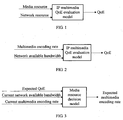
- FIG. 1 shows a QoE evaluation model of an IP multimedia service.
- the QoE evaluation model uses a multimedia resource and a network resource as the input parameters, and uses the QoE as the output value. In this way, the QoE evaluation model among the multimedia resource, network resource, and the IP multimedia service is established. Subjective evaluation is performed on the video quality, and each parameter value of the QoE evaluation model is obtained by using the regression algorithm.
- the two input parameters in the QoE evaluation model that is, the multimedia resource and network resource
- users can enjoy satisfactory QoE only under the joint effect of the multimedia resource and the network resource.
- the multimedia resource refers to various indexes involved in the process of encoding the IP multimedia service and radio service. These indexes determine the degree of damage in the service encoding process, thus affecting the user's QoE. Specifically, these indexes include the encoding quantization granularity and media encoding rate.
- the network resource refers to the network QoS performance of services received by the users, namely, packet loss related parameters including the bandwidth resource, packet loss ratio, and packet loss burst event or delay jitter, which are monitored on a real-time basis.
- the network resource determines the network performance and affects the degree of damage in the service transmission process, thus affecting the user's QoE.
- the QoE evaluation model uses the multimedia resource and network resource as the input parameters, and uses the QoE as the output value.
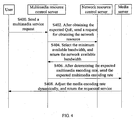
- FIG. 2 illustrates another IP multimedia evaluation model.
- a QoE evaluation model is established among the media encoding rate, the network available bandwidth, and the IP multimedia service by using the multimedia encoding rate and the network available bandwidth as the input parameters and using the QoE as the output value.
- the network available bandwidth is the current available bandwidth.
- the multimedia encoding rate is the main parameter reflecting the multimedia resource.
- the network available bandwidth is the main parameter reflecting the network resource.
- the multimedia encoding rate is one of the main factors affecting the user's QoE.
- the multimedia encoding rate is the bit rate output by the encoder. The higher the media encoding rate is, the clearer the picture is, and vice versa.
- the media encoding rate is one of the main factors that affect the user's QoE if the network performance remains unchanged and that the user's QoE may be improved by increasing the media encoding rate.
- a higher media encoding rate requires a larger bandwidth and affects the network performance. Thus, it is not enough to increase the media encoding rate merely.
- the network available bandwidth is the key factor that affects the network performance parameter. For example, if the bandwidth is inadequate in the transmission process, network congestion may occur, which causes the loss of packets and discarding of video packets. As a result, the video quality of the user will be definitely affected. If the discarded packets include important information, the user may be greatly affected. In addition, if the network available bandwidth is inadequate, a delay may occur. Thus, the network available bandwidth is the key factor that affects the network performance parameter.
- a QoE evaluation model of the IP multimedia service is established according to the main parameter of the multimedia resource (that is, the media encoding rate) and the main parameter of the network resource (that is, the network available bandwidth), as shown in FIG 2 .
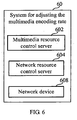
- the relation among the QoE, the media encoding rate, and the network available bandwidth is obtained through constant training with the subjective measurement value. That is, the multimedia resource decision model shown in FIG. 3 is obtained.
- the expected QoE of the IP multimedia service, the network available bandwidth, and the current media encoding rate are used as the input parameters of the multimedia resource decision model, and an expected media encoding rate is output according to the multimedia resource decision model.
- the multimedia resource decision model shown in FIG. 3 reflects the following process: A most proper media encoding rate (that is, the expected media encoding rate) is calculated by using the relation of the media resource decision model and according to the user's expected QoE, the current network available bandwidth of the network path that the media stream passes through, and the current media encoding rate; the media encoding rate is adjusted to the expected media encoding rate. In this way, under the current network performance, the expected media encoding rate may be selected to meet the user's expected QoE.
- the multimedia resource decision model is one of the multimedia resource decision polices.
- a multimedia resource decision model is established among the user's expected QoE, the current network available bandwidth of the network path that the multimedia stream passes through, the current media encoding rate, and the expected media encoding rate.
- the user's adjustment process is simplified, and an optimal point for balancing the effects of the media encoding rate and the network performance on the QoE is found, so that the user's expected QoE can be achieved under the current network performance.
- FIG. 4 is a flowchart of a method for adjusting the multimedia encoding rate according to an embodiment of the present invention.
- Step S400 The user sends a multimedia service request to the multimedia resource control server, and the multimedia resource control server determines the expected QoE for the service requested by the user.
- Step S402 The multimedia resource control server sends a request for obtaining the network resource to the network resource control server according to the service request sent from the user.
- the multimedia resource control server sends a request for obtaining the network resource, where the request includes quintuple information of the service, that is, the IP address of the media server, IP address of the terminal user, source port number of the media server providing the multimedia service, port number and protocol type of the terminal user receiving the multimedia service, requesting to obtain the network resource that the service requested by the user passes through.
- the network resource is the current available bandwidth information of all physical links of the transmission path that the multimedia service requested by the user passes through.
- Step S404 The network resource control server receives the request, selects the minimum available bandwidth, and returns it to the multimedia resource control server.
- the network resource control server calculates the transmission path that the multimedia service requested by the user may pass through, and finds the current available bandwidth information corresponding to each physical link of the transmission path stored on the network resource control server according to the transmission path of the multimedia service; or the network resource control server requests the network resource monitoring server to query for the current network available bandwidth information corresponding to each physical link of the transmission path that the multimedia service may pass through.
- the network resource control server selects the minimum value of the current available bandwidth information corresponding to all the physical links as the current available bandwidth information corresponding to the transmission path of the multimedia service, and returns the value to the multimedia resource control server; or the network resource control server sends the current network available bandwidth information to the multimedia resource control server, and the multimedia resource control server selects the minimum value of the current available bandwidth information corresponding to all the physical links as the current available bandwidth information corresponding to the transmission path of the multimedia service.
- Step S406 The multimedia resource control server obtains an expected media encoding rate according to the multimedia resource decision model, and sends the expected media encoding rate to the media server.
- the expected media encoding rate is obtained according to the multimedia resource decision model.
- the expected media encoding rate reflects the optimal point for balancing the effects of the media encoding rate and the network performance on the QoE. In this way, the user can achieve the expected QoE under the current network performance.
- the expected QoE requested by the user, the network available bandwidth, and the current media encoding rate are used as the input parameters of the multimedia resource decision model. Because it is the first time for the user to request the service, the third input parameter of the multimedia resource decision model, that is, the current media encoding rate, is 0. The expected media encoding rate is output according to the multimedia resource decision model shown in FIG. 3 .
- the multimedia resource decision model may be multiple function relations, that is, the relation among the expected QoE, network available bandwidth, current media encoding rate, and expected multimedia encoding rate:
- P0 P1 P2 P3 P4 refer to coefficients and represent the weight of each factor, which may be adjusted.
- the expected media encoding rate is calculated by using the preceding formula according to the user's expected QoE, current network available bandwidth, and current media encoding rate. This formula gives only one of feasible solutions. This formula features simple relations among the parameters and ease of calculation.
- the expected media encoding rate calculated by the multimedia resource decision model is sent to the media server for encoding, and the media encoding rate is saved.
- the media server may be other devices on the network besides the media server in the multimedia system.
- Other devices on the network may be network devices that are able to adjust and regenerate multimedia resources, for example, a digital subscriber line access multiplexer (DSLAM), a broadband remote access server (BRAS), and a router.
- DSLAM digital subscriber line access multiplexer
- BRAS broadband remote access server
- router a router
- Step S408 The media server outputs a media stream to the user according to the received expected media encoding rate.
- the media server may be other devices on the network besides the media server in the multimedia system.
- Other devices on the network may be network devices that are able to adjust and regenerate multimedia resources, for example, a DSLAM, a BRAS, and a router.
- an expected media encoding rate is obtained by using the expected QoE and the network available bandwidth as the input parameters of the multimedia resource decision model. In this way, an optimal point for balancing the effects of the media encoding rate and the network performance on the QoE is found, and the repeated adjustment process is simplified, thus achieving the user's expected QoE under the current network performance.
- FIG. 4 illustrates an application scenario of the method for adjusting the media encoding rate dynamically when the user requests the service for the first time.
- the following describes an application scenario of the method for adjusting the media encoding rate dynamically in the process of receiving IP multimedia services after the user requests the service for the first time, as shown in FIG 5 .
- FIG. 5 is a flowchart of a method for adjusting the media encoding rate dynamically according to an embodiment of the present invention.
- Step S500 When the current QoE fails to meet the requirement, the user sends a multimedia service QoE improvement request to the multimedia resource control server.
- the current QoE fails to meet the requirement in the following two scenarios: 1.
- the user monitors the QoE of the received IP multimedia service on a real-time basis, and compares this QoE with the expected QoE of the service stored by the user.
- the user may store the expected QoE of the multimedia service and report policies. For example, when the monitored QoE is lower than the expected QoE, or the expected QoE is declining, the user sends a multimedia service QoE improvement request to the multimedia resource control server; 2.
- the multimedia resource control server monitors the QoE on a real-time basis, and compares the current QoE of the service with the expected QoE of the multimedia service stored on the multimedia resource control server. For example, when the monitored QoE is lower than the expected QoE or the expected QoE is declining, the process proceeds to step 502.
- Two methods are available for obtaining the expected QoE of the service: querying for and obtaining the expected QoE of the multimedia service according to the multimedia service QoE improvement request from the user; or obtaining the expected QoE according to a multimedia service request or a multimedia service QoE improvement request that carries the expected QoE of the multimedia service.
- the expected QoE is the parameter value that the user expects to obtain and that reflects the optimal video quality of the service.
- Step S502 The multimedia resource control server sends a request for obtaining the network resource to the network resource control server according to the request from the user, requesting to obtain the network resource information of the transmission path that the service requested by the user passes through.
- the multimedia resource control server sends a request for obtaining the network resource, where the request includes quintuple information of the service, that is, the it address of the media server, IP address of the terminal user, source port number of the media server providing the multimedia service, port number and protocol type of the terminal user receiving the multimedia service, requesting to obtain the network resource information that the service requested by the user passes through.
- the network resource is the current available bandwidth information of all physical links of the transmission path that the multimedia service requested by the user passes through.
- Step S504 The network resource control server receives the request, selects the minimum available bandwidth, and returns it to the multimedia resource control server.
- the network resource control server calculates the transmission path that the multimedia service requested by the user may pass through, and finds the current available bandwidth information corresponding to each physical link of the transmission path stored on the network resource control server according to the transmission path of the multimedia service; or the network resource control server requests the network resource monitoring server to query for the current network available bandwidth information corresponding to each physical link of the transmission path that the multimedia service may pass through.
- the network resource control server selects the minimum value of the current available bandwidth information corresponding to all the physical links as the current available bandwidth information corresponding to the transmission path of the multimedia service, and returns the value to the multimedia resource control server; or the network resource control server sends the current network available bandwidth information to the multimedia resource control server, and the multimedia resource control server selects the minimum value of the current available bandwidth information corresponding to all the physical links as the current available bandwidth information corresponding to the transmission path of the multimedia service.
- Step S506 The multimedia resource control server obtains an expected media encoding rate according to the multimedia resource decision model, and sends the expected media encoding rate to the media server.
- the expected media encoding rate is obtained according to the multimedia resource decision model. It reflects the optimal point for balancing the effects of the media encoding rate and the network performance on the QoE. In this way, the user can achieve the expected QoE under the current network performance.
- the expected QoE of the user, the available bandwidth of the network that the user passes through and the current media encoding rate are used as the input parameters of the multimedia resource decision model.
- the expected media encoding rate is output according to the multimedia resource decision model.
- the current media encoding rate is stored on the multimedia resource control server and retrieved by the multimedia resource control server.
- the multimedia resource decision model may be multiple function relations, that is, the relation among the expected QoE, network available bandwidth, current media encoding rate, and expected multimedia encoding rate:
- Expected multimedia encoding rate Function (current media encoding rate, current network available bandwidth, QoE).
- Expected multimedia encoding rate p Currentavailablebandwidth + p 1 Currentavailablebandwidth 0 + p Current multimedia encoding rate + p 3 2 Current multimedia encoding rate + p Expected QoE 4
- P0 P1 P2 P3 P4 refer to coefficients and represent the weight of each factor, which may be adjusted.
- the expected media encoding rate is calculated by using the preceding formula according to the user's expected QoE, current network available bandwidth, and current media encoding rate. This formula gives only one of feasible solutions. This formula features simple relations among the parameters and ease of calculation.
- the expected media encoding rate calculated by the multimedia resource decision model is sent to the media server for encoding, and the media encoding rate is saved.
- the media server may be other devices on the network besides the media server in the multimedia system.
- Other devices on the network may be network devices that are able to adjust and regenerate the multimedia resource, for example, a DSLAM, a BRAS, and a router.
- Step S508 The media server outputs the multimedia service according to the expected media encoding rate.
- This step may further include the following:
- the media server dynamically adjusts the expected media encoding rate. Multiple methods for dynamically adjusting the expected media encoding rate are available. If the media server is located in the multimedia system, the media server selects a proper encoding parameter according to the expected media encoding rate, and adjusts and outputs the expected encoding rate according to the new encoding parameter. If the media server is other devices on the network that do not have the re-encoding capability but can identity the frame type, the media server may adjust the multimedia encoding rate according to the frame type.
- One of the methods is as follows: reducing the encoding rate, discarding the unimportant data frames, for example, B frames, and guaranteeing the transmission of important frames, for example, I frames and P frames; increasing the encoding rate, restoring the important data frames firstly, and then restoring the unimportant frames.
- All or part of the steps of the method according to the embodiments of the present invention may be implemented by a program instructing relevant hardware.
- the program may be stored in a computer readable storage medium. When the program runs, the steps of the method according to the embodiments of the present invention are performed.
- the storage medium may be a read only memory (ROM), a random access memory (RAM), a magnetic disk, or a compact disk read-only memory (CD-ROM).
- the following describes the system and apparatus for adjusting the multimedia encoding rate.
- FIG. 6 illustrates a structure of a system for adjusting the multimedia encoding rate according to an embodiment of the present invention.
- a system 60 for adjusting the multimedia encoding rate includes a multimedia resource control server 602 and a network resource control server 604.
- the multimedia resource control server 602 is configured to: interact with the network resource control server to obtain the network available bandwidth corresponding to the transmission path of a multimedia service; obtain an expected multimedia encoding rate according to a preset multimedia resource policy and by using the network available bandwidth corresponding to the transmission path of the multimedia service, expected QoE of the multimedia service, and current multimedia encoding rate as input parameters, where the expected multimedia encoding rate is used as a reference for adjusting the current multimedia encoding rate.
- the network resource control server 604 is configured to: determine the network available bandwidth corresponding to the transmission path of the multimedia service according to a request sent from the multimedia resource control server 602, and return the network available bandwidth to the multimedia resource control server 602.
- the network available bandwidth corresponding to the transmission path of the multimedia service is the minimum value of available bandwidths of multiple physical links on the transmission path of the multimedia service.
- the system for adjusting the encoding rate in the preceding embodiment further includes a network device 606.
- the network device 606 is configured to: receive the expected media encoding rate sent from the multimedia resource control server 602, and output a multimedia service corresponding to the expected multimedia encoding rate.
- the network device is the multimedia server or other network devices that are able to adjust and regenerate the multimedia resource.
- FIG. 7 illustrates the structure of a multimedia resource control server according to an embodiment of the present invention.
- a multimedia resource control server includes an obtaining unit 702 and a multimedia resource deciding unit 704.
- the obtaining unit 702 is configured to: obtain the network available bandwidth corresponding to the transmission path of a multimedia service, expected QoE, and a current multimedia encoding rate, and send the obtained information to the multimedia resource deciding unit.
- the multimedia resource deciding unit 704 is configured to: receive the information obtained by the obtaining unit, and obtain an expected multimedia encoding rate according to the multimedia resource decision policy and by using the network available bandwidth corresponding to the transmission path of the multimedia service, the expected QoE, and the current multimedia encoding rate as input parameters, where the expected multimedia encoding rate is used as a reference for adjusting the current multimedia encoding rate.
- the multimedia resource control server further includes: a querying unit 706, configured to query for and obtain the expected QoE of the multimedia service according to the multimedia service request or the multimedia service QoE improvement request.
- the multimedia resource control server may further include: a requesting unit 708, configured to request the user to send expected QoE of the multimedia service when the querying unit 706 fails to find the expected QoE of the multimedia service.
- an optimal point for balancing the effects of the media encoding rate and the network performance on the QoE is found by adjusting the multimedia encoding rate, thus achieving optimal QoE.
- the adjustment process is simple and fast and the success rate is high, thus improving the QoE.
Landscapes
- Engineering & Computer Science (AREA)
- Multimedia (AREA)
- Computer Networks & Wireless Communication (AREA)
- Signal Processing (AREA)
- Two-Way Televisions, Distribution Of Moving Picture Or The Like (AREA)
- Data Exchanges In Wide-Area Networks (AREA)
Claims (12)
- Procédé de réduction d'un taux de codage multimédia, comprenant:l'obtention (S502), par un serveur de commande de ressources multimédia, d'une bande passante réseau disponible correspondant à une voie de transmission d'un service multimédia;l'obtention (S506), par le serveur de commande de ressources multimédia, d'une qualité d'expérience, QoE, attendue pour le service multimédia, qui reflète une qualité optimale du service multimédia, et d'un taux de codage multimédia en cours; etpour la réduction du taux de codage multimédia en cours afin d'obtenir la QoE attendue, l'obtention d'un taux de codage multimédia attendu en utilisant la bande passante réseau disponible, la QoE attendue pour le service multimédia, et le taux de codage multimédia en cours en tant que paramètres d'entrée et selon une politique de décision de ressources multimédia prédéfinie, le taux de codage multimédia attendu étant utilisé comme référence pour la réduction du taux de codage multimédia en cours; la QoE attendue étant une valeur de paramètre attendue par l'utilisateur du service multimédia.
- Procédé selon la revendication 1, dans lequel:la bande passante réseau disponible correspondant à la voie de transmission du service multimédia est une valeur minimale de bandes passantes disponibles de plusieurs liaisons physiques sur la voie de transmission du service multimédia.
- Procédé selon la revendication 1, dans lequel l'étape d'obtention de la QoE attendue pour le service multimédia comprend:la requête et l'obtention de la QoE attendue pour le service multimédia en fonction d'une demande de service multimédia ou d'une demande d'amélioration de QoE de service multimédia envoyée par un utilisateur;oul'obtention de la QoE attendue en fonction d'une demande de service multimédia ou d'une demande d'amélioration de QoE de service multimédia qui transporte la QoE attendue pour le service multimédia envoyée par l'utilisateur.
- Procédé selon la revendication 3, comprenant en outre:lors de la requête et l'obtention de la QoE attendue pour le service multimédia en fonction de la demande de service multimédia ou de la demande d'amélioration de QoE de service multimédia envoyée par l'utilisateur, si la QoE attendue pour le service multimédia n'est pas trouvée, la demande à l'utilisateur d'envoyer la QoE attendue pour le service multimédia.
- Procédé selon la revendication 1, dans lequel:la politique de décision de ressources multimédia prédéfinie est une relation entre la bande passante réseau disponible correspondant à la voie de transmission du service multimédia, la QoE attendue, le taux de codage multimédia en cours, et le taux de codage multimédia attendu.
- Système de réduction d'un taux de codage multimédia, comprenant un serveur de commande de ressources multimédia (602) et un serveur de commande de ressources réseau (604), dans lequel:le serveur de commande de ressources multimédia (602) est configuré pour : interagir avec le serveur de commande de ressources réseau (604) pour obtenir une bande passante réseau disponible correspondant à une voie de transmission d'un service multimédia ; et obtenir un taux de codage multimédia attendu selon une politique de décision de ressources multimédia prédéfinie et en utilisant la bande passante réseau disponible correspondant à la voie de transmission du service multimédia, la qualité d'expérience, QoE, attendue pour le service multimédia, qui reflète une qualité optimale du service multimédia, et un taux de codage multimédia en cours en tant que paramètres d'entrée pour réduire le taux de codage multimédia en cours afin d'obtenir la QoE attendue, le taux de codage multimédia attendu étant utilisé en tant que référence pour réduire le taux de codage multimédia en cours; etle serveur de commande de ressources réseau (604) est configuré pour : déterminer la bande passante réseau disponible correspondant à la voie de transmission du service multimédia en fonction d'une demande envoyée par le serveur de commande de ressources multimédia, et renvoyer la bande passante réseau disponible au serveur de commande de ressources multimédia;la QoE attendue étant une valeur de paramètre attendue par l'utilisateur du service multimédia.
- Système selon la revendication 6, dans lequel la bande passante réseau disponible correspondant à la voie de transmission du service multimédia est une valeur minimale de bandes passantes disponibles de plusieurs liaisons physiques sur la voie de transmission du service multimédia.
- Système selon la revendication 6, comprenant en outre:un dispositif réseau (608), configuré pour : recevoir le taux de codage média attendu envoyé par le serveur de commande de ressources multimédia (602), et émettre un service multimédia correspondant au taux de codage multimédia attendu.
- Système selon la revendication 8, dans lequel le dispositif réseau (608) est un serveur multimédia ou un dispositif réseau qui est capable d'ajuster et de régénérer des ressources multimédia.
- Serveur de commande de ressources multimédia, comprenant une unité d'obtention (702) et une unité de décision de ressources multimédia (704), dans lequel:l'unité d'obtention (702) est configurée pour : obtenir une bande passante réseau disponible correspondant à une voie de transmission d'un service multimédia, une qualité d'expérience, QoE, attendue, qui reflète une qualité optimale du service multimédia, et un taux de codage multimédia en cours, et envoyer les informations obtenues à l'unité de décision de ressources multimédia; etl'unité de décision de ressources multimédia (704) est configurée pour : recevoir les informations obtenues par l'unité d'obtention, et réduire le taux de codage multimédia en cours pour atteindre la QoE attendue, obtenir un taux de codage multimédia attendu selon une politique de décision de ressources multimédia et en utilisant la bande passante réseau disponible correspondant à la voie de transmission du service multimédia, la QoE attendue, et le taux de codage multimédia en cours en tant que paramètres d'entrée, le taux de codage multimédia attendu étant utilisé en tant que référence pour réduire le taux de codage multimédia en cours;la QoE attendue étant une valeur de paramètre attendue par l'utilisateur du service multimédia.
- Serveur de commande de ressources multimédia selon la revendication 10, comprenant en outre:une unité de requête (706), configurée pour requérir et obtenir la QoE attendue pour le service multimédia en fonction d'une demande de service multimédia ou d'une demande d'amélioration de QoE de service multimédia.
- Serveur de commande de ressources multimédia selon la revendication 10, comprenant en outre:une unité de demande (708), configurée pour demander à un utilisateur d'envoyer la QoE attendue pour le service multimédia si l'unité de requête ne trouve pas la QoE attendue pour le service multimédia.
Applications Claiming Priority (2)
| Application Number | Priority Date | Filing Date | Title |
|---|---|---|---|
| CN200810068194.3A CN101621351B (zh) | 2008-06-30 | 2008-06-30 | 一种调节多媒体编码速率的方法、装置及系统 |
| PCT/CN2009/072130 WO2010000168A1 (fr) | 2008-06-30 | 2009-06-04 | Procédé, appareil et système d'ajustement de rendement de codage multimédia |
Publications (3)
| Publication Number | Publication Date |
|---|---|
| EP2290894A1 EP2290894A1 (fr) | 2011-03-02 |
| EP2290894A4 EP2290894A4 (fr) | 2011-07-27 |
| EP2290894B1 true EP2290894B1 (fr) | 2016-08-10 |
Family
ID=41465487
Family Applications (1)
| Application Number | Title | Priority Date | Filing Date |
|---|---|---|---|
| EP09771938.9A Active EP2290894B1 (fr) | 2008-06-30 | 2009-06-04 | Procédé, appareil et système d'ajustement de rendement de codage multimédia |
Country Status (4)
| Country | Link |
|---|---|
| US (1) | US8467409B2 (fr) |
| EP (1) | EP2290894B1 (fr) |
| CN (1) | CN101621351B (fr) |
| WO (1) | WO2010000168A1 (fr) |
Families Citing this family (33)
| Publication number | Priority date | Publication date | Assignee | Title |
|---|---|---|---|---|
| CN101577631B (zh) * | 2008-05-07 | 2012-04-25 | 华为技术有限公司 | 评价用户体验质量的方法、系统及网络装置 |
| WO2012058781A1 (fr) * | 2010-11-01 | 2012-05-10 | Technicolor(China) Technology Co., Ltd. | Procédé et appareil pour la gestion de la qualité de l'expérience en rapport avec des services de réseau |
| CN102611676A (zh) * | 2011-01-24 | 2012-07-25 | 华为技术有限公司 | 一种保证QoE的方法及装置 |
| US9185005B2 (en) | 2011-02-10 | 2015-11-10 | Empire Technology Development Llc | Quality-of-experience measurement for voice services |
| CN102685472B (zh) * | 2011-03-08 | 2014-11-05 | 华为技术有限公司 | 数据传输的方法、装置和系统 |
| CN103650451B (zh) * | 2011-07-07 | 2016-10-19 | 瑞典爱立信有限公司 | 网络容量优化的自适应http流播 |
| CN102256314B (zh) * | 2011-07-20 | 2014-03-05 | 上海华为技术有限公司 | 业务编码速率调整方法及通信节点 |
| CN102916906B (zh) * | 2011-08-01 | 2016-06-29 | 华为技术有限公司 | 一种实现应用性能自适应的方法、装置及系统 |
| US20140181266A1 (en) * | 2011-09-29 | 2014-06-26 | Avvasi Inc. | System, streaming media optimizer and methods for use therewith |
| US20130304934A1 (en) * | 2011-09-29 | 2013-11-14 | Avvasi Inc. | Methods and systems for controlling quality of a media session |
| US20130301415A1 (en) * | 2011-09-29 | 2013-11-14 | Avvasi Inc. | Methods and systems for managing media traffic based on network conditions |
| CN103828384B (zh) * | 2011-09-30 | 2018-02-27 | 英特尔公司 | 基于软件的无线信道感知自适应视频比特率编码 |
| CN103095517B (zh) | 2011-11-04 | 2016-12-07 | 华为技术有限公司 | 流媒体传输质量评估和信息获取方法及相关设备和系统 |
| CN102546297B (zh) * | 2011-12-31 | 2015-11-25 | 华为技术有限公司 | 一种用户带宽通知方法和计费装置 |
| CN103312531B (zh) | 2012-03-15 | 2017-02-22 | 华为技术有限公司 | 一种获取qoe的方法、装置及保证qoe的方法、装置 |
| CN103369349B (zh) * | 2012-03-28 | 2016-04-27 | 中国移动通信集团公司 | 一种数字视频质量控制方法及其装置 |
| FR2992809A1 (fr) * | 2012-06-28 | 2014-01-03 | France Telecom | Procede d'estimation de la qoe d'un utilisateur sur un terminal dudit utilisateur |
| US10051519B2 (en) | 2012-08-27 | 2018-08-14 | Qualcomm Incorporated | Device and method for adaptive rate multimedia communications on a wireless network |
| US11159804B1 (en) * | 2012-09-13 | 2021-10-26 | Arris Enterprises Llc | QoE feedback based intelligent video transport stream tuning |
| CN103237331B (zh) * | 2013-05-15 | 2015-06-10 | 西华大学 | 一种固定中继的多跳蜂窝网络的路径选择方法 |
| CN103563439B (zh) * | 2013-06-06 | 2018-02-02 | 华为技术有限公司 | 移动宽带网络高速缓冲存储器实现方法、设备及系统 |
| CN103475951A (zh) * | 2013-08-20 | 2013-12-25 | 南京邮电大学 | 一种基于用户体验的实时视频传输速率自适应方法 |
| EP3108641B1 (fr) * | 2014-02-17 | 2020-04-08 | Telefonaktiebolaget LM Ericsson (publ) | Estimation de la qoe d'un service dans un réseau de communication |
| US9755993B2 (en) | 2014-07-24 | 2017-09-05 | Cisco Technology, Inc. | Joint quality management across multiple streams |
| EP3226472A1 (fr) * | 2016-04-01 | 2017-10-04 | Thomson Licensing | Procédé de prédiction d'un niveau de qualité d'expérience d'une application destinée à être exécutée sur un équipement d'utilisateur sans fil |
| CN107770633B (zh) * | 2017-09-14 | 2020-09-29 | 华为技术有限公司 | 码率自适应算法优化系统、方法及终端 |
| US11006282B2 (en) | 2018-04-12 | 2021-05-11 | Phantom Auto Inc. | Optimizing wireless networking using a virtual geographic information system overlay |
| CN109905696B (zh) * | 2019-01-09 | 2020-12-01 | 浙江大学 | 一种基于加密流量数据的视频服务体验质量的识别方法 |
| CN111083051B (zh) * | 2019-12-20 | 2020-12-25 | 北京邮电大学 | 一种基于多智能体的路径规划方法、装置及电子设备 |
| CN111182310A (zh) * | 2019-12-26 | 2020-05-19 | 腾讯科技(深圳)有限公司 | 视频处理方法、装置、计算机可读介质及电子设备 |
| CN111741248B (zh) * | 2020-05-26 | 2024-03-15 | 视联动力信息技术股份有限公司 | 一种数据传输方法、装置、终端设备和存储介质 |
| CN112911408B (zh) * | 2021-01-25 | 2022-03-25 | 电子科技大学 | 基于深度学习的智能视频码率调整及带宽分配方法 |
| CN115103235B (zh) * | 2022-06-21 | 2023-10-20 | 咪咕互动娱乐有限公司 | 数据传输方法、装置、设备与介质 |
Family Cites Families (12)
| Publication number | Priority date | Publication date | Assignee | Title |
|---|---|---|---|---|
| US5898696A (en) * | 1997-09-05 | 1999-04-27 | Motorola, Inc. | Method and system for controlling an encoding rate in a variable rate communication system |
| JP2000244384A (ja) * | 1999-02-18 | 2000-09-08 | Mitsubishi Electric Corp | 移動通信端末装置及び移動通信端末装置における音声符号化レート決定方法 |
| US6810236B2 (en) | 2001-05-14 | 2004-10-26 | Interdigital Technology Corporation | Dynamic channel quality measurement procedure for adaptive modulation and coding techniques |
| US7151749B2 (en) | 2001-06-14 | 2006-12-19 | Microsoft Corporation | Method and System for providing adaptive bandwidth control for real-time communication |
| JP4390112B2 (ja) * | 2002-09-05 | 2009-12-24 | エージェンシー フォー サイエンス,テクノロジー アンド リサーチ | ビデオシーケンスのレートを制御する方法及び装置並びにビデオ符号化装置 |
| US20040240390A1 (en) * | 2003-05-30 | 2004-12-02 | Vidiator Enterprises Inc. | Method and apparatus for dynamic bandwidth adaptation |
| BRPI0413812A (pt) * | 2003-08-21 | 2006-10-17 | Vidiator Entpr Inc | dispositivo e método de qualidade de experiência (qoe) para rede de comunicação celular |
| US7016409B2 (en) * | 2003-11-12 | 2006-03-21 | Sony Corporation | Apparatus and method for use in providing dynamic bit rate encoding |
| KR100744542B1 (ko) * | 2005-12-08 | 2007-08-01 | 한국전자통신연구원 | 가변대역 멀티코덱 QoS 제어 장치 및 방법 |
| US8280994B2 (en) * | 2006-10-27 | 2012-10-02 | Rockstar Bidco Lp | Method and apparatus for designing, updating and operating a network based on quality of experience |
| CA2672735A1 (fr) * | 2006-12-13 | 2008-06-19 | Quickplay Media Inc. | Plate-forme multimedia mobile |
| CN101068236B (zh) * | 2007-04-13 | 2011-10-26 | 华为技术有限公司 | 流媒体码率控制方法、系统和设备 |
-
2008
- 2008-06-30 CN CN200810068194.3A patent/CN101621351B/zh active Active
-
2009
- 2009-06-04 WO PCT/CN2009/072130 patent/WO2010000168A1/fr not_active Ceased
- 2009-06-04 EP EP09771938.9A patent/EP2290894B1/fr active Active
-
2010
- 2010-12-28 US US12/979,947 patent/US8467409B2/en active Active
Also Published As
| Publication number | Publication date |
|---|---|
| EP2290894A1 (fr) | 2011-03-02 |
| EP2290894A4 (fr) | 2011-07-27 |
| US8467409B2 (en) | 2013-06-18 |
| CN101621351A (zh) | 2010-01-06 |
| US20110090922A1 (en) | 2011-04-21 |
| WO2010000168A1 (fr) | 2010-01-07 |
| CN101621351B (zh) | 2013-09-11 |
Similar Documents
| Publication | Publication Date | Title |
|---|---|---|
| EP2290894B1 (fr) | Procédé, appareil et système d'ajustement de rendement de codage multimédia | |
| EP2810421B1 (fr) | Système et procédé de réduction de retard de démarrage de flux pour diffusion en continu adaptative | |
| KR100689430B1 (ko) | 디지털 홈 서비스에서 하이브리드 모니터링을 통한 동적서비스 품질 매핑 장치 및 방법 | |
| US8077609B2 (en) | Method for providing quality-of-service based services in a packet network | |
| Famaey et al. | On the merits of SVC-based HTTP adaptive streaming | |
| US8230105B2 (en) | Adaptive bitrate management for streaming media over packet networks | |
| US20140181266A1 (en) | System, streaming media optimizer and methods for use therewith | |
| EP3563540B1 (fr) | Procédé et système permettant de fournir des services vidéo en continu de qualité variable dans des réseaux de communication mobile | |
| US20120314718A1 (en) | Streaming media flows managament | |
| Muntean et al. | A comparison-based study of quality-oriented video on demand | |
| WO2009049676A1 (fr) | Procédé et appareil à utiliser dans un réseau | |
| Oliveira et al. | QoE-based load balancing of OTT video content in SDN networks | |
| Qadir et al. | QoE-aware cross-layer architecture for video traffic over Internet | |
| Zhang et al. | Resource allocation for audio and video streaming over the Internet | |
| Seyedebrahimi et al. | Client QoE-oriented segment selection for DASH | |
| Thai et al. | Viral: coupling congestion control with fair video quality metric | |
| Qadir et al. | Quality of experience enhancement through adapting sender bit rate | |
| Wakamiya et al. | Dynamic quality adaptation mechanisms for TCP-friendly MPEG-4 video transfer | |
| Abar et al. | How modeling QoE requirements using game theory | |
| Wagner et al. | Distributed Congestion Control of Scalable Video Streams. | |
| Bouras et al. | Adaptive smooth simulcast protocol (ASSP) for video applications: Description and performance evaluation | |
| Yoshida et al. | Proposal and evaluation of joint rate control for stored video streaming | |
| Kist et al. | QoE-Aware Cross-Layer Architecture for Video Traffic over Internet | |
| Yetgin et al. | Playing rate adaptation for increased QoE over streaming services | |
| Papadimitriou | An integrated smooth transmission control and temporal scaling scheme for MPEG-4 streaming video |
Legal Events
| Date | Code | Title | Description |
|---|---|---|---|
| PUAI | Public reference made under article 153(3) epc to a published international application that has entered the european phase |
Free format text: ORIGINAL CODE: 0009012 |
|
| 17P | Request for examination filed |
Effective date: 20101224 |
|
| AK | Designated contracting states |
Kind code of ref document: A1 Designated state(s): AT BE BG CH CY CZ DE DK EE ES FI FR GB GR HR HU IE IS IT LI LT LU LV MC MK MT NL NO PL PT RO SE SI SK TR |
|
| AX | Request for extension of the european patent |
Extension state: AL BA RS |
|
| A4 | Supplementary search report drawn up and despatched |
Effective date: 20110628 |
|
| DAX | Request for extension of the european patent (deleted) | ||
| 17Q | First examination report despatched |
Effective date: 20130906 |
|
| GRAP | Despatch of communication of intention to grant a patent |
Free format text: ORIGINAL CODE: EPIDOSNIGR1 |
|
| INTG | Intention to grant announced |
Effective date: 20151211 |
|
| RIC1 | Information provided on ipc code assigned before grant |
Ipc: H04L 29/02 20060101AFI20151127BHEP Ipc: H04L 29/06 20060101ALI20151127BHEP |
|
| GRAS | Grant fee paid |
Free format text: ORIGINAL CODE: EPIDOSNIGR3 |
|
| GRAP | Despatch of communication of intention to grant a patent |
Free format text: ORIGINAL CODE: EPIDOSNIGR1 |
|
| GRAS | Grant fee paid |
Free format text: ORIGINAL CODE: EPIDOSNIGR3 |
|
| INTG | Intention to grant announced |
Effective date: 20160504 |
|
| GRAA | (expected) grant |
Free format text: ORIGINAL CODE: 0009210 |
|
| AK | Designated contracting states |
Kind code of ref document: B1 Designated state(s): AT BE BG CH CY CZ DE DK EE ES FI FR GB GR HR HU IE IS IT LI LT LU LV MC MK MT NL NO PL PT RO SE SI SK TR |
|
| REG | Reference to a national code |
Ref country code: GB Ref legal event code: FG4D |
|
| REG | Reference to a national code |
Ref country code: CH Ref legal event code: EP Ref country code: AT Ref legal event code: REF Ref document number: 819932 Country of ref document: AT Kind code of ref document: T Effective date: 20160815 |
|
| REG | Reference to a national code |
Ref country code: IE Ref legal event code: FG4D |
|
| REG | Reference to a national code |
Ref country code: DE Ref legal event code: R096 Ref document number: 602009040286 Country of ref document: DE |
|
| REG | Reference to a national code |
Ref country code: LT Ref legal event code: MG4D |
|
| REG | Reference to a national code |
Ref country code: NL Ref legal event code: MP Effective date: 20160810 |
|
| REG | Reference to a national code |
Ref country code: AT Ref legal event code: MK05 Ref document number: 819932 Country of ref document: AT Kind code of ref document: T Effective date: 20160810 |
|
| PG25 | Lapsed in a contracting state [announced via postgrant information from national office to epo] |
Ref country code: FI Free format text: LAPSE BECAUSE OF FAILURE TO SUBMIT A TRANSLATION OF THE DESCRIPTION OR TO PAY THE FEE WITHIN THE PRESCRIBED TIME-LIMIT Effective date: 20160810 Ref country code: NL Free format text: LAPSE BECAUSE OF FAILURE TO SUBMIT A TRANSLATION OF THE DESCRIPTION OR TO PAY THE FEE WITHIN THE PRESCRIBED TIME-LIMIT Effective date: 20160810 Ref country code: HR Free format text: LAPSE BECAUSE OF FAILURE TO SUBMIT A TRANSLATION OF THE DESCRIPTION OR TO PAY THE FEE WITHIN THE PRESCRIBED TIME-LIMIT Effective date: 20160810 Ref country code: LT Free format text: LAPSE BECAUSE OF FAILURE TO SUBMIT A TRANSLATION OF THE DESCRIPTION OR TO PAY THE FEE WITHIN THE PRESCRIBED TIME-LIMIT Effective date: 20160810 Ref country code: IT Free format text: LAPSE BECAUSE OF FAILURE TO SUBMIT A TRANSLATION OF THE DESCRIPTION OR TO PAY THE FEE WITHIN THE PRESCRIBED TIME-LIMIT Effective date: 20160810 Ref country code: IS Free format text: LAPSE BECAUSE OF FAILURE TO SUBMIT A TRANSLATION OF THE DESCRIPTION OR TO PAY THE FEE WITHIN THE PRESCRIBED TIME-LIMIT Effective date: 20161210 Ref country code: NO Free format text: LAPSE BECAUSE OF FAILURE TO SUBMIT A TRANSLATION OF THE DESCRIPTION OR TO PAY THE FEE WITHIN THE PRESCRIBED TIME-LIMIT Effective date: 20161110 |
|
| PG25 | Lapsed in a contracting state [announced via postgrant information from national office to epo] |
Ref country code: GR Free format text: LAPSE BECAUSE OF FAILURE TO SUBMIT A TRANSLATION OF THE DESCRIPTION OR TO PAY THE FEE WITHIN THE PRESCRIBED TIME-LIMIT Effective date: 20161111 Ref country code: ES Free format text: LAPSE BECAUSE OF FAILURE TO SUBMIT A TRANSLATION OF THE DESCRIPTION OR TO PAY THE FEE WITHIN THE PRESCRIBED TIME-LIMIT Effective date: 20160810 Ref country code: AT Free format text: LAPSE BECAUSE OF FAILURE TO SUBMIT A TRANSLATION OF THE DESCRIPTION OR TO PAY THE FEE WITHIN THE PRESCRIBED TIME-LIMIT Effective date: 20160810 Ref country code: PT Free format text: LAPSE BECAUSE OF FAILURE TO SUBMIT A TRANSLATION OF THE DESCRIPTION OR TO PAY THE FEE WITHIN THE PRESCRIBED TIME-LIMIT Effective date: 20161212 Ref country code: PL Free format text: LAPSE BECAUSE OF FAILURE TO SUBMIT A TRANSLATION OF THE DESCRIPTION OR TO PAY THE FEE WITHIN THE PRESCRIBED TIME-LIMIT Effective date: 20160810 Ref country code: SE Free format text: LAPSE BECAUSE OF FAILURE TO SUBMIT A TRANSLATION OF THE DESCRIPTION OR TO PAY THE FEE WITHIN THE PRESCRIBED TIME-LIMIT Effective date: 20160810 Ref country code: LV Free format text: LAPSE BECAUSE OF FAILURE TO SUBMIT A TRANSLATION OF THE DESCRIPTION OR TO PAY THE FEE WITHIN THE PRESCRIBED TIME-LIMIT Effective date: 20160810 |
|
| PG25 | Lapsed in a contracting state [announced via postgrant information from national office to epo] |
Ref country code: RO Free format text: LAPSE BECAUSE OF FAILURE TO SUBMIT A TRANSLATION OF THE DESCRIPTION OR TO PAY THE FEE WITHIN THE PRESCRIBED TIME-LIMIT Effective date: 20160810 Ref country code: EE Free format text: LAPSE BECAUSE OF FAILURE TO SUBMIT A TRANSLATION OF THE DESCRIPTION OR TO PAY THE FEE WITHIN THE PRESCRIBED TIME-LIMIT Effective date: 20160810 |
|
| REG | Reference to a national code |
Ref country code: FR Ref legal event code: PLFP Year of fee payment: 9 Ref country code: DE Ref legal event code: R097 Ref document number: 602009040286 Country of ref document: DE |
|
| PG25 | Lapsed in a contracting state [announced via postgrant information from national office to epo] |
Ref country code: BE Free format text: LAPSE BECAUSE OF FAILURE TO SUBMIT A TRANSLATION OF THE DESCRIPTION OR TO PAY THE FEE WITHIN THE PRESCRIBED TIME-LIMIT Effective date: 20160810 Ref country code: DK Free format text: LAPSE BECAUSE OF FAILURE TO SUBMIT A TRANSLATION OF THE DESCRIPTION OR TO PAY THE FEE WITHIN THE PRESCRIBED TIME-LIMIT Effective date: 20160810 Ref country code: BG Free format text: LAPSE BECAUSE OF FAILURE TO SUBMIT A TRANSLATION OF THE DESCRIPTION OR TO PAY THE FEE WITHIN THE PRESCRIBED TIME-LIMIT Effective date: 20161110 Ref country code: SK Free format text: LAPSE BECAUSE OF FAILURE TO SUBMIT A TRANSLATION OF THE DESCRIPTION OR TO PAY THE FEE WITHIN THE PRESCRIBED TIME-LIMIT Effective date: 20160810 Ref country code: CZ Free format text: LAPSE BECAUSE OF FAILURE TO SUBMIT A TRANSLATION OF THE DESCRIPTION OR TO PAY THE FEE WITHIN THE PRESCRIBED TIME-LIMIT Effective date: 20160810 |
|
| PLBE | No opposition filed within time limit |
Free format text: ORIGINAL CODE: 0009261 |
|
| STAA | Information on the status of an ep patent application or granted ep patent |
Free format text: STATUS: NO OPPOSITION FILED WITHIN TIME LIMIT |
|
| 26N | No opposition filed |
Effective date: 20170511 |
|
| PG25 | Lapsed in a contracting state [announced via postgrant information from national office to epo] |
Ref country code: SI Free format text: LAPSE BECAUSE OF FAILURE TO SUBMIT A TRANSLATION OF THE DESCRIPTION OR TO PAY THE FEE WITHIN THE PRESCRIBED TIME-LIMIT Effective date: 20160810 |
|
| REG | Reference to a national code |
Ref country code: DE Ref legal event code: R119 Ref document number: 602009040286 Country of ref document: DE |
|
| PG25 | Lapsed in a contracting state [announced via postgrant information from national office to epo] |
Ref country code: MC Free format text: LAPSE BECAUSE OF FAILURE TO SUBMIT A TRANSLATION OF THE DESCRIPTION OR TO PAY THE FEE WITHIN THE PRESCRIBED TIME-LIMIT Effective date: 20160810 |
|
| REG | Reference to a national code |
Ref country code: CH Ref legal event code: PL |
|
| REG | Reference to a national code |
Ref country code: IE Ref legal event code: MM4A |
|
| PG25 | Lapsed in a contracting state [announced via postgrant information from national office to epo] |
Ref country code: LI Free format text: LAPSE BECAUSE OF NON-PAYMENT OF DUE FEES Effective date: 20170630 Ref country code: DE Free format text: LAPSE BECAUSE OF NON-PAYMENT OF DUE FEES Effective date: 20180103 Ref country code: CH Free format text: LAPSE BECAUSE OF NON-PAYMENT OF DUE FEES Effective date: 20170630 Ref country code: LU Free format text: LAPSE BECAUSE OF NON-PAYMENT OF DUE FEES Effective date: 20170604 Ref country code: IE Free format text: LAPSE BECAUSE OF NON-PAYMENT OF DUE FEES Effective date: 20170604 |
|
| REG | Reference to a national code |
Ref country code: FR Ref legal event code: PLFP Year of fee payment: 10 |
|
| PG25 | Lapsed in a contracting state [announced via postgrant information from national office to epo] |
Ref country code: MT Free format text: LAPSE BECAUSE OF NON-PAYMENT OF DUE FEES Effective date: 20170604 |
|
| PG25 | Lapsed in a contracting state [announced via postgrant information from national office to epo] |
Ref country code: HU Free format text: LAPSE BECAUSE OF FAILURE TO SUBMIT A TRANSLATION OF THE DESCRIPTION OR TO PAY THE FEE WITHIN THE PRESCRIBED TIME-LIMIT; INVALID AB INITIO Effective date: 20090604 |
|
| PG25 | Lapsed in a contracting state [announced via postgrant information from national office to epo] |
Ref country code: CY Free format text: LAPSE BECAUSE OF NON-PAYMENT OF DUE FEES Effective date: 20160810 |
|
| PG25 | Lapsed in a contracting state [announced via postgrant information from national office to epo] |
Ref country code: MK Free format text: LAPSE BECAUSE OF FAILURE TO SUBMIT A TRANSLATION OF THE DESCRIPTION OR TO PAY THE FEE WITHIN THE PRESCRIBED TIME-LIMIT Effective date: 20160810 |
|
| PG25 | Lapsed in a contracting state [announced via postgrant information from national office to epo] |
Ref country code: TR Free format text: LAPSE BECAUSE OF FAILURE TO SUBMIT A TRANSLATION OF THE DESCRIPTION OR TO PAY THE FEE WITHIN THE PRESCRIBED TIME-LIMIT Effective date: 20160810 |
|
| PGFP | Annual fee paid to national office [announced via postgrant information from national office to epo] |
Ref country code: GB Payment date: 20250501 Year of fee payment: 17 |
|
| PGFP | Annual fee paid to national office [announced via postgrant information from national office to epo] |
Ref country code: FR Payment date: 20250508 Year of fee payment: 17 |