EP2290912A1 - Inhaltsverteilungsverfahren, dienstumleitverfahren und system und knoteneinrichtung - Google Patents
Inhaltsverteilungsverfahren, dienstumleitverfahren und system und knoteneinrichtung Download PDFInfo
- Publication number
- EP2290912A1 EP2290912A1 EP08874451A EP08874451A EP2290912A1 EP 2290912 A1 EP2290912 A1 EP 2290912A1 EP 08874451 A EP08874451 A EP 08874451A EP 08874451 A EP08874451 A EP 08874451A EP 2290912 A1 EP2290912 A1 EP 2290912A1
- Authority
- EP
- European Patent Office
- Prior art keywords
- nodes
- node
- content
- segment
- segments
- Prior art date
- Legal status (The legal status is an assumption and is not a legal conclusion. Google has not performed a legal analysis and makes no representation as to the accuracy of the status listed.)
- Withdrawn
Links
- 238000000034 method Methods 0.000 title claims abstract description 138
- 238000003860 storage Methods 0.000 claims description 75
- 230000008569 process Effects 0.000 claims description 12
- 238000013507 mapping Methods 0.000 claims description 5
- 230000004888 barrier function Effects 0.000 claims description 3
- 230000006870 function Effects 0.000 abstract description 9
- 230000007547 defect Effects 0.000 abstract description 2
- 239000003795 chemical substances by application Substances 0.000 description 74
- 238000010586 diagram Methods 0.000 description 24
- 238000005516 engineering process Methods 0.000 description 13
- 238000004891 communication Methods 0.000 description 9
- 230000005540 biological transmission Effects 0.000 description 7
- 238000013500 data storage Methods 0.000 description 6
- 238000012423 maintenance Methods 0.000 description 6
- 238000012545 processing Methods 0.000 description 5
- 241001522296 Erithacus rubecula Species 0.000 description 4
- 238000007616 round robin method Methods 0.000 description 4
- 230000008901 benefit Effects 0.000 description 3
- 230000007257 malfunction Effects 0.000 description 3
- 238000005259 measurement Methods 0.000 description 3
- 238000012546 transfer Methods 0.000 description 3
- 101150012579 ADSL gene Proteins 0.000 description 2
- 102100020775 Adenylosuccinate lyase Human genes 0.000 description 2
- 108700040193 Adenylosuccinate lyases Proteins 0.000 description 2
- 235000008694 Humulus lupulus Nutrition 0.000 description 2
- 238000009825 accumulation Methods 0.000 description 2
- 230000009471 action Effects 0.000 description 2
- 230000003044 adaptive effect Effects 0.000 description 2
- 230000003247 decreasing effect Effects 0.000 description 2
- 238000009826 distribution Methods 0.000 description 2
- 239000012634 fragment Substances 0.000 description 2
- 230000004075 alteration Effects 0.000 description 1
- 238000004364 calculation method Methods 0.000 description 1
- 230000007423 decrease Effects 0.000 description 1
- 238000011161 development Methods 0.000 description 1
- 238000013467 fragmentation Methods 0.000 description 1
- 238000006062 fragmentation reaction Methods 0.000 description 1
- 230000006872 improvement Effects 0.000 description 1
- 238000002955 isolation Methods 0.000 description 1
- 238000004519 manufacturing process Methods 0.000 description 1
- 230000004048 modification Effects 0.000 description 1
- 238000012986 modification Methods 0.000 description 1
- 230000008520 organization Effects 0.000 description 1
- 230000000737 periodic effect Effects 0.000 description 1
- 230000004044 response Effects 0.000 description 1
- 238000000926 separation method Methods 0.000 description 1
- 238000006467 substitution reaction Methods 0.000 description 1
Images




Classifications
-
- H—ELECTRICITY
- H04—ELECTRIC COMMUNICATION TECHNIQUE
- H04L—TRANSMISSION OF DIGITAL INFORMATION, e.g. TELEGRAPHIC COMMUNICATION
- H04L65/00—Network arrangements, protocols or services for supporting real-time applications in data packet communication
- H04L65/60—Network streaming of media packets
- H04L65/61—Network streaming of media packets for supporting one-way streaming services, e.g. Internet radio
- H04L65/612—Network streaming of media packets for supporting one-way streaming services, e.g. Internet radio for unicast
-
- H—ELECTRICITY
- H04—ELECTRIC COMMUNICATION TECHNIQUE
- H04L—TRANSMISSION OF DIGITAL INFORMATION, e.g. TELEGRAPHIC COMMUNICATION
- H04L65/00—Network arrangements, protocols or services for supporting real-time applications in data packet communication
- H04L65/60—Network streaming of media packets
- H04L65/70—Media network packetisation
-
- H—ELECTRICITY
- H04—ELECTRIC COMMUNICATION TECHNIQUE
- H04L—TRANSMISSION OF DIGITAL INFORMATION, e.g. TELEGRAPHIC COMMUNICATION
- H04L67/00—Network arrangements or protocols for supporting network services or applications
- H04L67/01—Protocols
- H04L67/10—Protocols in which an application is distributed across nodes in the network
- H04L67/104—Peer-to-peer [P2P] networks
-
- H—ELECTRICITY
- H04—ELECTRIC COMMUNICATION TECHNIQUE
- H04L—TRANSMISSION OF DIGITAL INFORMATION, e.g. TELEGRAPHIC COMMUNICATION
- H04L67/00—Network arrangements or protocols for supporting network services or applications
- H04L67/01—Protocols
- H04L67/10—Protocols in which an application is distributed across nodes in the network
- H04L67/104—Peer-to-peer [P2P] networks
- H04L67/1074—Peer-to-peer [P2P] networks for supporting data block transmission mechanisms
- H04L67/1078—Resource delivery mechanisms
- H04L67/108—Resource delivery mechanisms characterised by resources being split in blocks or fragments
Definitions
- the present invention relates to a technology of distributing and delivering media content in data communication field, and specifically, to a content distributing method, a service redirecting method and system, and a node device.
- IPTV Internet Protocol Television
- VoIP Video On Demand
- TVoD TV On Demand
- the current IPTV system is a C/S structure.
- P2P Peer to Peer
- the IPTV system based on the C/S structure has poor extensibility, and it is difficult for the system to extend to the situation of a very large number of users (e.g. one hundred thousands of users, millions of users).
- a server with any capacity will eventually encounter the situation in which the server cannot respond to the request of users in time.
- the resources of the server will finally be consumed up, and the server cannot provide IPTV services to the users, which becomes the bottleneck of the IPTV system.
- the methods for reducing the pressure of the server comprises the follows: Multicasting method, Batching technique, Patching technique, Merging technique, Periodic broadcasting technique and so on. These techniques are basically based on Multicasting mode, i.e., combining a plurality of broadcasts on-demand (or live broadcasts) of a single file into a multicast channel service.
- a method using media fragment may also be used to reduce the pressure of the server, for example: a cooperative proxy caching technique, which may shorten the waiting time of the user before channel switch and program broadcast; a segment-based caching technique, which distributes individual segments of a media file in the manner of cooperation to the user to broadcast, which however fails to improve the extensibility of the IPTV system.
- a cooperative proxy caching technique which may shorten the waiting time of the user before channel switch and program broadcast
- a segment-based caching technique which distributes individual segments of a media file in the manner of cooperation to the user to broadcast, which however fails to improve the extensibility of the IPTV system.
- the P2P system allows peer exchange of data between different computers, and each computer running a P2P software is referred to as a peer.
- Any system with a media service locating function must be able to provide the function of searching and looking up information, and the P2P software can provide this capability of media service locating and searching and looking up the P2P network information.
- the searching schemes used by the P2P network can generally be divided into two kinds: a structured system and an unstructured network in which search is performed in the manner of flooding.
- the unstructured P2P network searching in a manner of flooding may produces a large number of redundant requests and is difficult to extend to a network with a plenty of peers.
- the structured P2P system uses the searching technology based on Distributed Hash Table (DHT). This searching method closely couples the position of content (or data) with the network topology structure, which will lead to a higher maintenance cost, and this network only supports ID searching and looking up and lacks the flexibility of searching and looking up based on key words.
- DHT Distributed Hash Table
- the C/S mode-based structure has poor extensibility; the unstructured P2P network searching in a manner of flooding has poor extensibility, and the structured P2P system has a high maintenance cost and is not flexible in searching.
- the present invention aims to provide a content distributing method, a service redirecting method, apparatus and system, so as to improve the extensibility of the IPTV system.
- a content distributing method is provided according to one aspect of the present invention.
- the content distributing method comprises: dividing content to be distributed into multiple segments; determining for each segment one or more nodes for storing the segment; distributing the segment to the one or more nodes for storing the segment.
- the operation of dividing content to be distributed into multiple segments particularly comprises: dividing the content to be distributed into multiple identical or different segments with each segment containing multiple blocks whose size is adjustable and/or configurable.
- the one or more nodes for storing the segment are determined by at least one of the following node information: available bandwidth of the node, stability of the node, available storage space of the node, and utilization frequency of the node.
- the method further comprises: periodically acquiring a report message transmitted by a node, with the report message carrying the node information.
- EstimatedStay i (new) represents stability of the node
- CurrentStay i is a time-period length of a non-barrier duration or a duration of the node i participating in the system
- EstimatedStay i (prev) is a historical value of EstimatedStay i
- Bw i is the available bandwidth for the node i
- R i usage is an average utilization of a bandwidth donated by the node i participating in the system
- Fre serve i is frequency at which the node i processes IPTV requests within a predetermined period;
- ⁇ St' ⁇ St' St are weight factors
- m is the number of nodes participating in the IPTV system.
- the operation for determining one or more nodes for storing the segment particularly comprises: obtaining a goodness measure G st i corresponding to each node; and selecting goodness measures which are greater than or not less than a preset value, and setting nodes corresponding to the goodness measures which are greater than the preset value as the nodes for storing the segment.
- the operation of distributing the segment to the one or more nodes for storing the segment is performed in the following way: distributing the segment to one or more nodes respectively, according to the goodness measures of one or more nodes determined for storing the segment.
- a service redirecting method is provided according to one aspect of the present invention.
- the service redirecting method comprises: acquiring a content request message, wherein the content request message is used to request downloading/pulling down content; determining one or more nodes for storing individual segments of the content; downloading/pulling down individual segments of the content from the one or more nodes; and obtaining complete content according to the individual segments of the content.
- the following step is further comprised: adding node identifiers of the determined one or more nodes to a node list downloading/pulling down the content.
- the following is further comprised: assigning downloading/pulling-down data blocks to the one or more nodes, which can be particularly performed through at least one of the following manners: according to the order of the nodes, downloading/pulling down the segments or one/more blocks in the segment from the one or more nodes in the 'round robin', wherein the segments or the blocks assigned to each node in each cycle are identical, or the segments or the blocks assigned are in proportion to the bandwidth of the node; downloading/pulling down each of the segments or one/more blocks in the segments from the one or more nodes, according to the bandwidth of the one or more nodes for storing the segment.
- the operation of downloading/pulling down individual segments of the content from the one or more nodes is carried out via at least one of the following manners: downloading/pulling down individual segments of the content by accumulating the bandwidth; writing into a preset circular cache the individual segments of the content downloaded/pulled down with the circular cache preset with corresponding locations of the individual segments and/or one or more blocks of the individual segments, wherein the each segment contains multiple blocks whose size is adjustable and/or configurable.
- the method further comprises: selecting alternative nodes for one or more failure nodes whose receiving rate is less than a preset value, and downloading/pulling down from the alternative nodes the segments and/or blocks stored in corresponding failure nodes.
- a service redirecting system is provided according to another aspect of the present invention.
- the service redirecting system comprises one or more clusters, wherein each cluster includes: a central node, configured to store all content to be distributed, and to distribute the content; one or more subordinate nodes with a hierarchical structure, directly connected to the central node or connected to an upper-level node of the subordinate node, configured to store individual segments of the content distributed by the system, to determine one or more nodes of a downloaded/pulled-down content upon receiving a request message corresponding to downloaded/pulled-down content, and to download/pull down the individual segments of the content from the one or more nodes determined.
- the central node and the subordinate nodes form a tree-type topology structure or a netty topology structure.
- each of the nodes comprises: a category table, configured to store a mapping relation between individual categories and agent nodes of a cluster to which the category pertains, wherein the category is directory information which classifies all the content, and the agent nodes are used to maintain and manage nodes containing one or more kinds of directory content in the categories; a storage module, configured to store segments of the content locally stored; and a link module, configured to store links to other nodes.
- a category table configured to store a mapping relation between individual categories and agent nodes of a cluster to which the category pertains, wherein the category is directory information which classifies all the content, and the agent nodes are used to maintain and manage nodes containing one or more kinds of directory content in the categories
- a storage module configured to store segments of the content locally stored
- a link module configured to store links to other nodes.
- the system further comprises: a content index table, configured to maintain nodes for storing content, and address information corresponding to the nodes; an overlay link table, configured to store address information of one or more agent nodes having an identical category in other clusters, wherein the category is directory information which classifies all the content.
- a content index table configured to maintain nodes for storing content, and address information corresponding to the nodes
- an overlay link table configured to store address information of one or more agent nodes having an identical category in other clusters, wherein the category is directory information which classifies all the content.
- a node device is provided according another aspect of the present invention.
- the node device comprises: a category table, configured to store a mapping relation between the individual categories and agent nodes of a cluster to which the category pertains, wherein the category is directory information which classifies all the content, and the agent nodes are used to maintain and manage nodes containing one or more kinds of directory content in the categories; a storage module, configured to store segments of the content locally stored; and a link module, configured to store links to other nodes.
- the node device further comprises: a content index table, configured to maintain nodes for storing content, and address information corresponding to the nodes; an overlay link table, configured to store address information of one or more agent nodes having an identical category in other clusters, wherein the category is directory information which classifies all the content.
- a content index table configured to maintain nodes for storing content, and address information corresponding to the nodes
- an overlay link table configured to store address information of one or more agent nodes having an identical category in other clusters, wherein the category is directory information which classifies all the content.
- the above link module comprises: a parent link sub module, configured to store a link to an upper-level node; and a sub link sub module, configured to store a link to a lower-level node.
- the content distributing method, service redirecting method, node device and system in each of the embodiments of the present invention may distribute content on a large scale and perform media service location on the internet.
- the content is divided into multiple different segments, these segments may be stored in multiple nodes of the system. Segments of hot (i.e., content the users click more frequently) programs (or very important segments) may be stored in multiple different nodes, and when the users request to watch the corresponding programs, it is not necessary to complete the download of all the segments requested before media playing.
- the segment of a video file may be further divided into multiple blocks, which helps to parallelly receive different parts of a segment from different storage nodes, so as to accumulate the up-link bandwidths from different storage nodes.
- multiple storage nodes support one IPTV request, and are able to use some available storage space and up-link bandwidth to a user terminal to support the IPTV service request.
- the content is divided into several segments, and is distributed to multiple different storage nodes, which is different from the existing technology that the whole content or file is taken as a unit and stored in a certain server node, can respond to requests of the users at multiple nodes separately, effectively improve the extensibility of the IPTV system, and complete the functions such as the IPTV media service direction.
- the embodiments of the present invention provide a scheme for distributing content applicable to the IPTV system, which can respond to the requests of the users at multiple nodes respectively, and complete the functions such as the IPTV media service direction, by dividing the content to be distributed into multiple segments;, determining for each segment thereof one or more nodes for storing the segment; and distributing the segment to the one or more nodes for storing the segment, which is different from the existing technology in which the whole content or file, as a unit, is stored in a certain server node,
- a service redirecting system a content distributing method, a service redirecting method and a service redirecting apparatus are provided.
- a content distributing method e.g., a content distributing method
- a service redirecting method e.g., a service redirecting apparatus
- an IPTV system is provided.
- FIG. 1 is a schematic diagram of an IPTV system for realizing a P2P technology by using a system for redirecting service according to an embodiment of the present invention.
- Figure 1 shows an IPTV system 10 based on P2P.
- the system 10 includes a number of nodes, such as nodes 12A-12H in Figure 1 , wherein each node is an apparatus with calculation ability and data storage ability.
- the nodes 12A-12H may be a PC, a work station, a Set-Top-Box (STB), a stream media server, other network device, and so on.
- the nodes 12A-12H are interconnected through a data communication network 14, and the nodes 12A-12H can exchange information and content through the network 14.
- Figure 1 only shows eight nodes, but the number of the nodes is not limited to eight, and the system 10 may include more nodes.
- FIG 2 is a structural schematic diagram of each node in Figure 1 .
- the node contains a data processor 16A, a network interface 16B, a data storage device 16C, a category table 16D, and a playing device 16E, wherein the data processor 16A executes the category table 16D, and obtains node address information of a corresponding category, with the particular processing procedure to be described in detail hereinafter.
- the data storage device 16C may store segments distributed by the system; and the node stores routing relations between this node and other nodes in the link table 16D, wherein part of or all of each of the nodes in the system in Figure 1 may have a playing device 16E.
- the IPTV content cannot be used by the system 10 until it is distributed to the system 10.
- the content or the media content in each embodiment of the present invention may be any kind of data.
- the media content may be one of the following or the combination thereof:
- a method for distributing content is provided.
- FIG 3 is a flow chart of a content distributing method according to an embodiment of the present invention. As shown in Figure 3 , the present embodiment includes the following processes (Step S32 to Step S36).
- Step S32 may refer to Figure 3A.
- Figure 3A is a schematic diagram of an embodiment of dividing the content into segments in Step 32 in Figure 3 .
- the content to be distributed is provided in the form of file 31.
- Step 32 may divide the file 31 into several segments 31A (or fragment) through a fragmentation processor, wherein the segments may have an equal size or unequal size.
- Each segment 31A may also contain several blocks 31B, the size of which is adjustable or configurable.
- Step S34 one or more nodes (such as several nodes of the nodes 12A-12H in Figure 1 ) are selected for storing every segment 31A.
- Step S36 the system may distribute individual segments of the content to the different nodes selected, wherein the different nodes may receive one or more segments.
- all the segments 31A of the media file 31 are stored in the nodes of the system.
- each of the segments 31A is stored in multiple nodes of the system.
- the nodes 12A-12H in the system 10 may donate some out-of-band bandwidth and file storage space for the system 10 to realize the distribution of the content in the system 10. Assuming that the out-of-band bandwidth and the file storage space donated by the ith node Pi are Bwi and Sti respectively, determining which node stores the segments 31A of the current media file may be based on many factors. For example, determining one or more nodes for storing the segments 31A may be based on the following one or more factors: an available bandwidth Bwi of the nodes, an available storage space Sti of the node, the stability of the node, and a degree at which the system uses the node recently, i.e., the utilization frequency of the node.
- a node is selected to store a certain segment 31A increases with the increase of the available bandwidth and the storage space of the node and the stability of the node, and decreases with the increase of the degree at which the node is used by the system 10. That is, the possibility that a node is determined to store the segment 31A is in a direct proportion to the available bandwidth, storage space of the node and the stability of the node, and in an inverse proportion to the utilization frequency of the node.
- One possible measurement of the stability of the node i is: based on the length of the period, during the period, the node (such as any node of the nodes 12A-12H in Figure 1 ) is kept in connection with the system 10 without interruption or offline.
- the degree at which the node i is used by the system recently may be measured according to the following two parameters: an average utilization rate R i usage of the bandwidth donated by the node i since the node i participates in the system, a frequency Fre serve i at which the node processes the IPTV requests in the recent period.
- one or more nodes for storing the segments of the content (file) may be determined.
- the possibility that the node i is selected to store the segment 31A of the media file 31 may be based on measuring G st i the G st value is referred to as a "goodness measure" hereinafter.
- G St i ⁇ St ⁇ EstimatedStay i new max 1 ⁇ i ⁇ m EstimatedStay i new + ⁇ St ⁇ Bw i ⁇ 1 - R i usage max 1 ⁇ i ⁇ m Bw i ⁇ 1 - R i usage - ⁇ St ⁇ Freq i serve max l ⁇ i ⁇ m Freq i serve , wherein ⁇ St' ⁇ St' St are weight factors, m is the number of the nodes participating in the system.
- the node with the content to be distributed searches the G St values of other nodes and determines other nodes (one or more) with a higher G St values, and distributes the segment 31A on these determined nodes.
- a central node or a regional central node may be set in the system shown in Figure 1 , and is used to be responsible for maintaining and managing the other multiple nodes which are closest to the (regional) central node, the other multiple nodes except the central node collect and calculate the G St value of themselves, and forward these G St values calculated to the (regional) central node.
- the (regional) central node maintains a data structure, and associates each node with the corresponding G St value, wherein the data structure may include a list classifying according to the G St values.
- the (regional) central node may select node Nc with the highest G St value, and send back information of the determined node Nc to the node j which is to distribute content.
- the nodes 12A-12H of the system 10 are organized into one or more cluster structures.
- Each cluster contains a central node which is used to be responsible for accumulating the G St values of the corresponding nodes in the cluster managed by this central node.
- the central node of each cluster besides determining the node having the highest G st value in its own cluster, may also forward the requests in the present cluster to other central nodes.
- the request node to distribute content for example, node j, can receive the information of the determined node Nc sent by the central node after waiting for a period of time (it is allowed to set the longest waiting time), the node j may distribute the segment 31A to the determined nodes based on an order of the G St value of the determined nodes.
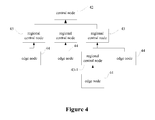
- a specific implementation situation of the cluster structure is a tree structure, as shown in Figure 4 .
- each node periodically transmits a "heartbeat" message (i.e., a report message) to its upper-level node (shortened as a parent node hereinafter).
- the heartbeat message may include at least one of the following: EstimatedStay, Bw, R usage and Freq serve .
- the parent node collects information including a heartbeat message of a lower-level node and the "heartbeat" message of its own, and periodically sends an accumulation report to its own parent node.
- the central node will have recent or latest information sufficient for calculating the G St value of each node, the central node may classify the nodes in a manner of a G St descending order and/or store results in the manner of a classified candidate node list, and the central node maintains the classified candidate node list based on the recent information of the nodes.
- the heartbeat message of a certain node may be tested whether the node has left the system for a certain reason.
- each segment 31A is circularly distributed between these storage nodes.
- the method for distributing the segments is: assigning an initial segment to the candidate node with the highest G st value, and then, distributing the second segment to the candidate node with the second highest G st value, and so on in a similar fashion.
- the node to distribute content sends the segment 31A to each allocated node, and the node stores the received segment 31A in the data storage device 16C.
- the user will not continue to watch the following segments of the content if the user is not interested in the content watched; and that, on the other hand, if the user has no time to continue watching the content after watching the initial several segments, the user will not watch the content of the following segments, either, the number of copies of the initial segment or the initial several segments of the content (or referred to as file) to be distributed which is stored in the system needs to be greater than the number of copies of the following segments of the content, that is, multiple storage nodes are selected to store the initial segment or the initial several segments of the file.
- the content to be distributed may be divided into multiple segments (such as the segments 31A in Figure 3A ), and each segment is stored in one or more nodes in the system.
- the above embodiment provides a Media Segment Distributing (MSD) method which can make a selection of storing which segments in which nodes according by combining information such as the stability of the node, the available up-link bandwidth, and the recent stream service load/frequency, and can distribute each segment of the file to different nodes to store.
- MSD Media Segment Distributing
- the data processor 16A can enable some segments 31A of the media file 31 to be stored in the data storage device 16C. These stored segments may be used and downloaded by other nodes in the system 10, especially the segments of the content of some hot programs (such as the files the users click more frequently) need to be stored in the system 10, considering the factor of users' watching in practice, the initial several segments 31A of the media content are more likely to be select to store in the system 10 than the following segments of the content.
- all the segments of the content of a file are stored in the data storage device 16C for at least some time.
- the segments stored in a local storage device 16C are allowed to be quickly forwarded or played back, as long as the segments are stored in reception nodes, the content (such as video) can be played at the reception nodes, it is not necessary to download the segments, each of the nodes may be configured with a time length during which the program is allowed to be played back.
- the complete copy (including all the segments of the file) of the content file 31 can be stored in the selected nodes (for example, the nodes which are always on line) which are very stable. Only when none of the other nodes has the content requested by the user, the request of the user is redirected to this kind of nodes (such as the central node 42 in Figure 4 ), which ensures the existence of "seed" of the program content.
- FIG 4 is a schematic diagram of a tree structure cluster formed by a service redirecting system according to an embodiment of the present invention. As shown in Figure 4 , except the central node, the other nodes are either directly connected to the central node, or connected to the central node through intermediate nodes. In Figure 4 , the cluster only contains one central node 42, the multiple nodes directly connected to the central node are referred to as regional central nodes 43, the lowest-level nodes are referred to as edge nodes 44 which are closest to the users, wherein the regional central nodes 43 are the upper-level nodes or the parent nodes of the edge nodes 44.
- the organization structure of the cluster is in logic, and only relates to routing, according to the routing, the edge nodes and the central nodes may communicate with each other.
- the arrangement of each node in the cluster is not necessarily affected by the network structure or the geographical location of the nodes.
- the central node 42 is used to store all the content to be distributed and to distribute the content, which may refer to the description concerning content distribution in the method embodiment in Figure 3 and Figure 3A in particular;
- the regional central node 43 is used to maintain and manage information (such as the heartbeat massages reported by the edge nodes) of the regional central node 43 and of each edge node 44 in the region, to store the content distributed by the central node, and to store the corresponding relation (e.g.
- the regional central node 43 may also include a lower-level regional central node 43-1, and forms a hierarchical structure.
- the service redirecting system may differently restrict the structure and the scale of the cluster in different way.
- all the nodes belonging to a certain cluster are required to be N levels or N hops at most, and the N levels or the N hops are referred to as the restriction on the scope or the size of the cluster.
- the number of the levels from one node to the central node through the tree structure is referred to as the scope of the node.
- a cluster may be formed through the following two different modes:
- the cluster is formed by allowing a node's request of participating in an existing cluster
- an on-line node i can communicate with a node j of a cluster to request to participate in the cluster, if the scope of the node j is smaller than the scope of the cluster (for example, not reaching the N levels), the node i may be requested to participate in the cluster to which the node j belongs and acts as a sub node of the node j.
- the cluster is formed by creating a new cluster
- the node i requests to participate in the cluster to which the node j belongs, if the scope of the node j equals to the scope of the cluster (for example, reaching the N levels), the request node i may create a new cluster (for example, this node becomes the central node of the cluster newly created).
- different clusters have identical or similar sizes, and the size may be managed, which can be specifically controlled through the following manners:
- Figure 5 is a schematic diagram of an internal structure of the service redirecting system and each node apparatus according to an embodiment of the present invention.
- Figure 5 specifies the internal structure of each node in Figure 4 .
- the nodes to be assigned to maintain and manage indexes of category content defined in advance are referred to as "Agent Nodes" of a certain category.
- the category relates to the network content, and may be included but not limited to a category describing media. For example, the categories of the films stored by the system are divided into "action”, “comedy”, “historical” and so on.
- the nodes which have stored a certain segment of the file of the content requested in the system are expected to be determined, and the stored segment 55 is used to store those segments of the category content locally stored in the node.
- the categories 1 th 2 th ... may be created for each segment of a certain file content in turn, to represent each segment of the file.
- the system after the system receives a messages of requiring to download a certain file sent by the user, the system firstly searches nodes including the first segment data of the file, and checks whether the stored segment 55 of each node contains the 1 th of the file, and then, downloads the data from the nodes searched, and further downloads the second segment data of the file from the searched node containing the 2 th of the file, and so on.
- the categories may also be based on a coefficient factor, for example, the categories may be based on two factors: a subject classification of the content and an order of the segments.
- the agent nodes may be classified according to the categories, for example, the agent node of each category maintains a keyword list (shortened as a "content index table” hereinafter) for some or all of the information belonging to the category or allocated to the category.
- the content index list includes a data structure belonging to a list of all the content keywords of a certain category.
- each entity includes the following information: a category, a keyword list, a node.
- the "category” represents a category to which the content has been distributed;
- the "keyword list” includes one or more keywords matching with the content;
- the "node” indicates that the information is stored in the node.
- an entity ⁇ CA, KL, Nx> indicates that the node Nx includes the content which belongs to the category CA and matches with the keyword KL, specifically, it may be that the node Nx includes the content which belongs to category "action" and matches with "hero".
- the content index table is only maintained in the agent node.
- the service redirecting system in Figure 5 shows a cluster structure, and the cluster has a central node 53A, a regional central node 53B, two edge nodes 53C and 53D, two agent nodes 53E and 53F, wherein each node contains a category table 54 and a locally stored segment 55, the category table 54 is used to store a mapping table between each category and agent nodes of the cluster to which the category belongs.
- Each entity in the category table may include the following data: ⁇ category, agent node, timestamp>, for example, an entity ⁇ CA, Nx, Ti> indicates that, at the moment Ti, the agent node Nx is associated with the category CA.
- the node may locate the agent node of the category corresponding to the content to be inquired.
- each agent node 53E and 53F include one or more content index tables 59A and one or more overlay link tables 59B, wherein the overlay link table 59B indicates address information of one or more agent nodes which have identical categories in other clusters.
- the category overlay related to the overlay link table is introduced hereinafter.
- the nodes in the P2P network may be divided into cluster structures. Every cluster may include one, two or more nodes. Different clusters may include different numbers of nodes. Each cluster includes several agent nodes maintaining different categories. A single node may be the agent node of multiple categories. The agent nodes of categories which belong to different clusters may be associated with each other, and the association relation may be formed by the links between the agent nodes of different clusters. A link includes an address record or other contact information of the agent nodes of the category maintained by other nodes. In some specific cases, each agent node contains an overlay link list which lists multiple address information of the agent nodes of the category in other clusters. This association between the agent nodes of different clusters is referred to as "category overlay". The overlay of multiple categories may be constructed, and each category overlay is corresponding to a category. Since different clusters may include different numbers of the nodes, a certain node may belong to multiple category overlays.
- Figure 6 is a schematic diagram of a service redirecting system according to an embodiment of the present invention, and the system is applied to the IPTV system of the P2P technology to realize category overlay of the content searched and looked up.
- Figure 6 shows an example in which the nodes are organized into a cluster 60A, a cluster 60B, and a cluster 60C, and multiple category overlays 62A, 62B, and 62C.
- an agent node is allocated to one of the three defined categories: Ca1, Ca2, and Ca3.
- the agent node N1 is associated with the category Ca2
- the agent node N2 is associated with the category Ca2
- the agent node N3 is associated with the category Ca2.
- the nodes N1, N2, N3 are all the agent nodes of the category Ca2, these three agent nodes may associate with each other to form the category overlay 62B.
- the category overlays 62A and 62C may be formed for the agent nodes of the categories Ca1 and Ca3, respectively.
- the parent nodes and the sub nodes form a topology of the cluster
- the overlay link table 59B forms a topology of the category overlay, i.e., the topology between different clusters.
- the node may send a request message for querying a certain content, the request includes the category to be queried, and the keyword list associated with the information to be searched from the system.
- the node i.e., a request node
- sending a query request may locate the agent nodes associated with the categories, and sends the request message to the agent nodes associated with the categories.
- the agent nodes receive the query request, query information which matches with the keywords in the keyword list from the content index table of the agent nodes, and send the queried result, i.e., information of the node in which the keyword content is stored, to the request node.
- the agent nodes receiving the query request may query information matching with the querying keyword in its content index table 59A, and return the query results to the request node.
- the query results may include a node list in which information which satisfies query conditions is stored.
- the agent node of the category CA receives the query request message, the agent node carries out query locally, looks for the agent node of the category CA in another cluster according to the overlay link list, and forwards the query request to the agent node of corresponding category overlay contained in the overlay link list.
- another agent node receives the forwarded query, it checks and determines whether it is the first time to receive the query, if it is the first time to receive the query, a local query is performed; otherwise, the query request may be neglected, specifically, it can be realized through DHT.
- a query request only needs to be transmitted in the category overlay related to the query, which is more efficient compared with query all the nodes in the manner of flooding in the prior art.
- the flooding of each category at most contains N peer nodes.
- a query request is only transmitted among the agent nodes related to its category overlay, the number of nodes relating to the query request is very small, and the query speed is fast.
- the node related to the user may sends a request for querying "country" category, the query request includes a keyword list containing the names of the singers or the names of the songs, and the address of the node storing what matching with the query may be returned through the agent node.
- the request node may also determine nodes for storing the segments of a certain file by using a category overlay search. For example, if the segment of the requested file is the Nth segment (N th ), the request node may determine the agent node which is associated with the Nth segment of the file, so as to send a query request to the agent node containing the Nth segment category, the agent node searches and returns one or more node lists storing the Nth segment of the requested file.
- FIG. 7 is a flow chart of a service redirecting method according to an embodiment of the present invention. As shown in Figure 7 , the following processing procedure is included:
- a request message such as an IPTV request
- one or more nodes for storing each segment of the content are determined from the central node, the regional central node, or the agent node, for example, the node storing the content and the address corresponding to the node are obtained from the content index table of the agent node
- the request node sending the request message may download/pull down each segment of the content from the determined one or more nodes, and finally the complete content data is obtained according to the each segment of the content.
- the service redirecting method of the present embodiment is used to provide downloading/pulling down media data.
- the present embodiment may be used as media content pulled down to the reception node, the media content may consist of several segments, and these segments are stored in the nodes of the network.
- the nodes may search the nodes which store the content requested by the user, preferably, form the determined one or more nodes storing each segment of the content requested by the user into a node list, and download the content requested by the user from the node list.
- the scheduling method solves how to download the segment from M storage nodes, such that there is less initial buffer time from each block of the segment to the reception node, and each block can be downloaded as early as possible.
- Step S76 of the embodiment in Figure 7 may be realized in the following three ways:
- the determined nodes (referred as storage nodes) for storing the segments are numbered as 1, 2,..., M. According to the order from 1 to M, data blocks are downloaded/pulled down from each storage node.
- the manner in which the data blocks are downloaded/pulled down using the round robin method treat all the storage nodes equally by allocating identical number of blocks for each storage node, no matter how much bandwidth each storage node may donate to stream media session.
- Figure 7A is a schematic diagram of a distributing order for using a service redirecting method according to an embodiment of the present invention to realize downloading/pulling down data blocks based on around robin method.
- Figure 7A shows a specific embodiment of downloading/pulling down eight data blocks (B1-B8) with the same size from three storage nodes (P1-P3) using the RR method.
- the number of the blocks allocated to each storage node is proportional to the bandwidth of the node.
- the storage node Pi is designated to download/pull down Bwi/Br data blocks, wherein Bwi is the bandwidth of the node i, and Br is the playing speed.
- the method of downloading/pulling down the data blocks using the BP method may make full use of the bandwidth of each storage node.
- Figure 7B is a schematic diagram of a distributing order for using a service redirecting method according to an embodiment of the present invention to realize downloading/pulling down data blocks based on bandwidth.
- Figure 7B shows a specific embodiment of downloading/pulling down eight data blocks (B1-B8) with the same size from three storage nodes (P1-P3) using the BP method.
- the playing speed Br is 512kbps
- each block contains video content with the playing time of 1 second
- the bandwidth of the storage node P1 is 320kbps (5/8 ⁇ Br)
- the bandwidth of P2 is 128kbps (1/4 ⁇ Br)
- the bandwidth of P3 is 64kbps (1/8 ⁇ Br)
- the BP method may effectively use the bandwidth of each storage node.
- the initial several data blocks are allocated to one node, only the bandwidth of one node is used to download/pull down the initial several data blocks. If the initial several data blocks are desired to be cached, it may take longer to cache these initial several data blocks than to download/pull down the initial several data blocks.
- the multi-source method is a method using Multi-Source Scheduling (MSS), this method combines the advantages of the RR and the BP, and the main process of the method is: the data blocks of one segment are allocated to a storage node in the manner of the RR, in each circulation, the number of the data blocks allocated to the node is proportional to the bandwidth of the node.
- MSS Multi-Source Scheduling
- the storage nodes may be classified according to the manner of the descending order of the bandwidth Bw. Assuming that the earliest time when a storage node Pi begins to send the current data block is Ti, if the storage node Pi has not sent the data blocks yet, the Ti is the current time; if the storage node has sent several data blocks, the Ti is the time when the storage node finishes the transmission of the data blocks. The initial value of Ti is set as 0.
- the data blocks of the segment to be downloaded/pulled down are allocated to the storage node in the order in which the data blocks are numbered, and is started from the first data block B 1 .
- the reception node may firstly calculate an estimation value of the time it takes to complete the downloading of the block from each storage node.
- T finish(i) is the estimation value of the completion time of the storage node Pi
- Size is the size of the current block B current .
- the MSS method is to allocate the storage nodes providing blocks based on the estimation value of the completion time of the current block.
- the node with the lowest estimation value of the completion time delivers the current data block to a user terminal.
- the MSS method ensures that the allocated storage nodes are in a direct proportion to the bandwidth which can be provided by the storage nodes. After receiving the previous blocks, the reception node will download the next block as quick as possible.
- Figure 7C is a schematic diagram of a distributing order for using a service redirecting method according to an embodiment of the present invention to realize downloading/pulling down data blocks based on a multi-source method.
- Figure 7C shows a specific embodiment of downloading/pulling down eight data blocks (B1-B8) with the same size from three storage nodes (P1-P3) using the MMS method.
- the RR method, the BP method and the MSS method can be compared with each other through Figure 7A- Figure 7C .
- Figure 7A- Figure 7C it can be known that the delivery of eight blocks costs 16 seconds by using the RR method, while the delivery of the same blocks only costs eight seconds by using the BP method and the MSS method.
- the BP method and the MSS method are different in the time for completing the delivery of the initial several blocks. If the number of initial buffer blocks is three, it takes 8 seconds to finish the delivery of the 3 blocks by using the RR method. By comparison, it takes 4.8 seconds to finish the delivery of the 3 blocks by using the BP method, while it only takes 4 seconds to finish the delivery of the 3 blocks by using the MSS method.
- the three scheduling methods of RR, BP, and MSS in Figure 7A- Figure 7C it is sufficiently explained that it is possible to take less time to download each block, and obtain less initial buffer time.
- the reception node may pull down the second segment and the following segments simultaneously, until the complete file has been pulled down to the reception node.
- the reception node determines a node list storing the initial segment of the content file through an agent node.
- the reception node prepares to download/pull down other segments of the expected media content, the initial segment has been downloaded/pulled down from one or more nodes.
- the reception node may use the scheduling methods shown illustrated by Figure 7A- Figure 7C to calculate the bandwidth of the selected storage node, and begin to pull down the data content from the initial segment to the reception node in the scheduling method similar to the MSS.
- a method for searching Category Overlay is also provided. Performing service redirection by using the searching method can locate the media segment requested for an IPTV streaming session.
- the method for searching Category Overlay is used during a stream media session, and it is not necessary to finish downloading of all the segments requested before the media playing.
- a segment of a video file may be further divided into multiple blocks, which is helpful to parallel reception of different parts of a segment which are from different storage nodes, and to the accumulation of up-link bandwidth from different storage nodes.
- the MSS method may be used to select the allocation order of each block of a segment and the storage nodes, and to coordinate downloading/pulling down of each storage node to ensure the service of one IPTV request in time.
- the method for searching Category Overlay may be used to the unstructured network based on P2P overlay of the P2P technology of the cluster, and the structure allows the separation between the flow produced by searching and the system maintenance.
- category overlay search is performed, the number of the messages produced by performing the search may be limited, classified search may be performed according to category and cluster/region, and moreover, flow of index may be search through isolation.
- the content requested or searched currently may include Metadata.
- the metadata may determine each segment of a video file corresponding to a certain scene.
- the metadata may include relatively detailed information related to segment information content, so as to facilitate accurate determination of a specific segment.
- the segment in which a certain actor or actress is a lead actor may be determined through the metadata, which is helpful for the users' watching, and improves the experience of the users.
- the metadata allows intelligent search on content.
- the metadata may be included in one or more initial segments of the content, such that the metadata may be obtained and used immediately by a playing device of a reception node.
- the segment of the expected scene beginning to play can be accurately determined, and the playing device may also be configured to play content, such that it can provide fast forwarding or turning back to a particular logical scene, subsequent location, caching, and playing from a determined segment.
- FIG 8 is a schematic diagram of using a service redirecting method according to an embodiment of the present invention to realize a transmission of data to users using accumulated bandwidth.
- the reception node P6 searches segment# 0 of the video, and finds that the nodes P1, P2 and P3 include the segment# 0, at this time, the reception node P6 may select P1, P2, P3 as the nodes providing the segment# 0, and calculate the bandwidth for pulling down the segment# 0 of P1, P2, P3.
- segment# 1 is pulled down from P3, P4; and segment#2 is pulled down from P4, P5.
- the reception node P6 may cache each segment pulled down in the storage space provided by the storage node, in this way, based on the segment stored, the reception node P6 may provide content service for other nodes.
- the reception node may send a scheduling command to the storage node which is selected to provide the media content service; when the storage node receives the scheduling command, the storage node may send blocks allocated during scheduling to the reception node (or user terminal).
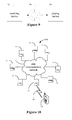
- FIG. 9 is a schematic diagram of using a service redirecting method according to an embodiment of the present invention to realize a transmission of data blocks to users using a round robin method.
- a reception node may maintain a circular cache 90. Once a reception device 92 in the reception node receives a block from the storage node, the reception node may insert the block to a correct position in the circular cache 90, and play the block through a playing device 94.
- the size of the circular cache 90 may be expressed as ⁇ buff ⁇ N sche ⁇ blk_Size, wherein ⁇ buff is a parameter and ⁇ buff >1, N sche represents the number of the data blocks scheduled, and blk_Size represents the size of a data block.
- the reception node In order to be adaptive to delay of a stream media package or a certain node's departure from the system or a fault, before playing a media file, the reception node should at least be able to cache S initBuff (initial cache) blocks. After initial cache time, the reception node may continually read media data from the circular cache 90 and play the media file.
- S initBuff initial cache
- the reception node may monitor the state of the circular cache 90, and track the received blocks. Before the received blocks are scheduled to be played, each block at least receives certain set time (referred to as T adv seconds). If the block fails to receive the set time, the block may be determined as "lost". Thus, the reception node may to the corresponding nodes a request for re-transmitting the lost blocks, which ensures the quality and the accuracy of transmission.
- T adv seconds certain set time
- an alternative node of the node may be selected.
- the minimum value of a reception rate may be preset, for one or more nodes (which may also be shortened as failure nodes) whose reception rate is smaller than the minimum value or one or more nodes (which may also be shortened as failure nodes) which leave the system, the alternative nodes may be selected for them, and the segments and/or the blocks stored in the failure nodes are downloaded/pulled down from the selected alternative nodes.
- the reception node may select one or more alternative nodes from the nodes of the requested segment.
- the reception node may select another node to replace the node that has left the system or has malfunctioned.
- the reception node may produce a stream delivery scheduling formed by new nodes which haven't received a block.
- the reception node sends a modified scheduling (that is, from which nodes the currently received blocks are received) to the alternative nodes.
- the new nodes may send the allocated blocks to the reception node according to the order instructed in the scheduling.
- the process may be referred to as "provider switching".
- the reception node (or the user terminal) may monitor the rate of the content received from each storage node.
- the reception node may perform the above provider switching processing.
- the initial cache may be selected to be sufficiently large, such that the playing can be continued without interruption even if the phenomenon of the provider switching happens.
- each embodiment of the present invention support to search shared information in a relatively large scope of nodes.
- the function of service redirecting can be distributed in many nodes, the maximum number of the nodes can reach the degree of the product of the number of categories and the number of the clusters in the system.
- For the maintenance of the system for example, content index, automatically combining new nodes or processing leaving of nodes, may also be performed in many nodes separately.
- the service redirecting method of the embodiment of the present invention can use a case where the up-link bandwidth of the node in the network is smaller than the downlink bandwidth (e.g. ADSL). For example, the rate of a single node uploading data is relatively low, while the rate of pulling down/downloading data from multiple nodes to the reception node is relatively high.
- ADSL downlink bandwidth
- the content distributing method and the service redirecting method provided by the above each embodiment of the present invention may extend the IPTV system, and can be used in devices besides the system.
- the content may be delivered to a Personal Digital Assistant (PDA), a mobile phone and so on, specifically, it can be realized by using proxy nodes as the reception nodes, after the proxy nodes download/pull down the content from system nodes, the proxy nodes themselves can play the content and may also forward the content downloaded to other device (e.g. mobile phone).
- PDA Personal Digital Assistant
- FIG 10 is a schematic diagram of an extended structure of an IPTV system applying a service redirecting system according to an embodiment of the present invention to P2P technology.
- Figure 10 shows a system 10A which contains a proxy node 10.
- the proxy node 10 receives content data by communicating with other node 12, through a communication link 14A, the proxy node 10 also communicates with a node 100 which does not participate in the system 10A, the communication link 14A may include a wireless connection.
- the proxy node 10 interacts with the other parts of the system 10A, and forwards the received content data to the node 100 through the communication link 14A.
- the node 100 specifically can be a commonly used mobile phone.
- a mobile phone user can search videos in the system 10A, and then plays the videos on the mobile phone.
- the rate of the content data may be decreased by performing transcoding at the proxy node 10, so as to be adaptive to the node 100 and/or the communication link 14A.
- relevant explanations of the embodiments in Figure 1- Figure 9 and no repeated description about the identical or similar content is given here.
- the IPTV system in the above system embodiment is convenient to extend, and can provide a better load balance among the nodes.
- a "super node" capable of independently handling all the searching services of the system may not be set.
- the association can be carried out in two ways: on one hand, the node is associated to the cluster, for example, maintenance tasks such as determining which node is the proxy node of which cluster may be associated by using the topology structure of the cluster; on the other hand, the agent nodes are associated in the category overlay, for example, a searching task of the service redirecting node may be managed by using a corresponding category overlay topology.
- the content is divided into several segments, and distributed to multiple different storage nodes, the requests of the users may be responded from multiple nodes separately, the extensibility of the IPTV system can be effectively improved, the functions such as IPTV media service directing are completed.
- Each of the above embodiments may also provide effective keyword with a large scale to search services based on a P2P network model, which effectively shortens the time for service redirecting.
Landscapes
- Engineering & Computer Science (AREA)
- Multimedia (AREA)
- Computer Networks & Wireless Communication (AREA)
- Signal Processing (AREA)
- Information Transfer Between Computers (AREA)
Applications Claiming Priority (2)
| Application Number | Priority Date | Filing Date | Title |
|---|---|---|---|
| CN200810110325.XA CN101594292A (zh) | 2008-05-30 | 2008-05-30 | 内容发布方法、服务重定向方法及系统、节点设备 |
| PCT/CN2008/073616 WO2009143686A1 (zh) | 2008-05-30 | 2008-12-19 | 内容发布方法、服务重定向方法及系统、节点设备 |
Publications (2)
| Publication Number | Publication Date |
|---|---|
| EP2290912A1 true EP2290912A1 (de) | 2011-03-02 |
| EP2290912A4 EP2290912A4 (de) | 2016-08-24 |
Family
ID=41376562
Family Applications (1)
| Application Number | Title | Priority Date | Filing Date |
|---|---|---|---|
| EP08874451.1A Withdrawn EP2290912A4 (de) | 2008-05-30 | 2008-12-19 | Inhaltsverteilungsverfahren, dienstumleitverfahren und system und knoteneinrichtung |
Country Status (3)
| Country | Link |
|---|---|
| EP (1) | EP2290912A4 (de) |
| CN (1) | CN101594292A (de) |
| WO (1) | WO2009143686A1 (de) |
Cited By (7)
| Publication number | Priority date | Publication date | Assignee | Title |
|---|---|---|---|---|
| CN102395047A (zh) * | 2011-10-25 | 2012-03-28 | 深圳市同洲电子股份有限公司 | 删除内容发布网络节点中多媒体内容的方法及设备 |
| US20120117240A1 (en) * | 2010-11-05 | 2012-05-10 | Verizon Patent And Licensing Inc. | Systems and methods for allocating network bandwidth |
| CN102802053A (zh) * | 2012-07-23 | 2012-11-28 | 深圳市融创天下科技股份有限公司 | 一种音视频文件转码集群调度方法及装置 |
| CN103312795A (zh) * | 2013-05-31 | 2013-09-18 | 合一网络技术(北京)有限公司 | 一种p2p系统中种子分发方法和装置 |
| WO2016099356A1 (en) * | 2014-12-18 | 2016-06-23 | Telefonaktiebolaget Lm Ericsson (Publ) | Method and content management module for managing content in a content distribution network |
| CN109246487A (zh) * | 2018-08-17 | 2019-01-18 | 上海悠络客电子科技股份有限公司 | 一种智能调度系统 |
| CN109600683A (zh) * | 2018-12-05 | 2019-04-09 | 深圳市网心科技有限公司 | 一种视频点播方法、装置及其相关设备 |
Families Citing this family (18)
| Publication number | Priority date | Publication date | Assignee | Title |
|---|---|---|---|---|
| CN102196297B (zh) * | 2011-03-24 | 2014-03-26 | 东莞中山大学研究院 | 一种多服务器视频点播资源的聚类处理方法 |
| CN102609278B (zh) * | 2011-12-06 | 2015-07-08 | 北京航空航天大学 | 软件分发方法和装置 |
| CN103166851B (zh) * | 2011-12-16 | 2016-06-15 | 中国电信股份有限公司 | 互联网信息的传送处理方法与系统 |
| CN102761550B (zh) * | 2012-07-04 | 2015-09-23 | 青岛海信传媒网络技术有限公司 | 实现流媒体服务的方法、装置及系统 |
| CN102833581B (zh) * | 2012-08-27 | 2015-09-16 | 中兴通讯股份有限公司 | 内容管理的方法和系统 |
| WO2017035789A1 (zh) * | 2015-09-01 | 2017-03-09 | 深圳好视网络科技有限公司 | 一种数据传输方法及系统 |
| CN105553685B (zh) * | 2015-10-13 | 2019-06-28 | 福州开发区慧聚通信技术有限公司 | 一种监控网络设备是否在线的系统和方法 |
| CN107277561A (zh) * | 2016-04-08 | 2017-10-20 | 北京优朋普乐科技有限公司 | 内容分发网络 |
| CN106713468B (zh) * | 2016-12-29 | 2018-11-20 | 深圳云天励飞技术有限公司 | 一种分布式集群服务系统及其节点协同方法 |
| CN107707519A (zh) * | 2017-07-10 | 2018-02-16 | 贵州白山云科技有限公司 | 一种流媒体传输方法、装置和系统 |
| CN109819285B (zh) * | 2017-11-21 | 2021-09-21 | 北京乐我无限科技有限责任公司 | 一种直播方法、装置、电子设备及存储介质 |
| CN110971627B (zh) * | 2018-09-28 | 2022-08-05 | 杭州海康威视数字技术股份有限公司 | 节点控制方法及装置、任务处理系统 |
| CN110191143B (zh) * | 2018-12-13 | 2022-09-30 | 浙江宇视科技有限公司 | 一种资源发布方法、装置及系统 |
| CN112565811B (zh) * | 2020-12-07 | 2022-09-20 | 福建大屏网络科技有限公司 | 一种互联网电视去中心化边缘节点分发系统 |
| CN113157207B (zh) * | 2021-04-07 | 2022-03-08 | 橙色云互联网设计有限公司 | 一种数据处理方法、装置及存储介质 |
| CN115695560B (zh) * | 2021-07-23 | 2024-11-08 | 伊姆西Ip控股有限责任公司 | 内容分发方法、电子设备和计算机程序产品 |
| CN118890349A (zh) * | 2024-08-01 | 2024-11-01 | 福建天晴在线互动科技有限公司 | 一种文件下载优化的方法与系统 |
| CN119030855B (zh) * | 2024-09-03 | 2026-01-16 | 济南浪潮数据技术有限公司 | 基于网元探测机制的流量引流方法及相关组件 |
Family Cites Families (5)
| Publication number | Priority date | Publication date | Assignee | Title |
|---|---|---|---|---|
| US20030204602A1 (en) * | 2002-04-26 | 2003-10-30 | Hudson Michael D. | Mediated multi-source peer content delivery network architecture |
| US20060224760A1 (en) * | 2005-03-15 | 2006-10-05 | 1000 Oaks Hu Lian Technology Development (Beijing) Co., Ltd. | Method and system for providing streaming content in a peer-to-peer network with network coding |
| US20070288638A1 (en) * | 2006-04-03 | 2007-12-13 | British Columbia, University Of | Methods and distributed systems for data location and delivery |
| CN101136911B (zh) * | 2006-08-31 | 2010-12-15 | 腾讯科技(深圳)有限公司 | 一种采用p2p技术下载文件的方法和p2p下载系统 |
| CN100566233C (zh) * | 2006-09-25 | 2009-12-02 | 腾讯科技(深圳)有限公司 | 一种数据同步方法及流媒体发布源端、接收端和后台服务器 |
-
2008
- 2008-05-30 CN CN200810110325.XA patent/CN101594292A/zh active Pending
- 2008-12-19 WO PCT/CN2008/073616 patent/WO2009143686A1/zh not_active Ceased
- 2008-12-19 EP EP08874451.1A patent/EP2290912A4/de not_active Withdrawn
Cited By (9)
| Publication number | Priority date | Publication date | Assignee | Title |
|---|---|---|---|---|
| US20120117240A1 (en) * | 2010-11-05 | 2012-05-10 | Verizon Patent And Licensing Inc. | Systems and methods for allocating network bandwidth |
| CN102395047A (zh) * | 2011-10-25 | 2012-03-28 | 深圳市同洲电子股份有限公司 | 删除内容发布网络节点中多媒体内容的方法及设备 |
| CN102802053A (zh) * | 2012-07-23 | 2012-11-28 | 深圳市融创天下科技股份有限公司 | 一种音视频文件转码集群调度方法及装置 |
| CN103312795A (zh) * | 2013-05-31 | 2013-09-18 | 合一网络技术(北京)有限公司 | 一种p2p系统中种子分发方法和装置 |
| CN103312795B (zh) * | 2013-05-31 | 2016-12-28 | 合一网络技术(北京)有限公司 | 一种p2p系统中种子分发方法和装置 |
| WO2016099356A1 (en) * | 2014-12-18 | 2016-06-23 | Telefonaktiebolaget Lm Ericsson (Publ) | Method and content management module for managing content in a content distribution network |
| US10148783B2 (en) | 2014-12-18 | 2018-12-04 | Telefonaktiebolaget Lm Ericsson (Publ) | Method and content management module for managing content in a content distribution network |
| CN109246487A (zh) * | 2018-08-17 | 2019-01-18 | 上海悠络客电子科技股份有限公司 | 一种智能调度系统 |
| CN109600683A (zh) * | 2018-12-05 | 2019-04-09 | 深圳市网心科技有限公司 | 一种视频点播方法、装置及其相关设备 |
Also Published As
| Publication number | Publication date |
|---|---|
| EP2290912A4 (de) | 2016-08-24 |
| WO2009143686A1 (zh) | 2009-12-03 |
| CN101594292A (zh) | 2009-12-02 |
Similar Documents
| Publication | Publication Date | Title |
|---|---|---|
| CN101594292A (zh) | 内容发布方法、服务重定向方法及系统、节点设备 | |
| US11870871B2 (en) | Methods and apparatus for serving content to customer devices based on dynamic content popularity | |
| US8646016B2 (en) | Content storage and delivery systems and associated methods | |
| US20070288638A1 (en) | Methods and distributed systems for data location and delivery | |
| CN101472166B (zh) | 一种内容缓存、查询方法及点对点媒体传输系统 | |
| US10506062B2 (en) | Network-optimized content delivery for high demand non-live contents | |
| US8875207B2 (en) | Content storage and delivery system and associated method and device | |
| CN101911636B (zh) | 一种用于管理存储于内容分发网络中的内容项的方法及内容分发网络 | |
| US20080091840A1 (en) | Method and System for Caching Streaming Multimedia on the Internet | |
| CN102474524B (zh) | 用于对等网络中的针对性广告的方法 | |
| EP2109289A1 (de) | Inhaltsverteilung | |
| JP2004501556A (ja) | 選択的ルーティング | |
| WO2008054623A2 (en) | Method and apparatus for controlling information available from content distribution points | |
| CN101394423B (zh) | 一种媒体定位、搜索方法和系统 | |
| CN101800731B (zh) | 网络传输管理服务器、网络传输管理方法及网络传输系统 | |
| CN113676514B (zh) | 一种文件回源方法及装置 | |
| Shen et al. | A DHT-aided chunk-driven overlay for scalable and efficient peer-to-peer live streaming | |
| TW201234194A (en) | Data stream management system for accessing mass data | |
| EP2158547A1 (de) | Push-caching-schema für eine werbearchitektur mit spätanbindung | |
| CN101997891A (zh) | 一种p2p媒体流分发的方法、装置及系统 | |
| US8583819B2 (en) | System and method for controlling server usage in peer-to-peer (P2P) based streaming service | |
| Claeys et al. | Cooperative announcement-based caching for video-on-demand streaming | |
| WO2009135374A1 (zh) | Iptv媒体交付系统、iptv媒体内容发布方法、及媒体交付系统 | |
| CN115834597B (zh) | 一种内容分发方法及客户端、电子设备、存储介质 | |
| Zhang et al. | Video on-demand streaming on the internet—a survey |
Legal Events
| Date | Code | Title | Description |
|---|---|---|---|
| PUAI | Public reference made under article 153(3) epc to a published international application that has entered the european phase |
Free format text: ORIGINAL CODE: 0009012 |
|
| 17P | Request for examination filed |
Effective date: 20101228 |
|
| AK | Designated contracting states |
Kind code of ref document: A1 Designated state(s): AT BE BG CH CY CZ DE DK EE ES FI FR GB GR HR HU IE IS IT LI LT LU LV MC MT NL NO PL PT RO SE SI SK TR |
|
| AX | Request for extension of the european patent |
Extension state: AL BA MK RS |
|
| DAX | Request for extension of the european patent (deleted) | ||
| RA4 | Supplementary search report drawn up and despatched (corrected) |
Effective date: 20160727 |
|
| RIC1 | Information provided on ipc code assigned before grant |
Ipc: H04L 29/06 20060101ALI20160721BHEP Ipc: H04L 29/08 20060101AFI20160721BHEP |
|
| STAA | Information on the status of an ep patent application or granted ep patent |
Free format text: STATUS: THE APPLICATION IS DEEMED TO BE WITHDRAWN |
|
| 18D | Application deemed to be withdrawn |
Effective date: 20170223 |