EP2291228B1 - Materiau polyhipe a haute tenue mecanique, son procede de preparation, emulsion utile pour sa preparation et article constitue d'un tel materiau - Google Patents
Materiau polyhipe a haute tenue mecanique, son procede de preparation, emulsion utile pour sa preparation et article constitue d'un tel materiau Download PDFInfo
- Publication number
- EP2291228B1 EP2291228B1 EP09761676.7A EP09761676A EP2291228B1 EP 2291228 B1 EP2291228 B1 EP 2291228B1 EP 09761676 A EP09761676 A EP 09761676A EP 2291228 B1 EP2291228 B1 EP 2291228B1
- Authority
- EP
- European Patent Office
- Prior art keywords
- monomer
- alkenyltriazole
- phase
- cross
- solvent
- Prior art date
- Legal status (The legal status is an assumption and is not a legal conclusion. Google has not performed a legal analysis and makes no representation as to the accuracy of the status listed.)
- Not-in-force
Links
- 239000000463 material Substances 0.000 title claims description 73
- 239000000839 emulsion Substances 0.000 title claims description 57
- 238000004519 manufacturing process Methods 0.000 title description 7
- 239000000178 monomer Substances 0.000 claims description 70
- 239000002904 solvent Substances 0.000 claims description 32
- 238000004132 cross linking Methods 0.000 claims description 30
- XLYOFNOQVPJJNP-UHFFFAOYSA-N water Substances O XLYOFNOQVPJJNP-UHFFFAOYSA-N 0.000 claims description 23
- -1 polyethylene Polymers 0.000 claims description 19
- 239000004094 surface-active agent Substances 0.000 claims description 18
- 238000000034 method Methods 0.000 claims description 15
- 229910052739 hydrogen Inorganic materials 0.000 claims description 12
- ITUNZCVRYICLQM-UHFFFAOYSA-N 1-ethenyl-1,2,4-triazole Chemical group C=CN1C=NC=N1 ITUNZCVRYICLQM-UHFFFAOYSA-N 0.000 claims description 11
- 239000000203 mixture Substances 0.000 claims description 11
- 239000003505 polymerization initiator Substances 0.000 claims description 11
- 238000002360 preparation method Methods 0.000 claims description 11
- ZIUHHBKFKCYYJD-UHFFFAOYSA-N n,n'-methylenebisacrylamide Chemical compound C=CC(=O)NCNC(=O)C=C ZIUHHBKFKCYYJD-UHFFFAOYSA-N 0.000 claims description 10
- 239000002798 polar solvent Substances 0.000 claims description 10
- PEDCQBHIVMGVHV-UHFFFAOYSA-N Glycerine Chemical compound OCC(O)CO PEDCQBHIVMGVHV-UHFFFAOYSA-N 0.000 claims description 6
- 229920003171 Poly (ethylene oxide) Polymers 0.000 claims description 5
- NINIDFKCEFEMDL-UHFFFAOYSA-N Sulfur Chemical group [S] NINIDFKCEFEMDL-UHFFFAOYSA-N 0.000 claims description 5
- 125000003178 carboxy group Chemical group [H]OC(*)=O 0.000 claims description 5
- 235000014113 dietary fatty acids Nutrition 0.000 claims description 5
- 229930195729 fatty acid Natural products 0.000 claims description 5
- 239000000194 fatty acid Substances 0.000 claims description 5
- 150000004665 fatty acids Chemical class 0.000 claims description 5
- 125000000623 heterocyclic group Chemical group 0.000 claims description 5
- 229920000642 polymer Polymers 0.000 claims description 5
- 238000005406 washing Methods 0.000 claims description 5
- LEJBBGNFPAFPKQ-UHFFFAOYSA-N 2-(2-prop-2-enoyloxyethoxy)ethyl prop-2-enoate Chemical compound C=CC(=O)OCCOCCOC(=O)C=C LEJBBGNFPAFPKQ-UHFFFAOYSA-N 0.000 claims description 4
- HCLJOFJIQIJXHS-UHFFFAOYSA-N 2-[2-[2-(2-prop-2-enoyloxyethoxy)ethoxy]ethoxy]ethyl prop-2-enoate Chemical compound C=CC(=O)OCCOCCOCCOCCOC(=O)C=C HCLJOFJIQIJXHS-UHFFFAOYSA-N 0.000 claims description 4
- KUDUQBURMYMBIJ-UHFFFAOYSA-N 2-prop-2-enoyloxyethyl prop-2-enoate Chemical compound C=CC(=O)OCCOC(=O)C=C KUDUQBURMYMBIJ-UHFFFAOYSA-N 0.000 claims description 4
- 125000000217 alkyl group Chemical group 0.000 claims description 4
- 125000004122 cyclic group Chemical group 0.000 claims description 4
- 150000002191 fatty alcohols Chemical class 0.000 claims description 4
- 229910052760 oxygen Inorganic materials 0.000 claims description 4
- 239000001301 oxygen Substances 0.000 claims description 4
- 229920000728 polyester Polymers 0.000 claims description 4
- 230000000379 polymerizing effect Effects 0.000 claims description 4
- 239000011343 solid material Substances 0.000 claims description 4
- 229920002554 vinyl polymer Polymers 0.000 claims description 4
- 239000004698 Polyethylene Substances 0.000 claims description 3
- 229920001214 Polysorbate 60 Polymers 0.000 claims description 3
- 229910006069 SO3H Inorganic materials 0.000 claims description 3
- 239000003463 adsorbent Substances 0.000 claims description 3
- 125000001931 aliphatic group Chemical group 0.000 claims description 3
- QVGXLLKOCUKJST-UHFFFAOYSA-N atomic oxygen Chemical compound [O] QVGXLLKOCUKJST-UHFFFAOYSA-N 0.000 claims description 3
- 238000001035 drying Methods 0.000 claims description 3
- 239000007789 gas Substances 0.000 claims description 3
- 238000007210 heterogeneous catalysis Methods 0.000 claims description 3
- 229910021645 metal ion Inorganic materials 0.000 claims description 3
- 229920001451 polypropylene glycol Polymers 0.000 claims description 3
- JNYAEWCLZODPBN-JGWLITMVSA-N (2r,3r,4s)-2-[(1r)-1,2-dihydroxyethyl]oxolane-3,4-diol Chemical compound OC[C@@H](O)[C@H]1OC[C@H](O)[C@H]1O JNYAEWCLZODPBN-JGWLITMVSA-N 0.000 claims description 2
- HWSSEYVMGDIFMH-UHFFFAOYSA-N 2-[2-[2-(2-methylprop-2-enoyloxy)ethoxy]ethoxy]ethyl 2-methylprop-2-enoate Chemical compound CC(=C)C(=O)OCCOCCOCCOC(=O)C(C)=C HWSSEYVMGDIFMH-UHFFFAOYSA-N 0.000 claims description 2
- TURITJIWSQEMDB-UHFFFAOYSA-N 2-methyl-n-[(2-methylprop-2-enoylamino)methyl]prop-2-enamide Chemical compound CC(=C)C(=O)NCNC(=O)C(C)=C TURITJIWSQEMDB-UHFFFAOYSA-N 0.000 claims description 2
- DBCAQXHNJOFNGC-UHFFFAOYSA-N 4-bromo-1,1,1-trifluorobutane Chemical compound FC(F)(F)CCCBr DBCAQXHNJOFNGC-UHFFFAOYSA-N 0.000 claims description 2
- IAYPIBMASNFSPL-UHFFFAOYSA-N Ethylene oxide Chemical compound C1CO1 IAYPIBMASNFSPL-UHFFFAOYSA-N 0.000 claims description 2
- UFHFLCQGNIYNRP-UHFFFAOYSA-N Hydrogen Chemical compound [H][H] UFHFLCQGNIYNRP-UHFFFAOYSA-N 0.000 claims description 2
- 150000001335 aliphatic alkanes Chemical class 0.000 claims description 2
- 150000001412 amines Chemical class 0.000 claims description 2
- 229920001400 block copolymer Polymers 0.000 claims description 2
- STVZJERGLQHEKB-UHFFFAOYSA-N ethylene glycol dimethacrylate Substances CC(=C)C(=O)OCCOC(=O)C(C)=C STVZJERGLQHEKB-UHFFFAOYSA-N 0.000 claims description 2
- 125000005843 halogen group Chemical group 0.000 claims description 2
- 239000001257 hydrogen Substances 0.000 claims description 2
- 125000004435 hydrogen atom Chemical group [H]* 0.000 claims description 2
- AYGYHGXUJBFUJU-UHFFFAOYSA-N n-[2-(prop-2-enoylamino)ethyl]prop-2-enamide Chemical compound C=CC(=O)NCCNC(=O)C=C AYGYHGXUJBFUJU-UHFFFAOYSA-N 0.000 claims description 2
- 239000002736 nonionic surfactant Substances 0.000 claims description 2
- 125000005010 perfluoroalkyl group Chemical group 0.000 claims description 2
- 239000007870 radical polymerization initiator Substances 0.000 claims description 2
- PIYJQTKZHLLZQE-UHFFFAOYSA-N 2-methyl-n-[2-(2-methylprop-2-enoylamino)ethyl]prop-2-enamide Chemical compound CC(=C)C(=O)NCCNC(=O)C(C)=C PIYJQTKZHLLZQE-UHFFFAOYSA-N 0.000 claims 1
- 238000006555 catalytic reaction Methods 0.000 claims 1
- 125000001183 hydrocarbyl group Chemical group 0.000 claims 1
- GJQRYIOSVPEUQJ-UHFFFAOYSA-N n-[3-(prop-2-enoylamino)propyl]prop-2-enamide Chemical compound C=CC(=O)NCCCNC(=O)C=C GJQRYIOSVPEUQJ-UHFFFAOYSA-N 0.000 claims 1
- 239000002245 particle Substances 0.000 claims 1
- 229920000573 polyethylene Polymers 0.000 claims 1
- 239000012071 phase Substances 0.000 description 36
- LXEKPEMOWBOYRF-UHFFFAOYSA-N [2-[(1-azaniumyl-1-imino-2-methylpropan-2-yl)diazenyl]-2-methylpropanimidoyl]azanium;dichloride Chemical compound Cl.Cl.NC(=N)C(C)(C)N=NC(C)(C)C(N)=N LXEKPEMOWBOYRF-UHFFFAOYSA-N 0.000 description 12
- 125000004429 atom Chemical group 0.000 description 10
- SNRUBQQJIBEYMU-UHFFFAOYSA-N dodecane Chemical compound CCCCCCCCCCCC SNRUBQQJIBEYMU-UHFFFAOYSA-N 0.000 description 9
- LFQSCWFLJHTTHZ-UHFFFAOYSA-N Ethanol Chemical compound CCO LFQSCWFLJHTTHZ-UHFFFAOYSA-N 0.000 description 8
- 239000012153 distilled water Substances 0.000 description 8
- 238000006116 polymerization reaction Methods 0.000 description 8
- MYRTYDVEIRVNKP-UHFFFAOYSA-N 1,2-Divinylbenzene Chemical compound C=CC1=CC=CC=C1C=C MYRTYDVEIRVNKP-UHFFFAOYSA-N 0.000 description 6
- CSCPPACGZOOCGX-UHFFFAOYSA-N Acetone Chemical compound CC(C)=O CSCPPACGZOOCGX-UHFFFAOYSA-N 0.000 description 6
- WEVYAHXRMPXWCK-UHFFFAOYSA-N Acetonitrile Chemical compound CC#N WEVYAHXRMPXWCK-UHFFFAOYSA-N 0.000 description 6
- 210000004027 cell Anatomy 0.000 description 6
- BGHCVCJVXZWKCC-UHFFFAOYSA-N tetradecane Chemical compound CCCCCCCCCCCCCC BGHCVCJVXZWKCC-UHFFFAOYSA-N 0.000 description 6
- 125000004432 carbon atom Chemical group C* 0.000 description 5
- 239000003795 chemical substances by application Substances 0.000 description 5
- 150000001875 compounds Chemical class 0.000 description 5
- 150000002430 hydrocarbons Chemical group 0.000 description 5
- 150000003839 salts Chemical class 0.000 description 5
- IAZDPXIOMUYVGZ-UHFFFAOYSA-N Dimethylsulphoxide Chemical compound CS(C)=O IAZDPXIOMUYVGZ-UHFFFAOYSA-N 0.000 description 4
- 229920000463 Poly(ethylene glycol)-block-poly(propylene glycol)-block-poly(ethylene glycol) Polymers 0.000 description 4
- PPBRXRYQALVLMV-UHFFFAOYSA-N Styrene Chemical compound C=CC1=CC=CC=C1 PPBRXRYQALVLMV-UHFFFAOYSA-N 0.000 description 4
- 240000008042 Zea mays Species 0.000 description 4
- 125000003118 aryl group Chemical group 0.000 description 4
- 125000000753 cycloalkyl group Chemical group 0.000 description 4
- 239000003999 initiator Substances 0.000 description 4
- ZMXDDKWLCZADIW-UHFFFAOYSA-N N,N-Dimethylformamide Chemical compound CN(C)C=O ZMXDDKWLCZADIW-UHFFFAOYSA-N 0.000 description 3
- 239000008346 aqueous phase Substances 0.000 description 3
- 239000003054 catalyst Substances 0.000 description 3
- 239000002270 dispersing agent Substances 0.000 description 3
- 229910052757 nitrogen Inorganic materials 0.000 description 3
- 229920001983 poloxamer Polymers 0.000 description 3
- 229920000136 polysorbate Polymers 0.000 description 3
- 229910052700 potassium Inorganic materials 0.000 description 3
- 239000011591 potassium Substances 0.000 description 3
- USHAGKDGDHPEEY-UHFFFAOYSA-L potassium persulfate Chemical compound [K+].[K+].[O-]S(=O)(=O)OOS([O-])(=O)=O USHAGKDGDHPEEY-UHFFFAOYSA-L 0.000 description 3
- 0 *c1nc(*)n[n]1C=C Chemical compound *c1nc(*)n[n]1C=C 0.000 description 2
- SMZOUWXMTYCWNB-UHFFFAOYSA-N 2-(2-methoxy-5-methylphenyl)ethanamine Chemical compound COC1=CC=C(C)C=C1CCN SMZOUWXMTYCWNB-UHFFFAOYSA-N 0.000 description 2
- NIXOWILDQLNWCW-UHFFFAOYSA-N 2-Propenoic acid Natural products OC(=O)C=C NIXOWILDQLNWCW-UHFFFAOYSA-N 0.000 description 2
- OMPJBNCRMGITSC-UHFFFAOYSA-N Benzoylperoxide Chemical compound C=1C=CC=CC=1C(=O)OOC(=O)C1=CC=CC=C1 OMPJBNCRMGITSC-UHFFFAOYSA-N 0.000 description 2
- RTZKZFJDLAIYFH-UHFFFAOYSA-N Diethyl ether Chemical compound CCOCC RTZKZFJDLAIYFH-UHFFFAOYSA-N 0.000 description 2
- 241000283986 Lepus Species 0.000 description 2
- FXHOOIRPVKKKFG-UHFFFAOYSA-N N,N-Dimethylacetamide Chemical compound CN(C)C(C)=O FXHOOIRPVKKKFG-UHFFFAOYSA-N 0.000 description 2
- SECXISVLQFMRJM-UHFFFAOYSA-N N-Methylpyrrolidone Chemical compound CN1CCCC1=O SECXISVLQFMRJM-UHFFFAOYSA-N 0.000 description 2
- ZLMJMSJWJFRBEC-UHFFFAOYSA-N Potassium Chemical compound [K] ZLMJMSJWJFRBEC-UHFFFAOYSA-N 0.000 description 2
- 239000004809 Teflon Substances 0.000 description 2
- 229920006362 Teflon® Polymers 0.000 description 2
- GWEVSGVZZGPLCZ-UHFFFAOYSA-N Titan oxide Chemical compound O=[Ti]=O GWEVSGVZZGPLCZ-UHFFFAOYSA-N 0.000 description 2
- 239000002250 absorbent Substances 0.000 description 2
- 230000002745 absorbent Effects 0.000 description 2
- 239000002253 acid Substances 0.000 description 2
- 210000003850 cellular structure Anatomy 0.000 description 2
- 238000012669 compression test Methods 0.000 description 2
- 239000000470 constituent Substances 0.000 description 2
- ZUOUZKKEUPVFJK-UHFFFAOYSA-N diphenyl Chemical compound C1=CC=CC=C1C1=CC=CC=C1 ZUOUZKKEUPVFJK-UHFFFAOYSA-N 0.000 description 2
- 125000001072 heteroaryl group Chemical group 0.000 description 2
- 230000002209 hydrophobic effect Effects 0.000 description 2
- 238000010907 mechanical stirring Methods 0.000 description 2
- 125000002757 morpholinyl group Chemical group 0.000 description 2
- QYZFTMMPKCOTAN-UHFFFAOYSA-N n-[2-(2-hydroxyethylamino)ethyl]-2-[[1-[2-(2-hydroxyethylamino)ethylamino]-2-methyl-1-oxopropan-2-yl]diazenyl]-2-methylpropanamide Chemical compound OCCNCCNC(=O)C(C)(C)N=NC(C)(C)C(=O)NCCNCCO QYZFTMMPKCOTAN-UHFFFAOYSA-N 0.000 description 2
- 239000012074 organic phase Substances 0.000 description 2
- 125000005385 peroxodisulfate group Chemical group 0.000 description 2
- 125000003386 piperidinyl group Chemical group 0.000 description 2
- 229920006395 saturated elastomer Polymers 0.000 description 2
- 238000003756 stirring Methods 0.000 description 2
- 239000000126 substance Substances 0.000 description 2
- 125000004434 sulfur atom Chemical group 0.000 description 2
- 238000002411 thermogravimetry Methods 0.000 description 2
- 238000001757 thermogravimetry curve Methods 0.000 description 2
- XOLBLPGZBRYERU-UHFFFAOYSA-N tin dioxide Chemical compound O=[Sn]=O XOLBLPGZBRYERU-UHFFFAOYSA-N 0.000 description 2
- 229920000428 triblock copolymer Polymers 0.000 description 2
- KMBSSXSNDSJXCG-UHFFFAOYSA-N 1-[2-(2-hydroxyundecylamino)ethylamino]undecan-2-ol Chemical compound CCCCCCCCCC(O)CNCCNCC(O)CCCCCCCCC KMBSSXSNDSJXCG-UHFFFAOYSA-N 0.000 description 1
- GOXQRTZXKQZDDN-UHFFFAOYSA-N 2-Ethylhexyl acrylate Chemical compound CCCCC(CC)COC(=O)C=C GOXQRTZXKQZDDN-UHFFFAOYSA-N 0.000 description 1
- HDDASRVGBMCBDY-UHFFFAOYSA-N 2-[(1-amino-1-imino-2-methylpropan-2-yl)diazenyl]-2-methylpropanimidamide;chloric acid Chemical compound OCl(=O)=O.OCl(=O)=O.NC(=N)C(C)(C)N=NC(C)(C)C(N)=N HDDASRVGBMCBDY-UHFFFAOYSA-N 0.000 description 1
- NDAJNMAAXXIADY-UHFFFAOYSA-N 2-methylpropanimidamide Chemical compound CC(C)C(N)=N NDAJNMAAXXIADY-UHFFFAOYSA-N 0.000 description 1
- SMBRHGJEDJVDOB-UHFFFAOYSA-N 2-methylpropanimidamide;dihydrochloride Chemical compound Cl.Cl.CC(C)C(N)=N SMBRHGJEDJVDOB-UHFFFAOYSA-N 0.000 description 1
- QTBSBXVTEAMEQO-UHFFFAOYSA-M Acetate Chemical compound CC([O-])=O QTBSBXVTEAMEQO-UHFFFAOYSA-M 0.000 description 1
- HRPVXLWXLXDGHG-UHFFFAOYSA-N Acrylamide Chemical compound NC(=O)C=C HRPVXLWXLXDGHG-UHFFFAOYSA-N 0.000 description 1
- 239000004342 Benzoyl peroxide Substances 0.000 description 1
- MYMOFIZGZYHOMD-UHFFFAOYSA-N Dioxygen Chemical compound O=O MYMOFIZGZYHOMD-UHFFFAOYSA-N 0.000 description 1
- 229910002567 K2S2O8 Inorganic materials 0.000 description 1
- 229910002651 NO3 Inorganic materials 0.000 description 1
- NHNBFGGVMKEFGY-UHFFFAOYSA-N Nitrate Chemical compound [O-][N+]([O-])=O NHNBFGGVMKEFGY-UHFFFAOYSA-N 0.000 description 1
- JCXJVPUVTGWSNB-UHFFFAOYSA-N Nitrogen dioxide Chemical compound O=[N]=O JCXJVPUVTGWSNB-UHFFFAOYSA-N 0.000 description 1
- 239000004435 Oxo alcohol Substances 0.000 description 1
- CBENFWSGALASAD-UHFFFAOYSA-N Ozone Chemical compound [O-][O+]=O CBENFWSGALASAD-UHFFFAOYSA-N 0.000 description 1
- 239000004743 Polypropylene Substances 0.000 description 1
- 229920001213 Polysorbate 20 Polymers 0.000 description 1
- 239000004793 Polystyrene Substances 0.000 description 1
- 241000206607 Porphyra umbilicalis Species 0.000 description 1
- GOOHAUXETOMSMM-UHFFFAOYSA-N Propylene oxide Chemical compound CC1CO1 GOOHAUXETOMSMM-UHFFFAOYSA-N 0.000 description 1
- 150000007513 acids Chemical class 0.000 description 1
- 125000005073 adamantyl group Chemical group C12(CC3CC(CC(C1)C3)C2)* 0.000 description 1
- 238000013019 agitation Methods 0.000 description 1
- 229910052783 alkali metal Inorganic materials 0.000 description 1
- 150000001340 alkali metals Chemical class 0.000 description 1
- 229910052784 alkaline earth metal Inorganic materials 0.000 description 1
- 150000001342 alkaline earth metals Chemical class 0.000 description 1
- 125000003342 alkenyl group Chemical group 0.000 description 1
- 125000000304 alkynyl group Chemical group 0.000 description 1
- HSFWRNGVRCDJHI-UHFFFAOYSA-N alpha-acetylene Natural products C#C HSFWRNGVRCDJHI-UHFFFAOYSA-N 0.000 description 1
- 150000001450 anions Chemical class 0.000 description 1
- 125000002178 anthracenyl group Chemical group C1(=CC=CC2=CC3=CC=CC=C3C=C12)* 0.000 description 1
- 239000012736 aqueous medium Substances 0.000 description 1
- 239000012300 argon atmosphere Substances 0.000 description 1
- 125000003236 benzoyl group Chemical group [H]C1=C([H])C([H])=C(C([H])=C1[H])C(*)=O 0.000 description 1
- 235000019400 benzoyl peroxide Nutrition 0.000 description 1
- 125000001797 benzyl group Chemical group [H]C1=C([H])C([H])=C(C([H])=C1[H])C([H])([H])* 0.000 description 1
- 230000015572 biosynthetic process Effects 0.000 description 1
- 235000010290 biphenyl Nutrition 0.000 description 1
- 239000004305 biphenyl Substances 0.000 description 1
- 238000007664 blowing Methods 0.000 description 1
- 125000004369 butenyl group Chemical group C(=CCC)* 0.000 description 1
- 125000000484 butyl group Chemical group [H]C([*])([H])C([H])([H])C([H])([H])C([H])([H])[H] 0.000 description 1
- 125000000480 butynyl group Chemical group [*]C#CC([H])([H])C([H])([H])[H] 0.000 description 1
- 229910052799 carbon Inorganic materials 0.000 description 1
- 150000001768 cations Chemical class 0.000 description 1
- 230000001413 cellular effect Effects 0.000 description 1
- 238000011109 contamination Methods 0.000 description 1
- 125000000392 cycloalkenyl group Chemical group 0.000 description 1
- 125000001995 cyclobutyl group Chemical group [H]C1([H])C([H])([H])C([H])(*)C1([H])[H] 0.000 description 1
- 125000000113 cyclohexyl group Chemical group [H]C1([H])C([H])([H])C([H])([H])C([H])(*)C([H])([H])C1([H])[H] 0.000 description 1
- 125000000640 cyclooctyl group Chemical group [H]C1([H])C([H])([H])C([H])([H])C([H])([H])C([H])(*)C([H])([H])C([H])([H])C1([H])[H] 0.000 description 1
- 125000001511 cyclopentyl group Chemical group [H]C1([H])C([H])([H])C([H])([H])C([H])(*)C1([H])[H] 0.000 description 1
- 125000001559 cyclopropyl group Chemical group [H]C1([H])C([H])([H])C1([H])* 0.000 description 1
- 125000002704 decyl group Chemical group [H]C([H])([H])C([H])([H])C([H])([H])C([H])([H])C([H])([H])C([H])([H])C([H])([H])C([H])([H])C([H])([H])C([H])([H])* 0.000 description 1
- 230000000994 depressogenic effect Effects 0.000 description 1
- 125000000532 dioxanyl group Chemical group 0.000 description 1
- 239000000975 dye Substances 0.000 description 1
- 238000004945 emulsification Methods 0.000 description 1
- 229940082150 encore Drugs 0.000 description 1
- 125000001495 ethyl group Chemical group [H]C([H])([H])C([H])([H])* 0.000 description 1
- 125000005469 ethylenyl group Chemical group 0.000 description 1
- 125000002534 ethynyl group Chemical group [H]C#C* 0.000 description 1
- 238000001704 evaporation Methods 0.000 description 1
- 230000008020 evaporation Effects 0.000 description 1
- 238000001125 extrusion Methods 0.000 description 1
- 125000002541 furyl group Chemical group 0.000 description 1
- PCHJSUWPFVWCPO-UHFFFAOYSA-N gold Chemical compound [Au] PCHJSUWPFVWCPO-UHFFFAOYSA-N 0.000 description 1
- 239000010931 gold Substances 0.000 description 1
- 229910052737 gold Inorganic materials 0.000 description 1
- 150000004820 halides Chemical class 0.000 description 1
- YCOZIPAWZNQLMR-UHFFFAOYSA-N heptane - octane Natural products CCCCCCCCCCCCCCC YCOZIPAWZNQLMR-UHFFFAOYSA-N 0.000 description 1
- 125000003187 heptyl group Chemical group [H]C([*])([H])C([H])([H])C([H])([H])C([H])([H])C([H])([H])C([H])([H])C([H])([H])[H] 0.000 description 1
- 125000005842 heteroatom Chemical group 0.000 description 1
- 125000004366 heterocycloalkenyl group Chemical group 0.000 description 1
- 125000000592 heterocycloalkyl group Chemical group 0.000 description 1
- 125000006038 hexenyl group Chemical group 0.000 description 1
- 125000004051 hexyl group Chemical group [H]C([H])([H])C([H])([H])C([H])([H])C([H])([H])C([H])([H])C([H])([H])* 0.000 description 1
- 125000005980 hexynyl group Chemical group 0.000 description 1
- XLYOFNOQVPJJNP-UHFFFAOYSA-M hydroxide Chemical compound [OH-] XLYOFNOQVPJJNP-UHFFFAOYSA-M 0.000 description 1
- 125000002883 imidazolyl group Chemical group 0.000 description 1
- 230000000977 initiatory effect Effects 0.000 description 1
- 239000000976 ink Substances 0.000 description 1
- 229910052500 inorganic mineral Inorganic materials 0.000 description 1
- 238000009413 insulation Methods 0.000 description 1
- 230000001788 irregular Effects 0.000 description 1
- 125000000959 isobutyl group Chemical group [H]C([H])([H])C([H])(C([H])([H])[H])C([H])([H])* 0.000 description 1
- 125000001972 isopentyl group Chemical group [H]C([H])([H])C([H])(C([H])([H])[H])C([H])([H])C([H])([H])* 0.000 description 1
- 125000001449 isopropyl group Chemical group [H]C([H])([H])C([H])(*)C([H])([H])[H] 0.000 description 1
- 239000002609 medium Substances 0.000 description 1
- 239000012528 membrane Substances 0.000 description 1
- QSHDDOUJBYECFT-UHFFFAOYSA-N mercury Chemical compound [Hg] QSHDDOUJBYECFT-UHFFFAOYSA-N 0.000 description 1
- 229910052753 mercury Inorganic materials 0.000 description 1
- 229910052751 metal Inorganic materials 0.000 description 1
- 239000002184 metal Substances 0.000 description 1
- FQPSGWSUVKBHSU-UHFFFAOYSA-N methacrylamide Chemical compound CC(=C)C(N)=O FQPSGWSUVKBHSU-UHFFFAOYSA-N 0.000 description 1
- 125000002496 methyl group Chemical group [H]C([H])([H])* 0.000 description 1
- 239000011707 mineral Substances 0.000 description 1
- 125000002950 monocyclic group Chemical group 0.000 description 1
- WHQSYGRFZMUQGQ-UHFFFAOYSA-N n,n-dimethylformamide;hydrate Chemical compound O.CN(C)C=O WHQSYGRFZMUQGQ-UHFFFAOYSA-N 0.000 description 1
- 125000004433 nitrogen atom Chemical group N* 0.000 description 1
- QJGQUHMNIGDVPM-UHFFFAOYSA-N nitrogen group Chemical group [N] QJGQUHMNIGDVPM-UHFFFAOYSA-N 0.000 description 1
- 229920000847 nonoxynol Polymers 0.000 description 1
- 125000001400 nonyl group Chemical group [H]C([*])([H])C([H])([H])C([H])([H])C([H])([H])C([H])([H])C([H])([H])C([H])([H])C([H])([H])C([H])([H])[H] 0.000 description 1
- SNQQPOLDUKLAAF-UHFFFAOYSA-N nonylphenol Chemical compound CCCCCCCCCC1=CC=CC=C1O SNQQPOLDUKLAAF-UHFFFAOYSA-N 0.000 description 1
- 125000002868 norbornyl group Chemical group C12(CCC(CC1)C2)* 0.000 description 1
- 229920002113 octoxynol Polymers 0.000 description 1
- 125000002347 octyl group Chemical group [H]C([*])([H])C([H])([H])C([H])([H])C([H])([H])C([H])([H])C([H])([H])C([H])([H])C([H])([H])[H] 0.000 description 1
- 125000005069 octynyl group Chemical group [H]C([H])([H])C([H])([H])C([H])([H])C([H])([H])C([H])([H])C([H])([H])C#C* 0.000 description 1
- 125000001117 oleyl group Chemical group [H]C([*])([H])C([H])([H])C([H])([H])C([H])([H])C([H])([H])C([H])([H])C([H])([H])C([H])([H])/C([H])=C([H])\C([H])([H])C([H])([H])C([H])([H])C([H])([H])C([H])([H])C([H])([H])C([H])([H])C([H])([H])[H] 0.000 description 1
- 150000001451 organic peroxides Chemical class 0.000 description 1
- 125000002971 oxazolyl group Chemical group 0.000 description 1
- 125000002255 pentenyl group Chemical group C(=CCCC)* 0.000 description 1
- 125000001147 pentyl group Chemical group C(CCCC)* 0.000 description 1
- 125000005981 pentynyl group Chemical group 0.000 description 1
- 125000001997 phenyl group Chemical group [H]C1=C([H])C([H])=C(*)C([H])=C1[H] 0.000 description 1
- 238000007146 photocatalysis Methods 0.000 description 1
- 230000001699 photocatalysis Effects 0.000 description 1
- 239000011941 photocatalyst Substances 0.000 description 1
- 125000003367 polycyclic group Chemical group 0.000 description 1
- 239000002861 polymer material Substances 0.000 description 1
- 229940051841 polyoxyethylene ether Drugs 0.000 description 1
- 229920000056 polyoxyethylene ether Polymers 0.000 description 1
- 239000000256 polyoxyethylene sorbitan monolaurate Substances 0.000 description 1
- 235000010486 polyoxyethylene sorbitan monolaurate Nutrition 0.000 description 1
- 229920001155 polypropylene Polymers 0.000 description 1
- 229920002223 polystyrene Polymers 0.000 description 1
- 229920001343 polytetrafluoroethylene Polymers 0.000 description 1
- 239000004810 polytetrafluoroethylene Substances 0.000 description 1
- 238000002459 porosimetry Methods 0.000 description 1
- 239000011148 porous material Substances 0.000 description 1
- 125000005470 propylenyl group Chemical group 0.000 description 1
- 125000002568 propynyl group Chemical group [*]C#CC([H])([H])[H] 0.000 description 1
- 238000000746 purification Methods 0.000 description 1
- 125000004309 pyranyl group Chemical group O1C(C=CC=C1)* 0.000 description 1
- 125000003373 pyrazinyl group Chemical group 0.000 description 1
- 125000003226 pyrazolyl group Chemical group 0.000 description 1
- 125000001725 pyrenyl group Chemical group 0.000 description 1
- 125000004076 pyridyl group Chemical group 0.000 description 1
- 125000000714 pyrimidinyl group Chemical group 0.000 description 1
- 125000000719 pyrrolidinyl group Chemical group 0.000 description 1
- 125000000168 pyrrolyl group Chemical group 0.000 description 1
- 125000002943 quinolinyl group Chemical group N1=C(C=CC2=CC=CC=C12)* 0.000 description 1
- 125000002914 sec-butyl group Chemical group [H]C([H])([H])C([H])([H])C([H])(*)C([H])([H])[H] 0.000 description 1
- 229920002545 silicone oil Polymers 0.000 description 1
- 230000003068 static effect Effects 0.000 description 1
- 230000035882 stress Effects 0.000 description 1
- 229910052717 sulfur Inorganic materials 0.000 description 1
- 239000011593 sulfur Substances 0.000 description 1
- 230000008961 swelling Effects 0.000 description 1
- 238000003786 synthesis reaction Methods 0.000 description 1
- 125000000999 tert-butyl group Chemical group [H]C([H])([H])C(*)(C([H])([H])[H])C([H])([H])[H] 0.000 description 1
- 125000003718 tetrahydrofuranyl group Chemical group 0.000 description 1
- 125000005958 tetrahydrothienyl group Chemical group 0.000 description 1
- 230000008646 thermal stress Effects 0.000 description 1
- 125000000335 thiazolyl group Chemical group 0.000 description 1
- 125000001544 thienyl group Chemical group 0.000 description 1
- 239000004408 titanium dioxide Substances 0.000 description 1
- 230000009466 transformation Effects 0.000 description 1
- 125000001425 triazolyl group Chemical group 0.000 description 1
- JSPLKZUTYZBBKA-UHFFFAOYSA-N trioxidane Chemical compound OOO JSPLKZUTYZBBKA-UHFFFAOYSA-N 0.000 description 1
- 239000011800 void material Substances 0.000 description 1
Images




Classifications
-
- C—CHEMISTRY; METALLURGY
- C08—ORGANIC MACROMOLECULAR COMPOUNDS; THEIR PREPARATION OR CHEMICAL WORKING-UP; COMPOSITIONS BASED THEREON
- C08F—MACROMOLECULAR COMPOUNDS OBTAINED BY REACTIONS ONLY INVOLVING CARBON-TO-CARBON UNSATURATED BONDS
- C08F2/00—Processes of polymerisation
- C08F2/32—Polymerisation in water-in-oil emulsions
-
- B—PERFORMING OPERATIONS; TRANSPORTING
- B01—PHYSICAL OR CHEMICAL PROCESSES OR APPARATUS IN GENERAL
- B01D—SEPARATION
- B01D39/00—Filtering material for liquid or gaseous fluids
- B01D39/02—Loose filtering material, e.g. loose fibres
- B01D39/04—Organic material, e.g. cellulose, cotton
-
- B—PERFORMING OPERATIONS; TRANSPORTING
- B01—PHYSICAL OR CHEMICAL PROCESSES OR APPARATUS IN GENERAL
- B01J—CHEMICAL OR PHYSICAL PROCESSES, e.g. CATALYSIS OR COLLOID CHEMISTRY; THEIR RELEVANT APPARATUS
- B01J20/00—Solid sorbent compositions or filter aid compositions; Sorbents for chromatography; Processes for preparing, regenerating or reactivating thereof
- B01J20/22—Solid sorbent compositions or filter aid compositions; Sorbents for chromatography; Processes for preparing, regenerating or reactivating thereof comprising organic material
- B01J20/26—Synthetic macromolecular compounds
-
- B—PERFORMING OPERATIONS; TRANSPORTING
- B01—PHYSICAL OR CHEMICAL PROCESSES OR APPARATUS IN GENERAL
- B01J—CHEMICAL OR PHYSICAL PROCESSES, e.g. CATALYSIS OR COLLOID CHEMISTRY; THEIR RELEVANT APPARATUS
- B01J20/00—Solid sorbent compositions or filter aid compositions; Sorbents for chromatography; Processes for preparing, regenerating or reactivating thereof
- B01J20/22—Solid sorbent compositions or filter aid compositions; Sorbents for chromatography; Processes for preparing, regenerating or reactivating thereof comprising organic material
- B01J20/26—Synthetic macromolecular compounds
- B01J20/261—Synthetic macromolecular compounds obtained by reactions only involving carbon to carbon unsaturated bonds
-
- B—PERFORMING OPERATIONS; TRANSPORTING
- B01—PHYSICAL OR CHEMICAL PROCESSES OR APPARATUS IN GENERAL
- B01J—CHEMICAL OR PHYSICAL PROCESSES, e.g. CATALYSIS OR COLLOID CHEMISTRY; THEIR RELEVANT APPARATUS
- B01J20/00—Solid sorbent compositions or filter aid compositions; Sorbents for chromatography; Processes for preparing, regenerating or reactivating thereof
- B01J20/22—Solid sorbent compositions or filter aid compositions; Sorbents for chromatography; Processes for preparing, regenerating or reactivating thereof comprising organic material
- B01J20/26—Synthetic macromolecular compounds
- B01J20/265—Synthetic macromolecular compounds modified or post-treated polymers
- B01J20/267—Cross-linked polymers
-
- C—CHEMISTRY; METALLURGY
- C08—ORGANIC MACROMOLECULAR COMPOUNDS; THEIR PREPARATION OR CHEMICAL WORKING-UP; COMPOSITIONS BASED THEREON
- C08F—MACROMOLECULAR COMPOUNDS OBTAINED BY REACTIONS ONLY INVOLVING CARBON-TO-CARBON UNSATURATED BONDS
- C08F226/00—Copolymers of compounds having one or more unsaturated aliphatic radicals, each having only one carbon-to-carbon double bond, and at least one being terminated by a single or double bond to nitrogen or by a heterocyclic ring containing nitrogen
- C08F226/06—Copolymers of compounds having one or more unsaturated aliphatic radicals, each having only one carbon-to-carbon double bond, and at least one being terminated by a single or double bond to nitrogen or by a heterocyclic ring containing nitrogen by a heterocyclic ring containing nitrogen
-
- C—CHEMISTRY; METALLURGY
- C08—ORGANIC MACROMOLECULAR COMPOUNDS; THEIR PREPARATION OR CHEMICAL WORKING-UP; COMPOSITIONS BASED THEREON
- C08J—WORKING-UP; GENERAL PROCESSES OF COMPOUNDING; AFTER-TREATMENT NOT COVERED BY SUBCLASSES C08B, C08C, C08F, C08G or C08H
- C08J9/00—Working-up of macromolecular substances to porous or cellular articles or materials; After-treatment thereof
- C08J9/28—Working-up of macromolecular substances to porous or cellular articles or materials; After-treatment thereof by elimination of a liquid phase from a macromolecular composition or article, e.g. drying of coagulum
-
- C—CHEMISTRY; METALLURGY
- C08—ORGANIC MACROMOLECULAR COMPOUNDS; THEIR PREPARATION OR CHEMICAL WORKING-UP; COMPOSITIONS BASED THEREON
- C08J—WORKING-UP; GENERAL PROCESSES OF COMPOUNDING; AFTER-TREATMENT NOT COVERED BY SUBCLASSES C08B, C08C, C08F, C08G or C08H
- C08J9/00—Working-up of macromolecular substances to porous or cellular articles or materials; After-treatment thereof
- C08J9/28—Working-up of macromolecular substances to porous or cellular articles or materials; After-treatment thereof by elimination of a liquid phase from a macromolecular composition or article, e.g. drying of coagulum
- C08J9/283—Working-up of macromolecular substances to porous or cellular articles or materials; After-treatment thereof by elimination of a liquid phase from a macromolecular composition or article, e.g. drying of coagulum a discontinuous liquid phase emulsified in a continuous macromolecular phase
-
- C—CHEMISTRY; METALLURGY
- C08—ORGANIC MACROMOLECULAR COMPOUNDS; THEIR PREPARATION OR CHEMICAL WORKING-UP; COMPOSITIONS BASED THEREON
- C08F—MACROMOLECULAR COMPOUNDS OBTAINED BY REACTIONS ONLY INVOLVING CARBON-TO-CARBON UNSATURATED BONDS
- C08F222/00—Copolymers of compounds having one or more unsaturated aliphatic radicals, each having only one carbon-to-carbon double bond, and at least one being terminated by a carboxyl radical and containing at least one other carboxyl radical in the molecule; Salts, anhydrides, esters, amides, imides, or nitriles thereof
- C08F222/36—Amides or imides
- C08F222/38—Amides
- C08F222/385—Monomers containing two or more (meth)acrylamide groups, e.g. N,N'-methylenebisacrylamide
-
- C—CHEMISTRY; METALLURGY
- C08—ORGANIC MACROMOLECULAR COMPOUNDS; THEIR PREPARATION OR CHEMICAL WORKING-UP; COMPOSITIONS BASED THEREON
- C08J—WORKING-UP; GENERAL PROCESSES OF COMPOUNDING; AFTER-TREATMENT NOT COVERED BY SUBCLASSES C08B, C08C, C08F, C08G or C08H
- C08J2205/00—Foams characterised by their properties
- C08J2205/04—Foams characterised by their properties characterised by the foam pores
- C08J2205/05—Open cells, i.e. more than 50% of the pores are open
-
- C—CHEMISTRY; METALLURGY
- C08—ORGANIC MACROMOLECULAR COMPOUNDS; THEIR PREPARATION OR CHEMICAL WORKING-UP; COMPOSITIONS BASED THEREON
- C08J—WORKING-UP; GENERAL PROCESSES OF COMPOUNDING; AFTER-TREATMENT NOT COVERED BY SUBCLASSES C08B, C08C, C08F, C08G or C08H
- C08J2339/00—Characterised by the use of homopolymers or copolymers of compounds having one or more unsaturated aliphatic radicals, each having only one carbon-to-carbon double bond, and at least one being terminated by a single or double bond to nitrogen or by a heterocyclic ring containing nitrogen; Derivatives of such polymers
- C08J2339/04—Homopolymers or copolymers of monomers containing heterocyclic rings having nitrogen as ring member
Definitions
- the present invention relates to a polyHIPE material which has, among other properties, that of having a particularly high mechanical strength.
- It also relates to a method and an emulsion for preparing this material and to an article or object made in whole or part of such a material.
- the polyHIPE material according to the invention is likely to find applications in all fields where the use of a material which combines the properties inherent to an interconnected cellular structure with remarkable mechanical strength may be of interest.
- open cell materials are obtained whose cells correspond to the imprint of the bubbles formed by this solvent during the preparation of the emulsion and are interconnected by smaller openings. they are commonly referred to as pores.
- the polyHIPE materials have a particularly high void volume / volume ratio and, therefore, a particularly low density, as well as an isotropic, spherical and regular cellular structure, which makes them very different from conventional alveolar polymer materials obtained by blowing or extrusion who are characterized by an anisotropic, oriented and irregular cell structure.
- polyHIPE materials are of increasing interest and their use has been proposed in many areas, including the manufacture of disposable absorbent articles, thermal insulation articles, acoustic electrical or mechanical membranes, filters or supports for inks, dyes and catalysts.
- the vast majority of the polyHIPE materials described in the literature to date are represented by materials obtained from HIPE "water-in-oil" emulsions, that is to say having as dispersant phase, an organic phase and for dispersed phase, an aqueous phase.
- the polymerizable monomers are hydrophobic, generally vinyl-unsaturated monomers such as styrene, divinylbenzene and 2-ethylhexyl acrylate.
- PolyHIPE materials are also known from HIPE "oil-in-water" emulsions, that is to say having as dispersing phase, an aqueous phase and for dispersed phase, an organic phase.
- HIPE emulsions that is to say having as dispersing phase, an aqueous phase and for dispersed phase, an organic phase.
- PCT published under WO 2004/044041 [2] describes the use, for the manufacture of absorbent hygiene articles, of HIPE emulsions whose dispersing phase is an aqueous phase in which hydrophilic polymerizable monomers of the acrylic acid type and its derivatives are dissolved while the phase dispersed consists of a silicone oil.
- P. Krajnc et al. describe in Macromol. Rapid Comm.
- the present invention is specifically intended to provide a polyHIPE material with high mechanical strength.
- the N- alkenyltriazole monomer can be in the form of a salt when R 1 and / or R 2 represent a group capable of forming a salt, which is particularly the case for -OH groups, - SH, -SO 3 H, -NH 2 , -COOH and nitrogenous heterocyclic groups of the piperidinyl or morpholinyl type.
- This salt may be a halide, a hydroxide, a mineral acid salt (nitrate for example) or an organic acid salt (acetate for example) when the salifiable group is in the form of a cation (-NH 3 + for example); however, it may also be a salt of an alkali metal or alkaline earth metal when the salifiable group is in the form of an anion (-SO 3 - or -COO - for example).
- R 1 and / or R 2 represent a cyclic or heterocyclic hydrocarbon group and, more especially, when it is an aromatic or heteroaromatic group, then this group may be substituted by one or more polar groups of type -OH, -SH, -NH 2 , -CO 2 H or -SO 3 H, so as to promote the solubility of the N- alkenyltriazole monomer in polar solvents.
- the N- alkenyltriazole monomer of general formula (I) is preferably, chosen from monomers in which R 1 and R 2 represent, independently of one another, a hydrogen atom, a group -OH, -SH, -SO 3 H, -NO 2 , -NH 2 , -COOH or C n F 2n + 1 with n as previously defined, 1-vinyl-1,2,4-triazole being very particularly preferred.
- the crosslinking monomer is itself preferably chosen from polyvinyl compounds soluble in polar solvents such as water, dimethylformamide, dimethylsulfoxide, dimethylacetamide, N- methylpyrrolidone, acetonitrile and mixtures thereof.
- it is a water-soluble polyvinyl compound such as, for example, ethylene glycol diacrylate, diethylene glycol diacrylate, tetraethylene glycol diacrylate, ethylene glycol dimethacrylate, triethylene glycol dimethacrylate, N, N ' -methylenebis (acrylamide), N, N'-ethylenebis (acrylamide), N, N' -trimethylenebis (acrylamide), N, N ' -methylenebis (methacrylamide) and N, N ' -ethylenebis (methacrylamide), N, N'-methylenebis (acrylamide) being very particularly preferred.
- ethylene glycol diacrylate diethylene glycol diacrylate, tetraethylene glycol diacrylate, ethylene glycol dimethacrylate, triethylene glycol dimethacrylate
- N, N ' -methylenebis (acrylamide) N, N'-ethylenebis (acrylamide), N, N' -trimethylenebis (acrylamide), N, N ' -methylenebis (meth
- the weight ratio of the crosslinking monomer to the N- alkenyltriazole monomer is preferably from 1/100 to 20/100, and more preferably from 3/100 to 10/100, which corresponds, in this case, to last case, at a degree of crosslinking of the monomer N- alkenyltriazole of 3 to 10%.
- the dispersing phase comprises, besides the N- alkenyltriazole monomer of general formula (I), the crosslinking monomer, the surfactant and the crosslinking initiator, a polar solvent such as water dimethylformamide, dimethylsulfoxide, dimethylacetamide, N- methylpyrrolidone, acetonitrile or a mixture thereof, while the dispersed phase comprises an apolar solvent.
- a polar solvent such as water dimethylformamide, dimethylsulfoxide, dimethylacetamide, N- methylpyrrolidone, acetonitrile or a mixture thereof
- the mass ratio of the polar solvent to the N- alkenyltriazole monomer ranges from preferably from 1/3 to 4/1 and, more preferably, from 0.8/1 to 2/1, while the mass ratio of the apolar solvent to said monomer is preferably from 1/1 to 10/1, preferably from 1/1 to 6/1 and more preferably 1.5 / 1 to 5/1.
- the emulsion be an "oil-in-water" emulsion, that is to say that the solvent of the dispersing phase is water, preferably distilled, or a mixture of water and another polar solvent, while the solvent of the dispersed phase is a long chain alkane, ie C 6 to C 32 , advantageously a dodecane or a tetradecane.
- the surfactant is preferably a nonionic surfactant, in which case it may be chosen in particular from alkyl ethoxylates, fatty alcohol ethoxylates, fatty amine ethoxylates and ethoxylates.
- fatty acids oxoalcohol ethoxylates, alkylphenol ethoxylates such as, for example, octylphenol and nonylphenol ethoxylates, polyethylene and polypropylene oxide complex polymers, polyethylene oxide block copolymers and polypropylene such as, for example, PEO-PPO-PEO triblock copolymers, ethylene oxide and propylene oxide condensates on fatty alcohols, monoesters (monolaurate, monomyristate, monostearate, monopalmitate, monooleate, etc.) and polyesters.
- monoesters monolaurate, monomyristate, monostearate, monopalmitate, monooleate, etc.
- Surfactants have proved particularly suitable are, for example, polyoxyethylenesorbitan mono known as Tween ® trade name, the fatty alcohol ethoxylates known under the trade name Brij ®, alkyl phenol ethoxylates known as the Igepal ® trade name, the triblock PEO-PPO-PEO such as those known under the trade name Pluronic ®, and mixtures thereof.
- the weight ratio of this agent to the N- alkenyltriazole monomer is advantageously from 0.2 / 1 to 1/1, preferably from 0.25 / 1 to 0.8 / 1 and better again, from 0.3 / 1 to 0.6 / 1.
- the polymerization initiator is preferably a radical polymerization initiator, in which case it may be chosen from any compound known to be capable of initiating a radical-type polymerization. It is preferred, however, that it be a compound soluble in polar solvents such as potassium peroxodisulfate, 2,2'-azobis (2-methyl-propionamidine) dichlorate and some organic peroxides such as benzoyl.
- polar solvents such as potassium peroxodisulfate, 2,2'-azobis (2-methyl-propionamidine) dichlorate and some organic peroxides such as benzoyl.
- the polymerization initiator is advantageously present in the emulsion in a mass ratio to the N- alkenyltriazole monomer of 0.5 / 100 to 10/100, preferably of 2/100 to 8/100, and even better, from 4/100 to 6/100.
- the emulsion can be prepared using any device for producing an emulsion between two phases of different natures.
- a low-volume emulsion can be prepared using a vortex-type stirrer (the constituents of the emulsion are then placed in a test tube), while an emulsion of larger volume can be carried out in a reactor equipped with a mechanical stirring system or with a system with two syringes connected together and actuated by a syringe pump.
- the polymerization of the emulsion is preferably carried out hot, that is to say at a temperature above room temperature but not exceeding 100 ° C, typically 40 to 80 ° C. It is generally conducted after pouring the emulsion into a mold, preferably polytetrafluoroethylene (Teflon ® ), of shape and dimensions corresponding to those to be presented by the final material according to the use for which it is intended.
- This mold is preferably hermetically sealed to prevent evaporation of volatile solvents and possible contamination of the emulsion during the polymerization.
- the time required for the polymerization of the emulsion to lead to a solid material is typically of the order of 12 to 48 hours.
- the solid material obtained at the end of the polymerization is, once demolded if the polymerization has been carried out in a mold, washed to remove all the components that have not polymerized, that is, the unreacted monomers, the surfactant, the transformation products of the polymerization initiator, the solvent of the dispersed phase and, if appropriate, the solvent of the dispersing phase.
- This washing is preferably carried out using successively several different solvents or different mixtures of solvents.
- this washing can be carried out in a soxhlet-type extractor using, in succession, ethanol, distilled water, a mixture of distilled water / ethanol and acetone, an ethanol wash followed by acetone washing being preferred.
- the material thus washed is dried, preferably under vacuum at a temperature ranging from 20 to 150 ° C and, more preferably, from 40 to 80 ° C.
- the preferred characteristics of the monomer N- alkenyltriazole, the crosslinking monomer, the surfactant, the initiator of polymerization and solvents are the same as those indicated above for the polyHIPE material according to the invention and its method of preparation. It is the same of the preferred proportions of these different components.
- the polyHIPE material according to the invention has many advantages. Indeed, it is rigid, thermostable, homogeneous and particularly resistant even with a low level of crosslinking. Thus, it is able to withstand high stresses and can, for example, be machined from a mmonolithic block without being damaged.
- N- alkenyltriazole of general formula (I) is described in the patent US Patent 5,646,293 [4] and that it is therefore perfectly known to those skilled in the art.
- Example 1 Preparation of emulsions by means of a vortex
- emulsions based on 1-vinyl-1,2,4-triazole hereinafter emulsions 1 to 10, are produced by proceeding as follows.
- this tube is shaken by means of a vortex (Bioblock Scientific, Top-Mix ® model ) during 30 minutes to obtain a stable opaque white emulsion.
- the table below specifies, for each of the emulsions 1 to 10, the quantities, expressed in milligrams, of VT, MBA, K 2 S 2 O 8 and distilled water used, the type of surfactant and the type of water immiscible solvent used as well as their amounts, also expressed in milligrams.
- emulsions 11 and 12 Two emulsions based on 1-vinyl-1,2,4-triazole, denoted hereinafter emulsions 11 and 12 , are produced by proceeding as follows.
- a 1-vinyl-1,2,4-triazole, distilled water, potassium peroxodisulphate and N are introduced into a reactor equipped with mechanical stirring, in this case a D-shaped blade.
- N '-methylene-bis (acrylamide) While maintaining the medium under stirring, n- dodecane was added dropwise, followed by stirring for 1 hour to obtain a stable opaque white emulsion.
- Table II specifies, for each of emulsions 11 and 12, the quantities, expressed in grams, of VT, MBA, K 2 S 2 O 8 , surfactant, distilled water and n - dodecane used. TABLE II Emulsion VT MBA K 2 S 2 O 8 T3 + T4 H 2 O C 12 H 26 11 8 0.4 0.4 2.4 2.4 5.3 32 12 10 0.5 0.5 3 + 3 10 40
- emulsions 13 to 18 Six emulsions based on 1-vinyl-1,2,4-triazole, hereinafter emulsions 13 to 18, are produced by proceeding as follows.
- This solution and n- dodecane are poured into the body of a first 60 ml syringe.
- This syringe is connected to a second syringe which is empty, whose piston is depressed and which is equipped with a tube 4 mm in diameter and 20 mm in length.
- the two syringes thus connected are fixed on a syringe pump.
- the emulsification time is set at 25 minutes.
- Table III specifies, for each of emulsions 13 to 18, the quantities, expressed in grams, of VT, MBA, distilled water and dodecane used, the type of polymerization initiator and the type of surfactant used. as well as their quantities, also expressed in grams.
- Emulsion VT MBA Initiator (g) TA (g) H 2 O C 12 H 26 13 6 0.3 K 2 S 2 O 8 (0.3) T4 (3) 6 24 14 6 0.3 K 2 S 2 O 8 (0.3) T3 + T4 (1.5 + 1.5) 6 10 15 6 0.3 K 2 S 2 O 8 (0.3) T4 (3) 6 10 16 6 0.3 PE (0.3) T3 + T4 (1.5 + 1.5) 6 24 17 6 0.3 V-50 (0.3) T3 + T4 (1.5 + 1.5) 6 10 18 6 0.3 V-50 (0.3) T4 (3) 6 10
- Table IV specifies, for each of the materials 19 to 28, the emulsion from which it is made, the internal dimensions of the mold in which this emulsion is poured and the porosity presented by the material after drying. This porosity was determined by porosimetry by mercury intrusion.
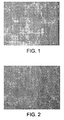
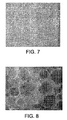
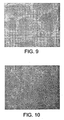
- FIGS. 1 to 10 which correspond to photographs of materials 19 to 28, taken under a scanning electron microscope at magnifications ranging from ⁇ 750 to ⁇ 7500 depending on the case, show the open-cell and interconnected structure presented by these materials.
- Test specimens of a polyHIPE material of 1-vinyl-1,2,4-triazole crosslinked at 5% by weight of N, N'-methylenebis (acrylamide) are prepared by proceeding as described in Example 4 above but using as emulsion, the emulsion 15 and molds of 7 mm internal diameter and 4 mm internal height. The test pieces thus obtained are therefore cylindrical and measure 7 mm in diameter and 4 mm in thickness. Their porosity is 70%.
- the figure 11 represents the stress-strain curve established from the data collected for a minimum of four samples as well as the Young's modulus E c calculated from these same data.
- This module is found to be 23.4 MPa, more than twice that reported by H. Deleuze et al. (ibid) for polyHIPE materials formed from 50% cross-linked polystyrene with divinylbenzene, porosity comparable to that of the material 29 (80% versus 70%).
- polyHIPE materials according to the invention have a mechanical resistance quite remarkable even with a very low degree of crosslinking (here of 5%).
- the material 22 is preheated to 110 ° C. under vacuum overnight and then subjected to thermogravimetric analysis using a Netzsch STA 409 analyzer under an argon atmosphere, bringing the temperature from 25 ° C. to 650 ° C. ° C at 10 ° C / minute.
- the figure 12 represents the thermogram thus obtained, which shows that the polyHIPE material according to the invention has a good thermal stability, of the order of 280-300 ° C.
Landscapes
- Chemical & Material Sciences (AREA)
- Chemical Kinetics & Catalysis (AREA)
- Organic Chemistry (AREA)
- Polymers & Plastics (AREA)
- Health & Medical Sciences (AREA)
- Medicinal Chemistry (AREA)
- Analytical Chemistry (AREA)
- Materials Engineering (AREA)
- Engineering & Computer Science (AREA)
- Oil, Petroleum & Natural Gas (AREA)
- Addition Polymer Or Copolymer, Post-Treatments, Or Chemical Modifications (AREA)
- Solid-Sorbent Or Filter-Aiding Compositions (AREA)
- Compositions Of Macromolecular Compounds (AREA)
- Filtering Materials (AREA)
- Polymerisation Methods In General (AREA)
Description
- La présente invention se rapporte à un matériau polyHIPE qui présente, entre autres propriétés, celle d'avoir une résistance mécanique particulièrement élevée.
- Elle se rapporte également à un procédé et à une émulsion permettant de préparer ce matériau ainsi qu'à un article ou objet constitué en tout ou partie d'un tel matériau.
- Le matériau polyHIPE selon l'invention est susceptible de trouver des applications dans tous les domaines où l'utilisation d'un matériau qui associe, aux propriétés inhérentes à une structure cellulaire interconnectée, une résistance mécanique remarquable, peut présenter un intérêt.
- En particulier, il est susceptible d'être utilisé dans la fabrication de supports de catalyseurs pour la catalyse hétérogène et, notamment, de photo-catalyseurs du type dioxyde de titane ou dioxyde d'étain pour la dépollution de l'eau ou de l'air par photocatalyse, la fabrication de filtres à particules, la fabrication d'adsorbants d'ions métalliques pour la purification de l'eau, celle de capteurs de gaz, par exemple, d'ozone, ainsi que, plus généralement, dans toutes les applications dans lesquelles l'utilisation de matériaux sous forme de blocs monolithiques à cellules ouvertes et interconnectées est requise.
- Les matériaux « polyHIPE » (de Polymerised High Internal Phase Emulsion) sont obtenus par polymérisation d'une émulsion dénommée HIPE (de High Internal Phase Emulsion) et qui est composée :
- d'une part, d'une phase externe ou dispersante qui est essentiellement constituée de monomères polymérisables et d'un agent tensioactif en solution dans un solvant, et
- d'autre part, d'une phase interne ou dispersée qui représente typiquement 74% ou plus du volume total de l'émulsion et qui est essentiellement constituée d'un solvant non miscible aux monomères polymérisables ou au solvant de la phase dispersante.
- Après polymérisation et élimination du solvant de la phase dispersée, on obtient des matériaux à cellules ouvertes dont les cellules correspondent à l'empreinte des bulles formées par ce solvant au cours de la préparation de l'émulsion et sont interconnectées par des ouvertures de plus petite taille qu'elles, communément désignées sous le terme de pores.
- Les matériaux polyHIPE présentent un rapport volume vide/volume plein particulièrement élevé et, donc, une densité particulièrement faible, ainsi qu'une structure cellulaire isotropique, sphérique et régulière, ce qui les rend très différents des matériaux polymères alvéolaires classiquement obtenus par soufflage ou extrusion qui se caractérisent, eux, par une structure cellulaire anisotropique, orientée et irrégulière.
- Compte tenu de leurs caractéristiques, les matériaux polyHIPE sont l'objet d'un intérêt croissant et leur utilisation a été proposée dans de nombreux domaines parmi lesquels on peut citer la fabrication d'articles absorbants jetables, d'articles d'isolation thermique, acoustique, électrique ou mécanique, de membranes, de filtres ou encore de supports pour les encres, les colorants et les catalyseurs.
- La très grande majorité des matériaux polyHIPE décrits dans la littérature à ce jour est représentée par des matériaux obtenus à partir d'émulsions HIPE « eau-dans-huile », c'est-à-dire ayant pour phase dispersante, une phase organique et pour phase dispersée, une phase aqueuse. Dans ce cas, les monomères polymérisables sont des monomères hydrophobes, généralement à insaturation vinylique tels que le styrène, le divinylbenzène et l'acrylate de 2-éthyl-hexyle.
- Or, H. Deleuze et al. ont montré, dans Polymer 2005, 46, 9653-9663 [1], que des matériaux polyHIPE à partir de monomères hydrophobes du type styrène et divinylbenzène présentent, même avec un taux de réticulation de 50%, un module d'Young de 9 MPa, soit une valeur que l'on considère généralement comme trop faible pour certaines applications.
- On connaît aussi des matériaux polyHIPE issus d'émulsions HIPE « huile-dans-eau », c'est-à-dire ayant pour phase dispersante, une phase aqueuse et pour phase dispersée, une phase organique. Ainsi, par exemple, la demande internationale
PCT publiée sous le n° WO 2004/044041 [2] décrit l'utilisation, pour la fabrication d'articles d'hygiène absorbants, d'émulsions HIPE dont la phase dispersante est une phase aqueuse dans laquelle sont dissous des monomères polymérisables hydrophiles du type acide acrylique et ses dérivés tandis que la phase dispersée est constituée d'une huile de silicone. Egalement, P. Krajnc et al. décrivent, dans Macromol. Rapid Comm. 2005, 26, 1289-1293 [3], la préparation d'un polymère cellulaire constitué d'acide acrylique réticulé par le N,N'-méthylène-bis(acrylamide) à partir d'une émulsion HIPE « huile-dans-eau ». Cependant, tous ces travaux conduisent à des matériaux polyHIPE qui ont un haut pouvoir gonflant dans les milieux aqueux mais qui ont une faible tenue mécanique. - Il serait donc souhaitable de disposer de matériaux qui, tout en présentant les avantages propres aux matériaux polyHIPE, aient une résistance mécanique élevée ou, à tout le moins, suffisamment élevée pour que leur utilisation dans toutes les applications qui ont été proposées pour ce type de matériaux puisse être réellement envisagée.
- La présente invention a précisément pour but de fournir un matériau polyHIPE à haute tenue mécanique.
- La présente invention a donc, en premier lieu, pour objet un matériau polyHIPE qui comprend sous forme copolymérisée :
- a) au moins un monomère N-alcényltriazole de formule générale (I) ci-après :
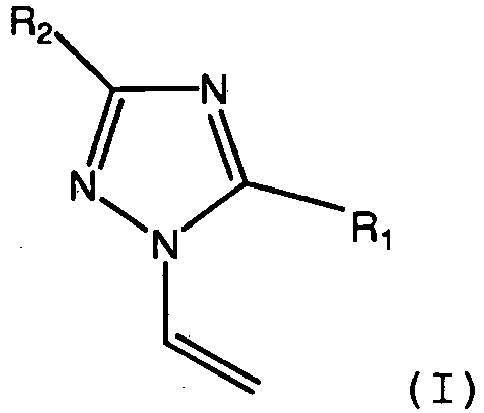
- b) au moins un monomère réticulant ; dans un rapport massique monomère réticulant/monomère N-alcényltriazole de 1/100 à 60/100.
- Dans ce qui précède et ce qui suit :
- * l'expression « groupe hydrocarboné aliphatique en C1 à C16 » désigne tout groupe hydrocarboné, linéaire ou ramifié mais non cyclique, saturé ou insaturé et qui est formé par au moins un atome de carbone et au plus 16 atomes de carbone ; ainsi, il peut s'agir d'un groupe alkyle (par exemple, méthyle, éthyle, n-propyle, isopropyle, butyle, isobutyle, sec-butyle, tert-butyle, pentyle, isopentyle, hexyle, heptyle, octyle, nonyle ou décyle), alcényle (par exemple, éthylényle, propylényle, butényle, pentényle, hexényle, méthylpentényle ou buta-1,3-diényle) ou bien encore alcynyle (par exemple, éthynyle, propynyle, butynyle, pentynyle, hexynyle ou octynyle) ; lorsque ce groupe est interrompu par un ou plusieurs atomes d'oxygène ou de soufre, alors cela signifie que ce ou ces atomes sont intercalés entre deux atomes de carbone ;
- * l'expression « groupe hydrocarboné cyclique en C3 à C16 » désigne tout groupe hydrocarboné monocyclique ou polycyclique, saturé ou insaturé et qui est formé par au moins 3 atomes de carbone et au plus 16 atomes de carbone ; il peut s'agir d'un groupe non aromatique, c'est-à-dire d'un groupe cycloalkyle (par exemple, cyclopropyle, cyclobutyle, cyclopentyle, cyclohexyle, cyclooctyle, norbornyle, bicyclo[4.3.2]-undécyle, bicyclo[4.4.0]décyle ou adamantyle), cyclo-alcényle ou cycloalcynyle, mais il peut également s'agir d'un groupe aromatique, c'est-à-dire d'un groupe satisfaisant à la règle de Hückel et présentant un nombre d'électrons π délocalisés égal à 4n + 2 (par exemple, phényle, benzyle, biphényle, phényl-acétylényle, pyrényle ou anthra-cényle) ;
- * l'expression « groupe hydrocarboné hétérocyclique de 3 à 16 chaînons » désigne un groupe hydrocarboné cyclique tel qu'il vient d'être défini mais dont un ou plusieurs atomes du cycle ou des cycles qui le constituent sont remplacés par un hétéroatome, typiquement un atome d'oxygène, de soufre ou d'azote ; là également, il peut s'agir d'un groupe non aromatique, c'est-à-dire d'un groupe hétérocycloalkyle (par exemple, tétrahydrothiényle, pyrrolidinyle, tétrahydrofuryle, pipéridinyle, dioxanyle ou morpholinyle), hétérocycloalcényle ou hétérocyclo-alcynyle mais il peut également s'agir d'un groupe hétéroaromatique (par exemple, furyle, pyrrolyle, thiényle, oxazolyle, pyrazolyle, thiazolyle, imidazolyle, triazolyle, pyridinyle, pyranyle, quinoléinyle, pyrazinyle ou pyrimidinyle).
- Conformément à l'invention, le monomère N-alcényltriazole peut se présenter sous la forme d'un sel lorsque R1 et/ou R2 représentent un groupe apte à former un sel, ce qui est notamment le cas des groupes -OH, -SH, -SO3H, -NH2, -COOH et des groupes hétérocycliques azotés du type pipéridinyle ou morpholinyle. Ce sel peut être un halogénure, un hydroxyde, un sel d'acide minéral (nitrate par exemple) ou un sel d'acide organique (acétate par exemple) lorsque le groupe salifiable se présente sous la forme d'un cation (-NH3+ par exemple) ; toutefois, il peut également être un sel d'un métal alcalin ou alcalino-terreux lorsque le groupe salifiable se présente sous la forme d'un anion (-SO3 - ou -COO- par exemple) .
- Par ailleurs, lorsque R1 et/ou R2 représentent un groupe hydrocarboné cyclique ou hétérocyclique et, plus spécialement, lorsqu'il s'agit d'un groupe aromatique ou hétéroaromatique, alors ce groupe peut être substitué par un ou plusieurs groupes polaires du type -OH, -SH, -NH2, -CO2H ou -SO3H, de manière à favoriser la solubilité du monomère N-alcényltriazole dans les solvants polaires.
- Conformément à l'invention, le monomère N-alcényltriazole de formule générale (I) est, de préférence, choisi parmi les monomères dans lesquels R1 et R2 représentent, indépendamment l'un de l'autre, un atome d'hydrogène, un groupe -OH, -SH, -SO3H, -NO2, -NH2, -COOH ou CnF2n+1 avec n tel que précédemment défini, le 1-vinyl-1,2,4-triazole étant tout particulièrement préféré.
- Le monomère réticulant est, lui, de préférence choisi parmi les composés polyvinyliques solubles dans les solvants polaires tels que l'eau, le diméthylformamide, le diméthylsulfoxyde, le diméthylacétamide, la N-méthylpyrrolidone, l'acétonitrile et leurs mélanges.
- Mieux encore, il s'agit d'un composé polyvinylique soluble dans l'eau comme, par exemple, le diacrylate d'éthylèneglycol, le diacrylate de diéthylèneglycol, le diacrylate de tétraéthylèneglycol, de diméthacrylate d'éthylèneglycol, le diméthacrylate de triéthylèneglycol, le N,N'-méthylènebis(acrylamide), le N,N'-éthylènebis(acrylamide), le N,N'-triméthylène-bis(acrylamide), le N,N'-méthylènebis(méthacrylami.de) et le N,N'-éthylènebis(méthacrylamide), le N,N'-méthylènebis(acrylamide) étant tout particulièrement préféré.
- Conformément à l'invention, le rapport massique du monomère réticulant au monomère N-alcényltriazole va, de préférence, de 1/100 à 20/100 et, mieux encore, de 3/100 à 10/100, ce qui correspond, dans ce dernier cas, à un taux de réticulation du monomère N-alcényltriazole de 3 à 10%.
- Le matériau selon l'invention peut être préparé par un procédé qui comprend les étapes consistant à :
- a) former une émulsion entre :
- une première phase, dite phase dispersante, comprenant le monomère N-alcényltriazole de formule générale (I) et le monomère réticulant, dans un rapport massique du monomère réticulant au monomère N-alcényltriazole de 1/100 à 60/100, un agent tensioactif, un initiateur (ou amorceur) de polymérisation et, éventuellement, un solvant des monomères N-alcényltriazole et réticulant, et
- une deuxième phase, dite phase dispersée, comprenant un solvant immiscible avec lesdits monomères et/ou, le cas échéant, avec le solvant de la première phase ;
- b) polymériser l'émulsion obtenue à l'étape a) jusqu'à l'obtention d'un matériau solide ; et
- c) laver et sécher le matériau obtenu à l'étape b).
- Selon une disposition préférée de l'invention, la phase dispersante comprend, outre le monomère N-alcényltriazole de formule générale (I), le monomère réticulant, l'agent tensioactif et l'initiateur de réticulation, un solvant polaire tel que l'eau, le diméthylformamide, le diméthylsulfoxyde, le diméthylacétamide, la N-méthylpyrrolidone, l'acétonitrile ou un mélange de ceux-ci, tandis que la phase dispersée comprend un solvant apolaire.
- Auquel cas, le rapport massique du solvant polaire au monomère N-alcényltriazole va, de préférence, de 1/3 à 4/1 et, mieux encore, de 0,8/1 à 2/1, tandis que le rapport massique du solvant apolaire audit monomère est avantageusement de 1/1 à 10/1, de préférence de 1/1 à 6/1 et, mieux encore, de 1,5/1 à 5/1.
- Plus encore, on préfère que l'émulsion soit une émulsion « huile-dans-eau », c'est-à-dire que le solvant de la phase dispersante soit de l'eau, de préférence distillée, ou un mélange d'eau et d'un autre solvant polaire, tandis que le solvant de la phase dispersée est un alcane à chaîne longue, c'est-à-dire en C6 à C32, avantageusement un dodécane ou un tétradécane.
- Conformément à l'invention, l'agent tensioactif est, de préférence, un surfactant non ionique, auquel cas il peut notamment être choisi parmi les éthoxylates d'alkyles, les éthoxylates d'alcools gras, les éthoxylates d'amines grasses, les éthoxylates d'acides gras, les éthoxylates d'oxoalcools, les éthoxylates d'alkylphénols comme, par exemple, les éthoxylates d'octylphénol et de nonylphénol, les polymères complexes d'oxydes de polyéthylène et de polypropylène, les copolymères blocs d'oxydes de polyéthylène et de polypropylène comme, par exemple, les copolymères triblocs PEO-PPO-PEO, les condensats d'oxyde d'éthylène et de propylène sur des alcools gras, les monoesters (monolaurate, monomyristate, monostéarate, monopalmitate, monooléate, etc) et polyesters d'acides gras et du sorbitane, les monoesters (monolaurate, monomyristate, monostéarate, monopalmitate, monooléate, etc) et polyesters d'acides gras et du glycérol, les monoesters de polyoxyéthylène sorbitane, et leurs mélanges.
- Des agents tensioactifs s'étant révélés convenir particulièrement bien sont, par exemple, les monoesters de polyoxyéthylène sorbitane connus sous le nom commercial Tween®, les éthoxylates d'alcools gras connus sous le nom commercial Brij®, les éthoxylates d'alkylphénols connus sous le nom commercial Igepal®, les copolymères triblocs PEO-PPO-PEO tels que ceux connus sous le nom commercial Pluronic®, et les mélanges de ceux-ci.
- Quel que soit l'agent tensioactif utilisé, le rapport massique de cet agent au monomère N-alcényltriazole est avantageusement de 0,2/1 à 1/1, de préférence de 0,25/1 à 0,8/1 et, mieux encore, de 0,3/1 à 0,6/1.
- L'initiateur de polymérisation est, lui, de préférence un initiateur de polymérisation radicalaire, auquel cas il peut être choisi parmi tous les composés connus pour être aptes à initier une polymérisation de type radicalaire. On préfère, toutefois, qu'il s'agisse d'un composé soluble dans les solvants polaires comme le peroxodisulfate de potassium, le dichlorate de 2,2'-azobis(2-méthyl-propionamidine) et certains peroxydes organiques comme le peroxyde de benzoyle.
- En tout état de cause, l'initiateur de polymérisation est avantageusement présent dans l'émulsion dans un rapport massique au monomère N-alcényltriazole de 0,5/100 à 10/100, de préférence de 2/100 à 8/100 et, mieux encore, de 4/100 à 6/100.
- Conformément à l'invention, l'émulsion peut être préparée au moyen de tout dispositif permettant de réaliser une émulsion entre deux phases de natures différentes. Ainsi, par exemple, une émulsion de faible volume peut être préparée à l'aide d'un agitateur de type vortex (les constituants de l'émulsion étant alors placés dans un tube à essai), tandis qu'une émulsion de volume plus important peut être réalisée dans un réacteur muni d'un système d'agitation mécanique ou bien à l'aide d'un système à deux seringues reliées entre elles et mises en action par un pousse-seringues.
- La polymérisation de l'émulsion est, de préférence, réalisée à chaud, c'est-à-dire à une température supérieure à la température ambiante mais ne dépassant pas 100°C, typiquement de 40 à 80°C. Elle est généralement conduite après avoir versé l'émulsion dans un moule, avantageusement en polytétrafluoro-éthylène (Teflon®), de forme et de dimensions correspondant à celles devant être présentées par le matériau final en fonction de l'usage auquel il est destiné. Ce moule est, de préférence, hermétiquement fermé afin d'éviter l'évaporation des solvants volatils ainsi qu'une éventuelle contamination de l'émulsion au cours de la polymérisation. Le temps nécessaire pour que la polymérisation de l'émulsion conduise à un matériau solide est typiquement de l'ordre de 12 à 48 heures.
- Le matériau solide obtenu à l'issue de la polymérisation est, une fois démoulé si la polymérisation a été réalisée dans un moule, lavé pour éliminer tous les constituants n'ayant pas polymérisé, c'est-à-dire les monomères n'ayant pas réagi, l'agent tensioactif, les produits de transformation de l'initiateur de polymérisation, le solvant de la phase dispersée et, le cas échéant, le solvant de la phase dispersante. Ce lavage est, de préférence, réalisé en utilisant successivement plusieurs solvants différents ou des mélanges différents de solvants. En particulier, ce lavage peut être réalisé dans un extracteur de type soxhlet en utilisant successivement de l'éthanol, de l'eau distillée, un mélange eau disillée/éthanol ou de l'acétone, un lavage à l'éthanol suivi d'un lavage à l'acétone étant préférés.
- Puis, le matériau ainsi lavé est séché, de préférence sous vide à une température allant de 20 à 150°C et, mieux encore, de 40 à 80°C.
- L'invention a, encore, pour objet une émulsion utile pour la préparation d'un matériau polyHIPE tel que défini ci-avant, qui comprend :
- une première phase comprenant le monomère N-alcényltriazole de formule générale (I) et le monomère réticulant, dans un rapport massique du monomère réticulant au monomère N-alcényltriazole de 1/100 à 60/100, un agent tensioactif, un initiateur de polymérisation et, éventuellement, un solvant des monomères N-alcényltriazole et réticulant, et
- une deuxième phase comprenant un solvant immiscible avec lesdits monomères et/ou, le cas échéant, avec le solvant de la première phase.
- Dans cette émulsion, les caractéristiques préférées du monomère N-alcényltriazole, du monomère réticulant, de l'agent tensioactif, de l'initiateur de polymérisation et des solvants sont les mêmes que celles précédemment indiquées pour le matériau polyHIPE selon l'invention et son procédé de préparation. Il en est de même des proportions préférées de ces différents composants.
- Le matériau polyHIPE selon l'invention présente de nombreux avantages. En effet, il est rigide, thermostable, homogène et particulièrement résistant même avec un faible taux de réticulation. Ainsi, il est capable de supporter de fortes contraintes et peut, par exemple, être usiné à partir d'un bloc mmonolithique sans être détérioré.
- Il est donc tout particulièrement utile pour fabriquer des articles devant à la fois présenter une structure à cellules ouvertes et interconnectées et être capables de résister à des sollicitations mécaniques et/ou thermiques comme, par exemple, des supports de catalyseurs pour la catalyse hétérogène, des filtres à particules, des adsorbants d'ions métalliques ou des capteurs de gaz.
- Au surplus, il peut être fabriqué par un procédé qui est relativement simple à mettre en oeuvre et qui n'utilise que des composés qui sont soit disponibles dans le commerce soit aisément synthétisables par un homme du métier. A cet égard, il convient de noter que la synthèse des N-alcényltriazole de formule générale (I) est décrite dans le brevet
US-A-5,646,293 [4] et qu'elle est donc parfaitement connue de l'homme du métier. - D'autres caractéristiques et avantages de l'invention apparaîtront mieux à la lecture du complément de description qui suit, qui se rapporte à des exemples de préparation d'émulsions utiles pour la préparation de matériaux polyHIPE selon l'invention, ainsi qu'à des exemples de réalisation de matériaux polyHIPE selon l'invention à partir de ces émulsions et de démonstration de leurs propriétés.
- Bien entendu, ces exemples ne sont donnés qu'à titre d'illustrations de l'objet de l'invention et ne constituent en aucun cas une limitation de cet objet.
-
- La
figure 1 représente une photographie prise au microscope électronique à balayage, à un grossissement de × 750, d'un premier exemple de matériau polyHIPE selon l'invention. - La
figure 2 représente une photographie prise au microscope électronique à balayage, à un grossissement de × 750, d'un deuxième exemple de matériau polyHIPE selon l'invention. - La
figure 3 représente une photographie prise au microscope électronique à balayage, à un grossissement de × 750, d'un troisième exemple de matériau polyHIPE selon l'invention. - La
figure 4 représente une photographie prise au microscope électronique à balayage, à un grossissement de × 750, d'un quatrième exemple de matériau polyHIPE selon l'invention. - La
figure 5 représente une photographie prise au microscope électronique à balayage, à un grossissement de × 750, d'un cinquième exemple de matériau polyHIPE selon l'invention. - La
figure 6 représente une photographie prise au microscope électronique à balayage, à un grossissement de × 750, d'un sixième exemple de matériau polyHIPE selon l'invention. - La
figure 7 représente une photographie prise au microscope électronique à balayage, à un grossissement de × 750, d'un septième exemple de matériau polyHIPE selon l'invention. - La
figure 8 représente une photographie prise au microscope électronique à balayage, à un grossissement de × 3500, d'un huitième exemple de matériau polyHIPE selon l'invention. - La
figure 9 représente une photographie prise au microscope électronique à balayage, à un grossissement de × 5000, d'un neuvième exemple de matériau polyHIPE selon l'invention. - La
figure 10 représente une photographie prise au microscope électronique à balayage, à un grossissement de × 7500, d'un dixième exemple de matériau polyHIPE selon l'invention. - La
figure 11 représente la courbe contrainte-déformation et le module d'Young obtenus en soumettant quatre éprouvettes d'un onzième exemple de matériau polyHIPE selon l'invention à un test en compression. - La
figure 12 représente le thermogramme obtenu en soumettant le matériau polyHIPE montré sur lafigure 4 à une analyse thermogravimétrique. - On réalise dix émulsions à base de 1-vinyl-1,2,4-triazole, notées ci-après émulsions 1 à 10, en procédant de la manière suivante.
- On introduit dans un tube à essai :
- * du 1-vinyl-1,2,4-triazole, noté ci-après VT (Interchim, réf. BE893),
- * de l'eau distillée,
- * du peroxodisulfate de potassium K2S2O8,
- * du N,N'-méthylènebis(acrylamide), noté ci-après MBA (Sigma-Aldrich, réf. 148326),
- * un agent tensioactif (TA) choisi parmi :
- un monolaurate de polyoxyéthylène sorbitane, noté ci-après T1 (Sigma-Aldrich, Tween® 20),
- un éther de polyoxyéthylène et d'oléyle, noté ci-après T3 (Sigma-Aldrich, Brij® 98),
- un éther de polyoxyéthylène et de nonylphénol, noté ci-après T4 (Sigma-Aldrich, Igepal® CO-890),
- un copolymère tribloc PEO-PPO-PEO à 80% de PEO, noté ci-après T5 (Sigma-Aldrich, Pluronic® F 108), et
- des mélanges T1/T4, T3/T4 et T4/T5, et enfin
- * un solvant immiscible à l'eau choisi parmi le n-dodécane C12H26 et le n-tétradécane C14H30.
- Puis, on agite ce tube au moyen d'un vortex (Bioblock Scientific, modèle Top-Mix®) pendant 30 minutes pour obtenir une émulsion blanche opaque stable.
- Le tableau ci-après I précise, pour chacune des émulsions 1 à 10, les quantités, exprimées en milligrammes, de VT, de MBA, de K2S2O8 et d'eau distillée utilisées, le type d'agent tensioactif et le type de solvant immiscible à l'eau employés ainsi que leurs quantités, également exprimées en milligrammes.
TABLEAU 1 Emulsion VT MBA K2S2O8 TA (mg) H2O Solvant immiscible à l'eau (mg) 1 200 10 10 T1 (80) 200 C12H26 (1600) 2 200 10 10 T3 (80) 200 C12H26 (1600) 3 200 10 10 T4 (80) 200 C12H26 (1600) 4 100 10 10 T4 (80) 300 C12H26 (1600) 5 200 10 10 T4 (80) 200 C12H26 (1600) 6 600 30 30 T4 240 600 C12H26 (4200) 7 600 30 30 T4 (240) 600 C14H30 (4200) 8 400 20 20 T1+T4 (60+60) 400 C12H26 (1600) 9 400 20 20 T3+T4 (60+60) 400 C12H26 (1600) 10 400 20 20 T4+T5 (90+30) 400 C12H26 (1600) - On réalise deux émulsions à base de 1-vinyl-1,2,4-triazole, notées ci-après émulsions 11 et 12, en procédant de la manière suivante.
- On introduit dans un réacteur muni d'une agitation mécanique, en l'occurrence une pale en forme de D, du 1-vinyl-1,2,4-triazole, de l'eau distillée, du peroxodisulfate de potassium et du N,N'-méthylène-bis(acrylamide). Tout en maintenant le milieu sous agitation, on ajoute du n-dodécane goutte à goutte, puis on poursuit l'agitation pendant 1 heure pour obtenir une émulsion blanche opaque stable.
- Le tableau II ci-après précise, pour chacune des émulsions 11 et 12, les quantités, exprimées en grammes, de VT, de MBA, de K2S2O8, d'agent tensioactif, d'eau distillée et de n-dodécane utilisées.
TABLEAU II Emulsion VT MBA K2S2O8 T3+T4 H2O C12H26 11 8 0,4 0,4 2,4+2,4 5,3 32 12 10 0,5 0,5 3+3 10 40 - On réalise six émulsions à base de 1-vinyl-1,2,4-triazole, notées ci-après émulsions 13 à 18, en procédant de la façon suivante.
- On met en solution dans un bécher, sous agitation magnétique, du 1-vinyl-1,2,4-triazole, de l'eau distillée, du N,N'-méthylènebis(acrylamide) et un initiateur de polymérisation choisi parmi :
- le peroxodisulfate de potassium,
- le peroxyde de benzoyle, noté ci-après PB, et
- le dichlorate de 2,2'-azobis(2-méthyl-propionamidine, noté ci-après V-50, (Wako Chemicals, V-50) .
- On verse cette solution ainsi que du n-dodécane dans le corps d'une première seringue de 60 mL. Cette seringue est connectée à une deuxième seringue qui est vide, dont le piston est enfoncé et qui est équipée d'un tube de 4 mm de diamètre et de 20 mm de longueur. On fixe les deux seringues ainsi connectées sur un pousse-seringues. Le temps d'émulsification est fixé à 25 minutes.
- Le tableau III précise, pour chacune des émulsions 13 à 18, les quantités, exprimées en grammes, de VT, de MBA, d'eau distillée et de dodécane utilisées, le type d'initiateur de polymérisation et le type d'agent tensioactif utilisés ainsi que leurs quantités, également exprimées en grammes.
TABLEAU III Emulsion VT MBA Initiateur (g) TA (g) H2O C12H26 13 6 0,3 K2S2O8 (0,3) T4 (3) 6 24 14 6 0,3 K2S2O8 (0,3) T3+T4 (1,5+1,5) 6 10 15 6 0,3 K2S2O8 (0,3) T4 (3) 6 10 16 6 0,3 PE (0,3) T3+T4 (1,5+1,5) 6 24 17 6 0,3 V-50 (0,3) T3+T4 (1,5+1,5) 6 10 18 6 0,3 V-50 (0,3) T4 (3) 6 10 - On réalise onze matériaux polyHIPE de 1-vinyl-1,2,4-triazole réticulé à 5% en masse de N,N'-méthylènebis(acrylamide), notés ci-après matériaux 19 à 28, en procédant de la manière suivante.
- On verse une émulsion préparée conformément aux exemples 1 à 3 dans un moule en Teflon®, on ferme le moule et on le chauffe à 60°C pendant 24 heures. Après quoi, on démoule le matériau présent dans le moule, on le lave au soxhlet avec de l'éthanol pendant 48 heures, puis avec de l'acétone pendant 24 heures, et on le sèche sous vide à 55°C pendant 5 jours.
- Le tableau IV précise, pour chacun des matériaux 19 à 28, l'émulsion à partir de laquelle il est réalisé, les dimensions internes du moule dans lequel cette émulsion est versée et la porosité présentée par le matériau à l'issue de son séchage. Cette porosité a été déterminée par porosimétrie par intrusion de mercure.
TABLEAU IV Matériau Emulsion utilisée Dimensions internes du moule Porosité du matériau 19 6 φ = 15 mm 66% H = 30 mm 20 7 φ = 15 mm 69% H = 30 mm 21 12 φ = 15 mm 86% H = 30 mm 22 13 φ = 15 mm 80% H = 30 mm 23 14 φ = 15 mm 68% H = 30 mm 24 16 φ = 15 mm 75% H = 30 mm 25 17 φ = 15 mm 72% H = 30 mm 26 15 φ = 32 mm 70% H = 110 mm 27 16 φ = 15 mm 75% H = 30 mm 28 17 φ = 15 mm 72% H = 30 mm - Les
figures 1 à 10 , qui correspondent à des photographies des matériaux 19 à 28, prises au microscope électronique à balayage à des grossissements allant de × 750 à × 7500 selon les cas, montrent la structure à cellules ouvertes et interconnectées présentée par ces matériaux. - On réalise des éprouvettes d'un matériau polyHIPE de 1-vinyl-1,2,4-triazole réticulé à 5% en masse de N,N'-méthylènebis(acrylamide) en procédant comme décrit dans l'exemple 4 ci-avant mais en utilisant comme émulsion, l'émulsion 15 et des moules de 7 mm de diamètre interne et de 4 mm de hauteur interne. Les éprouvettes ainsi obtenues sont donc cylindriques et mesurent 7 mm de diamètre sur 4 mm d'épaisseur. Leur porosité est de 70%.
- Elles sont soumises à des tests de compression que l'on réalise à température ambiante, en utilisant un appareil Instron 4460 muni d'une cellule de mesure statique de 500 N. Les éprouvettes sont comprimées à vitesse constante (5 mm/min) normalement à leurs surfaces planes entre deux plaques métalliques.
- La
figure 11 représente la courbe de contrainte-déformation établie à partir des données recueillies pour un minimum de quatre échantillons ainsi que le module de Young Ec calculé à partir de ces mêmes données. - On constate que ce module est de 23,4 MPa, soit plus de deux fois supérieur à celui rapporté par H. Deleuze et al. (ibid) pour des matériaux polyHIPE formés de polystyrène réticulé à 50% par du divinylbenzène, de porosité comparable à celle du matériau 29 (80% versus 70%) .
- Ce qui signifie que les matériaux polyHIPE selon l'invention présentent une résistance mécanique tout à fait remarquable même avec un taux de réticulation très faible (ici de 5%).
- On préchauffe le matériau 22 à 110°C, sous vide, pendant toute une nuit puis on le soumet à une analyse thermogravimétrique au moyen d'un analyseur Netzsch STA 409 sous atmosphère d'argon, en portant la température de 25°C à 650°C à raison de 10°C/minute.
- La
figure 12 représente le thermogramme ainsi obtenu, lequel montre que le matériau polyHIPE selon l'invention présente une bonne stabilité thermique, de l'ordre de 280-300°C. -
- [1] H. Deleuze et al., Polymer 2005, 46, 9653-9663
-
[2]
WO-A-2004/044041 - [3] P. Krajnc et al., Macromol. Rapid Comm. 2005, 26, 1289-1293
-
[4]
US-A-5,646,293
Claims (21)
- Matériau obtenu par polymérisation d'une émulsion à phase interne hautement concentrée, qui comprend sous forme copolymérisée :a) au moins un monomère N-alcényltriazole répondant à la formule générale (I) ci-après :
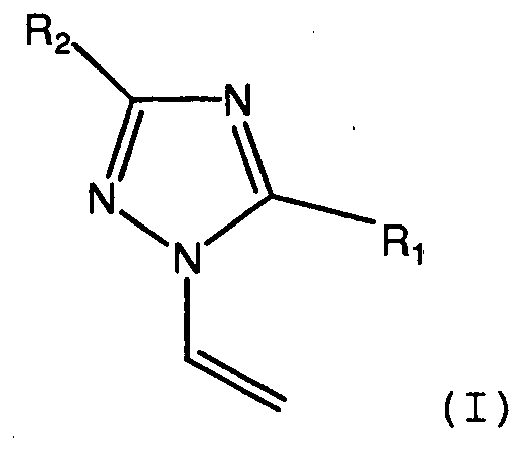 b) un monomère réticulant ;
le rapport massique du monomère réticulant au monomère N-alcényltriazole allant de 1/100 à 60/100. - Matériau selon la revendication 1, dans lequel le monomère N-alcényltriazole est choisi parmi les monomères de formule générale (I) dans laquelle R1 et R2 représentent, indépendamment l'un de l'autre, un atome d'hydrogène, un groupe -OH, -SH, -SO3H, -NO2, -NH2, -COOH ou CnF2n+1 avec n tel que précédemment défini.
- Matériau selon la revendication 2, dans lequel le monomère N-alcényltriazole est le 1-vinyl-1,2,4-triazole.
- Matériau selon l'une quelconque des revendications précédentes, dans lequel le monomère réticulant est un monomère polyvinylique soluble dans les solvants polaires.
- Matériau selon la revendication 4, dans lequel le monomère réticulant est un monomère polyvinylique soluble dans l'eau.
- Matériau selon la revendication 5, dans lequel le monomère réticulant est choisi parmi le diacrylate d'éthylèneglycol, le diacrylate de diéthylèneglycol, le diacrylate de tétraéthylèneglycol, de diméthacrylate d'éthylèneglycol, le diméthacrylate de triéthylèneglycol, le N,N'-méthylènebis(acrylamide), le N,N'-éthylènebis(acrylamide), le N,N'-triméthylène-bis(acrylamide), le N,N'-méthylènebis(méthacrylamide) et le N,N'-éthylènebis(méthacrylamide).
- Matériau selon la revendication 6, dans lequel le monomère réticulant est le N,N'-méthylène-bis(acrylamide).
- Matériau selon l'une quelconque des revendications précédentes, dans lequel le rapport massique du monomère réticulant au monomère N-alcényltriazole va de 1/100 à 20/100 et, de préférence, de 3/100 à 10/100.
- Procédé de préparation d'un matériau tel que défini dans l'une quelconque des revendications 1 à 8, qui comprend :a) former une émulsion entre :- une première phase comprenant le monomère N-alcényltriazole de formule générale (I) et le monomère réticulant, dans un rapport massique du monomère réticulant au monomère N-alcényltriazole de 1/100 à 60/100, un agent tensioactif, un initiateur de polymérisation et, éventuellement, un solvant des monomères N-alcényltriazole et réticulant, et- une deuxième phase comprenant un solvant immiscible avec lesdits monomères et/ou, le cas échéant, avec le solvant de la première phase ;b) polymériser l'émulsion obtenue à l'étape a) jusqu'à l'obtention d'un matériau solide ; etc) laver et sécher le matériau obtenu à l'étape b).
- Procédé selon la revendication 9, dans lequel la première phase comprend un solvant polaire, tandis que la deuxième phase comprend un solvant apolaire.
- Procédé selon la revendication 10, dans lequel le rapport massique du solvant polaire au monomère N-alcényltriazole va de 1/3 à 4/1 et, de préférence, de 0,8/1 à 2/1, tandis que le rapport massique du solvant apolaire audit monomère va de 1/1 à 10/1 et, de préférence, de 1/1 à 6/1.
- Procédé selon la revendication 10 ou la revendication 11, dans lequel la première phase comprend de l'eau ou un mélange formé d'eau et d'un autre solvant polaire, tandis que la deuxième phase comprend un alcane en C6 à C32.
- Procédé selon l'une quelconque des revendications 9 à 12, dans lequel l'agent tensioactif est un surfactant non ionique.
- Procédé selon la revendication 13, dans lequel l'agent tensioactif est choisi parmi les éthoxylates d'alkyles, les éthoxylates d'alcools gras, les éthoxylates d'amines grasses, les éthoxylates d'acides gras, les éthoxylates d'oxoalcools, les éthoxylates d'alkylphénols, les polymères complexes d'oxydes de polyéthylène et de polypropylène, les copolymères blocs d'oxydes de polyéthylène et de polypropylène, les condensats d'oxyde d'éthylène et de propylène sur des alcools gras, les monoesters et polyesters d'acides gras et du sorbitane, les monoesters et polyesters d'acides gras et du glycérol, les monoesters de polyoxyéthylène sorbitane, et leurs mélanges.
- Procédé selon l'une quelconque des revendications 9 à 14, dans lequel le rapport massique de l'agent tensioactif au monomère N-alcényltriazole va de 0,2/1 à 1/1 et, de préférence, de 0,25/1 à 0,8/1.
- Procédé selon l'une quelconque des revendications 9 à 15, dans lequel l'initiateur de polymérisation est un initiateur de polymérisation radicalaire.
- Procédé selon l'une quelconque des revendications 9 à 16, dans lequel le rapport massique de l'initiateur de polymérisation au monomère N-alcényltriazole va de 0,5/100 à 10/100 et, de préférence, de 2/100 à 8/100.
- Procédé selon l'une quelconque des revendications précédentes, dans lequel l'émulsion est polymérisée à une température supérieure à la température ambiante mais ne dépassant pas 100°C, de préférence de 40 à 80°C.
- Emulsion utile pour la préparation d'un matériau tel que défini dans l'une quelconque des revendications 1 à 8, qui comprend :- une première phase comprenant le monomère N-alcényltriazole de formule générale (I) et le monomère réticulant, dans un rapport massique du monomère réticulant au monomère N-alcényltriazole de 1/100 à 60/100, un agent tensioactif, un initiateur de polymérisation et, éventuellement, un solvant des monomères N-alcényltriazole et réticulant, et- une deuxième phase comprenant un solvant immiscible avec lesdits monomères et/ou, le cas échéant, avec le solvant de la première phase.
- Article qui est constitué en tout ou partie d'un matériau selon l'une quelconque des revendications 1 à 8.
- Article selon la revendication 20, qui est un support de catalyseur(s) pour la catalyse hétérogène, un filtre à particules, un adsorbant d'ions métalliques ou un capteur de gaz.
Applications Claiming Priority (2)
| Application Number | Priority Date | Filing Date | Title |
|---|---|---|---|
| FR0853809A FR2932184B1 (fr) | 2008-06-09 | 2008-06-09 | Materiau polyhipe a haute tenue mecanique, son procede de preparation, emulsion utile pour sa preparation et article constitue d'un tel materiau |
| PCT/EP2009/056998 WO2009150113A1 (fr) | 2008-06-09 | 2009-06-08 | Materiau polyhipe a haute tenue mecanique, son procede de preparation, emulsion utile pour sa preparation et article constitue d'un tel materiau |
Publications (2)
| Publication Number | Publication Date |
|---|---|
| EP2291228A1 EP2291228A1 (fr) | 2011-03-09 |
| EP2291228B1 true EP2291228B1 (fr) | 2014-07-23 |
Family
ID=40229811
Family Applications (1)
| Application Number | Title | Priority Date | Filing Date |
|---|---|---|---|
| EP09761676.7A Not-in-force EP2291228B1 (fr) | 2008-06-09 | 2009-06-08 | Materiau polyhipe a haute tenue mecanique, son procede de preparation, emulsion utile pour sa preparation et article constitue d'un tel materiau |
Country Status (6)
| Country | Link |
|---|---|
| US (1) | US20110130534A1 (fr) |
| EP (1) | EP2291228B1 (fr) |
| JP (1) | JP2011522919A (fr) |
| ES (1) | ES2520115T3 (fr) |
| FR (1) | FR2932184B1 (fr) |
| WO (1) | WO2009150113A1 (fr) |
Families Citing this family (8)
| Publication number | Priority date | Publication date | Assignee | Title |
|---|---|---|---|---|
| FR2966153B1 (fr) | 2010-10-19 | 2013-05-17 | Commissariat Energie Atomique | Utilisation d'azaboronates cycliques comme materiaux sensibles dans des capteurs destines a detecter la presence de peroxydes dans un milieu gazeux |
| FR2980797B1 (fr) | 2011-09-29 | 2013-11-01 | Univ Bordeaux 1 | Materiau microcellulaire interconnecte a base de lignine industrielle et son procede de preparation |
| US9180094B2 (en) | 2011-10-12 | 2015-11-10 | The Texas A&M University System | High porosity materials, scaffolds, and method of making |
| EP2639247A1 (fr) | 2012-03-16 | 2013-09-18 | Technische Universität Graz | Procédé de production de structures poreuses |
| WO2015070074A2 (fr) | 2013-11-08 | 2015-05-14 | The Texas A &M University System | Nanoparticules poreuses à haute efficacité de chargement |
| EP3315516A1 (fr) * | 2016-10-31 | 2018-05-02 | University of Vienna | Billes macroporeuses |
| CN111387545B (zh) * | 2020-05-11 | 2022-04-19 | 河南中烟工业有限责任公司 | 一种可降低烟气中巴豆醛释放量的新型滤棒的制备方法 |
| CN114688668B (zh) * | 2022-03-23 | 2023-10-03 | 四川长虹电器股份有限公司 | 用于空气净化器产品的组合式光催化滤网及其制备方法 |
Family Cites Families (11)
| Publication number | Priority date | Publication date | Assignee | Title |
|---|---|---|---|---|
| FR1343961A (fr) * | 1961-12-23 | 1963-11-22 | Basf Ag | Procédé pour la production de mousses |
| JPS5318026B2 (fr) * | 1973-05-21 | 1978-06-13 | ||
| DE3324835A1 (de) * | 1983-07-09 | 1985-01-17 | Cassella Ag, 6000 Frankfurt | Vernetztes copolymerisat, verfahren zu seiner herstellung und seine verwendung als sorptionsmittel |
| US5387207A (en) * | 1991-08-12 | 1995-02-07 | The Procter & Gamble Company | Thin-unit-wet absorbent foam materials for aqueous body fluids and process for making same |
| US5200433A (en) * | 1992-04-20 | 1993-04-06 | Shell Oil Company | Process for preparing low density porous crosslinked polymeric materials |
| DE19519339A1 (de) * | 1995-05-26 | 1996-11-28 | Basf Ag | Wasserlösliche Copolymerisate, die Vernetzer einpolymerisiert enthalten, Verfahren zu ihrer Herstellung und ihre Verwendung |
| DE19524618A1 (de) * | 1995-07-06 | 1997-01-09 | Basf Ag | Verfahren zur Herstellung von N-Alkenyl-azolen |
| US6048908A (en) * | 1997-06-27 | 2000-04-11 | Biopore Corporation | Hydrophilic polymeric material |
| JP4908674B2 (ja) * | 2000-10-24 | 2012-04-04 | 株式会社日本触媒 | 多孔質架橋ポリマー材料の製法 |
| US20040087926A1 (en) * | 2002-11-06 | 2004-05-06 | Ko Young C. | Absorbent articles comprising inverse HIPE foams other foams |
| GB0325668D0 (en) * | 2003-11-04 | 2003-12-10 | Dogru Murat | Intensified and minaturized gasifier with multiple air injection and catalytic bed |
-
2008
- 2008-06-09 FR FR0853809A patent/FR2932184B1/fr not_active Expired - Fee Related
-
2009
- 2009-06-08 US US12/737,141 patent/US20110130534A1/en not_active Abandoned
- 2009-06-08 ES ES09761676.7T patent/ES2520115T3/es active Active
- 2009-06-08 JP JP2011512151A patent/JP2011522919A/ja active Pending
- 2009-06-08 EP EP09761676.7A patent/EP2291228B1/fr not_active Not-in-force
- 2009-06-08 WO PCT/EP2009/056998 patent/WO2009150113A1/fr not_active Ceased
Also Published As
| Publication number | Publication date |
|---|---|
| FR2932184A1 (fr) | 2009-12-11 |
| ES2520115T3 (es) | 2014-11-11 |
| FR2932184B1 (fr) | 2010-07-30 |
| EP2291228A1 (fr) | 2011-03-09 |
| WO2009150113A1 (fr) | 2009-12-17 |
| JP2011522919A (ja) | 2011-08-04 |
| US20110130534A1 (en) | 2011-06-02 |
Similar Documents
| Publication | Publication Date | Title |
|---|---|---|
| EP2291228B1 (fr) | Materiau polyhipe a haute tenue mecanique, son procede de preparation, emulsion utile pour sa preparation et article constitue d'un tel materiau | |
| CN104661959B (zh) | 石墨烯基材料 | |
| FR3035544A1 (fr) | Electrolyte polymere solide et dispositifs electrochimiques le comprenant | |
| EP3584006B1 (fr) | Produit cosmetique ou pharmaceutique contenant des microgels de poly(ethylene glycol-methacrylate) | |
| EP1996633A2 (fr) | Empreintes moleculaires pour une reconnaissance en milieux aqueux, leurs procedes de preparation et leurs utilisations | |
| EP3426384B1 (fr) | Films poreux obtenus a partir de latex de polymeres | |
| WO2019023430A1 (fr) | Procédé de préparation de couches sélectives de membrane par polymérisation radicalaire interfaciale | |
| EP0457660A1 (fr) | Nouveaux polymères absorbants, leur procédé de fabrication et leur application | |
| EP3658595A1 (fr) | Procédé de préparation d'un film de polymère fluoré réticulé | |
| FR3035545B1 (fr) | Electrolyte polymere et dispositifs electrochimiques le comprenant | |
| EP2615074B1 (fr) | Additif pour le moulage de matériau céramique | |
| FR2837493A1 (fr) | Aerogel a base d'un polymere ou copolymere hydrocarbone et leur procede de preparation | |
| EP0185830B2 (fr) | Electrode plastifiée de cadmium | |
| EP2354171A1 (fr) | Matériau polymère fluorocarboné et procédé de synthèse | |
| JP2009018215A (ja) | コア−シェル型高分子ゲル微粒子の固定化方法及び分離材 | |
| EP3964541A1 (fr) | Fabrication d'un aerogel conducteur | |
| EP3676234B1 (fr) | Procede de preparation d'une poudre a base d'oxyde(s) d'yttrium, d'aluminium et eventuellement d'au moins un autre element | |
| EP1687341B1 (fr) | Mousses polymeres de tres basse densite et leur procede de fabrication. | |
| JP7453687B2 (ja) | 高分子材料及びその製造方法、並びに高分子組成物 | |
| EP1694716B1 (fr) | Mousses polymeres a cellules ouvertes de tres faible diametre et leur procede de fabrication | |
| EP0245144B1 (fr) | Procédé de fabrication de colloides ionomères perfluorés conducteurs cationiques et le utilisation des colloides obtenus | |
| CN114933683B (zh) | 具有热响应性的两亲性三嵌段聚合物及其制备方法、应用和载药胶束 | |
| EP4025650A1 (fr) | Particules nanocomposites électriquement conductrices possédant un coeur de polyacrylate d'alkyle et une écorce de polymère conducteur | |
| FR2954338A1 (fr) | Procede d'elaboration de ballons ou billes polymeriques comprenant des elements metalliques | |
| JP4758886B2 (ja) | 固体電解コンデンサ用陽極体の製造方法及び固体電解コンデンサ用陽極体 |
Legal Events
| Date | Code | Title | Description |
|---|---|---|---|
| PUAI | Public reference made under article 153(3) epc to a published international application that has entered the european phase |
Free format text: ORIGINAL CODE: 0009012 |
|
| 17P | Request for examination filed |
Effective date: 20101210 |
|
| AK | Designated contracting states |
Kind code of ref document: A1 Designated state(s): AT BE BG CH CY CZ DE DK EE ES FI FR GB GR HR HU IE IS IT LI LT LU LV MC MK MT NL NO PL PT RO SE SI SK TR |
|
| AX | Request for extension of the european patent |
Extension state: AL BA RS |
|
| DAX | Request for extension of the european patent (deleted) | ||
| GRAP | Despatch of communication of intention to grant a patent |
Free format text: ORIGINAL CODE: EPIDOSNIGR1 |
|
| INTG | Intention to grant announced |
Effective date: 20140217 |
|
| GRAS | Grant fee paid |
Free format text: ORIGINAL CODE: EPIDOSNIGR3 |
|
| GRAA | (expected) grant |
Free format text: ORIGINAL CODE: 0009210 |
|
| AK | Designated contracting states |
Kind code of ref document: B1 Designated state(s): AT BE BG CH CY CZ DE DK EE ES FI FR GB GR HR HU IE IS IT LI LT LU LV MC MK MT NL NO PL PT RO SE SI SK TR |
|
| REG | Reference to a national code |
Ref country code: GB Ref legal event code: FG4D Free format text: NOT ENGLISH |
|
| REG | Reference to a national code |
Ref country code: CH Ref legal event code: EP |
|
| REG | Reference to a national code |
Ref country code: IE Ref legal event code: FG4D Free format text: LANGUAGE OF EP DOCUMENT: FRENCH |
|
| REG | Reference to a national code |
Ref country code: AT Ref legal event code: REF Ref document number: 678536 Country of ref document: AT Kind code of ref document: T Effective date: 20140815 |
|
| REG | Reference to a national code |
Ref country code: DE Ref legal event code: R096 Ref document number: 602009025521 Country of ref document: DE Effective date: 20140904 |
|
| REG | Reference to a national code |
Ref country code: ES Ref legal event code: FG2A Ref document number: 2520115 Country of ref document: ES Kind code of ref document: T3 Effective date: 20141111 |
|
| REG | Reference to a national code |
Ref country code: AT Ref legal event code: MK05 Ref document number: 678536 Country of ref document: AT Kind code of ref document: T Effective date: 20140723 |
|
| REG | Reference to a national code |
Ref country code: NL Ref legal event code: VDEP Effective date: 20140723 |
|
| REG | Reference to a national code |
Ref country code: LT Ref legal event code: MG4D |
|
| PG25 | Lapsed in a contracting state [announced via postgrant information from national office to epo] |
Ref country code: FI Free format text: LAPSE BECAUSE OF FAILURE TO SUBMIT A TRANSLATION OF THE DESCRIPTION OR TO PAY THE FEE WITHIN THE PRESCRIBED TIME-LIMIT Effective date: 20140723 Ref country code: PT Free format text: LAPSE BECAUSE OF FAILURE TO SUBMIT A TRANSLATION OF THE DESCRIPTION OR TO PAY THE FEE WITHIN THE PRESCRIBED TIME-LIMIT Effective date: 20141124 Ref country code: NO Free format text: LAPSE BECAUSE OF FAILURE TO SUBMIT A TRANSLATION OF THE DESCRIPTION OR TO PAY THE FEE WITHIN THE PRESCRIBED TIME-LIMIT Effective date: 20141023 Ref country code: LT Free format text: LAPSE BECAUSE OF FAILURE TO SUBMIT A TRANSLATION OF THE DESCRIPTION OR TO PAY THE FEE WITHIN THE PRESCRIBED TIME-LIMIT Effective date: 20140723 Ref country code: SE Free format text: LAPSE BECAUSE OF FAILURE TO SUBMIT A TRANSLATION OF THE DESCRIPTION OR TO PAY THE FEE WITHIN THE PRESCRIBED TIME-LIMIT Effective date: 20140723 Ref country code: GR Free format text: LAPSE BECAUSE OF FAILURE TO SUBMIT A TRANSLATION OF THE DESCRIPTION OR TO PAY THE FEE WITHIN THE PRESCRIBED TIME-LIMIT Effective date: 20141024 Ref country code: BG Free format text: LAPSE BECAUSE OF FAILURE TO SUBMIT A TRANSLATION OF THE DESCRIPTION OR TO PAY THE FEE WITHIN THE PRESCRIBED TIME-LIMIT Effective date: 20141023 |
|
| PG25 | Lapsed in a contracting state [announced via postgrant information from national office to epo] |
Ref country code: LV Free format text: LAPSE BECAUSE OF FAILURE TO SUBMIT A TRANSLATION OF THE DESCRIPTION OR TO PAY THE FEE WITHIN THE PRESCRIBED TIME-LIMIT Effective date: 20140723 Ref country code: HR Free format text: LAPSE BECAUSE OF FAILURE TO SUBMIT A TRANSLATION OF THE DESCRIPTION OR TO PAY THE FEE WITHIN THE PRESCRIBED TIME-LIMIT Effective date: 20140723 Ref country code: AT Free format text: LAPSE BECAUSE OF FAILURE TO SUBMIT A TRANSLATION OF THE DESCRIPTION OR TO PAY THE FEE WITHIN THE PRESCRIBED TIME-LIMIT Effective date: 20140723 Ref country code: PL Free format text: LAPSE BECAUSE OF FAILURE TO SUBMIT A TRANSLATION OF THE DESCRIPTION OR TO PAY THE FEE WITHIN THE PRESCRIBED TIME-LIMIT Effective date: 20140723 Ref country code: NL Free format text: LAPSE BECAUSE OF FAILURE TO SUBMIT A TRANSLATION OF THE DESCRIPTION OR TO PAY THE FEE WITHIN THE PRESCRIBED TIME-LIMIT Effective date: 20140723 Ref country code: IS Free format text: LAPSE BECAUSE OF FAILURE TO SUBMIT A TRANSLATION OF THE DESCRIPTION OR TO PAY THE FEE WITHIN THE PRESCRIBED TIME-LIMIT Effective date: 20141123 Ref country code: CY Free format text: LAPSE BECAUSE OF FAILURE TO SUBMIT A TRANSLATION OF THE DESCRIPTION OR TO PAY THE FEE WITHIN THE PRESCRIBED TIME-LIMIT Effective date: 20140723 |
|
| REG | Reference to a national code |
Ref country code: DE Ref legal event code: R097 Ref document number: 602009025521 Country of ref document: DE |
|
| PG25 | Lapsed in a contracting state [announced via postgrant information from national office to epo] |
Ref country code: RO Free format text: LAPSE BECAUSE OF FAILURE TO SUBMIT A TRANSLATION OF THE DESCRIPTION OR TO PAY THE FEE WITHIN THE PRESCRIBED TIME-LIMIT Effective date: 20140723 Ref country code: DK Free format text: LAPSE BECAUSE OF FAILURE TO SUBMIT A TRANSLATION OF THE DESCRIPTION OR TO PAY THE FEE WITHIN THE PRESCRIBED TIME-LIMIT Effective date: 20140723 Ref country code: SK Free format text: LAPSE BECAUSE OF FAILURE TO SUBMIT A TRANSLATION OF THE DESCRIPTION OR TO PAY THE FEE WITHIN THE PRESCRIBED TIME-LIMIT Effective date: 20140723 Ref country code: CZ Free format text: LAPSE BECAUSE OF FAILURE TO SUBMIT A TRANSLATION OF THE DESCRIPTION OR TO PAY THE FEE WITHIN THE PRESCRIBED TIME-LIMIT Effective date: 20140723 Ref country code: EE Free format text: LAPSE BECAUSE OF FAILURE TO SUBMIT A TRANSLATION OF THE DESCRIPTION OR TO PAY THE FEE WITHIN THE PRESCRIBED TIME-LIMIT Effective date: 20140723 |
|
| PLBE | No opposition filed within time limit |
Free format text: ORIGINAL CODE: 0009261 |
|
| STAA | Information on the status of an ep patent application or granted ep patent |
Free format text: STATUS: NO OPPOSITION FILED WITHIN TIME LIMIT |
|
| REG | Reference to a national code |
Ref country code: FR Ref legal event code: PLFP Year of fee payment: 7 |
|
| 26N | No opposition filed |
Effective date: 20150424 |
|
| PGFP | Annual fee paid to national office [announced via postgrant information from national office to epo] |
Ref country code: DE Payment date: 20150612 Year of fee payment: 7 Ref country code: ES Payment date: 20150629 Year of fee payment: 7 Ref country code: GB Payment date: 20150619 Year of fee payment: 7 |
|
| PGFP | Annual fee paid to national office [announced via postgrant information from national office to epo] |
Ref country code: IT Payment date: 20150612 Year of fee payment: 7 |
|
| PG25 | Lapsed in a contracting state [announced via postgrant information from national office to epo] |
Ref country code: SI Free format text: LAPSE BECAUSE OF FAILURE TO SUBMIT A TRANSLATION OF THE DESCRIPTION OR TO PAY THE FEE WITHIN THE PRESCRIBED TIME-LIMIT Effective date: 20140723 |
|
| PGFP | Annual fee paid to national office [announced via postgrant information from national office to epo] |
Ref country code: FR Payment date: 20150630 Year of fee payment: 7 |
|
| PG25 | Lapsed in a contracting state [announced via postgrant information from national office to epo] |
Ref country code: MC Free format text: LAPSE BECAUSE OF FAILURE TO SUBMIT A TRANSLATION OF THE DESCRIPTION OR TO PAY THE FEE WITHIN THE PRESCRIBED TIME-LIMIT Effective date: 20140723 |
|
| REG | Reference to a national code |
Ref country code: CH Ref legal event code: PL |
|
| PG25 | Lapsed in a contracting state [announced via postgrant information from national office to epo] |
Ref country code: LU Free format text: LAPSE BECAUSE OF FAILURE TO SUBMIT A TRANSLATION OF THE DESCRIPTION OR TO PAY THE FEE WITHIN THE PRESCRIBED TIME-LIMIT Effective date: 20150608 |
|
| REG | Reference to a national code |
Ref country code: IE Ref legal event code: MM4A |
|
| PG25 | Lapsed in a contracting state [announced via postgrant information from national office to epo] |
Ref country code: IE Free format text: LAPSE BECAUSE OF NON-PAYMENT OF DUE FEES Effective date: 20150608 Ref country code: LI Free format text: LAPSE BECAUSE OF NON-PAYMENT OF DUE FEES Effective date: 20150630 Ref country code: CH Free format text: LAPSE BECAUSE OF NON-PAYMENT OF DUE FEES Effective date: 20150630 |
|
| PG25 | Lapsed in a contracting state [announced via postgrant information from national office to epo] |
Ref country code: MT Free format text: LAPSE BECAUSE OF FAILURE TO SUBMIT A TRANSLATION OF THE DESCRIPTION OR TO PAY THE FEE WITHIN THE PRESCRIBED TIME-LIMIT Effective date: 20140723 |
|
| REG | Reference to a national code |
Ref country code: DE Ref legal event code: R119 Ref document number: 602009025521 Country of ref document: DE |
|
| GBPC | Gb: european patent ceased through non-payment of renewal fee |
Effective date: 20160608 |
|
| REG | Reference to a national code |
Ref country code: FR Ref legal event code: ST Effective date: 20170228 |
|
| PG25 | Lapsed in a contracting state [announced via postgrant information from national office to epo] |
Ref country code: FR Free format text: LAPSE BECAUSE OF NON-PAYMENT OF DUE FEES Effective date: 20160630 Ref country code: DE Free format text: LAPSE BECAUSE OF NON-PAYMENT OF DUE FEES Effective date: 20170103 |
|
| PG25 | Lapsed in a contracting state [announced via postgrant information from national office to epo] |
Ref country code: HU Free format text: LAPSE BECAUSE OF FAILURE TO SUBMIT A TRANSLATION OF THE DESCRIPTION OR TO PAY THE FEE WITHIN THE PRESCRIBED TIME-LIMIT; INVALID AB INITIO Effective date: 20090608 Ref country code: GB Free format text: LAPSE BECAUSE OF NON-PAYMENT OF DUE FEES Effective date: 20160608 |
|
| PG25 | Lapsed in a contracting state [announced via postgrant information from national office to epo] |
Ref country code: IT Free format text: LAPSE BECAUSE OF NON-PAYMENT OF DUE FEES Effective date: 20160608 |
|
| PG25 | Lapsed in a contracting state [announced via postgrant information from national office to epo] |
Ref country code: BE Free format text: LAPSE BECAUSE OF NON-PAYMENT OF DUE FEES Effective date: 20150630 |
|
| PG25 | Lapsed in a contracting state [announced via postgrant information from national office to epo] |
Ref country code: TR Free format text: LAPSE BECAUSE OF FAILURE TO SUBMIT A TRANSLATION OF THE DESCRIPTION OR TO PAY THE FEE WITHIN THE PRESCRIBED TIME-LIMIT Effective date: 20140723 |
|
| PG25 | Lapsed in a contracting state [announced via postgrant information from national office to epo] |
Ref country code: ES Free format text: LAPSE BECAUSE OF NON-PAYMENT OF DUE FEES Effective date: 20160609 |
|
| REG | Reference to a national code |
Ref country code: ES Ref legal event code: FD2A Effective date: 20180627 |
|
| PG25 | Lapsed in a contracting state [announced via postgrant information from national office to epo] |
Ref country code: MK Free format text: LAPSE BECAUSE OF FAILURE TO SUBMIT A TRANSLATION OF THE DESCRIPTION OR TO PAY THE FEE WITHIN THE PRESCRIBED TIME-LIMIT Effective date: 20140723 |