EP2292193A2 - Dispositif pour injection dans le globe oculaire d'un perfluorocarbone liquide - Google Patents
Dispositif pour injection dans le globe oculaire d'un perfluorocarbone liquide Download PDFInfo
- Publication number
- EP2292193A2 EP2292193A2 EP10175445A EP10175445A EP2292193A2 EP 2292193 A2 EP2292193 A2 EP 2292193A2 EP 10175445 A EP10175445 A EP 10175445A EP 10175445 A EP10175445 A EP 10175445A EP 2292193 A2 EP2292193 A2 EP 2292193A2
- Authority
- EP
- European Patent Office
- Prior art keywords
- container body
- adapter
- connecting means
- stopper
- face
- Prior art date
- Legal status (The legal status is an assumption and is not a legal conclusion. Google has not performed a legal analysis and makes no representation as to the accuracy of the status listed.)
- Withdrawn
Links
- 239000007788 liquid Substances 0.000 title claims abstract description 41
- 210000005252 bulbus oculi Anatomy 0.000 title claims abstract description 13
- 239000012530 fluid Substances 0.000 claims abstract description 26
- 239000000463 material Substances 0.000 claims description 6
- TXEYQDLBPFQVAA-UHFFFAOYSA-N tetrafluoromethane Chemical compound FC(F)(F)F TXEYQDLBPFQVAA-UHFFFAOYSA-N 0.000 description 7
- 210000001508 eye Anatomy 0.000 description 5
- 238000000034 method Methods 0.000 description 4
- 230000008878 coupling Effects 0.000 description 3
- 238000010168 coupling process Methods 0.000 description 3
- 238000005859 coupling reaction Methods 0.000 description 3
- 206010038848 Retinal detachment Diseases 0.000 description 2
- 150000001875 compounds Chemical class 0.000 description 2
- 238000002347 injection Methods 0.000 description 2
- 239000007924 injection Substances 0.000 description 2
- 230000007170 pathology Effects 0.000 description 2
- 230000004264 retinal detachment Effects 0.000 description 2
- 230000001464 adherent effect Effects 0.000 description 1
- 238000000605 extraction Methods 0.000 description 1
- 229920002313 fluoropolymer Polymers 0.000 description 1
- 239000011521 glass Substances 0.000 description 1
- 210000003128 head Anatomy 0.000 description 1
- 238000003780 insertion Methods 0.000 description 1
- 230000037431 insertion Effects 0.000 description 1
- 238000004519 manufacturing process Methods 0.000 description 1
- 238000012986 modification Methods 0.000 description 1
- 230000004048 modification Effects 0.000 description 1
- 229920006254 polymer film Polymers 0.000 description 1
- 238000003825 pressing Methods 0.000 description 1
- 210000001525 retina Anatomy 0.000 description 1
- 239000000243 solution Substances 0.000 description 1
- 230000007480 spreading Effects 0.000 description 1
- 238000003892 spreading Methods 0.000 description 1
- 238000001356 surgical procedure Methods 0.000 description 1
Images


Classifications
-
- A—HUMAN NECESSITIES
- A61—MEDICAL OR VETERINARY SCIENCE; HYGIENE
- A61F—FILTERS IMPLANTABLE INTO BLOOD VESSELS; PROSTHESES; DEVICES PROVIDING PATENCY TO, OR PREVENTING COLLAPSING OF, TUBULAR STRUCTURES OF THE BODY, e.g. STENTS; ORTHOPAEDIC, NURSING OR CONTRACEPTIVE DEVICES; FOMENTATION; TREATMENT OR PROTECTION OF EYES OR EARS; BANDAGES, DRESSINGS OR ABSORBENT PADS; FIRST-AID KITS
- A61F9/00—Methods or devices for treatment of the eyes; Devices for putting in contact-lenses; Devices to correct squinting; Apparatus to guide the blind; Protective devices for the eyes, carried on the body or in the hand
- A61F9/0008—Introducing ophthalmic products into the ocular cavity or retaining products therein
- A61F9/0017—Introducing ophthalmic products into the ocular cavity or retaining products therein implantable in, or in contact with, the eye, e.g. ocular inserts
-
- A—HUMAN NECESSITIES
- A61—MEDICAL OR VETERINARY SCIENCE; HYGIENE
- A61F—FILTERS IMPLANTABLE INTO BLOOD VESSELS; PROSTHESES; DEVICES PROVIDING PATENCY TO, OR PREVENTING COLLAPSING OF, TUBULAR STRUCTURES OF THE BODY, e.g. STENTS; ORTHOPAEDIC, NURSING OR CONTRACEPTIVE DEVICES; FOMENTATION; TREATMENT OR PROTECTION OF EYES OR EARS; BANDAGES, DRESSINGS OR ABSORBENT PADS; FIRST-AID KITS
- A61F9/00—Methods or devices for treatment of the eyes; Devices for putting in contact-lenses; Devices to correct squinting; Apparatus to guide the blind; Protective devices for the eyes, carried on the body or in the hand
- A61F9/007—Methods or devices for eye surgery
- A61F9/00727—Apparatus for retinal reattachment
-
- A—HUMAN NECESSITIES
- A61—MEDICAL OR VETERINARY SCIENCE; HYGIENE
- A61M—DEVICES FOR INTRODUCING MEDIA INTO, OR ONTO, THE BODY; DEVICES FOR TRANSDUCING BODY MEDIA OR FOR TAKING MEDIA FROM THE BODY; DEVICES FOR PRODUCING OR ENDING SLEEP OR STUPOR
- A61M5/00—Devices for bringing media into the body in a subcutaneous, intra-vascular or intramuscular way; Accessories therefor, e.g. filling or cleaning devices, arm-rests
- A61M5/14—Infusion devices, e.g. infusing by gravity; Blood infusion; Accessories therefor
- A61M5/142—Pressure infusion, e.g. using pumps
- A61M5/145—Pressure infusion, e.g. using pumps using pressurised reservoirs, e.g. pressurised by means of pistons
- A61M5/1452—Pressure infusion, e.g. using pumps using pressurised reservoirs, e.g. pressurised by means of pistons pressurised by means of pistons
- A61M5/14526—Pressure infusion, e.g. using pumps using pressurised reservoirs, e.g. pressurised by means of pistons pressurised by means of pistons the piston being actuated by fluid pressure
-
- A—HUMAN NECESSITIES
- A61—MEDICAL OR VETERINARY SCIENCE; HYGIENE
- A61M—DEVICES FOR INTRODUCING MEDIA INTO, OR ONTO, THE BODY; DEVICES FOR TRANSDUCING BODY MEDIA OR FOR TAKING MEDIA FROM THE BODY; DEVICES FOR PRODUCING OR ENDING SLEEP OR STUPOR
- A61M5/00—Devices for bringing media into the body in a subcutaneous, intra-vascular or intramuscular way; Accessories therefor, e.g. filling or cleaning devices, arm-rests
- A61M5/14—Infusion devices, e.g. infusing by gravity; Blood infusion; Accessories therefor
- A61M5/142—Pressure infusion, e.g. using pumps
- A61M5/145—Pressure infusion, e.g. using pumps using pressurised reservoirs, e.g. pressurised by means of pistons
- A61M5/155—Pressure infusion, e.g. using pumps using pressurised reservoirs, e.g. pressurised by means of pistons pressurised by gas introduced into the reservoir
-
- A—HUMAN NECESSITIES
- A61—MEDICAL OR VETERINARY SCIENCE; HYGIENE
- A61M—DEVICES FOR INTRODUCING MEDIA INTO, OR ONTO, THE BODY; DEVICES FOR TRANSDUCING BODY MEDIA OR FOR TAKING MEDIA FROM THE BODY; DEVICES FOR PRODUCING OR ENDING SLEEP OR STUPOR
- A61M5/00—Devices for bringing media into the body in a subcutaneous, intra-vascular or intramuscular way; Accessories therefor, e.g. filling or cleaning devices, arm-rests
- A61M5/178—Syringes
- A61M5/20—Automatic syringes, e.g. with automatically actuated piston rod, with automatic needle injection, filling automatically
- A61M5/2053—Media being expelled from injector by pressurised fluid or vacuum
-
- A—HUMAN NECESSITIES
- A61—MEDICAL OR VETERINARY SCIENCE; HYGIENE
- A61M—DEVICES FOR INTRODUCING MEDIA INTO, OR ONTO, THE BODY; DEVICES FOR TRANSDUCING BODY MEDIA OR FOR TAKING MEDIA FROM THE BODY; DEVICES FOR PRODUCING OR ENDING SLEEP OR STUPOR
- A61M5/00—Devices for bringing media into the body in a subcutaneous, intra-vascular or intramuscular way; Accessories therefor, e.g. filling or cleaning devices, arm-rests
- A61M5/178—Syringes
- A61M5/31—Details
- A61M2005/3103—Leak prevention means for distal end of syringes, i.e. syringe end for mounting a needle
- A61M2005/3104—Caps for syringes without needle
-
- A—HUMAN NECESSITIES
- A61—MEDICAL OR VETERINARY SCIENCE; HYGIENE
- A61M—DEVICES FOR INTRODUCING MEDIA INTO, OR ONTO, THE BODY; DEVICES FOR TRANSDUCING BODY MEDIA OR FOR TAKING MEDIA FROM THE BODY; DEVICES FOR PRODUCING OR ENDING SLEEP OR STUPOR
- A61M5/00—Devices for bringing media into the body in a subcutaneous, intra-vascular or intramuscular way; Accessories therefor, e.g. filling or cleaning devices, arm-rests
- A61M5/178—Syringes
- A61M5/31—Details
- A61M5/32—Needles; Details of needles pertaining to their connection with syringe or hub; Accessories for bringing the needle into, or holding the needle on, the body; Devices for protection of needles
- A61M5/34—Constructions for connecting the needle, e.g. to syringe nozzle or needle hub
- A61M5/344—Constructions for connecting the needle, e.g. to syringe nozzle or needle hub using additional parts, e.g. clamping rings or collets
-
- A—HUMAN NECESSITIES
- A61—MEDICAL OR VETERINARY SCIENCE; HYGIENE
- A61M—DEVICES FOR INTRODUCING MEDIA INTO, OR ONTO, THE BODY; DEVICES FOR TRANSDUCING BODY MEDIA OR FOR TAKING MEDIA FROM THE BODY; DEVICES FOR PRODUCING OR ENDING SLEEP OR STUPOR
- A61M5/00—Devices for bringing media into the body in a subcutaneous, intra-vascular or intramuscular way; Accessories therefor, e.g. filling or cleaning devices, arm-rests
- A61M5/178—Syringes
- A61M5/31—Details
- A61M5/32—Needles; Details of needles pertaining to their connection with syringe or hub; Accessories for bringing the needle into, or holding the needle on, the body; Devices for protection of needles
- A61M5/34—Constructions for connecting the needle, e.g. to syringe nozzle or needle hub
- A61M5/347—Constructions for connecting the needle, e.g. to syringe nozzle or needle hub rotatable, e.g. bayonet or screw
Definitions
- This invention relates to a device for injecting into an eyeball a sterile liquid selected from amongst perfluorocarbons
- this invention refers to a new device that can be used in the surgical treatment of ophthalmic pathologies.
- some ophthalmic pathologies such as retinal detachments
- a liquid into the eye which acts as a surgical endotamponade.
- the liquid injected into the eyeball is chosen from the perfluorocarbon family. This liquid wholly or partly replaces the vitreous humour and thus, thanks to its high surface tension, is able to push against the detached or curled retina, spreading and remaining adherent to the inner wall of the eyeball to enable subsequent reattachment.
- insertion of the aforementioned liquid compounds into the rear chamber is generally performed using a normal syringe which, following extraction from its packet (whose purpose is to keep the syringe sterile), is initially coupled with a needle. The surgeon then uses the syringe to make a hole in the rubber seal of the container of the sterile liquid compound and aspirates the required amount.
- the needle is removed from the syringe and replaced with a canula for intraocular injection (normally fitted with a small hose coupling to allow the syringe to be kept far enough away from the area being operated on).
- this same applicant has designed a package containing a syringe prefilled with the sterile liquid (described in European patent application EP 2 020 245 A1 ). In this case, the surgeon need do no more than extract the syringe from the package and attach the canula.
- the fact that it is the assistant dispensing the sterile liquid requires extreme coordination between the two operators. Indeed, to perform the operation in the best way possible, the fluid must be dispensed at the right speed according to the position of the canula within the rear chamber and the quantity of gas that is gradually aspirated. The entire operation is made even more difficult by the fact that the volume of the rear chamber is minute and the surgeon must observe through a microscope. Furthermore, owing to the dimensions of the syringe, friction with the stopper as it moves and human limitations, it is almost impossible to guarantee that the sterile liquid is dispensed gradually and uniformly; on the contrary, the sterile liquid is normally dispensed in spurts.
- Patent US 5,037,384 describes an alternative methodology where the sterile liquid is held in a containment chamber, basically consisting of a syringe cylinder with no stopper and plunger and closed on the top with a rubber seal.
- a containment chamber basically consisting of a syringe cylinder with no stopper and plunger and closed on the top with a rubber seal.
- the surgeon makes a hole in the seal using a needle connected to a pressurised air source and monitors the flow of liquid via a valve located near the dispensing canula (which, in this case, is rigid and has no coupling tubes).
- this methodology also has its inconvenient aspects. Indeed, by injecting pressurised air directly into the sterile liquid, there is a risk of generating excessive pressure which may cause damage to the eye. Moreover, in this case too, it is difficult to activate the valve in such a way as to obtain a gradual flow.
- the technical aim behind the present invention is to create a device for injecting a sterile liquid chosen from the perfluorocarbon family into the eyeball which overcomes the aforementioned inconvenient factors.
- the technical task of the present invention is to create a device for injecting a sterile liquid chosen from the perfluorocarbon family into the eyeball which can be used directly and autonomously by the surgeon, without the need for external assistance, which, at the same time, enables the gradual flow of the liquid.
- the specified technical task and the exposed aims are essentially achieved with a device for injecting a sterile liquid chosen from the perfluorocarbon family into the eyeball as described in the annexed claims.
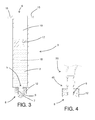
- the device in the present invention consists of two fundamental elements, a container body 3 which holds the sterile liquid 2, and an adapter 4 which allows the liquid to be connected sealed to a source of pressurised thrust fluid.
- the sterile liquid 2 is a liquid 2 injectable into the eyeball and is chosen from the perfluorocarbon family.
- the container body 3 is tubular and has a first dispensing end 5 and a second end 6.
- the container body 3 advantageously consists of the cylinder of a traditional syringe and advantageously made of glass.
- the first end 5 is nozzle-shaped, has a smaller cross-section than the other end and can be connected during use to a dispensing means (such as a canula, not illustrated here as the variety is well known). Before use, the first end 5 is closed by a seal 7. To enable attachment of the dispensing means, the first end 5 may also be fitted with a male or female Luer fitting. Luer fittings are standardised attachments in the medical sector, with a double male-female connector.
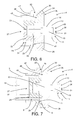
- a first part 8 of the fitting includes a male nozzle 9 which can be inserted in a sealed fashion into a female connector 10 hollowed out from the second part 11; furthermore, to ensure the tightness of the seal, the first part 8 is also fitted with an internally threaded bushing 12 mounted around the nozzle 9, into which a threading can be mounted or plurality of radial teeth 13 shaped from the outside of a coupling 14 which defines the inside of the female connector 10.
- Luer attachments can be seen in figures 3 and 4 (two second parts 11 referring to the identification in the previous paragraph) and 6-9 (two first parts 8 referring to the identification in the previous paragraph).
- male and female Luer fittings will be referred to as the first part 8 and the second part 11 respectively, as defined above (male-female identification is thus made with reference to the fluid duct).
- the second end 6 is opposite the first end 5 and its cross-section corresponds essentially to the container body 3 (with the exception of the first end 5).
- the container body 3 presents a radial projection at the second end 6 consisting of two flat tabs 15 perpendicular to the main axis of the container body 3, diametrically opposite it and coupled via a smaller edge 16 which is level with it (viewed in cross-section in figure 7 ).
- a first stopper 17, made from flexible material is slid opportunely into the container body 3, and opportunely at a distance from the second end 6, (the first stopper 17 should preferably be coated with a flexible, polymer film which is inert to the sterile liquid 2 and opportunely consisting of a fluorinated polymer).
- the first stopper 17 divides the internal volume of the container body 3 into two chambers, a collection chamber 18 close between the first end 5 and the first stopper 17, filled with sterile liquid 2, and a thrust chamber 19 closed between the first stopper 17 and the second end 6.
- the seal 7 of the first end 5 may be opportunely made of the same material as the first stopper 17.
- the adapter 4 opportunely has the function of connecting the second end 6 of the container body 3 with a tube 20 for feeding a thrust fluid into the thrust chamber 19.
- the adapter 4 includes, first of all, first connecting means 21 to attach the adapter 4 to the feed tube 20 and second connecting means 22 to attach the adapter 4 to the second end 6 of the container body 3, as well as first seal means 23 to guarantee the fluid seal between the feed tube 20 and the adapter 4 and second seal means 24 to guarantee the fluid seal between adapter 4 and the container body 3.
- the adapter 4 has at least one duct 25 for the passage of a thrust fluid, extending from an infeed section 26 to an outfeed section 27.
- the infeed section 26 is positioned for when the adapter 4 is attached to a feed tube 20 by the first connecting means 21; in this position, the infeed section 26 is in fluid connection with to the inside of the tube 20.
- the outfeed section 27 is positioned for when the adapter 4 is attached to the container body 3 by the second connecting means 22; with this layout, the outfeed section 27 is in fluid connection with the thrust chamber 19 of the container body 3.
- the pressurised thrust fluid dispensed through the tube 20 can reach the thrust chamber 19 and create a uniform thrust on the first stopper 17, creating a gradual shift towards the first end 5, with consequent dispensing of the sterile liquid 2.
- the first connecting means 21 consist of a Luer fitting 11, 12, male or female (female in the annexed figures) designed to connect to a corresponding Luer type connector 11, 12, female or male respective (male in figure 4 ), attached to the feed tube 20.
- the first connecting means 21 also consist opportunely of the first seal means 23 (in fact the seal is guaranteed by the tightening of the Luer fitting 11, 12).
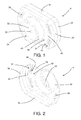
- the second connecting means 22 made by dividing the adapter 4 into a first body 28 and a second body 29 which are hooked onto each other. Once hooked, the first body 28 and the second body 29 form a housing 30 for containing at least the second end 6 of the container body 3 (in other words, the housing 30 forms the second connecting means 22).
- the housing 30 is shaped to surround, lock and completely contain the radial projection of the container body 3.
- the first body 28 can be sealed to the second end 6 of the container body 3. In particular, this can be achieved by attaching the first body 28 to the second end 6 in the same direction as the main axis of the container body 3 itself.
- the second seal means 24 consist of a projecting element 31 attached to the first body 28 and made of elastically deformable material (such as rubber), which can be inserted into the second end 6 in a sealed fashion (in this case, the duct 25 extends at least partly through the projecting element 31 itself).
- the projecting element 31 consists of a second stopper 32, similar to the first, mounted onto a rigid support element 33 projecting from and part of the first body 28.
- the first body 28 consists of single block of material and includes a first main portion 34 mainly extending flat which has a first 35 on which the first connecting means 21 are mounted (consisting of a female Luer fitting 11, 12), and a second face 36 on which the second seal means 24. Near the edge of the second face 36 a plurality of hooked teeth 37 are mounted. Presented in cross-section, each of these consists of a stem 38 which has an engagement head 39 designed to hook to the second body 29 as explained below.
- the second body 29 has an annular shape shaped to match the outside of the container body 3 thus being able to slide along the container body 3 from the first end 5 towards the second end 6 hooking to the first body 28.
- the second body 29 consist of a second main portion 40 extending mainly flat (essentially similar to the first main portion 34) and with a third face 41, in practice connectable to the second face 36, and a fourth face 42 opposite the third face, from which there extends cantilever-style a tubular element 43 the inside of which is shaped to match the outer wall of the container body 3, the hole in the tubular element 43 extends as far as the third face 41 so that the second body 29 takes the overall shape of a bushing.
- the second 36 and/or the third face 41 create the housing 30 for the radial projection of the container body 3.
- the second main portion 40 also has on the third face 41 undercut seats 44 which can be engaged by the hooking teeth 37. To hook the two bodies 28, 29 together, it is sufficient to push the teeth 37 into the seats 44, deforming them elastically until they are hooked in.
- the duct 25 is made through the first body 28 (and in particular through the first main portion 34), the rigid support element 33 and the second stopper 32.
- the device that is the subject of the present invention may also include a tube 20 ( figure 4 ) with a first end 45 able to connect to the first connecting means 21 (e.g. it may have special third connecting means such as a Luer fitting 11, 12) and a second end able to connect to a source of pressurised thrust fluid (the second end, not illustrated in the annexed figures, will also be fitted with special connecting means to the source of pressurised thrust fluid).
- the various components of the device that is the subject of the present invention may be held in one or several sealed container packages (not illustrated) with sterile air.
- a dispensing canula may also be inserted in these packages to complete the device).
- the adapter by itself is part of the present invention 4, provided it is destined to be used with container bodies of the type described above containing a sterile liquid 2 chosen from the family of perfluorocarbons.
- the device that is the subject of the present invention functions as described above.
- the surgeon when ready for use, the surgeon removes the components from the package and, connects the adapter 4 to the syringe (if not already connected) and then connects the adapter 4 to the tube 20 and, possibly, connects the tube 20 to the source of pressurised thrust fluid. He or she can then remove the seal 7 of the container body 3 and connect the dispensing canula.
- the surgeon may then insert the canula into the eye together with the aspirator (using both hands) and monitor the flow of the liquid 2 via the pedal control which is usually fitted on pressurised fluid equipment.
- the injection pressure supplied by the equipment is set at between 0.1 and 1.5 bars. Indeed, with pressures of between 0.2 and 0.3 bars, flow may be intermittent, while with pressures at 0.7 bars, the liquid flow can form continuously and gradually.
- the present invention provides important advantages.
- liquid can be dispensed by the surgeon himself/herself; on the other hand, the flow can be monitored with high precision and can take place continuously and gradually with no intermittence, given that the pedal controls the pressure within the thrust chamber.
Landscapes
- Health & Medical Sciences (AREA)
- Veterinary Medicine (AREA)
- Public Health (AREA)
- Biomedical Technology (AREA)
- Heart & Thoracic Surgery (AREA)
- Vascular Medicine (AREA)
- Life Sciences & Earth Sciences (AREA)
- Animal Behavior & Ethology (AREA)
- General Health & Medical Sciences (AREA)
- Engineering & Computer Science (AREA)
- Anesthesiology (AREA)
- Ophthalmology & Optometry (AREA)
- Hematology (AREA)
- Physics & Mathematics (AREA)
- Fluid Mechanics (AREA)
- Nuclear Medicine, Radiotherapy & Molecular Imaging (AREA)
- Surgery (AREA)
- Medical Preparation Storing Or Oral Administration Devices (AREA)
- Infusion, Injection, And Reservoir Apparatuses (AREA)
- Medicinal Preparation (AREA)
Applications Claiming Priority (1)
| Application Number | Priority Date | Filing Date | Title |
|---|---|---|---|
| ITVR2009A000134A IT1395436B1 (it) | 2009-09-08 | 2009-09-08 | Dispositivo per l iniezione in un bulbo oculare di un liquido sterile scelto tra i perfluorocarburi o perfluorocarboni |
Publications (2)
| Publication Number | Publication Date |
|---|---|
| EP2292193A2 true EP2292193A2 (fr) | 2011-03-09 |
| EP2292193A3 EP2292193A3 (fr) | 2012-10-31 |
Family
ID=42078360
Family Applications (1)
| Application Number | Title | Priority Date | Filing Date |
|---|---|---|---|
| EP10175445A Withdrawn EP2292193A3 (fr) | 2009-09-08 | 2010-09-06 | Dispositif pour injection dans le globe oculaire d'un perfluorocarbone liquide |
Country Status (3)
| Country | Link |
|---|---|
| US (1) | US20110060291A1 (fr) |
| EP (1) | EP2292193A3 (fr) |
| IT (1) | IT1395436B1 (fr) |
Cited By (1)
| Publication number | Priority date | Publication date | Assignee | Title |
|---|---|---|---|---|
| EP2915593A1 (fr) * | 2014-03-04 | 2015-09-09 | Nordson Corporation | Dispositifs de distribution pour une utilisation avec des cartouches de fluide juxtaposées et procédés associés |
Families Citing this family (1)
| Publication number | Priority date | Publication date | Assignee | Title |
|---|---|---|---|---|
| US10869966B2 (en) | 2015-02-20 | 2020-12-22 | Regeneron Pharmaceuticals, Inc. | Syringe systems, piston seal systems, stopper systems, and methods of use and assembly |
Citations (4)
| Publication number | Priority date | Publication date | Assignee | Title |
|---|---|---|---|---|
| US5037384A (en) | 1988-01-12 | 1991-08-06 | Cornell Research Foundation, Inc. | Method and apparatus for the treatment of complicated retinal detachments |
| US5336175A (en) | 1992-10-29 | 1994-08-09 | Mames Robert N | Method for the treatment of retinal detachments |
| US5792099A (en) | 1995-02-14 | 1998-08-11 | Decamp; Dennis | Syringe and cannula for insertion of viscoelastic material into an eye and method of using same |
| EP2020245A1 (fr) | 2007-07-31 | 2009-02-04 | AL.CHI.MI.A. S.r.l. | Dispositif pour traitements ophtalmiques et procédés pour la réalisation dudit dispositif |
Family Cites Families (5)
| Publication number | Priority date | Publication date | Assignee | Title |
|---|---|---|---|---|
| WO1997028835A1 (fr) * | 1996-02-05 | 1997-08-14 | Volker Lang | Dispositif d'application de medicaments pour pompes de seringue |
| US7601140B2 (en) * | 2004-06-25 | 2009-10-13 | Alcon, Inc. | Syringe pressure applicator |
| JP4943690B2 (ja) * | 2005-10-27 | 2012-05-30 | 前田産業株式会社 | シリンジホルダー及び注射器 |
| EP2032467B1 (fr) * | 2006-06-13 | 2010-08-18 | Nordson Corporation | Seringue de distribution de liquide |
| WO2008076083A1 (fr) * | 2006-12-18 | 2008-06-26 | Abed Alwahab Atalla | Seringue pneumatique médicale |
-
2009
- 2009-09-08 IT ITVR2009A000134A patent/IT1395436B1/it active
-
2010
- 2010-09-06 EP EP10175445A patent/EP2292193A3/fr not_active Withdrawn
- 2010-09-08 US US12/877,192 patent/US20110060291A1/en not_active Abandoned
Patent Citations (6)
| Publication number | Priority date | Publication date | Assignee | Title |
|---|---|---|---|---|
| US5037384A (en) | 1988-01-12 | 1991-08-06 | Cornell Research Foundation, Inc. | Method and apparatus for the treatment of complicated retinal detachments |
| US5037384B1 (en) | 1988-01-12 | 1994-08-16 | Cornell Res Foundation Inc | Method and apparatus for the treatment of complicated retinal detachments |
| US5037384B2 (en) | 1988-01-12 | 1995-12-26 | Cornell Res Foundation Inc | Method and apparatus for the treatment of complicated retinal detachments |
| US5336175A (en) | 1992-10-29 | 1994-08-09 | Mames Robert N | Method for the treatment of retinal detachments |
| US5792099A (en) | 1995-02-14 | 1998-08-11 | Decamp; Dennis | Syringe and cannula for insertion of viscoelastic material into an eye and method of using same |
| EP2020245A1 (fr) | 2007-07-31 | 2009-02-04 | AL.CHI.MI.A. S.r.l. | Dispositif pour traitements ophtalmiques et procédés pour la réalisation dudit dispositif |
Cited By (2)
| Publication number | Priority date | Publication date | Assignee | Title |
|---|---|---|---|---|
| EP2915593A1 (fr) * | 2014-03-04 | 2015-09-09 | Nordson Corporation | Dispositifs de distribution pour une utilisation avec des cartouches de fluide juxtaposées et procédés associés |
| US9302289B2 (en) | 2014-03-04 | 2016-04-05 | Nordson Corporation | Dispensing devices for use with side-by-side fluid cartridges and related methods |
Also Published As
| Publication number | Publication date |
|---|---|
| IT1395436B1 (it) | 2012-09-14 |
| ITVR20090134A1 (it) | 2011-03-09 |
| EP2292193A3 (fr) | 2012-10-31 |
| US20110060291A1 (en) | 2011-03-10 |
Similar Documents
| Publication | Publication Date | Title |
|---|---|---|
| JP6426531B2 (ja) | 注入ポートを通って治療剤を送出するための方法および装置 | |
| RU2154462C2 (ru) | Устройство для перемещения жидкости и способ его применения | |
| CN100488484C (zh) | 用于临时制备单次使用量的无菌流体的装置和方法 | |
| JP5804675B2 (ja) | コネクター用キャップ及びこれを備えた輸液ラインの接続装置 | |
| JP6781040B2 (ja) | ガスシリンジ充填デバイス及び当該デバイスの製造及び使用方法 | |
| JP7566382B2 (ja) | 静脈内カテーテルデバイス | |
| CN104415428A (zh) | 具有滑动前端连接件和可收回针的组合医疗装置 | |
| MXPA04010381A (es) | Aditamento para un dispositivo medico. | |
| JPWO2008152849A1 (ja) | 留置針組立体の製造方法および留置針組立体 | |
| CN1320051A (zh) | 具有伸缩式针头的输液装置 | |
| JP2016521172A5 (fr) | ||
| US6296623B2 (en) | Disposable needle and anesthetic carrier assembly | |
| CN107438444A (zh) | 流体传送设备和连接器 | |
| JP2026065007A (ja) | 安全シリンジのためのシステム | |
| EP2292193A2 (fr) | Dispositif pour injection dans le globe oculaire d'un perfluorocarbone liquide | |
| WO2006096960A1 (fr) | Regulateur de debit pour recipient de liquide medical | |
| US20170304536A1 (en) | Cannulated dose delivery device, system and method of use | |
| JP4855246B2 (ja) | 有効成分を送出するための装置用の均一供給コネクタ | |
| JP2017051545A (ja) | 医療用粉体の体内噴射装置 | |
| US10493210B2 (en) | Negative pressure syringe for drip prevention | |
| JP2022520888A (ja) | ポリマー製の注入システム | |
| JP2026509090A (ja) | 注入システムおよび方法 | |
| KR20220145170A (ko) | 커버와 이를 구비한 의약품주입기 | |
| TWI668029B (zh) | 具有滑動前端附接件及可回縮針的醫療裝置 | |
| CN119421728A (zh) | 具有一体式易开帽的注射器 |
Legal Events
| Date | Code | Title | Description |
|---|---|---|---|
| PUAI | Public reference made under article 153(3) epc to a published international application that has entered the european phase |
Free format text: ORIGINAL CODE: 0009012 |
|
| AK | Designated contracting states |
Kind code of ref document: A2 Designated state(s): AL AT BE BG CH CY CZ DE DK EE ES FI FR GB GR HR HU IE IS IT LI LT LU LV MC MK MT NL NO PL PT RO SE SI SK SM TR |
|
| AX | Request for extension of the european patent |
Extension state: BA ME RS |
|
| PUAL | Search report despatched |
Free format text: ORIGINAL CODE: 0009013 |
|
| AK | Designated contracting states |
Kind code of ref document: A3 Designated state(s): AL AT BE BG CH CY CZ DE DK EE ES FI FR GB GR HR HU IE IS IT LI LT LU LV MC MK MT NL NO PL PT RO SE SI SK SM TR |
|
| AX | Request for extension of the european patent |
Extension state: BA ME RS |
|
| RIC1 | Information provided on ipc code assigned before grant |
Ipc: A61F 9/007 20060101ALI20120921BHEP Ipc: A61M 5/145 20060101ALI20120921BHEP Ipc: A61M 5/20 20060101ALI20120921BHEP Ipc: A61M 5/155 20060101ALI20120921BHEP Ipc: A61M 5/34 20060101ALI20120921BHEP Ipc: A61F 9/00 20060101AFI20120921BHEP |
|
| STAA | Information on the status of an ep patent application or granted ep patent |
Free format text: STATUS: THE APPLICATION IS DEEMED TO BE WITHDRAWN |
|
| 18D | Application deemed to be withdrawn |
Effective date: 20130503 |