EP2292731B1 - Procédé de production de cultures complexes - Google Patents
Procédé de production de cultures complexes Download PDFInfo
- Publication number
- EP2292731B1 EP2292731B1 EP10172690.9A EP10172690A EP2292731B1 EP 2292731 B1 EP2292731 B1 EP 2292731B1 EP 10172690 A EP10172690 A EP 10172690A EP 2292731 B1 EP2292731 B1 EP 2292731B1
- Authority
- EP
- European Patent Office
- Prior art keywords
- culture
- cultivated
- complex
- complex culture
- portions
- Prior art date
- Legal status (The legal status is an assumption and is not a legal conclusion. Google has not performed a legal analysis and makes no representation as to the accuracy of the status listed.)
- Not-in-force
Links
Images





Classifications
-
- C—CHEMISTRY; METALLURGY
- C12—BIOCHEMISTRY; BEER; SPIRITS; WINE; VINEGAR; MICROBIOLOGY; ENZYMOLOGY; MUTATION OR GENETIC ENGINEERING
- C12N—MICROORGANISMS OR ENZYMES; COMPOSITIONS THEREOF; PROPAGATING, PRESERVING, OR MAINTAINING MICROORGANISMS; MUTATION OR GENETIC ENGINEERING; CULTURE MEDIA
- C12N1/00—Microorganisms; Compositions thereof; Processes of propagating, maintaining or preserving microorganisms or compositions thereof; Processes of preparing or isolating a composition containing a microorganism; Culture media therefor
- C12N1/20—Bacteria; Culture media therefor
-
- A—HUMAN NECESSITIES
- A23—FOODS OR FOODSTUFFS; TREATMENT THEREOF, NOT COVERED BY OTHER CLASSES
- A23L—FOODS, FOODSTUFFS OR NON-ALCOHOLIC BEVERAGES, NOT OTHERWISE PROVIDED FOR; PREPARATION OR TREATMENT THEREOF
- A23L13/00—Meat products; Meat meal; Preparation or treatment thereof
- A23L13/40—Meat products; Meat meal; Preparation or treatment thereof containing additives
- A23L13/45—Addition of, or treatment with, microorganisms
-
- A—HUMAN NECESSITIES
- A23—FOODS OR FOODSTUFFS; TREATMENT THEREOF, NOT COVERED BY OTHER CLASSES
- A23L—FOODS, FOODSTUFFS OR NON-ALCOHOLIC BEVERAGES, NOT OTHERWISE PROVIDED FOR; PREPARATION OR TREATMENT THEREOF
- A23L29/00—Foods or foodstuffs containing additives; Preparation or treatment thereof
- A23L29/065—Microorganisms
-
- A—HUMAN NECESSITIES
- A23—FOODS OR FOODSTUFFS; TREATMENT THEREOF, NOT COVERED BY OTHER CLASSES
- A23L—FOODS, FOODSTUFFS OR NON-ALCOHOLIC BEVERAGES, NOT OTHERWISE PROVIDED FOR; PREPARATION OR TREATMENT THEREOF
- A23L33/00—Modifying nutritive qualities of foods; Dietetic products; Preparation or treatment thereof
- A23L33/10—Modifying nutritive qualities of foods; Dietetic products; Preparation or treatment thereof using additives
- A23L33/135—Bacteria or derivatives thereof, e.g. probiotics
Definitions
- the present invention relates to a method for preparing complex cultures of microorganisms.
- Complex cultures for example Probat 505TM (a complex mesophilic dairy culture produced and sold by Danisco A/S), are cultures comprising different microorganisms (e.g. bacteria) that are co-cultivated.
- Complex cultures typically comprise a high and undefined diversity of strains and are also called traditional cultures since their origins go back to spontaneous fermentations of foodstuffs.
- Such complex cultures differ fundamentally from multiple strain cultures, the latter comprising a blend of a defined number of single strains. In such multiple strain cultures, each single strain is usually cultivated separately before blending, contrary to co-cultivation of an undefined number of strains in a complex culture.
- Complex cultures are often used as starter cultures in the production of, for example foodstuffs, such as dairy products, e.g. cheese, meat based products or vegetable based foodstuffs.
- the complex culture may be a probiotic culture.
- Boquien et al. demonstrate the effects of fermentation conditions on growth of Streptococcus cremoris AM2 and Leuconostoc lactis CNRZ 1091 in pure and mixed cultures.
- Boquien et al. show that a starter culture is composed of strains with properties defined by their acidifying and flavour-developing properties, their sensitivity to bacteriophages, and their potential production of bacteriocins and bitter peptides.
- Boquien et al state that these characteristics are no longer sufficient to characterise the starter; and that it is necessary to study the behaviour of individual strains in mixed culture under different fermentation conditions to determine final populations, ⁇ max and acidification rates. Boquien et al do this by using a reactor in well-controlled culture conditions.
- US5026647 discloses including a heavy metal salt in a medium comprising a mixed culture of Propionibacterium and other microorganisms to selectively promote the growth of metal salt-resistant Propionibacterium strains.
- each microorganism may provide a certain functionality to the final product.
- the following organisms which are often present in complex cultures display the following main functionality/functionalities:
- One aim of the present invention is to provide a flexible and/or efficient system for the production of complex cultures.
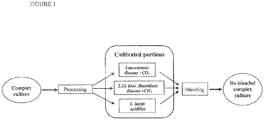
- the present invention provides in a first aspect a method of preparing a blended complex culture of microorganisms according to claim 1 as appended. In a further aspect the present invention provides the use of two or more cultivated portions to manufacture a blended complex culture according to claim 17 as appended.
- the present invention relates to complex cultures - the term "complex culture” as used herein means a culture comprising more than one different microorganism (e.g. bacteria) that are co-cultivated.
- the complex culture used in the method according to the invention comprises at least 5, more preferably more than 5, for example at least 6, 7, 8, 9, or 10 different microorganisms which are co-cultivated.
- complex cultures are also called traditional cultures since their origins go back to spontaneous fermentations of foodstuffs.
- Such complex cultures differ fundamentally from multiple strain cultures, the latter comprising a blend of a defined number of single strains.
- each single strain is usually cultivated separately before blending as opposed to co-cultivation of an undefined number of strains in a complex culture.
- the term "taking at least two portions from an initial complex culture” as used herein may mean dividing an initial complex culture into at least two portions. This may mean that the initial complex culture is separated into equal portions (i.e. it is halved when there are two portions, or it is divided into thirds when there are three portions etc.). Alternatively, this may mean that the initial complex culture is separated into unequal portions. In some embodiments not all of the initial complex culture may be used. In other embodiments all of the initial complex culture will be used.
- culturing each of the portions under conditions which enrich each portion refers to culturing the at least two portions under different conditions in order to enrich each portion in one or more microorganism.
- At least one of said portions may be subjected sequentially to at least two different sets of culture conditions so as to enrich the portion in one or more, preferably two or more, microorganisms.
- the method of the present invention may comprise culturing one of said portions under a first set of conditions which enrich one or more microorganisms to form a first cultivated portion and subsequently culturing this first cultivated portion under a second set of conditions which further enrich one or more microorganisms to form a second cultivated portion and formulating a blended complex culture comprising said second cultivated portion.
- the microorganisms enriched during culturing under the first and second sets of conditions are different.
- microorganism as used herein includes bacteria, moulds and/or yeasts.
- microorganism and microorganisms as used herein mean bacterium and bacteria, respectively.
- microorganism as used herein may be a microorganism genus, a species, a subspecies, a biovariety, or a strain.
- one or more microorganisms may be one or more genera, one or more species, one or more subspecies, one or more biovarieties or one or more strains or any combination thereof.
- Complex cultures typically contain a high number of different strains within each genus, species, subspecies or biovariety.
- the strain complexity in the complex culture is maintained.
- each genus, species, subspecies, or biovariety comprises a number of strains.
- the portions in the present invention are cultured under conditions which enrich each portion in one or more microorganisms to obtain a cultivated portion.
- enrich or “enrichment” as used herein may mean increasing one microorganism (e.g. bacteria) in the culture compared with another microorganism (e.g. bacteria) in the culture or may mean increasing one microorganism (e.g. bacteria) in the portion compared with the amount (CFU/mL and/or %) of the same microorganism (e.g. bacteria) initially in the portion taken from the initial complex culture.
- enrich or “enrichment” may mean increasing the actual number of microorganisms (e.g. bacteria).
- a specific mixture of microorganisms e.g. bacteria
- a specific mixture of different genera, species, subspecies, biovarieties or strains of microorganisms e.g. bacteria
- the cultivated portion (following culturing to enrich the portion in one or more microorganisms) may be enriched such that more than 80% (preferably more than 85%, more preferably more than 90%, more preferably more than 95%, suitably more than 98%, suitably 100%) of the microorganisms in the cultivated portion are comprised of the specific microorganism (e.g. bacteria) (or the specific mixture of microorganisms) being enriched.
- the specific microorganism e.g. bacteria
- more than 80% (preferably more than 85%, more preferably more than 90%, more preferably more than 95%, suitably more than 98%, suitably 100%) of the microorganisms (e.g. bacteria) in the cultivated portion is comprised of a specific genus, species, subspecies, biovariety or strain of microorganism (e.g. bacteria) (or a specific mixture of genera, species subspecies, biovarieties or strains of microorganisms [e.g. bacteria]).
- Each cultivated portion remains a complex culture, i.e. with a high strain diversity.
- the amount of microorganisms in the cultivated portion is determined at the end of the culturing step, i.e. immediately after culturing each of the portions under conditions, which enrich each portion in one or more microorganisms to obtain a cultivated portion.
- the amount of the microorganism may be determined after culturing the portion between about 2 to about 76 hours total fermentation time.
- the blended complex culture is formulated such that it comprises at least one of the cultivated portions (building blocks). A high strain diversity in the blended complex culture is maintained.
- the blended complex culture may have a different composition (such as a different number of microorganisms; or different mixture of microorganisms; or a different relative ratio of different microorganisms) compared with the initial complex culture.
- the blended complex culture may be a re-blended complex culture, i.e. one where the blended complex culture has the same composition as the initial complex culture.
- One advantage of the latter embodiment is that as there is no cultivation compromise, i.e. in other words the individual microorganisms are grown under optimal conditions, one can then re-blend in the same proportions (e.g. in respect of microorganisms and/or in respect of the number of microorganisms) as in the initial complex culture thus forming a blended complex culture, which will have (or will maintain) the properties of the initial complex culture.
- composition when we refer to the same composition as the initial complex culture this may be in terms of the types of genera, species, subspecies, biovarieties, or strains and/or the number of microorganisms (i.e. in each genus, species, subspecies, biovariety or strain of microorganism).
- the initial complex culture may comprise a number of microorganisms and it may be desirable to enrich all of these microorganisms. In another embodiment it may be desirable to enrich only a few of the microorganisms in the initial complex culture (for example due to market constraints or types of applications of the complex cultures).
- the initial complex culture may comprise 2 different genera of microorganism and at least 3 species and 3 strains of microorganism, but it may be only desirable to enrich 1 of the genera and 1 or 2 of the strains or species.
- the method according to the present invention may further comprise the optional steps of examining one or more of i) the initial complex culture, ii) a portion or part thereof, iii) the cultivated portion and/or iv) the blended complex culture to determine the composition of microorganism(s) therein. This examination may take place before step a) and/or after step a) and/or after step b) and/or after step c).
- the initial complex culture and/or the blended complex culture is/are a complex culture for use in a foodstuff or feed or as a starter culture in a foodstuff or feed.
- the initial complex culture and/or the blended complex culture may be a complex culture for use in dairy products, such as cheese or milk, or a complex culture for use in a meat based food product, or a complex culture for use in a vegetable food product or a complex culture for use in or as a probiotic composition, such as a probiotic complex culture for dairy products for instance, or a complex culture for use in biopreservation.
- the initial complex culture and/or the blended complex culture may be a thermophilic or mesophilic complex culture.
- the initial complex culture and/or the blended complex culture may be a thermophilic complex dairy culture, a thermophilic complex culture for meat based food products, a thermophilic complex culture for vegetable-based food products, a thermophilic complex probiotic culture or a thermophilic biopreservation complex culture.
- the initial complex culture and/or the blended complex culture may be a mesophilic complex dairy culture, a mesophilic complex culture for meat based food products, a mesophilic complex culture for vegetable-based food products, a mesophilic complex probiotic culture or a mesophilic complex biopreservation culture.
- step a) of the method according to the present invention may comprise taking at least 2 (suitably at least 3, at least 4, at least 5 or at least 6) portions of the initial complex culture.
- the method according to the present invention may comprise dividing the initial complex culture into at least 2 (suitably at least 3, suitably at least 4, suitably at least 5, or suitably at least 6) portions.
- the process may comprise taking at least 2, preferably 3, portions of the initial complex culture, e.g. dividing the initial complex culture into at least 2, preferably 3, portions.
- the method according to the present invention comprises the step of determining the conditions for culturing the portions by testing each portion or a part thereof and determining at least one critical parameter for each portion which enables enrichment of a microorganism or enables enrichment of a specific mixture of microorganism(s), and culturing each portion under (a) condition(s) which includes said at least one critical parameter.
- each portion is cultured under conditions which include at least one critical parameter.
- each portion or a part thereof may be tested to determine at least two critical parameters (preferably at least 3 parameters, more preferably at least 4 parameters) which enable enrichment of a microorganism or enable enrichment of a specific mixture of microorganism(s).
- at least two critical parameters preferably at least 3 parameters, more preferably at least 4 parameters
- each portion may be cultured under conditions which include said at least two critical parameters (preferably at least 3 critical parameters, more preferably at least 4 critical parameters).
- the method may suitably further comprise testing each portion or a part thereof to determine the effect on the microorganism(s) in the portion of one or more of the following parameters: pH; temperature; agitation speed; phosphate salts; aeration; citrate; acetate; glutathione; cysteine; addition of protectants, e.g. used during freezing; cooling time; freezing time; pelleting size; parameters for preserving the portion.
- the method further comprises analysing one or more of i) the initial complex culture, ii) a portion or part thereof, iii) the cultivated portion and/or iv) the blended complex culture to determine one or more of the group consisting of: microorganism diversity (e.g.
- the portion genus, species, subspecies, biovariety or strain diversity
- genetic relationships between the microorganisms in the portion such as DNA-fingerprinting of the microorganism(s) in the portion); bacteriophage sensitivity; bacteriophage resistance of the microorganism(s); the presence of functional genes which may result in preferred or detrimental functional effect; the functional properties of the portion (such as bacteriocin producing properties for example).
- the method comprises analysing ii) a portion of the initial complex culture or a part thereof.
- the method may additionally or alternatively comprise testing one or more of i) the initial complex culture, ii) a portion or part thereof, iii) the cultivated portion and/or iv) the blended complex culture to determine one or more of the following properties (or functionalities) selected from the group consisting of: rheological properties, aroma, taste, texture, viscosity, preserving properties of the portion, probiotic properties, acidification, gas formation, lactose reduction, bacteriophage sensitivity; bacteriophage resistance, health benefits (for example production of certain vitamins), production of substances that promote the growth of the culture and interaction between the microorganisms, production of substances that increase the survival of microorganisms after freezing and/or freeze drying, production of biopreservative substances, capacity to remove undesirable compounds by enzymatic activity (e.g. production or use of bitter peptides causing an off-flavour).
- properties or functionalities
- the method comprises analysing ii) a portion of the initial complex culture or a part thereof.
- the cultivated portion and/or the blended complex culture may be preserved.
- the cultivated portion or the blended complex culture may have one or more preservatives (e.g. chemical preservatives) added thereto; and/or the cultivated portion or the blended complex culture may be frozen (for example under a pelletized format); and/or the cultivated portion or the blended complex culture may be in liquid form (e.g. preserved in liquid form) and/or dried (such as freeze-dried (i.e. lyophilised) or spray-dried, or dried using any other preservation technique) and/or encapsulated (e.g. by micro-encapsulation or nano-encapsulation).
- preservatives e.g. chemical preservatives
- the cultivated portion or the blended complex culture may be frozen (for example under a pelletized format); and/or the cultivated portion or the blended complex culture may be in liquid form (e.g. preserved in liquid form) and/or dried (such as freeze-dried (i.e. lyophilised) or spray-d
- the cultivated portion may be formulated into a blended complex culture, i.e. step c), in a liquid, frozen, encapsulated or dried state or following thawing or rehydrating of the cultivated portion.
- the method of the present invention may additionally comprise the step of freezing (and/or preparing a frozen block or pellet) and/or drying (such as freeze-drying (i.e. lyophilising) or spray-drying, or drying using any other preservation technique) and/or encapsulating at least one cultivated portion following step b), i.e. following culturing each portion under conditions which enrich each portion in one or more microorganisms to obtain cultivated portions.
- freezing and/or preparing a frozen block or pellet
- drying such as freeze-drying (i.e. lyophilising) or spray-drying, or drying using any other preservation technique
- encapsulating at least one cultivated portion following step b i.e. following culturing each portion under conditions which enrich each portion in one or more microorganisms to obtain cultivated portions.
- the method of the present invention may comprise the step of freezing, drying (e.g. freeze-drying (i.e. lyophilising) or spray drying) and/or encapsulating the blended complex culture following step c), i.e. formulating a blended complex culture comprising at least one of said cultivated portions.
- freezing e.g. freeze-drying (i.e. lyophilising) or spray drying
- encapsulating the blended complex culture following step c i.e. formulating a blended complex culture comprising at least one of said cultivated portions.
- the blended complex culture may be in the form of a powder (preferably a lyophilised powder), or in the form of a pellet, or in the form of a tablet, or in the form of a capsule or in the form of a liquid.
- the cultivated portion(s) may be admixed or formulated into the blended complex culture as active (e.g. liquid) cultures, as frozen cultures or as lyophilised cultures.
- the cultivated portion(s) may be in the form of a powder, a tablet, a liquid, a capsule or a pellet.
- the cultivated portion(s) are in the form of a powder, a tablet, a liquid, a capsule or a pellet prior to formulating said cultivated portion into the blended complex culture.
- complex cultures for use in the present invention are differentiated from multiple strain cultures or mixed strain cultures which comprise a predetermined number and combination of microorganisms which may be co-cultivated or cultivated individually and subsequently combined.
- co-cultivated refers to the culture of at least two microorganisms together in a single growth medium.
- initial complex culture refers to a complex culture which has not been further cultivated, enriched or blended by the addition of one or more microorganisms to the culture.
- cultivadas portion refers to a complex culture which has been cultivated under conditions which lead to the culture being enriched in one or more microorganisms.
- portion does not refer to a single microorganism or strain which has been isolated from the complex culture by, for example, plating the complex culture and isolating single colonies or by any other suitable method.
- blended complex culture refers to a culture comprising at least one cultivated portion of a complex culture and at least one further microorganism or culture thereof. This "at least one further microorganism or culture thereof” is a further cultivated portion of the complex culture or a different complex culture or cultivated portion thereof.
- formulating a blended complex culture refers to the step of mixing (admixing or blending) at least one of the cultivated portions with the at least one further microorganism or culture thereof.
- the step of formulating the blended culture may occur subsequently to the step of culturing the portion(s) of the complex culture to form the cultivated portion(s).
- the step of formulating the blended culture may be undertaken concomitantly with, or overlap with the culturing and enrichment step. It will be apparent to the skilled person that this could occur, for example, in a continuous rather than batch process.
- the cultivated portion(s) may be formulated into a blended complex culture immediately following the production of the cultivated portion, i.e. immediately following the culturing step b). In some embodiments there may be a delay between production of the cultivated portion and formulating the cultivated portion(s) into the blended complex culture. In some embodiments the cultivated portions are concentrated (e.g. by filtration or centrifugation) prior to formulating the cultivated portion(s) into the blended complex culture. In some embodiments the cultivated portions may be frozen or dried (e.g. freeze-dried (i.e. lyophilised) or spray dried) or encapsulated prior to formulating the cultivated portion(s) into the blended complex culture.
- the cultivated portion(s) may be formulated into a blended complex culture as and when the blended complex culture is placed into packaging.
- the formulating of the blended complex culture may occur at the same time as packaging the blended complex culture.
- the blending may be done as the cultivated portion(s) making up the blended complex culture (optionally with a microorganism or mixture thereof which has not been taken from the initial complex culture) are being placed into packaging, i.e. as the blended complex culture is placed into pouches or packaging for selling.
- the present invention yet further provides a kit comprising at least two packages, each package comprising at least one cultivated portion.
- the formulation or blending step may take place prior to or during packaging of the blended complex culture.
- the blended complex culture may be formulated by placing an appropriate amount of each cultivated portion (optionally together with one or more cultures of at least one microorganism which has not been taken from the initial complex culture) in packaging to form a blended complex culture in the packaging.
- the blended complex culture is formulated prior to packaging the same.
- the blended complex culture may be cultured under conditions which are the same as or similar to those used to culture the initial complex culture.
- the blended complex culture is concentrated (e.g. by filtration or centrifugation) after the cultivated portions are admixed.
- the cultivated portion and/or blended complex culture according to the present invention may be in the form of a frozen, dried (e.g. freeze-dried (i.e. lyophilised) or spray dried), liquid or encapsulated culture.
- the blended complex culture may be sold in the form of a frozen, dried (e.g. freeze-dried (i.e. lyophilised) or spray dried), liquid or encapsulated culture.
- the blended complex culture may be sold in the form of a pellet, e.g. a freeze-dried (i.e. lyophilised) pellet, a powder, a tablet, a liquid or a capsule.
- the blended complex culture may be used to inoculate a bulk starter culture which may then be used for inoculation of production tanks.
- the blended complex culture may be used as a starter culture directly. In this way the advantages of the present invention may be fully maintained.
- the blended complex culture has been reactivated if necessary (i.e. thawed or rehydrated) it is used immediately or with minimal further culturing. In this way the advantages obtained using the present invention will be fully maintained.
- the blended complex culture of the present invention is a blended complex starter culture.
- each of the portions may be cultured under conditions which enrich each portion in two or more microorganisms (e.g. bacteria), suitably three or more (e.g. four or more, five or more, or six or more) microorganisms (e.g. bacteria).
- microorganisms e.g. bacteria
- three or more e.g. four or more, five or more, or six or more
- microorganisms e.g. bacteria
- each of the portions is cultured under conditions which enrich a specific mixture of microorganisms (e.g. bacteria).
- microorganisms e.g. bacteria
- the one or more microorganisms or mixture of microorganisms in each cultivated portion are different compared with the other cultivated portion(s).
- the term "different” as used herein means that the actual genus, species, subspecies, biovariety or strain of microorganism (or mixture thereof) is different in each cultivated portion and/or that each cultivated portion has a different proportion or number of specific genera, species, subspecies, biovarieties or strains of microorganisms compared with other cultivated portions.
- the aim is to achieve a ratio of more than 90% (preferably more than 91%, preferably more than 92%, preferably more than 93%, preferably more than 94%, even more preferably more than 95%) of the targeted genus, species, subspecies, biovariety or group of strains in one cultivated portion whereas the ratio of the same genus, species, subspecies, biovariety or group of strains in the other portion is less than 10% (preferably less than 9%, preferably less than 8%, preferably less than 7%, preferably less than 6%, even more preferably less than 5%), both portions being cultivated from the same original complex culture.
- at least two portions are cultured under a different culture condition(s).
- each portion is cultured under a different culture condition(s) compared with the other portion(s).
- Each portion is cultured under a condition(s) which promotes the growth of (and thus enriches the portion in) a microorganism (e.g. bacteria) or a mixture of microorganisms (e.g. bacteria) which has/have a specific functionality.
- Each cultivated portion imparts a different functionality on the blended complex culture.
- the term "cultivated portion” as used herein is used synonymously with the terms "building block”.
- Each portion is cultured under a different culture condition(s) compared with the other portion(s), such that each cultivated portion imparts a different functionality on the blended complex culture. For instance, one portion may be cultivated to impart a texturising property on the blended complex culture, whereas another portion may be cultivated to impart a flavour or aroma property on the blended complex culture.
- the functionality may be selected from one or more of the group consisting of: probiotic properties, acidification, aroma enhancement. gas formation, texturisation, lactose reduction, nitrate reduction, rheological properties, taste, texture, viscosity, bacteriophage sensitivity, bacteriophage resistance, health benefits (for example production of certain vitamins), producer of substances that promote the growth of the culture and interaction between the species, producer of substances that increase the survival of strains after freezing and/or freeze drying, producer of biopreservative substances, capacity to remove undesirable compounds by enzymatic activity (e.g. production or use of bitter peptides causing an off-flavour).
- the enrichment of one or more microorganisms (e.g. bacteria) in each portion is such that more than 80% (preferably more than 85%, more preferably more than 90%, more preferably more than 95%) of the microorganisms (e.g. bacteria) in the cultivated portion is comprised of the enriched microorganisms (e.g. bacteria).
- the at least one cultivated portion may be admixed with a further complex culture or portion thereof or cultivated portion thereof (e.g. a cultivated portion obtained from culturing a portion of a second complex culture which may be different from the initial complex culture).
- the blended complex culture may be a mixture of at least 2 or at least 3 or at least 4 of the cultivated portions, and optionally at least one microorganism (preferably a bacterium) which has not been taken from the initial complex culture and/or a further complex culture or portion thereof or cultivated portion thereof (which further complex culture may be different from the initial complex culture).
- a microorganism preferably a bacterium
- the culture of a single microorganism (preferably a bacterium) or a mixture of microorganisms (preferably bacteria) which has not been taken from the initial complex culture may for example comprise a bacteriophage resistant bacterium.
- said method comprises admixing at least two (suitably at least 3, suitably at least 4, suitably at least 5) of said cultivated portions.
- formulating a blended complex culture comprising at least one of said cultivated portions preferably comprises admixing all of the cultivated portions obtained from culturing all of the portions taken from the initial complex culture.
- the blended complex culture may have the same composition as the initial complex culture.
- the blended complex culture may be formulated by admixing all of the cultivated portions obtained from culturing all of the portions taken from the initial complex culture together with optionally a culture of at least one microorganism (preferably a bacterium) which has not been taken from the initial complex culture.
- all of the cultivated portions may be admixed together, as well as with a culture of a single microorganism (e.g. a single bacterium).
- the single microorganism e.g. bacterium
- all of the cultivated portions may be admixed together, as well as with a further complex culture or portion thereof or cultivated portion thereof (e.g. obtained from a second complex culture which may be different from the initial complex culture).
- each cultivated portion is admixed such that the microorganism(s) (e.g. bacteria) contained in the blended complex culture are in a specific ratio (this ratio can be the same as or different from the ratio of microorganisms found in the initial complex culture).
- the ratio may depend on the functional properties imparted by each cultivated portion and the requisite properties of the final blended complex culture.
- the selected ratio may be anywhere from 0.1 to 99.9%, preferably 1 to 99%.
- the microorganism(s) (e.g. bacteria) contained in the blended complex culture may be in a ratio of 50:50, suitably 20:80 or 10:90 for example where there are two microorganisms.
- the ratio of each microorganism can be determined by known conventional methods, for example by way of microbiological cultivation on differential agar plates or by molecular-biological methods.
- the method may comprise adding either the cultivated portion(s) (of step b) or the blended complex culture (of step c) to a food ingredient to produce a food product.
- the food product may be one or more of a dairy product, a meat based food product, a vegetable food product, a probiotic composition or a biopreservation composition.
- the present invention provides a method of preparing a blended complex culture (preferably a blended dairy complex culture) comprising:
- One advantage of the present invention is that it provides a flexible system for the production and development of complex cultures.
- the present invention provides a building block approach (e.g. cultivated portion approach) to formulating blended complex cultures.
- each microorganism e.g. bacterium
- only selected microorganisms may be enriched in the final complex culture, such as at least a specific genus, species, subspecies, biovariety or strain thereof (e.g. groups of strains).
- An advantage of the present invention is the development of new complex cultures by blending of cultivated portions, these may be different from initial complex cultures.
- the new approach allows the flexible handling and development of blended complex cultures.
- bacteriophage-alternatives can easily be created by exchanging one phage sensitive cultivated portion from one complex culture by the same but phage resistant cultivated portion of another complex culture.
- the new approach allows the creation of complex cultures with new functionalities without losing the complex culture status.
- an advantage of the present invention is that it is possible to develop bacteriophage backups.
- Bacteriophage backups are alternative cultures to known cultures with the same functionality but which are not sensitive to bacteriophages.
- the present invention allows for a bacteriophage-sensitive cultivated portion or a microorganism (e.g. bacterium) infected by bacteriophages to be readily removed from complex cultures. This offers more possibilities to create bacteriophage resistant complex cultures without losing the complex status in terms of strain diversity in a complex culture. Parts of a culture that are bacteriophage-resistant may remain in the culture and only the sensitive parts may be exchanged.
- the present invention provides a simple method to remove a bacteriophage-sensitive cultivated portion or a simple method for replacing bacteriophage infected bacteria in a complex culture with uninfected bacteria or a bacteriophage resistant bacterium.
- the uninfected replacement bacteria or bacteriophage resistant bacteria may or may not have the same functionality as the bacteriophage infected bacteria.
- Another advantage of the present invention is that it allows the strain complexity in each cultivated portion to be kept. Indeed, in the present invention a complex culture is taken as a basis for the cultivated portions. Therefore, the strain complexity, i.e. the main key feature of a complex culture, can be maintained in each cultivated portion. There is still high strain diversity at each step of the present method (i.e. in the initial complex culture, in the cultivated portion and in the blended complex culture).
- One further advantage of the present invention is that the method enables the simple development of new complex cultures.
- the present invention may be used to develop bespoke complex cultures.
- the present invention may also be used to create blended complex cultures according to market needs. Currently the ratio of the cultivated portions in a complex culture can only be adapted within certain limits, with the new approach any ratio of the cultivated portions that is required can be achieved by blending.
- Yet another advantage of the present invention is that an improvement in the consistency and yields of the complex culture can be readily achieved.
- a cultivated portion i.e. building block
- the growth of each group is optimised leading to higher cell counts and better activity.
- the needs of the different groups in a complex culture are different and sometimes contradictory, for example some strains prefer 30°C whilst others prefer only 20°C.
- incubate at 25°C but this temperature would be actually sub-optimal for both groups.
- the present invention also leads to the advantageous reduction in production costs. For example, by achieving higher cell counts and better activity the total amount of cultures used for the blending can be reduced. For example instead of 500 g, 450 g might be sufficient in the packaged product.
- a further advantage which has been observed is an improved product consistency.
- a complex culture is fermented/produced in the traditional/conventional way (one step fermentation of the whole culture) the ratio of the specific bacterial groups can only partly be influenced during the fermentation.
- the ratio of the different groups is given and sometimes the demanded ratio is not achieved.
- every wanted ratio of the cultivated portions can be achieved by blending the cultivated portions.
- each portion is cultured under condition(s) which promotes the growth of (and thus enriches a portion in) a microorganism or a mixture of microorganisms which has/have or impart(s) a specific functionality.
- each cultivated portion imparts a specific functionality on the blended complex culture.
- each cultivated portion imparts a different functionality on the blended complex culture compared with the other cultivated portions.
- more than one cultivated portion may impart the same functionality on the blended complex culture.
- the cultivated portion may impart one or more of the following functionalities on the blended complex culture or the final foodstuff in which the blended complex culture is used: acidification, aroma formation, lactose reduction, nitrate reduction, gas formation, a probiotic effect, flavour, mildness, consistency, texture, body, mouthfeel, firmness, viscosity, gel fracture, structure, bacteriophage sensitivity, bacteriophage resistance, health benefits (for example production of certain vitamins), production of substances that promote the growth of the culture and interaction between the species, production of substances that increase the survival of strains after freezing and/or freeze drying, production of biopreservative substances and/or organoleptic properties, capacity to remove undesirable compounds by enzymatic activity (e.g.
- At least two portions are cultured under a different culture condition(s). Preferably different fermentation or culturing parameters are selected for each portion in order to obtain separate functionality. Thus at least two and preferably each cultivated portion provides a separate functionality
- the parameters used to obtain the separate functionality may be any parameter which affects the growth or metabolism of a microorganism.
- the parameter(s) may be selected from one or more of the following: aeration, such as an oxygen content of between about 50% to about 80% for example; pH; temperature; agitation speed; cooling time; freezing time; pelleting size; preservation parameters; phosphate salts; citrate content/presence; acetate content/presence; glutathione content/presence; cysteine content/presence.
- the invention relates to a process of taking one (initial) complex culture and carrying out the method of the present invention to produce an enhanced (blended) complex culture.
- the cultivated portion(s) taught herein are also referred to as building blocks.
- the present invention relates to the use of building blocks comprising portions of an initial complex culture to produce an enhanced, blended complex culture.
- the microorganism of the present invention may be a bacterium, a yeast, a fungi or a mould for example, or mixtures thereof.
- yeasts, fungi and moulds are: Geotricum candidum, Penicillium roqueforti, Penicillium candidum, Penicillium nalgiovense, Penicillium chrysogenum, Debaryomyces hansenii, Verticillium lecanii, Trichothecium domesticum, Candida famata, Candida utilis, Candida kefyr, Rhodosporidium infirmomimiatum, Pichia membranifaciens, Kluyveromyces lactis, Hafnia alvei.
- the microorganism used herein is a bacterium.
- the bacterium may be a lactic acid bacterium, a Micrococcus (Micrococcus varians, Micrococcus luteus), a bacterium having anti-microbial activity (such as anti- Listeria or anti-mould activity) or a bacterium having a nitrate reductase activity such as certain bacteria of the Staphylococcus genus, or any mixture thereof.
- the bacterium is a lactic acid bacterium.
- the term 'lactic acid bacterium' includes any bacterium capable of producing, as the major metabolic end product of carbohydrate fermentation, lactic acid or at least one of its derivatives (including, but not limited to, propionic acid): the term is therefore intended to include propionic acid bacteria (PAB), which produce propionic acid as a carbohydrate fermentation product.
- PAB propionic acid bacteria
- the bacterium for use in the present invention is a lactic acid bacterium which is generally recognised as safe and, which is preferably GRAS approved.
- the bacterium used in accordance with the present invention is one which is suitable for human and/or animal consumption.
- the bacteria used may be of the same type (genus, species, subspecies, biovariety, strain) or may comprise a mixture of genera, species, subspecies, biovarieties or groups of strains.
- Suitable lactic acid bacteria may be selected from the genera Lactococcus, Lactobacillus, Leuconostoc, Bifidobacterium, Carnobacterium, Enterococcus, Propionibacterium, Pediococcus, and Streptococcus and mixtures thereof.
- the lactic acid bacteria are selected from the species, subspecies or biovarieties Leuconostoc spp., Lactococcus lactis subsp. cremoris, Lactococcus lactis subsp. lactis, Lactococcus lactis subsp.
- lactis biovariety diacetilactis Lactobacillus acidophilus, Lactocbacillus alimentarius, Lactobacillus casei, Lactobacillus coryneformis, Lactobacillus gasseri, Lactobacillus kefiri, Lactobacillus brevis, Lactobacillus helveticus, Lactobacillus paracasei ssp, Lactobacillus rhamnosus, Lactobacillus salivarius, Lactobacillus curvatus, Lactobacillus delbrueckii subsp. bulgaricus, Lactobacillus delbrueckii subsp. lactis, Lactobacillus delbrueckii subsp.
- Bifidobacterium breve Bifidobacterium infantis
- Bifidobacterium catenulatum Bifidobacterium pseudocatenulatum
- Bifidobacterium adolescentis Bifidobacterium angulatum, and combinations of any thereof.
- the bacteria used in the present invention are selected from the genera Lactococcus or Leuconostoc and mixtures thereof. More preferably, the bacteria used in the present invention are selected from the species, subspecies or biovariety Lactococcus lactis subspecies lactis, Lactococcus lactis subspecies cremoris, Lactococcus lactis subspecies lactis biov. diacetilactis, Leuconostoc ssp, and mixtures thereof.
- the microorganism used in the present invention may be a probiotic microorganism.
- the probiotic strains most commonly used, in particular in dairy products, are principally bacteria and yeasts of the following genera: Lactobacillus, Streptococcus., Enterococcus, Bifidobacterium. and Saccharomyces
- the microorganism used in the present invention may be a probiotic bacterium, more preferably a lactic acid bacterium.
- probiotic bacterium' is defined as covering any non-pathogenic bacterium which, when administered live in adequate amounts, confers a health benefit on the host.
- probiotic strains generally have the ability to survive the passage through the upper part of the digestive tract. They are non-pathogenic, non-toxic and exercise their beneficial effect on health on the one hand via ecological interactions with the resident flora in the digestive tract, and on the other hand via their ability to influence the immune system in a positive manner via the "GALT" (gut-associated lymphoid tissue).
- these bacteria when given in a sufficient number, have the ability to progress live through the intestine, however they do not cross the intestinal barrier and their primary effects are therefore induced in the lumen and/or the wall of the gastrointestinal tract. They then form part of the resident flora during the administration period.
- This colonization (or transient colonization) allows the probiotic bacteria to exercise a beneficial effect, such as the repression of potentially pathogenic micro-organisms present in the flora and interactions with the immune system of the intestine.
- the blended complex cultures produced by the method of the present invention may be used in the production of for example a foodstuff or feed, such as a dairy product, e.g. cheese or milk based products, a meat based product, a vegetable food product, a probiotic culture or a biopreservation complex culture.
- a dairy product e.g. cheese or milk based products
- a meat based product e.g. cheese or milk based products
- a vegetable food product e.g. cheese or milk based products
- a probiotic culture e.g., a probiotic culture or a biopreservation complex culture.
- the blended complex cultures may be used as - or in the preparation of - a food.
- the term "food” is used in a broad sense - and covers food for humans as well as food for animals (i.e. a feed). In a preferred aspect, the food is for human consumption.
- blended complex cultures may be used as starter cultures in the production of food.
- the food may be in the form of a solution or as a solid - depending on the use and/or the mode of application and/or the mode of administration.
- composition When used as - or in the preparation of - a food - such as a functional food - the composition may be used in conjunction with one or more of: a nutritionally acceptable carrier, a nutritionally acceptable diluent, a nutritionally acceptable excipient, a nutritionally acceptable adjuvant, a nutritionally active ingredient.
- blended complex cultures prepared according to the method of the present invention may be used as a food ingredient.
- the term "food ingredient” includes a formulation which is or can be added to functional foods or foodstuffs as a nutritional supplement and/or fibre supplement.
- the term food ingredient as used here also refers to formulations which can be used at low levels in a wide variety of products that require gelling, texturising, stabilising, suspending, film-forming and structuring, retention of juiciness and improved mouthfeel, without adding viscosity.
- the food ingredient may be in the form of a solution or as a solid - depending on the use and/or the mode of application and/or the mode of administration.
- blended complex cultures prepared according to the method of the present invention may be - or may be added to - food supplements.
- blended complex cultures prepared according to the method of the present invention may be - or may be added to - functional foods.
- the term "functional food” means food which is capable of providing not only a nutritional effect and/or a taste satisfaction, but is also capable of delivering a further beneficial effect to consumer.
- functional foods are ordinary foods that have components or ingredients (such as those described herein) incorporated into them that impart to the food a specific functional - e.g. medical or physiological benefit - other than a purely nutritional effect.
- nutraceuticals means a food which is capable of providing not only a nutritional effect and/or a taste satisfaction, but is also capable of delivering a therapeutic (or other beneficial) effect to the consumer. Nutraceuticals cross the traditional dividing lines between foods and medicine.
- the blended complex cultures prepared according to the present invention can be used in the preparation of food products such as one or more of: jams, marmalades, jellies, dairy products (such as milk or cheese), meat products, vegetable based food products, poultry products, fish products and bakery products.
- food products such as one or more of: jams, marmalades, jellies, dairy products (such as milk or cheese), meat products, vegetable based food products, poultry products, fish products and bakery products.
- the blended complex cultures can be used as ingredients to soft drinks, a fruit juice or a beverage comprising whey protein, health teas, cocoa drinks, milk drinks and lactic acid bacteria drinks, yoghurt and drinking yoghurt, cheese, ice cream, water ices and desserts, confectionery, biscuits cakes and cake mixes, snack foods, breakfast cereals, and cup noodles, and balanced foods and drinks, cheese cake flavoured filling, cake and doughnut icing, heat stable bakery filling, instant bakery filling creams, filling for cookies, ready-to-use bakery filling, reduced calorie filling, adult nutritional beverage, acidified soy/juice beverage, aseptic/retorted chocolate drink, bar mixes, beverage powders, calcium fortified soy/plain and chocolate milk.
- a blended complex culture prepared according to the present invention can further be used as an ingredient in food products such as American cheese sauce, anti-caking agent for grated & shredded cheese, chip dip, cream cheese, dry blended whip topping fat free sour cream, freeze/thaw dairy whipping cream, freeze/thaw stable whipped tipping, low fat natural cheddar cheese, low fat Swiss style yoghurt, aerated frozen desserts, and novelty bars, hard pack ice cream, label friendly, improved economics & indulgence of hard pack ice cream, low fat ice cream: soft serve, barbecue sauce, cheese dip sauce, cottage cheese dressing, dry mix Alfredo sauce, mix cheese sauce, and others.
- food products such as American cheese sauce, anti-caking agent for grated & shredded cheese, chip dip, cream cheese, dry blended whip topping fat free sour cream, freeze/thaw dairy whipping cream, freeze/thaw stable whipped tipping, low fat natural cheddar cheese, low fat Swiss style yoghurt, aerated frozen desserts, and novelty bars, hard pack ice
- the foodstuff is a beverage.
- the beverage may be a fermented milk drink.
- the foodstuff is a bakery product - such as sour dough bread, bread, Danish pastry, biscuits or cookies.
- dairy product as used herein is meant to include a medium comprising milk of animal and/or vegetable origin.
- milk of animal origin there can be mentioned cow's, sheep's, goat's or buffalo's milk.
- milk of vegetable origin there can be mentioned any fermentable substance of vegetable origin which can be used, in particular originating from soybeans, rice or cereals.
- Still more preferably blended complex cultures produced by the present invention are employed in or in the production of a food product which is a fermented milk or humanized milk.
- the blended complex cultures may be used in connection with yoghurt production, such as fermented yoghurt drink, yoghurt, drinking yoghurt, cheese, fermented cream, fermented milk, milk based desserts and others.
- yoghurt production such as fermented yoghurt drink, yoghurt, drinking yoghurt, cheese, fermented cream, fermented milk, milk based desserts and others.
- cheese may be any kind of cheese and includes, e.g. natural cheese, cheese analogues and processed cheese.
- the cheese may be obtained by any suitably process known in the art, such as e.g. by enzymatic coagulation of the cheese milk with rennet, or by acid coagulation of the cheese milk with food grade acid or acid produced by lactic acid bacteria growth.
- the cheese may be a rennet-curd cheese.
- the cheese for which the blended complex culture may be used include all varieties of cheese, such as, e.g. Campesino, Chester, Danbo, Drabant, Herreg ⁇ rd, Manchego, Provoline, Saint Paulin, Soft Cheese, Svecia, Talegio, White Cheese, including rennet-curd cheese produced by rennet-coagulation of the cheese curd; ripened cheeses such as Cheddar, Colby, Edam, Muenster, Gruyere, Emmental, Camembert, Parmesan and Romano; fresh cheeses such as Mozzarella and Feta; acid coagulated cheeses such as cream cheese, Neufchatel, Quarg, Cottage Cheese and Queso Blanco; and pasta filata cheese.
- the cheese may be a pizza cheese in one embodiment.
- the blended complex culture produced by the method of the present invention may be added at any time during the conventional cheese-making process.
- the blended complex culture may be added to the cheese milk or one or more milk fractions, such as skimmed milk, cream, whole milk, buttermilk from production of sweet or acidified butter, whey protein concentrate, and butter or butter oil.
- the blended complex cultures can be further used as an ingredient in (or a starter culture for) one or more of cheese applications, meat applications, vegetable applications or applications comprising protective cultures.
- blended complex cultures prepared according to the method of the present invention (and optionally with other components/ingredients), wherein the blended complex cultures is used in an amount to be capable of improving the nutrition and/or health benefits/functionality of the product.
- the term "contacted" refers to the indirect or direct application of the blended complex cultures prepared according to the method of the present invention to the product.
- the application methods include, but are not limited to, treating the product in a material comprising the blended complex cultures, direct application by mixing the blended complex cultures with the product, spraying the blended complex cultures onto the product surface or dipping the product into a preparation of the blended complex cultures.
- the blended complex culture prepared according to the method of the present invention may be admixed with the food.
- the blended complex cultures may be included in the emulsion or raw food ingredients of a foodstuff.
- the blended complex cultures may be applied as a seasoning, glaze, colorant mixture, and the like.
- the blended complex culture is made available on or to the surface of a product or foodstuff to be affected/treated. This may allow the blended complex culture to impart one or more of the following favourable characteristics: nutrition and/or health benefits and/or a particular specific functionality.
- blended complex cultures prepared according to the method of the present invention may be applied to intersperse, coat and/or impregnate a product or foodstuff with a controlled amount of a viable microorganism.
- the blended complex cultures is used to ferment milk or common fermentable sugars (such as sucrose, glucose, lactose and maltose for example), or fortified milk or lactic media with any common fermentable sugar (such as sucrose, glucose, lactose and maltose for example) where the resulting media containing all components of the blended complex cultures can be added as an ingredient to yoghurt milk in suitable concentrations - such as for example in concentrations in the final product which offer a daily dose of 10 6 -10 10 cfu.
- common fermentable sugars such as sucrose, glucose, lactose and maltose for example
- suitable concentrations - such as for example in concentrations in the final product which offer a daily dose of 10 6 -10 10 cfu.
- blended complex culture prepared according to the present invention may be used as, or in the preparation of, animal feeds, such as livestock feeds, in particular poultry (such as chicken) feed, or pet food.
- animal feeds such as livestock feeds, in particular poultry (such as chicken) feed, or pet food.
- the viable lactic acid microorganisms in the blended complex culture prepared according to the method of the present invention can exert a probiotic culture effect. It is also within the scope of the present invention to add to the blended complex culture of the present invention further probiotics and/or prebiotics.
- probiotic culture defines live microorganisms (including bacteria or yeasts for example) which, when for example ingested or locally applied in sufficient numbers, beneficially affect the host organism, i.e. by conferring one or more demonstrable health benefits on the host organism.
- Probiotics may improve the microbial balance in one or more mucosal surfaces.
- the mucosal surface may be the intestine, the urinary tract, the respiratory tract or the skin.
- probiotic as used herein also encompasses live microorganisms that can stimulate the beneficial branches of the immune system and at the same time decrease the inflammatory reactions in a mucosal surface, for example the gut.
- a prebiotic is: " a non-digestible food ingredient that beneficially affects the host by selectively stimulating the growth and / or the activity of one or a limited number of beneficial bacteria ".
- the prebiotic component of the combination comprising the blended complex culture are characterised with slow fermentation in the large bowel. Such prebiotics can exert a positive effect on the gut flora, specifically in the left side of the colon, an area of the gut which is especially prone to disorders in particular bowel cancer and ulcerative colitis.
- Prebiotics are typically non-digestible carbohydrates (oligo- or polysaccharides) or a sugar alcohol which is not degraded or absorbed in the upper digestive tract.
- Known prebiotics used in commercial products and useful includes inulin (fructo-oligosaccharide, or FOS) and transgalacto-oligosaccharides (GOS or TOS).
- Other suitable prebiotics include palatinoseoligosaccharide, soybean oligosaccharide, gentiooligosaccharide, xylooligomers, non-degradable starch, lactosaccharose, lactulose, lactitol, maltitol, polydextrose (i.e. Litesse®) or the like.
- a blended complex culture prepared according to the method of the present invention with a prebiotic.
- the prebiotic for use in this combination may be one or more of the above list.
- the prebiotic may be administered (or added to the food) simultaneously with (e.g. in admixture together with or delivered simultaneously by the same or different routes) or sequentially to (e.g. by the same or different routes) the blended complex culture.
- Biopreservation refers to extended storage life and enhanced safety of foods using the microorganisms having anti-microbial activity, such as anti-Listeria and/or anti-mould activities and (or) their antibacterial products.
- Lactic acid bacteria have a major potential for use in biopreservation because they are safe to consume and during storage they naturally dominate the microflora of many foods.
- milk, brined vegetables, many cereal products and meats with added carbohydrates the growth of lactic acid bacteria produces a new food product.
- raw meats and fish that are chill stored under vacuum or in an environment with elevated carbon dioxide concentration the lactic acid bacteria become the dominant population and preserve the meat with a hidden fermentation. The same applies to processed meats provided that the lactic acid bacteria survive the heat treatment or they are inoculated onto the product after heat treatment.
- blended complex cultures prepared according to the method of the present invention are used in (or in the production of) biopreservation compositions or foods which display an extended storage life and enhanced safety due to the natural microflora and/or their antibacterial products.
- a meat based food product is any product based on meat.
- the meat based food product is suitable for human and/or animal consumption as a food and/or a feed.
- the meat based food product is a feed product for feeding animals, such as for example a pet food product.
- the meat based food product is a food product for humans.
- a meat based food product may comprise non-meat ingredients such as for example water, salt, flour, milk protein, vegetable protein, starch, hydrolysed protein, phosphate, acid, spices, colouring agents and/or texturising agents.
- non-meat ingredients such as for example water, salt, flour, milk protein, vegetable protein, starch, hydrolysed protein, phosphate, acid, spices, colouring agents and/or texturising agents.
- a meat based food product preferably comprises between 5-90% (weight/weight) meat.
- the meat based food product may comprise at least 30% (weight/weight) meat, such as at least 50%, at least 60% or at least 70% meat.
- the meat based food product is a cooked meat, such as ham, loin, picnic shoulder, bacon and/or pork belly for example.
- the meat based food product may be one or more of the following:
- the meat based food product is a processed meat product, such as for example a sausage, bologna, meat loaf, comminuted meat product, ground meat, bacon, polony, salami or pate.
- a processed meat product may be for example an emulsified meat product, manufactured from a meat based emulsion, such as for example mortadella, bologna, pepperoni, liver sausage, chicken sausage, wiener, frankfurter, luncheon meat, meat pate.
- a meat based emulsion such as for example mortadella, bologna, pepperoni, liver sausage, chicken sausage, wiener, frankfurter, luncheon meat, meat pate.
- the meat based emulsion may be cooked, sterilised or baked, e.g. in a baking form or after being filled into a casing of for example plastic, collagen, cellulose or a natural casing.
- a processed meat product may also be a restructured meat product, such as for example restructured ham.
- a meat product of the invention may undergo processing steps such as for example salting, e.g. dry salting; curing, e.g. brine curing; drying; smoking; fermentation; cooking; canning; retorting; slicing and/or shredding.
- the meat may be minced meat.
- the food product may be an emulsified meat product.
- tissue as used herein means any kind of tissue derived from any kind of animal.
- meat as used herein may be tissue comprising muscle fibres derived from an animal.
- the meat may be an animal muscle, for example a whole animal muscle or pieces cut from an animal muscle.
- the meat may comprise inner organs of an animal, such as heart, liver, kidney, spleen, thymus and brain for example.
- meat encompasses meat which is ground, minced or cut into smaller pieces by any other appropriate method known in the art.
- the meat may be derived from any kind of animal, such as from cow, pig, lamb, sheep, goat, chicken, turkey, ostrich, pheasant, deer, elk, reindeer, buffalo, bison, antelope, camel, kangaroo; any kind of fish e.g.
- sprat cod
- haddock tuna, sea ee1, salmon, herring, sardine, mackerel, horse mackerel, saury, round herring, Pollack, flatfish, anchovy, pilchard, blue whiting, pacific whiting, trout, catfish, bass, capelin, marlin, red snapper, Norway pout and/or hake; any kind of shellfish, e.g. clam, mussel, scallop, cockle, periwinkle, snail, oyster, shrimp, lobster, langoustine, crab, crayfish, cuttlefish, squid, and/or octopus.
- shellfish e.g. clam, mussel, scallop, cockle, periwinkle, snail, oyster, shrimp, lobster, langoustine, crab, crayfish, cuttlefish, squid, and/or octopus.
- the meat is beef, pork, chicken, lamb and/or turkey.
- the vegetable based product as taught herein may be any vegetable.
- the vegetable based food product as taught herein may be a fermented vegetable product, a brined vegetable, or a pickled vegetable product.
- the vegetable based food product as taught herein may be a beverage, for example a beverage containing soya such as a soya vegetable drink.
- the vegetable based food product as taught herein may be a fermented vegetable product such as a sauerkraut fermentation, pickles from fresh, green cucumbers, fermented mixed vegetables or any fermented plant or legumes that can be for example onion, celery, beet, lettuce, spinach, broccoli, cauliflower, mushroom, potatoes, radish, cabbage, peas. It can also be silage.
- the vegetable based food product as taught herein may be bean based, such as cheonggukjang, doenjang, miso, natto, soy sauce, stinky tofu, tempeh for example.
- the vegetable based food product as taught herein may be grain based.
- the vegetable based food product may be a batter made from rice and lentil ( Vigna mungo ) prepared and fermented for baking Idlis and Dosas, amazake, beer, bread, choujiu, gamju, injera, makgeolli, murri, ogi, sake, sikhye, sourdough, rice wine, Malt whisky, grain whisky, Vodka, batter.
- Each processing of the targeted microorganism started taking at least two portions of a complex culture.
- the fermentations were done in 5- liter scale using Labfors 2 fermenters (Infors AG, Bottmingen CH) by applying the selected parameter(s).
- This method evaluates the ratio of three different microorganisms (i.e. genera, species, subspecies or biovarieties) in mesophilic complex cultures by agar-plating.
- the agar medium containing insoluble Ca-citrate, allows the differentiation between the citrate-fermenters ( L. lactis subsp. lactis biovariety diacetilactis and Leuconostoc pseudomesenteroides / Leuconostoc mesenteroides subsp. cremoris ) and the non-citrate-fermenters ( L. lactis subsp. lactis / L. lactis subsp. cremoris). Citrate-fermenters are recognised by the formation of a cleared zone around the colonies.
- the L. lactis subsp. lactis biovariety diacetilactis can be distinguished from the genus Leuconostoc by the ability of the latter to split the lactose analogue 5-bromo-4-chloro-3-indolyl- ⁇ -D-galactopyranoside (XGal) forming blue colonies.
- XGal 5-bromo-4-chloro-3-indolyl- ⁇ -D-galactopyranoside
- the ratio of three different microorganisms (i.e. genera, species, subspecies or biovarieties) in the fermented product can be measured with a published Real-Time fourplex qPCR assay (Friedrich and Lenke, 2006).
- the Multiplex PCR reaction contained PCR buffer, 5 mM MgCl2, 0.8 ⁇ M of dNTPs, 2.5 U of HotStar Taq Polymerase (QIAGEN, Hilden, Germany) and suitable primers. Four microliters of template DNA of 1 ng/ ⁇ L is added to the reaction of 16 ⁇ L.
- the Multiplex PCR is carried out on a Rotor-Gene model 3000 quantitative PCR cycler (Corbett Research). Fluorescence data is acquired at the end of each elongation step in the four channels FAM, JOE, ROX and Cy5. Reactions are performed in duplicates. For the calculation of relative proportions of each of the taxa relative to DNA encoding bacterial 16SrDNA, the formula of Pfaffl (2001) is applied. Additionally, a qPCR assay for L. lactis subsp. lactis biovar diacetilactis is applied targeting citF. The relative proportion is calculated by measuring DNA encoding for citF relative to DNA encoding for bacterial 16SrDNA.
- Oligonucleotide probes based on ldh (lactate dehydrogenase), celB (IIc component of the cellobiose-specific Phosphotranferase sytem) and 16SrDNA sequences are designed to identify the three different microorganisms (i.e. genera, species, subspecies, biovarieties) within the culture on genus, species, subspecies and biovariety level.
- the probes are designed by using the software package Allele ID (Allele ID 5.0; Premier Biosoft International) and are synthesized and modified with C6-amino linkages by Metabion, Germany. All pipetting of oligonucleotides is carried out by using an epmotion 5075 liquid handling system (Eppendorf). DNA microarrays are produced using SMP3 pins (Telechem) on a BioOdysseyTM CalligrapherTM MiniArrayer (BioRad).
- Oligonucleotides are deposited as 30 ⁇ M diameter spots in 2X Spot Buffer (QInstruments) on Epoxy coated glass slides (EBN European Biotech Network) using the robotic arrayer. Relative humidity is kept constant at 50% and temperature is maintained at 20°C throughout spotting.
- Printed Epoxy coated slides are incubated at 30 % humidity over night in the dark to allow efficient cross-linking.
- microarray slides are scanned using GenePix 4000 (Axon Instruments Inc.) with an excitation wavelength of 532 nm (Cy3) and 635 nm (Cy5).
- GenePix 4000 Auto Instruments Inc.
- Cy3 the image analysis software
- Cy5 the image analysis software
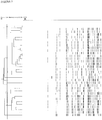
- DNA-fingerprinting is done on whole cultures and on the base of bacterial strain isolates.
- Bacterial strains are isolated from serial dilution plates on calcium-citrate agar and incubated (16-18h, 30°C) in modified Elliker broth of the following composition: Ingredients g/L 1. Peptone 20.0 g 2. Yeast extract 5.0 g 3. Gelatine 2.5 g 4. Glucose, waterfree 5.0 g 5. Lactose EP 5.0 g 6. Saccharose 5.0 g 7. Sodium chloride 4.0 g 8. Sodium acetate x 3 H2O 1.5 g 9. L (+) ascorbic acid 0.5 g 10. Tween 80 0.5 g 11. Sodium glycerophosphate hydrate 19.0g target pH before sterilization 7.20 - 7.30 target pH after sterilization: 6.70 - 6.90
- the DNA is extracted.
- DNeasyTM Tissue Kit cell pellets are resuspended in 180 ⁇ L lysis buffer (20 mM Tris-HCl, pH 8.0, 2 mM EDTA, pH 8.0, 1.2 % Triton X-100, 20 mg/mL lysozyme, 100 U/ml Mutanolysin) and incubated for 30 min at 37°C. Afterwards, the DNeasyTM Tissue Kit (Qiagen) is applied according to the guidelines of the manufacturer to isolate DNA. The DNA of whole cultures is extracted without prior cultivation steps. The DNA is submitted to fingerprinting analysis by using specific restriction endonucleases. Fluorescence markers allow the laser-based detection of fragments on the capillary sequencer CEQ8000. Data analysis is performed using the software CEQ 8000, version 9.0.25.
- the DNA-microarray is applied.
- a set of genes encoding for different functionalities of Lactococci and Leuconostoc is selected for the in silico design of hybridisation probes. These included genes encoding aroma-forming proteins (such as esterases, aminotransferases, enzymes of citrate metabolism etc.), genes related to texture formation in Lactococci ( epsA , epsB , epsC , epsX etc.), genes related to phage resistance (all known abi genes, adsorption and injection inhibition, restriction modification systems), and genes encoding bacteriocins.
- the probes are designed by using the software package Allele ID (Allele ID 5.0; Premier Biosoft International) and are synthesized and modified with C6-amino linkages by Metabion, Germany. All pipetting of oligonucleotides is carried out by using an epmotion 5075 liquid handling system (Eppendorf). DNA microarrays are produced using SMP3 pins (Telechem) on a BioOdysseyTM CalligrapherTM MiniArrayer (BioRad).
- Oligonucleotides are deposited as 30 ⁇ M diameter spots in 2X Spot Buffer (QInstruments) on Epoxy coated glass slides (EBN European Biotech Network) using the robotic arrayer. Relative humidity is kept constant at 50% and temperature is maintained at 20°C throughout spotting.
- Printed Epoxy coated slides are incubated at 30 % humidity over night in the dark to allow efficient cross-linking.
- microarray slides are scanned using GenePix 4000 (Axon Instruments Inc.) with an excitation wavelength of 532 nm (Cy3) and 635 nm (Cy5).
- GenePix 4000 Auto Instruments Inc.
- Cy3 the image analysis software
- Cy5 the image analysis software
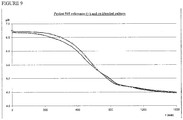
- the acidification properties of the cultivated portions are measured in 9% reconstituted skim milk using the CINAC-system, a computer-controlled device to record and evaluate the pH in definite steps.
- EXAMPLE 1 Identification of the main critical parameters for the selective enrichment of Lactococcus lactis (acidifier), L . lactis subsp. lactis biov. diacetilactis and Leuconostoc in PROBAT 505TM.
- Lactococcus lactis (acidifier), L. lactis subsp. lactis biov. diacetilactis and Leuconostoc in the three cultivated portions (building blocks) seven different parameters (temperature, pH, aeration, supplementation of the fermentation medium with either citrate, acetate, gluthatione or cysteine) were applied separately to portions of PROBAT 505TM (a mesophilic complex culture available from Danisco A/S). The pre-screening of the parameters was done in a fedbatch-pro® modular system (DASGIP) using a bi-substrate batch medium, an initial enzymatic treatment may be applied.
- the medium composition is given in table 1.
- Table 1 Medium composition of the basic fermentation medium Ingredient Amount (in the range of kg / 1000 L) Water 900 - 950 Skim milk powder 30 - 40 Yeast extract 10 - 20 Lactose 10 - 20 Glucose 30 - 40 Tween 80 0.1 - 1 Manganese(II)-sulfate-monohydrate 0.001 - 0.01
- Table 2 Typical ratio of Lactococcus lactis (acidifier), L. lactis subsp. lactis biov. diacetilactis and Leuconostoc tin PROBAT 505TM in five-liter scale Cell count (CFU/ml Calcium-citrate agar) Percentage of CFU count (%) Lc. lactis acidifier Leuconostoc Lc.l.l. diac. Total CFU Lc.
- lactis acidifier Leuconostoc Lc.l.l. dicac. Mean val. 1.47E+09 1.44E+07 1.22E+08 1.60E+09 91.5 0.9 7.6 Stdev 5.08E+08 6.93E+06 9.81E+08 5.98E+08 34.6 48.0 80.4
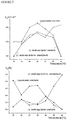
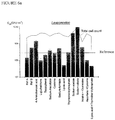
- Fermentations of PROBAT 505TM were done at 15, 20, 25, 30, 35 and 40 °C with a controlled pH of 6.0. All fermentations were performed in duplicates. The ratio of Lactococcus lactis (acidifier), L. lactis subsp. lactis biov. diacetilactis and Leuconostoc was measured on calcium-citrate agar (the results are shown in Figure 2 ).
- the ratio of the different Lactococcus lactis (acidifier), L. lactis subsp. lactis biov. diacetilactis and Leuconostoc was measured on calcium-citrate- agar (the results are shown in Figure 3 ).
- the pH showed a significant impact on the growth of Leuconostoc.
- Lactococcus lactis (acidifier), L. lactis subsp. lactis biov. diacetilactis and Leuconostoc t
- concentrations are given in Table 3.
- Table 3 Type and concentration of the tested compounds Compound Concentration 4-Aminobenzoic acid (PABA) 70 mg/L L-gluthatione 1 g/L ⁇ -tocopherol 1 g/L Ascorbic acid 1 g/L Cysteine 0.5 g/L Formic acid 1 g/L Lipoic acid 0.1 g/L Thymidine triphosphate (TPP) 0.3 g/L Acetic acid 7 g/L Citric acid 13 g/L Inosine + guanosine 0.3 g/L
- PABA aminobenzoic acid
- TPP Thymidine triphosphate
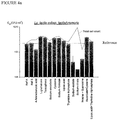
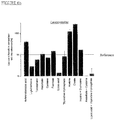
- Figure 4 shows the effect of the different compounds on the growth of the acidifier ( Lc. lactis subsp. lactis and Lactococcos lactis subsp. cremoris ).
- Glutathione, toccopherol, cysteine and formate promoted the growth of Lactococcus lactis (acidifier) in PROBAT 505TM whereas acetate and citrate had an inhibitory effect on this species.
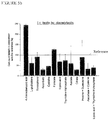
- Figure 5 shows the effect of the different compounds on the growth of the aroma producer Lc. lactis subsp. lactis biovariety diacetilactis.
- Figure 6 shows the effect of the different compounds on the growth of the aroma producer Leuconostoc ssp.
- PABA 4-Aminobenzoic acid
- organic acids citrate and acetate promoted the growth of Leuconostoc in PROBAT 505TM.
- the CFU of the Lc. lactis subsp. lactis biov. diacetilactis remained at the same level.
- Table 4 Influence of aeration on the ratio of Lactococcus lactis (acidifier), L. lactis subsp. lactis biov. diacetilactis and Leuconostoc % pO2 Cell count (CFU/ml Calcium-citrate agar) Percentage of CFU count (%) Lc. lactis acidifier Leuconostoc Lc.l.l. diac. Total CFU Lc. lactis acidifier Leuconostoc Lc.l.l. diac.
- EXAMPLE 2 Processing of the cultivated portions of the initial complex culture under conditions which enrich each portion in one or more genus, species, subspecies, biovarieties), strains or group of strains of microorganisms.
- the identified parameters were applied in combination to portions of the complex culture PROBAT 505TM. Each cultivated portion represents a building block of the initial culture. All tests were done in five-liter scale in Prop 3 medium (Table 1). A 3-step-fermentation was done, the selective parameter were applied in the main fermentation only. For a selective enrichment achieving >90% purity of the targeted microorganism, at least two of the identified parameters were applied in combination in the fermentation process.
- Table 5 shows the cell count numbers and ratios of Lactococcus lactis (acidifier), L. lactis subsp. lactis biov. diacetilactis and Leuconostoc of 3 fermentations after application of the Lc. lactis (acidifier) parameters at the fermentate step.
- Table 5 Ratio of the microorganisms in the cultivated portions after application of the Lc. lactis (acidifier) parameter Cell count (CFU/ml calcium-citrate agar) Percentage of CFU count (%) Lc. lactis acidifier Leuconostoc Lc.l.l. diac. Total CFU Lc. lactis acidifier Leuconostoc Lc.l.l. diac.
- test 1 1.15E+09 2.25E+07 7.25E+07 1.24E+09 92.3 1.8 5.8 test 2 2.23E+09 2.00E+07 2.10E+08 2.46E+09 90.7 0.8 8.5 test 3 1.10E+09 7.50E+06 4.40E+07 1.15E+09 95.5 0.6 3.8
- Table 8 summarizes potential critical parameters for the selective enrichment of Lactococcus lactis (acidifier), L. lactis subsp. lactis biov. diacetilactis and Leuconostoc with the main critical parameters in bold.
- Table 8 Critical parameters for the selective enrichment of Lactococcus lactis (acidifier), L. lactis subsp. lactis biov. diacetilactis and Leuconostoc Parameter Leuconostoc L.l.l. diacetilactis L.
- PROBAT 505TM For the assessment whether there would be a loss of phage resistance of the generated cultivated portions compared to PROBAT 505TM a phage sensitivity test was done.
- PROBAT 505TM and the generated cultivated portions Lc. lactis (acidifier) and Lc. lactis ssp. lactis biov. diacetilactis were challenged with 20 different phage samples from the Danisco phage collection. After incubation time a deviation of the pH-value of +0.05 and above in comparison to the control indicates a positive phage reaction. As shown in Table 12 no deviation in the pH value was found for the cultivated portions although minor deviations occurred in PROBAT 505TM demonstrating the virulence of the phages towards PROBAT 505TM.
- Table 12 Acidification test for PROBAT 505TM and the generated cultivated portions Cultivated portions Phage PROBAT 505TM 505D (acidifier) Lc.l.l. diacetilactis Control - 4.70 4.64 5.89 P677 4.77 4.63 5.34 P751 4.81 4.63 5.01 P775 4.78 4.63 4.83 P806 4.77 4.64 4.80 P816 4.79 4.66 4.99 P855 4.80 4.64 5.05 P1020 4.76 4.65 4.96 P1060 4.78 4.64 4.88 P1096 4.78 4.63 4.90 P1128 4.75 4.63 4.86 P1154 4.76 4.64 4.80 P1307 4.78 4.63 4.75 P1389 4.77 4.61 4.73 P1423 4.74 4.62 4.81 P1429 4.78 4.62 4.82 P1451 4.76 4.62 4.77 P1456 4.78 4.62 4.73 P1469 4.80 4.63 4.78 P1548 4.78 4.61 4.74 P1588 4.78 4.65 4.76
- Figure 7 shows a consensus dendrogram of different Lc. lactis strain types in a complex culture.
- One DNA-fingerprint pattern represents one bacterial isolate.
- Figure 8 shows the DNA-fingerprint of an initial complex culture and of the cultivated portion Lc. lactis (acidifier).
- the pattern of (a) and (b) are identical, indicating no loss of strain diversity in the cultivated portion.
- PROBAT 505TM The produced cultivated portions of PROBAT 505TM were re-blended following the specification of the initial culture PROBAT 505TM.
- EXAMPLE 6 Blending of two cultivated portions from two different complex cultures and single bacterial strains to a new complex culture with the same sensorial and acidifying properties as PROBAT 505TM but having a different phage lysotype
- Lc. lactis (acidifier) and the Lc. lactis ssp. lactis biovar. diacetilactis portion were obtained from two different complex cultures by applying the same parameters as for the processing of the cultivated portions of PROBAT 505TM (a first complex culture). Additionally single Leuconostoc strains were added to the blend. Both portions and the single Leuconostoc strains have a different lysotype compared to the corresponding cultivated portions of the PROBAT 505TM culture.
- lactis (acidifier) parameters Cell count (CFU/ml Calcium-citrate agar) Percentage of CFU count (%) Lc. lactis acidifier Leuconostoc Lc.l.l. diac. Total CFU Lc. lactis acidifier Leuconostoc Lc.l.l. diac. Reference C 3.70E+08 3.80E+07 ⁇ 10E+06 4.08E+08 90.70% 9.30% ⁇ 1% 1. test 1 4.25E+09 ⁇ 10E+06 ⁇ 10E+06 4.25E+09 100% 0% 0% 2.test 2 5.35E+09 ⁇ 10E+06 ⁇ 10E+06 5.35E+09 100% 0% 0% 0%
- Table 14 shows the ratio of the microorganisms of the culture (reference D) before and after the application of the Lc. lactis ssp. lactis biovar. diacetilactis parameters.
- a Lc. lactis ssp. lactis biovar. diacetilactis portion of > 90% purity was obtained.
- Table 14 Ratio of the microorganisms in the cultivated portion before (reference D) and after (1. test 1) application of the Lc.
- the produced cultivated portions of the second and third complex cultures and the single strains of Leuconostoc were blended following the specification of the culture PROBAT505TM. As shown in Figure 10 the blended phage-alternative culture was much faster than the complex culture PROBAT 505TM. Compared to PROBAT505TM less culture material would be needed to obtain the same properties.
- the sensorial properties were evaluated by a trained test panel.
- the phage-alternative blended complex culture had the same sensory as the PROBAT 505TM reference culture.
Landscapes
- Life Sciences & Earth Sciences (AREA)
- Health & Medical Sciences (AREA)
- Chemical & Material Sciences (AREA)
- Engineering & Computer Science (AREA)
- Polymers & Plastics (AREA)
- Food Science & Technology (AREA)
- Nutrition Science (AREA)
- Microbiology (AREA)
- Biotechnology (AREA)
- Organic Chemistry (AREA)
- Bioinformatics & Cheminformatics (AREA)
- Genetics & Genomics (AREA)
- Wood Science & Technology (AREA)
- Zoology (AREA)
- Medicinal Chemistry (AREA)
- General Engineering & Computer Science (AREA)
- General Health & Medical Sciences (AREA)
- Biochemistry (AREA)
- Biomedical Technology (AREA)
- Virology (AREA)
- Tropical Medicine & Parasitology (AREA)
- Mycology (AREA)
- Micro-Organisms Or Cultivation Processes Thereof (AREA)
Claims (17)
- Méthode de préparation d'une culture complexe assemblée de microorganismes, comprenant les étapes consistant à :a) prélever au moins deux portions d'une culture complexe initiale comprenant au moins 5 microorganismes différents ;b) cultiver chacune des portions dans des conditions qui enrichissent chaque portion en un ou plusieurs microorganismes afin d'obtenir une portion cultivée, où chaque portion est cultivée dans une ou plusieurs conditions de cultures différentes par rapport à la ou les autres portions de sorte que chaque portion cultivée confère une fonctionnalité différente ; etc) formuler une culture complexe assemblée comprenant au moins l'une desdites portions cultivées, en c1) mélangeant ou assemblant au moins 2 des portions cultivées ou bien c2) mélangeant ou assemblant au moins l'une des portions cultivées avec une culture complexe différente ou une portion cultivée de celle-ci.
- Méthode selon la revendication 1, où le microorganisme est une bactérie.
- Méthode selon la revendication 1 ou la revendication 2, où la culture complexe initiale ou la culture complexe assemblée est choisie parmi une ou plusieurs dans le groupe constitué par : une culture laitière complexe, une culture complexe de produit alimentaire à base de viande, une culture complexe de produit alimentaire à base de légumes, une culture probiotique complexe et une culture de bio-conservation complexe.
- Méthode selon l'une quelconque des revendications précédentes, où les conditions de culture des portions sont déterminées en testant chaque portion ou une partie de celle-ci et en déterminant au moins un paramètre critique pour chaque portion qui permet un enrichissement en un microorganisme spécifique ou permet un enrichissement en un mélange spécifique de microorganismes, et en cultivant chaque portion dans une ou plusieurs conditions qui comportent ledit au moins un paramètre critique.
- Méthode selon l'une quelconque des revendications précédentes, où la méthode comprend en outre l'étape consistant à tester chaque portion ou une partie de celle-ci afin de déterminer l'effet sur le ou les microorganismes dans la portion d'un ou plusieurs paramètres choisis dans le groupe constitué par : le pH ; la température ; la vitesse d'agitation ; les sels de phosphate ; l'aération ; le citrate ; l'acétate ; le glutathion ; la cystéine ; l'addition de protecteurs, par exemple utilisés lors de la congélation ; le temps de refroidissement, le temps de congélation, la taille de pelletisation, les paramètres de conservation.
- Méthode selon l'une quelconque des revendications précédentes, où la méthode comprend en outre l'étape consistant à analyser et/ou tester i) la culture complexe initiale, ii) une portion ou une partie de celle-ci, iii) la portion cultivée et/ou iv) la culture complexe assemblée, afin de déterminer un(e) ou plusieurs parmi ce qui suit : la diversité d'espèce ou de souche ; les relations génétiques entre les microorganismes dans la portion ; l'identification génétique du ou des microorganismes dans la portion ; la sensibilité aux bactériophages ; la résistance aux bactériophages ; le lysotype du ou des microorganismes ; la présence de gènes fonctionnels qui peut entraîner un effet fonctionnel préféré ou préjudiciable ; les propriétés fonctionnelles de la portion ; les propriétés de production de bactériocine de la part de la portion, les propriétés rhéologiques, l'arôme, le goût, la texture, la viscosité, les propriétés probiotiques, l'acidification, la formation de gaz, la réduction du lactose, les bénéfices pour la santé (par exemple la production de certaines vitamines), la production de substances qui favorisent la croissance de la culture et l'interaction entre les microorganismes, la production de substances qui augmentent la survie des microorganismes après congélation et/ou lyophilisation, la production de substances bio-conservatrices, la capacité à éliminer des composés non désirés par une activité enzymatique (par exemple la production ou l'utilisation de peptides amers provoquant une saveur passée).
- Méthode selon l'une quelconque des revendications précédentes, où les un ou plusieurs microorganismes ou le mélange de microorganismes dans chaque portion cultivée sont des microorganismes ou mélanges de microorganismes différents par rapport à l'autre ou aux autres portions cultivées.
- Méthode selon la revendication 7, où le genre, l'espèce, la sous-espèce ou la bio-variété des microorganismes ou du mélange de microorganismes dans chaque portion cultivée est différent(e) par rapport à l'autre ou aux autres portions cultivées.
- Méthode selon la revendication 1, où la fonctionnalité peut être choisie parmi un(e) ou plusieurs dans le groupe constitué par : les propriétés probiotiques, l'acidification, l'amélioration de l'arôme, la formation de gaz, la texturisation, la réduction du lactose, la réduction des nitrates, la sensibilité aux bactériophages, la résistance aux bactériophages, les bénéfices pour la santé (par exemple la production de certaines vitamines), la production de substances qui favorisent la croissance de la culture et l'interaction entre les microorganismes, la production de substances qui augmentent la survie des microorganismes après congélation et/ou lyophilisation, la production de substances bio-conservatrices, la capacité à éliminer des composés non désirés par une activité enzymatique (par exemple la production ou l'utilisation de peptides amers provoquant une saveur passée).
- Méthode selon l'une quelconque des revendications précédentes, où l'enrichissement en un ou plusieurs microorganismes dans chaque portion est tel que plus de 80% du ou des microorganismes dans la portion cultivée sont constitués du ou des microorganismes enrichis.
- Méthode selon la revendication 10, où plus de 90% ou plus de 95% du ou des microorganismes dans la portion cultivée sont constitués du ou des microorganismes enrichis.
- Méthode selon l'une quelconque des revendications précédentes, comprenant le mélange d'au moins 2, au moins 3 ou au moins 4 des portions cultivées, et éventuellement d'au moins un microorganisme n'ayant pas été prélevé à partir de la culture complexe initiale et/ou d'une culture complexe différente ou d'une portion cultivée de celle-ci.
- Méthode selon la revendication 12, où ladite culture de microorganismes n'ayant pas été prélevée à partir de la culture complexe initiale comprend une bactérie résistante aux bactériophages ou une bactérie qui n'est pas infectée par des bactériophages.
- Méthode selon l'une quelconque des revendications précédentes, comprenant le mélange d'au moins deux desdites portions cultivées, préférablement le mélange de l'ensemble des portions cultivées obtenues à partir de la culture de toutes les portions issues de la culture complexe initiale.
- Méthode selon l'une quelconque des revendications précédentes, où la méthode comprend la congélation, le séchage et/ou l'encapsulation des portions cultivées (de l'étape b) ou de la culture complexe assemblée (de l'étape c) ou bien des deux, afin de produire une portion cultivée et/ou une culture complexe assemblée congelée, séchée et/ou encapsulée.
- Méthode selon l'une quelconque des revendications précédentes, où la méthode comprend l'addition des portions cultivées (de l'étape b) ou bien de la culture complexe assemblée (de l'étape c) à un ingrédient alimentaire afin de fournir un produit alimentaire, tel qu'un produit laitier, un produit alimentaire à base de viande, un produit alimentaire à base de légumes, une composition probiotique ou une composition de bio-conservation.
- Utilisation de deux, ou plus, portions cultivées, afin de préparer une culture complexe assemblée, chaque portion cultivée étant obtenue après la culture de deux, ou plus, portions - issues d'une culture complexe - dans des conditions de culture différentes qui enrichissent chaque portion en un ou plusieurs microorganismes différents (par exemple des bactéries) et de sorte que chaque portion cultivée confère une fonctionnalité différente.
Priority Applications (1)
| Application Number | Priority Date | Filing Date | Title |
|---|---|---|---|
| EP10172690.9A EP2292731B1 (fr) | 2009-08-13 | 2010-08-12 | Procédé de production de cultures complexes |
Applications Claiming Priority (2)
| Application Number | Priority Date | Filing Date | Title |
|---|---|---|---|
| EP09010437 | 2009-08-13 | ||
| EP10172690.9A EP2292731B1 (fr) | 2009-08-13 | 2010-08-12 | Procédé de production de cultures complexes |
Publications (2)
| Publication Number | Publication Date |
|---|---|
| EP2292731A1 EP2292731A1 (fr) | 2011-03-09 |
| EP2292731B1 true EP2292731B1 (fr) | 2018-04-04 |
Family
ID=41259222
Family Applications (1)
| Application Number | Title | Priority Date | Filing Date |
|---|---|---|---|
| EP10172690.9A Not-in-force EP2292731B1 (fr) | 2009-08-13 | 2010-08-12 | Procédé de production de cultures complexes |
Country Status (2)
| Country | Link |
|---|---|
| EP (1) | EP2292731B1 (fr) |
| DK (1) | DK2292731T3 (fr) |
Families Citing this family (11)
| Publication number | Priority date | Publication date | Assignee | Title |
|---|---|---|---|---|
| CA2858373A1 (fr) | 2011-12-13 | 2013-06-20 | Danisco Us Inc. | Cocktails enzymatiques prepares a partir de cultures mixtes |
| GB201122458D0 (en) | 2011-12-30 | 2012-02-08 | Univ Wageningen | Modified cascade ribonucleoproteins and uses thereof |
| FI20125755A7 (fi) * | 2012-06-29 | 2013-12-30 | Valio Oy | Aromimaitokoostumus |
| RU2662932C2 (ru) | 2013-03-14 | 2018-07-31 | Карибо Биосайенсиз, Инк. | Композиции и способы с участием нуклеиновых кислот, нацеленных на нуклеиновые кислоты |
| US9902973B2 (en) | 2013-04-11 | 2018-02-27 | Caribou Biosciences, Inc. | Methods of modifying a target nucleic acid with an argonaute |
| CA2829344A1 (fr) * | 2013-10-02 | 2015-04-02 | Famiantro Lux | Utilisation de probiotiques dans la viande |
| EP3133928B1 (fr) * | 2014-03-19 | 2019-11-27 | DuPont Nutrition Biosciences ApS | Amélioration de la fabrication de viande cuite |
| FI20165932A7 (fi) * | 2016-12-07 | 2018-06-08 | Uute Scient Oy | Immunomodulatorisia koostumuksia |
| CN106754506B (zh) * | 2016-12-21 | 2020-12-29 | 四川东坡中国泡菜产业技术研究院 | 一种低盐泡菜微生态添加剂及其制备方法 |
| CN109805294B (zh) * | 2018-12-29 | 2022-07-19 | 中国肉类食品综合研究中心 | 一种微生物发酵源风味补充剂的制备方法及应用 |
| CN111647542A (zh) * | 2020-07-11 | 2020-09-11 | 漳州市农业科学研究所 | 一种复合微生物菌群最优发酵的生防制剂及其制备方法 |
Family Cites Families (6)
| Publication number | Priority date | Publication date | Assignee | Title |
|---|---|---|---|---|
| FR1185M (fr) * | 1961-03-03 | 1962-03-19 | Ile De Rech S Scient Et Ind So | Médicament a base de colibacilles non pathogenes vivants. |
| US5026647A (en) * | 1990-05-03 | 1991-06-25 | Pioneer Hi-Bred International, Inc. | Selective medium for propionibacterium growth |
| DE69228845T2 (de) * | 1991-01-23 | 1999-10-07 | Snow Brand Milk Products Co., Ltd. | Peroxidase enthaltende starter-kultur eines milchsäurebakteriums, fermentiertes milchprodukt und seine herstellung |
| RU2083665C1 (ru) * | 1995-06-13 | 1997-07-10 | Всероссийский научно-исследовательский институт мясной промышленности | Способ приготовления бактериального препарата для приготовления мясных продуктов |
| ATE367092T1 (de) * | 2001-05-07 | 2007-08-15 | Kraft Foods R & D Inc | Verfahren zur herstellung von käse und anderen molkereiprodukten sowie deren produkte |
| CA2516088A1 (fr) * | 2002-02-14 | 2003-08-21 | Sa Majeste La Reine Du Chef Du Canada | Culture de ferment mixte et utilisations |
-
2010
- 2010-08-12 EP EP10172690.9A patent/EP2292731B1/fr not_active Not-in-force
- 2010-08-12 DK DK10172690.9T patent/DK2292731T3/en active
Non-Patent Citations (1)
| Title |
|---|
| None * |
Also Published As
| Publication number | Publication date |
|---|---|
| EP2292731A1 (fr) | 2011-03-09 |
| DK2292731T3 (en) | 2018-07-23 |
Similar Documents
| Publication | Publication Date | Title |
|---|---|---|
| EP2292731B1 (fr) | Procédé de production de cultures complexes | |
| Champagne et al. | Challenges in the addition of probiotic cultures to foods | |
| Castro et al. | Biocheese: a food probiotic carrier | |
| Dinkçi et al. | Survival of probiotics in functional foods during shelf life | |
| da Cruz et al. | Probiotic cheese: health benefits, technological and stability aspects | |
| Bernardeau et al. | Beneficial lactobacilli in food and feed: long-term use, biodiversity and proposals for specific and realistic safety assessments | |
| Rouhi et al. | Probiotic fermented sausage: viability of probiotic microorganisms and sensory characteristics | |
| Boylston et al. | Incorporation of bifidobacteria into cheeses: challenges and rewards | |
| Doyle et al. | Bacteria in food and beverage production | |
| KR20190111890A (ko) | 신규 유산균 및 그 용도 | |
| EP2016834B1 (fr) | Produit alimentaire comportant des bactéries et acide gras de sorbitan | |
| Shin et al. | Leuconostoc spp. as starters and their beneficial roles in fermented foods | |
| JP6551934B2 (ja) | ビフィドバクテリウム属細菌および/または乳酸菌の増殖促進および/または減少抑制剤 | |
| Ngasotter et al. | Diversity of lactic acid bacteria (LAB) in fermented fish products: a review | |
| KR20190054811A (ko) | 락토바실러스 플란타럼 kacc 92189 균주, 이를 포함하는 육가공 제품 조성물 및 이의 제조방법 | |
| JP2017109976A5 (fr) | ||
| US20250262255A1 (en) | Lactobacilli for treating cardiac dysfunction | |
| Koutinas | Fermented dairy products | |
| US10471110B2 (en) | Bifidobacteria for treating cardiac conditions | |
| Coelho et al. | Lactic Acid Bacteria in Raw-Milk Cheeses: From Starter Cultures to Probiotic Functions. Foods 2022, 11, 2276 | |
| Negm | Classification, antimicrobial potential, industrial applications and probiotic capability of lactic acid bacteria: A review article | |
| Hemme | Leuconostoc and its use in dairy technology | |
| Marino et al. | Main technological challenges associated with the incorporation of probiotic cultures into foods | |
| Shah et al. | Cultured milk and yogurt | |
| Rafique et al. | Lactobacilli: Application in food industry |
Legal Events
| Date | Code | Title | Description |
|---|---|---|---|
| PUAI | Public reference made under article 153(3) epc to a published international application that has entered the european phase |
Free format text: ORIGINAL CODE: 0009012 |
|
| AK | Designated contracting states |
Kind code of ref document: A1 Designated state(s): AL AT BE BG CH CY CZ DE DK EE ES FI FR GB GR HR HU IE IS IT LI LT LU LV MC MK MT NL NO PL PT RO SE SI SK SM TR |
|
| AX | Request for extension of the european patent |
Extension state: BA ME RS |
|
| 17P | Request for examination filed |
Effective date: 20110819 |
|
| RAP1 | Party data changed (applicant data changed or rights of an application transferred) |
Owner name: DUPONT NUTRITION BIOSCIENCES APS |
|
| RAP1 | Party data changed (applicant data changed or rights of an application transferred) |
Owner name: DUPONT NUTRITION BIOSCIENCES APS |
|
| 17Q | First examination report despatched |
Effective date: 20160111 |
|
| RAP1 | Party data changed (applicant data changed or rights of an application transferred) |
Owner name: DUPONT NUTRITION BIOSCIENCES APS |
|
| GRAP | Despatch of communication of intention to grant a patent |
Free format text: ORIGINAL CODE: EPIDOSNIGR1 |
|
| STAA | Information on the status of an ep patent application or granted ep patent |
Free format text: STATUS: GRANT OF PATENT IS INTENDED |
|
| RIC1 | Information provided on ipc code assigned before grant |
Ipc: C12N 1/20 20060101ALI20170929BHEP Ipc: A23L 13/40 20160101ALI20170929BHEP Ipc: A23L 33/135 20160101ALI20170929BHEP Ipc: C12N 1/00 20060101AFI20170929BHEP Ipc: A23L 29/00 20160101ALI20170929BHEP |
|
| INTG | Intention to grant announced |
Effective date: 20171031 |
|
| GRAS | Grant fee paid |
Free format text: ORIGINAL CODE: EPIDOSNIGR3 |
|
| GRAA | (expected) grant |
Free format text: ORIGINAL CODE: 0009210 |
|
| STAA | Information on the status of an ep patent application or granted ep patent |
Free format text: STATUS: THE PATENT HAS BEEN GRANTED |
|
| AK | Designated contracting states |
Kind code of ref document: B1 Designated state(s): AL AT BE BG CH CY CZ DE DK EE ES FI FR GB GR HR HU IE IS IT LI LT LU LV MC MK MT NL NO PL PT RO SE SI SK SM TR |
|
| REG | Reference to a national code |
Ref country code: GB Ref legal event code: FG4D |
|
| REG | Reference to a national code |
Ref country code: CH Ref legal event code: EP |
|
| REG | Reference to a national code |
Ref country code: AT Ref legal event code: REF Ref document number: 985612 Country of ref document: AT Kind code of ref document: T Effective date: 20180415 |
|
| REG | Reference to a national code |
Ref country code: DE Ref legal event code: R096 Ref document number: 602010049607 Country of ref document: DE |
|
| REG | Reference to a national code |
Ref country code: IE Ref legal event code: FG4D |
|
| REG | Reference to a national code |
Ref country code: DK Ref legal event code: T3 Effective date: 20180716 |
|
| REG | Reference to a national code |
Ref country code: NL Ref legal event code: FP |
|
| REG | Reference to a national code |
Ref country code: FR Ref legal event code: PLFP Year of fee payment: 9 |
|
| REG | Reference to a national code |
Ref country code: LT Ref legal event code: MG4D |
|
| PG25 | Lapsed in a contracting state [announced via postgrant information from national office to epo] |
Ref country code: ES Free format text: LAPSE BECAUSE OF FAILURE TO SUBMIT A TRANSLATION OF THE DESCRIPTION OR TO PAY THE FEE WITHIN THE PRESCRIBED TIME-LIMIT Effective date: 20180404 Ref country code: PL Free format text: LAPSE BECAUSE OF FAILURE TO SUBMIT A TRANSLATION OF THE DESCRIPTION OR TO PAY THE FEE WITHIN THE PRESCRIBED TIME-LIMIT Effective date: 20180404 Ref country code: LT Free format text: LAPSE BECAUSE OF FAILURE TO SUBMIT A TRANSLATION OF THE DESCRIPTION OR TO PAY THE FEE WITHIN THE PRESCRIBED TIME-LIMIT Effective date: 20180404 Ref country code: BG Free format text: LAPSE BECAUSE OF FAILURE TO SUBMIT A TRANSLATION OF THE DESCRIPTION OR TO PAY THE FEE WITHIN THE PRESCRIBED TIME-LIMIT Effective date: 20180704 Ref country code: FI Free format text: LAPSE BECAUSE OF FAILURE TO SUBMIT A TRANSLATION OF THE DESCRIPTION OR TO PAY THE FEE WITHIN THE PRESCRIBED TIME-LIMIT Effective date: 20180404 Ref country code: NO Free format text: LAPSE BECAUSE OF FAILURE TO SUBMIT A TRANSLATION OF THE DESCRIPTION OR TO PAY THE FEE WITHIN THE PRESCRIBED TIME-LIMIT Effective date: 20180704 Ref country code: AL Free format text: LAPSE BECAUSE OF FAILURE TO SUBMIT A TRANSLATION OF THE DESCRIPTION OR TO PAY THE FEE WITHIN THE PRESCRIBED TIME-LIMIT Effective date: 20180404 Ref country code: SE Free format text: LAPSE BECAUSE OF FAILURE TO SUBMIT A TRANSLATION OF THE DESCRIPTION OR TO PAY THE FEE WITHIN THE PRESCRIBED TIME-LIMIT Effective date: 20180404 |
|
| PGFP | Annual fee paid to national office [announced via postgrant information from national office to epo] |
Ref country code: FR Payment date: 20180726 Year of fee payment: 9 Ref country code: NL Payment date: 20180815 Year of fee payment: 9 Ref country code: DE Payment date: 20180731 Year of fee payment: 9 |
|
| PG25 | Lapsed in a contracting state [announced via postgrant information from national office to epo] |
Ref country code: GR Free format text: LAPSE BECAUSE OF FAILURE TO SUBMIT A TRANSLATION OF THE DESCRIPTION OR TO PAY THE FEE WITHIN THE PRESCRIBED TIME-LIMIT Effective date: 20180705 Ref country code: LV Free format text: LAPSE BECAUSE OF FAILURE TO SUBMIT A TRANSLATION OF THE DESCRIPTION OR TO PAY THE FEE WITHIN THE PRESCRIBED TIME-LIMIT Effective date: 20180404 Ref country code: HR Free format text: LAPSE BECAUSE OF FAILURE TO SUBMIT A TRANSLATION OF THE DESCRIPTION OR TO PAY THE FEE WITHIN THE PRESCRIBED TIME-LIMIT Effective date: 20180404 |
|
| PGFP | Annual fee paid to national office [announced via postgrant information from national office to epo] |
Ref country code: DK Payment date: 20180810 Year of fee payment: 9 |
|
| REG | Reference to a national code |
Ref country code: AT Ref legal event code: MK05 Ref document number: 985612 Country of ref document: AT Kind code of ref document: T Effective date: 20180404 |
|
| PG25 | Lapsed in a contracting state [announced via postgrant information from national office to epo] |
Ref country code: PT Free format text: LAPSE BECAUSE OF FAILURE TO SUBMIT A TRANSLATION OF THE DESCRIPTION OR TO PAY THE FEE WITHIN THE PRESCRIBED TIME-LIMIT Effective date: 20180806 |
|
| REG | Reference to a national code |
Ref country code: DE Ref legal event code: R097 Ref document number: 602010049607 Country of ref document: DE |
|
| PG25 | Lapsed in a contracting state [announced via postgrant information from national office to epo] |
Ref country code: CZ Free format text: LAPSE BECAUSE OF FAILURE TO SUBMIT A TRANSLATION OF THE DESCRIPTION OR TO PAY THE FEE WITHIN THE PRESCRIBED TIME-LIMIT Effective date: 20180404 Ref country code: SK Free format text: LAPSE BECAUSE OF FAILURE TO SUBMIT A TRANSLATION OF THE DESCRIPTION OR TO PAY THE FEE WITHIN THE PRESCRIBED TIME-LIMIT Effective date: 20180404 Ref country code: EE Free format text: LAPSE BECAUSE OF FAILURE TO SUBMIT A TRANSLATION OF THE DESCRIPTION OR TO PAY THE FEE WITHIN THE PRESCRIBED TIME-LIMIT Effective date: 20180404 Ref country code: RO Free format text: LAPSE BECAUSE OF FAILURE TO SUBMIT A TRANSLATION OF THE DESCRIPTION OR TO PAY THE FEE WITHIN THE PRESCRIBED TIME-LIMIT Effective date: 20180404 Ref country code: AT Free format text: LAPSE BECAUSE OF FAILURE TO SUBMIT A TRANSLATION OF THE DESCRIPTION OR TO PAY THE FEE WITHIN THE PRESCRIBED TIME-LIMIT Effective date: 20180404 |
|
| PLBE | No opposition filed within time limit |
Free format text: ORIGINAL CODE: 0009261 |
|
| STAA | Information on the status of an ep patent application or granted ep patent |
Free format text: STATUS: NO OPPOSITION FILED WITHIN TIME LIMIT |
|
| PG25 | Lapsed in a contracting state [announced via postgrant information from national office to epo] |
Ref country code: SM Free format text: LAPSE BECAUSE OF FAILURE TO SUBMIT A TRANSLATION OF THE DESCRIPTION OR TO PAY THE FEE WITHIN THE PRESCRIBED TIME-LIMIT Effective date: 20180404 Ref country code: IT Free format text: LAPSE BECAUSE OF FAILURE TO SUBMIT A TRANSLATION OF THE DESCRIPTION OR TO PAY THE FEE WITHIN THE PRESCRIBED TIME-LIMIT Effective date: 20180404 |
|
| 26N | No opposition filed |
Effective date: 20190107 |
|
| PG25 | Lapsed in a contracting state [announced via postgrant information from national office to epo] |
Ref country code: MC Free format text: LAPSE BECAUSE OF FAILURE TO SUBMIT A TRANSLATION OF THE DESCRIPTION OR TO PAY THE FEE WITHIN THE PRESCRIBED TIME-LIMIT Effective date: 20180404 |
|
| REG | Reference to a national code |
Ref country code: CH Ref legal event code: PL |
|
| GBPC | Gb: european patent ceased through non-payment of renewal fee |
Effective date: 20180812 |
|
| PG25 | Lapsed in a contracting state [announced via postgrant information from national office to epo] |
Ref country code: LU Free format text: LAPSE BECAUSE OF NON-PAYMENT OF DUE FEES Effective date: 20180812 Ref country code: CH Free format text: LAPSE BECAUSE OF NON-PAYMENT OF DUE FEES Effective date: 20180831 Ref country code: LI Free format text: LAPSE BECAUSE OF NON-PAYMENT OF DUE FEES Effective date: 20180831 |
|
| REG | Reference to a national code |
Ref country code: BE Ref legal event code: MM Effective date: 20180831 |
|
| REG | Reference to a national code |
Ref country code: IE Ref legal event code: MM4A |
|
| PG25 | Lapsed in a contracting state [announced via postgrant information from national office to epo] |
Ref country code: SI Free format text: LAPSE BECAUSE OF FAILURE TO SUBMIT A TRANSLATION OF THE DESCRIPTION OR TO PAY THE FEE WITHIN THE PRESCRIBED TIME-LIMIT Effective date: 20180404 |
|
| PG25 | Lapsed in a contracting state [announced via postgrant information from national office to epo] |
Ref country code: IE Free format text: LAPSE BECAUSE OF NON-PAYMENT OF DUE FEES Effective date: 20180812 |
|
| PG25 | Lapsed in a contracting state [announced via postgrant information from national office to epo] |
Ref country code: BE Free format text: LAPSE BECAUSE OF NON-PAYMENT OF DUE FEES Effective date: 20180831 |
|
| PG25 | Lapsed in a contracting state [announced via postgrant information from national office to epo] |
Ref country code: GB Free format text: LAPSE BECAUSE OF NON-PAYMENT OF DUE FEES Effective date: 20180812 |
|
| PG25 | Lapsed in a contracting state [announced via postgrant information from national office to epo] |
Ref country code: MT Free format text: LAPSE BECAUSE OF NON-PAYMENT OF DUE FEES Effective date: 20180812 |
|
| REG | Reference to a national code |
Ref country code: DE Ref legal event code: R119 Ref document number: 602010049607 Country of ref document: DE |
|
| PG25 | Lapsed in a contracting state [announced via postgrant information from national office to epo] |
Ref country code: TR Free format text: LAPSE BECAUSE OF FAILURE TO SUBMIT A TRANSLATION OF THE DESCRIPTION OR TO PAY THE FEE WITHIN THE PRESCRIBED TIME-LIMIT Effective date: 20180404 |
|
| REG | Reference to a national code |
Ref country code: DK Ref legal event code: EBP Effective date: 20190831 |
|
| REG | Reference to a national code |
Ref country code: NL Ref legal event code: MM Effective date: 20190901 |
|
| PG25 | Lapsed in a contracting state [announced via postgrant information from national office to epo] |
Ref country code: HU Free format text: LAPSE BECAUSE OF FAILURE TO SUBMIT A TRANSLATION OF THE DESCRIPTION OR TO PAY THE FEE WITHIN THE PRESCRIBED TIME-LIMIT; INVALID AB INITIO Effective date: 20100812 |
|
| PG25 | Lapsed in a contracting state [announced via postgrant information from national office to epo] |
Ref country code: MK Free format text: LAPSE BECAUSE OF NON-PAYMENT OF DUE FEES Effective date: 20180404 Ref country code: CY Free format text: LAPSE BECAUSE OF FAILURE TO SUBMIT A TRANSLATION OF THE DESCRIPTION OR TO PAY THE FEE WITHIN THE PRESCRIBED TIME-LIMIT Effective date: 20180404 |
|
| PG25 | Lapsed in a contracting state [announced via postgrant information from national office to epo] |
Ref country code: DE Free format text: LAPSE BECAUSE OF NON-PAYMENT OF DUE FEES Effective date: 20200303 Ref country code: FR Free format text: LAPSE BECAUSE OF NON-PAYMENT OF DUE FEES Effective date: 20190831 Ref country code: DK Free format text: LAPSE BECAUSE OF NON-PAYMENT OF DUE FEES Effective date: 20190831 Ref country code: NL Free format text: LAPSE BECAUSE OF NON-PAYMENT OF DUE FEES Effective date: 20190901 Ref country code: IS Free format text: LAPSE BECAUSE OF FAILURE TO SUBMIT A TRANSLATION OF THE DESCRIPTION OR TO PAY THE FEE WITHIN THE PRESCRIBED TIME-LIMIT Effective date: 20180804 |