EP2292891A2 - Appareil et procede pour controler les boues dans la reinjection de residus - Google Patents
Appareil et procede pour controler les boues dans la reinjection de residus Download PDFInfo
- Publication number
- EP2292891A2 EP2292891A2 EP10186843A EP10186843A EP2292891A2 EP 2292891 A2 EP2292891 A2 EP 2292891A2 EP 10186843 A EP10186843 A EP 10186843A EP 10186843 A EP10186843 A EP 10186843A EP 2292891 A2 EP2292891 A2 EP 2292891A2
- Authority
- EP
- European Patent Office
- Prior art keywords
- slurry
- properties
- surface properties
- viscometer
- densitometer
- Prior art date
- Legal status (The legal status is an assumption and is not a legal conclusion. Google has not performed a legal analysis and makes no representation as to the accuracy of the status listed.)
- Withdrawn
Links
Images




Classifications
-
- E—FIXED CONSTRUCTIONS
- E21—EARTH OR ROCK DRILLING; MINING
- E21B—EARTH OR ROCK DRILLING; OBTAINING OIL, GAS, WATER, SOLUBLE OR MELTABLE MATERIALS OR A SLURRY OF MINERALS FROM WELLS
- E21B21/00—Methods or apparatus for flushing boreholes, e.g. by use of exhaust air from motor
- E21B21/06—Arrangements for treating drilling fluids outside the borehole
- E21B21/063—Arrangements for treating drilling fluids outside the borehole by separating components
- E21B21/065—Separating solids from drilling fluids
- E21B21/066—Separating solids from drilling fluids with further treatment of the solids, e.g. for disposal
-
- E—FIXED CONSTRUCTIONS
- E21—EARTH OR ROCK DRILLING; MINING
- E21B—EARTH OR ROCK DRILLING; OBTAINING OIL, GAS, WATER, SOLUBLE OR MELTABLE MATERIALS OR A SLURRY OF MINERALS FROM WELLS
- E21B21/00—Methods or apparatus for flushing boreholes, e.g. by use of exhaust air from motor
- E21B21/01—Arrangements for handling drilling fluids or cuttings outside the borehole, e.g. mud boxes
-
- E—FIXED CONSTRUCTIONS
- E21—EARTH OR ROCK DRILLING; MINING
- E21B—EARTH OR ROCK DRILLING; OBTAINING OIL, GAS, WATER, SOLUBLE OR MELTABLE MATERIALS OR A SLURRY OF MINERALS FROM WELLS
- E21B41/00—Equipment or details not covered by groups E21B15/00 - E21B40/00
- E21B41/005—Waste disposal systems
- E21B41/0057—Disposal of a fluid by injection into a subterranean formation
Definitions
- drilling cuttings i.e ., pieces of a formation dislodged by the cutting action of teeth on a drill bit
- these waste products may be re-injected into the formation through a cuttings re-injection (CRI) operation.
- CRI cuttings re-injection
- cuttings re-injection is used to describe the operation, it should be understood by one of ordinary skill in the art that the term is used generically to describe any process whereby drilling waste including, but not limited to, drill cuttings, produced sands, water, scale, and other byproducts, are reintroduced into the formation using methods and apparatus described herein.
- the conditioned slurry may be delivered to the disposal formation through a casing annulus or a tubular system to a dedicated disposal wellbore but, in circumstances where such a wellbore is unavailable, the slurry may be delivered to a disposal section of a producing wellbore.
- the conditioned slurry is often injected intermittently in batches into the disposal formation.
- the batch process may involve injecting roughly the same volumes of conditioned slurry and then waiting for a period of time (e.g ., shut-in time) after each injection. Each batch injection may last from a few hours to several days or even longer, depending upon the batch volume and the injection rate.
- the batch processing i.e ., injecting conditioned slurry into the disposal formation and then waiting for a period of time after the injection
- the pressure in the disposal formation typically increases due to the presence of the injected solids (i.e ., the solids present in the drill cuttings slurry), thereby promoting new fracture creation during subsequent batch injections.
- the new fractures are typically not aligned with the azimuths of previous existing fractures.
- Important containment factors considered during the course of the operations include the following: the location of the injected waste and the mechanisms for storage; the capacity of an injection wellbore or annulus; whether injection should continue in the current zone or in a different zone; whether another disposal wellbore should be drilled; the required operating parameters necessary for proper waste containment; and the operational slurry design parameters necessary for solids suspension during slurry transport.
- flammable gases including mixtures of oxygen, methane, ethane, propane, hydrogen sulfide and others. Standardized classifications for various types of hazardous locations have been adopted and assigned by regulatory agencies according to the nature and type of hazard that is generally present or that may occasionally be present.
- electrical components because their nature, may generate heat and sparks sufficient to ignite a flammable gas or other flammable mixture under even normal operating conditions, such components must be carefully designed, selected and installed when used in an area that is classified as hazardous. More specifically, the components must exceed certain minimum standards as to such characteristics as power consumption, operating temperature, current and voltage requirements, and energy storage capabilities. These standards are also established by regulatory authorities and vary depending upon the particular hazardous environment.
- the claimed subject matter includes an apparatus to monitor properties of a solution to be used in an oilfield process including a flow loop in communication with a tank containing the solution, wherein the flow loop includes a pump, a viscometer and a densitometer.
- the viscometer is configured to measure a viscosity of the solution and provide a viscosity output
- the densitometer is configured to measure the density of the solution and provide a density output.
- the apparatus includes a controller to receive the viscosity and density outputs and provide an operator interface terminal and system diagnostics, wherein the operator interface terminal is in communication with the controller and displays the viscosity and density outputs and system diagnostics.
- the claimed subject matter includes a method to inject a slurry into a subterranean formation, wherein the method includes measuring characteristic data from a well in communication with the subterranean formation, estimating downhole properties of the slurry using the measured characteristic data, measuring surface properties of the slurry with a measurement apparatus, determining optimal surface properties for the slurry from the estimated downhole properties, comparing the measured surface properties with the determined optimal surface properties, modifying the slurry until the measured surface properties are within tolerance values of the determined optimal surface properties, and injecting the modified slurry into the subterranean formation through the well.
- Figure 2 is a perspective-view drawing of a skid-mounted monitoring system in accordance with embodiments of the present disclosure.
- FIG. 5 is a block diagram of a re-injection monitoring system in accordance with embodiments of the present disclosure.
- Figure 6 is a schematic layout of a data management process in accordance with embodiments of the present disclosure.
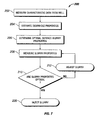
- Figure 7 is a block diagram of a re-injection method in accordance with embodiments of the present disclosure.
- Embodiments of the present disclosure include methods and apparatuses to monitor the properties of a solution to be used in an oilfield operation. More particularly, selected embodiments describe methods and apparatuses to monitor the properties of a waste re-injection slurry prior to and during an operation to inject that slurry into a subterranean formation.
- an onshore cuttings re-injection site 100 is shown schematically. While re-injection site 100 is disclosed as an onshore system, it should be understood by one of ordinary skill that the systems described and disclosed herein are applicable to offshore, land-based, and remote ( e.g ., subsea, artic, etc.) locations.
- a mechanism 102 e.g ., one or more shale shaker screens
- the separated solids and cuttings are directed to a collection area 104.
- a mixing tank 106 is also provided, in which the slurry to be injected is prepared.
- a skid-mounted monitoring apparatus 10 to monitor various properties of a waste re-injection slurry.
- any configuration may be used.
- the components of apparatus 10 may be confined to a single container (e.g. , a skid) or may be spread out over a greater distance.
- apparatus 10 may be portable (i.e., moveable as a single unit), or may be configured in a more fixed, permanent configuration. As such, the physical size, configuration, and location of apparatus 10 is not to be limited by embodiments disclosed herein.
- the monitoring apparatus 10 depicted in Figure 2 includes a skid 12 to which a pump 14, a viscometer 30, and a densitometer 50 are mounted.
- a data acquisition control system 60 and operator interface terminal (OIT) 70 may be housed in a control system enclosure 62 in digital communication with equipment on skid (12 of Figure 2 ) and a plurality of sensors 80 located separately at the injection site.
- the OIT 70 may be remotely located and connected to remaining components on skid 12 via any networking or communication protocol known to one of skill in the art.
- skid 12 is positioned proximate to holding tank 108 in a location that minimizes the distance therebetween.
- a viscometer 30 and a densitometer 50 of skid 12 are placed in fluid communication with the contents of holding tank 108.
- the slurry viscosity and density characteristics are measured by viscometer 30 and densitometer 50 and analyzed before injection into the well.
- skid 12 comprises a flow loop 15 to circulate the slurry mixture from holding tank 108, through viscometer 30 and a densitometer 50.
- An optional second densitometer (not shown) in series with densitometer 50 may be used for redundant measurement of the slurry through flow loop 15. While flow loop 15 depicted in Figure 3 includes a single viscometer 30 and a single densitometer 50, it should be understood by one of ordinary skill that any number of viscometers 30 or densitometers 50 may be used without departing from the scope of claims appended hereto.
- flow loop 15 includes a plurality of lines 16, 18, 20, and 22, a plurality of valves 24.
- at least one vent line 26 may be included to connect components of the flow loop 15 (e.g., viscometer 30 and densitometer 50) to a vent line of holding tank 108.
- vent line 26 (if present) may be routed to an inlet of pump 14. While one particular arrangement of flow loop 15 is depicted in Figure 3 , it should be understood by one of ordinary skill that any number of combinations or configurations may be used to connect viscometers 30 and densitometers 50 to slurry holding tank 108. Generally, any combination of lines 16, 18, 20, and 22 may be used in conjunction with various valve 24 configurations to direct the slurry in holding tank 108 through viscometer 30 and densitometer 50.
- first line 16 communicates the slurry from holding tank 108 to pump 14, wherein pump 14 is configured to circulate the slurry through viscometer 30 and densitometer 50.
- a strainer 28 may be located within first line 16 between holding tank 108 and pump 14.
- Second line 18 communicates the pressurized slurry from pump 14 to viscometer 30.
- Third line 20 communicates the slurry from viscometer 30 to densitometer 50.
- fourth line 22 returns the slurry from densitometer 50 to holding tank 108.
- several valves 24 are positioned to direct and restrict flow of the slurry through flow loop 15.
- pump 14 may be selected to circulate a range of slurry viscosities and densities for extended periods of time. Further, as the slurry will, by its very nature, include particles of varying size and geometry, it is desirable for pump 14 to be durable enough to withstand wear and abrasion associated with pumping a slurry including such particles. Furthermore, in an effort to reduce damage to the measurement instruments, pump 14 may be configured to pump the slurry through densitometer 50 and viscometer 30 at reduced flow rates. These reduced flow rates may be dictated by physical limitations of the measurement instruments, or, they may be dictated by the type of measurement to be made.
- a flow rate through flow loop 15 may be set not to exceed 20 gallons per minute.
- viscometer 30 is desirably positioned in close proximity to pump 14 along line 18 so that the distance through which the slurry must travel is minimized.
- the pressure through line 18 may be controlled so that entrapped air is reduced. An excess of entrapped air may produce erroneous results or, in extreme cases, may damage flow loop 15 components.
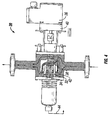
- a motor 36 provides rotation to a concentric outer cylinder 38 at a predetermined rotational velocity through a gear box 40.
- the slurry is directed into an annulus 42 formed between outer cylinder 38 and inner cylinder 32.
- the slurry directed between inner cylinder 32 and outer cylinder 38 imparts a force to inner cylinder 32 causing rotational movement thereof.
- the magnitude of the rotation imparted to inner cylinder 32 is a function of the resistive force of torsion element 34 and the viscosity of the slurry. Because the properties of torsion element 34 are known, the viscosity of the slurry may be determined.
- the measurement output of viscometer 30 is communicated through an output line 44 to data acquisition control system 60 (represented in Figure 5 ) and operator interface terminal 70. It should be understood that such communication may be accomplished through any digital or analog communications protocol known to one of ordinary skill in the art.
- viscometer 30 is desirably mounted in close proximity with the equipment used to prepare and inject the slurry, and because the area in which the preparation and injection of the slurry takes place may be classified by relevant standards as a hazardous area, viscometer 30 should be constructed as an explosion proof or intrinsically safe device as required by those standards.
- Both motor 36 and output line 44 utilize electrical current in some form, which may, in certain circumstances, become an ignition source.
- motor 36, the interface between viscometer 30 and output line 44, and output line 44 itself are preferably shielded, armored, and/or ventilated so as to meet requirements for local standards in hazardous areas.
- densitometer 50 is positioned such that it is in fluid communication with viscometer 30 through third line 20. While densitometer 50 is depicted as a vibrating tube densitometer, it should be understood that other types of densitometer including, but not limited to, vibrating fork devices, Coriolis-type mass flow devices, magnetic devices, and radioactive devices may be used without departing from the scope of the claims appended hereto. Furthermore, in circumstances where multiple densitometers 50 are used, different types of densitometers may be deployed so that any advantages and disadvantages of each type may be accounted and compensated for.
- densitometer 50 is in close proximity to viscometer 30 so as to minimize the distance the slurry must travel in third line 20 between viscometer 30 and densitometer 50.
- densitometer 50 operates to measure a flow density of the slurry and transmit data via an output line 52.
- an additional densitometer (not shown) may be provided in fluid communication with an outlet of densitometer 50.
- Second densitometer may not be required, but may be included to allow for built-in redundancy in the event densitometer 50 becomes inoperable.
- densitometer 50 is safe for use in areas that are zoned as hazardous.
- valves 24 are located within lines 16, 18, 20, and 22 of flow loop 15. Valves 24 may be manipulated by data acquisition control system 60 to control the pressure and flow rate of the slurry therethrough. Gases entrained in the slurry are compressed and may be released through vent line 26 to holding tank 108 for treatment and venting, thereby maintaining pressure required to achieve accurate readings from viscometer 30 and densitometer 50.
- control system 60 is shown housed within a control system enclosure 62 of monitoring apparatus 10.
- Control system enclosure 62 may also house operator interface terminal 70 where an operator is able to monitor and modify the performance of monitoring apparatus 10.
- control system enclosure 62 is designed and constructed such that a sufficient amount of protection against exposure to drilling mud and other chemical agents is provided. It should be understood by one of ordinary skill, that while the control system 60 and enclosure 62 may be located within a hazardous area, operator interface terminal 70 may be located remotely, to an area outside the hazardous zone.
- a plurality of remote sensors 80 are located at the injection site and are configured to measure and relay parameters including, but not limited to, flow rate, pump stroke, temperature, and pressure to control system 60.
- remote sensors 80 may include outputs from additional viscometers and densitometers, if present.
- Control system 60 interfaces with pump 14, valves 24, viscometer 30, and densitometer 50, and receives data measured therefrom in addition to data transmitted by sensors 80.
- control system 60 may interface with and actuate pump 14 and valves 24 to regulate the flow of slurry through lines 16, 18, 20, and 22 of flow loop 15 to achieve the desired pressure and/or flow rate.
- Operator interface terminal 70 may display internal diagnostics of control system 60 including, but not limited to, current values and warning flags from remote sensors 80, viscometer 30, and densitometer 50. It is contemplated that an operator may view real-time input values for parameters including well pressure, head pressure, pump stroke rate, slurry density, and slurry viscosity. Furthermore, the operator may view any or all input and output values, the status of the inputs and outputs, alarms, and controller health indicators from the operator interface terminal 70. Additionally, troubleshooting and help information may also be provided to the user at the operator interface terminal 70. As operator interface terminal 70 may be positioned on or near control system enclosure, it may be remotely located outside a hazardous area such that an operator may view and interact with it without having to enter the hazardous area. Additionally, when operator interface terminal 70 is located in an outdoor area, an adjustable sun visor (not shown) may be provided to remove glare from the display screen (not shown).
- data may be transmitted from control system 60 via a server interface 90 to a location away from both flow loop 15 and control system enclosure 62.
- a server interface 90 may be a personal computer or a processing device (e.g ., a programmable logic controller) including a software application operable to receive data from control system 60 and provide the data in a format readable by the operator.
- a cuttings re-injection monitoring and diagnostic evaluation software module 94 may monitor parameters being measured by sensors 80, viscometer 30, densitometer 50, at holding tank 108, and at the well. Alarms may be initiated by the software module when measured values and/or derived parameters based on measured values fall below or rise above predetermined values or when a trend in the measured values and/or derived parameters indicates a potential issue.
- software module 94 may be in communication with a database 96 containing historical values and/or maximum and minimum values for such parameters monitored by software module 94. While Figure 5 shows server interface 90, software module 94, and database 96 be contained within a single device 98, it should be understood that separate devices connected by a communications network may also be used.
- a remote operator interface 90' may include a third party data acquisition system similar to that already in use by the operator.
- control system 60 communicates data from sensors 80, viscometer 30, and densitometer 50 to remote operator interface 90'. Based upon the data provided, the operator may decide either to continue injecting the slurry having the properties measured or to modify the slurry in mixing tank 106 and/or holding tank 108 through the addition of solids, fluids, and additives.
- data collected from a particular re-injection site may be transmitted to a centralized data collection location 92.
- This data transmission may be initiated by any of a variety of automatic or manual methods including, but not limited to, input by on-rig personnel, predetermined time schedules, accrued data quantity schedules, or by events triggered upon the diagnostic software configured to detect combinations of parameter values.
- data is collected from various remote sites, it is loaded into a database management system for future reference.
- the data from any particular site may be reviewed by remote operator interfaces located at a re-injection site 90A, at a support center 90B, or at an administration location 90C.
- data collected at a particular injection site may be transmitted directly to the centralized data collection area 92.
- the data from a plurality of injection wells is collected and tabulated in the centralized data collection area 92.
- the centralized data collection area 92 may include a secure administrative database. Using data provided by operators, potential risks may be identified at a single injection site based on deviation of measured parameters from control limits established from data collected from sites having comparable characteristics. In addition, advisories regarding preferred slurry characteristics may be made to the operator of a particular re-injection site based upon the comparison of that site's data to comparable data in centralized data collection area 92. It is contemplated that data may be transmitted in real time to the centralized data collection area 92 for such analysis. The operator may then decide whether to inject the slurry having the current characteristics or return the slurry to mixing tank 106 or 106' for modification of the slurry prior to injection.
- monitoring apparatus 10 is used to monitor the slurry in one of the mixing tanks 106 or 106'.
- the properties of the slurry are monitored as it is prepared. Based on the properties measured, additional solids or liquids may be added to the slurry until it exhibits the desired characteristics.
- the addition of solids, liquids, and/or additives may be automated, based on values obtained from the monitoring apparatus 10. Manual control of the addition of slurry materials may be exclusive or shared with automated controls.
- the embodiments described herein may be used in conjunction with a slurry simulator to predict and/or measure the performance of a downhole cuttings re-injection operation so that real-time adjustments may be made to optimize the operation.
- Numerous variables including, but not limited to, slurry temperature, slurry viscosity, slurry density, slurry particle size, injection pressure, injection flow rate, particle settling, borehole trajectory, and borehole geometry may affect the success and feasibility of a CRI operation. Particularly, in smaller boreholes in substantially horizontal trajectories, solids may rapidly accumulate at the bottom of the borehole and "stall" the re-injection operation.
- a slurry simulator may be used to estimate the bottom-hole pressure as a function of time for a particular slurry.
- CRI operations are performed in batches, whereby an amount of slurry is injected and the operation is paused when a predetermined pressure or amount of injected solution is reached.
- the downhole properties including the bottom-hole pressure of the slurry change until a stabilization point is reached.
- the CRI operation may continue to allow another amount of slurry to be injected into the formation.
- the time to reach this stabilization point varies by slurry composition and wellbore properties, the ability to estimate the bottom-hole pressure and stabilization time of an injected slurry is of great benefit.
- the slurry simulator may be capable of determining the bottom-hole pressure of an injected slurry as a function of properties (i.e ., surface temperature and pressure) that are directly measurable.
- a slurry simulator may be capable of outputting a real-time plot of bottom-hole pressure as a function of time for a particular re-injection well. As such, an operator of a CRI process can use such a plot to determine how large of a batch of slurry may be injected next, and when that injection may take place.
- a slurry simulator In using a slurry simulator, known values for certain variables are inputted so that unknown variables may be calculated or estimated. From these calculations, parameters for a theoretically optimal slurry are calculated. Next, using a measurement apparatus (e.g . apparatus 10 and flow loop 15 of Figures 1-6 ), the state of the current slurry may be measured and compared with the optimal model to determine if the slurry may be modified to more closely approximate ( i.e ., fall within tolerances of) the optimal model. If changes are made, the measurement apparatus may again be used to verify the slurry composition before it is injected downhole.
- a measurement apparatus e.g . apparatus 10 and flow loop 15 of Figures 1-6
- the measurement apparatus may again be used to verify the slurry composition before it is injected downhole.
- slurry simulator and measurement apparatus are operated in real-time in conjunction with one another to not only create an optimal slurry composition at the beginning of a CRI operation, but also to continuously re-evaluate the needs of the injected slurry and tweak its composition throughout the entire life of the CRI operation.
- a single device may perform all the tasks of estimating, calculating, and optimizing, it should be understood that several devices may be used in conjunction with one another to accomplish the same goal.
- the slurry simulator may account for changes in slurry properties downhole when calculating the desired composition of slurry before injection.
- slurry injection method 200 begins with the measurement of characteristic data from the well 202.
- properties of the formation and/or slurry that are not directly measurable are estimated or calculated 204.
- the measurable temperatures and pressures of a slurry or drilling fluid as it enters and exits the wellbore may be recorded.
- differential pressure and temperature values may be used in conjunction with additional known or measurable quantities (e.g ., well depth and temperature of the formation) to calculate the pressure and temperature of the slurry in the formation downhole.
- the slurry simulator uses the measured well characteristics in addition to the estimated and calculated downhole properties to determine the properties for an optimal slurry 206.
- the current properties of the slurry are measured 208 using a measurement apparatus (e.g ., apparatus 10 and flow loop 15). If the measured slurry properties are within tolerances of the optimized slurry as determined by the slurry simulator 210, the re-injection operation proceeds to inject the slurry 220. If the measured slurry properties are outside of the optimized slurry tolerances 210, the slurry is adjusted 212 and the measurement 208 and comparison steps 210 are repeated.
- the slurry simulator may be continuously used to monitor the measured characteristic data and the surface slurry properties to make adjustments for changes in either the downhole formation properties or the surface slurry composition.
- the slurry simulator may simply output an indication of "go/no-go" for the measured slurry or may output a complex graphical representation showing the where the slurry properties lie within the tolerance band.
- embodiments described by the present disclosure allow for cuttings re-injection operations to be monitored and optimized for various configurations and types of re-injection wellbores.
- properties of waste and cuttings slurries can be monitored, modified, and optimized so that their re-injection into the formations can proceed as efficiently and cost effectively as possible.
- a single slurry simulator may be capable of optimizing the slurry composition for several re-injection locations.
- a single slurry simulator connected to various wellbore locations through a communications network may configure and optimize numerous re-injection wells with a minimal need for human presence in hazardous zones.
- monitoring apparatus 10 may be used to monitor drilling fluids prepared for and used in a drilling operation. Accordingly, the scope of the claimed subject matter should be limited only by the attached claims.
Landscapes
- Engineering & Computer Science (AREA)
- Geology (AREA)
- Mining & Mineral Resources (AREA)
- Life Sciences & Earth Sciences (AREA)
- Environmental & Geological Engineering (AREA)
- General Life Sciences & Earth Sciences (AREA)
- Fluid Mechanics (AREA)
- Physics & Mathematics (AREA)
- Geochemistry & Mineralogy (AREA)
- Mechanical Engineering (AREA)
- Consolidation Of Soil By Introduction Of Solidifying Substances Into Soil (AREA)
- Physical Or Chemical Processes And Apparatus (AREA)
- Treatment Of Sludge (AREA)
- Investigation Of Foundation Soil And Reinforcement Of Foundation Soil By Compacting Or Drainage (AREA)
- Feeding, Discharge, Calcimining, Fusing, And Gas-Generation Devices (AREA)
- Investigating Or Analyzing Materials By The Use Of Ultrasonic Waves (AREA)
- Bulkheads Adapted To Foundation Construction (AREA)
- Excavating Of Shafts Or Tunnels (AREA)
Applications Claiming Priority (3)
| Application Number | Priority Date | Filing Date | Title |
|---|---|---|---|
| US70367205P | 2005-07-29 | 2005-07-29 | |
| US11/409,831 US7721594B2 (en) | 2005-07-29 | 2006-04-24 | Apparatus and method to monitor slurries for waste re-injection |
| EP06788847A EP1910642B1 (fr) | 2005-07-29 | 2006-07-28 | Appareil et procede pour controler les boues dans la reinjection de residus |
Related Parent Applications (4)
| Application Number | Title | Priority Date | Filing Date |
|---|---|---|---|
| EP06788847A Division EP1910642B1 (fr) | 2005-07-29 | 2006-07-28 | Appareil et procede pour controler les boues dans la reinjection de residus |
| WOPCT/US2006/029516 Previously-Filed-Application | 2006-07-28 | ||
| EP06788847.9 Division | 2006-07-28 | ||
| PCT/US2006/029516 Previously-Filed-Application WO2007016389A1 (fr) | 2005-07-29 | 2006-07-28 | Appareil et procede pour controler les boues dans la reinjection de residus |
Publications (2)
| Publication Number | Publication Date |
|---|---|
| EP2292891A2 true EP2292891A2 (fr) | 2011-03-09 |
| EP2292891A3 EP2292891A3 (fr) | 2016-07-13 |
Family
ID=37398313
Family Applications (2)
| Application Number | Title | Priority Date | Filing Date |
|---|---|---|---|
| EP10186843.8A Withdrawn EP2292891A3 (fr) | 2005-07-29 | 2006-07-28 | Appareil et procede pour controler les boues dans la reinjection de residus |
| EP06788847A Not-in-force EP1910642B1 (fr) | 2005-07-29 | 2006-07-28 | Appareil et procede pour controler les boues dans la reinjection de residus |
Family Applications After (1)
| Application Number | Title | Priority Date | Filing Date |
|---|---|---|---|
| EP06788847A Not-in-force EP1910642B1 (fr) | 2005-07-29 | 2006-07-28 | Appareil et procede pour controler les boues dans la reinjection de residus |
Country Status (11)
| Country | Link |
|---|---|
| US (3) | US7721594B2 (fr) |
| EP (2) | EP2292891A3 (fr) |
| AR (1) | AR056009A1 (fr) |
| AT (1) | ATE497570T1 (fr) |
| CA (1) | CA2616188C (fr) |
| DE (1) | DE602006019968D1 (fr) |
| DK (1) | DK1910642T3 (fr) |
| EA (1) | EA017330B1 (fr) |
| MX (1) | MX2008001139A (fr) |
| NO (1) | NO339350B1 (fr) |
| WO (1) | WO2007016389A1 (fr) |
Families Citing this family (25)
| Publication number | Priority date | Publication date | Assignee | Title |
|---|---|---|---|---|
| US20100175877A1 (en) * | 2006-01-24 | 2010-07-15 | Parris Michael D | Method of designing and executing a well treatment |
| CA2647242C (fr) * | 2006-05-08 | 2015-08-11 | Invensys Systems, Inc. | Mesures dans un fluide a phase unique ou multiple |
| US7730966B2 (en) * | 2007-01-31 | 2010-06-08 | M-I L.L.C. | High density slurry |
| WO2009003168A1 (fr) * | 2007-06-27 | 2008-12-31 | Teletrol Systems, Inc. | Système et procédé pour fournir une commande et une modification indépendantes de dispositif |
| US7581436B2 (en) * | 2008-01-25 | 2009-09-01 | Schlumberger Technology Corporation | Method for operating a couette device to create and study emulsions |
| US8731890B2 (en) * | 2008-02-22 | 2014-05-20 | M-I L.L.C. | Method of estimating well disposal capacity |
| US8527205B2 (en) * | 2009-08-21 | 2013-09-03 | Schlumberger Technology Corporation | Gravity interpretation workflow in injection wells |
| US20120211228A1 (en) * | 2009-08-31 | 2012-08-23 | Troshko Andrey A | Artificial Lift Modeling Methods and Systems |
| WO2012082216A1 (fr) * | 2010-12-17 | 2012-06-21 | Exxonmobil Upstream Research Company | Systèmes et procédés d'injection d'un mélange particulaire |
| US9222350B2 (en) | 2011-06-21 | 2015-12-29 | Diamond Innovations, Inc. | Cutter tool insert having sensing device |
| US9134291B2 (en) | 2012-01-26 | 2015-09-15 | Halliburton Energy Services, Inc. | Systems, methods and devices for analyzing drilling fluid |
| US9274038B2 (en) | 2012-02-23 | 2016-03-01 | Halliburton Energy Services, Inc. | Apparatus and method for constant shear rate and oscillatory rheology measurements |
| WO2014186554A1 (fr) * | 2013-05-15 | 2014-11-20 | M-I L.L.C. | Simulation interactive d'ingénierie en matière de boues |
| US10578766B2 (en) | 2013-08-05 | 2020-03-03 | Advantek International Corp. | Quantifying a reservoir volume and pump pressure limit |
| GB2531982B (en) | 2014-06-11 | 2020-06-03 | Advantek Int Corporation | Quantifying a reservoir volume and pump pressure limit |
| CA2953727C (fr) | 2014-06-30 | 2021-02-23 | Advantek International Corporation | Reduction en coulis et mise au rebut de dechets par pompage sous pression dans une formation sous la surface |
| US10489523B2 (en) * | 2014-10-22 | 2019-11-26 | Board Of Supervisors Of Louisiana State University And Agricultural And Mechanical College | Apparatuses, systems and methods for performing remote real-time experiments |
| US20160313292A1 (en) * | 2015-04-24 | 2016-10-27 | Petroleum Analyzer Company, Lp | Method and apparatus for measuring characteristics of a heated fluid in a hostile environment |
| US10247182B2 (en) * | 2016-02-04 | 2019-04-02 | Caterpillar Inc. | Well stimulation pump control and method |
| US20180016875A1 (en) * | 2016-07-12 | 2018-01-18 | M.I. L.L.C. | Systems and methods for real-time controlling of cuttings reinjection operations |
| CA3034539A1 (fr) * | 2016-09-07 | 2018-03-15 | Schlumberger Canada Limited | Systemes et procedes d'injection de fluides dans une ligne d'injection haute pression |
| US11136872B2 (en) | 2016-12-09 | 2021-10-05 | Cameron International Corporation | Apparatus and method of disbursing materials into a wellbore |
| US12174102B2 (en) * | 2019-01-31 | 2024-12-24 | Halliburton Energy Services, Inc. | Optical fluidic methods for a rheometer |
| CN111240284B (zh) * | 2020-01-17 | 2023-03-10 | 陈欣 | 一种模拟生产过程中液体浆料产品产量的品质控制方法 |
| CN115059421B (zh) * | 2022-06-14 | 2023-06-16 | 中国海洋石油集团有限公司 | 一种自动配浆控制系统及其控制方法 |
Citations (1)
| Publication number | Priority date | Publication date | Assignee | Title |
|---|---|---|---|---|
| US7344805B2 (en) | 2002-12-24 | 2008-03-18 | Rohm Co., Ltd. | Mask and method for producing thereof and a semiconductor device using the same |
Family Cites Families (12)
| Publication number | Priority date | Publication date | Assignee | Title |
|---|---|---|---|---|
| US4526584A (en) * | 1982-05-05 | 1985-07-02 | Alfred University Research Foundation, Inc. | Process for pumping a carbonaceous slurry |
| US4557142A (en) | 1983-10-13 | 1985-12-10 | Hutchinson-Hayes International, Inc. | Apparatus and method for real-time measurement of drilling fluid properties |
| US6045070A (en) | 1997-02-19 | 2000-04-04 | Davenport; Ricky W. | Materials size reduction systems and process |
| GB2327442B (en) * | 1997-07-17 | 2000-12-13 | Jeffrey Reddoch | Cuttings injection system |
| US6640912B2 (en) | 1998-01-20 | 2003-11-04 | Baker Hughes Incorporated | Cuttings injection system and method |
| EP1554570A2 (fr) * | 2002-10-18 | 2005-07-20 | Symyx Technologies, Inc. | Systeme et procede de captage d'un fluide contenu dans un systeme de controle de l'environnement |
| GB2401944A (en) | 2003-05-20 | 2004-11-24 | Ross Lamond Colquhoun | Continuous measurement of drilling fluid properties |
| WO2005103645A2 (fr) * | 2004-04-21 | 2005-11-03 | Symyx Technologies, Inc. | Dispositif de detection a resonateur de flexion et procede associe |
| US7494957B2 (en) * | 2005-01-24 | 2009-02-24 | Schlumberger Technology Corporation | Energized fluids and methods of use thereof |
| US7478020B2 (en) * | 2005-03-07 | 2009-01-13 | M-I Llc | Apparatus for slurry and operation design in cuttings re-injection |
| US7318013B2 (en) * | 2005-03-07 | 2008-01-08 | M-I, L.L.C. | Method for slurry and operation design in cuttings re-injection |
| US7325629B2 (en) * | 2005-09-08 | 2008-02-05 | Halliburton Energy Services, Inc. | Method and system for processing oil and gas well cuttings utilizing existing slurry processing equipment |
-
2006
- 2006-04-24 US US11/409,831 patent/US7721594B2/en not_active Expired - Fee Related
- 2006-07-28 CA CA2616188A patent/CA2616188C/fr not_active Expired - Fee Related
- 2006-07-28 DE DE602006019968T patent/DE602006019968D1/de active Active
- 2006-07-28 AT AT06788847T patent/ATE497570T1/de not_active IP Right Cessation
- 2006-07-28 DK DK06788847.9T patent/DK1910642T3/da active
- 2006-07-28 WO PCT/US2006/029516 patent/WO2007016389A1/fr not_active Ceased
- 2006-07-28 EA EA200800483A patent/EA017330B1/ru not_active IP Right Cessation
- 2006-07-28 AR ARP060103286A patent/AR056009A1/es not_active Application Discontinuation
- 2006-07-28 MX MX2008001139A patent/MX2008001139A/es active IP Right Grant
- 2006-07-28 EP EP10186843.8A patent/EP2292891A3/fr not_active Withdrawn
- 2006-07-28 EP EP06788847A patent/EP1910642B1/fr not_active Not-in-force
-
2007
- 2007-04-23 US US11/738,785 patent/US7721595B2/en not_active Expired - Fee Related
- 2007-04-23 US US11/738,815 patent/US7721596B2/en not_active Expired - Fee Related
-
2008
- 2008-02-28 NO NO20081060A patent/NO339350B1/no not_active IP Right Cessation
Patent Citations (1)
| Publication number | Priority date | Publication date | Assignee | Title |
|---|---|---|---|---|
| US7344805B2 (en) | 2002-12-24 | 2008-03-18 | Rohm Co., Ltd. | Mask and method for producing thereof and a semiconductor device using the same |
Also Published As
| Publication number | Publication date |
|---|---|
| EP1910642B1 (fr) | 2011-02-02 |
| MX2008001139A (es) | 2008-03-13 |
| ATE497570T1 (de) | 2011-02-15 |
| DK1910642T3 (da) | 2011-05-23 |
| NO20081060L (no) | 2008-04-29 |
| US20070186625A1 (en) | 2007-08-16 |
| NO339350B1 (no) | 2016-12-05 |
| WO2007016389A1 (fr) | 2007-02-08 |
| AR056009A1 (es) | 2007-09-12 |
| CA2616188C (fr) | 2011-11-22 |
| US7721595B2 (en) | 2010-05-25 |
| DE602006019968D1 (de) | 2011-03-17 |
| US7721596B2 (en) | 2010-05-25 |
| CA2616188A1 (fr) | 2007-02-08 |
| EA200800483A1 (ru) | 2008-06-30 |
| US7721594B2 (en) | 2010-05-25 |
| EP2292891A3 (fr) | 2016-07-13 |
| US20070197851A1 (en) | 2007-08-23 |
| US20070022802A1 (en) | 2007-02-01 |
| EA017330B1 (ru) | 2012-11-30 |
| EP1910642A1 (fr) | 2008-04-16 |
Similar Documents
| Publication | Publication Date | Title |
|---|---|---|
| US7721596B2 (en) | Apparatus and method to monitor slurries for waste re-injection | |
| AU2013212697B2 (en) | Systems, methods and devices for analyzing drilling fluid | |
| RU2484242C2 (ru) | Система и способ контроля и регулирования дебита скважин | |
| US10493383B2 (en) | Optimized recycling of drilling fluids by coordinating operation of separation units | |
| US10294742B2 (en) | Borehole pressure management methods and systems with adaptive learning | |
| RU2468191C2 (ru) | Система и способ контроля физического состояния эксплуатационного оборудования скважины и регулирования дебита скважины | |
| US12173581B2 (en) | System and method for performing a real-time integrated cementing operation | |
| CN112219009A (zh) | 用于选择井筒钻井流体堵漏材料的智能系统 | |
| WO2008150811A1 (fr) | Appareil et procédé pour gérer l'alimentation d'additifs sur les emplacements de forage | |
| AU2015327849A1 (en) | Integrated drilling control system and associated method | |
| US11162332B2 (en) | Optimizing fluid transfer design and execution during wellbore displacement operations | |
| US20260103977A1 (en) | Autonomous well construction system with integrated ai | |
| US12241354B1 (en) | Automatically determining flow type histories for frack pumps and managing usage thereof using the flow type histories | |
| US12392205B2 (en) | Automatically detecting a key parameter affecting pump components | |
| US12503937B1 (en) | Autonomous drilling system with integrated AI | |
| Eustes et al. | Onshore Drilling |
Legal Events
| Date | Code | Title | Description |
|---|---|---|---|
| PUAI | Public reference made under article 153(3) epc to a published international application that has entered the european phase |
Free format text: ORIGINAL CODE: 0009012 |
|
| AC | Divisional application: reference to earlier application |
Ref document number: 1910642 Country of ref document: EP Kind code of ref document: P |
|
| AK | Designated contracting states |
Kind code of ref document: A2 Designated state(s): AT BE BG CH CY CZ DE DK EE ES FI FR GB GR HU IE IS IT LI LT LU LV MC NL PL PT RO SE SI SK TR |
|
| RIN1 | Information on inventor provided before grant (corrected) |
Inventor name: ALBA, ANDREA Inventor name: ROGERS, BRIAN Inventor name: STOCKS, SHANNON Inventor name: CHANG, LINGO Inventor name: PERI, SHRINIVAS |
|
| PUAL | Search report despatched |
Free format text: ORIGINAL CODE: 0009013 |
|
| AK | Designated contracting states |
Kind code of ref document: A3 Designated state(s): AT BE BG CH CY CZ DE DK EE ES FI FR GB GR HU IE IS IT LI LT LU LV MC NL PL PT RO SE SI SK TR |
|
| RIC1 | Information provided on ipc code assigned before grant |
Ipc: E21B 21/06 20060101ALI20160608BHEP Ipc: E21B 41/00 20060101AFI20160608BHEP Ipc: E21B 21/01 20060101ALI20160608BHEP |
|
| 17P | Request for examination filed |
Effective date: 20170110 |
|
| RBV | Designated contracting states (corrected) |
Designated state(s): AT BE BG CH CY CZ DE DK EE ES FI FR GB GR HU IE IS IT LI LT LU LV MC NL PL PT RO SE SI SK TR |
|
| 17Q | First examination report despatched |
Effective date: 20180702 |
|
| STAA | Information on the status of an ep patent application or granted ep patent |
Free format text: STATUS: THE APPLICATION IS DEEMED TO BE WITHDRAWN |
|
| 18D | Application deemed to be withdrawn |
Effective date: 20181113 |