EP2292922A2 - Dispositif d'allumage laser pour moteur à combustion - Google Patents
Dispositif d'allumage laser pour moteur à combustion Download PDFInfo
- Publication number
- EP2292922A2 EP2292922A2 EP10006568A EP10006568A EP2292922A2 EP 2292922 A2 EP2292922 A2 EP 2292922A2 EP 10006568 A EP10006568 A EP 10006568A EP 10006568 A EP10006568 A EP 10006568A EP 2292922 A2 EP2292922 A2 EP 2292922A2
- Authority
- EP
- European Patent Office
- Prior art keywords
- fuel
- prechamber
- chamber
- air mixture
- channel
- Prior art date
- Legal status (The legal status is an assumption and is not a legal conclusion. Google has not performed a legal analysis and makes no representation as to the accuracy of the status listed.)
- Withdrawn
Links
- 238000002485 combustion reaction Methods 0.000 title claims abstract description 76
- 239000000203 mixture Substances 0.000 claims abstract description 48
- 239000000446 fuel Substances 0.000 claims abstract description 25
- 239000012530 fluid Substances 0.000 claims abstract description 14
- 238000004891 communication Methods 0.000 claims abstract description 8
- 238000000034 method Methods 0.000 claims abstract description 5
- 230000008878 coupling Effects 0.000 claims description 15
- 238000010168 coupling process Methods 0.000 claims description 15
- 238000005859 coupling reaction Methods 0.000 claims description 15
- 230000006835 compression Effects 0.000 claims description 6
- 238000007906 compression Methods 0.000 claims description 6
- 230000003287 optical effect Effects 0.000 claims description 4
- 230000007423 decrease Effects 0.000 claims description 3
- 239000007789 gas Substances 0.000 description 22
- 238000011109 contamination Methods 0.000 description 6
- 230000008901 benefit Effects 0.000 description 5
- 238000002156 mixing Methods 0.000 description 3
- QVGXLLKOCUKJST-UHFFFAOYSA-N atomic oxygen Chemical compound [O] QVGXLLKOCUKJST-UHFFFAOYSA-N 0.000 description 2
- 230000015572 biosynthetic process Effects 0.000 description 2
- 238000005520 cutting process Methods 0.000 description 2
- 230000002349 favourable effect Effects 0.000 description 2
- 238000005755 formation reaction Methods 0.000 description 2
- VNWKTOKETHGBQD-UHFFFAOYSA-N methane Chemical compound C VNWKTOKETHGBQD-UHFFFAOYSA-N 0.000 description 2
- 230000004048 modification Effects 0.000 description 2
- 238000012986 modification Methods 0.000 description 2
- 239000001301 oxygen Substances 0.000 description 2
- 229910052760 oxygen Inorganic materials 0.000 description 2
- 239000003380 propellant Substances 0.000 description 2
- 230000005855 radiation Effects 0.000 description 2
- 239000004071 soot Substances 0.000 description 2
- 238000004140 cleaning Methods 0.000 description 1
- 238000009760 electrical discharge machining Methods 0.000 description 1
- 238000011010 flushing procedure Methods 0.000 description 1
- 239000002737 fuel gas Substances 0.000 description 1
- 238000000265 homogenisation Methods 0.000 description 1
- 230000006872 improvement Effects 0.000 description 1
- 239000012535 impurity Substances 0.000 description 1
- 238000002347 injection Methods 0.000 description 1
- 239000007924 injection Substances 0.000 description 1
- 230000002045 lasting effect Effects 0.000 description 1
- 238000004519 manufacturing process Methods 0.000 description 1
- 239000002245 particle Substances 0.000 description 1
Images



Classifications
-
- F—MECHANICAL ENGINEERING; LIGHTING; HEATING; WEAPONS; BLASTING
- F02—COMBUSTION ENGINES; HOT-GAS OR COMBUSTION-PRODUCT ENGINE PLANTS
- F02P—IGNITION, OTHER THAN COMPRESSION IGNITION, FOR INTERNAL-COMBUSTION ENGINES; TESTING OF IGNITION TIMING IN COMPRESSION-IGNITION ENGINES
- F02P23/00—Other ignition
- F02P23/04—Other physical ignition means, e.g. using laser rays
-
- F—MECHANICAL ENGINEERING; LIGHTING; HEATING; WEAPONS; BLASTING
- F02—COMBUSTION ENGINES; HOT-GAS OR COMBUSTION-PRODUCT ENGINE PLANTS
- F02B—INTERNAL-COMBUSTION PISTON ENGINES; COMBUSTION ENGINES IN GENERAL
- F02B19/00—Engines characterised by precombustion chambers
- F02B19/08—Engines characterised by precombustion chambers the chamber being of air-swirl type
-
- F—MECHANICAL ENGINEERING; LIGHTING; HEATING; WEAPONS; BLASTING
- F02—COMBUSTION ENGINES; HOT-GAS OR COMBUSTION-PRODUCT ENGINE PLANTS
- F02B—INTERNAL-COMBUSTION PISTON ENGINES; COMBUSTION ENGINES IN GENERAL
- F02B19/00—Engines characterised by precombustion chambers
- F02B19/10—Engines characterised by precombustion chambers with fuel introduced partly into pre-combustion chamber, and partly into cylinder
- F02B19/1004—Engines characterised by precombustion chambers with fuel introduced partly into pre-combustion chamber, and partly into cylinder details of combustion chamber, e.g. mounting arrangements
-
- F—MECHANICAL ENGINEERING; LIGHTING; HEATING; WEAPONS; BLASTING
- F02—COMBUSTION ENGINES; HOT-GAS OR COMBUSTION-PRODUCT ENGINE PLANTS
- F02B—INTERNAL-COMBUSTION PISTON ENGINES; COMBUSTION ENGINES IN GENERAL
- F02B19/00—Engines characterised by precombustion chambers
- F02B19/10—Engines characterised by precombustion chambers with fuel introduced partly into pre-combustion chamber, and partly into cylinder
- F02B19/1095—Engines characterised by precombustion chambers with fuel introduced partly into pre-combustion chamber, and partly into cylinder with more than one pre-combustion chamber (a stepped form of the main combustion chamber above the piston is to be considered as a pre-combustion chamber if this stepped portion is not a squish area)
-
- F—MECHANICAL ENGINEERING; LIGHTING; HEATING; WEAPONS; BLASTING
- F02—COMBUSTION ENGINES; HOT-GAS OR COMBUSTION-PRODUCT ENGINE PLANTS
- F02B—INTERNAL-COMBUSTION PISTON ENGINES; COMBUSTION ENGINES IN GENERAL
- F02B19/00—Engines characterised by precombustion chambers
- F02B19/12—Engines characterised by precombustion chambers with positive ignition
-
- F—MECHANICAL ENGINEERING; LIGHTING; HEATING; WEAPONS; BLASTING
- F02—COMBUSTION ENGINES; HOT-GAS OR COMBUSTION-PRODUCT ENGINE PLANTS
- F02P—IGNITION, OTHER THAN COMPRESSION IGNITION, FOR INTERNAL-COMBUSTION ENGINES; TESTING OF IGNITION TIMING IN COMPRESSION-IGNITION ENGINES
- F02P13/00—Sparking plugs structurally combined with other parts of internal-combustion engines
-
- H—ELECTRICITY
- H01—ELECTRIC ELEMENTS
- H01S—DEVICES USING THE PROCESS OF LIGHT AMPLIFICATION BY STIMULATED EMISSION OF RADIATION [LASER] TO AMPLIFY OR GENERATE LIGHT; DEVICES USING STIMULATED EMISSION OF ELECTROMAGNETIC RADIATION IN WAVE RANGES OTHER THAN OPTICAL
- H01S3/00—Lasers, i.e. devices using stimulated emission of electromagnetic radiation in the infrared, visible or ultraviolet wave range
- H01S3/02—Constructional details
- H01S3/03—Constructional details of gas laser discharge tubes
- H01S3/034—Optical devices within, or forming part of, the tube, e.g. windows, mirrors
-
- Y—GENERAL TAGGING OF NEW TECHNOLOGICAL DEVELOPMENTS; GENERAL TAGGING OF CROSS-SECTIONAL TECHNOLOGIES SPANNING OVER SEVERAL SECTIONS OF THE IPC; TECHNICAL SUBJECTS COVERED BY FORMER USPC CROSS-REFERENCE ART COLLECTIONS [XRACs] AND DIGESTS
- Y02—TECHNOLOGIES OR APPLICATIONS FOR MITIGATION OR ADAPTATION AGAINST CLIMATE CHANGE
- Y02T—CLIMATE CHANGE MITIGATION TECHNOLOGIES RELATED TO TRANSPORTATION
- Y02T10/00—Road transport of goods or passengers
- Y02T10/10—Internal combustion engine [ICE] based vehicles
- Y02T10/12—Improving ICE efficiencies
Definitions
- the invention relates to a device for igniting a fuel-air mixture in the combustion chamber of a cylinder of an internal combustion engine comprising a prechamber and a laser light generating device.
- the invention further relates to a method for igniting a fuel-air mixture in the combustion chamber of a cylinder of an internal combustion engine.
- the invention relates to an internal combustion engine with such a device.
- Object of the present invention is therefore to remedy this situation and to keep the contamination of the surface of the combustion chamber window and the coupling optics as low as possible.
- a basic idea of the invention is to allow as little as possible incinerated fuel-air mixture to reach the coupling-in optics.
- the first prechamber should be in fluid communication with the combustion chamber only via the second prechamber, but not in direct fluid communication. This means that fluid from the combustion chamber could only enter the first prechamber when that fluid first passed through the second prechamber.
- the first pre-chamber has an ignition space and a connecting channel, wherein the connecting channel between the ignition space and coupling optics is arranged.
- the laser light generating device and the connecting channel are arranged so that the focal point of the laser light is in the operating state in the ignition space.
- the foreclosure of the coupling optics from the combustion chamber through the connecting channel is even better.
- the return flow of burned gas is particularly low when the connecting channel has a cross-section which decreases with increasing distance from the coupling optics.
- the special arrangement of the first and second pre-chamber and laser generating device ensures that before the coupling optics, a low fluid flow prevails, or a very low reverse flow of combusted fuel-air mixture ,
- the second pre-chamber has a main space and a channel which opens into the main space.
- an approximately spherical or ellipsoidal main space can be provided.
- the at least one outlet opening is arranged at one end of the channel.
- the channel is arranged in the installed state in an angle different from 0 ° to the main direction of movement of the piston in the cylinder.
- the angle may e.g. between 15 ° and 75 °, preferably between 30 ° and 60 °.
- the channel causes a good turbulence in the second antechamber.
- the embodiments with an obliquely arranged channel have the advantage that it comes to a spiral-shaped turbulence.
- the channel may be at least partially cylindrical.
- the channel may be at least partially conically widening, for example in the form of a cone or truncated cone. The widening preferably takes place toward the second pre-chamber for better pushing back of the burnt residual gas in the direction of the first prechamber in the compression phase.
- An advantageous variant provides an approximately spherical or ellipsoid ignition space.
- the volume ratio of main space to ignition space is preferably> 10: 1.
- the first antechamber has at least two, preferably four, transfer openings. At four Transfer openings, these can be arranged along an imaginary circle, each transfer opening is offset by 90 ° to the center of the circle.
- the second prechamber has at least two, preferably four, outlet openings.
- the four outlet openings are arranged along a circle, each outlet opening is offset by 90 ° to the center of the circle.
- first prechamber and / or the second prechamber are formed in some regions approximately spherical.
- the object stated in the introduction is further solved by a method for igniting a fuel-air mixture in the combustion chamber of a cylinder of an internal combustion engine with a device of the aforementioned type, wherein fuel is introduced into the second prechamber, which enters the first prechamber via the transfer openings and is ignited with the laser light generating device, wherein the ignited fuel-air mixture over the transfer openings in the second pre-chamber ignites and there ignites fuel-air mixture, which then generates the pilot lights, which pass through the outlet openings in the combustion chamber and there a fuel - ignite the air mixture.
- the invention relates to an internal combustion engine having a device of the aforementioned type.
- a stationary internal combustion engine in particular a gas engine, ie an internal combustion engine which burns a gaseous fuel such as methane.
- a gas engine ie an internal combustion engine which burns a gaseous fuel such as methane.
- it may be a mixed-charge gas engine.
- mixed-supercharged gas engines is compressed as a fluid not pure air, but a fuel-air mixture in a compression device.
- it may also be an air-charged gas engine, compressed in the air and is admitted into the combustion chamber and the fuel supply separately eg via inlet valves or a Port injection takes place.
- this may be an Otto engine, ie a spark ignition internal combustion engine.
- Stationary internal combustion engines are often used to drive a generator that provides electrical power. Such stationary internal combustion engines are therefore usually designed for long uninterrupted running times, so that it is important that the ignition device must have a long service life with as constant as possible properties
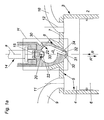
- FIG. 1a and 1b is a cross-section through a device 1 according to the invention in the installed state in an internal combustion engine 2 (each partially broken away) shown.
- an internal combustion engine 2 (each partially broken away) shown.
- Representative of the internal combustion engine 2 only one cylinder 3 is shown, although such internal combustion engines 2 regularly have more than four, for example up to 24 cylinders.
- the cylinder 3 is a combustion chamber 4 which is bounded by the cylinder walls 5 and a movably mounted piston 6.
- the operation of such a reciprocating piston assembly is well known us need not be described in more detail here, as the expert knows such facilities.
- a receptacle 8 for the device 1 is provided on the cylinder head 7 of the cylinder 3.
- the device 1 can be clamped in the receptacle 8 or fastened by means of other fastening devices, although not shown.
- device 1 and cylinder 3 can also be permanently connected to each other or formed in one piece.
- the cylinder 3 is additionally connected to an inlet tract 9 and an outlet tract 10 via inlet valve 11 and outlet valve 12. Via the inlet tract 9 and the inlet valve 11, the combustion chamber 4 is supplied with fuel and air from the intake tract by a fuel source. Burnt fuel-air mixture (exhaust gas) can be transferred into the exhaust tract 10 via the exhaust valve 12.
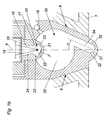
- the device 1 for igniting the fuel-air mixture comprises a first pre-chamber 20 with a wall 21 in which the transfer openings 22 are introduced ( Fig. 1b ). Visible are two such transfer openings 22 which are offset by 180 ° to each other by an imaginary circle about the axis a. The two further transfer openings 22, which are offset from the transfer openings 22 shown by 90 °, are in the Fig. 1a and the Fig. 1b not recognizable, as they lie in front of and behind the cutting plane. Furthermore, a laser light generating device 14 is provided, as known per se. This has a coupling-in optical system 15 in the form of a combustion chamber window, via which laser light 16 is focused at the focal point 17.
- the first prechamber 20 is additionally subdivided into an ignition space 23, in which the focal point 17 of the laser light 16 from the laser light generating device 14 is focused.
- a connecting channel 24 is arranged, whose cross-section decreases with increasing distance from the combustion chamber window 15 towards the focal point 17.
- the transfer openings 22 are arranged on the opposite side of the connecting channel 24 in comparison to the focal point 17 and the connecting channel 24.
- the two crossing openings 22 are inclined to the main axis a of the device, that is arranged at an angle ⁇ .
- the angle ⁇ is about 45 ° here.
- the first prechamber 20 is partially surrounded by a second prechamber 30.
- the first prechamber 20 extends partially into the second prechamber 30.
- the first prechamber 20 is separated from the second prechamber 30 via the wall 21.
- the transfer openings 22 enable fluid communication between the first 20 and the second pre-chamber 30.
- the second pre-chamber 30 has a main space 33 and a channel 34.
- the channel 34 connects the main chamber 33 and the combustion chamber 4.
- the outlet openings 32 are arranged on the side facing away from the main chamber 33 of the channel 34. Recognizable are two such outlet openings 32 which are offset by 180 ° to each other by an imaginary circle about the axis a.
- the two further outlet openings 32 which are offset from the outlet openings 32 shown by 90 °, are in the Fig. 1 not recognizable, as they lie in front of and behind the cutting plane.
- the channel 34 is compared to the main direction of movement R of the piston 6 in the cylinder 3 (indicated by the arrow) by the angle ⁇ of about 30 ° inclined.
- Main chamber 33 and ignition chamber 23 are both formed substantially spherical or ellipsoidal substantially.
- the ratio of the volumes of the first prechamber 20 to the second prechamber 30 is about 1:50.
- the second prechamber 30 is supplied with fuel via the fuel inlet 18. Preference is given to pure fuel, preferably gaseous fuel - that is, propellant gas - introduced into the second pre-chamber 30 via the fuel inlet 18. Oxygen flows via the outlet openings 32 from the combustion chamber 4 into the second pre-chamber 30.
- a fuel-air mixture preferably a propellant gas-air mixture through the inlet valves 11 is admitted.
- the ratio of air to fuel ⁇ is> 1, that is, it is a lean mixture with oxygen excess.
- the fuel inlet 18 is used to refill the mixture to preferably ⁇ ⁇ 1. This mixture flows into the first prechamber 20 via the transfer openings 22.
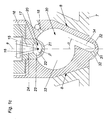
- the Fig. 1c shows a slight modification of the device 1 according to Fig. 1a and 1b ,
- only one transfer opening 22 is provided.
- This is fluidically arranged so that it is on the side facing away from the flow side, that is, "lee-sided” is arranged.
- air flows out of the channel 34 towards the wall 21 and only with some delay via the transfer opening 22 into the first pre-chamber 20.
- This arrangement that the one (or more) crossing opening (s) 22 on the side facing away from the flow direction is arranged (have), has the advantage that the fresh gas (fuel-air mixture) can only slowly displace the residual gas.
- Fig. 1d Another variant is in the Fig. 1d shown, which also have only the transfer openings 22 on the side facing away from the flow side.
- the channel 34 is conical, that is formed substantially like a truncated cone.
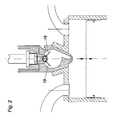
- the laser light 16 In operating condition ( Fig. 2 ) ignites the laser light generating device 14, the laser light 16 provides with an intensity so that a fuel-air mixture can be ignited, the fuel-air mixture in the first prechamber 20.
- the combustion flares 19 flow into the second pre-chamber 30 on the Transfer openings 22 and ignite there existing fuel-air mixture.
- the combustion torches 19 from the second antechamber 30 in the combustion chamber 4 via ( Fig. 3 ) to cause there now the final ignition of the fuel-air mixture, which causes a volume expansion, so that the piston performs 6 Hubarbeit.
- the boundary of the first pre-chamber 20 and the ignition space 23 is shielded to the rear of the combustion chamber window 15 via the connecting channel 24 from the combustion chamber 4.
- the oblique arrangement of the channel 34 and the spherical formations of the individual chambers 20, 30 cause a good mixing in the first and second pre-chamber 20, 30.
- the narrowing connecting channel 34 to the combustion chamber window 15 minimizes a back flow and thus also prevents the backflow of soot particles or partially unburned fuel, which thus can not be deposited on the combustion chamber window 15 and can not cause pollution.
- the ignition of the mixture in the first pre-chamber 20 is effected by a plasma flame, which is generated by the focusing of laser light radiation 16 in a courtyard-like extension (ignition space 23) at the lower end of the first pre-chamber 20.
- the flaming conditions for the plasma plumes are favorable, wherein the fuel-air mixture flowing from the second prechamber 30 through the transfer openings (bores) 22 during the compression phase both has an ideal combustion air ratio and also has ideal flow conditions at the ignition location.
- relatively small ignition torches 19 exit into the main chamber 33, which cause a rapid and complete ignition of the mixture in the second pre-manifold 30. This in turn generates very strong in the combustion chamber.
- the production of the laser light radiation 16 lasting only a few nanoseconds (eg 1 to 8 nsec), which is focused in the plasma peaks, is effected by already known laser light generating devices 14, for example by diode-pumped NdYAG solid-state lasers.
- the optical interface between the laser ignition device 1 and the ignition chamber 23, in which the spark is generated, forms the combustion chamber window 15 and the coupling optics 15.
- the combustion chamber window 15 is screened as far as possible from the combustion zone.
- the second pre-chamber 30 should preferably be designed so that the compression chamber (during the upward movement of the piston 6) Combustion chamber 4 in the antechamber 30 incoming fuel-air mixture a swirl flow is generated, see Fig. 4 ,
- the spin axis Z is perpendicular to the plane of the drawing.
- the pre-chamber gas may consist of the fuel gas itself, another combustible gas or a mixture of one or more fuels with air and / or exhaust gas.
- the spark location is shielded from the second pre-chamber 30 and connected only by one or more Studentstrittsbohrept 22 thereto. Through these holes 22 is ereicht that the ignition space in the ignition chamber 23 is shielded from the relatively high flow velocity in the second prechamber 30 and a flushing of the connecting channel 24 to the combustion chamber window 15 by combustible fuel-air mixture is largely avoided.
- primary ignition flares 19 are formed, which quickly and completely ignite the mixture in the second pre-chamber 30.
- the geometry of the spark gap is designed so that mixing of the main pre-chamber mixture and the residual gas present in the first pre-chamber 20 is avoided as far as possible.
- the plasma spark is placed in a correspondingly optimized courtyard-like extension in the vicinity of the overflow holes (between the first prechamber and the second prechamber).
- the concentration of the residual gas is significantly higher and the combustion chamber window 15 itself virtually no combustible mixture is present, which can lead to the formation of combustion residues on the window surface 15.
- This purpose can best be achieved by providing a channel-shaped constriction 24 between the coupling optics 15 and the plasma spark location through which the laser beams are directed.
- the examples shown have the advantage that the inflow of fresh gas to the Einkoppeloptik 15 reduces and the residual gas is displaced only slowly from the fresh gas.
- the first pre-chamber 20 is designed so that the combustion chamber window 15 is accessible for cleaning a possibly occurring residual contamination or spark pre-chamber and combustion chamber windows can be dismantled.
Landscapes
- Engineering & Computer Science (AREA)
- Chemical & Material Sciences (AREA)
- Combustion & Propulsion (AREA)
- Mechanical Engineering (AREA)
- General Engineering & Computer Science (AREA)
- Physics & Mathematics (AREA)
- Optics & Photonics (AREA)
- Combustion Methods Of Internal-Combustion Engines (AREA)
Applications Claiming Priority (1)
| Application Number | Priority Date | Filing Date | Title |
|---|---|---|---|
| AT0115909A AT508618B1 (de) | 2009-07-23 | 2009-07-23 | Vorrichtung zur zündung eines treibstoff-luft-gemischs |
Publications (1)
| Publication Number | Publication Date |
|---|---|
| EP2292922A2 true EP2292922A2 (fr) | 2011-03-09 |
Family
ID=42938241
Family Applications (1)
| Application Number | Title | Priority Date | Filing Date |
|---|---|---|---|
| EP10006568A Withdrawn EP2292922A2 (fr) | 2009-07-23 | 2010-06-24 | Dispositif d'allumage laser pour moteur à combustion |
Country Status (2)
| Country | Link |
|---|---|
| EP (1) | EP2292922A2 (fr) |
| AT (1) | AT508618B1 (fr) |
Cited By (6)
| Publication number | Priority date | Publication date | Assignee | Title |
|---|---|---|---|---|
| WO2012152471A1 (fr) * | 2011-05-10 | 2012-11-15 | Robert Bosch Gmbh | Bougie d'allumage laser |
| WO2012152467A3 (fr) * | 2011-05-10 | 2013-01-10 | Robert Bosch Gmbh | Bougie d'allumage laser |
| WO2013007441A1 (fr) * | 2011-07-12 | 2013-01-17 | Robert Bosch Gmbh | Module de pré-chambre pour une bougie d'allumage laser et procédé de production associé |
| EP2713024A1 (fr) * | 2012-09-26 | 2014-04-02 | GE Jenbacher GmbH & Co OG | Système de chambre amont pour un moteur à combustion interne |
| RU2553916C2 (ru) * | 2013-10-21 | 2015-06-20 | Общество с ограниченной ответственностью "Спектралазер" | Способ лазерного воспламенения топлива в дизельном двигателе, устройство для лазерного воспламенения топлива в дизельном двигателе и воспламенитель |
| JP2016033342A (ja) * | 2014-07-31 | 2016-03-10 | 株式会社日本自動車部品総合研究所 | レーザ点火装置 |
Families Citing this family (1)
| Publication number | Priority date | Publication date | Assignee | Title |
|---|---|---|---|---|
| DE102019209753A1 (de) * | 2019-07-03 | 2021-01-07 | Ford Global Technologies, Llc | Zündkerze mit Vorkammer und Vorrichtung zum Spülen der Vorkammer |
-
2009
- 2009-07-23 AT AT0115909A patent/AT508618B1/de not_active IP Right Cessation
-
2010
- 2010-06-24 EP EP10006568A patent/EP2292922A2/fr not_active Withdrawn
Non-Patent Citations (1)
| Title |
|---|
| None |
Cited By (12)
| Publication number | Priority date | Publication date | Assignee | Title |
|---|---|---|---|---|
| WO2012152471A1 (fr) * | 2011-05-10 | 2012-11-15 | Robert Bosch Gmbh | Bougie d'allumage laser |
| WO2012152467A3 (fr) * | 2011-05-10 | 2013-01-10 | Robert Bosch Gmbh | Bougie d'allumage laser |
| WO2013007441A1 (fr) * | 2011-07-12 | 2013-01-17 | Robert Bosch Gmbh | Module de pré-chambre pour une bougie d'allumage laser et procédé de production associé |
| EP2713024A1 (fr) * | 2012-09-26 | 2014-04-02 | GE Jenbacher GmbH & Co OG | Système de chambre amont pour un moteur à combustion interne |
| CN103775191A (zh) * | 2012-09-26 | 2014-05-07 | Ge延巴赫两合无限公司 | 内燃机的预燃室系统 |
| US9316144B2 (en) | 2012-09-26 | 2016-04-19 | Ge Jenbacher Gmbh & Co Og | Pre-chamber system for an internal combustion engine |
| RU2553916C2 (ru) * | 2013-10-21 | 2015-06-20 | Общество с ограниченной ответственностью "Спектралазер" | Способ лазерного воспламенения топлива в дизельном двигателе, устройство для лазерного воспламенения топлива в дизельном двигателе и воспламенитель |
| JP2016033342A (ja) * | 2014-07-31 | 2016-03-10 | 株式会社日本自動車部品総合研究所 | レーザ点火装置 |
| EP3176423A4 (fr) * | 2014-07-31 | 2017-08-02 | Denso Corporation | Dispositif d'allumage par laser |
| CN107076100A (zh) * | 2014-07-31 | 2017-08-18 | 株式会社电装 | 激光点火装置 |
| US10006433B2 (en) | 2014-07-31 | 2018-06-26 | Denso Corporation | Laser ignition device |
| CN107076100B (zh) * | 2014-07-31 | 2023-02-10 | 株式会社电装 | 激光点火装置 |
Also Published As
| Publication number | Publication date |
|---|---|
| AT508618A1 (de) | 2011-02-15 |
| AT508618B1 (de) | 2011-05-15 |
Similar Documents
| Publication | Publication Date | Title |
|---|---|---|
| AT508618B1 (de) | Vorrichtung zur zündung eines treibstoff-luft-gemischs | |
| EP2072803B1 (fr) | Dispositif d'allumage d'un mélange carburant-air dans une chambre de combustion d'un moteur à combustion interne | |
| DE102006018973A1 (de) | Laserzündung in einer Vorkammer | |
| EP2304321A1 (fr) | Bougie d'allumage laser comprenant un dispositif destiné à agir sur le flux de mélange air-carburant et à améliorer l'inflammation | |
| DE3709976A1 (de) | Verfahren und zuendkerze zur entflammung sehr magerer kraftstoff-luft-gemische, insbesondere fuer gasmotoren | |
| EP2577042A1 (fr) | Allumage induit par laser pour un moteur a combustion interne | |
| EP2577040A1 (fr) | Allumage induit par laser pour moteur a combustion interne | |
| EP3899228B1 (fr) | Tête de cylindre pour un moteur a combustion interne | |
| DE102005017186A1 (de) | Verfahren zur Verbesserung der Entflammungsbedingungen bei einem Vorkammer- Verbrennungsmotor mit Zündung in der Vorkammer | |
| DE1576030C3 (de) | Brennkraftmaschine mit als Zund kerzenvorkammer ausgebildeter Verdampfungs kammer | |
| DE10007211A1 (de) | Brennkraftbetriebenes Arbeitsgerät mit erhöhter Flammfront-Ausbreitungsgeschwindigkeit in seiner Vorkammer | |
| DE2717762A1 (de) | Fackelgezuendete brennkraftmaschine | |
| DE102008062573A1 (de) | Zündkerze für eine Brennkraftmaschine und Vorkammeranordnung hierfür | |
| DE4215763A1 (de) | Brenner | |
| EP3899226B1 (fr) | Culasse pour un moteur à combustion interne | |
| DE102017206021B3 (de) | Brennraumanordnung für eine Brennkraftmaschine, Einspritzverfahren und Verwendung einer Brennraumanordnung zum Einspritzen von OME-Kraftstoff | |
| DE2502931A1 (de) | Rotationskolbenmaschine | |
| AT500024B1 (de) | Verfahren zum betreiben einer mit gasförmigem kraftstoff betriebenen brennkraftmaschine | |
| EP0287596A1 (fr) | Bruleur pour la combustion de combustible liquide. | |
| AT523836A4 (de) | Verfahren zum Betreiben eines Hubkolbenmotors sowie Hubkolbenmotor | |
| EP3607186B1 (fr) | Chambre de combustion pour un moteur à combustion interne et utilisation d'une chambre de combustion pour injecter un carburant de type ome | |
| WO2004106722A2 (fr) | Moteur a combustion interne | |
| EP1557607B1 (fr) | Brûleur avec composant refroidi, turbine à gaz et procédé pour refroidir le composant | |
| DE3040190A1 (de) | Verfahren und vorrichtung zum steuern einer verbrennungskraftmaschine | |
| EP0819838B1 (fr) | Moteur à combustion polycarburant et son application |
Legal Events
| Date | Code | Title | Description |
|---|---|---|---|
| PUAI | Public reference made under article 153(3) epc to a published international application that has entered the european phase |
Free format text: ORIGINAL CODE: 0009012 |
|
| AK | Designated contracting states |
Kind code of ref document: A2 Designated state(s): AL AT BE BG CH CY CZ DE DK EE ES FI FR GB GR HR HU IE IS IT LI LT LU LV MC MK MT NL NO PL PT RO SE SI SK SM TR |
|
| AX | Request for extension of the european patent |
Extension state: BA ME RS |
|
| STAA | Information on the status of an ep patent application or granted ep patent |
Free format text: STATUS: THE APPLICATION HAS BEEN PUBLISHED |
|
| STAA | Information on the status of an ep patent application or granted ep patent |
Free format text: STATUS: THE APPLICATION IS DEEMED TO BE WITHDRAWN |
|
| 18D | Application deemed to be withdrawn |
Effective date: 20170103 |