EP2293436B1 - Dispositif de pré-distorsion alimenté en série et son procédé de commande de compensation de distorsion correspondant - Google Patents
Dispositif de pré-distorsion alimenté en série et son procédé de commande de compensation de distorsion correspondant Download PDFInfo
- Publication number
- EP2293436B1 EP2293436B1 EP10174180.9A EP10174180A EP2293436B1 EP 2293436 B1 EP2293436 B1 EP 2293436B1 EP 10174180 A EP10174180 A EP 10174180A EP 2293436 B1 EP2293436 B1 EP 2293436B1
- Authority
- EP
- European Patent Office
- Prior art keywords
- phase
- bands
- amplitude
- distortion
- frequency characteristic
- Prior art date
- Legal status (The legal status is an assumption and is not a legal conclusion. Google has not performed a legal analysis and makes no representation as to the accuracy of the status listed.)
- Not-in-force
Links
Images







Classifications
-
- H—ELECTRICITY
- H03—ELECTRONIC CIRCUITRY
- H03F—AMPLIFIERS
- H03F1/00—Details of amplifiers with only discharge tubes, only semiconductor devices or only unspecified devices as amplifying elements
- H03F1/32—Modifications of amplifiers to reduce non-linear distortion
- H03F1/3241—Modifications of amplifiers to reduce non-linear distortion using predistortion circuits
- H03F1/3247—Modifications of amplifiers to reduce non-linear distortion using predistortion circuits using feedback acting on predistortion circuits
-
- H—ELECTRICITY
- H03—ELECTRONIC CIRCUITRY
- H03F—AMPLIFIERS
- H03F1/00—Details of amplifiers with only discharge tubes, only semiconductor devices or only unspecified devices as amplifying elements
- H03F1/32—Modifications of amplifiers to reduce non-linear distortion
- H03F1/3241—Modifications of amplifiers to reduce non-linear distortion using predistortion circuits
- H03F1/3294—Acting on the real and imaginary components of the input signal
Definitions
- the present invention relates to a power series digital predistorter and a distortion compensation control method therefor.
- Nonlinear distortion compensation methods for microwave power amplifiers include a predistortion method.
- the predistortion method uses a predistorter to add, to a power amplifier input signal beforehand, a distortion compensation component for cancelling out a distortion component generated by the power amplifier.
- the power amplifier generally provides high efficiency when it is operated at around the saturation output power. As the power amplifier approaches its saturation output power, the intermodulation distortion (distortion component hereafter) increases because of the nonlinear characteristics. In addition, the distortion component has frequency dependent.
- Predistorters that can compensate for the frequency dependent distortion component include a power series digital predistorter (digital predistorter hereafter) that compensates for the frequency dependence of the distortion component (refer to S. Mizuta, Y. Suzuki, S. Narahashi, and Y. Yamao, "A New Adjustment Method for the Frequency-Dependent IMD Compensator of the Digital Predistortion Linearizer," IEEE Radio and Wireless Symposium 2006, pp. 255-258, Jan. 2006 and J. Ohkawara et al., "Fast calculation scheme for frequency characteristic compensator of digital predistortion linearizer", IEEE 69th vehicular technology conference, Apr. 2009 ).
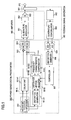
- Fig. 1 shows a conventional structure of a digital predistorter 900 and its peripheral equipment.
- a digital input transmission signal includes an I-phase signal and a Q-phase signal (I/Q signals hereafter).
- the digital predistorter 900 includes a linear transfer path 901A, a distortion generation path 901B, dividers 902, combiners 903, digital-to-analog converters (DACs) 904, analog-to-digital converters (ADCs) 905, an distortion observer 906, and a controller 907.
- the linear transfer path 901A includes a delay unit 901A1.
- the distortion generation path 901B includes a distortion generator 901B1, a distortion vector adjuster 901B2, and a frequency characteristic compensator 901B3.
- the dividers 902 divide the input transmission signal into the linear transfer path 901 A and the distortion generation path 901B.
- the combiners 903 combine the outputs of the linear transfer path 901A and the outputs of the distortion generation path 901B.
- the digital-to-analog converters (DACs) 904 convert the outputs of the combiners 903 (digital I/Q signals with distortion compensation components added thereto) to analog I/Q signals.
- the analog-to-digital converters (ADCs) 905 convert the outputs (analog I/Q signals) of a feedback signal generator 960 that takes in a part of the output of an amplifier 950 as a feedback signal to digital I/Q signals.
- the distortion observer 906 detects a distortion component from the outputs of the ADCs 905.
- the controller 907 adjusts vector coefficients (amplitude and phase) to be set in the distortion vector adjuster 901B2 and one or more frequency characteristic compensator coefficients (amplitude and phase) to be set in the frequency characteristic compensator 901B3, in accordance with the output of the distortion observer 906.
- the amplifier 950 includes a quadrature modulator 951 for performing quadrature modulation of the analog I/Q signals output from the digital predistorter 900, a frequency upconverter 952 for converting the frequency of the modulated output to the carrier frequency, and a power amplifier 953 for performing power amplification of the frequency-converted signal, and supplies the power-amplified signal from an output terminal 970 to an antenna, for example, via a duplexer, not shown.
- the feedback signal generator 960 includes a coupler 961 that extracts a part of the output of the amplifier 950 as a feedback signal, a frequency downconverter 962 for converting the frequency of the feedback signal, and a quadrature demodulator 963 for performing quadrature demodulation of the down-converted feedback signal.
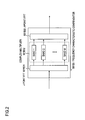
- Fig. 2 shows an example structure of the frequency characteristic compensator 901B3.
- the frequency characteristic compensator 901B3 includes a J-point FFT 901B31, a complex multiplier 901B32, and a J-point IFFT 901B33.
- the FFT 901B31 converts the input signal of the frequency characteristic compensator 901B3 into the frequency domain.
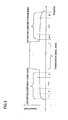
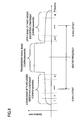
- the complex multiplier 901B32 multiplies each of M bands formed by dividing the upper band and lower band of the distortion component, as shown in Fig. 3 , by a frequency characteristic compensator coefficient given by the controller 907 (phase and amplitude adjustment).
- the output of the FFT 901B31 outside the divided bands is directly input to the IFFT 901B33, which is not shown in the figure.
- the IFFT 901B33 converts the output of the complex multiplier 901B32 into the time domain.
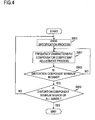
- Fig. 4 shows a flowchart illustrating processing for frequency characteristic compensator coefficients that minimize the distortion component, in the frequency characteristic compensator.
- the controller 907 specifies one band where the frequency characteristic compensator coefficient is to be adjusted (band specification step S900), adjusts the frequency characteristic compensator coefficient to reduce the power of the distortion component in the specified band to the minimum level (or a target value), and sets the coefficient in the frequency characteristic compensator (frequency characteristic compensator coefficient adjustment steps S901, S902).
- the controller 907 ends the frequency characteristic compensator coefficient adjustment process and sets the obtained frequency characteristic compensator coefficients in the frequency characteristic compensator (S903).
- the controller 907 goes back to the band specification step and repeats the steps S900, S901, and S902 until the conditions 1 and 2 are satisfied (S903).
- the frequency characteristic compensator 901B3 has eight bands, the time required to adjust the frequency characteristic compensator coefficients of all the bands once is twice the time required by a frequency characteristic compensator having four bands.
- a power series digital predistorter adds to an input signal a distortion compensation component for cancelling a distortion component generated in a power amplifier.
- the power series digital predistorter includes a linear transfer path adapted to transfer the input signal with a delay; a distortion generation path outputting the output of an N-th order frequency characteristic compensator as the distortion compensation component, where N is a predetermined odd number equal to or larger than three; a combiner adapted to combine the output of the linear transfer path and the output of the distortion generation path; a distortion observer adapted to observe the distortion component included in the output of the power amplifier, which is adapted to amplify the output of the combiner; and a controller adapted to set adjustment amounts for the amplitude and the phase in each of M bands in the N-th order frequency characteristic compensator according to an observation result of the distortion observer, where M is a predetermined integer equal to or larger than two.
- the distortion generation path includes an N-th order distortion generator adapted to generate an N-th order distortion component of the input signal; an N-th order distortion vector adjuster adapted to adjust the amplitude and the phase of the N-th order distortion component; and the N-th order frequency characteristic compensator, which is adapted to divide the output of the N-th order distortion vector adjuster into the M bands in the frequency domain and to adjust the amplitude and the phase of the output in each of the M bands.
- the controller includes a phase setting unit adapted to collectively set the adjustment amounts for the phases in the M bands in the N-th order frequency characteristic compensator; an amplitude setting unit adapted to collectively set the adjustment amounts for the amplitudes in the M bands in the N-th order frequency characteristic compensator; and a processing control unit.
- the processing control unit is adapted to determine whether an index indicating the degree of cancellation of the distortion component generated in the power amplifier satisfies a preset condition, and, if the index does not satisfy the condition, to perform control such that the phase setting unit again collectively sets the adjustment amounts for the phases and the amplitude setting unit again collectively sets the adjustment amounts for the amplitudes.
- a distortion compensation control method for a power series digital predistorter includes a phase setting step of collectively setting adjustment amounts for the phases in bands in an N-th order frequency characteristic compensator; an amplitude setting step of collectively setting adjustment amounts for the amplitudes in the bands in the N-th order frequency characteristic compensator; and a processing control step of determining whether an index indicating the degree of cancellation of a distortion component generated in a power amplifier satisfies a preset condition, and, if the index does not satisfy the condition, of performing control such that the phase setting step and the amplitude setting step are performed again.
- the frequency characteristic compensator coefficients can be adjusted at high speed.
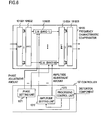
- First Embodiment Fig. 5 shows the structure of a power series digital predistorter 100 of a first embodiment of the present invention and its peripheral equipment.
- the peripheral equipment shown in Fig. 5 includes a digital predistorter input signal generator 990, an amplifier 950, and a feedback signal generator 960 which takes in a part of the output of the amplifier 950 and generates a feedback signal for the power series digital predistorter 100.
- the amplifier 950 and the feedback signal generator 960 are the same as the peripheral equipment of the digital predistorter 900, which has been described as the related art, and therefore, a repeated description will be omitted (see the foregoing description).
- the digital predistorter input signal generator 990 includes a transmission signal generator 991, a pilot signal generator 992, and a switch 993 for selecting the output of the transmission signal generator 991 or the output of the pilot signal generator 992.
- the digital input transmission signal output from the transmission signal generator 991 includes desired information.
- the pilot signal output by the pilot signal generator 992 is used when frequency characteristic compensator coefficients, which will be described later, are determined.
- the frequency and the like of the pilot signal are not especially limited.
- the digital input transmission signal and the pilot signal include the I-phase signal and the Q-phase signal (I/Q signals) each.
- the power series digital predistorter 100 in the first embodiment includes a linear transfer path 101A, an N-th order distortion generation path 101B, dividers 102, combiners 103, digital-to-analog converters (DACs) 104, analog-to-digital converters (ADCs) 105, a distortion observer 106, and a controller 107.
- the linear transfer path 101A includes a delay unit 101A1.
- the N-th order distortion generation path 101B includes an N-th order distortion generator 101B1, an N-th order distortion vector adjuster 101B2, and an N-th order frequency characteristic compensator 101B3.
- the dividers 102 divide the I-phase signal and the Q-phase signal into the linear transfer path 101A and the N-th order distortion generation path 101B.
- the combiners 103 combine the outputs of the linear transfer path 101A and the outputs of the N-th order distortion generation path 101B for the I-phase signal and the Q-phase signal.
- the digital-to-analog converters (DACs) 104 convert the I-phase signal and the Q-phase signal output from the combiners 103 (digital I/Q signals with distortion compensation signals added thereto) separately to analog I/Q signals.
- the analog-to-digital converters (ADCs) 105 convert the outputs (analog I/Q signals) of the feedback signal generator 960 which takes in a part of the output of the amplifier 950 as the feedback signal, to digital I/Q signals.
- the distortion observer 106 observes the outputs (digital I/Q signals) of the ADCs 105 and measures the power in the transmission signal band and the power of the N-th order distortion component generated by the amplifier 950 in bands divided by the N-th order frequency characteristic compensator 101B3.
- the controller 107 adjusts the vector coefficients (amplitude and phase) to be set in the N-th order distortion vector adjuster 101B2 and one or more frequency characteristic compensator coefficients (amplitude and phase) to be set in the N-th order frequency characteristic compensator 101B3, in accordance with the output of the distortion observer 106.
- N is a predetermined odd number equal to or larger than 3. In this example, N is 3.
- the controller 107 includes a phase setting unit 1071, an amplitude setting unit 1072, and a processing control unit 1073 (see Fig. 6 ).
- the phase setting unit 1071 sets the phase adjustment amounts of M distortion component bands collectively in the third-order frequency characteristic compensator 101B3.
- the amplitude setting unit 1072 sets the amplitude adjustment amounts of M distortion component bands (M is a predetermined integer equal to or larger than 2) collectively in the third-order frequency characteristic compensator 101B3.
- the processing control unit 1073 judges whether an index (ACLR, for example, as described later) indicating the degree of cancellation of the distortion component generated by the power amplifier 953 satisfies a predetermined condition (lower than or lower than or equal to the target value). If the condition is not satisfied, the phase setting unit 1071 is controlled to set the phase adjustment amounts again, and the amplitude setting unit 1072 is controlled to set the amplitude adjustment amounts again.
- ACLR an index
- just the third-order distortion component is the target of compensation. If one or more different W-th order distortion generation paths (W is an odd number equal to or larger than 5) are connected in parallel to the third-order distortion generation path 101B, a plurality of odd-order distortion components can become the compensation target.
- the third-order frequency characteristic compensator 101B3 converts the outputs of the third-order distortion vector adjuster 101B2 into the frequency domain and divides the upper and lower third-order distortion component bands into M parts, as shown in Fig. 3 .
- the third-order frequency characteristic compensator 101B3 includes a serial-to-parallel converter (S/P) 101B31, a fast Fourier transformer (FFT) 101B32, a complex multiplier (C.M.) 101B33, an inverse fast Fourier transformer (IFFT) 101B34, and a parallel-to-serial converter (P/S) 101B35.
- the S/P 101B31 converts the outputs of the third-order distortion vector adjuster 101B2 from serial to parallel.
- the FFT 101B32 converts the outputs of the S/P 101B31 into the frequency domain.
- the complex multiplier 101B33 adjusts the phase and amplitude by multiplying them by the frequency characteristic compensator coefficients given by the controller 107 in each of the M divided bands.
- the IFFT 101B34 converts the outputs of the complex multiplier 101B33 into the time domain.
- the P/S 101B35 converts the outputs of the IFFT 101B34 from parallel to serial.
- the third-order frequency characteristic compensator 101B3 adjusts the phase and amplitude in each of the M divided bands by using the frequency characteristic compensation coefficients (phase and amplitude) specified by the controller 107.
- the input signals of the digital predistorter 100 are the outputs (pilot signals) of the pilot signal generator 992 until the third-order distortion components are minimized (to the target value or below). After the third-order distortion components are minimized (to the target value or below), the switch 993 selects the outputs (transmission signals) of the transmission signal generator 991 as the input signals.
- the OFDM signal comprises 64 subcarriers with signal bandwidth of 3.84 MHz, and a route roll off rate of 0.22.
- the modulation scheme for each subcarrier is QPSK.
- the bandwidth, route roll off rate, the number of subcarriers, subcarrier modulation scheme, and the like can be specified as needed.
- the transmission signal can be specified appropriately for the signal to be amplified by the amplifier 950 and can be the WCDMA signal, for example.
- the adjacent channel leakage power ratio (ACLR) is used as an index for judging the degree of distortion compensation (index indicating the degree of cancellation of the distortion component generated by the power amplifier).
- the ACLR here is the ratio of the power in the upper and lower bands of third-order distortion component (3.84 MHz-bandwidth) at ⁇ 5 MHz offset from the center frequency to the power in the transmission signal band (3.84 MHz-bandwidth).
- the offset from the center frequency and the third-order distortion component band can be specified appropriately for the bandwidth of the transmission signal.
- the distortion compensation judgment index used in the first embodiment is ACLR, and the upper or lower band of third-order distortion component can also be used as the index.
- the phase adjustment amount and amplitude adjustment amount of the third-order distortion vector adjuster 101B2 are considered to have been specified appropriately by a known method. If the power of the third-order distortion component band is used as an index, for example, the controller 107 sets a phase adjustment amount and amplitude adjustment amount in the third-order distortion vector adjuster 101B2 such that the power of the upper or lower band of third-order distortion component is minimized (reaches the target value).
- One method for determining the phase adjustment amount and amplitude adjustment amount is a perturbation method (see Toshio Nojima, Yoshiharu Okamoto, Satoshi Oyama, "Predistortion Nonlinear Compensator for Microwave SSB-AM System", IEICE Transactions, Vol. J67-B, No.
- the phase adjustment amount is determined by using the perturbation method
- the power of the third-order distortion component band is measured when the phase adjustment amount is set to those immediately larger and smaller than the phase adjustment amount set first; the phase adjustment amount is changed by an offset value in the direction in which the power of the third-order distortion component band decreases; and the power of the third-order distortion component band is measured.
- the phase adjustment amount that minimizes the power of the third-order distortion component band is obtained. The same process can be applied to the amplitude.
- the controller 107 has a functional element to set the phase adjustment amount and amplitude adjustment amount in the third-order distortion vector adjuster 101B2
- the process of setting the phase adjustment amount and amplitude adjustment amount in the third-order distortion vector adjuster 101B2 is carried out prior to and independently of the process of setting a phase adjustment amount and an amplitude adjustment amount in the third-order frequency characteristic compensator 101B3. Therefore, the functional element is not shown in the figure.
- the phase setting unit 1071 of the controller 107 sets the phase adjustment amounts of the M distortion component bands collectively in the third-order frequency characteristic compensator 101B3 (collective phase adjustment process in step S101).
- the amplitude setting unit 1072 of the controller 107 sets the amplitude adjustments of the M distortion component bands collectively in the third-order frequency characteristic compensator 101B3 (collective amplitude adjustment process in step S102).
- the distortion observer 106 measures the power in the transmission signal band and the power in the M distortion component bands and obtains an ACLR (ACLR measurement process in step S103).
- the processing control unit 1073 of the controller 107 repeats steps S101 to S103 until the measured ACLR falls below the target value (ACLR judgment process in step S104).
- the phase adjustment amounts of the M distortion component bands are specified collectively.
- the amplitude adjustment amounts of the M distortion component bands are specified collectively. This is because the increase or decrease in the distortion component corresponding to the change in phase is generally larger than the increase or decrease in the distortion component corresponding to the change in amplitude.
- phase adjustment process 1 The collective phase adjustment process of the controller 107 will be described (this process will be referred to as collective phase adjustment process 1).
- phase adjustment amount to be specified in each of the M divided bands of the third-order frequency characteristic compensator 101B3 will be denoted by X m (0 ⁇ m ⁇ M), and the distortion component power in the divided band will be denoted by D m .
- Fig. 9 shows an equivalent low-pass system model of the digital predistorter and power amplifier.
- the power amplifier is formed of an amplification path and a third-order distortion generation path.
- s(t) denotes the input signal of the digital predistorter; ⁇ and ⁇ respectively denote the amplitude and phase of the third-order distortion vector adjuster in the digital predistorter; g(t) denotes the impulse response of the third-order frequency characteristic compensator in the digital predistorter; r 1 denotes the gain of the amplification path in the power amplifier; r 3 and ⁇ respectively denote the gain and phase of the third-order distortion generation path in the power amplifier; and h(t) denotes the impulse response indicating the frequency dependence of the third-order distortion component in the power amplifier.
- the output signal z(t) of the power amplifier can be expressed as follows.
- z t r 1 ⁇ s t + ⁇ ⁇ e j ⁇ ⁇ g t * s 3 t + r 3 ⁇ e j ⁇ ⁇ h t * s t + ⁇ ⁇ e j ⁇ ⁇ g t * s 3 t 3
- the asterisk (*) indicates convolution.
- the distortion component e(t) can be expressed as follows.
- e t r 3 ⁇ e j ⁇ ⁇ h t * s 3 t + r 1 ⁇ ⁇ ⁇ e j ⁇ ⁇ g t * s 3 t Equation (2) converted into the frequency domain is as follows.
- E f r 3 ⁇ e j ⁇ ⁇ H f + r 1 ⁇ ⁇ e j ⁇ ⁇ G f ⁇ S 3 f
- E(f), H(f), G(f), and S 3 (f) are L-point discrete Fourier transforms of e(t), h(t), g 3 (t), and s 3 (t), respectively.
- the frequency characteristic H m of the distortion component in the divided band m of the third-order frequency characteristic compensator is expressed as follows.
- H m K m ⁇ e j ⁇ ⁇ m
- G m is expressed as given below.
- Equation (3) the power D m of the distortion component in the divided band m is expressed as follows.
- Equation (7) the relationship between Y m and D m when X m is a constant X m (0) can be expressed as given below: D m
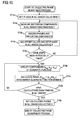
- Fig. 10 shows a flowchart illustrating the collective phase adjustment process 1.
- the phase setting unit 1071 of the controller 107 sets initial phase adjustment amounts X 1 to X M collectively in the third-order frequency characteristic compensator 101B3 (phase step S11p).
- the distortion observer 106 measures the powers D 1 to D M of the distortion component bands simultaneously (phase step S12p).
- the output signal of the amplifier 950 is converted to analog I/Q signals by the feedback signal generator 960, and the analog I/Q signals are converted to digital I/Q signals by the ADCs 105.
- the distortion observer 106 converts the digital I/Q signals from serial to parallel, then multiplies them by a window function (such as the Hamming window), and performs the discrete Fourier transform. Because the spectrum of the distortion component can be obtained collectively from the result of the discrete Fourier transform, the distortion observer 106 measures the powers D 1 to D M of the distortion component collectively from the results of the discrete Fourier transform.
- the conventional distortion observer 906 observes the power of a specified band only.
- the distortion observer 106 in the first embodiment measures the powers D 1 to D M of the M distortion component bands collectively.
- the phase setting unit 1071 of the controller 107 records the set phase adjustment amount X m and the measured power D m as R1 m,11 and R2 m,11 (0 ⁇ 11 ⁇ L1) in each band (phase step S13p).
- the phase setting unit 1071 of the controller 107 adds predetermined offset values A1 1 to A1 M (positive values) to the phase adjustment amounts X 1 to X M and sets the new phase adjustment amounts X 1 to X M collectively in the third-order frequency characteristic compensator 101B3 (phase step S14p).
- the phase setting unit 1071 of the controller 107 repeats the phase steps S12p to S14p L1 times (L1 is an integer equal to or larger than 3) (phase step S15p).
- negative offset values may be added to the phase adjustment amounts.
- a positive offset value may be added to the phase adjustment amount in odd-numbered distortion compensation bands, and a negative offset value may be added to the phase adjustment amount in even-numbered distortion compensation bands.
- the process may be modified such that, if the judgment made in the phase step S15p is No, the phase step S14p is executed.
- phase setting unit 1071 of the controller 107 calculates the phase adjustment amount X min,m that minimizes the quadratic function, as -a 1,m /(2a 2,m ) (phase step S17p).
- the phase setting unit 1071 of the controller 107 repeats the phase steps S16p and S 17p until the phase adjustment amount X min,m is calculated in all the distortion component bands (phase step S18p).
- the phase setting unit 1071 of the controller 107 sets the phase adjustment amounts X min,1 to X min,M collectively in the third-order frequency characteristic compensator 101B3 (phase step S19p).
- the relationship between the phase adjustment amount and the distortion component can be represented by a quadratic function by using the Taylor expansion on Equation (7), as descried earlier.
- X m is calculated so that D m is minimized with the specified coefficients (c 2,m , c 1,m , c 0,m ). For example, if X m is in radians, X min,m is calculated as ⁇ - c 1,m . Since the cosine function is used instead of approximation by the Taylor expansion, the relationship between the phase adjustment amount and the distortion component may be represented more accurately than when the quadratic function is used. The distortion compensation amount obtained by using the cosine function becomes larger than that obtained by using the quadratic function, and it may be possible to reach the target value with a smaller number of repetitions. Instead of the cosine function, a sine function can be used by utilizing the supplementary angle formula. In other embodiments described later, the relationship between the phase adjustment amount and the distortion component may be a cosine function.
- the collective amplitude adjustment process in the controller 107 is as illustrated by a flowchart shown in Fig. 11 (this process will be referred to as collective amplitude adjustment process 1).
- this process will be referred to as collective amplitude adjustment process 1).
- the amplitude adjustment amount to be specified in each of the M divided bands of the third-order frequency characteristic compensator 101B3 will be denoted by Y m .
- the amplitude setting unit 1072 of the controller 107 sets initial amplitude adjustment amounts Y 1 to Y M collectively in the third-order frequency characteristic compensator 101B3 (amplitude step S11a).
- the distortion observer 106 measures the distortion component powers D 1 to D M simultaneously (amplitude step S12a).
- the amplitude setting unit 1072 of the controller 107 records the set amplitude adjustment amount Y m and the measured power D m as R3 m,12 and R4 m,12 (0 ⁇ 12 ⁇ L2) in each band (amplitude step S13a).
- the amplitude setting unit 1072 of the controller 107 adds predetermined offset values B1 1 to B1 M (positive values) to the amplitude adjustment amounts Y 1 to Y M and sets the new amplitude adjustment amounts Y 1 to Y M collectively in the third-order frequency characteristic compensator 101B3 (amplitude step S14a).
- the amplitude setting unit 1072 of the controller 107 repeats the amplitude steps S12a to S14a L2 times (L2 is an integer equal to or larger than 3) (amplitude step S15a). In the amplitude step S14a, if the amplitude is larger than 0, a negative offset value may be added to the amplitude adjustment amount.
- a positive offset value may be added to the amplitude adjustment amount in odd-numbered distortion compensation bands
- a negative offset value may be added to the amplitude adjustment amount in even-numbered distortion compensation bands.
- the process may be modified such that, if the judgment made in the amplitude step S15a is No, the amplitude step S 14a is executed.
- the amplitude setting unit 1072 of the controller 107 calculates the amplitude adjustment amount Y min,m that minimizes the quadratic function, as -b 1,m /(2b 2,m ) (amplitude step S17a).
- the amplitude setting unit 1072 of the controller 107 repeats the amplitude steps S16a and S17a until the amplitude adjustment amount Y min,m is calculated in all the distortion component bands (amplitude step S18a).
- the amplitude setting unit 1072 of the controller 107 sets the amplitude adjustment amounts Y min,i to Y min,M collectively in the third-order frequency characteristic compensator 101B3 (amplitude step S19a).
- (1) indicates the processing time for setting the phase adjustment amount and measuring the distortion component; (2) indicates the time needed to calculate the phase adjustment amount that minimizes the quadratic function; and (3) indicates the processing time for setting the calculated phase adjustment amount.
- the periods (1), (2), and (3) are equally sized in Fig. 13 for the sake of simplicity, but they actually differ in size.
- the processes corresponding to (1) to (3) are executed for one band after another in method A, whereas the processes are executed for all the distortion component bands collectively in method B.
- the phase adjustment amounts can be determined more quickly by method B than by method A.
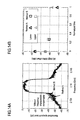
- Fig. 14A shows a spectrum (marked by "without frequency characteristic compensator") before phase adjustment amounts and amplitude adjustment amounts are set in the third-order frequency characteristic compensator 101B3, a spectrum when method A is used, and a spectrum when method B is used.
- Fig. 14B shows the upper and lower ACLRs for the normalized time.
- the setting times in methods A and B were normalized separately on the horizontal axis with reference to the period required to specify the phase adjustment amounts and amplitude adjustment amounts that reduce the distortion component to the minimum level (target level) in all the bands by method A.
- Fig. 14A shows that the distortion compensation amount in the lower spectrum by method B is smaller than that by method A.
- Fig. 14B shows that both the upper ACLR and the lower ACLR are below the target value in methods A and B.
- the normalized time of method B is 0.28, and the normalized time of method A is 1.0. This means that method B reduces the setting time by 72% compared with the conventional control method A.
- the collective phase adjustment process by the controller 107 may be as illustrated in a flowchart shown in Fig. 15 (this process will be referred to as collective phase adjustment process 2).
- the controller 107 sets initial phase adjustment amounts X 1 to X M collectively in the third-order frequency characteristic compensator 101B3 (phase step S21p).
- the distortion observer 106 measures the distortion component powers D 1 to D M simultaneously (phase step S22p).
- the controller 107 compares the distortion component power D m with a recorded value R5 m in each band (phase step S23p). If the distortion component power becomes smaller than the recorded value in one band at least, the controller 107 records the phase adjustment amount X m and the distortion component power D m in the band where the distortion component power D m is lower than the recorded value R5 m as X mm , m and as the recorded value R5 m , respectively (phase step S24p).
- the initial value of the recorded value R5 m is set to a value higher than the highest distortion component power D m that can be measured. This causes the phase step S24p to be executed at least once in all the bands and the phase adjustment amount X min , m to be recorded in all the bands.
- the controller 107 adds the offset value A2 m (A2 m > 0) to the phase adjustment amount X m , sets the new phase adjustment amount in the band where the distortion component power D m is lower than the recorded value R5 m (phase step S25p), and returns to the phase step S22p. In that step, a negative offset value may be added to the phase adjustment amount. If the distortion component power is equal to or higher than the recorded value in all the bands, the controller 107 sets the recorded phase adjustment amounts X mm,1 to X mim,M collectively in the third-order frequency characteristic compensator 101B3 (phase step S26p).
- the collective amplitude adjustment process by the controller 107 may be as illustrated in a flowchart shown in Fig. 16 (this process will be referred to as collective amplitude adjustment process 2).
- the controller 107 sets initial amplitude adjustment amounts Y 1 to Y M collectively in the third-order frequency characteristic compensator 101B3 (amplitude step S21a).
- the distortion observer 106 measures the distortion component powers D 1 to D M simultaneously (amplitude step S22a).
- the controller 107 compares the distortion component power D m with a recorded value R6 m in each band (amplitude step S23a). If the distortion component power is smaller than the recorded value in one band at least, the controller 107 records the amplitude adjustment amount Y m and the distortion component power D m in the band where the distortion component power D m is lower than the recorded value R6 m as Y min,m and recorded value R6 m , respectively (amplitude step S24a).
- the initial value of the recorded value R6 m is set to a value higher than the highest distortion component power D m that can be measured. This causes the amplitude step S24a to be executed at least once in all the bands and the amplitude adjustment amount Y min,m to be recorded in all the bands.
- the controller 107 adds the offset value B2 m (B2 m > 0) to the amplitude adjustment amount Y m , sets the new amplitude adjustment amount in the band where the distortion component power D m is lower than the recorded value R6 m (amplitude step S25a), and returns to the amplitude step S22a. In that step, if the amplitude adjustment amount Y m is larger than 0, a negative offset value may be added to the amplitude adjustment amount.
- the controller 107 sets the recorded amplitude adjustment amounts Y min,1 to Y min,M collectively in the third-order frequency characteristic compensator 101B3 (amplitude step S26a).
- the collective amplitude adjustment process may be repeated, and then the ACLR measurement may be performed.
- the first phase adjustment amount is specified such that the phase adjustment amount that minimizes the quadratic function becomes the median among the L1 phase adjustment amounts.
- the offset value may be changed to 2/3 times, 1/2 times, or the like, or may not be changed.
- the amplitude adjustment amounts are specified in the same manner as the phase adjustment amounts. If the collective phase adjustment process 2 and the collective amplitude adjustment process 2 are used, the phase adjustment amount offset values and the amplitude adjustment amount offset values are changed to 2/3 times, 1/2 times, or the like, respectively.
- the collective phase adjustment process 1 when the collective phase adjustment process 1 is used, the collective amplitude adjustment process 1 is used together therewith, but the collective amplitude adjustment process 2 may be used.
- the collective amplitude adjustment process 2 when the collective phase adjustment process 2 is used, the collective amplitude adjustment process 2 is used together therewith, but the collective amplitude adjustment process 1 may be used.
- the distortion component may increase.
- a lookup table may be provided so that the phase adjustment amounts and amplitude adjustment amounts of the third-order frequency characteristic compensator 101B3 can be specified appropriately for the transmission signal power.
- the lookup table stores the phase adjustment amounts and amplitude adjustment amounts to be set in the third-order frequency characteristic compensator 101B3 on the basis of the transmission signal power.
- the phase adjustment amounts and amplitude adjustment amounts to be stored are obtained in accordance with the transmission signal power, through the processes described earlier.
- the distortion observer 106 measures the transmission signal power, and the controller 107 references the lookup table to set phase adjustment amounts and amplitude adjustment amounts suitable for the transmission signal power in the third-order frequency characteristic compensator 101B3.
- the processes in the first embodiment do not depend on the order of the distortion in the distortion generation path 101B. If there are a plurality of distortion generation paths 101B, the processes described earlier should be performed in one distortion generation path 101B after another. If there are a third-order distortion generation path and a fifth-order distortion generation path and if a third-order distortion vector adjuster and a fifth-order distortion vector adjuster are controlled appropriately, for example, the phase adjustment amounts and amplitude adjustment amounts of all the bands to be set in the third-order frequency characteristic compensator should be adjusted in the processes described earlier, and the phase adjustment amounts and amplitude adjustment amounts of all the bands to be set in the fifth-order frequency characteristic compensator should be adjusted in the same way.
- the adjustment for the fifth-order frequency characteristic compensator may be followed by the adjustment for the third-order frequency characteristic compensator.
- Second Embodiment Fig. 17 shows a flowchart illustrating processing in a second embodiment of the present invention.
- the following processes are added at the transition from the ACLR judgment process to the collective phase adjustment process, in the first embodiment: a process for recording the measured ACLR and the phase adjustment amounts and amplitude adjustment amounts set in the third-order frequency characteristic compensator 101B3 (ACLR, phase, and amplitude recording process in step S105) and a process for determining whether processes (collective phase adjustment process, collective amplitude adjustment process, and ACLR measurement process) have been repeated a specified number of times (first repetition judgment process in step S106).
- ACLR third-order frequency characteristic compensator 101B3
- first repetition judgment process in step S106
- the controller 107 proceeds to the collective phase adjustment process described in the first embodiment. If the processes (collective phase adjustment process, collective amplitude adjustment process, and ACLR measurement process) have been repeated the specified number of times, the controller 107 collectively sets the phase adjustment amounts and amplitude adjustment amounts that have provided the minimum ACLRs of the ACLRs recorded in the ACLR, phase, and amplitude recording process, in all the bands of the third-order frequency characteristic compensator 101B3 (S107).
- the phase adjustment amounts and amplitude adjustment amounts that provide the smallest ACLRs among the ACLRs obtained in the processes repeated the specified number of times can be set in the third-order frequency characteristic compensator 101B3 without generating an endless loop.
- ACLRs are recorded. If the index of the distortion compensation amount in the third-order frequency characteristic compensator 101B3 is the power of the distortion component, the distortion component power is recorded instead of the ACLR in the ACLR, phase, and amplitude recording process (S105). In that case, the controller 107 collectively sets the phase adjustment amounts and amplitude adjustment amounts corresponding to the smallest distortion component powers among the recorded distortion component powers, in all the bands of the third-order frequency characteristic compensator 101B3.
- the frequency characteristic compensator coefficients (phase and amplitude) can be adjusted quickly, as clearly indicated by the first embodiment.
- Fig. 18 shows a flowchart of processing in the third embodiment of the present invention.
- the third embodiment differs from the second embodiment in that, when it is judged in the first repetition judgment process S106 that the processes have been repeated the specified number of times, it is judged whether the collective phase adjustment process and the collective amplitude adjustment process have been modified once (modification judgment process in step S106a). If no modification has been made, the collective phase adjustment process and the collective amplitude adjustment process are modified together (process for modifying the collective phase adjustment process and the collective amplitude adjustment process in step S106b).
- processing in the second embodiment is performed in a first stage in accordance with the collective phase adjustment process 1 and the collective amplitude adjustment process 1 described in the first embodiment
- processing in the next stage of the second embodiment is performed in accordance with the collective phase adjustment process 2 and the collective amplitude adjustment process 2 described in the first embodiment.
- Using two different pairs of the collective phase adjustment process and the collective amplitude adjustment process can provide better distortion compensation than using a single pair of the collective phase adjustment process and the collective amplitude adjustment process.
- the collective phase adjustment process and the collective amplitude adjustment process need not be changed together; just one process may be changed.
- processing in the second embodiment is performed in accordance with the collective phase adjustment process 1 and collective amplitude adjustment process 1 described in the first embodiment
- processing in the second embodiment is performed in accordance with the collective phase adjustment process 1 and collective amplitude adjustment process 2 described in the first embodiment
- processing in the third stage is performed in accordance with the collective phase adjustment process 2 and collective amplitude adjustment process 1 described in the first embodiment
- processing in the second embodiment is performed in accordance with the collective phase adjustment process 2 and collective amplitude adjustment process 1 described in the first embodiment
- processing in the second embodiment is performed in accordance with the collective phase adjustment process 2 and collective amplitude adjustment process 2 described in the first embodiment.
- Fourth Embodiment A fourth embodiment differs from the second embodiment in that the phase adjustment amounts and amplitude adjustment amounts are set individually if ACLR does not fall below the target value even after the processes (collective phase adjustment process, collective amplitude adjustment process, and ACLR measurement process) are repeated the specified number of times.
- Fig. 19 shows a flowchart illustrating processing in the fourth embodiment. The difference from the second embodiment is that, if it is judged in the first repetition judgment process in step S106 shown in Fig.
- the phase adjustment amount is adjusted in one band after another (individual phase adjustment process in step S108); the amplitude adjustment amount is adjusted in one band after another (individual amplitude adjustment process in step S109); the ACLR measurement process in step (S110) is carried out; and except when the ACLR falls below the target value (S111), the individual phase adjustment process to the ACLR measurement process (S 108 to S110) are repeated in that order up to a specified number of times (second repetition judgment process in step S113).
- an ACLR, phase, and amplitude recording step S112 which is the same as the ACLR, phase, and amplitude recording step S105 described in the second embodiment, is performed. If the ACLR does not fall below the target value after the individual phase adjustment process S108 to the ACLR measurement process S110 are repeated, the controller 107 collectively sets the phase adjustment amounts and amplitude adjustment amounts corresponding to the minimum ACLRs among the measured ACLRs in the third-order frequency characteristic compensator 101B3.
- the repetition count judged in the second repetition judgment process in step S113 may or may not be the same as the repetition count judged in the first repetition judgment process in step S106.
- the amplitude adjustment amounts are adjusted. This is because the increase or decrease in the distortion component corresponding to the change in phase is generally larger than the increase or decrease in the distortion component corresponding to the change in amplitude. In some power amplifiers 953, however, the increase or decrease in the distortion component corresponding to the change in amplitude is larger than the increase or decrease in the distortion component corresponding to the change in phase. In that case, the phase adjustment and amplitude adjustment may be performed in reverse order.
- the controller 107 sets the phase adjustment amount X m in the band m (phase step S31p).
- the distortion observer 106 measures the distortion component power D m in the band m (phase step S32p).
- the controller 107 records the set phase adjustment amount X m and the measured power D m as R7 m,13 and R8 m , 13 (0 ⁇ 13 ⁇ L3), respectively (phase step S33p).
- the controller 107 adds an offset value A3 m (A3 m > 0) to the phase adjustment amount X m and sets the new phase adjustment amount X m in the band m (phase step S34p).
- the controller 107 repeats the phase steps S32p to S34p L3 times (L3 is an integer equal to or larger than 3) (phase step S35p).
- phase step S34p a negative offset value may be added to the phase adjustment amount.
- the controller 107 calculates the phase adjustment amount X min,m that minimizes the quadratic function, as -a 1,m /(2a 2,m ) (phase step S37p).
- the controller 107 sets the obtained phase adjustment amount X min,m in the third-order frequency characteristic compensator 101B3 (phase step S38p).
- the controller 107 repeats the phase steps S31p to S38p until the phase adjustment amount X min,m is set in all the distortion component bands (phase step S39p).
- the process may be changed such that, if judgment made in the phase step S35p is No, the phase step S34p is executed.
- the individual amplitude adjustment process is performed as illustrated in a flowchart shown in Fig. 21 (this process will be referred to as individual amplitude adjustment process 1).
- the controller 107 sets the amplitude adjustment amount Y m in the band m (amplitude step S31a).
- the distortion observer 106 measures the distortion component power D m in the band m (amplitude step S32a).
- the controller 107 records the set amplitude adjustment amount Y m and the measured power D m as R9 m,14 and R10 m,14 (0 ⁇ 14 ⁇ L4) (amplitude step S33a).
- the controller 107 adds an offset value B3 m (B3 m > 0) to the amplitude adjustment amount Y m and sets the new amplitude adjustment amount Y m in the band m (amplitude step S34a).
- the amplitude steps S31a to S34a are repeated L4 times (L4 is an integer equal to or larger than 3) (amplitude step S35a).
- L4 is an integer equal to or larger than 3
- amplitude step S35a When the amplitude adjustment amount is larger than 0, a negative offset value may be added to the amplitude adjustment amount in the amplitude step S34a.
- the controller 107 calculates the amplitude adjustment amount Y min,m that minimizes the quadratic function, as -b 1,m /(2b 2,m ) (amplitude step S37a).
- the controller 107 sets the obtained amplitude adjustment amount Y min,m in the third-order frequency characteristic compensator 101B3 (amplitude step S38a).
- the controller 107 repeats the amplitude steps S31a to S38a until the amplitude adjustment amount Y min,m is set in all the distortion component bands (amplitude step S39a).
- the individual phase adjustment process may be as illustrated in a flowchart shown in Fig. 22 (this process will be referred to as individual phase adjustment process 2).
- the controller 107 sets the phase adjustment amount X m in the band m (phase step S41p).
- the distortion observer 106 measures the distortion component power D m in the band m (phase step S42p).
- the controller 107 compares the distortion component power D m with a recorded value R11 m (phase step S43p). If the distortion component power D m falls below the recorded value R11 m , the controller 107 records the phase adjustment amount X m as X min,m and the distortion component power D m as the recorded value R11 m (phase step S44p).
- the initial value of the recorded value R11 m is set to a value higher than the highest distortion component power D m that can be measured.
- phase step S44p This causes the phase step S44p to be performed once at least and the phase adjustment amount X min,m to be recorded.
- the controller 107 adds the offset value A4 m (A4 m > 0) to the phase adjustment amount X m , sets the new phase adjustment amount X m in the band m (phase step S45p), and returns to the phase step S42p. In that step, a negative offset value may be added to the phase adjustment amount. If the distortion component power D m becomes equal to or higher than the recorded value R11 m , the controller 107 sets the recorded phase adjustment amount X min,m in the band m (phase step S46p). The controller 107 repeats the processes until the phase adjustment amount X min,m is set in all the distortion component bands (phase step S47p).
- the individual amplitude adjustment process may be as illustrated in a flowchart shown in Fig. 23 (this process will be referred to as individual amplitude adjustment process 2).
- the controller 107 sets the amplitude adjustment amount Y m of the band m (amplitude step S41a).
- the distortion observer 106 measures the distortion component power D m in the band m (amplitude step S42a).
- the controller 107 compares the distortion component power D m with a recorded value R12 m (amplitude step S43a). If the distortion component power D m is smaller than the recorded value R12 m , the controller 107 records the amplitude adjustment amount Y m as Y min,m and the distortion component power D m as the recorded value R12 m (amplitude step S44a).
- the initial value of the recorded value R12 m is set to a value higher than the highest distortion component power D m that can be measured.
- the controller 107 adds the offset value B4 m to the amplitude adjustment amount Y m , sets the new amplitude adjustment amount Y m in the band m (amplitude step S45a), and returns to the amplitude step S42a. If the amplitude adjustment amount is larger than 0, a negative offset value may be added to the amplitude adjustment amount.
- the controller 107 sets the recorded amplitude adjustment amount Y min,m in the band m (amplitude step S46a). The controller 107 repeats the processes described above until the amplitude adjustment amount Y min,m is set in all the distortion component bands (amplitude step S47a).
- the fourth embodiment may be modified such that, in the collective adjustments made in all the bands as in the third embodiment, the collective phase adjustment process and/or the collective amplitude adjustment process is changed after the first repetition judgment process; and/or, in the adjustment made in one band after another, the individual phase adjustment process and/or the individual amplitude adjustment process is changed after the second repetition judgment process.
- Modification A modification of the fourth embodiment will be described with reference to Fig. 24 .
- This modification differs from the fourth embodiment in that the third-order frequency characteristic compensator 101B3 sets a phase adjustment amount and an amplitude adjustment amount in one band and then sets a phase adjustment amount and an amplitude adjustment amount in another band (S106c, S106d).
- ACLR can be brought to a value smaller than the target value with a smaller number of repetitions than when the amplitude adjustment amounts are adjusted in all the bands after the phase adjustment amounts are adjusted in all the bands, as in the fourth embodiment.
- the phase adjustment and the amplitude adjustment may be made in that order or in reverse order.
- phase and amplitude adjustment process will be described with reference to Fig. 25 (this process will be referred to as individual phase and amplitude adjustment process 1).
- the phase adjustment amount to be specified in each of M divided bands of the third-order frequency characteristic compensator 101B3 is denoted by X m,15 (0 ⁇ m ⁇ M, 0 ⁇ 15 ⁇ L5); the amplitude adjustment amount is denoted by Y m,16 (0 ⁇ 16 ⁇ L6); and the distortion component power in the divided band is denoted by D m .
- the controller 107 sets the phase adjustment amount X m,15 in the band m (phase and amplitude step S51).
- the distortion observer 106 measures the distortion component power D m in the band m (phase and amplitude step S52).
- the controller 107 records the set phase adjustment amount X m,15 and the measured power D m as R13 m,15 and R14 m,15 , respectively (phase and amplitude step S53).
- the controller 107 repeats the phase and amplitude steps S51 to S53 until the distortion component power D m is measured for L5 different phase adjustment amounts X m,15 (L5 is an integer larger than 2) (phase and amplitude step S54).
- the controller 107 calculates the phase adjustment amount X min,m that minimizes the quadratic function, as -a 1,m /(2a 2,m ) (phase and amplitude step S56).
- the controller 107 sets the obtained phase adjustment amount X min,m in the band m (phase and amplitude step S57).
- the controller 107 sets the amplitude adjustment amount Y m,16 in the band m (phase and amplitude step S58).
- the distortion observer 106 measures the distortion component power D m in the band m (phase and amplitude step S59).
- the controller 107 records the set amplitude adjustment amount Y m,16 and the measured power D m as R15 m , 16 and R16 m,16, respectively (phase and amplitude step S60).
- the controller 107 repeats the phase and amplitude steps S58 to S60 until the distortion component power D m is measured for L6 different amplitude adjustment amounts Y m,16 (L6 is an integer larger than 2) (phase and amplitude step S61).
- the controller 107 calculates the amplitude adjustment amount Y min,m that minimizes the quadratic function, as -b 1,m /(2b 2,m ) (phase and amplitude step S63).
- the controller 107 sets the obtained amplitude adjustment amount Y min,m in the band m (phase and amplitude step S64).
- the individual phase and amplitude adjustment process may be as illustrated in a flowchart shown in Fig. 26 (this process will be referred to as individual phase and amplitude adjustment process 2).
- X m (0 ⁇ m ⁇ M) and Y m (0 ⁇ m ⁇ M) respectively denote the phase adjustment amount and the amplitude adjustment amount to be specified in each of the M divided bands of the third-order frequency characteristic compensator 101B3.
- the controller 107 sets the phase adjustment amount X m in the band m (phase and amplitude step S71).
- the distortion observer 106 measures the distortion component power D m in the band m (phase and amplitude step S72).
- the controller 107 compares the distortion component power D m with a recorded value R17 m (phase and amplitude step S73). If the distortion component power D m falls below the recorded value R17 m , the controller 107 records the phase adjustment amount X m as X min,m and the distortion component power D m as R17 m (phase and amplitude step S74).
- the initial value of R17 m is set to a value higher than the highest distortion component power D m that can be measured.
- phase and amplitude step S74 causes the phase and amplitude step S74 to be executed at least once and the phase adjustment amount X min,m to be recorded.
- the controller 107 adds an offset value A5 m to the phase adjustment amount X m , sets the new phase adjustment amount X m in the band m (phase and amplitude step S75), and returns to the phase amplitude step S72. If the distortion component power D m becomes equal to or higher than R17 m , the controller 107 sets the recorded phase adjustment amount X min,m in the band m (phase and amplitude step S76). The controller 107 sets the amplitude adjustment amount Y m in the band m (phase and amplitude step S77).
- the distortion observer 106 measures the distortion component power D m in the band m (phase and amplitude step S78).
- the controller 107 compares the distortion component power D m with a recorded value R18 m (phase and amplitude step S79). If the distortion component power D m becomes smaller than the recorded value R18 m , the controller 107 records the amplitude adjustment amount Y m as Y min,m and the distortion component power D m as R18 m (phase and amplitude step S80).
- the initial value of R18 m is set to a value higher than the highest distortion component power D m that can be measured. This causes the phase and amplitude step S80 to be performed at least once and the amplitude adjustment amount Y min,m to be recorded.
- the controller 107 adds an offset value B5 m to the amplitude adjustment amount Y m , sets the new amplitude adjustment amount Y m in the band m (phase and amplitude step S81), and returns to the phase and amplitude step S78. If the distortion component power D m becomes equal to or higher than R18 m , the controller 107 sets the recorded amplitude adjustment amount Y min,m in the band m (phase and amplitude step S82).
Landscapes
- Physics & Mathematics (AREA)
- Nonlinear Science (AREA)
- Engineering & Computer Science (AREA)
- Power Engineering (AREA)
- Amplifiers (AREA)
Claims (7)
- Dispositif de prédistorsion numérique à série de puissances (100) destiné à ajouter à un signal d'entrée une composante de compensation de distorsion afin d'annuler une composante de distorsion générée dans un amplificateur de puissance (853), le dispositif de prédistorsion numérique à série de puissances comprenant :un trajet de transfert linéaire (101A) conçu pour transférer le signal d'entrée avec un retard ;un trajet générateur de distorsion (101B) comprenant :un générateur de distorsion d'ordre N (101B1) conçu pour générer une composante de distorsion d'ordre N du signal d'entrée ;un dispositif d'ajustement de vecteur de distorsion d'ordre N (101B2) conçu pour ajuster l'amplitude et la phase de la composante de distorsion d'ordre N ; etun compensateur de caractéristique de fréquence d'ordre N (101B3) conçu pour diviser la sortie du dispositif d'ajustement de vecteur de distorsion d'ordre N en M bandes dans le domaine fréquentiel et pour ajuster l'amplitude et la phase de la sortie dans chacune des M bandes ; etle trajet générateur de distorsion délivrant la sortie du compensateur de caractéristique de fréquence d'ordre N en tant que composante de compensation de distorsion, où N est un nombre impair prédéterminé supérieur ou égal à trois et M est un entier prédéterminé supérieur ou égal à deux ;un combineur (103) conçu pour combiner la sortie du trajet de transfert linéaire et la sortie du trajet générateur de distorsion ;un observateur de distorsion (106) conçu pour observer la composante de distorsion contenue dans la sortie de l'amplificateur de puissance, qui est conçu pour amplifier la sortie du combineur ; etune unité de commande conçue pour régler des quantités d'ajustement pour l'amplitude et la phase dans chacune des M bandes dans le compensateur de caractéristique de fréquence d'ordre N conformément à un résultat d'observation de l'observateur de distorsion ;l'unité de commande comprenant :une unité de réglage de phase (1071) conçue pour régler collectivement les quantités d'ajustement pour les phases dans les M bandes dans le compensateur de caractéristique de fréquence d'ordre N ;une unité de réglage d'amplitude (1072) conçue pour régler collectivement les quantités d'ajustement pour les amplitudes dans les M bandes dans le compensateur de caractéristique de fréquence d'ordre N ; etune unité de commande de traitement (1073) conçue pour déterminer si un indice indiquant le degré d'annulation de la composante de distorsion générée dans l'amplificateur de puissance respecte une condition préréglée, et, si l'indice ne respecte pas la condition, pour mettre en oeuvre une commande telle que l'unité de réglage de phase règle de nouveau collectivement les quantités d'ajustement pour les phases et que l'unité de réglage d'amplitude règle de nouveau collectivement les quantités d'ajustement pour les amplitudes.
- Procédé de commande de compensation de distorsion destiné à un dispositif de prédistorsion numérique à série de puissances (100), le dispositif de prédistorsion numérique à série de puissances comportant :un trajet de transfert linéaire (101A) conçu pour transférer un signal d'entrée avec un retard ;un trajet générateur de distorsion (101B) comportant :un générateur de distorsion d'ordre N (101B1) conçu pour générer une composante de distorsion d'ordre N du signal d'entrée ;un dispositif d'ajustement de vecteur de distorsion d'ordre N (101B2) conçu pour ajuster l'amplitude et la phase de la composante de distorsion d'ordre N ; etun compensateur de caractéristique de fréquence d'ordre N (101B3) conçu pour diviser la sortie du dispositif d'ajustement de vecteur de distorsion d'ordre N en M bandes dans le domaine fréquentiel et à ajuster l'amplitude et la phase de la sortie dans chacune des M bandes ; etle trajet générateur de distorsion délivrant la sortie du compensateur de caractéristique de fréquence d'ordre N en tant que composante de compensation de distorsion, où N est un nombre impair prédéterminé supérieur ou égal à trois et M est un entier prédéterminé supérieur ou égal à deux ;un combineur (103) conçu pour combiner la sortie du trajet de transfert linéaire et la sortie du trajet générateur de distorsion ;un observateur de distorsion (106) conçu pour observer une composante de distorsion contenue dans la sortie d'un amplificateur de puissance conçu pour amplifier la sortie du combineur ; etune unité de commande (107) conçue pour régler des quantités d'ajustement pour l'amplitude et la phase dans chacune des M bandes dans le compensateur de caractéristique de fréquence d'ordre N conformément à un résultat d'observation de l'observateur de distorsion ;le procédé de commande de compensation de distorsion comprenant :une étape de réglage de phase (1071) consistant à régler collectivement les quantités d'ajustement pour les phases dans les M bandes dans le compensateur de caractéristique de fréquence d'ordre N ;une étape de réglage d'amplitude (1072) consistant à régler collectivement les quantités d'ajustement pour les amplitudes dans les M bandes dans le compensateur de caractéristique de fréquence d'ordre N ; etune étape de commande de traitement (1073) consistant à déterminer si un indice indiquant le degré d'annulation de la composante de distorsion générée dans l'amplificateur de puissance respecte une condition préréglée, et, si l'indice ne respecte pas la condition, à mettre en oeuvre une commande telle que l'étape de réglage de phase et l'étape de réglage d'amplitude soient de nouveau mises en oeuvre.
- Procédé de commande de compensation de distorsion destiné au dispositif de prédistorsion numérique à série de puissances selon la revendication 2, dans lequel l'étape de réglage de phase comprend :une étape de réglage de phase initiale consistant à régler collectivement des quantité d'ajustement initiales pour les phases dans les M bandes dans le compensateur de caractéristique de fréquence d'ordre N ;une étape d'enregistrement de phase consistant à enregistrer dans chacune des M bandes une combinaison de la quantité d'ajustement pour la phase dans chacune des M bandes, réglée dans le compensateur de caractéristique de fréquence d'ordre N, et une composante de distorsion observée dans chacune des M bandes par l'observateur de distorsion lorsque le compensateur de caractéristique de fréquence d'ordre N ajuste la phase conformément à la quantité d'ajustement ;une étape de modification de la quantité d'ajustement de phase consistant à modifier la quantité d'ajustement pour la phase dans chacune des M bandes d'un décalage préréglé dans chacune des M bandes ;une étape consistant à répéter L1 fois l'étape d'enregistrement de phase et l'étape de modification de la quantité d'ajustement de phase, où L1 est un entier prédéterminé supérieur ou égal à trois ;une étape d'approximation de phase consistant à calculer des coefficients a2, a1 et a0 utilisés dans une fonction quadratique exprimant la relation entre la quantité d'ajustement x pour la phase et la composante de distorsion d,

dans chacune des M bandes en utilisant la combinaison enregistrée lors de l'étape d'enregistrement de phase dans chacune des M bandes ;une étape de calcul de phase consistant à calculer une quantité d'ajustement, -a1 (2a2), pour la phase, qui donne la valeur minimale de la fonction quadratique dans chacune des M bandes en utilisant les coefficients calculés lors de l'étape d'approximation de phase ; etune étape de réglage de phase finale consistant à régler collectivement les quantités d'ajustement pour les phases dans les M bandes calculées lors de l'étape de calcul de phase, dans le compensateur de caractéristique de fréquence d'ordre N. - Procédé de commande de compensation de distorsion destiné au dispositif de prédistorsion numérique à série de puissances selon la revendication 2, dans lequel l'étape de réglage de phase comprend :une étape de réglage de phase initiale consistant à régler collectivement des quantités d'ajustement initiales pour les phases dans les M bandes dans le compensateur de caractéristique de fréquence d'ordre N ;une étape d'enregistrement de phase consistant à enregistrer dans chacune des M bandes une combinaison de la quantité d'ajustement pour la phase dans chacune des M bandes, réglée dans le compensateur de caractéristique de fréquence d'ordre N, et une composante de distorsion observée dans chacune des M bandes par l'observateur de distorsion lorsque le compensateur de caractéristique de fréquence d'ordre N ajuste la phase conformément à la quantité d'ajustement ;une étape de modification de la quantité d'ajustement de phase consistant à modifier la quantité d'ajustement pour la phase dans chacune des M bandes d'un décalage préréglé dans chacune des M bandes ;une étape consistant à répéter L1 fois l'étape d'enregistrement de phase et l'étape de modification de la quantité d'ajustement de phase, où L1 est un entier prédéterminé supérieur ou égal à trois ;une étape de déduction de cosinus consistant à calculer des coefficients c2, c1 et c0 utilisés dans un cosinus exprimant la relation entre la quantité d'ajustement x pour la phase et la composante de distorsion d,

dans chacune des M bandes en utilisant la combinaison enregistrée lors de l'étape d'enregistrement de phase dans chacune des M bandes ;une étape de calcul de phase consistant à calculer une quantité d'ajustement, c1 - π, pour la phase qui donne la valeur minimale du cosinus dans chacune des M bandes en utilisant les coefficients calculés lors de l'étape de déduction de cosinus, la quantité d'ajustement pour la phase étant exprimée en unités de radians ; etune étape de réglage de phase finale consistant à régler collectivement les quantités d'ajustement pour les phases dans les M bandes calculées lors de l'étape de calcul de phase, dans le compensateur de caractéristique de fréquence d'ordre N. - Procédé de commande de compensation de distorsion destiné au dispositif de prédistorsion numérique à série de puissances selon la revendication 2, dans lequel l'étape de réglage de phase comprend :une étape de réglage de phase initiale consistant à régler collectivement des quantités d'ajustement initiales pour les phases dans les M bandes dans le compensateur de caractéristique de fréquence d'ordre N ;une étape de détermination de phase consistant à déterminer si une composante de distorsion observée dans chacune des M bandes par l'observateur de distorsion lorsque le compensateur de caractéristique de fréquence d'ordre N ajuste la phase conformément à la quantité d'ajustement pour la phase réglée dans chacune des M bandes dans le compensateur de caractéristique de fréquence d'ordre N, est inférieure ou égale à la valeur courante enregistrée de la composante de distorsion ou est inférieure à la valeur courante enregistrée de la composante de distorsion ;une étape de mise à jour de la phase consistant, si une ou plusieurs bandes défectueuses pour lesquelles la composante de distorsion observée est inférieure ou égale à la valeur courante enregistrée ou est inférieure à la valeur courante enregistrée sont trouvées dans les M bandes lors de l'étape de détermination de phase, à mettre à jour la valeur courante enregistrée de la quantité d'ajustement pour la phase à la valeur d'ajustement pour la phase courante réglée dans le compensateur de caractéristique de fréquence d'ordre N dans chacune des bandes défectueuses, à mettre à jour la valeur courante enregistrée de la composante de distorsion à la composante de distorsion observée, dans chacune des bandes défectueuses, et à modifier la quantité d'ajustement pour la phase dans chacune des bandes défectueuses d'un décalage préréglé ; etune étape de réglage de phase finale consistant à régler collectivement les quantités d'ajustement courantes enregistrées pour les phases dans les M bandes dans le compensateur de caractéristique de fréquence d'ordre N si aucune bande défectueuse n'est trouvée lors de l'étape de détermination de phase.
- Procédé de commande de compensation de distorsion destiné au dispositif de prédistorsion numérique à série de puissances selon l'une des revendications 2 à 5, dans lequel l'étape de réglage d'amplitude comprend :une étape de réglage d'amplitude initiale consistant à régler collectivement des quantités d'ajustement initiales pour les amplitudes dans les M bandes dans le compensateur de caractéristique de fréquence d'ordre N ;une étape d'enregistrement d'amplitude consistant à enregistrer dans chacune des M bandes une combinaison de la quantité d'ajustement pour l'amplitude dans chacune des M bandes, réglée dans le compensateur de caractéristique de fréquence d'ordre N, et une composante de distorsion observée dans chacune des M bandes par l'observateur de distorsion lorsque le compensateur de caractéristique de fréquence d'ordre N ajuste l'amplitude conformément à la quantité d'ajustement ;une étape de modification de la quantité d'ajustement d'amplitude consistant à modifier la quantité d'ajustement pour l'amplitude dans chacune des M bandes d'un décalage préréglé dans chacune des M bandes ;une étape consistant à répéter L2 fois l'étape d'enregistrement d'amplitude et l'étape de modification de la quantité d'ajustement d'amplitude, où L2 est un entier prédéterminé supérieur ou égal à trois ;une étape d'amplitude consistant à calculer des coefficients b2, b1 et b0 utilisés dans une fonction quadratique exprimant la relation entre la quantité d'ajustement y pour l'amplitude et la composante de distorsion d,

dans chacune des M bandes en utilisant la combinaison enregistrée lors de l'étape d'enregistrement d'amplitude dans chacune des M bandes ;une étape de calcul d'amplitude consistant à calculer une quantité d'ajustement, -b1/(2b2), pour l'amplitude qui donne la valeur minimale de la fonction quadratique dans chacune des M bandes en utilisant les coefficients calculés lors de l'étape d'amplitude ; etune étape de réglage d'amplitude finale consistant à régler collectivement les quantités d'ajustement pour les amplitudes dans les M bandes calculées lors de l'étape de calcul d'amplitude, dans le compensateur de caractéristique de fréquence d'ordre N. - Procédé de commande de compensation de distorsion destiné au dispositif de prédistorsion numérique à série de puissances selon l'une des revendications 2 à 5, dans lequel l'étape de réglage d'amplitude comprend :une étape de réglage d'amplitude initiale consistant à régler collectivement des quantités d'ajustement initiales pour les amplitudes dans les M bandes dans le compensateur de caractéristique de fréquence d'ordre N ;une étape de détermination d'amplitude consistant à déterminer si une composante de distorsion observée dans chacune des M bandes par l'observateur de distorsion lorsque le compensateur de caractéristique de fréquence d'ordre N ajuste l'amplitude conformément à la quantité d'ajustement pour l'amplitude réglée dans chacune des M bandes dans le compensateur de caractéristique de fréquence d'ordre N, est inférieure ou égale à la valeur courante enregistrée de la composante de distorsion ou est inférieure à la valeur courante enregistrée de la composante de distorsion ;une étape de mise à jour d'amplitude consistant, si une ou plusieurs bandes défectueuses pour lesquelles la composante de distorsion observée est inférieure ou égale à la valeur courante enregistrée ou est inférieure à la valeur courante enregistrée sont trouvées dans les M bandes lors de l'étape de détermination d'amplitude, à mettre à jour la valeur courante enregistrée de la quantité d'ajustement pour l'amplitude à la valeur d'ajustement pour l'amplitude courante réglée dans le compensateur de caractéristique de fréquence d'ordre N dans chacune des bandes défectueuses, à mettre à jour la valeur courante enregistrée de la composante de distorsion à la composante de distorsion observée, dans chacune des bandes défectueuses, et à modifier la quantité d'ajustement pour l'amplitude dans chacune des bandes défectueuses d'un décalage préréglé ; etune étape de réglage d'amplitude finale consistant à régler collectivement les quantités d'ajustement courantes enregistrées pour les amplitudes dans les M bandes dans le compensateur de caractéristique de fréquence d'ordre N si aucune bande défectueuse n'est trouvée lors de l'étape de détermination d'amplitude.
Applications Claiming Priority (2)
| Application Number | Priority Date | Filing Date | Title |
|---|---|---|---|
| JP2009197292 | 2009-08-27 | ||
| JP2010152769A JP5355508B2 (ja) | 2009-08-27 | 2010-07-05 | べき級数型ディジタルプリディストータとその歪補償制御方法 |
Publications (3)
| Publication Number | Publication Date |
|---|---|
| EP2293436A2 EP2293436A2 (fr) | 2011-03-09 |
| EP2293436A3 EP2293436A3 (fr) | 2013-10-02 |
| EP2293436B1 true EP2293436B1 (fr) | 2014-11-26 |
Family
ID=43244809
Family Applications (1)
| Application Number | Title | Priority Date | Filing Date |
|---|---|---|---|
| EP10174180.9A Not-in-force EP2293436B1 (fr) | 2009-08-27 | 2010-08-26 | Dispositif de pré-distorsion alimenté en série et son procédé de commande de compensation de distorsion correspondant |
Country Status (5)
| Country | Link |
|---|---|
| US (1) | US8594231B2 (fr) |
| EP (1) | EP2293436B1 (fr) |
| JP (1) | JP5355508B2 (fr) |
| KR (1) | KR101097089B1 (fr) |
| CN (1) | CN102006013B (fr) |
Families Citing this family (16)
| Publication number | Priority date | Publication date | Assignee | Title |
|---|---|---|---|---|
| US9332585B2 (en) * | 2010-11-18 | 2016-05-03 | Dsp Group Ltd. | Non-synchronized ADPCM with discontinuous transmission |
| US9184710B2 (en) * | 2011-02-09 | 2015-11-10 | Intel Corporation | Digital predistortion of a power amplifier for signals comprising widely spaced carriers |
| US9059879B2 (en) * | 2011-07-08 | 2015-06-16 | Infineon Technologies Ag | Test signal generation and application in receivers |
| US8874052B2 (en) * | 2012-11-15 | 2014-10-28 | Motorola Mobility Llc | Method and apparatus for improving efficiency and distortion leakage in a wireless power amplifier |
| JP6036210B2 (ja) * | 2012-11-19 | 2016-11-30 | 富士通株式会社 | エンファシス信号生成回路 |
| US9480032B2 (en) * | 2012-12-17 | 2016-10-25 | Zte Wistron Telecom Ab | Tracking received power in wireless communications |
| US9258156B2 (en) * | 2013-12-18 | 2016-02-09 | Skyworks Solutions, Inc. | Baseband envelope predistorter |
| US9798318B2 (en) * | 2014-04-14 | 2017-10-24 | General Electric Company | Online frequency response characterization system and method |
| WO2015165087A1 (fr) * | 2014-04-30 | 2015-11-05 | 华为技术有限公司 | Système et procédé de pré-distorsion |
| BR112016026017B1 (pt) * | 2014-05-27 | 2022-11-22 | Telefonaktiebolaget Lm Ericsson (Publ) | Método realizado por um nó de rádio, nó de rádio, e, portador |
| US9450848B1 (en) * | 2014-08-27 | 2016-09-20 | Marvell International Ltd. | Methods and apparatus for adjusting a phase of a transmitted signal based on an evaluation of an eye opening in an eye diagram |
| KR101646575B1 (ko) | 2015-08-31 | 2016-08-08 | 삼부토건주식회사 | 급배수형 워터 벨트를 이용한 지중 급배수 시설 및 이의 시공 공법 |
| EP3476042B1 (fr) * | 2016-06-24 | 2020-08-05 | Telefonaktiebolaget LM Ericsson (publ) | Architecture de transmetteur pour massif-mimo |
| US10404322B2 (en) * | 2016-12-30 | 2019-09-03 | Google Llc | Powering electronic devices in a data center |
| CN107994923B (zh) * | 2017-11-03 | 2019-11-12 | 京信通信系统(中国)有限公司 | 超宽带数字预失真方法、装置和系统 |
| CN109462809B (zh) * | 2018-09-07 | 2021-08-13 | 深圳市万普拉斯科技有限公司 | 功率放大器的检测方法和系统 |
Family Cites Families (19)
| Publication number | Priority date | Publication date | Assignee | Title |
|---|---|---|---|---|
| JPH0295917U (fr) * | 1989-01-20 | 1990-07-31 | ||
| JP4097430B2 (ja) * | 1999-07-28 | 2008-06-11 | 富士通株式会社 | 歪補償機能を備えた無線装置 |
| GB9926886D0 (en) * | 1999-11-12 | 2000-01-12 | Nokia Networks Oy | Linerisation of an amplifier |
| US6590449B2 (en) * | 2000-05-30 | 2003-07-08 | Matsushita Electric Industrial Co., Ltd. | Predistortion circuit, low-distortion power amplifier, and control methods therefor |
| GB2376584B (en) * | 2001-06-15 | 2005-02-16 | Wireless Systems Int Ltd | Signal correction techniques |
| US6683495B2 (en) * | 2001-06-28 | 2004-01-27 | Simon Fraser University | Reduced architecture for multibranch feedforward power amplifier linearizers |
| US6788140B2 (en) * | 2002-02-13 | 2004-09-07 | Texas Instruments Incorporated | Ultra-low distortion, wide-bandwidth amplifier architecture using actively phase-matched feed-forward linearization |
| US7197085B1 (en) * | 2002-03-08 | 2007-03-27 | Andrew Corporation | Frequency-dependent magnitude pre-distortion for reducing spurious emissions in communication networks |
| US7170342B2 (en) * | 2002-12-10 | 2007-01-30 | Ntt Docomo, Inc. | Linear power amplification method and linear power amplifier |
| JP3946188B2 (ja) * | 2002-12-10 | 2007-07-18 | 株式会社エヌ・ティ・ティ・ドコモ | 線形電力増幅方法、線形電力増幅器及びそのディジタルプリディストータ設定方法 |
| US7251293B2 (en) * | 2003-06-27 | 2007-07-31 | Andrew Corporation | Digital pre-distortion for the linearization of power amplifiers with asymmetrical characteristics |
| JP4467319B2 (ja) * | 2004-01-29 | 2010-05-26 | 株式会社日立国際電気 | プリディストータ |
| US7170344B2 (en) * | 2004-02-03 | 2007-01-30 | Ntt Docomo, Inc. | Multi-band predistorter using power series representation |
| JP4598414B2 (ja) * | 2004-02-27 | 2010-12-15 | 株式会社エヌ・ティ・ティ・ドコモ | べき級数型プリディストータの制御方法及び装置 |
| CN100576724C (zh) * | 2005-05-18 | 2009-12-30 | 株式会社Ntt都科摩 | 幂级数型前置补偿器及其控制方法 |
| JP4344367B2 (ja) * | 2005-06-06 | 2009-10-14 | 株式会社エヌ・ティ・ティ・ドコモ | 多周波帯用べき級数型プリディストータ |
| JP4812643B2 (ja) * | 2007-02-01 | 2011-11-09 | 株式会社日立国際電気 | 増幅装置 |
| JP2008271289A (ja) * | 2007-04-23 | 2008-11-06 | Hitachi Kokusai Electric Inc | 歪補償装置 |
| US7899416B2 (en) * | 2007-11-14 | 2011-03-01 | Crestcom, Inc. | RF transmitter with heat compensation and method therefor |
-
2010
- 2010-07-05 JP JP2010152769A patent/JP5355508B2/ja not_active Expired - Fee Related
- 2010-08-25 US US12/868,063 patent/US8594231B2/en not_active Expired - Fee Related
- 2010-08-26 KR KR1020100082868A patent/KR101097089B1/ko not_active Expired - Fee Related
- 2010-08-26 EP EP10174180.9A patent/EP2293436B1/fr not_active Not-in-force
- 2010-08-27 CN CN201010267371.8A patent/CN102006013B/zh not_active Expired - Fee Related
Also Published As
| Publication number | Publication date |
|---|---|
| EP2293436A3 (fr) | 2013-10-02 |
| US8594231B2 (en) | 2013-11-26 |
| JP2011071964A (ja) | 2011-04-07 |
| US20110050339A1 (en) | 2011-03-03 |
| CN102006013A (zh) | 2011-04-06 |
| JP5355508B2 (ja) | 2013-11-27 |
| CN102006013B (zh) | 2014-04-16 |
| KR20110022543A (ko) | 2011-03-07 |
| EP2293436A2 (fr) | 2011-03-09 |
| KR101097089B1 (ko) | 2011-12-22 |
Similar Documents
| Publication | Publication Date | Title |
|---|---|---|
| EP2293436B1 (fr) | Dispositif de pré-distorsion alimenté en série et son procédé de commande de compensation de distorsion correspondant | |
| Anttila et al. | Joint mitigation of power amplifier and I/Q modulator impairments in broadband direct-conversion transmitters | |
| JP5427300B2 (ja) | べき級数型ディジタルプリディストータとその制御方法 | |
| EP1569331B1 (fr) | Procédé et dispositif de commande de prédistorsion d'un linéarisateur à base de polynomes | |
| US6240278B1 (en) | Scalar cost function based predistortion linearizing device, method, phone and basestation | |
| JP4843716B2 (ja) | 適応サブバンド先行歪み器を使ったrf電力増幅器の線形化 | |
| US7948311B2 (en) | Power series predistorter and control method thereof | |
| EP2232713B1 (fr) | Traitement de signaux d'émission efficace dans des émetteurs radio sans fil | |
| US20040247042A1 (en) | Digital linearization circuit | |
| US20080285640A1 (en) | RF Transmitter With Nonlinear Predistortion and Method Therefor | |
| KR101255561B1 (ko) | 멱급수형 디지털 프리디스토터와 그 왜곡 보상 제어 방법 | |
| US20140191799A1 (en) | Predistorter and predistorter control method | |
| EP2517362A1 (fr) | Réseau d'antennes actives comportant une pré-distorsion à base de modulateur | |
| US20050123066A1 (en) | Adaptive pre-distortion method and apparatus for digital rf transmitters | |
| Anttila et al. | Recursive learning-based joint digital predistorter for power amplifier and I/Q modulator impairments | |
| JP6190635B2 (ja) | プリディストータ、プリディストータの制御方法 | |
| JP4755937B2 (ja) | 歪補償装置及び歪補償方法 | |
| KR100625445B1 (ko) | 가변차수 전치왜곡장치 및 그의 제어 방법 | |
| JP6190634B2 (ja) | プリディストータ、プリディストータの制御方法 | |
| Gottardo | Hybrid Recursive Active Filter for RF Transceivers Front-Ends |
Legal Events
| Date | Code | Title | Description |
|---|---|---|---|
| PUAI | Public reference made under article 153(3) epc to a published international application that has entered the european phase |
Free format text: ORIGINAL CODE: 0009012 |
|
| 17P | Request for examination filed |
Effective date: 20100826 |
|
| AK | Designated contracting states |
Kind code of ref document: A2 Designated state(s): AL AT BE BG CH CY CZ DE DK EE ES FI FR GB GR HR HU IE IS IT LI LT LU LV MC MK MT NL NO PL PT RO SE SI SK SM TR |
|
| AX | Request for extension of the european patent |
Extension state: BA ME RS |
|
| PUAL | Search report despatched |
Free format text: ORIGINAL CODE: 0009013 |
|
| AK | Designated contracting states |
Kind code of ref document: A3 Designated state(s): AL AT BE BG CH CY CZ DE DK EE ES FI FR GB GR HR HU IE IS IT LI LT LU LV MC MK MT NL NO PL PT RO SE SI SK SM TR |
|
| AX | Request for extension of the european patent |
Extension state: BA ME RS |
|
| RIC1 | Information provided on ipc code assigned before grant |
Ipc: H03F 1/32 20060101AFI20130829BHEP |
|
| RBV | Designated contracting states (corrected) |
Designated state(s): AL AT BE BG CH CY CZ DE DK EE ES FI FR GB GR HR HU IE IS IT LI LT LU LV MC MK MT NL NO PL PT RO SE SI SK SM TR |
|
| GRAP | Despatch of communication of intention to grant a patent |
Free format text: ORIGINAL CODE: EPIDOSNIGR1 |
|
| INTG | Intention to grant announced |
Effective date: 20140708 |
|
| GRAS | Grant fee paid |
Free format text: ORIGINAL CODE: EPIDOSNIGR3 |
|
| GRAA | (expected) grant |
Free format text: ORIGINAL CODE: 0009210 |
|
| AK | Designated contracting states |
Kind code of ref document: B1 Designated state(s): AL AT BE BG CH CY CZ DE DK EE ES FI FR GB GR HR HU IE IS IT LI LT LU LV MC MK MT NL NO PL PT RO SE SI SK SM TR |
|
| RAP1 | Party data changed (applicant data changed or rights of an application transferred) |
Owner name: NTT DOCOMO, INC. |
|
| REG | Reference to a national code |
Ref country code: GB Ref legal event code: FG4D |
|
| REG | Reference to a national code |
Ref country code: CH Ref legal event code: EP |
|
| REG | Reference to a national code |
Ref country code: AT Ref legal event code: REF Ref document number: 698684 Country of ref document: AT Kind code of ref document: T Effective date: 20141215 |
|
| REG | Reference to a national code |
Ref country code: IE Ref legal event code: FG4D |
|
| REG | Reference to a national code |
Ref country code: DE Ref legal event code: R096 Ref document number: 602010020489 Country of ref document: DE Effective date: 20150108 |
|
| REG | Reference to a national code |
Ref country code: NL Ref legal event code: VDEP Effective date: 20141126 |
|
| REG | Reference to a national code |
Ref country code: AT Ref legal event code: MK05 Ref document number: 698684 Country of ref document: AT Kind code of ref document: T Effective date: 20141126 |
|
| REG | Reference to a national code |
Ref country code: LT Ref legal event code: MG4D |
|
| PG25 | Lapsed in a contracting state [announced via postgrant information from national office to epo] |
Ref country code: NL Free format text: LAPSE BECAUSE OF FAILURE TO SUBMIT A TRANSLATION OF THE DESCRIPTION OR TO PAY THE FEE WITHIN THE PRESCRIBED TIME-LIMIT Effective date: 20141126 Ref country code: NO Free format text: LAPSE BECAUSE OF FAILURE TO SUBMIT A TRANSLATION OF THE DESCRIPTION OR TO PAY THE FEE WITHIN THE PRESCRIBED TIME-LIMIT Effective date: 20150226 Ref country code: FI Free format text: LAPSE BECAUSE OF FAILURE TO SUBMIT A TRANSLATION OF THE DESCRIPTION OR TO PAY THE FEE WITHIN THE PRESCRIBED TIME-LIMIT Effective date: 20141126 Ref country code: LT Free format text: LAPSE BECAUSE OF FAILURE TO SUBMIT A TRANSLATION OF THE DESCRIPTION OR TO PAY THE FEE WITHIN THE PRESCRIBED TIME-LIMIT Effective date: 20141126 Ref country code: ES Free format text: LAPSE BECAUSE OF FAILURE TO SUBMIT A TRANSLATION OF THE DESCRIPTION OR TO PAY THE FEE WITHIN THE PRESCRIBED TIME-LIMIT Effective date: 20141126 Ref country code: IS Free format text: LAPSE BECAUSE OF FAILURE TO SUBMIT A TRANSLATION OF THE DESCRIPTION OR TO PAY THE FEE WITHIN THE PRESCRIBED TIME-LIMIT Effective date: 20150326 Ref country code: PT Free format text: LAPSE BECAUSE OF FAILURE TO SUBMIT A TRANSLATION OF THE DESCRIPTION OR TO PAY THE FEE WITHIN THE PRESCRIBED TIME-LIMIT Effective date: 20150326 |
|
| PG25 | Lapsed in a contracting state [announced via postgrant information from national office to epo] |
Ref country code: SE Free format text: LAPSE BECAUSE OF FAILURE TO SUBMIT A TRANSLATION OF THE DESCRIPTION OR TO PAY THE FEE WITHIN THE PRESCRIBED TIME-LIMIT Effective date: 20141126 Ref country code: CY Free format text: LAPSE BECAUSE OF FAILURE TO SUBMIT A TRANSLATION OF THE DESCRIPTION OR TO PAY THE FEE WITHIN THE PRESCRIBED TIME-LIMIT Effective date: 20141126 Ref country code: GR Free format text: LAPSE BECAUSE OF FAILURE TO SUBMIT A TRANSLATION OF THE DESCRIPTION OR TO PAY THE FEE WITHIN THE PRESCRIBED TIME-LIMIT Effective date: 20150227 Ref country code: AT Free format text: LAPSE BECAUSE OF FAILURE TO SUBMIT A TRANSLATION OF THE DESCRIPTION OR TO PAY THE FEE WITHIN THE PRESCRIBED TIME-LIMIT Effective date: 20141126 Ref country code: LV Free format text: LAPSE BECAUSE OF FAILURE TO SUBMIT A TRANSLATION OF THE DESCRIPTION OR TO PAY THE FEE WITHIN THE PRESCRIBED TIME-LIMIT Effective date: 20141126 Ref country code: HR Free format text: LAPSE BECAUSE OF FAILURE TO SUBMIT A TRANSLATION OF THE DESCRIPTION OR TO PAY THE FEE WITHIN THE PRESCRIBED TIME-LIMIT Effective date: 20141126 |
|
| PG25 | Lapsed in a contracting state [announced via postgrant information from national office to epo] |
Ref country code: DK Free format text: LAPSE BECAUSE OF FAILURE TO SUBMIT A TRANSLATION OF THE DESCRIPTION OR TO PAY THE FEE WITHIN THE PRESCRIBED TIME-LIMIT Effective date: 20141126 Ref country code: SK Free format text: LAPSE BECAUSE OF FAILURE TO SUBMIT A TRANSLATION OF THE DESCRIPTION OR TO PAY THE FEE WITHIN THE PRESCRIBED TIME-LIMIT Effective date: 20141126 Ref country code: EE Free format text: LAPSE BECAUSE OF FAILURE TO SUBMIT A TRANSLATION OF THE DESCRIPTION OR TO PAY THE FEE WITHIN THE PRESCRIBED TIME-LIMIT Effective date: 20141126 Ref country code: RO Free format text: LAPSE BECAUSE OF FAILURE TO SUBMIT A TRANSLATION OF THE DESCRIPTION OR TO PAY THE FEE WITHIN THE PRESCRIBED TIME-LIMIT Effective date: 20141126 Ref country code: CZ Free format text: LAPSE BECAUSE OF FAILURE TO SUBMIT A TRANSLATION OF THE DESCRIPTION OR TO PAY THE FEE WITHIN THE PRESCRIBED TIME-LIMIT Effective date: 20141126 |
|
| REG | Reference to a national code |
Ref country code: DE Ref legal event code: R097 Ref document number: 602010020489 Country of ref document: DE |
|
| PG25 | Lapsed in a contracting state [announced via postgrant information from national office to epo] |
Ref country code: PL Free format text: LAPSE BECAUSE OF FAILURE TO SUBMIT A TRANSLATION OF THE DESCRIPTION OR TO PAY THE FEE WITHIN THE PRESCRIBED TIME-LIMIT Effective date: 20141126 |
|
| PLBE | No opposition filed within time limit |
Free format text: ORIGINAL CODE: 0009261 |
|
| STAA | Information on the status of an ep patent application or granted ep patent |
Free format text: STATUS: NO OPPOSITION FILED WITHIN TIME LIMIT |
|
| 26N | No opposition filed |
Effective date: 20150827 |
|
| PG25 | Lapsed in a contracting state [announced via postgrant information from national office to epo] |
Ref country code: IT Free format text: LAPSE BECAUSE OF FAILURE TO SUBMIT A TRANSLATION OF THE DESCRIPTION OR TO PAY THE FEE WITHIN THE PRESCRIBED TIME-LIMIT Effective date: 20141126 |
|
| PG25 | Lapsed in a contracting state [announced via postgrant information from national office to epo] |
Ref country code: SI Free format text: LAPSE BECAUSE OF FAILURE TO SUBMIT A TRANSLATION OF THE DESCRIPTION OR TO PAY THE FEE WITHIN THE PRESCRIBED TIME-LIMIT Effective date: 20141126 |
|
| PG25 | Lapsed in a contracting state [announced via postgrant information from national office to epo] |
Ref country code: LU Free format text: LAPSE BECAUSE OF FAILURE TO SUBMIT A TRANSLATION OF THE DESCRIPTION OR TO PAY THE FEE WITHIN THE PRESCRIBED TIME-LIMIT Effective date: 20150826 Ref country code: MC Free format text: LAPSE BECAUSE OF FAILURE TO SUBMIT A TRANSLATION OF THE DESCRIPTION OR TO PAY THE FEE WITHIN THE PRESCRIBED TIME-LIMIT Effective date: 20141126 |
|
| REG | Reference to a national code |
Ref country code: CH Ref legal event code: PL |
|
| PG25 | Lapsed in a contracting state [announced via postgrant information from national office to epo] |
Ref country code: LI Free format text: LAPSE BECAUSE OF NON-PAYMENT OF DUE FEES Effective date: 20150831 Ref country code: CH Free format text: LAPSE BECAUSE OF NON-PAYMENT OF DUE FEES Effective date: 20150831 |
|
| REG | Reference to a national code |
Ref country code: IE Ref legal event code: MM4A |
|
| REG | Reference to a national code |
Ref country code: FR Ref legal event code: ST Effective date: 20160429 |
|
| PG25 | Lapsed in a contracting state [announced via postgrant information from national office to epo] |
Ref country code: IE Free format text: LAPSE BECAUSE OF NON-PAYMENT OF DUE FEES Effective date: 20150826 |
|
| PG25 | Lapsed in a contracting state [announced via postgrant information from national office to epo] |
Ref country code: FR Free format text: LAPSE BECAUSE OF NON-PAYMENT OF DUE FEES Effective date: 20150831 |
|
| PG25 | Lapsed in a contracting state [announced via postgrant information from national office to epo] |
Ref country code: MT Free format text: LAPSE BECAUSE OF FAILURE TO SUBMIT A TRANSLATION OF THE DESCRIPTION OR TO PAY THE FEE WITHIN THE PRESCRIBED TIME-LIMIT Effective date: 20141126 |
|
| PG25 | Lapsed in a contracting state [announced via postgrant information from national office to epo] |
Ref country code: SM Free format text: LAPSE BECAUSE OF FAILURE TO SUBMIT A TRANSLATION OF THE DESCRIPTION OR TO PAY THE FEE WITHIN THE PRESCRIBED TIME-LIMIT Effective date: 20141126 Ref country code: HU Free format text: LAPSE BECAUSE OF FAILURE TO SUBMIT A TRANSLATION OF THE DESCRIPTION OR TO PAY THE FEE WITHIN THE PRESCRIBED TIME-LIMIT; INVALID AB INITIO Effective date: 20100826 Ref country code: BG Free format text: LAPSE BECAUSE OF FAILURE TO SUBMIT A TRANSLATION OF THE DESCRIPTION OR TO PAY THE FEE WITHIN THE PRESCRIBED TIME-LIMIT Effective date: 20141126 |
|
| PG25 | Lapsed in a contracting state [announced via postgrant information from national office to epo] |
Ref country code: TR Free format text: LAPSE BECAUSE OF FAILURE TO SUBMIT A TRANSLATION OF THE DESCRIPTION OR TO PAY THE FEE WITHIN THE PRESCRIBED TIME-LIMIT Effective date: 20141126 |
|
| PG25 | Lapsed in a contracting state [announced via postgrant information from national office to epo] |
Ref country code: BE Free format text: LAPSE BECAUSE OF FAILURE TO SUBMIT A TRANSLATION OF THE DESCRIPTION OR TO PAY THE FEE WITHIN THE PRESCRIBED TIME-LIMIT Effective date: 20141126 |
|
| PG25 | Lapsed in a contracting state [announced via postgrant information from national office to epo] |
Ref country code: MK Free format text: LAPSE BECAUSE OF FAILURE TO SUBMIT A TRANSLATION OF THE DESCRIPTION OR TO PAY THE FEE WITHIN THE PRESCRIBED TIME-LIMIT Effective date: 20141126 |
|
| PG25 | Lapsed in a contracting state [announced via postgrant information from national office to epo] |
Ref country code: AL Free format text: LAPSE BECAUSE OF FAILURE TO SUBMIT A TRANSLATION OF THE DESCRIPTION OR TO PAY THE FEE WITHIN THE PRESCRIBED TIME-LIMIT Effective date: 20141126 |
|
| PGFP | Annual fee paid to national office [announced via postgrant information from national office to epo] |
Ref country code: DE Payment date: 20180814 Year of fee payment: 9 |
|
| PGFP | Annual fee paid to national office [announced via postgrant information from national office to epo] |
Ref country code: GB Payment date: 20180822 Year of fee payment: 9 |
|
| REG | Reference to a national code |
Ref country code: DE Ref legal event code: R119 Ref document number: 602010020489 Country of ref document: DE |
|
| GBPC | Gb: european patent ceased through non-payment of renewal fee |
Effective date: 20190826 |
|
| PG25 | Lapsed in a contracting state [announced via postgrant information from national office to epo] |
Ref country code: DE Free format text: LAPSE BECAUSE OF NON-PAYMENT OF DUE FEES Effective date: 20200303 |
|
| PG25 | Lapsed in a contracting state [announced via postgrant information from national office to epo] |
Ref country code: GB Free format text: LAPSE BECAUSE OF NON-PAYMENT OF DUE FEES Effective date: 20190826 |