EP2294583B1 - Elektrisch isolierende beschichtung und verfahren zu ihrer herstellung - Google Patents
Elektrisch isolierende beschichtung und verfahren zu ihrer herstellung Download PDFInfo
- Publication number
- EP2294583B1 EP2294583B1 EP09762012.4A EP09762012A EP2294583B1 EP 2294583 B1 EP2294583 B1 EP 2294583B1 EP 09762012 A EP09762012 A EP 09762012A EP 2294583 B1 EP2294583 B1 EP 2294583B1
- Authority
- EP
- European Patent Office
- Prior art keywords
- group
- layer
- around
- groups
- electrical conductor
- Prior art date
- Legal status (The legal status is an assumption and is not a legal conclusion. Google has not performed a legal analysis and makes no representation as to the accuracy of the status listed.)
- Active
Links
Images


Classifications
-
- H—ELECTRICITY
- H01—ELECTRIC ELEMENTS
- H01B—CABLES; CONDUCTORS; INSULATORS; SELECTION OF MATERIALS FOR THEIR CONDUCTIVE, INSULATING OR DIELECTRIC PROPERTIES
- H01B3/00—Insulators or insulating bodies characterised by the insulating materials; Selection of materials for their insulating or dielectric properties
- H01B3/18—Insulators or insulating bodies characterised by the insulating materials; Selection of materials for their insulating or dielectric properties mainly consisting of organic substances
- H01B3/30—Insulators or insulating bodies characterised by the insulating materials; Selection of materials for their insulating or dielectric properties mainly consisting of organic substances plastics; resins; waxes
- H01B3/46—Insulators or insulating bodies characterised by the insulating materials; Selection of materials for their insulating or dielectric properties mainly consisting of organic substances plastics; resins; waxes silicones
Definitions
- the present invention relates to insulating coatings for electrical conductors and a method of formation thereof.
- the invention relates to insulating coatings for electrical conductors used in high temperature applications.
- the invention relates to insulating coatings for electrical conductors that are required to be subjected to bending and which are capable of withstanding temperatures of 500°C or more.
- a component may be subject to heat due to other factors such as an electrical current carried by a conductor as well as other stresses.
- electrical wires used to form windings for motors and generators are subject to particularly harsh thermal and mechanical conditions. The integrity of coatings of such wires is critical to continued successful operation of the motor or generator.
- a major barrier restricting the operating temperature of electrical machines is the limited thermal stability of insulation materials applied to the wire from which windings of the machines are formed, as well as the limited stability of insulation materials applied to the windings themselves. Breakdown of insulation materials can occur at excessively high temperatures, or following prolonged exposure of the insulation materials to high temperatures.
- high temperature wire is conventionally used to describe wire insulated with a polymer such as polyimide or polytetrafluoroethylene with a service temperature limited to about 250°C.
- a polymer such as polyimide or polytetrafluoroethylene
- service temperature limited to about 250°C.
- new applications such as those described above may require insulation material that can withstand temperatures of 500°C or higher. Such temperatures generally preclude the possibility of using organic polymers and therefore the use of inorganic materials has been explored.
- US 5468557 discloses a method for manufacturing stainless steel clad copper wire coated with an insulator which may be alumina, silica or aluminium nitrite.
- the insulator is applied to the conductor by means of plasma CVD ion plating.
- the insulator thickness is limited to around 3 to 4 ⁇ m due to brittleness of the insulator material, which limits the breakdown voltage to around 400V.
- US 6876734 discloses a conductor coated with an insulator composition containing a zirconium compound and a silicon compound which is itself coated with a bonding agent comprising polyamide or polyimide.
- the high proportion of organic material of the insulator composition imparts good mechanical properties but limits the operating temperature to a maximum of 420°C.
- US 5139820 , EP 0292780 and EP 0460238 disclose conducting wires coated with an insulator formed from alkoxide precursors such as tetraethoxysilane produced by a sol-gel method.
- US 5139820 discloses adding at least one thermoplastic polymer or monomer to the mixture to make the gel extrudable.
- US 4942094 relates to a silicone resin-mica laminate and a method of manufacturing the same made up of laminated mica consisting of at least two mica layers, each of which is covered on both sides by a silicone resin layer bonded thereto by a bonding layer produced from a mixture of an amino group-containing alkoxysilane compound and/or a hydrolyzed derivative thereof an epoxy group-containing organic silicon compound.
- WO9840895 relates to an electrical cable, in particular for low-tension power transmission or for telecommunications, this cable comprising a coating which has fire-resistance properties and is capable of keeping its electrical insulation properties unchanged when said cable is in the presence of moisture.
- US3802913 relates to a pressureless curing system for chemically cross-linking ethylene containing polymers, and products formed thereby.
- a method of fabricating an electrical conductor having an insulating coating including the steps of:
- a precursor structure for an electrical conductor having an insulating coating comprising:
- an electrical conductor having an insulating coating when obtained by subjecting a precursor structure of claim 14 or 15 to thermal curing.
- the disclosure also provides a structure comprising an electrical conductor having a layer of an insulating material provided thereon, the insulating layer comprising inorganic filler particles bound together by means of a SiO 2 based binder material derived from decomposition of organo-alkoxides according to a reaction of the form ARSiO 3/2 + BO 2 -> CSiO 2 + DH 2 O + ECO 2 or similar, where A, B, C, D and E depend on the nature of the organic precursor R.
- a sol-gel derived precursor material being a hybrid sol-gel derived precursor material comprising an organo-silane compound.
- a hybrid sol-gel precursor comprising an organosilane compound is understood to be a compound comprising silicon which is bonded to at least one non-hydrolysable organic group and 2 or 3 hydrolyzable organic groups.
- FIG. 5(a) shows an example of a sol-gel silica material, tetraethoxysilane (TEOS). Hydrolysis of this material proceeds according to the equation: Si(OC 2 H 5 ) 4 + 2H 2 O -> SiO 2 + 4C 2 H 5 OH 1.1
- the sol-gel silica material can be mixed ('filled') with filler particles to reduce shrinkage and increase thickness.
- the material remains too brittle to meet the flexibility requirements of coated wires for the present application.
- FIG. 5(b) shows an example of a sol-gel organosilane hybrid material methyltrimethoxysilane (MTMS).
- MTMS methyltrimethoxysilane
- the coating following curing may be referred to as a gel or a gel composite or a 'composite', the coating comprising a gel containing inorganic filler particles.
- the filler material may comprise particles of a functional filler material providing a secondary deformation mechanism.
- the particles may be of a specific multi-laminar form and morphology
- the presence in the precursor material of the additional non-hydrolysable organic moiety 2 R containing a functional group that can react with another like functional group to form an organic polymer has the advantage that a resistance of the coating to fracture when flexed following curing may be increased relative to a coating not having this organic moiety.
- additional temporary flexibility may be provided to facilitate manufacture of coil windings etc.
- the reaction of this functional group to form a secondary organic polymer bond takes place during the curing process and may facilitate the development of increased coating and/or interfacial bond strength.
- hydrolysed material remains capable of deformation to a certain extent without cracking, and certainly deformable to a greater extent than hydrolysed sol-gel TEOS.
- the organic polymer formed by the 2 R moieties may decompose. This is typically not a problem since bending of the wire coated by the coating occurs following curing of the coating, i.e. following reaction of the 2 R non-hydrolysable organic moieties to form an organic polymer, and before heating of the polymer to in-service temperatures. Thus the organic polymer is present when bending of the wire is performed.
- Some embodiments of the invention have the advantage that no separate polymeric material is required to be added to the sol-gel material in order to provide a flexible coating following curing since an organic polymer may be formed directly within the material. This is because the sol-gel material has the second organo-alkoxide bearing the 2 R organic moiety.
- the organic polymer is so formed, it is found to be intimately mixed with the coating following curing. Therefore an extent to which relatively large domains of this polymer form during curing is reduced relative to a process in which mixing of a separately formed polymer material with sol-gel material not having the second organo-alkoxide bearing the 2 R organic moiety is performed prior to application of the coating.
- the pore structure may collapse and seal under appropriate conditions thereby preserving the electrical integrity of an insulating layer formed from this material.
- Some embodiments of the invention provide an insulated wire which is both capable of being significantly deformed and bent without damage to facilitate winding and assembly of coils in the as manufactured form, and also capable of providing sustained electrical insulation following heat treatment to a temperature in excess of 500°C
- 1 R and 2 R are organic radicals containing 1 to 18 carbon atoms.
- R' and 2 R' are alkyl radicals containing 1 to 4 carbon atoms.
- More preferably 1 R is one selected from amongst an alkyl group, a fluoroalkyl group and an aryl group.
- 2 R may be one selected from amongst an epoxy group, a trifluoropropyl group, a chloropropyl group, an aminopropyl group, a phenylethyl group, an acryloyloxypropyl group, a methacryloyloxypropyl group and a glycidyloxypropyl group.
- the step of providing a layer of a precursor material above the electrical conductor may comprise the step of:
- the step of providing a layer of the precursor material may comprise the step of heating the material.
- the step of heating of the material may be arranged to cause reaction of the 2 R groups thereby to form the organic polymer. Heating may also be arranged to cause condensation of hydrolysed organosilane species thereby to form inorganic polymer.
- the step of heating of the material may be referred to as a 'curing' process.
- the inorganic filler material may comprise at least one selected from amongst alumina, titania and zirconia.
- the inorganic filler material comprises a material having a layered structure, the material being optionally one selected from amongst vermiculite, mica and kaolinite.
- any particulate ceramic material may be used, however in the preferred embodiment, silicate or similar minerals with a layer type crystal structure, having relatively weak interlayer bonding, are used as a significant component of the filler.
- Such layered minerals are preferred as the filler particles due to their ability to be readily separated into thin insulating sheets which allow the thickness of the coating to be reduced. Furthermore, the particles impart improved dielectric strength and provide improved mechanical flexibility to the coating. This improved mechanical flexibility is due at least in part to an ability of the particles to slide over one another when the coating is bent.
- filler particles in combination with the sol-gel derived binder allows an insulation coating to be achieved with a breakdown voltage in excess of 1000V at a coating thickness of approximately 20 microns after heat treatment to a temperature in excess of 500°C.
- the mechanical properties of the coating imparted by the composition allow it to be bent to a radius of less than 4mm without damage in the condition in which it is applied to a conductor without becoming damaged.
- the inorganic filler material may comprise a material having a hardness of substantially 3 or less on the Mohs scale of hardness. Other values of hardness greater than 3 are also useful.
- the layer of precursor material may comprise a plurality of component layers.
- the layer of precursor material may comprise a first component layer having a first average diameter and a second component layer having a second average diameter, the first average diameter being smaller than the second average diameter.
- the first component layer does not comprise inorganic filler material and the second component layer does comprise inorganic filler material.
- first and second component layers may each comprise inorganic filler material.
- the first and second component layers may each comprise respective different proportions of the inorganic filler material by weight percent.
- the first layer comprises 1 R groups and substantially no 2 R groups.
- the first layer may comprise 1 R groups and 2 R groups.
- the first layer may comprise a greater proportion of 1 R groups than 2 R groups.
- the first layer may comprise a greater proportion of 2 R groups than 1 R groups.
- the second layer may comprise 1 R groups and 2 R groups.
- the second layer may comprise a greater proportion of 1 R groups than 2 R groups.
- the second layer may comprise a greater proportion of 2 R groups than 1 R groups.
- the first layer may have a thickness in the range from around to 5 to around 40 ⁇ m, optionally from around 5 to around 25 ⁇ m, preferably from around 5 to around 15 ⁇ m.
- the second layer may have a thickness in the range from around 5 to around 40 ⁇ m, preferably from around 10 to around 30 ⁇ m.
- a further one or more layers may be provided in addition to the first and second layers.
- the precursor layer may comprise a third component layer, the second component layer being provided between the third component layer and the first component layer.
- a relative proportion of 1 R groups and 2 R groups in the first, second and third component layers is arranged to vary as a function of average distance of the respective component layer from the wire.
- the third layer contains a greater proportion of 2 R groups with respect to 1 R groups than the second layer.
- the second layer in turn contains a greater proportion of 2 R groups with respect to 1 R groups than the first layer.
- the first layer may contain substantially no 2 R groups.
- a ratio of thicknesses of the first component layer: second component layer: third component layer may be around 1:3:2. In some embodiments the ratio is substantially 1:2:3. Other ratios are also useful.
- the electrical conductor may comprise a wire member.
- the wire member may comprises at least one selected from amongst nickel, copper, nickel coated copper, silver coated copper, stainless steel and invar wire.
- the layer of precursor material may comprise from 1 to 30 percent by mass of said inorganic filler particles having an average particle diameter between around 0.01 and 10 microns; and 30 to 95 percent by mass of organic solvents.
- At least a portion of the layer of the precursor material is formed by passing the conductor through a bath of precursor material.
- the electrical conductor is coated in precursor material in a substantially continuous manner.
- the method may further comprise the step of subjecting the structure to a drying process whereby a quantity of solvent is removed from the layer.
- the method preferably comprises the step of subjecting the structure to a curing process whereby the structure is heated to a temperature in the range from around 150°C to around 350°C, optionally from around 200°C to around 350°C, further optionally from around 220°C to around 320°C.
- the method may further comprise the step of firing the structure at a temperature of from around 350°C to around 800°C.
- 1 R may be selected to be a non-hydrolysable organic moiety thermally stable to a temperature of at least 200°C, preferably a temperature between 200°C and 500°C, optionally a temperature between 300°C and 500°C.
- 2 R may be a non-hydrolysable organic moiety containing a functional group that can react with another like functional group to form an organic polymer by one selected from amongst polymerisation, copolymerisation and polycondensation.
- 1 R and 2 R are organic radicals containing 1 to 18 carbon atoms.
- R' and 2 R' are alkyl radicals containing 1 to 4 carbon atoms.
- 1 R may be one selected from amongst an alkyl group, a fluoroalkyl group and an aryl group.
- 2 R may be is one selected from amongst an epoxy group, a trifluoropropyl group, a chloropropyl group, an aminopropyl group, a phenylethyl group, an acryloyloxypropyl group, a methacryloyloxypropyl group and a glycidyloxypropyl group.
- electrical wire having a ceramic insulation coating was produced by the process steps illustrated schematically in FIG. 1 .
- the electrical wire is formed from nickel-coated copper.
- Other materials are also useful including copper, nickel, iron, stainless steel, silver-coated copper and alloy wires such as Invar wire.
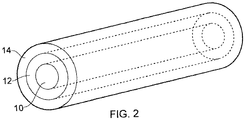
- the base layer insulator formulation was applied to a wire member 10 not having a coating thereon ( FIG. 2 ) to form a base insulator layer 12.
- the top layer insulator formulation was applied to the base insulator layer 12 to form a top insulator layer 14.
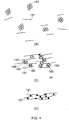
- the formulation is shown schematically in FIG. 4(a) in which inorganic filler particles 181 are seen suspended in a mixture comprising the hydrolysed and/or partially-hydrolised products 183 of the first and second organo-alkoxides and solvent.
- the formulation is applied to the wire and cured. During the curing process, condensation of the products 183 takes place to form the organic moiety-containing polysiloxane which may also be referred to as an inorganic polymer.
- the inorganic filler particles are advantageously selected to have a characteristic layered structure in order to provide improved insulation and flexibility of the coating.
- the wire is typically a nickel coated copper wire, the nickel providing a suitable substrate for the coating. Deposition directly onto copper can result in poor adhesion of the coating to the wire due to oxidation of the surface of the copper wire.
- particles of an organic-inorganic hybrid nanocomposite 185 are formed as shown in FIG. 4(b) .
- the term 'nano' refers to a size of the hybrid molecules so formed.
- the hybrid nanocomposite 185 comprises organic moiety-containing polysiloxane, where a portion of the organic moieties are in the form of organic polymer formed from the functional groups associated with the second organo-alkoxide.
- the particles of the nanocomposite 185 agglomerate to form larger agglomerates of particles 186.
- the nanocomposite particles 185 form bridges between the inorganic filler particles 181 during the curing process as described above and illustrated in FIG. 4(b) .
- the presence of the organic polymer particles 186 facilitates bonding and sliding of the platelets lending flexibility to the coating and enhancing a resistance of the coating to fracture.
- the nanocomposite 185 agglomerates to form a continuous matrix during curing, with the inorganic filler particles 181 dispersed therein.
- the wire is heated (in some embodiments this may be described as a 'firing' process) to a temperature in the range from around 150° to around 500°C and the organic polymer decomposes ('burns off').
- the organic polymer decomposes ('burns off').
- out-gassing takes place.
- at least some organic moieties from the first organo-alkoxide remain following firing, depending on a temperature to which the structure has been heated during firing. The presence of the organic moieties increases a thermal expansion coefficient of the structure such that the thermal expansion coefficient is more closely matched to that of the wire underlying the coating.
- the organic moieties may be methyl groups.
- SiO 2 187 ( FIG. 4(c) ) remains following firing, the material being arranged to form bridges between inorganic filler particles as shown in the figure.
- the use of filler particles having a layered structure lends resistance to fracture even in the absence of polymer since the particles are capable of experiencing internal deformation/sliding in order to relieve stresses to which the particles may be subjected without fracture.
- Example 1 base insulator layer formulation
- the composition is optimised such that after curing the layer has a lower polymer content than that of a layer above the base layer.
- This feature enables a reduction in the amount of shrinkage of the base layer and the amount of gas evolved during heating following curing which typically occurs to much higher temperatures in service.
- the shrinkage and gas evolution (out-gassing) otherwise inhibits effective bonding of the base layer to the wire and/or of the base layer to a layer above the base layer.
- the reduced organic content of the base layer simultaneously reduces the flexibility of the base layer.
- the thickness of the base layer should therefore be precisely controlled (typically to a within a few microns) in order to allow the requisite mechanical properties to be achieved.
- step 101B a hybrid nano-composite sol was produced by mixing an alkoxy-silane (54.4g of methyltrimethoxysilane, MTMS) with an acid catalyst (0.8g of phosphomolybdic acid) and a mixture of solvents (16g of diacetone alcohol, 8g of toluene and 14.4g of water). The components were stirred in a flask at 65°C for 5 hours.
- alkoxy-silane 54.4g of methyltrimethoxysilane, MTMS
- an acid catalyst 0.8g of phosphomolybdic acid
- solvents 16g of diacetone alcohol, 8g of toluene and 14.4g of water.
- catalysts are useful instead of or in addition to phosphomolybdic acid including but not limited to phosphoric acid, boric acid, tungstic acid, phosphotungstic acid and molybdic acid.
- the catalyst is chosen on the basis that it may be converted into an oxide upon heating to high temperature.
- the catalyst may also impart a fluxing function to assist in sealing of porosity during heat treatment.
- step 102B an inorganic filler material (11.5g of vermiculite) was mixed with an additive (0.2g of acetic acid) and 27g of a mixed solvent (42.5% diacetone alcohol, 42.5% toluene and 15% isopropanol). The resulting composition was ball milled for 24 hours to form a dielectric paste.
- the hybrid nanocomposite sol and dielectric paste were subsequently mixed (step 103B) and ball milled (step 104B) for a further 24 hours to form a base insulator formulation in the form of a sol-gel.
- step 101T a hybrid nano-composite sol was produced by mixing an alkoxy-silane (43.5g of MTMS, 18.9g of glycidyloxypropyltrimethoxysilane, GPTMS), an acid catalyst (0.8g of phosphomolybdic acid) and a mixed solvent (16g of diacetone alcohol, 8g of toluene and 14.4g of water).
- an alkoxy-silane (43.5g of MTMS, 18.9g of glycidyloxypropyltrimethoxysilane, GPTMS)
- an acid catalyst 0.8g of phosphomolybdic acid
- a mixed solvent 16g of diacetone alcohol, 8g of toluene and 14.4g of water.
- the components were stirred in a flask at 65°C for 8 hours followed by stirring at ambient temperature for 24 hours to form a hybrid nanocomposite sol.
- step 102T an inorganic filler material (16.3g of vermiculite) was mixed with an additive (0.27g of acetic acid) and 38g of a mixed solvent 38g (57% diacetone alcohol and 43% toluene). The resulting composition was ball milled for 24 hours to form a dielectric paste.
- the hybrid nanocomposite sol and dielectric paste were subsequently mixed and ball milled for a further 24 hours to form the top layer insulator formulation in the form of a sol-gel.
- a nickel-plated copper wire is subjected to a coating step in which the wire is coated with base layer insulator formulation by passing the wire through a bath of the formulation.
- the wire is subjected to the coating step using an automated reel-to-reel coating system having a drying stage and a curing stage.
- continuous lengths of insulated wires may be formed.
- the purpose of the drying stage is to remove excess solvent from the coating.
- coated wire is passed through a tunnel in the presence of a counter flow of hot air.
- the purpose of the curing stage is at least in part to drive remaining solvent residue out from the coated wire.
- the curing stage involves heating the dried coated wire to a prescribed temperature for a prescribed period of time in order to increase the mechanical strength of the coating as described above. Following the curing stage the coated wire may typically be handled and wound without damaging the coating.
- the coated wire may be used to fabricate a winding or other article, prior to being subjected to heating to a temperature of from around 350°C to around 800°C.
- the firing process removes organic components present in the coating and results in a completion of the polycondensation reaction of the precursor layer.
- firing of the wire is performed in a furnace. In some alternative embodiments firing is not performed in a furnace. Instead, removal of the organic components and/or further polycondensation may occur during service of the coated wire.
- the drying stage involves the step of flowing hot air over the coated wire at a temperature of around 60°C. Other temperatures are also useful. Other drying methods are also useful.
- the curing stage involves the step of heating the wire to a temperature of from around 220°C to around 320°C.
- the nickel-coated copper wire has a diameter of around 1.2mm and the coating step involves the formation of a base insulator coating around the wire that is around 18 microns in thickness.
- the wire is subject to the coating step more than once in order to build up a base insulator layer 12 of a required thickness.
- base insulator layer 12 Other thicknesses of base insulator layer 12 are also useful. Other diameters of the nickel-coated copper wire are also useful. Other materials are also useful for forming the wire.
- the top insulator layer 14 is formed over the base insulator layer in a similar manner.
- the two-stage drying and curing process is performed in a similar manner to that described above except that the curing stage involves the step of heating the wire to a temperature in the range from around 180°C to around 260°C. Other temperature ranges are also useful.
- the base insulator layer is around 18 microns in thickness and the top insulator layer is around 12 microns in thickness.
- a wire member having a base insulator layer and a top insulator layer as described can be bent around a mandrel such that a bend having an inner radius of 5mm or less can be formed without damaging the coating.
- Such a wire can withstand temperatures in excess of 500°C with a breakdown voltage after firing at 500°C that is greater than 1100 Volts.
- a layer of insulator provided over another layer of insulator i.e. an outer layer of the two
- another layer of insulator i.e. an inner layer of the two
- portions of the outer layer will experience a compressive or tensile stress of greater magnitude than corresponding portions of the inner layer and will therefore be subject to a greater amount of tensile or compressive deformation.
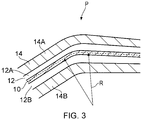
- FIG. 3 This phenomenon is illustrated in FIG. 3 .
- the conducting wire member 10 of FIG. 2 is shown having a portion P having a bend formed therein.
- Base layer 12 and top layer 14 are bent in a corresponding manner. It is to be understood that, with respect to the radius of bending R of the portion P of the conducting wire member 10.
- a radially outer region 14A of the top layer 14 is subjected to a greater amount of tensile strain than a radially outer region 12A of the base layer 12.
- a radially inner region 14B of the top layer 14 is subjected to a greater amount of compressive strain than a radially inner region 12B of the base layer 12.
- the relative amounts of a given R group associated with a given layer changes as a function of radial position of the layer.
- a larger amount of second alkoxide (bearing 2 R organic moeties) is provided in formulation used to provide an upper layer of the coating relative to the amount of first alkoxide (bearing 1 R organic moeties) use to form a lower layer of the coating.
- an increased amount of an R group of larger size relative to the amount of an R group of smaller size is provided in a given layer to increase a flexibility of that layer.
- the presence of increasing amounts of a larger R group relative to the amount of a smaller R group may be provided in a given layer, the amount increasing for successive layers from an inner layer outwards.
- the base layer 12 (example 1) is formed to have a silane having only the smallest R group (methyl group) since it is formed by mixing an alkoxy-silane being MTMS with acid catalyst and solvent.
- the top layer 13 (example 2) (or second layer) is formed to have a silane comprising an amount of a larger R group such as glycidyloxypropyl.
- the second layer has around 25 mol% of the methyl groups substituted by glycidyloxypropyl groups.
- the R groups are provided by a mixture of around 75mol% MTMS and 25mol% GPTMS.
- a third layer is provided.
- the third layer has a greater proportion of glycidyloxypropyl groups compared with the second layer.
- R groups of the third layer are formed from a mixture comprising around 40mol% GPTMS and 60mol% MTMS.
- a mixture containing even larger R groups is used.
- the mixture of R groups contains methacryloyloxypropyl.
- the mixture of R groups in the second or third layer contains around 75mol% MTMS and 25mol% methacryloyloxypropyltrimethoxysilane.
- the thickness of the base insulator layer 12 is in the range from around 2 to around 25 ⁇ m, preferably in the range from around 5 to around 15 ⁇ m.
- the thickness of a middle layer being a layer between the base layer and top layer may be formed to have a thickness in the range from around 6 to around 40 ⁇ m, preferably in the range from around 15 to around 30 ⁇ m.
- the top layer may be formed to have a thickness in the range from around 5 to around 30 ⁇ m, preferably from around 10 to around 20 ⁇ m.
- the ratio of thickness of the base layer to the middle layer to the top layer is preferably around 1:3:2. Other ratios are also useful, such as 1:2:3 or any other suitable ratio.
- the base layer coating comprises 70 wt% of nanocomposite sol made from MTMS and 30 wt% of particulate filler.
- the middle layer comprises 40 wt% of particulate filler and 60 wt% of nanocomposite sol made from 80 mol% of MTMS and 20 mol% of GPTMS.
- the top layer comprises 40 wt% of particulate filler and 60 wt% of nanocomposite sol made from 70 mol% of MTMS, 20 mol% of GPTMS and 10 mol% of methacryloyloxypropyltrimethoxysilane. It is to be understood that the relative proportions of the different constituents of the three layers may be varied in order to optimise the properties of the coatings for a given application.
- a cross-section of an electrical wire is generally circular and a diameter or radius of the wire can be readily defined.
- the cross-section is not circular and may instead be any suitable shape including generally square, oblong, elliptical or any other shape. It is to be understood that in such embodiments an average radius or diameter may be defined being an average distance of an outer surface of the wire from a centroid of the cross-section, or any other suitable reference position.
Landscapes
- Physics & Mathematics (AREA)
- Spectroscopy & Molecular Physics (AREA)
- Organic Insulating Materials (AREA)
- Insulated Conductors (AREA)
- Paints Or Removers (AREA)
Claims (16)
- Verfahren zur Herstellung eines elektrischen Leiters mit einer isolierenden Beschichtung, wobei das Verfahren die folgenden Schritte enthält:Bereitstellen eines elektrischen Leiters;Beschichten des elektrischen Leiters mit mindestens einer Schicht aus einem flexiblen isolierenden Vorläufermaterial, wobei das Vorläufermaterial umfasst:
ein erstes organisches Alkoxid 1RxSi(O1R')4-x und ein zweites organisches Alkoxid 2RxSi(O2R')4-x und ein anorganisches Füllmaterial, wobei 1R eine nicht-hydrolysierbare organische Gruppe ist, die bis zu einer Temperatur von mindestens 150°C thermisch stabil ist, 2R eine nicht-hydrolysierbare organische Gruppe, enthaltend eine Funktionsgruppe, ist, die mit einer anderen ähnlichen Funktionsgruppe reagieren kann, um ein organisches Polymer zu formen, 1R' und 2R' Alkylreste sind und x 1 oder 2 ist. - Verfahren nach Anspruch 1, wobei 1R und 2R organische Reste sind, die 1 bis 18 Kohlenstoffatome enthalten, vorzugsweise wobei 1R ausgewählt ist aus der Gruppe, bestehend aus einer Alkylgruppe, einer Fluoralkylgruppe und einer Arylgruppe, und vorzugsweise wobei 2R ausgewählt ist aus der Gruppe, bestehend aus einer Epoxygruppe, einer Trifluorpropylgruppe, einer Chlorpropylgruppe, einer Aminopropylgruppe, einer Phenylethylgruppe, einer Acryloyloxypropylgruppe, einer Methacryloyloxypropylgruppe und einer Glycidyloxypropylgruppe und/oder wobei 1R' und 2R' Alkylreste sind, die 1 bis 4 Kohlenstoffatome enthalten.
- Verfahren nach einem der vorstehenden Ansprüche 1 oder 2, wobei der Schritt des Beschichtens des elektrischen Leiters mit dem Vorläufermaterial den folgenden Schritt umfasst:
Bereitstellen einer Mischung, umfassend die ersten und zweiten organischen Alkoxide, einen Säurekatalysator und ein Lösungsmittel, Hydrolyisieren der ersten organischen Alkoxide, um eine hydrolysierte Organosilatart zu bilden, und anschließend Kontaktieren des elektrischen Leiters mit der Mischung. - Verfahren nach Anspruch 3, wobei auf den Beschichtungsschritt der Schritt des Erhitzens des Vorläufermaterials und dadurch Aushärten des Materials durch Kondensation hydrolysierter Organosilanarten folgt, um dadurch ein anorganisches Polymer zu bilden und ein organisches Polymer durch Reaktion der 2R-Gruppen zu bilden.
- Verfahren nach einem der vorstehenden Ansprüche, wobei das anorganische Füllmaterial mindestens eines ausgewählt aus Siliziumdioxid, Aluminiumoxid, Titandioxid und Zirkoniumdioxid umfasst, vorzugsweise ein Material mit einer geschichteten Struktur, wobei das Material optional eines ist, das ausgewählt ist unter Vermiculit, Glimmer und Kaolinit.
- Verfahren nach einem der vorstehenden Ansprüche, wobei die mindestens eine Schicht aus Vorläufermaterial eine Vielzahl von Komponentenschichten umfasst und vorzugsweise wobei die mindestens eine Schicht aus Vorläufermaterial eine erste Komponentenschicht, die eine innere Schicht ist, und eine zweite Komponentenschicht oberhalb der inneren Schicht umfasst.
- Verfahren nach Anspruch 6, wobei die Schicht aus Vorläufermaterial eine erste und zweite Komponentenschicht, umfassend jeweils unterschiedliche Anteile nach Gewichtsprozent des anorganischen Füllmaterials umfasst und optional wobei die erste Komponentenschicht kein anorganisches Füllmaterial umfasst und die zweite Komponentenschicht anorganisches Füllmaterial umfasst.
- Verfahren nach Anspruch 6 oder 7, wobei die erste Schicht 1R-Gruppen und im Wesentlichen keine 2R-Gruppen umfasst oder wobei die erste Schicht 1R-Gruppen und 2R-Gruppen umfasst und/oder wobei die zweite Schicht 1R-Gruppen und 2R-Gruppen umfasst.
- Verfahren nach einem der Ansprüche 6 bis 8, wobei eine weitere eine oder mehrere Schichten zusätzlich zu den ersten und zweiten Schichten bereitgestellt sind.
- Verfahren nach einem der Ansprüche 6 bis 9, wobei das Vorläufermaterial eine dritte Komponentenschicht umfasst, wobei die zweite Komponentenschicht zwischen der dritten Komponentenschicht und der ersten Komponentenschicht bereitgestellt ist, und vorzugsweise wobei ein relativer Anteil von 1R-Gruppen 2R-Gruppen in der ersten, zweiten und dritten Komponentenschicht angeordnet ist, um abhängig von einem durchschnittlichen Abstand der jeweiligen Komponentenschicht vom elektrischen Leiter zu variieren.
- Verfahren nach einem der vorstehenden Ansprüche, ferner umfassend den Schritt des Unterwerfens der Struktur einem Trocknungsprozess, wobei eine Menge von Lösungsmittel aus der Schicht entfernt wird.
- Verfahren nach einem der vorstehenden Ansprüche, umfassend den Schritt des Unterwerfens der Struktur einem Aushärtungsprozess, wobei die Struktur auf eine Temperatur im Bereich von etwa 150°C bis etwa 350°C, optional von etwa 200°C bis etwa 350°C, ferner optional von etwa 220°C bis etwa 320°C erhitzt wird.
- Verfahren nach einem der vorstehenden Ansprüche, ferner umfassend den Schritt des Brennens der Struktur auf eine Temperatur von etwa 350°C bis etwa 800°C.
- Vorläuferstruktur für einen elektrischen Leiter mit einer isolierenden Beschichtung, umfassend:einen elektrischen Leiter;mindestens eine Schicht aus einem flexiblen isolierenden Material oberhalb des elektrischen Leiters, wobei das Vorläufermaterial umfasst:
ein erstes organisches Alkoxid 1RxSi(O1R')4-x und ein zweites organisches Alkoxid 2RxSi(O2R')4-x und ein anorganisches Füllmaterial, wobei 1R eine nicht-hydrolysierbare organische Gruppe ist, die bis zu einer Temperatur von mindestens 150°C thermisch stabil ist, 2R eine nicht-hydrolysierbare organische Gruppe, enthaltend eine Funktionsgruppe, ist, die mit einer anderen ähnlichen Funktionsgruppe reagieren kann, um ein organisches Polymer zu formen, 1R' und R' Alkylreste sind und x 1 oder 2 ist. - Struktur nach Anspruch 14, wobei 1R und 2R organische Reste sind, die 1 bis 18 Kohlenstoffatome enthalten, vorzugsweise wobei 1R ausgewählt ist aus der Gruppe, bestehend aus einer Alkylgruppe, einer Fluoralkylgruppe und einer Arylgruppe, und vorzugsweise wobei 2R ausgewählt ist aus der Gruppe, bestehend aus einer Epoxygruppe, einer Trifluorpropylgruppe, einer Chlorpropylgruppe, einer Aminopropylgruppe, einer Phenylethylgruppe, einer Acryloyloxypropylgruppe, einer Methacryloyloxypropylgruppe und einer Glycidyloxypropylgruppe und/oder wobei 1R' und 2R' Alkylreste sind, die 1 bis 4 Kohlenstoffatome enthalten.
- Elektrischer Leiter mit einer isolierenden Beschichtung, wenn dieser durch Unterwerfen einer Vorläuferstruktur nach Anspruch 14 oder 15 einem thermischen Aushärten erhalten wird.
Applications Claiming Priority (2)
| Application Number | Priority Date | Filing Date | Title |
|---|---|---|---|
| GBGB0810572.8A GB0810572D0 (en) | 2008-06-10 | 2008-06-10 | Electrically insulating coating and method |
| PCT/GB2009/050656 WO2009150463A1 (en) | 2008-06-10 | 2009-06-10 | Electrically insulating coating and method of formation thereof |
Publications (2)
| Publication Number | Publication Date |
|---|---|
| EP2294583A1 EP2294583A1 (de) | 2011-03-16 |
| EP2294583B1 true EP2294583B1 (de) | 2019-01-09 |
Family
ID=39650727
Family Applications (1)
| Application Number | Title | Priority Date | Filing Date |
|---|---|---|---|
| EP09762012.4A Active EP2294583B1 (de) | 2008-06-10 | 2009-06-10 | Elektrisch isolierende beschichtung und verfahren zu ihrer herstellung |
Country Status (5)
| Country | Link |
|---|---|
| US (1) | US8476528B2 (de) |
| EP (1) | EP2294583B1 (de) |
| ES (1) | ES2707581T3 (de) |
| GB (1) | GB0810572D0 (de) |
| WO (1) | WO2009150463A1 (de) |
Families Citing this family (6)
| Publication number | Priority date | Publication date | Assignee | Title |
|---|---|---|---|---|
| GB2473002A (en) * | 2009-08-25 | 2011-03-02 | Nippon Sheet Glass Co Ltd | Reinforcement structure for rubber articles and methods of preparation |
| GB201308704D0 (en) * | 2013-05-15 | 2013-06-26 | Rolls Royce Plc | Electrical apparatus encapsulant |
| US10131802B2 (en) | 2015-11-02 | 2018-11-20 | Metashield Llc | Nanosilica based compositions, structures and apparatus incorporating same and related methods |
| KR102553437B1 (ko) * | 2018-03-12 | 2023-07-11 | 에섹스 후루카와 마그넷 와이어 재팬 가부시키가이샤 | 집합 도선, 분할 도체, 이것을 이용한 세그먼트 코일 및 모터 |
| GB201906525D0 (en) | 2019-05-09 | 2019-06-26 | Teesside Univ | Multilayer coating |
| DE102021202222A1 (de) * | 2021-03-08 | 2022-09-08 | Schott Ag | Verbundmaterial |
Family Cites Families (8)
| Publication number | Priority date | Publication date | Assignee | Title |
|---|---|---|---|---|
| DE2038760C3 (de) * | 1969-08-05 | 1974-01-10 | Sumitomo Chemical Co. Ltd., Osaka (Japan) | Verfahren zur Herstellung von Alkylenoxidhomopolymeren oder -copolymeren |
| US3802913A (en) | 1970-10-28 | 1974-04-09 | Gen Electric | Pressureless curing system for chemically cross-linking ethylene containing polymers,and product formed thereby |
| EP0021753B1 (de) * | 1979-06-20 | 1984-03-14 | Sumitomo Chemical Company, Limited | Verfahren zur Herstellung hochkristalliner Olefin-Polymerisate |
| US4471091A (en) * | 1982-08-09 | 1984-09-11 | The Lubrizol Corporation | Combinations of carboxylic acylating agents substituted with olefin polymers of high and low molecular weight mono-olefins, derivatives thereof, and fuels and lubricants containing same |
| US4675441A (en) * | 1983-09-23 | 1987-06-23 | Texaco Inc. | Preparation of N-substituted acrylamides |
| JPS6424742A (en) | 1987-07-21 | 1989-01-26 | Shinetsu Chemical Co | Silicone-mica laminated object and its manufacture |
| JPH03201311A (ja) | 1989-12-27 | 1991-09-03 | Sumitomo Electric Ind Ltd | 絶縁電線 |
| NZ336984A (en) | 1997-03-13 | 2001-05-25 | Pirelli Cavi E Sistemi Spa | Electrical cable with fire-resistant, moisture-resistant coating |
-
2008
- 2008-06-10 GB GBGB0810572.8A patent/GB0810572D0/en not_active Ceased
-
2009
- 2009-06-10 EP EP09762012.4A patent/EP2294583B1/de active Active
- 2009-06-10 WO PCT/GB2009/050656 patent/WO2009150463A1/en not_active Ceased
- 2009-06-10 ES ES09762012T patent/ES2707581T3/es active Active
- 2009-06-10 US US12/997,278 patent/US8476528B2/en active Active
Non-Patent Citations (1)
| Title |
|---|
| None * |
Also Published As
| Publication number | Publication date |
|---|---|
| GB0810572D0 (en) | 2008-07-16 |
| US8476528B2 (en) | 2013-07-02 |
| US20110147040A1 (en) | 2011-06-23 |
| EP2294583A1 (de) | 2011-03-16 |
| WO2009150463A1 (en) | 2009-12-17 |
| ES2707581T3 (es) | 2019-04-04 |
Similar Documents
| Publication | Publication Date | Title |
|---|---|---|
| EP2294583B1 (de) | Elektrisch isolierende beschichtung und verfahren zu ihrer herstellung | |
| US10510459B2 (en) | Insulated winding wire articles having conformal coatings | |
| US10487241B2 (en) | Methods of encapsulating electrical windings in an encapsulant composition | |
| CN108384479A (zh) | 高导热少胶云母带用的胶粘剂及其制备方法和少胶云母带 | |
| CN105295720A (zh) | 一种有机硅浸渍漆的制备方法 | |
| JP6139384B2 (ja) | 圧粉磁心用粉末 | |
| CN103050177B (zh) | 多层覆皮的电绝缘电线 | |
| CN115926623A (zh) | 一种耐高温绝缘漆及其制备和应用 | |
| EP2243142A1 (de) | Oberflächenmodifiziertes elektrisches isolierungssystem | |
| KR100977411B1 (ko) | 전선 피복용 폴리아미드이미드 실리카 하이브리드 재료의제조방법 및 그 재료 그리고 그 재료를 피복시킨 전선 | |
| CN108973282B (zh) | 铁路牵引电机线圈用高导热聚酰亚胺玻璃粉云母带 | |
| US11594347B2 (en) | Composition for coating insulated wire comprising heat dissipation silicone elastomer compound having light shielding layer | |
| KR102518139B1 (ko) | 고함량의 세라믹을 가지는 변성 pai 절연바니쉬가 다층 구조로 코팅된 각형 코일 및 이의 제조방법 | |
| Pang et al. | Ceramic/inorganic-organic nano-hybrid composites for thermally stable insulation of electrical wires. Part I: Composition and synthetic parameters | |
| CN108864973A (zh) | 一种耐高温阻燃的薄膜少胶云母带 | |
| CN205451802U (zh) | 单芯聚酰亚胺绝缘复合膜导电石墨粉涂覆护层电线 | |
| JP2007200986A (ja) | 電磁コイル、その製造方法および回転電機 | |
| JP2909768B2 (ja) | 耐熱絶縁電線及び耐熱絶縁電線の製造方法 | |
| JPS63237404A (ja) | コイル | |
| JP2511190B2 (ja) | 耐熱絶縁線輪の製造方法 | |
| WO2020225572A1 (en) | Multilayer coating | |
| JPH0393107A (ja) | 耐熱性絶縁電線およびその製造方法 | |
| CN105255110A (zh) | 一种用于电缆的耐高温、抗老化绝缘基层 | |
| CN121768776A (zh) | 一种用于电机绕组的复合散热绝缘层及其制备方法与应用 | |
| JP2008091034A (ja) | 高耐熱導線及び高耐熱電磁機器 |
Legal Events
| Date | Code | Title | Description |
|---|---|---|---|
| PUAI | Public reference made under article 153(3) epc to a published international application that has entered the european phase |
Free format text: ORIGINAL CODE: 0009012 |
|
| 17P | Request for examination filed |
Effective date: 20110110 |
|
| AK | Designated contracting states |
Kind code of ref document: A1 Designated state(s): AT BE BG CH CY CZ DE DK EE ES FI FR GB GR HR HU IE IS IT LI LT LU LV MC MK MT NL NO PL PT RO SE SI SK TR |
|
| AX | Request for extension of the european patent |
Extension state: AL BA RS |
|
| DAX | Request for extension of the european patent (deleted) | ||
| RAP1 | Party data changed (applicant data changed or rights of an application transferred) |
Owner name: TEESSIDE UNIVERSITY |
|
| RAP1 | Party data changed (applicant data changed or rights of an application transferred) |
Owner name: TEESSIDE UNIVERSITY |
|
| STAA | Information on the status of an ep patent application or granted ep patent |
Free format text: STATUS: EXAMINATION IS IN PROGRESS |
|
| 17Q | First examination report despatched |
Effective date: 20170119 |
|
| GRAP | Despatch of communication of intention to grant a patent |
Free format text: ORIGINAL CODE: EPIDOSNIGR1 |
|
| STAA | Information on the status of an ep patent application or granted ep patent |
Free format text: STATUS: GRANT OF PATENT IS INTENDED |
|
| INTG | Intention to grant announced |
Effective date: 20180328 |
|
| GRAJ | Information related to disapproval of communication of intention to grant by the applicant or resumption of examination proceedings by the epo deleted |
Free format text: ORIGINAL CODE: EPIDOSDIGR1 |
|
| STAA | Information on the status of an ep patent application or granted ep patent |
Free format text: STATUS: EXAMINATION IS IN PROGRESS |
|
| GRAP | Despatch of communication of intention to grant a patent |
Free format text: ORIGINAL CODE: EPIDOSNIGR1 |
|
| STAA | Information on the status of an ep patent application or granted ep patent |
Free format text: STATUS: GRANT OF PATENT IS INTENDED |
|
| INTC | Intention to grant announced (deleted) | ||
| INTG | Intention to grant announced |
Effective date: 20180816 |
|
| GRAS | Grant fee paid |
Free format text: ORIGINAL CODE: EPIDOSNIGR3 |
|
| GRAJ | Information related to disapproval of communication of intention to grant by the applicant or resumption of examination proceedings by the epo deleted |
Free format text: ORIGINAL CODE: EPIDOSDIGR1 |
|
| GRAL | Information related to payment of fee for publishing/printing deleted |
Free format text: ORIGINAL CODE: EPIDOSDIGR3 |
|
| STAA | Information on the status of an ep patent application or granted ep patent |
Free format text: STATUS: EXAMINATION IS IN PROGRESS |
|
| GRAR | Information related to intention to grant a patent recorded |
Free format text: ORIGINAL CODE: EPIDOSNIGR71 |
|
| STAA | Information on the status of an ep patent application or granted ep patent |
Free format text: STATUS: GRANT OF PATENT IS INTENDED |
|
| GRAA | (expected) grant |
Free format text: ORIGINAL CODE: 0009210 |
|
| STAA | Information on the status of an ep patent application or granted ep patent |
Free format text: STATUS: THE PATENT HAS BEEN GRANTED |
|
| AK | Designated contracting states |
Kind code of ref document: B1 Designated state(s): AT BE BG CH CY CZ DE DK EE ES FI FR GB GR HR HU IE IS IT LI LT LU LV MC MK MT NL NO PL PT RO SE SI SK TR |
|
| INTG | Intention to grant announced |
Effective date: 20181205 |
|
| REG | Reference to a national code |
Ref country code: GB Ref legal event code: FG4D |
|
| REG | Reference to a national code |
Ref country code: CH Ref legal event code: EP Ref country code: AT Ref legal event code: REF Ref document number: 1088327 Country of ref document: AT Kind code of ref document: T Effective date: 20190115 |
|
| REG | Reference to a national code |
Ref country code: DE Ref legal event code: R096 Ref document number: 602009056638 Country of ref document: DE |
|
| REG | Reference to a national code |
Ref country code: IE Ref legal event code: FG4D |
|
| REG | Reference to a national code |
Ref country code: CH Ref legal event code: NV Representative=s name: TR-IP CONSULTING LLC, CH |
|
| REG | Reference to a national code |
Ref country code: NL Ref legal event code: FP |
|
| REG | Reference to a national code |
Ref country code: ES Ref legal event code: FG2A Ref document number: 2707581 Country of ref document: ES Kind code of ref document: T3 Effective date: 20190404 |
|
| REG | Reference to a national code |
Ref country code: NO Ref legal event code: T2 Effective date: 20190109 |
|
| REG | Reference to a national code |
Ref country code: LT Ref legal event code: MG4D |
|
| REG | Reference to a national code |
Ref country code: AT Ref legal event code: MK05 Ref document number: 1088327 Country of ref document: AT Kind code of ref document: T Effective date: 20190109 |
|
| PG25 | Lapsed in a contracting state [announced via postgrant information from national office to epo] |
Ref country code: FI Free format text: LAPSE BECAUSE OF FAILURE TO SUBMIT A TRANSLATION OF THE DESCRIPTION OR TO PAY THE FEE WITHIN THE PRESCRIBED TIME-LIMIT Effective date: 20190109 Ref country code: SE Free format text: LAPSE BECAUSE OF FAILURE TO SUBMIT A TRANSLATION OF THE DESCRIPTION OR TO PAY THE FEE WITHIN THE PRESCRIBED TIME-LIMIT Effective date: 20190109 Ref country code: PT Free format text: LAPSE BECAUSE OF FAILURE TO SUBMIT A TRANSLATION OF THE DESCRIPTION OR TO PAY THE FEE WITHIN THE PRESCRIBED TIME-LIMIT Effective date: 20190509 Ref country code: PL Free format text: LAPSE BECAUSE OF FAILURE TO SUBMIT A TRANSLATION OF THE DESCRIPTION OR TO PAY THE FEE WITHIN THE PRESCRIBED TIME-LIMIT Effective date: 20190109 Ref country code: LT Free format text: LAPSE BECAUSE OF FAILURE TO SUBMIT A TRANSLATION OF THE DESCRIPTION OR TO PAY THE FEE WITHIN THE PRESCRIBED TIME-LIMIT Effective date: 20190109 |
|
| PG25 | Lapsed in a contracting state [announced via postgrant information from national office to epo] |
Ref country code: HR Free format text: LAPSE BECAUSE OF FAILURE TO SUBMIT A TRANSLATION OF THE DESCRIPTION OR TO PAY THE FEE WITHIN THE PRESCRIBED TIME-LIMIT Effective date: 20190109 Ref country code: LV Free format text: LAPSE BECAUSE OF FAILURE TO SUBMIT A TRANSLATION OF THE DESCRIPTION OR TO PAY THE FEE WITHIN THE PRESCRIBED TIME-LIMIT Effective date: 20190109 Ref country code: IS Free format text: LAPSE BECAUSE OF FAILURE TO SUBMIT A TRANSLATION OF THE DESCRIPTION OR TO PAY THE FEE WITHIN THE PRESCRIBED TIME-LIMIT Effective date: 20190509 Ref country code: GR Free format text: LAPSE BECAUSE OF FAILURE TO SUBMIT A TRANSLATION OF THE DESCRIPTION OR TO PAY THE FEE WITHIN THE PRESCRIBED TIME-LIMIT Effective date: 20190410 Ref country code: BG Free format text: LAPSE BECAUSE OF FAILURE TO SUBMIT A TRANSLATION OF THE DESCRIPTION OR TO PAY THE FEE WITHIN THE PRESCRIBED TIME-LIMIT Effective date: 20190409 |
|
| REG | Reference to a national code |
Ref country code: DE Ref legal event code: R097 Ref document number: 602009056638 Country of ref document: DE |
|
| PG25 | Lapsed in a contracting state [announced via postgrant information from national office to epo] |
Ref country code: EE Free format text: LAPSE BECAUSE OF FAILURE TO SUBMIT A TRANSLATION OF THE DESCRIPTION OR TO PAY THE FEE WITHIN THE PRESCRIBED TIME-LIMIT Effective date: 20190109 Ref country code: DK Free format text: LAPSE BECAUSE OF FAILURE TO SUBMIT A TRANSLATION OF THE DESCRIPTION OR TO PAY THE FEE WITHIN THE PRESCRIBED TIME-LIMIT Effective date: 20190109 Ref country code: AT Free format text: LAPSE BECAUSE OF FAILURE TO SUBMIT A TRANSLATION OF THE DESCRIPTION OR TO PAY THE FEE WITHIN THE PRESCRIBED TIME-LIMIT Effective date: 20190109 Ref country code: RO Free format text: LAPSE BECAUSE OF FAILURE TO SUBMIT A TRANSLATION OF THE DESCRIPTION OR TO PAY THE FEE WITHIN THE PRESCRIBED TIME-LIMIT Effective date: 20190109 Ref country code: CZ Free format text: LAPSE BECAUSE OF FAILURE TO SUBMIT A TRANSLATION OF THE DESCRIPTION OR TO PAY THE FEE WITHIN THE PRESCRIBED TIME-LIMIT Effective date: 20190109 Ref country code: SK Free format text: LAPSE BECAUSE OF FAILURE TO SUBMIT A TRANSLATION OF THE DESCRIPTION OR TO PAY THE FEE WITHIN THE PRESCRIBED TIME-LIMIT Effective date: 20190109 |
|
| PLBE | No opposition filed within time limit |
Free format text: ORIGINAL CODE: 0009261 |
|
| STAA | Information on the status of an ep patent application or granted ep patent |
Free format text: STATUS: NO OPPOSITION FILED WITHIN TIME LIMIT |
|
| 26N | No opposition filed |
Effective date: 20191010 |
|
| PG25 | Lapsed in a contracting state [announced via postgrant information from national office to epo] |
Ref country code: MC Free format text: LAPSE BECAUSE OF FAILURE TO SUBMIT A TRANSLATION OF THE DESCRIPTION OR TO PAY THE FEE WITHIN THE PRESCRIBED TIME-LIMIT Effective date: 20190109 |
|
| REG | Reference to a national code |
Ref country code: CH Ref legal event code: PCAR Free format text: NEW ADDRESS: ROUTE DU COUTSET 18, 1485 NUVILLY (CH) |
|
| PG25 | Lapsed in a contracting state [announced via postgrant information from national office to epo] |
Ref country code: SI Free format text: LAPSE BECAUSE OF FAILURE TO SUBMIT A TRANSLATION OF THE DESCRIPTION OR TO PAY THE FEE WITHIN THE PRESCRIBED TIME-LIMIT Effective date: 20190109 |
|
| REG | Reference to a national code |
Ref country code: BE Ref legal event code: MM Effective date: 20190630 |
|
| PG25 | Lapsed in a contracting state [announced via postgrant information from national office to epo] |
Ref country code: TR Free format text: LAPSE BECAUSE OF FAILURE TO SUBMIT A TRANSLATION OF THE DESCRIPTION OR TO PAY THE FEE WITHIN THE PRESCRIBED TIME-LIMIT Effective date: 20190109 |
|
| PG25 | Lapsed in a contracting state [announced via postgrant information from national office to epo] |
Ref country code: LU Free format text: LAPSE BECAUSE OF NON-PAYMENT OF DUE FEES Effective date: 20190610 Ref country code: BE Free format text: LAPSE BECAUSE OF NON-PAYMENT OF DUE FEES Effective date: 20190630 |
|
| PGFP | Annual fee paid to national office [announced via postgrant information from national office to epo] |
Ref country code: IE Payment date: 20200616 Year of fee payment: 12 |
|
| PGFP | Annual fee paid to national office [announced via postgrant information from national office to epo] |
Ref country code: NL Payment date: 20200612 Year of fee payment: 12 |
|
| PG25 | Lapsed in a contracting state [announced via postgrant information from national office to epo] |
Ref country code: CY Free format text: LAPSE BECAUSE OF FAILURE TO SUBMIT A TRANSLATION OF THE DESCRIPTION OR TO PAY THE FEE WITHIN THE PRESCRIBED TIME-LIMIT Effective date: 20190109 |
|
| PG25 | Lapsed in a contracting state [announced via postgrant information from national office to epo] |
Ref country code: MT Free format text: LAPSE BECAUSE OF FAILURE TO SUBMIT A TRANSLATION OF THE DESCRIPTION OR TO PAY THE FEE WITHIN THE PRESCRIBED TIME-LIMIT Effective date: 20190109 Ref country code: HU Free format text: LAPSE BECAUSE OF FAILURE TO SUBMIT A TRANSLATION OF THE DESCRIPTION OR TO PAY THE FEE WITHIN THE PRESCRIBED TIME-LIMIT; INVALID AB INITIO Effective date: 20090610 |
|
| PGFP | Annual fee paid to national office [announced via postgrant information from national office to epo] |
Ref country code: NO Payment date: 20210621 Year of fee payment: 13 Ref country code: IT Payment date: 20210607 Year of fee payment: 13 Ref country code: DE Payment date: 20210618 Year of fee payment: 13 Ref country code: FR Payment date: 20210608 Year of fee payment: 13 |
|
| PGFP | Annual fee paid to national office [announced via postgrant information from national office to epo] |
Ref country code: CH Payment date: 20210702 Year of fee payment: 13 Ref country code: ES Payment date: 20210712 Year of fee payment: 13 |
|
| REG | Reference to a national code |
Ref country code: NL Ref legal event code: MM Effective date: 20210701 |
|
| PG25 | Lapsed in a contracting state [announced via postgrant information from national office to epo] |
Ref country code: IE Free format text: LAPSE BECAUSE OF NON-PAYMENT OF DUE FEES Effective date: 20210610 |
|
| PG25 | Lapsed in a contracting state [announced via postgrant information from national office to epo] |
Ref country code: NL Free format text: LAPSE BECAUSE OF NON-PAYMENT OF DUE FEES Effective date: 20210701 |
|
| PG25 | Lapsed in a contracting state [announced via postgrant information from national office to epo] |
Ref country code: MK Free format text: LAPSE BECAUSE OF FAILURE TO SUBMIT A TRANSLATION OF THE DESCRIPTION OR TO PAY THE FEE WITHIN THE PRESCRIBED TIME-LIMIT Effective date: 20190109 |
|
| REG | Reference to a national code |
Ref country code: DE Ref legal event code: R119 Ref document number: 602009056638 Country of ref document: DE |
|
| REG | Reference to a national code |
Ref country code: NO Ref legal event code: MMEP |
|
| REG | Reference to a national code |
Ref country code: CH Ref legal event code: PL |
|
| PG25 | Lapsed in a contracting state [announced via postgrant information from national office to epo] |
Ref country code: NO Free format text: LAPSE BECAUSE OF NON-PAYMENT OF DUE FEES Effective date: 20220630 Ref country code: LI Free format text: LAPSE BECAUSE OF NON-PAYMENT OF DUE FEES Effective date: 20220630 Ref country code: FR Free format text: LAPSE BECAUSE OF NON-PAYMENT OF DUE FEES Effective date: 20220630 Ref country code: CH Free format text: LAPSE BECAUSE OF NON-PAYMENT OF DUE FEES Effective date: 20220630 |
|
| PG25 | Lapsed in a contracting state [announced via postgrant information from national office to epo] |
Ref country code: DE Free format text: LAPSE BECAUSE OF NON-PAYMENT OF DUE FEES Effective date: 20230103 |
|
| REG | Reference to a national code |
Ref country code: ES Ref legal event code: FD2A Effective date: 20230728 |
|
| PG25 | Lapsed in a contracting state [announced via postgrant information from national office to epo] |
Ref country code: IT Free format text: LAPSE BECAUSE OF NON-PAYMENT OF DUE FEES Effective date: 20220610 |
|
| PG25 | Lapsed in a contracting state [announced via postgrant information from national office to epo] |
Ref country code: ES Free format text: LAPSE BECAUSE OF NON-PAYMENT OF DUE FEES Effective date: 20220611 |
|
| PGFP | Annual fee paid to national office [announced via postgrant information from national office to epo] |
Ref country code: GB Payment date: 20250528 Year of fee payment: 17 |