EP2294735B1 - Selbstpositionierende zugangspunkte - Google Patents
Selbstpositionierende zugangspunkte Download PDFInfo
- Publication number
- EP2294735B1 EP2294735B1 EP09767673.8A EP09767673A EP2294735B1 EP 2294735 B1 EP2294735 B1 EP 2294735B1 EP 09767673 A EP09767673 A EP 09767673A EP 2294735 B1 EP2294735 B1 EP 2294735B1
- Authority
- EP
- European Patent Office
- Prior art keywords
- timing signals
- access point
- network
- closed
- filtering
- Prior art date
- Legal status (The legal status is an assumption and is not a legal conclusion. Google has not performed a legal analysis and makes no representation as to the accuracy of the status listed.)
- Not-in-force
Links
- 238000000034 method Methods 0.000 claims description 36
- 238000001914 filtration Methods 0.000 claims description 23
- 230000001360 synchronised effect Effects 0.000 claims description 6
- 238000004590 computer program Methods 0.000 claims description 5
- 238000004891 communication Methods 0.000 description 29
- 238000005259 measurement Methods 0.000 description 9
- 230000015654 memory Effects 0.000 description 6
- 230000006870 function Effects 0.000 description 5
- 238000012545 processing Methods 0.000 description 5
- 238000010586 diagram Methods 0.000 description 4
- 238000005516 engineering process Methods 0.000 description 4
- 238000004458 analytical method Methods 0.000 description 3
- 239000013078 crystal Substances 0.000 description 3
- 239000011159 matrix material Substances 0.000 description 3
- 238000010295 mobile communication Methods 0.000 description 3
- 230000001413 cellular effect Effects 0.000 description 2
- 230000000694 effects Effects 0.000 description 2
- 239000000835 fiber Substances 0.000 description 2
- 230000007246 mechanism Effects 0.000 description 2
- 230000003287 optical effect Effects 0.000 description 2
- 230000007704 transition Effects 0.000 description 2
- 230000003044 adaptive effect Effects 0.000 description 1
- 238000013459 approach Methods 0.000 description 1
- 238000003491 array Methods 0.000 description 1
- 230000008901 benefit Effects 0.000 description 1
- 230000008859 change Effects 0.000 description 1
- 230000001010 compromised effect Effects 0.000 description 1
- 230000001419 dependent effect Effects 0.000 description 1
- 230000009977 dual effect Effects 0.000 description 1
- 230000007774 longterm Effects 0.000 description 1
- 238000011089 mechanical engineering Methods 0.000 description 1
- 238000012986 modification Methods 0.000 description 1
- 230000004048 modification Effects 0.000 description 1
- 230000008569 process Effects 0.000 description 1
- 238000011084 recovery Methods 0.000 description 1
- 230000008054 signal transmission Effects 0.000 description 1
- 238000012358 sourcing Methods 0.000 description 1
- 239000013589 supplement Substances 0.000 description 1
- 238000012546 transfer Methods 0.000 description 1
Images


Classifications
-
- H—ELECTRICITY
- H04—ELECTRIC COMMUNICATION TECHNIQUE
- H04J—MULTIPLEX COMMUNICATION
- H04J3/00—Time-division multiplex systems
- H04J3/02—Details
- H04J3/06—Synchronising arrangements
- H04J3/0635—Clock or time synchronisation in a network
- H04J3/0638—Clock or time synchronisation among nodes; Internode synchronisation
-
- H—ELECTRICITY
- H04—ELECTRIC COMMUNICATION TECHNIQUE
- H04W—WIRELESS COMMUNICATION NETWORKS
- H04W88/00—Devices specially adapted for wireless communication networks, e.g. terminals, base stations or access point devices
- H04W88/08—Access point devices
-
- H—ELECTRICITY
- H04—ELECTRIC COMMUNICATION TECHNIQUE
- H04J—MULTIPLEX COMMUNICATION
- H04J3/00—Time-division multiplex systems
- H04J3/02—Details
- H04J3/06—Synchronising arrangements
- H04J3/0635—Clock or time synchronisation in a network
- H04J3/0638—Clock or time synchronisation among nodes; Internode synchronisation
- H04J3/0658—Clock or time synchronisation among packet nodes
- H04J3/0661—Clock or time synchronisation among packet nodes using timestamps
- H04J3/0667—Bidirectional timestamps, e.g. NTP or PTP for compensation of clock drift and for compensation of propagation delays
-
- H—ELECTRICITY
- H04—ELECTRIC COMMUNICATION TECHNIQUE
- H04W—WIRELESS COMMUNICATION NETWORKS
- H04W56/00—Synchronisation arrangements
-
- H—ELECTRICITY
- H04—ELECTRIC COMMUNICATION TECHNIQUE
- H04W—WIRELESS COMMUNICATION NETWORKS
- H04W64/00—Locating users or terminals or network equipment for network management purposes, e.g. mobility management
-
- H—ELECTRICITY
- H04—ELECTRIC COMMUNICATION TECHNIQUE
- H04J—MULTIPLEX COMMUNICATION
- H04J3/00—Time-division multiplex systems
- H04J3/02—Details
- H04J3/06—Synchronising arrangements
- H04J3/0635—Clock or time synchronisation in a network
- H04J3/0638—Clock or time synchronisation among nodes; Internode synchronisation
- H04J3/0644—External master-clock
-
- H—ELECTRICITY
- H04—ELECTRIC COMMUNICATION TECHNIQUE
- H04W—WIRELESS COMMUNICATION NETWORKS
- H04W88/00—Devices specially adapted for wireless communication networks, e.g. terminals, base stations or access point devices
- H04W88/02—Terminal devices
Definitions
- a mobile communication device (hereinafter referred to as a mobile station) is sometimes compromised by the inability to establish a good communication link with a base transceiver station (BTS).
- BTS base transceiver station
- Failure to obtain a good communications link deprives the mobile station user of many of the services available through the mobile station such as the ability to determine the geographic position of the mobile station, etc.
- Mobile phones have had the capability of using alternate communication methods in the past such as those allowing the use of the Advanced Mobile Phone Service (AMPS), an analog system, when a digital communication system is unavailable within a geographic area.
- AMPS Advanced Mobile Phone Service
- AMPS Advanced Mobile Phone Service
- Wireless Local Area Networks enable users of wireless devices to wirelessly connect to an access point (e.g., hotspot) which often acts as a bridge connecting a wireless network to the Internet through a Wide Area Network (WAN) provided by an Internet Service Provider (ISP).
- Wi-Fi networks typically use one or more crystal oscillator reference clocks which may, for instance, clock data exchanged between an ISP's WAN and a WLAN device connected wirelessly to an access point.
- the reference clock at the access point typically employs a voltage controlled oscillator using a crystal clock. Low phase noise and frequency stability provided by the reference clock is necessary to ensure wireless communication between client devices and the access point. Nevertheless, reference clocks will drift which affects the proper synchronization of WLAN devices.
- a mobile station refers to a device such as a cellular or other wireless communication device, personal communication system (PCS) device, personal navigation device, laptop or other suitable mobile device capable of receiving and processing SPS signals.
- SPS Satellite Positioning System
- PCS personal communication system
- mobile station is also intended to include devices which communicate with a personal navigation device (PND), such as by short-range wireless, infrared, wireline connection, or other connection - regardless of whether satellite signal reception, assistance data reception, and/or position-related processing occurs at the device or at the PND.
- PND personal navigation device
- mobile station is intended to include all devices, including wireless communication devices, computers, laptops, etc. which are capable of communication with a server, such as via the Internet, WiFi, or other network, and regardless of whether satellite signal reception, assistance data reception, and/or position-related processing occurs at the device, at a server, or at another device associated with the network. Any operable combination of the above are also considered a “mobile station.”
- Fingerprinting provides one approach to determining the position of a mobile station. Radio frequency signal characteristics associated with various regions in a signal transmission area are collected in a database. Each grouping of signal characteristics for a region is known as a fingerprint. Typically, the position of a mobile station is determined by comparing a RF data sample collected by the mobile station to fingerprint data in the database. The mobile station's position is determined to lie in the area corresponding to a fingerprint data point of highest correlation to the RF data sample.
- Received signal strength intensity has been used in connection with network planning and fingerprinting. Radio network sample points are collected from different site locations. Each sample point contains RSSI data together with related map coordinates which are stored in a database for position tracking of persons, assets, equipment, etc. within a Wi-Fi network (IEEE 802.11 a/b/g), WiMAX network (IEEE 802.16), etc.
- Wi-Fi network IEEE 802.11 a/b/g
- WiMAX network IEEE 802.11 a/b/g
- These networks may use a program running on a server that calculates position determinations and interacts with a client device (i.e., laptop computer, personal digital assistant (PDA), Wi-Fi Tag, etc.) in connection with an application program for recording field data (e.g., RSSI data).
- the position determination data returned may include the speed, heading, building floor and grid location of a client device.
- a mobile phone's location may be determined using RSSI measurements for trilateration made in connection with data measured from several access points.
- WLAN base stations also known as Access Points for IEEE 802.11 networks
- Access Points for IEEE 802.11 networks
- An important consideration centers on accurate timing information and synchronization in connection with the receipt of packet information in a packet network.
- the master unit computes the time-differences-of-arrival (TDOA) between multiple receivers and computes differences between the measured TDOAs and theoretical TDOAs computed in conformity with the predetermined position of each location receiver.;
- the deviations between theoretical and measured TDOAs are collected in a statistical sample set and Kalman filters are used to produce a model of location receiver timebase offset and drift over multiple received beacon signals.
- WO 03/058863 A describes a method and apparatus for providing accurately synchronised timing signals at mutually distant locations employs a GPS or similar receiver at each location. These receivers are interconnected by a communications network, and exchange data over network to agree a common timing reference.
- WO 20078/051123 A describes methods and mechanisms for adaptive clock recovery of a service clock (fs) of a constant bit rate, CBR, service transmitted as a stream of data packets (P(i)) over a packet network from a sending end node (S) to a receiving end node (R), via at least one intermediate node (T).
- fs service clock
- CBR constant bit rate
- a secondary communication link using a Wi-Fi (e.g., IEEE 802.11) or Bluetooth connection to WLAN or Personal Area Network (PAN) base station may be relied upon for connection to the Internet using an Internet protocol (IP).
- IP Internet protocol
- WiFi and 802.11 are considered and used interchangeably.
- Mobile stations having dual digital and AMPS capability have been contemplated and would benefit from the disclosure herein.
- one method for maintaining proper clock timing involves synchronizing the clock with a reliable outside time source.
- DSL Digital Subscriber Line
- Accurate timing synchronization for the access point clock may be derived from timing information received through the access point from the ISP's WAN which may be connected to a server implementing the Network Time Protocol (NTP).
- NTP uses Marzullo's algorithm with the Coordinated Universal Time (UTC) time scale, including support for features such as leap seconds.
- UTC Coordinated Universal Time
- NTP version 4 (NTPv4) has been shown to maintain time to within 10 milliseconds over the Internet. Further, NTP can achieve accuracies to within 200 microseconds or better in some instances running on a local area network.
- NTP is implemented using a hierarchical system of clock strata. The stratum levels define the distance in the hierarchical scheme from the reference clock and the associated accuracy. Timing drift at stratum 1 devices may be less than that at other strata. Nevertheless, drift will result when sourcing timing information from various clock stratum levels.
- synchronization of the access point clock oscillator may occur with the accurate time provided over the Internet.
- clock error such as those disclosed by E. Filho, H. Kuga and R. Lopes. 2003 in Real Time Estimation of GPS Receiver Clock Offset by the Kalman Filter, Proceedings of COBEM 2003, 17th International Congress of Mechanical Engineering , which is hereby incorporated by reference.
- a recursive filter such as a Kalman filter may be used to synchronize a clock. Therefore such a filter may be used to synchronize an access point clock with the NTP time provided through the Internet.
- the Kalman filter may present a real time state estimation problem as a set of mathematical equations for which a recursive solution is available. Consequently, the Kalman filter is a recursive estimator which estimates the current state from the previous time step and current measurements. It uses a predict phase and an update phase. The predict phase uses the state estimate from the previous time step to produce an estimate of the state at the current time step. In the update phase, measurement information at the current time step is used to refine this prediction to arrive at a new state estimate which is intended to have greater accuracy, again for the current time step.
- H k is a m x n observation matrix for each time step k, that provides a state transition model for the previous state x k -1 . Consequently, it maps the true state space into the observed space.
- v k is the observation white noise which is assumed to have a Gaussian distribution with zero mean and covariance matrix R k (t).
- F being a state transition model applied to the previous state.
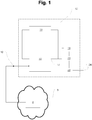
- a time signal from a NTP server 4 is transmitted through an ISP's WAN 6 using the Internet.
- Input 10 of access point 12 which receives the time signal and inputs it to filter section 14 which determines the predicted state of the time signal.
- Filter sections 14 and 16 collectively form a Kalman Filter.
- Filter section 16 determines the update equations state for feedback of the measurement residual to filter section 14 . This process continues, resulting in what is intended to be successively better clock pulse predictions for synchronization of the access point's internal frequency source 18 (e.g., a crystal oscillator) with the clocking signals received through the Internet.
- the access point's internal frequency source 18 e.g., a crystal oscillator
- the access point frequency source 18 (or clock) may be self-positioning. From time to time, the filter output at 17 from filter section 14 , with contribution from feedback through filter section 16 , is used to calibrate, using processor 22 , and internal frequency source 18 which clocks signals through transceiver 20. This calibration may occur continuously.
- processor 22 may represent a hardware device.
- An effective NTP time source may be effectively provided at a WLAN access point, thereby enabling proper mobile station functionality especially in instances where a connection with a primary network is not possible and where a WI-Fi network is relied upon for communications involving devices connecting to access point 12 through antenna 24 .
- FIG. 2 is a flowchart illustrating the operation of the recursive filter in the calibration of the access point clock and the synchronization of the access point time signals with the NTP time signals received over the Internet.
- the received network time signal is closed-loop filtered until the difference between filter output and input becomes zero.
- the access point clock is calibrated based on this information. This methodology continues as newly received network time signals are input to the filter
- CDMA Code Division Multiple Access
- WCDMA Wideband Code Division Multiple Access
- TDMA Time Division Multiple Access
- GSM Global System for Mobile Communications
- AMPS Frequency Division Multiple Access
- This functionality may be greatly enhanced with the foregoing synchronization scheme which also allows an enhanced knowledge of the access point clock's absolute time and timing drift. For instance, position determination of and navigation with a mobile station may be greatly facilitated through synchronization and knowledge of absolute timing acquired through use of the foregoing Kalman filtering scheme using several methods.
- the mobile station's location position may be approximated as that of the access point.
- the mobile station's position may be determined using time of arrival, RSSI, etc. methods.
- the mobile station's position may be determined using the afore-mentioned methods including instances where the access point is itself mobile and not fixed.
- mobile station position determination and mobile navigation requests may be handled in connection with directing navigation related requests to a website wherein a program may make navigation and position determinations based upon data collected through an Internet or an intranet connection to the access point.
- Entry through an access point may only be provided to selected users. For instance, subscribers to a given phone service, e.g., Verizon®, Sprint®, etc. may be the only ones allowed to connect to a WAN through an access point. Since the 802.11 network may take the mobile station off-line from the conventional billing mechanism, billing for services in connection with the 802.11 network may occur using a variety of methods based on ad hoc service requests, monthly rates for a package of services, etc. Alternatively, a connection through an access point may be made to a virtual private network based on various criteria.
- a connection through an access point may be made to a virtual private network based on various criteria.
- Voice and other data communications may be conducted using the Wi-Fi connection to an access point using the Internet, as further facilitated by the foregoing Kalman filtering scheme. Additionally, a handoff scheme may be used to switch a call in service to a primary communication network once wireless communications with that network become available.
- position determination for a mobile station may occur based on time of arrival (TOA) ranging wherein measurement occurs of the arrival time, at the mobile station receiver, of a known signal that has been transmitted at a known time from an access point.
- TOA time of arrival
- the difference between the arrival time and the transmitted time, i.e. the propagation time, of the known signal is multiplied by the speed of light in order to obtain the signal propagation distance between the signal emitter and the mobile station receiver, i.e., the emitter-to receiver range.
- the position of the mobile station may be determined in connection with measuring the propagation time of signals broadcast from multiple signal emitters at access points at known locations.
- the signal propagation distance between each signal emitter and the mobile station receiver is commonly referred to as a pseudo range.
- Three such pseudo ranges provide three unknown position coordinates that may be determined in three simultaneous equations, thereby allowing the mobile station's position to be determined by well-known methods using trilateration.
- a number of features executed by a mobile station with an active link to a BTS may be carried out by a mobile station connected to an 802.11 network such as Voice-Over Internet Protocol (VOIP) with many of its attendant features.
- VOIP Voice-Over Internet Protocol
- a processor within mobile station 15 will cause mobile station 15 to change it's functionality from operation through a primary network involving a BTS to a secondary network using Wi-Fi in the event that connectivity to the primary network is unavailable.
- this processor may shift mobile station 15 back to functionality through the primary network upon the establishment of a suitable communication link between mobile station 15 and the primary network.
- mobile station position determination and navigation service may be offered through the mobile station in connection with the foregoing.
- the position of the mobile station may be assumed to be the same as that of the known fixed position of the access point to which it is connected, should the mobile station receive signals from more than one access point, the location of the access point having the greatest received signal strength link with the mobile station may be used as indicating the position of the mobile station. Furthermore, knowledge of the transmit power can be sued to ascertain the distance traveled therefore placing the mobile station on the circle around the location of the access point with the radius equal to the distance traveled.
- the position of the mobile station is determined in connection with signal analysis in relation to a plurality of access points using well known position determination techniques, e.g. trilateration and/or triangulation.
- Position determination and navigation requests may require analysis utilizing resources outside of the mobile station. Consequently, should a position or navigation request be made from a mobile station not in contact with its primary network, the request may be handled through an access point using the Internet, the Internet including a Virtual Private Network (VPN), an Intranet or ATM through which an access point provides a connection. For instance, relevant signal data from the mobile station may be forwarded to an Internet Protocol (IP) address.
- IP Internet Protocol
- FIG. 3 illustrates a diagram of a system employing a website for mobile station position determination and navigation.
- relevant signal data e.g. RSSI, TOA information, etc.
- the designated IP address may be that of server 36 which may be dedicated to handling position determination or navigation requests (i.e. step-by-step directions for traveling between a designated destination and a determined location or position).
- Server 36 may respond to position determination or navigation requests back through secondary network 30 through an access point 12 and/or it may respond through primary network 32 using a BTS 42 in event that mobile station 15 reestablishes contact with primary network 32 .
- communication center 48 may enable satellite communications through satellite 50 to supplement communications involving secondary network 30 and primary network 32 .
- server 36 may handle aspects of mobile station feature requests and billing for service provided to mobile station 15 .
- Position and navigation determinations may be made in connection with using RSSI, fingerprinting, trilateration, triangulation, etc. with the analysis of signals received at the mobile station or from the mobile station being performed at server 36 through the forwarding of data to an access point 12 .
- Position determination techniques described herein may be used for various wireless communication networks such as a wireless wide area network (WWAN), a wireless local area network (WLAN), a wireless personal area network (WPAN), and so on.
- WWAN wireless wide area network
- WLAN wireless local area network
- WPAN wireless personal area network
- network and “system” are often used interchangeably.
- a WWAN may be a Code Division Multiple Access (CDMA) network, a Time Division Multiple Access (TDMA) network, a Frequency Division Multiple Access (FDMA) network, an Orthogonal Frequency Division Multiple Access (OFDMA) network, a Single-Carrier Frequency Division Multiple Access (SC-FDMA) network, and so on.
- CDMA network may implement one or more radio access technologies (RATs) such as cdma2000, Wideband-CDMA (WCDMA), and so on.
- Cdma2000 includes IS-95, IS-2000, and IS-856 standards.
- a TDMA network may implement Global System for Mobile Communications (GSM), Digital Advanced Mobile Phone System (D-AMPS), or some other RAT.
- GSM Global System for Mobile Communications
- D-AMPS Digital Advanced Mobile Phone System
- GSM and WCDMA are described in documents from a consortium named "3rd Generation Partnership Project” (3GPP).
- Cdma2000 is described in documents from a consortium named “3rd Generation Partnership Project 2" (3GPP2).
- 3GPP and 3GPP2 documents are publicly available.
- a WLAN may be an IEEE 802.11x network
- a WPAN may be a Bluetooth network, an IEEE 802.15x, or some other type of network.
- the techniques may also be used for any combination of WWAN, WLAN and/or WPAN.
- SPS satellite positioning systems
- GPS Global Positioning System
- GLONASS Global Positioning System
- NAVSTAR GNSS
- SPS will also be understood to include pseudolite systems.
- the disclosed method and apparatus may be used with positioning determination systems that utilize pseudolites or a combination of satellites and pseudolites.
- Pseudolites are ground-based transmitters that broadcast a PN code or other ranging code (similar to a GPS or CDMA cellular signal) modulated on an L-band (or other frequency) carrier signal, which may be synchronized with GPS time. Each such transmitter may be assigned a unique PN code so as to permit identification by a remote receiver.
- Pseudolites are useful in situations where GPS signals from an orbiting satellite might be unavailable, such as in tunnels, mines, buildings, urban canyons or other enclosed areas. Another implementation of pseudolites is known as radio-beacons.
- tellite is intended to include pseudolites, equivalents of pseudolites, and possibly others.
- SPS signals is intended to include SPS-like signals from pseudolites or equivalents of pseudolites.
- the methodologies described herein may be implemented by various means depending upon the application. For example, these methodologies may be implemented in hardware, firmware, software, or a combination thereof.
- the processing units may be implemented within one or more application specific integrated circuits (ASICs), digital signal processors (DSPs), digital signal processing devices (DSPDs), programmable logic devices (PLDs), field programmable gate arrays (FPGAs), processors, controllers, micro-controllers, microprocessors, electronic devices, other electronic units designed to perform the functions described herein, or a combination thereof.
- ASICs application specific integrated circuits
- DSPs digital signal processors
- DSPDs digital signal processing devices
- PLDs programmable logic devices
- FPGAs field programmable gate arrays
- processors controllers, micro-controllers, microprocessors, electronic devices, other electronic units designed to perform the functions described herein, or a combination thereof.
- modules e.g., procedures, functions, and so on
- Memory may be implemented within the processor or external to the processor.
- the term "memory" refers to any type of long term, short term, volatile, nonvolatile, or other memory and is not to be limited to any particular type of memory or number of memories, or type of media upon which memory is stored.
- the functions described may be implemented in hardware, software, firmware, or any combination thereof. If implemented in software, the functions may be stored on or transmitted over as one or more instructions or code on a computer-readable medium.
- Computer-readable media includes both computer storage media and communication media including any medium that facilitates transfer of a computer program from one place to another.
- a storage media may be any available media that can be accessed by a computer.
- such computer-readable media can comprise RAM, ROM, EEPROM, CD-ROM or other optical disk storage, magnetic disk storage or other magnetic storage devices, or any other medium that can be used to carry or store desired program code in the form of instructions or data structures and that can be accessed by a computer.
- any connection is properly termed a computer-readable medium.
- the software is transmitted from a website, server, or other remote source using a coaxial cable, fiber optic cable, twisted pair, digital subscriber line (DSL), or wireless technologies such as infrared, radio, and microwave
- the coaxial cable, fiber optic cable, twisted pair, DSL, or wireless technologies such as infrared, radio, and microwave are included in the definition of medium.
- Disk and disc includes compact disc (CD), laser disc, optical disc, digital versatile disc (DVD), floppy disk and blu-ray disc where disks usually reproduce data magnetically, while discs reproduce data optically with lasers. Combinations of the above should also be included within the scope of computer-readable media.
Landscapes
- Engineering & Computer Science (AREA)
- Computer Networks & Wireless Communication (AREA)
- Signal Processing (AREA)
- Mobile Radio Communication Systems (AREA)
- Position Fixing By Use Of Radio Waves (AREA)
- Synchronisation In Digital Transmission Systems (AREA)
- Data Exchanges In Wide-Area Networks (AREA)
Claims (13)
- Ein Zugriffspunkt (12) für ein drahtloses Netzwerk, wobei der Zugriffspunkt Folgendes aufweist:Mittel (18) zum Erzeugen von lokalen Uhrzeitsignalen;Mittel zum Closed-Loop Filtern (14, 16), welche mit den Mitteln zum Erzeugen (18) verbunden sind, und zwar von Zeitsignalen direkt von einer Quelle, wobei die Mittel zum Closed-Loop Filtern einen vorausgesagten Zustand der empfangenen Zeitsignale bestimmen, und zwar basierend auf einer Abschätzung der Zeitsignale von einem vorherigen Zeitschritt, wobei eine Eingabe für die Mittel zum Closed-Loop Filtern (14, 16) gebildet wird, und zwar für einen derzeitigen Zeitschritt, um abgeschätzte Zeitsignale bereitzustellen, welche eine Ausgabe der Mittel zum Closed-Loop Filtern (14, 16) in dem derzeitigen Zeitschritt bilden, wobei jedes der empfangenen Zeitsignale durch die Mittel zum Closed-Loop Filtern (14, 16) gefiltert wird, bis eine Differenz für jedes empfangene Zeitsignal zwischen der Ausgabe der Mittel zum Closed-Loop Filtern (14, 16) in dem derzeitigen Zeitschritt und der Eingabe der Mittel zum Closed-Loop Filtern (14, 16) in dem derzeitigen Zeitschritt null wird;Mittel zum Kalibrieren der Mittel zum Erzeugen (18), und zwar basierend auf den Informationen von den Mitteln zum Closed-Loop Filtern, um die lokalen Uhrzeitsignale mit den empfangenen Zeitsignalen zu synchronisieren.
- Ein Zugriffspunkt gemäß Anspruch 1, wobei das Mittel zum Filtern ein Closed-Loop Filter ist, welcher betreibbar ist zum Ausgeben von Zeit-Offsets der Uhrzeitsignale von Zeitsignalen, welche von einem Netzwerk empfangen wurden, welches mit dem Internet verbunden ist.
- Ein Zugriffspunkt gemäß Anspruch 1, wobei der Closed-Loop Filter ein Kalman-Filter ist.
- Ein Zugriffspunkt gemäß Anspruch 1, wobei bevorzugt das Netzwerk ein Wide Area Network ist.
- Ein Zugriffspunkt gemäß Anspruch 1, wobei das Zeitsignal, welches von dem Netzwerk empfangen wurde, welches mit dem Internet verbunden ist, durch einen Server erzeugt wird, welcher das Network Time Protocol implementiert.
- Ein Zugriffspunkt gemäß Anspruch 1, wobei der Prozessor ausgebildet ist zum Kalibrieren der Uhr durch die Verwendung von Hardware.
- Ein Zugriffspunkt gemäß Anspruch 1, wobei der Prozessor ausgebildet ist zum Kalibrieren der Uhr durch die Verwendung von Software.
- Ein Zugriffspunkt gemäß Anspruch 1, wobei die Zeitsignale, welche von dem Netzwerk empfangen werden, welches mit dem Internet verbunden ist, mit Zeitsignalen synchronisiert werden, welche durch ein Satellitennavigationssystem erzeugt werden.
- Ein Zugriffspunkt gemäß Anspruch 8, wobei das Satellitennavigationssystem aus GPS, Galileo, GLONASS, NAVSTAR, GNSS oder einer Kombination davon besteht.
- Ein Verfahren zum Synchronisieren eines drahtlosen Netzwerkzugriffspunkts (12), wobei das Verfahren folgende Schritte aufweist:Erzeugen von lokalen Uhrzeitsignalen;Filtern, in einer rekursiven Art und Weise, von Zeitsignalen, welche direkt von einer Quelle empfangen werden, wobei das Filtern durchgeführt wird unter Verwendung eines Closed-Loop Filters, und wobei das Filtern ein Bestimmen eines vorausgesagten Zustands der empfangenen Zeitsignale basierend auf einer Abschätzung der Zeitsignale von einem vorherigen Zeitschritt beinhaltet, wobei eine Eingabe für eine Closed-Loop Filterung für einen derzeitigen Zeitschritt erzeugt wird, und zwar zum Vorsehen von abgeschätzten Zeitsignalen, welche eine Ausgabe der Closed-Loop-Filterung des derzeitigen Zeitschritts bilden, wobei das Filtern der empfangenen Zeitsignale ausgeführt wird für jedes empfangene Zeitsignal, bis eine Differenz für jedes empfangene Zeitsignal zwischen der Ausgabe der Filterung in dem derzeitigen Zeitschritt und der Eingabe der Filterung in dem derzeitigen Zeitschritt null wird; undKalibrieren der lokalen Uhrzeitsignale basierend auf der Information von der Filterung, um die lokalen Uhrzeitsignale mit den empfangenen Zeitsignalen zu synchronisieren.
- Ein Verfahren gemäß Anspruch 10, wobei die Zeitsignale durch eine Quelle erzeugt werden, welche das Network Time Protocol implementiert.
- Ein Verfahren gemäß Anspruch 10, wobei das Kalibrieren der Uhrzeitsignale mindestens teilweise über Hardware oder Software ausgeführt wird.
- Ein Computerprogrammprodukt, welches auf einem greifbaren Medium gespeichert wird, welches Instruktionen speichert, welche, wenn sie durch einen Prozessor ausgeführt werden, verursachen, dass der Prozessor die Verfahrensschritte von einem der Ansprüche 10 bis 12 ausführt.
Applications Claiming Priority (2)
| Application Number | Priority Date | Filing Date | Title |
|---|---|---|---|
| US12/140,634 US20090310593A1 (en) | 2008-06-17 | 2008-06-17 | Self-positioning access points |
| PCT/US2009/047692 WO2009155364A1 (en) | 2008-06-17 | 2009-06-17 | Self-positioning access points |
Related Child Applications (1)
| Application Number | Title | Priority Date | Filing Date |
|---|---|---|---|
| EP13020042.1 Division-Into | 2013-06-19 |
Publications (2)
| Publication Number | Publication Date |
|---|---|
| EP2294735A1 EP2294735A1 (de) | 2011-03-16 |
| EP2294735B1 true EP2294735B1 (de) | 2018-10-17 |
Family
ID=41087327
Family Applications (1)
| Application Number | Title | Priority Date | Filing Date |
|---|---|---|---|
| EP09767673.8A Not-in-force EP2294735B1 (de) | 2008-06-17 | 2009-06-17 | Selbstpositionierende zugangspunkte |
Country Status (7)
| Country | Link |
|---|---|
| US (2) | US20090310593A1 (de) |
| EP (1) | EP2294735B1 (de) |
| JP (3) | JP5313344B2 (de) |
| KR (2) | KR101387234B1 (de) |
| CN (1) | CN102037667B (de) |
| TW (1) | TWI393468B (de) |
| WO (1) | WO2009155364A1 (de) |
Families Citing this family (40)
| Publication number | Priority date | Publication date | Assignee | Title |
|---|---|---|---|---|
| WO2008069925A1 (en) * | 2006-12-01 | 2008-06-12 | Fox Interactive Media Labs | Methods, systems, and computer program products for providing uplink collision identification |
| US8334787B2 (en) | 2007-10-25 | 2012-12-18 | Trilliant Networks, Inc. | Gas meter having ultra-sensitive magnetic material retrofitted onto meter dial and method for performing meter retrofit |
| EP2257884A4 (de) | 2007-11-25 | 2011-04-20 | Trilliant Networks Inc | System und verfahren zum senden und empfangen von informationen über ein nachbarschaftsbereichsnetz |
| EP2215550A1 (de) | 2007-11-25 | 2010-08-11 | Trilliant Networks, Inc. | System und verfahren zur steuerung des energieverbrauchs |
| CA2705091A1 (en) | 2007-11-25 | 2009-05-28 | Trilliant Networks, Inc. | System and method for power outage and restoration notification in an advanced metering infrasturcture network |
| US8971441B2 (en) | 2009-06-08 | 2015-03-03 | Lawrence Livermore National Security, Llc | Transmit-reference methods in software defined radio platforms for communication in harsh propagation environments and systems thereof |
| US9031775B2 (en) * | 2010-08-03 | 2015-05-12 | Raytheon Company | Determining locations of wireless mobile devices |
| US9084120B2 (en) | 2010-08-27 | 2015-07-14 | Trilliant Networks Inc. | System and method for interference free operation of co-located transceivers |
| US20120092184A1 (en) * | 2010-10-18 | 2012-04-19 | Trilliant Incorporated | Method for Synchronizing Meter Clocks in a Network |
| US8832428B2 (en) | 2010-11-15 | 2014-09-09 | Trilliant Holdings Inc. | System and method for securely communicating across multiple networks using a single radio |
| WO2012097204A1 (en) | 2011-01-14 | 2012-07-19 | Trilliant Holdings, Inc. | Process, device and system for volt/var optimization |
| US8970394B2 (en) | 2011-01-25 | 2015-03-03 | Trilliant Holdings Inc. | Aggregated real-time power outages/restoration reporting (RTPOR) in a secure mesh network |
| US8856323B2 (en) | 2011-02-10 | 2014-10-07 | Trilliant Holdings, Inc. | Device and method for facilitating secure communications over a cellular network |
| US9041349B2 (en) | 2011-03-08 | 2015-05-26 | Trilliant Networks, Inc. | System and method for managing load distribution across a power grid |
| US9001787B1 (en) | 2011-09-20 | 2015-04-07 | Trilliant Networks Inc. | System and method for implementing handover of a hybrid communications module |
| CN103179658B (zh) * | 2011-12-22 | 2017-04-12 | 华为技术有限公司 | 利用无线信号来定位的方法和定位服务器 |
| US8938636B1 (en) * | 2012-05-18 | 2015-01-20 | Google Inc. | Generating globally coherent timestamps |
| US9609614B2 (en) * | 2012-05-30 | 2017-03-28 | Comcast Cable Communications, Llc | Access node locations in a network |
| US9569253B1 (en) | 2012-06-04 | 2017-02-14 | Google Inc. | Ensuring globally consistent transactions |
| CN103828442A (zh) * | 2012-09-24 | 2014-05-28 | 华为技术有限公司 | 一种wlan接入方法和装置 |
| US9191908B2 (en) * | 2013-03-05 | 2015-11-17 | Qualcomm Incorporated | Reducing impact of clock drift in wireless devices |
| US9404995B2 (en) | 2013-05-31 | 2016-08-02 | Nokia Technologies Oy | Calibration data |
| US9386461B2 (en) | 2013-06-21 | 2016-07-05 | Qualcomm Incorporated | Location aware self-locating access point |
| KR102280610B1 (ko) * | 2014-04-24 | 2021-07-23 | 삼성전자주식회사 | 전자 장치의 위치 추정 방법 및 장치 |
| CN112135168B (zh) * | 2014-11-20 | 2022-11-04 | 松下电器(美国)知识产权公司 | 发送方法、接收方法、发送装置以及接收装置 |
| JP6828991B2 (ja) * | 2014-12-08 | 2021-02-10 | パナソニック インテレクチュアル プロパティ コーポレーション オブ アメリカPanasonic Intellectual Property Corporation of America | 送信方法、受信方法、送信装置及び受信装置 |
| JP6828992B2 (ja) * | 2015-02-18 | 2021-02-10 | パナソニック インテレクチュアル プロパティ コーポレーション オブ アメリカPanasonic Intellectual Property Corporation of America | 送信方法、受信方法、送信装置及び受信装置 |
| JP6765802B2 (ja) * | 2014-11-20 | 2020-10-07 | パナソニック インテレクチュアル プロパティ コーポレーション オブ アメリカPanasonic Intellectual Property Corporation of America | 送信方法、受信方法、送信装置及び受信装置 |
| CN105636179A (zh) * | 2014-11-27 | 2016-06-01 | 华为终端(东莞)有限公司 | 一种发射功率的确定方法及装置 |
| US10305617B2 (en) | 2015-02-10 | 2019-05-28 | Sony Corporation | Transmission apparatus, transmission method, reception apparatus, and reception method |
| KR102500223B1 (ko) * | 2015-07-14 | 2023-02-15 | 주식회사 엘지유플러스 | 네트워크 기능 가상화 장치 및 그의 타임 동기화 방법 |
| CN110023778B (zh) * | 2017-10-12 | 2021-09-14 | 华为技术有限公司 | 一种定位方法及设备 |
| US10109168B1 (en) * | 2017-11-16 | 2018-10-23 | Cognitive Systems Corp. | Motion localization based on channel response characteristics |
| CN108282493B (zh) * | 2018-03-05 | 2024-01-30 | 深圳市兴威帆电子技术有限公司 | 一种无线时钟模块及无线校时方法 |
| US11018734B1 (en) | 2019-10-31 | 2021-05-25 | Cognitive Systems Corp. | Eliciting MIMO transmissions from wireless communication devices |
| US11570712B2 (en) | 2019-10-31 | 2023-01-31 | Cognitive Systems Corp. | Varying a rate of eliciting MIMO transmissions from wireless communication devices |
| CA3152905A1 (en) | 2019-10-31 | 2021-05-06 | Christopher Beg | Using mimo training fields for motion detection |
| CN113271121B (zh) * | 2021-04-06 | 2022-08-05 | 北京大学 | 一种电缆传输方法 |
| US12477310B2 (en) * | 2022-03-30 | 2025-11-18 | Eagle Technology, Llc | Communications system having mobile wireless devices that communicate in push-to-talk groups via satellite or ad hoc network link |
| US12401413B2 (en) | 2022-03-30 | 2025-08-26 | Eagle Technology, Llc | Communications system having mobile wireless devices that communicate via satellite or WiFi and associated methods |
Family Cites Families (24)
| Publication number | Priority date | Publication date | Assignee | Title |
|---|---|---|---|---|
| US5841396A (en) * | 1996-03-08 | 1998-11-24 | Snaptrack, Inc. | GPS receiver utilizing a communication link |
| US5884214A (en) * | 1996-09-06 | 1999-03-16 | Snaptrack, Inc. | GPS receiver and method for processing GPS signals |
| US6208290B1 (en) * | 1996-03-08 | 2001-03-27 | Snaptrack, Inc. | GPS receiver utilizing a communication link |
| JP2785789B2 (ja) * | 1996-02-09 | 1998-08-13 | 日本電気株式会社 | ディジタル移動通信システム |
| SE512034C2 (sv) * | 1998-05-11 | 2000-01-17 | Ericsson Telefon Ab L M | Förfarande och anordning för synkronisering av noder |
| JP2000197108A (ja) * | 1998-12-25 | 2000-07-14 | Kyocera Corp | Wll通信における同期確立方法及びそのシステム |
| DE10034686A1 (de) * | 1999-09-13 | 2001-03-22 | Siemens Ag | Anordnung zur Informationsübermittlung zwischen zwei Kommunikationseinrichtungen |
| US7929928B2 (en) * | 2000-05-18 | 2011-04-19 | Sirf Technology Inc. | Frequency phase correction system |
| US6748202B2 (en) * | 2001-12-12 | 2004-06-08 | Nokia Corporation | Method, apparatus and system for synchronizing a cellular communication system to GPS time |
| GB2388264A (en) * | 2002-01-10 | 2003-11-05 | Roke Manor Research | GPS based networked time synchronised unit |
| US6937872B2 (en) * | 2002-04-15 | 2005-08-30 | Qualcomm Incorporated | Methods and apparatuses for measuring frequencies of basestations in cellular networks using mobile GPS receivers |
| US20040203870A1 (en) * | 2002-08-20 | 2004-10-14 | Daniel Aljadeff | Method and system for location finding in a wireless local area network |
| US7499712B2 (en) * | 2002-09-05 | 2009-03-03 | Qualcomm Incorporated | Position computation in a positioning system using synchronization time bias |
| JP3751936B2 (ja) * | 2002-11-28 | 2006-03-08 | Necインフロンティア株式会社 | 時刻整合システム及び時刻整合方法 |
| US6816111B2 (en) * | 2002-12-13 | 2004-11-09 | Qualcomm Incorporated | Calibration and correction system for satellite position location systems |
| JP4439286B2 (ja) * | 2004-02-18 | 2010-03-24 | 京セラ株式会社 | 無線同期方法およびそれを利用した基地局装置 |
| KR100824044B1 (ko) * | 2004-06-21 | 2008-04-21 | 삼성전자주식회사 | 통신 시스템에서 기지국들 간의 시간 동기 획득하는 방법 및 시스템 |
| US20070177605A1 (en) * | 2006-01-30 | 2007-08-02 | Benco David S | Method for utilizing a backup timing source when GPS becomes nonfunctional |
| US8064484B2 (en) * | 2006-02-01 | 2011-11-22 | Symmetricom, Inc. | Enhanced clock control in packet networks |
| US9274207B2 (en) * | 2006-02-01 | 2016-03-01 | Zih Corp. | System and method for determining signal source location in wireless local area network |
| JP2007312078A (ja) * | 2006-05-18 | 2007-11-29 | Central Res Inst Of Electric Power Ind | 不法電波源探索方法および不法電波源探索システム |
| US7774132B2 (en) * | 2006-07-05 | 2010-08-10 | Cisco Technology, Inc. | Providing navigation directions |
| WO2008051123A1 (en) * | 2006-10-27 | 2008-05-02 | Telefonaktiebolaget Lm Ericsson (Publ) | Method for clock recovery using updated timestamps |
| US8473638B2 (en) * | 2008-05-02 | 2013-06-25 | James Aweya | Method and apparatus for time and frequency transfer in communication networks |
-
2008
- 2008-06-17 US US12/140,634 patent/US20090310593A1/en not_active Abandoned
-
2009
- 2009-06-17 EP EP09767673.8A patent/EP2294735B1/de not_active Not-in-force
- 2009-06-17 TW TW098120320A patent/TWI393468B/zh not_active IP Right Cessation
- 2009-06-17 KR KR1020137011334A patent/KR101387234B1/ko not_active Expired - Fee Related
- 2009-06-17 JP JP2011514776A patent/JP5313344B2/ja not_active Expired - Fee Related
- 2009-06-17 KR KR1020117001061A patent/KR20110030592A/ko not_active Ceased
- 2009-06-17 WO PCT/US2009/047692 patent/WO2009155364A1/en not_active Ceased
- 2009-06-17 CN CN200980119578.6A patent/CN102037667B/zh not_active Expired - Fee Related
-
2013
- 2013-07-03 JP JP2013139733A patent/JP2013243711A/ja not_active Withdrawn
-
2015
- 2015-09-14 JP JP2015181050A patent/JP6324935B2/ja active Active
-
2016
- 2016-08-26 US US15/248,873 patent/US20160365937A1/en not_active Abandoned
Non-Patent Citations (1)
| Title |
|---|
| None * |
Also Published As
| Publication number | Publication date |
|---|---|
| JP6324935B2 (ja) | 2018-05-16 |
| KR20110030592A (ko) | 2011-03-23 |
| KR20130054457A (ko) | 2013-05-24 |
| JP5313344B2 (ja) | 2013-10-09 |
| JP2016029804A (ja) | 2016-03-03 |
| WO2009155364A1 (en) | 2009-12-23 |
| TWI393468B (zh) | 2013-04-11 |
| TW201010480A (en) | 2010-03-01 |
| JP2013243711A (ja) | 2013-12-05 |
| EP2294735A1 (de) | 2011-03-16 |
| CN102037667B (zh) | 2015-01-21 |
| KR101387234B1 (ko) | 2014-04-21 |
| US20090310593A1 (en) | 2009-12-17 |
| US20160365937A1 (en) | 2016-12-15 |
| JP2011524725A (ja) | 2011-09-01 |
| CN102037667A (zh) | 2011-04-27 |
Similar Documents
| Publication | Publication Date | Title |
|---|---|---|
| US20160365937A1 (en) | Self-positioning access points | |
| CN113412654B (zh) | 用于在第五代无线网络中由移动设备进行定位的系统和方法 | |
| JP7422769B2 (ja) | ワイヤレスネットワークのための超低レイテンシ位置特定サービスのためのシステムおよび方法 | |
| US8463292B2 (en) | TDOA—based reconstruction of base station location data | |
| US10859595B2 (en) | Systems and methods for improving location accuracy for a mobile device using sensors | |
| EP2449834B1 (de) | Auf tdoa basierende rekonstruktion von basisstationsstandortdaten | |
| US20240162940A1 (en) | Reference signal transmission for reconfigurable intelligent surface (ris)-aided positioning | |
| CN102257402B (zh) | 对无线位置确定的部署后校准 | |
| US9645225B2 (en) | Network-centric determination of node processing delay | |
| US8781507B2 (en) | Obtaining timing of LTE wireless base stations using aggregated OTDOA assistance data | |
| US12379449B2 (en) | Reconfigurable intelligent surface (RIS)-assisted timing error calibration for mobile device positioning | |
| US8954089B2 (en) | Positioning LTE wireless base stations using aggregated OTDOA assistance data | |
| KR20230144012A (ko) | 셀룰러-기반 바이스태틱/멀티스태틱 레이더로의 ue패시브 rf 감지 | |
| TWI916449B (zh) | 利用基於蜂巢的雙基地/多基地雷達的ue被動rf感測 | |
| KR102963221B1 (ko) | 무선 네트워크들을 위한 초저 레이턴시 위치 서비스를 위한 시스템들 및 방법들 | |
| Maghdid | Hybridisation of GNSS with other wireless/sensors technologies onboard smartphones to offer seamless outdoors-indoors positioning for LBS applications |
Legal Events
| Date | Code | Title | Description |
|---|---|---|---|
| PUAI | Public reference made under article 153(3) epc to a published international application that has entered the european phase |
Free format text: ORIGINAL CODE: 0009012 |
|
| 17P | Request for examination filed |
Effective date: 20110117 |
|
| AK | Designated contracting states |
Kind code of ref document: A1 Designated state(s): AT BE BG CH CY CZ DE DK EE ES FI FR GB GR HR HU IE IS IT LI LT LU LV MC MK MT NL NO PL PT RO SE SI SK TR |
|
| AX | Request for extension of the european patent |
Extension state: AL BA RS |
|
| 17Q | First examination report despatched |
Effective date: 20110609 |
|
| DAX | Request for extension of the european patent (deleted) | ||
| STAA | Information on the status of an ep patent application or granted ep patent |
Free format text: STATUS: EXAMINATION IS IN PROGRESS |
|
| GRAP | Despatch of communication of intention to grant a patent |
Free format text: ORIGINAL CODE: EPIDOSNIGR1 |
|
| STAA | Information on the status of an ep patent application or granted ep patent |
Free format text: STATUS: GRANT OF PATENT IS INTENDED |
|
| INTG | Intention to grant announced |
Effective date: 20180511 |
|
| GRAS | Grant fee paid |
Free format text: ORIGINAL CODE: EPIDOSNIGR3 |
|
| GRAA | (expected) grant |
Free format text: ORIGINAL CODE: 0009210 |
|
| STAA | Information on the status of an ep patent application or granted ep patent |
Free format text: STATUS: THE PATENT HAS BEEN GRANTED |
|
| AK | Designated contracting states |
Kind code of ref document: B1 Designated state(s): AT BE BG CH CY CZ DE DK EE ES FI FR GB GR HR HU IE IS IT LI LT LU LV MC MK MT NL NO PL PT RO SE SI SK TR |
|
| REG | Reference to a national code |
Ref country code: GB Ref legal event code: FG4D |
|
| REG | Reference to a national code |
Ref country code: CH Ref legal event code: EP |
|
| REG | Reference to a national code |
Ref country code: IE Ref legal event code: FG4D |
|
| REG | Reference to a national code |
Ref country code: DE Ref legal event code: R096 Ref document number: 602009055122 Country of ref document: DE Ref country code: AT Ref legal event code: REF Ref document number: 1055249 Country of ref document: AT Kind code of ref document: T Effective date: 20181115 |
|
| REG | Reference to a national code |
Ref country code: DE Ref legal event code: R082 Ref document number: 602009055122 Country of ref document: DE Representative=s name: WAGNER & GEYER PARTNERSCHAFT MBB PATENT- UND R, DE Ref country code: DE Ref legal event code: R081 Ref document number: 602009055122 Country of ref document: DE Owner name: QUALCOMM INCORPORATED (N.D. GES. D. STAATES DE, US Free format text: FORMER OWNER: QUALCOMM INC., SAN DIEGO, CALIF., US |
|
| REG | Reference to a national code |
Ref country code: NL Ref legal event code: MP Effective date: 20181017 |
|
| REG | Reference to a national code |
Ref country code: LT Ref legal event code: MG4D |
|
| REG | Reference to a national code |
Ref country code: AT Ref legal event code: MK05 Ref document number: 1055249 Country of ref document: AT Kind code of ref document: T Effective date: 20181017 |
|
| PG25 | Lapsed in a contracting state [announced via postgrant information from national office to epo] |
Ref country code: NL Free format text: LAPSE BECAUSE OF FAILURE TO SUBMIT A TRANSLATION OF THE DESCRIPTION OR TO PAY THE FEE WITHIN THE PRESCRIBED TIME-LIMIT Effective date: 20181017 |
|
| PG25 | Lapsed in a contracting state [announced via postgrant information from national office to epo] |
Ref country code: LV Free format text: LAPSE BECAUSE OF FAILURE TO SUBMIT A TRANSLATION OF THE DESCRIPTION OR TO PAY THE FEE WITHIN THE PRESCRIBED TIME-LIMIT Effective date: 20181017 Ref country code: ES Free format text: LAPSE BECAUSE OF FAILURE TO SUBMIT A TRANSLATION OF THE DESCRIPTION OR TO PAY THE FEE WITHIN THE PRESCRIBED TIME-LIMIT Effective date: 20181017 Ref country code: AT Free format text: LAPSE BECAUSE OF FAILURE TO SUBMIT A TRANSLATION OF THE DESCRIPTION OR TO PAY THE FEE WITHIN THE PRESCRIBED TIME-LIMIT Effective date: 20181017 Ref country code: PL Free format text: LAPSE BECAUSE OF FAILURE TO SUBMIT A TRANSLATION OF THE DESCRIPTION OR TO PAY THE FEE WITHIN THE PRESCRIBED TIME-LIMIT Effective date: 20181017 Ref country code: LT Free format text: LAPSE BECAUSE OF FAILURE TO SUBMIT A TRANSLATION OF THE DESCRIPTION OR TO PAY THE FEE WITHIN THE PRESCRIBED TIME-LIMIT Effective date: 20181017 Ref country code: NO Free format text: LAPSE BECAUSE OF FAILURE TO SUBMIT A TRANSLATION OF THE DESCRIPTION OR TO PAY THE FEE WITHIN THE PRESCRIBED TIME-LIMIT Effective date: 20190117 Ref country code: IS Free format text: LAPSE BECAUSE OF FAILURE TO SUBMIT A TRANSLATION OF THE DESCRIPTION OR TO PAY THE FEE WITHIN THE PRESCRIBED TIME-LIMIT Effective date: 20190217 Ref country code: FI Free format text: LAPSE BECAUSE OF FAILURE TO SUBMIT A TRANSLATION OF THE DESCRIPTION OR TO PAY THE FEE WITHIN THE PRESCRIBED TIME-LIMIT Effective date: 20181017 Ref country code: BG Free format text: LAPSE BECAUSE OF FAILURE TO SUBMIT A TRANSLATION OF THE DESCRIPTION OR TO PAY THE FEE WITHIN THE PRESCRIBED TIME-LIMIT Effective date: 20190117 Ref country code: HR Free format text: LAPSE BECAUSE OF FAILURE TO SUBMIT A TRANSLATION OF THE DESCRIPTION OR TO PAY THE FEE WITHIN THE PRESCRIBED TIME-LIMIT Effective date: 20181017 |
|
| PG25 | Lapsed in a contracting state [announced via postgrant information from national office to epo] |
Ref country code: GR Free format text: LAPSE BECAUSE OF FAILURE TO SUBMIT A TRANSLATION OF THE DESCRIPTION OR TO PAY THE FEE WITHIN THE PRESCRIBED TIME-LIMIT Effective date: 20190118 Ref country code: SE Free format text: LAPSE BECAUSE OF FAILURE TO SUBMIT A TRANSLATION OF THE DESCRIPTION OR TO PAY THE FEE WITHIN THE PRESCRIBED TIME-LIMIT Effective date: 20181017 Ref country code: PT Free format text: LAPSE BECAUSE OF FAILURE TO SUBMIT A TRANSLATION OF THE DESCRIPTION OR TO PAY THE FEE WITHIN THE PRESCRIBED TIME-LIMIT Effective date: 20190217 |
|
| REG | Reference to a national code |
Ref country code: DE Ref legal event code: R097 Ref document number: 602009055122 Country of ref document: DE |
|
| PG25 | Lapsed in a contracting state [announced via postgrant information from national office to epo] |
Ref country code: DK Free format text: LAPSE BECAUSE OF FAILURE TO SUBMIT A TRANSLATION OF THE DESCRIPTION OR TO PAY THE FEE WITHIN THE PRESCRIBED TIME-LIMIT Effective date: 20181017 Ref country code: IT Free format text: LAPSE BECAUSE OF FAILURE TO SUBMIT A TRANSLATION OF THE DESCRIPTION OR TO PAY THE FEE WITHIN THE PRESCRIBED TIME-LIMIT Effective date: 20181017 Ref country code: CZ Free format text: LAPSE BECAUSE OF FAILURE TO SUBMIT A TRANSLATION OF THE DESCRIPTION OR TO PAY THE FEE WITHIN THE PRESCRIBED TIME-LIMIT Effective date: 20181017 |
|
| PLBE | No opposition filed within time limit |
Free format text: ORIGINAL CODE: 0009261 |
|
| STAA | Information on the status of an ep patent application or granted ep patent |
Free format text: STATUS: NO OPPOSITION FILED WITHIN TIME LIMIT |
|
| PG25 | Lapsed in a contracting state [announced via postgrant information from national office to epo] |
Ref country code: RO Free format text: LAPSE BECAUSE OF FAILURE TO SUBMIT A TRANSLATION OF THE DESCRIPTION OR TO PAY THE FEE WITHIN THE PRESCRIBED TIME-LIMIT Effective date: 20181017 Ref country code: SK Free format text: LAPSE BECAUSE OF FAILURE TO SUBMIT A TRANSLATION OF THE DESCRIPTION OR TO PAY THE FEE WITHIN THE PRESCRIBED TIME-LIMIT Effective date: 20181017 Ref country code: EE Free format text: LAPSE BECAUSE OF FAILURE TO SUBMIT A TRANSLATION OF THE DESCRIPTION OR TO PAY THE FEE WITHIN THE PRESCRIBED TIME-LIMIT Effective date: 20181017 |
|
| 26N | No opposition filed |
Effective date: 20190718 |
|
| PG25 | Lapsed in a contracting state [announced via postgrant information from national office to epo] |
Ref country code: SI Free format text: LAPSE BECAUSE OF FAILURE TO SUBMIT A TRANSLATION OF THE DESCRIPTION OR TO PAY THE FEE WITHIN THE PRESCRIBED TIME-LIMIT Effective date: 20181017 |
|
| REG | Reference to a national code |
Ref country code: DE Ref legal event code: R119 Ref document number: 602009055122 Country of ref document: DE |
|
| PG25 | Lapsed in a contracting state [announced via postgrant information from national office to epo] |
Ref country code: MC Free format text: LAPSE BECAUSE OF FAILURE TO SUBMIT A TRANSLATION OF THE DESCRIPTION OR TO PAY THE FEE WITHIN THE PRESCRIBED TIME-LIMIT Effective date: 20181017 |
|
| REG | Reference to a national code |
Ref country code: CH Ref legal event code: PL |
|
| GBPC | Gb: european patent ceased through non-payment of renewal fee |
Effective date: 20190617 |
|
| REG | Reference to a national code |
Ref country code: BE Ref legal event code: MM Effective date: 20190630 |
|
| PG25 | Lapsed in a contracting state [announced via postgrant information from national office to epo] |
Ref country code: TR Free format text: LAPSE BECAUSE OF FAILURE TO SUBMIT A TRANSLATION OF THE DESCRIPTION OR TO PAY THE FEE WITHIN THE PRESCRIBED TIME-LIMIT Effective date: 20181017 |
|
| PG25 | Lapsed in a contracting state [announced via postgrant information from national office to epo] |
Ref country code: IE Free format text: LAPSE BECAUSE OF NON-PAYMENT OF DUE FEES Effective date: 20190617 Ref country code: DE Free format text: LAPSE BECAUSE OF NON-PAYMENT OF DUE FEES Effective date: 20200101 Ref country code: GB Free format text: LAPSE BECAUSE OF NON-PAYMENT OF DUE FEES Effective date: 20190617 |
|
| PG25 | Lapsed in a contracting state [announced via postgrant information from national office to epo] |
Ref country code: BE Free format text: LAPSE BECAUSE OF NON-PAYMENT OF DUE FEES Effective date: 20190630 Ref country code: LI Free format text: LAPSE BECAUSE OF NON-PAYMENT OF DUE FEES Effective date: 20190630 Ref country code: LU Free format text: LAPSE BECAUSE OF NON-PAYMENT OF DUE FEES Effective date: 20190617 Ref country code: CH Free format text: LAPSE BECAUSE OF NON-PAYMENT OF DUE FEES Effective date: 20190630 |
|
| PG25 | Lapsed in a contracting state [announced via postgrant information from national office to epo] |
Ref country code: FR Free format text: LAPSE BECAUSE OF NON-PAYMENT OF DUE FEES Effective date: 20190630 |
|
| PG25 | Lapsed in a contracting state [announced via postgrant information from national office to epo] |
Ref country code: CY Free format text: LAPSE BECAUSE OF FAILURE TO SUBMIT A TRANSLATION OF THE DESCRIPTION OR TO PAY THE FEE WITHIN THE PRESCRIBED TIME-LIMIT Effective date: 20181017 |
|
| PG25 | Lapsed in a contracting state [announced via postgrant information from national office to epo] |
Ref country code: HU Free format text: LAPSE BECAUSE OF FAILURE TO SUBMIT A TRANSLATION OF THE DESCRIPTION OR TO PAY THE FEE WITHIN THE PRESCRIBED TIME-LIMIT; INVALID AB INITIO Effective date: 20090617 Ref country code: MT Free format text: LAPSE BECAUSE OF FAILURE TO SUBMIT A TRANSLATION OF THE DESCRIPTION OR TO PAY THE FEE WITHIN THE PRESCRIBED TIME-LIMIT Effective date: 20181017 |
|
| PG25 | Lapsed in a contracting state [announced via postgrant information from national office to epo] |
Ref country code: MK Free format text: LAPSE BECAUSE OF FAILURE TO SUBMIT A TRANSLATION OF THE DESCRIPTION OR TO PAY THE FEE WITHIN THE PRESCRIBED TIME-LIMIT Effective date: 20181017 |