EP2294888B1 - Procédés et appareils pour la réalisation d accès aléatoire dans un système de télécommunications - Google Patents
Procédés et appareils pour la réalisation d accès aléatoire dans un système de télécommunications Download PDFInfo
- Publication number
- EP2294888B1 EP2294888B1 EP08874734A EP08874734A EP2294888B1 EP 2294888 B1 EP2294888 B1 EP 2294888B1 EP 08874734 A EP08874734 A EP 08874734A EP 08874734 A EP08874734 A EP 08874734A EP 2294888 B1 EP2294888 B1 EP 2294888B1
- Authority
- EP
- European Patent Office
- Prior art keywords
- random access
- rapid
- dedicated random
- message
- base station
- Prior art date
- Legal status (The legal status is an assumption and is not a legal conclusion. Google has not performed a legal analysis and makes no representation as to the accuracy of the status listed.)
- Revoked
Links
Images


Classifications
-
- H—ELECTRICITY
- H04—ELECTRIC COMMUNICATION TECHNIQUE
- H04W—WIRELESS COMMUNICATION NETWORKS
- H04W74/00—Wireless channel access
- H04W74/08—Non-scheduled access, e.g. ALOHA
- H04W74/0833—Random access procedures, e.g. with 4-step access
-
- H—ELECTRICITY
- H04—ELECTRIC COMMUNICATION TECHNIQUE
- H04W—WIRELESS COMMUNICATION NETWORKS
- H04W74/00—Wireless channel access
- H04W74/002—Transmission of channel access control information
-
- H—ELECTRICITY
- H04—ELECTRIC COMMUNICATION TECHNIQUE
- H04W—WIRELESS COMMUNICATION NETWORKS
- H04W74/00—Wireless channel access
- H04W74/08—Non-scheduled access, e.g. ALOHA
- H04W74/0833—Random access procedures, e.g. with 4-step access
- H04W74/0838—Random access procedures, e.g. with 4-step access using contention-free random access [CFRA]
Definitions
- the present invention relates generally to the field of wireless telecommunications, and, more particularly, to methods and apparatuses for random access in a telecommunications system using a preamble.
- LTE Long term Evolution
- one or more cells are allocated to a radio base station, known in the 3GPP LTE system as eNB (enhanced/evolved NodeB) or eNodeB.
- eNBs in LTE will interact directly with the core network and with other eNBs.
- a plurality of user equipments can be placed in a cell served by an eNB.
- a user equipment (UE) can be represented by a mobile phone, a wireless terminal, a laptop, a personal computer, a personal digital assistant, a voice over internet protocol (VoIP) capable phone or any other 3GPP LTE capable UE.
- a UE's first access to the system is performed by means of a random access (RA) procedure.
- RA random access
- the objectives of the RA procedure may include: initial access; handover; scheduling request (request for radio resources); timing synchronization, and the like.
- the radio network nodes generally control the behavior of the UE.
- uplink transmission parameters like frequency, timing and power are regulated via downlink control signalling from the radio base station (e.g. eNB) to the UE.
- eNB radio base station
- UL frequency and power estimate parameters a UE can derive those parameters from one or several downlink (control) signals.
- making a timing estimate for the uplink is more difficult due to that the propagation delay between the eNB (or eNodeB) and the UE is generally unknown.
- the UE when a UE is powered on or turned on or after a long standby time, the UE is not synchronized in the uplink. Therefore, before commencing traffic, the UE has to access the network, which in a first step includes obtaining synchronization to the network. This is usually done by the UE which performs measurement(s) by listening to downlink signals and obtain from these signals timing synchronization, an estimate of a frequency error, and also an estimate of the downlink pathloss. Even though the UE is now time-synchronized to the downlink, signals to be sent from the UE are still not aligned with the reception timing at the eNB (or eNodeB) due to said unknown propagation delay.
- the eNB or eNodeB
- the UE has to carry out a random access (RA) procedure to the network.
- the RA procedure is a procedure typically used by the UE to request access to a system or resources when the UE discovers a need to acquire uplink synchronization or a need to make an uplink transmission and no resources for said uplink transmissions are yet available to the UE.
- synchronization or time alignment of uplink transmissions aims to minimize interference with transmissions of other UEs and increase resource efficiency by minimizing the need for guard bands.
- the RA procedure can be classified into a contention-based random access procedure and a contention-free (or non-contention-based) random access procedure.
- a contention-based random access procedure a first set forming a pool of non-dedicated random access preambles are assigned per cell (i.e. to a eNodeB). This pool is primarily used when there is UE-originated data and the UE has to establish a connection and an adequate uplink timing relation with the network through the RA procedure.
- the UE arbitrarily selects a preamble from the pool as the non-dedicated random access preamble. This is known as UE initiated random access (supported in LTE).
- the network (or the eNB) is not (immediately) aware of which UE selected which preamble.
- a drawback with this is that multiple UEs may in fact select the same preamble and they may attempt to access the network (or eNodeB) at the same time. This may cause collision(s) to occur.
- a second set forming a pool of random access preambles assigned per cell (i.e. to a eNodeB).
- These preambles are known as dedicated random access preambles.
- a dedicated random access preamble is assigned to the UE by the eNodeB. In other words, this preamble cannot be autonomously selected by the UE and therefore, for the duration of the validity of the assignment, this dedicated random access preamble is exclusively dedicated to the UE. This is known as network triggered or network ordered random access (supported in LTE).
- the network triggered random access described above can be used to force a UE, which does not have a valid uplink timing to synchronize its uplink to the timing at the eNodeB, e.g., prior to the eNodeB making a downlink transmission for which the UE will need to transmit an acknowledgment (ACK) or a negative-acknowledgment (or a non-acknowledgment) (NACK) feedback.
- ACK acknowledgment
- NACK non-acknowledgment
- the resynchronization is typically forced in advance of making the downlink transmission. If e.g.
- the above described dedicated random access preamble is assigned to the UE, which the UE can use to perform a contention-free random access procedure. This will trigger a timing advance adjustment command from the eNB, and based on this command, the UE can re-establish time-alignment.
- the random access procedure is the first procedure performed by the UE to access the network, it is important that random access works as it should. If random access fails, the UE cannot access the network.
- An exemplary scenario where a random access procedure can fail or cannot be established is when all of the preambles (dedicated) are already in use.
- the eNodeB keeps track of the dedicated preambles it has already allocated/assigned, and when there is no such dedicated preamble available for allocation, the eNB has to advice the UE on how to proceed.
- the UE cannot be instructed to perform a random access required to resume or conduct data transmissions. This will lead to delay in random access by the UE until e.g. a dedicated preamble becomes available, thus leading to unnecessary increase in data latency which is undesirable in a network.
- the 3GPP standard TS 36.321, version 8.0.0 describes selection of a random access preamble in a random access procedure.
- the preamble can be selected in two different ways: either using a non-contention-based random access procedure, where the preamble is explicitly signaled to the UE, or using a contention-based random access where the base station assigns and transmits a dedicated preamble to the UE.
- the above stated problem is solved by means of a method in a radio base station; to enable a user equipment to perform a contention based random access.
- the radio base station representing a eNB or a eNodeB or a NodeB, is assigned a first set forming a pool of non-dedicated random access preambles and a second set forming a pool of dedicated random access preambles.
- the radio base station determines a random access preamble identifier (RAPID); it then transmits a message to the UE, the message comprising the determined RAPID; and it receives from the UE, a non-dedicated random access preamble that is selected by the user equipment based on the RAPID comprised in the transmitted message.
- RAPID random access preamble identifier
- a RAPID is determined by the radio base station which signals it in a message to the UE and the UE selects based on the received RAPID a non-dedicated preamble to perform contention-based random access to the system instead of contention-free random access.
- the above stated problem is solved by means of a method in a UE to enabling said UE to perform a contention-based random access in a telecommunications system comprising a radio base station to which, as mentioned above, is assigned a first set forming a pool of non-dedicated random access preambles and a second set forming a pool of dedicated random access preambles, the method according to embodiments of the present invention comprises the steps of: receiving a message from the radio base station, the message comprising a RAPID.
- the method further comprises: determining that the RAPID received in said message belongs to the first set of non-dedicated random access preambles; selecting based on the received RAPID a non-dedicated random access preamble from the first set; and transmitting the selected non-dedicated random access preamble to the radio base station.
- the above stated problem is solved by means of a radio base station for enabling a UE to perform a contention-based random access.
- a first set forming a pool of non-dedicated random access preambles and a second set forming a pool of dedicated random access preambles are assigned to the radio base station.
- the radio base station is configured to determine a RAPID; to transmit a message to the UE, the message comprising the determined RAPID; and to receive from the UE, a non-dedicated random access preamble that is selected by the UE based on the RAPID comprised in the transmitted message.
- the above stated problem is solved by means of a UE for performing a contention-based random access in a telecommunications system comprising a radio base station to which are assigned a first set forming a pool of non-dedicated random access preambles and a second set forming a pool of dedicated random access preambles.
- the UE is configured to receive a message from the radio base station, the message comprising a RAPID.
- the UE is further configured to determine that the received RAPID belongs to the first set; the UE is also configured to select, based on the RAPID received in the message, a non-dedicated random access preamble from the first set; and to transmit the selected non-dedicated random access preamble to the radio base station.
- the above stated problem is solved by means of a method in a telecommunications system, of enabling a UE to perform a contention-based random access, the system comprising a radio base station being assigned a first set forming a pool of non-dedicated random access preambles and a second set forming a pool of dedicated random access preambles.
- the method comprises the steps of: determining in the radio base station a RAPID; receiving at the UE, a message from the radio base station, the message comprising the determined RAPID; determining at said UE that the received RAPID belongs to the first set; selecting in the UE, a non-dedicated random access preamble from the first set based on the received RAPID; and receiving at the radio base station, the selected non-dedicated preamble.
- the above stated problem is solved by means of a telecommunications system for enabling a UE to perform a contention based random access, the system comprising a radio base station being assigned a first set forming a pool of non-dedicated random access preambles and a second set forming a pool of dedicated random access preambles.
- the radio base station is configured to determine a RAPID; the user equipment is configured to receive a message from the radio base station, the message comprising the determined RAPID, and further determining that the received RAPID belongs to the first set, and the UE is further configured to select a non-dedicated random access preamble from the first set based on the received RAPID; and the radio base station is configured to receive the non-dedicated random access preamble that is selected by the UE.
- An advantage with the present invention is that a random access procedure is performed by a UE even though e.g. none of the dedicated random access preamble of the second set is available for allocation to the UE.
- Another advantage with the present invention is that data latency due to lack of e.g. dedicated random access preambles is reduced or even eliminated.
- Yet another advantage with the present invention is that existing signalling formats are re-used and no special message format is needed to achieve a random access procedure in accordance with embodiments of the present invention.
- the invention is described in a non-limiting general context in relation to random access procedures in a telecommunications network system that is based on the third generation (3G) long term evolution (LTE) concept.
- 3G LTE third generation long term evolution
- the present invention is not restricted to 3G LTE but can be applicable in other wireless systems that employ random access procedures, such as WiMAX (worldwide interoperability for microwave access), or HSPA (high speed packet access) or HSUPA (high speed uplink packet access) or HSDPA (high speed downlink packet access) or WCDMA (wideband code division multiple access) etc.
- WiMAX worldwide interoperability for microwave access
- HSPA high speed packet access
- HSUPA high speed uplink packet access
- HSDPA high speed downlink packet access
- WCDMA wideband code division multiple access
- the system 100 which is here considered to represent a simplified 3GPP LTE system, comprises a number of user equipments UE 110, UE 111, UE 112, and apparatuses acting as radio base stations and denoted eNodeB 1 120, eNodeB 2, 121 and eNodeB 3 122.
- eNodeB 1 120, eNodeB 2, 121 and eNodeB 3 122 One of the functions of the eNodeBs is to control traffic to and from UEs in a cell.
- a UE is suitable to be used as a mobile phone, a wireless terminal, a laptop, a personal computer, a personal digital assistant, a voice over internet protocol (VoIP) capable phone or any other 3GPP LTE capable equipment.
- Traffic, over a radio link, from a eNodeB to a UE is referred to as downlink (DL) traffic and traffic, over a radio link, from the UE to a eNodeB is referred to as uplink (UL) traffic.
- DL downlink
- UL uplink
- the number of UEs and eNodeBs is only illustrative and the embodiments of the present invention are not restricted to any particular number of UEs and/or number of eNodeBs and/or number of cells per eNodeB.
- UE 111 and UE 113 are served by eNodeB 1 120.
- UE 111 and UE 113 have already successfully random accessed the network 100 and are connected wirelessly to the eNodeB 1 120.
- a eNodeB e.g. eNodeB 1 120 is serving one cell alone, although this is not necessary.
- a eNodeB can be assigned these 64 preambles.
- preambles assigned to different cells controlled by the same eNodeB do not necessarily belong to the same set of preambles i.e. different sets (and pools) are typically cell specific. However, for better understanding the different embodiments of the present invention, it is in here assumed that a eNodeB is serving a single cell and therefore, in this case, it is adequate to state that a set of 64 preambles are assigned by eNodeB (or per cell). A first set within this set of 64 preambles, forms a pool of preambles for use with contention-based random access. The preambles of this pool are, as mentioned earlier, known as non-dedicated random access preambles.
- This pool is primarily used when there is UE-originated data and the UE has to establish a connection and/or an adequate uplink timing relation with the network through the random access (RA) procedure.
- the UE chooses/selects a non-dedicated random access preamble from this first set by random.
- a preamble identification number or preamble identifier
- RAPID Random Access Preamble ID
- a dedicated random access preamble of the second set is, as mentioned before, used to perform a contention-free random access.
- contention-free random access it is the eNodeB that assigns a dedicated random access preamble to the UE. In other words this type of random access is triggered by the network (e.g. the eNodeB).
- the eNodeB can therefore map the received preamble to the UE that has sent the random access preamble and has tried to access the system of network. Therefore, unlike for contention-based random access, no contention resolution procedure needs to be performed.
- a contention-free random access procedure is triggered by the network (e.g. by the eNBode 1 120) so that the UE can establish a time alignment and synchronization to the network (e.g. eNodeB).
- the network e.g. by the eNBode 1 120
- the eNodeB 1 120 keeps track of all the dedicated random access preambles it has allocated and that are currently in use. Once a contention-free random access has successfully completed or the validity of the dedicated preamble allocation has expired, the dedicated preamble can be re-used.
- the eNodeB in accordance with prior art solution, does not know what to advice (or instruct) the UE 110 and thus the contention-free random access procedure have to be delayed until e.g. a dedicated random access preamble is available.
- the eNodeB 120 knows, if such an event occurs, what advice (instruction) to give to the UE 110.
- the eNodeB 1 120 sends or transmits a message to the UE 110 and signals within that message a RAPID.
- the UE 110 determines that the RAPID received in the message belongs to the first set.
- the UE 110 selects based on said received RAPID, a non-dedicated random access preamble from the first set.
- the UE 110 can then perform a contention-based random access using the selected non-dedicated random access preamble, instead of performing a contention-free random access.
- the establishment of the time-alignment and synchronization is not unnecessarily delayed and the data latency is not unnecessarily increased.
- the eNodeB 1 120 signals the message comprising the RAPID to the UE 110, in a physical downlink control channel (PDCCH).
- the eNodeB 1 120 signals the RAPID as part of a handover (HO) command message to the UE 110.
- HO handover
- the eNodeB 1 120 determines a RAPID which e.g. is associated with a non-dedicated random access preamble of the first set, when e.g. none of the dedicated random access preambles (for contention-free random access) of the second set is available for allocation to the UE 110.
- the eNodeB 1 120 is configured/arranged to always select/use a fixed or pre-configured RAPID to signal a RAPID for contention-based access to the UE 110.
- the UE 110 determines based on said RAPID that it belongs to the first set of preambles, and based on this, selects a non-dedicated random access preamble from this first set in order to perform a contention-based random access by transmitting the selected non-dedicated random access preamble.
- the eNodeB 1 120 is configured/arranged to randomly select a RAPID to signal contention-based access to the UE 110 by sending the RAPID in a message (PDCCH message or as part of a HO command message).
- a message PCCH message or as part of a HO command message.
- the UE 110 receives the selected RAPID, it identifies that the RAPID belongs to the first set of preambles (or that it does not belong to the second set that forms the pool of dedicated random access preambles) and hence, that no dedicated preamble had been allocated to it and, consequently, the UE 110 knows that it should perform a contention-based random access instead of a contention-free random access.
- the UE 110 selects, based on the received RAPID, a non-dedicated random access preamble from the first set in order to perform a contention-based random access procedure.
- the UE 110 is configured/arranged to select a non-dedicated random access preamble from the first set, by directly selecting the non-dedicated random access preamble that is associated with the received RAPID.
- the UE 110 randomly selects a preamble from the first set of non-dedicated random access preambles, and uses it to perform a contention-based random access.
- FIG. 2 there is illustrated a flowchart of a method aimed to be performed/implemented in a radio base station (e.g. eNodeB), in accordance with the above described embodiments of the present invention.
- the radio base station is assigned a first set forming a pool of non-dedicated random access preambles and a second set forming a pool of dedicated random access preambles.
- the method in the radio base station enables a UE to perform a contention-based random access instead of a contention-free random access, due e.g. to that none of the dedicated random access preambles are available for allocation to said UE.
- the method comprises the following main steps:
- the radio base station can use a pre-configured RAPID that is explicitly signalled/transmitted in said message in order to indicate to the UE that a contention-based random access is to be performed.
- the radio base station can explicitly signal in said message to the UE a pre-configured RAPID value which is equal to e.g. 000000.
- the radio base station (or eNodeB) can also randomly select a RAPID and explicitly signals the randomly chosen RAPID in a message to the UE. It should be mentioned that the radio base station (e.g. eNodeB) is not restricted to the above described solution on how to identify/detect that none of the dedicated random access preambles is available for allocation.
- FIG. 3 there is illustrated a flowchart of a method aimed to be performed/implemented in a UE, in accordance with the previously described embodiments of the present invention.
- the method in the UE enables said UE to perform a contention-based random access instead of a contention-free random access, due e.g. to that none of the dedicated random access preambles are available for allocation to said UE.
- the method comprises the following main steps:
- the UE can select a non-dedicated random access preamble that is directly associated with the received RAPID.
- the UE can also randomly select a non-dedicated random access preamble from the first set of preambles.
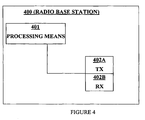
- FIG 4 there is illustrated a block diagram of an exemplary radio base station 400 (e.g. eNodeB) being configured/arranged to enable a UE to perform a contention-based random access.
- the radio base station 400 is assigned a first set forming a pool of non-dedicated random access preambles and a second set forming a pool of dedicated random access preambles.
- the radio base station 400 comprises processing means 401 adapted to determine a RAPID.
- the processing means 401 can identify that no dedicated random access preambles can be allocated to the UE and can then determine the RAPID.
- the radio base station 400 further comprises transmitting means 402A, denoted TX in figure 4 , which is adapted/configured to transmit or send the determined RAPID to said UE in a message (i.e. on the PDCCH or as part of a HO command message).
- the radio base station 400 further comprises receiving means 402B, denoted RX in figure 4 , which is arranged/configured to receive, from the UE, a non-dedicated random access preamble that is selected by the UE based on the received RAPID.
- the radio base station is adapted to determine a RAPID by selecting a pre-configured RAPID.
- the radio base station may also randomly select a RAPID.
- radio base station 400 is therefore not restricted and is not limited to the exemplary block diagram shown in figure 4 .
- the radio base station 400 may also comprise other element and/or blocks not illustrated in figure 4 .
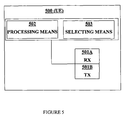
- the UE 500 comprises receiving means 501 A, denoted RX in figure 5 , which is adapted/configured to receive from a radio base station a message comprising a RAPID.
- the message e.g. on the PDCCH or as part of a HO command message
- the UE 500 further comprises processing means 502 configured/adapted to determine that the received RAPID belongs to the first set.
- the UE 500 further comprises selecting means 503 (which can be part, but not necessarily, of the processing means 502) which is adapted/configured to select based on the received RAPID, a non-dedicated random access preamble.
- the UE 500 further comprises transmitting means 501B, denoted TX in figure 5 , which is adapted/configured to transmit to said radio base station the selected non-dedicated random access preamble in order to perform a contention-based random access.
- the processing means 502 may also be adapted to perform the contention-based random access in cooperation with TX means 501B.
- the UE can select a non-dedicated random access preamble by directly selecting a non-dedicated random access preamble that is associated with the RAPID.
- the UE can also randomly select a preamble as previously described.
- one embodiment of the present invention includes a computer-readable medium having instructions stored thereon that are executable by a radio base station (e.g. eNodeB or eNB) and/or a UE of a telecommunications system.
- the instructions executable by the radio base station and/or the UE and stored on a computer-readable medium perform the method steps of the present invention as set forth in the claims.
Landscapes
- Engineering & Computer Science (AREA)
- Computer Networks & Wireless Communication (AREA)
- Signal Processing (AREA)
- Mobile Radio Communication Systems (AREA)
- Selective Calling Equipment (AREA)
Claims (20)
- Procédé dans une station radio de base (120, 400), pour permettre à un équipement d'utilisateur (110, 500) d'effectuer un accès aléatoire à base de contention, ladite station radio de base (120, 400) se voyant attribuer un premier ensemble formant un groupe de préambules d'accès aléatoire non dédiés et un deuxième ensemble formant un groupe de préambules d'accès aléatoire dédiés, le procédé étant caractérisé en ce qu'il comprend les étapes consistant à :- déterminer (201) un identifiant de préambule d'accès aléatoire, RAPID ;- transmettre (202) un message à l'équipement d'utilisateur (110, 500), ledit message comprenant le RAPID déterminé ; et- recevoir (203), de l'équipement d'utilisateur (110, 500), un préambule d'accès aléatoire non dédié qui est sélectionné par l'équipement d'utilisateur (110, 500) sur la base du RAPID compris dans le message transmis.
- Procédé selon la revendication 1, dans lequel l'étape consistant à déterminer (201) ledit RAPID consiste à sélectionner un RAPID préconfiguré qui est associé à un préambule d'accès aléatoire non dédié du premier ensemble.
- Procédé selon la revendication 1, dans lequel l'étape consistant à déterminer (201) ledit RAPID consiste à sélectionner de manière aléatoire un RAPID qui est associé à un préambule d'accès aléatoire non dédié du premier ensemble.
- Procédé selon l'une quelconque des revendications 1 à 3, dans lequel l'étape consistant à transmettre (202) consiste à transmettre le message comprenant ledit RAPID sur un canal de contrôle de liaison descendante physique, PDCCH.
- Procédé selon l'une quelconque des revendications 1 à 3, dans lequel l'étape consistant à transmettre (202) consiste à transmettre le RAPID en tant que partie d'un message de commande de transfert intercellulaire, HO.
- Procédé selon l'une quelconque des revendications 1 à 5, dans lequel l'étape consistant à recevoir (203) consiste à recevoir, de l'équipement d'utilisateur (110, 500), ledit préambule d'accès aléatoire non dédié de manière à effectuer un accès aléatoire à base de contention.
- Procédé selon l'une quelconque des revendications précédentes, dans lequel l'étape consistant à déterminer consiste à déterminer ledit RAPID lorsque aucun desdits préambules d'accès aléatoire dédiés du deuxième ensemble n'est disponible pour une attribution audit UE (110, 500).
- Procédé pour permettre à un équipement d'utilisateur (110, 500) d'effectuer un accès aléatoire à base de contention dans un système de télécommunications comprenant une station radio de base (120, 400) à laquelle sont attribués un premier ensemble formant un groupe de préambules d'accès aléatoire non dédiés et un deuxième ensemble formant un groupe de préambules d'accès aléatoire dédiés, le procédé étant caractérisé en ce qu'il comprend les étapes consistant à :- recevoir (301) un message de ladite station radio de base (120, 400), ledit message comprenant un identifiant de préambule d'accès aléatoire, RAPID ;- déterminer (302) que le RAPID reçu dans ledit message appartient au premier ensemble ;- sélectionner (303), sur la base du RAPID reçu dans ledit message, un préambule d'accès aléatoire non dédié du premier ensemble ; et- transmettre (304) le préambule d'accès aléatoire non dédié sélectionné à la station radio de base (120, 400).
- Procédé selon la revendication 8, dans lequel l'étape consistant à sélectionner (303) consiste à sélectionner un préambule d'accès aléatoire non dédié du premier ensemble, qui est associé au RAPID reçu dans ledit message.
- Procédé selon la revendication 8, dans lequel l'étape consistant à sélectionner (303) consiste à sélectionner de manière aléatoire un préambule d'accès aléatoire non dédié du premier ensemble.
- Procédé selon l'une quelconque des revendications 8 à 10, dans lequel l'étape consistant à recevoir (301) consiste à recevoir ledit message comprenant le RAPID sur un canal de contrôle de liaison descendante physique, PDCCH.
- Procédé selon l'une quelconque des revendications 8 à 10, dans lequel l'étape consistant à recevoir (301) consiste à recevoir le RAPID en tant que partie d'un message de commande de transfert intercellulaire, HO.
- Station radio de base (120, 400) pour permettre à un équipement d'utilisateur (110, 500) d'effectuer un accès aléatoire à base de contention, ladite station radio de base (120, 400) se voyant attribuer un premier ensemble formant un groupe de préambules d'accès aléatoire non dédiés et un deuxième ensemble formant un groupe de préambules d'accès aléatoire dédiés, caractérisée en ce que la station radio de base est configurée :- pour déterminer un identifiant de préambule d'accès aléatoire, RAPID ;- pour transmettre un message à l'équipement d'utilisateur (110, 500), ledit message comprenant le RAPID déterminé ; et- pour recevoir, de l'équipement d'utilisateur (110, 500), un préambule d'accès aléatoire non dédié qui est sélectionné par l'équipement d'utilisateur (110, 500) sur la base du RAPID compris dans le message transmis.
- Station radio de base (120, 400) selon la revendication 13, qui est configurée pour déterminer le RAPID en sélectionnant un RAPID préconfiguré qui est associé à un préambule d'accès aléatoire non dédié du premier ensemble.
- Station radio de base (120, 400) selon la revendication 13, qui est configurée pour déterminer le RAPID en sélectionnant de manière aléatoire un RAPID qui est associé à un préambule d'accès aléatoire non dédié du premier ensemble.
- Station radio de base (120, 400) selon l'une quelconque des revendications 13 à 15, qui est configurée pour recevoir, de l'équipement d'utilisateur (110, 500), ledit préambule d'accès aléatoire non dédié sélectionné de manière à effectuer un accès aléatoire à base de contention.
- Station radio de base (120, 400) selon l'une quelconque des revendications 13 à 16, qui est configurée pour déterminer ledit RAPID lorsque aucun desdits préambules d'accès aléatoire dédiés du deuxième ensemble n'est disponible pour une attribution audit équipement d'utilisateur (110, 500).
- Equipement d'utilisateur (110, 500) pour effectuer un accès aléatoire à base de contention dans un système de télécommunications (100) comprenant une station radio de base (120, 400) à laquelle sont attribués un premier ensemble formant un groupe de préambules d'accès aléatoire non dédiés et un deuxième ensemble formant un groupe de préambules d'accès aléatoire dédiés, caractérisé en ce que l'équipement d'utilisateur est configuré :- pour recevoir un message de ladite station radio de base (120, 400), ledit message comprenant un identifiant de préambule d'accès aléatoire, RAPID ;- pour déterminer que ledit RAPID reçu appartient au premier ensemble ;- pour sélectionner, sur la base du RAPID reçu dans ledit message, un préambule d'accès aléatoire non dédié du premier ensemble ; et- pour transmettre le préambule d'accès aléatoire non dédié sélectionné à ladite station radio de base (120, 400).
- Equipement d'utilisateur (110, 500) selon la revendication 18, qui est configuré pour sélectionner le préambule d'accès aléatoire non dédié en sélectionnant, dans le premier ensemble, un préambule d'accès aléatoire non dédié qui est associé au RAPID reçu dans ledit message.
- Equipement d'utilisateur (110, 500) selon la revendication 18, qui est configuré pour sélectionner le préambule d'accès aléatoire non dédié en sélectionnant de manière aléatoire, dans le premier ensemble, un préambule d'accès aléatoire non dédié.
Priority Applications (1)
| Application Number | Priority Date | Filing Date | Title |
|---|---|---|---|
| PL08874734T PL2294888T3 (pl) | 2008-06-19 | 2008-12-15 | Sposoby i urządzenia do przeprowadzania losowego dostępu w systemie telekomunikacyjnym |
Applications Claiming Priority (2)
| Application Number | Priority Date | Filing Date | Title |
|---|---|---|---|
| US7380808P | 2008-06-19 | 2008-06-19 | |
| PCT/SE2008/051452 WO2009154531A1 (fr) | 2008-06-19 | 2008-12-15 | Procédés et appareils pour la réalisation d’accès aléatoire dans un système de télécommunications |
Publications (2)
| Publication Number | Publication Date |
|---|---|
| EP2294888A1 EP2294888A1 (fr) | 2011-03-16 |
| EP2294888B1 true EP2294888B1 (fr) | 2011-10-12 |
Family
ID=40473912
Family Applications (1)
| Application Number | Title | Priority Date | Filing Date |
|---|---|---|---|
| EP08874734A Revoked EP2294888B1 (fr) | 2008-06-19 | 2008-12-15 | Procédés et appareils pour la réalisation d accès aléatoire dans un système de télécommunications |
Country Status (12)
| Country | Link |
|---|---|
| US (4) | US8223791B2 (fr) |
| EP (1) | EP2294888B1 (fr) |
| JP (1) | JP4854821B2 (fr) |
| CN (2) | CN103906259B (fr) |
| AT (1) | ATE528953T1 (fr) |
| BR (1) | BRPI0822709B1 (fr) |
| DE (2) | DE202008018550U1 (fr) |
| ES (1) | ES2372443T3 (fr) |
| MY (1) | MY153513A (fr) |
| PL (1) | PL2294888T3 (fr) |
| PT (1) | PT2294888E (fr) |
| WO (1) | WO2009154531A1 (fr) |
Families Citing this family (19)
| Publication number | Priority date | Publication date | Assignee | Title |
|---|---|---|---|---|
| EP2667676B1 (fr) | 2007-06-12 | 2018-03-07 | Sharp Kabushiki Kaisha | Dispositif de station de base, dispositif de station mobile, et procédé de requête de synchronisation en liaison montante. |
| BRPI0822709B1 (pt) * | 2008-06-19 | 2020-04-22 | Telefonaktiebolaget Lm Ericsson ( Publ ) | método para possibilitar que um equipamento do usuário efetue um acesso randômico com base em contenção, estação de rádio base, equipamento do usuário, e, sistema de telecomunicações |
| KR101548748B1 (ko) * | 2008-08-07 | 2015-09-11 | 엘지전자 주식회사 | 랜덤 접속 절차를 수행하는 방법 |
| KR101485807B1 (ko) * | 2009-04-01 | 2015-01-28 | 삼성전자주식회사 | 무선 통신 시스템의 랜덤 액세스 방법 및 장치 |
| US20110194513A1 (en) * | 2010-02-10 | 2011-08-11 | Electronics And Telecommunications Research Institute | Method for controlling transmitting power of control channel of csg pico base station |
| EP3675587B1 (fr) * | 2010-03-12 | 2022-12-28 | BlackBerry Limited | Procédé et dispositif pour l'enregistrement et la transmission de données faisant appel à la résolution de conflits d'accès rapide/zéro |
| GB2497752B (en) * | 2011-12-19 | 2014-08-06 | Broadcom Corp | Apparatus and methods for supporting device-to-device discovery in cellular communications |
| JP5950785B2 (ja) * | 2012-10-05 | 2016-07-13 | 株式会社Nttドコモ | 無線基地局及び移動局 |
| US9277465B1 (en) | 2013-08-23 | 2016-03-01 | Sprint Communications Company L.P. | Contention-free handoff return in a wireless network |
| US20150110076A1 (en) * | 2013-10-22 | 2015-04-23 | Qualcomm Incorporated | Reducing latency during redirection |
| KR102217075B1 (ko) * | 2014-04-21 | 2021-02-18 | 삼성전자 주식회사 | 무선 통신 시스템에서 랜덤 액세스 방법 및 장치 |
| US9253692B1 (en) * | 2014-04-22 | 2016-02-02 | Sprint Spectrum L.P. | Reuse of identifiers for contention-free random access requests to a network |
| CN107409317B (zh) * | 2015-03-09 | 2020-08-04 | Lg 电子株式会社 | 在无线通信系统中操作快速随机接入过程的方法及其设备 |
| WO2017080680A1 (fr) | 2015-11-09 | 2017-05-18 | Telefonaktiebolaget Lm Ericsson (Publ) | Attribution de ressource de liaison montante dans un système de réseau monofréquence unidirectionnel de trains à grande vitesse |
| US10419974B2 (en) * | 2015-11-09 | 2019-09-17 | Telefonaktiebolaget Lm Ericsson (Publ) | Random access handling in single frequency network with unidirectional antenna node arrangement |
| US9949195B1 (en) * | 2015-12-15 | 2018-04-17 | Sprint Spectrum L.P. | Contention-free mobile access for handover to a relay base station with wireless backhaul |
| US20200322991A1 (en) * | 2016-03-31 | 2020-10-08 | Ntt Docomo, Inc. | User equipment and communication method |
| WO2017212443A1 (fr) * | 2016-06-08 | 2017-12-14 | Telefonaktiebolaget Lm Ericsson (Publ) | Procédé pour fournir des ressources d'accès aléatoire sans contention pour nb-iot |
| CN109151087B (zh) * | 2018-08-17 | 2021-07-23 | 北京昂瑞微电子技术股份有限公司 | 一种同步地址配置方法及装置 |
Family Cites Families (32)
| Publication number | Priority date | Publication date | Assignee | Title |
|---|---|---|---|---|
| FI105741B (fi) * | 1998-02-12 | 2000-09-29 | Nokia Networks Oy | Tiedonsiirtomenetelmä ja radiojärjestelmä |
| KR100429540B1 (ko) * | 1998-08-26 | 2004-08-09 | 삼성전자주식회사 | 이동통신시스템의패킷데이터통신장치및방법 |
| EP1311075B9 (fr) * | 1998-12-14 | 2012-05-02 | Interdigital Technology Corporation | Détection de préambule pour canaux à accès aléatoire |
| AU2004302745B2 (en) | 2003-08-29 | 2008-02-07 | Samsung Electronics Co., Ltd. | Apparatus and method for controlling operational states of medium access control layer in a broadband wireless access communication system |
| KR20050024085A (ko) * | 2003-09-04 | 2005-03-10 | 삼성전자주식회사 | 광대역 이동통신 시스템에서 상향 억세스 접속 방법 |
| ES2985074T3 (es) * | 2004-03-09 | 2024-11-04 | Optis Wireless Technology Llc | Procedimiento de acceso aleatorio y dispositivo terminal de radiocomunicación |
| WO2007083230A2 (fr) * | 2006-01-20 | 2007-07-26 | Nokia Corporation | Procédure d'accès aléatoire avec couverture améliorée |
| RU2426251C2 (ru) * | 2006-10-31 | 2011-08-10 | Квэлкомм Инкорпорейтед | Устройство и способ произвольного доступа для беспроводной связи |
| CN101883440B (zh) * | 2006-10-31 | 2014-05-28 | 夏普株式会社 | 通信处理方法、通信系统、基站以及移动站 |
| EP2149274B1 (fr) * | 2007-04-27 | 2017-04-05 | Optis Wireless Technology, LLC | Transfert effectué au moyen de ressources spécialisées réservées pour un intervalle de temps limité |
| US20080268850A1 (en) * | 2007-04-30 | 2008-10-30 | Motorola, Inc. | Method and apparatus for handover in a wireless communication system |
| US20080268849A1 (en) * | 2007-04-30 | 2008-10-30 | Motorola, Inc. | Method and apparatus for handover in a wireless communication system |
| CN101682870B (zh) | 2007-05-24 | 2013-11-06 | 华为技术有限公司 | 移动通信系统、基站装置以及移动台装置 |
| US8169992B2 (en) | 2007-08-08 | 2012-05-01 | Telefonaktiebolaget Lm Ericsson (Publ) | Uplink scrambling during random access |
| JPWO2009038074A1 (ja) * | 2007-09-18 | 2011-01-06 | シャープ株式会社 | 無線通信システム、基地局装置、移動局装置およびランダムアクセス方法 |
| DK2213013T3 (en) * | 2007-10-31 | 2017-02-06 | ERICSSON TELEFON AB L M (publ) | SELECTION OF SENDING MODE IN A RANDOM ACCESS PROCEDURE |
| KR101447750B1 (ko) * | 2008-01-04 | 2014-10-06 | 엘지전자 주식회사 | 랜덤 액세스 과정을 수행하는 방법 |
| TR201810929T4 (tr) | 2008-01-11 | 2018-08-27 | Ericsson Telefon Ab L M | Bir iletişim ağında yöntemler ve cihazlar. |
| US8243667B2 (en) * | 2008-01-28 | 2012-08-14 | Lg Electronics Inc. | Method for transmitting scheduling request effectively in wireless communication system |
| CN101946424B (zh) * | 2008-02-25 | 2013-08-28 | Lg电子株式会社 | 在无线通信系统中执行随机接入流程的方法 |
| JP2009201114A (ja) | 2008-02-25 | 2009-09-03 | Asustek Computer Inc | ハンドオーバーのランダムアクセスプロセスを改善する方法及び通信装置 |
| US8649353B2 (en) * | 2008-03-04 | 2014-02-11 | Interdigital Patent Holdings, Inc. | Method and apparatus for accessing a random access channel by selectively using dedicated or contention-based preambles during handover |
| US7903818B2 (en) * | 2008-03-13 | 2011-03-08 | Lg Electronics Inc. | Random access method for improving scrambling efficiency |
| CN101999219B (zh) * | 2008-04-14 | 2014-02-19 | Lg电子株式会社 | 执行随机接入过程的方法和装置 |
| EP2136599B1 (fr) * | 2008-06-18 | 2017-02-22 | LG Electronics Inc. | Détection de défaillances de procédures d'accès aléatoire |
| GB2461158B (en) * | 2008-06-18 | 2011-03-02 | Lg Electronics Inc | Method for performing random access procedures and terminal therof |
| BRPI0822709B1 (pt) * | 2008-06-19 | 2020-04-22 | Telefonaktiebolaget Lm Ericsson ( Publ ) | método para possibilitar que um equipamento do usuário efetue um acesso randômico com base em contenção, estação de rádio base, equipamento do usuário, e, sistema de telecomunicações |
| US8811311B2 (en) * | 2008-06-23 | 2014-08-19 | Nokia Corporation | Method and apparatus for performing random access procedure using soft dedicated preambles |
| US9480084B2 (en) * | 2008-07-01 | 2016-10-25 | Telefonaktiebolaget Lm Ericsson (Publ) | Methods and apparatuses for performing preamble assignment for random access in a telecommunications system |
| EP3101990B1 (fr) * | 2008-07-01 | 2020-04-01 | Telefonaktiebolaget LM Ericsson (publ) | Attribution de préambule pour un accès aléatoire dans un système de télécommunications |
| EP2338312A1 (fr) * | 2008-09-11 | 2011-06-29 | Telefonaktiebolaget L M Ericsson (PUBL) | Procédé et configuration dans un système de réseau de communication |
| KR100917832B1 (ko) * | 2008-09-19 | 2009-09-18 | 엘지전자 주식회사 | 시간 정렬 타이머를 고려한 신호 송수신 방법 및 이를 위한 사용자 기기 |
-
2008
- 2008-12-15 BR BRPI0822709-8A patent/BRPI0822709B1/pt active IP Right Grant
- 2008-12-15 ES ES08874734T patent/ES2372443T3/es active Active
- 2008-12-15 WO PCT/SE2008/051452 patent/WO2009154531A1/fr not_active Ceased
- 2008-12-15 EP EP08874734A patent/EP2294888B1/fr not_active Revoked
- 2008-12-15 PL PL08874734T patent/PL2294888T3/pl unknown
- 2008-12-15 DE DE202008018550.5U patent/DE202008018550U1/de not_active Expired - Lifetime
- 2008-12-15 PT PT08874734T patent/PT2294888E/pt unknown
- 2008-12-15 CN CN201410135914.9A patent/CN103906259B/zh active Active
- 2008-12-15 MY MYPI2010005026A patent/MY153513A/en unknown
- 2008-12-15 JP JP2011514526A patent/JP4854821B2/ja active Active
- 2008-12-15 DE DE202008018554.8U patent/DE202008018554U1/de not_active Expired - Lifetime
- 2008-12-15 CN CN200880129948.XA patent/CN102067703B/zh active Active
- 2008-12-15 AT AT08874734T patent/ATE528953T1/de active
-
2009
- 2009-05-28 US US12/473,582 patent/US8223791B2/en active Active
-
2012
- 2012-07-16 US US13/550,104 patent/US8611369B2/en active Active
-
2013
- 2013-12-16 US US14/107,604 patent/US9137828B2/en active Active
-
2015
- 2015-09-14 US US14/853,064 patent/US9572182B2/en active Active
Also Published As
| Publication number | Publication date |
|---|---|
| US9572182B2 (en) | 2017-02-14 |
| CN103906259A (zh) | 2014-07-02 |
| US8611369B2 (en) | 2013-12-17 |
| CN102067703B (zh) | 2014-05-07 |
| ES2372443T3 (es) | 2012-01-19 |
| ATE528953T1 (de) | 2011-10-15 |
| CN103906259B (zh) | 2017-10-20 |
| JP4854821B2 (ja) | 2012-01-18 |
| BRPI0822709B1 (pt) | 2020-04-22 |
| US20120275435A1 (en) | 2012-11-01 |
| BRPI0822709A2 (pt) | 2015-07-07 |
| CN102067703A (zh) | 2011-05-18 |
| WO2009154531A1 (fr) | 2009-12-23 |
| DE202008018550U1 (de) | 2015-10-26 |
| US20090316653A1 (en) | 2009-12-24 |
| MY153513A (en) | 2015-02-27 |
| DE202008018554U1 (de) | 2015-09-24 |
| PL2294888T3 (pl) | 2012-02-29 |
| US20160014816A1 (en) | 2016-01-14 |
| US8223791B2 (en) | 2012-07-17 |
| EP2294888A1 (fr) | 2011-03-16 |
| US20140247776A1 (en) | 2014-09-04 |
| JP2011525087A (ja) | 2011-09-08 |
| US9137828B2 (en) | 2015-09-15 |
| PT2294888E (pt) | 2011-12-23 |
Similar Documents
| Publication | Publication Date | Title |
|---|---|---|
| EP2294888B1 (fr) | Procédés et appareils pour la réalisation d accès aléatoire dans un système de télécommunications | |
| US11729831B2 (en) | Methods and apparatuses for performing preamble assignment for random access in a telecommunications system | |
| US8493917B2 (en) | Methods and apparatuses for performing preamble assignment for random access in a telecommunications system | |
| EP2897428B1 (fr) | Procédé de gestion de la synchronisation en liaison montante et dispositif de communication associé | |
| EP3131336B1 (fr) | Procédé de transfert intercellulaire dans un système de communication mobile | |
| US12238782B2 (en) | Methods and apparatuses for performing preamble assignment for random access in a telecommunications system |
Legal Events
| Date | Code | Title | Description |
|---|---|---|---|
| PUAI | Public reference made under article 153(3) epc to a published international application that has entered the european phase |
Free format text: ORIGINAL CODE: 0009012 |
|
| 17P | Request for examination filed |
Effective date: 20101123 |
|
| AK | Designated contracting states |
Kind code of ref document: A1 Designated state(s): AT BE BG CH CY CZ DE DK EE ES FI FR GB GR HR HU IE IS IT LI LT LU LV MC MT NL NO PL PT RO SE SI SK TR |
|
| AX | Request for extension of the european patent |
Extension state: AL BA MK RS |
|
| GRAP | Despatch of communication of intention to grant a patent |
Free format text: ORIGINAL CODE: EPIDOSNIGR1 |
|
| DAX | Request for extension of the european patent (deleted) | ||
| GRAS | Grant fee paid |
Free format text: ORIGINAL CODE: EPIDOSNIGR3 |
|
| GRAA | (expected) grant |
Free format text: ORIGINAL CODE: 0009210 |
|
| AK | Designated contracting states |
Kind code of ref document: B1 Designated state(s): AT BE BG CH CY CZ DE DK EE ES FI FR GB GR HR HU IE IS IT LI LT LU LV MC MT NL NO PL PT RO SE SI SK TR |
|
| REG | Reference to a national code |
Ref country code: GB Ref legal event code: FG4D |
|
| REG | Reference to a national code |
Ref country code: CH Ref legal event code: EP |
|
| REG | Reference to a national code |
Ref country code: IE Ref legal event code: FG4D |
|
| REG | Reference to a national code |
Ref country code: RO Ref legal event code: EPE |
|
| REG | Reference to a national code |
Ref country code: PT Ref legal event code: SC4A Free format text: AVAILABILITY OF NATIONAL TRANSLATION Effective date: 20111207 |
|
| REG | Reference to a national code |
Ref country code: DE Ref legal event code: R096 Ref document number: 602008010516 Country of ref document: DE Effective date: 20111229 |
|
| REG | Reference to a national code |
Ref country code: CH Ref legal event code: NV Representative=s name: SERVOPATENT GMBH |
|
| REG | Reference to a national code |
Ref country code: ES Ref legal event code: FG2A Ref document number: 2372443 Country of ref document: ES Kind code of ref document: T3 Effective date: 20120119 |
|
| REG | Reference to a national code |
Ref country code: NL Ref legal event code: T3 |
|
| REG | Reference to a national code |
Ref country code: SE Ref legal event code: TRGR |
|
| REG | Reference to a national code |
Ref country code: PL Ref legal event code: T3 |
|
| LTIE | Lt: invalidation of european patent or patent extension |
Effective date: 20111012 |
|
| PG25 | Lapsed in a contracting state [announced via postgrant information from national office to epo] |
Ref country code: BE Free format text: LAPSE BECAUSE OF FAILURE TO SUBMIT A TRANSLATION OF THE DESCRIPTION OR TO PAY THE FEE WITHIN THE PRESCRIBED TIME-LIMIT Effective date: 20111012 Ref country code: IS Free format text: LAPSE BECAUSE OF FAILURE TO SUBMIT A TRANSLATION OF THE DESCRIPTION OR TO PAY THE FEE WITHIN THE PRESCRIBED TIME-LIMIT Effective date: 20120212 Ref country code: LT Free format text: LAPSE BECAUSE OF FAILURE TO SUBMIT A TRANSLATION OF THE DESCRIPTION OR TO PAY THE FEE WITHIN THE PRESCRIBED TIME-LIMIT Effective date: 20111012 Ref country code: NO Free format text: LAPSE BECAUSE OF FAILURE TO SUBMIT A TRANSLATION OF THE DESCRIPTION OR TO PAY THE FEE WITHIN THE PRESCRIBED TIME-LIMIT Effective date: 20120112 |
|
| PG25 | Lapsed in a contracting state [announced via postgrant information from national office to epo] |
Ref country code: GR Free format text: LAPSE BECAUSE OF FAILURE TO SUBMIT A TRANSLATION OF THE DESCRIPTION OR TO PAY THE FEE WITHIN THE PRESCRIBED TIME-LIMIT Effective date: 20120113 Ref country code: HR Free format text: LAPSE BECAUSE OF FAILURE TO SUBMIT A TRANSLATION OF THE DESCRIPTION OR TO PAY THE FEE WITHIN THE PRESCRIBED TIME-LIMIT Effective date: 20111012 Ref country code: SI Free format text: LAPSE BECAUSE OF FAILURE TO SUBMIT A TRANSLATION OF THE DESCRIPTION OR TO PAY THE FEE WITHIN THE PRESCRIBED TIME-LIMIT Effective date: 20111012 Ref country code: LV Free format text: LAPSE BECAUSE OF FAILURE TO SUBMIT A TRANSLATION OF THE DESCRIPTION OR TO PAY THE FEE WITHIN THE PRESCRIBED TIME-LIMIT Effective date: 20111012 |
|
| PG25 | Lapsed in a contracting state [announced via postgrant information from national office to epo] |
Ref country code: CY Free format text: LAPSE BECAUSE OF FAILURE TO SUBMIT A TRANSLATION OF THE DESCRIPTION OR TO PAY THE FEE WITHIN THE PRESCRIBED TIME-LIMIT Effective date: 20111012 |
|
| PLBI | Opposition filed |
Free format text: ORIGINAL CODE: 0009260 |
|
| REG | Reference to a national code |
Ref country code: HU Ref legal event code: AG4A Ref document number: E013399 Country of ref document: HU |
|
| PG25 | Lapsed in a contracting state [announced via postgrant information from national office to epo] |
Ref country code: EE Free format text: LAPSE BECAUSE OF FAILURE TO SUBMIT A TRANSLATION OF THE DESCRIPTION OR TO PAY THE FEE WITHIN THE PRESCRIBED TIME-LIMIT Effective date: 20111012 Ref country code: SK Free format text: LAPSE BECAUSE OF FAILURE TO SUBMIT A TRANSLATION OF THE DESCRIPTION OR TO PAY THE FEE WITHIN THE PRESCRIBED TIME-LIMIT Effective date: 20111012 Ref country code: CZ Free format text: LAPSE BECAUSE OF FAILURE TO SUBMIT A TRANSLATION OF THE DESCRIPTION OR TO PAY THE FEE WITHIN THE PRESCRIBED TIME-LIMIT Effective date: 20111012 Ref country code: DK Free format text: LAPSE BECAUSE OF FAILURE TO SUBMIT A TRANSLATION OF THE DESCRIPTION OR TO PAY THE FEE WITHIN THE PRESCRIBED TIME-LIMIT Effective date: 20111012 Ref country code: BG Free format text: LAPSE BECAUSE OF FAILURE TO SUBMIT A TRANSLATION OF THE DESCRIPTION OR TO PAY THE FEE WITHIN THE PRESCRIBED TIME-LIMIT Effective date: 20120112 Ref country code: MC Free format text: LAPSE BECAUSE OF NON-PAYMENT OF DUE FEES Effective date: 20111231 |
|
| PLAX | Notice of opposition and request to file observation + time limit sent |
Free format text: ORIGINAL CODE: EPIDOSNOBS2 |
|
| 26 | Opposition filed |
Opponent name: KELTIE LLP Effective date: 20120712 |
|
| REG | Reference to a national code |
Ref country code: IE Ref legal event code: MM4A |
|
| REG | Reference to a national code |
Ref country code: DE Ref legal event code: R026 Ref document number: 602008010516 Country of ref document: DE Effective date: 20120712 |
|
| PG25 | Lapsed in a contracting state [announced via postgrant information from national office to epo] |
Ref country code: IE Free format text: LAPSE BECAUSE OF NON-PAYMENT OF DUE FEES Effective date: 20111215 |
|
| PLBB | Reply of patent proprietor to notice(s) of opposition received |
Free format text: ORIGINAL CODE: EPIDOSNOBS3 |
|
| PG25 | Lapsed in a contracting state [announced via postgrant information from national office to epo] |
Ref country code: MT Free format text: LAPSE BECAUSE OF FAILURE TO SUBMIT A TRANSLATION OF THE DESCRIPTION OR TO PAY THE FEE WITHIN THE PRESCRIBED TIME-LIMIT Effective date: 20111012 |
|
| PG25 | Lapsed in a contracting state [announced via postgrant information from national office to epo] |
Ref country code: LU Free format text: LAPSE BECAUSE OF NON-PAYMENT OF DUE FEES Effective date: 20111215 |
|
| PG25 | Lapsed in a contracting state [announced via postgrant information from national office to epo] |
Ref country code: FI Free format text: LAPSE BECAUSE OF FAILURE TO SUBMIT A TRANSLATION OF THE DESCRIPTION OR TO PAY THE FEE WITHIN THE PRESCRIBED TIME-LIMIT Effective date: 20111012 |
|
| PG25 | Lapsed in a contracting state [announced via postgrant information from national office to epo] |
Ref country code: TR Free format text: LAPSE BECAUSE OF FAILURE TO SUBMIT A TRANSLATION OF THE DESCRIPTION OR TO PAY THE FEE WITHIN THE PRESCRIBED TIME-LIMIT Effective date: 20111012 |
|
| APBM | Appeal reference recorded |
Free format text: ORIGINAL CODE: EPIDOSNREFNO |
|
| APBP | Date of receipt of notice of appeal recorded |
Free format text: ORIGINAL CODE: EPIDOSNNOA2O |
|
| APAH | Appeal reference modified |
Free format text: ORIGINAL CODE: EPIDOSCREFNO |
|
| APBM | Appeal reference recorded |
Free format text: ORIGINAL CODE: EPIDOSNREFNO |
|
| APBP | Date of receipt of notice of appeal recorded |
Free format text: ORIGINAL CODE: EPIDOSNNOA2O |
|
| APBQ | Date of receipt of statement of grounds of appeal recorded |
Free format text: ORIGINAL CODE: EPIDOSNNOA3O |
|
| REG | Reference to a national code |
Ref country code: FR Ref legal event code: PLFP Year of fee payment: 8 |
|
| REG | Reference to a national code |
Ref country code: FR Ref legal event code: PLFP Year of fee payment: 9 |
|
| PG25 | Lapsed in a contracting state [announced via postgrant information from national office to epo] |
Ref country code: IT Free format text: LAPSE BECAUSE OF NON-PAYMENT OF DUE FEES Effective date: 20151215 |
|
| PG25 | Lapsed in a contracting state [announced via postgrant information from national office to epo] |
Ref country code: IT Free format text: LAPSE BECAUSE OF NON-PAYMENT OF DUE FEES Effective date: 20151215 |
|
| PGRI | Patent reinstated in contracting state [announced from national office to epo] |
Ref country code: IT Effective date: 20170710 |
|
| REG | Reference to a national code |
Ref country code: FR Ref legal event code: PLFP Year of fee payment: 10 |
|
| PGFP | Annual fee paid to national office [announced via postgrant information from national office to epo] |
Ref country code: PT Payment date: 20191121 Year of fee payment: 12 Ref country code: RO Payment date: 20191121 Year of fee payment: 12 Ref country code: HU Payment date: 20191203 Year of fee payment: 12 Ref country code: SE Payment date: 20191227 Year of fee payment: 12 Ref country code: NL Payment date: 20191226 Year of fee payment: 12 |
|
| REG | Reference to a national code |
Ref country code: DE Ref legal event code: R064 Ref document number: 602008010516 Country of ref document: DE Ref country code: DE Ref legal event code: R103 Ref document number: 602008010516 Country of ref document: DE |
|
| APBU | Appeal procedure closed |
Free format text: ORIGINAL CODE: EPIDOSNNOA9O |
|
| PGFP | Annual fee paid to national office [announced via postgrant information from national office to epo] |
Ref country code: FR Payment date: 20191226 Year of fee payment: 12 Ref country code: IT Payment date: 20191219 Year of fee payment: 12 Ref country code: PL Payment date: 20191121 Year of fee payment: 12 |
|
| PGFP | Annual fee paid to national office [announced via postgrant information from national office to epo] |
Ref country code: AT Payment date: 20191120 Year of fee payment: 12 |
|
| PGFP | Annual fee paid to national office [announced via postgrant information from national office to epo] |
Ref country code: DE Payment date: 20191231 Year of fee payment: 12 Ref country code: GB Payment date: 20200102 Year of fee payment: 12 Ref country code: ES Payment date: 20200102 Year of fee payment: 12 |
|
| PGFP | Annual fee paid to national office [announced via postgrant information from national office to epo] |
Ref country code: CH Payment date: 20191231 Year of fee payment: 12 |
|
| RDAF | Communication despatched that patent is revoked |
Free format text: ORIGINAL CODE: EPIDOSNREV1 |
|
| RDAG | Patent revoked |
Free format text: ORIGINAL CODE: 0009271 |
|
| STAA | Information on the status of an ep patent application or granted ep patent |
Free format text: STATUS: PATENT REVOKED |
|
| REG | Reference to a national code |
Ref country code: CH Ref legal event code: PCAR Free format text: NEW ADDRESS: WANNERSTRASSE 9/1, 8045 ZUERICH (CH) Ref country code: CH Ref legal event code: PL |
|
| REG | Reference to a national code |
Ref country code: FI Ref legal event code: MGE |
|
| 27W | Patent revoked |
Effective date: 20200220 |
|
| GBPR | Gb: patent revoked under art. 102 of the ep convention designating the uk as contracting state |
Effective date: 20200220 |
|
| REG | Reference to a national code |
Ref country code: SE Ref legal event code: ECNC |
|
| REG | Reference to a national code |
Ref country code: AT Ref legal event code: MA03 Ref document number: 528953 Country of ref document: AT Kind code of ref document: T Effective date: 20200220 |