EP2294954A2 - Dispositif d'appareil ménager - Google Patents
Dispositif d'appareil ménager Download PDFInfo
- Publication number
- EP2294954A2 EP2294954A2 EP20100173676 EP10173676A EP2294954A2 EP 2294954 A2 EP2294954 A2 EP 2294954A2 EP 20100173676 EP20100173676 EP 20100173676 EP 10173676 A EP10173676 A EP 10173676A EP 2294954 A2 EP2294954 A2 EP 2294954A2
- Authority
- EP
- European Patent Office
- Prior art keywords
- component
- heat
- domestic appliance
- unit
- appliance device
- Prior art date
- Legal status (The legal status is an assumption and is not a legal conclusion. Google has not performed a legal analysis and makes no representation as to the accuracy of the status listed.)
- Withdrawn
Links
- 238000010411 cooking Methods 0.000 claims abstract description 43
- 238000010438 heat treatment Methods 0.000 claims abstract description 35
- 238000004519 manufacturing process Methods 0.000 claims abstract description 11
- 239000006260 foam Substances 0.000 claims description 31
- 238000009413 insulation Methods 0.000 claims description 10
- XAGFODPZIPBFFR-UHFFFAOYSA-N aluminium Chemical compound [Al] XAGFODPZIPBFFR-UHFFFAOYSA-N 0.000 claims description 6
- 229910052782 aluminium Inorganic materials 0.000 claims description 6
- 239000000463 material Substances 0.000 claims description 5
- 238000000034 method Methods 0.000 abstract description 7
- 239000000126 substance Substances 0.000 description 10
- 229910001220 stainless steel Inorganic materials 0.000 description 4
- 239000010935 stainless steel Substances 0.000 description 4
- 238000010276 construction Methods 0.000 description 3
- 230000009969 flowable effect Effects 0.000 description 2
- 239000007788 liquid Substances 0.000 description 2
- 239000007787 solid Substances 0.000 description 2
- 230000015572 biosynthetic process Effects 0.000 description 1
- 230000001419 dependent effect Effects 0.000 description 1
- 239000013070 direct material Substances 0.000 description 1
- 230000000694 effects Effects 0.000 description 1
- 238000005187 foaming Methods 0.000 description 1
- 239000013071 indirect material Substances 0.000 description 1
- 238000007747 plating Methods 0.000 description 1
- 239000011148 porous material Substances 0.000 description 1
- 238000002360 preparation method Methods 0.000 description 1
- 238000007493 shaping process Methods 0.000 description 1
- 239000008259 solid foam Substances 0.000 description 1
- 238000007711 solidification Methods 0.000 description 1
- 230000008023 solidification Effects 0.000 description 1
Images



Classifications
-
- F—MECHANICAL ENGINEERING; LIGHTING; HEATING; WEAPONS; BLASTING
- F24—HEATING; RANGES; VENTILATING
- F24C—DOMESTIC STOVES OR RANGES ; DETAILS OF DOMESTIC STOVES OR RANGES, OF GENERAL APPLICATION
- F24C7/00—Stoves or ranges heated by electric energy
- F24C7/06—Arrangement or mounting of electric heating elements
Definitions
- the invention relates to a domestic appliance device according to the preamble of claim 1.
- a heat conducting unit which forms a heatable working area.
- the heat-conducting unit is firmly connected to a heating element.
- the object of the invention is in particular to provide a generic device with improved properties in terms of a cost-effective design.
- the object is achieved by the features of claim 1, while advantageous embodiments and refinements of the invention can be taken from the dependent claims and the independent claim.
- the invention is based on a domestic appliance device, in particular cooking appliance device, with at least one first heat-conducting unit, which is firmly connected in at least one operating state with at least one heating element.
- the first heat-conducting unit has at least one component with a porosity differing from zero.
- a "heat-conducting unit” is to be understood in particular as a unit which is intended to conduct heat to an area in which it is used in an operating process, which is preferably a cooking process and / or a cooking process, the unit preferably being at least partially has a higher thermal conductivity than stainless steel and / or as a material from which a cooking surface of the heat conducting unit is formed.
- an operating process which is preferably a cooking process and / or a cooking process
- the unit preferably being at least partially has a higher thermal conductivity than stainless steel and / or as a material from which a cooking surface of the heat conducting unit is formed.
- intended is intended to be understood in particular specially designed and / or equipped.
- heat-conducting unit is "firmly" connected to a heating element during an operating process should be understood in particular to mean that the heat-conducting unit is fixed in such a way during the operating process that it is immovable relative to the heating element and preferably non-destructively only with a tool Heating element is removable. Particularly preferred here is the heat-conducting unit intended to be disassembled exclusively by a fitter and thus separated from the heating element.
- a "heating element” is intended in particular to be understood as an element which, in at least one operating process, emits energy for the purpose of heating a unit and preferably food, the element preferably delivering the energy in the form of thermal energy and / or magnetic energy.
- the "porosity" of a substance is to be understood in particular to mean that physical quantity which is defined as one minus the quotient of a bulk density of the substance and a pure density of the substance.
- bulk density of a substance is meant in particular a quotient of a mass of an amount of the substance and a volume of the amount of the substance, the volume also including the volumes of pore spaces which the substance forms.
- true density of a substance is meant, in particular, a quotient of a mass of a non-porous amount of the substance and a volume of the non-porous amount of the substance.
- a structure of the heat-conducting unit can be achieved from at least one material that can be processed flexibly, as a result of which cost-effective manufacturability of the heat-conducting unit can be achieved.
- a foam can be used in a production of the heat-conducting unit, which can be particularly cost-effective, in particular compared to producing a heat-conducting unit by plating two sheets with an aluminum plate arranged between the sheets, because during production of a sheet according to the invention
- the domestic appliance device has at least one component which, in at least one operating state, is in direct material contact with the component.
- the device is in an operating condition in a "direct material contact" with the component, should be understood in particular that the component rests against the component and / or materially connected thereto and / or a material heat conduction between the component and the component can be done.
- the heat-conducting unit preferably has the component.
- the domestic appliance device has at least one heating element, which is arranged at least partially between the component and the component of the heat-conducting unit.
- the heating element is arranged "at least partially between" the component and the component, should be understood in particular that there is at least one straight line, which the component in a first point, the heating element in a second point and the component in a third Point intersects and the second point lies on the line between the first and the third point.
- a high energy efficiency can be achieved.
- an energy to be delivered by the heating means can be used effectively.
- the energy can be passed on to a large extent by the heat-conducting unit.
- the domestic appliance device has at least one heating element, which rests against the component and / or the component in at least one operating state.
- the heating element rests on the component and / or the component, it should be understood in particular that a direct contact exists between the heating element and the component or the component. As a result, an effective heating can be achieved. In particular, a high efficiency of the heating element and the heat conducting unit can be achieved.
- the component forms a cooking surface at least partially.
- a "cooking surface” is to be understood as meaning, in particular, an area which is provided for placing food to be cooked on and for subsequent and / or simultaneous heating of the cooking product.
- heat insulation unit is to be understood in particular a unit that thermally insulated at least two units against each other, the units are preferably cooking surfaces and the unit the cooking surfaces so thermally insulated from each other, that a first of Gar surfaces with a first cooking temperature and at the same time a second Gar lake with a second cooking temperature are operable.
- the device is at least partially formed of a stainless steel.
- a robust construction can be achieved.
- the component is at least partially formed from a foam.
- a "foam” is to be understood in particular a solid and / or liquid structural unit, which has gas bubbles which are enclosed by solid or liquid walls of the assembly.
- a simple manufacturability can be achieved.
- a part of the heat-conducting unit can be produced by a simple foaming of a gap.
- the component is at least partially formed of aluminum, whereby a cost-effective design can be achieved.
- the component is plate-shaped, whereby a high-quality heat conduction can be achieved.
- the cooking surface is supplied with approximately the same amount of heat at all points.
- the domestic appliance device has at least one receiving unit, which is arranged at least partially within the first heat-conducting unit.
- a "receiving unit” is to be understood in particular as a unit which is intended to receive at least one functional means and in particular a sensor unit and preferably a temperature sensor unit. As a result, high functionality can be achieved.
- the domestic appliance device has at least one temperature sensor unit which is provided to detect a temperature of at least one region of the first heat-conducting unit.
- a high quality cooking can be achieved.
- a heat input can be measured precisely.
- the domestic appliance device has at least one second heat-conducting unit, which differs from the first heat-conducting unit and which is formed at least partially from at least one material having a non-zero porosity.
- the fact that the second heat-conducting unit differs from the first heat-conducting unit should be understood in particular to mean that the first heat-conducting unit is free is of at least one component which has the second heat-conducting unit.
- high functionality can be achieved.
- two different Garwolves can be supplied independently of each other effectively with heat from different heating means.
- the domestic appliance device has at least one receiving unit, which is arranged at least partially within the first heat-conducting unit.
- a "receiving unit” is to be understood in particular as a unit within which, in at least one operating state, a functional unit, which in particular has at least one electronic component and is preferably formed by a temperature sensor unit, is accommodated. This allows a high-quality cooking can be achieved. In particular, it can be achieved that a heat supply to the cooking surface can be controlled.
- a cooking plate unit is proposed with the home appliance device, whereby a cost-effective design can be achieved.
- Garraummuffeltechnik is proposed with a domestic appliance device. Under a "Garraummuffel nie" should be understood in particular a part of a Garraummuffel. This allows a cost-effective design can be achieved.
- a cakeleitvorschizing method is proposed, in particular for the preparation of the domestic appliance device in which at least one foam is used. This allows a cost-effective design and in particular a cost-effective manufacturing process can be achieved.
- the foam is introduced between at least two plate-shaped components.
- a simple manufacturability and in particular a simple shaping of a component can be achieved, which is formed by the foam in particular after a solidification of the foam.
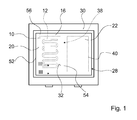
- FIG. 1 shows a plan view of a trained as Teppan-Yaki grill appliance domestic appliance, which has a cooking plate unit 28 with a domestic appliance device according to the invention.
- the domestic appliance device has a heat-conducting unit 10, which is fastened to a housing 30 of the domestic appliance.
- the domestic appliance device has a heating element 12 designed as a tubular heating element, which is likewise fastened to the housing 30 and relative to which the heating element 12 is immovable.
- the heat-conducting unit 10 has a solid foam 14 ', designed as an aluminum foam Component 14, which has a non-zero porosity ( FIGS. 1 to 3 ).
- the foam 14 ' is firmly bonded to a component 16 of the heat-conducting unit 10 and a component 18 of the domestic appliance device.
- the device 16 is disposed over the foam 14 'and completely covers the foam 14' in a plan view.
- the component 18 is arranged under the foam 14 ', so that the foam 14' is arranged between the components 16, 18.
- the component 14 has a thickness of eight millimeters.
- the components 16, 18 each have a thickness of eight hundred microns.
- the components 16 and 18 are each formed from a stainless steel sheet and both have planar surfaces 32, 34. In principle, it is also conceivable that the surfaces 32, 24 another shape, such. B. have a curved shape. Furthermore, the foam 14 'is plate-shaped. The foam 14 'and the component 18 have the same maximum longitudinal extension and the same maximum width extension.
- the heating element 12 is arranged in the operating state under the device 18 and is applied to this.
- the device 16 forms with its flat surface 32 a cooking surface 20, which is provided for a placement of food. In principle, it is conceivable that the cooking surface 20 is curved and is formed by a depression.
- the domestic appliance device has a second heat-conducting unit 22, which is identical to the heat-conducting unit 10. In the operating state, an upper region of the heat-conducting unit 22 is formed by the component 16.
- the heat-conducting unit 22 likewise has a component 36 which has a porosity differing from zero and which is formed separately from the component 14.
- the components 14 and 36 are spaced apart from each other and form a gap 38, which causes a thermal insulation between the two bathleitanneen 10, 22.
- the domestic appliance device has a heat insulation unit 58, which comprises a region 54 of the component 16.
- the device 16 is made of stainless steel and therefore conducts heat relatively poorly.
- the region 54 is arranged between the cooking surface 20 and a cooking surface 40, which is formed by the second heat-conducting unit 22, and effects a thermal insulation between the cooking surface 20 and the cooking surface 40. Further, between an edge 52 of the device 16 and the cooking surfaces 20, 40 a region 56 is arranged, which a portion of the heat insulating unit 58 is heated and at a cooking operation in which one or both of the cooking surfaces 20, 40 are heated, remains unheated and has an ambient temperature or only slightly, for. B. by a few degrees Celsius, deviates from the ambient temperature. The area 56 surrounds the cooking surfaces 20, 40.
- the domestic appliance device has a receiving unit 48 designed as a tube, which extends from one side of the first heat-conducting unit 10 within the first heat-conducting unit 10 ( FIGS. 1 and 3 ).
- the receiving unit 48 is embedded in the foam 14 'and touches it.
- a temperature sensor unit 50 is arranged, which measures a temperature of a portion of the first heat-conducting unit 10, which surrounds the receiving unit 48 in an operating operation.
- the devices 16 and 18, which are plate-shaped, are arranged parallel to each other at a distance of eight millimeters.
- the component 14 cuboidal shape components are arranged such that they form a cuboid cavity together with the components 16 and 18, in which the receiving unit 48 is introduced and which subsequently with the foam 14 ', which is in a flowable Condition is foamed. Thereafter, the mold components are removed and the foam 14 'solidifies.
- the components 16, 18 are materially connected to the foam 14 '.
- the first heat-conducting unit 10 is manufactured in this way. Analogously, the second heat conducting unit 22 is produced.
- a reworking of the foam 14 'or the components 16, 18 and in particular a reworking of edge regions of the foam 14' or the components 16, 18 is unnecessary.
- a reworking of the foam 14 'or the components 16, 18 for the production of the gap 38 is unnecessary.
- FIGS. 4 to 8 Alternative embodiments are shown. Substantially identical components, features and functions are basically numbered by the same reference numerals. To distinguish the embodiments, however, the reference numerals of the embodiment in the FIGS. 4 to 8 the letters "a", "b” etc. added. The following description is essentially limited to the differences from the embodiment in the FIGS. 1 to 3 in which respect Constant components, features and functions on the description of the embodiment in the FIGS. 1 to 3 can be referenced.
- FIG. 4 shows an alternative embodiment of a home appliance device.
- the domestic appliance device has a heating element 12a designed as a tubular heating element, which is arranged between a component 14a and a component 16a of the domestic appliance device and between the component 14a and a component 18a of the domestic appliance device.
- the components 16a and 18a are arranged in parallel and spaced from each other, after which the heating element 12a is inserted between the components 16a, 18a. Subsequently, a gap between the components 16a and 18a, in which the heating element 12a is arranged, is foamed with a flowable foam 14'a, which subsequently solidifies.
- FIG. 5 shows an alternative embodiment of a cooking plate unit 28b.
- a component 16b of the cooking plate unit 28b has a recess 42b at an edge region, which is arranged next to two cooking surfaces 20b, 40b of the cooking plate unit 28b.
- the component 16b is provided with the recess 42b by deep drawing. Subsequently or before, a foam 14'b is attached to the component 16b.
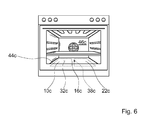
- FIG. 6 shows a domestic appliance with a Garraummuffelech 44 c, which has a home appliance device according to the invention.
- a component 16c of the domestic appliance device forms a lower limit of a cooking chamber 46c, which the cooking chamber unit 44c forms.
- the domestic appliance device further forms a bottom heat heating of the oven designed as a household appliance.
- the domestic appliance device heating elements (not shown), which heat the component 16c and thereby heat the cooking chamber 46c.
- FIG. 7 shows a plan view of an alternative embodiment of a heat conducting unit 10d and a heat insulating unit 58d.
- the heat-conducting unit 10d forms a curved cooking surface 20d.
- the heat-conducting unit 10d has a component 14d and a component 18d, both of which are curved ( FIG. 8 ).
- FIG. 9 an alternative embodiment is shown. Substantially identical components, features and functions are basically numbered by the same reference numerals. To distinguish the embodiments, however, the reference numerals of the embodiment in the FIG. 9 added the letter "e". The following description is essentially limited to the differences from the embodiment in the FIGS. 7 and 8 , wherein with respect to the same components, features and functions on the description of the embodiment in the FIGS. 7 and 8 can be referenced.
- FIG. 9 shows a section through a further alternative embodiment of a heat conducting unit 10e and a heat insulating unit 58e.
- the heat-conducting unit 10e has a component 18e, which is designed as a flat plate.
- the component 18e is fixedly connected to a flat surface 60e of a component 14e of the heat-conducting unit 10e.
Landscapes
- Engineering & Computer Science (AREA)
- Chemical & Material Sciences (AREA)
- Combustion & Propulsion (AREA)
- Mechanical Engineering (AREA)
- General Engineering & Computer Science (AREA)
- Cookers (AREA)
- Baking, Grill, Roasting (AREA)
Priority Applications (1)
| Application Number | Priority Date | Filing Date | Title |
|---|---|---|---|
| EP20100173676 EP2294954A2 (fr) | 2009-09-03 | 2010-08-23 | Dispositif d'appareil ménager |
Applications Claiming Priority (2)
| Application Number | Priority Date | Filing Date | Title |
|---|---|---|---|
| EP09290670 | 2009-09-03 | ||
| EP20100173676 EP2294954A2 (fr) | 2009-09-03 | 2010-08-23 | Dispositif d'appareil ménager |
Publications (1)
| Publication Number | Publication Date |
|---|---|
| EP2294954A2 true EP2294954A2 (fr) | 2011-03-16 |
Family
ID=42670301
Family Applications (1)
| Application Number | Title | Priority Date | Filing Date |
|---|---|---|---|
| EP20100173676 Withdrawn EP2294954A2 (fr) | 2009-09-03 | 2010-08-23 | Dispositif d'appareil ménager |
Country Status (1)
| Country | Link |
|---|---|
| EP (1) | EP2294954A2 (fr) |
Cited By (1)
| Publication number | Priority date | Publication date | Assignee | Title |
|---|---|---|---|---|
| EP3295841A4 (fr) * | 2015-05-15 | 2018-12-26 | A Utility Tool Co., Ltd. | Dispositif de cuisson |
Citations (1)
| Publication number | Priority date | Publication date | Assignee | Title |
|---|---|---|---|---|
| DE20215979U1 (de) | 2002-10-17 | 2004-03-04 | Eisfink Max Maier Gmbh & Co. Kg | Mehrzweckarbeitsplatte für einen Herd oder Grill |
-
2010
- 2010-08-23 EP EP20100173676 patent/EP2294954A2/fr not_active Withdrawn
Patent Citations (1)
| Publication number | Priority date | Publication date | Assignee | Title |
|---|---|---|---|---|
| DE20215979U1 (de) | 2002-10-17 | 2004-03-04 | Eisfink Max Maier Gmbh & Co. Kg | Mehrzweckarbeitsplatte für einen Herd oder Grill |
Cited By (1)
| Publication number | Priority date | Publication date | Assignee | Title |
|---|---|---|---|---|
| EP3295841A4 (fr) * | 2015-05-15 | 2018-12-26 | A Utility Tool Co., Ltd. | Dispositif de cuisson |
Similar Documents
| Publication | Publication Date | Title |
|---|---|---|
| EP3153080B1 (fr) | Robot menager electrique | |
| AT507718B1 (de) | Spritzgiessmaschine | |
| EP2377672A2 (fr) | Dispositif de réduction de l'espace de construction inférieur d'une installation de frittage laser | |
| DE3013659C2 (fr) | ||
| DE60130632T2 (de) | Werkzeug mit eingebautem heizelement und verbesserter wärmeleitfähigkeit | |
| DE102007047314B4 (de) | Presswerkzeug zum Warmumformen oder/und Presshärten von Werkstücken aus Blech | |
| DE29623597U1 (de) | Temperierblock mit Temperiereinrichtungen | |
| EP2268101B1 (fr) | Fond de creuset, appareil de cuisson et procédé de fonctionnement d'un tel appareil de cuisson | |
| EP2397219A2 (fr) | Dispositif de moussage d'un liquide | |
| DE19646116A1 (de) | Temperierblock mit Aufnahmen | |
| EP2982325B1 (fr) | Procédé de fabrication d'une branche et d'un instrument chirurgical doté d'un outil présentant une branche | |
| DE10245025A1 (de) | Kunststoffstanzverfahren und Vorrichtungen zur Durchführung des Verfahrens | |
| AT405039B (de) | Verbundbauteil | |
| WO2017212330A1 (fr) | Gamelle | |
| DE102016125678A1 (de) | Heizelement für eine Küchenmaschine, Küchenmaschine, Kochgefäß sowie Verfahren zur Herstellung eines Heizelementes | |
| DE102006033710B4 (de) | Verfahren zur Herstellung einer Widerstandsanordnung | |
| EP2247433B1 (fr) | Clavette électrique chauffante | |
| DE102017116931B4 (de) | Reparaturvorrichtung und Verfahren zur Herstellung einer Reparaturvorrichtung | |
| EP2294954A2 (fr) | Dispositif d'appareil ménager | |
| DE102020203521A1 (de) | PEF-Gargerät und Verfahren zum Einrichten desselben | |
| DE102011053867B4 (de) | Spritzgießwerkzeug mit Induktor für die Herstellung von Kunststoffformteilen | |
| DE102019127680A1 (de) | Werkzeug, Werkzeugsystem und Verfahren zum Herstellen von Partikelschaumstoffteilen | |
| DE19730859A1 (de) | Schneidwerkzeug und Verfahren zum Lochen von Werkstücken aus thermoplastischem Kunststoff | |
| EP3411163B1 (fr) | Système de fabrication de pièces en acier trempées et procédé de trempe | |
| WO2009083107A1 (fr) | Dispositif de chauffage |
Legal Events
| Date | Code | Title | Description |
|---|---|---|---|
| PUAI | Public reference made under article 153(3) epc to a published international application that has entered the european phase |
Free format text: ORIGINAL CODE: 0009012 |
|
| AK | Designated contracting states |
Kind code of ref document: A2 Designated state(s): AL AT BE BG CH CY CZ DE DK EE ES FI FR GB GR HR HU IE IS IT LI LT LU LV MC MK MT NL NO PL PT RO SE SI SK SM TR |
|
| AX | Request for extension of the european patent |
Extension state: BA ME RS |
|
| RAP1 | Party data changed (applicant data changed or rights of an application transferred) |
Owner name: BSH HAUSGERAETE GMBH |
|
| STAA | Information on the status of an ep patent application or granted ep patent |
Free format text: STATUS: THE APPLICATION IS DEEMED TO BE WITHDRAWN |
|
| 18D | Application deemed to be withdrawn |
Effective date: 20180301 |