EP2295101A2 - Dispositif destiné à l'alimentation d'un gaz respiratoire - Google Patents
Dispositif destiné à l'alimentation d'un gaz respiratoire Download PDFInfo
- Publication number
- EP2295101A2 EP2295101A2 EP20100185080 EP10185080A EP2295101A2 EP 2295101 A2 EP2295101 A2 EP 2295101A2 EP 20100185080 EP20100185080 EP 20100185080 EP 10185080 A EP10185080 A EP 10185080A EP 2295101 A2 EP2295101 A2 EP 2295101A2
- Authority
- EP
- European Patent Office
- Prior art keywords
- pressure
- patient
- respiratory
- signal
- data field
- Prior art date
- Legal status (The legal status is an assumption and is not a legal conclusion. Google has not performed a legal analysis and makes no representation as to the accuracy of the status listed.)
- Ceased
Links
Images


Classifications
-
- A—HUMAN NECESSITIES
- A61—MEDICAL OR VETERINARY SCIENCE; HYGIENE
- A61M—DEVICES FOR INTRODUCING MEDIA INTO, OR ONTO, THE BODY; DEVICES FOR TRANSDUCING BODY MEDIA OR FOR TAKING MEDIA FROM THE BODY; DEVICES FOR PRODUCING OR ENDING SLEEP OR STUPOR
- A61M16/00—Devices for influencing the respiratory system of patients by gas treatment, e.g. ventilators; Tracheal tubes
-
- A—HUMAN NECESSITIES
- A61—MEDICAL OR VETERINARY SCIENCE; HYGIENE
- A61M—DEVICES FOR INTRODUCING MEDIA INTO, OR ONTO, THE BODY; DEVICES FOR TRANSDUCING BODY MEDIA OR FOR TAKING MEDIA FROM THE BODY; DEVICES FOR PRODUCING OR ENDING SLEEP OR STUPOR
- A61M16/00—Devices for influencing the respiratory system of patients by gas treatment, e.g. ventilators; Tracheal tubes
- A61M16/0057—Pumps therefor
- A61M16/0066—Blowers or centrifugal pumps
- A61M16/0069—Blowers or centrifugal pumps the speed thereof being controlled by respiratory parameters, e.g. by inhalation
-
- A—HUMAN NECESSITIES
- A61—MEDICAL OR VETERINARY SCIENCE; HYGIENE
- A61M—DEVICES FOR INTRODUCING MEDIA INTO, OR ONTO, THE BODY; DEVICES FOR TRANSDUCING BODY MEDIA OR FOR TAKING MEDIA FROM THE BODY; DEVICES FOR PRODUCING OR ENDING SLEEP OR STUPOR
- A61M16/00—Devices for influencing the respiratory system of patients by gas treatment, e.g. ventilators; Tracheal tubes
- A61M16/021—Devices for influencing the respiratory system of patients by gas treatment, e.g. ventilators; Tracheal tubes operated by electrical means
- A61M16/022—Control means therefor
- A61M16/024—Control means therefor including calculation means, e.g. using a processor
-
- A—HUMAN NECESSITIES
- A61—MEDICAL OR VETERINARY SCIENCE; HYGIENE
- A61M—DEVICES FOR INTRODUCING MEDIA INTO, OR ONTO, THE BODY; DEVICES FOR TRANSDUCING BODY MEDIA OR FOR TAKING MEDIA FROM THE BODY; DEVICES FOR PRODUCING OR ENDING SLEEP OR STUPOR
- A61M16/00—Devices for influencing the respiratory system of patients by gas treatment, e.g. ventilators; Tracheal tubes
- A61M16/0003—Accessories therefor, e.g. sensors, vibrators, negative pressure
- A61M2016/0015—Accessories therefor, e.g. sensors, vibrators, negative pressure inhalation detectors
- A61M2016/0018—Accessories therefor, e.g. sensors, vibrators, negative pressure inhalation detectors electrical
- A61M2016/0021—Accessories therefor, e.g. sensors, vibrators, negative pressure inhalation detectors electrical with a proportional output signal, e.g. from a thermistor
-
- A—HUMAN NECESSITIES
- A61—MEDICAL OR VETERINARY SCIENCE; HYGIENE
- A61M—DEVICES FOR INTRODUCING MEDIA INTO, OR ONTO, THE BODY; DEVICES FOR TRANSDUCING BODY MEDIA OR FOR TAKING MEDIA FROM THE BODY; DEVICES FOR PRODUCING OR ENDING SLEEP OR STUPOR
- A61M16/00—Devices for influencing the respiratory system of patients by gas treatment, e.g. ventilators; Tracheal tubes
- A61M16/0003—Accessories therefor, e.g. sensors, vibrators, negative pressure
- A61M2016/003—Accessories therefor, e.g. sensors, vibrators, negative pressure with a flowmeter
- A61M2016/0033—Accessories therefor, e.g. sensors, vibrators, negative pressure with a flowmeter electrical
- A61M2016/0039—Accessories therefor, e.g. sensors, vibrators, negative pressure with a flowmeter electrical in the inspiratory circuit
-
- A—HUMAN NECESSITIES
- A61—MEDICAL OR VETERINARY SCIENCE; HYGIENE
- A61M—DEVICES FOR INTRODUCING MEDIA INTO, OR ONTO, THE BODY; DEVICES FOR TRANSDUCING BODY MEDIA OR FOR TAKING MEDIA FROM THE BODY; DEVICES FOR PRODUCING OR ENDING SLEEP OR STUPOR
- A61M2205/00—General characteristics of the apparatus
- A61M2205/50—General characteristics of the apparatus with microprocessors or computers
- A61M2205/52—General characteristics of the apparatus with microprocessors or computers with memories providing a history of measured variating parameters of apparatus or patient
Definitions
- the invention relates to a device for supplying a respiratory gas to a patient in the context of the diagnosis and / or therapy of sleep-related respiratory disorders.
- the invention relates to a CPAP device with self-tuning bilevel pressure control.
- Sleep-related respiratory disorders in particular in conjunction with obstructions in the upper respiratory tract, can be treated in a physiologically well-tolerated manner by positive-pressure respiration with a respiratory gas pressure that may be alternating but permanently above the ambient pressure level.
- This over-pressure ventilation commonly referred to as CPAP therapy, is based on over-pressure "pneumatic splinting" of the upper respiratory tract. This pneumatic protection prevents any obstruction in the upper respiratory tract.
- CPAP therapy In order to ensure the highest possible physiological compatibility of the CPAP therapy, it is endeavored to keep the ventilation pressure as low as possible and in particular to lower it during an expiration phase compared to the inspirationsphasa.
- the invention has for its object to provide a device for supplying a breathing gas to a patient, through which the ventilation pressure levels can be more reliably matched to the physiological condition of the patient.
- a device for supplying a breathing gas with an electronic signal processing device for generating a pressure control signal based on signals indicative of the respiratory activity and / or the physiological state of a person signals wherein the signal processing means comprises a signal input device and a Extlementsehnchtung, for the generation of Data field entries in accordance with predetermined signal analysis procedures, and a pressure signal generator is provided for generating the pressure control signal, wherein the pressure signal generator generates the pressure signal taking into account at least selected selected by the extraction device determiniterter data field entries.
- the evaluation of the signals indicative of the respiratory gas flow is preferably based on a time series analysis, in particular on the basis of a variance analysis of the first, second and third derivative of the respiratory gas flow.
- the extraction device is designed such that it analyzes the deviations of the respiratory gas flow from a reference respiratory flow pattern in connection with the evaluation of the respiratory gas flow.
- This reference respiratory flow pattern can be updated continuously.
- a classification data set indicative of the physiological state of the patient is generated.
- This classification data set can be transmitted via an interface device, for example via an infrared interface or also by a portable data carrier, for further evaluation, e.g. by a specialist.
- the extraction device generates a link data record which describes a relationship between the data-feed entries determined on the basis of selected anatization criteria.
- This relationship between the extracted features or the probability of this relationship can be further classified by statistical information, so that the meaning of the extracted features, or their weighting in the pressure control can be considered accordingly.
- the pressure signal generator 4 is so operatively integrated into the signal processing device such that it takes into account when generating the pressure control signal P breathing phase data and Atemphasenumschaltsignale.
- This makes it possible to tune the time course of the respiratory gas pressure change between the subsequent respiratory phases such that a particularly high respiratory comfort is ensured, in particular, during a falling asleep and high blood oxygen content.
- the Atemphasenumschaltsignale be gem.
- a respiratory phase coordinator which is so operatively involved in the signal processing means such that it has in the same way as the pressure signal generator access to certain field entries of the data field generated by the extraction device.
- the respiratory phase coordinator is preferably integrated in the signal processing device in such a way that it also has access, essentially in real time, to the signals "raw data" present at the signal input device or at least signals derived therefrom (for example, defined filters). This makes it possible to perform the respiratory phase detection under a precise vote on the current physiological state of the user, without causing greater delay times in the analysis of the respiratory gas flow occur.
- the respiratory respiratory coordination is performed by a respiratory phase detection based on a threshold value analysis, wherein the threshold value changes with increasing time interval from the time of the previous respiratory phase change.
- This change dynamics is preferably tuned programmatically based on selected entries in the data field.
- the respiratory phase recognition preferably also takes place with recourse to a more extensive data set, in particular a characteristic map, wherein the position within this characteristic field is determined as a function of the currently recognized physiological state of the user.
- the respiratory phase coordinator is preferably designed such that it analyzes the first and preferably also the second derivative of the respiratory gas flow in the respiratory phase detection.
- a particularly high reliability with regard to the recognition of the individual breathing phases can be achieved by processing several recognition criteria in a linked manner. It is possible to select these detection criteria based on FUZZI logic procedures or weight them differently depending on the data field entries generated by the extractor.
- the respiratory phase coordinator and the pressure setting device are preferably operatively linked in such a way that, in the case of non-respiratory phase detection, the distance between the inspiratory pressure and the expiration pressure is reduced. It is also possible to operate the pressure setting device with an additional return to an additional patient-specific pressure control data record.
- the respiratory phase selection data set and the pressure regulation data set can be generated from data fields that are modified by recourse to the data field entries generated by the extraction device.
- a pressure adjusting device is provided for the final adjustment of the breathing gas pressure, which is supplied to the side generated by the pressure setting device pressure control signal as Solteben.
- the pressure adjusting device automatically assumes the tuning of the respiratory gas pressure in accordance with the supplied pressure control signal and preferably with high control dynamics.
- a particularly precise adjustment of the respiratory gas pressure is in this case achieved in that the respiratory gas pressure is detected at a near-patient pressure tap. It is possible to set the respiratory gas pressure such that only the static pressure component at the Druckabgriffstelle, or even the static pressure component in the interior of a breathing mask corresponds to the predetermined in accordance with the pressure control signal respiratory gas pressure. As far as an immediate pressure tap in the area of a user is not possible, acc.
- the pressure-adjusting device is designed in such a way that that this calculates, taking into account the instantaneous respiratory gas flow, pressure correction values for compensation of line-induced pressure drops.
- the inventive device for supplying a breathing gas is particularly suitable as a CPAP device with automatically adjusting bilevel pressure control.
- Fig. 1 illustrated control technical concept of the present physiological state of a patient indicative signals are fed to a subsequently referred to as extractor 2 processing means.
- extractor 2 processing means a data field 3 is filled in on the basis of an adaptive evaluation procedure. The information contained in the data field 3 are taken into account in the tuning of the instantaneous timing of the breathing gas pressure control.
- a part of the field entries is taken into account in the determination of a target inspiratory pressure as well as a target expiratory pressure.
- a respiratory phase coordinator 5 In conjunction with other entries read from the criteria field 3.
- the instantaneous respiratory gas pressure value determined in this way is supplied to a pressure control device 8 which is in communication. adjusts the respiratory gas pressure with a highly dynamic control loop, for example by controlling a fan speed to the predetermined Atemgassolitik.
- the extremely timely adjustment of the respiratory gas pressures is achieved in the control concept shown by filtering at least some of the signals S sampled on the patient side merely by means of a bandpass filter, which has individual control components available.
- control concept according to the invention can be realized by a sufficiently powerful computer device, whereby it is possible to make the components described here clearly demarcated in the form of possibly overlapping sub-procedures by means of a corresponding program sequence.
- At least one signal indicative of the instantaneous respiratory gas flow is preferably subjected to a time-series analysis, wherein preferably at least the first, the second and the third derivative of this signal are formed. Furthermore, statistical parameters, in particular the variance of the signal sequence or its time derivatives are determined.
- the features determined in connection with the individual curve discussion criteria are preferably entered in the field 3 in connection with a statistical security as well as a weighting factor or association parameter which possibly changes with increasing statistical significance. At least part of the information entered in field 3 is taken into account in the tuning of the time behavior of the actual breathing gas pressure control.
- position signals are also displayed via the signal input device 1 in addition to the respiratory flow indicative signals as well as with regard to the respiratory gas pressure indicative signals detected. These signals are in a defined filtered form as needed, the control systems of the signal processing device according to the invention available.
- the extraction device 2 a multi-dimensional data field 3 is generated in the embodiment shown here.
- This data field 3 contains the dynamically changing data field entries generated by the extraction device.
- certain data field entries generated by the extraction device 2 are assigned further information, in particular information for statistical security.
- the data field entries stored in the data field 3 dynamically managed in accordance with the extraction device 2 are, as indicated here by data flow arrows 9, available to the pressure setting device 4 and to the respiratory phase coordinator 5.
- the pressure setting device 4 determines the maximum inspiratory pressure and the maximum expiratory pressure based on selected data entries in the dynamic data field 3. Furthermore, the pressure setting device 4 determines a; on the current physiological state of spontaneously breathing person tuned temporal pressure curve when switching between the two respiratory phases.
- the recognition of the respiratory phases takes place via the respiratory phase coordinator 5, which also has access to selected data processing orders in the data field 3.
- the respiratory phase coordinator 5 is also connected to the signal input device 1 in an almost deadtime-free signal composite.
- the respiratory activity of the spontaneously breathing person by the respiratory phase coordinator 5 is additionally assessed in the illustrated exemplary embodiment taking account of patient-specific default variables as well as taking into account the pressure control signals P predetermined by the pressure setting device 4
- the pressure control signals P generated by the pressure setting device 4 are supplied to a pressure adjusting device 8, by means of which the relevant organs for the construction of the breathing gas pressure, for example a blower device, are actuated.
- the regulation of the respiratory gas pressure in accordance with the pressure control signal P can take place via a high-dynamic control circuit provided for this purpose with its own pressure-sensing devices.
- the coordination of both the inspiratory pressure and the expiratory pressure can be carried out on the basis of a patient-specific adapted maps, wherein the current position in this map can be based on classification information, which are determined in conjunction with the generated by the extraction device 2 data field entries 3.
- a maximum Atemoasinspirations réelle and associated here a minimum Atemgasexpirationstik is determined. These two pressure levels preferably lie within the knee area 10 of the characteristic field, which is indicated more strongly hatched here.
- the map extends over a CPAP pressure range of 4 - 18 mb.
- the distance between the maximum inspiratory pressure and the minimum expiratory pressure is below 6 mb for the patient-specific characteristic map shown here.
- the distance between the maximum inspiratory pressure and the minimum expiratory pressure is determined, in addition to the slope of the characteristic field in the illustrated knee region 10, by other influencing factors which are determined on the basis of the data field dynamically filled up by the extraction device 2.
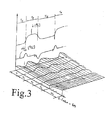
- the representation acc. Fig. 3 shows qualitatively the time course of the breathing gas flow V with assignment of the respiratory phase coordinator 5 recognized inspiratory phases T 1 and Expirationsphasen T E. Below the respiratory gas flow curve, the first derivative of the same is sketched. Depending on the entries in the data field 3 and preferably also in dependence on the pressure control signal P predetermined by the pressure setting extension 4, the criteria for the respiratory phase detection are tuned. In the exemplary embodiment shown here, in a first respiratory phase classification category K 1 the respiratory phase detection is performed by a threshold value comparison with a threshold value that changes in time with high dynamics from a comparatively large value to a relatively low value. Immediately after the detection of a respiratory phase change, the threshold is increased again.
- the immediate return to the previous respiratory phase is avoided by a dynamically adjusted dead time.
- the deviation between the maximum threshold and the minimum threshold is already lower.
- the difference between the two heavy values in the classification category 3 is even lower.
- the respiratory phase recognition takes place on the basis of an almost constant threshold value.
- respiratory phase recognition also takes place on the basis of constant thresholds, but depending on the data feed entries increasing thresholds.
- the classification categories are preferably carried out as a function of a breath pattern recognition performed by the extraction device 2 and communicating by data field entries.
- a CPAP device for carrying out home-based respiratory therapy, which automatically adjusts the respiratory gas pressure to the physiological needs of a user both for the inspiratory process and for the expiration process.
- the inventively provided extraction device it is possible to classify the current physiological state of the user by detecting the breathing activity. Based on this classification, it becomes possible to determine the currently most favorable respiratory gas pressure values for the inspiratory process and for the expiration process. Furthermore, it becomes possible to carry out the respiratory phase detection required for setting the possibly deviating pressure rule with high precision.
Landscapes
- Health & Medical Sciences (AREA)
- Emergency Medicine (AREA)
- Pulmonology (AREA)
- Engineering & Computer Science (AREA)
- Anesthesiology (AREA)
- Biomedical Technology (AREA)
- Heart & Thoracic Surgery (AREA)
- Hematology (AREA)
- Life Sciences & Earth Sciences (AREA)
- Animal Behavior & Ethology (AREA)
- General Health & Medical Sciences (AREA)
- Public Health (AREA)
- Veterinary Medicine (AREA)
- Measurement Of The Respiration, Hearing Ability, Form, And Blood Characteristics Of Living Organisms (AREA)
- Sampling And Sample Adjustment (AREA)
Applications Claiming Priority (2)
| Application Number | Priority Date | Filing Date | Title |
|---|---|---|---|
| DE10103810A DE10103810A1 (de) | 2001-01-29 | 2001-01-29 | Vorrichtung zur Zufuhr eines Atemgases |
| EP02710048A EP1357967B1 (fr) | 2001-01-29 | 2002-01-29 | Dispositif d'alimentation en gaz respiratoire |
Related Parent Applications (1)
| Application Number | Title | Priority Date | Filing Date |
|---|---|---|---|
| EP02710048.6 Division | 2002-01-29 |
Publications (2)
| Publication Number | Publication Date |
|---|---|
| EP2295101A2 true EP2295101A2 (fr) | 2011-03-16 |
| EP2295101A3 EP2295101A3 (fr) | 2013-05-29 |
Family
ID=7672018
Family Applications (2)
| Application Number | Title | Priority Date | Filing Date |
|---|---|---|---|
| EP20100185080 Ceased EP2295101A3 (fr) | 2001-01-29 | 2002-01-29 | Dispositif destiné à l'alimentation d'un gaz respiratoire |
| EP02710048A Expired - Lifetime EP1357967B1 (fr) | 2001-01-29 | 2002-01-29 | Dispositif d'alimentation en gaz respiratoire |
Family Applications After (1)
| Application Number | Title | Priority Date | Filing Date |
|---|---|---|---|
| EP02710048A Expired - Lifetime EP1357967B1 (fr) | 2001-01-29 | 2002-01-29 | Dispositif d'alimentation en gaz respiratoire |
Country Status (4)
| Country | Link |
|---|---|
| US (4) | US7717111B2 (fr) |
| EP (2) | EP2295101A3 (fr) |
| DE (1) | DE10103810A1 (fr) |
| WO (1) | WO2002060518A1 (fr) |
Families Citing this family (50)
| Publication number | Priority date | Publication date | Assignee | Title |
|---|---|---|---|---|
| DE10103810A1 (de) * | 2001-01-29 | 2002-08-01 | Map Gmbh | Vorrichtung zur Zufuhr eines Atemgases |
| US7588033B2 (en) | 2003-06-18 | 2009-09-15 | Breathe Technologies, Inc. | Methods, systems and devices for improving ventilation in a lung area |
| EP1651158B1 (fr) * | 2003-07-28 | 2018-11-07 | Salter Labs | Systeme de therapie respiratoire comprenant un ensemble canule nasale |
| AU2004266693B2 (en) | 2003-08-18 | 2011-03-10 | Breathe Technologies, Inc | Method and device for non-invasive ventilation with nasal interface |
| NZ567968A (en) | 2003-12-29 | 2009-12-24 | Resmed Ltd | Mechanical ventilation in the presence of sleep disordered breathing |
| CN101454041B (zh) | 2005-09-20 | 2012-12-12 | 呼吸科技公司 | 对患者进行呼吸支持的系统、方法和装置 |
| CN101541365A (zh) | 2006-05-18 | 2009-09-23 | 呼吸科技公司 | 气管切开方法和装置 |
| EP2068992B1 (fr) | 2006-08-03 | 2016-10-05 | Breathe Technologies, Inc. | Dispositifs de support respiratoire peu invasif |
| WO2008144589A1 (fr) | 2007-05-18 | 2008-11-27 | Breathe Technologies, Inc. | Procédés et dispositifs pour détecter la respiration et fournir une thérapie de ventilation |
| KR101397207B1 (ko) * | 2007-06-12 | 2014-05-20 | 삼성전자주식회사 | 이동 통신 시스템에서 공통제어채널 송수신 방법 및 장치 |
| JP5519510B2 (ja) | 2007-09-26 | 2014-06-11 | ブリーズ・テクノロジーズ・インコーポレーテッド | 換気装置 |
| JP5513392B2 (ja) | 2007-09-26 | 2014-06-04 | ブリーズ・テクノロジーズ・インコーポレーテッド | 睡眠時無呼吸を治療するための方法及び装置 |
| EP2276535B1 (fr) | 2008-04-18 | 2020-05-27 | Breathe Technologies, Inc. | Dispositifs pour détecter la respiration et réguler des fonctions respiratoires |
| US8770193B2 (en) | 2008-04-18 | 2014-07-08 | Breathe Technologies, Inc. | Methods and devices for sensing respiration and controlling ventilator functions |
| US8251876B2 (en) | 2008-04-22 | 2012-08-28 | Hill-Rom Services, Inc. | Breathing exercise apparatus |
| US20090306529A1 (en) * | 2008-06-06 | 2009-12-10 | Salter Labs | Adaptive temperature sensor for breath monitoring device |
| US20090306528A1 (en) * | 2008-06-06 | 2009-12-10 | Salter Labs | Adaptive temperature sensor for breath monitoring device |
| US20100168600A1 (en) * | 2008-06-06 | 2010-07-01 | Salter Labs | Support structure for airflow temperature sensor and the method of using the same |
| MX339200B (es) | 2008-06-06 | 2016-05-16 | Salter Labs | Sensor de temperatura adaptable para dispositivo de monitoreo de respiración. |
| WO2010022363A1 (fr) | 2008-08-22 | 2010-02-25 | Breathe Technologies, Inc. | Procédés et dispositifs pour fournir une ventilation mécanique avec une interface de voies respiratoires ouvertes |
| JP5711661B2 (ja) | 2008-10-01 | 2015-05-07 | ブリーズ・テクノロジーズ・インコーポレーテッド | バイオフィードバックモニタリング及び患者の活動及び健康を改善する制御装置を有するベンチレータ |
| WO2010080709A1 (fr) | 2009-01-08 | 2010-07-15 | Hancock Medical | Systèmes de pression des voies respiratoires positifs intermittents et autonomes, et méthodes de traitement de l'apnée du sommeil, du ronflement et d'autres troubles respiratoires |
| WO2010115168A1 (fr) | 2009-04-02 | 2010-10-07 | Breathe Technologies, Inc. | Procédés, systèmes et dispositifs de ventilation ouverte non vulnérante utilisant des buses d'apport de gaz prévues dans un tuyau extérieur |
| US9132250B2 (en) | 2009-09-03 | 2015-09-15 | Breathe Technologies, Inc. | Methods, systems and devices for non-invasive ventilation including a non-sealing ventilation interface with an entrainment port and/or pressure feature |
| US9962512B2 (en) | 2009-04-02 | 2018-05-08 | Breathe Technologies, Inc. | Methods, systems and devices for non-invasive ventilation including a non-sealing ventilation interface with a free space nozzle feature |
| WO2011029074A1 (fr) | 2009-09-03 | 2011-03-10 | Breathe Technologies, Inc. | Procédés, systèmes et dispositifs de ventilation non invasive comprenant une interface de ventilation non étanche avec orifice d'entraînement et/ou élément de pression |
| WO2012024342A1 (fr) | 2010-08-16 | 2012-02-23 | Breathe Technologies, Inc. | Procédés, systèmes et dispositifs utilisant de l'oxygène liquide pour fournir une assistance ventilatoire |
| CA2811423C (fr) | 2010-09-30 | 2019-03-12 | Breathe Technologies, Inc. | Procedes, systemes et dispositifs d'humidification de voies respiratoires |
| DE102010055243B4 (de) * | 2010-12-20 | 2016-10-27 | Drägerwerk AG & Co. KGaA | Automatisch gesteuertes Beatmungsgerät |
| DE102010055253B4 (de) * | 2010-12-20 | 2016-11-10 | Drägerwerk AG & Co. KGaA | Automatisch gesteuertes Beatmungsgerät |
| US8327846B2 (en) | 2011-02-08 | 2012-12-11 | Hancock Medical, Inc. | Positive airway pressure system with head position control |
| US8783250B2 (en) | 2011-02-27 | 2014-07-22 | Covidien Lp | Methods and systems for transitory ventilation support |
| US9180271B2 (en) | 2012-03-05 | 2015-11-10 | Hill-Rom Services Pte. Ltd. | Respiratory therapy device having standard and oscillatory PEP with nebulizer |
| US9993604B2 (en) | 2012-04-27 | 2018-06-12 | Covidien Lp | Methods and systems for an optimized proportional assist ventilation |
| US9375542B2 (en) | 2012-11-08 | 2016-06-28 | Covidien Lp | Systems and methods for monitoring, managing, and/or preventing fatigue during ventilation |
| US10314989B2 (en) | 2013-01-28 | 2019-06-11 | Hancock Medical, Inc. | Position control devices and methods for use with positive airway pressure systems |
| US9358355B2 (en) | 2013-03-11 | 2016-06-07 | Covidien Lp | Methods and systems for managing a patient move |
| US10327034B2 (en) * | 2014-03-27 | 2019-06-18 | Tvu Networks Corporation | Methods, apparatus and systems for exchange of video content |
| WO2016028525A1 (fr) | 2014-08-18 | 2016-02-25 | Hancock Medical, Inc. | Dispositif pap portable avec humidification |
| EP3197430A1 (fr) | 2014-09-26 | 2017-08-02 | Glaxosmithkline Intellectual Property (No. 2) Limited | Compositions pharmaceutiques à action prolongée |
| US9950129B2 (en) | 2014-10-27 | 2018-04-24 | Covidien Lp | Ventilation triggering using change-point detection |
| USD776802S1 (en) | 2015-03-06 | 2017-01-17 | Hancock Medical, Inc. | Positive airway pressure system console |
| AU2016243801B2 (en) | 2015-04-02 | 2020-05-21 | Hill-Rom Services Pte. Ltd. | Manifold for respiratory device |
| JP2019518520A (ja) | 2016-05-19 | 2019-07-04 | ハンコック メディカル, インコーポレイテッド | 位置閉塞性睡眠時無呼吸検出システム |
| US10792449B2 (en) | 2017-10-03 | 2020-10-06 | Breathe Technologies, Inc. | Patient interface with integrated jet pump |
| WO2019099185A1 (fr) | 2017-11-14 | 2019-05-23 | Covidien Lp | Méthodes et systèmes de ventilation spontanée par pression de commande |
| US11478594B2 (en) | 2018-05-14 | 2022-10-25 | Covidien Lp | Systems and methods for respiratory effort detection utilizing signal distortion |
| US11517691B2 (en) | 2018-09-07 | 2022-12-06 | Covidien Lp | Methods and systems for high pressure controlled ventilation |
| US11752287B2 (en) | 2018-10-03 | 2023-09-12 | Covidien Lp | Systems and methods for automatic cycling or cycling detection |
| CN116035560B (zh) * | 2022-12-28 | 2025-07-22 | 深圳市云中飞电子有限公司 | 呼吸事件报警方法、装置、电子设备、计算机可读介质 |
Family Cites Families (20)
| Publication number | Priority date | Publication date | Assignee | Title |
|---|---|---|---|---|
| US4448192A (en) | 1982-03-05 | 1984-05-15 | Hewlett Packard Company | Medical ventilator device parametrically controlled for patient ventilation |
| US5050614A (en) * | 1986-08-06 | 1991-09-24 | Spacelabs, Inc. | Apparatus and method for inspiration detection |
| US5134995A (en) * | 1989-05-19 | 1992-08-04 | Puritan-Bennett Corporation | Inspiratory airway pressure system with admittance determining apparatus and method |
| US5148802B1 (en) | 1989-09-22 | 1997-08-12 | Respironics Inc | Method and apparatus for maintaining airway patency to treat sleep apnea and other disorders |
| US5239995A (en) | 1989-09-22 | 1993-08-31 | Respironics, Inc. | Sleep apnea treatment apparatus |
| ATE193656T1 (de) | 1991-11-14 | 2000-06-15 | Univ Technologies Int | Automatisches system zum erzeugen eines kontinuierlichen positiven atemwegsdruck |
| US5490502A (en) * | 1992-05-07 | 1996-02-13 | New York University | Method and apparatus for optimizing the continuous positive airway pressure for treating obstructive sleep apnea |
| US5388575A (en) * | 1992-09-25 | 1995-02-14 | Taube; John C. | Adaptive controller for automatic ventilators |
| AUPM279393A0 (en) | 1993-12-03 | 1994-01-06 | Rescare Limited | Estimation of flow and detection of breathing in cpap treatment |
| US6932084B2 (en) * | 1994-06-03 | 2005-08-23 | Ric Investments, Inc. | Method and apparatus for providing positive airway pressure to a patient |
| US5551419A (en) * | 1994-12-15 | 1996-09-03 | Devilbiss Health Care, Inc. | Control for CPAP apparatus |
| US5953713A (en) * | 1995-10-26 | 1999-09-14 | Board Of Regents, The University Of Texas System | Method and apparatus for treatment of sleep disorder breathing employing artificial neural network |
| AUPN627395A0 (en) * | 1995-10-31 | 1995-11-23 | Compumedics Sleep Pty Ltd | Integrated diagnostic and therapeutic device for gas delivery to patient |
| AUPO247496A0 (en) * | 1996-09-23 | 1996-10-17 | Resmed Limited | Assisted ventilation to match patient respiratory need |
| DE19706092C2 (de) * | 1997-02-17 | 2000-02-24 | Map Gmbh | Verfahren für das Schalten in die Ein- oder Ausatmungsphase bei einem CPAP-Therapiegerät |
| DE19717106A1 (de) * | 1997-04-23 | 1998-10-29 | Map Gmbh | Vorrichtung und Verfahren zur automatisierten Beatmung in der CPAP-Therapie |
| FR2779932B1 (fr) * | 1998-06-18 | 2000-12-01 | Taema | Dispositif de determination de phases respiratoires du sommeil d'un utilisateur |
| DE20008049U1 (de) * | 1999-05-04 | 2000-08-17 | MAP Medizintechnik für Arzt und Patient GmbH & Co. KG, 82152 Planegg | Anordnung zur Diagnose und/oder Therapie schlafbezogener Atmungsstörungen |
| DE10103810A1 (de) * | 2001-01-29 | 2002-08-01 | Map Gmbh | Vorrichtung zur Zufuhr eines Atemgases |
| DE10253946B3 (de) | 2002-11-19 | 2004-01-29 | Seleon Gmbh | Verfahren für ein Beatmungsgerät, Beatmungsgerät sowie Speichermedium |
-
2001
- 2001-01-29 DE DE10103810A patent/DE10103810A1/de not_active Withdrawn
-
2002
- 2002-01-29 EP EP20100185080 patent/EP2295101A3/fr not_active Ceased
- 2002-01-29 EP EP02710048A patent/EP1357967B1/fr not_active Expired - Lifetime
- 2002-01-29 WO PCT/EP2002/000907 patent/WO2002060518A1/fr not_active Ceased
- 2002-01-29 US US10/470,348 patent/US7717111B2/en not_active Expired - Fee Related
-
2010
- 2010-03-31 US US12/750,850 patent/US8061354B2/en not_active Expired - Fee Related
-
2011
- 2011-10-12 US US13/271,567 patent/US8522781B2/en not_active Expired - Fee Related
-
2013
- 2013-08-30 US US14/014,478 patent/US9827387B2/en not_active Expired - Fee Related
Non-Patent Citations (1)
| Title |
|---|
| None * |
Also Published As
| Publication number | Publication date |
|---|---|
| EP1357967A1 (fr) | 2003-11-05 |
| US20120024288A1 (en) | 2012-02-02 |
| EP2295101A3 (fr) | 2013-05-29 |
| US20100180898A1 (en) | 2010-07-22 |
| US20140000612A1 (en) | 2014-01-02 |
| US8522781B2 (en) | 2013-09-03 |
| EP1357967B1 (fr) | 2012-08-01 |
| US8061354B2 (en) | 2011-11-22 |
| DE10103810A1 (de) | 2002-08-01 |
| US7717111B2 (en) | 2010-05-18 |
| US9827387B2 (en) | 2017-11-28 |
| WO2002060518A1 (fr) | 2002-08-08 |
| WO2002060518A9 (fr) | 2002-10-31 |
| US20040112382A1 (en) | 2004-06-17 |
Similar Documents
| Publication | Publication Date | Title |
|---|---|---|
| EP1357967B1 (fr) | Dispositif d'alimentation en gaz respiratoire | |
| EP1136094B1 (fr) | Appareil de ventilation artificielle avec un dispositif de surveillance | |
| DE60128770T2 (de) | Atemgerät mit adaptivem Trigger | |
| DE69730748T2 (de) | Vorrichtung zur steuerung der gas- oder arzneimittelverabreichung zu einem patienten | |
| EP1294426A1 (fr) | Dispositif de detection de l'activite respiratoire d'une personne | |
| DE60203246T2 (de) | Aktive implantierbare medizinische Vorrichtung mit verbesserten Mitteln zum Unterscheiden zwischen den Phasen von Wachzustand und Schlafzustand | |
| DE69800637T2 (de) | Auswahl von Grenzwerten für Patientenüberwachungssysteme | |
| DE102006057709B4 (de) | Vorrichtung und Verfahren zum Bestimmen einer Atemfrequenz | |
| DE69731899T2 (de) | Vorrichtung zum optimieren des kontinuierlichen positiven luftwegdrucks zum behandeln des atemstillstandes im schlaf bei verlegten atemwegen | |
| DE69430693T2 (de) | Medizinisches Beatmungsgerät | |
| EP1727580B1 (fr) | Procede de commande d'un appareil bi-level et appareil bi-level | |
| DE69636501T2 (de) | Einrichtung zur messung von mindestens zwei pneumatischen lungenparametern und messverfahren dazu | |
| DE102007048774A1 (de) | Detektion von Operations-Phasen und/oder Eingriffen | |
| EP1605998A1 (fr) | Procede et dispositif pour le titrage de signaux de mesure physiologiques en association avec l'observation de troubles respiratoires du sommeil d'un patient | |
| DE102006006632A1 (de) | Vorrichtung zur Beatmung sowie Verfahren zur Steuerung eines Beatmungsgerätes | |
| EP3769668A1 (fr) | Analyseur d'inspiration, appareil respiratoire et procédé d'analyse d'inspiration | |
| DE102018000741A1 (de) | Beatmungsgerät mit Synchronitätsindex | |
| DE60023301T2 (de) | Vorrichtung und verfahren zum behandeln einer durchflussbehinderung der obereren atemwege | |
| EP2989978B1 (fr) | Appareil de respiration pour detection de une cheyene-strokes-respiration | |
| DE10118968A1 (de) | Verfahren zum Steuern des Solldrucks eines Geräts zur Druchführung der CPAP-Therapie sowie ein Gerät zur Durchführung der CPAP-Therapie | |
| EP1706162A1 (fr) | Dispositif de respiration pour le traitement de l'apnee du sommeil et son procede de controle | |
| DE102019120307A1 (de) | Vorrichtung zur unterstützenden Beatmung eines Lebewesens und Computerprogramm | |
| EP1408832A2 (fr) | Dispositif de commande pour definir une pression de gaz respiratoire | |
| EP1518579B1 (fr) | Appareil respiratoire | |
| DE19940070B4 (de) | Anlage zur Überwachung von Patienten mit Schlafstörungen |
Legal Events
| Date | Code | Title | Description |
|---|---|---|---|
| PUAI | Public reference made under article 153(3) epc to a published international application that has entered the european phase |
Free format text: ORIGINAL CODE: 0009012 |
|
| AC | Divisional application: reference to earlier application |
Ref document number: 1357967 Country of ref document: EP Kind code of ref document: P |
|
| AK | Designated contracting states |
Kind code of ref document: A2 Designated state(s): AT BE CH CY DE DK ES FI FR GB GR IE IT LI LU MC NL PT SE TR |
|
| RIN1 | Information on inventor provided before grant (corrected) |
Inventor name: HEIDMANN, DIETER Inventor name: SCHNEIDER, HARTMUT Inventor name: MADAUS, STEFAN Inventor name: MEIER, JOERG Inventor name: JAKOBS, RAINER Inventor name: BRANDMEIER, RICHARD Inventor name: VOEGELE, HARALD Inventor name: SCHAETZL, STEFAN |
|
| RAP1 | Party data changed (applicant data changed or rights of an application transferred) |
Owner name: RESMED R&D GERMANY GMBH |
|
| PUAL | Search report despatched |
Free format text: ORIGINAL CODE: 0009013 |
|
| AK | Designated contracting states |
Kind code of ref document: A3 Designated state(s): AT BE CH CY DE DK ES FI FR GB GR IE IT LI LU MC NL PT SE TR |
|
| RIC1 | Information provided on ipc code assigned before grant |
Ipc: A61M 16/00 20060101AFI20130424BHEP |
|
| 17P | Request for examination filed |
Effective date: 20131105 |
|
| RBV | Designated contracting states (corrected) |
Designated state(s): AT BE CH CY DE DK ES FI FR GB GR IE IT LI LU MC NL PT SE TR |
|
| 17Q | First examination report despatched |
Effective date: 20150310 |
|
| 18R | Application refused |
Effective date: 20180222 |