EP2295513A2 - Verbesserte strukturelle Klebstoffe - Google Patents
Verbesserte strukturelle Klebstoffe Download PDFInfo
- Publication number
- EP2295513A2 EP2295513A2 EP20100193801 EP10193801A EP2295513A2 EP 2295513 A2 EP2295513 A2 EP 2295513A2 EP 20100193801 EP20100193801 EP 20100193801 EP 10193801 A EP10193801 A EP 10193801A EP 2295513 A2 EP2295513 A2 EP 2295513A2
- Authority
- EP
- European Patent Office
- Prior art keywords
- coated
- metal
- additives
- adhesive material
- aspect ratio
- Prior art date
- Legal status (The legal status is an assumption and is not a legal conclusion. Google has not performed a legal analysis and makes no representation as to the accuracy of the status listed.)
- Withdrawn
Links
Images



Classifications
-
- C—CHEMISTRY; METALLURGY
- C09—DYES; PAINTS; POLISHES; NATURAL RESINS; ADHESIVES; COMPOSITIONS NOT OTHERWISE PROVIDED FOR; APPLICATIONS OF MATERIALS NOT OTHERWISE PROVIDED FOR
- C09J—ADHESIVES; NON-MECHANICAL ASPECTS OF ADHESIVE PROCESSES IN GENERAL; ADHESIVE PROCESSES NOT PROVIDED FOR ELSEWHERE; USE OF MATERIALS AS ADHESIVES
- C09J9/00—Adhesives characterised by their physical nature or the effects produced, e.g. glue sticks
- C09J9/02—Electrically-conducting adhesives
-
- C—CHEMISTRY; METALLURGY
- C09—DYES; PAINTS; POLISHES; NATURAL RESINS; ADHESIVES; COMPOSITIONS NOT OTHERWISE PROVIDED FOR; APPLICATIONS OF MATERIALS NOT OTHERWISE PROVIDED FOR
- C09J—ADHESIVES; NON-MECHANICAL ASPECTS OF ADHESIVE PROCESSES IN GENERAL; ADHESIVE PROCESSES NOT PROVIDED FOR ELSEWHERE; USE OF MATERIALS AS ADHESIVES
- C09J11/00—Features of adhesives not provided for in group C09J9/00, e.g. additives
-
- C—CHEMISTRY; METALLURGY
- C09—DYES; PAINTS; POLISHES; NATURAL RESINS; ADHESIVES; COMPOSITIONS NOT OTHERWISE PROVIDED FOR; APPLICATIONS OF MATERIALS NOT OTHERWISE PROVIDED FOR
- C09J—ADHESIVES; NON-MECHANICAL ASPECTS OF ADHESIVE PROCESSES IN GENERAL; ADHESIVE PROCESSES NOT PROVIDED FOR ELSEWHERE; USE OF MATERIALS AS ADHESIVES
- C09J11/00—Features of adhesives not provided for in group C09J9/00, e.g. additives
- C09J11/02—Non-macromolecular additives
- C09J11/04—Non-macromolecular additives inorganic
-
- H—ELECTRICITY
- H05—ELECTRIC TECHNIQUES NOT OTHERWISE PROVIDED FOR
- H05K—PRINTED CIRCUITS; CASINGS OR CONSTRUCTIONAL DETAILS OF ELECTRIC APPARATUS; MANUFACTURE OF ASSEMBLAGES OF ELECTRICAL COMPONENTS
- H05K9/00—Screening of apparatus or components against electric or magnetic fields
- H05K9/0073—Shielding materials
- H05K9/0081—Electromagnetic shielding materials, e.g. EMI, RFI shielding
- H05K9/0083—Electromagnetic shielding materials, e.g. EMI, RFI shielding comprising electro-conductive non-fibrous particles embedded in an electrically insulating supporting structure, e.g. powder, flakes, whiskers
-
- C—CHEMISTRY; METALLURGY
- C08—ORGANIC MACROMOLECULAR COMPOUNDS; THEIR PREPARATION OR CHEMICAL WORKING-UP; COMPOSITIONS BASED THEREON
- C08K—Use of inorganic or non-macromolecular organic substances as compounding ingredients
- C08K2201/00—Specific properties of additives
- C08K2201/016—Additives defined by their aspect ratio
-
- C—CHEMISTRY; METALLURGY
- C08—ORGANIC MACROMOLECULAR COMPOUNDS; THEIR PREPARATION OR CHEMICAL WORKING-UP; COMPOSITIONS BASED THEREON
- C08K—Use of inorganic or non-macromolecular organic substances as compounding ingredients
- C08K7/00—Use of ingredients characterised by shape
-
- C—CHEMISTRY; METALLURGY
- C08—ORGANIC MACROMOLECULAR COMPOUNDS; THEIR PREPARATION OR CHEMICAL WORKING-UP; COMPOSITIONS BASED THEREON
- C08K—Use of inorganic or non-macromolecular organic substances as compounding ingredients
- C08K9/00—Use of pretreated ingredients
- C08K9/02—Ingredients treated with inorganic substances
-
- C—CHEMISTRY; METALLURGY
- C09—DYES; PAINTS; POLISHES; NATURAL RESINS; ADHESIVES; COMPOSITIONS NOT OTHERWISE PROVIDED FOR; APPLICATIONS OF MATERIALS NOT OTHERWISE PROVIDED FOR
- C09J—ADHESIVES; NON-MECHANICAL ASPECTS OF ADHESIVE PROCESSES IN GENERAL; ADHESIVE PROCESSES NOT PROVIDED FOR ELSEWHERE; USE OF MATERIALS AS ADHESIVES
- C09J2301/00—Additional features of adhesives in the form of films or foils
- C09J2301/40—Additional features of adhesives in the form of films or foils characterized by the presence of essential components
- C09J2301/412—Additional features of adhesives in the form of films or foils characterized by the presence of essential components presence of microspheres
-
- H—ELECTRICITY
- H01—ELECTRIC ELEMENTS
- H01B—CABLES; CONDUCTORS; INSULATORS; SELECTION OF MATERIALS FOR THEIR CONDUCTIVE, INSULATING OR DIELECTRIC PROPERTIES
- H01B1/00—Conductors or conductive bodies characterised by the conductive materials; Selection of materials as conductors
- H01B1/20—Conductive material dispersed in non-conductive organic material
-
- H—ELECTRICITY
- H01—ELECTRIC ELEMENTS
- H01B—CABLES; CONDUCTORS; INSULATORS; SELECTION OF MATERIALS FOR THEIR CONDUCTIVE, INSULATING OR DIELECTRIC PROPERTIES
- H01B1/00—Conductors or conductive bodies characterised by the conductive materials; Selection of materials as conductors
- H01B1/20—Conductive material dispersed in non-conductive organic material
- H01B1/22—Conductive material dispersed in non-conductive organic material the conductive material comprising metals or alloys
-
- H—ELECTRICITY
- H01—ELECTRIC ELEMENTS
- H01B—CABLES; CONDUCTORS; INSULATORS; SELECTION OF MATERIALS FOR THEIR CONDUCTIVE, INSULATING OR DIELECTRIC PROPERTIES
- H01B1/00—Conductors or conductive bodies characterised by the conductive materials; Selection of materials as conductors
- H01B1/20—Conductive material dispersed in non-conductive organic material
- H01B1/24—Conductive material dispersed in non-conductive organic material the conductive material comprising carbon-silicon compounds, carbon or silicon
-
- H—ELECTRICITY
- H05—ELECTRIC TECHNIQUES NOT OTHERWISE PROVIDED FOR
- H05K—PRINTED CIRCUITS; CASINGS OR CONSTRUCTIONAL DETAILS OF ELECTRIC APPARATUS; MANUFACTURE OF ASSEMBLAGES OF ELECTRICAL COMPONENTS
- H05K1/00—Printed circuits
- H05K1/02—Details
- H05K1/0213—Electrical arrangements not otherwise provided for
- H05K1/0254—High voltage adaptations; Electrical insulation details; Overvoltage or electrostatic discharge protection ; Arrangements for regulating voltages or for using plural voltages
- H05K1/0257—Overvoltage protection
- H05K1/0259—Electrostatic discharge [ESD] protection
-
- H—ELECTRICITY
- H05—ELECTRIC TECHNIQUES NOT OTHERWISE PROVIDED FOR
- H05K—PRINTED CIRCUITS; CASINGS OR CONSTRUCTIONAL DETAILS OF ELECTRIC APPARATUS; MANUFACTURE OF ASSEMBLAGES OF ELECTRICAL COMPONENTS
- H05K3/00—Apparatus or processes for manufacturing printed circuits
- H05K3/30—Assembling printed circuits with electric components, e.g. with resistors
- H05K3/32—Assembling printed circuits with electric components, e.g. with resistors electrically connecting electric components or wires to printed circuits
- H05K3/321—Assembling printed circuits with electric components, e.g. with resistors electrically connecting electric components or wires to printed circuits by conductive adhesives
-
- Y—GENERAL TAGGING OF NEW TECHNOLOGICAL DEVELOPMENTS; GENERAL TAGGING OF CROSS-SECTIONAL TECHNOLOGIES SPANNING OVER SEVERAL SECTIONS OF THE IPC; TECHNICAL SUBJECTS COVERED BY FORMER USPC CROSS-REFERENCE ART COLLECTIONS [XRACs] AND DIGESTS
- Y10—TECHNICAL SUBJECTS COVERED BY FORMER USPC
- Y10T—TECHNICAL SUBJECTS COVERED BY FORMER US CLASSIFICATION
- Y10T428/00—Stock material or miscellaneous articles
- Y10T428/249921—Web or sheet containing structurally defined element or component
- Y10T428/249924—Noninterengaged fiber-containing paper-free web or sheet which is not of specified porosity
- Y10T428/249933—Fiber embedded in or on the surface of a natural or synthetic rubber matrix
-
- Y—GENERAL TAGGING OF NEW TECHNOLOGICAL DEVELOPMENTS; GENERAL TAGGING OF CROSS-SECTIONAL TECHNOLOGIES SPANNING OVER SEVERAL SECTIONS OF THE IPC; TECHNICAL SUBJECTS COVERED BY FORMER USPC CROSS-REFERENCE ART COLLECTIONS [XRACs] AND DIGESTS
- Y10—TECHNICAL SUBJECTS COVERED BY FORMER USPC
- Y10T—TECHNICAL SUBJECTS COVERED BY FORMER US CLASSIFICATION
- Y10T428/00—Stock material or miscellaneous articles
- Y10T428/249921—Web or sheet containing structurally defined element or component
- Y10T428/249924—Noninterengaged fiber-containing paper-free web or sheet which is not of specified porosity
- Y10T428/249933—Fiber embedded in or on the surface of a natural or synthetic rubber matrix
- Y10T428/249937—Fiber is precoated
-
- Y—GENERAL TAGGING OF NEW TECHNOLOGICAL DEVELOPMENTS; GENERAL TAGGING OF CROSS-SECTIONAL TECHNOLOGIES SPANNING OVER SEVERAL SECTIONS OF THE IPC; TECHNICAL SUBJECTS COVERED BY FORMER USPC CROSS-REFERENCE ART COLLECTIONS [XRACs] AND DIGESTS
- Y10—TECHNICAL SUBJECTS COVERED BY FORMER USPC
- Y10T—TECHNICAL SUBJECTS COVERED BY FORMER US CLASSIFICATION
- Y10T428/00—Stock material or miscellaneous articles
- Y10T428/249921—Web or sheet containing structurally defined element or component
- Y10T428/249924—Noninterengaged fiber-containing paper-free web or sheet which is not of specified porosity
- Y10T428/24994—Fiber embedded in or on the surface of a polymeric matrix
-
- Y—GENERAL TAGGING OF NEW TECHNOLOGICAL DEVELOPMENTS; GENERAL TAGGING OF CROSS-SECTIONAL TECHNOLOGIES SPANNING OVER SEVERAL SECTIONS OF THE IPC; TECHNICAL SUBJECTS COVERED BY FORMER USPC CROSS-REFERENCE ART COLLECTIONS [XRACs] AND DIGESTS
- Y10—TECHNICAL SUBJECTS COVERED BY FORMER USPC
- Y10T—TECHNICAL SUBJECTS COVERED BY FORMER US CLASSIFICATION
- Y10T428/00—Stock material or miscellaneous articles
- Y10T428/249921—Web or sheet containing structurally defined element or component
- Y10T428/249924—Noninterengaged fiber-containing paper-free web or sheet which is not of specified porosity
- Y10T428/24994—Fiber embedded in or on the surface of a polymeric matrix
- Y10T428/249948—Fiber is precoated
-
- Y—GENERAL TAGGING OF NEW TECHNOLOGICAL DEVELOPMENTS; GENERAL TAGGING OF CROSS-SECTIONAL TECHNOLOGIES SPANNING OVER SEVERAL SECTIONS OF THE IPC; TECHNICAL SUBJECTS COVERED BY FORMER USPC CROSS-REFERENCE ART COLLECTIONS [XRACs] AND DIGESTS
- Y10—TECHNICAL SUBJECTS COVERED BY FORMER USPC
- Y10T—TECHNICAL SUBJECTS COVERED BY FORMER US CLASSIFICATION
- Y10T428/00—Stock material or miscellaneous articles
- Y10T428/25—Web or sheet containing structurally defined element or component and including a second component containing structurally defined particles
-
- Y—GENERAL TAGGING OF NEW TECHNOLOGICAL DEVELOPMENTS; GENERAL TAGGING OF CROSS-SECTIONAL TECHNOLOGIES SPANNING OVER SEVERAL SECTIONS OF THE IPC; TECHNICAL SUBJECTS COVERED BY FORMER USPC CROSS-REFERENCE ART COLLECTIONS [XRACs] AND DIGESTS
- Y10—TECHNICAL SUBJECTS COVERED BY FORMER USPC
- Y10T—TECHNICAL SUBJECTS COVERED BY FORMER US CLASSIFICATION
- Y10T428/00—Stock material or miscellaneous articles
- Y10T428/31504—Composite [nonstructural laminate]
- Y10T428/31511—Of epoxy ether
- Y10T428/31515—As intermediate layer
Definitions
- the present invention relates to adhesive materials, and particularly, but not exclusively to, structural pastes and film adhesive materials.
- Braids can provide improved electro-magnetic protection for both the adhesive, and the structure which the adhesive is a constituent of, but at the disadvantage of increased expense and increased weight. This increased expense and weight is particularly disadvantageous in fields where increased component weight is undesirable.
- a combination high aspect ratio additives and low aspect ratio additives such as silver coated glass beads and silver coated glass fibres, in a adhesive polymeric resin of an adhesive material greatly reduces its bulk electrical resistivity in the z-direction (through the thickness). This results in improved electrical conductivity through the adhesive material. Additionally, the same improvements in electrical conductivity can be obtained by using only the low aspect ratio or high aspect ratio metal-coated additives at low loading amounts (i.e. low aspect ratio metal-coated additives at 0.2 wt.% to 30 wt.% or discrete high aspect ratio metal-coated additives at 0.2 to 25 wt.%).
- the adhesive material is arranged between the joint substrates, and facilitates the electrical conduction between the substrates.
- the reduction in bulk electrical resistivity and improvement in conductivity of the adhesive material provides improved electrical transfer between the bonded substrates, thus providing for dissipation of electric discharge energy, and more specifically improved lightning strike performance.
- metal-coated additives e.g. adhesion/bonding, lap shear strength, viscosity, compression, or flexibility.
- the volume resistivity is only measured in the z-direction (through the joint). In every case it is referenced as the “volume” resistivity as the thickness is always taken into consideration in the calculation. However in conditions where the conductive additives both control the thickness and change the electrical conductivity, establishment "volume resistivity" is calculated the same way but the actual term becomes inaccurate.
- the term "aspect ratio" used herein is understood to refer to the ratio of the longest dimension to the shortest dimension of a three dimensional body.
- the term is applicable to additives of any shape and size as used herein. Where the term is used in relation to spherical or substantially spherical bodies, the relevant ratio would be that of the largest cross sectional diameter to the smallest cross sectional diameter of the spherical body. It will therefore be understood that a perfect sphere would have an aspect ration of 1:1.
- the aspect ratios as specified herein for metal-coated additives are based on the dimensions of the additives after the metal coating has been applied.
- the low aspect ratio metal-coated additives are metal-coated additives having an aspect ratio of less than 10:1.
- the aspect ratio is less than 5:1. More preferably, the aspect ratio is less than 2:1.
- the core material formed from polymer may be formed from any suitable thermoplastic or thermosetting polymer.
- thermoplastic polymer and “thermosetting polymer” are as characterised herein.
- the core material formed from metal or metal alloys may be of any suitable metal or metal alloys having high electrical conductivity.
- Suitable metal or metal alloys include, by way of example, silver, gold, nickel, copper, tin, aluminium, platinum, palladium, bronze, or brass.
- the core material may be porous or hollow, or may itself comprise a core-shell structure, for example core-shell polymer particles.
- microspheres or beads may be porous or hollow, or may themselves comprise a core-shell structure, for example core-shell polymer particles.
- Use of hollow low aspect ratio metal-coated additives in general, hollow metal-coated microspheres, or hollow metal-coated beads in particular, may be advantageous for applications where weight reduction is of particular importance.
- the low aspect ratio metal-coated additives may generally have a size in the range 2 ⁇ m to 250 ⁇ m.
- the low aspect ratio metal-coated additives may be present in the range 0.2 wt.% to 30 wt.% of the adhesive material. More preferably, they may be present in the range 1 wt.% to 20 wt.%. Most preferably, they may be present in the range 2 wt.% to 15 wt.%.
- the high aspect ratio metal-coated additives are metal-coated additives having an aspect ratio greater than 10:1.
- Suitable high aspect ratio metal-coated additives may be selected from, by way of example, particles, fibres, flakes, rods, any other three-dimensional particles, or any combination thereof.
- the high aspect ratio metal-coated additives may comprise a core material which may be completely or partially coated by at least one suitable metal.
- Suitable three dimensional bodies for the core material include, by way of example, particles, fibres, flakes, rods, any other suitable three-dimensional bodies, or any combination thereof.
- the core material formed from glass may be any of the types used for making solid or glass microspheres.
- Suitable glass may contain silica, or may be substantially silica free.
- suitable silica containing glass include soda glass, borosilicate, and quartz.
- a suitable substantially silica free glass is, by way of example, chalcogenide glass.
- Preferred core materials which can be used in a metal-coated form include carbon nanotubes, carbon nanofibres or any high aspect ratio three dimensional body made from polymer, glass, carbon, metal or metal alloys.
- Suitable core materials formed from fibres include glass fibres, carbon fibres, carbon nanotubes, carbon nanofibres, and suitable polymer based fibres.
- Particularly preferred core materials include glass fibres and carbon fibres.
- Metal-coated fibres or metal-coated flakes are preferred as the high aspect ratio metal-coated additives. Particularly preferred are metal-coated fibres.
- the high aspect ratio metal-coated additives may be used in any suitable combination in the adhesive material.
- Suitable combinations of metal-coated additives include metal-coated intrinsically conducting polymer fibres (ICPs - including polypyrrole, polythiophene, and polyaniline), and metal-coated glass fibres.
- ICPs metal-coated intrinsically conducting polymer fibres
- the high aspect ratio metal-coated additives may have a size dispersion with at least 80% of the additives having a size in the range 10 ⁇ m to 6,000 ⁇ m. Preferably, with at least 80% of the additives having a size in the range 50 ⁇ m to 1,000 ⁇ m. Most preferably, with at 80% of the additives having a sized in the range 80 ⁇ m to 300 ⁇ m.
- the metal-coated fibres may have a size dispersion with at least 80% of the fibres having a size in the range 50 ⁇ m to 6,000 ⁇ m. Preferably, with at least 80% of the fibres having a size in the range 80 ⁇ m to 1,000 ⁇ m. Most preferably, with at least 80% of the fibres having a size in the range 100 ⁇ m to 400 ⁇ m.
- high aspect ratio metal-coated additives having core fibres formed from glass fibres or carbon fibres may have a length in the range 100 ⁇ m to 300 ⁇ m.
- the additives may have a length in the range 10 ⁇ m to 100 ⁇ m. It is also envisaged that where the core fibres are carbon nanotubes, the additives may have a length in the range 1 ⁇ m to 15 ⁇ m.
- Core materials based on fibres may have a diameter in the range 1 ⁇ m to 25 ⁇ m.
- core materials based on carbon nanotubes or carbon nanofibres may have a diameter in the range 0.50 ⁇ m (500 nm) to 1 ⁇ m.
- the metal-coated fibres may have an aspect ratio in the range 10:1 to 10,000:1.
- the aspect ratio is in the range 10:1 to 1,000:1. More preferably, the aspect ratio is in the range 10:1 to 100:1.
- the aspect ratio may be in the range 30:1 to 10,000:1.
- the high aspect ratio metal-coated additives may be present in the range 0.2 wt.% to 25 wt.% of the adhesive material. More preferably, they may be present in the range 1 wt.% to 20 wt.%. Most preferably, they may be present in the range 2 wt.% to 15 wt.%.
- Metals suitable for coating either the low aspect ratio or high aspect ratio metal-coated additives include, by way of example, silver, gold, nickel, copper, tin, aluminium, platinum, palladium, and other metals which may have high electrical conductivity.
- metals suitable for coating the additives may include metal alloys having high electrical conductivity.
- Suitable alloys include bronze, brass, sterling silver, pewter, cupronickel, duralumin, or any other suitable alloys.
- Multiple layers of metal coatings may be used to coat the additives, for example gold coated copper, or silver coated copper. Any suitable combination of metals may be used to provide multiple layers of metal coatings. Simultaneous deposition of metals may also be used, thereby producing mixed metal coatings.
- the mixed metal coatings may provide enhanced properties such as conductivity, corrosion resistance, or energy dissipation.
- the metal coating may be carried out by any of the means known for coating additives.
- suitable coating processes include chemical vapour deposition, sputtering, electroplating, or electroless deposition.
- the metal may be present as bulk metal, porous metal, columnar, microcrystalline, fibrillar, dendritic, or any other form known in metal coating.
- the metal coating once applied to the additive, may provide a smooth surface.
- the metal coating, once applied to the additive may comprise surface irregularities such as fibrils, or bumps so as to increase the specific surface area and improve interfacial bonding.
- the additives, once coated with metal may be of any suitable shape for example spherical, ellipsoidal, spheroidal, discoidal, dendritic, rods, discs, acicular, cuboid or polyhedral.
- the metal-coated additives may have well defined geometries or may be irregular in shape.
- the metal-coated additive size distribution may be monodisperse or polydisperse.
- the metal-coated additives are distributed in the uncured or unprocessed adhesive material. It is envisaged that the term “distributed” includes where the metal-coated additives may be present throughout the entire adhesive material. Alternatively, the term includes the metal-coated additives being present in substantially higher concentrations in specific parts or localised areas of the uncured or unprocessed adhesive material.
- distributed also includes the embodiment where the metal-coated additives are present throughout the entire adhesive material before application to the joint. Once the adhesive material is applied to the substrate, the additives may continue to be distributed throughout the entire adhesive material, or may be present in localised areas of the material.
- the metal-coated additives may be suitably distributed within the adhesive polymeric resin of the adhesive material by conventional methods, including mixing or blending operations.
- the adhesive polymeric resin will have an initial bulk electrical resistivity that is lowered by addition of the metal-coated additives in accordance with the first aspect or the fourth aspect of the present invention.
- Preferred combinations of metal-coated additives may include high aspect ratio metal-coated fibres and low aspect ratio metal-coated beads in a ratio of 3:1.
- metal-coated additives of the present invention include glass or carbon fibres coated with silver or nickel, in combination with solid or hollow glass spheres or polymer beads also coated in silver.
- a suitable combination of metal-coated beads and metal-coated fibres is silver coated glass fibre having lengths in the range 150 to 300 ⁇ m with silver coated hollow glass beads having a size in the range 10 to 40 ⁇ m.
- a further embodiment of the present invention for providing a toughened layer with a lower specific gravity may be obtained by use of a mixture of metal-coated carbon fibres with metal-coated rubber beads.
- thermoset resin is more preferably selected from epoxy resins, cyanate ester resins, bismaleimide resins, vinyl ester resins, benzoxazine resins, or phenolic resins.
- the metallic particles may be formed from, by way of example, silver, gold, nickel, copper, tin, aluminium, platinum, palladium, and other metals known to possess high electrical conductivity.
- the metallic particles may be made from alloys known to possess high electrical conductivity.
- Suitable alloys may include bronze, brass, sterling silver, pewter, cupronickel, duralumin, or any other suitable alloys.
- Particularly preferred non-metallic particles include carbon nanofibres, carbon nanotubes, carbon black, graphite, and polyaniline.
- Toughening particles/agents may include, by way of example, any of the following either alone or in combination: polyamides, copolyamides, polyimides, aramids, polyketones, polyetheretherketones, polyarylene ethers, polyesters, polyurethanes, polysulphones, high performance hydrocarbon polymers, liquid crystal polymers, PTFE, elastomers, segmented elastomers such as reactive liquid rubbers based on homo or copolymers of acrylonitrile, butadiene, styrene, cyclopentadiene, acrylate, or polyurethane rubbers.
- the adhesive material containing all the necessary metal-coated particles and optional additives and carriers can be processed by any of the known methods to manufacture and apply adhesives, for example a so-called lacquer process, resin film process, extrusion, spraying, cartridge dispenser process, printing, or other known methods.
- the present invention when used for aerospace components, can be used for adhering primary structure parts (i.e. those parts of the structure which are critical for maintaining the integrity of the airplane), as well as adhering secondary structure parts.
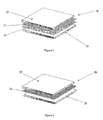
- FIG. 2 there is shown a schematic perspective view of a further alternate joint assembly 20.
- the assembly 20 comprises two substrates which are aluminium plates 22 and 23. Sandwiched between the substrates 22 and 23 is a layer of paste adhesive material 21 containing additional spheres (conductive or non-conductive) large enough to control the bondline thickness. A usual size for spacing spheres is 80 ⁇ m to 150 ⁇ m in diameter.
- the layer of adhesive material 21 can also comprise conductive additives.
- the whole assembly 20 can be cured.
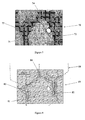
- FIG. 5 there is shown a micrograph ( Figure 5 ) and a schematic view ( Figure 6 ) of a polished cross section of an assembly 50 and 60.
- the assembly 50 and 60 is an aluminium-aluminium joint comprising film adhesive material 51 and 61 (based on resin used in Example 14-2) and a nylon carrier A1050 (Heathcoat of Tiverton, UK) 53 and 63 arranged between two layers of substrate 55 and 65.
- the adhesive material layer 51 and 61 comprises distributed silver-coated glass beads 52 and 62 and silver-coated glass fibres 54 and 64.
- the ratio of fibres 54 and 64 to beads 52 and 62 is 3:1.
- the bondline thickness of the adhesive material layer between the substrates 55 and 65 is 120 ⁇ m.
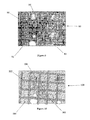
- FIG. 11 there is shown a micrograph ( Figure 11 ) and a schematic view ( Figure 12 ) of a polished cross section of assembly 110 and 120.
- the assembly 110 and 120 is an aluminium-aluminium joint comprising film adhesive material 111 and 121 (based on resin from Example 14-2) and a PET carrier 113 and 123 (F0826 from Heathcoat, Tiverton, UK) arranged between two layers of substrate 115 and 125.
- the adhesive material layer 111 and 121 comprises distributed silver-coated glass beads 112 and 122 and silver-coated glass fibres 114 and 124.
- the ratio of fibres 114 and 124 to beads 112 and 122 is 3:1.
- the bondline thickness of the adhesive material layer between the substrates 115 and 125 is 100 ⁇ m.
- the micrograph ( Figure 11 ) and the schematic view ( Figure 12 ) of the joint section clearly show how the fibres 114 and 124 can directly or indirectly bridge the substrates 115 and 125.
- the thickness is usually controlled by introducing a carrier 113 and 123 in the joint.
- the adhesive paste used as host for the conductive additives is a two part epoxy paste Redux®870 available from Hexcel (Duxford, UK).
- the conductive additives were added in the part A (epoxy resin) and thoroughly mixed using a Flaktec Speedmixer.
- the part B (curative) was subsequently added and mixed by the same method prior to being applied on the adherend and cured according to standard conditions. Part A and B were mixed in the proportion 100:45 by weight respectively.
- the two-part paste adhesive can be cured at temperatures in the range of 25°C to 120°C, and in these examples was cured for 1 hour at 100°C between parallel plate heating presses under 4 bar pressure.
- the heating rate used was 3°C per min from 25°C to 100°C.
- the volume resistivity test method for adhesive material is derived from ASTM D2739-97 (reapproved 2004) - Standards Test Method for Volume Resistivity of Conductive Adhesives.
- the main difference between the method D2739-97 and the one used for the purpose of this invention is that volume resistivity of the cured adhesive layer was measured between aluminium adherends instead of silver-plated or gold plated adherends.
- the system comprises two aluminium plates and a layer of adhesive material 74 x 74 x t mm 3 where t is the thickness of the joint and depends on the spacer used and the pressure applied. A usual value for t is 80 ⁇ m to 200 ⁇ m.
- the non-conductive carrier A1050 from Heathcoat (Tiverton, UK) was used as a spacer unless an alternative is stated.
- the bondline thickness can vary from 120 ⁇ 15 ⁇ m in films to 130 ⁇ 20 ⁇ m in pastes.
- Two devices are used to measure the electrical resistance through the aluminium-aluminium joint.
- a resistivity meter model 272 from Monroe Electronics is used.
- the device is made of a ring electrode and a circular metal electrode placed on the top and bottom surface of the joint specimen respectively.
- the flat and smooth surface of the aluminium plates ensures the good contact between the electrodes and the specimen.
- a precision micro/milli Ohmmeter BS407 from Thurlby Thandar Instruments (TTi) equipped with Kelvin clip leads is used. The clips are plugged on the top and bottom aluminium plates.
- the adhesive materials were cured following the same conditions as for the resistivity test specimens. Six specimens are tested for each batch and the average of the resulting shear strengths is calculated. In order to eliminate the batch to batch variation, the shear strength of the modified adhesive material is compared to the shear strength of the batch of neat resin from which it is made. The retention value is given in percentages.
- viscosity was measured with a parallel plate/controlled shear CVO 120 Rheometer obtained from Bohlin Instruments (Malvern, UK).
- the modified or neat part A of adhesive paste was tested at 25°C between a cone plate 4° angle/40 mm in diameter situated 1mm away from the bottom plate at a constant shear rate of 4 s -1 .
- the resulting complex viscosity value is an average of at least 20 points.
- the viscosity of the modified adhesive material is compared to the viscosity of the batch of neat part A resin from which it is made.
- the retention value given in percentages in the tables herein was calculated from the log 10 of the complex viscosity values.
- the film adhesives were cured at 2°C/min up to 240°C between parallel plates situated 1mm away from each other and oscillating at a frequency of 3 Hz at constant strain. The viscosity was measured over this range of temperature. The minimum viscosity of the adhesive material containing conductive additives is compared to the minimum viscosity of the neat resin from which it is made.
- Examples 1 to 3 represent prior art reference examples in which the adhesive material comprises polymeric resin and non-metal coated additives only.
- Examples 4-12 represent examples in which the adhesive material comprises polymeric resin and various combinations of metal coated low and high aspect ratio additives.
- the addition of silver-coated glass beads also decreases the volume resistivity of the paste.
- the viscosity of the modified part A is decreased and the shear properties are not significantly affected.
- the decrease in resistivity is similar to modified adhesive with fibre alone at similar loading.
- the viscosity is not increased as much as with fibres alone and the shear properties are no longer affected, and even slightly improved at a loading of 5.5 wt.%.
- Conductivity is enhanced further at conductive additive loadings of 11 wt.% and the other properties are, unexpectedly, only moderately affected by such a fibre loading.
- metal-coated hollow glass beads and metal-coated polymer beads offer a good light weight alternative to the solid glass beads.
- Table 5 Volume resistivity, viscosity retention and shear strength retention of paste adhesive modified with conductive adhesives. Ex n° Silvered Glass Fibres Silvered Glass Beads 20 ⁇ m Silvered Glass Beads 100 ⁇ m z-direction Volume Resistivity Viscosity Retention Lap Shear Strength Retention wt.% wt.% wt.% ⁇ m % % 1 - - - 7x10 11 100 100.0 6-1 4.1 1.4 - 0.7 104 105.9 12 - - 2.7 0.05 98 104.5
- two adhesive films are used as hosts for the conductive additives.
- One is an epoxy-based films Redux®330 available from Hexcel (Duxford, UK).
- the second is also an epoxy-based adhesive film referenced as Resin and has a similar composition as Redux®330.
- the adhesive material was prepared by blending all the components uniformly in a Z-blade mixer (Winkworth Machinery Ltd, Reading, UK). The conductive particles were added during this process without altering the mixing parameters.
- the resins were cast into 110 gsm to 120 gsm films prior to be assembled with the carrier, applied on the adherend, and cured following conventional conditions.
- the two adhesive films used in these examples were cured for 1 hour at 175°C between parallel plate heating presses under 4 bar pressure.
- the heating rate was 3°C per min from room temperature to 175°C.
- Neat resins were prepared in a Z-blade mixer and cast into 110gsm films. Specimens for resistivity measurement and lap shear tests were cured and tested following the procedure described before. Results for resistivity, viscosity and shear strength measurement are summarised in Table 6.
- the bondline thickness of the cured joint was measured by image analysis from a cut and polished view of the resistivity test specimens. The bondline of the joints cured with A1050 was 120 ⁇ 15 ⁇ m thick.
- the conductive additives were distributed into one of the liquid resins constitutive of the adhesive materials Redux®330 and neat resin using a Flaktec speedmixer.
- the adhesive material was then prepared, including this premix, in a Z-blade mixer and cast into 110gsm films.
- the final resin film contained 4.1 wt.% silver coated glass fibres and 1.4 wt.% beads (ratio fibres/beads 3:1).
- Specimens for resistivity measurement and lap shear tests were cured and tested following the procedure described before.
- the bondline of the joints cured with A1050 was 120 ⁇ 15 ⁇ m thick. Results for resistivity, viscosity and shear strength measurement were summarised in Table 6.
- Table 6 Volume resistivity, viscosity and shear strength of adhesive films modified with conductive additives.
- n° Adhesive film Silvered Glass Fibres Silvered Glass Beads z-direction Volume Resistivity Minimum Viscosity Retention Lap Shear Strength Retention wt.% wt.% ⁇ m % % 13-1 Redux330 - - 2x10 11 100 100 14-1 Redux330 4.1 1.4 0.12 106 85 13-2 Resin - - 7x10 11 100 100 14-2 Resin 4.1 1.4 0.09 97 144
- the conductivity through adhesive joints can thus be improved greatly by the addition of a low loading of carefully chosen conductive particles.
- the use of a combination of high aspect ratio particles such as fibres and low aspect ratio particles such as spheres close to a volume ratio 3:1 shows improved conductivity levels and unchanged or manageable changes in viscosity and mechanical properties.
- Another benefit of this invention is that dispersion of such particles is relatively easy and does not require any major change of processing.
Landscapes
- Chemical & Material Sciences (AREA)
- Organic Chemistry (AREA)
- Physics & Mathematics (AREA)
- Electromagnetism (AREA)
- Engineering & Computer Science (AREA)
- Microelectronics & Electronic Packaging (AREA)
- Inorganic Chemistry (AREA)
- Adhesives Or Adhesive Processes (AREA)
Applications Claiming Priority (2)
| Application Number | Priority Date | Filing Date | Title |
|---|---|---|---|
| GB0710425A GB0710425D0 (en) | 2007-06-01 | 2007-06-01 | Improved structural adhesive materials |
| EP20080762216 EP2152831B1 (de) | 2007-06-01 | 2008-06-02 | Verbesserte strukturelle haftmaterialien |
Related Parent Applications (2)
| Application Number | Title | Priority Date | Filing Date |
|---|---|---|---|
| EP20080762216 Division EP2152831B1 (de) | 2007-06-01 | 2008-06-02 | Verbesserte strukturelle haftmaterialien |
| EP08762216.3 Division | 2008-06-02 |
Publications (2)
| Publication Number | Publication Date |
|---|---|
| EP2295513A2 true EP2295513A2 (de) | 2011-03-16 |
| EP2295513A3 EP2295513A3 (de) | 2018-01-17 |
Family
ID=38289635
Family Applications (3)
| Application Number | Title | Priority Date | Filing Date |
|---|---|---|---|
| EP10193831.4A Withdrawn EP2295514A3 (de) | 2007-06-01 | 2008-06-02 | Verbesserte strukturelle Klebstoffe |
| EP20080762216 Not-in-force EP2152831B1 (de) | 2007-06-01 | 2008-06-02 | Verbesserte strukturelle haftmaterialien |
| EP10193801.7A Withdrawn EP2295513A3 (de) | 2007-06-01 | 2008-06-02 | Verbesserte strukturelle Klebstoffe |
Family Applications Before (2)
| Application Number | Title | Priority Date | Filing Date |
|---|---|---|---|
| EP10193831.4A Withdrawn EP2295514A3 (de) | 2007-06-01 | 2008-06-02 | Verbesserte strukturelle Klebstoffe |
| EP20080762216 Not-in-force EP2152831B1 (de) | 2007-06-01 | 2008-06-02 | Verbesserte strukturelle haftmaterialien |
Country Status (6)
| Country | Link |
|---|---|
| US (1) | US8840813B2 (de) |
| EP (3) | EP2295514A3 (de) |
| AT (1) | ATE528368T1 (de) |
| ES (1) | ES2375318T3 (de) |
| GB (1) | GB0710425D0 (de) |
| WO (1) | WO2008146014A2 (de) |
Cited By (2)
| Publication number | Priority date | Publication date | Assignee | Title |
|---|---|---|---|---|
| CN102433098A (zh) * | 2011-09-19 | 2012-05-02 | 常州合润新材料科技有限公司 | 一种填充石墨烯各向同性高性能导热胶粘剂及制备方法 |
| US9780236B2 (en) | 2013-12-17 | 2017-10-03 | Industrial Technology Research Institute | Conductive paste composition and method for manufacturing electrode |
Families Citing this family (47)
| Publication number | Priority date | Publication date | Assignee | Title |
|---|---|---|---|---|
| DE102008020441A1 (de) * | 2008-04-23 | 2009-10-29 | Merck Patent Gmbh | Klebstoff |
| KR100964561B1 (ko) | 2009-06-01 | 2010-06-21 | 박기호 | 도전성 점착제 조성물 |
| BR112012000203B1 (pt) * | 2009-06-12 | 2020-01-28 | Lord Corp | método para proteção de um substrato contra relâmpagos |
| NO333507B1 (no) * | 2009-06-22 | 2013-06-24 | Condalign As | Fremgangsmate for a lage et anisotropisk, ledende lag og en derav frembrakt gjenstand |
| CN102598895B (zh) * | 2009-11-06 | 2016-06-08 | 3M创新有限公司 | 具有非卤化固化剂的电介质材料 |
| KR101305072B1 (ko) * | 2009-12-30 | 2013-09-11 | 제일모직주식회사 | 탄소 섬유상 금속 복합체 및 그 제조방법 |
| KR101307378B1 (ko) * | 2009-12-31 | 2013-09-11 | 제일모직주식회사 | 전자파 차폐 특성이 우수한 열가소성 수지 조성물 |
| CN103190209B (zh) | 2010-10-26 | 2016-05-18 | 汉高知识产权控股有限责任公司 | 用于板级emi屏蔽的复合膜 |
| US8796361B2 (en) | 2010-11-19 | 2014-08-05 | Ppg Industries Ohio, Inc. | Adhesive compositions containing graphenic carbon particles |
| US20140150970A1 (en) | 2010-11-19 | 2014-06-05 | Ppg Industries Ohio, Inc. | Structural adhesive compositions |
| CN102903414A (zh) * | 2011-07-29 | 2013-01-30 | 硕禾电子材料股份有限公司 | 导电组合物和用于太阳能电池片的导电组合物 |
| JP2013058471A (ja) * | 2011-07-29 | 2013-03-28 | Giga Solar Materials Corp | 導電性組成物および製造法 |
| US9546100B2 (en) * | 2011-08-29 | 2017-01-17 | Purdue Research Foundation | Continuous-flow solar ultraviolet disinfection system for drinking water |
| US9484123B2 (en) | 2011-09-16 | 2016-11-01 | Prc-Desoto International, Inc. | Conductive sealant compositions |
| JP5872440B2 (ja) * | 2012-02-13 | 2016-03-01 | Dowaエレクトロニクス株式会社 | 球状銀粉およびその製造方法 |
| CA2872477C (en) * | 2012-05-03 | 2018-01-23 | Ppg Industries Ohio, Inc. | Adhesive compositions containing graphenic carbon particles |
| DE102012207462A1 (de) * | 2012-05-04 | 2013-11-07 | Tesa Se | Dreidimensional elektrisch leitfähige Klebstofffolie |
| GB2510133B (en) * | 2013-01-24 | 2017-08-30 | Bae Systems Plc | Conductive bonded composites |
| AU2013200685B2 (en) * | 2013-02-08 | 2015-08-06 | Bower Aero Pty Ltd | Adhesive and method of manufacturing same |
| WO2014197009A1 (en) * | 2013-06-05 | 2014-12-11 | Hybrid Coatings And Components Llc | Shield assembly for protecting spacecraft |
| US9334386B2 (en) * | 2013-09-04 | 2016-05-10 | Alfaisal University | Antimicrobial polymer-graphene-silver nanocomposite |
| JP6327550B2 (ja) * | 2014-01-07 | 2018-05-23 | パナソニックIpマネジメント株式会社 | 金属部材用接着剤組成物とこれを用いた熱可塑性樹脂被覆金属部材 |
| JP6383183B2 (ja) * | 2014-06-03 | 2018-08-29 | 太陽インキ製造株式会社 | 導電性接着剤およびそれを用いた電子部品 |
| CN104130735B (zh) * | 2014-07-22 | 2016-01-06 | 深圳市华星光电技术有限公司 | 石墨烯球导电胶的制备方法及该石墨烯球导电胶 |
| JP2017524801A (ja) * | 2014-08-14 | 2017-08-31 | アルテコ コリア カンパニー リミテッド | 伝導性複合体及びその製造方法 |
| CN104262953B (zh) * | 2014-08-21 | 2016-06-29 | 巨石集团有限公司 | 一种石墨烯涂覆玻璃纤维增强树脂基复合材料及制备方法 |
| US10213984B2 (en) | 2014-09-22 | 2019-02-26 | Cytec Industries Inc. | Composite materials with high Z-direction electrical conductivity |
| DE112015004599A5 (de) | 2014-10-07 | 2017-08-24 | Schleifring Und Apparatebau Gmbh | Drehübertrager mit Schirmung aus gefüllten SMC und/oder BMC Materialien |
| EP3064560B1 (de) | 2015-03-05 | 2022-05-04 | Henkel AG & Co. KGaA | Thermisch leitfähiger Klebstoff |
| CN104774573B (zh) * | 2015-03-30 | 2019-04-23 | 中国电子科技集团公司第三十八研究所 | 一种含石墨烯的高性能导电银胶及其制备方法 |
| US9963619B2 (en) | 2015-11-24 | 2018-05-08 | Orbital Atk, Inc. | Electrically conductive adhesives, assemblies including the electrically conductive adhesives, and related methods |
| EP3395894B1 (de) * | 2015-12-24 | 2020-04-15 | Kaneka Corporation | Harzzusammensetzung und klebefolie |
| US20180065327A1 (en) * | 2016-04-18 | 2018-03-08 | Littelfuse, Inc. | Electromagnetic interference suppression device and method for manufacturing same |
| WO2018042701A1 (ja) * | 2016-08-30 | 2018-03-08 | 日立化成株式会社 | 接着剤組成物 |
| CN108913057B (zh) | 2017-03-27 | 2023-11-10 | 昆山雅森电子材料科技有限公司 | 一种多层异向型导电布胶及其制作方法 |
| KR102346866B1 (ko) * | 2017-05-09 | 2022-01-04 | 쓰리엠 이노베이티브 프로퍼티즈 컴파니 | 전기 전도성 접착제 |
| US20190070847A1 (en) * | 2017-06-07 | 2019-03-07 | Sustainable Solutions International Llc | Anilox cleaning blanket |
| CN107722932B (zh) * | 2017-10-24 | 2020-11-27 | 浙江理工大学 | 一种碳/聚苯胺吸波微球的制备方法 |
| CN109843029B (zh) * | 2017-11-29 | 2021-05-25 | 深圳光启岗达创新科技有限公司 | 吸波复合材料及其制备方法 |
| CN108284647B (zh) * | 2018-01-24 | 2020-12-22 | 河南蓝翎环科防水材料有限公司 | 具有自愈性、自粘性的防水卷材及防水结构 |
| KR20240069825A (ko) | 2018-05-16 | 2024-05-20 | 헨켈 아게 운트 코. 카게아아 | 다이 부착을 위한 경화성 접착제 조성물 |
| WO2020076806A1 (en) * | 2018-10-10 | 2020-04-16 | Global Graphene Group, Inc. | Highly conductive graphitic thick films and method of production |
| US12187870B2 (en) * | 2020-01-27 | 2025-01-07 | The University Of Akron | Electrically conductive polymer adhesives with complex dimensional filters |
| CN114296286A (zh) * | 2020-09-22 | 2022-04-08 | 广州奥翼电子科技股份有限公司 | 一种固态电泳显示薄膜材料和显示装置 |
| CN114296287A (zh) * | 2020-09-22 | 2022-04-08 | 广州奥翼电子科技股份有限公司 | 一种固态电泳显示薄膜材料和显示装置 |
| US20230117613A1 (en) * | 2021-10-18 | 2023-04-20 | Ving Dee Pu | Carbon Graphene Compound Additive to Eliminate ESD and EMI, and Also Manipulate Dielectric Constant |
| JP7750267B2 (ja) * | 2022-11-30 | 2025-10-07 | Jfeスチール株式会社 | パネル部品用接合構造、及びパネル部品の取付け方法 |
Family Cites Families (9)
| Publication number | Priority date | Publication date | Assignee | Title |
|---|---|---|---|---|
| US4740657A (en) * | 1986-02-14 | 1988-04-26 | Hitachi, Chemical Company, Ltd | Anisotropic-electroconductive adhesive composition, method for connecting circuits using the same, and connected circuit structure thus obtained |
| US5240761A (en) * | 1988-08-29 | 1993-08-31 | Minnesota Mining And Manufacturing Company | Electrically conductive adhesive tape |
| US5620795A (en) * | 1993-11-10 | 1997-04-15 | Minnesota Mining And Manufacturing Company | Adhesives containing electrically conductive agents |
| US5951918A (en) * | 1995-02-08 | 1999-09-14 | Hitachi Chemical Company, Ltd. | Composite electroconductive powder, electroconductive paste, process for producing electroconductive paste, electric circuit and process for producing electric circuit |
| US5840215A (en) * | 1996-12-16 | 1998-11-24 | Shell Oil Company | Anisotropic conductive adhesive compositions |
| EP1099541A4 (de) * | 1998-05-26 | 2002-02-13 | Mitsui Takeda Chemicals Inc | Material zum formen einer wärmehärtbaren kunstharzfolie, herstellungsverfahren und geformtes produkt |
| US6533963B1 (en) * | 1999-02-12 | 2003-03-18 | Robert A. Schleifstein | Electrically conductive flexible compositions, and materials and methods for making same |
| US20070241303A1 (en) * | 1999-08-31 | 2007-10-18 | General Electric Company | Thermally conductive composition and method for preparing the same |
| US6909100B2 (en) * | 2002-07-25 | 2005-06-21 | Ii-Vi Incorporated | Radiation detector assembly |
-
2007
- 2007-06-01 GB GB0710425A patent/GB0710425D0/en not_active Ceased
-
2008
- 2008-06-02 EP EP10193831.4A patent/EP2295514A3/de not_active Withdrawn
- 2008-06-02 WO PCT/GB2008/001858 patent/WO2008146014A2/en not_active Ceased
- 2008-06-02 US US12/601,826 patent/US8840813B2/en active Active
- 2008-06-02 AT AT08762216T patent/ATE528368T1/de active
- 2008-06-02 EP EP20080762216 patent/EP2152831B1/de not_active Not-in-force
- 2008-06-02 ES ES08762216T patent/ES2375318T3/es active Active
- 2008-06-02 EP EP10193801.7A patent/EP2295513A3/de not_active Withdrawn
Non-Patent Citations (1)
| Title |
|---|
| None |
Cited By (3)
| Publication number | Priority date | Publication date | Assignee | Title |
|---|---|---|---|---|
| CN102433098A (zh) * | 2011-09-19 | 2012-05-02 | 常州合润新材料科技有限公司 | 一种填充石墨烯各向同性高性能导热胶粘剂及制备方法 |
| CN102433098B (zh) * | 2011-09-19 | 2013-10-30 | 常州合润新材料科技有限公司 | 一种填充石墨烯各向同性高性能导热胶粘剂及制备方法 |
| US9780236B2 (en) | 2013-12-17 | 2017-10-03 | Industrial Technology Research Institute | Conductive paste composition and method for manufacturing electrode |
Also Published As
| Publication number | Publication date |
|---|---|
| US8840813B2 (en) | 2014-09-23 |
| EP2295514A2 (de) | 2011-03-16 |
| ATE528368T1 (de) | 2011-10-15 |
| EP2295513A3 (de) | 2018-01-17 |
| ES2375318T3 (es) | 2012-02-28 |
| EP2152831A2 (de) | 2010-02-17 |
| US20100276645A1 (en) | 2010-11-04 |
| EP2152831B1 (de) | 2011-10-12 |
| WO2008146014A2 (en) | 2008-12-04 |
| WO2008146014A3 (en) | 2009-06-04 |
| EP2295514A3 (de) | 2018-01-17 |
| GB0710425D0 (en) | 2007-07-11 |
Similar Documents
| Publication | Publication Date | Title |
|---|---|---|
| EP2152831B1 (de) | Verbesserte strukturelle haftmaterialien | |
| EP2271486B1 (de) | Verbesserte verbundmaterialien | |
| EP2540491B1 (de) | Verbesserte Verbundwerkstoffe | |
| EP2431438B1 (de) | Elektrisch leitfähiger Klebstoff | |
| US9202607B2 (en) | Conductivity of resin materials and composite materials | |
| US20130330514A1 (en) | Composite materials | |
| JP2015057472A (ja) | プリプレグ及びその製造方法 |
Legal Events
| Date | Code | Title | Description |
|---|---|---|---|
| PUAI | Public reference made under article 153(3) epc to a published international application that has entered the european phase |
Free format text: ORIGINAL CODE: 0009012 |
|
| 17P | Request for examination filed |
Effective date: 20101206 |
|
| AC | Divisional application: reference to earlier application |
Ref document number: 2152831 Country of ref document: EP Kind code of ref document: P |
|
| AK | Designated contracting states |
Kind code of ref document: A2 Designated state(s): AT BE BG CH CY CZ DE DK EE ES FI FR GB GR HR HU IE IS IT LI LT LU LV MC MT NL NO PL PT RO SE SI SK TR |
|
| AX | Request for extension of the european patent |
Extension state: AL BA MK RS |
|
| PUAL | Search report despatched |
Free format text: ORIGINAL CODE: 0009013 |
|
| AK | Designated contracting states |
Kind code of ref document: A3 Designated state(s): AT BE BG CH CY CZ DE DK EE ES FI FR GB GR HR HU IE IS IT LI LT LU LV MC MT NL NO PL PT RO SE SI SK TR |
|
| AX | Request for extension of the european patent |
Extension state: AL BA MK RS |
|
| RIC1 | Information provided on ipc code assigned before grant |
Ipc: C09J 201/00 20060101ALI20171208BHEP Ipc: H05K 3/32 20060101ALI20171208BHEP Ipc: C09J 9/02 20060101AFI20171208BHEP |
|
| STAA | Information on the status of an ep patent application or granted ep patent |
Free format text: STATUS: THE APPLICATION IS DEEMED TO BE WITHDRAWN |
|
| 18D | Application deemed to be withdrawn |
Effective date: 20180718 |