EP2295634A2 - Procédé de formation de bande de papier continue extensible dans le sens longitudinal et transversal - Google Patents
Procédé de formation de bande de papier continue extensible dans le sens longitudinal et transversal Download PDFInfo
- Publication number
- EP2295634A2 EP2295634A2 EP10172060A EP10172060A EP2295634A2 EP 2295634 A2 EP2295634 A2 EP 2295634A2 EP 10172060 A EP10172060 A EP 10172060A EP 10172060 A EP10172060 A EP 10172060A EP 2295634 A2 EP2295634 A2 EP 2295634A2
- Authority
- EP
- European Patent Office
- Prior art keywords
- web
- roller
- compaction
- paper web
- axis
- Prior art date
- Legal status (The legal status is an assumption and is not a legal conclusion. Google has not performed a legal analysis and makes no representation as to the accuracy of the status listed.)
- Withdrawn
Links
- 238000000034 method Methods 0.000 title claims abstract description 46
- 238000005056 compaction Methods 0.000 claims abstract description 59
- XLYOFNOQVPJJNP-UHFFFAOYSA-N water Substances O XLYOFNOQVPJJNP-UHFFFAOYSA-N 0.000 claims abstract description 6
- 230000015572 biosynthetic process Effects 0.000 claims description 16
- 238000011282 treatment Methods 0.000 claims description 8
- 239000000463 material Substances 0.000 claims description 4
- 230000002093 peripheral effect Effects 0.000 claims description 4
- 230000008602 contraction Effects 0.000 claims 2
- 230000001427 coherent effect Effects 0.000 claims 1
- 229910000831 Steel Inorganic materials 0.000 description 2
- 239000010959 steel Substances 0.000 description 2
- 238000011144 upstream manufacturing Methods 0.000 description 2
- 230000002301 combined effect Effects 0.000 description 1
- 239000000470 constituent Substances 0.000 description 1
- 239000004744 fabric Substances 0.000 description 1
- 239000000835 fiber Substances 0.000 description 1
- 239000012528 membrane Substances 0.000 description 1
- 235000011837 pasties Nutrition 0.000 description 1
- 239000004033 plastic Substances 0.000 description 1
- 238000009941 weaving Methods 0.000 description 1
Images
Classifications
-
- D—TEXTILES; PAPER
- D21—PAPER-MAKING; PRODUCTION OF CELLULOSE
- D21F—PAPER-MAKING MACHINES; METHODS OF PRODUCING PAPER THEREON
- D21F11/00—Processes for making continuous lengths of paper, or of cardboard, or of wet web for fibre board production, on paper-making machines
-
- B—PERFORMING OPERATIONS; TRANSPORTING
- B65—CONVEYING; PACKING; STORING; HANDLING THIN OR FILAMENTARY MATERIAL
- B65H—HANDLING THIN OR FILAMENTARY MATERIAL, e.g. SHEETS, WEBS, CABLES
- B65H23/00—Registering, tensioning, smoothing or guiding webs
- B65H23/02—Registering, tensioning, smoothing or guiding webs transversely
- B65H23/022—Registering, tensioning, smoothing or guiding webs transversely by tentering devices
- B65H23/025—Registering, tensioning, smoothing or guiding webs transversely by tentering devices by rollers
- B65H23/0251—Registering, tensioning, smoothing or guiding webs transversely by tentering devices by rollers with a straight axis
- B65H23/0253—Registering, tensioning, smoothing or guiding webs transversely by tentering devices by rollers with a straight axis with axially movable elements
-
- B—PERFORMING OPERATIONS; TRANSPORTING
- B65—CONVEYING; PACKING; STORING; HANDLING THIN OR FILAMENTARY MATERIAL
- B65H—HANDLING THIN OR FILAMENTARY MATERIAL, e.g. SHEETS, WEBS, CABLES
- B65H23/00—Registering, tensioning, smoothing or guiding webs
- B65H23/02—Registering, tensioning, smoothing or guiding webs transversely
- B65H23/032—Controlling transverse register of web
- B65H23/038—Controlling transverse register of web by rollers
-
- B—PERFORMING OPERATIONS; TRANSPORTING
- B65—CONVEYING; PACKING; STORING; HANDLING THIN OR FILAMENTARY MATERIAL
- B65H—HANDLING THIN OR FILAMENTARY MATERIAL, e.g. SHEETS, WEBS, CABLES
- B65H23/00—Registering, tensioning, smoothing or guiding webs
- B65H23/04—Registering, tensioning, smoothing or guiding webs longitudinally
- B65H23/32—Arrangements for turning or reversing webs
-
- D—TEXTILES; PAPER
- D21—PAPER-MAKING; PRODUCTION OF CELLULOSE
- D21H—PULP COMPOSITIONS; PREPARATION THEREOF NOT COVERED BY SUBCLASSES D21C OR D21D; IMPREGNATING OR COATING OF PAPER; TREATMENT OF FINISHED PAPER NOT COVERED BY CLASS B31 OR SUBCLASS D21G; PAPER NOT OTHERWISE PROVIDED FOR
- D21H25/00—After-treatment of paper not provided for in groups D21H17/00 - D21H23/00
- D21H25/005—Mechanical treatment
-
- B—PERFORMING OPERATIONS; TRANSPORTING
- B65—CONVEYING; PACKING; STORING; HANDLING THIN OR FILAMENTARY MATERIAL
- B65H—HANDLING THIN OR FILAMENTARY MATERIAL, e.g. SHEETS, WEBS, CABLES
- B65H2404/00—Parts for transporting or guiding the handled material
- B65H2404/10—Rollers
- B65H2404/13—Details of longitudinal profile
- B65H2404/131—Details of longitudinal profile shape
- B65H2404/1316—Details of longitudinal profile shape stepped or grooved
- B65H2404/13162—Helicoidal grooves
-
- B—PERFORMING OPERATIONS; TRANSPORTING
- B65—CONVEYING; PACKING; STORING; HANDLING THIN OR FILAMENTARY MATERIAL
- B65H—HANDLING THIN OR FILAMENTARY MATERIAL, e.g. SHEETS, WEBS, CABLES
- B65H2404/00—Parts for transporting or guiding the handled material
- B65H2404/10—Rollers
- B65H2404/14—Roller pairs
-
- B—PERFORMING OPERATIONS; TRANSPORTING
- B65—CONVEYING; PACKING; STORING; HANDLING THIN OR FILAMENTARY MATERIAL
- B65H—HANDLING THIN OR FILAMENTARY MATERIAL, e.g. SHEETS, WEBS, CABLES
- B65H2801/00—Application field
- B65H2801/84—Paper-making machines
Definitions
- the present invention relates to a method for forming a continuous paper web extensible in the longitudinal direction and in the transverse direction.
- Extensible papers are known, these having the property of being extensible in one or more directions if subjected to stretching.
- the paper web under formation is caused to undergo a path comprising a first portion curved in a certain direction, followed by a portion curved in the opposite direction.
- This method makes use of the thickness of the paper web under formation, which along the first curved portion causes longitudinal compaction of those fibres located internally, with reference to the thickness of the paper web, whereas along the second curved portion it causes longitudinal compaction of those fibres which, although located in the interior of this second portion, correspond in fact to the external part of the previous portion.
- the final result consists of an overall compaction of the fibres of the paper web in the longitudinal direction, and hence of a longitudinal extensibility of the web.
- the two treatments can also be effected in sequence, to finally obtain a paper web provided with extensibility characteristics both in the longitudinal direction and in the transverse direction, however with fairly complex and costly equipment which inter alia reduces the normal productivity of a traditional continuous paper machine.
- a paper sheet under formation is positioned between two prestretched membranes of plastic material, such that their subsequent elastic return to their rest configuration causes the sheet to be compacted in all directions by entrainment, to give it extensibility characteristics in all directions.
- This method results in extremely slow operability and moreover is applicable only to paper sheets and not to the webs leaving a continuous paper machine.
- An object of the invention is to overcome all the drawbacks jointly and separately found in known methods for making extensible papers by proposing a new method which enables paper webs extensible in all directions to be formed, using a very simple apparatus applicable virtually to all continuous paper machines, without substantially reducing their productivity.
- the method of the invention consists essentially of using a known method for compacting a paper web of high water content, in particular a paper web under formation, in a manner different from that used in the traditional art. More particularly, all the known methods for compacting a paper web consist of passing the web under formation through compaction units which, while operating on the basis of different compaction techniques and using methods related to said techniques, always use rollers having their axes perpendicular to the web advancement direction. It follows that on termination of the treatment, the web leaves in the same direction as the entry direction or at most at an angle along the longitudinal plane, but always perpendicular to the roller axes.
- compaction is achieved while maintaining the rollers of the compaction unit inclined to the direction from which the paper web to be treated originates, and in particular disposed with their axes forming an angle between 30° and 60°, preferably 45°, such that compaction takes place in all cases both with a component parallel to the longitudinal axis of the paper web and with a component perpendicular thereto.
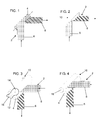
- Figure 1 schematically shows a paper web, which is diverted in passing about a roller 4.
- the paper web has a high water content of between 20% and 80%, and is thus highly pliable; it could be a web under formation in any continuous paper machine, or an already formed web subjected to a prior steeping treatment.
- the entering portion 6 of the web i.e. the web portion upstream of the roller 4 advances in a certain direction, with the axis of the roller 4 inclined to the advancement direction of the web 2 by an angle between 30° and 60°, preferably 45°; it can also be seen that the exiting portion 8 of the web 2, i.e. the web portion downstream of the roller 4, is inclined to the direction of the upstream portion 6 by an angle between 60° and 120°, in this particular case it being 90°.
- Figure 2 shows schematically, as a parallelepiped box, the unit which compacts the fibres of the web 2.
- this unit comprises the roller 4 and all that which traditionally cooperates with it to achieve compaction of the web fibres both in the longitudinal direction and in the transverse direction or, as found in practice, prevalently in one of the two directions but also with a small component in the other direction.
- the paper web portion 6 which enters the compaction unit, indicated overall by 10 has substantially no extensibility characteristics, whereas when it leaves that unit it has high extensibility characteristics.
- the web, in passing through the unit 10 is subjected to compaction treatment in a direction inclined to the web longitudinal axis, it is clear that independently of whether the compaction applied to that band of the web 2 in contact with the deviation roller 4 is transverse or longitudinal, in reality it presents both a transverse component and a longitudinal component, the extensibility ratio in one and the other direction evidently being linked both to the inclination of the roller 4 to the longitudinal axis of the entering web, and to the compaction method used.
- Figure 3 shows schematically the compaction method of FR 1 242 857 , in which the web 2 is passed between rollers, one of which is the deviation roller 4 and the other rollers, and in particular the rollers 12 and 14, are associated with a continuous web 16, which causes a first portion of the web 2 to adhere to a portion of the cylindrical surface of the deviation roller 4, and a subsequent portion of the web 2 to adhere to a portion of the cylindrical surface of the web 14.
- the web 2 which has a certain thickness and is curved in one direction, causes longitudinal compaction of the fibres on the inner (concave) side of the web, i.e. on that side of the web which adheres to the roller 14, whereas in the next portion the web 2 is curved in the opposite direction and causes longitudinal compaction of the fibres on the opposite side of the web 2, which adheres to the roller 14.
- the compaction unit is arranged perpendicular to the longitudinal axis of the web 2 and causes fibre compaction prevalently in the longitudinal direction, to give the web a certain extensibility prevalently in a longitudinal direction, whereas in the present case because the compaction unit 10 is inclined to the web advancement direction, this unit gives the web 2 extensibility both in the longitudinal direction and in the transverse direction.
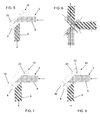
- FIG 4 shows an example of the paper web longitudinal compaction method according to US 6 024 832 .
- the compaction unit 10 essentially comprises the deviation roller 4, made of rubber, and a backing roller 18, which is made of steel and rotates in the opposite direction to the roller 4 but at a greater peripheral velocity.
- the result is that in the contact region between the rollers 4 and 18 the paper web 2 is subjected to a force which tends to cause it to advance and also to a counteracting force which tends to brake it.
- the combined effect of these two contrasting forces results in compaction of the fibres of the web 2, this compaction taking place both in the longitudinal direction and in the transverse direction because of the arrangement of the unit 10 inclined to the web advancement direction.
- FIG. 5 shows an example of the paper web transverse compaction method according to Italian Patent Application VE2008A000066 .
- the compaction unit 10 comprises the roller 4, which in this case is provided with a large circumferential cavity closed by an elastic sleeve, and a further pair of rollers 20, which interfere with the roller 4 and temporarily cause said elastic sleeve to locally retract into the circumferential cavity of the roller, to thus stretch the sleeve axially.
- the sleeve When the sleeve emerges from the interference by the rollers 20 and regains its original configuration, it causes the paper web under formation to undergo compaction parallel to the axis of the roller 4.
- the arrangement of the compaction unit 10 inclined to the longitudinal axis of the web 2 means that the compaction, which would otherwise be essentially transverse, in reality is also longitudinal with the result that the paper web obtained is extensible in all directions, with prevalence in the transverse direction or in the longitudinal direction depending on the angle of inclination of the compaction unit 10.
- the paper web instead of being simply rested on the sleeve, which has been prestretched, could possibly be pressed against this by another sleeve or by a belt or by a roller.
- the method of the invention enables the treated paper web to leave the compaction unit inclined to the entering web and, if the axes of the rollers of said compaction unit are disposed at 45° to the longitudinal axis of the entering web, the exit web will lie at an angle of 90° to the entering web.
- the invention provides for counteracting this translation by forming said roller with at least one spiral-shaped element 22, disposed such that as the roller rotates, this urges the paper web in the direction to oppose this translation.
- This spiral-shaped element can involve the deviation roller 4 as stated, but could evidently involve the roller 18 cooperating with the roller 4, or even both the rollers, and in general at least one of the two surfaces involved in carrying out the compaction of the paper web 2.
- This spiral-shaped element 22 can be formed in the most varied ways, in the sense that it can be formed integrally with the roller 4 and/or 18 to which it pertains, or can be applied to it, in which case it can be made of the same or different material. In this latter case the spiral-shaped element can be in relief relative to the surface of the roller 4 and/or 18 or can be coplanar therewith and perform its function by utilizing the greater friction which it presents compared with the remaining part of the roller surface.
- the spiralled roller 4 and/or 18 can be formed specifically for this function or can consist of a traditional loom temple, i.e. a roller used in weaving to transversely stretch the fabric, with which it is in contact.
Landscapes
- Engineering & Computer Science (AREA)
- Mechanical Engineering (AREA)
- Paper (AREA)
- Road Paving Machines (AREA)
Applications Claiming Priority (1)
| Application Number | Priority Date | Filing Date | Title |
|---|---|---|---|
| ITVE2009A000040A IT1395302B1 (it) | 2009-08-07 | 2009-08-07 | Metodo di realizzazione di un nastro continuo di carta estensibile in senso longitudinale ed in senso trasversale.- |
Publications (2)
| Publication Number | Publication Date |
|---|---|
| EP2295634A2 true EP2295634A2 (fr) | 2011-03-16 |
| EP2295634A3 EP2295634A3 (fr) | 2013-09-04 |
Family
ID=42261993
Family Applications (1)
| Application Number | Title | Priority Date | Filing Date |
|---|---|---|---|
| EP10172060.5A Withdrawn EP2295634A3 (fr) | 2009-08-07 | 2010-08-05 | Procédé de formation de bande de papier continue extensible dans le sens longitudinal et transversal |
Country Status (2)
| Country | Link |
|---|---|
| EP (1) | EP2295634A3 (fr) |
| IT (1) | IT1395302B1 (fr) |
Cited By (1)
| Publication number | Priority date | Publication date | Assignee | Title |
|---|---|---|---|---|
| CN111169179A (zh) * | 2018-11-12 | 2020-05-19 | 柯尼卡美能达株式会社 | 变形矫正装置、记录介质输送装置以及喷墨图像形成装置 |
Citations (4)
| Publication number | Priority date | Publication date | Assignee | Title |
|---|---|---|---|---|
| FR1242857A (fr) | 1958-01-20 | 1960-10-07 | Clupak Inc | Tissu à texture modifiée et procédé et machine pour sa fabrication |
| GB1194252A (en) | 1966-05-26 | 1970-06-10 | Cartiere Ambrogio Binda Spa | Improved Method and Apparatus for Creped Sheet Production. |
| US6024832A (en) | 1995-04-07 | 2000-02-15 | Giorgio Trani Cartiere Cariolaro S. P. A. | Method and apparatus for producing extensible paper |
| ITVE20080066A1 (it) | 2008-08-07 | 2010-02-08 | Giorgio Trani | Metodo di realizzazione di nastri di materiale fibroso estensibile trasversalmente, in particolare carta, ed apparecchiatura per effettuare il metodo. |
Family Cites Families (10)
| Publication number | Priority date | Publication date | Assignee | Title |
|---|---|---|---|---|
| US2071347A (en) * | 1931-08-24 | 1937-02-23 | Paper Service Co | Multilaterally stretchable creped paper product |
| US2008181A (en) * | 1932-07-29 | 1935-07-16 | Paper Service Co | Art of producing multilateral stretchability in paper webs or the like |
| US2257429A (en) * | 1937-08-04 | 1941-09-30 | Ruegenberg Gottfried | Process for producing all-around extensible paper |
| US2494334A (en) * | 1946-07-29 | 1950-01-10 | Cincinnati Ind Inc | Process of and apparatus for making longitudinally and laterally stretchable creped webs |
| US3995354A (en) * | 1975-05-30 | 1976-12-07 | Clupak, Inc. | Nip roll for treating web materials and method of manufacturing same |
| US4760627A (en) * | 1987-03-23 | 1988-08-02 | Enrique Schele | Apparatus for an oscillating pinch roll assembly utilized in the extrusion of blown films |
| DE10358185B4 (de) * | 2003-12-12 | 2006-11-02 | Voith Patent Gmbh | Verfahren zum Behandeln einer Papierbahn |
| DE102004017823A1 (de) * | 2004-04-13 | 2005-11-03 | Voith Paper Patent Gmbh | Papiermaschine |
| DE102005000045A1 (de) * | 2005-04-28 | 2006-11-02 | Voith Patent Gmbh | Verfahren zur Herstellung einer Papierbahn, insbesondere Tiefdruckpapier |
| US7926758B2 (en) * | 2006-07-31 | 2011-04-19 | Industrial Technology Research Institute | Apparatus and system for roll-to-roll processing |
-
2009
- 2009-08-07 IT ITVE2009A000040A patent/IT1395302B1/it active
-
2010
- 2010-08-05 EP EP10172060.5A patent/EP2295634A3/fr not_active Withdrawn
Patent Citations (4)
| Publication number | Priority date | Publication date | Assignee | Title |
|---|---|---|---|---|
| FR1242857A (fr) | 1958-01-20 | 1960-10-07 | Clupak Inc | Tissu à texture modifiée et procédé et machine pour sa fabrication |
| GB1194252A (en) | 1966-05-26 | 1970-06-10 | Cartiere Ambrogio Binda Spa | Improved Method and Apparatus for Creped Sheet Production. |
| US6024832A (en) | 1995-04-07 | 2000-02-15 | Giorgio Trani Cartiere Cariolaro S. P. A. | Method and apparatus for producing extensible paper |
| ITVE20080066A1 (it) | 2008-08-07 | 2010-02-08 | Giorgio Trani | Metodo di realizzazione di nastri di materiale fibroso estensibile trasversalmente, in particolare carta, ed apparecchiatura per effettuare il metodo. |
Cited By (1)
| Publication number | Priority date | Publication date | Assignee | Title |
|---|---|---|---|---|
| CN111169179A (zh) * | 2018-11-12 | 2020-05-19 | 柯尼卡美能达株式会社 | 变形矫正装置、记录介质输送装置以及喷墨图像形成装置 |
Also Published As
| Publication number | Publication date |
|---|---|
| IT1395302B1 (it) | 2012-09-05 |
| EP2295634A3 (fr) | 2013-09-04 |
| ITVE20090040A1 (it) | 2011-02-08 |
Similar Documents
| Publication | Publication Date | Title |
|---|---|---|
| DE69803049T2 (de) | Verfahren zum kalandrieren und ein kalander zur durchführung des verfahrens | |
| US3849526A (en) | Method of making webs of filter material | |
| DE644905C (de) | Verfahren und Vorrichtung zum Schrumpfen von Waeschestoffen | |
| DE69919493T2 (de) | Oberflächenwickler mit Klemmschneider | |
| NO164797B (no) | Sidelommedor. | |
| DE2413050A1 (de) | Verfahren und vorrichtung zur kompressiven schrumpfung von textilgeweben mit hoher geschwindigkeit unter verwendung einer einstellbaren gummiband-schrumpfeinheit | |
| DE1635150A1 (de) | Verfahren und Vorrichtung zum mechanischen Laengspressen von flexiblem Textilmaterial | |
| EP2278067B1 (fr) | Calandre destinée au traitement d'une bande de matériau | |
| DE1284829B (de) | Verfahren und Vorrichtung zum Beschichten von Faserstoffbahnen | |
| DE1511070A1 (de) | Verfahren und Vorrichtung zum Querrecken oder Querschrumpfen einer Materialbahn | |
| EP4158098B1 (fr) | Procédé et machine pour produire une bande fibreuse pouvant être allongée dans la direction transversale | |
| DE1611758C3 (de) | Vorrichtung zum Herstellen von dehnbaren Papierbahnen in der Papiermaschine | |
| DE10232550C5 (de) | Vorrichtung und Verfahren zum Imprägnieren einer Papier- oder Kartonbahn | |
| EP3827123B1 (fr) | Procédé de traitement d'une nappe de tissu et dispositif de traitement d'une nappe de tissu | |
| DE3437572A1 (de) | Verfahren und vorrichtung zum vorschrumpfen textiler gewebe oder gewirke | |
| DE2218074C3 (de) | Einrichtung zur kontinuierlichen Herstellung von kaschierten Spanholzbahnen | |
| DE102018127037B4 (de) | Kalander | |
| DE102009047470A1 (de) | Vorrichtung zur Behandlung einer laufenden Papier-, Karton- oder anderen Faserstoffbahn | |
| EP1837438A2 (fr) | Machine de fabrication de matériaux roulant, en particulier du papier ou du carton, et procédé de traitement d'une surface d'une bande de transport dans une machine destinée à la fabrication de matériaux roulants | |
| DE102021124107A1 (de) | Rollung von stabförmigen Artikeln der Tabak verarbeitenden Industrie | |
| DE327460C (de) | Verfahren zum Kreppen von Papierbahnen | |
| CA2040295C (fr) | Courroie sans fin et machine pour retrecir les tissues | |
| DE1511281C3 (fr) | ||
| DE9204175U1 (de) | Bahnabnahme-Vorrichtung | |
| DE1955196A1 (de) | Vorrichtung zum Stauchen von textilen Wirk- und Webwaren |
Legal Events
| Date | Code | Title | Description |
|---|---|---|---|
| PUAI | Public reference made under article 153(3) epc to a published international application that has entered the european phase |
Free format text: ORIGINAL CODE: 0009012 |
|
| AK | Designated contracting states |
Kind code of ref document: A2 Designated state(s): AL AT BE BG CH CY CZ DE DK EE ES FI FR GB GR HR HU IE IS IT LI LT LU LV MC MK MT NL NO PL PT RO SE SI SK SM TR |
|
| AX | Request for extension of the european patent |
Extension state: BA ME RS |
|
| PUAL | Search report despatched |
Free format text: ORIGINAL CODE: 0009013 |
|
| AK | Designated contracting states |
Kind code of ref document: A3 Designated state(s): AL AT BE BG CH CY CZ DE DK EE ES FI FR GB GR HR HU IE IS IT LI LT LU LV MC MK MT NL NO PL PT RO SE SI SK SM TR |
|
| AX | Request for extension of the european patent |
Extension state: BA ME RS |
|
| RIC1 | Information provided on ipc code assigned before grant |
Ipc: B65H 23/32 20060101ALI20130726BHEP Ipc: D21H 25/14 20060101AFI20130726BHEP Ipc: D21F 1/40 20060101ALI20130726BHEP |
|
| STAA | Information on the status of an ep patent application or granted ep patent |
Free format text: STATUS: THE APPLICATION IS DEEMED TO BE WITHDRAWN |
|
| 18D | Application deemed to be withdrawn |
Effective date: 20140305 |