EP2295912A2 - Panneau de corps froid de chauffage - Google Patents
Panneau de corps froid de chauffage Download PDFInfo
- Publication number
- EP2295912A2 EP2295912A2 EP10008280A EP10008280A EP2295912A2 EP 2295912 A2 EP2295912 A2 EP 2295912A2 EP 10008280 A EP10008280 A EP 10008280A EP 10008280 A EP10008280 A EP 10008280A EP 2295912 A2 EP2295912 A2 EP 2295912A2
- Authority
- EP
- European Patent Office
- Prior art keywords
- elevations
- shell
- shells
- recesses
- flow path
- Prior art date
- Legal status (The legal status is an assumption and is not a legal conclusion. Google has not performed a legal analysis and makes no representation as to the accuracy of the status listed.)
- Granted
Links
Images



Classifications
-
- F—MECHANICAL ENGINEERING; LIGHTING; HEATING; WEAPONS; BLASTING
- F28—HEAT EXCHANGE IN GENERAL
- F28D—HEAT-EXCHANGE APPARATUS, NOT PROVIDED FOR IN ANOTHER SUBCLASS, IN WHICH THE HEAT-EXCHANGE MEDIA DO NOT COME INTO DIRECT CONTACT
- F28D1/00—Heat-exchange apparatus having stationary conduit assemblies for one heat-exchange medium only, the media being in contact with different sides of the conduit wall, in which the other heat-exchange medium is a large body of fluid, e.g. domestic or motor car radiators
- F28D1/02—Heat-exchange apparatus having stationary conduit assemblies for one heat-exchange medium only, the media being in contact with different sides of the conduit wall, in which the other heat-exchange medium is a large body of fluid, e.g. domestic or motor car radiators with heat-exchange conduits immersed in the body of fluid
- F28D1/03—Heat-exchange apparatus having stationary conduit assemblies for one heat-exchange medium only, the media being in contact with different sides of the conduit wall, in which the other heat-exchange medium is a large body of fluid, e.g. domestic or motor car radiators with heat-exchange conduits immersed in the body of fluid with plate-like or laminated conduits
- F28D1/0308—Heat-exchange apparatus having stationary conduit assemblies for one heat-exchange medium only, the media being in contact with different sides of the conduit wall, in which the other heat-exchange medium is a large body of fluid, e.g. domestic or motor car radiators with heat-exchange conduits immersed in the body of fluid with plate-like or laminated conduits the conduits being formed by paired plates touching each other
-
- F—MECHANICAL ENGINEERING; LIGHTING; HEATING; WEAPONS; BLASTING
- F28—HEAT EXCHANGE IN GENERAL
- F28F—DETAILS OF HEAT-EXCHANGE AND HEAT-TRANSFER APPARATUS, OF GENERAL APPLICATION
- F28F3/00—Plate-like or laminated elements; Assemblies of plate-like or laminated elements
- F28F3/02—Elements or assemblies thereof with means for increasing heat-transfer area, e.g. with fins, with recesses, with corrugations
- F28F3/025—Elements or assemblies thereof with means for increasing heat-transfer area, e.g. with fins, with recesses, with corrugations the means being corrugated, plate-like elements
-
- F—MECHANICAL ENGINEERING; LIGHTING; HEATING; WEAPONS; BLASTING
- F28—HEAT EXCHANGE IN GENERAL
- F28D—HEAT-EXCHANGE APPARATUS, NOT PROVIDED FOR IN ANOTHER SUBCLASS, IN WHICH THE HEAT-EXCHANGE MEDIA DO NOT COME INTO DIRECT CONTACT
- F28D21/00—Heat-exchange apparatus not covered by any of the groups F28D1/00 - F28D20/00
- F28D2021/0019—Other heat exchangers for particular applications; Heat exchange systems not otherwise provided for
- F28D2021/0035—Other heat exchangers for particular applications; Heat exchange systems not otherwise provided for for domestic or space heating, e.g. heating radiators
-
- Y—GENERAL TAGGING OF NEW TECHNOLOGICAL DEVELOPMENTS; GENERAL TAGGING OF CROSS-SECTIONAL TECHNOLOGIES SPANNING OVER SEVERAL SECTIONS OF THE IPC; TECHNICAL SUBJECTS COVERED BY FORMER USPC CROSS-REFERENCE ART COLLECTIONS [XRACs] AND DIGESTS
- Y02—TECHNOLOGIES OR APPLICATIONS FOR MITIGATION OR ADAPTATION AGAINST CLIMATE CHANGE
- Y02B—CLIMATE CHANGE MITIGATION TECHNOLOGIES RELATED TO BUILDINGS, e.g. HOUSING, HOUSE APPLIANCES OR RELATED END-USER APPLICATIONS
- Y02B30/00—Energy efficient heating, ventilation or air conditioning [HVAC]
Definitions
- the invention relates to a heating-Kühlêteel according to the preamble of claim 1.
- the subject of the invention may be a radiator panel as well as a heat sink panel.
- a radiator panel as well as a heat sink panel.
- Such panels are used alone or to form multi-layer heating heatsinks.
- Such panels are known and are to be improved while retaining the exact shape and construction of their front or front shell. This improvement should in particular be in the efficiency of the panel, which should be increased by the lowest possible water content and thus achieved a high reaction speed in the rules. Furthermore, the heat output to be increased by the wetted surface of the two half-shells is increased and at the same time the air cross-section for the past the air moving past the panel is increased. Furthermore, the convection ribs, especially in multi-layer heating heatsinks may have a greater depth. Ultimately, the average surface temperature of the half-shells and thus the radiation power to be increased or decreased depending on the use.
- the half-shells lie in particular line-shaped, extending along the flow path or contact surfaces abutting or touching or are arranged at a mutual distance, or that the flanks between the elevations and depressions of a half-shell and the flanks between the protrusions and recesses of the other half-shell abut each other or touch each other at least along a number of touch points or contact strips or are arranged at a mutual distance.
- the inner wall surfaces of successive elevations in the half-shells and the inner wall surfaces of the recesses receiving these elevations abut each other or are connected to each other and the Transition regions or flanks between the elevations and the recesses receiving them are at a mutual distance and form or limit the flow path.
- the flow path is not or only partially limited by the elevations and depressions.
- a variable structure of the heating-Kssel redesign arises especially when the flow path is limited by the alternately successive elevations and depressions in the two half-shells.
- the flow path is formed by all existing elevations and depressions or only by every second elevation in one half shell and the associated depression in the respective other half shell.
- a specific embodiment provides that the inner wall surfaces of successive elevations in one, preferably the outer, half shell are connected to the inner wall surfaces of the depressions of the other half shell receiving these elevations, wherein the inner wall surface of the elevations of the other half shell is connected to the inner wall surface of the depressions a half-shell and possibly also the inner wall surfaces of the transition regions or flanks between the elevations and the depressions are at a distance from each other and so limited space represents the flow path.
- the stability of the radiator is increased if in the areas of a - preferably in the use position internal - half shell, in which the elevations and depressions abut each other, the base surfaces of Konvektorblechen attached, in particular welded or clinched, are.
- the base surfaces of Konvektorblechen, in particular welded or clinched are ,
- a good flow characteristic is achieved when the successive elevations and depressions in the respective half-shells in a sectional plane perpendicular to the flow path have uneven width, wherein the ratio of the widths B: B 'of the recesses and the elevations in the half-shell between 1: 1 and 1: 2 and or in the (n) in use the front (V) or in a multi-layer heating heat sink, the front and the rear or wall side forming half-shell (s), the wells are narrower than the surveys.
- a stable structure or good cohesion of the panels results when in the course or along a in use the rear surface of a panel or an inner surface of a two-layer heating heat sink forming half-shell in the wells of this half-shell a number of the other, the front or the rear wall-forming half-shell is formed towards or pronounced connecting knobs, which are connected to the wall portions of the recesses of this half-shell by welding, soldering, gluing or clinching and / or if in the course or along the in use the rear surface of the panel or a Inner surface of a two-layer heating heat sink forming half-shell in the wall regions of the elevations of this half-shell a number of on the other, the front-forming or the outer half-shell directed towards or pronounced spacer is formed on the inner wall surface of the recesses of these opposite supported horizontally arranged half-shell and the two half-shells against each other and connected to this shell optionally by welding, soldering, gluing and / or clinching and / or
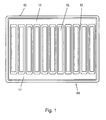
- Fig. 1 shows a panel in front view and its front and visible side (V).
- the structure of the surface of this panel corresponds to conventional panels.
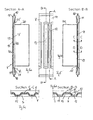
- Fig. 3 shows a known two-layer heating heat sink in section, in which half shells H1, the forward facing front surface V and the outwardly back or in use facing to a wall rear surface, as these half-shells H1 in Fig. 1 are shown.
- the respective inner surfaces of this heating heat sink are formed by equally constructed half-shells H2.
- the half-shell H1 representing the front surfaces V and the half-shell H2 forming the respective rear surface R or the inner surface of a panel form wavy or bent, successive elevations 13, 13 'and depressions 12, 12' wall surface areas have, which define flow channels S between them.
- the half shells H1 and H2 are connected to each other, for example by welding, soldering or gluing.
- elevations of a half-shell H1 or H2 wall surface areas which - viewed from the volume of the flow channel ago - extend into the space between the two half-shells H1, H2 or reduce this, whereas depressions in expand the half-shells H1 and H2, the space between the half-shells H1, H2 and the flow channels in the form of a bulge as seen from the interior of the flow channels.
- the elevations 13, 13 ' are based on the outer surface of the respective half-shell H1, H2 further inside or represent indentations of the outer surface.
- the mutually spaced recesses 12, 12 'of the half-shells H1, H2 define between them the flow path or flow channels S, according to Fig. 1 from a laterally, in particular at the top collecting duct 11 to an opposite lateral, in particular lower collecting duct 11 'extend.
- At the back R of the inner half shells H2 of the two panels is one each Konvektorblech 20 connected, in such a way that the base surfaces 21 of the Konvektorbleches 20 are connected to the outer surfaces of the recesses 12 'of the half-shell H2.
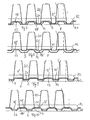
- a heating heat sink as it is formed in accordance with the invention and in Fig. 4 is shown, it can be seen that the half shells H1, H2 elevations 13, 13 'and recesses 12, 12' have, which limit a flow path S, wherein from the interior of the heating heat sink, that is, seen from the flow path S forth in the Recesses 12 of a half-shell H1 protrude the elevations 13 'of the other half-shell H2.
- a relatively narrow flow path S is formed, which extends between the collecting channels 11 and 11 '.
- the distance from opposite elevations and depressions or the thickness of the flow path S corresponds to 10 to 30% of the width of a depression 12 'of the half-shell H2.
- each of the half shells facing the flow path S bounded by the two half shells H1, H2 and partly projecting therefrom, are received by recesses 12, 12' in part or over a partial area of their height, which are located in the latter a half shell H1 facing wall of the opposite half-shell H2 are formed.
- half-shells H1, H2 in, in particular linear, along the flow path S extending or located contact points abut each other or touch, or if the flanks F 'between the elevations 13 and depressions 12 of a half-shell H1 and the flanks F 'abut one another between the elevations 13' and depressions 12 'of the other half-shell H2, or contact each other at least along a number of contact points or contact strips.
- the successive elevations 13, 13 'and depressions 12, 12' have unequal width B, B 'in a sectional plane perpendicular to the flow path S, the ratio of the widths B: B' being between 1 : 1 and 1: 2 is.
- Out Fig. 4 recognizes that advantageously the recesses 12 of the half-shell H1 are formed narrower than the elevations 13 of this half-shell. Accordingly, the half-shell H2 is adjusted.
- connection knobs 14 directed towards the respective other half shell H1 forming the front side V is formed which are connected to the elevations 13 of these in use, the visible surface or the outer wall surface of the panel forming half-shell H1 by welding, soldering, gluing or clinching.
- connection nubs 14 are provided to connect the half shell H1 to the half shell H2 to withstand the fluid pressure prevailing inside the panel.
- a convector sheet 20 may also be welded, e.g. be connected by resistance pressure welding, or by clinching. It is advantageous if on the outer wall surface of the recesses in use the back R of a panel or the inwardly facing wall surface of a panel of a two-layer heating heat sink, the base surfaces 21 of a wavy or angularly bent or folded convection plate 20, preferably by welding , Soldering, gluing and / or clinching are attached.
- the rear surface R of the panel forming half shell H2 in the elevations 13 'forming wall surface areas a number of the other, ie the spacers 15 forming or projecting outwardly from the front panel V or forming an outermost half shell H1 are formed or extended on the inner wall surface of this opposing half shell H1, spacing the two half shells H1 and H2 from one another and optionally with the half shell H1 can be connected by welding, soldering, gluing and / or clinching.
- the half shells H1, H2 in the region of the spacers 15 could also be connected by resistance pressure welding.
- the collecting channels 11 in at least one lateral end region have an end portion 26 of mutually parallel wall surfaces of the half shells H1, H2 or Collection channel 11 is limited, 26 terminals are formed for the heat transfer fluid in this end portion.
- Fig. 5 shows an embodiment of a panel in which the half-shells H1, H2 along the extending between the elevations and depressions or these connecting surfaces or flanks F, F 'at least partially along these inclined surfaces or flanks F, F' touch and / or abut each other.
- the arrangement and design of the flanks F, F 'show Fig. 5c and 5d It also recognizes the spacers 15 and the connecting knobs 14th Fig. 5a, 5b show sections along AA or BB through such a ausgestaltetes panel.
- the cross-sectional shape of the half-shells H1 and H2 correspond to each other.
- the thickness of the flow path S is determined inter alia by the flank angle, which include the flanks with the plane of the panel.
- Fig. 6 shows an embodiment of a panel, wherein the cross-sectional shape of the half-shells H1 and H2 with respect to the formation of the projections and depressions as in the panel according to Fig. 5 adapted to each other.
- the half shells H1, H2 are held by the connecting knobs 14 at a mutual distance from each other.
- spacers 15 are usually not provided, although these can also be quite used.
- the result is a continuous flow path S, which shows the shape of a corrugated gap in cross section.
- the half shells H1 and H2 are connected only in their edge region by the weld 10 and the connecting knobs 14.
- At least one of the half-shells to be designed such that the half shells H1 and H2, similar to in Fig. 5 shown touching each other in their flanks or inclined surfaces between the elevations and depressions or abut each other.
- a particularly advantageous form of the connection of the two half shells H1, H2 in the region of the connecting knobs 14 at best with simultaneous connection to the base 21 of a Konvektorbleches 20 takes place by clinching.
- nubs adapted to the connecting knobs 14 are formed in the base 21.
- a fluid-tight and firm cohesion between the half-shells H1, H2 and the base surfaces 21 of the Konvektorbleches 20 is achieved by material deformation and recovery.
- This procedure represents a simple production possibility for the panels according to the invention, which can be used well and efficiently, in particular in the region of the connecting knobs 14.
- the half-shells H1, H2 are connected to one another via a weld seam 10 or a roll-seam connection.
- the embodiment according to Fig. 6 provides the prerequisite that the entire surface of the panel is in contact with heat transfer fluid, resulting in a homogenization of the surface temperature and thus an improvement in the heating cooling performance including increased radiant power.
- the special arrangement of the half-shells H1, H2 also gives rise to the possibility that the convection plates 20 can be made larger or the space delimited by them larger while the total overall depth of a panel remains the same, because the panel created by the half-shells H1, H2 in the region , in which the convection surface 20 are formed or attached, is thinner.
- the air cross section between the panels of two-layer heating heat sinks is larger in comparison with conventional panels, which in turn leads to an increase in performance.
- the hydraulic connection of panels takes place in the area 26 by connecting fittings, in particular T-pieces by welding or soldering, wherein within the panel in this area corresponding support elements can be installed to the stresses when connecting the connectors for multilayer heating body or encounter when inserting the connection elements.
- connecting parts can be installed in the collecting channel 11.
- the spacers 15 can be omitted; however, the knob embossments 14 are also used on smaller dimension panels.
- the all-round Sch spafalz 10 is placed in the plane parallel to the panel plane symmetry plane of the collecting channels 11. It is through formed in the half-shell H2 inclined surfaces 25 of the transition from the rear surface of the collecting channels 11 to the flow path S, wherein obtained in the region of the recesses 12 and 12 'of the half-shells H1 and H2, the symmetry of the collecting channel 11 with respect to the front and rear surface remains.
- the advantage of the clinch process is that different materials, e.g. Steel, which is used for the panels, and aluminum, which is used for the convection plates 20, can be quickly and firmly connected.
- the distance from opposite elevations and depressions or the thickness of the flow path corresponds to 5 to 30% of the width B 'of the collecting channel. Furthermore, it can be provided that in the region between the elevations 13, 13 'and depressions 12, 12' of the half shells H1, H2, the connecting or inclined surfaces or the flanks F, F 'run at a mutual distance or in the form of a linear Touch each other.
- the gap thickness of the flow path S perpendicular to its course can remain the same over the width of the panel or, in particular in the flank areas, change or decrease.
- the connecting knobs 14 and the spacers 15 are formed by embossing, beading or comparable mechanical processing of the panel sheets, possibly simultaneously with the formation of the elevations and depressions.
- the elevations and depressions and their intermediate connecting surfaces advantageously show a trapezoidal course with rounded edges.
- half-shells H1, H2 Due to the thickness of the panel walls or the material thickness of the half-shells H1, H2, a flow path can always be freed when juxtaposed half-shells are constructed in the same way. Obviously, half-shells having the same cross-sectional profile can advantageously be arranged at a mutual distance without mutual contact (FIG. Fig. 6 ).
- FIG. 7 An alternative embodiment of a heating-Kühlêteels invention is in Fig. 7 shown.
- the inner wall surfaces of the opposite elevations 13 and 13 'and recesses 12 and 12' are connected, in particular by welding or clinching or penetration joints.
- the flow path S is formed by the transition regions which lie between the elevations 13, 13 'and the depressions 12, 12'.
- the cross section of the flow path S is set by the spacing of the flanks F, F 'or the distance between the individual elevations 13, 13' and the depressions 12, 12 '.
- the base 21 of Konvektorblechen 20 is advantageously on the outer wall surface of the elevations 13 ', that is the usually in use half-shell H2, connected, in particular by welding or clinching.
- FIG. 8 an embodiment of a heat-Kühlêteels invention is shown, in which the inner wall surfaces of the recesses 12 'of the half-shell H2 are connected to the inner wall surfaces of the elevations 13 of the half-shell H1.
- the inner wall surfaces of the elevations 13 'and the depressions 12 are at a distance as well as the transition regions or flanks F, F' between the elevations 13, 13 'and depressions 12, 12'.
- the base surfaces 21 of the Konvektorbleche 20 are formed on a survey 13 'of the half-shell H2 and thus are in good heat transfer with the fluid flowing in the flow path S.
- the in the FIGS. 9 and 10 The two halves H1 and H2 are connected to one another such that the inner wall surfaces of the elevations 13 of the half shell H1 and the inner wall surfaces of the depressions 12 'of the half shell H2 abut each other. Furthermore, the transition surfaces F, F 'between the elevations 13, 13' and the recesses 12, 12 'at least partially against each other or open against the flow path S.
- This flow path S is formed by the spaced-apart inner wall surfaces of Elevations 13 'of the half shell H2 and recesses 12 of the half shell H1.
- the base surfaces 21 are attached directly to the flow path S limiting wall surface of the survey 13 '.
- the embodiment according to Fig. 10 is a simple attachment of the base surfaces 21 to the interconnected wall surfaces of the elevations 13 and recesses 12 'is provided.
- the advantageous shape of the flow path S is mainly determined by the size, thickness and production of the panels, in particular in order to achieve a good heat dissipation with a small amount of fluid passed through.
Landscapes
- Engineering & Computer Science (AREA)
- Physics & Mathematics (AREA)
- Thermal Sciences (AREA)
- Mechanical Engineering (AREA)
- General Engineering & Computer Science (AREA)
- Cookers (AREA)
- Heat-Exchange Devices With Radiators And Conduit Assemblies (AREA)
Priority Applications (1)
| Application Number | Priority Date | Filing Date | Title |
|---|---|---|---|
| PL10008280T PL2295912T3 (pl) | 2009-08-24 | 2010-08-09 | Panel grzewczo-chłodzący |
Applications Claiming Priority (1)
| Application Number | Priority Date | Filing Date | Title |
|---|---|---|---|
| AT13332009 | 2009-08-24 |
Publications (3)
| Publication Number | Publication Date |
|---|---|
| EP2295912A2 true EP2295912A2 (fr) | 2011-03-16 |
| EP2295912A3 EP2295912A3 (fr) | 2012-04-25 |
| EP2295912B1 EP2295912B1 (fr) | 2013-09-04 |
Family
ID=43242309
Family Applications (1)
| Application Number | Title | Priority Date | Filing Date |
|---|---|---|---|
| EP10008280.9A Active EP2295912B1 (fr) | 2009-08-24 | 2010-08-09 | Panneau de corps froid de chauffage |
Country Status (2)
| Country | Link |
|---|---|
| EP (1) | EP2295912B1 (fr) |
| PL (1) | PL2295912T3 (fr) |
Family Cites Families (3)
| Publication number | Priority date | Publication date | Assignee | Title |
|---|---|---|---|---|
| GB1313438A (en) * | 1971-09-06 | 1973-04-11 | Miles D | Convector space heating or cooling apparatus |
| BE894761A (fr) * | 1981-10-21 | 1983-02-14 | Schaefer Werke Gmbh | Echangeur de chaleur |
| DE3500752C2 (de) * | 1985-01-11 | 1987-02-05 | Buderus Ag, 6330 Wetzlar | Plattenheizkörper |
-
2010
- 2010-08-09 PL PL10008280T patent/PL2295912T3/pl unknown
- 2010-08-09 EP EP10008280.9A patent/EP2295912B1/fr active Active
Non-Patent Citations (1)
| Title |
|---|
| None |
Also Published As
| Publication number | Publication date |
|---|---|
| EP2295912A3 (fr) | 2012-04-25 |
| PL2295912T3 (pl) | 2014-02-28 |
| EP2295912B1 (fr) | 2013-09-04 |
Similar Documents
| Publication | Publication Date | Title |
|---|---|---|
| DE69324234T2 (de) | Verfahren zum Herstellen eines Kühlrohrs für Wärmetauscher | |
| DE69203387T2 (de) | Wärmeaustauscher mit rohrförmigen Endkammern mit Querwänden und Methode zu seiner Herstellung. | |
| DE4026988A1 (de) | Waermetauscher mit einem paket aus flachrohren und wellrippeneinheiten | |
| DE102013203222A1 (de) | Wärmeübertrager | |
| DE29614186U1 (de) | Wärmetauscher, insbesondere Wäschetrocknerkondensator, und zu dessen Herstellung bestimmte Rohranordnung | |
| DE2404630C2 (de) | Wärmeaustauscher | |
| DE212013000202U1 (de) | Heißluftofen | |
| DE3877694T2 (de) | Waermeaustauscher. | |
| EP0092033B1 (fr) | Procédé pour la fabrication d'un échangeur de chaleur à plaques | |
| EP1662223B1 (fr) | Echangeur de chaleur et son procédé de fabrication | |
| DE102006002932A1 (de) | Wärmetauscher und Herstellungsverfahren für Wärmetauscher | |
| EP2295912B1 (fr) | Panneau de corps froid de chauffage | |
| DE2539856C2 (de) | Plattenheizkörper | |
| DE10212799C1 (de) | Verformungsvorrichtung zur Herstellung eines Hohlkammerprofils aus Metall insbesondere für Wärmetauscher | |
| DE202007006464U1 (de) | Heizplatte | |
| EP0994320B1 (fr) | Radiateur avec au-moins deux tubes plats superposés | |
| DE102005043093A1 (de) | Wärmetauscherrohr | |
| DE102015107927A1 (de) | Flachrohrkühler und Verfahren zur Herstellung eines Flachrohrs | |
| EP2098812A2 (fr) | Radiateur plat de chauffage ou de refroidissement et procédé de fabrication d'un tel radiateur | |
| DE102006029821B3 (de) | Wärmetauscher | |
| DE4108763A1 (de) | Radiator fuer raumtemperierung sowie verfahren und vorrichtung zum herstellen von sektionen des radiators | |
| DE3422684C2 (de) | Hohlplattenheizkörper | |
| AT412581B (de) | Paneel für plattenheiz(kühl)körper und verfahren zur herstellung des paneels | |
| EP0816777B1 (fr) | Procédé de fabrication d'une chambre de combustion, spécialement pour chauffe-eau à gaz, et chambre de combustion fabriquée selon ce procédé | |
| DE3229757C2 (de) | Profilrohr für Wärmetauscher, insbesondere für Raumheizkörper |
Legal Events
| Date | Code | Title | Description |
|---|---|---|---|
| PUAI | Public reference made under article 153(3) epc to a published international application that has entered the european phase |
Free format text: ORIGINAL CODE: 0009012 |
|
| AK | Designated contracting states |
Kind code of ref document: A2 Designated state(s): AL AT BE BG CH CY CZ DE DK EE ES FI FR GB GR HR HU IE IS IT LI LT LU LV MC MK MT NL NO PL PT RO SE SI SK SM TR |
|
| AX | Request for extension of the european patent |
Extension state: BA ME RS |
|
| PUAL | Search report despatched |
Free format text: ORIGINAL CODE: 0009013 |
|
| AK | Designated contracting states |
Kind code of ref document: A3 Designated state(s): AL AT BE BG CH CY CZ DE DK EE ES FI FR GB GR HR HU IE IS IT LI LT LU LV MC MK MT NL NO PL PT RO SE SI SK SM TR |
|
| AX | Request for extension of the european patent |
Extension state: BA ME RS |
|
| RIC1 | Information provided on ipc code assigned before grant |
Ipc: F28F 3/02 20060101ALI20120322BHEP Ipc: F28D 1/03 20060101AFI20120322BHEP |
|
| 17P | Request for examination filed |
Effective date: 20121024 |
|
| 17Q | First examination report despatched |
Effective date: 20121212 |
|
| GRAP | Despatch of communication of intention to grant a patent |
Free format text: ORIGINAL CODE: EPIDOSNIGR1 |
|
| GRAS | Grant fee paid |
Free format text: ORIGINAL CODE: EPIDOSNIGR3 |
|
| GRAA | (expected) grant |
Free format text: ORIGINAL CODE: 0009210 |
|
| AK | Designated contracting states |
Kind code of ref document: B1 Designated state(s): AL AT BE BG CH CY CZ DE DK EE ES FI FR GB GR HR HU IE IS IT LI LT LU LV MC MK MT NL NO PL PT RO SE SI SK SM TR |
|
| REG | Reference to a national code |
Ref country code: GB Ref legal event code: FG4D Free format text: NOT ENGLISH |
|
| REG | Reference to a national code |
Ref country code: CH Ref legal event code: EP |
|
| REG | Reference to a national code |
Ref country code: AT Ref legal event code: REF Ref document number: 630756 Country of ref document: AT Kind code of ref document: T Effective date: 20130915 |
|
| REG | Reference to a national code |
Ref country code: IE Ref legal event code: FG4D Free format text: LANGUAGE OF EP DOCUMENT: GERMAN |
|
| REG | Reference to a national code |
Ref country code: DE Ref legal event code: R096 Ref document number: 502010004580 Country of ref document: DE Effective date: 20131031 |
|
| REG | Reference to a national code |
Ref country code: NL Ref legal event code: VDEP Effective date: 20130904 |
|
| PG25 | Lapsed in a contracting state [announced via postgrant information from national office to epo] |
Ref country code: CY Free format text: LAPSE BECAUSE OF FAILURE TO SUBMIT A TRANSLATION OF THE DESCRIPTION OR TO PAY THE FEE WITHIN THE PRESCRIBED TIME-LIMIT Effective date: 20130710 Ref country code: LT Free format text: LAPSE BECAUSE OF FAILURE TO SUBMIT A TRANSLATION OF THE DESCRIPTION OR TO PAY THE FEE WITHIN THE PRESCRIBED TIME-LIMIT Effective date: 20130904 Ref country code: SE Free format text: LAPSE BECAUSE OF FAILURE TO SUBMIT A TRANSLATION OF THE DESCRIPTION OR TO PAY THE FEE WITHIN THE PRESCRIBED TIME-LIMIT Effective date: 20130904 Ref country code: HR Free format text: LAPSE BECAUSE OF FAILURE TO SUBMIT A TRANSLATION OF THE DESCRIPTION OR TO PAY THE FEE WITHIN THE PRESCRIBED TIME-LIMIT Effective date: 20130904 Ref country code: NO Free format text: LAPSE BECAUSE OF FAILURE TO SUBMIT A TRANSLATION OF THE DESCRIPTION OR TO PAY THE FEE WITHIN THE PRESCRIBED TIME-LIMIT Effective date: 20131204 |
|
| REG | Reference to a national code |
Ref country code: NL Ref legal event code: VDEP Effective date: 20130904 |
|
| REG | Reference to a national code |
Ref country code: LT Ref legal event code: MG4D |
|
| PG25 | Lapsed in a contracting state [announced via postgrant information from national office to epo] |
Ref country code: GR Free format text: LAPSE BECAUSE OF FAILURE TO SUBMIT A TRANSLATION OF THE DESCRIPTION OR TO PAY THE FEE WITHIN THE PRESCRIBED TIME-LIMIT Effective date: 20131205 Ref country code: LV Free format text: LAPSE BECAUSE OF FAILURE TO SUBMIT A TRANSLATION OF THE DESCRIPTION OR TO PAY THE FEE WITHIN THE PRESCRIBED TIME-LIMIT Effective date: 20130904 Ref country code: FI Free format text: LAPSE BECAUSE OF FAILURE TO SUBMIT A TRANSLATION OF THE DESCRIPTION OR TO PAY THE FEE WITHIN THE PRESCRIBED TIME-LIMIT Effective date: 20130904 Ref country code: SI Free format text: LAPSE BECAUSE OF FAILURE TO SUBMIT A TRANSLATION OF THE DESCRIPTION OR TO PAY THE FEE WITHIN THE PRESCRIBED TIME-LIMIT Effective date: 20130904 |
|
| REG | Reference to a national code |
Ref country code: PL Ref legal event code: T3 |
|
| PG25 | Lapsed in a contracting state [announced via postgrant information from national office to epo] |
Ref country code: CY Free format text: LAPSE BECAUSE OF FAILURE TO SUBMIT A TRANSLATION OF THE DESCRIPTION OR TO PAY THE FEE WITHIN THE PRESCRIBED TIME-LIMIT Effective date: 20130904 |
|
| PG25 | Lapsed in a contracting state [announced via postgrant information from national office to epo] |
Ref country code: SK Free format text: LAPSE BECAUSE OF FAILURE TO SUBMIT A TRANSLATION OF THE DESCRIPTION OR TO PAY THE FEE WITHIN THE PRESCRIBED TIME-LIMIT Effective date: 20130904 Ref country code: CZ Free format text: LAPSE BECAUSE OF FAILURE TO SUBMIT A TRANSLATION OF THE DESCRIPTION OR TO PAY THE FEE WITHIN THE PRESCRIBED TIME-LIMIT Effective date: 20130904 Ref country code: IS Free format text: LAPSE BECAUSE OF FAILURE TO SUBMIT A TRANSLATION OF THE DESCRIPTION OR TO PAY THE FEE WITHIN THE PRESCRIBED TIME-LIMIT Effective date: 20140104 Ref country code: NL Free format text: LAPSE BECAUSE OF FAILURE TO SUBMIT A TRANSLATION OF THE DESCRIPTION OR TO PAY THE FEE WITHIN THE PRESCRIBED TIME-LIMIT Effective date: 20130904 Ref country code: RO Free format text: LAPSE BECAUSE OF FAILURE TO SUBMIT A TRANSLATION OF THE DESCRIPTION OR TO PAY THE FEE WITHIN THE PRESCRIBED TIME-LIMIT Effective date: 20130904 Ref country code: EE Free format text: LAPSE BECAUSE OF FAILURE TO SUBMIT A TRANSLATION OF THE DESCRIPTION OR TO PAY THE FEE WITHIN THE PRESCRIBED TIME-LIMIT Effective date: 20130904 |
|
| PG25 | Lapsed in a contracting state [announced via postgrant information from national office to epo] |
Ref country code: ES Free format text: LAPSE BECAUSE OF FAILURE TO SUBMIT A TRANSLATION OF THE DESCRIPTION OR TO PAY THE FEE WITHIN THE PRESCRIBED TIME-LIMIT Effective date: 20130904 |
|
| REG | Reference to a national code |
Ref country code: DE Ref legal event code: R097 Ref document number: 502010004580 Country of ref document: DE |
|
| PG25 | Lapsed in a contracting state [announced via postgrant information from national office to epo] |
Ref country code: PT Free format text: LAPSE BECAUSE OF FAILURE TO SUBMIT A TRANSLATION OF THE DESCRIPTION OR TO PAY THE FEE WITHIN THE PRESCRIBED TIME-LIMIT Effective date: 20140106 |
|
| PLBE | No opposition filed within time limit |
Free format text: ORIGINAL CODE: 0009261 |
|
| STAA | Information on the status of an ep patent application or granted ep patent |
Free format text: STATUS: NO OPPOSITION FILED WITHIN TIME LIMIT |
|
| 26N | No opposition filed |
Effective date: 20140605 |
|
| PG25 | Lapsed in a contracting state [announced via postgrant information from national office to epo] |
Ref country code: IT Free format text: LAPSE BECAUSE OF FAILURE TO SUBMIT A TRANSLATION OF THE DESCRIPTION OR TO PAY THE FEE WITHIN THE PRESCRIBED TIME-LIMIT Effective date: 20130904 |
|
| REG | Reference to a national code |
Ref country code: DE Ref legal event code: R097 Ref document number: 502010004580 Country of ref document: DE Effective date: 20140605 |
|
| PG25 | Lapsed in a contracting state [announced via postgrant information from national office to epo] |
Ref country code: DK Free format text: LAPSE BECAUSE OF FAILURE TO SUBMIT A TRANSLATION OF THE DESCRIPTION OR TO PAY THE FEE WITHIN THE PRESCRIBED TIME-LIMIT Effective date: 20130904 |
|
| PG25 | Lapsed in a contracting state [announced via postgrant information from national office to epo] |
Ref country code: LU Free format text: LAPSE BECAUSE OF FAILURE TO SUBMIT A TRANSLATION OF THE DESCRIPTION OR TO PAY THE FEE WITHIN THE PRESCRIBED TIME-LIMIT Effective date: 20140809 Ref country code: MC Free format text: LAPSE BECAUSE OF FAILURE TO SUBMIT A TRANSLATION OF THE DESCRIPTION OR TO PAY THE FEE WITHIN THE PRESCRIBED TIME-LIMIT Effective date: 20130904 |
|
| REG | Reference to a national code |
Ref country code: CH Ref legal event code: PL |
|
| PG25 | Lapsed in a contracting state [announced via postgrant information from national office to epo] |
Ref country code: LI Free format text: LAPSE BECAUSE OF NON-PAYMENT OF DUE FEES Effective date: 20140831 Ref country code: CH Free format text: LAPSE BECAUSE OF NON-PAYMENT OF DUE FEES Effective date: 20140831 Ref country code: BE Free format text: LAPSE BECAUSE OF NON-PAYMENT OF DUE FEES Effective date: 20140831 |
|
| REG | Reference to a national code |
Ref country code: IE Ref legal event code: MM4A |
|
| PG25 | Lapsed in a contracting state [announced via postgrant information from national office to epo] |
Ref country code: IE Free format text: LAPSE BECAUSE OF NON-PAYMENT OF DUE FEES Effective date: 20140809 |
|
| PG25 | Lapsed in a contracting state [announced via postgrant information from national office to epo] |
Ref country code: SM Free format text: LAPSE BECAUSE OF FAILURE TO SUBMIT A TRANSLATION OF THE DESCRIPTION OR TO PAY THE FEE WITHIN THE PRESCRIBED TIME-LIMIT Effective date: 20130904 |
|
| PG25 | Lapsed in a contracting state [announced via postgrant information from national office to epo] |
Ref country code: BG Free format text: LAPSE BECAUSE OF FAILURE TO SUBMIT A TRANSLATION OF THE DESCRIPTION OR TO PAY THE FEE WITHIN THE PRESCRIBED TIME-LIMIT Effective date: 20130904 Ref country code: MT Free format text: LAPSE BECAUSE OF FAILURE TO SUBMIT A TRANSLATION OF THE DESCRIPTION OR TO PAY THE FEE WITHIN THE PRESCRIBED TIME-LIMIT Effective date: 20130904 |
|
| PG25 | Lapsed in a contracting state [announced via postgrant information from national office to epo] |
Ref country code: HU Free format text: LAPSE BECAUSE OF FAILURE TO SUBMIT A TRANSLATION OF THE DESCRIPTION OR TO PAY THE FEE WITHIN THE PRESCRIBED TIME-LIMIT; INVALID AB INITIO Effective date: 20100809 Ref country code: TR Free format text: LAPSE BECAUSE OF FAILURE TO SUBMIT A TRANSLATION OF THE DESCRIPTION OR TO PAY THE FEE WITHIN THE PRESCRIBED TIME-LIMIT Effective date: 20130904 |
|
| REG | Reference to a national code |
Ref country code: FR Ref legal event code: PLFP Year of fee payment: 7 |
|
| REG | Reference to a national code |
Ref country code: FR Ref legal event code: PLFP Year of fee payment: 8 |
|
| PG25 | Lapsed in a contracting state [announced via postgrant information from national office to epo] |
Ref country code: MK Free format text: LAPSE BECAUSE OF FAILURE TO SUBMIT A TRANSLATION OF THE DESCRIPTION OR TO PAY THE FEE WITHIN THE PRESCRIBED TIME-LIMIT Effective date: 20130904 |
|
| REG | Reference to a national code |
Ref country code: FR Ref legal event code: PLFP Year of fee payment: 9 |
|
| PG25 | Lapsed in a contracting state [announced via postgrant information from national office to epo] |
Ref country code: AL Free format text: LAPSE BECAUSE OF FAILURE TO SUBMIT A TRANSLATION OF THE DESCRIPTION OR TO PAY THE FEE WITHIN THE PRESCRIBED TIME-LIMIT Effective date: 20130904 |
|
| REG | Reference to a national code |
Ref country code: DE Ref legal event code: R081 Ref document number: 502010004580 Country of ref document: DE Owner name: PURMO GROUP OY AB, FI Free format text: FORMER OWNER: RETTIG ICC BV, MAASTRICHT-AIRPORT, NL |
|
| REG | Reference to a national code |
Ref country code: GB Ref legal event code: 732E Free format text: REGISTERED BETWEEN 20210930 AND 20211006 |
|
| REG | Reference to a national code |
Ref country code: AT Ref legal event code: PC Ref document number: 630756 Country of ref document: AT Kind code of ref document: T Owner name: PURMO GROUP OY AB, FI Effective date: 20211022 |
|
| PGFP | Annual fee paid to national office [announced via postgrant information from national office to epo] |
Ref country code: DE Payment date: 20250820 Year of fee payment: 16 |
|
| PGFP | Annual fee paid to national office [announced via postgrant information from national office to epo] |
Ref country code: PL Payment date: 20250731 Year of fee payment: 16 |
|
| PGFP | Annual fee paid to national office [announced via postgrant information from national office to epo] |
Ref country code: GB Payment date: 20250820 Year of fee payment: 16 |
|
| PGFP | Annual fee paid to national office [announced via postgrant information from national office to epo] |
Ref country code: FR Payment date: 20250829 Year of fee payment: 16 Ref country code: AT Payment date: 20250808 Year of fee payment: 16 |