EP2296332A1 - Primärsynchronistaionserkennung mit geringer Komplexität mit grober Frequenzoffseteinschätzung für ein drahtloses LTE-Kommunikationssystem - Google Patents
Primärsynchronistaionserkennung mit geringer Komplexität mit grober Frequenzoffseteinschätzung für ein drahtloses LTE-Kommunikationssystem Download PDFInfo
- Publication number
- EP2296332A1 EP2296332A1 EP09305829A EP09305829A EP2296332A1 EP 2296332 A1 EP2296332 A1 EP 2296332A1 EP 09305829 A EP09305829 A EP 09305829A EP 09305829 A EP09305829 A EP 09305829A EP 2296332 A1 EP2296332 A1 EP 2296332A1
- Authority
- EP
- European Patent Office
- Prior art keywords
- fft
- block
- pss
- frequency
- frequency domain
- Prior art date
- Legal status (The legal status is an assumption and is not a legal conclusion. Google has not performed a legal analysis and makes no representation as to the accuracy of the status listed.)
- Withdrawn
Links
- 238000001514 detection method Methods 0.000 title claims abstract description 8
- 238000004891 communication Methods 0.000 title claims description 6
- 238000000034 method Methods 0.000 claims abstract description 35
- 125000004122 cyclic group Chemical group 0.000 claims description 11
- 238000012360 testing method Methods 0.000 abstract description 7
- 238000004364 calculation method Methods 0.000 description 10
- 239000013598 vector Substances 0.000 description 7
- 238000005070 sampling Methods 0.000 description 3
- 230000000875 corresponding effect Effects 0.000 description 2
- 239000013078 crystal Substances 0.000 description 2
- 230000007774 longterm Effects 0.000 description 2
- 241000842763 Sesia Species 0.000 description 1
- 241001316498 Stefania Species 0.000 description 1
- 230000003416 augmentation Effects 0.000 description 1
- 230000005540 biological transmission Effects 0.000 description 1
- 239000000969 carrier Substances 0.000 description 1
- 230000002596 correlated effect Effects 0.000 description 1
- 238000001914 filtration Methods 0.000 description 1
- 230000007274 generation of a signal involved in cell-cell signaling Effects 0.000 description 1
- 230000011218 segmentation Effects 0.000 description 1
Images




Classifications
-
- H—ELECTRICITY
- H04—ELECTRIC COMMUNICATION TECHNIQUE
- H04L—TRANSMISSION OF DIGITAL INFORMATION, e.g. TELEGRAPHIC COMMUNICATION
- H04L27/00—Modulated-carrier systems
- H04L27/26—Systems using multi-frequency codes
- H04L27/2601—Multicarrier modulation systems
- H04L27/2647—Arrangements specific to the receiver only
- H04L27/2655—Synchronisation arrangements
-
- H—ELECTRICITY
- H04—ELECTRIC COMMUNICATION TECHNIQUE
- H04L—TRANSMISSION OF DIGITAL INFORMATION, e.g. TELEGRAPHIC COMMUNICATION
- H04L27/00—Modulated-carrier systems
- H04L27/26—Systems using multi-frequency codes
- H04L27/2601—Multicarrier modulation systems
- H04L27/2647—Arrangements specific to the receiver only
- H04L27/2655—Synchronisation arrangements
- H04L27/2668—Details of algorithms
- H04L27/2673—Details of algorithms characterised by synchronisation parameters
- H04L27/2675—Pilot or known symbols
-
- H—ELECTRICITY
- H04—ELECTRIC COMMUNICATION TECHNIQUE
- H04L—TRANSMISSION OF DIGITAL INFORMATION, e.g. TELEGRAPHIC COMMUNICATION
- H04L27/00—Modulated-carrier systems
- H04L27/26—Systems using multi-frequency codes
- H04L27/2601—Multicarrier modulation systems
- H04L27/2647—Arrangements specific to the receiver only
- H04L27/2655—Synchronisation arrangements
- H04L27/2668—Details of algorithms
- H04L27/2681—Details of algorithms characterised by constraints
- H04L27/2684—Complexity
Definitions
- the invention relates to the synchronization process with a signal, especially the synchronization of the mobile cell phone, and more particularly to a simplified process for treating the synchronization signal sent by a base station.
- the present invention is for example applicable to the LTE (Long Term Evolution) wireless communication system defined by the 3GPP standardization committee and can be included for example in the Release 8 specification.
- LTE Long Term Evolution
- the LTE standard uses two synchronization signals, i.e. the Primary Synchronization Signal (PSS) and the Secondary Synchronization Signal (SSS).
- PSS Primary Synchronization Signal
- SSS Secondary Synchronization Signal
- the UE acquires the slot timing and the carrier frequency. Then with the SSS, the UE determines the identification of the cell identity.
- the PSS is a sequence of a known type. In LTE, there are three PSS sequences corresponding to the three cell physical-layer identities. The exact sequence of the PSS and its transmission time are not known and have to be detected.
- a correlation process of the incident signal with known PSS time domain sequences is performed.
- the incident signal is correlated with different known PSS time domain sequences at all timing samples within a LTE radio frame.
- the PSS sequence and the timing offering the best-correlation result is detected.
- the UE may experience frequency offsets. These offsets correspond to the difference between the frequency tuned by the cell phone oscillator and the frequency of the received signal. Maximum frequency drifts of 5ppm and 11ppm were identified for respectively DCXO (Digital compensated crystal oscillator) and VC-TCXO (Voltage control temperature compensated crystal oscillator) oscillators.
- DCXO Digital compensated crystal oscillator
- VC-TCXO Voltage control temperature compensated crystal oscillator
- the correlation calculation is perturbed. It is then necessary to perform PSS sequence correlation calculation at several frequency offset hypothesis by applying to the signal a frequency rotation (multiplication of the k th received sample by exp( j .2 ⁇ . f i . k )) equal to the opposite of the tested offset frequency, this offset being applied prior to the correlations computation.
- the average number of operations for the PSS detection in the state of art is three correlations and one complex multiplication per sample for each frequency to be tested. It is a complicated process necessitating 4'627'200 complex multiplications for five frequencies to be tested and a sampling rate of 960KHz.
- FFT Fast Fourier Transform
- a method for enabling correlations calculation and a coarse frequency offset estimation with a low complexity algorithm.
- a method and a device are proposed allowing in particular low complexity primary synchronization signal detection with coarse frequency offset estimation for LTE.
- PSS PSS Primary Synchronization Signal
- the correlations are performed in the frequency domain.
- the correlation calculation is easier and comprises a smaller number of complex multiplications.
- performing said correlations in the frequency domain comprises:
- the Fast Fourier Transform is a widely used transform.
- the padding can enable the Fast Fourier Transform to process block whose length can be expressed as 2 n . This length can be processed faster.
- Said combining step may comprise an Overlap-add based process or an Overlap-save based process.
- performing said correlations further comprises applying frequency rotations in the frequency domain.
- Applying said frequency rotations may comprise cyclically shifting said FFT transformed blocks in the frequency domain.
- the primary synchronization needs a frequency rotation to be applied before the correlation.
- a complex multiplication per received sample was necessary for each frequency to be tested.
- Working in the frequency domain enables to apply a frequency rotation as a cyclic shift.
- the complexity of a shift is far less than the complexity of complex multiplications.
- PSS Primary Synchronization Signal
- the processing means are configured to perform the correlations in the frequency domain.
- the processing means comprise:
- Combining means may comprise an Overlap-save based calculator or an Overlap-add based calculator.
- the processing means may further comprise means configured for applying frequency rotations in the frequency domain.
- the means configured for applying frequency rotations in the frequency domain comprises means configured for applying a cyclic shift of the said FFT transformed blocks in the frequency domain.
- All these means may be realized by software modules within a processor and/or by specific components within an integrated circuit.
- a wireless communication apparatus for example a mobile phone, comprising a device as defined above.
- figure 1 illustrates an autocorrelation evolution versus frequency offsets
- one of the computed sequences (ZC 25 , ZC 29 , or ZC 34 ) is sent by the base station as an OFDM burst every 5ms.
- Zadoff-Chu sequences have been chosen for their good auto and cross correlation properties.
- PSS and Zadoff-Chu sequences the man skilled in the art can refer to the literature regarding LTE, and particularly to the following document:
- a PSS correlation is processed in each of the three branches.
- Each PSS correlator simultaneously runs three aperiodic correlations of the received signal against the three different PSS correlation sequences (ZC 25 , ZC 29 , ZC 34 ) of length N each.
- the respective correlator output signals are squared.
- P M * k 2 where m is the time index within the radio-frame, P M is the PSS time domain sequence of root M (i.e. the IFFT of the sequence given by equation (1) with M equals either 25, 29 or 34 ), N is the PSS time domain sequence length and Y [ k ] is the received signal at time instant k.
- the input signal is first segmented by the segmenting means (301) into consecutive non-overlapping blocks of length N Block . After the segmentation, each block is zero padded to the length N FFT by the zero padding means (302).
- a Fast Fourier Transform (FFT) is processed on each block by the FFT means (303).
- the resulting frequency-domain vector and each three different complex-valued correlation vectors are multiplied element-wise by the multiplying means (304, 307, and 310).
- These correlation vectors are pre-computed. They comprise the FFT of the zero-padded time-domain Zadoff Chu PSS sequences (ZC 25 , ZC 29 , ZC 34 ).
- blocks are converted back to the time domain using Inverse FFT (IFFT) means (305, 308, and 311).
- IFFT Inverse FFT
- the blocks outputted from the IFFT are then summed. As they overlap, each last samples N FFT - N Block of block number i are summed with the first samples N FFT - N Block of the next block number i+1. This combining is realized by the "overlap and add blocks” means (306, 309, and 312).
- the length of the block is chosen according to N Block ⁇ N FFT - Ncorr + 1, where N Corr is the correlation length.
- the correlation length N Corr is equal to N, the PSS time domain sequence length.
- N FFT is the size of Fast Fourier Transform (FFT) processed on each block (values available are 128, 256, 512, 1024, ).
- the maximum length of N Block is chosen in order that the block after correlation according to equation (2) is inferior to N FFT .
- the constraint of this choice is the necessity of a frequency domain multiplication which can be processed by the IFFT.
- correlation can be advantageously done in the frequency domain by vectors element-wise complex multiplications.
- All the means used in this process may be realized by software modules within a processor and/or by specific components within an integrated circuit.
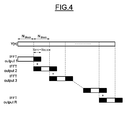
- the input signal is first segmented into consecutive blocks of length N Block by the segmenting means (501). Then each block is padded to the length N FFT by the padding means (502). For the first block before the first sample a block N FFT - N Block zero padded is added. In the subsequent blocks number i the first part are padded with N FFT - N Block last samples of the preceding block number i-1.
- a Fast Fourier Transform (FFT) is then processed on each block of size N FFT by the FFT means (505, 508 and 511). The resulting frequency-domain vector is multiplied and each three different complex-valued correlation vectors are multiplied element-wise by multiplying means (504, 507, and 510).
- the correlation vectors are pre-computed as padded FFTs of the 3 time-domain Zadoff Chu PSS sequences (ZC 25 , ZC 29 , ZC 34 ).
- blocks are converted back to the time domain using the IFFT means (505, 508, and 511).
- the N FFT - N Block first samples of each IFFT output number i are discarded, and the N Block remaining samples are extracted.
- the blocks can then be concatenated.
- the combining is realized by the illustrated "Extract samples" means (506, 509, and 512).
- the length of the block must be chosen according to the restriction, N Block ⁇ N FFT - N Corr + 1, to ensure that the size of correlation of each block according to equation (2) is inferior to N FFT . This choice is necessary to be sure that the result of the frequency domain multiplication can be processed by the IFFT.
- All these means may be realized by software modules within a processor and/or by specific components within an integrated circuit.
- a frequency rotation equal to the opposite of the tested offset is applied to the signal prior to the autocorrelation computation.
- the frequency rotation of the state of the art consists of multiplying each sample of the received signal Y[k] by exp( j .2 ⁇ . f i . k ).
- the frequency rotation is performed by means of a cyclic shift of the signal after FFT and prior to multiplication by the PSS sequences.
- the frequency spacing ⁇ f is 1,875 kHz and precision of the frequency estimation is significantly inferior to 15kHz. This value represents, in the case of LTE standard, the sub carrier spacing during signal generation at the base station.
- the sequence received Y[k] is first segmented into block of length N Block and is zero padded to the length N FFT .
- a FFT is then processed to each block.
- the signal then goes through several branches each one testing one possible frequency offset.
- the means used for this process are identical to the precedent embodiments.
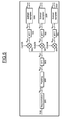
- a cyclic shift is applied.
- the cyclic shift is realized by means configured for applying a cyclic shift (701, 702, 703, and 704); these means may be realized by software modules within a processor and/or by specific components within an integrated circuit.
- the sequence received Y[k] is first segmented into block of length N Block and is padded to the length N FFT .
- a FFT is then processed to each block.
- the signal then goes through several branches each one testing one possible frequency offset with a cyclic shift. The same process as described in figure 5 & 6 is then applied to the signal shifted.
- the number of block is: 4800 / 449.
- All the means used may be realized by software modules within a processor and/or by specific components within an integrated circuit.
- the invention as described provides an easy implementation enabling low complexity algorithm.
- Working in the frequency domain enables first an easy correlation calculation. It enables also to apply a frequency offset as a fast cyclic shift instead of a complex multiplication.
- the relative high drift of a cheaper local oscillator can be compensated by this correlator with no cost premium.
Landscapes
- Engineering & Computer Science (AREA)
- Computer Networks & Wireless Communication (AREA)
- Signal Processing (AREA)
- Synchronisation In Digital Transmission Systems (AREA)
Priority Applications (2)
| Application Number | Priority Date | Filing Date | Title |
|---|---|---|---|
| EP09305829A EP2296332A1 (de) | 2009-09-10 | 2009-09-10 | Primärsynchronistaionserkennung mit geringer Komplexität mit grober Frequenzoffseteinschätzung für ein drahtloses LTE-Kommunikationssystem |
| PCT/EP2010/063026 WO2011029793A1 (en) | 2009-09-10 | 2010-09-06 | Low complexity primary synchronization signal detection with coarse frequency offset estimation for lte wireless communication system |
Applications Claiming Priority (1)
| Application Number | Priority Date | Filing Date | Title |
|---|---|---|---|
| EP09305829A EP2296332A1 (de) | 2009-09-10 | 2009-09-10 | Primärsynchronistaionserkennung mit geringer Komplexität mit grober Frequenzoffseteinschätzung für ein drahtloses LTE-Kommunikationssystem |
Publications (1)
| Publication Number | Publication Date |
|---|---|
| EP2296332A1 true EP2296332A1 (de) | 2011-03-16 |
Family
ID=41727828
Family Applications (1)
| Application Number | Title | Priority Date | Filing Date |
|---|---|---|---|
| EP09305829A Withdrawn EP2296332A1 (de) | 2009-09-10 | 2009-09-10 | Primärsynchronistaionserkennung mit geringer Komplexität mit grober Frequenzoffseteinschätzung für ein drahtloses LTE-Kommunikationssystem |
Country Status (2)
| Country | Link |
|---|---|
| EP (1) | EP2296332A1 (de) |
| WO (1) | WO2011029793A1 (de) |
Cited By (4)
| Publication number | Priority date | Publication date | Assignee | Title |
|---|---|---|---|---|
| WO2013029397A1 (zh) * | 2011-09-02 | 2013-03-07 | 中兴通讯股份有限公司 | 基于预处理的主同步信号检测方法、装置及终端 |
| JP2014204439A (ja) * | 2013-04-03 | 2014-10-27 | 株式会社イノワイアレスInnowireless Co.,Ltd | マルチセル環境におけるlteセル検出装置 |
| RU2757975C2 (ru) * | 2019-12-11 | 2021-10-25 | Федеральное государственное бюджетное учреждение "4 Центральный научно-исследовательский институт" Министерства обороны Российской Федерации | Способ повышения помехозащищенности сигналов синхронизации |
| CN113595954A (zh) * | 2021-08-04 | 2021-11-02 | 重庆邮电大学 | 一种基于分段差分算法的pss定时同步检测方法 |
Families Citing this family (3)
| Publication number | Priority date | Publication date | Assignee | Title |
|---|---|---|---|---|
| CN103379523B (zh) * | 2012-04-19 | 2019-03-08 | 马维尔国际有限公司 | 用于处理lte系统中的大频率误差低复杂度灵活pss相关器 |
| CN104618289B (zh) * | 2014-12-29 | 2018-04-03 | 中国科学院计算技术研究所 | 用于主同步信号检测的方法及装置 |
| CN110677364B (zh) * | 2019-09-17 | 2022-08-23 | 广州粒子微电子有限公司 | 一种检测主同步信号的方法及检测装置 |
Citations (2)
| Publication number | Priority date | Publication date | Assignee | Title |
|---|---|---|---|---|
| WO2006130502A2 (en) * | 2005-06-01 | 2006-12-07 | Qualcomm Incorporated | Receiver for wireless communication network with extended range |
| EP1953982A1 (de) * | 2007-02-05 | 2008-08-06 | Sequans Communications | Verfahren und Vorrichtung zur Zeitsynchronisation und Scanning von Nachbarzellen für zelluläre OFDM-Systeme |
-
2009
- 2009-09-10 EP EP09305829A patent/EP2296332A1/de not_active Withdrawn
-
2010
- 2010-09-06 WO PCT/EP2010/063026 patent/WO2011029793A1/en not_active Ceased
Patent Citations (2)
| Publication number | Priority date | Publication date | Assignee | Title |
|---|---|---|---|---|
| WO2006130502A2 (en) * | 2005-06-01 | 2006-12-07 | Qualcomm Incorporated | Receiver for wireless communication network with extended range |
| EP1953982A1 (de) * | 2007-02-05 | 2008-08-06 | Sequans Communications | Verfahren und Vorrichtung zur Zeitsynchronisation und Scanning von Nachbarzellen für zelluläre OFDM-Systeme |
Non-Patent Citations (2)
| Title |
|---|
| LUCENT TECHNOLOGIES: "RACH in Support of High-Speed UEs", 3GPP DRAFT; R1-062387, 3RD GENERATION PARTNERSHIP PROJECT (3GPP), MOBILE COMPETENCE CENTRE ; 650, ROUTE DES LUCIOLES ; F-06921 SOPHIA-ANTIPOLIS CEDEX ; FRANCE, vol. RAN WG1, no. Tallinn; 20060823, 23 August 2006 (2006-08-23), XP050102905 * |
| TOUFIK ISSAM; BAKER MATTHEW: "SESIA Stefania", 2009, WILEY, article "LTE - The UMTS Long Term Evolution: from Theory to Practice" |
Cited By (7)
| Publication number | Priority date | Publication date | Assignee | Title |
|---|---|---|---|---|
| WO2013029397A1 (zh) * | 2011-09-02 | 2013-03-07 | 中兴通讯股份有限公司 | 基于预处理的主同步信号检测方法、装置及终端 |
| CN102984719A (zh) * | 2011-09-02 | 2013-03-20 | 中兴通讯股份有限公司 | 基于预处理的主同步信号检测方法、装置及终端 |
| CN102984719B (zh) * | 2011-09-02 | 2018-05-04 | 深圳市中兴微电子技术有限公司 | 基于预处理的主同步信号检测方法、装置及终端 |
| JP2014204439A (ja) * | 2013-04-03 | 2014-10-27 | 株式会社イノワイアレスInnowireless Co.,Ltd | マルチセル環境におけるlteセル検出装置 |
| RU2757975C2 (ru) * | 2019-12-11 | 2021-10-25 | Федеральное государственное бюджетное учреждение "4 Центральный научно-исследовательский институт" Министерства обороны Российской Федерации | Способ повышения помехозащищенности сигналов синхронизации |
| CN113595954A (zh) * | 2021-08-04 | 2021-11-02 | 重庆邮电大学 | 一种基于分段差分算法的pss定时同步检测方法 |
| CN113595954B (zh) * | 2021-08-04 | 2023-06-20 | 重庆邮电大学 | 一种基于分段差分算法的pss定时同步检测方法 |
Also Published As
| Publication number | Publication date |
|---|---|
| WO2011029793A1 (en) | 2011-03-17 |
Similar Documents
| Publication | Publication Date | Title |
|---|---|---|
| EP2296332A1 (de) | Primärsynchronistaionserkennung mit geringer Komplexität mit grober Frequenzoffseteinschätzung für ein drahtloses LTE-Kommunikationssystem | |
| US6628606B1 (en) | Coarse frequency offset estimator in orthogonal frequency division multiplexing receiver and method thereof | |
| CN101325450B (zh) | 一种同步方法、频偏估计方法、同步装置、频偏估计装置 | |
| EP1530858B1 (de) | Verfahren und gerät zur rahmendetektion und synchronisierung | |
| CN102130883B (zh) | 一种用于td-lte系统时频同步的方法 | |
| EP2084875B1 (de) | Zellen-ID-Detektion in einem OFDM-Kommunikationssystem | |
| EP2461502B1 (de) | Verfahren und Vorrichtung zur nicht-kohärenten Erkennung sekundärer Synchronisationssignale und entsprechendes Computerprogramm | |
| CN104618289B (zh) | 用于主同步信号检测的方法及装置 | |
| EP3435710B1 (de) | System und verfahren zur funkzellensynchronisierung | |
| US9621340B1 (en) | Method and device for detecting primary synchronization signal in LTE and LTE advanced communication system | |
| US8804863B2 (en) | Process for estimating the channel from the PSS signal in a LTE communication network, and receiver for the same | |
| CN109428847B (zh) | NB-IoT系统中下行次同步信号的检测与同步方法及装置 | |
| US10687289B2 (en) | Method and apparatus for secondary synchronization in internet of things | |
| JP7087066B2 (ja) | ランダムアクセス検出方法および装置 | |
| CN104902560B (zh) | 一种下行定时同步方法及装置 | |
| CN105007095B (zh) | 一种小区初搜过程中整数倍频偏估计方法及装置 | |
| CN102832981B (zh) | 一种确定时间同步位置的方法及设备 | |
| CN112583753B (zh) | 一种相位补偿方法及电子设备 | |
| EP3387754B1 (de) | Drahtloskommunikationsvorrichtung und verfahren darin zur zeitsynchronisation in einem drahtloskommunikationsnetzwerk | |
| CN109743277B (zh) | 一种ofdm系统快速接入搜索方法及快速接入搜索装置 | |
| CN101741800A (zh) | 同步搜索方法 | |
| CN110915176B (zh) | 网络中窄带物联网信号的快速扫描 | |
| US20110292927A1 (en) | Uplink receiving apparatus of ofdma system based on lte and frequency synchronization method thereof | |
| CN101902249B (zh) | 一种频偏估计装置和方法 | |
| US20120275291A1 (en) | Wireless communication apparatus and wireless communication method |
Legal Events
| Date | Code | Title | Description |
|---|---|---|---|
| PUAI | Public reference made under article 153(3) epc to a published international application that has entered the european phase |
Free format text: ORIGINAL CODE: 0009012 |
|
| AK | Designated contracting states |
Kind code of ref document: A1 Designated state(s): AT BE BG CH CY CZ DE DK EE ES FI FR GB GR HR HU IE IS IT LI LT LU LV MC MK MT NL NO PL PT RO SE SI SK SM TR |
|
| 17P | Request for examination filed |
Effective date: 20110913 |
|
| 17Q | First examination report despatched |
Effective date: 20111004 |
|
| STAA | Information on the status of an ep patent application or granted ep patent |
Free format text: STATUS: THE APPLICATION IS DEEMED TO BE WITHDRAWN |
|
| 18D | Application deemed to be withdrawn |
Effective date: 20120417 |