EP2296366A1 - Verfahren zur Übertragung und Empfang von Videodiensten - Google Patents
Verfahren zur Übertragung und Empfang von Videodiensten Download PDFInfo
- Publication number
- EP2296366A1 EP2296366A1 EP09305809A EP09305809A EP2296366A1 EP 2296366 A1 EP2296366 A1 EP 2296366A1 EP 09305809 A EP09305809 A EP 09305809A EP 09305809 A EP09305809 A EP 09305809A EP 2296366 A1 EP2296366 A1 EP 2296366A1
- Authority
- EP
- European Patent Office
- Prior art keywords
- resolution
- video
- service
- video service
- multiplex
- Prior art date
- Legal status (The legal status is an assumption and is not a legal conclusion. Google has not performed a legal analysis and makes no representation as to the accuracy of the status listed.)
- Withdrawn
Links
Images

Classifications
-
- H—ELECTRICITY
- H04—ELECTRIC COMMUNICATION TECHNIQUE
- H04N—PICTORIAL COMMUNICATION, e.g. TELEVISION
- H04N21/00—Selective content distribution, e.g. interactive television or video on demand [VOD]
- H04N21/60—Network structure or processes for video distribution between server and client or between remote clients; Control signalling between clients, server and network components; Transmission of management data between server and client, e.g. sending from server to client commands for recording incoming content stream; Communication details between server and client
- H04N21/63—Control signaling related to video distribution between client, server and network components; Network processes for video distribution between server and clients or between remote clients, e.g. transmitting basic layer and enhancement layers over different transmission paths, setting up a peer-to-peer communication via Internet between remote STB's; Communication protocols; Addressing
- H04N21/64—Addressing
- H04N21/6405—Multicasting
-
- H—ELECTRICITY
- H04—ELECTRIC COMMUNICATION TECHNIQUE
- H04N—PICTORIAL COMMUNICATION, e.g. TELEVISION
- H04N21/00—Selective content distribution, e.g. interactive television or video on demand [VOD]
- H04N21/20—Servers specifically adapted for the distribution of content, e.g. VOD servers; Operations thereof
- H04N21/23—Processing of content or additional data; Elementary server operations; Server middleware
- H04N21/234—Processing of video elementary streams, e.g. splicing of video streams or manipulating encoded video stream scene graphs
- H04N21/2343—Processing of video elementary streams, e.g. splicing of video streams or manipulating encoded video stream scene graphs involving reformatting operations of video signals for distribution or compliance with end-user requests or end-user device requirements
- H04N21/23439—Processing of video elementary streams, e.g. splicing of video streams or manipulating encoded video stream scene graphs involving reformatting operations of video signals for distribution or compliance with end-user requests or end-user device requirements for generating different versions
-
- H—ELECTRICITY
- H04—ELECTRIC COMMUNICATION TECHNIQUE
- H04N—PICTORIAL COMMUNICATION, e.g. TELEVISION
- H04N21/00—Selective content distribution, e.g. interactive television or video on demand [VOD]
- H04N21/20—Servers specifically adapted for the distribution of content, e.g. VOD servers; Operations thereof
- H04N21/23—Processing of content or additional data; Elementary server operations; Server middleware
- H04N21/236—Assembling of a multiplex stream, e.g. transport stream, by combining a video stream with other content or additional data, e.g. inserting a URL [Uniform Resource Locator] into a video stream, multiplexing software data into a video stream; Remultiplexing of multiplex streams; Insertion of stuffing bits into the multiplex stream, e.g. to obtain a constant bit-rate; Assembling of a packetised elementary stream
- H04N21/23608—Remultiplexing multiplex streams, e.g. involving modifying time stamps or remapping the packet identifiers
-
- H—ELECTRICITY
- H04—ELECTRIC COMMUNICATION TECHNIQUE
- H04N—PICTORIAL COMMUNICATION, e.g. TELEVISION
- H04N21/00—Selective content distribution, e.g. interactive television or video on demand [VOD]
- H04N21/20—Servers specifically adapted for the distribution of content, e.g. VOD servers; Operations thereof
- H04N21/23—Processing of content or additional data; Elementary server operations; Server middleware
- H04N21/236—Assembling of a multiplex stream, e.g. transport stream, by combining a video stream with other content or additional data, e.g. inserting a URL [Uniform Resource Locator] into a video stream, multiplexing software data into a video stream; Remultiplexing of multiplex streams; Insertion of stuffing bits into the multiplex stream, e.g. to obtain a constant bit-rate; Assembling of a packetised elementary stream
- H04N21/2365—Multiplexing of several video streams
-
- H—ELECTRICITY
- H04—ELECTRIC COMMUNICATION TECHNIQUE
- H04N—PICTORIAL COMMUNICATION, e.g. TELEVISION
- H04N21/00—Selective content distribution, e.g. interactive television or video on demand [VOD]
- H04N21/20—Servers specifically adapted for the distribution of content, e.g. VOD servers; Operations thereof
- H04N21/23—Processing of content or additional data; Elementary server operations; Server middleware
- H04N21/238—Interfacing the downstream path of the transmission network, e.g. adapting the transmission rate of a video stream to network bandwidth; Processing of multiplex streams
- H04N21/2383—Channel coding or modulation of digital bit-stream, e.g. QPSK modulation
-
- H—ELECTRICITY
- H04—ELECTRIC COMMUNICATION TECHNIQUE
- H04N—PICTORIAL COMMUNICATION, e.g. TELEVISION
- H04N21/00—Selective content distribution, e.g. interactive television or video on demand [VOD]
- H04N21/20—Servers specifically adapted for the distribution of content, e.g. VOD servers; Operations thereof
- H04N21/23—Processing of content or additional data; Elementary server operations; Server middleware
- H04N21/238—Interfacing the downstream path of the transmission network, e.g. adapting the transmission rate of a video stream to network bandwidth; Processing of multiplex streams
- H04N21/2385—Channel allocation; Bandwidth allocation
-
- H—ELECTRICITY
- H04—ELECTRIC COMMUNICATION TECHNIQUE
- H04N—PICTORIAL COMMUNICATION, e.g. TELEVISION
- H04N21/00—Selective content distribution, e.g. interactive television or video on demand [VOD]
- H04N21/40—Client devices specifically adapted for the reception of or interaction with content, e.g. set-top-box [STB]; Operations thereof
- H04N21/43—Processing of content or additional data, e.g. demultiplexing additional data from a digital video stream; Elementary client operations, e.g. monitoring of home network or synchronising decoder's clock; Client middleware
- H04N21/438—Interfacing the downstream path of the transmission network originating from a server, e.g. retrieving encoded video stream packets from an IP network
- H04N21/4383—Accessing a communication channel
- H04N21/4384—Accessing a communication channel involving operations to reduce the access time, e.g. fast-tuning for reducing channel switching latency
Definitions
- This invention relates to methods for the transmission and reception of video services, in view of reducing the delay perceived by the user when switching channels.
- the invention can be applied in a Video over Internet Protocol delivery network and an associated transmission device and receiver, but is not limited to this environment.
- the time required for switching from one program or channel to another, e.g. from one multicast stream to another, is a key aspect of the quality of user experience.
- the overall delay may be significant, especially when the user scans through a number of DVB services consecutively ('zapping').
- the document "Fast channel change in RTP - Version 1.0 - Technical Working Paper - December 2007" ('document 1' in the rest of the document) edited by ISMA (Internet Stream Media Alliance) describes several approaches. It is supposed that a receiver tunes in to a multicast service for receiving content.
- One of the approaches is to include, into a same multicast service, a low-resolution stream and a full-resolution stream corresponding both to the same content or program or channel, the low-resolution stream comprising I-frames at a greater frequency than the full-resolution stream, the receiver decoding and displaying the low-resolution stream up-converted to full-resolution until an I-frame is received from the full-resolution stream.
- the invention concerns a method for transmitting video services in a digital video transmission network, the method being characterized, at the level of a transmission device by the steps of:
- the present embodiment is based on an implementation of an Internet Protocol (IP) based network designed for transporting MPEG-2 Transport Streams.
- IP Internet Protocol
- ETSI European Telecommunications Standards Institute
- the latest version available at the time of filing of this application was version 1.4.1, August 2009. It is explicitly noted that the invention can be used in networks using other technologies than those mentioned above and in the description below.
- modules shown are functional units that may or may not correspond to physically distinguishable units.
- these modules or some of them can be grouped together in a single component, or constitute functions of the same software.
- some modules may also be composed of separate physical entities.
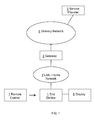
- FIG. 1 The main elements of a system providing a video over IP service are shown in figure 1 .
- An end device 1 typically a Set Top Box, referred to as 'STB' in the rest of the document, is connected to a gateway 3 by means of a local area network or 'home network' 2.
- the local area network (LAN) is an Ethernet network and can also be another type of wired network, or a wireless LAN.
- the home network can also limit itself to an Ethernet point-to-point link, as in the embodiment shown in figure 1 , although of course the home network will typically comprise a plurality of end devices.
- End device 1 comprises an interface to a television set 6 acting as a display.
- Gateway 3 connects the local area network 2 to the delivery network 4 by which it can communicate with a service provider 5.
- the role of the service provider is to provide content services to the end device via the delivery network and the gateway.
- the gateway includes an ADSL modem which is used to connect the LAN to the Internet delivery network 4 by means of an ADSL connection.
- the gateway could just as well include another type of DSL modem, or modem used for any other broadband connection type (DOCSIS, PON).
- DOCSIS broadband connection type
- PON broadband connection type
- the gateway 3 implements the well-known Internet Group Management Protocol (IGMP). Using that protocol, end devices may subscribe to multicast groups through the gateway, in particular in view of receiving multicast services provided by the service provider. The gateway will then forward on the home network the multicast packets corresponding to the groups to which the end device(s) on the home network have subscribed.
- IGMP Internet Group Management Protocol
- a remote control 7 is used to control the STB.
- the remote control 7 preferably has both a number pad for entering a desired program number directly, as well as 'program/channel up' and 'program/channel down' keys to select the previous or the next program compared to the current program, according to an order that is determined by the service provider and which would be a common order of viewing the programs when zapping from one program to another.
- the predetermined order is the order of display of programs in an electronic program guide provided by the service provider to the user. The user will then intuitively adapt to such a predetermined order.
- the predetermined order may be the alphanumerical order of the names of the programs, and/or result at least partially from groupings of programs having similar themes (sports channels for instance).
- this order will influence the constitution of the different multicast services to which the receiver can subscribe.
- the predefined order is not necessarily fixed: it can be modified by the service provider to fit changes in the available programs, to increase performance in view of new statistics regarding program consumption etc...
- the service provider will however have to communicate to the receiver the order of programs it will use in the multicast services according to the present embodiment in order to benefit from its advantages.
- This communication may be explicit (i.e. a list determining the order is sent) or result implicitly from variables used for another purpose (e.g. the order may be determined according to increasing program identifiers provided in the MPEG system tables).
- the predetermined order concerns only part of the available programs, e.g. those most frequently viewed, and only the multicast services containing this subset of programs will be constructed as described.
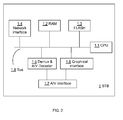
- the essential parts of end device STB 1 with regard to the video over IP service are shown in figure 2 .
- the STB comprises a network interface 1.4, which is an Ethernet type interface in the embodiment. It comprises a memory of the Random Access Memory type, noted as RAM 1.2 corresponding to the main memory, and a secondary memory of the Flash type 1.3, that can store data even when the device is switched off.
- the STB also comprises a central processing unit 1.1 noted as CPU.
- the audio-video decoder 1.5 and the graphical user interface 1.6 prepare the content that is sent to display 6 by means of the audio-video interface.
- the decoder 1.5 comprises a demultiplexer which filters MPEG2 transport stream packets according to instructions provided by the CPU in view of service data provided in the streams received from service provider 5 and user input.
- the data travels between the different modules via an internal bus 1.8.
- the CPU also configures the A/V decoder and demultiplexer 1.5 for upconverting low-resolution video to nominal (standard or full) resolution.
- a conditional access sub-module (not shown) is provided for access right management; descrambling key processing and descrambling of the relevant de-multiplexed packet payloads.
- Memory 1.3 stores the STB's operating system, the user interface application and the software for carrying out the actions from the STB 1, under control of the CPU.
- Service provider 5 proposes multicast services, each service comprising a transport stream which itself comprises one or more programs (also called 'DVB services').
- a program and a DVB service are considered to be one and the same object - they are comparable to a television 'channel'.
- This object is to be distinguished from a multicast service, which may comprise more than one program or DVB service or 'channel'.
- the difference in language is due to the fact that the different standard documents use different terminology. As far as possible, the present application tries to use the terminology of the standard documents.
- the transport stream (TS) corresponding to a multicast service is composed of MPEG 2 transport stream packets containing elementary audio, video streams and auxiliary (e.g. data) streams, as well as service information.
- the TS is composed of 188 byte packets comprising a header and a payload.
- the header of each packet comprises a so-called 'PID' or Packet Identifier.
- the TS present in a multicast service comprises all service data required by the STB to determine which programs are multiplexed in the TS, inform the user of the available programs and demultiplex and decode them according to user requirements. This information is contained in tables which comprise the PAT (Program Association Table) and a number of PMTs (Program Map Tables).
- a receiver will acquire the PAT, using a predefined PID for demultiplexing the TS packets containing this table.
- the PAT identifies the programs (or DVB services) in the transport stream and identifies a PMT for each program.
- the PAT will contain a DVB service identifier and the PID of the packets containing the DVB service's Program Map Table.
- the Program Map Table contains the PIDs of the elementary streams composing the DVB service and will hence allow the STB to selectively extract these components from the transport stream. It is assumed that the list of DVB services available has already been acquired by the receiver from the service provider.
- the PAT and PMT tables are defined by ISO/IEC13818-1, commonly referred to as 'MPEG 2 Systems'.
- the MPEG 2 transport stream is moreover compliant with ETSI TS 101 154, which is a standard document which defines the use of MPEG 2 in a DVB network.
- Transport stream encapsulation for transport over an IP network is realised using RTP, UDP and finally the IP protocol. Given the size of a TS packet, several TS packets can be included within a single IP packet.
- each multicast service comprises a full-resolution (e.g. standard resolution) stream, along with two lower resolution streams, each of the three streams corresponding to a distinct program.
- Figure 3 shows three such multicast services, labelled 3.1, 3.2 and 3.3.
- Multicast service 3.1 comprises a transport stream which results from the multiplexing of programs P0, P1 and P2.
- Each multicast service also comprises service information..
- a program is noted Px, where 'x' represents the rank in the predetermined sequence or order previously described.
- Program P1 is adjacent to both programs P0 and P2.
- Multicast service 3.1 however comprises only low-resolution versions of programs P0 and P2.
- a multicast service 3.2 comprises a full-resolution version of program P2, but low resolution versions of programs P1 and P3.
- low-resolution versions programs will be redundantly sent in two distinct multicast services.
- a multicast service 3.x will comprise a full resolution version of program Px and low resolution versions of programs Px-1 and Px+1.
- the predetermined program order is handled by a receiver in a cyclic way, i.e. when the user presses the channel up button although the highest rank in the order has been reached, the receiver will jump to the lowest order program. Conversely, when the current program is the lowest order program and the user presses the channel down button, the receiver will jump to the highest order program. In other words, the highest rank program and the lowest rank program are considered to be adjacent.
- the multicast services are adapted to this handling of the program order by the receiver, i.e. a multicast service containing a full resolution version of program P0 would contain a low resolution version of the highest ranking program.
- a low resolution stream has the following characteristics:
- a multicast service e.g. 3.1, does not contain a full-resolution version of adjacent programs, i.e. P0 and P2 for service 3.1.
- a multicast service contains either a full-resolution version of a program or a low-resolution version, but not both.
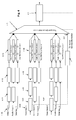
- Figure 4 is a functional block diagram of a device for constructing a multicast service according to figure 3 for programs P0 to P2.
- a path for encoding and packetizing program P1 at full resolution comprises a video path, an audio path and a data path.
- the video path comprises a video input 4.10 to a video encoder 4.11.
- the video encoder is an MPEG 2 encoder according to present embodiment, but of course other encoding technologies can be applied.
- the resulting compressed video is packetized into a video Program Elementary Stream (Video PES) 4.13 by a packetizer 4.12. Per se, this is a well-known encoding process.
- Audio input 1 is encoded using a sub-path having a similar structure except for the encoder which an audio encoder. Auxiliary data is simply packetized.
- the encoding paths for P0 and P2 comprise respective sub-samplers 4.04 and 4.24 for reducing the resolution of the video signals to QCIF format before encoding (compression) according to the above defined criteria with regard to GOP size and lack of B-frames.
- the encoding and packetization process is controlled by controller 4.4.
- Compressed and packetized programs P0 to P2 are fed to TS multiplexer 4.1 for encapsulating PES packets in transport packets with headers provided at input 4.2 by controller 4.4.
- TS packets containing the required service information are also provided over this input by the controller 4.4.
- FIG 4 distinct compression and packetization paths are provided for the three programs constituting a multicast stream - this presentation is chosen for clarity purposes, but an actual implementation can differ and in particular use one functional block such as an encoder or packetizer for several audio, respectively video and data components.
- the compressed and packetized programs may also be stored on a computer readable medium such as a hard disk prior to being fed to the multiplexer 4.1, or prior to being fed to the IP/UDP/RTP encapsulation block 4.3, or received in packetized form from an external source.
- Figure 5 is a temporal diagram illustrating switching from a multicast service 5.1 containing only full resolution program P1 to another multicast service 5.2 also containing only one full resolution program P2 upon activation by a user of the 'channel up' key of the remote control.
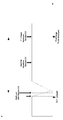
- Figure 6 represents a temporal diagram of the switching from the multicast service 3.1 to the multicast service 3.2, upon activation by a user of the 'channel up' key of the remote control.
- These two multicast services contain the programs already described in relation with figure 3 .
- the receiver sends a multicast leave message to the gateway in order to leave multicast service 5.1.
- the receiver will also send a multicast join message to join multicast service 5.2.
- the receiver will start receiving packets from that multicast service 5.2. It will then wait until it receives the PAT table and the right PMT table for service 5.2.
- the PIDs defined in the PMT table it will start extracting TS packets including TS video packets for program P2.
- the first image can be displayed when the first I-frame has been received,buffered and decoded.
- the number and type of frames that need to be buffered before a first frame can be displayed depends on the coding technology. In some cases, an I frame is sufficient, while in others a P frame may also be required. Lastly, the number of frames to be buffered also depends on the order in which they are transmitted.
- the time between the pressing of the channel up key and the display of the first frame of program P2 comprises principally the time between the sending of the multicast join message and the reception of the PAT/PMT tables, as well as the time between the reception of the PMT table and the time corresponding to an I-frame being stored in the buffer.
- the first one is a function of the network switching time and the periodicity of the transmission of the tables, while the second one is function of the periodicity of I-frames and thus of GOP length and content.
- the receiver upon activation of the channel up key, the receiver emits a multicast join message for multicast service 3.2. However, the receiver continues to receive packets for multicast service 3.1 and does not send a multicast leave message for that multicast service until later in the process. Instead, while the PAT/PMT tables are received for multicast service 3.2 and the first I-frame is buffered for full-resolution program P2, the receiver processes the PAT/PMT tables already received for service 3.1 in order to demultiplex TS packets for the low resolution version of P2.
- the PAT table has been previously acquired for multicast service 3.1 and the PMT tables for all three programs in that multicast service have been advantageously buffered and thus the PMT table for low-resolution program P2 is also available without delay.
- the receiver Once the receiver has buffered an I-frame for low resolution program P2, it can start displaying the low-resolution video stream of P2, appropriately up-converted to full resolution by audio/video decoder 1.5.
- the receiver buffers the last I frames received on one or more of the adjacent low resolution streams to speed up the acquisition process.
- the receiver demultiplexes the PAT/PMT tables of that multicast service and demultiplexes and buffers the video data for a first full-resolution I-frame.
- the receiver stops decoding the low resolution version of P2, displays the full resolution program and sends a multicast leave message for multicast service 3.1.
- all multicast services comprise a full-resolution program and two low-resolution programs, differing in their content from the full-resolution program.
- the embodiment may be applied to only certain programs, for example in order to reduce bandwidth. The other programs will then be transmitted only in full-resolution, with no adjacent low-resolution streams in the same multiplex.
- the embodiment can be applied to a subgroup of most viewed programs, which will be grouped in the predetermined program order to as to be adjacent.
- a multicast service comprises a full-resolution program and two low-resolution programs, one of which preceding, the other one following the full-resolution program in the program order. If bandwidth is less of an issue, more than one low-resolution program preceding or following the full-resolution stream may be included into a single multicast service. The number of low-resolution streams preceding the full-resolution stream and the number following it need not be the same. This will enable faster display of more up-converted low-resolution programs when changing channels quickly.
- unicast services may also be applied to unicast services, wherein a unicast services comprises a full-resolution program and at least one adjacent low-resolution program.
- a unicast services comprises a full-resolution program and at least one adjacent low-resolution program.
- the use of unicast services renders the system less scalable.
- a program adjacent to the 'main' program of a multicast service is sent in lower resolution, it is sufficient that the actual bandwidth or data rate used for the adjacent program(s) be lower. This can be achieved by other means than reducing resolution per se, e.g. by acting on the compression algorithm. These means can be combined with a lower resolution.
- the predetermined order mentioned in the preferred embodiment may also result implicitly from the content of the currently tuned multicast service.
- the 'next' or the 'previous' program compared to the current program is one the low-resolution programs present in the same multicast (e.g. based on program number for instance).
- the receiver can then request joining the correct multicast group containing the full-resolution program.
- such a stream may comprise any combination of adjacent full-resolution and low-resolution programs.
- the most popular programs are transmitted in full-resolution, while the programs on which the user is less likely to remain.are coded as low-resolution programs.
- the embodiment is placed in an Internet Protocol network environment, the invention is not limited to such a specific environment and can for example be applied in any transmission system where switching from one program to another requires a certain time which is noticeable by the end user.
- the receiver ought to be able to open in parallel, for a certain time, two connections, receive two multiplexes or be member of two multicast groups in order to be able to provide display of a low-resolution version of a program while setting up a higher resolution program.
Landscapes
- Engineering & Computer Science (AREA)
- Multimedia (AREA)
- Signal Processing (AREA)
- Computer Networks & Wireless Communication (AREA)
- Two-Way Televisions, Distribution Of Moving Picture Or The Like (AREA)
Priority Applications (1)
| Application Number | Priority Date | Filing Date | Title |
|---|---|---|---|
| EP09305809A EP2296366A1 (de) | 2009-09-03 | 2009-09-03 | Verfahren zur Übertragung und Empfang von Videodiensten |
Applications Claiming Priority (1)
| Application Number | Priority Date | Filing Date | Title |
|---|---|---|---|
| EP09305809A EP2296366A1 (de) | 2009-09-03 | 2009-09-03 | Verfahren zur Übertragung und Empfang von Videodiensten |
Publications (1)
| Publication Number | Publication Date |
|---|---|
| EP2296366A1 true EP2296366A1 (de) | 2011-03-16 |
Family
ID=41506501
Family Applications (1)
| Application Number | Title | Priority Date | Filing Date |
|---|---|---|---|
| EP09305809A Withdrawn EP2296366A1 (de) | 2009-09-03 | 2009-09-03 | Verfahren zur Übertragung und Empfang von Videodiensten |
Country Status (1)
| Country | Link |
|---|---|
| EP (1) | EP2296366A1 (de) |
Citations (3)
| Publication number | Priority date | Publication date | Assignee | Title |
|---|---|---|---|---|
| EP1061737A1 (de) * | 1999-06-18 | 2000-12-20 | THOMSON multimedia | Verfahren und Vorrichtung zum Schalten von digitalen Fernsehprogrammen |
| US20070195203A1 (en) * | 2006-02-21 | 2007-08-23 | Qualcomm Incorporated | Multi-program viewing in a wireless apparatus |
| EP1830540B1 (de) * | 2006-03-03 | 2009-08-19 | Thomson Licensing | Verfahren zum Senden von audiovisuellen Strömen vor den Benutzerbefehlen und Empfänger und Sender zum Ausführen des Verfahrens |
-
2009
- 2009-09-03 EP EP09305809A patent/EP2296366A1/de not_active Withdrawn
Patent Citations (3)
| Publication number | Priority date | Publication date | Assignee | Title |
|---|---|---|---|---|
| EP1061737A1 (de) * | 1999-06-18 | 2000-12-20 | THOMSON multimedia | Verfahren und Vorrichtung zum Schalten von digitalen Fernsehprogrammen |
| US20070195203A1 (en) * | 2006-02-21 | 2007-08-23 | Qualcomm Incorporated | Multi-program viewing in a wireless apparatus |
| EP1830540B1 (de) * | 2006-03-03 | 2009-08-19 | Thomson Licensing | Verfahren zum Senden von audiovisuellen Strömen vor den Benutzerbefehlen und Empfänger und Sender zum Ausführen des Verfahrens |
Non-Patent Citations (8)
| Title |
|---|
| "Digital Video Broadcasting (DVB); Transport of MPEG-2 Based DVB Services over IP Based Networks", ETSI TS 102 034 |
| "Internet Group Management Protocol, Version 3", IETF RFC 3376 |
| "Internet Protocol", IETF RFC 791 |
| DE WACHTER J., TYTGAT D., VERSTRAETE V.,STROBBE M.: "Optimizing channel switching for digital television through low quality streams", PROCEEDINGS OF THE 6TH IASTED INTERNATIONAL CONFERENCE COMMUNICATION SYSTEMS AND NETWORKS, 31 August 2007 (2007-08-31), pages 55 - 62, XP002566732, ISBN: 978-0-88986-695-9, Retrieved from the Internet <URL:http://www.actapress.com/Abstract.aspx?paperId=31633> [retrieved on 20100204] * |
| POSTEL J.: "Transmission Control Protocol", IETF STD 0007, September 1981 (1981-09-01) |
| POSTEL J.: "User Datagram Protocol", IETF STD 0006, August 1980 (1980-08-01) |
| SCHULZRINNE H. ET AL.: "RTP: A Transport Protocol for Real-Time Applications", IETF RFC 3550, July 2003 (2003-07-01) |
| WENGER S. ET AL.: "RTP payload Format for H.264 Video", IETF RFC 3984, February 2005 (2005-02-01) |
Similar Documents
| Publication | Publication Date | Title |
|---|---|---|
| US8539525B2 (en) | Method and apparatus in a media player | |
| US8291448B2 (en) | Providing zapping streams to broadcast receivers | |
| US8516531B2 (en) | Reducing channel change delays | |
| US20100218232A1 (en) | Signalling of auxiliary information that assists processing of video according to various formats | |
| US20090222873A1 (en) | Multimedia Channel Switching | |
| RU2547624C2 (ru) | Способ сигнализации для широковещания видео-контента, способ записи и устройство, использующее сигнализацию | |
| KR100689489B1 (ko) | 연속적인 비디오 디스플레이를 위한 트랜스코딩 방법 | |
| US20080120671A1 (en) | Method and system for speeding up channel change in internet protocol television service and digital broadcasting environment | |
| CN100568971C (zh) | 一种mpeg-4的传输码流到互联网流媒体联盟流的实时转换方法 | |
| Park et al. | Delivery of ATSC 3.0 services with MPEG media transport standard considering redistribution in MPEG-2 TS format | |
| EP2071850A1 (de) | Intelligente Verpackung von Videoinhalten zur Erleichterung der Downstreamverarbeitung von Videostreams | |
| US9148289B2 (en) | Method for streaming video data | |
| WO2008117892A1 (ja) | コンテンツ配信システム、変換装置及びそれらに用いるコンテンツ配信方法 | |
| US7643508B2 (en) | Client side PID translation | |
| US20120008053A1 (en) | Method and system for fast channel change between programs utilizing a single decoder to concurrently decode multiple programs | |
| KR20140104975A (ko) | 멀티미디어 콘텐츠의 멀티플렉싱된 스트리밍을 위한 시스템 및 방법 | |
| US9414096B2 (en) | Method and apparatus for processing multistream content | |
| CN101193290A (zh) | 一种mpeg-4的传输码流到互联网流媒体联盟流的实时转换系统 | |
| EP3142375A1 (de) | Verfahren und vorrichtung zur einkapselung von streams mit audiovisuellem inhalt in private mpeg2-abschnitte, netzwerkkommunikationsprotokoll für ip-basierte lokale netzwerke, interaktive anwendung für digitales fernsehen, benutzervorrichtung mit anwendungen und verfahren zur übertragung von audiovisuellem inhalt und daten | |
| WO2009080114A1 (en) | Method and apparatus for distributing media over a communications network | |
| JP2002084238A (ja) | 多重放送方法および装置 | |
| KR100994053B1 (ko) | Iptv 방송 서비스 시스템, iptv 방송 서비스 시스템에 있어서의 채널 전환 방법, iptv 셋톱박스 | |
| EP2093951B1 (de) | Verfahren und Vorrichtung zur Verarbeitung von Multimediadaten und Kommunikationssystem mit einer derartigen Vorrichtung | |
| EP2357820A1 (de) | System und Verfahren zur Signalisierung von Programmen von verschiedenen Transportströmen | |
| KR20090130609A (ko) | 인터넷 프로토콜 텔레비전 수신기 및 채널 전환 방법 |
Legal Events
| Date | Code | Title | Description |
|---|---|---|---|
| PUAI | Public reference made under article 153(3) epc to a published international application that has entered the european phase |
Free format text: ORIGINAL CODE: 0009012 |
|
| AK | Designated contracting states |
Kind code of ref document: A1 Designated state(s): AT BE BG CH CY CZ DE DK EE ES FI FR GB GR HR HU IE IS IT LI LT LU LV MC MK MT NL NO PL PT RO SE SI SK SM TR |
|
| AX | Request for extension of the european patent |
Extension state: AL BA RS |
|
| PUAJ | Public notification under rule 129 epc |
Free format text: ORIGINAL CODE: 0009425 |
|
| 32PN | Public notification |
Free format text: NOTING OF LOSS OF RIGHTS PURSUANT TO RULE 112(1) EPC (EPO FORM 1097 OF 15.11.2011) |
|
| STAA | Information on the status of an ep patent application or granted ep patent |
Free format text: STATUS: THE APPLICATION IS DEEMED TO BE WITHDRAWN |
|
| 18D | Application deemed to be withdrawn |
Effective date: 20110917 |