EP2296400A1 - Kommunikationssystem - Google Patents
Kommunikationssystem Download PDFInfo
- Publication number
- EP2296400A1 EP2296400A1 EP09773262A EP09773262A EP2296400A1 EP 2296400 A1 EP2296400 A1 EP 2296400A1 EP 09773262 A EP09773262 A EP 09773262A EP 09773262 A EP09773262 A EP 09773262A EP 2296400 A1 EP2296400 A1 EP 2296400A1
- Authority
- EP
- European Patent Office
- Prior art keywords
- address
- mobile station
- header compression
- connection device
- compression rule
- Prior art date
- Legal status (The legal status is an assumption and is not a legal conclusion. Google has not performed a legal analysis and makes no representation as to the accuracy of the status listed.)
- Withdrawn
Links
- 238000004891 communication Methods 0.000 title claims abstract description 33
- 230000006835 compression Effects 0.000 claims abstract description 53
- 238000007906 compression Methods 0.000 claims abstract description 53
- 238000000034 method Methods 0.000 claims description 25
- 238000012546 transfer Methods 0.000 claims description 9
- 238000010586 diagram Methods 0.000 description 26
- 238000012545 processing Methods 0.000 description 9
- 230000006870 function Effects 0.000 description 6
- 230000004044 response Effects 0.000 description 6
- 230000000694 effects Effects 0.000 description 5
- 230000005540 biological transmission Effects 0.000 description 3
- 230000008901 benefit Effects 0.000 description 1
- 230000008859 change Effects 0.000 description 1
- 230000000052 comparative effect Effects 0.000 description 1
- 125000004122 cyclic group Chemical group 0.000 description 1
- 238000007429 general method Methods 0.000 description 1
- 230000007246 mechanism Effects 0.000 description 1
- 238000010295 mobile communication Methods 0.000 description 1
- 238000012986 modification Methods 0.000 description 1
- 230000004048 modification Effects 0.000 description 1
- 230000001629 suppression Effects 0.000 description 1
Images






Classifications
-
- H—ELECTRICITY
- H04—ELECTRIC COMMUNICATION TECHNIQUE
- H04L—TRANSMISSION OF DIGITAL INFORMATION, e.g. TELEGRAPHIC COMMUNICATION
- H04L61/00—Network arrangements, protocols or services for addressing or naming
- H04L61/09—Mapping addresses
- H04L61/10—Mapping addresses of different types
- H04L61/103—Mapping addresses of different types across network layers, e.g. resolution of network layer into physical layer addresses or address resolution protocol [ARP]
-
- H—ELECTRICITY
- H04—ELECTRIC COMMUNICATION TECHNIQUE
- H04L—TRANSMISSION OF DIGITAL INFORMATION, e.g. TELEGRAPHIC COMMUNICATION
- H04L61/00—Network arrangements, protocols or services for addressing or naming
- H04L61/50—Address allocation
- H04L61/5007—Internet protocol [IP] addresses
- H04L61/5014—Internet protocol [IP] addresses using dynamic host configuration protocol [DHCP] or bootstrap protocol [BOOTP]
-
- H—ELECTRICITY
- H04—ELECTRIC COMMUNICATION TECHNIQUE
- H04L—TRANSMISSION OF DIGITAL INFORMATION, e.g. TELEGRAPHIC COMMUNICATION
- H04L69/00—Network arrangements, protocols or services independent of the application payload and not provided for in the other groups of this subclass
- H04L69/04—Protocols for data compression, e.g. ROHC
-
- H—ELECTRICITY
- H04—ELECTRIC COMMUNICATION TECHNIQUE
- H04L—TRANSMISSION OF DIGITAL INFORMATION, e.g. TELEGRAPHIC COMMUNICATION
- H04L69/00—Network arrangements, protocols or services independent of the application payload and not provided for in the other groups of this subclass
- H04L69/22—Parsing or analysis of headers
-
- H—ELECTRICITY
- H04—ELECTRIC COMMUNICATION TECHNIQUE
- H04W—WIRELESS COMMUNICATION NETWORKS
- H04W28/00—Network traffic management; Network resource management
- H04W28/02—Traffic management, e.g. flow control or congestion control
- H04W28/06—Optimizing the usage of the radio link, e.g. header compression, information sizing, discarding information
-
- H—ELECTRICITY
- H04—ELECTRIC COMMUNICATION TECHNIQUE
- H04W—WIRELESS COMMUNICATION NETWORKS
- H04W8/00—Network data management
- H04W8/26—Network addressing or numbering for mobility support
Definitions
- the present invention relates to a communication system, connection device, connection method and program for providing a service to a mobile terminal.
- a mobile WiMAX (Worldwide interoperability for Microwave Access) system realized by applying to mobile communication a WiMAX technique, which is becoming a focus of attention in recent years, includes an MS, which is a mobile station that receives a service by subscribing to the system, a BS, which is a base station configured to be connectable to the MS and an ASN-GW (Access Service Network Gateway), which is a connection device for connecting the MS to a network via the BS.
- MS Mobile station that receives a service by subscribing to the system
- BS which is a base station configured to be connectable to the MS
- ASN-GW Access Service Network Gateway
- Figure 1 is a diagram illustrating one configuration example of a general WiMAX system.
- the WiMAX system shown in Figure 1 is provided with-DHCP server 1003, ASN-GW 1004, BS 1005 and MS 1006.
- DHCP server 1003 is a server which is located on CSN (Connectivity Service Network) 1001 and has a DHCP (Dynamic Host Configuration Protocol) function which is a protocol for automatically setting an IP (Internet Protocol) address in MS 1006.
- CSN Connectivity Service Network
- DHCP Dynamic Host Configuration Protocol
- ASN-GW 1004 is a connection device for connecting CSN 1001 to ASN (Access Service Network) 1002. Furthermore, ASN-GW 1004 is connected to DHCP server 1003 and BS 1005.
- BS 1005 is a base station located on ASN 1002 and configured to be connectable to MS 1006.
- MS 1006 is a mobile station which is movable and communicates with CSN 1001 via BS 1005 and ASN-GW 1004.
- JP2005-124077A discloses a technique of performing communication by compressing a packet header of the packet data for reducing on the communication bandwidth.
- An example of such a technique is a PHS (Payload Header Suppression) rule.
- the PHS rule is a mechanism of payload header compression capable of efficiently operating a communication channel by reducing information of a redundant packet header and thereby reducing bands used.
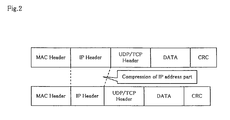
- Figure 2 is a diagram illustrating an example of compression of a packet header to which a predetermined PHS rule is applied.
- part of the packet header section to which the predetermined PHS rule is applied of the packet data made up of MAC (Media Access Control) header, IP header and UDP (User Datagram Protocol)/TCP (Transmission Control Protocol) header and data, and CRC (Cyclic Redundancy Check) field is compressed.
- MAC Media Access Control
- IP header and UDP User Datagram Protocol
- TCP Transmission Control Protocol
- CRC Cyclic Redundancy Check
- Figure 3 is a diagram illustrating the PHS rule.
- a packet header made up of A, B, C, D and E is transmitted from the transmitting side which is a transmission apparatus to the receiving side which is a receiving apparatus via a radio zone.
- A, B, C, D and E are data in byte units. Applying the PHS rule to this packet header causes the packet header to be compressed.
- desired data can be compressed using "PHSM (PHS-Mask)” which is information indicating the position to be compressed and "PHSF (PHS-Field)” which is the content (information) of data to be compressed.
- PHSM PHS-Mask
- PHS-Field PHS-Field
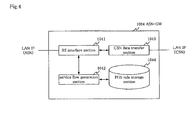
- Figure 4 is a diagram illustrating an example of an internal configuration of ASN-GW 1004 shown in Figure 1 .
- ASN-GW 1004 shown in Figure 1 is provided with BS interface section 1041, service flow generation section 1042, CSN data transfer section 1043 and PHS rule storage section 1044.
- BS interface section 1041 has an interface function for BS 1005.
- Service flow generation section 1042 reads the PHS rule stored in PHS rule storage section 1044 and transmits the read PHS rule to BS 1005 via BS interface section 1041.
- CSN data transfer section 1043 has an interface function for CSN 1001.
- PHS rule storage section 1044 stores the PHS rule manually created beforehand.
- Figure 5 is a sequence diagram illustrating a method for MS 1006 to subscribe to the WiMAX system shown in Figure 1 .
- an RNG-REQ (Ranging-Request) message which is a ranging request signal is transmitted from MS 1006 to BS 1005.
- an RNG-RSP (Ranging-Response) message which is a response signal to the RNG-REQ message is transmitted from BS 1005 to MS 1006.
- an SBC-REQ (Station Basic Capability-Request) message is transmitted from MS 1006 to BS 1005.
- SBC-RSP Selection Basic Capability-Response
- a REG-REQ (Registration-Request) message which is a registration request signal is transmitted from MS 1006 to BS 1005.
- a REG-RSP (Registration-Response) message which is a response signal to the REG-REQ message is transmitted from BS 1005 to MS 1006.
- a DSA-REQ (Dynamic Service Addition-Request)/RSP/ACK (Acknowledge) message for establishing a new service flow is transmitted/received between BS 1005 and MS 1006 one time for an uplink and a downlink in steps 87 to 92.
- the DSA-REQ message transmitted from BS 1005 to MS 1006 includes the PHS rule.
- MS 1006 requests an IP address to DHCP server 1003 via BS 1005 and ASN-GW 1004, and DHCP server 1003 assigns an IP address to MS 1006.
- a first problem is that since the PHS rule is manually created, unless the content of a packet is known beforehand, it is possible neither to specify the compression location nor to generate the PHS rule.
- a second problem is that since the PHS rule cannot be generated unless the content of a packet is known beforehand, it is only fixed IP addresses that can be handled. That is, when an IP address is assigned using DHCP, the IP address part cannot be compressed.
- the present invention is a communication system made up of a mobile station, a base station that communicates with the mobile station by applying a header compression rule for compressing a packet header and a connection device that connects the base station to a predetermined network, wherein the mobile station transmits a physical address given to the mobile station to the connection device via the base station when subscribing to the communication system, the connection device includes an address storage section that previously stores the physical address given to the mobile station and an IP address in association with each other, searches the address storage section for the IP address corresponding to the physical address transmitted from the mobile station, generates the header compression rule in accordance with the IP address searched for, and transmits the generated header compression rule to the mobile station via the base station.
- the present invention is a connection device connected to a base station that communicates with a mobile station by applying a header compression rule for compressing a packet header, including an address storage section that previously stores a physical address given to the mobile station and an IP address in association with each other, a service flow generation section that searches the address storage section for the IP address corresponding to the physical address transmitted from the mobile station and generates a header compression rule in accordance with the IP address searched for, and a base station interface section that transmits the generated header compression rule to the mobile station via the base station.
- a header compression rule for compressing a packet header including an address storage section that previously stores a physical address given to the mobile station and an IP address in association with each other, a service flow generation section that searches the address storage section for the IP address corresponding to the physical address transmitted from the mobile station and generates a header compression rule in accordance with the IP address searched for, and a base station interface section that transmits the generated header compression rule to the mobile station via the base station.
- the present invention is a connection method for a communication system made up of a mobile station, a base station that communicates with the mobile station by applying a header compression rule for compressing a packet header and a connection device that connects the base station to a predetermined network, including a step of the mobile station transmitting a physical address given to the mobile station to the connection device via the base station when subscribing to the communication system, a step of the connection device previously storing the physical address given to the mobile station and an IP address in a table of the connection device in association with each other, a step of the connection device searching the table for the IP address corresponding to the physical address transmitted from the mobile station, a step of the connection device generating a header compression rule in accordance with the IP address searched for, and a step of the connection device transmitting the generated header compression rule to the mobile station via the base station.
- the present invention is a connection method of connecting a mobile station to a network via a base station, including a step of previously storing a physical address given to the mobile station and an IP address in association with each other, a step of searching the stored correspondence for the IP address corresponding to the physical address transmitted from the mobile station, a step of generating a header compression rule for compressing a packet header in accordance with the IP address searched for, and a step of transmitting the generated header compression rule to the mobile station via the base station.
- the present invention is a program for causing a computer connected to a base station that communicates with a mobile station by applying a header compression rule for compressing a packet header, to execute a step of previously storing a physical address given to the mobile station and an IP address in a table provided for the computer in association with each other, a step of searching the table for the IP address corresponding to the physical address transmitted from the mobile station, a step of generating the header compression rule in accordance with the IP address searched for and a step of transmitting the generated header compression rule to the mobile station via the base station.
- the present invention adopts a configuration in which the mobile station transmits the physical address given to the mobile station to the connection device via the base station when subscribing to the communication system, the connection device previously stores the physical address given to the mobile station and an IP address in a table provided for the connection device in association with each other, searches the table for the IP address corresponding to the physical address transmitted from the mobile station, generates a header compression rule in accordance with the IP address searched for, and transmits the generated header compression rule to the mobile station via the base station, and the present invention can thereby easily generate and apply a PHS rule which is the header compression rule.
- Figure 6 is a diagram illustrating one exemplary embodiment of a communication system according to the present invention.
- the present exemplary embodiment is a WiMAX system provided with DHCP server 103, ASN-GW 104, BS 105 and MS 106.
- DHCP server 103 is a server which is located on CSN (Connectivity Service Network) 101 and has a DHCP (Dynamic Host Configuration Protocol) function, which is a protocol for automatically setting an IP address in MS 106.
- DHCP server 103 may be the same as DHCP server 1003 shown in Figure 1 .
- ASN-GW 104 is a connection device for connecting CSN 101 and ASN (Access Service Network) 102. Furthermore, ASN-GW 104 is connected to DHCP server 103 and BS 105.
- BS 105 is a base station which is located on ASN 102 and configured to be connectable to MS 106. Furthermore, BS 105 performs subscription processing (Network Entry) for MS 106 at the request of MS 106.
- MS 106 is a mobile station that communicates with CSN 101 via BS 105 and ASN-GW 104.
- Figure 7 is a diagram illustrating an example of an internal configuration of ASN-GW 104 shown in Figure 6 .
- ASN-GW 104 shown in Figure 6 is provided with BS interface section 141, service flow generation section 142, CSN data transfer section 143 and address correspondence table 144 as shown in Figure 7 .
- BS interface section 141 is a base station interface section having an interface function for BS 105.
- Service flow generation section 142 reads an IP address stored in address correspondence table 144 and generates a PHS rule which is a header compression rule based on the read IP address. Furthermore, service flow generation section 142 generates a service flow including the generated PHS rule and transmits the service flow to BS 105 via BS interface section 141.
- CSN data transfer section 143 has an interface function for CSN 101.
- Address correspondence table 144 is an address storage section that stores the correspondence between a MAC address which is a physical address given to MS 106 and an IP address.
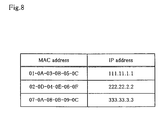
- Figure 8 is a diagram illustrating an example of a structure of address correspondence table 144 shown in Figure 7 .
- Address correspondence table 144 shown in Figure 7 stores the MAC address which is a physical address given to each MS and an IP address in association with each other as shown in Figure 8 .
- the IP address is the IP address acquired by the MS from DHCP server 103.
- MAC address "01-0A-03-0B-05-0C” and IP address "111.11.1.1” are stored in association with each other. This means that the IP address of an MS whose MAC address is “01-0A-03-0B-05-0C” is “111.11.1.1.” Furthermore, MAC address "02-0D-04-0E-06-0F” and IP address "222.22.2.2” are stored in association with each other. This means that the IP address of an MS whose MAC address is "02-0D-04-0E-06-0F” is "222.22.2.2.” Furthermore, MAC address "07-0A-08-0B-09-0C” and IP address "333.33.3.3” are stored in association with each other.
- IP address of an MS whose MAC address is "07-0A-08-0B-09-0C” is "333.33.3.3.”
- There are three sets of correspondence between MAC addresses and IP addresses shown in Figure 8 but it goes without saying that the number of sets stored in address correspondence table 144 is not limited to 3.
- enumeration of simple numbers is used as the MAC addresses and IP addresses shown in Figure 8 , but this has nothing to do with real addresses and it does not matter whether or not the addresses actually exist.
- address correspondence table 144 shown in Figure 7 stores the correspondence between the MAC address given to MS 106 and the IP address.
- the MAC address of MS 106 is "01-0A-03-0B-05-0C" and address correspondence table 144 stores the correspondence shown in Figure 8 .
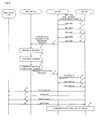
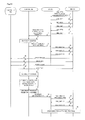
- Figure 9 is a sequence diagram illustrating the method for MS 106 to subscribe to the communication system shown in Figure 6 when address correspondence table 144 shown in Figure 7 stores the correspondence between the MAC address given to MS 106 and the IP address.
- step 1 an RNG-REQ message which is a ranging request signal is transmitted from MS 106 to BS 105.
- the MAC address given to MS 106 is transmitted using the RNG-REQ message.
- step 2 an RNG-RSP message which is a response signal to the RNG-REQ message is transmitted from BS 105 to MS 106.
- step 3 an SBC-REQ message is transmitted from MS 106 to BS 105. Then in step 4, an SBC-RSP message which is a response signal to the SBC-REQ message is transmitted from BS 105 to MS 106.
- step 5 a REG-REQ message which is a registration request signal is transmitted from MS 106 to BS 105. Then in step 6, a REG-RSP message which is a response signal to the REG-REQ message is transmitted from BS 105 to MS 106.
- steps 2 to 6 is the same as the processing in steps 82 to 86 described using Figure 5 .
- the MAC address of MS 106 transmitted from MS 106 in step 1 is transmitted from BS 105 to ASN-GW 104 in step 7.
- the MAC address of MS 106 transmitted from BS 105 is received by BS interface section 141 of ASN-GW 104, and in step 8, service flow generation section 142 searches address correspondence table 144 for the IP address corresponding to the MAC address.
- service flow generation section 142 searches address correspondence table 144 for the IP address corresponding to the MAC address.
- Service flow generation section 142 then generates a PHS rule based on the acquired IP address in step 10.
- a PHS rule for performing header compression to omit the Source address of the IP header included in the uplink signal is generated.
- a downlink signal (signal from BS 105 to MS 106) between BS 105 and MS 106, a PHS rule for performing header compression to omit the Destination address of the IP header included in the downlink signal is generated.
- Figure 10 is a diagram illustrating header compression of the uplink signal.
- the Source address of the IP header of the uplink signal is omitted. Since other fields are fields generally used, those fields will not be particularly described here.
- Figure 11 is a diagram illustrating header compression of the downlink signal.
- the Destination address of the IP header of the downlink signal is omitted.
- Other fields are the same as those shown in Figure 10 .
- a PHS rule showing that the aforementioned fields are omitted is generated.
- the PHS rule generated includes the following information.
- PHSM is information indicating the position of a portion to be compressed (omitted) within the header.
- this information indicates the position of the corresponding portion.
- this PHSM indicates the position of an IP address, the IP address is shown in PHSF.
- PHSS is information indicating the number of data items to be compressed according to the PHS rule and coincides with the length of PHSF.
- the PHS rule made up of the information is output from service flow generation section 142 to BS interface section 141 and in step 11, transmitted from BS interface section 141 to BS 105.
- a DSA-REQ/RSP/ACK message for establishing a new service flow is transmitted/received between BS 105 and MS 106 in steps 12 to 14 one time for the uplink and the downlink.
- a DSA-REQ message which is a service flow establishment request signal transmitted from BS 105 to MS 106 includes the PHS rule transmitted from ASN-GW 104 in step 11.
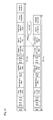
- Figure 12 is a diagram illustrating an example of the DSA-REQ message including the PHS rule.
- the DSA-REQ message includes the PHS rule.
- whether or not the PHS rule is included in the DSA-REQ message is judged depending on whether or not Associated PHSI (PHS-Index) shown in Figure 12 is included in a Packet Classifier rule.
- PHS-Index Associated PHSI
- the PHS rule is judged to be included in the DSA-REQ message.
- Whether or not Associated PHSI is included in the Packet Classifier rule can be judged by TLV (Type, Length, Value).
- PHSI is a field made up of 1 byte and is an index indicating the number of the PHS rule that follows.
- PHSF PHSM
- PHSS PHSS
- PHSV PHS-Valid
- DSA-REQ DSA-REQ
- the IP address is requested from MS 106 to DHCP server 103 via BS 105 and ASN-GW 104, and the IP address is assigned from DHCP server 103 to MS 106.
- the method of assigning the IP address by DHCP server 103 is the same as a general method.
- the IP address assigned here is the same as the previous one, that is, the IP address stored in address correspondence table 144.
- communication is carried out between BS 105 and MS 106 in step 19 by applying the PHS rule hereafter.
- Figure 13 is a sequence diagram illustrating the method for MS 106 to subscribe to the communication system shown in Figure 6 when address correspondence table 144 shown in Figure 7 does not store the correspondence between the MAC address given to MS 106 and the IP address.
- steps 1 to 8 is the same as the processing described using Figure 9 .
- service flow generation section 142 since this is a case where the correspondence between MAC address given to MS 106 and the IP address is not stored in address correspondence table 144, the IP address corresponding to MAC address "05-0A-03-0B-01-0C" is not acquired. Therefore, in step 31, service flow generation section 142 generates a signal indicating the absence of the IP address, the signal is transmitted to BS 105 via BS interface section 141 and the fact that no IP address corresponding to MAC address "05-0A-03-0B-01-0C" exists in the address correspondence table is reported.
- a DSA-REQ/RSP/ACK message for establishing a new service flow is transmitted/received between BS 105 and MS 106 in steps 32 to 34 one time for the uplink and the downlink.
- a normal DSA-REQ/RSP/ACK message is transmitted/received.
- an IP address is requested from MS 106 to DHCP server 103 via BS 105 and ASN-GW 104 and an IP address is assigned from DHCP server 103 to MS 106.
- the IP address is assigned from DHCP server 103 to MS 106, CSN data transfer section 143 detects the data transfer of DHCP, and the IP address is acquired in step 39.
- the acquired IP address is associated with the MAC address by CSN data transfer section 143 in step 40 and stored in address correspondence table 144.
- address correspondence table 144 At the same time, the fact that the correspondence between the MAC address and the IP address is stored in address correspondence table 144 is reported from CSN data transfer section 143 to service flow generation section 142. Taking this opportunity, service flow generation section 142 looks up address correspondence table 144 and a PHS rule is generated based on the IP address in step 41. The method of generating the PHS rule is the same as the method described using step 10 shown in Figure 9 .
- the PHS rule generated is then output in step 42 from service flow generation section 142 to BS interface section 141 and transmitted from BS interface section 141 to BS 105.
- a DSC (Dynamic Service Change)- REQ/RSP/ACK message for changing the service flow is transmitted/received between BS 105 and MS 106 in steps 43 to 45 one time for the uplink and the downlink.
- a DSC-REQ message which is a service flow establishment request signal transmitted from BS 105 to MS 106 includes the PHS rule transmitted from ASN-GW 104 in step 42.
- step 46 communication applying the PHS rule is carried out between BS 105 and MS 106.
- the IP address assigned by DHCP is associated with the MAC address of MS 106 and stored in ASN-GW 104, even when the IP address of MS 106 is not a fixed IP address, it is possible to generate a PHS rule for compressing the IP address portion. Furthermore, the PHS rule can be generated not manually, but automatically by ASN-GW 104. Furthermore, even if the DSA-REQ message is not used, a DSC-REQ message can be used as a substitute and initial Network Entry can also obtain effects comparative to those of second and subsequent Network Entries. Furthermore, when the IP address stored in ASN-GW 104 is different from the IP address assigned from DHCP server 103, the PHS rule can be applied again by performing the processing in steps 39 to 46.
- DHCP server 103 may be identical to ASN-GW 104 and share address correspondence table 144.
- ASN-GW 104 may store IP address information assigned from an outside authentication server in address correspondence table 144 when subscribing MS 106 as a DHCP proxy server.
- ASN-GW 104 may be executed by a logical circuit tailored to the purpose. Furthermore, a program describing the processing contents as a procedure may be recorded in a recording medium readable to ASN-GW 104, the program recorded in the recording medium may be read and executed by ASN-GW 104.
- the recording medium readable to ASN-GW 104 refers to a portable recording medium such as floppy disk (registered trademark), magneto-optical disk, DVD, CD and memory such as ROM, RAM built in ASN-GW 104 and HDD or the like.
- the program recorded in the recording medium is read into a CPU (not shown) in ASN-GW 104 and the same processing as that described above is performed under the control of the CPU.
- ASN-GW 104 operates as a computer that executes the program read from the recording medium in which the program is recorded.
- the present invention has the following effects.
- a first effect is that since the correspondence between the IP address assigned by DHCP server 103 and the MAC address of MS 106 is stored in address correspondence table 144 of ASN-GW 104, it is possible to generate a PHS rule for compressing the IP address portion even when the IP address of MS 106 is not a fixed IP address.
- a second effect is that since ASN-GW 104 acquires and reflects the IP address assigned by DHCP server 103, ASN-GW 104 can generate a PHS rule not manually but automatically.
- a third effect is that taking advantage of the fact that DHCP server 103 assigns the same IP address to the same MAC address, it is possible to generate a PHS rule before DHCP server 103 assigns the IP address when subscribing MS 106 (Network Entry) from the second time onward. That is, it is possible to carry out communication applying the PHS rule immediately after DHCP server 103 assigns the IP address.
Landscapes
- Engineering & Computer Science (AREA)
- Computer Networks & Wireless Communication (AREA)
- Signal Processing (AREA)
- Computer Security & Cryptography (AREA)
- Mobile Radio Communication Systems (AREA)
- Data Exchanges In Wide-Area Networks (AREA)
Applications Claiming Priority (2)
| Application Number | Priority Date | Filing Date | Title |
|---|---|---|---|
| JP2008170416A JP4780345B2 (ja) | 2008-06-30 | 2008-06-30 | 通信システム、接続装置、接続方法およびプログラム |
| PCT/JP2009/060311 WO2010001684A1 (ja) | 2008-06-30 | 2009-06-05 | 通信システム |
Publications (2)
| Publication Number | Publication Date |
|---|---|
| EP2296400A1 true EP2296400A1 (de) | 2011-03-16 |
| EP2296400A4 EP2296400A4 (de) | 2016-01-20 |
Family
ID=41465787
Family Applications (1)
| Application Number | Title | Priority Date | Filing Date |
|---|---|---|---|
| EP09773262.2A Withdrawn EP2296400A4 (de) | 2008-06-30 | 2009-06-05 | Kommunikationssystem |
Country Status (5)
| Country | Link |
|---|---|
| US (1) | US8687687B2 (de) |
| EP (1) | EP2296400A4 (de) |
| JP (1) | JP4780345B2 (de) |
| CN (1) | CN102057719B (de) |
| WO (1) | WO2010001684A1 (de) |
Families Citing this family (6)
| Publication number | Priority date | Publication date | Assignee | Title |
|---|---|---|---|---|
| US8874793B2 (en) * | 2009-11-30 | 2014-10-28 | Qualcomm Innovation Center, Inc. | Methods and apparatus for improving header compression |
| CN103179094B (zh) * | 2011-12-22 | 2019-10-01 | 南京中兴软件有限责任公司 | Ip报文头的发送、接收方法、发送装置以及接收装置 |
| CN103533092A (zh) * | 2012-10-23 | 2014-01-22 | 深圳市友讯达科技发展有限公司 | 一种网络地址的压缩方法及网络中心设备 |
| US9357435B2 (en) * | 2013-11-06 | 2016-05-31 | Samsung Electronics Co., Ltd. | Method and system for handling audio packets during a volte call |
| WO2016067954A1 (ja) * | 2014-10-30 | 2016-05-06 | ソニー株式会社 | 送信装置、送信方法、受信装置、及び、受信方法 |
| JP6455541B2 (ja) * | 2017-03-30 | 2019-01-23 | 日本電気株式会社 | 通信システム |
Family Cites Families (19)
| Publication number | Priority date | Publication date | Assignee | Title |
|---|---|---|---|---|
| US5860136A (en) * | 1989-06-16 | 1999-01-12 | Fenner; Peter R. | Method and apparatus for use of associated memory with large key spaces |
| US5862452A (en) * | 1997-10-20 | 1999-01-19 | Motorola, Inc. | Method, access point device and peripheral devices for low complexity dynamic persistence mode for random access in a wireless communication system |
| US6058106A (en) * | 1997-10-20 | 2000-05-02 | Motorola, Inc. | Network protocol method, access point device and peripheral devices for providing for an efficient centrally coordinated peer-to-peer wireless communications network |
| JP2001320422A (ja) | 2000-03-03 | 2001-11-16 | Ntt Docomo Inc | ヘッダ圧縮を伴うパケット伝送のための方法および装置 |
| JP2002094553A (ja) | 2000-09-12 | 2002-03-29 | Matsushita Electric Ind Co Ltd | パケット伝送装置およびパケット伝送方法 |
| US6967964B1 (en) | 2000-10-03 | 2005-11-22 | Telefonaktiebolaget Lm Ericsson (Publ) | Context identification using header compression key at link layer |
| JP2002141931A (ja) | 2000-10-30 | 2002-05-17 | Sharp Corp | ルータ装置及び経路制御方法 |
| JP3979084B2 (ja) | 2001-12-25 | 2007-09-19 | 松下電器産業株式会社 | 無線lan用ネットワーク機器 |
| US20040181811A1 (en) * | 2003-03-13 | 2004-09-16 | Rakib Selim Shlomo | Thin DOCSIS in-band management for interactive HFC service delivery |
| TW200425690A (en) * | 2003-05-13 | 2004-11-16 | Benq Corp | A header format of transmission control protocol/Internet protocol |
| AU2004272192C1 (en) * | 2003-09-10 | 2010-05-06 | Hyperdata Technologies, Inc. | Internet protocol optimizer |
| JP3766081B2 (ja) | 2003-09-30 | 2006-04-12 | 株式会社東芝 | 通信システムの制御方法、同システム、同システムの移動局および端末装置 |
| JP2005124077A (ja) * | 2003-10-20 | 2005-05-12 | Toshiba Corp | 無線lanシステム、その通信制御方法、送信局および受信局 |
| JP2005252855A (ja) | 2004-03-05 | 2005-09-15 | Nec Electronics Corp | ヘッダ圧縮パケット処理装置及びヘッダ圧縮パケット処理方法 |
| US7512118B1 (en) * | 2005-06-30 | 2009-03-31 | Nortel Networks Limited | CODEC negotiation considering quality and costs |
| KR100745782B1 (ko) * | 2006-09-29 | 2007-08-03 | 한국전자통신연구원 | 동적 헤더 압축 장치 및 방법 |
| JP5125287B2 (ja) | 2006-12-14 | 2013-01-23 | Tdk株式会社 | 磁気デバイス及び周波数アナライザ |
| US7975109B2 (en) * | 2007-05-30 | 2011-07-05 | Schooner Information Technology, Inc. | System including a fine-grained memory and a less-fine-grained memory |
| US8018961B2 (en) * | 2009-06-22 | 2011-09-13 | Citrix Systems, Inc. | Systems and methods for receive and transmission queue processing in a multi-core architecture |
-
2008
- 2008-06-30 JP JP2008170416A patent/JP4780345B2/ja not_active Expired - Fee Related
-
2009
- 2009-06-05 CN CN2009801215116A patent/CN102057719B/zh not_active Expired - Fee Related
- 2009-06-05 US US12/989,464 patent/US8687687B2/en not_active Expired - Fee Related
- 2009-06-05 EP EP09773262.2A patent/EP2296400A4/de not_active Withdrawn
- 2009-06-05 WO PCT/JP2009/060311 patent/WO2010001684A1/ja not_active Ceased
Non-Patent Citations (1)
| Title |
|---|
| See references of WO2010001684A1 * |
Also Published As
| Publication number | Publication date |
|---|---|
| CN102057719B (zh) | 2013-11-13 |
| US20110090889A1 (en) | 2011-04-21 |
| JP4780345B2 (ja) | 2011-09-28 |
| US8687687B2 (en) | 2014-04-01 |
| CN102057719A (zh) | 2011-05-11 |
| WO2010001684A1 (ja) | 2010-01-07 |
| JP2010011288A (ja) | 2010-01-14 |
| EP2296400A4 (de) | 2016-01-20 |
Similar Documents
| Publication | Publication Date | Title |
|---|---|---|
| US7817554B2 (en) | Methods and devices for changing quality of service | |
| CN110417840B (zh) | 一种信息处理方法及装置 | |
| CN102714636B (zh) | 用于便于越过网络边界的推送通信的方法和装置 | |
| US7012913B2 (en) | Apparatus, and associated method, for facilitating communication of unfragmented packet-formatted data in a radio communication system | |
| US8687687B2 (en) | Communication system | |
| KR20110025048A (ko) | Mac 헤더 타입 정보를 이용한 mac pdu 송수신 방법 및 장치 | |
| CN103647759B (zh) | 一种mss的协商方法及装置 | |
| US11917523B2 (en) | Polymorphic network control system and method supporting mobile access of terminal | |
| CN103414714B (zh) | 一种报文处理方法、装置和设备 | |
| US9015344B2 (en) | Method, apparatus and system for managing private network remotely using session initiation protocol | |
| CN111225016A (zh) | 网络服务系统及网络服务方法 | |
| CN111385268A (zh) | 一种数据包头压缩确认方法及通信设备 | |
| US20030081578A1 (en) | Address allocation for mobile terminals | |
| US10136375B2 (en) | Method for service data management, apparatus, and system | |
| JP2007520097A (ja) | 圧縮されたメッセージを送信するためのシステム及び方法 | |
| CN112469083A (zh) | 数据传输方法、装置、设备和存储介质 | |
| US20240340256A1 (en) | Multimedia Message Transmission Method and Apparatus | |
| WO2021152369A1 (en) | Dynamic uplink end-to-end data transfer scheme with optimized memory path | |
| WO2022111365A1 (zh) | 数据传输方法、装置、设备、存储介质及程序产品 | |
| CN101257517A (zh) | 地址解析协议请求消息处理方法及装置 | |
| CN112118594A (zh) | 数据上传方法、下载方法、电子设备及存储介质 | |
| WO2025036184A1 (zh) | Dns信息处理方法及地址重叠处理方法、装置、通信设备 | |
| CN111865790B (zh) | 用于采集路由器信息的方法、装置、物联设备和物联网系统 | |
| US20240267829A1 (en) | Communication method and apparatus | |
| CN106612307B (zh) | 一种永远在线业务的实现方法及装置 |
Legal Events
| Date | Code | Title | Description |
|---|---|---|---|
| PUAI | Public reference made under article 153(3) epc to a published international application that has entered the european phase |
Free format text: ORIGINAL CODE: 0009012 |
|
| 17P | Request for examination filed |
Effective date: 20101129 |
|
| AK | Designated contracting states |
Kind code of ref document: A1 Designated state(s): AT BE BG CH CY CZ DE DK EE ES FI FR GB GR HR HU IE IS IT LI LT LU LV MC MK MT NL NO PL PT RO SE SI SK TR |
|
| AX | Request for extension of the european patent |
Extension state: AL BA RS |
|
| DAX | Request for extension of the european patent (deleted) | ||
| RA4 | Supplementary search report drawn up and despatched (corrected) |
Effective date: 20151222 |
|
| STAA | Information on the status of an ep patent application or granted ep patent |
Free format text: STATUS: THE APPLICATION HAS BEEN WITHDRAWN |
|
| 18W | Application withdrawn |
Effective date: 20160204 |