EP2296500B1 - Casque antichoc à éclairage résistant aux impacts - Google Patents
Casque antichoc à éclairage résistant aux impacts Download PDFInfo
- Publication number
- EP2296500B1 EP2296500B1 EP09753507A EP09753507A EP2296500B1 EP 2296500 B1 EP2296500 B1 EP 2296500B1 EP 09753507 A EP09753507 A EP 09753507A EP 09753507 A EP09753507 A EP 09753507A EP 2296500 B1 EP2296500 B1 EP 2296500B1
- Authority
- EP
- European Patent Office
- Prior art keywords
- crash helmet
- luminaire
- helmet
- opening
- outer shell
- Prior art date
- Legal status (The legal status is an assumption and is not a legal conclusion. Google has not performed a legal analysis and makes no representation as to the accuracy of the status listed.)
- Not-in-force
Links
- 239000011324 bead Substances 0.000 claims description 8
- 230000000295 complement effect Effects 0.000 claims description 6
- 230000035939 shock Effects 0.000 claims description 6
- 239000006096 absorbing agent Substances 0.000 claims description 3
- 239000012080 ambient air Substances 0.000 claims description 2
- 230000005484 gravity Effects 0.000 claims description 2
- 238000009423 ventilation Methods 0.000 description 10
- 239000003570 air Substances 0.000 description 6
- 210000003625 skull Anatomy 0.000 description 6
- 230000001681 protective effect Effects 0.000 description 5
- 206010017076 Fracture Diseases 0.000 description 3
- 239000000853 adhesive Substances 0.000 description 3
- 230000001070 adhesive effect Effects 0.000 description 3
- 230000008901 benefit Effects 0.000 description 3
- 238000009420 retrofitting Methods 0.000 description 3
- 210000004243 sweat Anatomy 0.000 description 3
- 235000011437 Amygdalus communis Nutrition 0.000 description 2
- 241000220304 Prunus dulcis Species 0.000 description 2
- 208000028979 Skull fracture Diseases 0.000 description 2
- 235000020224 almond Nutrition 0.000 description 2
- 230000006835 compression Effects 0.000 description 2
- 238000007906 compression Methods 0.000 description 2
- 239000006260 foam Substances 0.000 description 2
- 125000006850 spacer group Chemical group 0.000 description 2
- 230000007480 spreading Effects 0.000 description 2
- 229920001817 Agar Polymers 0.000 description 1
- 208000010392 Bone Fractures Diseases 0.000 description 1
- 206010015137 Eructation Diseases 0.000 description 1
- 208000028389 Nerve injury Diseases 0.000 description 1
- 208000027418 Wounds and injury Diseases 0.000 description 1
- 230000001133 acceleration Effects 0.000 description 1
- 230000004913 activation Effects 0.000 description 1
- 230000001154 acute effect Effects 0.000 description 1
- 230000002411 adverse Effects 0.000 description 1
- 239000010426 asphalt Substances 0.000 description 1
- 230000004888 barrier function Effects 0.000 description 1
- 208000027687 belching Diseases 0.000 description 1
- 238000010276 construction Methods 0.000 description 1
- 230000006378 damage Effects 0.000 description 1
- 230000009849 deactivation Effects 0.000 description 1
- 230000006735 deficit Effects 0.000 description 1
- 238000004146 energy storage Methods 0.000 description 1
- 238000011156 evaluation Methods 0.000 description 1
- 230000006870 function Effects 0.000 description 1
- 230000012447 hatching Effects 0.000 description 1
- 238000005286 illumination Methods 0.000 description 1
- 230000003116 impacting effect Effects 0.000 description 1
- 208000014674 injury Diseases 0.000 description 1
- 230000010354 integration Effects 0.000 description 1
- 230000001788 irregular Effects 0.000 description 1
- 239000010985 leather Substances 0.000 description 1
- 239000000463 material Substances 0.000 description 1
- 230000007246 mechanism Effects 0.000 description 1
- 238000005065 mining Methods 0.000 description 1
- 210000003205 muscle Anatomy 0.000 description 1
- 230000008764 nerve damage Effects 0.000 description 1
- 230000000149 penetrating effect Effects 0.000 description 1
- 239000004033 plastic Substances 0.000 description 1
- 229920003023 plastic Polymers 0.000 description 1
- 230000009993 protective function Effects 0.000 description 1
- 238000005096 rolling process Methods 0.000 description 1
- 206010041569 spinal fracture Diseases 0.000 description 1
- 239000004753 textile Substances 0.000 description 1
- 238000013022 venting Methods 0.000 description 1
Images



Classifications
-
- A—HUMAN NECESSITIES
- A42—HEADWEAR
- A42B—HATS; HEAD COVERINGS
- A42B3/00—Helmets; Helmet covers ; Other protective head coverings
- A42B3/04—Parts, details or accessories of helmets
- A42B3/0406—Accessories for helmets
- A42B3/0433—Detecting, signalling or lighting devices
- A42B3/044—Lighting devices, e.g. helmets with lamps
Definitions
- the invention relates to a crash helmet, consisting of a relatively thin and hard outer shell and a relatively thick and soft inner shell with at least one opening in the outer and the inner shell and at least one lamp which is at least partially disposed within an opening.
- spacers ensure that there is a distance between the hard shell and the skull of the head in the normal state. Compared to a directly lying, hard shell, the impact speed is slightly reduced in case of contact. Another advantage is that the air space between the skull and the hard shell is used for ventilation and thus for the removal of sweat.
- This configuration is usually referred to as a "protective helmet” and is z. B. for construction workers and miners a standardized protection device. In mining, it has long been known to provide such a protective helmet with a lamp.
- helmets differ in that as a spacer between the head and thin, hard outer shell a much thicker, much softer inner shell is introduced. In the event of a collision, it ensures a continuous deceleration of the head, so that the impact speed of the head on the hard outer shell is significantly reduced.
- crash helmets are used in the use of powered by muscle power vehicles such as bicycles or rudders or driving aids and sports equipment such as skateboards and inliners.
- muscle power vehicles such as bicycles or rudders or driving aids and sports equipment such as skateboards and inliners.
- sports equipment such as skateboards and inliners.
- perspiration is permanently released from the head and has to be removed by air.
- ventilation openings are common.
- the openings were very welcome as vents to dissipate heat and sweat. Their almond shape was later transferred to the vents of current, clamshell helmets. As with the historic crash lids, their soft inner shell on impact provides a "crumple zone" that reduces the acceleration applied to the head by spreading the impact of a crash over a longer period of time, significantly reducing the likelihood of skull fracture becomes.
- the helmet must be able to slide as little resistance as possible on the impact surface or the impact edge along. Otherwise, the resulting friction forces are transmitted via the crash helmet and the head to the cervical vertebrae, which can cause vertebral fractures and nerve damage, the so-called "whiplash", or threatens the final final cervical fracture.
- the hard outer shell must have as low as possible a “sliding friction coefficient" when sliding on asphalt, stones and other expected surfaces. This requirement is met by numerous plastics.
- the surface contour of the outer shell must be continuously curved and, if possible, should have no edges or even protruding parts.
- brackets of the lights can be rammed into the head of the user in an impact from the impact surface through the ventilation openings and thereby increase the risk of punctured fractures of the skull.
- the patent US 5, 871, 271, Chien describes a bicycle helmet, in whose ventilation holes LEDs are installed as a light source.
- This patent provides, in addition to the ventilation openings in the soft inner shell further recesses in which z. B. a battery is housed.
- the main disadvantage is that internals such as the battery, the protective effect of the helmet is reversed on impact to the contrary: Instead of spreading the impact force over a large area on the skull, it is concentrated by the non-compressible battery on the outer edge. As a result, an impact in the battery is a very high, in the illustrated embodiment FIG. 5 create linear strain on the human skull with the high risk of skull fracture at this site.
- the invention has taken on the task of integrating into the openings of a crash helmet a lamp so that it does not affect the safety function of the helmet in an impact, and additionally improves the stability of the helmet something.
- each luminaire is fixed to a crossbar which connects two opposite edges of the opening, in which it projects on both sides of the opening over its edge and is fastened with at least two bearing surfaces on the outer shell.
- the crossbar By connecting two opposite edges of the opening, the crossbar ensures increased stability of the crash helmet. Since it is attached to the outer shell, it finds in the structure of the helmet the best possible grip and does not interfere with the protective function of the inner shell during the impact.
- the lamp is mounted within the opening on the crossbar.
- the luminaire is preferably arranged on the side of the traverse facing the center of the helmet. This ensures that a light in the rear part of the helmet in an impact is not driven by their inertial mass on and catapulted to the helmet actually to be protected, but is prevented by the Traverse because it is across the opening and is supported on the outer surface of the helmet.
- the front in the direction of movement of the helmet lights are protected in a collision by the crossbar from spikes that would otherwise penetrate into the opening and thereby could press the light on the head.
- the desirable on impact sliding ability of the helmet on the impact surface is not further limited.
- the crossbar increases the effective outer surface of the helmet, thereby distributing the peak forces acting on the outer shell more evenly.
- the traverse extends slightly beyond the contour of the outer shell, this is less advantageous than a flush with the contour of the helmet integration.
- the part projecting beyond the contour first wears on the impact surface during sliding movements of the crash helmet, as it is rubbed off by friction, the crosshead is thereby sanded relatively quickly to a uniform course of the contour.
- the crossbar protrudes only slightly beyond the contour, the impact will not cause an excessive concentration of impact forces in this area and the additional impulses that arise when a sliding movement of the helmet on the impact surface transferred to the cervical vertebrae are not too large. Nevertheless, in this case, the outstanding part of the contour of the traverse should be as flat as possible.
- a lamp according to the invention is also suitable for retrofitting helmets.
- the traverse can then be glued with at least one support surface at its two ends on the outer surface in the vicinity of the edge of an opening.
- the traverse engages with a permanently elastic latching lug in a complementary counterpart in the outer shell.
- this latching connection must be so stable that it holds the maximum expected forces in a collision forces and still so shallow building, that even at a significant compression of the helmet at this point does not cause a point overloading of the head.
- both bearing surfaces of the traverse are concave and complementary to beads formed at the edges and form an undercut with respect to the beads of two opposite edges.
- Such a connection can be formed as a latching connection, provided that the materials of the outer shell and traverse have a corresponding elasticity.
- bearing surfaces are lowered into an approximately almond-shaped ventilation opening at the widest point from the outside and then within the opening in the direction of the Longitudinal axis to be moved until the two bearing surfaces rest on the beads of the edge. Since the concave bearing surfaces are formed complementary to the beads at the edges of the opening, and are aligned so that an undercut is formed, the traverse is secured with the concave bearing surfaces behind the beads.
- the crossbar is inserted in a ventilation slot at the top of the helmet, which is aligned in the direction of movement of the helmet, then also has a rigidly fixed to the crossbar light in the direction of movement forward and / or backward. It is located essentially within the contour of the outer shell and therefore does not interfere with the impact.
- the lamp via at least one hinge relative to the crossbar is pivotable, so that the direction of the light beam of the lamp can be repeatedly adapted to the current head posture.
- the longitudinal axis of the luminaire can no longer be aligned tangentially to the front outer surface of the helmet. Then it must be pivotable relative to the crossbar. Since the lamp then protrudes from the opening Publ and beyond the contour of the helmet, must they are folded back on impact, which happens automatically by the belching on the impact surface.
- the lamp finds a secure fit at any angle, the pivoting can be inhibited by a friction element or a locking element with several locking steps. Then the lamp remains in the desired position even when driving through a pothole.
- a shock absorber can be provided which helps to reduce the forces occurring in the event of an impact when the light is swung back. Such a shock absorber is also useful if an automatic alignment of the lamp is provided, this can, for. B. the center of gravity of the lamp are arranged lower than the pivot axis of the respective joint. As a result, the exiting light beam after completion of the pivoting movement always in the desired direction.
- the orientation of the lights depending on the current position of the head - also be done automatically.
- an automatic pivoting drive for the lights is required.
- the invention proposes that on a side surface a pendulum arm is pivotally mounted, which is mechanically or pneumatically connected to the pivotable lights and radiate the lights in the desired direction when pointing vertically downwards pendulum.
- the invention proposes as a variant of a pneumatic connection.
- a small pneumatic cylinder or - even easier - a bellows or a rolling bellows must be attached.
- These pneumatic elements are interconnected by small air hoses.
- the advantage is that the air hoses are inexpensive and without significant impairment of the protective effect of the crash helmet -. B. can be installed in the joint between the inner and outer shell.
- pendulum and lights Another connection between pendulum and lights is a mechanism, either via pressure and tension rods or cables or chains. Also conceivable is an electromotive pivoting of each individual lamp. About a position sensor and a E-lektronikbau facia for evaluation of the position sensor then the electric motor will pivot the lamp accordingly.
- Another way to compensate for movements of the head are multiple light sources in a lamp, of which only one is activated, which radiates approximately in the direction currently desired.
- each lamp is an autonomous functional unit, that is in each lamp, a light source such.
- a light source such.
- B. a battery and that also a switch are installed in the housing of the lamp.
- the invention recommends that lenses are installed in the lamp, which focus the emitted light.
- the trusses of adjacent openings can be connected to a common light carrier, which runs on the outer shell. If this light carrier is only worked quite flat, so hardly protrudes beyond the contour of the crash helmet, it hardly hampers the optimal backup in the impact.
- the helmet may be equipped with a fan that draws in ambient air and distributes it to the inner surface through tubes, hoses, or other channels within the inner shell.
- a lamp with flashing light source can be arranged on the two longitudinal sides of a crash helmet. These turn signals can serve as direction indicator. To turn it off and on, the invention proposes a wireless activation and deactivation, e.g. B. from the handlebar of a bicycle.
- Skateboard or Inline riders can activate the flashing light as well as the front or rear facing lights by a switch directly on the light.
- both bearing surfaces of the traverse are glued not only to the outer shell but also to the inner shell. Depending on the dimensioning of the individual components, this further increases the stability of the crash helmet and also the stability of the luminaire attachment. If used for bonding surface portion of the inner shell extends at an acute angle to the contour of the crash helmet and therefore protrudes despite a relatively large adhesive surface or other, constructive reason, the crossbar only with a relatively small degree in the soft inner shell, in the event of a fall the passive one Effectiveness of compressing the soft inner shell is not significantly impeded.
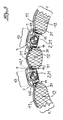
- the upper light 2 is still in the pivoted state in which it lies approximately in the plane of the outer shell 11 of the crash helmet.
- the two lower lights 2 are pivoted so far with respect to the cross member 3 that their light exit surface 21 points forward or rearward in the direction of travel and thereby light beams 22 in the direction of movement (eg for lane illumination) and counter to the direction of movement (eg. as a tail light).
- the trusses 3 according to the invention with the lights 2 pivotally attached thereto are also suitable for retrofitting existing helmets.
- FIG. 2 the supervision is shown on a bicycle helmet, which corresponds to the in FIG. 1 is similar. Very conspicuous are the numerous openings 13 in the outer shell 11, which continue through the adjoining inner shell 12. At the edges 14 of the opening 13, the view of the cut edges of the thick and soft inner shell 12 becomes visible FIG. 2 characterized by irregular hatching.
- a lamp 2 is fixed by means of a cross member 3 respectively. It can be seen how the Traverse 3 protrudes beyond the opening 13 and rests in the region of the outer shell 11.
- four lights 2 forward and two lights 2 to the rear.
- the two outer, forward facing lights are still pivoted into the contour of the outer shell 11, so that the lights could not radiate parallel to the other two lights 2.
- FIG. 3 is a section through a crash helmet 1 with two lights 2 reproduced, which are secured by trusses 3 in the openings 13. For the sake of clarity, the lines of the helmet 1 located behind the cutting plane are not drawn.
- FIG. 3 shown area corresponds approximately to the in FIG. 1 and FIG. 2 illustrated two middle, the forward facing group of four lights.
- FIG. 3 In cross-section of FIG. 3 clearly shows how the two lights 2 are supported with their wing-like protruding bearing surfaces 31 on the outer shell 11. It is in FIG. 3 the retrofitting of a helmet by universally usable trusses 3 shown. The area adjoining the support surface 31 of the traverse 3, which includes the pivot axis 42 of the joint 4, forms a profile which is only approximately complementary to the profile of the edges 14. In FIG. 3 it becomes clear that the resulting small cavity is replaced by a - in FIG. 3 not shown - adhesive can be filled, so that the contact area between the cross member 3 and the crash helmet 1 is increased.
- FIG. 3 is very easy to understand that the cross member 3 only slightly over the outer shell 11 to the outside (ie in FIG. 3 to the top) protrudes.
- the cross member 3 with the attached light 2 pressed only slightly into the crash helmet 1.
- FIG. 3 is comprehensible, as well as in a compression of the outer shell 11 compared to the very thick inner shell 12 to half the lights 2 still do not protrude beyond the inside of the compressed inner shell 12 and thus during the impact not in contact with the - not shown here - Head come.
- FIG. 3 are the lights 2 on the pivot axis 42 relative to the cross member 3 pivotally. In the illustrated rest position, they thus do not protrude appreciably beyond the contour of the outer shell 11 or beyond the contour of the inner shell 12.
- FIG. 4 the section is drawn by a traverse 3. Since the cut is placed in the middle of the here U-shaped traverse 3, only that part of the traverse 3 is to be seen as a cutting surface, which connects the two bearing surfaces 31 together.
- FIG. 4 In FIG. 4 are drawn with dashed lines, the two positions of a built-in traverse 3 pivotally mounted light 2. In the lower of the two positions shown, the longitudinal axis of the lamp 2 is approximately parallel or tangential to - here not shown - outer shell 11. In the upper angular position of the lamp 2 it protrudes maximally from the crash helmet 1 out. As a result, the pivoting region 41 of the joint 4 with the swiveling axis 42 becomes clear.
- FIG. 5 is the front of the in FIG. 4 cut lamp 2 shown.
- the luminaire 2 has with its light exit surface 21 to the viewer and the pivot axis 42 of the joint 4 extends in the image plane.
- Very clearly visible are the two bearing surfaces 31 of the traverse 3, which will rest on the Au ⁇ enschale 11 in the installed state.
- the traverse 3 bulges in this embodiment spherical segment.
- FIG. 6 is the supervision on the in FIG. 4 and FIG. 5 see the light unit 2 shown with its traverse 3.
- the U-shaped configuration of the traverse 3 is clear in this embodiment.
- the two legs of the U each form one, in FIG. 6 From the viewer technological support surface 31. In the space between the two legs, the lamp 2 can swing.
- Traverse 3 is shown as a single part and that with a view of the two bearing surfaces 31. Between these, in the embodiment shown, a free space is formed in which the lamp 2 can be pivoted about the pivot axis 42.
- Traverse 3 is shown as an individual part of the page.
- the viewing direction of the cross member 3 corresponds to the viewing direction of the
- FIG. 4 In contrast to FIG. 4 however, the full page view is shown. In this case, the bottom of the cross member 3 set web 4 is clear, which carries the pivot axis 42 of the joint 4.
Landscapes
- Helmets And Other Head Coverings (AREA)
Claims (20)
- Casque (1), consistant en• une enveloppe extérieure (11) relativement mince et dure et• une enveloppe intérieure (12) relativement épaisse et molle ayant• au moins une ouverture (13) dans l'enveloppe extérieure (11) et dans l'enveloppe intérieure (12) et• au moins une lampe d'éclairage (2) disposée au moins en partie à l'intérieur d'une ouverture (13),
caractérisé par le fait que
chaque lampe d'éclairage (2) est fixée sur une traverse (3), qui• relie entre eux deux bords (14) de l'ouverture (13) situés l'un en face de l'autre,• en dépassant des deux côtés de l'ouverture (13) par-dessus leur bord (14).• en étant fixée par au moins deux surfaces de support (31) sur l'enveloppe extérieure (11) - Casque (1) selon la revendication précédente 1, caractérisé par le fait
que la traverse (3) ne dépasse que faiblement ou pas du tout par-dessus le contour de l'enveloppe extérieure (11). - Casque (1) selon une des revendications précédentes, caractérisé par le fait
que la lampe d'éclairage (2) est disposée sur le côté de la traverse (3) qui est tourné vers le centre du casqué (1). - Casque (1) selon une des revendications précédentes, caractérisé par le fait
qu'au moins une lampe d'éclairage (2) peut être pivotée d'au moins une articulation (4) par rapport à la traverse (3). - Casque (1) selon la revendication 4, caractérisé par le fait que la lampe d'éclairage (2)• peut être pivotée d'au moins 90 degrés et• se trouve pour la plus grande partie à l'intérieur de l'ouverture (13) lors de l'atteinte de la première butée de la zone de pivotement (41) et• est tournée vers l'extérieur lorsque la seconde butée avec la surface de sortie de la lumière (21) est atteinte.
- Casque (1) selon une des revendications précédentes 4 ou 5, caractérisé par le fait que la lampe d'éclairage (2) est, lors de son pivotement, alimentée par• un élément de friction et/ou• un élément d'encrantement ayant plusieurs niveaux d'encrantement et/ou• un pare-chocs
- Casque (1) selon au moins une des revendications précédentes 4 à 6, caractérisé par le fait que le centre de gravité de la lampe d'éclairage (2) est disposé plus bas que l'axe de pivotement de son articulation (4) et que le rayon lumineux (22) de la lampe d'éclairage (2) est dirigé dans la direction souhaitée à la fin du mouvement de pivotement.
- Casque (1) selon la revendication précédente 7, caractérisé par le fait qu'un bras pendulaire est fixé de façon à pouvoir pivoter sur une surface latérale, lequel est relié aux plans mécanique et pneumatique avec les lampes d'éclairage (2) orientables, les lampes d'éclairage rayonnant dans la direction souhaitée lorsque le bras pendulaire est dirigé vers le bas.
- Casque (1) selon une des revendications précédentes, caractérisé par le fait que la lampe d'éclairage (2) intègre• une source lumineuse telle qu'une DEL ou une ampoule et• une source d'énergie telle qu'une pile et• un interrupteur.
- Casque (1) selon une des revendications précédentes, caractérisé par le fait que des lentilles qui concentrent la lumière émise sont montées dans la lampe d'éclairage (2).
- Casque (1) selon une des revendications précédentes, caractérisé par le fait que, vers l'avant, toutes les lampes d'éclairage (2) émettent de la lumière blanche ou faiblement jaune et que toutes les lampes d'éclairage (2) émettent de la lumière rouge vers l'arrière.
- Casque (1) selon une des revendications précédentes, caractérisé par le fait que les traverses (3) d'ouvertures voisines sont reliées à un support lumineux commun qui court sur l'enveloppe extérieure (11).
- Casque (1) selon une des revendications précédentes, caractérisé par le fait qu'une lampe d'éclairage (2) est disposée dans chaque ouverture (13).
- Casque (1) selon la revendication précédente 13, caractérisé par le fait qu'il contient un ventilateur qui aspire l'air ambiant et qui l'amène sur la surface intérieure• par l'intermédiaire de tuyaux et/ou• par l'intermédiaire de flexibles et/ou• par l'intermédiaire d'autres canaux situés à l'intérieur de l'enveloppe intérieure (12).
- Casque (1) selon une des revendications précédentes, caractérisé par le fait qu'une lampe d'éclairage (2) ayant au moins une source lumineuse clignotante est disposée sur chacun de ses deux côtés.
- Casque (1) selon une des revendications précédentes, caractérisé par le fait que la source lumineuse peut être allumée et éteinte sans fil.
- Casque selon une des revendications précédentes, caractérisé par le fait que la traverse (3) peut être encrantée avec un nez d'encrantement à élasticité permanente dans une contre-pièce dans l'enveloppe extérieure (11).
- Casque (1) selon une des revendications précédentes, caractérisé par le fait que les deux surfaces de support (31) de la traverse (3) ont une forme concave et complémentaire aux bourrelets sur les bords (15), en formant une indentation par rapport aux bourrelets de bords (15) situés en face l'un de l'autre.
- Casque (1) selon la revendication précédente 18, caractérisé par le fait que la traverse (3) peut être abaissée depuis l'extérieur dans une ouverture (13) ayant à peu près la forme d'une amande, à l'endroit le plus large, en pouvant être déplacée dans le sens de son axe longitudinal jusqu'à ce que les surfaces de support (31) reposent sur les bourrelets du bord (15).
- Casque (1) selon une des revendications précédentes, caractérisé par le fait que les deux surfaces de support (31) de la traverse sont collées à la fois à l'enveloppe extérieure (11) et à l'enveloppe intérieure (12).
Applications Claiming Priority (2)
| Application Number | Priority Date | Filing Date | Title |
|---|---|---|---|
| DE102008026092A DE102008026092A1 (de) | 2008-05-30 | 2008-05-30 | Sturzhelm mit aufprallsicherer Beleuchtung |
| PCT/DE2009/000478 WO2009143791A1 (fr) | 2008-05-30 | 2009-04-07 | Casque antichoc à éclairage résistant aux impacts |
Publications (2)
| Publication Number | Publication Date |
|---|---|
| EP2296500A1 EP2296500A1 (fr) | 2011-03-23 |
| EP2296500B1 true EP2296500B1 (fr) | 2012-01-18 |
Family
ID=40902028
Family Applications (1)
| Application Number | Title | Priority Date | Filing Date |
|---|---|---|---|
| EP09753507A Not-in-force EP2296500B1 (fr) | 2008-05-30 | 2009-04-07 | Casque antichoc à éclairage résistant aux impacts |
Country Status (4)
| Country | Link |
|---|---|
| EP (1) | EP2296500B1 (fr) |
| AT (1) | ATE541473T1 (fr) |
| DE (2) | DE102008026092A1 (fr) |
| WO (1) | WO2009143791A1 (fr) |
Cited By (5)
| Publication number | Priority date | Publication date | Assignee | Title |
|---|---|---|---|---|
| EP2687115A1 (fr) | 2012-07-19 | 2014-01-22 | ALPINA SPORTS GmbH | Casque de protection avec élément d'éclairage |
| DE202017102318U1 (de) | 2017-04-19 | 2017-05-17 | Slobodan Gavric | Helmlichtaufsatz |
| DE102017108315A1 (de) | 2017-04-19 | 2018-10-25 | Slobodan Gavric | Helmlichtaufsatz |
| DE102019006117A1 (de) * | 2019-08-29 | 2021-03-04 | Sqlab Gmbh | Fahrradhelm mit Dämpfungselement |
| EP4305990A1 (fr) | 2022-07-11 | 2024-01-17 | SQlab GmbH | Casque de bicyclette |
Families Citing this family (4)
| Publication number | Priority date | Publication date | Assignee | Title |
|---|---|---|---|---|
| DE102009045383A1 (de) * | 2009-10-06 | 2011-04-07 | Casco Group Societate In Comandita Simpla (Scs) | Lüftungssystem für Sporthelme |
| USD959036S1 (en) | 2019-01-21 | 2022-07-26 | Milwaukee Electric Tool Corporation | Headlamp |
| WO2020160442A1 (fr) | 2019-02-01 | 2020-08-06 | Milwaukee Electric Tool Corporation | Lampe frontale haute visibilité |
| EP3785558B1 (fr) | 2019-08-29 | 2023-03-08 | SQlab GmbH | Casque de bicyclette pourvu d'élément d'amortissement |
Family Cites Families (13)
| Publication number | Priority date | Publication date | Assignee | Title |
|---|---|---|---|---|
| US5871271A (en) | 1995-11-30 | 1999-02-16 | Chien; Tseng Lu | LED illuminated protective headwear |
| DE20017922U1 (de) * | 2000-10-19 | 2001-01-11 | SETOLITE-Vertriebsges. mbH, 42929 Wermelskirchen | Schutzhelm |
| WO2002062165A1 (fr) | 2001-02-08 | 2002-08-15 | Matthew Ronald Whittaker | Systeme d'eclairage pour casque a ouvertures |
| US7128434B1 (en) * | 2003-07-28 | 2006-10-31 | Sportcraft, Ltd. | Lighted headgear with motion activated switch |
| DE20319126U1 (de) * | 2003-12-10 | 2005-05-04 | Brückl, Franz | Fahrrad-Schutzhelm mit Beleuchtung |
| DE102004055290A1 (de) * | 2004-11-16 | 2006-05-18 | Uvex Sports Gmbh & Co. Kg | Schutzhelm |
| WO2007093348A1 (fr) * | 2006-02-12 | 2007-08-23 | Brueckl Franz | Casque protecteur |
| DE102007006860A1 (de) * | 2006-02-12 | 2007-08-23 | Brückl, Franz | Schützende Kopfbedeckung |
| US20080055887A1 (en) * | 2006-08-30 | 2008-03-06 | Strategic Sports Ltd. | Helmet visor |
| DE202006014755U1 (de) * | 2006-09-22 | 2007-03-01 | Krauter, Günter | Fahrradhelm |
| JP4489753B2 (ja) * | 2006-12-27 | 2010-06-23 | 株式会社シマノ | 自転車用ヘルメット |
| DE202007001785U1 (de) * | 2007-02-02 | 2007-04-05 | Lin, Henkel, Houli Hsiang | Schutzhaube |
| DE202008001838U1 (de) * | 2008-02-08 | 2008-04-30 | Knauer, Hans-Georg | Fahrradhelm |
-
2008
- 2008-05-30 DE DE102008026092A patent/DE102008026092A1/de active Pending
-
2009
- 2009-04-07 EP EP09753507A patent/EP2296500B1/fr not_active Not-in-force
- 2009-04-07 AT AT09753507T patent/ATE541473T1/de active
- 2009-04-07 WO PCT/DE2009/000478 patent/WO2009143791A1/fr not_active Ceased
- 2009-04-07 DE DE112009001908T patent/DE112009001908A5/de not_active Withdrawn
Cited By (7)
| Publication number | Priority date | Publication date | Assignee | Title |
|---|---|---|---|---|
| EP2687115A1 (fr) | 2012-07-19 | 2014-01-22 | ALPINA SPORTS GmbH | Casque de protection avec élément d'éclairage |
| DE102012212707A1 (de) | 2012-07-19 | 2014-01-23 | Alpina Sports Gmbh | Schutzhelm mit Leuchtelement |
| DE102012212707B4 (de) * | 2012-07-19 | 2015-02-12 | Alpina Sports Gmbh | Schutzhelm mit Leuchtelement |
| DE202017102318U1 (de) | 2017-04-19 | 2017-05-17 | Slobodan Gavric | Helmlichtaufsatz |
| DE102017108315A1 (de) | 2017-04-19 | 2018-10-25 | Slobodan Gavric | Helmlichtaufsatz |
| DE102019006117A1 (de) * | 2019-08-29 | 2021-03-04 | Sqlab Gmbh | Fahrradhelm mit Dämpfungselement |
| EP4305990A1 (fr) | 2022-07-11 | 2024-01-17 | SQlab GmbH | Casque de bicyclette |
Also Published As
| Publication number | Publication date |
|---|---|
| DE112009001908A5 (de) | 2011-04-28 |
| ATE541473T1 (de) | 2012-02-15 |
| EP2296500A1 (fr) | 2011-03-23 |
| WO2009143791A1 (fr) | 2009-12-03 |
| DE102008026092A1 (de) | 2009-12-03 |
Similar Documents
| Publication | Publication Date | Title |
|---|---|---|
| EP2296500B1 (fr) | Casque antichoc à éclairage résistant aux impacts | |
| DE602004010618T2 (de) | Helmmontierter elektrolumineszenter positionsanzeiger | |
| DE69904687T2 (de) | Sicherheitshelm und Befestigungsvorrichtung für Beatmungsmaske | |
| DE60100845T2 (de) | Schutzhelm mit vorrichtung zum verstellen der kopfweite | |
| DE69511614T2 (de) | Vorrichtung zur Befestigung eines Helmes am Hinterkopf | |
| DE3935828C2 (fr) | ||
| DE69503276T2 (de) | Auf dem Kopf zu tragende Ausrüstung mit isostatischer Verbindung zwischen Helmschale und optoelektronischen Instrumenten | |
| DE102007006860A1 (de) | Schützende Kopfbedeckung | |
| WO2007093348A1 (fr) | Casque protecteur | |
| EP1513424A2 (fr) | Casque | |
| AT8206U1 (de) | Helm | |
| EP3054801A1 (fr) | Casque de protection | |
| EP2528462B1 (fr) | Protecteur dorsal | |
| DE3228746A1 (de) | Sporthelm | |
| DE3232762A1 (de) | Schutzhelm | |
| EP2241181A1 (fr) | Dispositif de contrôle du comportement de chasse et/ou de fuite d'animaux domestiques | |
| WO2012025463A1 (fr) | Casque de protection à dispositif lumineux arrière | |
| AT527624B1 (de) | Sporthelmanordnung | |
| DE202011109220U1 (de) | Oberkörperprotektor für Nackenprotektoren | |
| DE3529912C1 (de) | Kraftfahrzeug mit Leuchtenschutzvorrichtung | |
| DE29915934U1 (de) | Schutzhelm | |
| EP1656045B1 (fr) | Casque | |
| WO2015128206A1 (fr) | Casque | |
| EP3826501A1 (fr) | Structure de protection antichoc | |
| EP3212022B1 (fr) | Système de protection corporel modulaire pour le rachis cervical |
Legal Events
| Date | Code | Title | Description |
|---|---|---|---|
| PUAI | Public reference made under article 153(3) epc to a published international application that has entered the european phase |
Free format text: ORIGINAL CODE: 0009012 |
|
| 17P | Request for examination filed |
Effective date: 20101230 |
|
| AK | Designated contracting states |
Kind code of ref document: A1 Designated state(s): AT BE BG CH CY CZ DE DK EE ES FI FR GB GR HR HU IE IS IT LI LT LU LV MC MK MT NL NO PL PT RO SE SI SK TR |
|
| AX | Request for extension of the european patent |
Extension state: AL BA RS |
|
| GRAP | Despatch of communication of intention to grant a patent |
Free format text: ORIGINAL CODE: EPIDOSNIGR1 |
|
| DAX | Request for extension of the european patent (deleted) | ||
| GRAS | Grant fee paid |
Free format text: ORIGINAL CODE: EPIDOSNIGR3 |
|
| GRAA | (expected) grant |
Free format text: ORIGINAL CODE: 0009210 |
|
| AK | Designated contracting states |
Kind code of ref document: B1 Designated state(s): AT BE BG CH CY CZ DE DK EE ES FI FR GB GR HR HU IE IS IT LI LT LU LV MC MK MT NL NO PL PT RO SE SI SK TR |
|
| REG | Reference to a national code |
Ref country code: GB Ref legal event code: FG4D Free format text: NOT ENGLISH |
|
| REG | Reference to a national code |
Ref country code: CH Ref legal event code: EP |
|
| REG | Reference to a national code |
Ref country code: AT Ref legal event code: REF Ref document number: 541473 Country of ref document: AT Kind code of ref document: T Effective date: 20120215 Ref country code: IE Ref legal event code: FG4D Free format text: LANGUAGE OF EP DOCUMENT: GERMAN |
|
| REG | Reference to a national code |
Ref country code: DE Ref legal event code: R096 Ref document number: 502009002501 Country of ref document: DE Effective date: 20120315 |
|
| REG | Reference to a national code |
Ref country code: NL Ref legal event code: VDEP Effective date: 20120118 |
|
| LTIE | Lt: invalidation of european patent or patent extension |
Effective date: 20120118 |
|
| PG25 | Lapsed in a contracting state [announced via postgrant information from national office to epo] |
Ref country code: NL Free format text: LAPSE BECAUSE OF FAILURE TO SUBMIT A TRANSLATION OF THE DESCRIPTION OR TO PAY THE FEE WITHIN THE PRESCRIBED TIME-LIMIT Effective date: 20120118 Ref country code: HR Free format text: LAPSE BECAUSE OF FAILURE TO SUBMIT A TRANSLATION OF THE DESCRIPTION OR TO PAY THE FEE WITHIN THE PRESCRIBED TIME-LIMIT Effective date: 20120118 Ref country code: BG Free format text: LAPSE BECAUSE OF FAILURE TO SUBMIT A TRANSLATION OF THE DESCRIPTION OR TO PAY THE FEE WITHIN THE PRESCRIBED TIME-LIMIT Effective date: 20120418 Ref country code: LT Free format text: LAPSE BECAUSE OF FAILURE TO SUBMIT A TRANSLATION OF THE DESCRIPTION OR TO PAY THE FEE WITHIN THE PRESCRIBED TIME-LIMIT Effective date: 20120118 Ref country code: IS Free format text: LAPSE BECAUSE OF FAILURE TO SUBMIT A TRANSLATION OF THE DESCRIPTION OR TO PAY THE FEE WITHIN THE PRESCRIBED TIME-LIMIT Effective date: 20120518 Ref country code: NO Free format text: LAPSE BECAUSE OF FAILURE TO SUBMIT A TRANSLATION OF THE DESCRIPTION OR TO PAY THE FEE WITHIN THE PRESCRIBED TIME-LIMIT Effective date: 20120418 |
|
| REG | Reference to a national code |
Ref country code: IE Ref legal event code: FD4D |
|
| PG25 | Lapsed in a contracting state [announced via postgrant information from national office to epo] |
Ref country code: FI Free format text: LAPSE BECAUSE OF FAILURE TO SUBMIT A TRANSLATION OF THE DESCRIPTION OR TO PAY THE FEE WITHIN THE PRESCRIBED TIME-LIMIT Effective date: 20120118 Ref country code: LV Free format text: LAPSE BECAUSE OF FAILURE TO SUBMIT A TRANSLATION OF THE DESCRIPTION OR TO PAY THE FEE WITHIN THE PRESCRIBED TIME-LIMIT Effective date: 20120118 Ref country code: PL Free format text: LAPSE BECAUSE OF FAILURE TO SUBMIT A TRANSLATION OF THE DESCRIPTION OR TO PAY THE FEE WITHIN THE PRESCRIBED TIME-LIMIT Effective date: 20120118 Ref country code: GR Free format text: LAPSE BECAUSE OF FAILURE TO SUBMIT A TRANSLATION OF THE DESCRIPTION OR TO PAY THE FEE WITHIN THE PRESCRIBED TIME-LIMIT Effective date: 20120419 Ref country code: PT Free format text: LAPSE BECAUSE OF FAILURE TO SUBMIT A TRANSLATION OF THE DESCRIPTION OR TO PAY THE FEE WITHIN THE PRESCRIBED TIME-LIMIT Effective date: 20120518 |
|
| PGFP | Annual fee paid to national office [announced via postgrant information from national office to epo] |
Ref country code: FR Payment date: 20120705 Year of fee payment: 4 |
|
| PG25 | Lapsed in a contracting state [announced via postgrant information from national office to epo] |
Ref country code: CY Free format text: LAPSE BECAUSE OF FAILURE TO SUBMIT A TRANSLATION OF THE DESCRIPTION OR TO PAY THE FEE WITHIN THE PRESCRIBED TIME-LIMIT Effective date: 20120118 |
|
| BERE | Be: lapsed |
Owner name: BRUCKL, FRANZ Effective date: 20120430 |
|
| PG25 | Lapsed in a contracting state [announced via postgrant information from national office to epo] |
Ref country code: RO Free format text: LAPSE BECAUSE OF FAILURE TO SUBMIT A TRANSLATION OF THE DESCRIPTION OR TO PAY THE FEE WITHIN THE PRESCRIBED TIME-LIMIT Effective date: 20120118 Ref country code: IE Free format text: LAPSE BECAUSE OF FAILURE TO SUBMIT A TRANSLATION OF THE DESCRIPTION OR TO PAY THE FEE WITHIN THE PRESCRIBED TIME-LIMIT Effective date: 20120118 Ref country code: SI Free format text: LAPSE BECAUSE OF FAILURE TO SUBMIT A TRANSLATION OF THE DESCRIPTION OR TO PAY THE FEE WITHIN THE PRESCRIBED TIME-LIMIT Effective date: 20120118 Ref country code: EE Free format text: LAPSE BECAUSE OF FAILURE TO SUBMIT A TRANSLATION OF THE DESCRIPTION OR TO PAY THE FEE WITHIN THE PRESCRIBED TIME-LIMIT Effective date: 20120118 Ref country code: DK Free format text: LAPSE BECAUSE OF FAILURE TO SUBMIT A TRANSLATION OF THE DESCRIPTION OR TO PAY THE FEE WITHIN THE PRESCRIBED TIME-LIMIT Effective date: 20120118 Ref country code: SE Free format text: LAPSE BECAUSE OF FAILURE TO SUBMIT A TRANSLATION OF THE DESCRIPTION OR TO PAY THE FEE WITHIN THE PRESCRIBED TIME-LIMIT Effective date: 20120118 Ref country code: CZ Free format text: LAPSE BECAUSE OF FAILURE TO SUBMIT A TRANSLATION OF THE DESCRIPTION OR TO PAY THE FEE WITHIN THE PRESCRIBED TIME-LIMIT Effective date: 20120118 |
|
| PLBE | No opposition filed within time limit |
Free format text: ORIGINAL CODE: 0009261 |
|
| STAA | Information on the status of an ep patent application or granted ep patent |
Free format text: STATUS: NO OPPOSITION FILED WITHIN TIME LIMIT |
|
| PG25 | Lapsed in a contracting state [announced via postgrant information from national office to epo] |
Ref country code: MC Free format text: LAPSE BECAUSE OF NON-PAYMENT OF DUE FEES Effective date: 20120430 Ref country code: IT Free format text: LAPSE BECAUSE OF FAILURE TO SUBMIT A TRANSLATION OF THE DESCRIPTION OR TO PAY THE FEE WITHIN THE PRESCRIBED TIME-LIMIT Effective date: 20120118 Ref country code: SK Free format text: LAPSE BECAUSE OF FAILURE TO SUBMIT A TRANSLATION OF THE DESCRIPTION OR TO PAY THE FEE WITHIN THE PRESCRIBED TIME-LIMIT Effective date: 20120118 |
|
| 26N | No opposition filed |
Effective date: 20121019 |
|
| PG25 | Lapsed in a contracting state [announced via postgrant information from national office to epo] |
Ref country code: BE Free format text: LAPSE BECAUSE OF NON-PAYMENT OF DUE FEES Effective date: 20120430 |
|
| REG | Reference to a national code |
Ref country code: DE Ref legal event code: R097 Ref document number: 502009002501 Country of ref document: DE Effective date: 20121019 |
|
| PG25 | Lapsed in a contracting state [announced via postgrant information from national office to epo] |
Ref country code: MK Free format text: LAPSE BECAUSE OF FAILURE TO SUBMIT A TRANSLATION OF THE DESCRIPTION OR TO PAY THE FEE WITHIN THE PRESCRIBED TIME-LIMIT Effective date: 20120118 |
|
| PG25 | Lapsed in a contracting state [announced via postgrant information from national office to epo] |
Ref country code: ES Free format text: LAPSE BECAUSE OF FAILURE TO SUBMIT A TRANSLATION OF THE DESCRIPTION OR TO PAY THE FEE WITHIN THE PRESCRIBED TIME-LIMIT Effective date: 20120429 |
|
| PG25 | Lapsed in a contracting state [announced via postgrant information from national office to epo] |
Ref country code: MT Free format text: LAPSE BECAUSE OF FAILURE TO SUBMIT A TRANSLATION OF THE DESCRIPTION OR TO PAY THE FEE WITHIN THE PRESCRIBED TIME-LIMIT Effective date: 20120118 |
|
| REG | Reference to a national code |
Ref country code: DE Ref legal event code: R082 Ref document number: 502009002501 Country of ref document: DE |
|
| REG | Reference to a national code |
Ref country code: CH Ref legal event code: PL |
|
| GBPC | Gb: european patent ceased through non-payment of renewal fee |
Effective date: 20130407 |
|
| PG25 | Lapsed in a contracting state [announced via postgrant information from national office to epo] |
Ref country code: GB Free format text: LAPSE BECAUSE OF NON-PAYMENT OF DUE FEES Effective date: 20130407 Ref country code: CH Free format text: LAPSE BECAUSE OF NON-PAYMENT OF DUE FEES Effective date: 20130430 Ref country code: LI Free format text: LAPSE BECAUSE OF NON-PAYMENT OF DUE FEES Effective date: 20130430 |
|
| PGFP | Annual fee paid to national office [announced via postgrant information from national office to epo] |
Ref country code: DE Payment date: 20131024 Year of fee payment: 5 |
|
| REG | Reference to a national code |
Ref country code: FR Ref legal event code: ST Effective date: 20131231 |
|
| PG25 | Lapsed in a contracting state [announced via postgrant information from national office to epo] |
Ref country code: FR Free format text: LAPSE BECAUSE OF NON-PAYMENT OF DUE FEES Effective date: 20130430 |
|
| PG25 | Lapsed in a contracting state [announced via postgrant information from national office to epo] |
Ref country code: TR Free format text: LAPSE BECAUSE OF FAILURE TO SUBMIT A TRANSLATION OF THE DESCRIPTION OR TO PAY THE FEE WITHIN THE PRESCRIBED TIME-LIMIT Effective date: 20120118 |
|
| PG25 | Lapsed in a contracting state [announced via postgrant information from national office to epo] |
Ref country code: LU Free format text: LAPSE BECAUSE OF NON-PAYMENT OF DUE FEES Effective date: 20120407 |
|
| PG25 | Lapsed in a contracting state [announced via postgrant information from national office to epo] |
Ref country code: HU Free format text: LAPSE BECAUSE OF FAILURE TO SUBMIT A TRANSLATION OF THE DESCRIPTION OR TO PAY THE FEE WITHIN THE PRESCRIBED TIME-LIMIT Effective date: 20090407 |
|
| REG | Reference to a national code |
Ref country code: DE Ref legal event code: R119 Ref document number: 502009002501 Country of ref document: DE |
|
| PG25 | Lapsed in a contracting state [announced via postgrant information from national office to epo] |
Ref country code: DE Free format text: LAPSE BECAUSE OF NON-PAYMENT OF DUE FEES Effective date: 20141101 |
|
| REG | Reference to a national code |
Ref country code: DE Ref legal event code: R119 Ref document number: 502009002501 Country of ref document: DE Effective date: 20141101 |
|
| REG | Reference to a national code |
Ref country code: AT Ref legal event code: MM01 Ref document number: 541473 Country of ref document: AT Kind code of ref document: T Effective date: 20140407 |
|
| PG25 | Lapsed in a contracting state [announced via postgrant information from national office to epo] |
Ref country code: AT Free format text: LAPSE BECAUSE OF NON-PAYMENT OF DUE FEES Effective date: 20140407 |