EP2296760B1 - Utilisation de dérivés de benzotropolone en tant qu'absorbeurs uv et antioxydants, et leur utilisation dans des écrans solaires et/ou des compositions cosmétiques - Google Patents
Utilisation de dérivés de benzotropolone en tant qu'absorbeurs uv et antioxydants, et leur utilisation dans des écrans solaires et/ou des compositions cosmétiques Download PDFInfo
- Publication number
- EP2296760B1 EP2296760B1 EP09769173.7A EP09769173A EP2296760B1 EP 2296760 B1 EP2296760 B1 EP 2296760B1 EP 09769173 A EP09769173 A EP 09769173A EP 2296760 B1 EP2296760 B1 EP 2296760B1
- Authority
- EP
- European Patent Office
- Prior art keywords
- alkyl
- substituted
- hydrogen
- benzotropolone
- aryl
- Prior art date
- Legal status (The legal status is an assumption and is not a legal conclusion. Google has not performed a legal analysis and makes no representation as to the accuracy of the status listed.)
- Active
Links
- 0 CC(CC1)(C(*)CC2)C2C2C1C(C)(CCC(C1)O)C1=CC2 Chemical compound CC(CC1)(C(*)CC2)C2C2C1C(C)(CCC(C1)O)C1=CC2 0.000 description 2
- HJQOGVYHSPCEBQ-IZGNUAERSA-N CC(OC[C@H]([C@H](C([C@H]1OC(C)=O)OC(C)=O)O[C@@H]([C@@H]([C@H]2OC(C)=O)OC(C)=O)O[C@H](COC(C)=O)[C@@H]2OC(C)=O)O[C@H]1Oc(cccc1O)c1O)=O Chemical compound CC(OC[C@H]([C@H](C([C@H]1OC(C)=O)OC(C)=O)O[C@@H]([C@@H]([C@H]2OC(C)=O)OC(C)=O)O[C@H](COC(C)=O)[C@@H]2OC(C)=O)O[C@H]1Oc(cccc1O)c1O)=O HJQOGVYHSPCEBQ-IZGNUAERSA-N 0.000 description 1
- UIWCSPHFBBZRFH-UHFFFAOYSA-N CCCCC(CC)C(c(ccc(O)c1O)c1O)=O Chemical compound CCCCC(CC)C(c(ccc(O)c1O)c1O)=O UIWCSPHFBBZRFH-UHFFFAOYSA-N 0.000 description 1
- AORQOEZPFDKGCW-UHFFFAOYSA-N CCCCC(CC)Cc(c(C=CC(CC(CC)CCCC)=C1O)c(c(O)c2O)C1=O)c2O Chemical compound CCCCC(CC)Cc(c(C=CC(CC(CC)CCCC)=C1O)c(c(O)c2O)C1=O)c2O AORQOEZPFDKGCW-UHFFFAOYSA-N 0.000 description 1
- DFJAOSAKBFSSGI-UHFFFAOYSA-N CCCCC(CC)Cc(ccc(O)c1O)c1O Chemical compound CCCCC(CC)Cc(ccc(O)c1O)c1O DFJAOSAKBFSSGI-UHFFFAOYSA-N 0.000 description 1
- PDDJKQPMZFMXFU-UHFFFAOYSA-N CCCCCCCCCCCCOC(C(C=C(C(c1c2O)=O)O)=Cc1cc(OCCCCCCCCCCCC)c2O)=O Chemical compound CCCCCCCCCCCCOC(C(C=C(C(c1c2O)=O)O)=Cc1cc(OCCCCCCCCCCCC)c2O)=O PDDJKQPMZFMXFU-UHFFFAOYSA-N 0.000 description 1
- NBKKYHLLAHQYGV-UHFFFAOYSA-N CCCCc(c(C=CC(CCCC)=C1O)c(c(O)c2O)C1=O)c2O Chemical compound CCCCc(c(C=CC(CCCC)=C1O)c(c(O)c2O)C1=O)c2O NBKKYHLLAHQYGV-UHFFFAOYSA-N 0.000 description 1
- AFTSUDMUYUQFOP-UHFFFAOYSA-N CCOC1(C)Oc(c(OCCO)ccc2)c2O1 Chemical compound CCOC1(C)Oc(c(OCCO)ccc2)c2O1 AFTSUDMUYUQFOP-UHFFFAOYSA-N 0.000 description 1
- DQWQITFUWFBXON-UHFFFAOYSA-N COC(C(C=C1O)=Cc(ccc(O)c2O)c2C1=O)=O Chemical compound COC(C(C=C1O)=Cc(ccc(O)c2O)c2C1=O)=O DQWQITFUWFBXON-UHFFFAOYSA-N 0.000 description 1
- LFADBTRIIWWJTM-UHFFFAOYSA-N COc(c(O)c1O)cc(C=C(C=C2O)C(O)=O)c1C2=O Chemical compound COc(c(O)c1O)cc(C=C(C=C2O)C(O)=O)c1C2=O LFADBTRIIWWJTM-UHFFFAOYSA-N 0.000 description 1
- AAMWINKQXVNPIN-UHFFFAOYSA-N OCCOc1cccc(O)c1O Chemical compound OCCOc1cccc(O)c1O AAMWINKQXVNPIN-UHFFFAOYSA-N 0.000 description 1
- ILWDUTQYLRCUJZ-XDDOLJPXSA-N OC[C@H]([C@@H]([C@@H]([C@H]1O)O)O)O[C@H]1O[C@H]([C@@H](CO)O[C@H]([C@@H]1O)Oc(cccc2O)c2O)[C@@H]1O Chemical compound OC[C@H]([C@@H]([C@@H]([C@H]1O)O)O)O[C@H]1O[C@H]([C@@H](CO)O[C@H]([C@@H]1O)Oc(cccc2O)c2O)[C@@H]1O ILWDUTQYLRCUJZ-XDDOLJPXSA-N 0.000 description 1
- CNUHQQZCSWOSPZ-UHFFFAOYSA-O Oc(c(O)c(c(C=CC=C1O[P+](O)=O)c2)C1=O)c2OP(O)(O)=O Chemical compound Oc(c(O)c(c(C=CC=C1O[P+](O)=O)c2)C1=O)c2OP(O)(O)=O CNUHQQZCSWOSPZ-UHFFFAOYSA-O 0.000 description 1
- BKUSARXCOFTJSN-UHFFFAOYSA-O Oc1cc(C(C[P+](O)=O)=O)c(C=CC=C(C2=O)O)c2c1O Chemical compound Oc1cc(C(C[P+](O)=O)=O)c(C=CC=C(C2=O)O)c2c1O BKUSARXCOFTJSN-UHFFFAOYSA-O 0.000 description 1
Classifications
-
- A—HUMAN NECESSITIES
- A61—MEDICAL OR VETERINARY SCIENCE; HYGIENE
- A61Q—SPECIFIC USE OF COSMETICS OR SIMILAR TOILETRY PREPARATIONS
- A61Q17/00—Barrier preparations; Preparations brought into direct contact with the skin for affording protection against external influences, e.g. sunlight, X-rays or other harmful rays, corrosive materials, bacteria or insect stings
- A61Q17/04—Topical preparations for affording protection against sunlight or other radiation; Topical sun tanning preparations
-
- A—HUMAN NECESSITIES
- A61—MEDICAL OR VETERINARY SCIENCE; HYGIENE
- A61K—PREPARATIONS FOR MEDICAL, DENTAL OR TOILETRY PURPOSES
- A61K8/00—Cosmetics or similar toiletry preparations
- A61K8/18—Cosmetics or similar toiletry preparations characterised by the composition
- A61K8/30—Cosmetics or similar toiletry preparations characterised by the composition containing organic compounds
- A61K8/33—Cosmetics or similar toiletry preparations characterised by the composition containing organic compounds containing oxygen
- A61K8/35—Ketones, e.g. benzophenone
-
- A—HUMAN NECESSITIES
- A61—MEDICAL OR VETERINARY SCIENCE; HYGIENE
- A61P—SPECIFIC THERAPEUTIC ACTIVITY OF CHEMICAL COMPOUNDS OR MEDICINAL PREPARATIONS
- A61P17/00—Drugs for dermatological disorders
- A61P17/16—Emollients or protectives, e.g. against radiation
-
- A—HUMAN NECESSITIES
- A61—MEDICAL OR VETERINARY SCIENCE; HYGIENE
- A61P—SPECIFIC THERAPEUTIC ACTIVITY OF CHEMICAL COMPOUNDS OR MEDICINAL PREPARATIONS
- A61P17/00—Drugs for dermatological disorders
- A61P17/18—Antioxidants, e.g. antiradicals
-
- A—HUMAN NECESSITIES
- A61—MEDICAL OR VETERINARY SCIENCE; HYGIENE
- A61P—SPECIFIC THERAPEUTIC ACTIVITY OF CHEMICAL COMPOUNDS OR MEDICINAL PREPARATIONS
- A61P39/00—General protective or antinoxious agents
- A61P39/06—Free radical scavengers or antioxidants
-
- A—HUMAN NECESSITIES
- A61—MEDICAL OR VETERINARY SCIENCE; HYGIENE
- A61Q—SPECIFIC USE OF COSMETICS OR SIMILAR TOILETRY PREPARATIONS
- A61Q19/00—Preparations for care of the skin
-
- A—HUMAN NECESSITIES
- A61—MEDICAL OR VETERINARY SCIENCE; HYGIENE
- A61Q—SPECIFIC USE OF COSMETICS OR SIMILAR TOILETRY PREPARATIONS
- A61Q19/00—Preparations for care of the skin
- A61Q19/08—Anti-ageing preparations
-
- A—HUMAN NECESSITIES
- A61—MEDICAL OR VETERINARY SCIENCE; HYGIENE
- A61Q—SPECIFIC USE OF COSMETICS OR SIMILAR TOILETRY PREPARATIONS
- A61Q5/00—Preparations for care of the hair
-
- C—CHEMISTRY; METALLURGY
- C07—ORGANIC CHEMISTRY
- C07C—ACYCLIC OR CARBOCYCLIC COMPOUNDS
- C07C305/00—Esters of sulfuric acids
- C07C305/02—Esters of sulfuric acids having oxygen atoms of sulfate groups bound to acyclic carbon atoms of a carbon skeleton
- C07C305/16—Esters of sulfuric acids having oxygen atoms of sulfate groups bound to acyclic carbon atoms of a carbon skeleton being unsaturated and containing rings
- C07C305/18—Esters of sulfuric acids having oxygen atoms of sulfate groups bound to acyclic carbon atoms of a carbon skeleton being unsaturated and containing rings containing six-membered aromatic rings
-
- C—CHEMISTRY; METALLURGY
- C07—ORGANIC CHEMISTRY
- C07C—ACYCLIC OR CARBOCYCLIC COMPOUNDS
- C07C49/00—Ketones; Ketenes; Dimeric ketenes; Ketonic chelates
- C07C49/587—Unsaturated compounds containing a keto groups being part of a ring
- C07C49/703—Unsaturated compounds containing a keto groups being part of a ring containing hydroxy groups
- C07C49/747—Unsaturated compounds containing a keto groups being part of a ring containing hydroxy groups containing six-membered aromatic rings
-
- C—CHEMISTRY; METALLURGY
- C07—ORGANIC CHEMISTRY
- C07C—ACYCLIC OR CARBOCYCLIC COMPOUNDS
- C07C62/00—Compounds having carboxyl groups bound to carbon atoms of rings other than six—membered aromatic rings and containing any of the groups OH, O—metal, —CHO, keto, ether, groups, groups, or groups
- C07C62/30—Unsaturated compounds
- C07C62/38—Unsaturated compounds containing keto groups
-
- C—CHEMISTRY; METALLURGY
- C07—ORGANIC CHEMISTRY
- C07C—ACYCLIC OR CARBOCYCLIC COMPOUNDS
- C07C69/00—Esters of carboxylic acids; Esters of carbonic or haloformic acids
- C07C69/66—Esters of carboxylic acids having esterified carboxylic groups bound to acyclic carbon atoms and having any of the groups OH, O—metal, —CHO, keto, ether, acyloxy, groups, groups, or in the acid moiety
- C07C69/67—Esters of carboxylic acids having esterified carboxylic groups bound to acyclic carbon atoms and having any of the groups OH, O—metal, —CHO, keto, ether, acyloxy, groups, groups, or in the acid moiety of saturated acids
- C07C69/708—Ethers
- C07C69/712—Ethers the hydroxy group of the ester being etherified with a hydroxy compound having the hydroxy group bound to a carbon atom of a six-membered aromatic ring
-
- C—CHEMISTRY; METALLURGY
- C07—ORGANIC CHEMISTRY
- C07C—ACYCLIC OR CARBOCYCLIC COMPOUNDS
- C07C69/00—Esters of carboxylic acids; Esters of carbonic or haloformic acids
- C07C69/74—Esters of carboxylic acids having an esterified carboxyl group bound to a carbon atom of a ring other than a six-membered aromatic ring
- C07C69/757—Esters of carboxylic acids having an esterified carboxyl group bound to a carbon atom of a ring other than a six-membered aromatic ring having any of the groups OH, O—metal, —CHO, keto, ether, acyloxy, groups, groups, or in the acid moiety
-
- C—CHEMISTRY; METALLURGY
- C07—ORGANIC CHEMISTRY
- C07F—ACYCLIC, CARBOCYCLIC OR HETEROCYCLIC COMPOUNDS CONTAINING ELEMENTS OTHER THAN CARBON, HYDROGEN, HALOGEN, OXYGEN, NITROGEN, SULFUR, SELENIUM OR TELLURIUM
- C07F9/00—Compounds containing elements of Groups 5 or 15 of the Periodic Table
- C07F9/02—Phosphorus compounds
- C07F9/28—Phosphorus compounds with one or more P—C bonds
- C07F9/38—Phosphonic acids [RP(=O)(OH)2]; Thiophosphonic acids ; [RP(=X1)(X2H)2(X1, X2 are each independently O, S or Se)]
- C07F9/40—Esters thereof
- C07F9/4003—Esters thereof the acid moiety containing a substituent or a structure which is considered as characteristic
- C07F9/4006—Esters of acyclic acids which can have further substituents on alkyl
-
- C—CHEMISTRY; METALLURGY
- C07—ORGANIC CHEMISTRY
- C07H—SUGARS; DERIVATIVES THEREOF; NUCLEOSIDES; NUCLEOTIDES; NUCLEIC ACIDS
- C07H15/00—Compounds containing hydrocarbon or substituted hydrocarbon radicals directly attached to hetero atoms of saccharide radicals
- C07H15/18—Acyclic radicals, substituted by carbocyclic rings
-
- C—CHEMISTRY; METALLURGY
- C07—ORGANIC CHEMISTRY
- C07H—SUGARS; DERIVATIVES THEREOF; NUCLEOSIDES; NUCLEOTIDES; NUCLEIC ACIDS
- C07H15/00—Compounds containing hydrocarbon or substituted hydrocarbon radicals directly attached to hetero atoms of saccharide radicals
- C07H15/20—Carbocyclic rings
- C07H15/203—Monocyclic carbocyclic rings other than cyclohexane rings; Bicyclic carbocyclic ring systems
-
- C—CHEMISTRY; METALLURGY
- C07—ORGANIC CHEMISTRY
- C07H—SUGARS; DERIVATIVES THEREOF; NUCLEOSIDES; NUCLEOTIDES; NUCLEIC ACIDS
- C07H15/00—Compounds containing hydrocarbon or substituted hydrocarbon radicals directly attached to hetero atoms of saccharide radicals
- C07H15/26—Acyclic or carbocyclic radicals, substituted by hetero rings
-
- C—CHEMISTRY; METALLURGY
- C07—ORGANIC CHEMISTRY
- C07C—ACYCLIC OR CARBOCYCLIC COMPOUNDS
- C07C2602/00—Systems containing two condensed rings
- C07C2602/02—Systems containing two condensed rings the rings having only two atoms in common
- C07C2602/04—One of the condensed rings being a six-membered aromatic ring
- C07C2602/12—One of the condensed rings being a six-membered aromatic ring the other ring being at least seven-membered
Definitions
- the present invention relates to the use of one or more benzotropolone and their derivatives as antioxidants and UV absorbers and their use in sunscreens and/or cosmetic compositions.
- Oxidative damage of biological systems is caused by many different intrinsic and extrinsic factors.
- Reactive oxygen species (ROS) and radicals play a pivotal role in inducing oxidative damage and aging processes in skin cells.
- the aging processes are characterized by wrinkles and loss of skin tone and resilience. Therefore natural and synthetic antioxidants are used in many different cosmetic and/or topical pharmaceutical products in order to prevent or mitigate the adverse effects of oxidants and/or radicals.
- Phenolic compounds are the most intensively studied and widely used natural and synthetic antioxidants. Examples for various types of natural phenolic antioxidants are alpha-tocopherol, quercetin, morin, 3, 4-dihydroxybenzoic acid, thymol and carvacrol among others.
- the vitamin alpha-tocopherol is the major lipid-soluble, chain-breaking antioxidant in human blood plasma and in low-density lipoprotein associates. Its mechanism of action as an antioxidant, and that of phenolic compounds in general, is believed to be the transfer of its phenolic H-atom to a chain-carrying peroxyl radical at a rate much faster than that at which the chain-propagating step of lipid peroxidation proceeds.
- UV light is another important source of radical generation as well as of a number of biological adverse effects. Therefore photostable antioxidants with UV absorbing properties would be expedient in two aspects:
- UV radiation is harmful to human skin.
- UV-B radiation (about 290 nm to about 320 nm) is responsible for sunburn and can cause skin cancer.
- UV-A radiation (about 320 nm to about 400 nm) while producing tanning of the skin, contributes also to sunburn and the induction of skin cancer.
- UVA mainly produces free radicals/reactive oxygen species through interaction with endogenous photosensitizers. These free radicals will cause indirect damage to DNA, proteins and membranes. Therefore free radical reactions in the skin are one of the most interesting subjects of skin research because they are involved in various skin diseases, including skin tumors, skin wrinkling and skin aging.
- sun care products The purpose of sun care products is the reduction of skin damage produced by single and repeated exposure to solar ultraviolet (UV) radiation.
- UV radiation Multiple lines of defence have been developed, aimed to protect skin against UV light and from oxidative stress.
- Sun care products therefore contain UV absorbers as a first defence line. Their purpose is to attenuate the UV radiation of the sun.
- Antioxidants are used in sun care products as a secondary line of defence. Their purpose is to neutralize reactive radicals.
- the benzotropolone moiety is able to provide UV light shielding and antioxidative properties in one molecule.
- metal ion chelating properties might also contribute to their potent capability to inhibit oxidative processes.
- Trace metals can significantly contribute to the free-radical formation by e.g. decomposing lipid hydroperoxides into free radicals.
- Metal chelators like benzotropolones, which convert metal pro-oxidants especially iron or copper derivatives, into stable products inhibit free-radical formation initiated through metal ions.
- the ability of benzotropolones to chelate metal ions is obvious when a metal salt is added into a benzotropolone containing solution. Upon addition of metal salts the solution often immediately changes its color.
- the benzotropolone moiety is the characteristic structural feature of some natural occurring compounds among which the theaflavins are best known.
- Theaflavins are found in black tea and exhibit a wide range of biological activities among which the antioxidative properties are best recognized.
- the theaflavins represent a group of dark orange-red colored pigments what makes them unsuitable for topical applications where low discolorations are desired.
- US 2005/0049284 A1 discloses specific benzotropolone derivatives including neotheaflavate B and EGCGCa which are effective antioxidant and anti-inflammatory agents.
- US 2,770,545 discloses specific benzotropolones for the stabilization of organic compounds Surprisingly it was found that the benzotropolone moiety is able to provide UV light shielding and antioxidative properties in one molecule.
- US 2003/157035 discloses benzylidene derivatives as photostable antioxidants with UV absorbing properties useful as topical sunscreen composition.
- WO 2005/094772 discloses specific benzophenone derivatives as UV filters useful for preventing tanning of the skin.
- the present invention relates to benzotropolone derivatives represented by the following formula wherein
- Novel synthetic protocols for natural identical derivatives, apt for large scale preparation are also given.
- C 1 -C 30 alkyl are straight chain or branched radicals like methyl, ethyl, n-propyl, isopropyl, n-butyl, sec.butyl, tert.butyl, amyl, isoamyl or tert.amyl, hexyl, 2-ethylhexyl, heptyl, octyl, isooctyl, nonyl, decyl, undecyl, dodecyl, tetradecyl, undecyl, eicosyl, tetracosyl, pentacosyl, heptacosyl, octacosyl or triacontyl.
- C 1 -C 30 alkoxy are straight chain or branched radicals like methoxy, ethoxy, n-propoxy, iso-propoxy, n-butyloxy, sec.butyloxy, tert.butyloxy, amyloxy, isoamyloxy, tert.amyloxy, hexyloxy, 2-ethylhexyloxy, heptyloxy, octyloxy, isooctyloxy, nonyloxy, decyloxy, undecyloxy, dodecyloxy, tetradecyloxy, undecyloxy eicosyloxy tetracosyloxy, pentacosyloxy, heptacosyloxy, octacosyloxy or triacontyloxy.
- C 2 -C 30 alkenyl are straight chain or branched radicals like allyl, methallyl, isopropenyl, 2-butenyl, 3-butenyl, isobutenyl, n-penta-2,4-dienyl, 3-methyl-but-2-enyl, n-oct-2-enyl, n-dodec-2-enyl, iso-dodecenyl, n-dodec-2-enyl, n-octadec-4-enyl, eicosenyl, tetracosenyl, pentacoensyl, heptacosenyl, octacosenyl or triacontenyl.
- C 3 -C 12 cycloalkyl is for example cyclopropyl, cyclobutyl, cyclopentyl, cycloheptyl, cyclooctyl, cyclononyl, cyclodecyl, cycloundecyl, cyclododecyl and preferably cyclohexyl.
- Each alkyl or cycloalkyl can be saturated or unsaturated.
- Each alkyl, cycloalkyl or alkoxy can preferably be substituted by one or more E and/or interrupted by one or more D.
- Each aryl can be preferably substituted by G.
- Each heteroaryl can be preferably substituted by G, C 2 -C 18 alkenyl, C 2 -C 18 alkynyl, C 7 -C 25 aralkyl, CN, or -CO-R 28 .
- the compounds of formula (1) can be present in their protonised or deprotonised form.
- Table 1 Representatives of benzotropolones according to the present disclosure B-1 B-2 B-3 B-4 B-5 B-6 B-7 B-8 B-9 B-10 B-11 B-12 B-13 B-14 B-15 B-16 B-17 B-18 B-19 B-20 B-21 B-22 B-23 B-24 B-25 B-26 B-27 B-28 B-29 B-30 B-31 B-34 B-32 B-33 B-35 B-36 B-37 B-38 B-39 B-40 B-41 B-42 B-43 B-44 B-45 B-46 B-47 B-48 B-49 B-50 B-51 B-52 B-53 B-54 B-55 B-56 B-57 B-58 B-59 B-60 B-61 B-62
- the benzotropolone derivatives as used in the present invention are known from the prior art.
- the benzotropolones according to the present disclosure are isolated from natural sources like from a plant extract and/or those synthesized by chemical oxidation of specific precursor compounds such as pyrogallol derivatives and 1,2-dihydroxy-benzene derivatives.
- Another embodiment of the instant disclosure relates to a process for preparing the compounds of general formula (1) described hereinbefore, wherein said process comprises the step of reacting a compound of general formula (1 a) with a compound of general formula (1b):
- the conversion can be mediated by a variety of oxidising agents.
- the oxidising agent can also be molecular oxygen.
- said reacting step is catalyzed for example by a catecholase.
- a catecholase examples are laccase-catalyzed or tyrosinase-catalyzed transformations, or peroxidase-catalyzed oxidations in the presence of hydrogen peroxide of (1 a) to (1 c) followed by subsequent reaction with (1 b).
- 1,2,3-trihydroxybenzene derivatives with substituents in the 4-, 5- and/or 6-position can be transformed to benzotropolone derivatives of formula (1) by the reaction with o-benzoquinones of general formula (1 c) as described in DE 1 091 114 .
- the enzymatic transformation is preferably carried out in an aqueous buffer system or a mixture with organic solvents or in sole organic solvents.
- the reaction temperature is between -20 and 100°C, more preferably between 0 and 40°C and most preferably between 10 and 30°C.
- Suitable enzymes which can be used according to the present disclosure are any polyphenoloxidases which are selected from the group of laccases E.C.[1.10.3.2], catecholoxidases E.C. [1.10.3.1], tyrosinases E.C.[1.14.18.1] and combinations thereof.
- laccases and/or tyrosinases are used. Even more preferably laccases are used.
- laccases from Trametes versicolor are applied.
- Another preferred embodiment encompasses the application of the above mentioned polyphenoloxidases in form of cross-linked enzyme crystals (CLEC), preferably of laccase.
- CLEC cross-linked enzyme crystals
- the enzymatic formation can be promoted by using an additional oxidant like hydrogen peroxide or N-oxides like 2,2,6,6-tetramethyl-4-hydroxy-1-piperidinyloxy (CAS No. 2226-96-2) or TEMPO (CAS No. 2564-83-2).
- an additional oxidant like hydrogen peroxide or N-oxides like 2,2,6,6-tetramethyl-4-hydroxy-1-piperidinyloxy (CAS No. 2226-96-2) or TEMPO (CAS No. 2564-83-2).
- a further class of enzymes which are able to perform the desired reaction are peroxidases [E.C. 1.11.1.7]. They use hydrogen peroxide instead of molecular oxygen as oxidant.
- inorganic or organic oxidants can be used for the said oxidative coupling reaction.
- Typical inorganic oxidants are such as K 3 [Fe(CN) 6 ], periodates such as potassium periodate, permanganates such as potassium permanganate, oxides like silver oxide or lead oxide, hydrogen peroxide.
- the synthesis of benzotropolone derivatives by using inorganic oxidants is for example described by L. Horner et al. (Monatshefte für Chemie, 1967, 98(3), pages 852-73 and Zeitschrift fur Naturforschung, 1959, 14b, pages 741-746 ) or by A. Critchlow et al. (Journal of the Chemical Society, 1951, pages 1318-25 ).
- This method can be applied to a variety of different catechol structures of formula (1 a) and different trihydroxybenzene structures of formula (1 b) leading to the corresponding phenols of formula (1).
- the compounds of general formula (1d) can be further converted to the benzotropolone of general formula (1) by any synthetic means which transfer unsubstituted into substituted hydroxyl groups. Such methods and techniques are well known to any person skilled in the art.
- the benzotropolones according to the present disclosure are preferably used in cosmetic or pharmaceutical preparations.
- the cosmetic or pharmaceutical preparations can be prepared by physically mixing the benzotropolones of formula (1) with the adjuvant using customary methods, for example by simply stirring together the individual components, especially by making use of the dissolution properties of already known cosmetic UV absorbers, for example octyl methoxycinnamate, salicylic acid isooctyl ester etc..
- Cosmetic or pharmaceutical preparations contain from 0.001 % to 20 % by weight, preferably from 0.01 to 3 % by weight, based on the total weight of the composition, of at least one benzotropolone of formula (1).
- mixing ratios of from 20:80 to 80:20, especially from 40:60 to 60:40 and preferably approximately 50:50.
- Such mixtures can be used, inter alia, to improve solubility or increase UV absorption.
- the topical application could contain at least one further hydrophilic or lipophilic antioxidant within the concentration range from 0.001% to 10% of the total weight of the cosmetic preparation.
- additional antioxidants are preferably selected from the group containing:
- antioxidants that interrupt the photochemical reaction chain triggered when UV radiation penetrates the skin or hair.
- Typical examples of such antioxidants are amino acids and their derivatives (e.g. glycine, histidine, acetyl histidine, tyrosine, caproyl tyrosine, tryptophan), imidazoles (e.g. urocanic acid) and derivatives thereof, peptides, such as D,L-carnosine, D-carnosine, L-carnosine and derivatives thereof (e.g. anserine), aurothioglycose, propylthiouracil and other thiols (e.g.
- thioredoxin glutathione, cysteine, cystine, cystamine and the glycosyl, N-acetyl, methyl, ethyl, propyl, amyl, butyl, lauryl, palmitoyl, oleyl, linoleyl, cholesteryl and glyceryl esters thereof) and also salts thereof, dilauryl thiodipropionate, distearyl thiodipropionate, thiodipropionic acid and derivatives thereof (esters, ethers, peptides, lipids, nucleotides, nucleosides and salts) and also sulfoximine compounds (e.g. buthionine sulfoximines, homocysteine sulfoximine, buthionine sulfones, penta-, hexa-, hepta-thionine sulfoximine).
- sulfoximine compounds
- citric acid lactic acid, malic acid, hydroxyl succinic acid
- humic acid bile acid, bile extracts, bilirubin, biliverdin, EDTA, EDDS, EGTA and derivatives thereof, unsaturated fatty acids and derivatives thereof (e.g.
- linolenic acid linoleic acid, oleic acid
- folic acid and derivatives thereof coniferyl benzoate of benzoin resin, ferulic acid, furfurylidene glucitol, carnosine, butyl hydroxytoluene, butyl hydroxyanisole, nordihydroguaiaretic acid, trihydroxybutyrophenone, uric acid and derivatives thereof, mannose and derivatives thereof, N-[3-(3,5-di-tert-butyl-4-hydroxyphenyl)propionyl]-sulfanilic acid (and salts thereof, for example the disodium salts), zinc and derivatives thereof (e.g.
- ZnO, ZnSO 4 selenium and derivatives thereof (e.g. seleno methionine), stilbene and derivatives thereof (in particular hydroxystilbenes, resveratrol and pinosylvin) and the derivatives suitable according to the disclosure (salts, esters, ethers, sugars, nucleotides, nucleosides, peptides and lipids) of those mentioned active ingredients.
- HALS "Hindered Amine Light Stabilizers" compounds may also be mentioned.
- Further synthetic and natural antioxidants are listed e.g. in patent WO 0025731 : Structures 1-3 (page 2), structure 4 (page 6), structures 5-6 (page 7) and compounds 7-33 (page 8-14).
- the topical application can additionally contain at least one component with anti-inflammatory effect, preferably from 0.1% to 10% more preferably about 0.5% to about 5%, of the composition, from following groups:
- the cosmetic or pharmaceutical preparations according to the present disclosure may contain additional antioxidants.
- antioxidants include but are not limited to p-hydroxybenzoic acid and its derivatives (ethylisobutyl, glyceryl esters of p-hydroxybenzoic acid), salicylates (octylamyl, phenyl, benzyl menthyl, glycerol and dipropyleneglycol esters), benzylidene malonates, phenylmethyl propanoic acid derivatives like [(4-hydroxy-3,5-dimethoxyphenyl)methyl]-propanedioic acid, bis(2-ethylhexyl) ester (CAS No. 872182-46-2), hydroxyl or methoxy substituted benzophenones, uric or tannic acid and its derivatives.
- p-hydroxybenzoic acid and its derivatives ethylisobutyl, glyceryl esters of p-hydroxybenzoic acid
- salicylates octylamyl, phen
- antioxidants which can be used in the cosmetic compositions according to the present disclosure are chosen from the group consisting of acetylcysteine, 3-tert-butyl-4-hydroxyanisole, 2,6-di-tert-butyl-p-cresol, caffeic acid, chlorogenic acid, decylmercaptomethylimidazole, diacetyl thiodipropionate, digalloyl trioleate, dilauryl thiodipropionate, dimyristyl thiodipropionate, dioleyl tocopheryl methylsilanol, disodium rutinyl disulphate, distearyl thiodipropionate, ditridecyl thiodipropionate, dodecyl gallate, erythorbic acid, ethyl ferulate, hydroquinone and alkylated hydroquinones (e.g.
- tert-butylhydroquinone diamylhydroquinone, di-tert-butylhydroquinone), p-hydroxyanisole, hydroxylamine hydrochloride, hydroxylamine sulphate, isooctyl thioglycolate, kojic acid, madecassicoside, methoxy-PEG-7-rutinyl succinate, octyl gallate, phenylthioglycolic acid, phloroglucinol, propyl gallate, rosmarinic acid and its derivatives, rutin, sodium erythorbate, sodium thioglycolate, sorbityl furfural, thiodiglycol, thiodiglycolamide, thiodiglycolic acid, thioglycolic acid, thiolactic acid, thiosalicylic acid, tocophereth-5, tocophereth-10, tocophereth-12, tocophereth-18,
- antioxidants which can be used in the cosmetic compositions according to the present disclosure are chosen from the group consisting of as well as alanine diacetic acid, quercetin, morin, 3,4-dihydroxybenzoic acid, thymol, carvacrol, catechins, as well as derivatives of gum benzoin resin, rutin and its derivatives, and benzylphosphonates such as, for example, dimethyl 2,5-di-tert-butyl-4-hydroxybenzylphosphonate, diethyl 3,5-di-tert-butyl-4-hydroxybenzylphosphonate and the calcium salt of monoethyl 3,5-di-tert-butyl-4-hydroxybenzylphosphonate.
- antioxidants which can be used in the cosmetic compositions according to the present disclosure correspond to compounds of formula wherein
- the cosmetic compositions according to the present disclosure may also contain phenolic or lactone-type antioxidants as disclosed for example in WO00/25731 and/or hindered amine light stabilizers as disclosed in WO 03/103622 , e.g. hindered nitroxyl, hydroxylamine and hydroxylamine salt compounds.
- Table 2 Suitable UV filter substances which can be additionally used with the compounds of formula (1) p-aminobenzoic acid derivatives, for example 4-dimethylaminobenzoic acid 2-ethylhexyl ester; salicylic acid derivatives, for example salicylic acid 2-ethylhexyl ester; benzophenone derivatives, for example 2-hydroxy-4-methoxybenzophenone and its 5-sulfonic acid derivative; diphenylacrylates, for example 2-ethylhexyl 2-cyano-3,3-diphenylacrylate, and 3-(benzofuranyl) 2-cyanoacrylate; 3-imidazol-4-ylacrylic acid and esters; benzofuran derivatives, especially 2-(p-aminophenyl)benzofuran derivatives, described in EP-A-582 189 , US-A-5 338 539 , US-
- the primary particle size is an average of 15nm-35nm and the particle size in dispersion is in the range of 100nm - 300nm.
- UV absorbers described in " Sunscreens", Eds. N.J. Lowe, N.A.Shaath, Marcel Dekker, Inc., New York and Basle or in Cosmetics & Toiletries (107), 50ff (1992 ) also can be used as additional UV protective substances.
- Table 3 Suitable UV filter substances which can be additionally used with the UV absorbers according to the present invention (Abbreviations T: Table, R: row, Comp: compound, Ex: compound(s) of Patent Example, p: page; the generic scope of the UV absorbers is described in the left-hand column; specific compounds are indicated in the right-hand column) DE 10013318 T 1 pp 8-9, all Examples pp 10-13, T 2 pp 13-14, all Examples p 14, Ex A, B, C, D, E, F pp 19-20 DE102004038485A1 Formula 1 on p 2; Ex 1-4 on p 13; DE102004039281A1 Formulas I-II on p 1; Ex la-lae on pp 7-12; Ex IIa-IIm on pp 14-15; Ex 1-25 on pp 42-56; DE 10206562 A1 Ex 1-3 p 10, Ex 4-7 p 11, Ex 8-15 pp 12-14 DE 10238144 A1 Ex on p 3-5; DE 10331804 T 1 p 4,
- EP 503 338 T 1 pp 9-10 EP 517 103 Ex 3,4,9,10 pp 6-7 EP 517 104 Ex 1, T 1, pp 4-5; Ex 8, T 2, pp 6-8 EP 626 950 all compounds EP 669 323 Ex 1-3, p 5 EP 743 309 A1 Ex 1-12 on pp 18-24; EP 780 382 Ex 1-11, pp 5-7 EP 823 418 Ex 1-4, pp 7-8 EP 826 361 T 1, pp 5-6 EP 832 641 Ex 5+6 p 7; T 2, p 8 EP 832 642 Ex 22, T 3, pp 10-15; T 4, p 16 EP 848944 A2 Formulas I and II on p 1; Ex on p 8; Examples on p 10; EP 852 137 T 2, pp 41-46 EP 858 318 T1,p6 EP 863 145 Ex 1-11, pp 12-18 EP 878 469 A1 T 1, pp 5-7; EP 895 776 Comp.
- Helioguard 365 from Milbelle AG, isolated mycosporine like amino acids from the red alga porphyra umbilicalis (INCI: Porphyra Umbilicalis) that are encapsulated into liposomes,) 70 alpha-lipoic-acid as described in DE 10229995 71 synthetic organic polymers as described in EP 1371358 , [0033]-[0041] 72 phyllosilicates as described in EP 1371357 [0034]-[0037] 73 silica compounds as described in EP1371356 , [0033]-[0041] 74 inorganic particles as described in DE10138496 [0043]-[0055] 75 latex particles as described in DE10138496 [0027]-[0040] 76 1H-Benzimidazole-4,6-disulfonic acid, 2,2'-(1,4-phenylene)bis-, disodium salt; Bisimidazylate; Neo Heliopan APC 180898-37
- the benzotropolones of formula (1) may be used as single component or in mixture with other stabilizers or UV absorbers in particular for skin-care products, bath and shower additives, preparations containing fragrances and odoriferous substances, hair-care products, dentifrices, deodorizing and antiperspirant preparations, decorative preparations, light protection formulations and preparations containing active ingredients.
- Skin-care products are, in particular, body oils, body lotions, body gels, treatment creams, skin protection ointments, shaving preparations, such as shaving foams or gels, skin powders, such as baby powder, moisturizing gels, moisturizing sprays, revitalizing body sprays, cellulite gels and peeling preparations.
- Suitable bath and shower additives are shower gels, bath-salts, bubble baths and soaps.
- fragrances and odoriferous substances are in particular scents, perfumes, toilet waters and shaving lotions (aftershave preparations).
- Suitable hair-care products are, for example, shampoos for humans and animals, in particular dogs, hair conditioners, products for styling and treating hair, perming agents, hair sprays and lacquers, hair gels, hair fixatives and hair dyeing or bleaching agents.
- Suitable dentifrices are in particular tooth creams, toothpastes, mouth-washes, mouth rinses, anti-plaque preparations and cleaning agents for dentures.
- Suitable decorative preparations are in particular lipsticks, nail varnishes, eye shadows, mascaras, dry and moist make-up, rouge, powders, depilatory agents and suntan lotions.
- Suitable cosmetic formulations containing active ingredients are in particular hormone preparations, vitamin preparations, vegetable extract preparations and antibacterial preparations.
- the mentioned body-care products may be in the form of creams, ointments, pastes, foams, gels, lotions, powders, make-ups, sprays, sticks or aerosols.
- These products preferably contain the benzotropolones of formulae (1) and, optionally, other UV absorbers, sterically hindered amines, complexing agents and phenolic or non-phenolic antioxidants.
- the present disclosure therefore also relates to a body-care product comprising at least one compound of formula (1).
- the compounds of formula (1) are present in the body care and household products in a concentration of about 5 to about 50000 ppm, based on the total formulation, preferably from about 10 to about 10000 ppm, and most preferably from about 500 to about 5000 ppm.
- compositions according to the present disclosure may also contain one or one more additional compounds as described below.
- ester oils are isopropylmyristate, isopropylpalmitate, isopropylstearate, isopropyl isostearate, isopropyloleate, n-butylstearate, n-hexyllaurate, n-decyloleate, isooctylstearate, iso-nonylstearate, isononyl isononanoate, 2-ethylhexylpalmitate, 2-hexyllaurate, 2-hexyldecylstearate, 2-octyldodecylpalmitate, oleyloleate, oleylerucate, erucyloleate, erucylerucate, cetearyl octanoate, cetyl palmitate, cetyl stearate, cetyl oleate, cetyl behenate, cetyl acetate, myristyl my
- Natural or synthetic triglycerides including glyceryl esters and derivatives
- Di- or tri-glycerides based on C6-C18 fatty acids, modified by reaction with other alcohols (caprylic/capric triglyceride, wheat germ glycerides, etc.).
- Fatty acid esters of polyglycerin polyglyceryl-n such as polyglyceryl-4 caprate, polyglyceryl-2 isostearate, etc.
- castor oil hydrogenated vegetable oil, sweet almond oil, wheat germ oil, sesame oil, hydrogenated cottonseed oil, coconut oil, avocado oil, corn oil, hydrogenated castor oil, shea butter, cocoa butter, soybean oil, mink oil, sunflower oil, safflower oil, macadamia nut oil, olive oil, hydrogenated tallow, apricot kernel oil, hazelnut oil, borago oil, etc.
- esters of long-chain acids and alcohols as well as compounds having wax-like properties, e.g., carnauba wax, beeswax (white or yellow), lanolin wax, candellila wax, ozokerite, Japan wax, paraffin wax, microcrystalline wax, ceresin, cetearyl esters wax, synthetic beeswax, etc.
- hydrophilic waxes as Cetearyl Alcohol or partial glycerides.
- Alkylene glycol esters especially ethylene glycol distearate; fatty acid alkanolamides, especially coco fatty acid diethanolamide; partial glycerides, especially stearic acid monoglyceride; esters of polyvalent, unsubstituted or hydroxy-substituted carboxylic acids with fatty alcohols having from 6 to 22 carbon atoms, especially long-chained esters of tartaric acid; fatty substances, for example fatty alcohols, fatty ketones, fatty aldehydes, fatty ethers and fatty carbonates, which in total have at least 24 carbon atoms, especially laurone and distearyl ether; fatty acids, such as stearic acid, hydroxystearic acid or behenic acid, ring-opening products of olefin epoxides having from 12 to 22 carbon atoms with fatty alcohols having from 12 to 22 carbon atoms and/or polyols having from 2 to 15 carbon atoms and from 2 to 10
- Mineral oil (light or heavy), petrolatum (yellow or white), microcrystalline wax, paraffinic and isoparaffinic compounds, hydrogenated isoparaffinic molecules as polydecenes and polybutene, hydrogenated polyisobutene, squalane, isohexadecane, isododecane and others from plant and animal kingdom.
- simethicones which are mixtures of dimethicones having an average chain length of from 200 to 300 dimethylsiloxane units with hydrogenated silicates.
- a detailed survey by Todd et al. of suitable volatile silicones may in addition be found in Cosm. Toil. 91, 27 (1976).
- Perfluorhexane dimethylcyclohexane, ethylcyclopentane, polyperfluoromethylisopropyl ether.
- Emulsifier systems may comprise for example: carbocyclic acids and their salts: alkaline soap of sodium, potassium and ammonium, metallic soap of calcium or magnesium, organic basis soap such as Lauric, palmitic, stearic and oleic acid etc.. Alkyl phosphates or phosphoric acid esters, acid phosphate, diethanolamine phosphate, potassium cetyl phosphate. Ethoxylated carboxylic acids or polyethyleneglycol esters, PEG-n acylates.
- Linear fatty alcohols having from 8 to 22 carbon atoms, branched from 2 to 30 mol of ethylene oxide and/or from 0 to 5 mol propylene oxide with fatty acids having from 12 to 22 carbon atoms and with alkylphenols having from 8 to 15 carbon atoms in the alkyl group.
- Fatty alcohol polyglycolether such as laureth-n, ceteareth-n, steareth-n, oleth-n.
- Fatty acid polyglycolether such as PEG-n stearate, PEG-n oleate, PEG-n cocoate.
- Monoglycerides and polyol esters Monoglycerides and polyol esters.
- Fatty acid and polyglycerol ester such as monostearate glycerol, diisostearoyl polyglyceryl-3-diisostearates, polyglyceryl-3-diisostearates, triglyceryl diisostearates, polyglyceryl-2-sesquiisostearates or polyglyceryl dimerates. Mixtures of compounds from a plurality of those substance classes are also suitable.
- Fatty acid polyglycolesters such as monostearate diethylene glycol, fatty acid and polyethylene glycol esters, fatty acid and saccharose esters such as sucro esters, glycerol and saccharose esters such as sucro glycerides.
- sorbitan esters such as sesquiisostearate, sorbitan, PEG-(6)-isostearate sorbitan, PEG-(10)-sorbitan laurate, PEG-17-dioleate sorbitan, glucose derivatives, C 8 -C 22 alkyl-mono and oligo-glycosides and ethoxylated analogues with glucose being preferred as the sugar component.
- O/W emulsifiers such as methyl gluceth-20 sesquistearate, sorbitan stearate/sucrose cocoate, methyl glucose sesquistearate, cetearyl alcohol/cetearyl glucoside.
- W/O emulsifiers such as methyl glucose dioleate/ methyl glucose isostearate.
- Sulfates and sulfonated derivatives dialkylsulfosuccinates, dioctyl succinate, alkyl lauryl sulfonate, linear sulfonated paraffins, sulfonated tetraproplyne sulfonate, sodium lauryl sulfates, ammonium and ethanolamine lauryl sulfates, lauryl ether sulfates, sodium laureth sulfates, sulfosuccinates, acyl isothionates, alkanolamide sulfates, taurines, methyl taurines, imidazole sulfates.
- Amine derivatives, amine salts, ethoxylated amines, oxide amine with chains containing an heterocycle such as alkyl imidazolines, pyridine derivatives, isoquinoteines, cetyl pyridinium chlorure, cetyl pyridinium bromide, quaternary ammonium such as cetyltrimethylbroide ammonium bromide (CTBA), stearylalkonium.
- Amide derivatives alkanolamides such as acylamide DEA, ethoxylated amides such as PEG-n acylamide, oxydeamide.
- Propoxylated or POE-n ethers (Meroxapols), Polaxamers or poly-(oxyethylene)m-block-poly(oxypropylene)n-block(oxyethylene).
- Zwitterionic surfactants that carry at least one quaternary ammonium group and at least one carboxylate and/or sulfonate group in the molecule.
- Zwitterionic surfactants that are especially suitable are betaines, such as N-alkyl-N,N_dimethylammonium glycinates, cocoalkyldimethylammonium glycinate, N-acylaminopropyl-N,N-dimethylammonium glycinates, cocoacylaminopropyldimethylammonium glycinate and 2_alkyl-3-carboxymethyl-3-hydroxyethylimidazolines each having from 8 to 18 carbon atoms in the alkyl or acyl group and also cocoacylaminoethylhydroxyethylcarboxymethylglycinate, N-alkylbetaine, N-alkylaminobetaines.
- betaines such as N-alkyl-N,N_dimethylammonium glycinates, cocoalkyldimethylammonium glycinate, N-acylaminopropyl-N,N-dimethylammonium
- Non ionic emulsifiers such as PEG-6 beeswax (and) PEG-6 stearate (and) polyglyceryl-2-isostearate [Apifac], glyceryl stearate (and) PEG-100 stearate.
- Anionic emulsifiers such as PEG-2 stearate SE, glyceryl stearate SE [Monelgine, Cutina KD], propylene glycol stearate [Tegin P], cetearyl Alcohol and Sodium cetearyl sulfate [Lanette N, Cutina LE, Crodacol GP], cetearyl alcohol and sodium lauryl sulfate [Lanette W], trilaneth-4 phopshate and glycol stearate and PEG-2 stearate [Sedefos 75], glyceryl stearate and sodium lauryl Sulfate [Teginacid Special].
- Cationic acid bases such as cetearyl alcohol and cetrimonium bromide.
- the emulsifiers may be used in an amount of, for example, from 1 to 30 % by weight, especially from 4 to 20 % by weight and preferably from 5 to 10 % by weight, based on the total weight of the composition.
- the preferably amount of such emulsifier system could represent 5% to 20% of the oil phase.
- Substances suitable for use as super-fatting agents are, for example, lanolin and lecithin and also polyethoxylated or acrylated lanolin and lecithin derivatives, polyol fatty acid esters, monoglycerides and fatty acid alkanolamides, the latter simultaneously acting as foam stabilisers.
- Suitable mild surfactants include fatty alcohol polyglycol ether sulfates, monoglyceride sulfates, mono- and/or di-alkyl sulfosuccinates, fatty acid isethionates, fatty acid sarcosinates, fatty acid taurides, fatty acid glutamates, ⁇ -olefin sulfonates, ethercarboxylic acids, alkyl oligoglucosides, fatty acid glucamides, alkylamidobetaines and/or protein fatty acid condensation products, the latter preferably being based on wheat proteins.
- silicon dioxide magnesium silicates, aluminium silicates, polysaccharides or derivatives thereof for example hyaluronic acid, xanthan gum, guar-guar, agar-agar, alginates, carraghenan, gellan, pectines, or modified cellulose such as hydroxycellulose, hydroxypropylmethylcellulose.
- polyacrylates or homopolymer of reticulated acrylic acids and polyacrylamides carbomer (carbopol types 980, 981, 1382, ETD 2001, ETD2020, Ultrez 10) or Salcare range such as Salcare SC80(steareth-10 allyl ether/acrylates copolymer), Salcare SC81 (acrylates copolymer), Salcare SC91 and Salcare AST(sodium acrylates copolymer/PPG-1 trideceth-6), sepigel 305(polyacrylamide/laureth-7), Simulgel NS and Simulgel EG (hydroxyethyl acrylate / sodium acryloyldimethyl taurate copolymer), Stabilen 30 (acrylates / vinyl isodecanoate crosspolymer), Pemulen TR-1 (acrylates / C10-30 alkyl acrylate crosspolymer), Luvigel EM (sodium acrylates copolymer), Aculyn 28 (acrylates/beheneth-25
- Suitable cationic polymers are, for example, cationic cellulose derivatives, for example a quarternised hydroxymethyl cellulose obtainable under the name Polymer JR 400 from Amerchol, cationic starches, copolymers of diallylammonium salts and acrylamides, quaternised vinylpyrrolidone/vinyl imidazole polymers, for example Luviquatâ (BASF), condensation products of polyglycols and amines, quaternised collagen polypeptides, for example lauryldimonium hydroxypropyl hydrolyzed collagen (LamequatâL/Grünau), quaternised wheat polypeptides, polyethyleneimine, cationic silicone polymers, for example amidomethicones, copolymers of adipic acid and dimethylaminohydroxypropyldiethylenetriamine (Cartaretin/Sandoz), copolymers of acrylic acid with dimethyldiallylammonium chloride (Merquat 550 / Che
- anionic, zwitterionic, amphoteric and non-ionic polymers there come into consideration, for example, vinyl acetate / crotonic acid copolymers, vinylpyrrolidone / vinyl acrylate copolymers, vinyl acetate / butyl maleate / isobornyl acrylate copolymers, methyl vinyl ether / maleic anhydride copolymers and esters thereof, uncrosslinked polyacrylic acids and polyacrylic acids crosslinked with polyols, acrylamidopropyl-trimethylammonium chloride /acrylate copolymers, octyl acrylamide/methyl methacrylatetert.
- butylaminoethyl methacrylate/2-hydroxypropyl methacrylate copolymers polyvinylpyrrolidone, vinylpyrrolidone/vinyl acetate copolymers, vinylpyrrolidone/dimethylaminoethyl methacrylate/vinyl caprolactam terpolymers and also optionally derivatised cellulose ethers and silicones. Furthermore the polymers as described in EP 1093796 (pages 3-8, paragraphs 17-68) may be used.
- cetyl trimethyl ammonium bromide (CTAB), dimethicone copolyols, amidomethicones, acrylamidepropyltrimonium chloride/Acrylamide copolymer, guar hydroxypropyl trimonium chloride, hydroxycetyl hydroxyethyl dimonium chloride quaternium compounds as listed in International Cosmetic Ingredient Dictionary and Handbook, 7 th Edition 1997, for example Quaternium-80, polyquaternium compounds, as listed in International Cosmetic Ingredient Dictionary and Handbook, 7 th Edition 1997, for example polyquaternium- 5, polyquaternium-6, polyquaternium-7, polyquaternium-10, polyquaternium-11, polyquaternium-17, polyquaternium-18, polyquaternium-24 or polyquaternium-27, polyquaternium-28, polyquaternium-32, polyquaternium-37.
- CTAB cetyl trimethyl ammonium bromide
- dimethicone copolyols amidomethicones
- Biogenic active ingredients are to be understood as meaning, for example, tocopherol, tocopherol acetate, tocopherol palmitate, ascorbic acid, deoxyribonucleic acid, retinol, bisabolol, allantoin, phytantriol, panthenol, AHA acids, amino acids, ceramides, pseudoceramides, essential oils, plant extracts and vitamin complexes.
- deodorising active ingredients are for example, antiperspirants, for example aluminium chlorohydrates (see J. Soc. Cosm. Chem. 24, 281 (1973)). Under the trade mark Locronâ of Hoechst AG, Frankfurt (FRG), there is available commercially, for example, an aluminium chlorohydrate corresponding to formula Al2(OH)5Cl x 2.5 H2O, the use of which is especially preferred (see J. Pharm. Pharmacol. 26, 531 (1975)). Besides the chlorohydrates, it is also possible to use aluminium hydroxyacetates and acidic aluminium/zirconium salts. Esterase inhibitors may be added as further deodorising active ingredients.
- Such inhibitors are preferably trialkyl citrates, such as trimethyl citrate, tripropyl citrate, triisopropyl citrate, tributyl citrate and especially triethyl citrate (Hydagen CAT, Henkel), which inhibit enzyme activity and hence reduce odour formation.
- trialkyl citrates such as trimethyl citrate, tripropyl citrate, triisopropyl citrate, tributyl citrate and especially triethyl citrate (Hydagen CAT, Henkel), which inhibit enzyme activity and hence reduce odour formation.
- esterase inhibitors are sterol sulfates or phosphates, for example lanosterol, cholesterol, campesterol, stigmasterol and sitosterol sulfate or phosphate, dicarboxylic acids and esters thereof, for example glutaric acid, glutaric acid monoethyl ester, glutaric acid diethyl ester, adipic acid, adipic acid monoethyl ester, adipic acid diethyl ester, malonic acid and malonic acid diethyl ester and hydroxycarboxylic acids and esters thereof, for example citric acid, malic acid, tartaric acid or tartaric acid diethyl ester.
- dicarboxylic acids and esters thereof for example glutaric acid, glutaric acid monoethyl ester, glutaric acid diethyl ester, adipic acid, adipic acid monoethyl ester, adipic acid diethyl ester, malonic acid and malonic
- Antibacterial active ingredients that influence the germ flora and kill or inhibit the growth of sweat-decomposing bacteria can likewise be present in the preparations (especially in stick preparations).
- Examples include chitosan, phenoxyethanol and chlorhexidine gluconate.
- 5-chloro-2-(2,4-dichlorophenoxy)-phenol Triclosan, Irgasan, Ciba Specialty Chemicals Inc. has also proved especially effective.
- Customary film formers include, for example, chitosan, microcrystalline chitosan, quaternised chitosan, polyvinylpyrrolidone, vinylpyrrolidone/vinyl acetate copolymers, polymers of quaternary cellulose derivatives containing a high proportion of acrylic acid, collagen, hyaluronic acid and salts thereof and similar compounds.
- hydrotropic agents for example ethoxylated or non ethoxylated mono-alcohols, diols or polyols with a low number of carbon atoms or their ethers (e.g.
- ethanol isopropanol, 1,2-dipropanediol, propyleneglycol, glycerine, ethylene glycol, ethylene glycol monoethylether, ethylene glycol monobutylether, propylene glycol monomethylether, propylene glycol monoethylether, propylene glycol monobutylether, diethylene glycol monomethylether; diethylene glycol monoethylether, diethylene glycol monobutylether and similar products).
- the polyols for that purpose comprise preferably 2 to 15 carbon atoms and at least two hydroxy groups.
- the polyols may also contain further functional groups, especially amino groups, and/or may be modified with nitrogen.
- Typical examples are as follows: glycerol, alkylene glycols, for example ethylene glycol, diethylene glycol, propylene glycol, butylene glycol, hexylene glycol and also polyethylene glycols having an average molecular weight of from 100 to 1000 Dalton; technical oligo-glycerol mixtures having an intrinsic degree of condensation of from 1.5 to 10, for example technical diglycerol mixtures having a diglycerol content of from 40 to 50 % by weight; methylol compounds, such as, especially, trimethylolethane, trimethylolpropane, trimethylolbutane, pentaerythritol and dipentaerythritol; lower alkyl-glucosides, especially those having from 1 to 8 carbon atoms in the alkyl radical, for example methyl and butyl glucoside; sugar alcohols having from 5 to 12 carbon atoms, for example sorbitol or mannitol; sugars having from 5 to 12 carbon atom
- Suitable preservatives include, for example methyl-, ethyl-, propyl-, butyl- parabens, benzalkonium chloride, 2-bromo-2-nitro-propane-1,3-diol, dihydroacetic acid, diazolidinyl urea, 2-dichloro-benzyl alcohol, dmdm hydantoin, formaldehyde solution, methyldibromoglutanitrile, phenoxyethanol, sodium hydroxymethylglycinate, imidazolidinyl urea, Triclosan and further substance classes listed in the following reference: K.F.Depolo - A Short Textbook Of Cosmetology, Chapter 7, Table 7-2, 7-3, 7-4 and 7-5, P210-219 .
- bacteria-inhibiting agents are preservatives that have a specific action against gram-positive bacteria, such as 2,4,4'-trichloro-2'-hydroxydiphenyl ether, chlorhexidine (1,6-di(4-chlorophenyl-biguanido)hexane) or TCC (3,4,4'-trichlorocarbanilide).
- gram-positive bacteria such as 2,4,4'-trichloro-2'-hydroxydiphenyl ether, chlorhexidine (1,6-di(4-chlorophenyl-biguanido)hexane) or TCC (3,4,4'-trichlorocarbanilide).
- TCC 3,4,4'-trichlorocarbanilide
- a large number of aromatic substances and ethereal oils also have antimicrobial properties.
- Typical examples are the active ingredients eugenol, menthol and thymol in clove oil, mint oil and thyme oil.
- a natural deodorising agent of interest is the terpene alcohol farnesol (3,7,11-trimethyl-2,6,10-dodecatrien-1-ol), which is present in lime blossom oil.
- Glycerol monolaurate has also proved to be a bacteriostatic agent.
- the amount of the additional bacteria-inhibiting agents present is usually from 0.1 to 2 % by weight, based on the solids content of the preparations.
- Natural aromatic substances are, for example, extracts from blossom (lilies, lavender, roses, jasmine, neroli, ylang-ylang), from stems and leaves (geranium, patchouli, petitgrain), from fruit (aniseed, coriander, carraway, juniper), from fruit peel (bergamot, lemons, oranges), from roots (mace, angelica, celery, cardamom, costus, iris, calmus), from wood (pinewood, sandalwood, guaiacum wood, cedarwood, rosewood), from herbs and grasses (tarragon, lemon grass, sage, thyme), from needles and twigs (spruce, pine, Scots pine, mountain pine), from resins and balsams (galbanum, elemi, benzoin, myrrh, olibanum, opoponax).
- Typical synthetic aromatic substances are, for example, products of the ester, ether, aldehyde, ketone, alcohol or hydrocarbon type.
- Aromatic substance compounds of the ester type are, for example, benzyl acetate, phenoxyethyl isobutyrate, p-tert-butylcyclohexyl acetate, linalyl acetate, dimethylbenzylcarbinyl acetate, phenylethyl acetate, linalyl benzoate, benzyl formate, ethylmethylphenyl glycinate, allylcyclohexyl propionate, styrallyl propionate and benzyl salicylate.
- the ethers include, for example, benzyl ethyl ether;
- the aldehydes include, for example, the linear alkanals having from 8 to 18 hydrocarbon atoms, citral, citronellal, citronellyl oxyacetaldehyde, cyclamen aldehyde, hydroxycitronellal, lilial and bourgeonal;
- the ketones include, for example, the ionones, isomethylionone and methyl cedryl ketone;
- the alcohols include, for example, anethol, citronellol, eugenol, isoeugenol, geraniol, linalool, phenyl ethyl alcohol and terpinol; and
- the hydrocarbons include mainly the terpenes and balsams.
- Ethereal oils of relatively low volatility which are chiefly used as aroma components, are also suitable as perfume oils, e.g. sage oil, camomile oil, clove oil, melissa oil, oil of cinnamon leaves, lime blossom oil, juniper berry oil, vetiver oil, olibanum oil, galbanum oil, labolanum oil and lavandin oil.
- the cosmetic preparations may contain, as adjuvants, anti-foams, such as silicones, structurants, such as maleic acid, solubilizers, such as ethylene glycol, propylene glycol, glycerol or diethylene glycol, opacifiers, such as latex, styrene/PVP or styrene/acrylamide copolymers, propellants, such as propane/butane mixtures, N 2 O, dimethyl ether, CO2, N2 or air, so-called coupler and developer components as oxidation dye precursors, reducing agents, such as thioglycolic acid and derivatives thereof, thiolactic acid, cysteamine, thiomalic acid or mercaptoethanesulfonic acid, or oxidising agents, such as hydrogen peroxide, potassium bromate or sodium bromate.
- anti-foams such as silicones
- structurants such as maleic acid
- solubilizers such as ethylene glycol,
- Suitable insect repellents are, for example, N,N-diethyl-m-toluamide, 1,2-pentanediol or insect repellent 3535; suitable self-tanning agents are, for example, dihydroxyacetone and/or erythrulose or dihydroxy acetone and/or dihydroxy acetone precursors as described in WO 01/85124 and/or erythrulose.
- the compounds of formula (1) as well as mixtures of these compounds with other UV absorbers as listed in Tables 2-4, phenolic or non-phenolic antioxidants or with complex formers are particularly suitable for protecting body-care and household products against photolytic degradation.
- the present stabilizer systems are particularly suitable for stabilizing body care products, in particular:
- Suitable cosmetic formulations containing active ingredients are in particular hormone preparations, vitamin preparations, vegetable extract preparations and antibacterial preparations.
- cosmetic preparations for the skin are light-protective preparations, such as sun milks, lotions, creams, oils, sun blocks or tropicals, pretanning preparations or after-sun preparations, also skin-tanning preparations, for example self-tanning creams.
- sun protection creams, sun protection lotions, sun protection milk and sun protection preparations in the form of a spray are especially interested.
- hair-washing preparations in the form of shampoos, hair conditioners, hair-care preparations, e.g. pre-treatment preparations, hair tonics, styling creams, styling gels, pomades, hair rinses, treatment packs, intensive hair treatments, hair-straightening preparations, liquid hair-setting preparations, hair foams and hairsprays.
- hair-washing preparations in the form of shampoos.
- a shampoo has, for example, the following composition:
- hair-cosmetic formulations may be used:
- Body care product Ingredients moisturizing cream vegetable oil, emulsifier, thickener, perfume, water, antioxidant, UV absorbers shampoo surfactant, emulsifier, preservatives, perfume, antioxidant, UV absorbers Toothpaste cleaning agent, thickener, sweetener, flavour, colorant, antioxidant, water, UV absorbers lip-care stick vegetable oil, wax, TiO 2 , antioxidant, UV absorbers
- the stabilizer systems of the present disclosure are also used in household cleaning and treatment agents, for example in laundry products and fabric softeners, liquid cleansing and scouring agents, glass detergents, neutral cleaners (all-purpose cleaners), acid household cleaners (bath), bathroom cleaners, WC cleaners, for instance in washing, rinsing and dishwashing agents, kitchen and oven cleaners, clear rinsing agents, dishwasher detergents, shoe polishes, polishing waxes, floor detergents and polishes, metal, glass and ceramic cleaners, textile-care products, rug cleaners and carpet shampoos, agents for removing rust, color and stains (stain remover salt), furniture and multipurpose polishes and leather and vinyl dressing agents (leather and vinyl sprays) and air fresheners.
- household cleaning and treatment agents for example in laundry products and fabric softeners, liquid cleansing and scouring agents, glass detergents, neutral cleaners (all-purpose cleaners), acid household cleaners (bath), bathroom cleaners, WC cleaners, for instance in washing, rins
- Household cleaning agents are aqueous or alcoholic (ethanol or isopropyl alcohol) solutions of one or more of the following components:
- Colored cleaning agents and decorative cosmetic products can comprise the following dyes:
- chromophores azo-(mono-, di, tris-, or poly-)stilbene-, carotenoide-, diarylmethane-, triarylmethan-, xanthene-, acridine-, quinoline, methine- (also polymethine-), thiazol-, indamine-, indophenol-, azine-, oxazine, thiazine-, anthraquinone-, indigoid-, phtalocyanine- and further synthetic, natural and/or inorganic chromophores.
- the present disclosure also relates to home care and fabric care products such as drain cleaners, disinfectant solutions, upholstery cleaners, automotive care products (e.g., to clean and/or polish and protect paint, tires, chrome, vinyl, leather, fabric, rubber, plastic and fabric), degreasers, polishes (glass, wood, leather, plastic, marble, granite, and tile, etc.), and metal polishes and cleaners.
- Antioxidants are suitable to protect fragrances in above products as well as in dryer sheets.
- the present disclosure also relates to home care products such as candles, gel candles, air fresheners and fragrance oils (for the home).
- Household cleaners/household treating agents Ingredients detergent concentrate surfactant mixture, ethanol, antioxidant, water, UV absorbers, antioxidants shoe polishwax wax emulsifier, antioxidant, water, preservative, UV absorbers, antioxidants wax-containing floor cleaning agent emulsifier, wax, sodium chloride, compound of formula (1), water, preservative UV absorbers, antioxidant
- the compounds of formula (1) according to the present disclosure are for example incurporated by dissolution in an oil phase or alcoholic or water phase, where required at elevated temperature.
- present body care products and household products have high stability towards color changes and chemical degradation of the ingredients present in these products.
- present compositions that comprise a dye are found to have excellent color stability.
- the mixture is stirred for one hour at room temperature until all starting material is consumed.
- the washings and the filtrate are combined and successively extracted with 1 N hydrogen chloride, water and brine.
- Compound (B-32-4) is obtained in yields of 16.7g as colourless oil from passage over a short silica pad (eluent: hexane ethyl acetate vol/vol 5 - 2).
- bromoacetate A obtained from acetylation of commercial bromoethanol with acetyl chloride applying standard conditions
- phenol (B-7-2) 2.86 g of commercial potassium tert. butoxide and 15 mg of sodium iodide are dissolved in 50 ml of dry dimethylformamide in an argon atmosphere and heated to 75°C for 18h. After cooling down to room temperature the red solution is successively extracted with 1 N hydrogen chloride, saturated sodium hydrogen carbonate, water and brine.
- the aqueous phase is then extracted with diethyl ether, dried over sodium sulphate and evaporated to leave B-54-1 as a crystallizing syrupy mass, 0.30 g, which can be further purified e.g. via sublimation.
- triol B-54-1 are dissolved in 20 ml of phosphate buffer containing 3 mg of laccase. Stirring over night yields a yellow precipitate which is removed via filtration and lyophilized from dioxane to give a yellow powder, 0.170 g.
- triol B-54-2 are dissolved in 100 ml of phosphate buffer and 5 ml acetone containing 7 mg of laccase. Stirring for 15 min yields a yellow precipitate which is removed via filtration and lyophilized from dioxane to give a yellow powder, 0.280 g.
- the organic phase is evaporated and remaining unreacted pyrogallol removed via a short silica gel pad (eluent: hexane ethyl acetate vol/vol 1 - 1) to yield 4.14 g of brownish oil B-56-1.
- triol B-56-2 are dissolved in 50 ml of phosphate buffer and 20 ml acetone containing 7 mg of laccase. Stirring for over 29 h yields an oil which is worked-up in the usual way.
- a final purification on a silica gel column (eluent: dichloromethane methanol vol/vol 20 - 1) gives a dark red syrup B-56, 0.64 g, which is, however, still slightly contaminated with a reaction intermediate.
- Example A33 Laccase-catalyzed synthesis of the compound (B-57).
- triol B-57-2 are dissolved in 250 ml of phosphate buffer and 10 ml acetone containing 12 mg of laccase. Stirring for 3.5 h yields a brown syrup after extraction with ethyl acetate and usual work-up, 0.17 g.
- 1 H-NMR (CDCl 3 , 300 MHz): 8.82 (OH); 7.58 (d, 1 H); 6.82 (d, 1 H); 2.96 (t, 2 H); 2.89 (t, 2 H); 1.20 - 1.52 (m, 40 H); 0.88 (t, 6 H).
- triol B-7-4 and 1.44 g gallic acid are dissolved in 230 ml and 46 ml acetone. 7 mg of laccase are added and the mixture incubated for 2 d. Usual work-up yields 1.80 g of compound B-58.
- triol B-7-5 and 2.60 g gallic acid are dissolved in 30 ml and 7 ml acetone. 10 mg of horse radish peroxidase and 3 ml of a 3% hydrogen peroxide solution are added and the mixture incubated for 4 d. Over that time periodically further enzyme (overall 20 mg) and peroxide solution are added (overall 4 ml). The mixture is then lyophilized and the resulting residue taken up in methanol and centrifuged. The methanol solution is finally evaporated to yield and the residue purified by column chromatography (eluent: acetone - water vol/vol 10 - 1) to give 0.27 g of compound B-59.
- Example A36 Laccase-catalyzed synthesis of the compound (B-60).
- the method used for assessment of photostability is based on the irradiation of a highly diluted solution of the UV-filter.
- the analysis after certain doses of irradiation is performed by UV-spectroscopy.
- the concentration of the UV-absorber in ethanol is adjusted to values between 1 ⁇ 10 -5 and 1 ⁇ 10 -6 mol/l, such that the absorbance of the solution in cuvette of 1 cm optical path length is ⁇ than 0.2.
- the mutual protection of filter molecules can be excluded under such conditions.
- Figure 1 shows the experimental set-up for the irradiation of the samples. r
- the UVB-intensity at the sample position is measured with a UV-radiometer (RM-12, Dr. Gröbel Electronic GmbH).
- RM-12 a UV-radiometer
- This radiometer is calibrated by comparison with a measurement of the spectral output of the metal halide lamp (including light guide and cut-off filter) using a wavelength-resolved radiometer (Gamma C11). Therefore the relationship of the reading of the RM-12 radiometer and the corresponding spectral output of the lamp is known, and one is able to determine the wavelength-resolved intensities by measuring the UVB-intensity.
- the UVB-intensity can be varied in the range of 100 ⁇ W/cm 2 and 4500 ⁇ W/cm 2 .
- the highest possible intensity was used (4.5 mW/cm 2 UVB-intensity measured with the Macam 103 radiometer).
- the irradiation time is varied from 0 to 180min.
- the dose the sample has received after 180min corresponds to 60 MED.
- the sample was stirred. After certain intervals of irradiation, the samples were analyzed in a UV-spectrometer (Perkin Elmer, Lambda 16).
- the concentration may be calculated using Lambert-Beer's law.
- a first order kinetic model was fitted to the experimental data. Since the UV-spectrum of the lamp and the UV-spectrum of the COLIPA standard sun are known, one can calculate the respective half-life of the UV-absorber under conditions of COLIPA standard sun irradiation [ Bernd Herzog, Stefan Müller, Myriam Sohn, Uli Osterwalder, "New Insight and Prediction of Photostability of Sunscreens", S ⁇ FW Journal 133, 26 - 36 (2007 )].
- the compounds Nos. B-1, B-2, B-3, B-4, B-5, B-13, B-19, B-32 and B-36 according to the present disclosure have high photostability and in all cases more than 90% of the benzotropolones are recovered after irradiation of 10 MED. While many compounds derived from natural sources suffer from insufficient and low photostability particularly the compounds Nos. B-3 and B-5 exhibit an extraordinary high inherent photostability.
- the benzotropolone compounds Nos. (B-1), (B-2), (B-3), (B-4); (B-5) and (B-6) according to the present disclosure have high shielding properties in the UV region as indicated by high A 1% 1cm values.
- the benzotropolone compound (B-1 shows high absorption in the UV-C and UV-B region while the compounds Nos. (B-2), (B-3), (B-4); (B-5) and (B-6) have UV-C/UV-B shielding properties as well as UV-A shielding properties with a second absorption maximum at about 390nm to 400 nm.
- DPPH 2,2-Diphenyl-1-picryl-hydrazyl
- AH antioxidant
- Antiradical activity is defined as the amount of antioxidant necessary to decrease the initial DPPH-concentration by 50%, and is characterized by the so-called EC 50 value. The smaller the EC 50 value, the more efficient is the antioxidant. Thus, the inverse, 1/EC 50 , can be used to quantify the antiradical power.
- benzotropolone compounds according to the present disclosure have significantly higher antioxidant/radical scavenging power measured in EC 50 values and the 1/EC 50 values compared to the state-of-the-art antioxidants vitamin C and vitamin E.
- the benzotropolone derivative (B-13) is still more effective in the DPPH assay than the state-of-the-art antioxidant resveratrol.
- Example C1 Composition according to the invention in the form of a lotion (water/oil emulsion) weight-% Cyclomethicone 25.00 Polyglyceryl-sesquiisostearate/Beeswax/Mineral Oil/Magnesium Stearate/Aluminum Stearate 12.00 Phenyl Dimethicone 6.00 Dimethicone 3.00 Isopropyl Myristate 3.50 BHT 0.05 Water q.s.p.
- Example C2 Composition according to the invention in the form of a lotion (water/oil emulsion) W/O-Creme Weight-% Paraffin DAB 9 13.00 Glycerin 6,30 Aqua 34,40 Paraffinum Liquidum 43,20 Cetearyl Alcohol/PEG-40 Castor Oil/Sodium Cetearyl Sulfate 2,50 Compound B-32 0,60
Landscapes
- Chemical & Material Sciences (AREA)
- Organic Chemistry (AREA)
- Health & Medical Sciences (AREA)
- Life Sciences & Earth Sciences (AREA)
- General Health & Medical Sciences (AREA)
- Animal Behavior & Ethology (AREA)
- Public Health (AREA)
- Veterinary Medicine (AREA)
- Biochemistry (AREA)
- Molecular Biology (AREA)
- Engineering & Computer Science (AREA)
- Dermatology (AREA)
- Genetics & Genomics (AREA)
- Biotechnology (AREA)
- Epidemiology (AREA)
- Birds (AREA)
- Emergency Medicine (AREA)
- Nuclear Medicine, Radiotherapy & Molecular Imaging (AREA)
- Pharmacology & Pharmacy (AREA)
- Medicinal Chemistry (AREA)
- General Chemical & Material Sciences (AREA)
- Chemical Kinetics & Catalysis (AREA)
- Gerontology & Geriatric Medicine (AREA)
- Toxicology (AREA)
- Bioinformatics & Cheminformatics (AREA)
- Cosmetics (AREA)
- Pharmaceuticals Containing Other Organic And Inorganic Compounds (AREA)
- Acyclic And Carbocyclic Compounds In Medicinal Compositions (AREA)
- Medicines That Contain Protein Lipid Enzymes And Other Medicines (AREA)
- Organic Low-Molecular-Weight Compounds And Preparation Thereof (AREA)
- Preparation Of Compounds By Using Micro-Organisms (AREA)
- Saccharide Compounds (AREA)
Claims (26)
- Benzotropolone représentée par la formule (1)
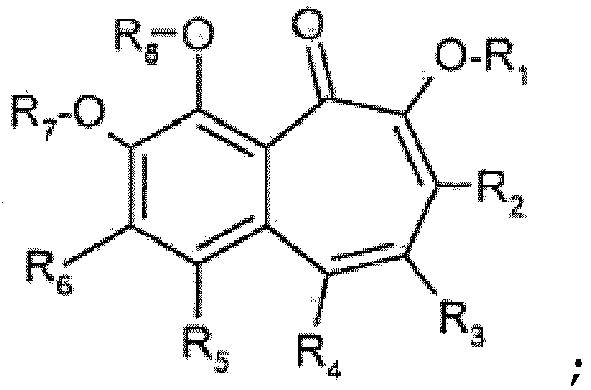 R2, R3, R4, R5 et R6 indépendamment les uns des autres sont hydrogène ; OH ; alkyle en C1-C30, alcényle en C2-C30, alcoxy en C1-C30, cycloalkyle en C3-C12 ou hydroxyalkyle en C1-C30, qui peuvent être substitués par un ou plusieurs E et/ou interrompus par un ou plusieurs D ; aryle en C6-C20 qui peut être substitué par un ou plusieurs G ; hétéroaryle en C4-C20 qui peut être substitué par un ou plusieurs G, alcényle en C2-C18, alcynyle en C2-C18, aralkyle en C7-C25, CN, ou -CO-R17 ; mono- ou dialkylamino en C1-C30 ; COR9 ; COOR9 ; CONR9R10 ; CN ; SO2R9 ; OCOOR9 ; OCOR9 ; NHCOOR9 ; NR9COR10 ; NH2 ; *-(CO)-NH-(CH2)n1-(PO)-(OR11)2 ; -(CO)-O-(CH2)n1-(PO)-(OR11)2 ; sulfate ; sulfonate ; phosphate ; phosphonate ; -(CH2)n2-[O-(SO2)]n3-OR11 ; -O-(CH2)n4(CO)n5-R11 ; -(O)n6-(CH2)n7-(PO)-(OR9)2 ; -(O)n6-(CH2)n7-SO2-OR9 ; halogène ; organosilanyle ; organosiloxanyle ; ou un résidu glucidique directement lié dans un mode α ou β par l'intermédiaire de l'oxygène anomère au système benzotropolone ou par l'intermédiaire d'un espaceur alkylène, alcénylène, alcadiène ou alcatriène linéaire ou ramifié (glucide- (CH2)n-(X1)1 ou 0-système benzotropolone, où n = 1-10 et X1 = -O-; -(CO)-; -O-CO-; -COO-; -NH- ; -S- ; -SO2-);R1, R7 et R8 indépendamment l'un de l'autre sont hydrogène ; alkyle en C1-C12 ou cycloalkyle en C3-C12, qui peuvent être substitués par un ou plusieurs E et/ou interrompus par un ou plusieurs D ; aryle en C6-C20, qui peut être substitué par un ou plusieurs G ; hétéroaryle en C4-C20, qui peut être substitué par un ou plusieurs G, alcényle en C2-C18-, alcynyle en C2-C18, aralkyle en C7-C25, ou COOR9 ; COR9 ; CONR9R10 ; SO3R9 ; SO2R9 ; PO3(R9)2 ; PO2(R9)2 ; organosilanyle ; organosiloxanyle ; ou un résidu glucidique directement lié dans un mode α ou β par l'intermédiaire de l'oxygène anomère au système benzotropolone ou par l'intermédiaire d'un espaceur alkylène, alcénylène, alcadiène ou alcatriène linéaire ou ramifié (glucide- (CH2)n-(X2)1 ou 0 -*, où n = 1-10 et X2 = -C(=O)- ; -O-CO-*) ;R9 et R10 indépendamment l'un de l'autre sont hydrogène ; alkyle en C1-C18 ou cycloalkyle en C3-C12 qui peuvent être substitués par un ou plusieurs E et/ou interrompus par un ou plusieurs D ; aryle en C6-C20, qui peut être substitué par un ou plusieurs G ; hétéroaryle en C4-C20, qui peut être substitué par un ou plusieurs G ; organosilanyle ; organosiloxanyle ; ou un résidu glucidique directement lié dans un mode α ou β par l'intermédiaire de l'oxygène anomère ou par l'intermédiaire d'un espaceur alkylène, alcénylène, alcadiène ou alcatriène linéaire ou ramifié (glucide-(CH2)n-*, où n = 1-10) ; ouR9 et R10 forment conjointement un cycle de cinq ou six chaînons,R11 est hydrogène ; ou alkyle en C1-C5 ;n1, n2, n4 et n7 indépendamment les uns des autres sont un nombre de 1 à 5 ;n3, n5 et n6 indépendamment l'un de l'autre sont 0 ; ou 1 ;D est -CO- ; -COO- ; -S- ; -SO- ; -SO2- ; -O- ; -NR14- ; -SiR19R20- ; -POR11- ; -CR12=CR13- ; ou -C≡C- ; etE est -OR18 ; -SR18 ; -NR14R15 ; -NR14COR15 ; -COR17 ;-COOR16 ; -CONR14R15 ; -CN ; halogène ; ou SO3R18 ; SO2R18 ; PO3(R18)2 ; PO2(R18)2 ; organosilanyle ; organosiloxanyle ; ou un résidu glucidique directement lié dans un mode α ou β par l'intermédiaire de l'oxygène anomère ou par l'intermédiaire d'un espaceur alkylène, alcénylène, alcadiène ou alcatriène linéaire ou ramifié (glucide-(CH2)n-(X1)1 ou 0-*, où n = 1 -10 et X1 = -O- ; -C(=O)- ; -O-CO- ; -COO- ; -NH- ; -S- ; -SO2-);G est E ; alkyle en C1-C18, qui est facultativement interrompu par D ; perfluoroalkyle en C1-C18 ; alcoxy en C1-C18, qui est facultativement substitué par E et/ou interrompu par D ; oùR12, R13, R14 et R15 indépendamment les uns des autres sont hydrogène ; aryle en C6-C18 qui est facultativement substitué par OH, alkyle en C1-C18 ou alcoxy en C1-C18 ; alkyle en C1-C18, qui est facultativement interrompu par -O- ; ouR14 et R15 forment conjointement un cycle de cinq ou six chaînons,R16 est hydrogène ; aryle en C6-C18 qui est facultativement substitué par OH, alkyle en C1-C18 ou alcoxy en C1-C18 ; alkyle en C1-C18 qui est facultativement interrompu par -O- ;R17 est H ; aryle en C6-C18 qui est facultativement substitué par OH, alkyle en C1-C18 ou alcoxy en C1-C18 ; ou alkyle en C1-C18 qui est facultativement interrompu par -O- ;R18 est hydrogène ; aryle en C6-C18, qui est facultativement substitué par OH, alkyle en C1-C18 ou alcoxy en C1-C18 ; alkyle en C1-C18, qui est facultativement interrompu par -O- ;R19 et R20 indépendamment l'un de l'autre sont hydrogène ; alkyle en C1-C18 ; aryle en C6-C18 qui est facultativement substitué par alkyle en C1-C18 ; et* signifie que ce radical est dirigé vers le fragment benzotropolone ;pour l'utilisation dans un procédé pour la protection de la peau humaine et animale contre le rayonnement UV.
 - Composés pour utilisation selon la revendication 1 ; dans lesquels dans la formule (1)R2, R3, R4, R5 et R6 indépendamment les uns des autres sont hydrogène ; OH ; alkyle en C1-C30, alcényle en C2-C30, alcoxy en C1-C30, cycloalkyle en C3-C12 ou hydroxyalkyle en C1-C30, qui peuvent être substitués par un ou plusieurs E et/ou interrompus par un ou plusieurs D ; aryle en C6-C20 qui peut être substitué par un ou plusieurs G ; hétéroaryle en C6-C20 qui peut être substitué par un ou plusieurs G, alcényle en C2-C18, alcynyle en C2-C18, aralkyle en C7-C25, CN, ou -CO-R17 ; mono- ou dialkylamino en C1-C30 ; COR9 ; COOR9 ; CONR9R10 ; CN ; SO2R9 ; OCOOR9 ; NHCOOR9 ; NR9COR10 ; NH2 ; *-(CO)-NH-(CH2)n1-(PO)-(OR11)2 ; -(CO)-O-(CH2)n1-(PO)-(OR11)2 ; sulfate ; sulfonate ; phosphate ; phosphonate; -(CH2)n2-[O-(SO2)]n3-OR11; -O-(CH2)n4(CO)n5-R11; -(O)n6-(CH2)n7-(PO)-(OR9)2 ; -(O)n6-(CH2)n7-SO2-OR9; halogène ; organosilanyle ; organosiloxanyle ; ou un résidu glucidique directement lié dans un mode α ou β par l'intermédiaire de l'oxygène anomère au système benzotropolone ou par l'intermédiaire d'un espaceur alkylène, alcénylène, alcadiène ou alcatriène linéaire ou ramifié (glucide-(CH2)n-(X1)1 ou 0-système benzotropolone, où n = 1-10 et X1 = -O-; -(CO)-; -O-CO-; -COO-; -NH- ; -S- ; -SO2-);R1, R7 et R8 indépendamment l'un de l'autre sont hydrogène ; alkyle en C1-C12 ou cycloalkyle en C3-C12, qui peuvent être substitués par un ou plusieurs E et/ou interrompus par un ou plusieurs D ; aryle en C6-C20, qui peut être substitué par un ou plusieurs G ; hétéroaryle en C6-C20, qui peut être substitué par un ou plusieurs G, alcényle en C2-C18, alcynyle en C2-C18, aralkyle en C7-C25, CN, ou COOR9 ; COR9 ; CONR9R10 ; SO3R9 ; SO2R9 ; PO3(R9)2 ; PO2(R9)2 ; organosilanyle ; organosiloxanyle ; ou un résidu glucidique directement lié dans un mode α ou β par l'intermédiaire de l'oxygène anomère au système benzotropolone ou par l'intermédiaire d'un espaceur alkylène, alcénylène, alcadiène ou alcatriène linéaire ou ramifié (glucide- (CH2)n-(X2)1 ou 0 -*, où n = 1-10 et X2 = -C(=O)- ; -O-CO-) ;R9 et R10 indépendamment l'un de l'autre sont hydrogène ; alkyle en C1-C18 ou cycloalkyle en C3-C12 qui peuvent être substitués par un ou plusieurs E et/ou interrompus par un ou plusieurs D ; aryle en C6-C20, qui peut être substitué par un ou plusieurs G ; organosilanyle ; organosiloxanyle ; ou un résidu glucidique directement lié dans un mode α ou β par l'intermédiaire de l'oxygène anomère ou par l'intermédiaire d'un espaceur alkylène, alcénylène, alcadiène ou alcatriène linéaire ou ramifié (glucide-(CH2)n-*, où n = 1-10) ; ouR9 et R10 forment conjointement un cycle de cinq ou six chaînons,R11 est hydrogène ; ou alkyle en C1-C5 ;n1, n2, n4 et n7 indépendamment les uns des autres sont un nombre de 1 à 5 ;n3 et n5 indépendamment l'un de l'autre sont 0 ; ou 1 ;D est -CO- ; -COO- ; -S- ; -SO- ; -SO2- ; -O- ; -NR14- ; -SiR19R20- ; -POR11- ; -CR12=CR13- ; ou -C≡C- ; etE est -OR18 ; -SR18 ; -NR14R15 ; -NR14COR15 ; -COR17 ;-COOR16 ; -CONR14R15 ; -CN ; halogène ; ou SO3R18 ; SO2R18 ; PO3 (R18)2 ; PO2 (R18)2 ; organosilanyle ; organosiloxanyle ; ou un résidu glucidique directement lié dans un mode α ou β par l'intermédiaire de l'oxygène anomère ou par l'intermédiaire d'un espaceur alkylène, alcénylène, alcadiène ou alcatriène linéaire ou ramifié (glucide-(CH2)n-(X1)1 ou 0-*, où n = 1 -10 et X1 = -O- ; -C(=O)- ; -O-CO- ; -NH- ; -S- ; -SO2-);G est E ; alkyle en C1-C18, qui est facultativement interrompu par D ; perfluoroalkyle en C1-C18 ; alcoxy en C1-C18, qui est facultativement substitué par E et/ou interrompu par D ; oùR12, R13, R14 et R15 indépendamment les uns des autres sont hydrogène ; aryle en C6-C18 qui est facultativement substitué par alkyle en C1-C18 ou alcoxy en C1-C18 ; alkyle en C1-C18, qui est facultativement interrompu par -O- ; ouR14 et R15 forment conjointement un cycle de cinq ou six chaînons,R16 est hydrogène ; aryle en C6-C18 qui est facultativement substitué par alkyle en C1-C18 ou alcoxy en C1-C18 ; alkyle en C1-C18 qui est facultativement interrompu par -O- ;R17 est H ; aryle en C6-C18 qui est facultativement substitué par alkyle en C1-C18 ou alcoxy en C1-C18 ; ou alkyle en C1-C18 qui est facultativement interrompu par -O- ;R18 est hydrogène ; aryle en C6-C18, qui est facultativement substitué par alkyle en C1-C18 ou alcoxy en C1-C18 ; alkyle en C1-C18, qui est facultativement interrompu par -O- ;R19 et R20 indépendamment l'un de l'autre sont hydrogène ; alkyle en C1-C18 ; aryle en C6-C18 qui est facultativement substitué par alkyle en C1-C18 ; et* signifie que ce radical est dirigé vers le fragment benzotropolone.
- Utilisation pour utilisation selon la revendication 1 ou 2, dans lesquelsR1, R7 et R8 sont hydrogène ; etR2, R3, R4, R5 et R6 sont définis comme dans la revendication 1.
- Composés pour utilisation selon l'une quelconque des revendications 1 à 3, dans lesquellesR6 est hydrogène ; OH ; alkyle en C1-C30 ou alcoxy en C1-C30, qui peuvent être substitués par un ou plusieurs E et/ou interrompus par un ou plusieurs D ; phosphate ; phosphonate ou un résidu glucidique directement lié dans un mode α ou β par l'intermédiaire de l'oxygène anomère au système benzotropolone ou par l'intermédiaire d'un espaceur alkylène, alcénylène, alcadiène ou alcatriène linéaire ou ramifié (glucide-(CH2)n-(X1)1 ou 0 -système benzotropolone, où n = 1-10 et X1 = -O- ; -(C=O)- ; -O-CO- ; -COO- ; -NH- ; -S- ; -SO2-);R5 est hydrogène ; alkyle en C1-C18 substitué ou non substitué ; ou un résidu glucidique directement lié dans un mode α ou β par l'intermédiaire de l'oxygène anomère au système benzotropolone ou par l'intermédiaire d'un espaceur alkylène, alcénylène, alcadiène ou alcatriène linéaire ou ramifié (glucide-(CH2)n-(X1)1 ou 0 -système benzotropolone, où n = 1-10 et X1 = -O- ; -(C=O)- ; -O-CO- ; -COO- ; -NH- ; -S- ; -SO2-);R2 et R4 indépendamment l'un de l'autre sont hydrogène ; ou alkyle en C1-C18 substitué ou non substitué ;R3 est hydrogène ; ou carboxylate COOX ; oùX est Na, K ou NH4 ; etD et E sont définis comme dans la revendication 1.
- Composés pour utilisation selon l'une quelconque des revendications 1 à 4, dans lesquels au moins l'un de R2, R3, R4, R5 et R6 indépendamment les uns des autres est un résidu mono-, di- ou oligosaccharide alpha- ou bêta-lié au système cyclique benzotropolone, où ledit résidu est constitué de sous-unités hexose ou pentose.
- Composés pour utilisation selon la revendication 3, dans lesquelsR3 et R6, indépendamment les uns des autres sont un résidu mono-, di- ou oligosaccharide alpha- ou bêta-lié au système cyclique benzotropolone, où ledit résidu est constitué de sous-unités hexose ou pentose ; etR2, R4, R5 sont tels que définis dans la revendication 1.
- Composés pour utilisation selon la revendication 3, dans lesquelsR2, R3, R4, R5 et R6, indépendamment les uns des autres sont hydrogène ; hydroxy ; alkyle en C1-C12, alcoxy en C1-C30 ; ou alcényle en C1-C12 substitué par E ;E est carboxylate ; OCOR9 ; sulfate ; sulfonate ; phosphonate ; ou phosphate ; etR9 est tel que défini dans la revendication 1.
- Composés pour utilisation selon la revendication 1, dans lesquelsR3 est un radical de formule
 R22 est hydrogène ; alkyle en C1-C12, qui peut être substitué par un ou plusieurs E et/ou interrompu par un ou plusieurs D ; aryle en C6-C20, qui peut être substitué par un ou plusieurs G ; hétéroaryle en C4-C20, qui peut être substitué par un ou plusieurs G, alcényle en C2-C18-, alcynyle en C2-C18-, aralkyle en C7-C25, ou -CO-R17 ; organosilanyle ; organosiloxanyle ; ou un résidu glucidique directement lié dans un mode α ou β par l'intermédiaire de l'oxygène anomère au groupe carboxylique ou par l'intermédiaire d'un espaceur alkylène, alcénylène, alcadiène ou alcatriène linéaire ou ramifié (glucide-(CH2)n-groupe carboxylique, où n = 1-10) ;R17 est H ; aryle en C6-C18 qui est facultativement substitué par alkyle en C1-C18 ou alcoxy en C1-C18 ; ou alkyle en C1-C18 qui est facultativement interrompu par -O- ; etR1, R2, R4, R5, R6, R7 et R8, D, G et E sont tels que définis dans la revendication 1.
 - Composés pour utilisation selon la revendication 1, dans lesquels au moins l'un de R2, R3, R4, R5, R6, R9, R10, R11 et R12 indépendamment les uns des autres sont sulfate ; sulfonate ; phosphate ; ou phosphonate et/ou au moins l'un de R1, R7 et R8 conjointement avec l'oxygène adjacent indépendamment les uns des autres forment un groupe sulfate, sulfonate, phosphate ou phosphonate.
- Composés pour utilisation selon la revendication 1, dans lesquels R1, R2, R3, R4, R5, R6, R7 ou R8 sont tels que définis dans la revendication 1 à condition que si R6 est hydroxy et au moins l'un de R1, R2, R3, R4, R5, R7 ou R8 n'est pas hydrogène, en tant qu'antioxydants et/ou des piégeurs de radicaux.
- Composés pour utilisation selon la revendication 10, dans lesquelsR3 est OH ; alkyle en C1-C30, alcényle en C2-C30, alcoxy en C1-C30, cycloalkyle en C3-C12 ou hydroxyalkyle en C1-C30, qui peut être substitué par un ou plusieurs E et/ou interrompu par un ou plusieurs D ; aryle en C6-C20, qui peut être substitué par un ou plusieurs G ; hétéroaryle en C4-C20, qui peut être substitué par un ou plusieurs G, alcényle en C2-C18-, alcynyle en C2-C18, aralkyle en C7-C14, CN, ou -CO-R17; mono- ou dialkylamino en C1-C30 ; COR9 ; COOR9 ; OC(=O)R9 ; CONR9R10 ; CN ; SO2R9 ; OCOOR9 ; NHCOOR9 ; NR9COR10 ; NH2 ; -(CO)-NH-(CH2)n1-(PO)-(ORn)2 ; sulfate ; sulfonate ; phosphate ; phosphonate; -(CH2)n2-[O-(SO2)]n3-OR11; -O-(CH2)n4(CO)n5-R11 ; -(O)n6-(CH2)n7-(PO)-(OR9)2 ; -(O)n6-(CH2)n7-SO2-OR9 ; halogène ; organosilanyle ; organosiloxanyle ; ou un résidu glucidique directement lié dans un mode α ou β par l'intermédiaire de l'oxygène anomère au système benzotropolone ou par l'intermédiaire d'un espaceur alkylène, alcénylène, alcadiène ou alcatriène linéaire ou ramifié (glucide-(CH2)n-(X1)1 ou 0 -système benzotropolone, où n = 1-10 et X1 = -O- ; -(C=O)- ; -O-CO- ; -COO-; -NH- ; -S- ; -SO2-);en tant qu'antioxydants et/ou piégeurs de radicaux, où R1, R2, R4, R5, R6, R7, R8, R9, R10, R11, R17, B, E, D, G, n1 n2, n3, n4, n5, n6, et n7 sont tels que définis dans la revendication 1.
- Composés pour utilisation selon la revendication 10, dans lesquelsR6 est OH ; alkyle en C1-C30, alcényle en C2-C30, alcoxy en C1-C30, cycloalkyle en C3-C12 ou hydroxyalkyle en C1-C30, qui peuvent être substitués par un ou plusieurs E et/ou interrompus par un ou plusieurs D ; aryle en C6-C20 qui peut être substitué par un ou plusieurs G ; hétéroaryle en C4-C20 qui peut être substitué par un ou plusieurs G, alcényle en C2-C18-, alcynyle en C2-C18, aralkyle en C7-C14, CN, ou -CO-R17; mono- ou dialkylamino en C1-C30 ; COR9 ; COOR9 ; -OC(=O)R9 CONR9R10 ; CN ; SO2R9 ; OCOR9 ; NHCOOR9 ; NR9COR10 ; NH2 ; -(CO)-NH-(CH2)n1-(PO)-(OR11)2 ; sulfate ; sulfonate ; phosphate ; phosphonate; -(CH2)n2-[O-(SO2)]n3-OR11; -O-(CH2)n4(CO)n5-R11 ; -(O)n6-(CH2)n7-(PO)-(OR'9)2 ; -(O)n6-(CH2)n7-(SO2)-OR'9 ; halogène ; organosilanyle ; organosiloxanyle ; ou un résidu glucidique directement lié dans un mode α ou β par l'intermédiaire de l'oxygène anomère au système benzotropolone ou par l'intermédiaire d'un espaceur alkylène, alcénylène, alcadiène ou alcatriène linéaire ou ramifié (glucide-(CH2)n-(X1)1 ou 0-système benzotropolone, où n = 1-10 et X1 = -O- ; -(C=O)- ; -O-CO- ; -COO-; -NH- ; -S- ; -SO2-);en tant qu'antioxydants et/ou piégeurs de radicaux, où R1, R2, R3, R4, R5, R7, R8, R9, R10, R11, R17, B, E, D, G, n1 n2, n3, n4, n5, n6, et n7 sont tels que définis dans la revendication 3.
- Dérivés de benzotropolone de formule (1) tels que définis dans la revendication 1 pour l'utilisation dans un procédé pour la protection simultanée de la peau humaine et animale contre le rayonnement UV et les dommages oxydatifs.
- Utilisation de benzotropolone représentée par la formule (1)
 R2, R3, R4, R5 et R6 indépendamment les uns des autres sont hydrogène ; OH ; alkyle en C1-C30, alcényle en C2-C30, alcoxy en C1-C30, cycloalkyle en C3-C12 ou hydroxyalkyle en C1-C30, qui peuvent être substitués par un ou plusieurs E et/ou interrompus par un ou plusieurs D ; aryle en C6-C20 qui peut être substitué par un ou plusieurs G ; hétéroaryle en C4-C20 qui peut être substitué par un ou plusieurs G, alcényle en C2-C18, alcynyle en C2-C18, aralkyle en C7-C25, CN, ou -CO-R17 ; mono- ou dialkylamino en C1-C30 ; COR9 ; COOR9 ; CONR9R10 ; CN ; SO2R9 ; OCOOR9 ; OCOR9 ; NHCOOR9 ; NR9COR10 ; NH2 ; *-(CO)-NH-(CH2)n1-(PO)-(OR11)2 ; -(CO)-O-(CH2)n1-(PO)-(OR11)2 ; sulfate ; sulfonate ; phosphate ; phosphonate; -(CH2)n2-[O-(SO2)]n3-OR11; -O-(CH2)n4(CO)n5-R11; -(O)n6-(CH2)n7-(PO)-(OR9)2 ; -(O)n6-(CH2)n7-SO2-OR9; halogène ; organosilanyle ; organosiloxanyle ; ou un résidu glucidique directement lié dans un mode α ou β par l'intermédiaire de l'oxygène anomère au système benzotropolone ou par l'intermédiaire d'un espaceur alkylène, alcénylène, alcadiène ou alcatriène linéaire ou ramifié (glucide- (CH2)n-(X1)1 ou 0-système benzotropolone, où n = 1-10 et X1 = -O-; -(CO)-; -O-CO-; -COO-; -NH- ; -S- ; -SO2-);R1, R7 et R8 indépendamment l'un de l'autre sont hydrogène ; alkyle en C1-C12 ou cycloalkyle en C3-C12, qui peuvent être substitués par un ou plusieurs E et/ou interrompus par un ou plusieurs D ; aryle en C6-C20, qui peut être substitué par un ou plusieurs G ; hétéroaryle en C4-C20, qui peut être substitué par un ou plusieurs G, alcényle en C2-C18-, alcynyle en C2-C18, aralkyle en C7-C25, ou COOR9 ; COR9 ; CONR9R10 ; SO3R9 ; SO2R9 ; PO3(R9)2 ; PO2(R9)2 ; organosilanyle ; organosiloxanyle ; ou un résidu glucidique directement lié dans un mode α ou β par l'intermédiaire de l'oxygène anomère au système benzotropolone ou par l'intermédiaire d'un espaceur alkylène, alcénylène, alcadiène ou alcatriène linéaire ou ramifié (glucide- (CH2)n-(X2)1 ou 0 -*, où n = 1-10 et X2 = -C(=O)- ; -O-CO-*) ;Rget R10 indépendamment l'un de l'autre sont hydrogène ; alkyle en C1-C18 ou cycloalkyle en C3-C12 qui peuvent être substitués par un ou plusieurs E et/ou interrompus par un ou plusieurs D ; aryle en C6-C20, qui peut être substitué par un ou plusieurs G ; hétéroaryle en C4-C20, qui peut être substitué par un ou plusieurs G ; organosilanyle ; organosiloxanyle ; ou un résidu glucidique directement lié dans un mode α ou β par l'intermédiaire de l'oxygène anomère ou par l'intermédiaire d'un espaceur alkylène, alcénylène, alcadiène ou alcatriène linéaire ou ramifié (glucide-(CH2)n-*, où n = 1-10) ; ouR9 et R10 forment conjointement un cycle de cinq ou six chaînons,R11 est hydrogène ; ou alkyle en C1-C5 ;n1, n2, n4 et n7 indépendamment les uns des autres sont un nombre de 1 à 5 ;n3, n5 et n6 indépendamment l'un de l'autre sont 0 ; ou 1 ;D est -CO- ; -COO- ; -S- ; -SO- ; -SO2- ; -O- ; -NR14- ; -SiR19R20- ; -POR11- ; -CR12=CR13- ; ou -C≡C- ; etE est -OR18 ; -SR18 ; -NR14R15 ; -NR14COR15 ; -COR17 ; - COOR16 ; -CONR14R15 ; -CN ; halogène ; ou SO3R18 ; SO2R18 ; PO3 (R18)2 ; PO2 (R18)2 ; organosilanyle ; organosiloxanyle ; ou un résidu glucidique directement lié dans un mode α ou β par l'intermédiaire de l'oxygène anomère ou par l'intermédiaire d'un espaceur alkylène, alcénylène, alcadiène ou alcatriène linéaire ou ramifié (glucide-(CH2)n- (X1)1 ou 0-*, où n = 1 -10 et X1 = -O- ; -C(=O)- ; -O-CO- ; -COO- ; -NH- ; -S- ; -SO2-);G est E ; alkyle en C1-C18, qui est facultativement interrompu par D ; perfluoroalkyle en C1-C18 ; alcoxy en C1-C18, qui est facultativement substitué par E et/ou interrompu par D ; oùR12, R13, R14 et R15 indépendamment les uns des autres sont hydrogène ; aryle en C6-C18 qui est facultativement substitué par OH, alkyle en C1-C18 ou alcoxy en C1-C18 ; alkyle en C1-C18, qui est facultativement interrompu par -O- ; ouR14 et R15 forment conjointement un cycle de cinq ou six chaînons,R16 est hydrogène ; aryle en C6-C18 qui est facultativement substitué par OH, alkyle en C1-C18 ou alcoxy en C1-C18 ; alkyle en C1-C18 qui est facultativement interrompu par -O- ;R17 est H ; aryle en C6-C18 qui est facultativement substitué par OH, alkyle en C1-C18 ou alcoxy en C1-C18 ; ou alkyle en C1-C18 qui est facultativement interrompu par -O- ;R18 est hydrogène ; aryle en C6-C18, qui est facultativement substitué par OH, alkyle en C1-C18 ou alcoxy en C1-C18 ; alkyle en C1-C18, qui est facultativement interrompu par -O- ;R19 et R20 indépendamment l'un de l'autre sont hydrogène ; alkyle en C1-C18 ; aryle en C6-C18 qui est facultativement substitué par alkyle en C1-C18 ; et* signifie que ce radical est dirigé vers le fragment benzotropolone ;pour la protection de la peau humaine et animale contre le rayonnement UV.
 - Utilisation de composés de benzotropolone selon la revendication 14, dans lesquels dans la formule (1)R2, R3, R4, R5 et R6 indépendamment les uns des autres sont hydrogène ; OH ; alkyle en C1-C30, alcényle en C2-C30, alcoxy en C1-C30, cycloalkyle en C3-C12 ou hydroxyalkyle en C1-C30, qui peuvent être substitués par un ou plusieurs E et/ou interrompus par un ou plusieurs D ; aryle en C6-C20 qui peut être substitué par un ou plusieurs G ; hétéroaryle en C6-C20 qui peut être substitué par un ou plusieurs G, alcényle en C2-C18, alcynyle en C2-C18, aralkyle en C7-C25, CN, ou -CO-R17 ; mono- ou dialkylamino en C1-C30 ; COR9 ; COOR9 ; CONR9R10 ; CN ; SO2R9 ; OCOOR9 ; NHCOOR9 ; NR9COR10 ; NH2 ; *-(CO)-NH-(CH2)n1-(PO)-(OR11)2 ; -(CO)-O-(CH2)n1-(PO)-(OR11)2 ; sulfate ; sulfonate ; phosphate ; phosphonate; -(CH2)n2-[O-(SO2)]n3-OR11; -O-(CH2)n4(CO)n5-R11; -(O)n6-(CH2)n7-(PO)-(OR9)2 ; -(O)n6-(CH2)n7-SO2-OR9; halogène ; organosilanyle ; organosiloxanyle ; ou un résidu glucidique directement lié dans un mode α ou β par l'intermédiaire de l'oxygène anomère au système benzotropolone ou par l'intermédiaire d'un espaceur alkylène, alcénylène, alcadiène ou alcatriène linéaire ou ramifié (glucide- (CH2)n-(X1)1 ou 0-système benzotropolone, où n = 1-10 et X1 = -O-; -(CO)-; -O-CO-; -COO-; -NH- ; -S- ; -SO2-);R1, R7 et R8 indépendamment l'un de l'autre sont hydrogène ; alkyle en C1-C12 ou cycloalkyle en C3-C12, qui peuvent être substitués par un ou plusieurs E et/ou interrompus par un ou plusieurs D ; aryle en C6-C20, qui peut être substitué par un ou plusieurs G ; hétéroaryle en C6-C20, qui peut être substitué par un ou plusieurs G, alcényle en C2-C18, alcynyle en C2-C18, aralkyle en C7-C25, CN, ou COOR9 ; COR9 ; CONR9R10 ; SO3R9 ; SO2R9 ; PO3(R9)2 ; PO2(R9)2 ; organosilanyle ; organosiloxanyle ; ou un résidu glucidique directement lié dans un mode α ou β par l'intermédiaire de l'oxygène anomère au système benzotropolone ou par l'intermédiaire d'un espaceur alkylène, alcénylène, alcadiène ou alcatriène linéaire ou ramifié (glucide- (CH2)n-(X2)1 ou 0 -*, où n = 1-10 et X2 = -C(=O) - ; -O-CO-) ;R9 et R10 indépendamment l'un de l'autre sont hydrogène ; alkyle en C1-C18 ou cycloalkyle en C3-C12 qui peuvent être substitués par un ou plusieurs E et/ou interrompus par un ou plusieurs D ; aryle en C6-C20, qui peut être substitué par un ou plusieurs G ; organosilanyle ; organosiloxanyle ; ou un résidu glucidique directement lié dans un mode α ou β par l'intermédiaire de l'oxygène anomère ou par l'intermédiaire d'un espaceur alkylène, alcénylène, alcadiène ou alcatriène linéaire ou ramifié (glucide- (CH2)n-*, où n = 1-10) ; ouR9 et R10 forment conjointement un cycle de cinq ou six chaînons,R11 est hydrogène ; ou alkyle en C1-C5 ;n1, n2, n4 et n7 indépendamment les uns des autres sont un nombre de 1 à 5 ;n3 et n5 indépendamment l'un de l'autre sont 0 ; ou 1 ; D est -CO- ; -COO- ; -S- ; -SO- ; -SO2- ; -O- ; -NR14- ; -SiR19R20- ; -POR11- ; -CR12=CR13- ; ou -C≡C- ; etE est -OR18; -SR18; -NR14R15 ; -NR14COR15 ; -COR17 ;-COOR16 ; -CONR14R15 ; -CN ; halogène ; ou SO3R18 ; SO2R18 ; PO3(R18)2 ; PO2(R18)2 ; organosilanyle ; organosiloxanyle ; ou un résidu glucidique directement lié dans un mode α ou β par l'intermédiaire de l'oxygène anomère ou par l'intermédiaire d'un espaceur alkylène, alcénylène, alcadiène ou alcatriène linéaire ou ramifié (glucide- (CH2) n- (X1) 1 ou 0-*, où n = 1 -10 et X1 = -O- ; -C (=O) - ; -O-CO- ; -NH- ; -S- ; -SO2-) ;G est E ; alkyle en C1-C18, qui est facultativement interrompu par D ; perfluoroalkyle en C1-C18 ; alcoxy en C1-C18, qui est facultativement substitué par E et/ou interrompu par D ; oùR12, R13, R14 et R15 indépendamment les uns des autres sont hydrogène ; aryle en C6-C18 qui est facultativement substitué par alkyle en C1-C18 ou alcoxy en C1-C18 ; alkyle en C1-C18, qui est facultativement interrompu par -O- ; ouR14 et R15 forment conjointement un cycle de cinq ou six chaînons,R16 est hydrogène ; aryle en C6-C18 qui est facultativement substitué par alkyle en C1-C18 ou alcoxy en C1-C18; alkyle en C1-C18 qui est facultativement interrompu par -O- ;R17 est H ; aryle en C6-C18 qui est facultativement substitué par alkyle en C1-C18 ou alcoxy en C1-C18 ; ou alkyle en C1-C18 qui est facultativement interrompu par -O- ;R18 est hydrogène ; aryle en C6-C18, qui est facultativement substitué par alkyle en C1-C18 ou alcoxy en C1-C18 ; alkyle en C1-C18, qui est facultativement interrompu par -O- ;R19 et R20 indépendamment l'un de l'autre sont hydrogène ; alkyle en C1-C18 ; aryle en C6-C18 qui est facultativement substitué par alkyle en C1-C18 ; et* signifie que ce radical est dirigé vers le fragment benzotropolone.
- Utilisation de composés de benzotropolone selon les revendications 14 ou 15, dans lesquelsR1, R7 et R8 sont hydrogène ; etR2, R3, R4, R5 et R6 sont définis comme dans la revendication 14.
- Utilisation de composés de benzotropolone selon la revendication 16, dans lesquelsR6 est hydrogène ; OH ; alkyle en C1-C30 ou alcoxy en C1-C30, qui peuvent être substitués par un ou plusieurs E et/ou interrompus par un ou plusieurs D ; phosphate ; phosphonate ou un résidu glucidique directement lié dans un mode α ou β par l'intermédiaire de l'oxygène anomère au système benzotropolone ou par l'intermédiaire d'un espaceur alkylène, alcénylène, alcadiène ou alcatriène linéaire ou ramifié (glucide-(CH2)n-(X1)1 ou 0-système benzotropolone, où n = 1-10 et X1 = -O- ; -(C=O)- ; -O-CO- ; -COO- ; -NH- ; -S- ; -SO2-) ;R5 est hydrogène ; alkyle en C1-C18 substitué ou non substitué ; ou un résidu glucidique directement lié dans un mode α ou β par l'intermédiaire de l'oxygène anomère au système benzotropolone ou par l'intermédiaire d'un espaceur alkylène, alcénylène, alcadiène ou alcatriène linéaire ou ramifié (glucide-(CH2)n- (X1) 1 ou 0-système benzotropolone, où n = 1-10 et X1 = -O- ; - (C=O) - ; -O-CO- ; -COO- ; -NH- ; -S- ; -SO2-) ;R2 et R4 indépendamment l'un de l'autre sont hydrogène ;ou alkyle en C1-C18 substitué ou non substitué ;R3 est hydrogène ; ou carboxylate COOX ; oùX est Na, K ou NH4 ; etD et E sont définis comme dans la revendication 14.
- Utilisation de composés de benzotropolone selon l'une quelconque des revendications 14 à 17, dans lesquels dans lesquels au moins l'un de R2, R3, R4, R5 et R6 indépendamment les uns des autres est un résidu mono-, di- ou oligosaccharide alpha- ou bêta-lié au système cyclique benzotropolone, où ledit résidu est constitué de sous-unités hexose ou pentose.
- Utilisation de composés de benzotropolone selon la revendication 16, dans lesquelsR3 et R6, indépendamment les uns des autres sont un résidu mono-, di- ou oligosaccharide alpha- ou bêta-lié au système cyclique benzotropolone, où ledit résidu est constitué de sous-unités hexose ou pentose ; etR2, R4, R5 sont tels que définis dans la revendication 14.
- Utilisation de composés de benzotropolone selon la revendication 16, dans lesquelsR2, R3, R4, R5 et R6, indépendamment les uns des autres sont hydrogène ; hydroxy ; alkyle en C1-C12, alcoxy en C1-C30 ; ou alcényle en C1-C12 substitué par E ;E est carboxylate ; OCOR9 ; sulfate ; sulfonate ; phosphonate ; ou phosphate ; etR9 est tel que défini dans la revendication 14.
- Utilisation de composés de benzotropolone selon la revendication 14, dans lesquelsR3 est un radical de formule
 R22 est hydrogène ; alkyle en C1-C12, qui peut être substitué par un ou plusieurs E et/ou interrompu par un ou plusieurs D ; aryle en C6-C20, qui peut être substitué par un ou plusieurs G ; hétéroaryle en C4-C20, qui peut être substitué par un ou plusieurs G, alcényle en C2-C18, alcynyle en C2-C18, aralkyle en C7-C25, ou -CO-R17 ; organosilanyle ; organosiloxanyle ; ou un résidu glucidique directement lié dans un mode α ou β par l'intermédiaire de l'oxygène anomère au groupe carboxylique ou par l'intermédiaire d'un espaceur alkylène, alcénylène, alcadiène ou alcatriène linéaire ou ramifié (glucide- (CH2)n-groupe carboxylique, où n = 1-10) ;R17 est H ; aryle en C6-C18 qui est facultativement substitué par alkyle en C1-C18 ou alcoxy en C1-C18 ; ou alkyle en C1-C18 qui est facultativement interrompu par -O- ; etR1, R2, R4, R5, R6, R7 et R8, D, G et E sont tels que définis dans la revendication 14.
 - Utilisation de composés de benzotropolone selon la revendication 14, dans lesquels au moins l'un de R2, R3, R4, R5, R6, R9, R10, R11 et R12 indépendamment les uns des autres sont sulfate ; sulfonate ; phosphate ; ou phosphonate et/ou au moins l'un de R1, R7 et R8 conjointement avec l'oxygène adjacent indépendamment les uns des autres forment un groupe sulfate, sulfonate, phosphate ou phosphonate.
- Utilisation de composés de benzotropolone selon la revendication 14, dans lesquels R1, R2, R3, R4, R5, R6, R7 ou R8 sont tels que définis dans la revendication 14 à condition que si R6 est hydroxy et au moins l'un de R1, R2, R3, R4, R5, R7 ou R8 n'est pas hydrogène, en tant qu'antioxydants et/ou des piégeurs de radicaux.
- Utilisation de composés de benzotropolone selon la revendication 23, dans lesquelsR3 est OH ; alkyle en C1-C30, alcényle en C2-C30, alcoxy en C1-C30, cycloalkyle en C3-C12 ou hydroxyalkyle en C1-C30, qui peut être substitué par un ou plusieurs E et/ou interrompu par un ou plusieurs D ; aryle en C6-C20, qui peut être substitué par un ou plusieurs G ; hétéroaryle en C4-C20, qui peut être substitué par un ou plusieurs G, alcényle en C2-C18, alcynyle en C2-C18, aralkyle en C7-C14, CN, ou -CO-R17; mono- ou dialkylamino en C1-C30 ; COR9 ; COOR9 ; -OC(=O)R9 ; CONR9R10 ; CN ; SO2R9 ; OCOOR9 ; NHCOOR9 ; NR9COR10 ; NH2 ; -(CO)-NH-(CH2)n1-(PO)-(OR11)2 ; sulfate ; sulfonate ; phosphate ; phosphonate ; - (CH2)n2-[O-(SO2)]n3-OR11 ; -O-(CH2)n4(CO)n5-R11 ; -(O)n3-(CH2)n7-(PO)-(OR9)2 ; -(O)n6-(CH2)n7-SO2-OR9 ; halogène ; organosilanyle ; organosiloxanyle ; ou un résidu glucidique directement lié dans un mode α ou β par l'intermédiaire de l'oxygène anomère au système benzotropolone ou par l'intermédiaire d'un espaceur alkylène, alcénylène, alcadiène ou alcatriène linéaire ou ramifié (glucide-(CH2)n-(X1)1 ou 0-système benzotropolone, où n = 1-10 et X1 = -O- ; - (C=O) - ; -O-CO- ; -COO- ; -NH- ; -S- ; -SO2-) ;en tant qu'antioxydants et/ou piégeurs de radicaux, où R1, R2, R4, R5, R6, R7, R8, R9, R10, R11, R17, B, E, D, G, n1 n2, n3, n4, n5, n6, et n7 sont tels que définis dans la revendication 14.
- Utilisation de composés de benzotropolone selon la revendication 23, dans lesquelsR6 est OH ; alkyle en C1-C30, alcényle en C2-C30, alcoxy en C1-C30, cycloalkyle en C3-C12 ou hydroxyalkyle en C1-C30, qui peuvent être substitués par un ou plusieurs E et/ou interrompus par un ou plusieurs D ; aryle en C6-C20 qui peut être substitué par un ou plusieurs G ; hétéroaryle en C4-C20 qui peut être substitué par un ou plusieurs G, alcényle en C2-C18, alcynyle en C2-C18, aralkyle en C7-C14, CN, ou -CO-R17; mono- ou dialkylamino en C1-C30; COR9 ; COOR9 ; -OC(O)R9 ; CONR9R10 ; CN ; SO2R9 ; OCOOR9 ; NHCOOR9 ; NR9COR10 ; NH2 ; -(CO)-NH-(CH2)n1-(PO)-(OR11)2 ; sulfate ; sulfonate ; phosphate ; phosphonate ; - (CH2)n2-[O-(SO2)]n3-OR11 ; -O-(CH2)n4(CO)n5R11 ; -(O)n6-(CH2)n7-(PO)-(OR'9)2 ; -(O)n6-(CH2)n7-SO2-OR'9 ; halogène ; organosilanyle ; organosiloxanyle ; ou un résidu glucidique directement lié dans un mode α ou β par l'intermédiaire de l'oxygène anomère au système benzotropolone ou par l'intermédiaire d'un espaceur alkylène, alcénylène, alcadiène ou alcatriène linéaire ou ramifié (glucide-(CH2)n-(X1) 1 ou 0-système benzotropolone, où n = 1-10 et X1 = -O- ; - (C=O) - ; -O-CO- ; -COO- ; -NH- ; -S- ; -SO2-) ;en tant qu'antioxydants et/ou piégeurs de radicaux, où R1, R2, R3, R4, R6, R7, R8, R9, R10, R11, R17, B, E, D, G, n1 n2, n3, n4, n5, n6, et n7 sont tels que définis dans la revendication 14.
- Utilisation de dérivés de benzotropolone de formule (1) tels que définis dans la revendication 14 pour la protection simultanée des poils humains et animaux contre le rayonnement UV et les dommages oxydatifs.
Priority Applications (1)
| Application Number | Priority Date | Filing Date | Title |
|---|---|---|---|
| EP09769173.7A EP2296760B1 (fr) | 2008-06-25 | 2009-06-18 | Utilisation de dérivés de benzotropolone en tant qu'absorbeurs uv et antioxydants, et leur utilisation dans des écrans solaires et/ou des compositions cosmétiques |
Applications Claiming Priority (5)
| Application Number | Priority Date | Filing Date | Title |
|---|---|---|---|
| EP08158977 | 2008-06-25 | ||
| EP08166349 | 2008-10-10 | ||
| EP09155560 | 2009-03-19 | ||
| PCT/EP2009/057587 WO2009156324A2 (fr) | 2008-06-25 | 2009-06-18 | Utilisation de dérivés de benzotropolone en tant qu’absorbeurs uv et antioxydants, et leur utilisation dans des écrans solaires et/ou des compositions cosmétiques |
| EP09769173.7A EP2296760B1 (fr) | 2008-06-25 | 2009-06-18 | Utilisation de dérivés de benzotropolone en tant qu'absorbeurs uv et antioxydants, et leur utilisation dans des écrans solaires et/ou des compositions cosmétiques |
Publications (2)
| Publication Number | Publication Date |
|---|---|
| EP2296760A2 EP2296760A2 (fr) | 2011-03-23 |
| EP2296760B1 true EP2296760B1 (fr) | 2016-03-16 |
Family
ID=41445016
Family Applications (1)
| Application Number | Title | Priority Date | Filing Date |
|---|---|---|---|
| EP09769173.7A Active EP2296760B1 (fr) | 2008-06-25 | 2009-06-18 | Utilisation de dérivés de benzotropolone en tant qu'absorbeurs uv et antioxydants, et leur utilisation dans des écrans solaires et/ou des compositions cosmétiques |
Country Status (8)
| Country | Link |
|---|---|
| US (1) | US9707417B2 (fr) |
| EP (1) | EP2296760B1 (fr) |
| JP (2) | JP2012500186A (fr) |
| KR (1) | KR101346442B1 (fr) |
| CN (1) | CN102238983B (fr) |
| BR (1) | BRPI0914926B1 (fr) |
| ES (1) | ES2570152T3 (fr) |
| WO (1) | WO2009156324A2 (fr) |
Families Citing this family (27)
| Publication number | Priority date | Publication date | Assignee | Title |
|---|---|---|---|---|
| ES2634423T3 (es) * | 2008-10-06 | 2017-09-27 | Elizabeth Arden International, Sarl | Tratamientos para la piel que contienen derivados de idebenona sustituidos con ácido carboxílico y métodos de preparación y utilización de los mismos |
| KR101701548B1 (ko) * | 2009-10-06 | 2017-02-01 | 바스프 에스이 | 벤조트로폴론을 함유하는 식물 추출물 및/또는 관련 벤조트로폴론 유도체의 사용에 의한 가정용 제품, 바디-관리 제품 및 식품의 안정화 |
| WO2011124528A2 (fr) * | 2010-04-06 | 2011-10-13 | Unilever Nv | Composition d'hygiène personnelle |
| US20110293543A1 (en) * | 2010-05-27 | 2011-12-01 | Wei Yu | Anhydrous composition comprising a dibenzoylmethane compound and a color pigment |
| US8846723B2 (en) * | 2010-07-29 | 2014-09-30 | Eastman Chemical Company | Esters of O-substituted hydroxy carboxylic acids and preparations thereof |
| US8613940B2 (en) | 2010-09-03 | 2013-12-24 | Eastman Chemical Company | Carbonate derivatives as skin care |
| KR102052874B1 (ko) * | 2010-12-22 | 2019-12-09 | 아지노모토 가부시키가이샤 | 배당체 화합물 |
| US8329938B2 (en) | 2011-02-21 | 2012-12-11 | Eastman Chemical Company | Hydroxyalkanoic acid and hydroxyalkanoice acid oligomer esters of retinol |
| CN102559797A (zh) * | 2012-02-15 | 2012-07-11 | 安徽大学 | 一种白藜芦醇多聚体的制备方法 |
| WO2014022287A1 (fr) * | 2012-07-29 | 2014-02-06 | The Regents Of The University Of Colorado, A Body Corporate | Antagonistes du complexe de récepteur 1/2 de type toll |
| KR101413232B1 (ko) | 2012-08-31 | 2014-08-06 | 한국기계연구원 | 경조직 재생용 지지체 조성물 및 이를 포함하는 경조직 재생용 지지체 및 이들의 제조방법 |
| CN103565852B (zh) * | 2012-12-26 | 2015-10-28 | 中国辐射防护研究院 | 用于受照人体放射性核素促排的中药提取物及其提取方法 |
| FR3004108B1 (fr) * | 2013-04-09 | 2015-04-10 | Jean-Noel Thorel | Extrait d'arthrobacter agilis pour son utilisation en cosmetique |
| CN106572953A (zh) * | 2014-08-08 | 2017-04-19 | 欧莱雅 | 皂基防晒组合物 |
| KR101711603B1 (ko) * | 2015-11-03 | 2017-03-03 | 윤철식 | 스티피탈리드를 유효성분으로 포함하는 조성물 |
| WO2017079564A1 (fr) * | 2015-11-04 | 2017-05-11 | The Penn State Research Foundation | Composés, compositions et méthodes pour la coloration de matières comestibles |
| EP3544578A1 (fr) * | 2016-11-23 | 2019-10-02 | GOJO Industries, Inc. | Composition nettoyante stimulant les peptides antimicrobiens |
| US10738002B2 (en) * | 2016-11-24 | 2020-08-11 | Universitair Ziekenhuis Antwerpen | Halogenated benzotropolones as ATG4B inhibitors |
| KR102040230B1 (ko) * | 2017-09-25 | 2019-11-04 | 제주대학교 산학협력단 | 푸르푸로갈린을 포함하는, 활성산소종, 자외선 또는 미세먼지에 대한 피부 보호용 화장료 조성물 |
| CN108276935B (zh) * | 2018-01-18 | 2020-06-02 | 中国科学院理化技术研究所 | 一种基于丙烯酸类树脂的负离子环保胶及其制备方法 |
| CN111004297B (zh) * | 2018-06-27 | 2023-08-22 | 上海和黄药业有限公司 | 糖苷类化合物、其制备方法、组合物、应用及中间体 |
| KR102311011B1 (ko) * | 2018-09-12 | 2021-10-08 | 주식회사 엘지생활건강 | 인간지방줄기세포의 증식 촉진용 조성물 |
| KR102010211B1 (ko) * | 2019-01-22 | 2019-08-12 | 이재현 | 하르가이 추출물을 함유하는 샴푸 조성물 및 그 제조 방법 |
| AU2021300119A1 (en) * | 2020-06-30 | 2023-03-02 | Amyris, Inc. | Metal oxide sunscreen formulations |
| KR102614802B1 (ko) * | 2021-02-02 | 2023-12-19 | 대구대학교 산학협력단 | 갈릭산 산화물로부터 분리된 화합물을 유효성분으로 함유하는 피부 주름 개선용 조성물 |
| CN114163322B (zh) * | 2021-11-23 | 2023-09-12 | 中国农业科学院农业环境与可持续发展研究所 | 紫外线吸收剂、制备方法和用途 |
| CN114369340B (zh) * | 2021-11-23 | 2023-09-08 | 中国农业科学院农业环境与可持续发展研究所 | 含有紫外线吸收剂的材料及制备方法 |
Family Cites Families (11)
| Publication number | Priority date | Publication date | Assignee | Title |
|---|---|---|---|---|
| US2770545A (en) * | 1953-10-02 | 1956-11-13 | Universal Oil Prod Co | Stabilization of organic compounds |
| DE1091114B (de) * | 1959-02-07 | 1960-10-20 | Hoechst Ag | Verfahren zur Herstellung von Benzotropolonderivaten |
| JPS568309A (en) * | 1979-06-29 | 1981-01-28 | Yasuaki Fukuda | White cosmetic |
| JP3019996B2 (ja) * | 1990-03-01 | 2000-03-15 | 三井農林株式会社 | 白癬治療剤 |
| AU1745592A (en) * | 1991-05-16 | 1992-12-30 | Tai-Wing Wu | Pharmaceutical composition comprising purpurogallin useful as an antioxidant and cytoprotective agent |
| US20050058709A1 (en) * | 1997-06-04 | 2005-03-17 | Fisher Gary J. | Methods for inhibiting photoaging of human skin using orally-administered agent |
| US6602527B1 (en) * | 2000-11-22 | 2003-08-05 | Thomas J. Slaga | Processing method for manufacturing black tea and an improved black tea |
| US6831191B2 (en) * | 2001-12-20 | 2004-12-14 | Em Industries | Photo stable organic sunscreen compounds with antioxidant properties and compositions obtained therefrom |
| US7087790B2 (en) * | 2003-08-29 | 2006-08-08 | Rutgers, The State University Of New Jersey | Benzotropolone derivatives and modulation of inflammatory response |
| JP2005281247A (ja) * | 2004-03-30 | 2005-10-13 | Hirobumi Nakano | 新規フェノール性化合物及びその製造方法 |
| GB2412866A (en) * | 2004-04-02 | 2005-10-12 | Ciba Sc Holding Ag | Amino-benzophenone UV filter formulations for the prevention of tanning |
-
2009
- 2009-06-18 BR BRPI0914926-0A patent/BRPI0914926B1/pt not_active IP Right Cessation
- 2009-06-18 ES ES09769173T patent/ES2570152T3/es active Active
- 2009-06-18 US US13/000,163 patent/US9707417B2/en not_active Expired - Fee Related
- 2009-06-18 WO PCT/EP2009/057587 patent/WO2009156324A2/fr not_active Ceased
- 2009-06-18 JP JP2011515320A patent/JP2012500186A/ja active Pending
- 2009-06-18 CN CN200980124354.4A patent/CN102238983B/zh not_active Expired - Fee Related
- 2009-06-18 KR KR1020117001727A patent/KR101346442B1/ko not_active Expired - Fee Related
- 2009-06-18 EP EP09769173.7A patent/EP2296760B1/fr active Active
-
2014
- 2014-04-10 JP JP2014080808A patent/JP5992010B2/ja not_active Expired - Fee Related
Also Published As
| Publication number | Publication date |
|---|---|
| WO2009156324A2 (fr) | 2009-12-30 |
| ES2570152T3 (es) | 2016-05-17 |
| CN102238983B (zh) | 2016-08-24 |
| US20110123468A1 (en) | 2011-05-26 |
| BRPI0914926A2 (pt) | 2015-10-20 |
| JP2012500186A (ja) | 2012-01-05 |
| BRPI0914926B1 (pt) | 2022-04-12 |
| KR20110023892A (ko) | 2011-03-08 |
| US9707417B2 (en) | 2017-07-18 |
| JP2014159446A (ja) | 2014-09-04 |
| CN102238983A (zh) | 2011-11-09 |
| EP2296760A2 (fr) | 2011-03-23 |
| JP5992010B2 (ja) | 2016-09-14 |
| WO2009156324A3 (fr) | 2012-06-21 |
| KR101346442B1 (ko) | 2014-01-15 |
Similar Documents
| Publication | Publication Date | Title |
|---|---|---|
| US9707417B2 (en) | Use of benzotropolone derivatives as UV absorbers and antioxidants and their use in sunscreens and/or cosmetic compositions | |
| EP2709977B1 (fr) | Utilisation de dérivés de benzotropolone en tant qu'antioxydants photostables pour la stabilisation de produits de soin corporel et de produits menagers | |
| EP2303222B1 (fr) | Stabilisation de produits de soin corporel et ménagers | |
| EP2178491B1 (fr) | Mélanges comprenant des benzotriazoles et des mérocyanines | |
| EP2391334B1 (fr) | Stabilisation de compositions cosmétiques | |
| EP1482904B1 (fr) | Compositions d'absorbeurs d'uv renfermant un compose d'hydroxyphenyltriazine | |
| US9066872B2 (en) | Stabilization of cosmetic compositions | |
| US20040191191A1 (en) | Symmetrical triazine derivatives | |
| EP3229766B1 (fr) | Agents de solubilisation pour filtres uv dans des formulations cosmétiques | |
| EP1919443B1 (fr) | Stabilisation de produits pour le soin du corps et de produits menagers contre la degradation par rayonnement uv utilisant des derives de merocyanine | |
| GB2412866A (en) | Amino-benzophenone UV filter formulations for the prevention of tanning | |
| EP3128995B1 (fr) | Agents de solubilisation pour filtres uv dans des formulations cosmétiques | |
| EP3481365B1 (fr) | Agents de solubilisation pour filtres uv dans des formulations cosmetiques | |
| GB2418141A (en) | Micro-particulate organic UV absorber composition |
Legal Events
| Date | Code | Title | Description |
|---|---|---|---|
| PUAI | Public reference made under article 153(3) epc to a published international application that has entered the european phase |
Free format text: ORIGINAL CODE: 0009012 |
|
| AK | Designated contracting states |
Kind code of ref document: A2 Designated state(s): AT BE BG CH CY CZ DE DK EE ES FI FR GB GR HR HU IE IS IT LI LT LU LV MC MK MT NL NO PL PT RO SE SI SK TR |
|
| AX | Request for extension of the european patent |
Extension state: AL BA RS |
|
| DAX | Request for extension of the european patent (deleted) | ||
| R17D | Deferred search report published (corrected) |
Effective date: 20120621 |
|
| 17P | Request for examination filed |
Effective date: 20121221 |
|
| RBV | Designated contracting states (corrected) |
Designated state(s): AT BE BG CH CY CZ DE DK EE ES FI FR GB GR HR HU IE IS IT LI LT LU LV MC MK MT NL NO PL PT RO SE SI SK TR |
|
| 17Q | First examination report despatched |
Effective date: 20150317 |
|
| RIC1 | Information provided on ipc code assigned before grant |
Ipc: A61K 8/35 20060101ALI20150731BHEP Ipc: A61Q 17/04 20060101ALI20150731BHEP Ipc: A61Q 17/00 20060101AFI20150731BHEP |
|
| GRAP | Despatch of communication of intention to grant a patent |
Free format text: ORIGINAL CODE: EPIDOSNIGR1 |
|
| INTG | Intention to grant announced |
Effective date: 20150922 |
|
| GRAS | Grant fee paid |
Free format text: ORIGINAL CODE: EPIDOSNIGR3 |
|
| GRAA | (expected) grant |
Free format text: ORIGINAL CODE: 0009210 |
|
| AK | Designated contracting states |
Kind code of ref document: B1 Designated state(s): AT BE BG CH CY CZ DE DK EE ES FI FR GB GR HR HU IE IS IT LI LT LU LV MC MK MT NL NO PL PT RO SE SI SK TR |
|
| REG | Reference to a national code |
Ref country code: GB Ref legal event code: FG4D |
|
| REG | Reference to a national code |
Ref country code: CH Ref legal event code: EP |
|
| REG | Reference to a national code |
Ref country code: IE Ref legal event code: FG4D |
|
| REG | Reference to a national code |
Ref country code: AT Ref legal event code: REF Ref document number: 780675 Country of ref document: AT Kind code of ref document: T Effective date: 20160415 |
|
| REG | Reference to a national code |
Ref country code: DE Ref legal event code: R096 Ref document number: 602009036833 Country of ref document: DE |
|
| REG | Reference to a national code |
Ref country code: ES Ref legal event code: FG2A Ref document number: 2570152 Country of ref document: ES Kind code of ref document: T3 Effective date: 20160517 |
|
| REG | Reference to a national code |
Ref country code: FR Ref legal event code: PLFP Year of fee payment: 8 |
|
| REG | Reference to a national code |
Ref country code: NL Ref legal event code: MP Effective date: 20160316 |
|
| REG | Reference to a national code |
Ref country code: LT Ref legal event code: MG4D |
|
| PG25 | Lapsed in a contracting state [announced via postgrant information from national office to epo] |
Ref country code: HR Free format text: LAPSE BECAUSE OF FAILURE TO SUBMIT A TRANSLATION OF THE DESCRIPTION OR TO PAY THE FEE WITHIN THE PRESCRIBED TIME-LIMIT Effective date: 20160316 Ref country code: FI Free format text: LAPSE BECAUSE OF FAILURE TO SUBMIT A TRANSLATION OF THE DESCRIPTION OR TO PAY THE FEE WITHIN THE PRESCRIBED TIME-LIMIT Effective date: 20160316 Ref country code: NO Free format text: LAPSE BECAUSE OF FAILURE TO SUBMIT A TRANSLATION OF THE DESCRIPTION OR TO PAY THE FEE WITHIN THE PRESCRIBED TIME-LIMIT Effective date: 20160616 Ref country code: GR Free format text: LAPSE BECAUSE OF FAILURE TO SUBMIT A TRANSLATION OF THE DESCRIPTION OR TO PAY THE FEE WITHIN THE PRESCRIBED TIME-LIMIT Effective date: 20160617 |
|
| REG | Reference to a national code |
Ref country code: AT Ref legal event code: MK05 Ref document number: 780675 Country of ref document: AT Kind code of ref document: T Effective date: 20160316 |
|
| PG25 | Lapsed in a contracting state [announced via postgrant information from national office to epo] |
Ref country code: SE Free format text: LAPSE BECAUSE OF FAILURE TO SUBMIT A TRANSLATION OF THE DESCRIPTION OR TO PAY THE FEE WITHIN THE PRESCRIBED TIME-LIMIT Effective date: 20160316 Ref country code: LT Free format text: LAPSE BECAUSE OF FAILURE TO SUBMIT A TRANSLATION OF THE DESCRIPTION OR TO PAY THE FEE WITHIN THE PRESCRIBED TIME-LIMIT Effective date: 20160316 Ref country code: NL Free format text: LAPSE BECAUSE OF FAILURE TO SUBMIT A TRANSLATION OF THE DESCRIPTION OR TO PAY THE FEE WITHIN THE PRESCRIBED TIME-LIMIT Effective date: 20160316 Ref country code: LV Free format text: LAPSE BECAUSE OF FAILURE TO SUBMIT A TRANSLATION OF THE DESCRIPTION OR TO PAY THE FEE WITHIN THE PRESCRIBED TIME-LIMIT Effective date: 20160316 |
|
| PG25 | Lapsed in a contracting state [announced via postgrant information from national office to epo] |
Ref country code: EE Free format text: LAPSE BECAUSE OF FAILURE TO SUBMIT A TRANSLATION OF THE DESCRIPTION OR TO PAY THE FEE WITHIN THE PRESCRIBED TIME-LIMIT Effective date: 20160316 Ref country code: PL Free format text: LAPSE BECAUSE OF FAILURE TO SUBMIT A TRANSLATION OF THE DESCRIPTION OR TO PAY THE FEE WITHIN THE PRESCRIBED TIME-LIMIT Effective date: 20160316 Ref country code: IS Free format text: LAPSE BECAUSE OF FAILURE TO SUBMIT A TRANSLATION OF THE DESCRIPTION OR TO PAY THE FEE WITHIN THE PRESCRIBED TIME-LIMIT Effective date: 20160716 |
|
| PG25 | Lapsed in a contracting state [announced via postgrant information from national office to epo] |
Ref country code: CZ Free format text: LAPSE BECAUSE OF FAILURE TO SUBMIT A TRANSLATION OF THE DESCRIPTION OR TO PAY THE FEE WITHIN THE PRESCRIBED TIME-LIMIT Effective date: 20160316 Ref country code: RO Free format text: LAPSE BECAUSE OF FAILURE TO SUBMIT A TRANSLATION OF THE DESCRIPTION OR TO PAY THE FEE WITHIN THE PRESCRIBED TIME-LIMIT Effective date: 20160316 Ref country code: SK Free format text: LAPSE BECAUSE OF FAILURE TO SUBMIT A TRANSLATION OF THE DESCRIPTION OR TO PAY THE FEE WITHIN THE PRESCRIBED TIME-LIMIT Effective date: 20160316 Ref country code: AT Free format text: LAPSE BECAUSE OF FAILURE TO SUBMIT A TRANSLATION OF THE DESCRIPTION OR TO PAY THE FEE WITHIN THE PRESCRIBED TIME-LIMIT Effective date: 20160316 Ref country code: PT Free format text: LAPSE BECAUSE OF FAILURE TO SUBMIT A TRANSLATION OF THE DESCRIPTION OR TO PAY THE FEE WITHIN THE PRESCRIBED TIME-LIMIT Effective date: 20160718 |
|
| REG | Reference to a national code |
Ref country code: DE Ref legal event code: R097 Ref document number: 602009036833 Country of ref document: DE |
|
| PG25 | Lapsed in a contracting state [announced via postgrant information from national office to epo] |
Ref country code: BE Free format text: LAPSE BECAUSE OF FAILURE TO SUBMIT A TRANSLATION OF THE DESCRIPTION OR TO PAY THE FEE WITHIN THE PRESCRIBED TIME-LIMIT Effective date: 20160316 |
|
| PLBE | No opposition filed within time limit |
Free format text: ORIGINAL CODE: 0009261 |
|
| STAA | Information on the status of an ep patent application or granted ep patent |
Free format text: STATUS: NO OPPOSITION FILED WITHIN TIME LIMIT |
|
| PG25 | Lapsed in a contracting state [announced via postgrant information from national office to epo] |
Ref country code: MC Free format text: LAPSE BECAUSE OF FAILURE TO SUBMIT A TRANSLATION OF THE DESCRIPTION OR TO PAY THE FEE WITHIN THE PRESCRIBED TIME-LIMIT Effective date: 20160316 Ref country code: DK Free format text: LAPSE BECAUSE OF FAILURE TO SUBMIT A TRANSLATION OF THE DESCRIPTION OR TO PAY THE FEE WITHIN THE PRESCRIBED TIME-LIMIT Effective date: 20160316 |
|
| 26N | No opposition filed |
Effective date: 20161219 |
|
| PG25 | Lapsed in a contracting state [announced via postgrant information from national office to epo] |
Ref country code: BG Free format text: LAPSE BECAUSE OF FAILURE TO SUBMIT A TRANSLATION OF THE DESCRIPTION OR TO PAY THE FEE WITHIN THE PRESCRIBED TIME-LIMIT Effective date: 20160616 |
|
| REG | Reference to a national code |
Ref country code: IE Ref legal event code: MM4A |
|
| PG25 | Lapsed in a contracting state [announced via postgrant information from national office to epo] |
Ref country code: SI Free format text: LAPSE BECAUSE OF FAILURE TO SUBMIT A TRANSLATION OF THE DESCRIPTION OR TO PAY THE FEE WITHIN THE PRESCRIBED TIME-LIMIT Effective date: 20160316 Ref country code: IE Free format text: LAPSE BECAUSE OF NON-PAYMENT OF DUE FEES Effective date: 20160618 |
|
| REG | Reference to a national code |
Ref country code: FR Ref legal event code: PLFP Year of fee payment: 9 |
|
| PG25 | Lapsed in a contracting state [announced via postgrant information from national office to epo] |
Ref country code: HU Free format text: LAPSE BECAUSE OF FAILURE TO SUBMIT A TRANSLATION OF THE DESCRIPTION OR TO PAY THE FEE WITHIN THE PRESCRIBED TIME-LIMIT; INVALID AB INITIO Effective date: 20090618 Ref country code: CY Free format text: LAPSE BECAUSE OF FAILURE TO SUBMIT A TRANSLATION OF THE DESCRIPTION OR TO PAY THE FEE WITHIN THE PRESCRIBED TIME-LIMIT Effective date: 20160316 |
|
| REG | Reference to a national code |
Ref country code: FR Ref legal event code: PLFP Year of fee payment: 10 |
|
| PG25 | Lapsed in a contracting state [announced via postgrant information from national office to epo] |
Ref country code: TR Free format text: LAPSE BECAUSE OF FAILURE TO SUBMIT A TRANSLATION OF THE DESCRIPTION OR TO PAY THE FEE WITHIN THE PRESCRIBED TIME-LIMIT Effective date: 20160316 Ref country code: LU Free format text: LAPSE BECAUSE OF NON-PAYMENT OF DUE FEES Effective date: 20160618 Ref country code: MK Free format text: LAPSE BECAUSE OF FAILURE TO SUBMIT A TRANSLATION OF THE DESCRIPTION OR TO PAY THE FEE WITHIN THE PRESCRIBED TIME-LIMIT Effective date: 20160316 Ref country code: MT Free format text: LAPSE BECAUSE OF NON-PAYMENT OF DUE FEES Effective date: 20160630 |
|
| PGFP | Annual fee paid to national office [announced via postgrant information from national office to epo] |
Ref country code: FR Payment date: 20230622 Year of fee payment: 15 Ref country code: DE Payment date: 20230627 Year of fee payment: 15 |
|
| PGFP | Annual fee paid to national office [announced via postgrant information from national office to epo] |
Ref country code: IT Payment date: 20230620 Year of fee payment: 15 Ref country code: GB Payment date: 20230620 Year of fee payment: 15 Ref country code: ES Payment date: 20230720 Year of fee payment: 15 Ref country code: CH Payment date: 20230702 Year of fee payment: 15 |
|
| REG | Reference to a national code |
Ref country code: DE Ref legal event code: R119 Ref document number: 602009036833 Country of ref document: DE |
|
| REG | Reference to a national code |
Ref country code: CH Ref legal event code: PL |
|
| GBPC | Gb: european patent ceased through non-payment of renewal fee |
Effective date: 20240618 |
|
| PG25 | Lapsed in a contracting state [announced via postgrant information from national office to epo] |
Ref country code: DE Free format text: LAPSE BECAUSE OF NON-PAYMENT OF DUE FEES Effective date: 20250101 |
|
| PG25 | Lapsed in a contracting state [announced via postgrant information from national office to epo] |
Ref country code: CH Free format text: LAPSE BECAUSE OF NON-PAYMENT OF DUE FEES Effective date: 20240630 |
|
| PG25 | Lapsed in a contracting state [announced via postgrant information from national office to epo] |
Ref country code: FR Free format text: LAPSE BECAUSE OF NON-PAYMENT OF DUE FEES Effective date: 20240630 |
|
| PG25 | Lapsed in a contracting state [announced via postgrant information from national office to epo] |
Ref country code: GB Free format text: LAPSE BECAUSE OF NON-PAYMENT OF DUE FEES Effective date: 20240618 Ref country code: IT Free format text: LAPSE BECAUSE OF NON-PAYMENT OF DUE FEES Effective date: 20240618 |
|
| REG | Reference to a national code |
Ref country code: ES Ref legal event code: FD2A Effective date: 20250801 |
|
| PG25 | Lapsed in a contracting state [announced via postgrant information from national office to epo] |
Ref country code: ES Free format text: LAPSE BECAUSE OF NON-PAYMENT OF DUE FEES Effective date: 20240619 |