EP2296903B1 - Verfahren zum bedrucken eines verkleidungspaneels - Google Patents
Verfahren zum bedrucken eines verkleidungspaneels Download PDFInfo
- Publication number
- EP2296903B1 EP2296903B1 EP09756393A EP09756393A EP2296903B1 EP 2296903 B1 EP2296903 B1 EP 2296903B1 EP 09756393 A EP09756393 A EP 09756393A EP 09756393 A EP09756393 A EP 09756393A EP 2296903 B1 EP2296903 B1 EP 2296903B1
- Authority
- EP
- European Patent Office
- Prior art keywords
- printing
- panel
- printing unit
- coupling means
- visible
- Prior art date
- Legal status (The legal status is an assumption and is not a legal conclusion. Google has not performed a legal analysis and makes no representation as to the accuracy of the status listed.)
- Not-in-force
Links
- 238000007639 printing Methods 0.000 title claims abstract description 112
- 238000000034 method Methods 0.000 title claims abstract description 33
- 230000008878 coupling Effects 0.000 claims abstract description 78
- 238000010168 coupling process Methods 0.000 claims abstract description 78
- 238000005859 coupling reaction Methods 0.000 claims abstract description 78
- 238000005253 cladding Methods 0.000 claims abstract description 8
- 239000000758 substrate Substances 0.000 claims description 4
- 238000007641 inkjet printing Methods 0.000 claims description 3
- 238000009434 installation Methods 0.000 claims 1
- 239000010410 layer Substances 0.000 description 20
- 238000005034 decoration Methods 0.000 description 12
- 239000011162 core material Substances 0.000 description 6
- 239000000123 paper Substances 0.000 description 5
- 239000002023 wood Substances 0.000 description 5
- 239000007799 cork Substances 0.000 description 4
- 229910052500 inorganic mineral Inorganic materials 0.000 description 4
- 239000011707 mineral Substances 0.000 description 4
- 239000004033 plastic Substances 0.000 description 4
- 239000004753 textile Substances 0.000 description 4
- 238000002508 contact lithography Methods 0.000 description 3
- 238000012986 modification Methods 0.000 description 2
- 230000004048 modification Effects 0.000 description 2
- 239000011120 plywood Substances 0.000 description 2
- 230000000284 resting effect Effects 0.000 description 2
- 241001136792 Alle Species 0.000 description 1
- 229920002522 Wood fibre Polymers 0.000 description 1
- 239000011093 chipboard Substances 0.000 description 1
- 239000007822 coupling agent Substances 0.000 description 1
- 230000001419 dependent effect Effects 0.000 description 1
- 238000003801 milling Methods 0.000 description 1
- 239000002245 particle Substances 0.000 description 1
- 239000002356 single layer Substances 0.000 description 1
- 239000007787 solid Substances 0.000 description 1
- 239000004575 stone Substances 0.000 description 1
- 239000002025 wood fiber Substances 0.000 description 1
Images



Classifications
-
- B—PERFORMING OPERATIONS; TRANSPORTING
- B41—PRINTING; LINING MACHINES; TYPEWRITERS; STAMPS
- B41J—TYPEWRITERS; SELECTIVE PRINTING MECHANISMS, i.e. MECHANISMS PRINTING OTHERWISE THAN FROM A FORME; CORRECTION OF TYPOGRAPHICAL ERRORS
- B41J3/00—Typewriters or selective printing or marking mechanisms characterised by the purpose for which they are constructed
- B41J3/407—Typewriters or selective printing or marking mechanisms characterised by the purpose for which they are constructed for marking on special material
- B41J3/4073—Printing on three-dimensional objects not being in sheet or web form, e.g. spherical or cubic objects
-
- B—PERFORMING OPERATIONS; TRANSPORTING
- B41—PRINTING; LINING MACHINES; TYPEWRITERS; STAMPS
- B41J—TYPEWRITERS; SELECTIVE PRINTING MECHANISMS, i.e. MECHANISMS PRINTING OTHERWISE THAN FROM A FORME; CORRECTION OF TYPOGRAPHICAL ERRORS
- B41J11/00—Devices or arrangements of selective printing mechanisms, e.g. ink-jet printers or thermal printers, for supporting or handling copy material in sheet or web form
- B41J11/008—Controlling printhead for accurately positioning print image on printing material, e.g. with the intention to control the width of margins
-
- B—PERFORMING OPERATIONS; TRANSPORTING
- B44—DECORATIVE ARTS
- B44C—PRODUCING DECORATIVE EFFECTS; MOSAICS; TARSIA WORK; PAPERHANGING
- B44C5/00—Processes for producing special ornamental bodies
- B44C5/04—Ornamental plaques, e.g. decorative panels, decorative veneers
- B44C5/0469—Ornamental plaques, e.g. decorative panels, decorative veneers comprising a decorative sheet and a core formed by one or more resin impregnated sheets of paper
-
- E—FIXED CONSTRUCTIONS
- E04—BUILDING
- E04F—FINISHING WORK ON BUILDINGS, e.g. STAIRS, FLOORS
- E04F15/00—Flooring
- E04F15/02—Flooring or floor layers composed of a number of similar elements
-
- E—FIXED CONSTRUCTIONS
- E04—BUILDING
- E04F—FINISHING WORK ON BUILDINGS, e.g. STAIRS, FLOORS
- E04F2201/00—Joining sheets or plates or panels
- E04F2201/01—Joining sheets, plates or panels with edges in abutting relationship
- E04F2201/0153—Joining sheets, plates or panels with edges in abutting relationship by rotating the sheets, plates or panels around an axis which is parallel to the abutting edges, possibly combined with a sliding movement
-
- E—FIXED CONSTRUCTIONS
- E04—BUILDING
- E04F—FINISHING WORK ON BUILDINGS, e.g. STAIRS, FLOORS
- E04F2201/00—Joining sheets or plates or panels
- E04F2201/02—Non-undercut connections, e.g. tongue and groove connections
- E04F2201/026—Non-undercut connections, e.g. tongue and groove connections with rabbets, e.g. being stepped
-
- E—FIXED CONSTRUCTIONS
- E04—BUILDING
- E04F—FINISHING WORK ON BUILDINGS, e.g. STAIRS, FLOORS
- E04F2201/00—Joining sheets or plates or panels
- E04F2201/03—Undercut connections, e.g. using undercut tongues or grooves
- E04F2201/035—Dovetail connections
-
- E—FIXED CONSTRUCTIONS
- E04—BUILDING
- E04F—FINISHING WORK ON BUILDINGS, e.g. STAIRS, FLOORS
- E04F2203/00—Specially structured or shaped covering, lining or flooring elements not otherwise provided for
- E04F2203/06—Specially structured or shaped covering, lining or flooring elements not otherwise provided for comprising two layers fixedly secured to one another, in offset relationship in order to form a rebate
Definitions
- the unobstructed panel presents the view of the observer from the same direction from which this also see the visible surface can, ie those Surface sections whose surface normal has a component which points in the same direction as the surface normal of the visible surface.
- This supplementary information is applied to the coupling means in an operation independent of the application of the first predetermined decoration to the visible surface of the panel, for example after a decorative paper has been pressed with the core material of the panel and the coupling means have been formed by milling.
- the document DE 10 2005 060 753 A1 describes a method for printing on at least one profiled section of a panel.
- the profiled portion of the panel is moved relative to a stationary printhead during printing.
- the printhead is an inkjet printhead.
- the edges of the panel are provided with tongue and groove profiles; a printing of these side profiles or the visible surface of the panel with a predetermined decor are not described.
- non-contact printing methods are basically known from the prior art.
- a non-contact printing unit i. a printing unit, which does not come into contact with the surface to be printed, by means of a plurality of printing elements print medium, for example ink, emits in the direction of the surface to be printed.
- both decors can be printed in one and the same operation on the panel.
- the control unit supplied to the printing unit for its control control signals are created in a bill taking into account the respective distance.
- the printing unit deliver the printing medium for printing the first predetermined decoration and the printing medium for printing the second predetermined decoration with a different timing.
- This different timing control can be specified to the printing unit either from the outside, for example, from a control unit controlling the printing unit (decentralized intelligence), or generated by the printing unit itself (central intelligence).
- the larger the distance of the surface to be printed from the printing unit the sooner does the printing unit have to discharge the printing medium.
- Another parameter that should be taken into account when creating the timing of the printing unit is the feed rate at which the panel passes the printing unit. The larger this feed rate, the sooner the printing unit must deliver the print medium.
- the panel moves past the printing unit in a purely linear motion at a constant feed rate.
- the overall decoration supplied to the printing unit with a counter-distortion of the first predetermined decoration and the second predetermined decoration, which is designed such that it reduces the distortion When printing balances, so that the overall result is the desired overall decor.
- the panel if a fixed counter-distortion is used, the panel must be moved past the printing unit at a feed rate corresponding to this counter-distortion.
- At least one further parameter for example the feed rate with which the panel is moved past the printing unit, can be taken into account when creating the control signals supplied to the printing unit for its control.
- the printing unit maintains a constant relative position to the panel to be printed during the printing process, preferably stationary.
- all coupling means of the panel can be printed with the method according to the invention, ie both those coupling means which are assigned to the side edges leading and trailing in the direction of movement of the panel, and those coupling means which are assigned to the two side edges in the direction of movement of the panel.
- the problem of "shading" at least a portion of the surface of these coupling means may arise due to the side edge trailing in the direction of movement of the panel.
- the printing unit is mounted such that it gives the printing medium leaving a speed component, which in the direction of movement of the panel relative to the printing unit during the printing process.
- the relative velocity between the printing medium and the panel in the direction of movement of the panel can at least be reduced, if not completely nullified, or even overcompensated.
- a portion of the surface of the coupling means associated with this side edge, which is "shaded" from the trailing edge of the panel can be at least reduced, if not completely eliminated.
- the visible surface basically runs essentially in one plane, it can nevertheless be contoured by impressions and / or elevations, for example in order to give the panel a surface structure which visually and / or haptically corresponds to the first predetermined décor , for example, this can be used to model the grain of a predetermined type of wood or the surface structure of tiles including the joints provided between them.
- the panel may comprise a core, which is provided with a decorative layer having the visible surface and a counter-contact layer having the contact surface.
- the core can be formed, for example, from an MDF board and / or an HDF board and / or an OSB board and / or a chipboard or / and a plywood board and / or multiplex board.
- the decorative layer can be formed, for example, by a laminate comprising at least one paper layer and / or a veneer and / or a layer comprising cork and / or at least one textile and / or at least one plastic or / and at least one mineral or / and linoleum or / and be formed of rubber and / or rubber, wherein the visible surface is formed each printable.
- the counteracting layer can likewise be a single-layer or multi-layer, resin-impregnated paper layer and / or a layer comprising a veneer and / or cork and / or at least one textile and / or at least one plastic or / and at least one mineral Linoleum and / or be made of rubber and / or rubber.
- the panels can not only be printed with second predetermined decorations which are independent of the first predetermined decoration, but it is also possible for the first predetermined decoration and the second predetermined decoration to merge into one another to let. In this way, it is for example possible to print on the coupling means a wood structure, so that the panel has the overall appearance of a solid wood panel.
- a trim panel is generally designated 10.
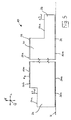
- the panel 10 is rectangular and comprises two mutually parallel side edges 12 and 14 extending in the longitudinal direction L long sides of the panel 10, and two mutually parallel side edges 16 and 18 extending in the transverse direction Q short sides of the panel 10. Both pairs 12/14 and 16/18 of side edges are provided with coupling means 20 and 22 and 24 and 26, respectively.
- FIG. 2 shows a along the line II-II in FIG. 1 taken sectional view of the trim panel 10.
- the coupling means 24 and 26 of the panel 10 may be formed as a so-called "Angling" coupling means, which are connected to each other by pivoting about a respective side edge substantially parallel axis.
- the panel 10 comprises a contact surface 10a intended for bearing against the substrate U and a visible surface 10b facing away from the contact surface 10a.
- the panel 10 comprises a core 30 made, for example, using wood fibers and / or wood shavings and, for example, an MDF board, an HDF board, an OSB board, a plywood board, a multiplex board, a particle board or the like may be formed.
- the core 30 On a surface 30 b assigned to the visible surface 10 b, the core 30 is covered with a decorative layer 32, whose surface 32 a forms the visible surface 10 b of the panel 10.
- the core 30 is coated on a surface 30a associated with the contact surface 10a with a counteracting layer 34 whose surface 34a forms the contact surface 10a of the panel 10.
- the decorative layer 32 may be formed, for example, of a laminate comprising at least one, preferably resin-impregnated, paper layer and / or a veneer and / or a layer comprising cork and / or at least one textile and / or at least one plastic or / and at least one mineral be and / or made of linoleum and / or rubber or / and rubber.
- the Schmidt Kom harsh 34 can also be used as a single or multi-layer, resin-impregnated paper layer and / or as a layer comprising a veneer and / or cork and / or at least one textile and / or at least one plastic or / and at least one mineral and / or made from linoleum and / or from rubber and / or rubber.
- the decorative layer 32 may have contours that make the panel 10 appear haptically and visually more pleasing, for example, by imitating the natural grain of wood or stone. Despite this possible contouring, the decorative layer 32 can be regarded as essentially flat and parallel to the counteracting layer 34. It is thus possible to assign a surface normal N to the essentially flat extension running parallel to the visible surface 10b.
- the panel 10 has on the surfaces of the coupling means 24, 26 at least one viewing section 24a, 26a, which is characterized in that its surface normal n comprises a component n N which points in the same direction as the surface normal N of the visible surface 10b.
- the term "direction” here is a unidirectional direction (in FIG. 2 to the top). It should also be noted that a "viewing section", as defined above, does not necessarily have to be actually visible to a viewer.
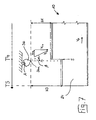
- FIGS. 3 and 4 are two further embodiments of cladding panels 10 '( FIG. 3 ) or 10 "( FIG. 4 ) which is connected to another type of coupling means 24 ', 26' ( FIG. 3 ) or 24 ", 26" ( FIG. 4 ) are formed.
- the coupling means 24 ', 26' according to FIG. 3 formed as a "fold-down" coupling means, ie as a coupling means which by simply nesting in a direction to the panel plane substantially orthogonal direction H (see FIG. 1 ) are connectable.
- the coupling means 26 ' has a plurality of viewing portions 26a' according to the concept of the term as defined above, the coupling means 24 'has no such viewing portions.
- the coupling means 24 “, 26” according to FIG. 4 are formed as “snap” coupling means, ie as coupling means, by substantially planar telescoping and latching are connectable. Both coupling means 24 “, 26” have viewing sections 24a “, 26a”, wherein the viewing sections 26a "are not completely visible to the view of the observer.
- coupling means 20, 22 on the long sides 12, 14 of the panel 10 may also be formed as a coupling means of the "Angling" -type, the "fold-down” type or the “snap” type, wherein the coupling means 20, 22 at the long sides 12, 14 and the coupling means 24, 26 on the short sides 16, 18 of the panel 10 need not necessarily be identical to each other.
- panels are known in which both the long sides 12, 14 and the short sides 16, 18 are provided with coupling means of the "Angling" type or the "snap” type.
- FIG. 5 shows a view of the panel 10 similar to in FIG. 2
- the coupling means 24, 26 are shown only roughly-schematically, ie with a greatly simplified profile geometry.
- both coupling means 24, 26 each have precisely only one viewing section 24a, 26a whose surface normal n also runs parallel to the surface normal N of the visible surface 10b of the panel 10. It is true, as one can easily see, with the coupling means 24, 26, as they are in the FIG. 5 but also the others FIGS. 6 . 7 and 8th , are shown, no coupling can be effected.
- the simplified representation of these coupling means serves to clarify the problem described above and the inventive solution better. The principle explained below is also with more complex profile geometries, such as in the embodiments of the Figures 2 . 3 and 4 shown, applicable.
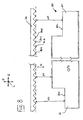
- FIG. 6 shows the panel 10 in the simplified representation according to FIG. 5 , as it is guided at a constant speed V P linearly in the longitudinal direction L of the panel 10 under a non-contact printing unit 36, which may be, for example, an inkjet printing unit. It has proven to be advantageous in practice to guide the panel 10 lying flat in the horizontal plane, while the printing unit 36 is disposed above this horizontal plane and usually extending parallel thereto (see. FIG. 8 ).
- the printing unit 36 is immovably mounted on a fixed frame and has a plurality of pressure nozzles (see. FIG. 8 ), of which in FIG. 6 only one pressure nozzle 36a is shown as an example.
- FIG. 6 a timeline t (pointing to the left) is plotted on this timeline, various times T1 to T5 are plotted, to which reference will be made in the course of the following discussion.
- the relative position of the printing unit 36 relative to the panel 10 is entered for two times T2, T4 of the printing process.
- the printing unit 36 first prints the viewing portion 26a of the coupling means 26 with a decoration indicated by a dot-and-dash line, then the visible surface 10b of the panel 10 with a dashed-dotted line indicated Decor and finally the viewing section 24a of the coupling means 24 with a direction indicated by a long stroke short line line decor.
- ink droplets leave the printing nozzles 36a of the printing unit 36 (in a reference frame resting on the printing unit 36) at a constant velocity V T in a direction perpendicular to the horizontal plane in which the panel is linearly guided.
- the ink droplets impinge not orthogonally but at an angle ⁇ on the viewing section 26a or the viewing section 10b or the viewing section 24a, which is smaller than 90 ° ,
- This angle ⁇ depends largely on the ratio between the speed V T of the ink, which is predetermined by the design of the printing unit 36, and the speed V P of the panel 10, which can be optionally adjusted from.
- the printing unit In order to print on the visible portion 26a of the coupling means 26, the printing unit starts the printing operation at a time T1, i. with a time advance ZV1 with respect to the outermost side edge 38 of the coupling means 26, which at time T1 is not yet vertically below the pressure nozzles 36a of the pressure unit 36.
- the size of this time delay ZV1 is dependent on the angle ⁇ and the distance H2 between the viewing section 26a and the pressure nozzle 36a.
- the printing unit 36 terminates the printing process for printing the viewing section 26a at a time T2, wherein the time T2 with respect to edge 40 has the time advance ZV1 already mentioned above.
- the lead time ZV2 for printing the viewing portion 10b which starts at the edge 42, smaller as the lead time ZV1. Consequently, the printing of the viewing section 10b need not be started until the time T3. So it comes to a break. If necessary, this break can also be used to also print the vertical flank between the viewing section 26a and the visible surface 10b.
- the entire visible surface 10b of the panel 10 is then printed, wherein the time T4 with respect to the edge 44, at which the visible surface 10b ends, the above-mentioned time lead ZV2 has.
- the printing unit 36 begins to print on the viewing section 24a of the coupling means 24 and continues this printing process until the edge 46 at which the viewing section 24a ends is reached at a time T5.
- the time advance ZV3, which can be assigned to the viewing section 24a is greater than the time advance ZV2.
- the printing of the viewing section 24a would therefore have to be started at a time at which the printing of the visible surface 10b is not yet completed. Of course this is not possible.
- the trailing coupling agent can therefore with the in FIG. 6 illustrated embodiment, the emergence of a "shadowed" portion S on the viewing portion 24a of the coupling means 24 can not be avoided.
- the size of the shaded portion S depends, in addition to the angle ⁇ , significantly on the difference between the distance H1 (distance between the visible surface 10b and pressure nozzle 36a) and the distance H3 (distance between the viewing section 24a and pressure nozzle 36a).
- the coupling means 24, 26, whose viewing portion 24a, 26a has the smaller distance H3, H2 to the pressure nozzle 36a, as to select the trailing coupling means and the respective other coupling means as the leading coupling means. For this reason (H2> H3) was according to FIG. 6 the coupling means 26 is selected as the leading coupling means and the coupling means 24 as the trailing coupling means.
- the relative speed between the ink and the panel 10 in the direction of movement of the panel 10 can be reduced, completely zeroed or even overcompensated. Overcompensation can be useful if the trailing coupling means has viewing sections that are located in undercuts, but should still be printed.
- FIG. 7 an arrangement of the printing unit 36 is shown in which the printing unit 36 is pivoted about the axis A to the extent that when the speed V T of the ink vectorially decomposed into a horizontal velocity component V TH and a vertical velocity component V TV , the amount and the direction of the horizontal velocity component V TH are identical to the magnitude and direction of the velocity V P of the panel.
- the time lapses ZV1, ZV2 and ZV3 are reduced to zero.
- the printing unit 36 includes a plurality of printing nozzles 36a, 36b, 36c, 36d, etc.
- FIG. 8 is a rough-schematic representation (with of FIG. 5 already known simplified profile geometry), the shows how the panel 10 can be printed on its entire transverse width Q at the same time by the printing nozzles 36a, 36b, 36c, 36d, etc., when it is passed under the printing unit 36.
- the coupling means 20, 22 on the respective side edges 12, 14 of the longitudinal sides L extending in the long sides of the panel 10 are the distances H4 and H5 between the respective viewing sections 22a, 20a of the coupling means 22, 20 and the above these viewing sections 22a 20a located pressure nozzles of the printing unit 36 to be considered.
- the possible coupling means of the panel 10 have a profile geometry, which is generally more complex than those which, for better illustration of the method according to the invention in FIG FIG. 5 has been described.
- the various viewing portions 20a, 22a, 24a, 26a of the coupling means 20, 22, 24, 26 need not all be parallel to the upper visible surface 10b of the panel 10 (see eg Figures 2 . 3, 4 Rather, if the respective viewing portions 20a, 22a, 24a, 26a are planar, they may be oblique or, if the viewing portions 20a, 22a, 24a, 26a are curved, have at least one radius of curvature.
- the respective viewing sections 20a, 22a, 24a, 26a may be viewed in an approximation, advantageously performed by the control unit, as a plurality of smaller viewing sections oriented approximately parallel to the viewing surface 10b of the panel 10, and thus have a well-defined distance to the corresponding printing nozzles of which the section is to be printed.
- the resolution of this subdivision is preferably based on the resolution of the printing unit 36.
- the printing of the viewing sections 20a, 22a, 24a, 26a always has certain limits depending on the geometry. This is especially true for viewing sections 20a, 22a, 24a, 26a, which are partially or entirely undercuts, so that ink from the printing unit 36 can hardly or not reach them (see, for example, the left viewing section 26a of the "angling" profile in FIG FIG. 2 or the viewing portion 26a “of the” snap “profile in FIG FIG. 4 ).
- the coupling means 24, 26 of the trailing or leading side edges 16, 18 of the above-described angle ⁇ , or possibly a pivot angle ⁇ of the printing unit 36 can be used about the axis A, to still print such viewing sections 24a, 26a within certain limits ,
Landscapes
- Engineering & Computer Science (AREA)
- Architecture (AREA)
- Civil Engineering (AREA)
- Structural Engineering (AREA)
- Manufacturing & Machinery (AREA)
- Printing Methods (AREA)
- Ink Jet (AREA)
- Pressure Welding/Diffusion-Bonding (AREA)
- Accessory Devices And Overall Control Thereof (AREA)
- Finishing Walls (AREA)
Description
- Die Erfindung betrifft ein Verfahren zum Bedrucken eines Verkleidungspaneels, insbesondere eines Verkleidungspaneels zum Verkleiden eines Untergrunds, beispielsweise eines Fußbodens, wobei das Verkleidungspaneel umfasst:
- eine zur Anlage am Untergrund bestimmte Anlagefläche und eine von der Anlagefläche abgewandte Sichtfläche,
- zwei Paare von einander gegenüberliegenden Seitenrändern, von denen wenigstens eines mit Kopplungsmitteln zur Verbindung zweier bezüglich der Kopplungsmittel identisch ausgebildeter Paneele versehen ist,
wobei wenigstens ein Sichtabschnitt der Oberfläche der Kopplungsmittel eine Flächennormale aufweist, die eine Komponente umfasst, welche in die gleiche Richtung weist wie die Flächennormale der Sichtfläche, und
wobei dieser wenigstens eine Sichtabschnitt in Höhenrichtung des Paneels gesehen zwischen der Sichtfläche und der Anlagefläche angeordnet ist, - das Verkleidungspaneel zum Bedrucken unter einem Druckaggregat hindurchführt, wobei die Sichtfläche berührungslos mit einem ersten vorbestimmten Dekor bedruckt wird, und
- wenigstens einen Teil des Sichtabschnitts der Oberfläche der Kopplungsmittel mit einem zweiten vorbestimmten Dekor bedruckt.
- Zwar ist dann, wenn eine Mehrzahl derartiger Verkleidungspaneele miteinander verbunden ist, nur noch die Sichtfläche der Paneele zu sehen, nicht jedoch diejenigen Oberflächenabschnitte der Kopplungsmittel, die das unverlegte Paneel dem Blick des Betrachters aus der gleichen Richtung darbietet, aus der dieser auch die Sichtfläche sehen kann, d.h. diejenigen Oberflächenabschnitte, deren Flächennormale eine Komponente aufweist, welche in die gleiche Richtung weist wie die Flächennormale der Sichtfläche. Allerdings wird in der letzten Zeit dazu übergegangen, auf diesen Oberflächenabschnitten ergänzende Informationen vorzusehen, beispielsweise den Namen oder das Logo des Herstellers. Diese ergänzenden Informationen werden in einem von der Aufbringung des ersten vorbestimmten Dekors auf die Sichtfläche des Paneels unabhängigen Arbeitsschritt auf die Kopplungsmittel aufgebracht, beispielsweise nachdem ein Dekorpapier mit dem Kernmaterial des Paneels verpresst und die Kopplungsmittel durch Fräsen ausgebildet worden sind.
- Das Dokument
DE 10 2005 060 753 A1 beschreibt ein Verfahren zum Bedrucken mindestens eines profilierten Abschnitts eines Paneels. Der profilierte Abschnitt des Paneels wird beim Bedrucken relativ zu einem ortsfesten Druckkopf bewegt. Der Druckkopf ist ein Tintenstrahldruckkopf. Die Kanten des Paneels sind mit Nut- und Federprofilen versehen; ein Bedrucken dieser Seitenprofile oder der Sichtfläche des Paneels mit einem vorbestimmten Dekor sind nicht beschrieben. - Die Verwendung von berührungslosen Druckverfahren ist aus dem Stand der Technik grundsätzlich bekannt. Beispielhaft sei auf das allgemein bekannte Inkjet-Druckverfahren verwiesen, bei welchem ein berührungslos arbeitendes Druckaggregat, d.h. ein Druckaggregat, das mit der zu bedruckenden Oberfläche nicht in Kontakt tritt, mittels einer Mehrzahl von Druckelementen Druckmedium, beispielsweise Tinte, in Richtung der zu bedruckenden Oberfläche abgibt.
- Ausgehend von dem vorstehend geschilderten Stand der Technik ist es Aufgabe der vorliegenden Erfindung, das eingangs angegebene Verfahren zu vereinfachen.
- Diese Aufgabe wird erfindungsgemäß durch ein Verfahren nach Anspruch 1 gelöst, bei welchem das erste vorbestimmte Dekor und das zweite vorbestimmte Dekor in einem gemeinsamen Druckvorgang berührungslos auf das Verkleidungspaneel aufgedruckt werden, wobei dem unterschiedlichen Abstand der Sichtfläche und des wenigstens einen Teils des Sichtabschnitts der Oberfläche der Kopplungsmittel vom Druckaggregat durch eine den jeweiligen Abstand berücksichtigende Erstellung der dem Druckaggregat zu dessen Steuerung zugeführten Steuerungssignale Rechnung getragen wird.
- Dadurch, dass man auch das zweite vorbestimmte Dekor berührungslos auf das Paneel aufdruckt, können beide Dekore in ein und demselben Arbeitsgang auf das Paneel aufgedruckt werden. Um dabei vermeiden zu können, dass die Tatsache, dass die mit dem ersten vorbestimmten Dekor zu bedruckende Oberfläche des Paneels von dem Druckaggregat einen anderen Abstand aufweist als die mit dem zweiten vorbestimmten Dekor zu bedruckende Oberfläche des Paneels, zu einer Verzerrung des aus dem ersten vorbestimmten Dekor und dem zweiten vorbestimmten Dekor gebildeten Gesamtdekors führt, werden die dem Druckaggregat zu dessen Steuerung zugeführten Steuerungssignale in einer dem jeweiligen Abstand Rechnung tragenden Weise erstellt.
- Gemäß einer ersten Möglichkeit wird vorgeschlagen, dass das Druckaggregat das Druckmedium zum Drucken des ersten vorbestimmten Dekors und das Druckmedium zum Drucken des zweiten vorbestimmten Dekors mit einer unterschiedlichen zeitlichen Steuerung abgibt. Diese unterschiedliche zeitliche Steuerung kann dem Druckaggregat entweder von außen vorgegeben werden, beispielsweise von einer das Druckaggregat steuernden Steuereinheit (dezentrale Intelligenz), oder vom Druckaggregat selbst generiert werden (zentrale Intelligenz). In der Regel gilt, dass das Druckaggregat das Druckmedium umso früher abgeben muss, je größer der Abstand der zu bedruckenden Oberfläche vom Druckaggregat ist. Ein weiterer Parameter, der bei der Erstellung der zeitlichen Steuerung des Druckaggregates berücksichtigt werden sollte, ist die Vorschubgeschwindigkeit, mit der sich das Paneel an dem Druckaggregat vorbeibewegt. Je größer diese Vorschubgeschwindigkeit ist, desto früher muss das Druckaggregat das Druckmedium abgeben. Vorzugsweise bewegt sich das Paneel in einer rein linearen Bewegung mit konstanter Vorschubgeschwindigkeit an dem Druckaggregat vorbei.
- Zusätzlich oder alternativ zu der ersten Möglichkeit ist es jedoch auch möglich, das dem Druckaggregat zugeführte Gesamtdekor mit einer Gegenverzerrung des ersten vorbestimmten Dekors und des zweiten vorbestimmten Dekors zu versehen, welche derart ausgebildet ist, dass sie die Verzerrung beim Drucken ausgleicht, so dass sich insgesamt das gewünschte Gesamtdekor ergibt. Wird in diesem Fall mit einer fest vorgegebenen Gegenverzerrung gearbeitet, muss das Paneel mit einer dieser Gegenverzerrung entsprechenden Vorschubgeschwindigkeit an dem Druckaggregat vorbeibewegt werden.
- Wie vorstehend bereits erwähnt, kann bei der Erstellung der dem Druckaggregat zu dessen Steuerung zugeführten Steuerungssignale wenigstens ein weiterer Parameter, beispielsweise die Vorschubgeschwindigkeit, mit der das Paneel am Druckaggregat vorbeibewegt wird, berücksichtigt werden.
- Um der Vorrichtung zur Durchführung des erfindungsgemäßen Verfahrens einen möglichst einfachen konstruktiven Aufbau verleihen zu können, wird in Weiterbildung der Erfindung vorgeschlagen, dass das Druckaggregat während des Druckvorgangs eine konstante Relativlage zu dem zu bedruckenden Paneel beibehält, vorzugsweise ortsfest angeordnet ist.
- Grundsätzlich können mit dem erfindungsgemäßen Verfahren sämtliche Kopplungsmittel des Paneels bedruckt werden, d.h. sowohl diejenigen Kopplungsmittel, die den in Bewegungsrichtung des Paneels vorauslaufenden und nachlaufenden Seitenrändern zugeordnet sind, als auch diejenigen Kopplungsmittel, die den beiden in Bewegungsrichtung des Paneels seitlichen Seitenrändern zugeordnet sind. Bei den Kopplungsmitteln, die dem in Bewegungsrichtung des Paneels nachlaufenden Seitenrand zugeordnet sind, kann sich allerdings das Problem einer "Abschattung" zumindest eines Abschnitts der Oberfläche dieser Kopplungsmittel durch den in Bewegungsrichtung des Paneels nachlaufenden Seitenrand ergeben. Um auch an dem in Bewegungsrichtung des Paneels nachlaufenden Seitenrand ein möglichst vollständiges Bedrucken des diesem Seitenrands zugeordneten Kopplungsmittels ermöglichen zu können, wird daher in Weiterbildung der Erfindung vorgeschlagen, dass das Druckaggregat derart angebracht ist, dass es dem es verlassenden Druckmedium eine Geschwindigkeitskomponente verleiht, welche in die Richtung der Bewegung des Paneels relativ zum Druckaggregat während des Druckvorgangs weist. Auf diese Art und Weise kann die Relativgeschwindigkeit zwischen dem Druckmedium und dem Paneel in der Bewegungsrichtung des Paneels zumindest verringert, wenn nicht gar vollständig zu Null gemacht oder sogar überkompensiert werden. Auf diese Weise kann ein von dem nachlaufenden Seitenrand des Paneels "abgeschatteter" Abschnitt der Oberfläche des diesem Seitenrands zugeordneten Kopplungsmittels zumindest verkleinert, wenn nicht gar vollständig eliminiert werden.
- Nachzutragen ist noch, dass die Sichtfläche zwar grundsätzlich im Wesentlichen in einer Ebene verläuft, dass sie aber gleichwohl durch Eindrückungen oder/und Erhebungen konturiert sein kann, beispielsweise um dem Paneel eine Oberflächenstruktur zu verleihen, die optisch oder/und haptisch dem ersten vorbestimmten Dekor entspricht. Beispielsweise kann hierdurch die Maserung einer vorbestimmten Holzart oder die Oberflächenstruktur von Fliesen einschließlich der zwischen diesen vorgesehenen Fugen nachempfunden werden.
- Das Paneel kann einen Kern umfassen, der mit einer die Sichtfläche aufweisenden Dekorschicht und einer die Anlagefläche aufweisenden Gegenzugschicht versehen ist. Der Kern kann beispielsweise von einer MDF-Platte oder/und einer HDF-Platte oder/und einer OSB-Platte oder/und einer SpanPlatte oder/und einer Sperrholz-Platte oder/und Multiplex-Platte gebildet sein. Die Dekorschicht kann beispielsweise von einem wenigstens eine Papierlage umfassenden Laminat oder/und einem Furnier gebildet sein oder/und eine Kork oder/und wenigstens ein Textil oder/und wenigstens einen Kunststoff oder/und wenigstens ein Mineral umfassende Schicht sein oder/und aus Linoleum oder/und aus Kautschuk oder/und aus Gummi gebildet sein, wobei die Sichtfläche jeweils bedruckbar ausgebildet ist. Die Gegenzugschicht kann ebenfalls als ein- oder mehrlagige, Kunstharz-getränkte Papierschicht oder/und als eine ein Furnier oder/und Kork oder/und wenigstens ein Textil oder/und wenigstens einen Kunststoff oder/und wenigstens ein Mineral umfassende Schicht oder/und aus Linoleum oder/und aus Kautschuk oder/und aus Gummi ausgebildet sein.
- Nachzutragen ist ferner, dass mit Hilfe des erfindungsgemäßen Verfahrens die Paneele nicht nur mit zweiten vorbestimmten Dekoren bedruckt werden können, die von dem ersten vorbestimmten Dekor unabhängig sind, sondern dass es auch möglich ist, das erste vorbestimmte Dekor und das zweite vorbestimmte Dekor ineinander übergehen zu lassen. Auf diese Weise ist es beispielsweise möglich, auch auf die Kopplungsmittel eine Holzstruktur aufzudrucken, so dass das Paneel insgesamt das Erscheinungsbild eines Massivholz-Paneels aufweist.
- Die Erfindung wird im Folgenden an Hand der beigefügten Zeichnung näher erläutert werden. Es stellt dar:
- Figur 1
- eine grobschematische Draufsicht auf ein Verkleidungspaneel;
- Figur 2
- eine längs der Linie II-II in
Figur 1 genommene Schnittansicht einer beispielhaften Ausgestaltung des Verkleidungspaneels; - Figuren 3 und 4
- Ansichten ähnlich
Figur 2 von Verkleidungspaneelen alternativer Ausgestaltungen; - Figur 5
- eine Ansicht ähnlich
Figur 2 , die eine grobschematische Vereinfachung des Verkleidungspaneels darstellt; - Figur 6
- eine Ansicht ähnlich
Figur 5 zur Erläuterung des erfindungsgemäßen Verfahrens; - Figur 7
- eine Ansicht ähnlich
Figur 6 , wobei aber nur das nachlaufende Kopplungsmittel dargestellt ist, zur Erläuterung einer abgewandelten Ausführungsform des erfindungsgemäßen Verfahrens; und - Figur 8
- eine längs der Linie VIII-VIII in
Figur 1 genommene grobschematische Schnittansicht des Verkleidungspaneels während des Druckvorganges; - In
Figur 1 ist ein Verkleidungspaneel allgemein mit 10 bezeichnet. Das Paneel 10 ist rechteckig ausgebildet und umfasst zwei zueinander parallel verlaufende Seitenränder 12 und 14 der in Längsrichtung L verlaufenden Langseiten des Paneels 10, sowie zwei zueinander parallel verlaufende Seitenränder 16 und 18 der in Querrichtung Q verlaufenden Kurzseiten des Paneels 10. Beide Paare 12/14 und 16/18 von Seitenrändern sind mit Kopplungsmitteln 20 und 22 bzw. 24 und 26 versehen. -
Figur 2 zeigt eine längs der Linie II-II inFigur 1 genommene Schnittansicht des Verkleidungspaneels 10. Wie inFigur 2 zu sehen ist, können die Kopplungsmittel 24 und 26 des Paneels 10 als so genannte "Angling"-Kopplungsmittel ausgebildet sein, welche durch Ineinander-Schwenken um eine zum jeweiligen Seitenrand im Wesentlichen parallel verlaufende Achse miteinander verbindbar sind. Das Paneel 10 umfasst eine zur Anlage am Untergrund U bestimmte Anlagefläche 10a und eine von der Anlagefläche 10a abgewandte Sichtfläche 10b. Des weiteren umfasst das Paneel 10 einen Kern 30, der beispielsweise unter Verwendung von Holzfasern oder/und Holzspänen gefertigt ist und beispielsweise von einer MDF-Platte, einer HDF-Platte, einer OSB-Platte, einer Sperrholz-Platte, einer Multiplex-Platte, einer Spanplatte oder dergleichen gebildet sein kann. An einer der Sichtfläche 10b zugeordneten Oberfläche 30b ist der Kern 30 mit einer Dekorschicht 32 belegt, deren Oberfläche 32a die Sichtfläche 10b des Paneels 10 bildet. In analoger Weise ist der Kern 30 an einer der Anlagefläche 10a zugeordneten Oberfläche 30a mit einer Gegenzugschicht 34 belegt, deren Oberfläche 34a die Anlagefläche 10a des Paneels 10 bildet. - Die Dekorschicht 32 kann beispielsweise von einem wenigstens eine, vorzugsweise Kunstharz-getränkte, Papierlage umfassenden Laminat oder/und einem Furnier gebildet sein oder/und eine Kork oder/und wenigstens ein Textil oder/und wenigstens einen Kunststoff oder/und wenigstens ein Mineral umfassende Schicht sein oder/und aus Linoleum oder/und aus Kautschuk oder/und aus Gummi gebildet sein. Die Gegenzugschicht 34 kann ebenfalls als ein- oder mehrlagige, Kunstharz-getränkte Papierschicht oder/und als eine ein Furnier oder/und Kork oder/und wenigstens ein Textil oder/und wenigstens einen Kunststoff oder/und wenigstens ein Mineral umfassende Schicht oder/und aus Linoleum oder/und aus Kautschuk oder/und aus Gummi ausgebildet sein. Ferner kann die Dekorschicht 32 Konturen aufweisen, welche das Paneel 10 haptisch und optisch ansprechender erscheinen lassen, zum Beispiel indem die natürliche Maserung von Holz oder Stein imitiert wird. Trotz dieser möglichen Konturierung kann die Dekorschicht 32 als im Wesentlichen eben und parallel zur Gegenzugschicht 34 betrachtet werden. Es ist somit möglich, der im Wesentlichen ebenen und parallel der Sichtfläche 10b verlaufenden Erstreckung eine Flächennormale N zuzuordnen.
- Das Paneel 10 weist an den Oberflächen der Kopplungsmittel 24, 26 wenigstens einen Sichtabschnitt 24a, 26a auf, welcher sich dadurch auszeichnet, dass seine Flächennormale n eine Komponente nN umfasst, die in die gleiche Richtung wie die Flächennormale N der Sichtfläche 10b weist. Unter dem Begriff "Richtung" ist hierbei eine unidirektionale Richtung (in
Figur 2 nach oben) zu verstehen. Ferner sei darauf hingewiesen, dass ein "Sichtabschnitt" nach dem vorstehend definierten Verständnis des Begriffs nicht notwendigerweise für einen Betrachter tatsächlich sichtbar sein muss. - In den
Figuren 3 und 4 sind zwei weitere Ausführungsbeispiele von Verkleidungspaneelen 10' (Figur 3 ) bzw. 10" (Figur 4 ) dargestellt, welche mit einer anderen Art von Kopplungsmitteln 24', 26' (Figur 3 ) bzw. 24", 26" (Figur 4 ) ausgebildet sind. Insbesondere sind die Kopplungsmittel 24', 26' gemäßFigur 3 als "Fold down"-Kopplungsmittel ausgebildet, d.h. als Kopplungsmittel, die durch einfaches Ineinander-Fügen in einer zur Paneelebene im Wesentlichen orthogonal verlaufenden Richtung H (sieheFigur 1 ) verbindbar sind. Während das Kopplungsmittel 26' mehrere Sichtabschnitt 26a' nach dem vorstehend definierten Verständnis des Begriffs aufweist, verfügt das Kopplungsmittel 24' über keine solche Sichtabschnitte. Die Kopplungsmittel 24", 26" gemäßFigur 4 sind als "Snap"-Kopplungsmittel ausgebildet, d.h. als Kopplungsmittel, die durch im Wesentlichen planares Ineinander-Schieben und Verrasten verbindbar sind. Beide Kopplungsmittel 24", 26" weisen Sichtabschnitte 24a", 26a" auf, wobei die Sichtabschnitte 26a" nicht vollständig für den Blick des Betrachters einsehbar sind. - Die in den
Figuren 2 bis 4 nicht dargestellten Kopplungsmittel 20, 22 an den Langseiten 12, 14 des Paneels 10 können ebenfalls als Kopplungsmittel des "Angling"-Typs, des "Fold Down"-Typs oder des "Snap"-Typs ausgebildet sein, wobei die Kopplungsmittel 20, 22 an den Langseiten 12, 14 und die Kopplungsmittel 24, 26 an den Kurzseiten 16, 18 des Paneels 10 nicht notwendigerweise zueinander identisch ausgebildet sein müssen. Bekannt sind zwar Paneele, bei denen sowohl die Langseiten 12, 14 als auch die Kurzseiten 16, 18 mit Kopplungsmitteln des "Angling"-Typs oder des "Snap"-Typs versehen sind. Bekannt sind aber auch Paneele, bei denen zwar die Langseiten 12, 14 mit Kopplungsmitteln des "Angling"-Typs oder des "Snap"-Typs versehen sind, die Kurzseiten 16, 18 hingegen mit Kopplungsmitteln des "Fold Down"-Typs. Entscheidend ist jedoch, dass eine Mehrzahl von bezüglich der Kopplungsmittel identisch ausgebildeten Paneelen in der Lage ist, eine stabile Verkleidung eines Untergrunds U zu bilden. -
Figur 5 zeigt eine Ansicht des Paneels 10 ähnlich wie inFigur 2 , wobei jedoch die Kopplungsmittel 24, 26 lediglich grob-schematisch, d.h. mit stark vereinfachter Profilgeometrie, dargestellt sind. Insbesondere weisen beide Kopplungsmittel 24, 26 jeweils genau nur einen einzigen Sichtabschnitt 24a, 26a auf, deren Flächennormale n zudem parallel zur Flächennormalen N der Sichtfläche 10b des Paneels 10 verläuft. Zwar kann, wie man leicht einsieht, mit den Kopplungsmitteln 24, 26, so wie sie in denFigur 5 , aber auch den weiterenFiguren 6 ,7 und8 , dargestellt sind, keine Kopplung bewirkt werden. Die vereinfachte Darstellung dieser Kopplungsmittel dient jedoch dazu, das eingangs beschriebene Problem und die erfindungsgemäße Lösung besser zu verdeutlichen. Das nachfolgend erklärte Prinzip ist aber auch bei komplexeren Profilgeometrien, wie zum Beispiel den in den Ausführungsbeispielen derFiguren 2 ,3 und 4 gezeigten, anwendbar. -
Figur 6 zeigt das Paneel 10 in der vereinfachten Darstellung gemäßFigur 5 , wie es mit einer konstanten Geschwindigkeit VP linear in Längsrichtung L des Paneels 10 unter einem berührungslos arbeitenden Druckaggregat 36 hindurchgeführt wird, welches beispielsweise ein Inkjet-Druckaggregat sein kann. Es hat sich in der Praxis als vorteilhaft erwiesen, das Paneel 10 flach liegend in der horizontalen Ebene zu führen, während das Druckaggregat 36 über dieser horizontalen Ebene und üblicherweise parallel zu dieser verlaufend angeordnet ist (vgl.Figur 8 ). Das Druckaggregat 36 ist dabei unbeweglich an einem festen Gestell montierten und weist eine Mehrzahl von Druckdüsen auf (vgl.Figur 8 ), von denen inFigur 6 nur eine Druckdüse 36a exemplarisch dargestellt ist. - Ferner ist in
Figur 6 ein (nach links weisender) Zeitstrahl t dargestellt, Auf diesem Zeitstrahl sind verschiedene Zeitpunkte T1 bis T5 aufgetragen, auf die im Verlaufe der nachfolgenden Diskussion Bezug genommen wird. Dabei ist für zwei Zeitpunkte T2, T4 des Druckvorganges die Relativposition des Druckaggregats 36 relativ zum Paneel 10 eingetragen. - Während das Paneel 10 unter ihm hindurchgeführt wird, bedruckt das Druckaggregat 36 zunächst den Sichtabschnitt 26a des Kopplungsmittels 26 mit einem durch eine Strich-Punkt-Punkt-Linie angedeuteten Dekor, dann die Sichtfläche 10b des Paneels 10 mit einem durch eine Strich-Punkt-Linie angedeuteten Dekor und abschließend den Sichtabschnitt 24a des Kopplungsmittels 24 mit einem durch eine Langstrich-Kurzstrich-Linie angedeuteten Dekor. Während des Druckvorganges verlassen Tintentropfen die Druckdüsen 36a des Druckaggregates 36 (in einem bezüglich des Druckaggregats 36 ruhenden Bezugssystem) mit einer konstanten Geschwindigkeit VT in einer Richtung, die senkrecht zu der horizontalen Ebene verläuft, in welcher das Paneel linear geführt wird. Vom Paneel 10 aus gesehen, d.h. in einem bezüglich des Paneels 10 ruhenden Bezugssystems, treffen die Tintentropfen aber nicht orthogonal, sondern unter einem Winkel α auf den Sichtabschnitt 26a bzw. die Sichtfläche 10b bzw. den Sichtabschnitt 24a auf, der kleiner als 90° ist. Dieser Winkel α hängt maßgeblich von dem Verhältnis zwischen der Geschwindigkeit VT der Tinte, die durch die Bauart des Druckaggregates 36 vorgegeben ist, und der Geschwindigkeit VP des Paneels 10, die ggf. eingestellt werden kann, ab.
- Um den Sichtabschnitt 26a des Kopplungsmittels 26 zu bedrucken, startet das Druckaggregat den Druckvorgang zu einem Zeitpunkt T1, d.h. mit einem zeitlichen Vorlauf ZV1 gegenüber dem äußersten Seitenrand 38 des Kopplungsmittels 26, welcher sich zum Zeitpunkt T1 noch nicht senkrecht unter den Druckdüsen 36a des Druckaggregates 36 befindet. Die Größe dieses zeitlichen Vorlaufs ZV1 ist abhängig von dem Winkel α und dem Abstand H2 zwischen dem Sichtabschnitt 26a und der Druckdüse 36a. Das Druckaggregat 36 beendet den Druckvorgang zum Bedrucken des Sichtabschnitts 26a zu einem Zeitpunkt T2, wobei der Zeitpunkt T2 in Hinblick auf Kante 40 den bereits oben genannten zeitlichen Vorlauf ZV1 aufweist.
- Da die anschließend zu bedruckende Sichtfläche 10b des Paneels 10 einen geringeren Abstand H1 zu der Druckdüse 36a aufweist, als der soeben bedruckte Sichtabschnitt 26a des Kopplungsmittels 26, ist der zeitliche Vorlauf ZV2 für das Bedrucken des Sichtabschnitts 10b, welcher an der Kante 42 beginnt, kleiner als der zeitliche Vorlauf ZV1. Folglich braucht mit dem Bedrucken des Sichtabschnitts 10b erst zum Zeitpunkt T3 begonnen zu werden. Es kommt also zu einer Pause. Diese Pause kann ggf. dazu genutzt werden, auch noch die vertikale Flanke zwischen dem Sichtabschnitt 26a und der Sichtfläche 10b zu bedrucken.
- Zu einem Zeitpunkt T4 ist dann die gesamte Sichtfläche 10b des Paneels 10 bedruckt, wobei der Zeitpunkt T4 in Hinblick auf die Kante 44, an der die Sichtfläche 10b endet, den bereits oben genannten zeitlichen Vorlauf ZV2 aufweist. Unmittelbar im Anschluss beginnt das Druckaggregat 36 damit, den Sichtabschnitt 24a des Kopplungsmittels 24 zu bedrucken, und setzt diesen Druckvorgang fort, bis zu einem Zeitpunkt T5 die Kante 46, an der der Sichtabschnitt 24a endet, erreicht wird. Dabei weist der Zeitpunkt T5 in Hinblick auf die Kante 46 einen zeitlichen Vorlauf ZV3 auf.
- Da der Sichtabschnitt 24a einen Abstand H3 zur Druckdüse 36a aufweist, welcher größer ist als der Abstand H1, ist auch der zeitliche Vorlauf ZV3, welcher dem Sichtabschnitt 24a zugeordnet werden kann, größer als der zeitliche Vorlauf ZV2. Mit dem Bedrucken des Sichtabschnitts 24a müsste also zu einem Zeitpunkt begonnen werden, zu dem das Bedrucken der Sichtfläche 10b noch nicht abgeschlossen ist. Dies ist selbstverständlich nicht möglich. Bei dem nachlaufendem Kopplungsmittel kann daher mit der in
Figur 6 dargestellten Ausführung die Entstehung eines "abgeschatteten" Abschnitts S auf dem Sichtabschnitt 24a des Kopplungsmittels 24 nicht vermieden werden. - Die Größe des abgeschatteten Abschnitts S hängt dabei, neben dem Winkel α, maßgeblich von der Differenz zwischen dem Abstand H1 (Abstand zwischen Sichtfläche 10b und Druckdüse 36a) und dem Abstand H3 (Abstand zwischen Sichtabschnitt 24a und Druckdüse 36a) ab. Je größer die Differenz zwischen dem Abstand H1 und dem Abstand H3 ist, desto größer ist der abgeschattete Bereich S. Um den abgeschatteten Bereich S möglichst klein zu halten, empfiehlt es sich daher, beim Führen des Paneels 10 unter dem Druckaggregat 36 darauf zu achten, das Kopplungsmittel 24, 26, dessen Sichtabschnitt 24a, 26a den geringeren Abstand H3, H2 zur Druckdüse 36a aufweist, als das nachlaufende Kopplungsmittel und das jeweils andere Kopplungsmittel als das vorauslaufende Kopplungsmittel zu wählen. Aus diesem Grund (H2 > H3) wurde gemäß
Figur 6 das Kopplungsmittel 26 als das vorauslaufende Kopplungsmittel und das Kopplungsmittel 24 als das nachlaufende Kopplungsmittel gewählt. - Auf Basis analoger Überlegungen würde man im Fall der "Angling"-Kopplungsmittel gemäß
Figur 2 daher das Kopplungsmittel 26 als das vorauslaufende Kopplungsmittel und das Kopplungsmittel 24 als das nachlaufende Kopplungsmittel wählen. - Wie in
Figur 7 zu sehen ist, in welcher nur das nachlaufende Ende 24 dargestellt ist, kann durch eine einfache Abwandlung der Anordnung des Druckaggregates 36 erreicht werden, dass der abgeschattete Abschnitt S verkleinert wird und eventuell sogar ganz verschwindet. Zur Darstellung gemäßFigur 7 sei angemerkt, dass in diesem Fall der Abschnitt S eine verschwindende Breite aufweist, wie durch den Pfeil S angedeutet ist. Bei der angesprochenen Abwandlung wird das Druckaggregat 36 so ausgerichtet, dass die Tinte nicht mehr in eine Richtung genau orthogonal zur horizontalen Ebene, in der das Paneel 10 beim Bedrucken geführt wird, abgegeben wird, sondern in eine hiervon um den Winkel β abweichenden Richtung, d.h. eine Richtung, die eine Komponente in Bewegungsrichtung des Paneels 10 aufweist. Je nachdem, wie weit das Druckaggregat 36 um eine Achse A (sieheFigur 7 ) geschwenkt wird, kann die Relativgeschwindigkeit zwischen Tinte und dem Paneel 10 in der Bewegungsrichtung des Paneels 10 verringert, vollständig zu Null gemacht oder sogar überkompensiert werden. Eine Überkompensation kann dann sinnvoll sein, wenn das nachlaufende Kopplungsmittel Sichtabschnitte aufweist, die sich in Hinterschneidungen befinden, aber dennoch bedruckt werden sollen. - In
Figur 7 ist eine Anordnung des Druckaggregates 36 dargestellt, bei der das Druckaggregat 36 um die Achse A genau soweit geschwenkt ist, dass dann, wenn man die Geschwindigkeit VT der Tinte vektoriell in eine horizontale Geschwindigkeitskomponente VTH und eine vertikale Geschwindigkeitskomponente VTV zerlegt, der Betrag und die Richtung der horizontalen Geschwindigkeitskomponente VTH identisch mit dem Betrag und der Richtung der Geschwindigkeit VP des Paneels sind. Dies hat zur Folge, dass es keinen abgeschatteten Abschnitt S mehr gibt, da die Tinte in einem bezüglich des Paneels ruhenden Bezugssystem exakt orthogonal zur Paneelebene auf das Paneel trifft, und zwar mit der Geschwindigkeit VTV. Ferner sind die zeitlichen Vorläufe ZV1, ZV2 und ZV3 auf Null reduziert. - Wie oben bereits erwähnt, umfasst das Druckaggregat 36 eine Mehrzahl von Druckdüsen 36a, 36b, 36c, 36d etc.
Figur 8 ist eine grob-schematische Darstellung (mit vonFigur 5 bereits bekannter vereinfachter Profilgeometrie), die zeigt, wie das Paneel 10 auf seiner gesamten in Querrichtung Q verlaufenden Breite zeitgleich von den Druckdüsen 36a, 36b, 36c, 36d etc. bedruckt werden kann, wenn es unter dem Druckaggregat 36 hindurchgeführt wird. Beim Bedrucken der Kopplungsmittel 20, 22 an den jeweiligen Seitenrändern 12, 14 der in Längsrichtung L verlaufenden Langseiten des Paneels 10 sind dabei die Abstände H4 bzw. H5 zwischen den jeweiligen Sichtabschnitten 22a, 20a der Kopplungsmittel 22, 20 und der sich über diesen Sichtabschnitten 22a, 20a befindlichen Druckdüsen des Druckaggregates 36 zu berücksichtigen. - Die vorstehend diskutierten und erläuterten Parameter, nämlich
- die Abstände H1 - H5 zwischen den zu bedruckenden Sichtabschnitten 20a, 22a, 24a, 26a der Kopplungsmittel 20, 22, 24, 26 bzw. der Sichtfläche 10b des Paneels 10 und den Druckdüsen 36a, 36b, 36c, 36d, usw.,
- die Geschwindigkeit VT der Tinte beim Verlassen des Druckaggregates 36,
- die Geschwindigkeit VP des Paneels, während es linear unter dem Druckaggregat 36 hindurchgeführt wird, sowie
- ggf. der Schwenkungswinkel β des Druckaggregates 36 um die Achse A
- Wie oben bereits erläutert, weisen die möglichen Kopplungsmittel des Paneels 10 eine Profilgeometrie auf, welche in der Regel komplexer ist als jene, die zur besseren Veranschaulichung des erfindungsgemäßen Verfahrens in
Figur 5 beschrieben wurde. Insbesondere müssen die verschiedenen Sichtabschnitte 20a, 22a, 24a, 26a der Kopplungsmittel 20, 22, 24, 26 nicht alle parallel zu der oberen Sichtfläche 10b des Paneels 10 liegen (siehe z.B.Figuren 2 ,3, 4 ), sondern können vielmehr dazu, falls die jeweiligen Sichtabschnitte 20a, 22a, 24a, 26a eben sind, schräg verlaufen bzw., falls die Sichtabschnitte 20a, 22a, 24a, 26a gekrümmt sind, wenigstens einen Krümmungsradius aufweisen. In solchen Fällen können die jeweiligen Sichtabschnitte 20a, 22a, 24a, 26a in einer Approximation, die vorteilhafter Weise von der Steuereinheit ausgeführt wird, als eine Mehrzahl von kleineren Sichtabschnitten betrachtet werden, welche näherungsweise parallel zur Sichtfläche 10b des Paneels 10 orientiert sind und welche somit einen genau definierten Abstand zu den entsprechenden Druckdüsen, von welcher der Abschnitt zu bedrucken ist, aufweisen. Die Auflösung dieser Unterteilung orientiert sich dabei vorzugsweise an der Auflösung des Druckaggregates 36. - Ferner ist anzumerken, dass dem Bedrucken von den Sichtabschnitten 20a, 22a, 24a, 26a je nach Geometrie grundsätzlich gewisse Grenzen gesetzt bleiben. Dies trifft besonders für Sichtabschnitte 20a, 22a, 24a, 26a zu, die sich teilweise oder ganz in Hinterschneidungen befinden, so dass Tinte vom Druckaggregat 36 sie kaum oder gar nicht erreichen kann (siehe z.B. den linken Sichtabschnitt 26a des "Angling"-Profils in
Figur 2 oder den Sichtabschnitt 26a" des "Snap"-Profils inFigur 4 ). Bei den Kopplungsmitteln 24, 26 der nachlaufenden bzw. vorauslaufenden Seitenränder 16, 18 kann der vorstehend beschriebene Winkel α, oder ggf. ein Schwenkungswinkel β des Druckaggregates 36 um die Achse A genutzt werden, um solche Sichtabschnitte 24a, 26a innerhalb gewisser Grenzen dennoch zu bedrucken.
Claims (7)
- Verfahren zum Bedrucken eines Verkleidungspaneels (10), insbesondere eines Verkleidungspaneels (10) zum Verkleiden eines Untergrunds (U), beispielsweise eines Fußbodens,
wobei das Verkleidungspaneel (10) umfasst:- eine zur Anlage am Untergrund (U) bestimmte Anlagefläche (10a) und eine von der Anlagefläche (10a) abgewandte Sichtfläche (10b),- zwei Paare von einander gegenüberliegenden Seitenrändern (16/18, 20/22), von denen wenigstens eines mit Kopplungsmitteln (20, 22, 24, 26) zur Verbindung zweier bezüglich der Kopplungsmittel (20, 22, 24, 26) identisch ausgebildeter Paneele (10) versehen ist,wobei man bei dem Verfahren
wobei wenigstens ein Sichtabschnitt (20a, 22a, 24a, 26a) der Oberfläche der Kopplungsmittel (20, 22, 24, 26) eine Flächennormale (n) aufweist, die eine Komponente (nN) umfasst, welche in die gleiche Richtung weist wie die Flächennormale (N) der Sichtfläche (10b), und
wobei dieser wenigstens eine Sichtabschnitt (20a, 22a, 24a, 26a) in Höhenrichtung (H) des Paneels (10) gesehen zwischen der Sichtfläche (10b) und der Anlagefläche (10a) angeordnet ist,- das Verkleidungspaneel (10) zum Bedrucken unter einem Druckaggregat (36) hindurchführt, wobei die Sichtfläche (10b) berührungslos mit einem ersten vorbestimmten Dekor bedruckt wird, und- wenigstens einen Teil des Sichtabschnitts (20a, 22a, 24a, 26a) der Oberfläche der Kopplungsmittel (20, 22, 24, 26) mit einem zweiten vorbestimmten Dekor bedruckt,wobei das erste vorbestimmte Dekor und das zweite vorbestimmte Dekor in einem gemeinsamen Druckvorgang berührungslos auf das Verkleidungspaneel (10) aufgedruckt werden, wobei dem unterschiedlichen Abstand (H2, H3, H4, H5) der Sichtfläche und des wenigstens einen Teils des Sichtabschnitts (20a, 22a, 24a, 26a) der Oberfläche der Kopplungsmittel (20, 22, 24, 26) vom Druckaggregat (36) durch eine den jeweiligen Abstand (H2, H3, H4, H5) berücksichtigende Erstellung der dem Druckaggregat (36) zu dessen Steuerung zugeführten Steuerungssignale Rechnung getragen wird. - Verfahren nach Anspruch 1,
dadurch gekennzeichnet, dass das Druckaggregat (36) das Druckmedium zum Drucken des ersten vorbestimmten Dekors und das Druckmedium zum Drucken des zweiten vorbestimmten Dekors mit einer unterschiedlichen zeitlichen Steuerung abgibt. - Verfahren nach Anspruch 1 oder 2 ,
dadurch gekennzeichnet, dass das dem Druckaggregat (36) zugeführte Gesamtdekor mit einer Gegenverzerrung des ersten vorbestimmten Dekors relativ zum zweiten vorbestimmten Dekor versehen ist. - Verfahren nach einem der Ansprüche 1 bis 3,
dadurch gekennzeichnet, dass bei der Erstellung der dem Druckaggregat (36) zu dessen Steuerung zugeführten Steuerungssignale wenigstens ein weiterer Parameter, beispielsweise die Vorschubgeschwindigkeit (VT), mit der das Paneel (10) am Druckaggregat (36) vorbeibewegt wird, berücksichtigt wird. - Verfahren nach einem der Ansprüche 1 bis 4,
dadurch gekennzeichnet, dass das Druckaggregat (36) während des Druckvorgangs eine konstante Relativlage zu dem zu bedruckenden Paneel (10) beibehält. - Verfahren nach einem der Ansprüche 1 bis 5,
dadurch gekennzeichnet, dass das Druckaggregat (36) derart angebracht ist, dass es dem es verlassenden Druckmedium eine Geschwindigkeitskomponente (VTH) verleiht, welche in die Richtung der Bewegung des Paneels (10) relativ zum Druckaggregat (36) während des Druckvorgangs weist. - Verfahren nach einem der Ansprüche 1 bis 6,
dadurch gekennzeichnet, dass das berührungslose Druckverfahren das Inkjet-Druckverfahren ist.
Priority Applications (2)
| Application Number | Priority Date | Filing Date | Title |
|---|---|---|---|
| SI200930189T SI2296903T1 (sl) | 2008-06-12 | 2009-06-10 | Postopek za tiskanje panela obloge |
| PL09756393T PL2296903T3 (pl) | 2008-06-12 | 2009-06-10 | Sposób zadrukowywania panelu okładzinowego |
Applications Claiming Priority (2)
| Application Number | Priority Date | Filing Date | Title |
|---|---|---|---|
| DE102008028000A DE102008028000A1 (de) | 2008-06-12 | 2008-06-12 | Verfahren zum Bedrucken eines Verkleidungspaneels |
| PCT/EP2009/057209 WO2009150185A1 (de) | 2008-06-12 | 2009-06-10 | Verfahren zum bedrucken eines verkleidungspaneels |
Publications (2)
| Publication Number | Publication Date |
|---|---|
| EP2296903A1 EP2296903A1 (de) | 2011-03-23 |
| EP2296903B1 true EP2296903B1 (de) | 2011-11-30 |
Family
ID=41067025
Family Applications (1)
| Application Number | Title | Priority Date | Filing Date |
|---|---|---|---|
| EP09756393A Not-in-force EP2296903B1 (de) | 2008-06-12 | 2009-06-10 | Verfahren zum bedrucken eines verkleidungspaneels |
Country Status (13)
| Country | Link |
|---|---|
| US (1) | US20100208019A1 (de) |
| EP (1) | EP2296903B1 (de) |
| CN (1) | CN101743126B (de) |
| AT (1) | ATE535381T1 (de) |
| CA (1) | CA2689077C (de) |
| DE (1) | DE102008028000A1 (de) |
| DK (1) | DK2296903T3 (de) |
| ES (1) | ES2375443T3 (de) |
| PL (1) | PL2296903T3 (de) |
| PT (1) | PT2296903E (de) |
| RU (1) | RU2413620C1 (de) |
| SI (1) | SI2296903T1 (de) |
| WO (1) | WO2009150185A1 (de) |
Families Citing this family (7)
| Publication number | Priority date | Publication date | Assignee | Title |
|---|---|---|---|---|
| DE102012107541A1 (de) * | 2011-08-16 | 2013-02-21 | Dieffenbacher System Automation Gmbh | Vorrichtung und Verfahren zum Bedrucken von Oberflächen von Werkstoffplatten mit einer mehrfarbigen Abbildung |
| EP2708675A1 (de) * | 2012-09-17 | 2014-03-19 | Akzenta Paneele + Profile GmbH | Dekorpaneel |
| EP3350387A1 (de) | 2015-09-17 | 2018-07-25 | Beaulieu International Group NV | Massgeschneiderte abdeckplatten durch digitales drucken von basisplatten |
| AT520096B1 (de) * | 2017-08-14 | 2019-01-15 | Ifn Holding Ag | Verfahren zur Herstellung eines Fenster- oder Türprofils |
| JP7342564B2 (ja) * | 2019-09-20 | 2023-09-12 | カシオ計算機株式会社 | 印刷装置、印刷システム、印刷方法及びプログラム |
| US12195964B2 (en) | 2020-08-24 | 2025-01-14 | Huber Engineered Woods Llc | Tongue-and-groove panel for improved interpanel fit |
| US20220379654A1 (en) * | 2021-05-27 | 2022-12-01 | Armstrong World Industries, Inc. | System and device for printing upon textured surfaces of building panels, and methods thereof |
Family Cites Families (13)
| Publication number | Priority date | Publication date | Assignee | Title |
|---|---|---|---|---|
| JPH1058668A (ja) * | 1996-08-15 | 1998-03-03 | Seiko Epson Corp | インクジェットプリンタおよびそのインク吐出タイミング補正方法 |
| JP3023333B2 (ja) * | 1997-06-30 | 2000-03-21 | ニチハ株式会社 | 建築板とその塗装方法 |
| DE06075877T1 (de) * | 2000-06-13 | 2007-02-08 | Flooring Industries Ltd. | Fußbodenbelag |
| US6755518B2 (en) * | 2001-08-30 | 2004-06-29 | L&P Property Management Company | Method and apparatus for ink jet printing on rigid panels |
| US7556690B2 (en) * | 2002-09-27 | 2009-07-07 | Brother Kogyo Kabushiki Kaisha | Nozzle head, nozzle head holder, and droplet jet patterning device |
| DE10323412B4 (de) * | 2003-05-23 | 2007-07-05 | Bauer, Jörg R. | Verfahren und Vorrichtung zum Herstellen eines Bauteils mit einer Oberfläche vorbestimmten Aussehens |
| BRPI0519338A2 (pt) * | 2004-12-16 | 2009-01-20 | Flooring Ind Ltd | painel de piso e mÉtodo para fabricar um painel de piso |
| DE102005001630A1 (de) * | 2005-01-12 | 2006-07-20 | Akzenta Paneele + Profile Gmbh | Fußbodenpaneel |
| KR100677579B1 (ko) * | 2005-04-26 | 2007-02-02 | 삼성전자주식회사 | 잉크젯 화상형성장치 |
| DE102005042658B3 (de) * | 2005-09-08 | 2007-03-01 | Kronotec Ag | Bauplatte, insbesondere Fußbodenpaneel |
| DE102005060753A1 (de) * | 2005-12-16 | 2007-06-21 | Kronotec Ag | Verfahren und Anlage zum Bedrucken von mindestens einem profilierten Abschnitt eines Paneels |
| US7918062B2 (en) * | 2006-06-08 | 2011-04-05 | Mannington Mills, Inc. | Methods and systems for decorating bevel and other surfaces of laminated floorings |
| DE102006034060B4 (de) * | 2006-07-20 | 2009-01-15 | Ball Packaging Europe Gmbh | Verfahren und Vorrichtung zum Dekorieren einer unebenen Fläche an einem formstabilen Objekt |
-
2008
- 2008-06-12 DE DE102008028000A patent/DE102008028000A1/de not_active Withdrawn
-
2009
- 2009-06-10 CN CN200980000548.3A patent/CN101743126B/zh not_active Expired - Fee Related
- 2009-06-10 EP EP09756393A patent/EP2296903B1/de not_active Not-in-force
- 2009-06-10 SI SI200930189T patent/SI2296903T1/sl unknown
- 2009-06-10 PL PL09756393T patent/PL2296903T3/pl unknown
- 2009-06-10 AT AT09756393T patent/ATE535381T1/de active
- 2009-06-10 PT PT09756393T patent/PT2296903E/pt unknown
- 2009-06-10 US US12/602,377 patent/US20100208019A1/en not_active Abandoned
- 2009-06-10 DK DK09756393.6T patent/DK2296903T3/da active
- 2009-06-10 WO PCT/EP2009/057209 patent/WO2009150185A1/de not_active Ceased
- 2009-06-10 ES ES09756393T patent/ES2375443T3/es active Active
- 2009-06-10 CA CA2689077A patent/CA2689077C/en not_active Expired - Fee Related
- 2009-06-10 RU RU2009147445/12A patent/RU2413620C1/ru not_active IP Right Cessation
Also Published As
| Publication number | Publication date |
|---|---|
| CN101743126B (zh) | 2014-04-09 |
| PL2296903T3 (pl) | 2012-04-30 |
| WO2009150185A1 (de) | 2009-12-17 |
| US20100208019A1 (en) | 2010-08-19 |
| ATE535381T1 (de) | 2011-12-15 |
| PT2296903E (pt) | 2012-01-16 |
| ES2375443T3 (es) | 2012-02-29 |
| DK2296903T3 (da) | 2012-03-19 |
| CN101743126A (zh) | 2010-06-16 |
| CA2689077C (en) | 2016-04-26 |
| CA2689077A1 (en) | 2009-12-17 |
| EP2296903A1 (de) | 2011-03-23 |
| RU2413620C1 (ru) | 2011-03-10 |
| DE102008028000A1 (de) | 2009-12-17 |
| SI2296903T1 (sl) | 2012-04-30 |
Similar Documents
| Publication | Publication Date | Title |
|---|---|---|
| EP2296903B1 (de) | Verfahren zum bedrucken eines verkleidungspaneels | |
| EP2593244B1 (de) | Verfahren zum herstellen eines ein dekor und eine dreidimensionale struktur aufweisenden paneels | |
| DE10323412B4 (de) | Verfahren und Vorrichtung zum Herstellen eines Bauteils mit einer Oberfläche vorbestimmten Aussehens | |
| EP2133154B1 (de) | Verfahren, Vorrichtung und System zum Herstellen von Bauteilen mit vorbestimmtem Oberflächenaussehen, insbesondere von Frontplatten von Küchenelementen | |
| DE102009043812B4 (de) | Verfahren zum Herstellen einer bedruckten Oberfläche auf einem flächigen Werkstück | |
| EP1862304B1 (de) | Verfahren zum Erzeugen eines Oberflächendekors auf einem Paneel und Druckmaschine zur Durchführung des Verfahrens | |
| WO2008067933A1 (de) | Verfahren und vorrichtung zum erzeugen individualisierter oberflächen durch bedrucken mit wenigstens einem aus einem urmuster hergeleiteten individuellen einzelmuster | |
| EP3458240B1 (de) | Vorrichtung und verfahren zum anbringen eines kantenprofils sowie möbelteil | |
| EP2955295B1 (de) | Verfahren zum Herstellen eines Paneels | |
| EP2572896B1 (de) | Vorrichtung zum Veredeln eines Paneels | |
| EP2873535A1 (de) | Werkstücke mit oberflächenstrukturierter Dekoroberfläche | |
| DE102007061035A1 (de) | Verkleidungspaneel und daraus gebildete Verkleidung | |
| WO2017198550A1 (de) | Verfahren zum herstellen eines kantenprofils und möbelteil | |
| EP2082898B1 (de) | Druckwalze und Verfahren zum Aufbringen eines Dekors auf ein Plattenelement | |
| EP1973752B1 (de) | Wand-, decken- oder fussbodenpaneele | |
| EP3234280A1 (de) | Paneel und eine mehrzahl derartiger paneele umfassendes paneelgebinde | |
| EP3656566B1 (de) | Verfahren zum bedrucken von länglichen profilleisten und profilleisten | |
| EP1886778B1 (de) | Verfahren und Vorrichtung zur Herstellung von Laminatpaneelen | |
| DE19963084A1 (de) | Zierlaminat | |
| EP3433109B1 (de) | Verfahren zur herstellung eines laminats | |
| EP4440804B1 (de) | Verfahren und druckervorrichtung zum herstellen eines presswerkzeugs | |
| AT520096B1 (de) | Verfahren zur Herstellung eines Fenster- oder Türprofils | |
| EP2532804B1 (de) | Verfahren zur Herstellung eines Paneels für einen Boden-, Wand- und/oder Deckenbelag | |
| EP4461547A1 (de) | Verfahren zum bedrucken eines beschichtungsmaterials sowie system | |
| DE102007023241B4 (de) | Laminatpaneel mit eingefärbtem Kern |
Legal Events
| Date | Code | Title | Description |
|---|---|---|---|
| PUAI | Public reference made under article 153(3) epc to a published international application that has entered the european phase |
Free format text: ORIGINAL CODE: 0009012 |
|
| 17P | Request for examination filed |
Effective date: 20091207 |
|
| AK | Designated contracting states |
Kind code of ref document: A1 Designated state(s): AT BE BG CH CY CZ DE DK EE ES FI FR GB GR HR HU IE IS IT LI LT LU LV MC MK MT NL NO PL PT RO SE SI SK TR |
|
| AX | Request for extension of the european patent |
Extension state: AL BA RS |
|
| GRAP | Despatch of communication of intention to grant a patent |
Free format text: ORIGINAL CODE: EPIDOSNIGR1 |
|
| DAX | Request for extension of the european patent (deleted) | ||
| GRAS | Grant fee paid |
Free format text: ORIGINAL CODE: EPIDOSNIGR3 |
|
| GRAA | (expected) grant |
Free format text: ORIGINAL CODE: 0009210 |
|
| RIN1 | Information on inventor provided before grant (corrected) |
Inventor name: SCHNIEP, JOCHEN |
|
| AK | Designated contracting states |
Kind code of ref document: B1 Designated state(s): AT BE BG CH CY CZ DE DK EE ES FI FR GB GR HR HU IE IS IT LI LT LU LV MC MK MT NL NO PL PT RO SE SI SK TR |
|
| REG | Reference to a national code |
Ref country code: CH Ref legal event code: NV Representative=s name: BOHEST AG Ref country code: CH Ref legal event code: EP Ref country code: GB Ref legal event code: FG4D Free format text: NOT ENGLISH |
|
| RIN1 | Information on inventor provided before grant (corrected) |
Inventor name: SCHNIEPP, JOCHEN |
|
| REG | Reference to a national code |
Ref country code: IE Ref legal event code: FG4D Free format text: LANGUAGE OF EP DOCUMENT: GERMAN |
|
| REG | Reference to a national code |
Ref country code: PT Ref legal event code: SC4A Free format text: AVAILABILITY OF NATIONAL TRANSLATION Effective date: 20120103 |
|
| REG | Reference to a national code |
Ref country code: DE Ref legal event code: R096 Ref document number: 502009002082 Country of ref document: DE Effective date: 20120209 |
|
| REG | Reference to a national code |
Ref country code: RO Ref legal event code: EPE |
|
| REG | Reference to a national code |
Ref country code: NL Ref legal event code: T3 Ref country code: ES Ref legal event code: FG2A Ref document number: 2375443 Country of ref document: ES Kind code of ref document: T3 Effective date: 20120229 |
|
| REG | Reference to a national code |
Ref country code: DK Ref legal event code: T3 |
|
| LTIE | Lt: invalidation of european patent or patent extension |
Effective date: 20111130 |
|
| PG25 | Lapsed in a contracting state [announced via postgrant information from national office to epo] |
Ref country code: LT Free format text: LAPSE BECAUSE OF FAILURE TO SUBMIT A TRANSLATION OF THE DESCRIPTION OR TO PAY THE FEE WITHIN THE PRESCRIBED TIME-LIMIT Effective date: 20111130 Ref country code: NO Free format text: LAPSE BECAUSE OF FAILURE TO SUBMIT A TRANSLATION OF THE DESCRIPTION OR TO PAY THE FEE WITHIN THE PRESCRIBED TIME-LIMIT Effective date: 20120229 Ref country code: IS Free format text: LAPSE BECAUSE OF FAILURE TO SUBMIT A TRANSLATION OF THE DESCRIPTION OR TO PAY THE FEE WITHIN THE PRESCRIBED TIME-LIMIT Effective date: 20120330 |
|
| REG | Reference to a national code |
Ref country code: PL Ref legal event code: T3 |
|
| REG | Reference to a national code |
Ref country code: SK Ref legal event code: T3 Ref document number: E 11187 Country of ref document: SK |
|
| PG25 | Lapsed in a contracting state [announced via postgrant information from national office to epo] |
Ref country code: SE Free format text: LAPSE BECAUSE OF FAILURE TO SUBMIT A TRANSLATION OF THE DESCRIPTION OR TO PAY THE FEE WITHIN THE PRESCRIBED TIME-LIMIT Effective date: 20111130 Ref country code: LV Free format text: LAPSE BECAUSE OF FAILURE TO SUBMIT A TRANSLATION OF THE DESCRIPTION OR TO PAY THE FEE WITHIN THE PRESCRIBED TIME-LIMIT Effective date: 20111130 Ref country code: GR Free format text: LAPSE BECAUSE OF FAILURE TO SUBMIT A TRANSLATION OF THE DESCRIPTION OR TO PAY THE FEE WITHIN THE PRESCRIBED TIME-LIMIT Effective date: 20120301 Ref country code: HR Free format text: LAPSE BECAUSE OF FAILURE TO SUBMIT A TRANSLATION OF THE DESCRIPTION OR TO PAY THE FEE WITHIN THE PRESCRIBED TIME-LIMIT Effective date: 20111130 |
|
| REG | Reference to a national code |
Ref country code: IE Ref legal event code: FD4D |
|
| PG25 | Lapsed in a contracting state [announced via postgrant information from national office to epo] |
Ref country code: CY Free format text: LAPSE BECAUSE OF FAILURE TO SUBMIT A TRANSLATION OF THE DESCRIPTION OR TO PAY THE FEE WITHIN THE PRESCRIBED TIME-LIMIT Effective date: 20111130 |
|
| PG25 | Lapsed in a contracting state [announced via postgrant information from national office to epo] |
Ref country code: BG Free format text: LAPSE BECAUSE OF FAILURE TO SUBMIT A TRANSLATION OF THE DESCRIPTION OR TO PAY THE FEE WITHIN THE PRESCRIBED TIME-LIMIT Effective date: 20120229 Ref country code: IE Free format text: LAPSE BECAUSE OF FAILURE TO SUBMIT A TRANSLATION OF THE DESCRIPTION OR TO PAY THE FEE WITHIN THE PRESCRIBED TIME-LIMIT Effective date: 20111130 Ref country code: EE Free format text: LAPSE BECAUSE OF FAILURE TO SUBMIT A TRANSLATION OF THE DESCRIPTION OR TO PAY THE FEE WITHIN THE PRESCRIBED TIME-LIMIT Effective date: 20111130 |
|
| PLBE | No opposition filed within time limit |
Free format text: ORIGINAL CODE: 0009261 |
|
| STAA | Information on the status of an ep patent application or granted ep patent |
Free format text: STATUS: NO OPPOSITION FILED WITHIN TIME LIMIT |
|
| 26N | No opposition filed |
Effective date: 20120831 |
|
| REG | Reference to a national code |
Ref country code: HU Ref legal event code: AG4A Ref document number: E014546 Country of ref document: HU |
|
| REG | Reference to a national code |
Ref country code: DE Ref legal event code: R097 Ref document number: 502009002082 Country of ref document: DE Effective date: 20120831 |
|
| PG25 | Lapsed in a contracting state [announced via postgrant information from national office to epo] |
Ref country code: MC Free format text: LAPSE BECAUSE OF NON-PAYMENT OF DUE FEES Effective date: 20120630 |
|
| PG25 | Lapsed in a contracting state [announced via postgrant information from national office to epo] |
Ref country code: MK Free format text: LAPSE BECAUSE OF FAILURE TO SUBMIT A TRANSLATION OF THE DESCRIPTION OR TO PAY THE FEE WITHIN THE PRESCRIBED TIME-LIMIT Effective date: 20111130 |
|
| PG25 | Lapsed in a contracting state [announced via postgrant information from national office to epo] |
Ref country code: FI Free format text: LAPSE BECAUSE OF FAILURE TO SUBMIT A TRANSLATION OF THE DESCRIPTION OR TO PAY THE FEE WITHIN THE PRESCRIBED TIME-LIMIT Effective date: 20111130 |
|
| PG25 | Lapsed in a contracting state [announced via postgrant information from national office to epo] |
Ref country code: MT Free format text: LAPSE BECAUSE OF FAILURE TO SUBMIT A TRANSLATION OF THE DESCRIPTION OR TO PAY THE FEE WITHIN THE PRESCRIBED TIME-LIMIT Effective date: 20111130 |
|
| PGFP | Annual fee paid to national office [announced via postgrant information from national office to epo] |
Ref country code: DK Payment date: 20131010 Year of fee payment: 5 |
|
| PGFP | Annual fee paid to national office [announced via postgrant information from national office to epo] |
Ref country code: HU Payment date: 20131004 Year of fee payment: 5 |
|
| REG | Reference to a national code |
Ref country code: CH Ref legal event code: PCAR Free format text: NEW ADDRESS: HOLBEINSTRASSE 36-38, 4051 BASEL (CH) |
|
| REG | Reference to a national code |
Ref country code: DK Ref legal event code: EBP Effective date: 20140630 |
|
| PG25 | Lapsed in a contracting state [announced via postgrant information from national office to epo] |
Ref country code: HU Free format text: LAPSE BECAUSE OF NON-PAYMENT OF DUE FEES Effective date: 20140611 |
|
| PG25 | Lapsed in a contracting state [announced via postgrant information from national office to epo] |
Ref country code: DK Free format text: LAPSE BECAUSE OF NON-PAYMENT OF DUE FEES Effective date: 20140630 |
|
| REG | Reference to a national code |
Ref country code: FR Ref legal event code: PLFP Year of fee payment: 8 |
|
| REG | Reference to a national code |
Ref country code: FR Ref legal event code: PLFP Year of fee payment: 9 |
|
| REG | Reference to a national code |
Ref country code: FR Ref legal event code: PLFP Year of fee payment: 10 |
|
| PGFP | Annual fee paid to national office [announced via postgrant information from national office to epo] |
Ref country code: DE Payment date: 20190415 Year of fee payment: 11 Ref country code: IT Payment date: 20190624 Year of fee payment: 11 Ref country code: PT Payment date: 20190604 Year of fee payment: 11 Ref country code: PL Payment date: 20190529 Year of fee payment: 11 Ref country code: NL Payment date: 20190619 Year of fee payment: 11 Ref country code: LU Payment date: 20190619 Year of fee payment: 11 Ref country code: CZ Payment date: 20190610 Year of fee payment: 11 |
|
| PGFP | Annual fee paid to national office [announced via postgrant information from national office to epo] |
Ref country code: BE Payment date: 20190619 Year of fee payment: 11 Ref country code: SI Payment date: 20190521 Year of fee payment: 11 Ref country code: TR Payment date: 20190528 Year of fee payment: 11 |
|
| PGFP | Annual fee paid to national office [announced via postgrant information from national office to epo] |
Ref country code: SK Payment date: 20190528 Year of fee payment: 11 Ref country code: CH Payment date: 20190619 Year of fee payment: 11 |
|
| PGFP | Annual fee paid to national office [announced via postgrant information from national office to epo] |
Ref country code: AT Payment date: 20190621 Year of fee payment: 11 Ref country code: ES Payment date: 20190719 Year of fee payment: 11 Ref country code: GB Payment date: 20190619 Year of fee payment: 11 |
|
| REG | Reference to a national code |
Ref country code: DE Ref legal event code: R231 Ref document number: 502009002082 Country of ref document: DE |
|
| PG25 | Lapsed in a contracting state [announced via postgrant information from national office to epo] |
Ref country code: DE Free format text: LAPSE BECAUSE OF THE APPLICANT RENOUNCES Effective date: 20200505 |
|
| PGFP | Annual fee paid to national office [announced via postgrant information from national office to epo] |
Ref country code: RO Payment date: 20200421 Year of fee payment: 12 |
|
| PG25 | Lapsed in a contracting state [announced via postgrant information from national office to epo] |
Ref country code: PT Free format text: LAPSE BECAUSE OF NON-PAYMENT OF DUE FEES Effective date: 20201210 Ref country code: CZ Free format text: LAPSE BECAUSE OF NON-PAYMENT OF DUE FEES Effective date: 20200610 |
|
| REG | Reference to a national code |
Ref country code: CH Ref legal event code: PL |
|
| REG | Reference to a national code |
Ref country code: NL Ref legal event code: MM Effective date: 20200701 |
|
| REG | Reference to a national code |
Ref country code: SK Ref legal event code: MM4A Ref document number: E 11187 Country of ref document: SK Effective date: 20200610 |
|
| REG | Reference to a national code |
Ref country code: AT Ref legal event code: MM01 Ref document number: 535381 Country of ref document: AT Kind code of ref document: T Effective date: 20200610 |
|
| GBPC | Gb: european patent ceased through non-payment of renewal fee |
Effective date: 20200610 |
|
| PG25 | Lapsed in a contracting state [announced via postgrant information from national office to epo] |
Ref country code: LU Free format text: LAPSE BECAUSE OF NON-PAYMENT OF DUE FEES Effective date: 20200610 |
|
| REG | Reference to a national code |
Ref country code: BE Ref legal event code: MM Effective date: 20200630 |
|
| PG25 | Lapsed in a contracting state [announced via postgrant information from national office to epo] |
Ref country code: PT Free format text: LAPSE BECAUSE OF NON-PAYMENT OF DUE FEES Effective date: 20210114 Ref country code: NL Free format text: LAPSE BECAUSE OF NON-PAYMENT OF DUE FEES Effective date: 20200701 Ref country code: GB Free format text: LAPSE BECAUSE OF NON-PAYMENT OF DUE FEES Effective date: 20200610 Ref country code: FR Free format text: LAPSE BECAUSE OF NON-PAYMENT OF DUE FEES Effective date: 20200630 Ref country code: LI Free format text: LAPSE BECAUSE OF NON-PAYMENT OF DUE FEES Effective date: 20200630 Ref country code: CH Free format text: LAPSE BECAUSE OF NON-PAYMENT OF DUE FEES Effective date: 20200630 |
|
| REG | Reference to a national code |
Ref country code: SI Ref legal event code: KO00 Effective date: 20210317 |
|
| PG25 | Lapsed in a contracting state [announced via postgrant information from national office to epo] |
Ref country code: BE Free format text: LAPSE BECAUSE OF NON-PAYMENT OF DUE FEES Effective date: 20200630 Ref country code: AT Free format text: LAPSE BECAUSE OF NON-PAYMENT OF DUE FEES Effective date: 20200610 Ref country code: SI Free format text: LAPSE BECAUSE OF NON-PAYMENT OF DUE FEES Effective date: 20200611 |
|
| PG25 | Lapsed in a contracting state [announced via postgrant information from national office to epo] |
Ref country code: SK Free format text: LAPSE BECAUSE OF NON-PAYMENT OF DUE FEES Effective date: 20200610 |
|
| PG25 | Lapsed in a contracting state [announced via postgrant information from national office to epo] |
Ref country code: IT Free format text: LAPSE BECAUSE OF NON-PAYMENT OF DUE FEES Effective date: 20200610 |
|
| PG25 | Lapsed in a contracting state [announced via postgrant information from national office to epo] |
Ref country code: RO Free format text: LAPSE BECAUSE OF NON-PAYMENT OF DUE FEES Effective date: 20210610 Ref country code: ES Free format text: LAPSE BECAUSE OF NON-PAYMENT OF DUE FEES Effective date: 20200611 |
|
| PG25 | Lapsed in a contracting state [announced via postgrant information from national office to epo] |
Ref country code: TR Free format text: LAPSE BECAUSE OF NON-PAYMENT OF DUE FEES Effective date: 20200610 |
|
| PG25 | Lapsed in a contracting state [announced via postgrant information from national office to epo] |
Ref country code: PL Free format text: LAPSE BECAUSE OF NON-PAYMENT OF DUE FEES Effective date: 20200610 |