EP2297059B1 - Verfahren zur herstellung einer verpackungsstruktur mit steuerung der parameter für hydrothermale synthese - Google Patents
Verfahren zur herstellung einer verpackungsstruktur mit steuerung der parameter für hydrothermale synthese Download PDFInfo
- Publication number
- EP2297059B1 EP2297059B1 EP09772683A EP09772683A EP2297059B1 EP 2297059 B1 EP2297059 B1 EP 2297059B1 EP 09772683 A EP09772683 A EP 09772683A EP 09772683 A EP09772683 A EP 09772683A EP 2297059 B1 EP2297059 B1 EP 2297059B1
- Authority
- EP
- European Patent Office
- Prior art keywords
- temperature
- hours
- weight
- hydrothermal synthesis
- less
- Prior art date
- Legal status (The legal status is an assumption and is not a legal conclusion. Google has not performed a legal analysis and makes no representation as to the accuracy of the status listed.)
- Not-in-force
Links
- 238000001027 hydrothermal synthesis Methods 0.000 title claims abstract description 40
- 238000012856 packing Methods 0.000 title claims abstract description 35
- 238000004519 manufacturing process Methods 0.000 title abstract description 17
- ODINCKMPIJJUCX-UHFFFAOYSA-N Calcium oxide Chemical compound [Ca]=O ODINCKMPIJJUCX-UHFFFAOYSA-N 0.000 claims abstract description 39
- VYPSYNLAJGMNEJ-UHFFFAOYSA-N Silicium dioxide Chemical compound O=[Si]=O VYPSYNLAJGMNEJ-UHFFFAOYSA-N 0.000 claims abstract description 35
- 239000000203 mixture Substances 0.000 claims abstract description 35
- 239000000292 calcium oxide Substances 0.000 claims abstract description 18
- 235000012255 calcium oxide Nutrition 0.000 claims abstract description 18
- 239000000377 silicon dioxide Substances 0.000 claims abstract description 16
- 238000001816 cooling Methods 0.000 claims abstract description 12
- XLYOFNOQVPJJNP-UHFFFAOYSA-N water Substances O XLYOFNOQVPJJNP-UHFFFAOYSA-N 0.000 claims description 18
- 238000001035 drying Methods 0.000 claims description 12
- 238000000034 method Methods 0.000 claims description 12
- MKTRXTLKNXLULX-UHFFFAOYSA-P pentacalcium;dioxido(oxo)silane;hydron;tetrahydrate Chemical compound [H+].[H+].O.O.O.O.[Ca+2].[Ca+2].[Ca+2].[Ca+2].[Ca+2].[O-][Si]([O-])=O.[O-][Si]([O-])=O.[O-][Si]([O-])=O.[O-][Si]([O-])=O.[O-][Si]([O-])=O.[O-][Si]([O-])=O MKTRXTLKNXLULX-UHFFFAOYSA-P 0.000 claims description 12
- 235000019738 Limestone Nutrition 0.000 claims description 11
- UGGQKDBXXFIWJD-UHFFFAOYSA-N calcium;dihydroxy(oxo)silane;hydrate Chemical compound O.[Ca].O[Si](O)=O UGGQKDBXXFIWJD-UHFFFAOYSA-N 0.000 claims description 11
- 239000006028 limestone Substances 0.000 claims description 11
- 230000008569 process Effects 0.000 claims description 11
- VTYYLEPIZMXCLO-UHFFFAOYSA-L Calcium carbonate Chemical compound [Ca+2].[O-]C([O-])=O VTYYLEPIZMXCLO-UHFFFAOYSA-L 0.000 claims description 8
- 238000001354 calcination Methods 0.000 claims description 5
- 229910000019 calcium carbonate Inorganic materials 0.000 claims description 4
- 229910052681 coesite Inorganic materials 0.000 claims description 3
- 229910052906 cristobalite Inorganic materials 0.000 claims description 3
- 239000000543 intermediate Substances 0.000 claims description 3
- 229910052682 stishovite Inorganic materials 0.000 claims description 3
- 229910052905 tridymite Inorganic materials 0.000 claims description 3
- 229910052799 carbon Inorganic materials 0.000 abstract description 7
- 239000007789 gas Substances 0.000 description 31
- 239000011148 porous material Substances 0.000 description 21
- 230000015572 biosynthetic process Effects 0.000 description 17
- 238000003786 synthesis reaction Methods 0.000 description 15
- 238000009826 distribution Methods 0.000 description 14
- 238000012360 testing method Methods 0.000 description 11
- 239000000463 material Substances 0.000 description 10
- HSFWRNGVRCDJHI-UHFFFAOYSA-N Acetylene Chemical compound C#C HSFWRNGVRCDJHI-UHFFFAOYSA-N 0.000 description 9
- ZMXDDKWLCZADIW-UHFFFAOYSA-N N,N-Dimethylformamide Chemical compound CN(C)C=O ZMXDDKWLCZADIW-UHFFFAOYSA-N 0.000 description 9
- CSCPPACGZOOCGX-UHFFFAOYSA-N Acetone Chemical compound CC(C)=O CSCPPACGZOOCGX-UHFFFAOYSA-N 0.000 description 8
- 229910004298 SiO 2 Inorganic materials 0.000 description 8
- 125000002534 ethynyl group Chemical group [H]C#C* 0.000 description 8
- 239000002243 precursor Substances 0.000 description 8
- 239000002904 solvent Substances 0.000 description 7
- 239000011575 calcium Substances 0.000 description 6
- 239000000835 fiber Substances 0.000 description 5
- 238000011049 filling Methods 0.000 description 5
- 238000011068 loading method Methods 0.000 description 5
- 239000000919 ceramic Substances 0.000 description 4
- 238000000605 extraction Methods 0.000 description 4
- 239000007788 liquid Substances 0.000 description 4
- 238000002360 preparation method Methods 0.000 description 4
- 235000012239 silicon dioxide Nutrition 0.000 description 4
- 239000007787 solid Substances 0.000 description 4
- 238000003860 storage Methods 0.000 description 4
- 235000010216 calcium carbonate Nutrition 0.000 description 3
- 239000000378 calcium silicate Substances 0.000 description 3
- 229910052918 calcium silicate Inorganic materials 0.000 description 3
- OYACROKNLOSFPA-UHFFFAOYSA-N calcium;dioxido(oxo)silane Chemical compound [Ca+2].[O-][Si]([O-])=O OYACROKNLOSFPA-UHFFFAOYSA-N 0.000 description 3
- 150000001875 compounds Chemical class 0.000 description 3
- 238000009472 formulation Methods 0.000 description 3
- QSHDDOUJBYECFT-UHFFFAOYSA-N mercury Chemical compound [Hg] QSHDDOUJBYECFT-UHFFFAOYSA-N 0.000 description 3
- 229910052751 metal Inorganic materials 0.000 description 3
- 239000002184 metal Substances 0.000 description 3
- 238000010791 quenching Methods 0.000 description 3
- 230000000171 quenching effect Effects 0.000 description 3
- IJGRMHOSHXDMSA-UHFFFAOYSA-N Atomic nitrogen Chemical compound N#N IJGRMHOSHXDMSA-UHFFFAOYSA-N 0.000 description 2
- OKTJSMMVPCPJKN-UHFFFAOYSA-N Carbon Chemical compound [C] OKTJSMMVPCPJKN-UHFFFAOYSA-N 0.000 description 2
- 229920003043 Cellulose fiber Polymers 0.000 description 2
- 235000008733 Citrus aurantifolia Nutrition 0.000 description 2
- 235000011941 Tilia x europaea Nutrition 0.000 description 2
- 238000002441 X-ray diffraction Methods 0.000 description 2
- 235000013339 cereals Nutrition 0.000 description 2
- 238000007906 compression Methods 0.000 description 2
- 230000006835 compression Effects 0.000 description 2
- 238000002425 crystallisation Methods 0.000 description 2
- 230000008025 crystallization Effects 0.000 description 2
- 230000000694 effects Effects 0.000 description 2
- 230000002349 favourable effect Effects 0.000 description 2
- 239000012530 fluid Substances 0.000 description 2
- 238000010438 heat treatment Methods 0.000 description 2
- 239000004571 lime Substances 0.000 description 2
- 229910052753 mercury Inorganic materials 0.000 description 2
- 239000002245 particle Substances 0.000 description 2
- 238000002459 porosimetry Methods 0.000 description 2
- 230000000750 progressive effect Effects 0.000 description 2
- 239000010453 quartz Substances 0.000 description 2
- 238000011084 recovery Methods 0.000 description 2
- 238000005476 soldering Methods 0.000 description 2
- 238000012546 transfer Methods 0.000 description 2
- 229910000975 Carbon steel Inorganic materials 0.000 description 1
- 229920002134 Carboxymethyl cellulose Polymers 0.000 description 1
- 229910004828 CaxSiy Inorganic materials 0.000 description 1
- 229920000896 Ethulose Polymers 0.000 description 1
- 239000001859 Ethyl hydroxyethyl cellulose Substances 0.000 description 1
- 229920002153 Hydroxypropyl cellulose Polymers 0.000 description 1
- 206010061218 Inflammation Diseases 0.000 description 1
- SNIOPGDIGTZGOP-UHFFFAOYSA-N Nitroglycerin Chemical compound [O-][N+](=O)OCC(O[N+]([O-])=O)CO[N+]([O-])=O SNIOPGDIGTZGOP-UHFFFAOYSA-N 0.000 description 1
- 239000002202 Polyethylene glycol Substances 0.000 description 1
- 229910000831 Steel Inorganic materials 0.000 description 1
- AMXBISSOONGENB-UHFFFAOYSA-N acetylene;ethene Chemical group C=C.C#C AMXBISSOONGENB-UHFFFAOYSA-N 0.000 description 1
- 239000000654 additive Substances 0.000 description 1
- 150000001335 aliphatic alkanes Chemical class 0.000 description 1
- 150000001336 alkenes Chemical class 0.000 description 1
- 150000001345 alkine derivatives Chemical class 0.000 description 1
- 238000004458 analytical method Methods 0.000 description 1
- 239000012736 aqueous medium Substances 0.000 description 1
- QVGXLLKOCUKJST-UHFFFAOYSA-N atomic oxygen Chemical compound [O] QVGXLLKOCUKJST-UHFFFAOYSA-N 0.000 description 1
- 230000002902 bimodal effect Effects 0.000 description 1
- 239000011230 binding agent Substances 0.000 description 1
- 239000000920 calcium hydroxide Substances 0.000 description 1
- 235000011116 calcium hydroxide Nutrition 0.000 description 1
- 239000010962 carbon steel Substances 0.000 description 1
- 239000001768 carboxy methyl cellulose Substances 0.000 description 1
- 235000010948 carboxy methyl cellulose Nutrition 0.000 description 1
- 239000008112 carboxymethyl-cellulose Substances 0.000 description 1
- 239000001913 cellulose Substances 0.000 description 1
- 229920002678 cellulose Polymers 0.000 description 1
- 238000012512 characterization method Methods 0.000 description 1
- 238000006243 chemical reaction Methods 0.000 description 1
- 238000010411 cooking Methods 0.000 description 1
- 238000005336 cracking Methods 0.000 description 1
- 239000013078 crystal Substances 0.000 description 1
- 230000007812 deficiency Effects 0.000 description 1
- 230000000593 degrading effect Effects 0.000 description 1
- 230000001419 dependent effect Effects 0.000 description 1
- 230000001627 detrimental effect Effects 0.000 description 1
- 239000002270 dispersing agent Substances 0.000 description 1
- 239000006185 dispersion Substances 0.000 description 1
- 229940059082 douche Drugs 0.000 description 1
- 238000010981 drying operation Methods 0.000 description 1
- 238000005265 energy consumption Methods 0.000 description 1
- 235000019326 ethyl hydroxyethyl cellulose Nutrition 0.000 description 1
- 238000004880 explosion Methods 0.000 description 1
- 235000013312 flour Nutrition 0.000 description 1
- 230000006870 function Effects 0.000 description 1
- 229910052733 gallium Inorganic materials 0.000 description 1
- 230000035784 germination Effects 0.000 description 1
- 239000011521 glass Substances 0.000 description 1
- 239000003365 glass fiber Substances 0.000 description 1
- 229960003711 glyceryl trinitrate Drugs 0.000 description 1
- 239000008240 homogeneous mixture Substances 0.000 description 1
- 239000004572 hydraulic lime Substances 0.000 description 1
- 229930195733 hydrocarbon Natural products 0.000 description 1
- 150000002430 hydrocarbons Chemical class 0.000 description 1
- 239000001257 hydrogen Substances 0.000 description 1
- 229910052739 hydrogen Inorganic materials 0.000 description 1
- 125000004435 hydrogen atom Chemical class [H]* 0.000 description 1
- 239000001863 hydroxypropyl cellulose Substances 0.000 description 1
- 235000010977 hydroxypropyl cellulose Nutrition 0.000 description 1
- 230000003116 impacting effect Effects 0.000 description 1
- 229910052738 indium Inorganic materials 0.000 description 1
- 230000004054 inflammatory process Effects 0.000 description 1
- 239000013067 intermediate product Substances 0.000 description 1
- 238000012423 maintenance Methods 0.000 description 1
- 230000007246 mechanism Effects 0.000 description 1
- 239000007769 metal material Substances 0.000 description 1
- 238000002156 mixing Methods 0.000 description 1
- 238000012986 modification Methods 0.000 description 1
- 230000004048 modification Effects 0.000 description 1
- 229910052757 nitrogen Inorganic materials 0.000 description 1
- 230000006911 nucleation Effects 0.000 description 1
- 238000010899 nucleation Methods 0.000 description 1
- 125000002524 organometallic group Chemical group 0.000 description 1
- 239000001301 oxygen Substances 0.000 description 1
- 229910052760 oxygen Inorganic materials 0.000 description 1
- 229920000570 polyether Polymers 0.000 description 1
- 229920001223 polyethylene glycol Polymers 0.000 description 1
- 239000000047 product Substances 0.000 description 1
- 230000009257 reactivity Effects 0.000 description 1
- 230000001105 regulatory effect Effects 0.000 description 1
- 239000012779 reinforcing material Substances 0.000 description 1
- 238000011076 safety test Methods 0.000 description 1
- 238000004626 scanning electron microscopy Methods 0.000 description 1
- 238000004088 simulation Methods 0.000 description 1
- 229910021647 smectite Inorganic materials 0.000 description 1
- 230000007928 solubilization Effects 0.000 description 1
- 238000005063 solubilization Methods 0.000 description 1
- 239000010959 steel Substances 0.000 description 1
- 239000012209 synthetic fiber Substances 0.000 description 1
- 229920002994 synthetic fiber Polymers 0.000 description 1
- 238000011144 upstream manufacturing Methods 0.000 description 1
- 210000003462 vein Anatomy 0.000 description 1
- 239000011800 void material Substances 0.000 description 1
- 238000003466 welding Methods 0.000 description 1
Images


Classifications
-
- C—CHEMISTRY; METALLURGY
- C04—CEMENTS; CONCRETE; ARTIFICIAL STONE; CERAMICS; REFRACTORIES
- C04B—LIME, MAGNESIA; SLAG; CEMENTS; COMPOSITIONS THEREOF, e.g. MORTARS, CONCRETE OR LIKE BUILDING MATERIALS; ARTIFICIAL STONE; CERAMICS; REFRACTORIES; TREATMENT OF NATURAL STONE
- C04B2/00—Lime, magnesia or dolomite
- C04B2/10—Preheating, burning calcining or cooling
-
- C—CHEMISTRY; METALLURGY
- C04—CEMENTS; CONCRETE; ARTIFICIAL STONE; CERAMICS; REFRACTORIES
- C04B—LIME, MAGNESIA; SLAG; CEMENTS; COMPOSITIONS THEREOF, e.g. MORTARS, CONCRETE OR LIKE BUILDING MATERIALS; ARTIFICIAL STONE; CERAMICS; REFRACTORIES; TREATMENT OF NATURAL STONE
- C04B28/00—Compositions of mortars, concrete or artificial stone, containing inorganic binders or the reaction product of an inorganic and an organic binder, e.g. polycarboxylate cements
- C04B28/18—Compositions of mortars, concrete or artificial stone, containing inorganic binders or the reaction product of an inorganic and an organic binder, e.g. polycarboxylate cements containing mixtures of the silica-lime type
-
- C—CHEMISTRY; METALLURGY
- C04—CEMENTS; CONCRETE; ARTIFICIAL STONE; CERAMICS; REFRACTORIES
- C04B—LIME, MAGNESIA; SLAG; CEMENTS; COMPOSITIONS THEREOF, e.g. MORTARS, CONCRETE OR LIKE BUILDING MATERIALS; ARTIFICIAL STONE; CERAMICS; REFRACTORIES; TREATMENT OF NATURAL STONE
- C04B2111/00—Mortars, concrete or artificial stone or mixtures to prepare them, characterised by specific function, property or use
- C04B2111/00474—Uses not provided for elsewhere in C04B2111/00
- C04B2111/00948—Uses not provided for elsewhere in C04B2111/00 for the fabrication of containers
-
- C—CHEMISTRY; METALLURGY
- C04—CEMENTS; CONCRETE; ARTIFICIAL STONE; CERAMICS; REFRACTORIES
- C04B—LIME, MAGNESIA; SLAG; CEMENTS; COMPOSITIONS THEREOF, e.g. MORTARS, CONCRETE OR LIKE BUILDING MATERIALS; ARTIFICIAL STONE; CERAMICS; REFRACTORIES; TREATMENT OF NATURAL STONE
- C04B2111/00—Mortars, concrete or artificial stone or mixtures to prepare them, characterised by specific function, property or use
- C04B2111/10—Compositions or ingredients thereof characterised by the absence or the very low content of a specific material
- C04B2111/1031—Lime-free or very low lime-content materials
-
- C—CHEMISTRY; METALLURGY
- C04—CEMENTS; CONCRETE; ARTIFICIAL STONE; CERAMICS; REFRACTORIES
- C04B—LIME, MAGNESIA; SLAG; CEMENTS; COMPOSITIONS THEREOF, e.g. MORTARS, CONCRETE OR LIKE BUILDING MATERIALS; ARTIFICIAL STONE; CERAMICS; REFRACTORIES; TREATMENT OF NATURAL STONE
- C04B2111/00—Mortars, concrete or artificial stone or mixtures to prepare them, characterised by specific function, property or use
- C04B2111/10—Compositions or ingredients thereof characterised by the absence or the very low content of a specific material
- C04B2111/1056—Silica-free or very low silica-content materials
-
- Y—GENERAL TAGGING OF NEW TECHNOLOGICAL DEVELOPMENTS; GENERAL TAGGING OF CROSS-SECTIONAL TECHNOLOGIES SPANNING OVER SEVERAL SECTIONS OF THE IPC; TECHNICAL SUBJECTS COVERED BY FORMER USPC CROSS-REFERENCE ART COLLECTIONS [XRACs] AND DIGESTS
- Y02—TECHNOLOGIES OR APPLICATIONS FOR MITIGATION OR ADAPTATION AGAINST CLIMATE CHANGE
- Y02P—CLIMATE CHANGE MITIGATION TECHNOLOGIES IN THE PRODUCTION OR PROCESSING OF GOODS
- Y02P40/00—Technologies relating to the processing of minerals
- Y02P40/60—Production of ceramic materials or ceramic elements, e.g. substitution of clay or shale by alternative raw materials, e.g. ashes
Definitions
- the subject of the present invention is new packing structures and their manufacturing process characterized in that the hydrothermal synthesis step is controlled by its operating parameters, namely the temperature, the rise time at this temperature, the pressure, the time of synthesis of silico-calcareous ceramic fillings and the time of descent in temperature.
- pressurized containers containing gases such as acetylene, dissolved in a solvent, such as acetone, in various medical and artisanal applications, and in particular for carrying out soldering and soldering operations. and heating in combination with a bottle of oxygen.
- These containers are usually filled with solid filling materials, intended to stabilize the gases they contain, which are thermodynamically unstable under the effect of pressure or temperature variations and therefore likely to decompose during storage, transport and storage. / or their distribution.
- These materials must have sufficient porosity to facilitate the filling and release of the gases contained in the container. They must also be incombustible, inert vis-à-vis these gases and have good mechanical strength.
- These materials are conventionally made of porous silica-based ceramic masses, obtained for example from a homogeneous mixture in quicklime water or milk of lime and silica (in particular in the form of quartz flour), as described in FIGS. Documents WO-A-93/16011 , WO-A-98/29682 , EP-A-262031 to form a mash that is then subjected to hydrothermal synthesis.
- the mash is introduced into the container to be filled, under partial vacuum, which is then subjected to pressure and temperature autoclaving, followed by drying in an oven to completely remove the water and form a monolithic solid mass of composition Ca x Si y O z , wH 2 O_presentant of tobermorite and xonotlite type crystalline structures, with a possible residual presence of quartz.
- Various additives can be introduced into these mixtures of the prior art to improve the dispersion of lime and silica and thus avoid the formation of structural inhomogeneities and the shrinkage phenomena observed during the hardening of the porous mass.
- the materials of The fillings obtained must in fact have a homogeneous porosity without voids, within the material and between the material and the container, in which pockets of gas could accumulate and cause risks of explosion.
- the document EP-A-264550 further indicates that a porous mass containing at least 50%, even at least 65%, or even at least 75% by weight of crystalline phase (based on the weight of calcium silicate) makes it possible to satisfy the double requirement of resistance compression and shrinkage at hydrothermal synthesis and cooking temperatures.
- the document EP-A-1886982 describes a method of manufacturing a packing structure characterized in that it comprises the successive steps of: calcining at a temperature of at least 850 deg. C for at least one hour of the limestone blocks such that at least 90% by weight have dimensions of 1 to 15 mm, said limestone having a purity of at least 92% by weight and an open porosity ranging from 0 to 25 %, to obtain particles of quicklime, to mix said particles, in an aqueous medium, silica and optionally other compounds, to obtain a mash, to subject said mash to a hydrothermal synthesis at a temperature of 170 at 300 deg. C, to obtain a ceramic mass, and to dry said ceramic mass at a temperature of 300 to 450 deg. C for a period of 40 to 200 hours.
- the bottles do not always make it possible to withdraw the gas which they contain continuously, with a high flow rate, for the duration necessary for certain applications, including welding, with a maximum gas release rate, corresponding to the ratio of the amount of usable gas to the amount of gas initially stored.
- a maximum gas release rate corresponding to the ratio of the amount of usable gas to the amount of gas initially stored.
- the container having a diameter / length ratio of between 0.2 and 0.7, preferably between 0.35 and 0.5, for a minimum water capacity of one liter and preferably between 3 and 50 liters.
- This deficiency is particularly related to the heat loss associated with the extraction of the gas out of the solvent which can be very detrimental to the withdrawal of the gas.
- This thermal loss is not related mainly to the intrinsic conductivity of the silico-calcareous material (for memory the void ratio is between 87-92%) but to the size of the crystals in the form of needles (dimensions) constituting the porous mass. Indeed, the smaller these are (i) the higher the number of points of contact between them and (ii) the lower the D50 of the pore size distribution (the D50 is defined as the average distribution porous distribution). This then disadvantages the transfer of heat by conduction resulting in a longer or shorter "unavailability of the bottle".
- a solution of the invention is a container packing structure comprising a crystalline phase containing from 55 to 97% by weight of xonotlite crystallites and from 3 to 45% by weight of tobermorite crystallites, characterized in that it comprises less 15% by weight of intermediates of formula Ca x Si y O z , wH 2 O with 1 ⁇ x ⁇ 16, 1 ⁇ y ⁇ 24, 4 ⁇ z ⁇ 60 and 1 ⁇ w ⁇ 18, of which less than 5% by weight of CaCO 3 , and less than 5% by weight of SiO 2 and in that said packing structure is homogeneous.
- homogeneous is meant that different samples taken locally at different points of the packing structure (for example axially, at the top, at the center and at the bottom, and radially at the center (core of the mass) and close to the metal wall ”) give results of analysis (X-ray diffraction, porosity, pore size distribution) homogeneous, that is to say that each measured quantitative data does not differ by more than 10% from one zone to another.
- This "homogeneous" character is important because it conditions the homogeneity of the solvent-acetylene solution in the case of an acetylene bottle, and consequently the uniformity of the local loading rates over the entire volume of the container containing the packing structure. If the microstructure is not homogeneous within the mass, excessive pressure is created locally in areas where the loading rate is higher than the nominal loading rate of the bottle. For example, simulations have shown that at 35 ° C, the pressure of a cylinder could be shifted from 22.3 bar to 24 bar assuming a loading rate of 30% higher than the nominal loading rate for 1/3 the volume of the mass.
- Xonotlite is a calcium silicate of formula Ca 6 Si 6 O 17 (OH) 2 , which has repeating units consisting of three tetrahedra. Furthermore, the tobermorite is also a calcium silicate of the formula Ca 5 Si 6 (0, OH) 18 ⁇ 5H 2 O, crystalline orthorhombic form.
- the most generally accepted xonotlite formation mechanism from the CaO and SiO 2 precursors in the CaO / SiO 2 molar ratio of about 1 in the presence of water is as follows: CaO / SiO 2 / H 2 O ⁇ Ca (OH) 2 / SiO 2 / H 2 O ⁇ CSH Gel ⁇ tobermorite ⁇ xonotlite
- the set of intermediate phases preferably represents from 0 to 10% and more preferably from 0 to 5% by weight of the crystalline phase ultimately present in the packing structure.
- the calcium carbonate and the silica each preferably represent less than 3% of the total weight of these crystalline phases.
- the compressive strength can be measured by taking a cube of 100 x 100 mm 2 in the packing structure and applying between two faces a compressive force.
- Mechanical strength is the pressure (in kg / cm 2 or MPa) from which the material begins to crack.
- the packing structure according to the invention may comprise fibers chosen from carbon-based synthetic fibers, as described in particular in the document US Patent 3,454,362 , alkaline-resistant glass fibers, as described in particular in the document US Patent 4,349,643 , partially delignified cellulose fibers, as described in particular in the document EP-A-262031 , and their mixtures, without this list being exhaustive.
- These fibers are optionally useful as reinforcing materials, to improve the impact resistance of the packing structure, and also make it possible to avoid problems of drying cracking of the structure. Their role is also to present sites of germination / nucleation on which the xonolite needles will start to grow. These fibers can be used as is or after treatment of their surface.
- the packing structure may further include dispersing agents and / or binders, such as cellulose derivatives, in particular carboxymethylcellulose, hydroxypropylcellulose or ethylhydroxyethylcellulose, polyethers, such as polyethylene glycol, synthetic clays. smectite type, amorphous silica of specific surface area advantageously between 150 and 300 m 2 / g, and mixtures thereof, without this list being limiting.
- dispersing agents and / or binders such as cellulose derivatives, in particular carboxymethylcellulose, hydroxypropylcellulose or ethylhydroxyethylcellulose, polyethers, such as polyethylene glycol, synthetic clays.
- smectite type, amorphous silica of specific surface area advantageously between 150 and 300 m 2 / g, and mixtures thereof, without this list being limiting.
- the packing structure contains fibers, in particular carbon and / or glass and / or cellulose fibers.
- the amount of fibers is advantageously less than 55% by weight, relative to all the solid precursors used in the process of manufacturing the packing structure. It is preferably between 1 and 20% by weight.
- step c) can be reduced to a sudden cooling of the porous masses characterized by withdrawal of the bottles at the end of the cycle b) and quenching in a cold water tank or passage under water jets for a period of between 1 minute and 1 hour.
- the Figure 1 schematizes the operating conditions of the hydrothermal synthesis step of the method of manufacturing the packing structure.
- purity is meant the percentage by weight of calcium carbonate in the limestone.
- the initial mixture represents a volume in water of at least 3 liters and at most 50 liters.
- silico-calcareous packing in particular as a function of (i) the choice and quality of the precursors (mainly CaO, and SiO 2), (ii) the temperature, the rise time to this temperature, the pressure and duration of the hydrothermal synthesis, the temperature ramp down to ambient temperature and (iii) the final drying step, the microstructure of the final porous mass (morphology grains / needles, arrangement of grains / needles, pore size distribution, specific BET surface area (SBET), etc.) and consequently the associated properties (storage capacity of acetone / acteneylene, gas recovery,. ..) can be greatly affected.
- the precursors mainly CaO, and SiO 2
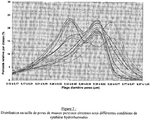
- the Figure 2 shows the pore size distribution determined by mercury porosimetry of microporous mass samples from production tests carried out for various hydrothermal synthesis parameters (synthesis temperature (180 to 210 ° C), rise time at this time). temperature (1 to 30 hours), synthesis pressure (between 10 and 30 bar), synthesis time (30 to 240 min),). As part of these tests, the temperature ramp was not changed. This is a brutal quenching of taking out the filled bottles after their synthesis cycle, showering them for a fixed time and allowing them to cool freely to room temperature. The choice of precursors and the drying step have not been modified in the context of these tests.
- the pores are obtained by stacks of micrometric needles of length ranging from 1 to 20 .mu.m, width ranging from 0.1 to 5 microns and thickness between 0.01 and 5 ⁇ m. These needle size dimensions are the direct consequence of the production process and in this case of the hydrothermal synthesis step.
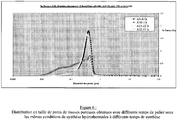
- the Figure 6 shows the pore size distribution and Table 1 shows the characteristics of the samples produced at different synthesis times t1: 3, 11, 22 and 44h.
- Table 1 Characteristics of samples produced at different synthesis times t1: 3, 11, 22 and 44h. Crystallographic phases determined by X-ray diffraction (%) TI synthesis time (h) CaCO3 SiO2 Tobermorite 11A Tobermorite 9A xonotlite % porosity D50 ( ⁇ m) 3 ⁇ 50 ⁇ 50 86.7 0.21 11 ⁇ 10 ⁇ 40 ⁇ 50 87.6 0.61 22 1-2 > 98 91.5 0.35 44 3-5 > 93 91.8 0.40
- the improved safety and gas withdrawal properties are directly dependent on the parameters of the manufacturing process and in this particular case hydrothermal synthesis conditions (cooling time). temperature rise, temperature, pressure, synthesis time and temperature descent time) previously described, which define the crystallized microstructural state of the linings.
- the type of lining structure sought ( Figures 5 and 6 ) according to the invention is firstly the consequence of the preparation of a quicklime having a satisfactory reactivity and capable of forming, after hydrothermal synthesis, the desired acicular material (S7092 and S7224 patents).
- the next stage of the process consists in mixing the quicklime with silica, which can be amorphous or crystalline, in a CaO: SiO 2 molar ratio of 0.8 to 1.
- the water / solid precursor ratio (lime + silica) is preferably between 2 and 60, more preferably between 3 and 25.
- the drying step serves not only to evacuate the residual water, but also to give the treated mass a predominantly crystalline structure and thus complete the hydrothermal synthesis step. Indeed, if after hydrothermal synthesis the majority phase is not the desired xonotlite, but a significant amount of tobermorite remains and / or residues of precursor phases (CaO, SiO2), the drying step can continue crystallization of xonotlite.
- This drying operation is carried out in a traditional electric oven (which may be the same as that used for the hydrothermal synthesis operation), at atmospheric pressure, that is to say after the plugs and valves have been removed. from the top of the vessels after hydrothermal synthesis in the second example of hydrothermal synthesis previously described.
- the invention also relates to a container containing a packing structure as described above, which container is adapted to contain and distribute a fluid.
- the container usually comprises a metal shell enclosing the packing structure described above.
- the metal casing may consist of a metallic material such as steel, for example a standard carbon steel P265NB according to standard NF EN10120, the thickness of which makes it capable of withstanding at least the hydrothermal synthesis pressure without risk of accident and able to withstand a test pressure of 60 bar (6 MPa), normative normative value for the packing of acetylene under the conditions described previously.
- the container is also usually cylindrical and generally provided with closure means and a pressure regulator. This container preferably has a diameter / length ratio of between 0.2 and 0.7, more preferably between 0.35 and 0.5, and a minimum water capacity of one liter. Usually, such a container will be in the shape of a bottle.
- the fluids stored in the packing structure according to the invention may be gases or liquids.
- gas there may be mentioned pure compressed gases or mixtures in gaseous or liquid form, such as hydrogen, gaseous hydrocarbons (alkanes, alkynes, alkenes), nitrogen and acetylene, and gases dissolved in a gas.
- solvents such as acetylene and acetylene-ethylene or acetylene-ethylene-propylene mixtures, dissolved in a solvent such as acetone or dimethylformamide (DMF).
- organometallic precursors such as Ga and In precursors, used in particular in electronics, as well as nitroglycerine.
- the container according to the invention contains acetylene dissolved in DMF or acetone.
- the present invention overcomes the disadvantages of the prior art by using a specific porous container packing structure formed by an entanglement of crystallites having a particular morphology and size.
- the packing structure manufacturing method according to the invention makes it possible to obtain these crystallites. Control of the operating parameters of all manufacturing steps (limestone treatment / formulation / dough preparation, hydrothermal synthesis, drying) is imperative.
- the patent FR 2 904 240 relates to the aspects of calcination of the limestone / formulation / preparation of the dough. From the moment when the CaO-SiO 2 -H 2 O paste is in conformity, the hydrothermal synthesis step, object of this patent, makes it possible to obtain a microstructure perfectly controlled and adaptable according to the desired properties (storage capacity gas, restitution rate, mechanical properties, compliance with flammability tests, reproducibility / reliability of masses produced on the production tool, etc.),
Landscapes
- Chemical & Material Sciences (AREA)
- Engineering & Computer Science (AREA)
- Ceramic Engineering (AREA)
- Structural Engineering (AREA)
- Materials Engineering (AREA)
- Organic Chemistry (AREA)
- Inorganic Chemistry (AREA)
- Chemical Kinetics & Catalysis (AREA)
- Physics & Mathematics (AREA)
- Thermal Sciences (AREA)
- Solid-Sorbent Or Filter-Aiding Compositions (AREA)
- Silicates, Zeolites, And Molecular Sieves (AREA)
- Silicon Compounds (AREA)
Claims (6)
- Verfahren zur Herstellung einer Behälterfüllstruktur, umfassend eine kristalline Phase, die 55 bis 97 Gewichts-% Xonotlit-Kristallite und 3 bis 45 Gewichts-% Tobermorit-Kristallite und weniger als 15 Gewichts-% Zwischenprodukte der folgenden Formel enthält:
CaxSiyOz, w H2O mit 1<x<16,1<y <24,4< z < 60 und 1<w< 18,
davon weniger als 5 Gewichts-% CaCO3 und weniger als 5 Gewichts-% SiO2, wobei die Füllstruktur homogen ist, dadurch gekennzeichnet, dass es die folgenden Schritte umfasst:a) einen Schritt zur Erhöhung der Temperatur, über eine Dauer von unter 10 h, eines Ausgangsgemischs aus Calciumoxid und Siliziumdioxid, auf eine Temperatur T1 zwischen 150 und 300 °C,b) einen Schritt zur hydrothermalen Synthese, der durchgeführt wird:- unter Verwendung des Gemischs aus Calciumoxid und Siliziumdioxid aus Schritt a),- bei einer Temperatur T1 zwischen 150 und 300 °C,- bei einem Druck P1 zwischen 5x10⁵ Pa und 25x105 Pa, und- während einer Dauer t1 zwischen 10 h und 70 h;c) einen Schritt zur Abkühlung, über eine Dauer zwischen 1 und 48 h, des Gemischs aus Schritt b) von der Temperatur T1 auf die Umgebungstemperatur bei einer Abkühlgeschwindigkeit ΔTR1 zwischen 3 und 200°C / Stunde,d) einen Schritt zum Trocknen des Gemischs aus Schritt c). - Verfahren nach Anspruch 1, dadurch gekennzeichnet, dass:- die Temperaturerhöhung in Schritt a) über eine Dauer Δt1 von unter 2 h erfolgt,- die Temperatur T1 in Schritt b) zwischen 180 und 250 °C liegt, und- der Druck P1 in Schritt c) zwischen 7x10⁵ Pa und 25x105 Pa liegt.
- Verfahren nach einem der Ansprüche 1 oder 2, dadurch gekennzeichnet, dass die Abkühldauer unter 25 h beträgt.
- Verfahren nach einem der Ansprüche 1 bis 3, dadurch gekennzeichnet, dass das Ausgangsgemisch ein Wasservolumen gleich 6 Liter darstellt und, dass der Schritt zur hydrothermalen Synthese während einer Dauer zwischen 35 und 45 h erfolgt.
- Verfahren nach einem der Ansprüche 1 bis 4, dadurch gekennzeichnet, dass Calciumoxid durch Brennen von Kalksteinblöcken, die derart sind, dass mindestens 90 Gewichts-% Abmessungen von 1 bis 15 mm aufweise, bei einer Temperatur von mindestens 850°C während mindestens einer Stunde erhalten wird, wobei der Kalkstein eine Reinheit von mindestens 92 Gewichts-% und eine offene Porosität von 0 bis 25% aufweiset.
- Verfahren nach einem der Ansprüche 1 bis 5, dadurch gekennzeichnet, dass der Trocknungsschritt bei einer Temperatur von 300 bis 450°C während einer Dauer von 40 bis 200 Stunden erfolgt.
Applications Claiming Priority (2)
| Application Number | Priority Date | Filing Date | Title |
|---|---|---|---|
| FR0854501A FR2933397B1 (fr) | 2008-07-02 | 2008-07-02 | Procede de fabrication d'une structure de garnissage avec maitrise des parametres de la synthese hydrothermale |
| PCT/FR2009/051017 WO2010001000A1 (fr) | 2008-07-02 | 2009-05-29 | Procede de fabrication d'une structure de garnissage avec maitrise des parametres de la synthese hydrothermale |
Publications (2)
| Publication Number | Publication Date |
|---|---|
| EP2297059A1 EP2297059A1 (de) | 2011-03-23 |
| EP2297059B1 true EP2297059B1 (de) | 2012-05-16 |
Family
ID=40352031
Family Applications (1)
| Application Number | Title | Priority Date | Filing Date |
|---|---|---|---|
| EP09772683A Not-in-force EP2297059B1 (de) | 2008-07-02 | 2009-05-29 | Verfahren zur herstellung einer verpackungsstruktur mit steuerung der parameter für hydrothermale synthese |
Country Status (8)
| Country | Link |
|---|---|
| US (1) | US20110207596A1 (de) |
| EP (1) | EP2297059B1 (de) |
| JP (1) | JP2011526570A (de) |
| CN (1) | CN102137824B (de) |
| AU (1) | AU2009265464A1 (de) |
| CA (1) | CA2729179A1 (de) |
| FR (1) | FR2933397B1 (de) |
| WO (1) | WO2010001000A1 (de) |
Families Citing this family (4)
| Publication number | Priority date | Publication date | Assignee | Title |
|---|---|---|---|---|
| EP2540684A1 (de) * | 2011-06-30 | 2013-01-02 | L'AIR LIQUIDE, Société Anonyme pour l'Etude et l'Exploitation des Procédés Georges Claude | Poröses Material auf Silizium- und Portlanditbasis zur Hinterfüllung von Dämmziegeln mit kontrollierter Struktur, und entsprechendes Herstellungsverfahren |
| FR2987620B1 (fr) * | 2012-03-05 | 2016-01-01 | Air Liquide | Brique de construction comprenant une matiere poreuse dont la microstructure est controlee par l'ajout d'un agent de germination lors de son procede d'elaboration |
| CN105329974B (zh) * | 2015-11-06 | 2017-12-01 | 中国科学院生态环境研究中心 | 一种从含氟废水中回收氟的方法 |
| CN106237975A (zh) * | 2016-08-09 | 2016-12-21 | 北京化工大学 | 一种高比表面大孔容硅酸镁吸附材料及其制备方法和应用 |
Family Cites Families (12)
| Publication number | Priority date | Publication date | Assignee | Title |
|---|---|---|---|---|
| GB1093084A (en) * | 1965-03-16 | 1967-11-29 | Union Carbide Corp | Manufactured graphite yarn |
| US3928539A (en) * | 1972-05-05 | 1975-12-23 | Onoda Chem Ind Co Ltd | Method for continuously producing hydrated calcium silicates |
| US4129450A (en) * | 1977-11-09 | 1978-12-12 | Union Carbide Corporation | Acetylene vessel filler composition |
| US4226839A (en) * | 1978-07-21 | 1980-10-07 | The United States Of America As Represented By The Administrator Of The U.S. Environmental Protection Agency | Activation of calcium oxide as a sorbent |
| US4349643A (en) * | 1980-05-15 | 1982-09-14 | International Telephone And Telegraph Corporation | Coating composition adapted for transfer coating during reaction injection molding containing a polyurethane catalyst |
| US4349463A (en) * | 1981-01-19 | 1982-09-14 | Union Carbide Corporation | Acetylene storage vessel |
| EP0236498B1 (de) * | 1985-09-06 | 1990-02-07 | Kabushiki Kaisha Osaka Packing Seizosho | Formkoerper aus kieselsaeure |
| FR2604102B1 (fr) * | 1986-09-18 | 1988-11-10 | Air Liquide | Masse silicocalcaire a haute porosite pour stockage de gaz, et procede de fabrication |
| US5632788A (en) * | 1995-01-31 | 1997-05-27 | Worthington Acetylene Cylinder, Inc. | High porosity calcium silicate mass for storing acetylene gas |
| JP5420815B2 (ja) * | 2006-03-27 | 2014-02-19 | ニチアス株式会社 | 低融点金属鋳造装置用耐熱材料 |
| FR2904240B1 (fr) * | 2006-07-26 | 2008-12-05 | Air Liquide | Structure de garnissage pour recipient de gaz a materiau cristallise sous forme d'aiguilles |
| FR2904239B1 (fr) * | 2006-07-26 | 2008-12-05 | Air Liquide | Structure de garnissage a phase cristalline de recipients de gaz |
-
2008
- 2008-07-02 FR FR0854501A patent/FR2933397B1/fr not_active Expired - Fee Related
-
2009
- 2009-05-29 EP EP09772683A patent/EP2297059B1/de not_active Not-in-force
- 2009-05-29 JP JP2011515535A patent/JP2011526570A/ja active Pending
- 2009-05-29 AU AU2009265464A patent/AU2009265464A1/en not_active Abandoned
- 2009-05-29 CA CA2729179A patent/CA2729179A1/fr not_active Abandoned
- 2009-05-29 CN CN2009801338718A patent/CN102137824B/zh not_active Expired - Fee Related
- 2009-05-29 US US13/000,547 patent/US20110207596A1/en not_active Abandoned
- 2009-05-29 WO PCT/FR2009/051017 patent/WO2010001000A1/fr not_active Ceased
Also Published As
| Publication number | Publication date |
|---|---|
| AU2009265464A1 (en) | 2010-01-07 |
| CN102137824A (zh) | 2011-07-27 |
| CA2729179A1 (fr) | 2010-01-07 |
| FR2933397B1 (fr) | 2011-07-22 |
| WO2010001000A1 (fr) | 2010-01-07 |
| US20110207596A1 (en) | 2011-08-25 |
| EP2297059A1 (de) | 2011-03-23 |
| JP2011526570A (ja) | 2011-10-13 |
| FR2933397A1 (fr) | 2010-01-08 |
| CN102137824B (zh) | 2013-07-24 |
Similar Documents
| Publication | Publication Date | Title |
|---|---|---|
| EP1887275B1 (de) | Packungsstruktur für gasbehälter aus nadelförmigem, kristallisiertem material | |
| EP1886982A1 (de) | Einsatzstruktur mit kristalliner Phase für Gasbehälter | |
| EP2300391A1 (de) | Verfahren zur herstellung einer verpackungsstruktur mit steuerung des trocknungsschrittes | |
| EP2297059B1 (de) | Verfahren zur herstellung einer verpackungsstruktur mit steuerung der parameter für hydrothermale synthese | |
| EP2462077A1 (de) | Poröses keramikmaterial mit durch schichtung von porenbildungsmitteln gesteuerter makroporosität | |
| EP2297063B1 (de) | Verfahren zur herstllung eines hochleistung verkleidungsstrukturs mit gesteuerten seitlichen spielräumen | |
| EP2462076B1 (de) | Poröses keramikmaterial mit zellulärer struktur und gesteuerter makroporosität | |
| FR2910466A1 (fr) | Procede de fabrication d'un materiau ceramique refractaire a haute temperature de solidus. | |
| TWI297672B (en) | Method for synthesizing aluminum nitride and composite thereof | |
| BE528235A (de) | ||
| CN102560173A (zh) | 大尺寸高减振性能的多孔Ti-Ni减振合金的制备方法 |
Legal Events
| Date | Code | Title | Description |
|---|---|---|---|
| PUAI | Public reference made under article 153(3) epc to a published international application that has entered the european phase |
Free format text: ORIGINAL CODE: 0009012 |
|
| 17P | Request for examination filed |
Effective date: 20110202 |
|
| AK | Designated contracting states |
Kind code of ref document: A1 Designated state(s): AT BE BG CH CY CZ DE DK EE ES FI FR GB GR HR HU IE IS IT LI LT LU LV MC MK MT NL NO PL PT RO SE SI SK TR |
|
| AX | Request for extension of the european patent |
Extension state: AL BA RS |
|
| DAX | Request for extension of the european patent (deleted) | ||
| GRAP | Despatch of communication of intention to grant a patent |
Free format text: ORIGINAL CODE: EPIDOSNIGR1 |
|
| RIC1 | Information provided on ipc code assigned before grant |
Ipc: F17C 1/00 20060101ALI20111206BHEP Ipc: C04B 2/10 20060101AFI20111206BHEP Ipc: C04B 28/18 20060101ALI20111206BHEP |
|
| GRAS | Grant fee paid |
Free format text: ORIGINAL CODE: EPIDOSNIGR3 |
|
| GRAA | (expected) grant |
Free format text: ORIGINAL CODE: 0009210 |
|
| AK | Designated contracting states |
Kind code of ref document: B1 Designated state(s): AT BE BG CH CY CZ DE DK EE ES FI FR GB GR HR HU IE IS IT LI LT LU LV MC MK MT NL NO PL PT RO SE SI SK TR |
|
| REG | Reference to a national code |
Ref country code: GB Ref legal event code: FG4D Free format text: NOT ENGLISH |
|
| REG | Reference to a national code |
Ref country code: CH Ref legal event code: EP |
|
| REG | Reference to a national code |
Ref country code: AT Ref legal event code: REF Ref document number: 558021 Country of ref document: AT Kind code of ref document: T Effective date: 20120615 |
|
| REG | Reference to a national code |
Ref country code: IE Ref legal event code: FG4D Free format text: LANGUAGE OF EP DOCUMENT: FRENCH |
|
| REG | Reference to a national code |
Ref country code: DE Ref legal event code: R096 Ref document number: 602009007101 Country of ref document: DE Effective date: 20120719 |
|
| REG | Reference to a national code |
Ref country code: NL Ref legal event code: VDEP Effective date: 20120516 |
|
| REG | Reference to a national code |
Ref country code: LT Ref legal event code: MG4D Effective date: 20120516 |
|
| PG25 | Lapsed in a contracting state [announced via postgrant information from national office to epo] |
Ref country code: FI Free format text: LAPSE BECAUSE OF FAILURE TO SUBMIT A TRANSLATION OF THE DESCRIPTION OR TO PAY THE FEE WITHIN THE PRESCRIBED TIME-LIMIT Effective date: 20120516 Ref country code: IS Free format text: LAPSE BECAUSE OF FAILURE TO SUBMIT A TRANSLATION OF THE DESCRIPTION OR TO PAY THE FEE WITHIN THE PRESCRIBED TIME-LIMIT Effective date: 20120916 Ref country code: NO Free format text: LAPSE BECAUSE OF FAILURE TO SUBMIT A TRANSLATION OF THE DESCRIPTION OR TO PAY THE FEE WITHIN THE PRESCRIBED TIME-LIMIT Effective date: 20120816 Ref country code: CY Free format text: LAPSE BECAUSE OF FAILURE TO SUBMIT A TRANSLATION OF THE DESCRIPTION OR TO PAY THE FEE WITHIN THE PRESCRIBED TIME-LIMIT Effective date: 20120516 Ref country code: LT Free format text: LAPSE BECAUSE OF FAILURE TO SUBMIT A TRANSLATION OF THE DESCRIPTION OR TO PAY THE FEE WITHIN THE PRESCRIBED TIME-LIMIT Effective date: 20120516 Ref country code: PL Free format text: LAPSE BECAUSE OF FAILURE TO SUBMIT A TRANSLATION OF THE DESCRIPTION OR TO PAY THE FEE WITHIN THE PRESCRIBED TIME-LIMIT Effective date: 20120516 Ref country code: SE Free format text: LAPSE BECAUSE OF FAILURE TO SUBMIT A TRANSLATION OF THE DESCRIPTION OR TO PAY THE FEE WITHIN THE PRESCRIBED TIME-LIMIT Effective date: 20120516 |
|
| BERE | Be: lapsed |
Owner name: L'AIR LIQUIDE S.A. POUR L'ETUDE ET L'EXPLOITATION Effective date: 20120531 |
|
| PG25 | Lapsed in a contracting state [announced via postgrant information from national office to epo] |
Ref country code: HR Free format text: LAPSE BECAUSE OF FAILURE TO SUBMIT A TRANSLATION OF THE DESCRIPTION OR TO PAY THE FEE WITHIN THE PRESCRIBED TIME-LIMIT Effective date: 20120516 Ref country code: PT Free format text: LAPSE BECAUSE OF FAILURE TO SUBMIT A TRANSLATION OF THE DESCRIPTION OR TO PAY THE FEE WITHIN THE PRESCRIBED TIME-LIMIT Effective date: 20120917 Ref country code: LV Free format text: LAPSE BECAUSE OF FAILURE TO SUBMIT A TRANSLATION OF THE DESCRIPTION OR TO PAY THE FEE WITHIN THE PRESCRIBED TIME-LIMIT Effective date: 20120516 Ref country code: SI Free format text: LAPSE BECAUSE OF FAILURE TO SUBMIT A TRANSLATION OF THE DESCRIPTION OR TO PAY THE FEE WITHIN THE PRESCRIBED TIME-LIMIT Effective date: 20120516 Ref country code: GR Free format text: LAPSE BECAUSE OF FAILURE TO SUBMIT A TRANSLATION OF THE DESCRIPTION OR TO PAY THE FEE WITHIN THE PRESCRIBED TIME-LIMIT Effective date: 20120817 |
|
| PG25 | Lapsed in a contracting state [announced via postgrant information from national office to epo] |
Ref country code: MC Free format text: LAPSE BECAUSE OF NON-PAYMENT OF DUE FEES Effective date: 20120531 |
|
| PG25 | Lapsed in a contracting state [announced via postgrant information from national office to epo] |
Ref country code: DK Free format text: LAPSE BECAUSE OF FAILURE TO SUBMIT A TRANSLATION OF THE DESCRIPTION OR TO PAY THE FEE WITHIN THE PRESCRIBED TIME-LIMIT Effective date: 20120516 Ref country code: EE Free format text: LAPSE BECAUSE OF FAILURE TO SUBMIT A TRANSLATION OF THE DESCRIPTION OR TO PAY THE FEE WITHIN THE PRESCRIBED TIME-LIMIT Effective date: 20120516 Ref country code: SK Free format text: LAPSE BECAUSE OF FAILURE TO SUBMIT A TRANSLATION OF THE DESCRIPTION OR TO PAY THE FEE WITHIN THE PRESCRIBED TIME-LIMIT Effective date: 20120516 Ref country code: RO Free format text: LAPSE BECAUSE OF FAILURE TO SUBMIT A TRANSLATION OF THE DESCRIPTION OR TO PAY THE FEE WITHIN THE PRESCRIBED TIME-LIMIT Effective date: 20120516 Ref country code: NL Free format text: LAPSE BECAUSE OF FAILURE TO SUBMIT A TRANSLATION OF THE DESCRIPTION OR TO PAY THE FEE WITHIN THE PRESCRIBED TIME-LIMIT Effective date: 20120516 |
|
| REG | Reference to a national code |
Ref country code: IE Ref legal event code: MM4A |
|
| PG25 | Lapsed in a contracting state [announced via postgrant information from national office to epo] |
Ref country code: IT Free format text: LAPSE BECAUSE OF FAILURE TO SUBMIT A TRANSLATION OF THE DESCRIPTION OR TO PAY THE FEE WITHIN THE PRESCRIBED TIME-LIMIT Effective date: 20120516 Ref country code: BE Free format text: LAPSE BECAUSE OF NON-PAYMENT OF DUE FEES Effective date: 20120531 Ref country code: MK Free format text: LAPSE BECAUSE OF FAILURE TO SUBMIT A TRANSLATION OF THE DESCRIPTION OR TO PAY THE FEE WITHIN THE PRESCRIBED TIME-LIMIT Effective date: 20120516 |
|
| REG | Reference to a national code |
Ref country code: DE Ref legal event code: R119 Ref document number: 602009007101 Country of ref document: DE Effective date: 20121201 |
|
| PLBE | No opposition filed within time limit |
Free format text: ORIGINAL CODE: 0009261 |
|
| STAA | Information on the status of an ep patent application or granted ep patent |
Free format text: STATUS: NO OPPOSITION FILED WITHIN TIME LIMIT |
|
| 26N | No opposition filed |
Effective date: 20130219 |
|
| PG25 | Lapsed in a contracting state [announced via postgrant information from national office to epo] |
Ref country code: IE Free format text: LAPSE BECAUSE OF NON-PAYMENT OF DUE FEES Effective date: 20120529 Ref country code: ES Free format text: LAPSE BECAUSE OF FAILURE TO SUBMIT A TRANSLATION OF THE DESCRIPTION OR TO PAY THE FEE WITHIN THE PRESCRIBED TIME-LIMIT Effective date: 20120827 |
|
| PG25 | Lapsed in a contracting state [announced via postgrant information from national office to epo] |
Ref country code: DE Free format text: LAPSE BECAUSE OF NON-PAYMENT OF DUE FEES Effective date: 20121201 |
|
| PG25 | Lapsed in a contracting state [announced via postgrant information from national office to epo] |
Ref country code: BG Free format text: LAPSE BECAUSE OF FAILURE TO SUBMIT A TRANSLATION OF THE DESCRIPTION OR TO PAY THE FEE WITHIN THE PRESCRIBED TIME-LIMIT Effective date: 20120816 Ref country code: MT Free format text: LAPSE BECAUSE OF FAILURE TO SUBMIT A TRANSLATION OF THE DESCRIPTION OR TO PAY THE FEE WITHIN THE PRESCRIBED TIME-LIMIT Effective date: 20120516 |
|
| REG | Reference to a national code |
Ref country code: CH Ref legal event code: PL |
|
| GBPC | Gb: european patent ceased through non-payment of renewal fee |
Effective date: 20130529 |
|
| PG25 | Lapsed in a contracting state [announced via postgrant information from national office to epo] |
Ref country code: CH Free format text: LAPSE BECAUSE OF NON-PAYMENT OF DUE FEES Effective date: 20130531 Ref country code: LI Free format text: LAPSE BECAUSE OF NON-PAYMENT OF DUE FEES Effective date: 20130531 |
|
| PG25 | Lapsed in a contracting state [announced via postgrant information from national office to epo] |
Ref country code: GB Free format text: LAPSE BECAUSE OF NON-PAYMENT OF DUE FEES Effective date: 20130529 Ref country code: TR Free format text: LAPSE BECAUSE OF FAILURE TO SUBMIT A TRANSLATION OF THE DESCRIPTION OR TO PAY THE FEE WITHIN THE PRESCRIBED TIME-LIMIT Effective date: 20120516 |
|
| PG25 | Lapsed in a contracting state [announced via postgrant information from national office to epo] |
Ref country code: LU Free format text: LAPSE BECAUSE OF NON-PAYMENT OF DUE FEES Effective date: 20120529 |
|
| PG25 | Lapsed in a contracting state [announced via postgrant information from national office to epo] |
Ref country code: HU Free format text: LAPSE BECAUSE OF FAILURE TO SUBMIT A TRANSLATION OF THE DESCRIPTION OR TO PAY THE FEE WITHIN THE PRESCRIBED TIME-LIMIT Effective date: 20090529 |
|
| REG | Reference to a national code |
Ref country code: FR Ref legal event code: PLFP Year of fee payment: 8 |
|
| REG | Reference to a national code |
Ref country code: FR Ref legal event code: PLFP Year of fee payment: 9 |
|
| REG | Reference to a national code |
Ref country code: FR Ref legal event code: PLFP Year of fee payment: 10 |
|
| PGFP | Annual fee paid to national office [announced via postgrant information from national office to epo] |
Ref country code: CZ Payment date: 20190502 Year of fee payment: 11 |
|
| PGFP | Annual fee paid to national office [announced via postgrant information from national office to epo] |
Ref country code: FR Payment date: 20190523 Year of fee payment: 11 |
|
| PGFP | Annual fee paid to national office [announced via postgrant information from national office to epo] |
Ref country code: AT Payment date: 20190522 Year of fee payment: 11 |
|
| REG | Reference to a national code |
Ref country code: AT Ref legal event code: MM01 Ref document number: 558021 Country of ref document: AT Kind code of ref document: T Effective date: 20200529 |
|
| PG25 | Lapsed in a contracting state [announced via postgrant information from national office to epo] |
Ref country code: CZ Free format text: LAPSE BECAUSE OF NON-PAYMENT OF DUE FEES Effective date: 20200529 Ref country code: AT Free format text: LAPSE BECAUSE OF NON-PAYMENT OF DUE FEES Effective date: 20200529 |
|
| PG25 | Lapsed in a contracting state [announced via postgrant information from national office to epo] |
Ref country code: FR Free format text: LAPSE BECAUSE OF NON-PAYMENT OF DUE FEES Effective date: 20200531 |