EP2297714B1 - Einrichtung und verfahren zum prüfen der integrität physischer objekte - Google Patents
Einrichtung und verfahren zum prüfen der integrität physischer objekte Download PDFInfo
- Publication number
- EP2297714B1 EP2297714B1 EP09765997.3A EP09765997A EP2297714B1 EP 2297714 B1 EP2297714 B1 EP 2297714B1 EP 09765997 A EP09765997 A EP 09765997A EP 2297714 B1 EP2297714 B1 EP 2297714B1
- Authority
- EP
- European Patent Office
- Prior art keywords
- data
- tags
- function
- tag
- group description
- Prior art date
- Legal status (The legal status is an assumption and is not a legal conclusion. Google has not performed a legal analysis and makes no representation as to the accuracy of the status listed.)
- Not-in-force
Links
Images






Classifications
-
- G—PHYSICS
- G06—COMPUTING OR CALCULATING; COUNTING
- G06K—GRAPHICAL DATA READING; PRESENTATION OF DATA; RECORD CARRIERS; HANDLING RECORD CARRIERS
- G06K7/00—Methods or arrangements for sensing record carriers, e.g. for reading patterns
- G06K7/10—Methods or arrangements for sensing record carriers, e.g. for reading patterns by electromagnetic radiation, e.g. optical sensing; by corpuscular radiation
- G06K7/10009—Methods or arrangements for sensing record carriers, e.g. for reading patterns by electromagnetic radiation, e.g. optical sensing; by corpuscular radiation sensing by radiation using wavelengths larger than 0.1 mm, e.g. radio-waves or microwaves
- G06K7/10366—Methods or arrangements for sensing record carriers, e.g. for reading patterns by electromagnetic radiation, e.g. optical sensing; by corpuscular radiation sensing by radiation using wavelengths larger than 0.1 mm, e.g. radio-waves or microwaves the interrogation device being adapted for miscellaneous applications
-
- G—PHYSICS
- G06—COMPUTING OR CALCULATING; COUNTING
- G06Q—INFORMATION AND COMMUNICATION TECHNOLOGY [ICT] SPECIALLY ADAPTED FOR ADMINISTRATIVE, COMMERCIAL, FINANCIAL, MANAGERIAL OR SUPERVISORY PURPOSES; SYSTEMS OR METHODS SPECIALLY ADAPTED FOR ADMINISTRATIVE, COMMERCIAL, FINANCIAL, MANAGERIAL OR SUPERVISORY PURPOSES, NOT OTHERWISE PROVIDED FOR
- G06Q10/00—Administration; Management
- G06Q10/08—Logistics, e.g. warehousing, loading or distribution; Inventory or stock management
- G06Q10/087—Inventory or stock management, e.g. order filling, procurement or balancing against orders
-
- G—PHYSICS
- G08—SIGNALLING
- G08B—SIGNALLING SYSTEMS, e.g. PERSONAL CALLING SYSTEMS; ORDER TELEGRAPHS; ALARM SYSTEMS
- G08B13/00—Burglar, theft or intruder alarms
- G08B13/02—Mechanical actuation
- G08B13/14—Mechanical actuation by lifting or attempted removal of hand-portable articles
-
- H—ELECTRICITY
- H04—ELECTRIC COMMUNICATION TECHNIQUE
- H04W—WIRELESS COMMUNICATION NETWORKS
- H04W12/00—Security arrangements; Authentication; Protecting privacy or anonymity
- H04W12/04—Key management, e.g. using generic bootstrapping architecture [GBA]
-
- H—ELECTRICITY
- H04—ELECTRIC COMMUNICATION TECHNIQUE
- H04W—WIRELESS COMMUNICATION NETWORKS
- H04W12/00—Security arrangements; Authentication; Protecting privacy or anonymity
- H04W12/10—Integrity
-
- H—ELECTRICITY
- H04—ELECTRIC COMMUNICATION TECHNIQUE
- H04W—WIRELESS COMMUNICATION NETWORKS
- H04W4/00—Services specially adapted for wireless communication networks; Facilities therefor
- H04W4/80—Services using short range communication, e.g. near-field communication [NFC], radio-frequency identification [RFID] or low energy communication
-
- G—PHYSICS
- G08—SIGNALLING
- G08B—SIGNALLING SYSTEMS, e.g. PERSONAL CALLING SYSTEMS; ORDER TELEGRAPHS; ALARM SYSTEMS
- G08B13/00—Burglar, theft or intruder alarms
- G08B13/02—Mechanical actuation
- G08B13/14—Mechanical actuation by lifting or attempted removal of hand-portable articles
- G08B13/1427—Mechanical actuation by lifting or attempted removal of hand-portable articles with transmitter-receiver for distance detection
-
- H—ELECTRICITY
- H04—ELECTRIC COMMUNICATION TECHNIQUE
- H04L—TRANSMISSION OF DIGITAL INFORMATION, e.g. TELEGRAPHIC COMMUNICATION
- H04L63/00—Network architectures or network communication protocols for network security
- H04L63/12—Applying verification of the received information
- H04L63/123—Applying verification of the received information received data contents, e.g. message integrity
-
- H—ELECTRICITY
- H04—ELECTRIC COMMUNICATION TECHNIQUE
- H04W—WIRELESS COMMUNICATION NETWORKS
- H04W12/00—Security arrangements; Authentication; Protecting privacy or anonymity
- H04W12/60—Context-dependent security
- H04W12/69—Identity-dependent
- H04W12/76—Group identity
Definitions
- the invention relates to a device for monitoring physical objects.
- Baggage labeling for example, is effective only if a control of the combination of baggage and their owner is carried out continuously, or at least continuously over particularly critical periods of time, such as stopping the baggage. a train station, the recovery of luggage after disembarkation, or the passage of security points. Such controls do not exist, or at best they are random.
- the invention is not only about baggage monitoring. Monitoring of physical objects is an important goal in many other sectors, such as transport of goods, the distribution of mail, the security of public or private institutions, for example.
- the invention aims to improve the situation.
- a device for monitoring physical objects comprising one or more short-range telelectors, memory elements intended to be attached to physical objects, a controller arranged to perform a reading function capable of cooperating with the one or more telelectors for acquiring data contained in neighborhood memory elements, and executing an integrity validation function capable of distinguishing in the acquired data individual identifiers, specific to each of the memory elements, and group description data, stored by at least some of these memory elements, and then checking the sufficiency of the group description data while verifying the compliance of the individual identifiers with the corresponding group description data.
- Such a device first has the advantage of a simple, inexpensive and autonomous infrastructure, mainly consisting of one or more telelectors and a controller. Physical objects can be monitored over large areas, for example by multiplying telelectors. Physical objects can also be monitored over small areas.
- Such a device makes it possible to make an association of physical objects into an aggregated object.
- the device then still makes it possible to verify that an aggregated object is complete, or integrates, in the sense that all the physical objects constituting it are present in a given area. For example, it becomes possible to verify that a traveler has around him all of his luggage by associating this traveler and his luggage in the same obj and aggregated.
- an aggregated object is easy since it consists mainly of programming the memory elements and affixing them to the physical objects.
- the device according to the invention is autonomous. It does not involve any connection to a data network, even on a local scale, unlike almost all current security features. These devices rely in fact mainly on the establishment of databases of increasing importance for tracing physical objects.
- the device according to the invention does not require any adaptation of the controller to an aggregated object in particular: an aggregated object is defined thanks to the programming of elements to memory only, without prior programming of the monitoring device. This results in low deployment costs, these costs being mainly related to the purchase and installation of telelectors. Moreover, the costs relating to memory elements and their programming can be left to the user, because the programming can be performed by the user.
- the device according to the invention is capable of simultaneously offering a surveillance of physical objects of a potentially very different nature: the same device can monitor both passenger luggage, personal equipment and the constitution of a group people, paper documents, vehicles in a parking lot or bicycles in a garage shared by several people, the contents of postal parcels or boxes of medicines.
- the device according to the invention is capable of verifying the integrity of an aggregated object constituted by the programming of memory elements, regardless of the nature of the physical objects that carry the memory elements.
- the invention also relates to a device for monitoring physical objects, of the type comprising one or more short-range telelectors, memory elements intended to be attached to physical objects, a controller arranged to execute a writing function. capable of cooperating with the telelector (s) to write in neighborhood memory elements individual identifier data specific to each of the memory elements and group description data stored by at least some of these memory elements .
- the figure 1 illustrates an aggregated object 1 consisting of the union of elementary objects 3, here E1, E2, E3, E4 and E5.
- Each of the elementary objects 3 here takes the form of a memory device, searchable at short range, hereinafter referred to as the label 5, intended to be carried by an object or a natural person.
- Each of the labels 5 constituting the aggregated object 1 stores in its memory identification data that are specific to it.
- Description data of the aggregated object 1 is stored by at least some of the tags of this aggregated object 1. This description data makes it possible to judge the integrity of the aggregated object 1 only from a set of data. individual identifiers of labels 5.
- each of the tags 5 also stores membership data to the aggregated object 1 making it possible to associate the individual identifier of the tag 5 in question with the aggregated object 1.
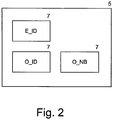
- the figure 2 shows an example of a label 5.
- the label 5 maintains, in one or more memory areas 7, elementary identifier data E_ID, specific to the label 5 in question, O_ID object identifier data, common to all the labels 5 constituting object 1, and, optionally, object cardinal data O_NB, indicating the number of labels 5 constituting the aggregated object 1.
- E_ID elementary identifier data
- O_ID object identifier data common to all the labels 5 constituting object 1
- O_NB object cardinal data
- tags 5 constituting the aggregated object 1 maintain these object cardinal data O_NB.
- Such a tag 5 can then be called master tag, or master elementary object.
- the description data of the aggregated object 1 here consist of O_ID object identifier data stored on each of the tags 5 of the object 1 and O_NB object cardinal data stored on at least one of these labels 5.
- the object identifier data O_ID may take the form of a result-value of a hash function generated from the set of individual identifier data E_ID of the labels 5 constituting the aggregated object 1.
- the integrity of the aggregated object 1 can then be verified by testing the match of the hashing value with a set of data of individual identifiers E_ID of labels 5. For example, a hash value can be generated from these individual identifier data E_ID, using a hash function analogous to or compatible with the hash function used for generating the object identifier O_ID, and then comparing this value with the identifier of O_ID object. The aggregated object 1 is then integral if the generated value and the object identifier O_ID match.
- the object cardinal data O_NB is optional: the object identifier O_ID is sufficient to check the concordance of the aggregated object 1 with a set of individual identifiers E_ID.
- the description data of the aggregated object 1 here consist of the object identifier O_ID.
- the master label quality can be additionally coded in a particular label, for example by setting 1 to a reserved memory bit.
- the elementary identifier E_ID can be any. This identifier can be integrated in a label 5 during the manufacture thereof, for example in the form of a universal product number.
- the description data of the aggregated object 1 comprises a list of the individual identifiers E_ID of the labels 5 constituting this aggregated object 1. These description data can be stored in each of the labels 5, for example to constitute O_ID object identifier data. These description data may also be stored in one of these tags only, typically the master tag.
- the object cardinal data O_NB is optional: the list of individual identifiers E_ID implicitly includes these object cardinal data O_NB, and this list of individual identifiers E_ID is sufficient to verify the integrity of the aggregated object 1 from a set of individual identifiers E_ID.
- the O_ID object identifier data take the form of a result-value of a hash function such that the membership of each of the individual identifiers E_ID to the aggregated object 1 can be verified from the result-value and the individual identifier E_ID in question only.
- Object cardinal data O_NB is stored in at least one of the labels 5, for example in a master label only.
- the object identifier O_ID is preferably statistically unique so as to prevent labels constituting different aggregated objects 1 from being programmed as if they belonged to the same obj and aggregated, that is, ie with the same object identifier O_ID.
- this object identifier O_ID comprises a prefix established from a unique identifier of the reader used for programming the labels constituting the aggregated object 1.
- the programming of the labels 5 can be performed by means of a controller executing an object creation function, or CREATION function.
- the CREATION function is arranged to interact with a label reader to control the registration of identification data specific to each of the labels 5, aggregate object description data 1 and, optionally, data of belonging to the aggregated object 1, in the memory of each of the labels 5.
- the CREATION function controls the registration of the individual identifier data E_ID, object identifier O_ID, and cardinal object O_NB.
- the CREATION function can be arranged to return information data on the writing operations, such as the number of programmed labels and / or the identity thereof.
- the labels 5 may have a tinted exterior appearance whose color is coded in memory.
- the CREATION function can then be arranged to return a color list corresponding to the programmed labels 5 to visually verify the proper operation of the programming.
- the CREATION function can control the writing in memory of an S_ID service identifier in each of the tags 5 of the aggregated object 1.
- This service identifier S_ID makes it possible to associate the tags 5 and the aggregated object. 1 to a particular service.
- the labels 5 may be write-protected and possibly read-protected, for example by means of encrypted keys.
- the CREATION function can be arranged to write each of the labels 5 constituting an aggregated object 1 sequentially, that is to say one label after another, at least from the point of view of the user. .
- a very short-range tag reader only able to read labels that are physically presented to it, one by one, then suffices for interaction with the CREATION function. Readers of this type generally have a small footprint, so that a user can keep a copy at home and program the labels 5 at his convenience.
- the controller may advantageously take the form of a computer program product executed on a personal computer connected to the reader in question.
- the tag reader in question can be portable, or at least mobile, so that it is possible, for example, to program labels already affixed to physical objects.
- the CREATION function can receive the number of labels 5 to be programmed as a parameter, for example entered by the user. A single passage in front of the tag reader of each of the tags 5 then suffices for the programming of the aggregated object 1.
- the set of labels 5 to be programmed is read prior to the write operation, so that the CREATION function acquires the individual identifiers E_ID of each of the labels intended to form the aggregated object 1, and establishes the number of these labels 5.
- This variant is more particularly advantageous when each of the labels 5 has an individual identifier E_ID prior to this programming operation and that this identifier does not have to be programmed again. Typically this is the case when the labels 5 are marketed with an individual identifier E_ID already stored.
- This variant is also advantageous when a hash function based on the individual identifiers E_ID is implemented.
- the hashing function can be implemented from, in addition to the individual identifiers E_ID, a public key value, to which correspond a private key value.
- This public key value can be integrated into the CREATION function.
- this public key can be constituted by the individual identifier of a tag that does not belong to the aggregated object 1, so that the hashing function can be common to embodiments that do not use a value.
- private key can be integrated into the CREATE function, to which private key values correspond.
- the CREATION function may be arranged to react to an end instruction by writing a last label 5.
- the latter label 5 may be a label 5 of the master type.
- the end instruction can be triggered by the user, or automatically at the occurrence of a particular event.
- the operations of reading and writing a tag can occur simultaneously, from the user's point of view, that is to say that each of the tags 5 constituting an aggregated object 1 can be read. and programmed before the next label. In other words, it is not necessary here to make an account of the labels 5 constituting the aggregated object 1 before programming the labels 5.
- the CREATION function can also be arranged to write each of the labels constituting an aggregated object 1 simultaneously, at least from the user's point of view.
- a tag reader capable of simultaneously reading a set of tags 5 in a determined volume is then required.
- Such a reader may for example incorporate a directional antenna, or bi-directional, when the labels 5 are radio frequency tags.
- the CREATION function is then advantageously arranged so as to read beforehand the set of labels 5 present in the determined volume and to program them so as to constitute the same aggregated object 1. For the user, the reading operation appears concomitant to the write operation.
- the creation of an aggregated object 1 then becomes particularly easy in that the user has only to have a chosen number of labels 5 in the determined volume to program an aggregated object 1 consisting of these labels 5.
- the determined volume may be limited so as to avoid simultaneous programming of unwanted tags.
- This can be achieved by means of impervious screens to the label reader's short-range communication means, typically to RF waves, at least in the envisaged frequency range.
- the screens may be mutually arranged to form a programming booth.
- the delimitation of the volume is optional, since the presence of undesirable labels in this volume becomes unlikely.
- a materialization of the volume may nevertheless appear advantageous in that it allows the user to visualize the volume in which the labels 5 are to be placed.
- any variant of the CREATION function can be used to create aggregated objects 1 consisting of a different number of labels 5.
- a set of labels 5 constituting the same aggregated object 1 can be marketed in the form of kit, for example in vending machines.
- the CREATION function can be arranged to execute on a user's command.
- the tags 5 advantageously take the form of RFID type tags ( radio frequency identification ), remotely searchable by radiofrequency, over a short range. Labels of this type have a relatively low cost. They also have a very small footprint and flexibility, which allows their affixing on different types of media, including non-flat surface. In addition, these labels can be easily concealed.
- the tags 5 may also take the form of devices compatible with the NFC ( Near Field Computing or Near Field Communication ).
- the figure 3 illustrates a monitoring device 9.
- the monitoring device 9 comprises a tag reader 13 provided with short-range communication means adapted to the type of tag 5, for example radio frequencies for RFID tags.
- the tag reader 13 is advantageously provided with various short-range communication means for reading different types of tags 5.
- the tag reader 13 is connected to a controller 15 provided with calculation means and a working memory, not shown.
- the controller 15 is arranged to perform a read function LECT capable of cooperating with the reader 13 to acquire the data stored in the labels 5 present in the range of the reader 13.
- the function LECT is arranged to cooperate with the memory of the controller 15 to write one or more recording tables gathering in an ordered manner the acquired data of the labels 5.
- the registration table can take the form of an array with an entry, which brings together the individual identifiers of the read tags.
- Each associated data in a label 5 to an individual identifier E_ID is stored in this table, in association with the individual identifier E_ID in question, for example in the same row of the table.
- the registration table may also take the form of a log file (" log " in English) gathering the individual identifier E_ID of each of the read labels, associated with the data contained in the label 5 in question, and a read date, or "stamp", TS.
- each tag 5 maintains in a single memory zone a juxtaposition of the different data required in the form of an individual identifier E_ID, that is to say, membership data to an aggregated object 1 and, the where appropriate, group description data.
- this memory zone stores an alphanumeric character string constituted by the juxtaposition of an individual identifier part E_ID, able to identify the label 5 in the aggregated object 1, of the object identifier O_ID, and, where applicable, the master tag attribute definition, and / or the O_NB object cardinal.
- the structure of the log file, and more generally the registration table is simplified in that it comprises only a list of individual identifiers E_ID, and possibly associated read times TS.
- the controller 15 is further arranged to perform a VAL object control function capable of cooperating with the memory of the controller 15 to read the contents of the registration table 17 and determine the integrity of one or more objects. aggregated 1 from the data stored in this table.
- the function LECT and the tag reader 13 are jointly arranged to read labels in sequence.
- the recording table here takes the form of a log file gathering the individual identifiers E_ID of the read tags 5, the data associated with these individual identifiers E_ID, and the read dates TS of the labels 5.
- a time delay DT is imposed for the passage of the labels 5 constituting the same aggregated object 1.
- an aggregate object 1 is here integral if the set of labels 5 which constitutes it is read within the time limit. temporal DT.
- the figure 4 illustrates the operation of the controller 15 in this embodiment.
- a step 400 the function LECT and the tag reader 13 cooperate to read a particular tag 5, identified by its individual identifier E_ID.
- a read date TS which is the current date TN, is associated with the data extracted from this tag.
- the controller 15 is arranged to call the function VAL with each of the individual identifiers E_ID contained in the log file whose read date TS is older than the date defined by the current date TN minus the time delay DT.
- the controller 15 may be arranged to delete the old records from the log file. For example, E_IDs whose associated TS read date is older than a TW window time value set for the log file are cleared in a step 404.
- a list gathering the object identifiers O_ID aggregated objects 1 being verified, or whose verification is scheduled, can be maintained in addition to the log file. If the object identifier O_ID of the label that has just been read and written in the log file is missing from this list, that is, if the aggregated object 1 corresponding to this label is not not being checked, this object identifier O_ID is registered and a call of the function of VAL is programmed at a date equaling the reading date TS to which is added the time delay DT. Otherwise, the programming of the object is already planned.
- Appendices A.1.1 and A.1.2 show an excerpt of computer program written in pseudo-computer code that can be used in this embodiment.
- Appendix A.1.2 generically shows a prog_check procedure for programming a call to the VAL function on a date entered as a parameter ("date_trigger").
- the figure 5 illustrates the VAL function in this embodiment.
- Appendix A.1.3 shows by way of example a program written in pseudo-code that can be used for the implementation of this function VAL.
- the function VAL receives a particular individual identifier E_ID, denoted E_ID0, and the read date TS associated with this particular individual identifier in the log file, denoted TS0.
- the function VAL reads the particular object identifier O_IDO associated with the identifier E_ID0 in the log file.
- This step may in certain embodiments be optional, in particular when the function VAL is called with the particular object identifier O_ID0, or when this identifier is included in one way or another in the particular individual identifier. E_ID0.
- the function VAL extracts a subset of the log file consisting of the individual identifiers E_ID associated with the particular object identifier O_ID0 and whose read date TS is not far from the particular reading date TS0 more than the time delay DT, that is to say such that the delay TS0 minus TS is less than DT.
- the function VAL verifies that the subset in question contains object description data, for example object cardinal data O_NB.
- the function VAL verifies that the individual identifiers E_ID of the subset correspond exactly to the object description data, in a step 508. For example, the function VAL performs an account of these individual identifiers E_ID, then compares this counts to object cardinal data O_NB. Still as an example, the description data comprises a list of individual identifiers E_ID and the function VAL compares this list with the individual identifiers of the subset extracted from the log file.
- step 508 If the result of step 508 is positive, then the function VAL delivers an alert of a first type, meaning that the aggregated object 1 identified by the particular object identifier O_ID0 is integral (step 510).
- step 508 If the result of step 508 is negative, then the function VAL delivers an alert of a second type, meaning that the aggregated object 1 identified by the particular object identifier O_ID0 is partially integrated (step 512).
- partially integral is meant that some of the labels 5 constituting the aggregated object 1 are absent from the given volume 11, but that the master tag is present in this volume.
- the function VAL delivers an alert of a third type, meaning that the aggregated object 1 is undefined.
- indefinite is meant here that there is no descriptive data aggregated object 1 sufficient to judge its integrity.
- This first embodiment of the invention is particularly suitable in the case where the tag reader 13 takes the form of a detection gantry, capable of reading labels 5 which passes through it.
- a reader of this type reads the tags sequentially.
- Such a reader can be arranged in the single input / output of a given volume 11.
- the device 9 provides a control of this volume 11.
- Such a reader allows an input or output control of the given volume 11.
- the tag reader 13 is however not limited to a gantry type reader, and can take other forms such as, for example, a hand scanner with which a user reads each of a set tags.
- This first embodiment can be simplified in the case where it is certain, or at least very likely, that the tags read in a given time interval belong to the same aggregated object 1.
- the extraction of the individual identifiers E_ID of step 506 is based solely on the read dates TS.
- the organization of the operation of the device 9 can make such a case occur. For example, a human agent can ensure that the tags read in the time interval belong to the same aggregated object 1.
- the LECT function and the tag reader 13 are jointly arranged to read labels in sequence and to determine a direction of movement of the tag read.
- the tag reader 13 is in the form of a gantry with at least two antennas, the direction of movement of a tag 5 then being determined by knowing which of the two antennas has the first read the tag 5 in question.
- the tag reader 13 may also have a single antenna and be provided with an additional device for detecting a direction of movement, for example of the radar type, capable of determining whether a tag is moving away or getting closer.
- the tag reader 15 and the LECT function are here able to determine two opposite directions of movement, respectively denoted AB and BA.
- the recording table here takes the form of two log files gathering the individual identifiers E_ID of the read tags 5, the data associated with these individual identifiers E_ID, and the reading dates TS of the labels 5.
- One of the log files maintains the individual identifiers E_ID of labels read as moving in the AB direction, while the other log file maintains the individual identifiers E_ID of labels read as moving in the BA direction.
- the figure 6 illustrates the operation of the controller 15 in this embodiment.
- And Annex 2 shows an excerpt from a computer program written pseudo-computer code that can be used for the realization of a portion of this controller 15.
- a step 600 the LECT function and the tag reader 13 cooperate to read a particular tag, which moves in one of the AB and BA directions.
- This particular tag is identified by its individual identifier E_ID.
- a read date TS which is the current date TN, is associated with the individual identifier E_ID in the log file corresponding to the direction of movement of the particular tag.
- the controller is arranged to erase the individual identifier E_ID of the tag read from the log file corresponding to the direction of movement opposite to the direction of movement of this tag, in the case where the log file in question contains this identifier.
- the controller 15 is arranged to call the function VAL with each of the individual identifiers E_ID contained in the log file corresponding to the direction of movement of the particular tag whose read date TS is older than the date defined by the current date TN minus the time delay DT.
- the controller 15 may be arranged to remove from the log file corresponding to the direction of movement of the particular tag 5 records too old. For example, E_IDs whose associated TS read date is older than the TW window time value set for the log file are cleared in step 606.
- the function VAL can be arranged analogously to the function VAL of the first embodiment, except that the integrity of an object Aggregate 1 is checked for the log file corresponding to the direction of movement of the particular tag.
- the individual identifiers E_ID extracted in step 504 are extracted from the log file corresponding to the direction of movement of the tag 5.
- an additional list can be maintained, which brings together the O_ID object identifiers of the aggregated objects 1 whose verification is in progress or programmed.
- Annexes A.2.1, A.2.2 and A.2.3 use such an additional list for each of the directions of movement AB and BA.
- the tag reader 13 can be arranged in the single access of a given volume 11, so as to perform an input / output control of the volume 11.
- the monitoring device 9 can also comprise several tag readers 13 placed at different points of a given volume 11, and connected to the same controller 15.
- the different tag readers 13 can be arranged at points physical access to the volume 11 so as to provide perimetric control of this volume.
- a tag reader 13 is disposed in each physical access of the volume 11 so that any tag 5 entering or leaving the volume 11 is read.
- the tag reader 13 advantageously takes the form of a reading portico 21, capable of reading labels 5 in front of it.
- a tag reader 13 may be placed in each of the doors facing the outside of the apartment.
- the direction of movement of the labels 5 it can be used to monitor a given volume 11 as to the integrity of one or more aggregated objects.
- the tag readers 13 are arranged so that the directions of movement AB and BA correspond to input movements in the given volume 11 and output thereof, respectively. The integrity of an aggregated object 1 being checked at the entry into the volume, and at the output thereof, this integrity is verified within the given volume 11, provided that a tag reader 13 is disposed at each access point to the volume 11.
- the monitoring device 9 of the first and second embodiments implements a sequential reading of the labels 5.
- These embodiments are advantageous in that they make it possible, among other things, to carry out a control of the inputs and outputs of a given volume 11. This makes it possible to monitor the whole of a given volume 11 at low deployment costs: it is sufficient to arrange the reader (s) in each physical access to the volume 11.
- the sequential reading of the labels 5 also makes it possible to preserve a certain temporal freedom in checking the integrity of an aggregated object 1. It is not necessary for the set of labels constituting an aggregated object 1 to be read. simultaneously, at a particular location of the given volume 11. Instead, all of these tags need only pass through that particular location within a fixed time interval.
- an almost simultaneous reading of all the labels 5 present in a given volume 11 may be preferred. This may be the case, in particular, when this given volume 11 has small dimensions, for example when it is desired, or that it is possible, to restrict the control to such a volume.
- a control booth can be made available, in which a user has a set of labels 5 to check the integrity of an aggregated object 1 constituted by these labels.
- the recording table can be performed even more simply, since it is not necessary to store a reading date.
- the controller 15 may be arranged in a similar manner to the first embodiment, except that it is not necessary to take into account the different read times TS. This can nevertheless be done as an option.
- the figure 8 illustrates another variant embodiment of the LECT function in the case of a volume reading of the labels 5.
- a step 800 the function LECT initializes a loop which relates to all the labels 5 located in the range of the tag reader 13.
- the function LECT cooperates with this tag reader 13 to acquire the data stored in the tag 5 being read.
- the function LECT is able to distinguish among these received data an individual identifier E_ID, an object identifier O_ID, and, where appropriate, an object cardinal O_NB, and more generally, the individual identification data, description data object and, where appropriate, belonging to an object.
- the LECT function cooperates with the memory of the controller 15 to write a recording table that gathers the acquired data in an orderly manner.
- the registration table takes the form of an array with an entry, which brings together the individual identifiers of the read tags.
- Each associated data in a tag 5 to an individual identifier E_ID is further stored in the table, next to the individual identifier in question.
- such an object table can be identified on the basis of the value of the O_ID object identification data.
- the function PLAY fills the table with the value of the individual identifier E_ID included in the data received in step 802 (step 806).
- the value thereof is also stored in the table. More generally, the object description data is also stored in this object table.
- the function LECT is restarted at step 802 without additional registration in this table.
- step 804 If the test of step 804 is negative, then the LECT function is able to cooperate with the controller's memory 15 to create an identified registration table based on the O_ID object identification data, in the course of time. a step 808, and continues with step 806.
- step 806 the function LECT is re-executed from step 802 for reading a new label 5.
- the execution of the function LECT can begin with an operation of deleting all the object tables from the memory of the controller 15, so that the state of the memory always corresponds to the labels present in the scope of the or tag readers 13 when executing this function LECT.
- the figure 9 schematically shows a registration table 17 for a value of the object identifier O_ID.
- This table 17 maintains in relation a value of an object identifier O_ID, a value of an object cardinal O_NB and values of individual identifiers E_ID of labels 5.
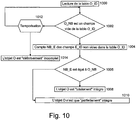
- the figure 10 illustrates an alternative embodiment of the VAL function in the case where a volume reading of the labels 15 can be implemented.
- the function VAL performs a reading of the registration table associated with a particular object O_ID.
- the function VAL checks whether a record corresponding to the cardinal of the object O_NB exists.
- the function VAL performs an account NB_E non-empty records corresponding to individual identifier values E_ID (step 1004).
- the function VAL checks whether the account NB_E is equal to the value of the object cardinal O_NB.
- the function VAL delivers a first type alert indicating an integrity object (step 1008).
- step 1010 If the test of step 1006 is negative, then the function VAL delivers a second type alert indicating partial integrity. (step 1010).
- step 1002 If the test of step 1002 is negative, then the function VAL implements a step 1012 of delay.
- step 1002 In the case where the test of step 1002 is again negative, the function VAL returns a third type alert indicating an undefined aggregated object.
- the controller 15 is advantageously arranged to execute the VAL function regularly.
- the label reader (s) 13 are preferably distributed in such a way that any label 5 present inside the volume 11 is read.
- the tag reader (s) 13 may be distributed to cover the entire volume 11.
- each of the tag readers 13 may take the form of a multidirectional antenna, as shown in FIG. figure 1 .
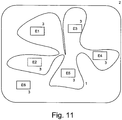
- the figure 11 shows a development of the invention.
- the aggregated object 1, or first aggregated object 1 consists of the elementary objects E1, E2, E3, E4 and E5, while a second aggregated object 2 consists of each of the elementary objects E1 to E6.
- the second aggregated object 2 consists of the first aggregated object 1 and the elementary object E6.
- Each of the elementary objects E1 to E6 takes the form of a variant of the label 5, designated label 5A.
- Each of the labels 5A constituting the first aggregated object 1 or the second aggregated object 2 stores in its memory identification data that are specific to it, for example elementary identifier data E_ID.
- Data of description of first aggregated object 1 are stored in at least some of the labels 5A corresponding to the elementary objects E1 to E5.
- Second and second description description data 2 are stored in at least some of the labels 5A corresponding to the elementary objects E1 to E6. The integrity of each of the first aggregated object 1 and the second aggregated object 2 can thus be verified from the respective description data and the individual identifier data of the labels 5A.
- each of the tags E1 to E5 holds first object identification data O1_ID and second object identifier data O2_ID.
- the tag E6 holds second object identifier data O2_ID only.
- the identification data of the first object O1_ID comprise a description of this first aggregated object 1, for example in the form of a fingerprint of this object.
- the identification data of second object O2_ID comprise a description of this second aggregated object 2, for example in the form of a print of this object.
- Appendix A3 shows an algorithm, written in pseudo-code, for checking the integrity of the first aggregated object 1 and the second aggregated object 2. This algorithm, which is only described by way of example, assumes that each of the tags 5A constituting both the first aggregated object 1 and the second aggregated object 2 maintains first object identifier data O1_ID and second object identification data O2_ID.
- the code “gid” designates the fingerprint of the first aggregated object 1, while the code “gid2” designates the fingerprint of the second aggregated object 2.
- the algorithm of Annex 3 differs from that of Annex 1 by the integrity checking procedure of an aggregated object, ie by programming the "check” procedure described in A.3.3.
- the verified object is the object "id0.gid”, which can be either the first aggregated object 1 or the second aggregated object 2.
- the integrity check of the first aggregated object 1 is performed by constituting a "group” object collecting the identifiers, "id”, whose first object identification data "id.gid” correspond.
- Verification of the integrity of the second aggregated object 2 is performed by verifying the integrity of the first aggregated object 1 and adding to the "group" of the first aggregated object 1 the identifiers "id” whose identification data of the second aggregated object 2, "id.gid2" match.
- the algorithm of Annex 3 takes advantage of the inclusion of the first aggregated object 1 in the second aggregated object 2 to simplify the verification process.
- an aggregated object may, more generally, include one or more different aggregated objects. It suffices each time at least one of the labels constituting an aggregated object to maintain description data of this object. Thus, it is possible to create a tree structure of aggregated objects. For example, these object identification data may be stored in each of the tags constituting a particular aggregated object, in the form of a fingerprint of that object.
- the second aggregated object 2 consists of the physical object P3 and the first aggregated object 1, which itself consists of the physical objects P1 and P2.
- the first aggregated object 1 can be defined by object description data.
- this data can take the form of a first object identifier 01_ID in the form of a fingerprint, or first fingerprint, that is to say data describing the constitution of the first aggregated object 1.
- This identifier of first object 01_ID can be stored in each of the constituent labels of the first aggregated object 1 or only in some of them.
- This footprint can simply result from the concatenation of the elementary identifier data E_ID of each of the tags constituting the first aggregated object 1.
- the first imprint can result from the application of a hash function to the set of these elementary identifier data E_ID.
- the second aggregated object 2 may be defined by object description data which may take the form of a second object identifier 02_ID realized in the form of a second imprint E2 of this object.
- each of the labels 5A to be affixed to the physical object P1and to the physical object P2 contains the first imprint E1, or primary imprint, and the second imprint E2, or secondary imprint.
- a primary fingerprint will correspond to the fingerprint of the highest level aggregated object, or N level, in the tree, while the secondary fingerprint will correspond to the fingerprint of the N-level aggregated object. 1 to which belongs the physical object on which the label will be affixed. This implies that the secondary imprint of the 5A tags for physical objects at the root of the tree will be empty or zero.
- the integrity of the first aggregated object 1 and the second aggregated object 2 can be tested by carrying out two verification processes, on both of the first aggregated object 1 and the second aggregated object 2.
- first aggregated object 1 and the second aggregated object 2 may be partially joined together.
- the second aggregated object 2 could thus comprise the labels E2, E5 and E6 only.
- Appendix A4 shows an algorithm, written in pseudo-code, for verifying the integrity of a first aggregated object 1 and a second aggregated object 2, in the case where the first aggregated object 1 is not totally included in the aggregated object 2.
- the algorithm in this appendix 4 assumes that each of the tags 5A included in both the first obj and aggregate 1 and the second aggregate object 2 maintain a first aggregate object identifier O1_ID, designated "gid in this appendix, and a second aggregate object identifier O2_ID, designated "gid2".
- delta_trans a maximum delay
- the algorithm in Annex 4 can not take advantage of the inclusion of the first aggregated object 1 in the second aggregated object 2.
- A.4.3 we therefore create a group "group” consisting of identifiers whose first object identifier data "id.gid” or the second object identifier data "id.gid2" correspond to the identifier of the verified object, that is, to say "id0.gid”.
- the "Check_Group” procedure is then called to check the match of this group with the description data of the checked object (A.4.4).
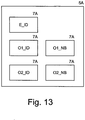
- the figure 13 illustrates an example of tag 5A as a variant of tag 5.
- Each tag 5A maintains, in one or more memory areas 7A, elementary identifier data E_ID, specific to the tag 5A in question, first aggregate object identifier data O1_ID, common to all the tags 5A constituting the aggregated object 1.
- each tag 5A further maintains, in these memory areas 7A, cardinal data of the first object O1_NB, indicating the number of labels 5A constituting the aggregated object 1.
- the tag 5A still maintains second object identifier data 02_ID, common to each of the tags 5A constituting a second aggregated object 2.
- second object identifier data 02_ID common to each of the tags 5A constituting a second aggregated object 2.
- data of cardinal of second object O2_NB, indicating the number of labels 5A constituting this second aggregated object 2 are also maintained in these memory areas 7A.
- first object O1_NB and second object 02_NB are optional.
- the first object identifier data O1_ID and the second object object O2_ID may implicitly or explicitly comprise a description of the first 1 and second 2 aggregated objects in themselves. This is particularly the case when these data take the form of fingerprints, as seen above.
- the first object identifier data O1_ID may consist of the result of a hash function generated from the elementary identifier data E_ID of each of the constituent labels of the first aggregated object 1.
- the second object identifier data O2_ID may consist of the result of a hash function generated from the elementary identifier data E_ID of each of the constituent labels of the second aggregated object 2.
- the second object identifier data O2_ID may comprise the result of a hash function generated from the first object identifier data O1_ID and the elementary identifier data E_ID of each of the elementary labels belonging to to the second aggregated object 2 and not belonging to the first aggregated object 1.
- the O_ID object identifier data consists of the result of a hash function generated from the elementary identifier data E_ID of each of the labels constituting the aggregated object 1 and a data item.
- public key type PUB_ID or the like.
- the integrity of the aggregated object 1 can be verified only if private key data PVT_ID, consistent with the public key data, are available to the function VAL.
- the public key data PUB_ID is only used for generating the O_ID object identifier data, while the private key data PVT_ID is used for the integrity checking of the aggregated object 1.
- the public key data PUB_ID can be integrated into the CREATION function described above for the generation of O_ID object identifier data. This allows the labels 5A to be written easily, in one of the ways described above.
- the public key data PUB_ID may be held in a tag 5A as the elementary identifier data E_ID of that tag.
- the CREATION function can thus be called with this particular label, in addition to the other labels 5A constituting the aggregated object 1. This has the advantage that the same function CREATION can be used, that we use public key data PUB_ID or not.
- the public key data PUB_ID can be entered for use by the CREATION function.
- These public key data PUB_ID can still be acquired by other means, such as reading a bar code, making an image followed by character recognition, receiving a message, or the like.
- This public key data PUB_ID can be seen as identifying a proxy, in the sense that these data replace the elementary identifier data E_ID of a constituent label of the aggregated object during the creation of the labels. In other words, it allows writing the labels of the aggregated object even though a label is missing.
- the private key data PVT_ID may be stored in a tag as elementary identifier data E_ID relating to that particular tag.
- the private key data PVT_ID can be integrated into the verification function.
- the use of public key data and private key data above all makes it possible to prevent the verification of the integrity of the object by a function other than that which integrates the private key data PVT_ID.
- the private key data PVT_ID can be entered or obtained by various means, such as reading a bar code, reading a magnetic medium, reading a smart card, receiving a card. a message, the reading of a fingerprint and the interrogation of a remote server, to others.
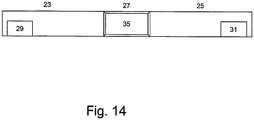
- the figure 14 illustrates a first example of application of the monitoring device 1.
- a first train car 23 and a second train car 25 are interconnected by a communication lock 27.
- the first wagon 23 has an external access door in which is disposed a dual antenna tag reader controlling access to a first volume to be monitored 29, while the second wagon 25 has a similar door, also equipped with a dual antenna tag reader for controlling access to a second volume to be monitored 31.
- a third volume to be monitored 33 may optionally be associated with airlock 27, each of which accesses the first car 23 and second car 25 is provided with a dual antenna tag reader.
- a traveler wears a type 5 label.
- Each of its luggage is provided with a label 5.
- the master label and all the labels carried by the luggage have been programmed so as to constitute the same aggregated object 1.
- the traveler To access the first wagon 23, the traveler enters the first volume to be monitored 29. In doing so, the label 5 that it carries, as well as all the tags 5 carried by the baggage entering the first volume 29 are read by cooperation of the dual antenna reader and the LECT function.
- the function VAL is called, for example consecutively to each label reading or programmed from the reading of the first label.
- the second type alert may be arranged to signal to the traveler the absence of one of his luggage. This alert can also be inhibited, for example by considering that the integrity of the aggregated object 1 formed of the traveler and this luggage does not have to be verified in the direction of the rise in the train.
- the time delay DT is advantageously fixed so that all the baggage of the traveler can be boarded by several people accessing the train in a substantially successive manner.
- the time delay DT may be set so that a first part of the baggage is introduced on board by the traveler himself while a second part is introduced by a person accompanying the passenger in question, such as a carrier for example.
- the time delay DT can thus be set to a duration of a few tens of seconds for example.
- the third type alert may be arranged to trigger an alarm. This means that luggage is introduced into the train without being accompanied by its owner-traveler. This may occur when the traveler is carrying a baggage that he mistakenly believes to be his, or when the person carrying the baggage in question stolen this baggage from a third party.
- the first type alert may be arranged to indicate to the passenger that all of his luggage has been fitted on board, for example the lighting of an indicator light of color.
- the first type alert can be processed by a door open / close control system to allow access to the compartment only when an integrity object has been detected.
- the first type of alert may be arranged to indicate to the traveler that it is well equipped with all of his luggage.
- the physical output of the volume 29 may be prohibited failing to present an aggregate object 1 integrates.
- the second type alert may be arranged to indicate to the traveler that one of his luggage is missing. This can be achieved by any means of indication, such as the lighting of a particular color light, or the activation of a sound signal.
- the third type alert may be arranged to warn anyone present that the person attempting to evacuate a piece of luggage is not the associated owner-traveler audit luggage. This avoids theft, but also interversions of physically identical luggage.
- the third type alert may take the form of a signal specifically intended for the owner of the luggage, for example a message sent to his mobile phone.
- the set of tags used, or at least one of them, then stores personal information related to said owner, such as a mobile phone number.
- any tag can maintain information intended to be specifically used for the transmission of at least one of the types of alerts, in particular information of destination of this alert.
- the second volume 31 can be monitored analogously to the first volume 29.
- the third volume 35 can also be monitored similarly to the first 29 and second 31 volumes to prevent one piece of luggage from being moved from one car to the other without its owner-traveler.
- the second type alert issued when an object partially intact is detected, can be inhibited, allowing the traveler to move on the train with only part of his luggage.
- double-antenna tag readers 13 are used here, it is possible to process the alerts controlled by the VAL function differently depending on whether it is a climb on the train or a descent of the train. -this. For example, one may choose to allow the introduction of a piece of luggage without the owner-traveler on the train but to issue an alarm when the baggage is unloaded without its owner.
- the reverse configuration can also be implemented, especially when it is desirable to monitor the introduction of unmanned baggage, as is the case in the fight against terrorism.
- the time delay DT is advantageously adjusted so that the triggering of the alarms is fast enough so that adequate measures can be taken while avoiding inadvertent tripping due to the introduction of baggage of the same object and aggregated by several people. the same group.
- the figure 15 illustrates a second example of application of the monitoring device 1.
- a baggage control zone 37 In a terminal, a baggage control zone 37, typically X-ray, is preceded by a volume before control 39 and a volume after control 41.
- a traveler with a tag 5 is accompanied by his baggage tagged in the pre-check volume 39.
- the CREATION function is called to register at least O_ID object identifier data on each of the labels 5 and O_NB object cardinal data in at least one of these labels to create an aggregated object 1.
- the volume before control 39 can take the form of a cabin whose walls are sealed to radio waves.
- the volume after control 41 is monitored by the device 1.
- a label reader 13 is arranged in this volume 41 so that a crossing of the volume 41 by a label 5 involves reading this label.
- This can be achieved by means of a tag reader 13 arranged in the form of a gantry or a bi-directional antenna reader capable of performing a "volume" reading of the volume 41.
- the function VAL is executed, for example consecutive to each reading of the label, or in a manner programmed from the reading of a first label of an aggregated object 1.
- the second type alert may be arranged to inform the traveler that one of his luggage is missing.
- the third type alert may be arranged to indicate that the person has a piece of luggage that does not belong to him. This makes it possible to identify baggage substitutions between two different owners.
- the output of the volume after control 41 may be conditioned on the issuance of a first type alert indicating an aggregate object 1 integrates.
- the traveler may be allowed to leave the area only if he is provided with all of his luggage.
- the output of the volume after control 41 can also be monitored so that a third party does not leave this control area in the company of a baggage of the person currently controlled. Gantry type tag readers 13 can then be placed at each physical output point of this volume after control 41.
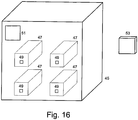
- the figure 16 illustrates a third application of the monitoring device 1 according to the invention.
- a package 45 to be sent to a recipient comprises a plurality of physical objects 47.
- Each of the physical objects 47 carries a radiofrequency label, or object label 49.
- the package 45 also carries a radiofrequency label, or package label 51.
- the set formed of the package 45 and the physical objects 47 form a first aggregate object.
- Each of the object tags 49 maintains elementary identifier data E_ID of its own.
- Object tags 49 may be pre-programmed with unique elementary identifier data E_ID. In this case, no special programming is necessary for these object tags 49, which can be used as factory outputs.
- the package label 51 maintains its own elementary identifier data E_ID, as well as coupled first object identifier data O1_ID established on the basis of the elementary identifier data E_ID of each of the object tags 49 and E_ID elementary identifier data of the package label 51.
- the first object identifier data O1_ID advantageously take the form of a fingerprint of the first object O1_ID. In this case, it is unnecessary for the package label 51 to maintain in addition to cardinal data of first object NB1_ID.
- the fingerprint E1 of the first aggregated object takes the form of the result of a hash function applied to all the elementary identifier data E_ID of the object tags 49 and the package label 51.
- This programming of the parcel label 51 is typically performed by the sender of the package 45, or by the carrier who supports the package 45.
- a second coupled object consists of each of the physical objects 47, the package 45 and the recipient of the package 51.
- the package label 51 further maintains second object identification data O2_ID established on the basis of the individual identifier data E_ID of the object labels 49, the package label 51 and an additional label, or consignee label 53.
- these O2_ID second object identification data takes the form of a fingerprint E2.
- the second object description data O2_ID are produced from a hash function applied to each of the elementary identifier E_ID data of the object labels 49, elementary identifier data E_ID of the package label. 51 and a public key PUB_ID which is consistent with private key data PVT_ID stored in the memory of the recipient tag 53 as elementary identifier data E_ID.
- the integrity of the first aggregated object can be verified by the compliance of the elementary identifiers E_ID of the object tags 49 and the package label of 51 with the first object description data O1_ID stored in the package label 51. This verification does not take place. requires none of the data stored in the recipient tag 53 and can therefore be realized in the absence of the recipient tag 53.
- the integrity of the first aggregated object 1 can be verified throughout the path of the package 45 by the carrier or carriers.
- Verification of the integrity of the first aggregated object 1 can be done with any of the embodiments of the monitoring device 1.
- a gantry read without management of the reading delay or a volume reading can be preferred here, given that the set of labels to be verified is almost certain in the same volume, namely the package 45.
- the integrity of the second aggregated object can be verified by the compliance of the individual identifiers E_ID of the object tags 49, the package label 51 and the recipient label 53 with the second object description data O2_ID.
- the integrity of the second aggregated object can only be verified in the presence of the recipient label 53.
- this integrity is verified during the delivery of the package 45 to its recipient.
- the sender thus ensures that the package 45 is delivered to the right recipient, while the latter can verify the integrity of the package 45 it receives, without opening the latter, before accepting delivery.
- the recipient knows that the package 45 he receives is identical to the content sent. This is interesting because the transfer of responsibility is usually done by the conveyor conveyor to the recipient, who accepts this responsibility knowing here that his package is complete.
- monitoring device 9 may be used. For example, a volume reading of the labels may be preferred for the parcel, while a reading with a hand scanner may be used together to read the label of the recipient.
- the package label 51 can take a form similar to that of a postage stamp, that is to say it can be visually tamper-proof and subject to the payment of postage. It may, in addition or in addition, be arranged to break if we try to take off, for example by the use of a suitable adhesive or an irreversible parcel connection system.
- the application that has just been described can be extended to any mailpiece whose container, typically an envelope, carries a label 5A and the content, typically a letter, a label 5.
- the figure 17 illustrates a development of the application of the figure 16 .
- An automatic set-point 54 is provided with an electronic opening system 56, controlled by a controller 58.
- the controller 58 is connected to a radio-frequency tag reading device 60 arranged to read all the tags at the same time. Inside the automatic locker 54.
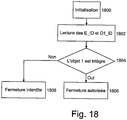
- the figure 18 illustrates the operation of the controller 58 for the filing of the package 45.
- a step 1800 the controller interacts with the opening devices 56 to verify that the setpoint 54 is open. This also corresponds to an initialization step of the controller 58.
- the controller 58 interacts with the reading device 60 to acquire the elementary identifier data E_ID of the labels placed inside the setpoint 54, as well as the first object identifier data O1_ID.
- the controller 58 calls an integrity check function for the first object. This function checks the correspondence of the elementary identifier data E_ID read and the first object identifier data O1_ID.
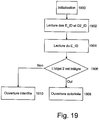
- the figure 19 illustrates the operation of the controller 58 for the removal of the package 45.
- a step 1900 the controller 58 is initialized.
- the controller 58 interacts with the reading device 60 to acquire the elementary identifier data E_ID of the tags placed inside the setpoint 54, as well as the second object identifier data O2_ID.
- the controller 58 interacts with a radio-frequency tag reader 62, possibly remote, to acquire from the destination tag 53 the elementary identifier data E_ID specific to this tag.
- the controller 58 calls an integrity check function for the second aggregated object.
- the opening of the door is controlled in a step 1908. Otherwise, the door remains closed.
- a "new deposit” order is sent to the controller. This order can be triggered automatically on the occurrence of an event such as the detection of the presence of a package by a photosensitive cell, the reading of the labels by a gantry, possibly connected to the controller 58, or other, or on command of the user.
- the controller 58 calls a set selection function, able to interrogate the allocation table to find the address of a set whose status is "free".
- this selection function is arranged so as to elect one of the "free" status instructions in a random manner, The controller can then be arranged to control the opening of the selected setpoint and / or to control the display. the address of this deposit for the depositor.
- the first signature of the package 45 can be entered in the allocation table, in connection with the address data of the deposit.
- This first signature was preferably read during the introduction to the deposit.
- this signature can be read by means of a single reader, common to all instructions 54.
- the controller 58 can be arranged to interpret the reading of the signature of a package as an instruction deposit.
- the recipient of the package is presented to all instructions 54, provided with his private key.
- the controller is arranged to test the consistency of this private key with each of the signatures maintained in the allocation table, in order to determine the address the deposit which houses the recipient's parcel. This amounts to testing the integrity of each of the second aggregated objects, the integrity of the first aggregated object included in the second aggregated object having already been verified and its signature stored. If one of the second aggregated objects is considered to be intact, the address of the corresponding instruction is returned to the controller 58 which authorizes its opening. Optionally, this controller 58 controls the opening.
- All instructions, or lockers can take the form of a cabinet or a rack of lockers, or any other form.
- This address data does not have to be affixed to the package either. And the selection of the setpoint can be random.
- a closed order may contain a parcel or not, without it being possible to know from outside.
- this application differs from the instructions with allocation in queue, or more generally according to a known sequence.
- Such a property significantly increases the safety of the instructions. This security can be further increased by conditioning the opening of the door of the room containing these instructions. the presence in these instructions of a parcel forming an integrated with the holder of the private key label.
- Verification of the integrity of an aggregated object can extend to several instructions.
- an aggregated object 1 can be distributed over several different instructions.
- the door of each of these instructions can be closed, respectively open, only when the aggregated object 1 has been considered intact.
- These instructions can be installed in very different places, such as halls, halls, specific premises such as post offices, metropolitan stations, near or inside street furniture elements, such as bus stops, bicycle rental facilities, and others.
- the parcel can take the form of a fold of a confidential nature.
- the first and second aggregated objects may be used to control the opening of doors, or more generally to control access to particular volumes, in which at least one associated aggregate object is located. For example, it can control access to a closed parking space protecting a rental vehicle.
- a second aggregate object 2 consisting of each of the particular instructions housing aggregated objects 1 linked together.
- all parcels 45 have the same recipient.
- the second aggregated object 2 and the recipient in question can form a third aggregated object.
- a particularly interesting application can be found in the field of air transport.
- An airline may want to offer a baggage service travelers who do not want some of their baggage to travel in the hold, but can not keep it in the cabin.
- the traveler places labels on these bags and places them in small containers, several pieces of luggage or objects that can be housed in the same container.
- the set of containers used for the same traveler forms a first aggregated object 1.
- This first object and the traveler form a second aggregated object 1.
- all the containers are arranged in one or more instructions, whose opening is controlled in a manner similar to that described above. These instructions can advantageously be arranged near the place of withdrawal of the rest of the luggage of the traveler.
- the monitoring of aggregated objects 1 or a given volume 11 can be done non-continuously: the integrity check may be performed at particular geographic locations, at particular time points, and / or at the onset of a particular event, including human intervention. This allows in particular a monitoring involving lower energy consumption.
- the device according to the invention makes it possible to verify the integrity of an aggregated object as well when this integrity is a priori desirable, as in the examples described above, only when this integrity must be avoided, in particular when it is a question of ensuring that particular individual physical objects are not present simultaneously in the same physical volume, which may be the case for chemicals or drugs for example.
- the data collected by or for the controller of the device according to the invention may be used, addressed, processed, stored or supplemented by other devices belonging to the same information network, or to a separate network, for all purposes, in particular statistics.
Landscapes
- Engineering & Computer Science (AREA)
- Business, Economics & Management (AREA)
- Physics & Mathematics (AREA)
- Computer Security & Cryptography (AREA)
- Signal Processing (AREA)
- Computer Networks & Wireless Communication (AREA)
- General Physics & Mathematics (AREA)
- Economics (AREA)
- Theoretical Computer Science (AREA)
- Toxicology (AREA)
- Health & Medical Sciences (AREA)
- Human Resources & Organizations (AREA)
- Finance (AREA)
- Strategic Management (AREA)
- General Business, Economics & Management (AREA)
- Quality & Reliability (AREA)
- Operations Research (AREA)
- Marketing (AREA)
- Entrepreneurship & Innovation (AREA)
- Development Economics (AREA)
- Tourism & Hospitality (AREA)
- Accounting & Taxation (AREA)
- Electromagnetism (AREA)
- General Health & Medical Sciences (AREA)
- Artificial Intelligence (AREA)
- Computer Vision & Pattern Recognition (AREA)
- Burglar Alarm Systems (AREA)
- Storage Device Security (AREA)
- Testing And Monitoring For Control Systems (AREA)
- Mobile Radio Communication Systems (AREA)
- Radar Systems Or Details Thereof (AREA)
Claims (24)
- Vorrichtung zum Überwachen physischer Objekte, die von der Art ist, die umfasst:- einen oder mehrere Etikettenleser (13) kurzer Reichweite;- Etiketten als Speicherelemente (5), die aus kurzem Abstand abfragbar und dazu bestimmt sind, an physischen Objekten angebracht zu sein;dadurch gekennzeichnet, dass:- die Etiketten individuelle Kennungen gespeichert haben, die jeweils den Etiketten eigen sind, und zumindest einige dieser Etiketten Gruppenbeschreibungsdaten gespeichert haben;dass die Vorrichtung darüber hinaus umfasst:- eine Steuerung (15), die dazu eingerichtet ist:- eine Lesefunktion auszuführen, die mit dem oder den Etikettenleser/n zusammenwirken kann, um Daten zu erfassen, die in den Etiketten der Umgebung enthalten sind, und- eine Integritätsvalidierungsfunktion auszuführen, die aus den erfassten Daten individuelle Kennungen und Gruppenbeschreibungsdaten unterscheiden kann, dann die Angemessenheit der Gruppenbeschreibungsdaten verifizieren kann, indem die Konformität der individuellen Kennungen mit den entsprechenden Gruppenbeschreibungsdaten verifiziert wird.
- Vorrichtung nach Anspruch 1, wobei die Integritätsvalidierungsfunktion das Aussenden einer ersten Warnung im Falle einer Unangemessenheit der Gruppenbeschreibungsdaten ansteuern kann.
- Vorrichtung nach einem der Ansprüche 1 und 2, wobei die Integritätsvalidierungsfunktion das Aussenden einer zweiten Warnung im Falle einer Nichtkonformität der Gesamtheit der individuellen Kennungen mit den Gruppenbeschreibungsdaten ansteuern kann.
- Vorrichtung nach einem der vorhergehenden Ansprüche, wobei die Validierungsfunktion dazu eingerichtet ist, eine Hash-Funktion aufzurufen, um aus der Gesamtheit der erfassten individuellen Kennungen einen Ergebniswert zu generieren und diesen Ergebniswert mit den Gruppenbeschreibungsdaten zu vergleichen, um die Konformität individueller Kennungen mit den Gruppenbeschreibungsdaten zu verifizieren.
- Vorrichtung nach einem der vorhergehenden Ansprüche, wobei die Integritätsvalidierungsfunktion dazu eingerichtet ist, in den erfassten Daten Gruppenkennungsdaten, die jeweils einer individuellen Kennung zugeordnet sind, und Gruppenhauptdaten zu unterscheiden, die erfassten individuellen Kennungen in Bezug auf eine spezielle Gruppenkennung zu zählen, dann die Anzahl dieser Kennungen mit den Gruppenhauptdaten zu vergleichen, um die Konformität der individuellen Kennungen mit den Gruppenbeschreibungsdaten zu verifizieren.
- Vorrichtung nach einem der vorhergehenden Ansprüche, wobei der oder die Etikettenleser so angeordnet ist/sind, dass jedes Etikett, das sich in einem physikalischen Volumen befindet, gelesen wird.
- Vorrichtung nach Anspruch 6, wobei sich das physikalische Volumen in Form einer Umhüllung mit elektronisch steuerbarem Öffnen/Schließen darstellt und das Öffnen und/oder das Schließen in Abhängigkeit von der Konformität der individuellen Kennungen mit den entsprechenden Gruppenbeschreibungsdaten gesteuert wird/werden.
- Vorrichtung nach einem der vorhergehenden Ansprüche, wobei der oder die Etikettenleser so eingerichtet ist/sind, dass jedes Etikett, das in ein bestimmtes physikalisches Volumen eintritt, und jedes Etikett, das aus diesem physikalischen Volumen austritt, gelesen wird.
- Vorrichtung nach einem der vorhergehenden Ansprüche, wobei die Etiketten vom Typ Funkfrequenzetiketten sind.
- Vorrichtung nach einem der vorhergehenden Ansprüche, wobei die Steuerung (15) darüber hinaus dazu eingerichtet ist, den erfassten Daten der Etiketten einen Lesezeitpunkt zuzuteilen, und wobei die Integritätsvalidierungs-funktion einzig an den Daten ausgeführt wird, deren Zeitpunkt in einer bestimmten Zeitspanne enthalten ist.
- Vorrichtung nach einem der vorhergehenden Ansprüche, wobei die Steuerung (15) darüber hinaus dazu eingerichtet ist, die Gesamtheit der erfassten Daten der Etiketten in mindestens zwei komplementäre Datensätze einzuordnen, und wobei die Integritätsvalidierungsfunktion auf unterschiedliche Weise an den in jedem der komplementären Datensätze enthaltenen Daten ausgeführt wird.
- Vorrichtung nach Anspruch 11, wobei die Steuerung (15) dazu eingerichtet ist, die Gesamtheit der erfassten Daten in Abhängigkeit von einer Verlagerung des Etiketts von der Stelle, an der die Daten erfasst wurden, zu verteilen.
- Vorrichtung nach einem der vorhergehenden Ansprüche, wobei die Steuerung (15) dazu eingerichtet ist, die Integritätsvalidierungsfunktion nach jeder Ausführung der Lesefunktion auszuführen.
- Vorrichtung nach einem der vorhergehenden Ansprüche, wobei die Steuerung (15) dazu eingerichtet ist, eine Zusatzdatenwiederherstellungsfunktion auszuführen, wobei die Integritätsvalidierungsfunktion darüber hinaus in der Lage ist, aus den Zusatzdaten eine oder mehrere zusätzliche individuelle Kennung/en zu unterscheiden, und dann die Konformität der individuellen Kennungen und der zusätzlichen individuellen Kennungen mit den Gruppenbeschreibungsdaten zu verifizieren.
- Vorrichtung nach einem der vorhergehenden Ansprüche, wobei die Integritätsvalidierungsfunktion aus den Gruppenbeschreibungsdaten Beschreibungsdaten einer ersten Gruppe und Beschreibungsdaten einer zweiten Gruppe unterscheiden kann, dann die Angemessenheit zumindest einiger der Beschreibungsdaten der ersten Gruppe und der Beschreibungsdaten der zweiten Gruppe verifizieren kann, indem sie die Konformität der individuellen Kennungen mit den Beschreibungsdaten der ersten Gruppe und den Beschreibungsdaten der zweiten Gruppe verifiziert.
- Vorrichtung zum Überwachen physischer Objekte, die von der Art ist, die umfasst:- einen oder mehrere Etikettenleser (13) kurzer Reichweite;- Etiketten als Speicherelemente (5), die aus kurzem Abstand abfragbar und dazu bestimmt sind, an physischen Objekten angebracht zu sein;dadurch gekennzeichnet, dass die Vorrichtung darüber hinaus umfasst:- eine Steuerung (15) dazu eingerichtet ist:- eine Lesefunktion auszuführen, die mit dem oder den Etikettenleser/n zusammenwirken kann, um in die Etiketten der Umgebung Daten individueller Kennungen, die jedem der Etiketten zueigen sind, und Gruppenbeschreibungsdaten einzuschreiben, die von zumindest einigen dieser Etiketten gespeichert werden.
- Vorrichtung nach Anspruch 16, wobei die Daten individueller Kennungen die Gruppenbeschreibungsdaten enthalten.
- Vorrichtung nach einem der Ansprüche 16 und 17, wobei die Gruppenbeschreibungsdaten sich aus der Ausführung einer Hash-Funktion ergeben, die mit der Gesamtheit der individuellen Kennungen der Gruppe aufgerufen wird.
- Vorrichtung nach einem der Ansprüche 16 bis 18, wobei die eingeschriebenen Gruppenbeschreibungsdaten auf Grundlage der eingeschriebenen Daten individueller Kennungen und Daten einer zusätzlichen individuellen Kennung erstellt werden.
- Vorrichtung nach Anspruch 19, wobei die Daten einer zusätzlichen individuellen Kennung Daten des Typs öffentlicher Schlüssel enthalten, denen Daten einer individuellen Kennung des Typs privater Schlüssel entsprechen.
- Vorrichtung nach Anspruch 20, wobei die Lesefunktion mit dem oder den Etikettenleser/n zusammenwirken kann, um in ein Etikett der Umgebung die Daten einer individuellen Kennung des Typs privater Schlüssel einzuschreiben.
- Vorrichtung nach einem der Ansprüche 16 bis 21, wobei die Steuerung (15) dazu eingerichtet ist:- eine Lesefunktion auszuführen, die mit dem oder den Etikettenleser/n zusammenwirken kann, um Daten zu erfassen, die in den Etiketten der Umgebung enthalten sind, und in den erfassten Daten individuelle Kennungen zu unterscheiden, die jedem der Etiketten zueigen sind,- eine Lesefunktion auszuführen, die mit dem oder den Etikettenleser/n zusammenwirken kann, um in zumindest einige der Etiketten der Umgebung Gruppenbeschreibungsdaten einzuschreiben.
- Vorrichtung nach Anspruch 22, wobei die Steuerung (15) dazu eingerichtet ist:- eine Lesefunktion auszuführen, die mit dem oder den Etikettenleser/n zusammenwirken kann, um Daten zu erfassen, die in den Etiketten der Umgebung enthalten sind, und in den erfassten Daten individuelle Kennungen zu unterscheiden, die jedem der Etiketten zueigen sind,- eine Lesefunktion auszuführen, die mit dem oder den Etikettenleser/n zusammenwirken kann, um in zumindest einige der Etiketten der Umgebung Gruppenbeschreibungsdaten einzuschreiben, die auf Grundlage der individuellen Kennungen erstellt sind.
- Vorrichtung nach Anspruch 23, wobei die erfassten Daten eine individuelle Kennung des Typs privater Schlüssel enthalten und die Gruppenbeschreibungsdaten, um in Bezug auf die Konformität mit einer individuellen Kennung des Typs öffentlicher Schlüssel verifiziert werden zu können, erstellt werden, indem die individuelle Kennung des Typs privater Schlüssel ersetzt wird.
Priority Applications (1)
| Application Number | Priority Date | Filing Date | Title |
|---|---|---|---|
| EP12179421A EP2523172A1 (de) | 2008-05-22 | 2009-05-20 | Vorrichtung und Verfahren zur Überprüfung der Integrität von physischen Objekten |
Applications Claiming Priority (3)
| Application Number | Priority Date | Filing Date | Title |
|---|---|---|---|
| FR0802783A FR2931612B1 (fr) | 2008-05-22 | 2008-05-22 | Dispositif et procede de verification d'integrite d'objets physiques |
| FR0901064A FR2931613B1 (fr) | 2008-05-22 | 2009-03-09 | Dispositif et procede de verification d'integrite d'objets physiques |
| PCT/FR2009/000597 WO2009153435A2 (fr) | 2008-05-22 | 2009-05-20 | Dispositif et procédé de vérification d'intégrité d'objets physiques |
Related Child Applications (1)
| Application Number | Title | Priority Date | Filing Date |
|---|---|---|---|
| EP12179421A Division-Into EP2523172A1 (de) | 2008-05-22 | 2009-05-20 | Vorrichtung und Verfahren zur Überprüfung der Integrität von physischen Objekten |
Publications (2)
| Publication Number | Publication Date |
|---|---|
| EP2297714A2 EP2297714A2 (de) | 2011-03-23 |
| EP2297714B1 true EP2297714B1 (de) | 2017-04-12 |
Family
ID=41343281
Family Applications (2)
| Application Number | Title | Priority Date | Filing Date |
|---|---|---|---|
| EP12179421A Withdrawn EP2523172A1 (de) | 2008-05-22 | 2009-05-20 | Vorrichtung und Verfahren zur Überprüfung der Integrität von physischen Objekten |
| EP09765997.3A Not-in-force EP2297714B1 (de) | 2008-05-22 | 2009-05-20 | Einrichtung und verfahren zum prüfen der integrität physischer objekte |
Family Applications Before (1)
| Application Number | Title | Priority Date | Filing Date |
|---|---|---|---|
| EP12179421A Withdrawn EP2523172A1 (de) | 2008-05-22 | 2009-05-20 | Vorrichtung und Verfahren zur Überprüfung der Integrität von physischen Objekten |
Country Status (5)
| Country | Link |
|---|---|
| US (3) | US9324219B2 (de) |
| EP (2) | EP2523172A1 (de) |
| ES (1) | ES2633141T3 (de) |
| FR (1) | FR2931613B1 (de) |
| WO (1) | WO2009153435A2 (de) |
Families Citing this family (5)
| Publication number | Priority date | Publication date | Assignee | Title |
|---|---|---|---|---|
| MX2017004059A (es) | 2014-09-29 | 2017-08-28 | Avery Dennison Corp | Etiqueta rfid de seguimiento de neumáticos. |
| FR3035250B1 (fr) | 2015-04-15 | 2017-03-24 | Inria Inst Nat De Rech En Informatique Et En Automatique | Dispositif d'aide au recensement d'objets |
| DE102015005071A1 (de) * | 2015-04-21 | 2016-10-27 | G Data Software Ag | System und Verfahren zur Überwachung der Integrität einer von einem Serversystem an ein Clientsystem ausgelieferten Komponente |
| US10275619B2 (en) * | 2017-03-27 | 2019-04-30 | International Business Machines Corporation | Luggage management system |
| EP3506100A1 (de) * | 2017-12-28 | 2019-07-03 | GuardSquare NV | Automatisiertes softwareanwendungsverifizierungssystem |
Family Cites Families (50)
| Publication number | Priority date | Publication date | Assignee | Title |
|---|---|---|---|---|
| US5050212A (en) * | 1990-06-20 | 1991-09-17 | Apple Computer, Inc. | Method and apparatus for verifying the integrity of a file stored separately from a computer |
| US5295256A (en) * | 1990-12-14 | 1994-03-15 | Racal-Datacom, Inc. | Automatic storage of persistent objects in a relational schema |
| US5594918A (en) * | 1991-05-13 | 1997-01-14 | International Business Machines Corporation | Parallel computer system providing multi-ported intelligent memory |
| US5423037A (en) * | 1992-03-17 | 1995-06-06 | Teleserve Transaction Technology As | Continuously available database server having multiple groups of nodes, each group maintaining a database copy with fragments stored on multiple nodes |
| US5594256A (en) * | 1995-01-13 | 1997-01-14 | Clark-Mxr, Inc. | High voltage switch for pockels cells |
| US5909571A (en) * | 1995-05-01 | 1999-06-01 | Apple Computer, Inc. | Clock distribution for processor and host cards |
| US5754841A (en) | 1995-10-20 | 1998-05-19 | Ncr Corporation | Method and apparatus for parallel execution of user-defined functions in an object-relational database management system |
| US5794250A (en) | 1995-10-20 | 1998-08-11 | Ncr Corporation | Method and apparatus for extending existing database management system for new data types |
| US6418382B2 (en) * | 1995-10-24 | 2002-07-09 | Curagen Corporation | Method and apparatus for identifying, classifying, or quantifying DNA sequences in a sample without sequencing |
| US5768526A (en) * | 1996-03-08 | 1998-06-16 | Glenayre Electronics, Inc. | Method and apparatus for validating data packets in a paging system |
| JP3570114B2 (ja) * | 1996-10-21 | 2004-09-29 | 富士ゼロックス株式会社 | データ検証方法およびデータ検証システム |
| US5787437A (en) * | 1996-10-29 | 1998-07-28 | Hewlett-Packard Company | Method and apparatus for shared management information via a common repository |
| US6021491A (en) * | 1996-11-27 | 2000-02-01 | Sun Microsystems, Inc. | Digital signatures for data streams and data archives |
| US6173338B1 (en) * | 1997-02-07 | 2001-01-09 | Canon Kabushiki Kaisha | Image output system having memory for storing image data and outputting stored image data based upon output condition and instruction |
| US6690289B1 (en) * | 1997-06-12 | 2004-02-10 | Microsoft Corporation | Message formatting, authentication, and error detection in home control systems |
| CA2212316C (en) * | 1997-07-31 | 2001-02-13 | Ibm Canada Limited - Ibm Canada Limitee | A method of recognizing fixed and variable sized data objects in memory |
| US6115790A (en) * | 1997-08-29 | 2000-09-05 | Silicon Graphics, Inc. | System, method and computer program product for organizing page caches |
| US6233687B1 (en) * | 1998-01-21 | 2001-05-15 | Nortel Networks Limited | Method and apparatus for providing configuration information in a network |
| US6807632B1 (en) * | 1999-01-21 | 2004-10-19 | Emc Corporation | Content addressable information encapsulation, representation, and transfer |
| US6023586A (en) * | 1998-02-10 | 2000-02-08 | Novell, Inc. | Integrity verifying and correcting software |
| US6446087B1 (en) * | 1998-11-04 | 2002-09-03 | Lucent Technologies Inc. | System for maintaining the integrity of application data |
| US6424650B1 (en) * | 1999-02-09 | 2002-07-23 | 3Com Corporation | Network address filter device |
| US6420122B1 (en) * | 1999-09-27 | 2002-07-16 | Massachusetts Institute Of Technology | Methods of screening for agents that inhibit aggregation of polypeptides |
| WO2001080054A1 (en) * | 2000-04-13 | 2001-10-25 | N-Tier Financial Services, Llc | Business objects process development framework for data reconciliation |
| US6804700B1 (en) * | 2000-10-04 | 2004-10-12 | Microsoft Corporation | Methods and systems for assigning human-readable and unique uniform resource locators to objects |
| US20040128516A1 (en) * | 2001-03-28 | 2004-07-01 | Okamoto Steve Atsushi | Method and apparatus for verifying bearing instruments |
| US6792431B2 (en) * | 2001-05-07 | 2004-09-14 | Anadarko Petroleum Corporation | Method, system, and product for data integration through a dynamic common model |
| US20030018584A1 (en) * | 2001-07-23 | 2003-01-23 | Cohen Jeremy Stein | System and method for analyzing transaction data |
| GB2395041A (en) * | 2001-08-14 | 2004-05-12 | Bloomberg Lp | Distribution and mapping of financial records from data stream |
| WO2003021888A1 (en) * | 2001-09-04 | 2003-03-13 | Operax Ab | Method and arrangement in an ip network |
| US20030156541A1 (en) * | 2002-02-21 | 2003-08-21 | Zheng Haihong | Method and system for reserving resources on an MPLS path |
| US20050234860A1 (en) * | 2002-08-30 | 2005-10-20 | Navio Systems, Inc. | User agent for facilitating transactions in networks |
| US7730077B2 (en) * | 2002-09-18 | 2010-06-01 | Netezza Corporation | Intelligent storage device controller |
| US7388488B2 (en) * | 2003-10-30 | 2008-06-17 | Peter Lupoli | Method and system for storing, retrieving, and managing data for tags |
| FR2865302B1 (fr) | 2004-01-15 | 2006-04-14 | Inst Nat Rech Inf Automat | Dispositif transactionnel a pre-traitement anticipe. |
| US20050200487A1 (en) * | 2004-03-06 | 2005-09-15 | O'donnell Ryan | Methods and devices for monitoring the distance between members of a group |
| DE102004034784B4 (de) * | 2004-07-09 | 2009-08-27 | Spreewerk Lübben GmbH | Verfahren und Vorrichtung zur Delaborierung von explosivstoffhaltigen Körpern |
| US20060250249A1 (en) * | 2005-04-08 | 2006-11-09 | Konaware, Inc. | Self describing RFID chains to validate parts in bills-of-material or manifest when disconnected from server |
| BRPI0607512A2 (pt) | 2005-04-13 | 2009-09-08 | Inria Inst Nat | instalação para a difusão contextual de informações em modo ao mesmo tempo coletivo e pessoal |
| US7483387B2 (en) * | 2005-05-23 | 2009-01-27 | Cisco Technology, Inc. | Hierarchical label distribution for inter-area summarization of edge-device addresses |
| US7668857B2 (en) * | 2005-11-07 | 2010-02-23 | International Business Machines Corporation | Meta-data tags used to describe data behaviors |
| US7623029B2 (en) * | 2005-11-14 | 2009-11-24 | System Planning Corporation | System and method for lot based processing and tracking in a container security system using wireless communications |
| US7348886B2 (en) * | 2006-01-17 | 2008-03-25 | International Business Machines Corporation | System and method to track inventory using RFID tags |
| US7904278B2 (en) * | 2006-05-02 | 2011-03-08 | The Johns Hopkins University | Methods and system for program execution integrity measurement |
| WO2008021874A1 (en) * | 2006-08-08 | 2008-02-21 | Robert Poor | Wireless protection system |
| US9172710B2 (en) * | 2007-02-05 | 2015-10-27 | Broadcom Corporation | Media transport protocol extensions for system integrity and robustness, and applications thereof |
| US8996483B2 (en) | 2007-03-28 | 2015-03-31 | Ricoh Co., Ltd. | Method and apparatus for recording associations with logs |
| US8032573B2 (en) * | 2007-06-10 | 2011-10-04 | Philippe Richard | System and method for managing and updating data from a number of sources for a project |
| JP4885819B2 (ja) * | 2007-10-22 | 2012-02-29 | 富士通株式会社 | 通信装置 |
| US8359480B2 (en) | 2008-12-19 | 2013-01-22 | University Of Washington | Scalable RFID systems: a privacy preserving protocol with constant-time identification |
-
2009
- 2009-03-09 FR FR0901064A patent/FR2931613B1/fr not_active Expired - Fee Related
- 2009-05-20 US US12/994,015 patent/US9324219B2/en active Active
- 2009-05-20 ES ES09765997.3T patent/ES2633141T3/es active Active
- 2009-05-20 WO PCT/FR2009/000597 patent/WO2009153435A2/fr not_active Ceased
- 2009-05-20 EP EP12179421A patent/EP2523172A1/de not_active Withdrawn
- 2009-05-20 EP EP09765997.3A patent/EP2297714B1/de not_active Not-in-force
-
2012
- 2012-08-14 US US13/585,126 patent/US9489811B2/en not_active Expired - Fee Related
-
2016
- 2016-11-07 US US15/345,139 patent/US20170053144A1/en not_active Abandoned
Non-Patent Citations (1)
| Title |
|---|
| None * |
Also Published As
| Publication number | Publication date |
|---|---|
| FR2931613B1 (fr) | 2010-08-20 |
| EP2297714A2 (de) | 2011-03-23 |
| US20120306629A1 (en) | 2012-12-06 |
| WO2009153435A2 (fr) | 2009-12-23 |
| ES2633141T3 (es) | 2017-09-19 |
| US9489811B2 (en) | 2016-11-08 |
| US9324219B2 (en) | 2016-04-26 |
| US20170053144A1 (en) | 2017-02-23 |
| US20110178999A1 (en) | 2011-07-21 |
| FR2931613A1 (fr) | 2009-11-27 |
| WO2009153435A3 (fr) | 2010-02-25 |
| EP2523172A1 (de) | 2012-11-14 |
Similar Documents
| Publication | Publication Date | Title |
|---|---|---|
| EP3752990B1 (de) | Vorrichtung zum speichern von objekten und verfahren zum implementieren einer solchen vorrichtung | |
| ES2581231T3 (es) | Método y sistema de gestión de entidad que usa dispositivos inalámbricos | |
| EP1593099B1 (de) | Aufbewahrungsvorrichtung und verfahren für das einlegen und ausgeben eines gegenstandes in eine aufbewahrungsvorrichtung | |
| CN101675201A (zh) | 用于移动零售推车的安全设备 | |
| US8567664B2 (en) | Secure ATM deposit | |
| EP2297714B1 (de) | Einrichtung und verfahren zum prüfen der integrität physischer objekte | |
| CN102855704A (zh) | 一种自助存取件机及其使用方法 | |
| PT1237445E (pt) | Sistema de entrega ou levantamento seguro | |
| CN105931363B (zh) | 钱箱的储存装置、储存系统及工作方法 | |
| EP3073864A1 (de) | Warentransportwagen mit geschützter öffnung sowie sicheres öffnungs- und schliesssystem und -verfahren mit solch einem wagen | |
| US11417166B2 (en) | System for parcel transport and tracking operated responsive to data bearing records | |
| EP2874129B1 (de) | Banknotenausgabeautomat mit wahlweiser Abschaltung der Rückgabe der Banknoten in den Safe in dem Fall einer durch den Benutzer fehlenden Entnahme | |
| US20050116032A1 (en) | Transport and delivery system for valuable items | |
| CN105740927B (zh) | 基于囊匣的文物管理方法、系统及装置 | |
| FR3078192A1 (fr) | Dispositif de stockage d'objets, et procede mettant en oeuvre un tel dispositif | |
| FR3044886A1 (fr) | Systeme collectif de boites aux lettres et procede de gestion correspondant | |
| US20210131164A1 (en) | Touchless smart storage box with face recognition | |
| FR2931612A1 (fr) | Dispositif et procede de verification d'integrite d'objets physiques | |
| FR2726659A1 (fr) | Dispositif et procede de telesurveillance d'objets deposes dans un local | |
| US20260092489A1 (en) | Safe Box | |
| CA3110992C (en) | System for parcel transport and tracking operated responsive to data bearing records | |
| WO2001075822A1 (fr) | Systeme de consigne pour deposer et recuperer un objet | |
| FR2688912A1 (fr) | Local d'utilisation en libre-service de sources d'informations. | |
| FR3089670A1 (fr) | Dispositif de stockage d’objets, et procédé mettant en œuvre un tel dispositif | |
| CA3121968A1 (en) | System for parcel transport and tracking operated responsive to data bearing records |
Legal Events
| Date | Code | Title | Description |
|---|---|---|---|
| PUAI | Public reference made under article 153(3) epc to a published international application that has entered the european phase |
Free format text: ORIGINAL CODE: 0009012 |
|
| 17P | Request for examination filed |
Effective date: 20101222 |
|
| AK | Designated contracting states |
Kind code of ref document: A2 Designated state(s): AT BE BG CH CY CZ DE DK EE ES FI FR GB GR HR HU IE IS IT LI LT LU LV MC MK MT NL NO PL PT RO SE SI SK TR |
|
| AX | Request for extension of the european patent |
Extension state: AL BA RS |
|
| DAX | Request for extension of the european patent (deleted) | ||
| RIN1 | Information on inventor provided before grant (corrected) |
Inventor name: BECUS, MATHIEU Inventor name: ALLARD, FABIEN Inventor name: COUDERC, PAUL Inventor name: BANATRE, MICHEL |
|
| 17Q | First examination report despatched |
Effective date: 20151012 |
|
| REG | Reference to a national code |
Ref country code: DE Ref legal event code: R079 Ref document number: 602009045400 Country of ref document: DE Free format text: PREVIOUS MAIN CLASS: G08B0013140000 Ipc: G06Q0010080000 |
|
| RIC1 | Information provided on ipc code assigned before grant |
Ipc: G08B 13/14 20060101ALI20160722BHEP Ipc: G06Q 10/08 20120101AFI20160722BHEP |
|
| GRAP | Despatch of communication of intention to grant a patent |
Free format text: ORIGINAL CODE: EPIDOSNIGR1 |
|
| INTG | Intention to grant announced |
Effective date: 20160908 |
|
| GRAJ | Information related to disapproval of communication of intention to grant by the applicant or resumption of examination proceedings by the epo deleted |
Free format text: ORIGINAL CODE: EPIDOSDIGR1 |
|
| STAA | Information on the status of an ep patent application or granted ep patent |
Free format text: STATUS: EXAMINATION IS IN PROGRESS |
|
| INTC | Intention to grant announced (deleted) | ||
| GRAR | Information related to intention to grant a patent recorded |
Free format text: ORIGINAL CODE: EPIDOSNIGR71 |
|
| GRAS | Grant fee paid |
Free format text: ORIGINAL CODE: EPIDOSNIGR3 |
|
| STAA | Information on the status of an ep patent application or granted ep patent |
Free format text: STATUS: GRANT OF PATENT IS INTENDED |
|
| GRAA | (expected) grant |
Free format text: ORIGINAL CODE: 0009210 |
|
| STAA | Information on the status of an ep patent application or granted ep patent |
Free format text: STATUS: THE PATENT HAS BEEN GRANTED |
|
| INTG | Intention to grant announced |
Effective date: 20170302 |
|
| RIN1 | Information on inventor provided before grant (corrected) |
Inventor name: BECUS, MATHIEU Inventor name: COUDERC, PAUL Inventor name: ALLARD, FABIEN Inventor name: BANATRE, MICHEL |
|
| AK | Designated contracting states |
Kind code of ref document: B1 Designated state(s): AT BE BG CH CY CZ DE DK EE ES FI FR GB GR HR HU IE IS IT LI LT LU LV MC MK MT NL NO PL PT RO SE SI SK TR |
|
| REG | Reference to a national code |
Ref country code: GB Ref legal event code: FG4D Free format text: NOT ENGLISH |
|
| REG | Reference to a national code |
Ref country code: CH Ref legal event code: EP |
|
| REG | Reference to a national code |
Ref country code: IE Ref legal event code: FG4D Free format text: LANGUAGE OF EP DOCUMENT: FRENCH |
|
| REG | Reference to a national code |
Ref country code: AT Ref legal event code: REF Ref document number: 884576 Country of ref document: AT Kind code of ref document: T Effective date: 20170515 |
|
| REG | Reference to a national code |
Ref country code: DE Ref legal event code: R096 Ref document number: 602009045400 Country of ref document: DE |
|
| REG | Reference to a national code |
Ref country code: NL Ref legal event code: MP Effective date: 20170412 |
|
| REG | Reference to a national code |
Ref country code: LT Ref legal event code: MG4D |
|
| REG | Reference to a national code |
Ref country code: AT Ref legal event code: MK05 Ref document number: 884576 Country of ref document: AT Kind code of ref document: T Effective date: 20170412 |
|
| REG | Reference to a national code |
Ref country code: ES Ref legal event code: FG2A Ref document number: 2633141 Country of ref document: ES Kind code of ref document: T3 Effective date: 20170919 |
|
| PG25 | Lapsed in a contracting state [announced via postgrant information from national office to epo] |
Ref country code: NL Free format text: LAPSE BECAUSE OF FAILURE TO SUBMIT A TRANSLATION OF THE DESCRIPTION OR TO PAY THE FEE WITHIN THE PRESCRIBED TIME-LIMIT Effective date: 20170412 |
|
| PG25 | Lapsed in a contracting state [announced via postgrant information from national office to epo] |
Ref country code: FI Free format text: LAPSE BECAUSE OF FAILURE TO SUBMIT A TRANSLATION OF THE DESCRIPTION OR TO PAY THE FEE WITHIN THE PRESCRIBED TIME-LIMIT Effective date: 20170412 Ref country code: NO Free format text: LAPSE BECAUSE OF FAILURE TO SUBMIT A TRANSLATION OF THE DESCRIPTION OR TO PAY THE FEE WITHIN THE PRESCRIBED TIME-LIMIT Effective date: 20170712 Ref country code: HR Free format text: LAPSE BECAUSE OF FAILURE TO SUBMIT A TRANSLATION OF THE DESCRIPTION OR TO PAY THE FEE WITHIN THE PRESCRIBED TIME-LIMIT Effective date: 20170412 Ref country code: AT Free format text: LAPSE BECAUSE OF FAILURE TO SUBMIT A TRANSLATION OF THE DESCRIPTION OR TO PAY THE FEE WITHIN THE PRESCRIBED TIME-LIMIT Effective date: 20170412 Ref country code: LT Free format text: LAPSE BECAUSE OF FAILURE TO SUBMIT A TRANSLATION OF THE DESCRIPTION OR TO PAY THE FEE WITHIN THE PRESCRIBED TIME-LIMIT Effective date: 20170412 Ref country code: GR Free format text: LAPSE BECAUSE OF FAILURE TO SUBMIT A TRANSLATION OF THE DESCRIPTION OR TO PAY THE FEE WITHIN THE PRESCRIBED TIME-LIMIT Effective date: 20170713 |
|
| REG | Reference to a national code |
Ref country code: FR Ref legal event code: PLFP Year of fee payment: 9 |
|
| PG25 | Lapsed in a contracting state [announced via postgrant information from national office to epo] |
Ref country code: BG Free format text: LAPSE BECAUSE OF FAILURE TO SUBMIT A TRANSLATION OF THE DESCRIPTION OR TO PAY THE FEE WITHIN THE PRESCRIBED TIME-LIMIT Effective date: 20170712 Ref country code: LV Free format text: LAPSE BECAUSE OF FAILURE TO SUBMIT A TRANSLATION OF THE DESCRIPTION OR TO PAY THE FEE WITHIN THE PRESCRIBED TIME-LIMIT Effective date: 20170412 Ref country code: IS Free format text: LAPSE BECAUSE OF FAILURE TO SUBMIT A TRANSLATION OF THE DESCRIPTION OR TO PAY THE FEE WITHIN THE PRESCRIBED TIME-LIMIT Effective date: 20170812 Ref country code: PL Free format text: LAPSE BECAUSE OF FAILURE TO SUBMIT A TRANSLATION OF THE DESCRIPTION OR TO PAY THE FEE WITHIN THE PRESCRIBED TIME-LIMIT Effective date: 20170412 Ref country code: SE Free format text: LAPSE BECAUSE OF FAILURE TO SUBMIT A TRANSLATION OF THE DESCRIPTION OR TO PAY THE FEE WITHIN THE PRESCRIBED TIME-LIMIT Effective date: 20170412 |
|
| REG | Reference to a national code |
Ref country code: CH Ref legal event code: PL |
|
| REG | Reference to a national code |
Ref country code: DE Ref legal event code: R097 Ref document number: 602009045400 Country of ref document: DE |
|
| PG25 | Lapsed in a contracting state [announced via postgrant information from national office to epo] |
Ref country code: CZ Free format text: LAPSE BECAUSE OF FAILURE TO SUBMIT A TRANSLATION OF THE DESCRIPTION OR TO PAY THE FEE WITHIN THE PRESCRIBED TIME-LIMIT Effective date: 20170412 Ref country code: RO Free format text: LAPSE BECAUSE OF FAILURE TO SUBMIT A TRANSLATION OF THE DESCRIPTION OR TO PAY THE FEE WITHIN THE PRESCRIBED TIME-LIMIT Effective date: 20170412 Ref country code: MC Free format text: LAPSE BECAUSE OF FAILURE TO SUBMIT A TRANSLATION OF THE DESCRIPTION OR TO PAY THE FEE WITHIN THE PRESCRIBED TIME-LIMIT Effective date: 20170412 Ref country code: DK Free format text: LAPSE BECAUSE OF FAILURE TO SUBMIT A TRANSLATION OF THE DESCRIPTION OR TO PAY THE FEE WITHIN THE PRESCRIBED TIME-LIMIT Effective date: 20170412 Ref country code: EE Free format text: LAPSE BECAUSE OF FAILURE TO SUBMIT A TRANSLATION OF THE DESCRIPTION OR TO PAY THE FEE WITHIN THE PRESCRIBED TIME-LIMIT Effective date: 20170412 Ref country code: SK Free format text: LAPSE BECAUSE OF FAILURE TO SUBMIT A TRANSLATION OF THE DESCRIPTION OR TO PAY THE FEE WITHIN THE PRESCRIBED TIME-LIMIT Effective date: 20170412 |
|
| PGFP | Annual fee paid to national office [announced via postgrant information from national office to epo] |
Ref country code: DE Payment date: 20171121 Year of fee payment: 9 |
|
| PLBE | No opposition filed within time limit |
Free format text: ORIGINAL CODE: 0009261 |
|
| STAA | Information on the status of an ep patent application or granted ep patent |
Free format text: STATUS: NO OPPOSITION FILED WITHIN TIME LIMIT |
|
| REG | Reference to a national code |
Ref country code: IE Ref legal event code: MM4A |
|
| PG25 | Lapsed in a contracting state [announced via postgrant information from national office to epo] |
Ref country code: CH Free format text: LAPSE BECAUSE OF NON-PAYMENT OF DUE FEES Effective date: 20170531 Ref country code: LI Free format text: LAPSE BECAUSE OF NON-PAYMENT OF DUE FEES Effective date: 20170531 |
|
| PGFP | Annual fee paid to national office [announced via postgrant information from national office to epo] |
Ref country code: GB Payment date: 20171123 Year of fee payment: 9 Ref country code: IT Payment date: 20171124 Year of fee payment: 9 Ref country code: ES Payment date: 20171121 Year of fee payment: 9 |
|
| 26N | No opposition filed |
Effective date: 20180115 |
|
| PG25 | Lapsed in a contracting state [announced via postgrant information from national office to epo] |
Ref country code: LU Free format text: LAPSE BECAUSE OF NON-PAYMENT OF DUE FEES Effective date: 20170520 |
|
| REG | Reference to a national code |
Ref country code: BE Ref legal event code: MM Effective date: 20170531 |
|
| PG25 | Lapsed in a contracting state [announced via postgrant information from national office to epo] |
Ref country code: IE Free format text: LAPSE BECAUSE OF NON-PAYMENT OF DUE FEES Effective date: 20170520 |
|
| REG | Reference to a national code |
Ref country code: FR Ref legal event code: PLFP Year of fee payment: 10 |
|
| PG25 | Lapsed in a contracting state [announced via postgrant information from national office to epo] |
Ref country code: SI Free format text: LAPSE BECAUSE OF FAILURE TO SUBMIT A TRANSLATION OF THE DESCRIPTION OR TO PAY THE FEE WITHIN THE PRESCRIBED TIME-LIMIT Effective date: 20170412 |
|
| PG25 | Lapsed in a contracting state [announced via postgrant information from national office to epo] |
Ref country code: BE Free format text: LAPSE BECAUSE OF NON-PAYMENT OF DUE FEES Effective date: 20170531 |
|
| PG25 | Lapsed in a contracting state [announced via postgrant information from national office to epo] |
Ref country code: MT Free format text: LAPSE BECAUSE OF FAILURE TO SUBMIT A TRANSLATION OF THE DESCRIPTION OR TO PAY THE FEE WITHIN THE PRESCRIBED TIME-LIMIT Effective date: 20170412 |
|
| REG | Reference to a national code |
Ref country code: DE Ref legal event code: R119 Ref document number: 602009045400 Country of ref document: DE |
|
| GBPC | Gb: european patent ceased through non-payment of renewal fee |
Effective date: 20180520 |
|
| PG25 | Lapsed in a contracting state [announced via postgrant information from national office to epo] |
Ref country code: DE Free format text: LAPSE BECAUSE OF NON-PAYMENT OF DUE FEES Effective date: 20181201 Ref country code: GB Free format text: LAPSE BECAUSE OF NON-PAYMENT OF DUE FEES Effective date: 20180520 Ref country code: IT Free format text: LAPSE BECAUSE OF NON-PAYMENT OF DUE FEES Effective date: 20180520 |
|
| PG25 | Lapsed in a contracting state [announced via postgrant information from national office to epo] |
Ref country code: HU Free format text: LAPSE BECAUSE OF FAILURE TO SUBMIT A TRANSLATION OF THE DESCRIPTION OR TO PAY THE FEE WITHIN THE PRESCRIBED TIME-LIMIT; INVALID AB INITIO Effective date: 20090520 |
|
| REG | Reference to a national code |
Ref country code: ES Ref legal event code: FD2A Effective date: 20190913 |
|
| PG25 | Lapsed in a contracting state [announced via postgrant information from national office to epo] |
Ref country code: ES Free format text: LAPSE BECAUSE OF NON-PAYMENT OF DUE FEES Effective date: 20180521 Ref country code: CY Free format text: LAPSE BECAUSE OF NON-PAYMENT OF DUE FEES Effective date: 20170412 |
|
| PG25 | Lapsed in a contracting state [announced via postgrant information from national office to epo] |
Ref country code: MK Free format text: LAPSE BECAUSE OF FAILURE TO SUBMIT A TRANSLATION OF THE DESCRIPTION OR TO PAY THE FEE WITHIN THE PRESCRIBED TIME-LIMIT Effective date: 20170412 |
|
| PG25 | Lapsed in a contracting state [announced via postgrant information from national office to epo] |
Ref country code: TR Free format text: LAPSE BECAUSE OF FAILURE TO SUBMIT A TRANSLATION OF THE DESCRIPTION OR TO PAY THE FEE WITHIN THE PRESCRIBED TIME-LIMIT Effective date: 20170412 |
|
| PG25 | Lapsed in a contracting state [announced via postgrant information from national office to epo] |
Ref country code: PT Free format text: LAPSE BECAUSE OF FAILURE TO SUBMIT A TRANSLATION OF THE DESCRIPTION OR TO PAY THE FEE WITHIN THE PRESCRIBED TIME-LIMIT Effective date: 20170412 |
|
| PGFP | Annual fee paid to national office [announced via postgrant information from national office to epo] |
Ref country code: FR Payment date: 20230526 Year of fee payment: 15 |
|
| PG25 | Lapsed in a contracting state [announced via postgrant information from national office to epo] |
Ref country code: FR Free format text: LAPSE BECAUSE OF NON-PAYMENT OF DUE FEES Effective date: 20240531 |