EP2298261A2 - Produit absorbant - Google Patents
Produit absorbant Download PDFInfo
- Publication number
- EP2298261A2 EP2298261A2 EP10009003A EP10009003A EP2298261A2 EP 2298261 A2 EP2298261 A2 EP 2298261A2 EP 10009003 A EP10009003 A EP 10009003A EP 10009003 A EP10009003 A EP 10009003A EP 2298261 A2 EP2298261 A2 EP 2298261A2
- Authority
- EP
- European Patent Office
- Prior art keywords
- main body
- standing
- elastic member
- side wall
- body part
- Prior art date
- Legal status (The legal status is an assumption and is not a legal conclusion. Google has not performed a legal analysis and makes no representation as to the accuracy of the status listed.)
- Withdrawn
Links
- 230000002745 absorbent Effects 0.000 title claims abstract description 163
- 239000002250 absorbent Substances 0.000 title claims abstract description 163
- 238000005452 bending Methods 0.000 claims abstract description 22
- 230000007480 spreading Effects 0.000 claims description 3
- 239000004745 nonwoven fabric Substances 0.000 description 20
- 239000006096 absorbing agent Substances 0.000 description 14
- 239000000835 fiber Substances 0.000 description 12
- 239000004831 Hot glue Substances 0.000 description 8
- -1 normally Substances 0.000 description 7
- 230000002265 prevention Effects 0.000 description 7
- 239000002985 plastic film Substances 0.000 description 6
- 229920006255 plastic film Polymers 0.000 description 6
- 239000005871 repellent Substances 0.000 description 5
- 230000004888 barrier function Effects 0.000 description 4
- 230000002209 hydrophobic effect Effects 0.000 description 4
- 239000004677 Nylon Substances 0.000 description 3
- 239000004952 Polyamide Substances 0.000 description 3
- 239000004698 Polyethylene Substances 0.000 description 3
- 239000004743 Polypropylene Substances 0.000 description 3
- 239000000463 material Substances 0.000 description 3
- 229920001778 nylon Polymers 0.000 description 3
- 229920002647 polyamide Polymers 0.000 description 3
- 229920000728 polyester Polymers 0.000 description 3
- 229920000573 polyethylene Polymers 0.000 description 3
- 229920000642 polymer Polymers 0.000 description 3
- 229920001155 polypropylene Polymers 0.000 description 3
- 229920000247 superabsorbent polymer Polymers 0.000 description 3
- 239000000470 constituent Substances 0.000 description 2
- 239000004744 fabric Substances 0.000 description 2
- 239000004750 melt-blown nonwoven Substances 0.000 description 2
- 230000035699 permeability Effects 0.000 description 2
- 229920002635 polyurethane Polymers 0.000 description 2
- 239000004814 polyurethane Substances 0.000 description 2
- 229920003043 Cellulose fiber Polymers 0.000 description 1
- 229920000742 Cotton Polymers 0.000 description 1
- 244000043261 Hevea brasiliensis Species 0.000 description 1
- 229920000297 Rayon Polymers 0.000 description 1
- 238000010521 absorption reaction Methods 0.000 description 1
- 229920002678 cellulose Polymers 0.000 description 1
- 239000001913 cellulose Substances 0.000 description 1
- 230000006835 compression Effects 0.000 description 1
- 238000007906 compression Methods 0.000 description 1
- 230000008602 contraction Effects 0.000 description 1
- 230000007423 decrease Effects 0.000 description 1
- 210000004013 groin Anatomy 0.000 description 1
- 230000012447 hatching Effects 0.000 description 1
- 238000004519 manufacturing process Methods 0.000 description 1
- 239000000203 mixture Substances 0.000 description 1
- 230000004048 modification Effects 0.000 description 1
- 238000012986 modification Methods 0.000 description 1
- 229920003052 natural elastomer Polymers 0.000 description 1
- 229920001194 natural rubber Polymers 0.000 description 1
- 229920006264 polyurethane film Polymers 0.000 description 1
- 239000002964 rayon Substances 0.000 description 1
- 210000002784 stomach Anatomy 0.000 description 1
- 239000004094 surface-active agent Substances 0.000 description 1
Images


Classifications
-
- A—HUMAN NECESSITIES
- A61—MEDICAL OR VETERINARY SCIENCE; HYGIENE
- A61F—FILTERS IMPLANTABLE INTO BLOOD VESSELS; PROSTHESES; DEVICES PROVIDING PATENCY TO, OR PREVENTING COLLAPSING OF, TUBULAR STRUCTURES OF THE BODY, e.g. STENTS; ORTHOPAEDIC, NURSING OR CONTRACEPTIVE DEVICES; FOMENTATION; TREATMENT OR PROTECTION OF EYES OR EARS; BANDAGES, DRESSINGS OR ABSORBENT PADS; FIRST-AID KITS
- A61F13/00—Bandages or dressings; Absorbent pads
- A61F13/15—Absorbent pads, e.g. sanitary towels, swabs or tampons for external or internal application to the body; Supporting or fastening means therefor; Tampon applicators
- A61F13/45—Absorbent pads, e.g. sanitary towels, swabs or tampons for external or internal application to the body; Supporting or fastening means therefor; Tampon applicators characterised by the shape
- A61F13/49—Absorbent pads, e.g. sanitary towels, swabs or tampons for external or internal application to the body; Supporting or fastening means therefor; Tampon applicators characterised by the shape specially adapted to be worn around the waist, e.g. diapers, nappies
- A61F13/494—Absorbent pads, e.g. sanitary towels, swabs or tampons for external or internal application to the body; Supporting or fastening means therefor; Tampon applicators characterised by the shape specially adapted to be worn around the waist, e.g. diapers, nappies characterised by edge leakage prevention means
- A61F13/49406—Absorbent pads, e.g. sanitary towels, swabs or tampons for external or internal application to the body; Supporting or fastening means therefor; Tampon applicators characterised by the shape specially adapted to be worn around the waist, e.g. diapers, nappies characterised by edge leakage prevention means the edge leakage prevention means being at the crotch region
- A61F13/49413—Absorbent pads, e.g. sanitary towels, swabs or tampons for external or internal application to the body; Supporting or fastening means therefor; Tampon applicators characterised by the shape specially adapted to be worn around the waist, e.g. diapers, nappies characterised by edge leakage prevention means the edge leakage prevention means being at the crotch region the edge leakage prevention means being an upstanding barrier
- A61F13/4942—Absorbent pads, e.g. sanitary towels, swabs or tampons for external or internal application to the body; Supporting or fastening means therefor; Tampon applicators characterised by the shape specially adapted to be worn around the waist, e.g. diapers, nappies characterised by edge leakage prevention means the edge leakage prevention means being at the crotch region the edge leakage prevention means being an upstanding barrier the barrier not being integral with the top- or back-sheet
Definitions
- the present invention relates to an absorbent product for receiving excrement from a wearer.
- a pair of side wall parts is conventionally provided on both sides in a width direction, and elastic yarns or the like provided on each side wall part contract to make the side wall part stand up toward the wearer.
- the pair of side wall parts becomes standing gathers which contact with the vicinity of wearer's groin, and therefore, leakage of excrement from the absorbent product is prevented.
- Japanese Patent Application Laid-Open No. 2006-223881 discloses a paper diaper where elastic extensible members for contact are provided at a distal edge (free edge) of each barrier cuff, elastic extensible members for standing are provided at a proximal edge, and the barrier cuff is standing almost vertically by high contractive force of the elastic extensible members for standing.
- an auxiliary pad is located at the inner side of the paper diaper, the auxiliary pad is wrapped around with the barrier cuffs which are not laid down and retroflex.
- each of two flaps provided on both side portions of an absorber has a base terminal part fixed on the absorber, a free terminal part on which elastic body is attached, and a turn-out line formed between the base terminal part and the free terminal part.
- a portion between the base terminal part and the turn-out line in the flap extends outward and upward with increasing distance from the base terminal part, and a portion between the turn-out line and the free terminal part extends inward and upward with increasing distance from the turn-out line.
- the flap since the flap is made to project outward while standing up as above, a pocket structure having large capacity is formed.
- Japanese Patent Application Laid-Open No. 2008-154606 discloses an absorbent product where side leakage prevention parts whose bodies are hollow are provided on both side portions of an absorber and string-like elastic members each extending in a longitudinal direction are provided at the top of each side leakage prevention part.
- the hollow body of side leakage prevention part is formed by curving a band-like nonwoven fabric at a curve part along the longitudinal direction and bonding end parts on both sides of the curve part to the upper surface and lower surface of the absorber, respectively.
- the present invention is intended for an absorbent product for receiving excrement from a wearer. It is an object of the present invention to prevent the wearer from being compressed excessively by an elastic member in each side wall part preventing leakage of excrement.
- the absorbent product according to the present invention comprises: a sheet-like main body part where an absorbent core is located between a back sheet and a top sheet; and a pair of side wall parts which is located on both side portions of the main body part and which extends in a longitudinal direction of the main body part, wherein each side wall part comprises: a standing part standing up from the main body part at a middle portion of the each side wall part in the longitudinal direction; two side wall end parts which are both end portions of the each side wall part in the longitudinal direction, being fixed on the main body part; and an elastic member which is bonded to a free edge of the standing part along the free edge and which contracts to form gathers in the standing part; and each side wall end part comprises: a first fixed part which is continuous in the longitudinal direction from a portion of the standing part, the portion being in the vicinity of a fixed edge of the standing part, the first fixed part lying inward to be fixed to the main body part; and a second fixed part lying between the main body part and the first fixed part to be fixed to the main body
- the each side wall part further comprises another elastic member which is bonded to the standing part in almost parallel with the longitudinal direction at a position away from the free edge and which contracts to form gathers in the standing part, and an inwardly bending part is formed in the standing part at a position between the elastic member and the another elastic member.
- this absorbent product since a portion located on the inside of the another elastic member in the standing part contacts with the wearer in surface shape (surface-like shape), it is possible to more certainly prevent the wearer from being compressed excessively and to prevent leakage of excrement more certainly.
- the another elastic member is a plurality of elastic elements each extending in the longitudinal direction which are arranged in a direction orthogonal to the longitudinal direction.
- a portion on which the another elastic member is located becomes surface shape and has high stiffness, and therefore the inwardly bending part is clearly formed. As the result, it is possible to easily keep the portion of standing part in surface shape where the portion contacts with the wearer.
- a portion of the standing part being in the vicinity of the free edge is in almost parallel with the main body part, or the portion is inclined so as to come closer to the main body part toward the free edge. This can more certainly prevent the wearer from being compressed excessively by the elastic member.
- the elastic member is a plurality of elastic elements each extending in the longitudinal direction which are arranged in a direction orthogonal to the longitudinal direction, the portion of the standing part being in the vicinity of the free edge can more easily be formed in surface shape.
- a pair of side sheets is located on the both side portions of the main body part, each side sheet comprises a strip-like bonded part bonded on the main body part, the each side wall part is a portion of the each side sheet and is continuous from the bonded part, and the each side sheet further comprises an elastic member which is bonded thereto along the fixed edge of the standing part.
- an auxiliary absorbent pad is located on the main body part at a position between the pair of side wall parts, and each side portion of the auxiliary absorbent pad is located between the standing part of the each side wall part and the main body part.
- Fig. 1 is a perspective view showing appearance of an absorbent product 1 in accordance with a preferred embodiment of the present invention.
- the absorbent product 1 is a pants-type (i.e., pull-up type) disposable diaper which has a waist opening 11 at an upper end being an end on the upper side of Fig. 1 and a pair of leg openings 12 on a lower part, and it receives excrement from a wearer.
- pants-type i.e., pull-up type
- Fig. 2 is a plan view of the absorbent product 1 in a state where the absorbent product 1 is developed and in Fig. 2 , the absorbent product 1 is viewed from the wearer's side.
- the absorbent product 1 has an outer covering sheet 4, an almost sheet-like absorber 20 which is attached on the outer covering sheet 4 to absorb excrement from the wearer (i.e., the absorber 20 is located on the wearer's side of the outer covering sheet 4), and two end holding sheets 5 which are bonded to the outer covering sheet 4 at both ends of absorber 20 in its longitudinal direction (i.e., an up-down direction in Fig. 2 ).
- Each end portion of absorber 20 in the longitudinal direction is caught between the end holding sheet 5 and the outer covering sheet 4 to be fixed.
- a lower portion in Fig. 2 is to be positioned on the front side (stomach side) of the wearer, and an upper portion in Fig. 2 is to be positioned on the back side of the wearer.
- the portions of the absorbent product 1 which are to be positioned on the front side and the back side of the wearer are referred to as a "front part” and a “back part”, respectively, and a portion to face a crotch region of the wearer at a position between the front part and the back part is referred to as a "middle part".
- the outer covering sheet 4 is folded at the middle part together with the absorber 20.
- right and left ends of the front part i.e., both ends in a width direction orthogonal to the longitudinal direction
- the waist opening 11 is formed at upper ends of the front part and the back part
- the pair of leg openings 12 is formed on right and left sides of the middle part, to thereby form the absorbent product 1 in a shape of underpants.
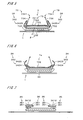
- Figs. 3 and 4 are cross-sectional views of the absorbent product 1 taken along lines III-III and IV-IV in Fig. 2 (i.e., cross-sectional views at the middle part and the front part), respectively.
- respective constituents of the absorbent product 1 are drawn to be slightly apart from one another for easy understanding of the drawings.
- a structure of the back part is similar to the structure of the front part shown in Fig. 4 .
- the absorber 20 has a sheet-like main body part 2 and a pair of side sheets 3 located on both side portions of the main body part 2 (i.e., both sides of the main body part 2 in the width direction), and the pair of side sheets 3 extends across almost the entire length of the main body part 2 in the longitudinal direction.
- the main body part 2 has a top sheet 21, a back sheet 23 and an absorbent core 22 which is located between the top sheet 21 and the back sheet 23.
- the contour of the absorbent core 22 is drawn by thick broken lines in Fig. 2 for easy understanding of the drawing. As shown in Fig. 2 , a width of the absorbent core 22 at each of both ends in the longitudinal direction is larger than that at middle in the longitudinal direction. In other words, the absorbent core 22 is formed in a form of hourglass.
- each side sheet 3 has a side sheet main body 31, and a first elastic member 35, a second elastic member 36 and a third elastic member 37 which are bonded to the side sheet main body 31 with hot melt adhesive or the like.
- the first elastic member 35 is bonded to a free edge (a free end) of the side sheet main body 31 along the free edge, and the second elastic member 36 and the third elastic member 37 are bonded to the side sheet main body 31 at positions away from the free edge.
- the first elastic member 35 is two first elastic elements 351 which are string-like and each of which extends in the longitudinal direction, and the second elastic member 36 is two second elastic elements 361 which are string-like and each of which extends in the longitudinal direction.
- the third elastic member 37 is one elastic element which is string-like and which extends in the longitudinal direction.
- the outer covering sheet 4 has a first covering sheet 41 and a second covering sheet 42, and as shown in Fig. 2 , it also has leg elastic members 43 and waist elastic members 44.
- the leg elastic members 43 shown in Fig. 4 are bonded between the first covering sheet 41 and the second covering sheet 42 with hot melt adhesive or the like in the state where each of them is stretched (i.e., the stretched leg elastic members 43 are bonded), and the leg elastic members 43 contract to form leg gathers.
- the waist elastic members 44 shown in Fig. 2 are bonded between the first covering sheet 41 and the second covering sheet 42 shown in Figs. 3 and 4 with hot melt adhesive or the like in the same way as the leg elastic members 43, and the waist elastic members 44 contract to form waist gathers.
- the back sheet 23 of the absorber 20 is bonded with hot melt adhesive or the like.
- the top sheet 21 is a nonwoven fabric made of liquid-pervious sheet material, for example, hydrophilic fibers, and the top sheet 21 immediately catches moisture of excrement from the wearer and moves the moisture into the absorbent core 22.
- nonwoven fabrics used for the top sheet 21 are a point-bond nonwoven fabric, air-through nonwoven fabric, spunlace nonwoven fabric and spunbond nonwoven fabric, and as hydrophilic fibers for making these nonwoven fabrics, normally, cellulose, rayon, cotton and the like are used.
- a liquid-pervious nonwoven fabric made of hydrophobic fibers for example, polypropylene, polyethylene, polyester, polyamide or nylon
- hydrophilic treatment is performed on its surface with a surfactant may be utilized.
- the absorbent core 22 is formed by wrapping a mixture of hydrophilic fibers such as crushed pulp fibers or cellulose fibers and granulated absorbent polymers (e.g., SAP (Super Absorbent Polymer)) in a tissue paper, a liquid-pervious nonwoven fabric or the like, and the absorbent core 22 rapidly absorbs and retains the moisture which has passed through the top sheet 21.
- the tissue paper, the liquid-pervious nonwoven fabric or the like to wrap the hydrophilic fibers is bonded to the hydrophilic fibers and the absorbent polymers with hot melt adhesive, to prevent deformation of the hydrophilic fibers and falling of the absorbent polymers (especially, falling after absorption of moisture).
- the absorbent core 22 includes pulp fibers and SAP.
- the back sheet 23 used is a water-repellent or liquid-impervious nonwoven fabric (for example, a spunbond nonwoven fabric, meltblown nonwoven fabric or SMS (spunbond-meltblown-spunbond) nonwoven fabric) made of hydrophobic fibers (e.g., polypropylene, polyethylene, polyester, polyamide or nylon), or a water-repellent or liquid-impervious plastic film.
- the back sheet 23 prevents moisture of excrement or the like which has come to the back sheet 23, from leaking out to the outer side of the main body part 2.
- a plastic film with permeability (breathability) is used, from the view point of preventing sweatiness in the absorbent product 1 and providing comfortable feeling to the wearer.
- a water-repellent or liquid-impervious nonwoven fabric for example, a spunbond nonwoven fabric, meltblown nonwoven fabric or SMS nonwoven fabric
- hydrophobic fibers e.g., polypropylene, polyethylene, polyester, polyamide or nylon
- a polyurethane yarn, strip-like polyurethane film, yarn-like or strip-like natural rubber, or the like is used as the first elastic element 351 of the first elastic member 35, the second elastic element 361 of the second elastic member 36, and the third elastic member 37.
- a polyurethane yarn is used as the first elastic element 351, the second elastic element 361 and the third elastic member 37.
- first covering sheet 41 and the second covering sheet 42 of the outer covering sheet 4 used is a water-repellent or liquid-impervious nonwoven fabric made of hydrophobic fibers, a water-repellent or liquid-impervious plastic film, or a laminated sheet of the nonwoven fabric and the plastic film in a similar fashion to the back sheet 23. It is preferable that the plastic film has permeability (breathability). Similar material to the first elastic member 35, the second elastic member 36 and the third elastic member 37 is used for the leg elastic members 43 and the waist elastic members 44. Similar material to the top sheet 21 is used for the end holding sheets 5 shown in Fig. 2 .
- each of the pair of side sheets 3 has a strip-like bonded part 33 and a side wall part 34.
- the bonded part 33 is one of two portions divided by a folding line 39 extending across almost the entire length thereof in the longitudinal direction, and the side wall part 34 is the other of the two portions.
- the pair of bonded parts 33 is located in the vicinity of both side edges of the main body part 2, it lies across almost the entire length thereof in the longitudinal direction, and it is bonded on the upper side (i.e., the wearer's side) of the main body part 2 with hot melt adhesive.
- Each side wall part 34 is continuous from the bonded part 33 at an outside edge (i.e., an edge located on the outside in the width direction) of the bonded part 33 which is the folding line 39, and on the side portion of the main body part 2, it extends across almost the entire length of the main body part 2 in the longitudinal direction.
- each side wall part 34 is in touch with the bonded part 33 at both end portions thereof in the longitudinal direction, and it is fixed on the bonded part 33 by heat bonding or ultrasonic bonding.
- a portion fixed on the bonded part 33 in the side wall part 34 is referred to as a "side wall end part 341".
- Each side wall end part 341 in the pair of side wall parts 34 is indirectly fixed to the main body part 2 by the intermediary of the bonded part 33.
- the side wall part 34 has a standing part 342 standing up from the main body part 2 at a middle portion thereof in the longitudinal direction and it is continuous from the two side wall end parts 341.
- hatching lines are drawn at each side wall end part 341 of the side wall parts 34 for easy understanding of the drawing.
- the side wall end part 341 has a first fixed part 3411 lying inward in the width direction from the folding line 39 to be fixed to the main body part 2, and a second fixed part 3412 lying between the first fixed part 3411 and the bonded part 33 (also between the first fixed part 3411 and the main body part 2) to be fixed to the main body part 2 and spreading outward in the width direction from an inside edge of the first fixed part 3411 (that is an edge located on the inside in the width direction (i.e., an edge closer to the other side wall part 34)).
- the first fixed part 3411 is continuous in the longitudinal direction from a portion which is in the vicinity of a fixed edge 3421 (see Fig. 3 ) of the standing part 342.
- the tip of second fixed part 3412 is continuous from the free edge 3422 (see Fig. 3 ) of the standing part 342 and the second fixed part 3412 spreads with the tip directed outward.
- the first fixed part 3411 and the second fixed part 3412 are not necessarily fixed to the main body part 2 by heat bonding or ultrasonic bonding, but the second fixed part 3412 may be bonded to the main body part 2 with hot melt adhesive, for example.
- hot melt adhesive is not necessarily applied between the first fixed part 3411 and the second fixed part 3412.
- the first fixed part 3411 is fixed to the main body part 2 together with the second fixed part 3412, since the first fixed part 3411 is continuous with the second fixed part 3412 at the inside edge.
- the side sheet main body 31 has a double-layered structure, and the first elastic member 35 is bonded along the free edge 3422 of the standing part 342 with it sandwiched between two layers of the side sheet main body 31.
- the second elastic member 36 is bonded at a position which is between the free edge 3422 and the fixed edge 3421 (that is a part of the folding line 39) of the standing part 342 and which is away from the free edge 3422, with it sandwiched between the two layers of the side sheet main body 31.
- the first elastic elements 351 of the first elastic member 35 and the second elastic elements 361 of the second elastic member 36 are bonded in almost parallel with the longitudinal direction and they lie across almost the entire length of the standing part 342 in the longitudinal direction.
- the first elastic member 35 and the second elastic member 36 contract to form gathers in the standing part 342.
- each side wall part 34 since each of two side wall end part 341 (see Fig. 4 ) has the structure described above and the first elastic member 35 is provided to the standing part 342, the standing part 342 is standing inward and upward from the fixed edge 3421 (with increasing distance from the fixed edge 3421) and in the standing part 342, a portion in the vicinity of the first elastic member 35 is lifted up in surface shape (i.e., in planar shape or in curved surface shape). Furthermore, since the second elastic member 36 is provided to each side wall part 34, an inwardly bending part 3423 (which bends inward in the standing part 342) is formed between the first elastic member 35 and the second elastic member 36.
- the inwardly bending part 3423 is curved so as to be convex upward, and a portion between the top of the inwardly bending part 3423 and the free edge 3422 is inclined downward and inward so as to come closer to the main body part 2 toward the free edge 3422.
- a portion of the standing part 342 being in the vicinity of the free edge 3422 is inclined downward and inward.
- first standing portion 3424 the portion between the fixed edge 3421 of the standing part 342 and the top of the inwardly bending part 3423 is referred to as a "first standing portion 3424" and the portion between the top of the inwardly bending part 3423 and the free edge 3422 is referred to as a "second standing portion 3425".
- the first standing portion 3424 is continuous with the first fixed part 3411 of the side wall end part 341 and the second standing portion 3425 is continuous with the second fixed part 3412 of the side wall end part 341.
- the two second elastic elements 361 of the second elastic member 36 are arranged in a direction orthogonal to the longitudinal direction (in the present embodiment, the direction is inclined relatively to the up-down direction and the width direction).
- the two first elastic elements 351 of the first elastic member 35 are arranged in a direction orthogonal to the longitudinal direction (in the present embodiment, the direction is inclined relatively to the up-down direction and the width direction).
- the two second elastic elements 361 of the second elastic member 36 are held between the two layers of the side sheet main body 31 without being bonded thereto and in the second fixed part 3412, the two first elastic elements 351 of the first elastic member 35 are held between the two layers of the side sheet main body 31 without being bonded thereto.
- the third elastic member 37 is bonded along the fixed edge 3421 of the standing part 342, it lies across almost the entire length of the standing part 342, and by contraction of the third elastic member 37, a sheet part located on the outside of the absorbent core 22 in the main body part 2 (i.e., the sheet part is a portion of the top sheet 21 and the back sheet 23 where they are bonded to each other at the outside of a side edge of the absorbent core 22.) is standing upward together with the standing part 342.
- a distance in the up-down direction between the standing part 342 and the main body part 2 can be made larger (i.e., a distance in the up-down direction between the top of the inwardly bending part 3423 in the standing part 342 and the top sheet 21 on the absorbent core 22 in the main body part 2 can be made larger.).
- each side wall part 34 comprises the standing part 342, the two side wall end part 341 and the first elastic member 35, and each of the two side wall end part 341 in the side wall part 34 comprises the first fixed part 3411 and the second fixed part 3412. Therefore, the standing part 342 is standing inward and upward from the fixed edge 3421 and in the standing part 342, the portion in the vicinity of the first elastic member 35 is lifted up in surface shape.
- the portion of surface shape in the vicinity of the first elastic member 35 in the standing part 342 comes into contact with (skin of) the wearer, it is possible to prevent the wearer from being compressed excessively (tightly) by the first elastic member 35 and to prevent excrement from the wearer, from leaking out to the outer side of the absorbent product 1 through a gap between the standing part 342 and the wearer.
- the first fixed part 3411 and the second fixed part 3412 are provided at the side wall end part 341, the portion of the standing part 342 being in the vicinity of the first elastic member 35 can be formed in surface shape.
- the inwardly bending part 3423 is formed at a position between the first elastic member 35 and the second elastic member 36.
- the inwardly bending part 3423 where no elastic member is provided comes into contact with the wearer to be deformed into surface shape, and a portion in the vicinity of the inwardly bending part 3423 and the first elastic member 35 (i.e., a portion on the inside of the second elastic member 36) contacts with the wearer in surface shape more certainly. It is therefore possible to more certainly prevent the wearer from being compressed excessively by the first elastic member 35 and the second elastic member 36 and to more certainly prevent excrement from leaking out to the outer side of the absorbent product 1.
- the first elastic member 35 is located at a position closer to the main body part 2 than the top of the inwardly bending part 3423 (i.e., the position is away from the wearer). This can more certainly prevent the wearer from being pressed strongly by the first elastic member 35.
- the portion of the standing part 342 being in the vicinity of the free edge 3422 may be in almost parallel with the upper surface of the main body part 2, as long as the wearer is prevented from being compressed excessively by the first elastic member 35.
- the second elastic member 36 is the two second elastic elements 361 which are arranged in a direction orthogonal to the longitudinal direction
- the first standing portion 3424 on which the second elastic member 36 is located becomes surface shape and has high stiffness, and therefore the inwardly bending part 3423 is clearly formed.
- the first elastic member 35 is the two first elastic elements 351 which are arranged in a direction orthogonal to the longitudinal direction
- the portion of the standing part 342 being in the vicinity of the free edge 3422 can more easily be formed in surface shape.
- the third elastic member 37 is bonded along the fixed edge 3421 of the standing part 342 (i.e., along the folding line 39), and therefore the side sheet main body 31 can be folded easily at the folding line 39 to make the standing part 342 be standing.
- Fig. 5 is a cross-sectional view of the absorbent product 1 and an auxiliary absorbent pad 7 where the auxiliary absorbent pad 7 for receiving excrement from a wearer at the inner side of an exterior product to be worn by the wearer is provided (attached) at the inner side (i.e., the wearer's side) of the absorbent product 1 shown in Figs 1 to 4 .
- Fig. 5 corresponds to above Fig. 3 . As shown in Fig.
- the auxiliary absorbent pad 7 has a sheet-like auxiliary absorbent main body part 72 and a pair of auxiliary absorbent side sheets 73 which is located on both side portions of the auxiliary absorbent main body part 72 (i.e., both sides in the width direction) and which extends across almost the entire length of the auxiliary absorbent main body part 72 in the longitudinal direction.
- the auxiliary absorbent main body part 72 has a top sheet 721, a back sheet 723 and an absorbent core 722 which is located between the top sheet 721 and the back sheet 723.
- Each auxiliary absorbent side sheet 73 has an auxiliary absorbent bonded part 733 bonded on the auxiliary absorbent main body part 72 and an auxiliary absorbent side wall part 734 which extends in the longitudinal direction and which is standing up from the auxiliary absorbent main body part 72 at least at a middle portion thereof in the longitudinal direction.
- the auxiliary absorbent pad 7 is located on the main body part 2 at a position between the pair of side wall parts 34, and each side portion of the auxiliary absorbent pad 7 (i.e., a portion of the top sheet 721, the back sheet 723 and the auxiliary absorbent bonded part 733 where they are bonded to one another at the outside of a side edge of the absorbent core 722) is located between the standing part 342 of each side wall part 34 and the main body part 2.
- the side portion of the auxiliary absorbent pad 7 is caught between the second standing portion 3425 which comes closer to the main body part 2 toward the inside and the top sheet 21 on the absorbent core 22 of the main body part 2, and therefore the auxiliary absorbent pad 7 is biased toward the main body part 2 to be fixed to the absorbent product 1 securely.
- auxiliary absorbent side wall part 734 projects upward at the middle portion thereof in the longitudinal direction and its top is positioned upper than the standing part 342 of the side wall part 34 in the absorbent product 1.
- the auxiliary absorbent side wall part 734 is tight on (skin of) the wearer. As the result, it is possible to more certainly prevent excrement from leaking out to the outer side of the auxiliary absorbent pad 7 and the absorbent product 1.
- the first elastic member 35 may be one first elastic element 351 or first elastic elements 351 more than two.
- the portion of the standing part 342 being in the vicinity of the free edge 3422 can more easily be formed in surface shape as described above.
- the second elastic member 36 may be one second elastic element 361 or second elastic elements 361 more than two in a similar fashion to the first elastic member 35.
- the inwardly bending part 3423 is clearly formed and it is possible to easily keep the portion of the standing part 342 in surface shape where the portion is in the vicinity of the inwardly bending part 3423 and the first elastic member 35 and the portion contacts with the wearer, as described above.
- the second elastic member 36 and the first elastic member 35 are not necessarily located at the first fixed part 3411 and the second fixed part 3412, respectively.
- two first elastic elements 351 of the first elastic member 35 and two second elastic elements 361 of the second elastic member 36 may be located at the second fixed part 3412.
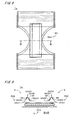
- Fig. 8 is a view showing another example of absorbent product, it is a plan view of an absorbent product 1a which is a pants-type disposable diaper in a state where the absorbent product 1a is developed and in Fig. 8 , the absorbent product 1a is viewed from the wearer's side in a similar fashion to Fig. 2 .
- Fig. 9 is a cross-sectional view of the absorbent product 1a taken along lines IX-IX in Fig. 8 .
- the absorber 20 of the absorbent product 1a has an absorbent core 22a as substitute for the absorbent core 22 formed in a form of hourglass as shown in Fig.
- the absorbent core 22a is almost rectangular in the plan view (i.e., the absorbent core 22a has a shape where a width in the width direction is almost equal throughout almost the entire length thereof in the longitudinal direction).
- Constituent elements other than that are identical to those of the absorbent product 1 shown in Figs. 1 to 4 and the same elements are denoted by the same reference signs in the following description.
- the fixed edge 3421 of standing part 342 in each side sheet 3 almost overlaps with the side edge of absorbent core 22a in the main body part 2.
- the first standing portion 3424 is standing inward and upward from the fixed edge 3421
- the second standing portion 3425 is inclined inward and downward so as to come closer to the main body part 2 toward the free edge 3422
- the inwardly bending part 3423 is formed between the first elastic member 35 and the second elastic member 36, in a similar fashion to the above absorbent product 1.
- the wearer since the standing part 342 contacts with the wearer in surface shape in a similar fashion to the absorbent product 1, the wearer is prevented from being compressed excessively by the first elastic member 35 and the second elastic member 36, and excrement from the wearer is prevented from leaking out to the outer side of the absorbent product 1a through a gap between the standing part 342 and the wearer.
- auxiliary absorbent pad 7 is provided at the inner side of the absorbent product 1a, since both side portions of the auxiliary absorbent pad 7 are located between the second standing portions 3425 in the pair of standing parts 342 and the main body part 2 in the same way as the absorbent product 1, the auxiliary absorbent pad 7 is biased toward the main body part 2 to be fixed to the absorbent product 1a stably.
- a width of the absorbent core 22 in the absorber 20 at one end in the longitudinal direction is larger than that at middle in the longitudinal direction and that at the other end in the longitudinal direction (i.e., a shape of the absorbent core 22 is like Japanese hagoita).
- Structures of the above absorbent products may be utilized for various absorbent product such as an open-type disposable diaper where a portion located on the front side of a wearer and a portion located on the back side are fastened around the waistline of the wearer in wearing the disposal diaper, other than the pants-type disposable diaper.
Landscapes
- Health & Medical Sciences (AREA)
- Epidemiology (AREA)
- Engineering & Computer Science (AREA)
- Biomedical Technology (AREA)
- Heart & Thoracic Surgery (AREA)
- Vascular Medicine (AREA)
- Life Sciences & Earth Sciences (AREA)
- Animal Behavior & Ethology (AREA)
- General Health & Medical Sciences (AREA)
- Public Health (AREA)
- Veterinary Medicine (AREA)
- Absorbent Articles And Supports Therefor (AREA)
- Orthopedics, Nursing, And Contraception (AREA)
Applications Claiming Priority (1)
| Application Number | Priority Date | Filing Date | Title |
|---|---|---|---|
| JP2009216144A JP5670036B2 (ja) | 2009-09-17 | 2009-09-17 | 吸収性物品 |
Publications (2)
| Publication Number | Publication Date |
|---|---|
| EP2298261A2 true EP2298261A2 (fr) | 2011-03-23 |
| EP2298261A3 EP2298261A3 (fr) | 2011-07-13 |
Family
ID=43013616
Family Applications (1)
| Application Number | Title | Priority Date | Filing Date |
|---|---|---|---|
| EP10009003A Withdrawn EP2298261A3 (fr) | 2009-09-17 | 2010-08-30 | Produit absorbant |
Country Status (6)
| Country | Link |
|---|---|
| US (1) | US8758319B2 (fr) |
| EP (1) | EP2298261A3 (fr) |
| JP (1) | JP5670036B2 (fr) |
| CN (1) | CN102018598B (fr) |
| CA (1) | CA2713635C (fr) |
| MX (1) | MX2010010103A (fr) |
Cited By (1)
| Publication number | Priority date | Publication date | Assignee | Title |
|---|---|---|---|---|
| WO2012169129A1 (fr) * | 2011-06-06 | 2012-12-13 | Livedo Corporation | Article absorbant |
Families Citing this family (19)
| Publication number | Priority date | Publication date | Assignee | Title |
|---|---|---|---|---|
| CN106943239B (zh) | 2011-04-29 | 2020-04-10 | 宝洁公司 | 具有腿衬垫箍的吸收制品 |
| BR112013032991A2 (pt) | 2011-06-21 | 2017-01-31 | Procter & Gamble | artigo absorvente com um cós e punho para pernas que tem franzidos |
| US9358161B2 (en) | 2011-06-21 | 2016-06-07 | The Procter & Gamble Company | Absorbent article with waistband having contraction |
| JP2015515921A (ja) | 2012-05-15 | 2015-06-04 | ザ プロクター アンド ギャンブルカンパニー | 有利な伸長及び製造性特性を有する使い捨て吸収性パンツ並びに、その製造方法 |
| US9394637B2 (en) | 2012-12-13 | 2016-07-19 | Jacob Holm & Sons Ag | Method for production of a hydroentangled airlaid web and products obtained therefrom |
| JP5755630B2 (ja) * | 2012-12-13 | 2015-07-29 | ユニ・チャーム株式会社 | ペット用使い捨ておむつ |
| CA2907948C (fr) | 2013-03-22 | 2018-01-02 | The Procter & Gamble Company | Articles absorbants jetables |
| BR112017019866A2 (pt) | 2015-03-18 | 2018-05-29 | Procter & Gamble | artigo absorvente com punhos para as pernas |
| US10524962B2 (en) | 2015-03-18 | 2020-01-07 | The Procter & Gamble Company | Absorbent article with waist gasketing element and leg cuffs |
| CN107427397A (zh) | 2015-03-18 | 2017-12-01 | 宝洁公司 | 带有腿箍的吸收制品 |
| US10537481B2 (en) | 2015-03-18 | 2020-01-21 | The Procter & Gamble Company | Absorbent article with waist gasketing element and leg cuffs |
| WO2016149589A1 (fr) | 2015-03-18 | 2016-09-22 | The Procter & Gamble Company | Article absorbant à manchons de jambe |
| US10543130B2 (en) | 2015-03-18 | 2020-01-28 | The Procter & Gamble Company | Absorbent article with leg cuffs |
| JP6518782B2 (ja) | 2015-03-18 | 2019-05-22 | ザ プロクター アンド ギャンブル カンパニーThe Procter & Gamble Company | 腰部ガスケット要素及びレッグカフを備える吸収性物品 |
| US10716716B2 (en) | 2015-03-18 | 2020-07-21 | The Procter & Gamble Company | Absorbent article with leg cuffs |
| US10485710B2 (en) | 2015-03-18 | 2019-11-26 | The Procter & Gamble Company | Absorbent article with leg cuffs |
| US10524963B2 (en) | 2015-03-18 | 2020-01-07 | The Procter & Gamble Company | Absorbent article with waist gasketing element and leg cuffs |
| JP7252084B2 (ja) * | 2019-07-17 | 2023-04-04 | 株式会社リブドゥコーポレーション | 吸収性物品 |
| WO2022203988A1 (fr) * | 2021-03-23 | 2022-09-29 | The Procter & Gamble Company | Articles absorbants en plusieurs parties avec revers de jambe |
Citations (3)
| Publication number | Priority date | Publication date | Assignee | Title |
|---|---|---|---|---|
| JPH09271489A (ja) | 1996-04-05 | 1997-10-21 | Oji Paper Co Ltd | 使いすておむつ |
| JP2006223881A (ja) | 2006-03-27 | 2006-08-31 | Daio Paper Corp | 使い捨て吸収性物品 |
| JP2008154606A (ja) | 2006-12-20 | 2008-07-10 | Kao Corp | 吸収性物品 |
Family Cites Families (14)
| Publication number | Priority date | Publication date | Assignee | Title |
|---|---|---|---|---|
| WO1997021409A1 (fr) * | 1995-12-11 | 1997-06-19 | Kimberly-Clark Worldwide, Inc. | Article absorbant avec rabats limitant un volume vide |
| JP2001095839A (ja) * | 1999-09-30 | 2001-04-10 | Toyo Eizai Corp | 吸収性物品 |
| US6840929B2 (en) * | 2001-11-14 | 2005-01-11 | Zuiko Corporation | Disposable worn absorbent article including stand-up cuffs |
| JP2003210521A (ja) * | 2001-11-14 | 2003-07-29 | Zuiko Corp | 使い捨て着用物品 |
| CN1293851C (zh) * | 2002-06-05 | 2007-01-10 | 利卫多株式会社 | 吸收性物品 |
| US20040002690A1 (en) * | 2002-07-01 | 2004-01-01 | The Procter & Gamble Company | Disposable absorbent article having elasticized outer leg cuff |
| CN2601646Y (zh) * | 2002-10-29 | 2004-02-04 | 福建恒安集团有限公司 | 持续动态贴合的一次性卫生用品 |
| JP4421224B2 (ja) * | 2003-06-20 | 2010-02-24 | ユニ・チャーム株式会社 | 生理用ナプキン |
| ATE549002T1 (de) * | 2003-06-20 | 2012-03-15 | Livedo Corp | Saugfähiger einwegartikel |
| US7172667B2 (en) * | 2003-09-30 | 2007-02-06 | Tyco Healthcare Retail Services Ag | System and method for incorporating graphics into absorbent articles |
| US20070073259A1 (en) * | 2005-09-29 | 2007-03-29 | Erdman Edward P | Absorbent article with dual gather leg cuff assemblies |
| US7918839B2 (en) | 2005-10-14 | 2011-04-05 | The Procter & Gamble Company | Absorbent article including barrier leg cuff structure and an elastically stretchable side panel |
| JP2008289602A (ja) * | 2007-05-23 | 2008-12-04 | Opelontex Co Ltd | 使い捨ておむつおよび使い捨て尿パッド |
| CN102427786A (zh) * | 2009-05-15 | 2012-04-25 | 宝洁公司 | 一次性吸收制品 |
-
2009
- 2009-09-17 JP JP2009216144A patent/JP5670036B2/ja active Active
-
2010
- 2010-08-25 CA CA 2713635 patent/CA2713635C/fr not_active Expired - Fee Related
- 2010-08-30 EP EP10009003A patent/EP2298261A3/fr not_active Withdrawn
- 2010-09-01 US US12/873,448 patent/US8758319B2/en active Active
- 2010-09-03 CN CN 201010275358 patent/CN102018598B/zh not_active Expired - Fee Related
- 2010-09-14 MX MX2010010103A patent/MX2010010103A/es active IP Right Grant
Patent Citations (3)
| Publication number | Priority date | Publication date | Assignee | Title |
|---|---|---|---|---|
| JPH09271489A (ja) | 1996-04-05 | 1997-10-21 | Oji Paper Co Ltd | 使いすておむつ |
| JP2006223881A (ja) | 2006-03-27 | 2006-08-31 | Daio Paper Corp | 使い捨て吸収性物品 |
| JP2008154606A (ja) | 2006-12-20 | 2008-07-10 | Kao Corp | 吸収性物品 |
Cited By (2)
| Publication number | Priority date | Publication date | Assignee | Title |
|---|---|---|---|---|
| WO2012169129A1 (fr) * | 2011-06-06 | 2012-12-13 | Livedo Corporation | Article absorbant |
| US9452092B2 (en) | 2011-06-06 | 2016-09-27 | Livedo Corporation | Absorbent article |
Also Published As
| Publication number | Publication date |
|---|---|
| CA2713635C (fr) | 2013-06-25 |
| EP2298261A3 (fr) | 2011-07-13 |
| CN102018598A (zh) | 2011-04-20 |
| JP2011062363A (ja) | 2011-03-31 |
| CA2713635A1 (fr) | 2011-03-17 |
| JP5670036B2 (ja) | 2015-02-18 |
| US20110066128A1 (en) | 2011-03-17 |
| US8758319B2 (en) | 2014-06-24 |
| MX2010010103A (es) | 2011-03-17 |
| CN102018598B (zh) | 2013-06-19 |
Similar Documents
| Publication | Publication Date | Title |
|---|---|---|
| CA2713635C (fr) | Produit absorbant | |
| KR102008543B1 (ko) | 일회용 착용 물품 | |
| KR101574683B1 (ko) | 흡수성 물품 | |
| EP2637618B1 (fr) | Article absorbant et procede de fabrication correspondant | |
| EP2593060B1 (fr) | Couche-culotte jetable | |
| US20130144243A1 (en) | Absorbent Product | |
| EP2588053B1 (fr) | Couche-culotte jetable | |
| JP5570876B2 (ja) | 使い捨ておむつ | |
| JP5524722B2 (ja) | 使い捨ておむつ | |
| HK1178777B (en) | Disposable diaper | |
| HK1178773B (en) | Disposable diaper |
Legal Events
| Date | Code | Title | Description |
|---|---|---|---|
| PUAI | Public reference made under article 153(3) epc to a published international application that has entered the european phase |
Free format text: ORIGINAL CODE: 0009012 |
|
| AK | Designated contracting states |
Kind code of ref document: A2 Designated state(s): AL AT BE BG CH CY CZ DE DK EE ES FI FR GB GR HR HU IE IS IT LI LT LU LV MC MK MT NL NO PL PT RO SE SI SK SM TR |
|
| AX | Request for extension of the european patent |
Extension state: BA ME RS |
|
| REG | Reference to a national code |
Ref country code: DE Ref legal event code: R079 Free format text: PREVIOUS MAIN CLASS: A61F0013494000 Ipc: A61F0013150000 |
|
| PUAL | Search report despatched |
Free format text: ORIGINAL CODE: 0009013 |
|
| AK | Designated contracting states |
Kind code of ref document: A3 Designated state(s): AL AT BE BG CH CY CZ DE DK EE ES FI FR GB GR HR HU IE IS IT LI LT LU LV MC MK MT NL NO PL PT RO SE SI SK SM TR |
|
| AX | Request for extension of the european patent |
Extension state: BA ME RS |
|
| RIC1 | Information provided on ipc code assigned before grant |
Ipc: A61F 13/494 20060101ALN20110606BHEP Ipc: A61F 13/15 20060101AFI20110606BHEP |
|
| 17P | Request for examination filed |
Effective date: 20120112 |
|
| 17Q | First examination report despatched |
Effective date: 20130917 |
|
| GRAP | Despatch of communication of intention to grant a patent |
Free format text: ORIGINAL CODE: EPIDOSNIGR1 |
|
| RIC1 | Information provided on ipc code assigned before grant |
Ipc: A61F 13/494 20060101ALN20160323BHEP Ipc: A61F 13/15 20060101AFI20160323BHEP |
|
| INTG | Intention to grant announced |
Effective date: 20160411 |
|
| STAA | Information on the status of an ep patent application or granted ep patent |
Free format text: STATUS: THE APPLICATION IS DEEMED TO BE WITHDRAWN |
|
| 18D | Application deemed to be withdrawn |
Effective date: 20160823 |