EP2298833A1 - Eisen(III)-Komplexbildner zur Stabilisierung von Kammpolymeren in mineralischen Bindemitteln - Google Patents
Eisen(III)-Komplexbildner zur Stabilisierung von Kammpolymeren in mineralischen Bindemitteln Download PDFInfo
- Publication number
- EP2298833A1 EP2298833A1 EP09170917A EP09170917A EP2298833A1 EP 2298833 A1 EP2298833 A1 EP 2298833A1 EP 09170917 A EP09170917 A EP 09170917A EP 09170917 A EP09170917 A EP 09170917A EP 2298833 A1 EP2298833 A1 EP 2298833A1
- Authority
- EP
- European Patent Office
- Prior art keywords
- iii
- complexing agent
- composition according
- iron
- comb
- Prior art date
- Legal status (The legal status is an assumption and is not a legal conclusion. Google has not performed a legal analysis and makes no representation as to the accuracy of the status listed.)
- Withdrawn
Links
- VTLYFUHAOXGGBS-UHFFFAOYSA-N Fe3+ Chemical compound [Fe+3] VTLYFUHAOXGGBS-UHFFFAOYSA-N 0.000 title claims abstract description 89
- 229920000642 polymer Polymers 0.000 title claims abstract description 77
- 230000006641 stabilisation Effects 0.000 title claims abstract description 7
- 239000008139 complexing agent Substances 0.000 title claims description 46
- 239000011230 binding agent Substances 0.000 title claims description 44
- 229910052500 inorganic mineral Inorganic materials 0.000 title claims description 32
- 239000011707 mineral Substances 0.000 title claims description 32
- 239000000203 mixture Substances 0.000 claims abstract description 42
- XEEYBQQBJWHFJM-UHFFFAOYSA-N Iron Chemical compound [Fe] XEEYBQQBJWHFJM-UHFFFAOYSA-N 0.000 claims abstract description 31
- -1 thiazol-2-ylamine compound Chemical class 0.000 claims abstract description 31
- DHMQDGOQFOQNFH-UHFFFAOYSA-N Glycine Chemical compound NCC(O)=O DHMQDGOQFOQNFH-UHFFFAOYSA-N 0.000 claims abstract description 13
- 239000002253 acid Substances 0.000 claims abstract description 12
- 150000001412 amines Chemical class 0.000 claims abstract description 8
- 235000013905 glycine and its sodium salt Nutrition 0.000 claims abstract description 7
- 229910019142 PO4 Inorganic materials 0.000 claims abstract description 6
- 125000003118 aryl group Chemical group 0.000 claims abstract description 6
- 238000011105 stabilization Methods 0.000 claims abstract description 6
- 229920006395 saturated elastomer Polymers 0.000 claims abstract description 3
- 239000004568 cement Substances 0.000 claims description 35
- 239000003963 antioxidant agent Substances 0.000 claims description 27
- 230000003078 antioxidant effect Effects 0.000 claims description 24
- 235000006708 antioxidants Nutrition 0.000 claims description 22
- 238000000034 method Methods 0.000 claims description 22
- 238000000227 grinding Methods 0.000 claims description 12
- 125000004432 carbon atom Chemical group C* 0.000 claims description 11
- 150000001875 compounds Chemical class 0.000 claims description 11
- 238000003860 storage Methods 0.000 claims description 11
- 230000008569 process Effects 0.000 claims description 10
- 150000002989 phenols Chemical class 0.000 claims description 9
- 230000009467 reduction Effects 0.000 claims description 9
- 150000005208 1,4-dihydroxybenzenes Chemical class 0.000 claims description 7
- 230000000694 effects Effects 0.000 claims description 7
- 150000007513 acids Chemical class 0.000 claims description 6
- 230000000087 stabilizing effect Effects 0.000 claims description 6
- 239000011398 Portland cement Substances 0.000 claims description 5
- 150000004982 aromatic amines Chemical class 0.000 claims description 5
- 239000000945 filler Substances 0.000 claims description 4
- 235000021317 phosphate Nutrition 0.000 claims description 4
- 150000003567 thiocyanates Chemical class 0.000 claims description 4
- 235000019738 Limestone Nutrition 0.000 claims description 3
- 150000005840 aryl radicals Chemical class 0.000 claims description 3
- 238000010668 complexation reaction Methods 0.000 claims description 3
- 239000007859 condensation product Substances 0.000 claims description 3
- 239000006028 limestone Substances 0.000 claims description 3
- 150000002898 organic sulfur compounds Chemical class 0.000 claims description 3
- 150000002903 organophosphorus compounds Chemical class 0.000 claims description 3
- 150000003013 phosphoric acid derivatives Chemical class 0.000 claims description 3
- MWOOGOJBHIARFG-UHFFFAOYSA-N vanillin Chemical compound COC1=CC(C=O)=CC=C1O MWOOGOJBHIARFG-UHFFFAOYSA-N 0.000 claims description 3
- FGQOOHJZONJGDT-UHFFFAOYSA-N vanillin Natural products COC1=CC(O)=CC(C=O)=C1 FGQOOHJZONJGDT-UHFFFAOYSA-N 0.000 claims description 3
- 235000012141 vanillin Nutrition 0.000 claims description 3
- 230000000536 complexating effect Effects 0.000 claims description 2
- 125000005266 diarylamine group Chemical group 0.000 claims description 2
- 239000010881 fly ash Substances 0.000 claims description 2
- 235000004515 gallic acid Nutrition 0.000 claims description 2
- 125000005843 halogen group Chemical group 0.000 claims description 2
- ORTFAQDWJHRMNX-UHFFFAOYSA-M oxidooxomethyl Chemical compound [O-][C]=O ORTFAQDWJHRMNX-UHFFFAOYSA-M 0.000 claims description 2
- AQSJGOWTSHOLKH-UHFFFAOYSA-N phosphite(3-) Chemical class [O-]P([O-])[O-] AQSJGOWTSHOLKH-UHFFFAOYSA-N 0.000 claims description 2
- XRBCRPZXSCBRTK-UHFFFAOYSA-N phosphonous acid Chemical class OPO XRBCRPZXSCBRTK-UHFFFAOYSA-N 0.000 claims description 2
- 229910021487 silica fume Inorganic materials 0.000 claims description 2
- 239000002893 slag Substances 0.000 claims description 2
- 229930003799 tocopherol Natural products 0.000 claims description 2
- 239000011732 tocopherol Substances 0.000 claims description 2
- 235000019149 tocopherols Nutrition 0.000 claims description 2
- QUEDXNHFTDJVIY-UHFFFAOYSA-N γ-tocopherol Chemical class OC1=C(C)C(C)=C2OC(CCCC(C)CCCC(C)CCCC(C)C)(C)CCC2=C1 QUEDXNHFTDJVIY-UHFFFAOYSA-N 0.000 claims description 2
- ZMZDMBWJUHKJPS-UHFFFAOYSA-M Thiocyanate anion Chemical compound [S-]C#N ZMZDMBWJUHKJPS-UHFFFAOYSA-M 0.000 abstract 2
- 229960002449 glycine Drugs 0.000 abstract 2
- ZMZDMBWJUHKJPS-UHFFFAOYSA-N hydrogen thiocyanate Natural products SC#N ZMZDMBWJUHKJPS-UHFFFAOYSA-N 0.000 abstract 2
- 229910052742 iron Inorganic materials 0.000 abstract 2
- NBIIXXVUZAFLBC-UHFFFAOYSA-K phosphate Chemical compound [O-]P([O-])([O-])=O NBIIXXVUZAFLBC-UHFFFAOYSA-K 0.000 abstract 2
- 239000010452 phosphate Substances 0.000 abstract 2
- 125000001475 halogen functional group Chemical group 0.000 abstract 1
- 235000010755 mineral Nutrition 0.000 description 25
- 239000000243 solution Substances 0.000 description 14
- CWYNVVGOOAEACU-UHFFFAOYSA-N iron (II) ion Substances [Fe+2] CWYNVVGOOAEACU-UHFFFAOYSA-N 0.000 description 13
- XLYOFNOQVPJJNP-UHFFFAOYSA-N water Substances O XLYOFNOQVPJJNP-UHFFFAOYSA-N 0.000 description 12
- RAIPHJJURHTUIC-UHFFFAOYSA-N 1,3-thiazol-2-amine Chemical compound NC1=NC=CS1 RAIPHJJURHTUIC-UHFFFAOYSA-N 0.000 description 11
- SURQXAFEQWPFPV-UHFFFAOYSA-L iron(2+) sulfate heptahydrate Chemical compound O.O.O.O.O.O.O.[Fe+2].[O-]S([O-])(=O)=O SURQXAFEQWPFPV-UHFFFAOYSA-L 0.000 description 11
- IISBACLAFKSPIT-UHFFFAOYSA-N bisphenol A Chemical compound C=1C=C(O)C=CC=1C(C)(C)C1=CC=C(O)C=C1 IISBACLAFKSPIT-UHFFFAOYSA-N 0.000 description 10
- 239000000654 additive Substances 0.000 description 9
- 238000001514 detection method Methods 0.000 description 9
- ISWSIDIOOBJBQZ-UHFFFAOYSA-N Phenol Natural products OC1=CC=CC=C1 ISWSIDIOOBJBQZ-UHFFFAOYSA-N 0.000 description 8
- JOPOVCBBYLSVDA-UHFFFAOYSA-N chromium(6+) Chemical compound [Cr+6] JOPOVCBBYLSVDA-UHFFFAOYSA-N 0.000 description 8
- NLZUEZXRPGMBCV-UHFFFAOYSA-N Butylhydroxytoluene Chemical compound CC1=CC(C(C)(C)C)=C(O)C(C(C)(C)C)=C1 NLZUEZXRPGMBCV-UHFFFAOYSA-N 0.000 description 7
- 239000011651 chromium Substances 0.000 description 7
- 239000004570 mortar (masonry) Substances 0.000 description 7
- VGTPCRGMBIAPIM-UHFFFAOYSA-M sodium thiocyanate Chemical compound [Na+].[S-]C#N VGTPCRGMBIAPIM-UHFFFAOYSA-M 0.000 description 7
- 125000001424 substituent group Chemical group 0.000 description 7
- LYCAIKOWRPUZTN-UHFFFAOYSA-N Ethylene glycol Chemical compound OCCO LYCAIKOWRPUZTN-UHFFFAOYSA-N 0.000 description 6
- ABNDFSOIUFLJAH-UHFFFAOYSA-N benzyl thiocyanate Chemical compound N#CSCC1=CC=CC=C1 ABNDFSOIUFLJAH-UHFFFAOYSA-N 0.000 description 6
- 238000004519 manufacturing process Methods 0.000 description 6
- 229910052757 nitrogen Inorganic materials 0.000 description 6
- KCXVZYZYPLLWCC-UHFFFAOYSA-N EDTA Chemical compound OC(=O)CN(CC(O)=O)CCN(CC(O)=O)CC(O)=O KCXVZYZYPLLWCC-UHFFFAOYSA-N 0.000 description 5
- 125000001033 ether group Chemical group 0.000 description 5
- 150000002500 ions Chemical class 0.000 description 5
- BAUYGSIQEAFULO-UHFFFAOYSA-L iron(2+) sulfate (anhydrous) Chemical compound [Fe+2].[O-]S([O-])(=O)=O BAUYGSIQEAFULO-UHFFFAOYSA-L 0.000 description 5
- 238000003801 milling Methods 0.000 description 5
- 239000007787 solid Substances 0.000 description 5
- 238000003756 stirring Methods 0.000 description 5
- GSEJCLTVZPLZKY-UHFFFAOYSA-N Triethanolamine Chemical compound OCCN(CCO)CCO GSEJCLTVZPLZKY-UHFFFAOYSA-N 0.000 description 4
- PXKLMJQFEQBVLD-UHFFFAOYSA-N bisphenol F Chemical compound C1=CC(O)=CC=C1CC1=CC=C(O)C=C1 PXKLMJQFEQBVLD-UHFFFAOYSA-N 0.000 description 4
- CZBZUDVBLSSABA-UHFFFAOYSA-N butylated hydroxyanisole Chemical compound COC1=CC=C(O)C(C(C)(C)C)=C1.COC1=CC=C(O)C=C1C(C)(C)C CZBZUDVBLSSABA-UHFFFAOYSA-N 0.000 description 4
- 230000008859 change Effects 0.000 description 4
- 238000006243 chemical reaction Methods 0.000 description 4
- ZCDOYSPFYFSLEW-UHFFFAOYSA-N chromate(2-) Chemical compound [O-][Cr]([O-])(=O)=O ZCDOYSPFYFSLEW-UHFFFAOYSA-N 0.000 description 4
- 239000002270 dispersing agent Substances 0.000 description 4
- 238000002474 experimental method Methods 0.000 description 4
- 229910000359 iron(II) sulfate Inorganic materials 0.000 description 4
- 239000011734 sodium Substances 0.000 description 4
- 239000002904 solvent Substances 0.000 description 4
- HVLLSGMXQDNUAL-UHFFFAOYSA-N triphenyl phosphite Chemical compound C=1C=CC=CC=1OP(OC=1C=CC=CC=1)OC1=CC=CC=C1 HVLLSGMXQDNUAL-UHFFFAOYSA-N 0.000 description 4
- QIGBRXMKCJKVMJ-UHFFFAOYSA-N 1,4-Benzenediol Natural products OC1=CC=C(O)C=C1 QIGBRXMKCJKVMJ-UHFFFAOYSA-N 0.000 description 3
- KGRVJHAUYBGFFP-UHFFFAOYSA-N 2,2'-Methylenebis(4-methyl-6-tert-butylphenol) Chemical compound CC(C)(C)C1=CC(C)=CC(CC=2C(=C(C=C(C)C=2)C(C)(C)C)O)=C1O KGRVJHAUYBGFFP-UHFFFAOYSA-N 0.000 description 3
- GAODDBNJCKQQDY-UHFFFAOYSA-N 2-methyl-4,6-bis(octylsulfanylmethyl)phenol Chemical compound CCCCCCCCSCC1=CC(C)=C(O)C(CSCCCCCCCC)=C1 GAODDBNJCKQQDY-UHFFFAOYSA-N 0.000 description 3
- VYZAMTAEIAYCRO-UHFFFAOYSA-N Chromium Chemical compound [Cr] VYZAMTAEIAYCRO-UHFFFAOYSA-N 0.000 description 3
- LFQSCWFLJHTTHZ-UHFFFAOYSA-N Ethanol Chemical compound CCO LFQSCWFLJHTTHZ-UHFFFAOYSA-N 0.000 description 3
- VYPSYNLAJGMNEJ-UHFFFAOYSA-N Silicium dioxide Chemical compound O=[Si]=O VYPSYNLAJGMNEJ-UHFFFAOYSA-N 0.000 description 3
- FEWJPZIEWOKRBE-UHFFFAOYSA-N Tartaric Acid Chemical compound [H+].[H+].[O-]C(=O)C(O)C(O)C([O-])=O FEWJPZIEWOKRBE-UHFFFAOYSA-N 0.000 description 3
- QYKIQEUNHZKYBP-UHFFFAOYSA-N Vinyl ether Chemical class C=COC=C QYKIQEUNHZKYBP-UHFFFAOYSA-N 0.000 description 3
- QVGXLLKOCUKJST-UHFFFAOYSA-N atomic oxygen Chemical compound [O] QVGXLLKOCUKJST-UHFFFAOYSA-N 0.000 description 3
- 229910052804 chromium Inorganic materials 0.000 description 3
- 230000009918 complex formation Effects 0.000 description 3
- 229920001577 copolymer Polymers 0.000 description 3
- 150000002148 esters Chemical class 0.000 description 3
- 230000003647 oxidation Effects 0.000 description 3
- 238000007254 oxidation reaction Methods 0.000 description 3
- 239000001301 oxygen Substances 0.000 description 3
- 229910052760 oxygen Inorganic materials 0.000 description 3
- NFHFRUOZVGFOOS-UHFFFAOYSA-N palladium;triphenylphosphane Chemical compound [Pd].C1=CC=CC=C1P(C=1C=CC=CC=1)C1=CC=CC=C1.C1=CC=CC=C1P(C=1C=CC=CC=1)C1=CC=CC=C1.C1=CC=CC=C1P(C=1C=CC=CC=1)C1=CC=CC=C1.C1=CC=CC=C1P(C=1C=CC=CC=1)C1=CC=CC=C1 NFHFRUOZVGFOOS-UHFFFAOYSA-N 0.000 description 3
- 239000004576 sand Substances 0.000 description 3
- 238000004383 yellowing Methods 0.000 description 3
- PKUKCASRNJIQNU-UHFFFAOYSA-N 1-(2-amino-4-methyl-1,3-thiazol-5-yl)ethanone Chemical compound CC(=O)C=1SC(N)=NC=1C PKUKCASRNJIQNU-UHFFFAOYSA-N 0.000 description 2
- VILCJCGEZXAXTO-UHFFFAOYSA-N 2,2,2-tetramine Chemical compound NCCNCCNCCN VILCJCGEZXAXTO-UHFFFAOYSA-N 0.000 description 2
- PFEFOYRSMXVNEL-UHFFFAOYSA-N 2,4,6-tritert-butylphenol Chemical compound CC(C)(C)C1=CC(C(C)(C)C)=C(O)C(C(C)(C)C)=C1 PFEFOYRSMXVNEL-UHFFFAOYSA-N 0.000 description 2
- ROHFBIREHKPELA-UHFFFAOYSA-N 2-[(3,5-ditert-butyl-4-hydroxyphenyl)methyl]prop-2-enoic acid;methane Chemical compound C.CC(C)(C)C1=CC(CC(=C)C(O)=O)=CC(C(C)(C)C)=C1O.CC(C)(C)C1=CC(CC(=C)C(O)=O)=CC(C(C)(C)C)=C1O.CC(C)(C)C1=CC(CC(=C)C(O)=O)=CC(C(C)(C)C)=C1O.CC(C)(C)C1=CC(CC(=C)C(O)=O)=CC(C(C)(C)C)=C1O ROHFBIREHKPELA-UHFFFAOYSA-N 0.000 description 2
- RNMCCPMYXUKHAZ-UHFFFAOYSA-N 2-[3,3-diamino-1,2,2-tris(carboxymethyl)cyclohexyl]acetic acid Chemical compound NC1(N)CCCC(CC(O)=O)(CC(O)=O)C1(CC(O)=O)CC(O)=O RNMCCPMYXUKHAZ-UHFFFAOYSA-N 0.000 description 2
- AKNMPWVTPUHKCG-UHFFFAOYSA-N 2-cyclohexyl-6-[(3-cyclohexyl-2-hydroxy-5-methylphenyl)methyl]-4-methylphenol Chemical compound OC=1C(C2CCCCC2)=CC(C)=CC=1CC(C=1O)=CC(C)=CC=1C1CCCCC1 AKNMPWVTPUHKCG-UHFFFAOYSA-N 0.000 description 2
- HXIQYSLFEXIOAV-UHFFFAOYSA-N 2-tert-butyl-4-(5-tert-butyl-4-hydroxy-2-methylphenyl)sulfanyl-5-methylphenol Chemical compound CC1=CC(O)=C(C(C)(C)C)C=C1SC1=CC(C(C)(C)C)=C(O)C=C1C HXIQYSLFEXIOAV-UHFFFAOYSA-N 0.000 description 2
- MQWCQFCZUNBTCM-UHFFFAOYSA-N 2-tert-butyl-6-(3-tert-butyl-2-hydroxy-5-methylphenyl)sulfanyl-4-methylphenol Chemical compound CC(C)(C)C1=CC(C)=CC(SC=2C(=C(C=C(C)C=2)C(C)(C)C)O)=C1O MQWCQFCZUNBTCM-UHFFFAOYSA-N 0.000 description 2
- WPMYUUITDBHVQZ-UHFFFAOYSA-M 3-(3,5-ditert-butyl-4-hydroxyphenyl)propanoate Chemical compound CC(C)(C)C1=CC(CCC([O-])=O)=CC(C(C)(C)C)=C1O WPMYUUITDBHVQZ-UHFFFAOYSA-M 0.000 description 2
- XMXLBDNVSIHRRA-UHFFFAOYSA-N 4,5-dimethyl-1,3-thiazol-2-amine Chemical compound CC=1N=C(N)SC=1C XMXLBDNVSIHRRA-UHFFFAOYSA-N 0.000 description 2
- VSAWBBYYMBQKIK-UHFFFAOYSA-N 4-[[3,5-bis[(3,5-ditert-butyl-4-hydroxyphenyl)methyl]-2,4,6-trimethylphenyl]methyl]-2,6-ditert-butylphenol Chemical compound CC1=C(CC=2C=C(C(O)=C(C=2)C(C)(C)C)C(C)(C)C)C(C)=C(CC=2C=C(C(O)=C(C=2)C(C)(C)C)C(C)(C)C)C(C)=C1CC1=CC(C(C)(C)C)=C(O)C(C(C)(C)C)=C1 VSAWBBYYMBQKIK-UHFFFAOYSA-N 0.000 description 2
- PYSJLPAOBIGQPK-UHFFFAOYSA-N 4-phenyl-1,3-thiazol-2-amine Chemical compound S1C(N)=NC(C=2C=CC=CC=2)=C1 PYSJLPAOBIGQPK-UHFFFAOYSA-N 0.000 description 2
- QGZKDVFQNNGYKY-UHFFFAOYSA-N Ammonia Chemical compound N QGZKDVFQNNGYKY-UHFFFAOYSA-N 0.000 description 2
- QGZKDVFQNNGYKY-UHFFFAOYSA-O Ammonium Chemical compound [NH4+] QGZKDVFQNNGYKY-UHFFFAOYSA-O 0.000 description 2
- IJGRMHOSHXDMSA-UHFFFAOYSA-N Atomic nitrogen Chemical compound N#N IJGRMHOSHXDMSA-UHFFFAOYSA-N 0.000 description 2
- RGHNJXZEOKUKBD-SQOUGZDYSA-N D-gluconic acid Chemical compound OC[C@@H](O)[C@@H](O)[C@H](O)[C@@H](O)C(O)=O RGHNJXZEOKUKBD-SQOUGZDYSA-N 0.000 description 2
- RPNUMPOLZDHAAY-UHFFFAOYSA-N Diethylenetriamine Chemical compound NCCNCCN RPNUMPOLZDHAAY-UHFFFAOYSA-N 0.000 description 2
- PIICEJLVQHRZGT-UHFFFAOYSA-N Ethylenediamine Chemical compound NCCN PIICEJLVQHRZGT-UHFFFAOYSA-N 0.000 description 2
- 239000004471 Glycine Substances 0.000 description 2
- KFZMGEQAYNKOFK-UHFFFAOYSA-N Isopropanol Chemical compound CC(C)O KFZMGEQAYNKOFK-UHFFFAOYSA-N 0.000 description 2
- WHUUTDBJXJRKMK-VKHMYHEASA-N L-glutamic acid Chemical compound OC(=O)[C@@H](N)CCC(O)=O WHUUTDBJXJRKMK-VKHMYHEASA-N 0.000 description 2
- YNAVUWVOSKDBBP-UHFFFAOYSA-N Morpholine Chemical compound C1COCCN1 YNAVUWVOSKDBBP-UHFFFAOYSA-N 0.000 description 2
- FSVCELGFZIQNCK-UHFFFAOYSA-N N,N-bis(2-hydroxyethyl)glycine Chemical compound OCCN(CCO)CC(O)=O FSVCELGFZIQNCK-UHFFFAOYSA-N 0.000 description 2
- QPCDCPDFJACHGM-UHFFFAOYSA-N N,N-bis{2-[bis(carboxymethyl)amino]ethyl}glycine Chemical compound OC(=O)CN(CC(O)=O)CCN(CC(=O)O)CCN(CC(O)=O)CC(O)=O QPCDCPDFJACHGM-UHFFFAOYSA-N 0.000 description 2
- NSOXQYCFHDMMGV-UHFFFAOYSA-N Tetrakis(2-hydroxypropyl)ethylenediamine Chemical compound CC(O)CN(CC(C)O)CCN(CC(C)O)CC(C)O NSOXQYCFHDMMGV-UHFFFAOYSA-N 0.000 description 2
- SLINHMUFWFWBMU-UHFFFAOYSA-N Triisopropanolamine Chemical compound CC(O)CN(CC(C)O)CC(C)O SLINHMUFWFWBMU-UHFFFAOYSA-N 0.000 description 2
- 239000007983 Tris buffer Substances 0.000 description 2
- 230000009471 action Effects 0.000 description 2
- 150000001298 alcohols Chemical class 0.000 description 2
- 229910052799 carbon Inorganic materials 0.000 description 2
- 239000003795 chemical substances by application Substances 0.000 description 2
- 230000007423 decrease Effects 0.000 description 2
- SHQNGLYXRFCPGZ-UHFFFAOYSA-N ethyl 2-(2-amino-1,3-thiazol-4-yl)acetate Chemical compound CCOC(=O)CC1=CSC(N)=N1 SHQNGLYXRFCPGZ-UHFFFAOYSA-N 0.000 description 2
- 235000013312 flour Nutrition 0.000 description 2
- 125000002768 hydroxyalkyl group Chemical group 0.000 description 2
- ZFSLODLOARCGLH-UHFFFAOYSA-N isocyanuric acid Chemical compound OC1=NC(O)=NC(O)=N1 ZFSLODLOARCGLH-UHFFFAOYSA-N 0.000 description 2
- 239000003446 ligand Substances 0.000 description 2
- 239000007788 liquid Substances 0.000 description 2
- BJEPYKJPYRNKOW-UHFFFAOYSA-N malic acid Chemical compound OC(=O)C(O)CC(O)=O BJEPYKJPYRNKOW-UHFFFAOYSA-N 0.000 description 2
- XTQKFBGFHDNUFY-UHFFFAOYSA-N methyl 2-(2-amino-1,3-thiazol-4-yl)acetate Chemical compound COC(=O)CC1=CSC(N)=N1 XTQKFBGFHDNUFY-UHFFFAOYSA-N 0.000 description 2
- 125000002496 methyl group Chemical group [H]C([H])([H])* 0.000 description 2
- 238000002156 mixing Methods 0.000 description 2
- MGFYIUFZLHCRTH-UHFFFAOYSA-N nitrilotriacetic acid Chemical compound OC(=O)CN(CC(O)=O)CC(O)=O MGFYIUFZLHCRTH-UHFFFAOYSA-N 0.000 description 2
- SSDSCDGVMJFTEQ-UHFFFAOYSA-N octadecyl 3-(3,5-ditert-butyl-4-hydroxyphenyl)propanoate Chemical compound CCCCCCCCCCCCCCCCCCOC(=O)CCC1=CC(C(C)(C)C)=C(O)C(C(C)(C)C)=C1 SSDSCDGVMJFTEQ-UHFFFAOYSA-N 0.000 description 2
- 150000002894 organic compounds Chemical class 0.000 description 2
- FWFGVMYFCODZRD-UHFFFAOYSA-N oxidanium;hydrogen sulfate Chemical compound O.OS(O)(=O)=O FWFGVMYFCODZRD-UHFFFAOYSA-N 0.000 description 2
- 229960003330 pentetic acid Drugs 0.000 description 2
- 239000004014 plasticizer Substances 0.000 description 2
- 239000000843 powder Substances 0.000 description 2
- 238000002360 preparation method Methods 0.000 description 2
- 230000002035 prolonged effect Effects 0.000 description 2
- 150000003254 radicals Chemical class 0.000 description 2
- 239000002994 raw material Substances 0.000 description 2
- 230000001603 reducing effect Effects 0.000 description 2
- YGSDEFSMJLZEOE-UHFFFAOYSA-N salicylic acid Chemical compound OC(=O)C1=CC=CC=C1O YGSDEFSMJLZEOE-UHFFFAOYSA-N 0.000 description 2
- 229910052708 sodium Inorganic materials 0.000 description 2
- 239000000126 substance Substances 0.000 description 2
- RVUXIPACAZKWHU-UHFFFAOYSA-N sulfuric acid;heptahydrate Chemical compound O.O.O.O.O.O.O.OS(O)(=O)=O RVUXIPACAZKWHU-UHFFFAOYSA-N 0.000 description 2
- FAGUFWYHJQFNRV-UHFFFAOYSA-N tetraethylenepentamine Chemical compound NCCNCCNCCNCCN FAGUFWYHJQFNRV-UHFFFAOYSA-N 0.000 description 2
- 239000002562 thickening agent Substances 0.000 description 2
- ZIBGPFATKBEMQZ-UHFFFAOYSA-N triethylene glycol Chemical compound OCCOCCOCCO ZIBGPFATKBEMQZ-UHFFFAOYSA-N 0.000 description 2
- FVNSRFMQXKMHTQ-UHFFFAOYSA-N (2-amino-1,3-benzothiazol-6-yl) thiocyanate Chemical compound C1=C(SC#N)C=C2SC(N)=NC2=C1 FVNSRFMQXKMHTQ-UHFFFAOYSA-N 0.000 description 1
- NLARCUDOUOQRPB-WTKPLQERSA-N (2z)-2-(2-amino-1,3-thiazol-4-yl)-2-methoxyiminoacetic acid Chemical compound CO\N=C(/C(O)=O)C1=CSC(N)=N1 NLARCUDOUOQRPB-WTKPLQERSA-N 0.000 description 1
- XCPFSALHURPPJE-UHFFFAOYSA-N (3,5-ditert-butyl-4-hydroxyphenyl) propanoate Chemical compound CCC(=O)OC1=CC(C(C)(C)C)=C(O)C(C(C)(C)C)=C1 XCPFSALHURPPJE-UHFFFAOYSA-N 0.000 description 1
- QUWHIBBGKKRYFW-UHFFFAOYSA-N (4-amino-3-nitrophenyl) thiocyanate Chemical compound NC1=CC=C(SC#N)C=C1[N+]([O-])=O QUWHIBBGKKRYFW-UHFFFAOYSA-N 0.000 description 1
- 125000003837 (C1-C20) alkyl group Chemical group 0.000 description 1
- ZJNLYGOUHDJHMG-UHFFFAOYSA-N 1-n,4-n-bis(5-methylhexan-2-yl)benzene-1,4-diamine Chemical compound CC(C)CCC(C)NC1=CC=C(NC(C)CCC(C)C)C=C1 ZJNLYGOUHDJHMG-UHFFFAOYSA-N 0.000 description 1
- SQAINHDHICKHLX-UHFFFAOYSA-N 1-naphthaldehyde Chemical class C1=CC=C2C(C=O)=CC=CC2=C1 SQAINHDHICKHLX-UHFFFAOYSA-N 0.000 description 1
- VFQLXEJMJXFMLY-UHFFFAOYSA-N 1-phenylnaphthalen-2-amine Chemical compound NC1=CC=C2C=CC=CC2=C1C1=CC=CC=C1 VFQLXEJMJXFMLY-UHFFFAOYSA-N 0.000 description 1
- HECLRDQVFMWTQS-RGOKHQFPSA-N 1755-01-7 Chemical compound C1[C@H]2[C@@H]3CC=C[C@@H]3[C@@H]1C=C2 HECLRDQVFMWTQS-RGOKHQFPSA-N 0.000 description 1
- TUYBEVLJKZQJPO-UHFFFAOYSA-N 19-(3,5-ditert-butyl-4-hydroxyphenyl)heptatriacontan-19-ylphosphonic acid Chemical compound CCCCCCCCCCCCCCCCCCC(CCCCCCCCCCCCCCCCCC)(P(O)(O)=O)C1=CC(C(C)(C)C)=C(O)C(C(C)(C)C)=C1 TUYBEVLJKZQJPO-UHFFFAOYSA-N 0.000 description 1
- OPLCSTZDXXUYDU-UHFFFAOYSA-N 2,4-dimethyl-6-tert-butylphenol Chemical compound CC1=CC(C)=C(O)C(C(C)(C)C)=C1 OPLCSTZDXXUYDU-UHFFFAOYSA-N 0.000 description 1
- JZODKRWQWUWGCD-UHFFFAOYSA-N 2,5-di-tert-butylbenzene-1,4-diol Chemical compound CC(C)(C)C1=CC(O)=C(C(C)(C)C)C=C1O JZODKRWQWUWGCD-UHFFFAOYSA-N 0.000 description 1
- SLUKQUGVTITNSY-UHFFFAOYSA-N 2,6-di-tert-butyl-4-methoxyphenol Chemical compound COC1=CC(C(C)(C)C)=C(O)C(C(C)(C)C)=C1 SLUKQUGVTITNSY-UHFFFAOYSA-N 0.000 description 1
- GXVUZYLYWKWJIM-UHFFFAOYSA-N 2-(2-aminoethoxy)ethanamine Chemical compound NCCOCCN GXVUZYLYWKWJIM-UHFFFAOYSA-N 0.000 description 1
- DYCLHZPOADTVKK-UHFFFAOYSA-N 2-(2-azaniumyl-1,3-thiazol-4-yl)acetate Chemical compound NC1=NC(CC(O)=O)=CS1 DYCLHZPOADTVKK-UHFFFAOYSA-N 0.000 description 1
- DMHHYBUEZRZGDK-UHFFFAOYSA-N 2-(3,5-ditert-butyl-4-hydroxyphenyl)propanamide Chemical compound NC(=O)C(C)C1=CC(C(C)(C)C)=C(O)C(C(C)(C)C)=C1 DMHHYBUEZRZGDK-UHFFFAOYSA-N 0.000 description 1
- FANGQVKSFHFPBY-UHFFFAOYSA-N 2-(3,5-ditert-butyl-4-hydroxyphenyl)propanoic acid Chemical compound OC(=O)C(C)C1=CC(C(C)(C)C)=C(O)C(C(C)(C)C)=C1 FANGQVKSFHFPBY-UHFFFAOYSA-N 0.000 description 1
- XKZQKPRCPNGNFR-UHFFFAOYSA-N 2-(3-hydroxyphenyl)phenol Chemical compound OC1=CC=CC(C=2C(=CC=CC=2)O)=C1 XKZQKPRCPNGNFR-UHFFFAOYSA-N 0.000 description 1
- RBAXANYTSDHGKI-UHFFFAOYSA-N 2-(4-hydroxy-3-methylphenyl)-2-methylhexanoic acid Chemical compound C(CCC)C(C(=O)O)(C)C1=CC(=C(C=C1)O)C RBAXANYTSDHGKI-UHFFFAOYSA-N 0.000 description 1
- MIHADVKEHAFNPG-UHFFFAOYSA-N 2-Amino-5-nitrothiazole Chemical compound NC1=NC=C([N+]([O-])=O)S1 MIHADVKEHAFNPG-UHFFFAOYSA-N 0.000 description 1
- URDCARMUOSMFFI-UHFFFAOYSA-N 2-[2-[bis(carboxymethyl)amino]ethyl-(2-hydroxyethyl)amino]acetic acid Chemical compound OCCN(CC(O)=O)CCN(CC(O)=O)CC(O)=O URDCARMUOSMFFI-UHFFFAOYSA-N 0.000 description 1
- PHXLONCQBNATSL-UHFFFAOYSA-N 2-[[2-hydroxy-5-methyl-3-(1-methylcyclohexyl)phenyl]methyl]-4-methyl-6-(1-methylcyclohexyl)phenol Chemical compound OC=1C(C2(C)CCCCC2)=CC(C)=CC=1CC(C=1O)=CC(C)=CC=1C1(C)CCCCC1 PHXLONCQBNATSL-UHFFFAOYSA-N 0.000 description 1
- FCLDUALXSYSMFB-UHFFFAOYSA-N 2-amino-1,3-thiazole-4-carboxylic acid Chemical compound NC1=NC(C(O)=O)=CS1 FCLDUALXSYSMFB-UHFFFAOYSA-N 0.000 description 1
- HZKMBJCDAXLMDN-UHFFFAOYSA-N 2-amino-1,3-thiazole-5-carbaldehyde Chemical compound NC1=NC=C(C=O)S1 HZKMBJCDAXLMDN-UHFFFAOYSA-N 0.000 description 1
- NGMYYADEHCNLGO-UHFFFAOYSA-N 2-amino-4-(trifluoromethyl)-1,3-thiazole-5-carboxylic acid Chemical compound NC1=NC(C(F)(F)F)=C(C(O)=O)S1 NGMYYADEHCNLGO-UHFFFAOYSA-N 0.000 description 1
- 229940018167 2-amino-5-nitrothiazole Drugs 0.000 description 1
- UHGULLIUJBCTEF-UHFFFAOYSA-N 2-aminobenzothiazole Chemical compound C1=CC=C2SC(N)=NC2=C1 UHGULLIUJBCTEF-UHFFFAOYSA-N 0.000 description 1
- YURLJVSPAZHMMB-UHFFFAOYSA-N 2-butyl-6-tert-butyl-3-methylphenol Chemical compound CCCCC1=C(C)C=CC(C(C)(C)C)=C1O YURLJVSPAZHMMB-UHFFFAOYSA-N 0.000 description 1
- AFENDNXGAFYKQO-UHFFFAOYSA-N 2-hydroxybutyric acid Chemical compound CCC(O)C(O)=O AFENDNXGAFYKQO-UHFFFAOYSA-N 0.000 description 1
- 125000000954 2-hydroxyethyl group Chemical group [H]C([*])([H])C([H])([H])O[H] 0.000 description 1
- VLUWLNIMIAFOSY-UHFFFAOYSA-N 2-methylbenzenesulfinic acid Chemical compound CC1=CC=CC=C1S(O)=O VLUWLNIMIAFOSY-UHFFFAOYSA-N 0.000 description 1
- FZIPCQLKPTZZIM-UHFFFAOYSA-N 2-oxidanylpropane-1,2,3-tricarboxylic acid Chemical compound OC(=O)CC(O)(C(O)=O)CC(O)=O.OC(=O)CC(O)(C(O)=O)CC(O)=O FZIPCQLKPTZZIM-UHFFFAOYSA-N 0.000 description 1
- WJQOZHYUIDYNHM-UHFFFAOYSA-N 2-tert-Butylphenol Chemical compound CC(C)(C)C1=CC=CC=C1O WJQOZHYUIDYNHM-UHFFFAOYSA-N 0.000 description 1
- PFANXOISJYKQRP-UHFFFAOYSA-N 2-tert-butyl-4-[1-(5-tert-butyl-4-hydroxy-2-methylphenyl)butyl]-5-methylphenol Chemical compound C=1C(C(C)(C)C)=C(O)C=C(C)C=1C(CCC)C1=CC(C(C)(C)C)=C(O)C=C1C PFANXOISJYKQRP-UHFFFAOYSA-N 0.000 description 1
- YLUZWKKWWSCRSR-UHFFFAOYSA-N 3,9-bis(8-methylnonoxy)-2,4,8,10-tetraoxa-3,9-diphosphaspiro[5.5]undecane Chemical compound C1OP(OCCCCCCCC(C)C)OCC21COP(OCCCCCCCC(C)C)OC2 YLUZWKKWWSCRSR-UHFFFAOYSA-N 0.000 description 1
- PZRWFKGUFWPFID-UHFFFAOYSA-N 3,9-dioctadecoxy-2,4,8,10-tetraoxa-3,9-diphosphaspiro[5.5]undecane Chemical compound C1OP(OCCCCCCCCCCCCCCCCCC)OCC21COP(OCCCCCCCCCCCCCCCCCC)OC2 PZRWFKGUFWPFID-UHFFFAOYSA-N 0.000 description 1
- HCILJBJJZALOAL-UHFFFAOYSA-N 3-(3,5-ditert-butyl-4-hydroxyphenyl)-n'-[3-(3,5-ditert-butyl-4-hydroxyphenyl)propanoyl]propanehydrazide Chemical compound CC(C)(C)C1=C(O)C(C(C)(C)C)=CC(CCC(=O)NNC(=O)CCC=2C=C(C(O)=C(C=2)C(C)(C)C)C(C)(C)C)=C1 HCILJBJJZALOAL-UHFFFAOYSA-N 0.000 description 1
- ATVJXMYDOSMEPO-UHFFFAOYSA-N 3-prop-2-enoxyprop-1-ene Chemical compound C=CCOCC=C ATVJXMYDOSMEPO-UHFFFAOYSA-N 0.000 description 1
- MRBKEAMVRSLQPH-UHFFFAOYSA-N 3-tert-butyl-4-hydroxyanisole Chemical compound COC1=CC=C(O)C(C(C)(C)C)=C1 MRBKEAMVRSLQPH-UHFFFAOYSA-N 0.000 description 1
- MDWVSAYEQPLWMX-UHFFFAOYSA-N 4,4'-Methylenebis(2,6-di-tert-butylphenol) Chemical compound CC(C)(C)C1=C(O)C(C(C)(C)C)=CC(CC=2C=C(C(O)=C(C=2)C(C)(C)C)C(C)(C)C)=C1 MDWVSAYEQPLWMX-UHFFFAOYSA-N 0.000 description 1
- SMWAOXCEPHEGFV-UHFFFAOYSA-N 4,5,6,7-tetrahydro-1,3-benzothiazol-2-amine Chemical compound C1CCCC2=C1N=C(N)S2 SMWAOXCEPHEGFV-UHFFFAOYSA-N 0.000 description 1
- DDKKXSCVPKDRRS-UHFFFAOYSA-N 4,6-difluoro-1,3-benzothiazol-2-amine Chemical compound C1=C(F)C=C2SC(N)=NC2=C1F DDKKXSCVPKDRRS-UHFFFAOYSA-N 0.000 description 1
- QRLSTWVLSWCGBT-UHFFFAOYSA-N 4-((4,6-bis(octylthio)-1,3,5-triazin-2-yl)amino)-2,6-di-tert-butylphenol Chemical compound CCCCCCCCSC1=NC(SCCCCCCCC)=NC(NC=2C=C(C(O)=C(C=2)C(C)(C)C)C(C)(C)C)=N1 QRLSTWVLSWCGBT-UHFFFAOYSA-N 0.000 description 1
- NDCSJUJQMRFHEX-UHFFFAOYSA-N 4-(3,4-difluorophenyl)-1,3-thiazol-2-amine Chemical compound S1C(N)=NC(C=2C=C(F)C(F)=CC=2)=C1 NDCSJUJQMRFHEX-UHFFFAOYSA-N 0.000 description 1
- ZBRNKOLWXWMLTA-UHFFFAOYSA-N 4-(4-bromophenyl)-1,3-thiazol-2-amine Chemical compound S1C(N)=NC(C=2C=CC(Br)=CC=2)=C1 ZBRNKOLWXWMLTA-UHFFFAOYSA-N 0.000 description 1
- DWGWNNCHJPKZNC-UHFFFAOYSA-N 4-(4-chlorophenyl)-1,3-thiazol-2-amine Chemical compound S1C(N)=NC(C=2C=CC(Cl)=CC=2)=C1 DWGWNNCHJPKZNC-UHFFFAOYSA-N 0.000 description 1
- ARLHWYFAPHJCJT-UHFFFAOYSA-N 4-(4-methylphenyl)-1,3-thiazol-2-amine Chemical compound C1=CC(C)=CC=C1C1=CSC(N)=N1 ARLHWYFAPHJCJT-UHFFFAOYSA-N 0.000 description 1
- RIKJWJIWXCUKQV-UHFFFAOYSA-N 4-(4-nitrophenyl)-1,3-thiazol-2-amine Chemical compound S1C(N)=NC(C=2C=CC(=CC=2)[N+]([O-])=O)=C1 RIKJWJIWXCUKQV-UHFFFAOYSA-N 0.000 description 1
- VAMBUGIXOVLJEA-UHFFFAOYSA-N 4-(butylamino)phenol Chemical compound CCCCNC1=CC=C(O)C=C1 VAMBUGIXOVLJEA-UHFFFAOYSA-N 0.000 description 1
- JWIBXZZNQWPVHC-UHFFFAOYSA-N 4-[[3,5-bis[(3,5-ditert-butyl-4-hydroxyphenyl)methyl]-1,3,5-trimethylcyclohexyl]methyl]-2,6-ditert-butylphenol Chemical group CC(C)(C)C1=C(O)C(C(C)(C)C)=CC(CC2(C)CC(C)(CC=3C=C(C(O)=C(C=3)C(C)(C)C)C(C)(C)C)CC(C)(CC=3C=C(C(O)=C(C=3)C(C)(C)C)C(C)(C)C)C2)=C1 JWIBXZZNQWPVHC-UHFFFAOYSA-N 0.000 description 1
- OEQQFQXMCPMEIH-UHFFFAOYSA-N 4-chloro-1,3-benzothiazol-2-amine Chemical compound C1=CC=C2SC(N)=NC2=C1Cl OEQQFQXMCPMEIH-UHFFFAOYSA-N 0.000 description 1
- YEBCRAVYUWNFQT-UHFFFAOYSA-N 4-methoxy-1,3-benzothiazol-2-amine Chemical compound COC1=CC=CC2=C1N=C(N)S2 YEBCRAVYUWNFQT-UHFFFAOYSA-N 0.000 description 1
- GRIATXVEXOFBGO-UHFFFAOYSA-N 4-methyl-1,3-benzothiazol-2-amine Chemical compound CC1=CC=CC2=C1N=C(N)S2 GRIATXVEXOFBGO-UHFFFAOYSA-N 0.000 description 1
- LZAIWKMQABZIDI-UHFFFAOYSA-N 4-methyl-2,6-dioctadecylphenol Chemical compound CCCCCCCCCCCCCCCCCCC1=CC(C)=CC(CCCCCCCCCCCCCCCCCC)=C1O LZAIWKMQABZIDI-UHFFFAOYSA-N 0.000 description 1
- WYDPIVMKULHMBF-UHFFFAOYSA-N 4-phenyl-5-tetradecyl-1,3-thiazol-2-amine Chemical compound S1C(N)=NC(C=2C=CC=CC=2)=C1CCCCCCCCCCCCCC WYDPIVMKULHMBF-UHFFFAOYSA-N 0.000 description 1
- IODWHFFPQHUDAG-UHFFFAOYSA-N 5,6-dimethyl-1,3-benzothiazol-2-amine Chemical compound C1=C(C)C(C)=CC2=C1SC(N)=N2 IODWHFFPQHUDAG-UHFFFAOYSA-N 0.000 description 1
- ZPUJTWBWSOOMRP-UHFFFAOYSA-N 5-bromo-1,3-benzothiazol-2-amine Chemical compound BrC1=CC=C2SC(N)=NC2=C1 ZPUJTWBWSOOMRP-UHFFFAOYSA-N 0.000 description 1
- XFDCNXIWKCIBAE-UHFFFAOYSA-N 5-bromo-1,3-thiazol-2-amine;hydrochloride Chemical compound Cl.NC1=NC=C(Br)S1 XFDCNXIWKCIBAE-UHFFFAOYSA-N 0.000 description 1
- SWQWTDAWUSBMGA-UHFFFAOYSA-N 5-chloro-1,3-thiazol-2-amine Chemical compound NC1=NC=C(Cl)S1 SWQWTDAWUSBMGA-UHFFFAOYSA-N 0.000 description 1
- GUABFMPMKJGSBQ-UHFFFAOYSA-N 5-methyl-1,3-thiazol-2-amine Chemical compound CC1=CN=C(N)S1 GUABFMPMKJGSBQ-UHFFFAOYSA-N 0.000 description 1
- HTXQOROHFFYFMC-UHFFFAOYSA-N 5-methyl-4-phenyl-1,3-thiazol-2-amine Chemical compound S1C(N)=NC(C=2C=CC=CC=2)=C1C HTXQOROHFFYFMC-UHFFFAOYSA-N 0.000 description 1
- WEDYEBJLWMPPOK-UHFFFAOYSA-N 6-(trifluoromethyl)-1,3-benzothiazol-2-amine Chemical compound C1=C(C(F)(F)F)C=C2SC(N)=NC2=C1 WEDYEBJLWMPPOK-UHFFFAOYSA-N 0.000 description 1
- VZEBSJIOUMDNLY-UHFFFAOYSA-N 6-bromo-1,3-benzothiazol-2-amine Chemical compound C1=C(Br)C=C2SC(N)=NC2=C1 VZEBSJIOUMDNLY-UHFFFAOYSA-N 0.000 description 1
- VMNXKIDUTPOHPO-UHFFFAOYSA-N 6-chloro-1,3-benzothiazol-2-amine Chemical compound C1=C(Cl)C=C2SC(N)=NC2=C1 VMNXKIDUTPOHPO-UHFFFAOYSA-N 0.000 description 1
- KOYJWFGMEBETBU-UHFFFAOYSA-N 6-ethoxy-1,3-benzothiazol-2-amine Chemical compound CCOC1=CC=C2N=C(N)SC2=C1 KOYJWFGMEBETBU-UHFFFAOYSA-N 0.000 description 1
- CJLUXPZQUXVJNF-UHFFFAOYSA-N 6-fluoro-1,3-benzothiazol-2-amine Chemical compound C1=C(F)C=C2SC(N)=NC2=C1 CJLUXPZQUXVJNF-UHFFFAOYSA-N 0.000 description 1
- KZHGPDSVHSDCMX-UHFFFAOYSA-N 6-methoxy-1,3-benzothiazol-2-amine Chemical compound COC1=CC=C2N=C(N)SC2=C1 KZHGPDSVHSDCMX-UHFFFAOYSA-N 0.000 description 1
- DZWTXWPRWRLHIL-UHFFFAOYSA-N 6-methyl-1,3-benzothiazol-2-amine Chemical compound CC1=CC=C2N=C(N)SC2=C1 DZWTXWPRWRLHIL-UHFFFAOYSA-N 0.000 description 1
- GPNAVOJCQIEKQF-UHFFFAOYSA-N 6-nitro-1,3-benzothiazol-2-amine Chemical compound C1=C([N+]([O-])=O)C=C2SC(N)=NC2=C1 GPNAVOJCQIEKQF-UHFFFAOYSA-N 0.000 description 1
- QTBSBXVTEAMEQO-UHFFFAOYSA-M Acetate Chemical compound CC([O-])=O QTBSBXVTEAMEQO-UHFFFAOYSA-M 0.000 description 1
- 229930185605 Bisphenol Natural products 0.000 description 1
- FERIUCNNQQJTOY-UHFFFAOYSA-M Butyrate Chemical compound CCCC([O-])=O FERIUCNNQQJTOY-UHFFFAOYSA-M 0.000 description 1
- FERIUCNNQQJTOY-UHFFFAOYSA-N Butyric acid Natural products CCCC(O)=O FERIUCNNQQJTOY-UHFFFAOYSA-N 0.000 description 1
- 239000004215 Carbon black (E152) Substances 0.000 description 1
- KRKNYBCHXYNGOX-UHFFFAOYSA-K Citrate Chemical compound [O-]C(=O)CC(O)(CC([O-])=O)C([O-])=O KRKNYBCHXYNGOX-UHFFFAOYSA-K 0.000 description 1
- RGHNJXZEOKUKBD-UHFFFAOYSA-N D-gluconic acid Natural products OCC(O)C(O)C(O)C(O)C(O)=O RGHNJXZEOKUKBD-UHFFFAOYSA-N 0.000 description 1
- GHKOFFNLGXMVNJ-UHFFFAOYSA-N Didodecyl thiobispropanoate Chemical compound CCCCCCCCCCCCOC(=O)CCSCCC(=O)OCCCCCCCCCCCC GHKOFFNLGXMVNJ-UHFFFAOYSA-N 0.000 description 1
- 208000010201 Exanthema Diseases 0.000 description 1
- WHUUTDBJXJRKMK-UHFFFAOYSA-N Glutamic acid Natural products OC(=O)C(N)CCC(O)=O WHUUTDBJXJRKMK-UHFFFAOYSA-N 0.000 description 1
- AEMRFAOFKBGASW-UHFFFAOYSA-N Glycolic acid Chemical class OCC(O)=O AEMRFAOFKBGASW-UHFFFAOYSA-N 0.000 description 1
- DGAQECJNVWCQMB-PUAWFVPOSA-M Ilexoside XXIX Chemical compound C[C@@H]1CC[C@@]2(CC[C@@]3(C(=CC[C@H]4[C@]3(CC[C@@H]5[C@@]4(CC[C@@H](C5(C)C)OS(=O)(=O)[O-])C)C)[C@@H]2[C@]1(C)O)C)C(=O)O[C@H]6[C@@H]([C@H]([C@@H]([C@H](O6)CO)O)O)O.[Na+] DGAQECJNVWCQMB-PUAWFVPOSA-M 0.000 description 1
- 229920001732 Lignosulfonate Polymers 0.000 description 1
- CERQOIWHTDAKMF-UHFFFAOYSA-N Methacrylic acid Chemical compound CC(=C)C(O)=O CERQOIWHTDAKMF-UHFFFAOYSA-N 0.000 description 1
- UTGQNNCQYDRXCH-UHFFFAOYSA-N N,N'-diphenyl-1,4-phenylenediamine Chemical compound C=1C=C(NC=2C=CC=CC=2)C=CC=1NC1=CC=CC=C1 UTGQNNCQYDRXCH-UHFFFAOYSA-N 0.000 description 1
- KEQFTVQCIQJIQW-UHFFFAOYSA-N N-Phenyl-2-naphthylamine Chemical compound C=1C=C2C=CC=CC2=CC=1NC1=CC=CC=C1 KEQFTVQCIQJIQW-UHFFFAOYSA-N 0.000 description 1
- OUBMGJOQLXMSNT-UHFFFAOYSA-N N-isopropyl-N'-phenyl-p-phenylenediamine Chemical compound C1=CC(NC(C)C)=CC=C1NC1=CC=CC=C1 OUBMGJOQLXMSNT-UHFFFAOYSA-N 0.000 description 1
- FVXJUSWWILORJQ-UHFFFAOYSA-N OCC(C)(C)CO.OP(O)OP(O)O.OCCOCCOCCO Chemical compound OCC(C)(C)CO.OP(O)OP(O)O.OCCOCCOCCO FVXJUSWWILORJQ-UHFFFAOYSA-N 0.000 description 1
- JKIJEFPNVSHHEI-UHFFFAOYSA-N Phenol, 2,4-bis(1,1-dimethylethyl)-, phosphite (3:1) Chemical compound CC(C)(C)C1=CC(C(C)(C)C)=CC=C1OP(OC=1C(=CC(=CC=1)C(C)(C)C)C(C)(C)C)OC1=CC=C(C(C)(C)C)C=C1C(C)(C)C JKIJEFPNVSHHEI-UHFFFAOYSA-N 0.000 description 1
- 229920000388 Polyphosphate Polymers 0.000 description 1
- OFOBLEOULBTSOW-UHFFFAOYSA-N Propanedioic acid Natural products OC(=O)CC(O)=O OFOBLEOULBTSOW-UHFFFAOYSA-N 0.000 description 1
- QAOWNCQODCNURD-UHFFFAOYSA-L Sulfate Chemical compound [O-]S([O-])(=O)=O QAOWNCQODCNURD-UHFFFAOYSA-L 0.000 description 1
- CIUQDSCDWFSTQR-UHFFFAOYSA-N [C]1=CC=CC=C1 Chemical compound [C]1=CC=CC=C1 CIUQDSCDWFSTQR-UHFFFAOYSA-N 0.000 description 1
- 230000000996 additive effect Effects 0.000 description 1
- 238000004220 aggregation Methods 0.000 description 1
- 230000002776 aggregation Effects 0.000 description 1
- 229910001413 alkali metal ion Inorganic materials 0.000 description 1
- 229910001420 alkaline earth metal ion Inorganic materials 0.000 description 1
- 150000001408 amides Chemical class 0.000 description 1
- 229910021529 ammonia Inorganic materials 0.000 description 1
- 125000004429 atom Chemical group 0.000 description 1
- 230000015572 biosynthetic process Effects 0.000 description 1
- IMHDGJOMLMDPJN-UHFFFAOYSA-N biphenyl-2,2'-diol Chemical compound OC1=CC=CC=C1C1=CC=CC=C1O IMHDGJOMLMDPJN-UHFFFAOYSA-N 0.000 description 1
- VCCBEIPGXKNHFW-UHFFFAOYSA-N biphenyl-4,4'-diol Chemical compound C1=CC(O)=CC=C1C1=CC=C(O)C=C1 VCCBEIPGXKNHFW-UHFFFAOYSA-N 0.000 description 1
- 230000000740 bleeding effect Effects 0.000 description 1
- 150000007942 carboxylates Chemical group 0.000 description 1
- 125000002843 carboxylic acid group Chemical group 0.000 description 1
- 235000013339 cereals Nutrition 0.000 description 1
- 230000000052 comparative effect Effects 0.000 description 1
- 239000000470 constituent Substances 0.000 description 1
- 239000000356 contaminant Substances 0.000 description 1
- 230000001419 dependent effect Effects 0.000 description 1
- 235000011180 diphosphates Nutrition 0.000 description 1
- 239000006185 dispersion Substances 0.000 description 1
- PWWSSIYVTQUJQQ-UHFFFAOYSA-N distearyl thiodipropionate Chemical compound CCCCCCCCCCCCCCCCCCOC(=O)CCSCCC(=O)OCCCCCCCCCCCCCCCCCC PWWSSIYVTQUJQQ-UHFFFAOYSA-N 0.000 description 1
- 238000005516 engineering process Methods 0.000 description 1
- 125000004185 ester group Chemical group 0.000 description 1
- HZNNHEOEYQXAAE-UHFFFAOYSA-N ethyl 2-amino-4-(4-bromophenyl)-1,3-thiazole-5-carboxylate Chemical compound S1C(N)=NC(C=2C=CC(Br)=CC=2)=C1C(=O)OCC HZNNHEOEYQXAAE-UHFFFAOYSA-N 0.000 description 1
- WZHUPCREDVWLKC-UHFFFAOYSA-N ethyl 2-amino-4-methyl-1,3-thiazole-5-carboxylate Chemical compound CCOC(=O)C=1SC(N)=NC=1C WZHUPCREDVWLKC-UHFFFAOYSA-N 0.000 description 1
- OZMXFXOHCUEEPD-UHFFFAOYSA-N ethyl 2-amino-4-phenyl-1,3-thiazole-5-carboxylate Chemical compound S1C(N)=NC(C=2C=CC=CC=2)=C1C(=O)OCC OZMXFXOHCUEEPD-UHFFFAOYSA-N 0.000 description 1
- 125000001495 ethyl group Chemical group [H]C([H])([H])C([H])([H])* 0.000 description 1
- DEFVIWRASFVYLL-UHFFFAOYSA-N ethylene glycol bis(2-aminoethyl)tetraacetic acid Chemical compound OC(=O)CN(CC(O)=O)CCOCCOCCN(CC(O)=O)CC(O)=O DEFVIWRASFVYLL-UHFFFAOYSA-N 0.000 description 1
- OUDSFQBUEBFSPS-UHFFFAOYSA-N ethylenediaminetriacetic acid Chemical compound OC(=O)CNCCN(CC(O)=O)CC(O)=O OUDSFQBUEBFSPS-UHFFFAOYSA-N 0.000 description 1
- 201000005884 exanthem Diseases 0.000 description 1
- 229910001447 ferric ion Inorganic materials 0.000 description 1
- 238000010304 firing Methods 0.000 description 1
- 239000004088 foaming agent Substances 0.000 description 1
- IVJISJACKSSFGE-UHFFFAOYSA-N formaldehyde;1,3,5-triazine-2,4,6-triamine Chemical class O=C.NC1=NC(N)=NC(N)=N1 IVJISJACKSSFGE-UHFFFAOYSA-N 0.000 description 1
- 239000000174 gluconic acid Substances 0.000 description 1
- 235000012208 gluconic acid Nutrition 0.000 description 1
- 229930195712 glutamate Natural products 0.000 description 1
- 235000013922 glutamic acid Nutrition 0.000 description 1
- 239000004220 glutamic acid Substances 0.000 description 1
- 150000002334 glycols Chemical class 0.000 description 1
- 239000008187 granular material Substances 0.000 description 1
- 238000010438 heat treatment Methods 0.000 description 1
- XXMIOPMDWAUFGU-UHFFFAOYSA-N hexane-1,6-diol Chemical compound OCCCCCCO XXMIOPMDWAUFGU-UHFFFAOYSA-N 0.000 description 1
- 229930195733 hydrocarbon Natural products 0.000 description 1
- 239000001257 hydrogen Substances 0.000 description 1
- 229910052739 hydrogen Inorganic materials 0.000 description 1
- 125000004435 hydrogen atom Chemical group [H]* 0.000 description 1
- 125000002636 imidazolinyl group Chemical group 0.000 description 1
- 239000004615 ingredient Substances 0.000 description 1
- RUTXIHLAWFEWGM-UHFFFAOYSA-H iron(3+) sulfate Chemical compound [Fe+3].[Fe+3].[O-]S([O-])(=O)=O.[O-]S([O-])(=O)=O.[O-]S([O-])(=O)=O RUTXIHLAWFEWGM-UHFFFAOYSA-H 0.000 description 1
- VZCYOOQTPOCHFL-UPHRSURJSA-N maleic acid Chemical compound OC(=O)\C=C/C(O)=O VZCYOOQTPOCHFL-UPHRSURJSA-N 0.000 description 1
- 239000011976 maleic acid Substances 0.000 description 1
- FPYJFEHAWHCUMM-UHFFFAOYSA-N maleic anhydride Chemical compound O=C1OC(=O)C=C1 FPYJFEHAWHCUMM-UHFFFAOYSA-N 0.000 description 1
- 150000002690 malonic acid derivatives Chemical class 0.000 description 1
- 229910000000 metal hydroxide Inorganic materials 0.000 description 1
- 150000004692 metal hydroxides Chemical class 0.000 description 1
- 229910021645 metal ion Inorganic materials 0.000 description 1
- 239000000178 monomer Substances 0.000 description 1
- VBBNSESFUHRMJU-UHFFFAOYSA-N n-[4-(2-amino-1,3-thiazol-4-yl)phenyl]acetamide Chemical compound C1=CC(NC(=O)C)=CC=C1C1=CSC(N)=N1 VBBNSESFUHRMJU-UHFFFAOYSA-N 0.000 description 1
- HYTJADYUOGDVRL-UHFFFAOYSA-N n-phenyl-n-(2-phenylpropan-2-yl)aniline Chemical compound C=1C=CC=CC=1C(C)(C)N(C=1C=CC=CC=1)C1=CC=CC=C1 HYTJADYUOGDVRL-UHFFFAOYSA-N 0.000 description 1
- 230000007935 neutral effect Effects 0.000 description 1
- 238000004806 packaging method and process Methods 0.000 description 1
- FJKROLUGYXJWQN-UHFFFAOYSA-N papa-hydroxy-benzoic acid Natural products OC(=O)C1=CC=C(O)C=C1 FJKROLUGYXJWQN-UHFFFAOYSA-N 0.000 description 1
- 239000008188 pellet Substances 0.000 description 1
- ACVYVLVWPXVTIT-UHFFFAOYSA-M phosphinate Chemical compound [O-][PH2]=O ACVYVLVWPXVTIT-UHFFFAOYSA-M 0.000 description 1
- DOIRQSBPFJWKBE-UHFFFAOYSA-N phthalic acid di-n-butyl ester Natural products CCCCOC(=O)C1=CC=CC=C1C(=O)OCCCC DOIRQSBPFJWKBE-UHFFFAOYSA-N 0.000 description 1
- 238000006116 polymerization reaction Methods 0.000 description 1
- 239000001205 polyphosphate Substances 0.000 description 1
- 235000011176 polyphosphates Nutrition 0.000 description 1
- 230000005855 radiation Effects 0.000 description 1
- 238000010526 radical polymerization reaction Methods 0.000 description 1
- 206010037844 rash Diseases 0.000 description 1
- XWGJFPHUCFXLBL-UHFFFAOYSA-M rongalite Chemical compound [Na+].OCS([O-])=O XWGJFPHUCFXLBL-UHFFFAOYSA-M 0.000 description 1
- 229960004889 salicylic acid Drugs 0.000 description 1
- 150000003839 salts Chemical class 0.000 description 1
- 238000005070 sampling Methods 0.000 description 1
- 238000005204 segregation Methods 0.000 description 1
- 238000000926 separation method Methods 0.000 description 1
- 231100000046 skin rash Toxicity 0.000 description 1
- JVBXVOWTABLYPX-UHFFFAOYSA-L sodium dithionite Chemical compound [Na+].[Na+].[O-]S(=O)S([O-])=O JVBXVOWTABLYPX-UHFFFAOYSA-L 0.000 description 1
- 235000019832 sodium triphosphate Nutrition 0.000 description 1
- UCWBKJOCRGQBNW-UHFFFAOYSA-M sodium;hydroxymethanesulfinate;dihydrate Chemical compound O.O.[Na+].OCS([O-])=O UCWBKJOCRGQBNW-UHFFFAOYSA-M 0.000 description 1
- 238000003892 spreading Methods 0.000 description 1
- 230000007480 spreading Effects 0.000 description 1
- 239000007858 starting material Substances 0.000 description 1
- 125000003107 substituted aryl group Chemical group 0.000 description 1
- 239000011975 tartaric acid Substances 0.000 description 1
- 235000002906 tartaric acid Nutrition 0.000 description 1
- 125000000999 tert-butyl group Chemical group [H]C([H])([H])C(*)(C([H])([H])[H])C([H])([H])[H] 0.000 description 1
- VZCYOOQTPOCHFL-UHFFFAOYSA-N trans-butenedioic acid Natural products OC(=O)C=CC(O)=O VZCYOOQTPOCHFL-UHFFFAOYSA-N 0.000 description 1
- IVIIAEVMQHEPAY-UHFFFAOYSA-N tridodecyl phosphite Chemical compound CCCCCCCCCCCCOP(OCCCCCCCCCCCC)OCCCCCCCCCCCC IVIIAEVMQHEPAY-UHFFFAOYSA-N 0.000 description 1
- BDZBKCUKTQZUTL-UHFFFAOYSA-N triethyl phosphite Chemical compound CCOP(OCC)OCC BDZBKCUKTQZUTL-UHFFFAOYSA-N 0.000 description 1
- CYTQBVOFDCPGCX-UHFFFAOYSA-N trimethyl phosphite Chemical compound COP(OC)OC CYTQBVOFDCPGCX-UHFFFAOYSA-N 0.000 description 1
- CNUJLMSKURPSHE-UHFFFAOYSA-N trioctadecyl phosphite Chemical compound CCCCCCCCCCCCCCCCCCOP(OCCCCCCCCCCCCCCCCCC)OCCCCCCCCCCCCCCCCCC CNUJLMSKURPSHE-UHFFFAOYSA-N 0.000 description 1
- UNXRWKVEANCORM-UHFFFAOYSA-I triphosphate(5-) Chemical compound [O-]P([O-])(=O)OP([O-])(=O)OP([O-])([O-])=O UNXRWKVEANCORM-UHFFFAOYSA-I 0.000 description 1
- WGKLOLBTFWFKOD-UHFFFAOYSA-N tris(2-nonylphenyl) phosphite Chemical compound CCCCCCCCCC1=CC=CC=C1OP(OC=1C(=CC=CC=1)CCCCCCCCC)OC1=CC=CC=C1CCCCCCCCC WGKLOLBTFWFKOD-UHFFFAOYSA-N 0.000 description 1
Classifications
-
- C—CHEMISTRY; METALLURGY
- C08—ORGANIC MACROMOLECULAR COMPOUNDS; THEIR PREPARATION OR CHEMICAL WORKING-UP; COMPOSITIONS BASED THEREON
- C08K—Use of inorganic or non-macromolecular organic substances as compounding ingredients
- C08K5/00—Use of organic ingredients
- C08K5/0091—Complexes with metal-heteroatom-bonds
-
- C—CHEMISTRY; METALLURGY
- C04—CEMENTS; CONCRETE; ARTIFICIAL STONE; CERAMICS; REFRACTORIES
- C04B—LIME, MAGNESIA; SLAG; CEMENTS; COMPOSITIONS THEREOF, e.g. MORTARS, CONCRETE OR LIKE BUILDING MATERIALS; ARTIFICIAL STONE; CERAMICS; REFRACTORIES; TREATMENT OF NATURAL STONE
- C04B40/00—Processes, in general, for influencing or modifying the properties of mortars, concrete or artificial stone compositions, e.g. their setting or hardening ability
- C04B40/0028—Aspects relating to the mixing step of the mortar preparation
- C04B40/0039—Premixtures of ingredients
-
- C—CHEMISTRY; METALLURGY
- C04—CEMENTS; CONCRETE; ARTIFICIAL STONE; CERAMICS; REFRACTORIES
- C04B—LIME, MAGNESIA; SLAG; CEMENTS; COMPOSITIONS THEREOF, e.g. MORTARS, CONCRETE OR LIKE BUILDING MATERIALS; ARTIFICIAL STONE; CERAMICS; REFRACTORIES; TREATMENT OF NATURAL STONE
- C04B2103/00—Function or property of ingredients for mortars, concrete or artificial stone
- C04B2103/52—Grinding aids; Additives added during grinding
Definitions
- the invention relates to the field of additives for hydraulically setting compositions.
- iron (III) compounds By oxidation by means of atmospheric oxygen of iron (II) sulfate to the iron (III) compound admixtures of known iron (II) compounds to dry cement flour but often lose their reducing effect after a relatively short time, as they are already in the air to ineffective Iron (III) compounds can be oxidized.
- a particular disadvantage of the iron (III) compounds is that they are capable of damaging organic compounds present in the cement, in particular comb polymers, for example by iron (III) -catalyzed oxidation of the organic compound with atmospheric oxygen.
- ferrous compound must be added in significant quantities, typically 0.4% by mass of ferrous compound, based on the cement, to ensure safe chromium reduction guarantee. This consequently leads to a considerable proportion of potential iron (III) compounds.
- Comb polymers have long been used in concrete technology as a dispersant, especially as a high-performance liquefier, because of their strong water reduction.
- Comb polymers are only conditionally stable at elevated temperature and are destroyed within days, so that they can no longer develop their effect. It has been found, in particular, that the effect of the comb polymers decreases greatly when they are used in the presence of inorganic powders, in particular hydraulic binders, in conjunction with iron (III) compounds at elevated temperature. Such problems occur, for example, in the storage of hydraulic binders or in the grinding of hydraulic binders.
- the hydraulic binders are usually stored at over 80 ° C, often even above 120 ° C, in silos.
- high pressures are present in silos, especially in high silos, which place particular demands on the stabilization of polymers. If comb polymers are added to the binder beforehand, which is particularly desirable in the preparation of ready-mixed mixtures, for example ready-mixed cement, the mode of action of the comb polymers decreases greatly after storage at the high temperatures.
- the object of the present invention is therefore to provide a composition and a process which comb polymers in the presence of iron (III) compounds, in particular in mineral binders, especially at elevated temperature, protects against damage by iron (III) compounds.
- composition comprising a comb polymer and at least one Fe (III) complexing agent X, which additionally comprises an antioxidant, is particularly suitable for protecting comb polymers from damage by iron (III) compounds.
- comb polymers protected in this way can still obtain their effect as grinding aids and / or as dispersants, in particular as plasticizers, even after they have been exposed to high temperatures during the milling process or during long storage.
- the present invention relates to a composition
- a composition comprising a comb polymer and at least one Fe (III) complexing agent X which is selected from the group consisting of thiocyanates condensed Phosphates, amines, aminoacetic acids, oxycarboxylic acids and compounds of the formula (V).
- Fe (III) complexing agent as used throughout this text is understood to mean a neutral molecule and / or ion which is suitable for arranging itself as a so-called ligand on a Fe (III), the so-called central ion, and a complex compound to form as she is described in CD Römpp Chemie Lexikon, 9th edition, version 1.0, Georg Thieme Verlag, Stuttgart ,
- the Fe (III) complexing agent X has a complexation constant for Fe (III) which is 10 times, in particular 1000 times, greater than the complexation constant for Fe (II). This is advantageous in particular when complex formation of Fe (III) complexing agent X with Fe (II) is disadvantageous.
- complex formation constant throughout the present text, the equilibrium constant K 1 for the formation of a complex of Fe (III), respectively, Fe (II), (central ion) and a Fe (III) complexing agent X (ligand) understood measured in water at room temperature.
- thiocyanates 2-nitro-4-thiocyanatoaniline and benzyl thiocyanate, in particular benzyl thiocyanate, are preferred.
- pyrophosphate As condensed phosphates pyrophosphate, tripolyphosphate and polyphosphate are preferred.
- Amines and aminoacetic acids are advantageous because they can undergo very stable complex compounds with Fe (III).
- amines are triethanolamine (TEA), ethylenediamine (EDA), 1- [2- (bis (2-hydroxypropyl) amino) ethyl (2-hydroxypropyl) amino] propan-2-ol (Quadrol), N, N-di - (hydroxyethyl) glycine (DHEG), diethylenetriamine (DETA), tetraethylenepentamine (TEPA), triethylenetetramine (TETA) are preferred.
- TEA triethanolamine
- EDA ethylenediamine
- EDA 1- [2- (bis (2-hydroxypropyl) amino) ethyl (2-hydroxypropyl) amino] propan-2-ol
- DHEG N, N-di - (hydroxyethyl) glycine
- DETA diethylenetriamine
- TEPA tetraethylenepentamine
- TETA triethylenetetramine
- NTA nitrilotriacetic acid
- EDTA ethylenediaminetetraacetic acid
- CDTA cyclohexanediaminetetraacetic acid
- DTPA diethylenetriamine pentaacetic acid
- EGTA ethylene glycol bis (aminoethyl ether) -N, N, N'N'-tetraacetic acid
- HEDTA N- (2-hydroxyethyl) ethylenediamine-N, N, N'-triacetic acid
- TTHA triethylenetetraminehexaacetic acid
- Glycine has a stability constant for Fe (III) of 6.3 x 10 10 and for Fe (II) of 2 x 10 4 .
- Glutamate has a stability constant for Fe (III) of 6.3 x 10 13 and for Fe (II) of 4 x 10 4 .
- NTA has a stability constant for Fe (III) of 8 x 10 15 .
- EDTA has a stability constant for Fe (III) of 1.3 x 10 25 and for Fe (II) of 2 x 10 14 .
- oxycarboxylic acids 2,3-dihydroxybutanedioic acid, 2-hydroxy-1,2,3-propanetricarboxylic acid (citric acid), gluconic acid, ⁇ -hydroxybutyric acid, hydroxysuccinic acid are preferable.
- R 10 and R 11 independently of one another are H, halogen atom, NO 2 or a branched, saturated or unsaturated alkyl radical having 1 to 25 C atoms or an aryl radical having 6 to 14 C atoms or an acyl radical having 1 to 10 C, Atoms or a carbonyl radical having 1 to 10 C atoms or a carboxyl radical having 1 to 10 C atoms, or R 10 and R 11 are part of an aromatic or cycloaliphatic ring, in particular an aromatic 6-membered ring.
- Examples of compounds of the formula (V) are 2-amino-5-bromothiazole, 2-amino-5-chlorothiazole, 2-amino-5-nitrothiazole, 2-aminothiazole, 2-aminothiazole-5-carboxaldehyde, 2-amino-4 thiazolecarboxylic acid, 2-amino-5-methylthiazole, 2-Amino-4- (trifluoromethyl) thiazole-5-carboxylic acid, 2-amino-4-thiazoleacetic acid, 2-amino-4,5-dimethylthiazole, 2-amino- ⁇ - (methoxyimino) -4-thiazoleacetic acid, 5-acetyl 2-amino-4-methylthiazole, 5-acetyl-2-amino-4-methylthiazole, methyl 2-amino-4-thiazole acetate, methyl 2-amino-4-thiazole acetate, 2-amino-4,6-difluorobenzothiazo
- the Fe (III) complexing agent X is a compound of formula (V).
- Fe (III) complexing agent X is not substances which, when used in mineral binders, lead to an odor nuisance.
- Fe (III) complexing agent X causes a reduction of Fe (III) to Fe (II).
- the ferrous compound for reducing soluble chromium (VI) may be added to the cement either as a cement additive during cement production or as a concrete admixture in concrete production.
- the dosage can be adapted to the soluble chromium (VI) content.
- 0.4% by mass (based on the cement) of iron (II) sulfate is added so that the cements produced meet the requirements of Directive 2003/53 / EC.
- the addition of iron (II) compounds can not be adjusted to the chromium (VI) content of the cement since the chromium (VI) content of the cements is generally unknown. In Germany, the chromium (VI) content can be up to 2 mg / kg.
- iron (II) compound typically iron (II) sulfate is used, but other iron (II) compounds, in particular iron (II) salts, are possible.
- iron (III) ions are typically formed by oxidation of iron (II) ions of the mentioned iron (II) compound, in particular by atmospheric oxygen or by chromium (VI) ions.
- ferric ions can also be of other origin.
- iron (III) ions can be derived from iron (III) compounds, in particular iron (III) salts.
- side chains form the "teeth" of a "comb”.
- Suitable comb polymers KP are, on the one hand, comb polymers with side chains bonded via ether groups to the linear polymer backbone.
- Side chains attached to the linear polymer backbone via ether groups can be introduced by polymerization of vinyl ethers or allyl ethers.
- R ' is H or an aliphatic hydrocarbon radical having 1 to 20 C atoms or a cycloaliphatic hydrocarbon radical having 5 to 8 C atoms or an optionally substituted, aryl radical having 6 to 14 C atoms.
- sequence of the substructure elements designated as s5, s6 and s7 in formula (II) can here be arranged alternately, blockwise or randomly.
- such comb polymers are copolymers of vinyl ether or allyl ether with maleic anhydride, maleic acid, and / or (meth) acrylic acid.
- comb polymers having side chains bonded via ester groups to the linear polymer backbone are suitable as the comb polymer KP .
- This type of comb polymer KP is preferred over the comb polymers with side chains attached via ether groups to the linear polymer backbone.
- Particularly preferred comb polymers KP are copolymers of the formula (I).
- M is independently H + , alkali metal ion, alkaline earth metal ion, di- or trivalent metal ion, ammonium ion, or organic ammonium group.
- the term "independently of one another" in the present document in each case means that a substituent can have different meanings available in the same molecule.
- the copolymer of the formula (I) can simultaneously have carboxylic acid groups and sodium carboxylate groups, ie for M in this case H + and Na + independently of one another.
- substituents R independently of one another represent hydrogen or a methyl group.
- the substituents R 1 independently of one another are - [AO] q -R 4 .
- the substituents R 2 independently of one another are a C 1 -C 20 -alkyl group, -cycloalkyl group, -alkylaryl group or - [AO] q -R 4 .
- the substituent A in both cases independently of one another is a C 2 -C 4 -alkylene group and R 4 is a C 1 - to C 20 -alkyl group, -cyclohexyl or -alkylaryl group, while q has a value of 2 to 250, in particular of 8 to 200, more preferably from 11 to 150.
- substituents R 8 and R 9 are each independently a C 1 - to C 20 -alkyl group, -cycloalkyl group, -alkylaryl group, -aryl group or a hydroxyalkyl group.
- the sum c + d is preferably greater than 0.
- the preparation of the comb polymer KP of the formula (I) can on the one hand by free radical polymerization of the corresponding monomers of the formula (III a ), (III b ), (III c ) or (III d ), which then to the structural elements structural units s1, s2 , s3 and s4 lead, or on the other hand by a so-called polymer-analogous reaction of a polycarboxylic acid of the formula (IV)
- the polycarboxylic acid of the formula (IV) is esterified or amidated with the corresponding alcohols, amines and then at most neutralized or partially neutralized (depending on the nature of the radical M, for example with metal hydroxides or ammonia). Details of the polymer-analogous reaction are disclosed, for example, in US 2002/0002218 A1 on page 5 in section [0077] to and with [0083], as well as in its examples or in US 6,387,176 B1 on page 5, line 18 to line 58 and in the examples thereof.
- comb polymers KP of the formula (I) are those in which c + d> 0, in particular d> 0.
- R 3 in particular -NH-CH 2 -CH 2 -OH has proved to be particularly advantageous.
- Comb polymers KP as sold commercially by Sika Nurse AG under the trade name series ViscoCrete®, have proved to be particularly advantageous.
- the weight fraction of the Fe (III) complexing agent X is 0.01 to 50 wt .-%, preferably 0.05 to 20 wt .-%, particularly preferably 0.1 to 5 wt .-%, based on the total weight of the comb polymer.
- composition further comprises at least one antioxidant, in particular in an amount of 0.01 to 50 Wt .-%, preferably 0.05 to 10 wt .-%, particularly preferably 0.1 to 5 wt .-%, based on the total weight of the comb polymer.
- Suitable antioxidants are, for example, selected from the group consisting of substituted phenols, in particular sterically hindered phenols; substituted hydroquinones, in particular sterically hindered hydroquinones; sterically hindered aromatic amines such as diarylamines; Arylamine-ketone condensation products; Organosulfur compounds such as dialkyldithiocarbamic acids or dialkyldithiophosphites; Organophosphorus compounds such as phosphites or phosphonites; Tocopherols and their derivatives; Gallic acids and their derivatives and vanillin.
- antioxidants which comprise at least one substituted phenol, substituted hydroquinone or a substituted aromatic amine.
- Particularly suitable are sterically hindered phenols, sterically hindered hydroquinones or sterically hindered aromatic amines.
- hindered phenols examples include 2-t-butyl-4,6-dimethylphenol, 2,6-di (t-butyl) -4-methylphenol (butylhydroxytoluene, BHT), 2-t-butyl-4-methoxyphenol (butylhydroxyanisole, BHA), pentaerythrityl tetrakis [3- (3,5-di-tert-butyl-4-hydroxyphenyl) -propionate] (Irganox® 1010), 2,6-dioctadecyl-4-methylphenol, 2,4,6-tri -t-butylphenol, ortho-tert-butylphenol, 3,5-bis (1,1-dimethylethyl) -4-hydroxybenzene-propionic acid ester of C4-C22 alcohols, 4,4'-butylidene-bis (6-t-butyl) butyl-3-methylphenol), 4,4'-methylidenebis (2,6-di-t
- BHT 2,6-di-t-butyl-4-methylphenol
- octadecyl-3- (3,5-di-t-butyl-4-hydroxyphenyl) propionate
- 2,2'-methylene-bis 4-methyl-6-cyclohexylphenol
- 2,2'-methylenebis (4-methyl-6-t-butylphenol)
- triethylene glycol bis-3- (t-butyl-4-hydroxy-5-methylphenyl) - propionate 2,2-bis- (4-hydroxyphenyl) -propane
- tetrakis [methylene-3- (3,5-di-t-butyl-4-hydroxyphenyl) -propionate] methane, or antioxidant, as is typically disclosed in U.S.
- hindered hydroquinones are 2,6-di-t-butyl-4-methoxyphenol, 2,5-di-t-butyl-hydroquinone.
- hindered aromatic amines and arylamine-ketone condensation products are N, N'-bis- (1,4-dimethyl-pentyl) -p-phenylenediamine, N, N'-diphenyl-p-phenylenediamine, 4- (p-) Toluene-sulfonamido) -diphenylamine, 4-n-butylaminophenol, 4,4'-di-t-octyldiphenylamine, 4,4'-di (alpha, alpha-dimethylbenzyl) -diphenylamine, Phenyl-beta-naphthylamine, N-isopropyl-N'-phenyl-p-phenylenediamine, and / or phenyl-2-aminonaphthalene.
- organosulfur compounds are 2,2'-thio-bis (4-methyl-6-t-butylphenol), 2-methyl-4,6-bis ((octylthio) methyl) phenol (Irganox® 1520), 4, 4'-thio-bis (6-t-butyl-3-methylphenol), 2,2'-thiodiethyl-bis-3- (3,5-di-t-butyl-4-hydroxyphenyl) propionate, 2,4 Bis (n-octylthio) -6- (4-hydroxy-3,5-di-t-butylanilino) -1,3,5-triazine, di-lauryl-3,3'-thiodipropionate, di-stearyl 3,3'-thiodipropionate, sodium dithionite, toluenesulfinic acid or its derivatives, for example, sodium hydroxymethanesulfinate dihydrate (Rongalit® C).
- organophosphorus compounds are dioctadecyl 3,5-di-t-butyl-4-hydroxybenzylphosphonic acid, trimethyl phosphite, triethyl phosphite, triphenyl phosphite, distearyl pentaerythritol diphosphite, tris (nonylphenyl) phosphite, tetrakis (2,4-di-t-butylphenyl 4,4'-biphenylene diphosphonite, tris (2,4-di-t-butylphenyl) phosphite, neopentyl glycol triethylene glycol diphosphite, diisodecyl pentaerythritol diphosphite, tristearyl phosphite, trilauryl phosphite, Na hypophosphite or triphenyl phosphite.
- a solvent is preferably used for the reaction.
- Preferred solvents are, for example, alcohols, in particular ethanol or isopropanol, and water, with water being the most preferred solvent.
- a dispersion or solution is formed. A solution is preferred.
- compositions may also be in solid state.
- a composition in the solid state of aggregation is understood as meaning compositions which are in the solid state at room temperature and are, for example, powders, flakes, pellets, granules or plates and can be easily transported and stored in this form.
- the present invention relates to a composition
- a composition comprising a comb polymer, a mineral binder and a complex of Fe (III) with at least one Fe (III) complexing agent X and optionally other complexing agents, wherein the Fe (III) - complexing X is a Fe (III) complexing agent X, as described advancing.
- the mineral binder typically a hydraulic binder, a latent hydraulic binder or a non-hydraulic binder, in particular a cement, preferably a Portland cement, or mixtures thereof with fly ash, silica fume, blast furnace slag and limestone filler.
- the weight fraction of the comb polymer is 0.01 to 10 wt .-%, preferably 0.2 to 2 wt .-%, based on the total weight of the mineral binder.
- the present invention relates to a process for stabilizing comb polymers in the presence of Fe (III) wherein at least one Fe (III) complexing agent X is added to the comb polymers.
- the comb polymer and the Fe (III) complexing agent X are comb polymers and Fe (III) complexing agents X, as described above.
- stabilization is understood in particular to mean that the comb polymers are not degraded over a prolonged period of time and thus their action, for example as dispersants, grinding aids, thickeners or cement refiners, is maintained.
- the stabilization of the comb polymer is maintained for at least one week, preferably at least four weeks.
- the at least one antioxidant is used in an amount of 0.01 to 50% by weight, preferably 0.05 to 10% by weight, based on the total weight of the comb polymer.
- the process is a process at a temperature of at least 40 ° C, preferably 80-160 ° C.
- the process is a process for stabilizing polymers in the presence of Fe (III) in a mineral binder.
- a mineral binder compounds are suitable, as they have previously been described as suitable as a mineral binder.
- cement clinker after the firing process at over 1000 ° C usually cooled to a temperature of about 100 to 200 ° C and normally stored at a temperature of about 80 to 150 ° C, in particular at about 80 to 120 ° C, for example in silos.
- temperatures of at least 40 ° C, preferably from 80 to 160 ° C during milling, especially when grinding the cement clinker to cement occur.
- subsequent storage and / or transport of the mineral binder in particular by solar radiation-induced heating of the storage, transport or packaging containers.
- the addition of the comb polymer and / or the Fe (III) complexing agent X and / or the antioxidant to the mineral binder may take place simultaneously or at different times.
- the Fe (III) complexing agent X is previously mixed with the comb polymer (and optionally with an antioxidant) and this mixture is then added at a desired time during the manufacturing process of the mineral binder, in particular the cement, for example before milling, or when conveying the mineral binder before storage, mixed with the mineral binder, or applied to the mineral binder, so that, for example, a mineral binder is formed, which is mixed with the mixture of Fe (III) complexing agent X and comb polymer (and possibly antioxidant) is coated.
- the transport or transport of the mineral binder can be carried out by means of devices known to the person skilled in the art, for example via air-conveying troughs, where the transport takes place pneumatically and gravimetrically.
- the grinding process is usually carried out in a cement mill, for example in a ball mill. However, in principle, other mills, such as are known in the cement industry, can be used.
- the present invention relates to a use of a Fe (III) complexing agent X for stabilizing comb polymers in the presence of Fe (III).
- the comb polymer and the Fe (III) complexing agent X are comb polymers and Fe (III) complexing agents X, as described above.
- Table 1 Raw materials used No. kind Manufacturer KB-1 2-aminothiazol Fluka, Switzerland KB-2 benzylthiocyanate Fluka, Switzerland KB-3 Ethylenediaminetetraacetic acid (EDTA) Fluka, Switzerland Anto sterically hindered phenol F2S Iron (II) sulfate heptahydrate Merck Chemicals, Germany F3S Iron (III) sulphate hydrate Fluka, Switzerland NaSCN sodium Fluka, Switzerland
- compositions according to the invention were tested in mortar.
- the following mortar mix was produced from the coated cement: Composition of the mortar mixture: (largest grain 8mm) Quantity in g Coated Portland Cement (Swiss CEM II / A-LL 42.5N) 750 limestone filler 141 Sand 0-1 mm 738 Sand 1-4 mm 1107 Sand 4-8 mm 1154
- the sands, filler and coated cement were dry blended for 1 minute in a Hobart mixer. Within 30 seconds, the mixing water was added and mixed for another 2.5 minutes. The water / cement value (w / c value) was 0.46. To determine the effectiveness, the slump (ABM) (Table 2) of the mortar was determined in accordance with EN 1015-3 after 0 minutes. The determination of the spread dimension used differs from EN 1015-3 in that the raising and dropping of the spreading table was omitted.
- Examples 1 to 6 represent examples according to the invention, while examples 7 to 12 represent comparative examples.
- Table 2 Slump (ABM) of a mortar mix in mm after 0 minutes (min), with immediate use of the coated cement or with storage of the coated cement at 60 ° C for 2, 3 and 7 days (d). No. additives Wt .-% additives, bez.
Landscapes
- Chemical & Material Sciences (AREA)
- Organic Chemistry (AREA)
- Engineering & Computer Science (AREA)
- Ceramic Engineering (AREA)
- Health & Medical Sciences (AREA)
- Chemical Kinetics & Catalysis (AREA)
- Medicinal Chemistry (AREA)
- Polymers & Plastics (AREA)
- Materials Engineering (AREA)
- Structural Engineering (AREA)
- Compositions Of Macromolecular Compounds (AREA)
Abstract
Die vorliegende Erfindung betrifft Zusammensetzungen umfassend ein Kammpolymer und einen Fe(III)-Komplexbildner X, welcher ausgewählt ist aus der Gruppe bestehend aus Thiocyanaten, kondensierten Phosphaten, Aminen, Aminoessigsäuren, Oxycarbonsäuren und Verbindungen der Formel (V). Zusätzlich betrifft die Erfindung ein Verfahren zur Stabilisierung von Kammpolymeren in Gegenwart von Fe(III) unter Verwendung von solchen Fe(III)-Komplexbildnern X.
Description
- Die Erfindung betrifft das Gebiet der Zusatzmittel für hydraulisch abbindende Zusammensetzungen.
- Es ist bereits seit langem bekannt, dass die Ausgangsprodukte für die Zementherstellung einen mehr oder minder hohen Chromgehalt aufweisen können. Insbesondere das Vorliegen von wasserlöslichem Chrom(VI) im Zementmehl kann in der Folge von längerem Hautkontakt zu Hautausschlägen, insbesondere dem sogenannten Maurerekzem, führen und ist aus diesem Grunde unerwünscht. Bekannt sind ferner Verfahren und Maßnahmen, um den unerwünschten löslichen Chrom(VI)-Gehalt zu reduzieren und in der reduzierten Stufe zu fixieren. Zu diesem Zweck wird beispielsweise Eisen(II)-Sulfat eingesetzt, wobei der wasserlösliche Chromatanteil in Zementen durch Eisen(II)-Sulfat zu dreiwertigem Chrom reduziert wird und Eisen(II)-lonen zu Eisen(III)-lonen oxidiert werden.
- Durch Oxidation mittels Luftsauerstoff von Eisen(II)-Sulfat zur Eisen(III)-Verbindung können Beimengungen von bekannten Eisen(II)-Verbindungen zum trockenen Zementmehl jedoch ihre reduzierende Wirkung häufig schon nach relativ kurzer Zeit verlieren, da sie bereits unter Luftzutritt zu unwirksamen Eisen(III)-Verbindungen oxidiert werden können. Besonders nachteilig ist an den Eisen(III)-Verbindungen, dass sie im Zement vorhandene organische Verbindungen, insbesondere Kammpolymere, zu schädigen vermögen, beispielsweise durch Eisen(III)-katalysierte Oxidation der organischen Verbindung mit Luftsauerstoff.
- Aus diesen Gründen müssen Eisen(II)-Verbindung in beträchtlichen Mengen, typischerweise 0,4 Massen-% Eisen(II)-Verbindung bezogen auf den Zement, zugegeben werden, um eine sichere Chromreduktion zu gewährleisten. Dies führt demzufolge zu einem beträchtlichen Anteil an potentiellen Eisen(III)-Verbindungen.
- Kammpolymere werden bereits seit längerem in der Betontechnologie als Dispergiermittel, insbesondere als Hochleistungsverflüssiger, wegen ihrer starken Wasserreduktion eingesetzt.
- Kammpolymere sind bei erhöhter Temperatur nur bedingt stabil und werden innert Tagen zerstört, so dass sie ihre Wirkung nicht mehr entfalten können. Es hat sich insbesondere gezeigt, dass die Wirkung der Kammpolymere stark abnimmt, wenn sie in Gegenwart von anorganischen Pulvern, insbesondere hydraulischen Bindemitteln, in Verbindung mit Eisen(III)-Verbindungen bei erhöhter Temperatur verwendet werden. Solche Probleme treten beispielsweise bei der Lagerung von hydraulischen Bindemitteln oder beim Mahlen von hydraulischen Bindemitteln auf.
- Bei der Lagerung werden die hydraulischen Bindemittel meist bei über 80°C, oft sogar bei über 120°C, in Silos aufbewahrt. Zudem liegen in Silos, insbesondere in Hochsilos, hohe Drücke vor, die besondere Anforderungen an die Stabilisierung von Polymeren stellen. Werden dem Bindemittel zuvor Kammpolymere zugegeben, was insbesondere bei der Herstellung von Fertigmischungen, beispielsweise Zementfertigmischungen, erwünscht ist, nimmt nach der Lagerung bei den hohen Temperaturen die Wirkungsweise der Kammpolymere stark ab.
- Kammpolymere werden zum Teil auch als Mahlhilfen beim Mahlen von hydraulischen Bindemitteln, beispielsweise von Klinkern, eingesetzt, wie beispielsweise in der
WO 2005/123621A1 beschrieben. Da beim Mahlen ebenfalls hohe Temperaturen vorliegen, können die Kammpolymere weitgehend zerstört werden und ihre Wirkung nicht mehr entfalten. - Aufgabe der vorliegenden Erfindung ist es daher, eine Zusammensetzung und ein Verfahren zur Verfügung zu stellen, welches Kammpolymere in Gegenwart von Eisen(III)-Verbindungen, insbesondere in mineralischen Bindemitteln, insbesondere bei erhöhter Temperatur, vor Schädigung durch Eisen(III)-Verbindungen schützt.
- Überraschenderweise wurde gefunden, dass dies durch eine Zusammensetzung gemäss Anspruch 1 erreicht werden kann. Es konnte nun festgestellt werden, dass durch Zusammensetzungen umfassend ein Kammpolymer und mindestens einen Fe(III)-Komplexbildner X, welcher ausgewählt ist aus der Gruppe bestehend aus Thiocyanaten, kondensierten Phosphaten, Aminen, Aminoessigsäuren, Oxycarbonsäuren und Verbindungen der Formel (V) Kammpolymere vor Schädigung durch Eisen(III)-Verbindungen geschützt werden können und auch bei erhöhter Temperatur in Gegenwart von Eisen(III)-Verbindungen ihre Wirkung über längere Zeit beibehalten können.
- Insbesondere überraschend ist, dass eine Zusammensetzung umfassend ein Kammpolymer und mindestens einen Fe(III)-Komplexbildner X, welche zusätzlich ein Antioxidationsmittel aufweist, besonders geeignet ist, Kammpolymere vor Schädigung durch Eisen(III)-Verbindungen zu schützen.
- Weiterhin hat sich gezeigt, dass auf diese Weise geschützte Kammpolymere ihre Wirkung als Mahlhilfsmittel und/oder als Dispergiermittel, insbesondere als Verflüssiger, auch noch erhalten können, nachdem sie beim Mahlprozess oder bei langer Lagerung hohen Temperaturen ausgesetzt waren.
- Weitere Aspekte der Erfindung sind Gegenstand weiterer unabhängiger Ansprüche. Besonders bevorzugte Ausführungsformen der Erfindung sind Gegenstand der abhängigen Ansprüche.
- Die vorliegende Erfindung betrifft eine Zusammensetzung umfassend ein Kammpolymer und mindestens einen Fe(III)-Komplexbildner X, welcher ausgewählt ist aus der Gruppe bestehend aus Thiocyanaten, kondensierten Phosphaten, Aminen, Aminoessigsäuren, Oxycarbonsäuren und Verbindungen der Formel (V).
- Unter dem Begriff "Fe(III)-Komplexbildner" wird im ganzen vorliegenden Text ein neutrales Molekül und/oder lon verstanden, welcher geeignet ist, sich als sogenannter Ligand an einem Fe(III), dem sogenannten Zentral-lon, anzuordnen und eine Komplexverbindung zu bilden, wie sie beschrieben ist in CD Römpp Chemie Lexikon, 9. Auflage, Version 1.0, Georg Thieme Verlag, Stuttgart.
- Es ist von Vorteil, wenn der Fe(III)-Komplexbildner X eine Komplexbildungskonstante für Fe(III) aufweist, die 10-mal, insbesondere 1000-mal, grösser ist als die Komplexbildungskonstante für Fe(II). Dies ist insbesondere dann vorteilhaft, wenn eine Komplexbildung Fe(III)-Komplexbildner X mit Fe(II) nachteilig ist.
- Unter dem Begriff "Komplexbildungskonstante" wird im ganzen vorliegenden Text die Gleichgewichtskonstante K1 für die Bildung einer Komplexverbindung aus Fe(III), respektive Fe(II), (Zentralion) und einem Fe(III)-Komplexbildner X (Ligand) verstanden, gemessen in Wasser bei Raumtemperatur.
- Als Thiocyanate sind 2-Nitro-4-thiocyanatoanilin und Benzylthiocyanat, insbesondere Benzylthiocyanat, bevorzugt.
- Als kondensierte Phosphate sind Pyrophosphat, Tripolyphosphat und Polyphosphat bevorzugt.
- Amine und Aminoessigsäuren sind vorteilhaft, da sie mit Fe(III) sehr stabile Komplexverbindungen eingehen können.
- Als Amine sind Triethanolamin (TEA), Ethylendiamin (EDA), 1-[2-(bis(2-hydroxypropyl)amino)ethyl-(2-hydroxypropyl)amino]propan-2-ol (Quadrol), N,N-Di-(hydroxyethyl)-glycin (DHEG), Diethylentriamin (DETA), Tetraethylenpentamin (TEPA), Triethylentetramin (TETA) bevorzugt.
- Als Aminoessigsäuren sind Nitrilotriessigsäure (NTA), Ethylendiamintetraessigsäure (EDTA), Cyclohexandiamintetraessigsäure (CDTA), Diethylentriaminpentaessigsäure (DTPA), Ethylenglykol-bis(amino-ethylether)-N,N,N'N'-Tetraessigsäure (EGTA), N-(2-Hydroxyethyl)-ethylendiamin-N,N,N'-triessigsäure (HEDTA), Triethylentetraminhexaessigsäure (TTHA), Glycin, Glutaminsäure, beziehungsweise deren Salze, bevorzugt.
- Glycin hat eine Stabilitätskonstante für Fe(III) von 6.3 x 10¹⁰ und für Fe(II) von 2 x 10⁴. Glutamat hat eine Stabilitätskonstante für Fe(III) von 6.3 x 10¹³ und für Fe(II) von 4 x 10⁴. NTA hat eine Stabilitätskonstante für Fe(III) von 8 x 10¹⁵. EDTA hat eine Stabilitätskonstante für Fe(III) von 1.3 x 1025 und für Fe(II) von 2 x 10¹⁴.
- Als Oxycarbonsäuren sind 2,3-Dihydroxybutandisäure, 2-Hydroxy-1,2,3-propantricarbonsäure (Zitronensäure), Glukonsäure, α-Hydroxybuttersäure, Hydroxybernsteinsäure bevorzugt.
- Glycolate haben eine Stabilitätskonstante für Fe(III) von 5 x 10³ und für Fe(II) von 8 x 101. Malonate haben eine Stabilitätskonstante für Fe(III) von 2 x 10⁹ und für Fe(II) von 5 x 10⁵. Citrat hat eine Stabilitätskonstante für Fe(III) von 3.2 x 10¹³ und für Fe(II) von 5 x 10⁵. Weinsäure hat eine Stabilitätskonstante für Fe(III) von 7.2 x 10¹¹.
- Bei Verbindungen der Formel (V)

R10 und R11 sind Teil von einem aromatischen oder cycloaliphatischen Ring, insbesondere einem aromatischen 6-Ring. - Beispiele für Verbindungen der Formel (V) sind 2-Amino-5-bromothiazol, 2-Amino-5-chlorothiazol, 2-Amino-5-nitrothiazol, 2-Aminothiazol, 2-Aminothiazol-5-carboxaldehyd, 2-Amino-4-thiazolcarbonsäure, 2-Amino-5-methylthiazol, 2-Amino-4-(trifluoromethyl)thiazol-5-carbonsäure, 2-Amino-4-thiazolessigsäure, 2-Amino-4,5-dimethylthiazol, 2-Amino-α-(methoxyimino)-4-thiazolessigsäure, 5-Acetyl-2-amino-4-methylthiazol, 5-Acetyl-2-amino-4-methylthiazol, Methyl-2-amino-4-thiazolacetat, Methyl-2-amino-4-thiazolacetat, 2-Amino-4,6-difluorobenzothiazol, 2-Amino-5-bromobenzothiazol, 2-Amino-6-bromobenzothiazol, 2-Amino-4-chlorobenzothiazol, 2-Amino-6-chlorobenzothiazol, 2-Amino-6-fluorobenzothiazol, 2-Amino-6-nitrobenzothiazol, 2-Aminobenzothiazol, Ethyl-2-amino-α-(hydroxyimino)-4-thiazolacetat, Ethyl-2-amino-4-methylthiazole-5-carboxylat, Ethyl-2-aminothiazole-4-acetat, Ethyl-2-aminothiazole-4-acetat, 2-Amino-4,5,6,7-tetrahydrobenzothiazol, 2-Amino-6-(trifluoromethyl)benzothiazol, 2-Amino-6-thiocyanatobenzothiazol, 2-Amino-4-methoxybenzothiazol, 2-Amino-6-methoxybenzothiazol, 2-Amino-4-methyl-benzothiazol, 2-Amino-6-methylbenzothiazol, 2-Amino-4-(3,4-difluorophenyl)-thiazol, 2-Amino-4-(4-bromophenyl)thiazol, 2-Amino-4-(4-chlorophenyl)thiazol, 2-Amino-4-(4-nitrophenyl)thiazol, 2-Amino-4-phenylthiazol, 2-Amino-4-phenylthiazol, 2-Amino-6-ethoxybenzothiazol, 2-Amino-5,6-dimethylbenzo-thiazol, 2-Amino-4-(p-tolyl)thiazol, 2-Amino-5-methyl-4-phenylthiazol, 4-(4-Acetamidophenyl)-2-aminothiazol, Ethyl-2-amino-4-(4-bromophenyl)thiazol-5-carboxylat, Ethyl-2-amino-4-phenylthiazol-5-carboxylat, 2-Amino-4-phenyl-5-tetradecylthiazol.
- Insbesondere bevorzugt ist 2-Aminothiazol.
- Vorzugsweise ist der Fe(III)-Komplexbildner X eine Verbindung der Formel (V).
- Es ist weiter besonders vorteilhaft, wenn es sich bei dem Fe(III)-Komplexbildner X nicht um Stoffe handelt, welche bei der Verwendung in mineralischen Bindemitteln zu einer Geruchsbelästigung führen.
- Es ist insbesondere von Vorteil, wenn der Fe(III)-Komplexbildner X eine Reduktion von Fe(III) zu Fe(II) bewirkt.
- Die Eisen(II)-Verbindung zur Reduktion von löslichem Chrom(VI) kann dem Zement entweder als Zementzusatzmittel während der Zementherstellung zugegeben werden oder als Betonzusatzmittel bei der Betonherstellung eingesetzt werden. Beim Einsatz als Mahlzusatzmittel kann die Dosierung dem löslichen Chrom(VI)-Gehalt angepasst werden. Dabei werden in der Regel 0,4 Massen-% (bezogen auf den Zement) Eisen(II)-sulfat zugegeben, so dass die hergestellten Zemente die Anforderungen der Richtlinie 2003/53/EG erfüllen. Bei dem Einsatz als Betonzusatzmittel bei der Betonherstellung kann die Zugabemenge der Eisen(II)-Verbindungen nicht an den Chrom(VI)-Gehalt des Zementes angepasst werden, da in der Regel der Chrom(VI)-Gehalt der Zemente nicht bekannt ist. In Deutschland kann der Chrom(VI)-Gehalt bis zu 2 mg/kg betragen.
- Als Eisen(II)-Verbindung wird typischerweise Eisen(II)-sulfat eingesetzt, es sind aber auch andere Eisen(II)-Verbindungen, insbesondere Eisen(II)-salze, möglich.
- Die Eisen(III)-lonen entstehen typischerweise durch Oxidation von Eisen(II)-lonen der erwähnten Eisen(II)-Verbindung, insbesondere durch Luftsauerstoff oder durch Chrom(VI)-lonen. Eisen(III)-lonen können jedoch auch anderen Ursprungs sein. So können Eisen(III)-lonen beispielsweise von Eisen(III)-Verbindungen, insbesondere Eisen(III)-Salzen stammen.
- Unter dem Begriff "Kammpolymer" wird im vorliegenden Dokument ein Kammpolymer bestehend aus einer linearen Polymerkette (=Hauptkette), an welcher über Ester- oder Ethergruppen Seitenketten angebunden sind, verstanden. Die Seitenketten bilden hierbei bildlich gesprochen die "Zähne" eines "Kamms".
- Bevorzugt handelt es sich bei dem mindestens einen Kammpolymer um ein Kammpolymer KP mit über Ester- oder Ethergruppen an die Hauptkette angebunden Seitenketten.
- Als Kammpolymer KP geeignet sind einerseits Kammpolymere mit über Ethergruppen an das lineare Polymergerüst gebundenen Seitenketten.
- Über Ethergruppen an das lineare Polymergerüst gebundene Seitenketten können durch Polymerisation von Vinylethern oder Allylethern eingeführt werden.
- Derartige Kammpolymere sind beispielsweise in
WO 2006/133933 A2 beschrieben, deren Inhalt hiermit insbesondere durch Bezugnahme eingeschlossen wird, offenbart sind. Die Vinylether oder Allylether weisen insbesondere die Formel (II) auf.
- Hierbei steht R' für H oder für einen aliphatischen Kohlenwasserstoffrest mit 1 bis 20 C-Atomen oder einen cycloaliphatischen Kohlenwasserstoffrest mit 5 bis 8 C-Atomen oder ein, gegebenenfalls substituierter, Arylrest mit 6 bis 14 C-Atomen. R" steht für H oder für eine Methylgruppe und R'" steht für einen unsubstituierten oder substituierten Arylrest, insbesondere für einen Phenylrest.
- Weiterhin stehen p für 0 oder 1; m und n unabhängig voneinander je für 2, 3 oder 4; und x und y und z unabhängig voneinander je für Werte aus dem Bereich von 0 bis 350.
- Die Abfolge der in Formel (II) als s5, s6 und s7 bezeichneten Teilstrukturelemente kann hierbei alternierend, blockartig oder zufällig angeordnet sein.
- Insbesondere sind derartige Kammpolymere Copolymerisate von Vinylether oder Allylether mit Maleinsäureanhydrid, Maleinsäure, und/oder (Meth)acrylsäure.
- Als Kammpolymer KP geeignet sind andererseits Kammpolymere mit über Estergruppen an das lineare Polymergerüst gebundenen Seitenketten. Diese Art von Kammpolymeren KP ist gegenüber den Kammpolymeren mit über Ethergruppen an das lineare Polymergerüst gebundenen Seitenketten bevorzugt.
- Besonders bevorzugte Kammpolymere KP sind Copolymere der Formel (I).
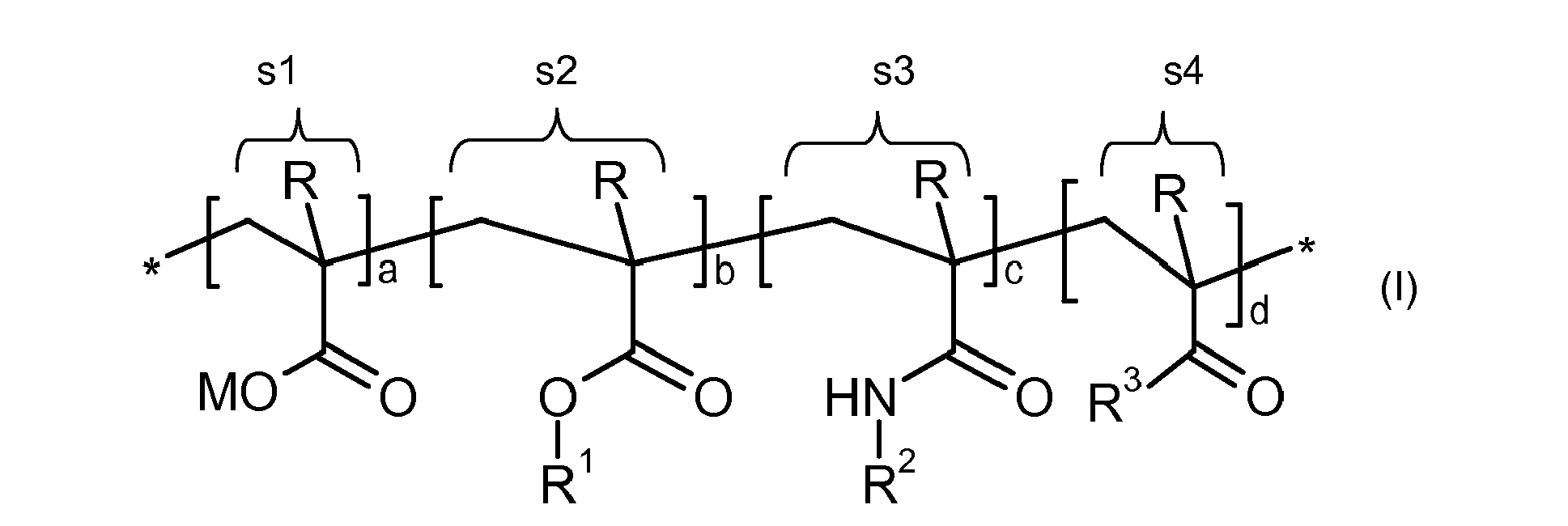
- Hierbei stehen M unabhängig voneinander für H+, Alkalimetallion, Erdalkalimetallion, zwei- oder dreiwertiges Metallion, Ammoniumion, oder organische Ammoniumgruppe. Der Term "unabhängig voneinander" bedeutet im vorliegenden Dokument jeweils, dass ein Substituent unterschiedliche zur Verfügung stehenden Bedeutungen in demselben Molekül aufweisen kann. So kann beispielsweise das Copolymer der Formel (I) gleichzeitig Carbonsäuregruppen und Natriumcarboxylatgruppen aufweisen, das heisst, dass für M in diesem Falle H+ und Na+ unabhängig voneinander bedeuten.
- Dem Fachmann ist klar, dass es sich einerseits um ein Carboxylat handelt, an welches das lon M gebunden ist, und dass andererseits bei mehrwertigen lonen M die Ladung durch Gegenionen ausgeglichen sein muss.
- Weiterhin stehen die Substituenten R unabhängig voneinander für Wasserstoff oder für eine Methylgruppe.
- Des Weiteren stehen die Substituenten R1 unabhängig voneinander für -[AO]q-R4. Die Substituenten R2 stehen unabhängig voneinander für eine C1-bis C20-Alkylgruppe, -Cycloalkylgruppe, -Alkylarylgruppe oder für -[AO]q-R4. Der Substituent A steht in beiden Fälle unabhängig voneinander für eine C2-bis C4-Alkylengruppe und R4 für eine C1- bis C20-Alkylgruppe, -Cyclohexylgruppe oder -Alkylarylgruppe, während q einen Wert von 2 bis 250, insbesondere von 8 bis 200, besonders bevorzugt von 11 bis 150, darstellt.
- Des Weiteren stehen die Substituenten R3 unabhängig voneinander für -NH2, -NR5R6, -OR7NR8R9. Hierbei stehen R5 und R6 unabhängig voneinander für eine C1- bis C20-Alkylgruppe, -Cycloalkylgruppe oder -Alkylarylgruppe oder -Arylgruppe oder für eine Hydroxyalkylgruppe oder für eine Acetoxyethyl-(CH3-CO-O-CH2-CH2-) oder eine Hydroxy-isopropyl- (HO-CH(CH3)-CH2-) oder eine Acetoxyisopropylgruppe (CH3-CO-O-CH(CH3)-CH2-), oder R5 und R6 bilden zusammen einen Ring, von dem der Stickstoff ein Teil ist, um einen Morpholin- oder Imidazolinring aufzubauen.
- Weiterhin stehen die Substituenten R8 und R9 je unabhängig voneinander für eine C1- bis C20-Alkylgruppe, -Cycloalkylgruppe, -Alkylarygruppe, -Arylgruppe oder für eine Hydroxyalkylgruppe.
- Die Abfolge der in Formel (I) als s1, s2, s3 und s4 bezeichneten Teilstrukturelemente kann hierbei alternierend, blockartig oder zufällig angeordnet sein.
- Schliesslich stellen die Indizes a, b, c und d Molverhältnisse der Struktureinheiten s1, s2, s3 und s4 dar. Diese Strukturelemente stehen in einem Verhältnis von
a/b/c/d = (0.1 - 0.9) / (0.1 - 0.9) / (0 - 0.8) / (0 - 0.3),
insbesondere a/b/c/d = (0.1 - 0.9) / (0.1 - 0.9) / (0 - 0.5) / (0 - 0.1),
bevorzugt a/b/c/d = (0.1 - 0.9) / (0.1 - 0.9) / (0 - 0.3) / (0 - 0.06), zueinander, mit der Massgabe, dass a + b + c + d = 1 ist. Die Summe c + d ist bevorzugt grösser als 0. - Die Herstellung des Kammpolymeren KP der Formel (I) kann einerseits durch radikalische Polymerisation der entsprechenden Monomere der Formel (IIIa), (IIIb), (IIIc) bzw. (IIId), welche dann zu den Strukturelementen Struktureinheiten s1, s2, s3 und s4 führen,


- In der polymer-analogen Umsetzung wird die Polycarbonsäure der Formel (IV) mit den korrespondierenden Alkoholen, Aminen verestert oder amidiert und dann allenfalls neutralisiert oder teilneutralisiert (je nach Art des Rest M z.B. mit Metallhydroxiden oder Ammoniak). Details zur polymer-analogen Umsetzung sind offenbart beispielsweise in
US 2002/0002218 A1 auf Seite 5 in Abschnitt [0077] bis und mit [0083], sowie in dessen Beispielen oder inUS 6,387,176 B1 auf Seite 5, Zeile 18 bis Zeile 58 sowie in dessen den Beispielen. In einer Abart davon, wie sie inUS 2006/0004148 A1 auf Seite 1 in Abschnitt [0011] bis und mit [0055] auf Seite 3 sowie in dessen Beispielen beschrieben sind, kann das Kammpolymer KP der Formel (I) in festem Aggregatszustand hergestellt werden. Die Offenbarung dieser gerade genannten Patentschriften wird hiermit insbesondere durch Bezugnahme eingeschlossen. - Es hat sich erwiesen, dass eine besonders bevorzugte Ausführungsform der Kammpolymere KP der Formel (I) diejenigen sind, in welchen c+d > 0, insbesondere d > 0, sind. Als Rest R3 hat sich insbesondere -NH-CH2-CH2-OH als besonderes vorteilhaft erwiesen.
- Als besonders vorteilhaft erwiesen haben sich Kammpolymere KP, wie sie von Sika Schweiz AG unter der Handelsnamenreihe ViscoCrete® kommerziell vertrieben werden.
- Typischerweise beträgt der Gewichtsanteil des Fe(III)-Komplexbildners X 0.01 bis 50 Gew.-%, bevorzugt 0.05 bis 20 Gew.-%, insbesondere bevorzugt 0.1 bis 5 Gew.-%, bezogen auf das Gesamtgewicht des Kammpolymers.
- Es ist weiter vorteilhaft, dass die Zusammensetzung weiter mindestens ein Antioxidationsmittel aufweist, insbesondere in einer Menge von 0.01 bis 50 Gew.-%, bevorzugt 0.05 bis 10 Gew.-%, insbesondere bevorzugt 0.1 bis 5 Gew.-%, bezogen auf das Gesamtgewicht des Kammpolymers.
- Geeignete Antioxidationsmittel sind beispielsweise ausgewählt aus der Gruppe bestehend aus substituierten Phenolen, insbesondere sterisch gehinderten Phenolen; substituierten Hydrochinonen, insbesondere sterisch gehinderten Hydrochinonen; sterisch gehinderten aromatischen Aminen wie Diarylamine; Arylamin-Keton-Kondensationsprodukten; Organoschwefelverbindungen wie Dialkyldithiocarbaminsäuren oder Dialkyldithiophosphiten; Organophosphorverbindungen wie Phosphiten oder Phosphoniten; Tocopherolen und deren Derivaten; Gallussäuren und deren Derivaten und Vanillin.
- Besonders geeignet sind Antioxidationsmittel, welche mindestens ein substituiertes Phenol, substituiertes Hydrochinon oder ein substituiertes aromatisches Amin umfassen. Besonders geeignet sind sterisch gehinderte Phenole, sterisch gehinderte Hydrochinone oder sterisch gehinderte aromatische Amine.
- Beispiele für sterisch gehinderte Phenole sind 2-t-Butyl-4,6-dimethylphenol, 2,6-di(t-butyl)-4-methylphenol (Butylhydroxytoluol, BHT), 2-t-Butyl-4-methoxyphenol (Butylhydroxyanisol, BHA), Pentaerythrityl-tetrakis-[3-(3,5-ditert.-butyl-4-hydroxyphenyl)-propionat] (Irganox® 1010), 2,6-Dioctadecyl-4-methylphenol, 2,4,6-Tri-t-butylphenol, ortho-tert-Butylphenol, 3,5-Bis(1,1-dimethylethyl)-4-hydroxybenzol-propionsäureester von C4-C22-Alkoholen, 4,4'-Butyliden-bis-(6-t-butyl-3-methylphenol), 4,4'-Methyliden-bis-(2,6-di-t-butylphenol), 3,5-Bis(1,1-ditert.-butyl)-4-hydroxyphenyl-propion-säureester von C4-C22-Alkoholen, 2,2'-Methylen-bis-(6-tert-butyl-4-methylphenol), 2,2-Bis-(4-hydroxyphenyl)-propan (Bisphenol A), 4,4'-Methylenebisphenol (Bisphenol F), 1,1-Bis-(5-t-butyl-4-hydroxy-2-methylphenyl)-butan, 2,2'-Methylen-bis-[4-methyl-6-(1-methylcyclohexyl)-phenol], Tetrakis[methylen-3-(3,5-di-t-butyl-4-hydroxyphenyl)-propionat]-methan, N,N'-Hexamethylenbis(3,5-di-t-butyl-4-hydroxy-hydrozimtsäureamid), Octadecyl-3-(3,5-di-t-butyl-4-hydroxyphenyl)propionat, 1,3,5-Tris-(3,5-di-t-butyl-4-hydroxybenzyl)isocyanurat, 1,1,3-Tris-(5-t-butyl-4-hydroxy-2-methylphenyl)-butan, 1,3,5-Tris-(3,5-di-t-butyl-4-hydroxybenzyl)mesitylen, Ethylenglykol-bis[3,3-bis(3'-t-butyl-4'-hydroxyphenyl)butyrat], Di-(3-t-butyl-4'-hydroxy-5-methylphenyl)dicyclopentadien, 2,2'-Methylen-bis-(4-methyl-6-cyclohexylphenol), 1,3,5-Tri-(3,5-di-t-butyl-4-hydroxybenzyl)-2,4,6-trimethylbenzol (Irganox® 1330), 1,3,5-Tris-(4-t-butyl-3-hydroxy-2,6-dimethylbenzyl)-isocyanurat, 3,5-Di-t-butyl-4-hydroxyphenyl-propionsäureester, 5-t-Butyl-4-hydroxy-3-methylphenyl-propionsäureester, 3,5-Di-t-butyl-4-hydroxyphenyl-propionsäureamide, 3,5-Di-(1,1-dimethylethyl)-4-hydroxybenzolpropionsäureester, 1,6-Hexandiol-bis-(3,5-di-t-butyl-4-hydroxyphenyl)propionat, Triethylenglykol-bis-3-(t-butyl-4-hydroxy-5-methylphenyl)-propionat, 2,2-Bis-(4-hydroxyphenyl)-propan, 2,2'-Thio-bis-(4-methyl-6-t-butylphenol), 2-Methyl-4,6-bis((octylthio)-methyl)phenol (Irganox® 1520), 4,4'-Thio-bis-(6-t-butyl-3-methylphenol), 2,2'-Thiodiethyl-bis-3-(3,5-di-t-butyl-4-hydroxyphenyl)propionat.
- Bevorzugt sind 2,6-Di-t-butyl-4-methylphenol (BHT), Octadecyl-3-(3,5-di-t-butyl-4-hydroxyphenyl)propionat, 2,2'-Methylen-bis-(4-methyl-6-cyclohexylphenol), 2,2'-Methylen-bis-(4-methyl-6-t-butylphenol), Triethylenglykol-bis-3-(t-butyl-4-hydroxy-5-methylphenyl)-propionat, 2,2-Bis-(4-hydroxyphenyl)-propan und Tetrakis[methylen-3-(3,5-di-t-butyl-4-hydroxyphenyl)-propionat]methan, oder Antioxidationsmittel, wie sie typischerweise unter dem Markennamen Irganox® der Firma Ciba Spezialitätenchemie vertrieben werden, insbesondere 2-Methyl-4,6-bis((octylthio)-methyl)phenol (Irganox® 1520), Pentaerythrityl-tetrakis-[3-(3,5-ditert.-butyl-4-hydroxyphenyl)-propionat] (Irganox® 1010), oder 1,3,5-Tri-(3,5-di-t-butyl-4-hydroxybenzyl)-2,4,6-trimethylbenzol (Irganox® 1330).
- Beispiele für sterisch gehinderte Hydrochinone sind 2,6-Di-t-butyl-4-methoxyphenol, 2,5-Di-t-butyl-hydrochinon.
- Beispiele für sterisch gehinderte aromatische Amine und Arylamin-Keton-Kondensationsprodukte sind N,N'-Bis-(1,4-dimethyl-pentyl)-p-phenylendiamin, N,N'-Diphenyl-p-phenylendiamin, 4-(p-Toluol-sulfonamido)-diphenylamin, 4-n-Butylaminophenol, 4,4'-Di-t-octyldiphenylamin, 4,4'-Di-(alpha,alpha-dimethylbenzyl)-diphenylamin, Phenyl-beta-naphthylamin, N-Isopropyl-N'-phenyl-p-phenylendiamin, und/oder Phenyl-2-aminonaphthalin.
- Beispiele für Organoschwefelverbindungen sind 2,2'-Thio-bis-(4-methyl-6-t-butylphenol), 2-Methyl-4,6-bis((octylthio)-methyl)phenol (Irganox® 1520), 4,4'-Thio-bis-(6-t-butyl-3-methylphenol), 2,2'-Thiodiethyl-bis-3-(3,5-di-t-butyl-4-hydroxyphenyl)propionat, 2,4-Bis-(n-octylthio)-6-(4-hydroxy-3,5-di-t-butylanilino)-1,3,5-triazin, Di-Lauryl-3,3'-thiodipropionat, Di-Stearyl-3,3'-thiodipropionat, Natriumdithionit, Toluolsulfinsäure oder deren Derivate, beispielsweise Natriumhydroxymethansulfinat-Dihydrat (Rongalit® C).
- Beispiele für Organophosphorverbindungen sind 3,5-Di-t-butyl-4-hydroxybenzyl-phosphonsäure-dioctadecylester, Trimethylphosphit, Triethylphosphit, Triphenylphosphit, Distearylpentaerythritdiphosphit, Tris-(nonylphenyl)-phosphit, Tetrakis-(2,4-di-t-butylphenyl-4,4'-biphenylendiphosphonit, Tris-(2,4-di-t-butylphenyl)phosphit, Neopentylglykoltriethylenglykoldiphosphit, Diisodecylpentaerythritdiphosphit, Tristearylphosphit, Trilaurylphosphit, Na-Hypophosphit oder Triphenylphosphit.
- In einer bevorzugten Ausführungsform ist das Antioxidationsmittel ein substituiertes Phenol, insbesondere ein sterisch gehindertes Phenol. Derartige Antioxidationsmittel sind beispielsweise unter dem Namen Irganox® bei der Firma Ciba erhältlich. Vorzugsweise ist das substituierte Phenol ausgewählt aus der Gruppe bestehend aus Butylhydroxytoluol (BHT), Butylhydroxyanisol (BHA), Bisphenol A, Bisphenol F, Salicylsäure, Hydrochinon, Vanillin, Biphenyldiol, beispielsweise 4,4'-Biphenyldiol oder 2,2'-Biphenyldiol, Gallate und Phenolpolykondensate.
- Die Zusammensetzung, wie sie vorgehend beschrieben wurde, kann sowohl in flüssiger als auch in fester Form, sowohl allein oder als Bestandteil einer weiteren Zusammensetzung, als Dispergiermittel, insbesondere als Verflüssiger; als Mahlhilfsmittel, als Verdicker oder als Zementveredler eingesetzt werden.
- Die Zusammensetzung, wie sie vorgehend beschrieben wurde, kann weitere Bestandteile enthalten. Beispiele für weitere Bestandteile sind Lösungsmittel oder Additive, wie Mahlhilfsmittel, beispielsweise Glycole oder Alkanolamine wie Triisopropanolamin (TIPA) oder Triethanolamin (TEA); Verfüssiger, beispielsweise Lignosulfonate, sulfonierte Naphthalin-Formaldehyd-Kondensate, oder sulfonierte Melamin-FormaldehydKondensate; Beschleuniger; Verzögerer; Schwindreduzierer; Entschäumer; Schaumbildner oder Bestandteile, welche eine Entmischung des Frischbetons, insbesondere das Absondern von Wasser (Bluten), vermindern und das Zusammenhaltevermögen des Frischbetons verbessern.
- Falls die Zusammensetzung in flüssiger Form verwendet wird, wird für die Umsetzung vorzugsweise ein Lösungsmittel eingesetzt. Bevorzugte Lösungsmittel sind beispielsweise Alkohole, insbesondere Ethanol oder Isopropanol, und Wasser, wobei Wasser das am meist bevorzugte Lösungsmittel ist. Je nach Art der Zusammensetzung entsteht eine Dispersion oder eine Lösung. Bevorzugt wird eine Lösung.
- Die Zusammensetzung kann auch in festem Aggregatszustand vorliegen. Unter einer Zusammensetzung im festen Aggregatszustand versteht man im Sinne der Erfindung Zusammensetzungen, die bei Raumtemperatur im festen Aggregatzustand vorliegen und beispielsweise Pulver, Schuppen, Pellets, Granulate oder Platten sind und sich in dieser Form problemlos transportieren und lagern lassen.
- In einem weiteren Aspekt betrifft die vorliegende Erfindung eine Zusammensetzung umfassend ein Kammpolymer, ein mineralisches Bindemittel und einen Komplex aus Fe(III) mit mindestens einem Fe(III)-Komplexbildner X und gegebenenfalls anderen Komplexbildnern, wobei es sich bei dem Fe(III)-Komplexbildner X um einen Fe(III)-Komplexbildner X handelt, wie er vorgehend beschrieben wurde.
- Das mineralisches Bindemittel typischerweise ein hydraulisches Bindemittel, ein latent hydraulisches Bindemittel oder ein nicht-hydraulisches Bindemittel, insbesondere ein Zement, bevorzugt ein Portlandzement, respektive dessen Mischungen mit Flugaschen, Silica fume, Hüttensande und Kalksteinfüller.
- Typischerweise beträgt der Gewichtsanteil des Kammpolymers 0.01 bis 10 Gew.-%, bevorzugt 0.2 bis 2 Gew.-%, bezogen auf das Gesamtgewicht des mineralischen Bindemittels.
- In einem weiteren Aspekt betrifft die vorliegende Erfindung ein Verfahren zur Stabilisierung von Kammpolymeren in Gegenwart von Fe(III), worin den Kammpolymeren mindestens ein Fe(III)-Komplexbildner X zugegeben wird. Beim Kammpolymer und beim Fe(III)-Komplexbildner X handelt es sich um Kammpolymere und Fe(III)-Komplexbildner X, wie sie vorhergehend beschrieben wurden.
- Unter dem Begriff "Stabilisierung" wird insbesondere verstanden, dass die Kammpolymere über eine längere Zeit nicht abgebaut werden und somit ihre Wirkung, beispielsweise als Dispergiermittel, Mahlhilfsmittel, Verdicker oder Zementveredler, aufrecht erhalten bleibt. Vorzugsweise bleibt die Stabilisierung des Kammpolymers über mindestens eine Woche, vorzugsweise mindestens 4 Wochen, erhalten.
- Vorzugsweise wird der Fe(III)-Komplexbildner X in einer Menge von 0.01 bis 50 Gew.-%, bevorzugt 0.05 bis 20 Gew.-%, bezogen auf das Gesamtgewicht des Kammpolymers, verwendet.
- Es ist weiter von Vorteil, wenn zusätzlich mindestens ein Antioxidationsmittel zugegeben wird. Als Antioxidationsmittel sind Verbindungen geeignet, wie sie vorgehend als geeignet als Antioxidationsmittel beschrieben wurden.
- Vorzugsweise wird das mindestens eine Antioxidationsmittel in einer Menge von 0.01 bis 50 Gew.-%, bevorzugt 0.05 bis 10 Gew.-%, bezogen auf das Gesamtgewicht des Kammpolymers, verwendet.
- Vorzugsweise handelt es sich bei dem Verfahren um ein Verfahren bei einer Temperatur von mindestens 40°C, vorzugsweise von 80 - 160°C.
- Vorzugsweise handelt es sich bei dem Verfahren um ein Verfahren zur Stabilisierung von Polymeren in Gegenwart von Fe(III) in einem mineralischen Bindemittel. Als mineralisches Bindemittel sind Verbindungen geeignet, wie sie vorgehend als geeignet als mineralisches Bindemittel beschrieben wurden.
- Beispielsweise werden Zementklinker nach dem Brennprozess bei über 1000°C üblicherweise auf eine Temperatur von etwa 100 bis 200°C abgekühlt und normalerweise bei einer Temperatur von etwa 80 bis 150°C, insbesondere bei etwa 80 bis 120°C gelagert, beispielsweise in Silos. Somit können beim Verfahren Temperaturen von mindestens 40°C, vorzugsweise von 80 - 160°C, beim Mahlen, insbesondere beim Mahlen des Zementklinkers zu Zement, auftreten. Ferner bei der anschliessenden Lagerung und/oder Transport des mineralischen Bindemittels, insbesondere durch Sonneneinstrahlungs-bedingte Erwärmung der Lager-, Transport- oder Verpackungsbehältnisse. Daher handelt es sich vorzugsweise um ein Verfahren zur Stabilisierung von Kammpolymeren in Gegenwart von Fe(III) in mineralischen Bindemitteln und bei einer Temperatur von mindestens 40°C, vorzugsweise von 80 - 160°C, wobei diese Temperatur beim Mahlen des mineralischen Bindemittels und/oder anschliessender Lagerung auftritt.
- Die Zugabe der Kammpolymers und/oder des Fe(III)-Komplexbildners X und/oder der Antioxidationsmittel zum mineralischen Bindemittel kann gleichzeitig oder zeitlich versetzt stattfinden.
- Die Zugabe der Kammpolymere und/oder des Fe(III)-Komplexbildners X und/oder der Antioxidationsmittel zum mineralischen Bindemittel kann beim Fördern des mineralischen Bindemittels, insbesondere beim Fördern von Zement, auf das mineralische Bindemittel aufgetragen werden. Vorzugsweise wird dem mineralischen Bindemittel, insbesondere Zement, während des Förderungsprozesses, beispielsweise in Transportkanälen, zur Lagerstätte, beispielsweise zum Silo oder zu Transportmitteln wie z.B. einem Lastwagen, die Kammpolymere und/oder der Fe(III)-Komplexbildner X und/oder das Antioxidationsmittel zugegeben.
- Die Zugabe der Kammpolymere und/oder des Fe(III)-Komplexbildners X und/oder der Antioxidationsmittel zum mineralischen Bindemittel kann weiter vor dem Mahlen des mineralischen Bindemittels, insbesondere vor und/oder während dem Mahlen des Zementklinkers, zum mineralischen Bindemittel zugegeben werden.
- In einer bevorzugten Ausführungsform wird der Fe(III)-Komplexbildner X vorgängig mit dem Kammpolymer (und gegebenenfalls mit einem Antioxidationsmittel) vermischt und diese Mischung wird dann zu einem gewünschten Zeitpunkt während des Herstellprozesses des mineralischen Bindemittels, insbesondere des Zements, beispielsweise vor dem Mahlen, oder beim Fördern des mineralischen Bindemittels vor der Lagerung, mit dem mineralischen Bindemittel vermischt, oder auf das mineralische Bindemittel aufgetragen, so dass beispielsweise ein mineralisches Bindemittel entsteht, welches mit der Mischung aus Fe(III)-Komplexbildner X und Kammpolymer (und eventuell Antioxidationsmittel) beschichtet ist. Die Förderung oder der Transport des mineralischen Bindemittels kann über dem Fachmann bekannte Vorrichtungen erfolgen, beispielsweise über Luftförderrinnen, wo der Transport pneumatisch und gravimetrisch erfolgt. Der Mahlprozess erfolgt üblicherweise in einer Zementmühle, beispielsweise in einer Kugelmühle. Es können aber grundsätzlich auch andere Mühlen, wie sie in der Zementindustrie bekannt sind, eingesetzt werden.
- In einem weiteren Aspekt betrifft die vorliegende Erfindung eine Verwendung eines Fe(III)-Komplexbildner X zur Stabilisierung von Kammpolymeren in Gegenwart von Fe(III).
- Beim Kammpolymer und beim Fe(III)-Komplexbildner X handelt es sich um Kammpolymere und Fe(III)-Komplexbildner X, wie sie vorhergehend beschrieben wurden.
- Die Erfindung wird nun anhand von Beispielen näher erläutert.
-
Tabelle 1: Verwendete Rohstoffe Nr. Art Hersteller KB-1 2-Aminothiazol Fluka, Schweiz KB-2 Benzylthiocyanat Fluka, Schweiz KB-3 Ethylendiamintetraessig-säure (EDTA) Fluka, Schweiz AntO sterisch gehindertes Phenol F2S Eisen(II)sulfat Heptahydrat Merck Chemicals, Deutschland F3S Eisen(III)sulfat Hydrat Fluka, Schweiz NaSCN Natriumthiocyanat Fluka, Schweiz - Die Wirksamkeit der erfindungsgemässen Zusammensetzungen wurde im Mörtel getestet.
- In einem ersten Schritt wurde Portlandzement (Schweizer CEM I 42.5R), durch Mischung in einem Küchenmixer (Moulinex), mit 1 Gew.-% Kammpolymer (Sika® ViscoCrete® 110 CH, erhältlich bei Sika Schweiz AG), bezogen auf das Gewicht des Portlandzements, und gegebenenfalls zusätzlich mit einer in Tabelle 2 angegebenen Menge (bezogen auf Gesamtgewicht des Kammpolymers) eines Fe(III)-Komplexbildners X (KB), eines Antioxidationsmittels (AntO) oder einem Fe(III)-Komplexbildners X zusammen mit einem Antioxidationsmittel, beschichtet. Der so beschichtete Zement wurde entweder sofort verwendet oder in einen Transportbehälter bei 60°C für die in Tabelle 2 angegebene Dauer gelagert, bevor er zur Herstellung von Mörtelmischungen verwendet wurde.
- Aus dem beschichteten Zement wurde folgende Mörtelmischung hergestellt:
Zusammensetzung der Mörtelmischung: (Grösstkorn 8mm) Menge in g Beschichteter Portlandzement (Schweizer CEM II/A-LL 42.5N) 750 Kalksteinfüller 141 Sand 0-1 mm 738 Sand 1-4 mm 1107 Sand 4-8 mm 1154 - Die Sande, der Füller und der beschichtete Zement wurden 1 Minute in einem Hobart-Mischer trocken gemischt. Innerhalb von 30 Sekunden wurde das Anmachwasser zugegeben und noch weitere 2.5 Minuten gemischt. Der Wasser/Zement-Wert (w/z-Wert) betrug 0.46. Zur Bestimmung der Wirksamkeit wurde das Ausbreitmass (ABM) (Tabelle 2) des Mörtels in Anlehnung an EN 1015-3 nach 0 Minuten bestimmt. Die verwendete Bestimmung des Ausbreitmasses unterscheidet sich dahingehend von EN 1015-3, dass auf das Anheben und Fallenlassen des Ausbreittisches verzichtet wurde.
- Die Beispiele1 bis 6 stellen erfindungsgemässe Beispiele dar, während die Beispiele 7 bis 12 Vergleichsbeispiele darstellen.
Tabelle 2: Ausbreitmass (ABM) einer Mörtelmischung in mm nach 0 Minuten (min), bei sofortiger Verwendung des beschichteten Zements oder bei einer Lagerung des beschichteten Zements bei 60°C von 2, 3 und 7 Tagen (d). Nr. Additive Gew.-% Additive, bez. auf das
KammpolymerTage (d) nach
Lagerung 60 °CABM
(mm)
0 min1 KB 1 8 Gew.-% 3 226 2 KB-1 8 Gew.-% 7 143 3 KB-2 8 Gew.-% 2 226 4 KB-3 10 Gew.-% 3 108 5 KB-1, AntO 5 Gew.-%(KB-1), 0.5 Gew.-% (AntO) 3 227 6 KB-1, AntO 5 Gew.-%(KB -1), 0.5 Gew.-% (AntO) 7 225 7 - - sofort verwendet 227 8 - - 2 100 9 - - 3 100 10 - - 7 100 11 AntO 0.5 Gew.-% 3 184 12 AntO 0.5 Gew.-% 7 146 - Die Resultate in Tabelle 2 zeigen, dass die erfindungsgemässen Zusammensetzungen geeignet sind, um Kammpolymere auch bei erhöhter Temperatur (60°C) zu stabilisieren.
- Die Wirksamkeit der Chromatreduktion durch Eisen(II)-sulfat Heptahydrat (F2S) in Gegenwart von 2-Aminothiazol (KB-1) wurde im Beton getestet.
- 20 g Zement (CEM II/A-LL 42.5N), 40 g Wasser und gegebenenfalls in Tabelle 3 aufgeführte Additive wurden 15 Minuten unter intensivem Rühren auf einem Magnetrührwerk vermischt und anschliessend über einem Whatman 597 ½ Faltenfilter abfiltriert. Der Cr(VI)-Gehalt des Durchflusses wurde reflektrometrisch mittels eines Chromat-Tests von Merck, Deutschland, gemäss den Anweisungen des Herstellers, bestimmt.
Tabelle 3: Cr(VI)-Gehalt in ppm des abfiltrierten Durchflusses. Nr. Additive Gew.-% Additive, bez. auf Gewicht
ZementKonz.
Cr(VI)(ppm)13 - - 5.5 14 F2S 0.4 Gew.-% 0.3 15 KB-1 0.4 Gew.-% 5.1 16 KB-1, F2S 0.4 Gew.-% (KB-1), 0.4 Gew.-% (Fe(II)sulfat) 0.2 - In Tabelle 3 ist ersichtlich, dass die Wirkung der Cr(VI)-Reduktion durch Eisen(II)sulfat Heptahydrat durch die Zugabe von 2-Aminothiazol nicht beeinträchtigt wird.
- 40 g Wasser und 0.2 g Fe(III)sulfat Hydrat (F3S-Lösung) und gegebenenfalls 0.6 g 2-Aminothiazol (KB-1) wurden 15 Minuten unter intensivem Rühren auf einem Magnetrührwerk vermischt, der pH auf 5 eingestellt und anschliessend nach 2 min, respektive 17 Stunden, ein Eisen(II)-Nachweis durchgeführt. Der Eisen(II)-Nachweis erfolgte mittels eines Reflektoquant Eisen(II)-Tests von Merck, Deutschland, gemäss den Anweisungen des Herstellers.
Tabelle 4: Nachweis von Fe(II). Nr. Lösung Probennahme Fe(II)-Nachweis 17 F3S Lösung nach 2 min unterhalb Nachweisgrenze 18 F3S Lösung nach 17 h unterhalb Nachweisgrenze 19 F3S Lösung, KB-1 nach 2 min unterhalb Nachweisgrenze 20 F3S Lösung, KB-1 nach 17 h positiver Nachweis von Fe(II) - Aus Tabelle 4 ist ersichtlich, dass 2-Aminothiazol eine Reduktion von Fe(III) zu Fe(II) bewirkt.
- In einem ersten Versuch wurden in 40 g Wasser 0.2 g Fe(II)sulfat Heptahydrat (F2S) unter intensivem Rühren auf einem Magnetrührwerk gelöst. Anschliessend wurde der Eisen(II)-Gehalt bestimmt. In einem zweiten Versuch wurden in 40 g Wasser 0.2 g Fe(II)sulfat Heptahydrat (F2S) unter intensivem Rühren auf einem Magnetrührwerk gelöst. Danach wurden 0.6 g 2-Aminothiazol (KB-1) zugegeben. Anschliessend wurde der Eisen(II)-Gehalt bestimmt.
- Die Eisen(II)-Gehaltsbestimmung erfolgte mittels eines Reflektoquant Eisen(II)-Tests von Merck, Deutschland, gemäss den Anweisungen des Herstellers.
Tabelle 5: Fe(II)-Gehalt in mg/l. Nr. Lösung Additive Konz. Fe(II)(mg/L) 21 F2S Lsg - 20 22 F2S Lsg KB-1 19 - In Tabelle 5, insbesondere im Vergleich zu Tabelle 4, ist ersichtlich, dass 2-Aminothiazol mit Fe(II) im Gegensatz zu Fe(III) kaum Komplexe bildet und somit gegenüber Fe(II) einen selektiven Fe(III)-Komplexbildner darstellt.
- In 40 g Wasser wurden 0.2 g Fe(III)sulfat Hydrat (F3S) unter intensivem Rühren auf einem Magnetrührwerk gelöst und der pH auf 5 eingestellt. Anschliessend wurde in einem ersten Versuch 1 g Natriumthiocyanat (NaSCN) zugegeben, nach 1 min die Lösung auf eine mögliche Farbänderung hin untersucht, 1 g 2-Aminothiazol (KB-1) zugegeben, nach 1 min die Lösung erneut auf eine mögliche Farbänderung hin untersucht. In einem zweiten Versuch wurden (NaSCN) und (KB-1) in umgekehrter Reihenfolge zugegeben.
Tabelle 6: Nachweis von Fe(II). Nr. Lösung Zugabe 1 Farbe der Lsg. Zugabe 2 Farbe der Lsg. 23 F3S Lsg NaSCN Braunfärbung KB-1 Gelbfärbung (Änderung) 24 F3S Lsg KB-1 Gelbfärbung NaSCN Gelbfärbung (keine Änderung) - Aus Tabelle 6 ist ersichtlich, dass 2-Aminothiazol als Fe(III)-Komplexbildner geeignet ist und gegenüber Natriumthiocyanat stärkere Fe(III)-Komplexe bildet.
- Selbstverständlich ist die Erfindung nicht auf die gezeigten und beschriebenen Ausführungsbeispiele beschränkt.
Claims (15)
- Zusammensetzung umfassend ein Kammpolymer und mindestens einen Fe(III)-Komplexbildner X, welcher ausgewählt ist aus der Gruppe bestehend aus Thiocyanaten, kondensierten Phosphaten, Aminen, Aminoessigsäuren, Oxycarbonsäuren und Verbindungen der Formel (V), wobei bei Verbindungen der Formel (V)

R10 und R11 Teil von einem aromatischen oder cycloaliphatischen Ring, insbesondere einem aromatischen 6-Ring, sind. - Zusammensetzung gemäss Anspruch 1, dadurch gekennzeichnet, dass der Fe(III)-Komplexbildner X eine Komplexbildungskonstante für Fe(III) aufweist, die 10-mal, insbesondere 1000-mal, grösser ist als die Komplexbildungskonstante für Fe(II).
- Zusammensetzung gemäss einem der vorhergehenden Ansprüche, dadurch gekennzeichnet, dass der Fe(III)-Komplexbildner X eine Reduktion von Fe(III) zu Fe(II) bewirkt.
- Zusammensetzung gemäss einem der vorhergehenden Ansprüche, dadurch gekennzeichnet, dass der Gewichtsanteil des Fe(III)-Komplexbildners X 0.01 bis 50 Gew.-%, bevorzugt 0.05 bis 20 Gew.-%, bezogen auf das Gesamtgewicht des Kammpolymers, beträgt.
- Zusammensetzung gemäss einem der vorhergehenden Ansprüche, dadurch gekennzeichnet, dass die Zusammensetzung weiter mindestens ein Antioxidationsmittel aufweist, insbesondere in einer Menge von 0.01 bis 50 Gew.-%, bevorzugt 0.05 bis 10 Gew.-%, bezogen auf das Gesamtgewicht des Kammpolymers.
- Zusammensetzung gemäss Anspruch 5, dadurch gekennzeichnet, dass das Antioxidationsmittel ausgewählt ist aus der Gruppe bestehend aus substituierten Phenolen, insbesondere sterisch gehinderten Phenolen; substituierten Hydrochinonen, insbesondere sterisch gehinderten Hydrochinonen; sterisch gehinderten aromatischen Aminen wie Diarylamine; Arylamin-Keton-Kondensationsprodukten; Organoschwefelverbindungen wie Dialkyldithiocarbaminsäuren oder Dialkyldithiophosphiten; Organophosphorverbindungen wie Phosphiten oder Phosphoniten; Tocopherolen und deren Derivaten; Gallussäuren und deren Derivaten und Vanillin.
- Zusammensetzung umfassend ein Kammpolymer, ein mineralisches Bindemittel und einen Komplex aus Fe(III) mit mindestens einem Fe(III)-Komplexbildner X und gegebenenfalls anderen Komplexbildnern, wobei es sich bei dem Fe(III)-Komplexbildner X um einen Fe(III)-Komplexbildner X handelt, wie er in der Zusammensetzung nach einem der Ansprüche 1 - 4 beschrieben ist.
- Zusammensetzung gemäss Anspruch 7, dadurch gekennzeichnet, dass das mineralisches Bindemittel ein hydraulisches Bindemittel, ein latent hydraulisches Bindemittel oder ein nicht-hydraulisches Bindemittel ist, insbesondere ein Zement, bevorzugt ein Portlandzement, respektive dessen Mischungen mit Flugaschen, Silica fume, Hüttensande und Kalksteinfüller.
- Zusammensetzung gemäss Anspruch 7 oder 8, dadurch gekennzeichnet, dass der Gewichtsanteil des Kammpolymers 0.01 bis 10 Gew.-%, bevorzugt 0.2 bis 2 Gew.-%, bezogen auf das Gesamtgewicht des mineralischen Bindemittels, beträgt.
- Verfahren zur Stabilisierung von Kammpolymeren in Gegenwart von Fe(III), dadurch gekennzeichnet, dass den Kammpolymeren mindestens ein Fe(III)-Komplexbildner X zugegeben wird, wobei es sich bei dem Fe(III)-Komplexbildner X um einen Fe(III)-Komplexbildner X handelt, wie er in der Zusammensetzung nach einem der Ansprüche 1 - 4 beschrieben ist.
- Verfahren nach Anspruch 10, dadurch gekennzeichnet, dass mindestens ein Antioxidationsmittel zugegeben wird.
- Verfahren nach einem der Ansprüche 10 oder 11, dadurch gekennzeichnet, dass es sich bei dem Verfahren um ein Verfahren bei einer Temperatur von mindestens 40°C, vorzugsweise von 80 - 160°C, handelt.
- Verfahren nach einem der Ansprüche 10 bis 12, dadurch gekennzeichnet, dass es sich bei dem Verfahren um ein Verfahren in einem mineralischen Bindemittel handelt.
- Verfahren nach Anspruch 10 oder 11, dadurch gekennzeichnet, dass es sich bei dem Verfahren um ein Verfahren zur Stabilisierung von Kammpolymeren in Gegenwart von Fe(III) in mineralischen Bindemitteln und bei einer Temperatur von mindestens 40°C, vorzugsweise von 80 - 160°C, wobei diese Temperatur beim Mahlen des mineralischen Bindemittels und/oder anschliessender Lagerung auftritt.
- Verwendung eines Fe(III)-Komplexbildners X zur Stabilisierung von Kammpolymeren in Gegenwart von Fe(III), dadurch gekennzeichnet, dass es sich bei dem Fe(III)-Komplexbildner X um einen Fe(III)-Komplexbildner X handelt, wie er in der Zusammensetzung nach einem der Ansprüche 1 - 4 beschrieben ist.
Priority Applications (10)
| Application Number | Priority Date | Filing Date | Title |
|---|---|---|---|
| EP09170917A EP2298833A1 (de) | 2009-09-22 | 2009-09-22 | Eisen(III)-Komplexbildner zur Stabilisierung von Kammpolymeren in mineralischen Bindemitteln |
| JP2012529304A JP2013505317A (ja) | 2009-09-21 | 2010-09-21 | 鉱物質結合剤において櫛形ポリマーを安定化させるための鉄(iii)−錯化剤 |
| BR112012006112A BR112012006112A2 (pt) | 2009-09-21 | 2010-09-21 | composição, método para a estabilização de polímeros em forma de pente na presença de fe(iii), e, utilização de um agente de complexação de fe(iii), x, para a estabilização de polímeros em forma de pente na presença de fe(iii) |
| CN201080042195.6A CN102575054B (zh) | 2009-09-21 | 2010-09-21 | 用于在矿物质粘合剂中稳定梳形聚合物的铁(iii)络合剂 |
| PCT/EP2010/063907 WO2011033127A1 (de) | 2009-09-21 | 2010-09-21 | Eisen(iii)-komplexbildner zur stabilisierung von kammpolymeren in mineralischen bindemitteln |
| US13/395,805 US20120178854A1 (en) | 2009-09-21 | 2010-09-21 | Iron(iii)-complexing agents for stabilizing comb polymers in mineral binding agents |
| EP10754534A EP2480600A1 (de) | 2009-09-21 | 2010-09-21 | Eisen(iii)-komplexbildner zur stabilisierung von kammpolymeren in mineralischen bindemitteln |
| KR1020127010117A KR20120099417A (ko) | 2009-09-21 | 2010-09-21 | 미네랄 바인딩 제재에서의 콤 폴리머들을 안정화시키기 위한 철(iii)-착물화 제재 |
| AU2010297199A AU2010297199A1 (en) | 2009-09-21 | 2010-09-21 | Iron(III)-complexing agent for stabilizing comb polymers in mineral binding agents |
| MX2012003366A MX2012003366A (es) | 2009-09-21 | 2010-09-21 | Formador de complejos de hierro(iii) para la estabilizacion de polimeros tipo peine en aglutinantes minerales. |
Applications Claiming Priority (1)
| Application Number | Priority Date | Filing Date | Title |
|---|---|---|---|
| EP09170917A EP2298833A1 (de) | 2009-09-22 | 2009-09-22 | Eisen(III)-Komplexbildner zur Stabilisierung von Kammpolymeren in mineralischen Bindemitteln |
Publications (1)
| Publication Number | Publication Date |
|---|---|
| EP2298833A1 true EP2298833A1 (de) | 2011-03-23 |
Family
ID=41650344
Family Applications (1)
| Application Number | Title | Priority Date | Filing Date |
|---|---|---|---|
| EP09170917A Withdrawn EP2298833A1 (de) | 2009-09-21 | 2009-09-22 | Eisen(III)-Komplexbildner zur Stabilisierung von Kammpolymeren in mineralischen Bindemitteln |
Country Status (1)
| Country | Link |
|---|---|
| EP (1) | EP2298833A1 (de) |
Cited By (1)
| Publication number | Priority date | Publication date | Assignee | Title |
|---|---|---|---|---|
| EP2970029A1 (de) * | 2013-03-13 | 2016-01-20 | Sika Technology AG | Einsatz von polycarboxylatethern in kombination mit weiteren zusatzmitteln für die zementmahlung |
Citations (7)
| Publication number | Priority date | Publication date | Assignee | Title |
|---|---|---|---|---|
| EP0539655A2 (de) * | 1991-10-28 | 1993-05-05 | The B.F. Goodrich Company | Mischungen von Polymeren mit Kammcopolymeren aus einem makromolekularen Polylakton-Monomer |
| WO1998031643A1 (en) * | 1997-01-21 | 1998-07-23 | W.R. Grace & Co.-Conn. | Emulsified comb polymer and defoaming agent composition and method of making same |
| US20020002218A1 (en) | 2000-03-29 | 2002-01-03 | Ulf Velten | Polymers for cement dispersing admixtures |
| US6387176B1 (en) | 1999-06-15 | 2002-05-14 | Sika Ag, Vorm. Kaspar Winkler & Co. | Multipurpose cement dispersing polymers for high flow and high strength concrete |
| WO2005123621A1 (de) | 2004-06-21 | 2005-12-29 | Sika Technology Ag | Zementmahlhilfsmittel |
| US20060004148A1 (en) | 2002-03-25 | 2006-01-05 | Sika Schweiz Ag | Polymers in a solid state |
| WO2006133933A2 (de) | 2005-06-14 | 2006-12-21 | Basf Construction Polymers Gmbh | Polyether-haltiges copolymer |
-
2009
- 2009-09-22 EP EP09170917A patent/EP2298833A1/de not_active Withdrawn
Patent Citations (7)
| Publication number | Priority date | Publication date | Assignee | Title |
|---|---|---|---|---|
| EP0539655A2 (de) * | 1991-10-28 | 1993-05-05 | The B.F. Goodrich Company | Mischungen von Polymeren mit Kammcopolymeren aus einem makromolekularen Polylakton-Monomer |
| WO1998031643A1 (en) * | 1997-01-21 | 1998-07-23 | W.R. Grace & Co.-Conn. | Emulsified comb polymer and defoaming agent composition and method of making same |
| US6387176B1 (en) | 1999-06-15 | 2002-05-14 | Sika Ag, Vorm. Kaspar Winkler & Co. | Multipurpose cement dispersing polymers for high flow and high strength concrete |
| US20020002218A1 (en) | 2000-03-29 | 2002-01-03 | Ulf Velten | Polymers for cement dispersing admixtures |
| US20060004148A1 (en) | 2002-03-25 | 2006-01-05 | Sika Schweiz Ag | Polymers in a solid state |
| WO2005123621A1 (de) | 2004-06-21 | 2005-12-29 | Sika Technology Ag | Zementmahlhilfsmittel |
| WO2006133933A2 (de) | 2005-06-14 | 2006-12-21 | Basf Construction Polymers Gmbh | Polyether-haltiges copolymer |
Cited By (1)
| Publication number | Priority date | Publication date | Assignee | Title |
|---|---|---|---|---|
| EP2970029A1 (de) * | 2013-03-13 | 2016-01-20 | Sika Technology AG | Einsatz von polycarboxylatethern in kombination mit weiteren zusatzmitteln für die zementmahlung |
Similar Documents
| Publication | Publication Date | Title |
|---|---|---|
| DE2341923C3 (de) | Mörtel aus anorganischen Bindemitteln, Verfahren zur Herstellung und Verwendung desselben | |
| EP1024120B1 (de) | Verfahren zur Reduzierung des Schwindens von hydraulischen Bindemitteln | |
| EP1761473B1 (de) | Zementmahlhilfsmittel | |
| WO2003000617A1 (de) | Verfahren zur beschleunigung des abbindens und erhärtens von hydraulischen bindemitteln und diese enthaltenden gemischen | |
| EP2298710A1 (de) | Zusatzmittel für mineralische Bindemittel | |
| DE1905187B2 (de) | Zusatz zur verbesserung der mahlbarkeit von zementklinkern und des fliessvermoegens des zementes beim lagern | |
| EP0670292A1 (de) | Chlorid- und nitritfreier Abbinde- und Erhärtungsbeschleuniger und Verfahren zur Beschleunigung des Abbindens und Erhärtens von hydraulischen Bindemitteln und diese enthaltenden Gemischen | |
| EP2509930A1 (de) | Zusatzmittel für mineralische bindemittel mit verringertem braunverfärbungspotential | |
| DE2114081A1 (de) | Verfahren zur Beschleunigung des Abbindens von Portland-Zement sowie hierfuer geeignete Mischungen | |
| DE19528912A1 (de) | Luftporenbildner | |
| DE19914367A1 (de) | Wasserbeständige hydraulisch abbindende Zusammensetzungen | |
| EP1752428B1 (de) | Methode zur Reduzierung von Chrom (VI) im Zement | |
| EP2480600A1 (de) | Eisen(iii)-komplexbildner zur stabilisierung von kammpolymeren in mineralischen bindemitteln | |
| EP2313350B1 (de) | Verfahren zur entstaubung einer pulverförmigen baustoffzusammensetzung | |
| WO2007021617A2 (en) | Dosage efficient, storage stable compositions for reducing chromium (vi) in cement | |
| EP2161247A1 (de) | Verfahren zur Stabilisierung von Polycarboxylaten | |
| EP0976695A1 (de) | Mahlhilfsmittel für Zement | |
| EP1916265A1 (de) | Verfahren zur Herstellung von Amid- und Estergruppen aufweisenden Polymeren im festen Aggregatszustand | |
| DE3217517A1 (de) | Hydraulischer zement mit einem gehalt an mahlhilfsstoffen | |
| DE2403707A1 (de) | Verfahren zur herstellung von alh tief 3 (po tief 4 ) tief 2 . 3h tief 2 o | |
| DE2348735B2 (de) | Verfahren zum Härten von Chloropren-Polymerisaten | |
| DE1028332B (de) | Verfahren zur Verguetung von Polyaethylen, das nach dem Niederdruckverfahren hergestellt worden ist | |
| DE3100570A1 (de) | Verfahren zur erhoehung der haftbefestigkeit zwischen kautschuk und metallen | |
| DE909631C (de) | Verfahren zum Vulkanisieren von Kautschuk | |
| DE1570125C3 (de) | Verfahren zum Vulkanisieren von Kautschuk |
Legal Events
| Date | Code | Title | Description |
|---|---|---|---|
| PUAI | Public reference made under article 153(3) epc to a published international application that has entered the european phase |
Free format text: ORIGINAL CODE: 0009012 |
|
| AK | Designated contracting states |
Kind code of ref document: A1 Designated state(s): AT BE BG CH CY CZ DE DK EE ES FI FR GB GR HR HU IE IS IT LI LT LU LV MC MK MT NL NO PL PT RO SE SI SK SM TR |
|
| AX | Request for extension of the european patent |
Extension state: AL BA RS |
|
| STAA | Information on the status of an ep patent application or granted ep patent |
Free format text: STATUS: THE APPLICATION IS DEEMED TO BE WITHDRAWN |
|
| 18D | Application deemed to be withdrawn |
Effective date: 20110924 |