EP2301330A1 - Kodierung für ein Gebisselement - Google Patents
Kodierung für ein Gebisselement Download PDFInfo
- Publication number
- EP2301330A1 EP2301330A1 EP10009309A EP10009309A EP2301330A1 EP 2301330 A1 EP2301330 A1 EP 2301330A1 EP 10009309 A EP10009309 A EP 10009309A EP 10009309 A EP10009309 A EP 10009309A EP 2301330 A1 EP2301330 A1 EP 2301330A1
- Authority
- EP
- European Patent Office
- Prior art keywords
- coding
- information
- readable
- denture
- read
- Prior art date
- Legal status (The legal status is an assumption and is not a legal conclusion. Google has not performed a legal analysis and makes no representation as to the accuracy of the status listed.)
- Withdrawn
Links
- 238000000034 method Methods 0.000 claims abstract description 12
- 239000002086 nanomaterial Substances 0.000 claims abstract description 5
- 239000003973 paint Substances 0.000 claims description 9
- 238000012545 processing Methods 0.000 abstract description 9
- 239000003550 marker Substances 0.000 abstract 1
- 241001465754 Metazoa Species 0.000 description 9
- 210000004513 dentition Anatomy 0.000 description 4
- 230000036346 tooth eruption Effects 0.000 description 4
- 230000003287 optical effect Effects 0.000 description 3
- 230000034994 death Effects 0.000 description 2
- 231100000517 death Toxicity 0.000 description 2
- 239000007943 implant Substances 0.000 description 2
- 239000008280 blood Substances 0.000 description 1
- 210000004369 blood Anatomy 0.000 description 1
- 239000011248 coating agent Substances 0.000 description 1
- 238000000576 coating method Methods 0.000 description 1
- 238000004040 coloring Methods 0.000 description 1
- 210000003298 dental enamel Anatomy 0.000 description 1
- 238000013461 design Methods 0.000 description 1
- 238000010586 diagram Methods 0.000 description 1
- 201000010099 disease Diseases 0.000 description 1
- 208000037265 diseases, disorders, signs and symptoms Diseases 0.000 description 1
- 239000003814 drug Substances 0.000 description 1
- 230000003203 everyday effect Effects 0.000 description 1
- 238000004880 explosion Methods 0.000 description 1
- 238000011835 investigation Methods 0.000 description 1
- 239000000463 material Substances 0.000 description 1
- 230000005226 mechanical processes and functions Effects 0.000 description 1
- 230000005693 optoelectronics Effects 0.000 description 1
- 238000012552 review Methods 0.000 description 1
- 239000000126 substance Substances 0.000 description 1
Images

Classifications
-
- A—HUMAN NECESSITIES
- A01—AGRICULTURE; FORESTRY; ANIMAL HUSBANDRY; HUNTING; TRAPPING; FISHING
- A01K—ANIMAL HUSBANDRY; AVICULTURE; APICULTURE; PISCICULTURE; FISHING; REARING OR BREEDING ANIMALS, NOT OTHERWISE PROVIDED FOR; NEW BREEDS OF ANIMALS
- A01K11/00—Marking of animals
-
- A—HUMAN NECESSITIES
- A61—MEDICAL OR VETERINARY SCIENCE; HYGIENE
- A61B—DIAGNOSIS; SURGERY; IDENTIFICATION
- A61B5/00—Measuring for diagnostic purposes; Identification of persons
- A61B5/117—Identification of persons
- A61B5/1171—Identification of persons based on the shapes or appearances of their bodies or parts thereof
- A61B5/1178—Identification of persons based on the shapes or appearances of their bodies or parts thereof using dental data
-
- A—HUMAN NECESSITIES
- A61—MEDICAL OR VETERINARY SCIENCE; HYGIENE
- A61B—DIAGNOSIS; SURGERY; IDENTIFICATION
- A61B5/00—Measuring for diagnostic purposes; Identification of persons
- A61B5/45—For evaluating or diagnosing the musculoskeletal system or teeth
- A61B5/4538—Evaluating a particular part of the muscoloskeletal system or a particular medical condition
- A61B5/4542—Evaluating the mouth, e.g. the jaw
- A61B5/4547—Evaluating teeth
-
- A—HUMAN NECESSITIES
- A61—MEDICAL OR VETERINARY SCIENCE; HYGIENE
- A61B—DIAGNOSIS; SURGERY; IDENTIFICATION
- A61B90/00—Instruments, implements or accessories specially adapted for surgery or diagnosis and not covered by any of the groups A61B1/00 - A61B50/00, e.g. for luxation treatment or for protecting wound edges
- A61B90/90—Identification means for patients or instruments, e.g. tags
-
- A—HUMAN NECESSITIES
- A61—MEDICAL OR VETERINARY SCIENCE; HYGIENE
- A61B—DIAGNOSIS; SURGERY; IDENTIFICATION
- A61B90/00—Instruments, implements or accessories specially adapted for surgery or diagnosis and not covered by any of the groups A61B1/00 - A61B50/00, e.g. for luxation treatment or for protecting wound edges
- A61B90/90—Identification means for patients or instruments, e.g. tags
- A61B90/92—Identification means for patients or instruments, e.g. tags coded with colour
-
- A—HUMAN NECESSITIES
- A61—MEDICAL OR VETERINARY SCIENCE; HYGIENE
- A61B—DIAGNOSIS; SURGERY; IDENTIFICATION
- A61B90/00—Instruments, implements or accessories specially adapted for surgery or diagnosis and not covered by any of the groups A61B1/00 - A61B50/00, e.g. for luxation treatment or for protecting wound edges
- A61B90/90—Identification means for patients or instruments, e.g. tags
- A61B90/94—Identification means for patients or instruments, e.g. tags coded with symbols, e.g. text
-
- A—HUMAN NECESSITIES
- A61—MEDICAL OR VETERINARY SCIENCE; HYGIENE
- A61B—DIAGNOSIS; SURGERY; IDENTIFICATION
- A61B90/00—Instruments, implements or accessories specially adapted for surgery or diagnosis and not covered by any of the groups A61B1/00 - A61B50/00, e.g. for luxation treatment or for protecting wound edges
- A61B90/90—Identification means for patients or instruments, e.g. tags
- A61B90/94—Identification means for patients or instruments, e.g. tags coded with symbols, e.g. text
- A61B90/96—Identification means for patients or instruments, e.g. tags coded with symbols, e.g. text using barcodes
-
- A—HUMAN NECESSITIES
- A61—MEDICAL OR VETERINARY SCIENCE; HYGIENE
- A61C—DENTISTRY; APPARATUS OR METHODS FOR ORAL OR DENTAL HYGIENE
- A61C19/00—Dental auxiliary appliances
Definitions
- the invention relates to a denture element, in particular an artificial denture element.
- the invention relates to a method for applying a coding.
- the invention has for its object to provide a simple identification option for a person or an animal.
- the reading of such a coding is opposite to a study considerably simpler and faster on the tooth system. You no longer need to find the dentist or dentist, but simply read the coding on the spot. A radiation exposure does not arise. In this way, medical measures can be taken quickly and / or members can be informed.
- the coding is read out via a reading device, such as a scanner or a camera.
- the coding As a denture teeth or parts of the jawbone of the person or animal are conceivable. But it is also possible to attach the coding to the artificial denture element. In particular, it is possible to attach the coding to a seal, a bridge, an inlet, an implant, an artificial denture or, more generally, to a tooth replacement part.
- the arrangement of the coding on the artificial denture element is particularly advantageous. It can be installed outside of a person or animal's body. So you do not have to consider when attaching to the body.
- an individual personal or animal-related coding is conceivable. This may include information about place of birth, place of residence, name, blood type, diseases, required medicine or other biometric data of the person or animal. It is also possible to save who should be notified in the event of an accident.
- the coding is designed as a paint job.
- This paint job can be an individual personal color.
- the coloring can be designed so that you can assign the color clearly the person to be identified, similar to a fingerprint.
- the application of paint is thereby arranged insoluble on the denture element.
- the coding preferably has an opto-electronically readable font.
- the opto-electronically readable font can be a bar code, bar code or bar code.
- the information can therefore be stored in binary symbols.
- One or more dimensional codings are conceivable.
- the coding is formed as a nanostructure.
- the coding can be so small that on the one hand it is not visible to a human eye. On the other hand, however, it is readily possible for the read-out device to read out the coding.
- the person wearing the coded denture element thus has no aesthetic disadvantage. The risk that information contained in the coding will be passed on to unauthorized persons is therefore also reduced.
- a coding element of the coding is readable in a predetermined wavelength interval.
- the wavelength interval may be in an invisible part of the light. This has the advantage that unauthorized persons can not read the coding without technical effort.
- coding elements of the coding are each readable at mutually different predetermined wavelength intervals.
- Part of the coding Thus, it may be included in a certain wavelength interval while another part of the coding is part of another wavelength interval.
- the wavelength intervals may overlap, but they may also be disjoint.
- optical filters and wavelength-sensitive receiving elements can then read the information contained in the respective coding elements and then merge them.
- a data processing device can be provided. In this way, a high information density is obtained, since several wavelength intervals, ie channels, are used simultaneously.
- the coding can only be decrypted with a decoder. Unauthorized persons can not read the coding.
- the decoder may also include an additional data processing device. The decoder then uses the information of the coding and decodes it with the aid of the data processing device.
- the coding has a heat protection. Especially with burns is secured so that the coding remains readable and undamaged.
- the heat protection may be formed as a coating. But it is also possible that the encoding adds an admixture that makes the coding heat resistant.
- the object is achieved in a method of the type mentioned above by applying the coding to a denture element, in particular to an artificial denture element.
- the encoding may include biometric information as well as any other information as mentioned above.
- biometric information As a denture element you can use parts of a human or animal dentition. But you can also use artificially manufactured Gebissetti.
- the coding is applied by means of a paint application.
- the application can be carried out, for example, with a device as disclosed in the patent DE 10 2006 061 893 is known. You can apply the paint so that it can be clearly assigned to the person or animal.
- one provides the coding with a heat protection.
- the heat protection can be applied after applying the coding. But this can also be done in one step, in which one adds a heat-resistant admixture coding.
- readable information is converted to secret information.
- sensitive biometric data can only be read by an authorized person in possession of the key.
- the coding is read out and compares information contained in the coding with further information.
- the person carrying the denture element can be identified and possibly additional information about it can be obtained.
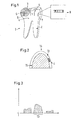
- a tooth element 1 designed as a tooth is shown.
- the denture element 1 consists of a natural denture element 2 and an artificial denture element 3.
- Several codings 4 are arranged on the denture element 1.
- the codes 4 can be arranged on the natural denture element 2, but also on the artificial denture element 3. Both are possible for all embodiments of the codes 4.
- the natural dentition element 2 may be a tooth or a part of the jawbone of a human dentition.
- the artificial denture element 2 can be designed as a seal, bridge, inlet, implant, artificial dentition or as a dental prosthetic item.
- the coding may store biometric information of a person or an animal.
- the coding can each have different configurations.
- the coding 4 is designed as an inking 5.
- the inking 5 can be permanently attached to the bit element 1.
- the coding 4 can also have an opto-electronically readable font 6.
- the opto-electronically readable font 6 may have a bar code, a bar code or a bar code.
- the coding 4 can be one-dimensional, but also multi-dimensional. It is possible to use the coding 4 as it is used in retail. In itself, it is possible to design the coding 4 so that you can see it with the naked eye. In practice, however, the coding 4 will be designed in such a way that it is not readable by the naked eye. In particular, one will choose a nanostructure 7. The nanostructure 7 is in Fig. 1 on the denture element 1 and as a zoom 8 to see greatly enlarged. Coding 4 is not noticeable to a third party, but it is nonetheless readable.
- An information density is plotted on the Y axis and a wavelength on the X axis.
- the information density is different from zero, ie at least one of the coding elements 9 is readable in this wavelength interval 10.
- One or more wavelength intervals 10 may be provided, wherein the wavelength intervals 10 may be configured disjoint, but also overlapping.
- a reading device 11 which has an optical filter and / or a wavelength-sensitive receiving element.
- a decoder 12 To make sure that no one can read code 4, they will be encrypted. To decrypt the coding 4 again, a decoder 12 must be used without which the coding 4 is not readable. For encoding one can also use different predetermined wavelength intervals 10.
- the heat protection 13 then prevents the coding 4 is damaged in fires, etc. Especially with fires in which badges burn etc., the coding 4 remains readable.
- Fig. 2 is a crown 14 to see. On its surface 15, the coding 4 is arranged.
- the heat protection 13 surrounds crown 14 and coding 4.
- the heat protection 13 can additionally take on a mechanical function. It can be made of hard material and thus prevent damage to the crown 14 with coding 4 in everyday life, but also in the event of an explosion.
- Fig. 4 the bit 1 is shown with coding 4.
- the coding 4 is read out by the read-out device 11. It can be encrypted. Therefore, behind the read-out device 11, the decoder 12 arranged, which decrypts the coding 4. Behind a data processing device 16 is arranged. The data processing device 16 then compares information 17 contained in the coding 4 with the further information 19 stored in a file 18. Thus, for example, the person can be identified on the basis of the coding 4 and the comparison with the further information 19 contained in the file. However, the data processing device 16 can also be used without a decoder 12 and without a file 18. Then it can serve, for example, to summarize several read coding elements 9 to the entire coding 4.
Landscapes
- Health & Medical Sciences (AREA)
- Life Sciences & Earth Sciences (AREA)
- Surgery (AREA)
- Veterinary Medicine (AREA)
- Public Health (AREA)
- General Health & Medical Sciences (AREA)
- Animal Behavior & Ethology (AREA)
- Pathology (AREA)
- Biomedical Technology (AREA)
- Oral & Maxillofacial Surgery (AREA)
- Molecular Biology (AREA)
- Medical Informatics (AREA)
- Heart & Thoracic Surgery (AREA)
- Engineering & Computer Science (AREA)
- Nuclear Medicine, Radiotherapy & Molecular Imaging (AREA)
- Dentistry (AREA)
- Biophysics (AREA)
- Physics & Mathematics (AREA)
- Environmental Sciences (AREA)
- Physical Education & Sports Medicine (AREA)
- Rheumatology (AREA)
- Biodiversity & Conservation Biology (AREA)
- Animal Husbandry (AREA)
- Zoology (AREA)
- Birds (AREA)
- Orthopedic Medicine & Surgery (AREA)
- Epidemiology (AREA)
- Measurement Of The Respiration, Hearing Ability, Form, And Blood Characteristics Of Living Organisms (AREA)
- Dental Tools And Instruments Or Auxiliary Dental Instruments (AREA)
Abstract
Description
- Die Erfindung betrifft ein Gebisselement, insbesondere ein künstliches Gebisselement.
- Ferner betrifft die Erfindung ein Verfahren zum Aufbringen einer Kodierung.
- Aus dem Übersichtsreferat "Identifikation unbekannter Toter durch odontologische Untersuchungen" '(Zeitschrift Rechtsmedizin, Vol. 11, S. 37-41, 2001; Springer Berlin Heidelberg) ist ein Verfahren bekannt, unbekannte Tote anhand von Untersuchungen des Zahnsystems zu identifizieren. Ein solches Verfahren wird vor allem dann durchgeführt, wenn andere Identifikationsmerkmale (etwa Personalpapiere oder Fingerabdrücke) in nicht ausreichender Weise vorhanden sind. Zähne weisen Zahnmerkmale auf, mit deren Hilfe sich Personen eindeutig identifizieren lassen. Zudem sind Zähne äußerst robust. Der Zahnschmelz gilt als härteste Substanz des menschlichen Körpers. Man kann bei der Identifikation ausnutzen, dass Zähne im Rahmen zahnärztlicher Behandlungen in zivilisierten Regionen registriert und dokumentiert sind. Bei einer vollständigen Dokumentation kann die Identifikation anhand prä- und postmortaler Befunde erfolgen. Alternativ kann ein Vergleich von prä- und postmortalen Röntgenbildern zur Identifikation führen. Insbesondere Panoramaschichtaufnahmen ermöglichen dem Rechtsmediziner eine zuverlässige Identifikation.
- Solche Verfahren haben sich zwar prinzipiell bewährt. Insbesondere bei Verbrennungen stellen die Zähne oft die einzig verbliebene Identifizierungsmöglichkeit dar. In jedem Fall erfordert aber eine solche Identifikation einen erheblichen Dokumentationsaufwand beim behandelnden Zahnarzt. Erschwert wird diese Dokumentation auch dadurch, dass viele Patienten beispielsweise aufgrund eines Ortswechsels oft den Zahnarzt wechseln. Röntgenbilder werden von Teilen der Bevölkerung aufgrund der Strahlenbelastung nur für den Fall einer absoluten Notwendigkeit akzeptiert.
- Der Erfindung liegt die Aufgabe zugrunde, eine einfache Identifizierungsmöglichkeit für eine Person oder ein Tier bereitzustellen.
- Diese Aufgabe wird bei einem Gebisselement der eingangs genannten Art dadurch gelöst, dass eine Kodierung an dem Gebisselement angeordnet ist.
- Mit dieser Ausgestaltung kann man auf einfache Weise Informationen am Gebisselement anbringen. Das Auslesen einer solchen Kodierung ist gegenüber einer Untersuchung am Zahnsystem erheblich einfacher und schneller. Man braucht nicht mehr den behandelnden Zahnarzt oder die behandelnden Zahnärzte ausfindig zu machen, sondern liest einfach die Kodierung vor Ort aus. Eine Strahlenbelastung entsteht dabei auch nicht. Auf diese Weise können schnell medizinische Maßnahmen ergriffen werden und/oder Angehörige informiert werden. Das Auslesen der Kodierung erfolgt über eine Ausleseeinrichtung wie einen Scanner oder eine Kamera.
- Als Gebisselement sind Zähne oder Teile des Kieferknochens der Person oder des Tieres denkbar. Es ist aber auch möglich, die Kodierung an dem künstlichen Gebisselement anzubringen. Insbesondere ist es möglich, die Kodierung an einer Plombe, einer Brücke, einem Inlet, einem Implantat, einem künstlichen Gebiss oder ganz allgemein an einem Zahnersatzteil anzubringen. Die Anordnung der Kodierung an dem künstlichen Gebisselement ist dabei besonders vorteilhaft. Sie kann außerhalb eines Körpers der Person oder des Tieres angebracht werden. Man muss also keine Rücksicht beim Anbringen auf den Körper nehmen.
- Insbesondere eine individuelle personenbezogene oder tierbezogene Kodierung ist denkbar. Diese kann Informationen zu Geburtsort, Wohnort, Name, Blutgruppe, Krankheiten, benötigter Medizin oder andere biometrische Daten der Person oder des Tieres beinhalten. Auch kann gespeichert werden, wer im Fall eines Unfalls benachrichtigt werden soll.
- Vorzugsweise ist die Kodierung als Farbauftrag ausgebildet. Dieser Farbauftrag kann dabei eine individuelle personenbezogene Farbgebung aufweisen. Die Farbgebung kann dabei so ausgestaltet sein, dass man die Farbgebung eindeutig der zu identifizierenden Person, ähnlich einem Fingerabdruck, zuweisen kann. Der Farbauftrag wird dabei unlöslich am Gebisselement angeordnet.
- Vorzugsweise weist die Kodierung eine optoelektronisch lesbare Schrift auf. Bei der optoelektronisch lesbaren Schrift kann es sich um einen Strichkode, Balkenkode oder Barkode handeln. Die Informationen können also in binären Symbolen gespeichert sein. Es sind ein- oder mehrdimensionale Kodierungen denkbar.
- Bevorzugterweise ist die Kodierung als Nanostruktur ausgebildet. Die Kodierung kann so klein sein, dass sie einerseits für ein menschliches Auge nicht sichtbar ist. Andererseits ist es aber für die Ausleseeinrichtung ohne Weiteres möglich, die Kodierung auszulesen. Der Mensch, der das kodierte Gebisselement trägt, hat also keinen ästhetischen Nachteil. Die Gefahr, dass in der Kodierung enthaltene Informationen an Unbefugte weitergegeben werden, ist damit auch reduziert.
- Bevorzugterweise ist ein Kodierungselement der Kodierung in einem vorbestimmten Wellenlängenintervall lesbar. Das Wellenlängenintervall kann in einem nicht sichtbaren Teil des Lichts sein. Dies hat den Vorteil, dass Unbefugte nicht ohne technischen Aufwand die Kodierung auslesen können.
- Bevorzugterweise sind Kodierungselemente der Kodierung jeweils in voneinander verschieden vorbestimmten Wellenlängenintervallen lesbar. Ein Teil der Kodierung kann also in einem bestimmten Wellenlängenintervall enthalten sein, während ein anderer Teil der Kodierung Teil eines anderen Wellenlängenintervalls ist. Die Wellenlängenintervalle können sich dabei überlappen, sie können aber auch disjunkt sein. Mit optischen Filtern und wellenlängensensiblen Empfangselementen kann man dann die in den jeweiligen Kodierungselementen enthaltenen Informationen auslesen und sie danach zusammenführen. Dazu kann eine Datenverarbeitungseinrichtung vorgesehen sein. Man erhält auf diese Weise auch eine hohe Informationsdichte, da man mehrere Wellenlängenintervalle, d.h. Kanäle, gleichzeitig benutzt.
- Vorzugsweise ist die Kodierung nur mit einem Dekodierer entschlüsselbar. Unbefugte können also die Kodierung nicht lesen. Der Dekodierer kann auch eine zusätzliche Datenverarbeitungseinrichtung aufweisen. Der Dekodierer benutzt dann die Informationen der Kodierung und dekodiert sie mit Hilfe der Datenverarbeitungseinrichtung.
- Vorzugsweise weist die Kodierung einen Hitzeschutz auf. Insbesondere bei Verbrennungen ist so gesichert, dass die Kodierung weiterhin lesbar bleibt und unbeschädigt ist. Der Hitzeschutz kann als Beschichtung ausgebildet sein. Es ist aber auch möglich, dass man der Kodierung eine Beimischung zufügt, die die Kodierung hitzebeständig macht.
- Die Aufgabe wird bei einem Verfahren der eingangs genannten Art dadurch gelöst, dass man die Kodierung an einem Gebisselement, insbesondere an einem künstlichen Gebisselement, aufbringt.
- In diesem Fall ist es nicht mehr erforderlich, die Person oder das Tier anhand odontologischer Untersuchungen zu identifizieren. Nachdem man einmal die Kodierung angebracht hat, kann man in der Kodierung gespeicherte Informationen einfach auslesen. Die Kodierung kann biometrische Informationen, aber auch beliebige andere Informationen enthalten, wie bereits erwähnt. Als Gebisselement kann man Teile eines menschlichen oder tierischen Gebisses verwenden. Man kann aber auch künstlich hergestellte Gebisselemente verwenden.
- Vorzugsweise trägt man die Kodierung mittels eines Farbauftrags auf. Das Auftragen kann beispielsweise mit einer Vorrichtung erfolgen, wie sie aus dem Patent
DE 10 2006 061 893 bekannt ist. Man kann den Farbauftrag so auftragen, dass er der Person oder dem Tier eindeutig zugeordnet werden kann. - Bevorzugterweise versieht man die Kodierung mit einem Hitzeschutz. Den Hitzeschutz kann man aufbringen, nachdem man die Kodierung aufgebracht hat. Dies kann aber auch in einem Schritt erfolgen, in dem man der Kodierung eine hitzebeständige Beimischung zufügt.
- Vorzugsweise verschlüsselt man die Kodierung. Unter Verwendung eines oder mehrerer Schlüssel werden lesbare Informationen in Geheiminformationen umgewandelt. Gerade sensible biometrische Daten können nur noch von einem Befugten gelesen werden, der im Besitz des Schlüssels ist.
- Hierbei ist von Vorteil, wenn man zum Verschlüsseln der Kodierung verschiedene vorbestimmte Wellenlängenintervalle verwendet. Bestimmte Teile der in der Kodierung gespeicherten Informationen sind nur in bestimmten Wellenlängenintervallen lesbar. Um die Kodierung lesen zu können, benötigt man dann verschiedene optische Filter und/oder wellenlängensensible optoelektrische Empfangselemente. Mit Hilfe einer Datenverarbeitungseinrichtung kann man dann die ausgelesenen Informationen zusammenführen und erhält so die vollständigen in der Kodierung gespeicherten Informationen.
- Bevorzugterweise liest man die Kodierung aus und vergleicht in der Kodierung enthaltene Informationen mit weiteren Informationen. Man kann zuerst die in der Kodierung enthaltenen Informationen, die beispielsweise im Farbauftrag enthalten sind, auslesen. Die so gewonnenen Informationen vergleicht man dann mit weiteren Informationen, die beispielsweise in einer Datei gespeichert sind. So kann die das Gebisselement tragende Person identifiziert werden und möglicherweise können noch zusätzliche Informationen über sie gewonnen werden.
- Die Erfindung wird im Folgenden anhand eines bevorzugten Ausführungsbeispiels in Verbindung mit den Zeichnungen beschrieben. Hierin zeigen:
- Fig. 1
- ein als Zahn ausgebildetes Gebisselement mit mehreren Kodierungen. Ein Teil des Zahns ist durch ein künstliches Gebisselement ersetzt.
- Fig. 2
- einen Schnitt durch eine Krone mit Kodierung und einem Hitzeschutz,
- Fig. 3
- ein Diagramm mit einer Informationsdichte als Funktion einer Wellenlänge,
- Fig. 4
- eine schematische Anordnung einer Ausleseein- richtung, einem Dekodierer, einer Datenverar- beitungseinrichtung und einer Datei.
- In
Fig. 1 ist ein als Zahn ausgebildetes Gebisselement 1 dargestellt. Das Gebisselement 1 besteht aus einem natürlichen Gebisselement 2 und einem künstlichen Gebisselement 3. An dem Gebisselement 1 sind mehrere Kodierungen 4 angeordnet. Die Kodierungen 4 können am natürlichen Gebisselement 2, aber auch am künstlichen Gebisselement 3 angeordnet sein. Beides ist für alle Ausgestaltungen der Kodierungen 4 möglich. Das natürliche Gebisselement 2 kann ein Zahn oder ein Teil des Kieferknochens eines menschlichen Gebisses sein. Das künstliche Gebisselement 2 kann als Plombe, Brücke, Inlet, Implantat, künstliches Gebiss oder als Zahnersatzteil ausgebildet sein. - In der Kodierung können biometrische Informationen einer Person oder eines Tieres gespeichert sein.
- Die Kodierung kann dabei jeweils verschiedene Ausgestaltungen haben. Insbesondere ist es denkbar, dass die Kodierung 4 als Farbauftrag 5 ausgebildet ist. Der Farbauftrag 5 kann permanent an das Gebisselement 1 angebracht werden. Insbesondere kann man den Farbauftrag 5 so wählen, dass dessen Farbe im nicht sichtbaren Bereich des Lichts liegt. Dies erschwert einem Unbefugten ein Auslesen der Kodierung 4.
- Man kann die Kodierung 4 auch eine optoelektronisch lesbare Schrift 6 aufweisen lassen. Die optoelektronisch lesbare Schrift 6 kann einen Strichkode, einen Balkenkode oder einen Barkode aufweisen. Die Kodierung 4 kann eindimensional, aber auch mehrdimensional sein. Es ist möglich, die Kodierung 4 so zu verwenden, wie sie im Einzelhandel benutzt wird. An sich ist es möglich, die Kodierung 4 so auszugestalten, dass man sie mit bloßem Auge sehen kann. In der Praxis wird man die Kodierung 4 aber so ausgestalten, dass sie mit bloßem Auge nicht lesbar ist. Insbesondere wird man eine Nanostruktur 7 wählen. Die Nanostruktur 7 ist in
Fig. 1 auf dem Gebisselement 1 und als Zoom 8 stark vergrößert zu sehen. Die Kodierung 4 fällt so einem Dritten nicht auf, sie ist aber trotzdem lesbar. - Man kann ein Kodierungselement 9, aber auch die gesamte Kodierung 4 in einem vorbestimmten Wellenlängenintervall 10 lesbar ausgestalten. Wählt man als Wellenlängenintervall 10 den nicht sichtbaren Teil des Lichts, dann ist die Kodierung 4 unabhängig von ihrer Größe nicht sichtbar.
- Wie in
Fig. 3 dargestellt kann man auch Kodierungselemente 9 der Kodierung 4 jeweils in voneinander verschiedenen vorbestimmten Wellenlängenintervallen 10 lesbar ausgestalten. InFig. 3 ist auf der Y-Achse eine Informationsdichte und auf der X-Achse eine Wellenlänge aufgetragen. Beispielsweise im Wellenlängenintervall 10 ist die Informationsdichte von Null verschieden, d.h. zumindest eines der Kodierungselemente 9 ist in diesem Wellenlängenintervall 10 lesbar. Man kann ein oder auch mehrere Wellenlängenintervalle 10 vorsehen, wobei die Wellenlängenintervalle 10 disjunkt, aber auch überlappend ausgestaltet sein können. Um die gesamte Kodierung 4 auslesen zu können, kann man eine Ausleseeinrichtung 11 vorsehen, die einen optischen Filter und/oder ein wellenlängensensibles Empfangselement aufweist. - Um sicher zu gehen, dass Niemand Unbefugtes die Kodierung 4 lesen kann, wird man sie verschlüsseln. Um die Kodierung 4 wieder zu entschlüsseln, muss ein Dekodierer 12 verwendet werden, ohne den die Kodierung 4 nicht lesbar ist. Zum Verschlüsseln kann man auch verschiedene vorbestimmte Wellenlängenintervalle 10 benutzen.
- Idealerweise wird man einen Hitzeschutz 13 vorsehen. Der Hitzeschutz 13 verhindert dann, dass die Kodierung 4 bei Bränden etc. beschädigt wird. Gerade bei Bränden, bei denen Ausweise etc. verbrennen, bleibt die Kodierung 4 weiter auslesbar. In
Fig. 2 ist eine Krone 14 zu sehen. An ihrer Oberfläche 15 ist die Kodierung 4 angeordnet. Der Hitzeschutz 13 umgibt Krone 14 und Kodierung 4. Der Hitzeschutz 13 kann zusätzlich auch noch eine mechanische Funktion übernehmen. Er kann aus hartem Material gefertigt sein und so die Beschädigung der Krone 14 mit Kodierung 4 im Alltag, aber auch im Falle einer Explosion verhindern. - In
Fig. 4 ist das Gebisselement 1 mit Kodierung 4 gezeigt. Die Kodierung 4 wird von der Ausleseeinrichtung 11 ausgelesen. Sie kann verschlüsselt sein. Deswegen ist hinter der Ausleseeinrichtung 11 der Dekodierer 12 angeordnet, der die Kodierung 4 entschlüsselt. Dahinter ist eine Datenverarbeitungseinrichtung 16 angeordnet. Die Datenverarbeitungseinrichtung 16 vergleicht dann in der Kodierung 4 enthaltene Informationen 17, mit denen in einer Datei 18 gespeicherten weiteren Informationen 19. So kann beispielsweise aufgrund der Kodierung 4 und dem Vergleich mit den in der Datei 18 enthaltenen weiteren Informationen 19 die Person identifiziert werden. Die Datenverarbeitungseinrichtung 16 kann aber auch ohne Dekodierer 12 und ohne Datei 18 benutzt werden. Dann kann sie beispielsweise dazu dienen, mehrere ausgelesene Kodierungselemente 9 zur gesamten Kodierung 4 zusammenzufassen.
Claims (14)
- Gebisselement, insbesondere künstliches Gebisselement, dadurch gekennzeichnet, dass eine Kodierung (4) an dem Gebisselement (1) angeordnet ist.
- Gebisselement nach Anspruch 1, dadurch gekennzeichnet, dass die Kodierung (4) als Farbauftrag (5) ausgebildet ist.
- Gebisselement nach einem der Ansprüche 1 oder 2, dadurch gekennzeichnet, dass die Kodierung (4) eine optoelektronisch lesbare Schrift (6) aufweist.
- Gebisselement nach einem der Ansprüche 1 bis 3, dadurch gekennzeichnet, dass die Kodierung (4) als Nanostruktur (7) ausgebildet ist.
- Gebisselement nach einem der Ansprüche 1 bis 4, dadurch gekennzeichnet, dass ein Kodierungselement (9) der Kodierung (4) in einem vorbestimmten Wellenlängenintervall (10) lesbar ist.
- Gebisselement nach Anspruch 5, dadurch gekennzeichnet, dass Kodierungselemente (9) der Kodierung (4) jeweils in voneinander verschiedenen vorbestimmten Wellenlängenintervallen (10) lesbar sind.
- Gebisselement nach einem der Ansprüche 1 bis 6, dadurch gekennzeichnet, dass die Kodierung (4) nur mit einem Dekodierer (12) entschlüsselbar ist.
- Gebisselement nach einem der Ansprüche 1 bis 7, dadurch gekennzeichnet, dass die Kodierung (4) einen Hitzeschutz (13) aufweist.
- Verfahren zum Aufbringen einer Kodierung, dadurch gekennzeichnet, dass man die Kodierung an einem Gebisselement, insbesondere an einem künstlichen Gebisselement, aufbringt.
- Verfahren nach Anspruch 9, dadurch gekennzeichnet, dass man die Kodierung mittels eines Farbauftrags aufträgt.
- Verfahren nach einem der Ansprüche 9 oder 10, dadurch gekennzeichnet, dass man die Kodierung mit einem Hitzeschutz versieht.
- Verfahren nach einem der Ansprüche 9 bis 11, dadurch gekennzeichnet, dass man die Kodierung verschlüsselt.
- Verfahren nach Anspruch 12, dadurch gekennzeichnet, dass man zum Verschlüsseln der Kodierung verschiedene vorbestimmte Wellenlängenintervalle verwendet.
- Verfahren nach einem der Ansprüche 9 bis 13, dadurch gekennzeichnet, dass man die Kodierung ausliest und die in der Kodierung enthaltenen Informationen mit weiteren Informationen vergleicht.
Applications Claiming Priority (1)
| Application Number | Priority Date | Filing Date | Title |
|---|---|---|---|
| DE102009043281A DE102009043281A1 (de) | 2009-09-29 | 2009-09-29 | Gebisselement-Kodierung |
Publications (1)
| Publication Number | Publication Date |
|---|---|
| EP2301330A1 true EP2301330A1 (de) | 2011-03-30 |
Family
ID=43035005
Family Applications (1)
| Application Number | Title | Priority Date | Filing Date |
|---|---|---|---|
| EP10009309A Withdrawn EP2301330A1 (de) | 2009-09-29 | 2010-09-08 | Kodierung für ein Gebisselement |
Country Status (3)
| Country | Link |
|---|---|
| US (1) | US20110076647A1 (de) |
| EP (1) | EP2301330A1 (de) |
| DE (1) | DE102009043281A1 (de) |
Cited By (2)
| Publication number | Priority date | Publication date | Assignee | Title |
|---|---|---|---|---|
| WO2014131866A1 (de) * | 2013-02-28 | 2014-09-04 | Sirona Dental Systems Gmbh | Verfahren und vorrichtung zur steuerung eines computerprogramms mittels eines intraoralen scanners |
| EP2879612A4 (de) * | 2012-08-05 | 2016-04-06 | Mishel Veshler | Verfahren zum kennzeichnen und identifizieren von implantaten und markierte implantate zur datenregistrierung und identifizierung von implantaten anhand einer nichtinvasiven vorrichtung |
Families Citing this family (7)
| Publication number | Priority date | Publication date | Assignee | Title |
|---|---|---|---|---|
| JP6121178B2 (ja) * | 2013-01-31 | 2017-04-26 | 株式会社ギコウ | 人工歯 |
| CN105530834B (zh) | 2013-08-13 | 2018-03-16 | 高露洁-棕榄公司 | 口腔护理器具 |
| FR3024831B1 (fr) * | 2014-08-14 | 2018-02-16 | Pascal Schmitt | Dispositif dentaire en ceramique comprenant un marquage invisible |
| CN105581849A (zh) * | 2014-10-23 | 2016-05-18 | 北京大学口腔医学院 | 多色树脂义齿修复体一体化快速成型方法 |
| JP2017070853A (ja) * | 2017-01-26 | 2017-04-13 | 株式会社ギコウ | 人工歯および義歯管理装置並びに義歯管理プログラム |
| CN106821523A (zh) * | 2017-02-10 | 2017-06-13 | 爱迪特(秦皇岛)科技股份有限公司 | 带基牙的基托上粘结全瓷牙冠的数字化全口义齿修复方法 |
| CN108309493B (zh) * | 2018-02-12 | 2021-01-05 | 苏州佳世达光电有限公司 | 口腔扫描仪控制方法及口腔扫描设备 |
Citations (11)
| Publication number | Priority date | Publication date | Assignee | Title |
|---|---|---|---|---|
| US4027391A (en) * | 1974-03-26 | 1977-06-07 | Philip Lawrence Samis | Positive identification method and structure |
| DE2811177A1 (de) * | 1977-03-22 | 1978-10-05 | Muehlemann Hans R | Forensische identifizierung |
| WO1986000213A1 (en) * | 1984-06-18 | 1986-01-16 | Mc-Mid, Inc. | Identification device and method |
| US4797101A (en) * | 1987-03-11 | 1989-01-10 | Alvan Morris | Dental identification system |
| US5044955A (en) * | 1989-05-09 | 1991-09-03 | Jagmin Gary E | Radiographically readable information carrier and method of using same |
| US5083814A (en) * | 1991-03-27 | 1992-01-28 | Sms Group Inc. | Security method with applied invisible security code markings |
| US5509805A (en) * | 1993-11-16 | 1996-04-23 | Jagmin; Gary E. | Radiographically readable information carrier and method of using the same |
| GB2297261A (en) * | 1995-01-26 | 1996-07-31 | Univ Wales Medicine | Medical or dental appliance carrying an embedded machine readable code |
| US5878155A (en) * | 1996-09-05 | 1999-03-02 | Heeter; Thomas W. | Method for verifying human identity during electronic sale transactions |
| DE102006052478A1 (de) * | 2006-11-07 | 2008-05-08 | Aepsilon Rechteverwaltungs Gmbh | Zahnersatzteil |
| DE102006061893B3 (de) | 2006-12-28 | 2008-07-10 | Ditzel Werkzeug- Und Maschinenfabrik Gmbh | Vorrichtung zum Aufbringen eines Farbauftrags |
Family Cites Families (9)
| Publication number | Priority date | Publication date | Assignee | Title |
|---|---|---|---|---|
| US4557693A (en) * | 1983-11-18 | 1985-12-10 | Exact-1-Dent, Incorporated | Human identification system |
| US5037301A (en) * | 1989-11-17 | 1991-08-06 | Dentistry Researchers & Designers Inc. | Method enabling dental identification of humans and animals |
| US6119943A (en) * | 1994-12-12 | 2000-09-19 | Moore Business Forms, Inc. | Multi-layer bar code arrangement using wavelength separation |
| US5782638A (en) * | 1995-05-19 | 1998-07-21 | Warren, Iii; A. Daniel | Ornamental film article for dental substrate decoration and dental substrate decorated therewith |
| US5759039A (en) * | 1997-04-17 | 1998-06-02 | Kunstadter; Maria A. | Method and system for applying designs to teeth |
| US6041102A (en) * | 1998-04-08 | 2000-03-21 | Francsis; Kenneth M. | Data-imprinted dental radiograph device and process |
| US5873724A (en) * | 1998-04-13 | 1999-02-23 | Carucci; Carmine A. | Dental implants for identification purposes |
| DE29907738U1 (de) * | 1999-05-03 | 1999-09-02 | Furtenhofer, Kay Oliver, Dr.med., 46045 Oberhausen | Gebißprothese, insbesondere aus Kunststoff |
| US20090029310A1 (en) * | 2007-02-26 | 2009-01-29 | Clearcorrect, Inc. | Dental models and series of dental models, and methods and apparatus for making and using same |
-
2009
- 2009-09-29 DE DE102009043281A patent/DE102009043281A1/de not_active Withdrawn
-
2010
- 2010-09-08 EP EP10009309A patent/EP2301330A1/de not_active Withdrawn
- 2010-09-23 US US12/888,942 patent/US20110076647A1/en not_active Abandoned
Patent Citations (11)
| Publication number | Priority date | Publication date | Assignee | Title |
|---|---|---|---|---|
| US4027391A (en) * | 1974-03-26 | 1977-06-07 | Philip Lawrence Samis | Positive identification method and structure |
| DE2811177A1 (de) * | 1977-03-22 | 1978-10-05 | Muehlemann Hans R | Forensische identifizierung |
| WO1986000213A1 (en) * | 1984-06-18 | 1986-01-16 | Mc-Mid, Inc. | Identification device and method |
| US4797101A (en) * | 1987-03-11 | 1989-01-10 | Alvan Morris | Dental identification system |
| US5044955A (en) * | 1989-05-09 | 1991-09-03 | Jagmin Gary E | Radiographically readable information carrier and method of using same |
| US5083814A (en) * | 1991-03-27 | 1992-01-28 | Sms Group Inc. | Security method with applied invisible security code markings |
| US5509805A (en) * | 1993-11-16 | 1996-04-23 | Jagmin; Gary E. | Radiographically readable information carrier and method of using the same |
| GB2297261A (en) * | 1995-01-26 | 1996-07-31 | Univ Wales Medicine | Medical or dental appliance carrying an embedded machine readable code |
| US5878155A (en) * | 1996-09-05 | 1999-03-02 | Heeter; Thomas W. | Method for verifying human identity during electronic sale transactions |
| DE102006052478A1 (de) * | 2006-11-07 | 2008-05-08 | Aepsilon Rechteverwaltungs Gmbh | Zahnersatzteil |
| DE102006061893B3 (de) | 2006-12-28 | 2008-07-10 | Ditzel Werkzeug- Und Maschinenfabrik Gmbh | Vorrichtung zum Aufbringen eines Farbauftrags |
Non-Patent Citations (1)
| Title |
|---|
| "Identifikation unbekannter Toter durch odontologische Untersuchungen", vol. 11, 2001, SPRINGER, pages: 37 - 41 |
Cited By (3)
| Publication number | Priority date | Publication date | Assignee | Title |
|---|---|---|---|---|
| EP2879612A4 (de) * | 2012-08-05 | 2016-04-06 | Mishel Veshler | Verfahren zum kennzeichnen und identifizieren von implantaten und markierte implantate zur datenregistrierung und identifizierung von implantaten anhand einer nichtinvasiven vorrichtung |
| WO2014131866A1 (de) * | 2013-02-28 | 2014-09-04 | Sirona Dental Systems Gmbh | Verfahren und vorrichtung zur steuerung eines computerprogramms mittels eines intraoralen scanners |
| US10271712B2 (en) | 2013-02-28 | 2019-04-30 | Dentsply Sirona Inc. | Method and device for controlling a computer program by means of an intraoral scanner |
Also Published As
| Publication number | Publication date |
|---|---|
| US20110076647A1 (en) | 2011-03-31 |
| DE102009043281A1 (de) | 2011-04-07 |
Similar Documents
| Publication | Publication Date | Title |
|---|---|---|
| EP2301330A1 (de) | Kodierung für ein Gebisselement | |
| Sweet | Forensic dental identification | |
| EP1527795B1 (de) | Vorrichtung zur Identifizierung von vorgefüllten medizinischen Spritzen | |
| EP2344988B1 (de) | Medizinisches produkt | |
| Hinchliffe | Forensic odontology, part 1. Dental identification | |
| Singh et al. | Dental orthopantomogram biometrics system for human identification | |
| EP1730666A1 (de) | Verfahren und system zur identifikation, verifikation, erkennung und wiedererkennung | |
| DE10023840B4 (de) | Farbfestlegungsvorrichtung sowie Verfahren zur Bestimmung und Festlegung von Farben für Zähne und Zahnrestaurationen | |
| Savić Pavičin et al. | Maintenance of dental records and forensic odontology awareness: a survey of Croatian dentists with implications for dental education | |
| EP2766863A1 (de) | Verfahren zur bearbeitung von patientenbezogenen datensätzen | |
| De Angelis et al. | Implant bone integration importance in forensic identification | |
| DE202019005316U1 (de) | Computerprogramm und System zum Verwalten von auf einen Patienten bezogenen Medizindaten | |
| EP1184801A2 (de) | Tele-Auswertesystem, insbesondere für die Medizin | |
| DE102016103694A1 (de) | Sicherheitsdokument und Verfahren zu dessen Authentifizierung | |
| EP3703571B1 (de) | Haltevorrichtung für röntgenfilme | |
| EP1956512A1 (de) | Verfahren zur kryptographischen Datenverschlüsselung | |
| EP2245787A2 (de) | System zum kontrollierten datenaustausch zwischen mindestens zwei datenträgern über mobile schreib-lese-speicher | |
| DE102017103804B4 (de) | Endoskopisches Bildaufnahmeverfahren und zugehörige Vorrichtung | |
| EMILIANO et al. | Potential contribution of periapical radiographic film image processing for forensic identification | |
| de Andrade et al. | Endodontic images as a forensic identification: A literature review | |
| Balagopal | The Application and Cogency of Dental Restorations and Endodontics in Forensic Odontology | |
| DE19802931C1 (de) | Übertragung von Bilddaten, insbesondere von medizinischen Bilddaten für Archivierungszwecke mit Zugriffssicherung | |
| DE102023119698A1 (de) | Identifikationselement zum Digitalisieren und Identifizieren eines Menschen oder eines Tieres und ein Verfahren zur Herstellung eines solchen Identifikationselements | |
| Bassed | Forensic odontology–Broader than just identification | |
| Winarno et al. | Utilization of quick response codes technology in forensic odontology procedures |
Legal Events
| Date | Code | Title | Description |
|---|---|---|---|
| PUAI | Public reference made under article 153(3) epc to a published international application that has entered the european phase |
Free format text: ORIGINAL CODE: 0009012 |
|
| AK | Designated contracting states |
Kind code of ref document: A1 Designated state(s): AL AT BE BG CH CY CZ DE DK EE ES FI FR GB GR HR HU IE IS IT LI LT LU LV MC MK MT NL NO PL PT RO SE SI SK SM TR |
|
| AX | Request for extension of the european patent |
Extension state: BA ME RS |
|
| RIN1 | Information on inventor provided before grant (corrected) |
Inventor name: NEUMEIER, PETER Inventor name: DITZEL, THOMAS |
|
| 17P | Request for examination filed |
Effective date: 20110416 |
|
| 17Q | First examination report despatched |
Effective date: 20110705 |
|
| STAA | Information on the status of an ep patent application or granted ep patent |
Free format text: STATUS: THE APPLICATION HAS BEEN WITHDRAWN |
|
| 18W | Application withdrawn |
Effective date: 20121222 |