EP2305571A1 - Procédé, étoffes et machines permettant d'obtenir des sacs et des articles similaires sans couture - Google Patents
Procédé, étoffes et machines permettant d'obtenir des sacs et des articles similaires sans couture Download PDFInfo
- Publication number
- EP2305571A1 EP2305571A1 EP09800084A EP09800084A EP2305571A1 EP 2305571 A1 EP2305571 A1 EP 2305571A1 EP 09800084 A EP09800084 A EP 09800084A EP 09800084 A EP09800084 A EP 09800084A EP 2305571 A1 EP2305571 A1 EP 2305571A1
- Authority
- EP
- European Patent Office
- Prior art keywords
- bags
- fabric
- strands
- transversal
- cutting
- Prior art date
- Legal status (The legal status is an assumption and is not a legal conclusion. Google has not performed a legal analysis and makes no representation as to the accuracy of the status listed.)
- Withdrawn
Links
- 239000004744 fabric Substances 0.000 title claims abstract description 58
- 238000000034 method Methods 0.000 title claims abstract description 19
- 238000005520 cutting process Methods 0.000 claims abstract description 35
- 238000007667 floating Methods 0.000 claims abstract description 17
- 238000005304 joining Methods 0.000 claims abstract description 10
- 238000009941 weaving Methods 0.000 claims abstract description 6
- 238000004519 manufacturing process Methods 0.000 claims description 18
- 230000001360 synchronised effect Effects 0.000 claims description 2
- 239000003086 colorant Substances 0.000 description 3
- 239000004033 plastic Substances 0.000 description 3
- 229920003023 plastic Polymers 0.000 description 3
- 239000000463 material Substances 0.000 description 2
- 239000000123 paper Substances 0.000 description 2
- 238000007639 printing Methods 0.000 description 2
- 230000000712 assembly Effects 0.000 description 1
- 238000000429 assembly Methods 0.000 description 1
- 230000015572 biosynthetic process Effects 0.000 description 1
- 238000010276 construction Methods 0.000 description 1
- 238000005034 decoration Methods 0.000 description 1
- 230000005484 gravity Effects 0.000 description 1
- 238000009434 installation Methods 0.000 description 1
- 238000003892 spreading Methods 0.000 description 1
- 239000002699 waste material Substances 0.000 description 1
- 238000003466 welding Methods 0.000 description 1
- 238000004804 winding Methods 0.000 description 1
Images



Classifications
-
- B—PERFORMING OPERATIONS; TRANSPORTING
- B65—CONVEYING; PACKING; STORING; HANDLING THIN OR FILAMENTARY MATERIAL
- B65D—CONTAINERS FOR STORAGE OR TRANSPORT OF ARTICLES OR MATERIALS, e.g. BAGS, BARRELS, BOTTLES, BOXES, CANS, CARTONS, CRATES, DRUMS, JARS, TANKS, HOPPERS, FORWARDING CONTAINERS; ACCESSORIES, CLOSURES, OR FITTINGS THEREFOR; PACKAGING ELEMENTS; PACKAGES
- B65D29/00—Sacks or like containers made of fabrics; Flexible containers of open-work, e.g. net-like construction
-
- D—TEXTILES; PAPER
- D03—WEAVING
- D03D—WOVEN FABRICS; METHODS OF WEAVING; LOOMS
- D03D1/00—Woven fabrics designed to make specified articles
- D03D1/04—Sack- or bag-like articles
-
- D—TEXTILES; PAPER
- D03—WEAVING
- D03D—WOVEN FABRICS; METHODS OF WEAVING; LOOMS
- D03D5/00—Selvedges
Definitions
- Plastic bags are very economic and easy to manufacture by welding and die cutting, and are widely used, generally for a single use, such as for instance when purchasing in stores, mainly in supermarkets and similar shops. This material is not biodegradable and creates a serious waste problem.
- Paper bags although their manufacturing is more complex, are also economic, but they are not very strong, thus their use is limited.
- cloth bags are the most ecological and are quite strong, though their handicap is their high cost, especially due to the cutting and stitching operations they require in the manufacturing process.
- the object of this invention is a procedure, fabrics and machines for obtaining bags and similar products without any stitching.
- This procedure produces bags or similar products directly from the loom with a subsequent die-cutting process, which results in a low cost that can compete with plastic bags, enabling them be used as single-use bags, even though due to their construction, they can be used several times.
- the procedure consists of weaving two superimposed separate pieces of fabric, which are joined together transversally by weaving strands of warp at predetermined distances using strands of the weft, at the same time, in the direction of the warp independent bands with the corresponding hems in the longitudinal edges are formed in the loom, the sides of which are then subject to total or partial die cutting that conforms the bag or similar product.
- the die cutting will produce a bag or similar product with the desired shape, for instance with or without handles, but there will always be die cutting in transversal direction, that be intermittent or continuous, obtaining in the first case bands of bags that can be separated by the user and can be commercialised in rolls, and in the second case, separate units will be produced that may be stacked and commercialised in boxes, for instance.
- This procedure can also incorporate silkscreen printing to customise the bags with the desired motifs.
- One of the fabrics to be used is composed of two independent superimposed pieces of fabric interwoven in transversal and longitudinal bands determining the hems between which are the joining areas with floating strands of warp and joining areas with strands of floating weft.
- bands are formed with transversal joining areas with floating strands of warp, which are installed in the winding machine to manufacture the bags.
- This machine is fitted with at least one roll of fabric and comprises means for moving, tensioning and aligning the fabric, means for transversal and angular or curved cutting, and means for stacking the bags manufactured.
- the means for moving, tensioning and aligning the fabric consist of a transversal spiked comb that is inserted into the areas with floating strands of warp and that is movable and retractable, moving with a motor under a platform with longitudinal slits on which the fabric moves along.
- the means for transversal cutting consists of a pneumatically activated cylinder holding an electric cutter, in collaboration with a pneumatic pressure pad that maintains the fabric tense.
- the means for stacking comprise a reception tray with to and fro and vertical movements on which the bags are deposited.
- the procedure object of the invention for obtaining bags and similar products made of fabric without any stitching consists in weaving on a loom of any type, for instance sulzer, airjet, ketten and raschel, two separate superimposed pieces of cloth (1 and 2) that at predetermined distances (x) are joined transversally by interweaving the strands of warp using strands (3) of the weft.
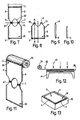
- the transversal die cutting (6') is carried out in the area where the two pieces of cloth join with strands (3) of the weft and this is complemented with other curved cuts (9, 10 and 11) forming the handles (12 and 13) of the bag (7').
- Figure 11 illustrates a band already cut, but with the transversal cut (6") partial (intermittent) so that the collection of bags can be rolled up forming a reel (14) from which the user can detach the bags, one by one.
- the reel (14) may be placed, for instance, in a dispensing machine.
- the die cutting phase may also be done by spreading the fabric from a roll (16) along a table (M) ( figure 12 ) forming several layers (18) one on top of the other, making cuts in different areas (17) coinciding in each layer to obtain blocks of ready-cut bags one on top of the other.
- M table
- the bags both those without handles (7) as well as (7') with handles, either in rolls or stacked, can be dispensed in boxes (15) with the features of 2 or as desired ( figure 13 ).
- the bags can be customised (19) either with decorations or motifs, by means of printing (20) for instance by transfer or laser. This can be done at the moment of die cutting, in the case of the process according to figures 4 and 7 , or before die cutting, in the case of figure 12 .
- the procedure produces bags with or without handles, however, with the same procedure, other similar products can be obtained, such as sacks, containers and covers in general, for instance for pillows.
- the bags can be obtained in uniform colours or several colours combined to give them a more original appearance, for this purpose there will be tinted strands in the loom with the predetermined colours.
- the fabric used for manufacturing the bags is composed of a separate double cloth (1, 2) with stroke without weft with strands of floating warp (3') (width of the fabric) and with combed empty spaces with strands of floating weft (3") (length of the fabric) that join the hems (5) of the double cloth of this fabric, bands are cut longitudinally (B) ( figure 15 ) by the strands of floating weft (3").
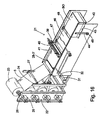
- the machine (21) comprises a support (22) where the four rolls are fitted (23) vertically (formed by bands (B) of fabric), which are centred to determine the location of the hems (5) for the transversal cutting and final stacking.
- photoelectric sensors (24) that transmit a signal to electrical worm drive lineal actuators (25) for guiding, with incorporated end of travel devices, the driving part comprising a linear bearing (26).
- the roll carrier has an adjustable braking system (not illustrated), which will be used if the roll has inertia greater than the stretching.
- the photoelectric sensors (24) are incorporated into alignment assemblies (27) that adjust the tension of the fabric in each roll.
- the means for moving, tensioning and aligning the fabric comprise a spiked comb (28) ( figure 17 ) that enters the areas with floating strands of warp (3') and that is (movable) by lineal guides (29) a double ball circulation (30) by the action of a servo-motorised motor (31), that incorporates an encoder inside, obtaining precision in stoppage, and to which a gear reduction motor (32) is fitted.
- the spiked comb (28) is also retractable by the action of parallel pneumatic cylinders (33 and 34).
- the spiked comb For the search by the spiked comb (28), in the area of floating warp (3') there is a strand of weft (T) of a different colour, detected by a fire optic photoelectric sensor (35) built into the spiked comb (28) ( figure 17 ), which runs under a platform (36) ( figure 18 ) with longitudinal slits (37) for the passage of the spikes of the comb and along which the fabric is moved.
- This platform has a small window (38) through which the photoelectric sensor works (35).
- the comb (28) when it reaches the mark formed by the strand of weft (T) rises to move the fabric, then an end of travel sensor is activated (39) that stops the movement and a pneumatic pressure pad (40) maintains the stretch tension lowering the spiked comb (28) to proceed then with the transversal cutting through the centre of the strands (3') by means of a pneumatic cylinder (41) holding an electric cutter.
- the means of stacking the manufactured bags comprises a motorised reception tray (42), with a to and fro movement on a base (43) ( figure 16 ) and vertical movement by means of rails (44) and with a lowering sensor (45), to which the bags arrive from a motorised conveyor belt (46) on two rollers at the ends (47 and 48), and synchronised with the reception tray (42).
- An alternative to the conveyor belt (46) consists of four pneumatic clamps (49) on the sides of the platform (36) ( figure 18 ) that will hold the sides of the bags and take them and deposit them by gravity onto the reception tray (42).
- Angular or curved cutting may be carried out by different systems incorporated to the machine and placed before the stacking devices.
- FIG. 19 An example of a cutting system could be that represented in figure 19 , comprising electric cutters (50) a rotating disc moved by a pneumatic cylinder (51) without shaft with and end of travel damper, or moved by an electric motor and pulleys; Reference (52) shows a tray comprising the cutting devices and the guides (53) for moving these devices.
- An angular or curved cut determines the handles of the bag (BO).
- the cutting system to obtain the handles of the bag may be any other, for instance through a bridge die cutter using in motorised band at the lower part.
Landscapes
- Engineering & Computer Science (AREA)
- Textile Engineering (AREA)
- Mechanical Engineering (AREA)
- Treatment Of Fiber Materials (AREA)
- Woven Fabrics (AREA)
- Looms (AREA)
Applications Claiming Priority (3)
| Application Number | Priority Date | Filing Date | Title |
|---|---|---|---|
| ES200802170A ES2345080B2 (es) | 2008-07-22 | 2008-07-22 | Procedimiento para la obtencion de bolsas y similares de tejido sin ningun cosido. |
| ES200901268A ES2354547B2 (es) | 2009-05-22 | 2009-05-22 | Tejido y maquina para la fabricacion de bolsas. |
| PCT/ES2009/000361 WO2010010205A1 (fr) | 2008-07-22 | 2009-07-10 | Procédé, étoffes et machines permettant d'obtenir des sacs et des articles similaires sans couture |
Publications (1)
| Publication Number | Publication Date |
|---|---|
| EP2305571A1 true EP2305571A1 (fr) | 2011-04-06 |
Family
ID=41570046
Family Applications (1)
| Application Number | Title | Priority Date | Filing Date |
|---|---|---|---|
| EP09800084A Withdrawn EP2305571A1 (fr) | 2008-07-22 | 2009-07-10 | Procédé, étoffes et machines permettant d'obtenir des sacs et des articles similaires sans couture |
Country Status (3)
| Country | Link |
|---|---|
| EP (1) | EP2305571A1 (fr) |
| CN (1) | CN102105364A (fr) |
| WO (1) | WO2010010205A1 (fr) |
Families Citing this family (5)
| Publication number | Priority date | Publication date | Assignee | Title |
|---|---|---|---|---|
| AT512806B1 (de) * | 2012-04-23 | 2014-01-15 | Bsw Machinery Handels Gmbh | Gewebe für die Herstellung von Säcken |
| CN105269621A (zh) * | 2015-09-18 | 2016-01-27 | 王跃军 | 一种eps保温板用设备及切割方法 |
| CN108842259B (zh) * | 2018-06-27 | 2019-12-27 | 桐乡波力科技复材用品有限公司 | woven布手工编织机 |
| TWI702173B (zh) * | 2019-05-30 | 2020-08-21 | 張瑞興 | 雙層防潮袋單工序作業裝置 |
| CN110346377A (zh) * | 2019-07-11 | 2019-10-18 | 浙江蒲惠智造科技有限公司 | 基于机器视觉的无纺布表面检测系统及其检测方法 |
Family Cites Families (8)
| Publication number | Priority date | Publication date | Assignee | Title |
|---|---|---|---|---|
| BE531575A (fr) * | ||||
| FR802430A (fr) * | 1936-02-26 | 1936-09-04 | Procédé de fabrication de sacs et produit nouveau en résultant | |
| ES8308259A1 (es) * | 1982-09-18 | 1983-09-16 | Intermas Sa | "procedimiento para la confeccion de sacos y similares". |
| ES1003058U (es) * | 1987-08-03 | 1988-07-01 | Mitjans Canalda Juan | Envase multiple monopieza |
| US4909636A (en) * | 1988-04-26 | 1990-03-20 | Cupples Paper Bag Company | Coupon for T-shirt grocery bag |
| FR2649728B1 (fr) * | 1989-07-13 | 1992-01-03 | Bordenoud Sarl Sacherie | Procede pour la realisation de sacs par tissage et nouveau type de sacs |
| AT392806B (de) * | 1989-09-21 | 1991-06-25 | Chemiefaser Lenzing Ag | Sackgewebe |
| US7093978B2 (en) * | 2004-05-20 | 2006-08-22 | Gregorio Lim Tan | Pre-cut plastic bag roll, method and apparatus for making same |
-
2009
- 2009-07-10 CN CN2009801286145A patent/CN102105364A/zh active Pending
- 2009-07-10 EP EP09800084A patent/EP2305571A1/fr not_active Withdrawn
- 2009-07-10 WO PCT/ES2009/000361 patent/WO2010010205A1/fr not_active Ceased
Non-Patent Citations (1)
| Title |
|---|
| See references of WO2010010205A1 * |
Also Published As
| Publication number | Publication date |
|---|---|
| WO2010010205A4 (fr) | 2010-04-08 |
| WO2010010205A8 (fr) | 2011-02-03 |
| CN102105364A (zh) | 2011-06-22 |
| WO2010010205A1 (fr) | 2010-01-28 |
Similar Documents
| Publication | Publication Date | Title |
|---|---|---|
| US4624198A (en) | Method and apparatus for fabricating pillowcases with attached hems | |
| US5040473A (en) | Method of, and apparatus for, processing textile material webs, particularly for manufacturing quilts and the like | |
| EP2305571A1 (fr) | Procédé, étoffes et machines permettant d'obtenir des sacs et des articles similaires sans couture | |
| US4883009A (en) | Method of and apparatus for processing textile material webs, especially for the manufacture of quilts and the like | |
| US20080156240A1 (en) | Method and apparatus for manufacturing a sewing product | |
| MXPA02009769A (es) | Metodo y aparato para desenrollar materiales tejidos. | |
| EP3278969A1 (fr) | Dispositif pour découper les sacs avec anses de le acheteur type enroulé dans un rouleau | |
| US4274896A (en) | Method for making sacks which are open at one end and comprise an outer sack of woven plastics tape fabric | |
| KR101122539B1 (ko) | 비닐봉투 제조장치 | |
| GB1573714A (en) | Bonded non-woven net structures and articles incorporating such structures | |
| EP0562383B1 (fr) | Procédé pour transporter des pièces à travers une série de stations de travail | |
| US3610493A (en) | Traveling web aligning apparatus | |
| US5447296A (en) | Cloth spreading system | |
| CN116685733B (zh) | 用于生产织物或皮革制品的方法和设备 | |
| US2788069A (en) | Method and means of subdividing sheet material into pieces | |
| US5168000A (en) | Flat textile body | |
| JPH03500995A (ja) | 可撓性強化重合体物品の製造方法 | |
| EP1036002B1 (fr) | Procede et dispositif pour produire une unite d'emballage, notamment pour des gants de protection | |
| WO1999058323A1 (fr) | Procede et appareil de production de sacs | |
| JPH03500751A (ja) | 強化重合体物品 | |
| US354952A (en) | Cloth laying and cutting machine | |
| US2986076A (en) | Container forming apparatus and method | |
| ES2354547B2 (es) | Tejido y maquina para la fabricacion de bolsas. | |
| EP0118628B1 (fr) | Procédé de laminage et appareil pour la fabrication d'une feuille renforcée | |
| SU1395577A1 (ru) | Способ настилани и раскро эластичных полотен |
Legal Events
| Date | Code | Title | Description |
|---|---|---|---|
| PUAI | Public reference made under article 153(3) epc to a published international application that has entered the european phase |
Free format text: ORIGINAL CODE: 0009012 |
|
| 17P | Request for examination filed |
Effective date: 20110114 |
|
| AK | Designated contracting states |
Kind code of ref document: A1 Designated state(s): AT BE BG CH CY CZ DE DK EE ES FI FR GB GR HR HU IE IS IT LI LT LU LV MC MK MT NL NO PL PT RO SE SI SK SM TR |
|
| AX | Request for extension of the european patent |
Extension state: AL BA RS |
|
| DAX | Request for extension of the european patent (deleted) | ||
| STAA | Information on the status of an ep patent application or granted ep patent |
Free format text: STATUS: THE APPLICATION IS DEEMED TO BE WITHDRAWN |
|
| 18D | Application deemed to be withdrawn |
Effective date: 20130201 |