EP2306967B1 - Coloration au moyen d'un polymère cationisable - Google Patents
Coloration au moyen d'un polymère cationisable Download PDFInfo
- Publication number
- EP2306967B1 EP2306967B1 EP09779667.6A EP09779667A EP2306967B1 EP 2306967 B1 EP2306967 B1 EP 2306967B1 EP 09779667 A EP09779667 A EP 09779667A EP 2306967 B1 EP2306967 B1 EP 2306967B1
- Authority
- EP
- European Patent Office
- Prior art keywords
- agent
- amino
- hair
- copolymer
- group
- Prior art date
- Legal status (The legal status is an assumption and is not a legal conclusion. Google has not performed a legal analysis and makes no representation as to the accuracy of the status listed.)
- Active
Links
- 0 C*(*C(C(*)=CC=*)=O)N(*)* Chemical compound C*(*C(C(*)=CC=*)=O)N(*)* 0.000 description 3
Classifications
-
- A—HUMAN NECESSITIES
- A61—MEDICAL OR VETERINARY SCIENCE; HYGIENE
- A61Q—SPECIFIC USE OF COSMETICS OR SIMILAR TOILETRY PREPARATIONS
- A61Q5/00—Preparations for care of the hair
- A61Q5/10—Preparations for permanently dyeing the hair
-
- A—HUMAN NECESSITIES
- A61—MEDICAL OR VETERINARY SCIENCE; HYGIENE
- A61K—PREPARATIONS FOR MEDICAL, DENTAL OR TOILETRY PURPOSES
- A61K8/00—Cosmetics or similar toiletry preparations
- A61K8/18—Cosmetics or similar toiletry preparations characterised by the composition
- A61K8/30—Cosmetics or similar toiletry preparations characterised by the composition containing organic compounds
- A61K8/40—Cosmetics or similar toiletry preparations characterised by the composition containing organic compounds containing nitrogen
- A61K8/44—Aminocarboxylic acids or derivatives thereof, e.g. aminocarboxylic acids containing sulfur; Salts; Esters or N-acylated derivatives thereof
-
- A—HUMAN NECESSITIES
- A61—MEDICAL OR VETERINARY SCIENCE; HYGIENE
- A61K—PREPARATIONS FOR MEDICAL, DENTAL OR TOILETRY PURPOSES
- A61K8/00—Cosmetics or similar toiletry preparations
- A61K8/18—Cosmetics or similar toiletry preparations characterised by the composition
- A61K8/72—Cosmetics or similar toiletry preparations characterised by the composition containing organic macromolecular compounds
- A61K8/81—Cosmetics or similar toiletry preparations characterised by the composition containing organic macromolecular compounds obtained by reactions involving only carbon-to-carbon unsaturated bonds
- A61K8/817—Compositions of homopolymers or copolymers of compounds having one or more unsaturated aliphatic radicals, each having only one carbon-to-carbon double bond, and at least one being terminated by a single or double bond to nitrogen or by a heterocyclic ring containing nitrogen; Compositions or derivatives of such polymers, e.g. vinylimidazol, vinylcaprolactame, allylamines (Polyquaternium 6)
- A61K8/8182—Copolymers of vinyl-pyrrolidones. Compositions of derivatives of such polymers
-
- A—HUMAN NECESSITIES
- A61—MEDICAL OR VETERINARY SCIENCE; HYGIENE
- A61Q—SPECIFIC USE OF COSMETICS OR SIMILAR TOILETRY PREPARATIONS
- A61Q5/00—Preparations for care of the hair
- A61Q5/004—Preparations used to protect coloured hair
Definitions
- the invention relates to an agent for color change of keratin-containing fibers, in particular human hair, which contains in a cosmetic carrier at least one oxidation dye precursor and a cationizable copolymer. Furthermore, the invention relates to a method of such agents on keratin-containing fibers. In addition, the invention relates to the use of this agent to improve the color content of the dyeing and to improve the gray coverage.
- Changing the shape and color of the hair is an important area of modern cosmetics. This allows the hair's appearance to be adapted to current fashion trends as well as to the individual wishes of the individual.
- the consumer accesses to color-changing agents. In addition to the desired dyeing power, these agents should cause the least possible damage to the hair and preferably even have additional care properties.
- oxidation colorants For permanent, intensive colorations with corresponding fastness properties, so-called oxidation colorants are used. Such colorants usually contain oxidation dye precursors, so-called developer components and coupler components. The developer components form under the influence of oxidizing agents or of atmospheric oxygen with one another or with coupling with one or more coupler components, the actual dyes.
- the oxidation dyes are characterized by excellent, long-lasting dyeing results. For naturally acting dyeings, however, usually a mixture of a larger number of oxidation dye precursors must be used; In many cases, direct dyes are still used for shading.
- dyeing or tinting agents which contain so-called direct drawers as a coloring component.
- These dye molecules that attach directly to the substrate and do not require an oxidative process to form the paint.
- These dyes include, for example, the henna already known from antiquity for coloring body and hair.
- These dyeings are generally much more sensitive to shampooing than the oxidative dyeings, so that a much more undesirable change in shade or even a visible, homogeneous color loss occurs much more quickly.
- precursors of the natural hair dye melanin are applied to the substrate, e.g. As hair applied; These then form part of the framework oxidative processes in the hair natural analog dyes.
- a first class of oxo dye precursors are compounds having at least one reactive carbonyl group.
- a second class of oxo dye precursors form CH-acidic compounds and compounds having primary or secondary amino groups or hydroxy groups, which in turn are selected from compounds of the group formed from primary or secondary aromatic amines, nitrogen-containing heterocyclic compounds and aromatic hydroxy compounds.
- the aforementioned components are generally not themselves dyes, and therefore are not suitable alone for dyeing keratin braver fibers alone.
- the dyes coloring the substrate are usually decolorized oxidatively using appropriate oxidizing agents, for example hydrogen peroxide.
- the fibers In order to improve the care state of the fibers, it has long been customary to subject the fibers to a special post-treatment following the color or shape-changing treatment.
- the hair is treated with special active ingredients, for example quaternary ammonium salts or special polymers, usually in the form of a rinse.
- this treatment improves combability, hold and fullness of the hair and reduces the split rate.
- combination preparations have also been developed to reduce the burden of the usual multi-stage process, especially in the direct application by consumers.
- these preparations additionally contain active ingredients which were formerly reserved for hair aftertreatment agents.
- the consumer thus saves an application step;
- packaging costs are reduced because one product is less needed.
- these agents in particular on fibers that are difficult to care for, still leave some wishes as to the care properties.
- the active substances which can be used in the context of such combination preparations must satisfy high demands, in particular with regard to their stability, since the dyeing creams or corrugating agents usually have a high pH and the oxidizing agent preparations have a low pH. Furthermore, incompatibilities of the various active substances with each other and thus a low storage stability should be avoided.
- oxidative hair dyes are disadvantageous to the user despite their advantageous dyeing properties.
- the use of the oxidizing agent for coloration or development of the actual dyeing leads to damage in the hair structure and on the hair surface.
- oxidative colorants usually require a basic pH for coloration, in particular between pH 9.0 and pH 10.5. This causes the hair to become brittle, lose its elasticity and decrease combability. This damage increases with the duration of use.
- Commercially available oxidative colorants usually have to act on the hair fiber for a period of 30 minutes and longer. The increase in the exposure time leads to an increased impairment of the hair structure.
- ammonia-containing colorants have additional advantages in terms of dyeing performance.
- ammonia-containing colorants have additional advantages in terms of dyeing performance.
- ammonia-containing colorants in addition to an intense, unpleasant odor has the disadvantage that ammonia can cause irritation of the eyes, scalp or mucous membranes, which sensitization or even allergic reactions can be caused.
- FR 2820032A1 discloses oxidation dyes containing a terpolymer containing inter alia monomers of dimethylaminoethyl methacrylamide and at least one monomer having a C 9 -C 30 alkyl chain.
- these colorants may contain at least one further amphoteric or cationic copolymer, including a copolymer according to formula (I) of the present invention.
- color modifiers containing an oxidative dye precursor can be significantly improved in terms of their leveling power and their ability to gray cover, if they additionally contain a cationizable copolymer having a basic aminoalkyl side chain.
- a first subject of the invention is therefore an agent for dyeing keratinic fibers, in particular human hair, containing in a cosmetic carrier at least one oxidation dye precursor, characterized in that the colorant additionally contains at least one non-permanently ionic copolymer which is derived from at least one cationizable monomer the general formula (I), wherein R 1 and R 2 each independently represent hydrogen or a methyl group, R 3 and R 4 each independently represent alkyl groups having 1 to 4 carbon atoms, Y represents an NH group and p represents an integer of 2 to 5, and further at least one amphoteric surfactant is included.
- R 1 and R 2 each independently represent hydrogen or a methyl group
- R 3 and R 4 each independently represent alkyl groups having 1 to 4 carbon atoms
- Y represents an NH group
- p represents an integer of 2 to 5
- at least one amphoteric surfactant is included.
- compositions according to the invention are primarily suitable for dyeing keratin fibers, in principle there is nothing to prevent their use in other fields as well.
- the agents according to the invention contain the active ingredients in a cosmetic carrier.
- this cosmetic carrier is aqueous, alcoholic or aqueous-alcoholic.
- hair coloring such carriers are, for example, creams, emulsions, gels or surfactant-containing foaming solutions, such as shampoos, foam aerosols or other preparations which are suitable for use on the hair.
- aqueous-alcoholic carriers are water-containing compositions containing 3 to 70% by weight of a C 1 -C 4 -alcohol, based on the total weight of the application mixture, in particular ethanol or isopropanol.
- compositions according to the invention may additionally contain other organic solvents, such as, for example, 4-methoxybutanol, ethyldiglycol, 1,2-propylene glycol, n-propanol, n-butanol, n-butylene glycol, glycerol, diethylene glycol monoethyl ether, and diethylene glycol mono-n-butyl ether. Preference is given to all water-soluble organic solvents.
- an aqueous carrier contains at least 30% by weight, in particular at least 50% by weight, of water, based on the total weight of the application mixture.
- the agent according to the invention contains at least one oxidation dye precursor.
- compositions according to the invention contain at least one oxidation dye precursor of the developer type and / or coupler type.
- the colorants of the present invention contain at least one developer type oxidation dye precursor and at least one coupler type oxidation dye precursor.
- the developer and coupler components are usually used in free form. In the case of substances having amino groups, however, it may be preferable to use them in salt form, in particular in the form of the hydrochlorides and hydrobromides or the sulfates.
- Particularly preferred p-phenylenediamines are selected from one or more compounds of the group formed from p-phenylenediamine, p-toluenediamine, 2-chloro-p-phenylenediamine, 2,3-dimethyl-p-phenylenediamine, 2,6- Dimethyl-p-phenylenediamine, 2,6-diethyl-p-phenylenediamine, 2,5-dimethyl-p-phenylenediamine, N, N-dimethyl-p-phenylenediamine, N, N-diethyl-p-phenylenediamine, N, N- Di-propyl-p-phenylenediamine, 4-amino-3-methyl- (N, N-diethyl) -aniline, N, N-bis- (2-hydroxyethyl) -p-phenylenediamine, 4-N, N-bis- (2-hydroxyeth
- Very particularly preferred p-phenylenediamine derivatives according to the invention are selected from at least one compound of the group p-phenylenediamine, p-toluenediamine, 2- (2-hydroxyethyl) -p-phenylenediamine, 2- (1,2-dihydroxyethyl) -p-phenylenediamine, N , N-bis (2-hydroxyethyl) -p-phenylenediamine, N- (4-amino-3-methylphenyl) -N- [3- (1H-imidazol-1-yl) propyl] amine, 2-methoxymethyl-p Phenylenediamine and the physiologically acceptable salts of these compounds.
- developer component compounds which contain at least two aromatic nuclei which are substituted by amino and / or hydroxyl groups.
- preferred binuclear developer components are selected from at least one of the following compounds: N, N'-bis (2-hydroxyethyl) -N, N'-bis (4'-aminophenyl) -1,3-diaminopropan-2-ol, N, N'-bis (2-hydroxyethyl) -N, N'-bis (4'-aminophenyl) ethylenediamine, N, N'-bis (4'-aminophenyl) tetramethylenediamine, N, N'-bis- (2-hydroxyethyl) -N, N'-bis (4'-aminophenyl) tetramethylenediamine, N, N'-bis (4- (methylamino) phenyl) tetramethylenediamine, N, N'-diethyl-N, N
- Very particularly preferred binuclear developer components are selected from N, N'-bis (2-hydroxyethyl) -N, N'-bis (4-aminophenyl) -1,3-diamino-propan-2-ol, bis (2 -hydroxy-5-aminophenyl) methane, 1,3-bis (2,5-diaminophenoxy) -propan-2-ol, N, N'-bis (4-aminophenyl) -1,4-diazacycloheptane, 1, 10-bis- (2,5-diaminophenyl) -1,4,7,10-tetraoxadecane or one of the physiologically acceptable salts of these compounds.
- p-aminophenol derivative or one of its physiologically tolerable salts.
- Particularly preferred p-aminophenols are p-aminophenol, N-methyl-p-aminophenol, 4-amino-3-methylphenol, 4-amino-3-fluorophenol, 2-hydroxymethylamino-4-aminophenol, 4-amino-3-hydroxymethylphenol, 4-amino-2- (2-hydroxyethoxy) phenol, 4-amino-2-methylphenol, 4-amino-2-hydroxymethylphenol, 4-amino-2-methoxymethyl-phenol, 4-amino-2-aminomethyl-phenol, 4-amino-2- (2-hydroxyethylaminomethyl) phenol, 4-amino-2- (1,2-dihydroxyethyl) phenol, 4-amino-2-fluorophenol, 4-amino-2-chlorophenol, 4- Amino-2,6-dichlorophenol, 4-amino-2-
- Very particularly preferred compounds are p-aminophenol, 4-amino-3-methylphenol, 4-amino-2-amino-methylphenol, 4-amino-2- (1,2-dihydroxyethyl) phenol and 4-amino-2- ( diethylaminomethyl) phenol.
- the developer component may be selected from o-aminophenol and its derivatives such as 2-amino-4-methylphenol, 2-amino-5-methylphenol or 2-amino-4-chlorophenol.
- the developer component may be selected from heterocyclic developer components, such as pyrimidine derivatives, pyrazole derivatives, pyrazolopyrimidine derivatives or their physiologically acceptable salts.
- Preferred pyrimidine derivatives are, in particular, the compounds 2,4,5,6-tetraaminopyrimidine, 4-hydroxy-2,5,6-triaminopyrimidine, 2-hydroxy-4,5,6-triaminopyrimidine, 2-dimethylamino-4,5, 6-triaminopyrimidine, 2,4-dihydroxy-5,6-diaminopyrimidine and 2,5,6-triaminopyrimidine.
- Preferred pyrazole derivatives are, in particular, the compounds which are selected from 4,5-diamino-1-methylpyrazole, 4,5-diamino-1- (2-hydroxyethyl) pyrazole, 3,4-diaminopyrazole, 4,5- Di-amino-1- (4'-chlorobenzyl) pyrazole, 4,5-diamino-1,3-dimethylpyrazole, 4,5-diamino-3-methyl-1-phenylpyrazole, 4,5-diamino-1-methyl- 3-phenylpyrazole, 4-amino-1,3-dimethyl-5-hydrazinopyrazole, 1-benzyl-4,5-diamino-3-methylpyrazole, 4,5-diamino-3-tert-butyl-1-methylpyrazole, 4, 5-diamino-1-tert-butyl-3-methylpyrazole, 4,5-diamino-1- (2-hydroxyethy
- Preferred pyrazolopyrimidine derivatives are, in particular, pyrazolo [1,5-a] pyrimidine-3,7-diamine, 2,5-dimethylpyrazolo [1,5-a] pyrimidine-3,7-diamine, pyrazolo [1,5-a] pyrimidine-3,7-diamine.
- Very particularly preferred developer components are selected from at least one compound from the group formed from p-phenylenediamine, p-toluenediamine, 2- (2-hydroxyethyl) -p-phenylenediamine, 2- (1,2-dihydroxyethyl) -p- phenylenediamine, N, N-bis (2-hydroxyethyl) -p-phenylenediamine, 2-methoxymethyl-p-phenylenediamine, N- (4-amino-3-methylphenyl) -N- [3- (1H-imidazole -1-yl) propyl] amine, N, N'-bis (2-hydroxyethyl) -N, N'-bis (4-amino-phenyl) -1,3-diamino-propan-2-ol, bis - (2-hydroxy-5-aminophenyl) methane, 1,3-bis (2,5-diaminophenoxy) -propan-2-ol
- Coupler components do not form a significant color within the framework of the oxidative dyeing alone, but always require the presence of developer components. Therefore, it is preferred according to the invention that at least one developer component is additionally used when using at least one coupler component.
- M-aminophenols or derivatives thereof that can be used according to the invention are preferably selected from at least one compound from the group formed from 3-amino-phenol, 5-amino-2-methylphenol, N-cyclopentyl-3-aminophenol, 3-amino 2-chloro-6-methylphenol, 2-hydroxy-4-aminophenoxyethanol, 2,6-dimethyl-3-aminophenol, 3-trifluoroacetylamino-2-chloro-6-methylphenol, 5-amino-4-chloro 2-methylphenol, 5-amino-4-methoxy-2-methylphenol, 5- (2'-hydroxyethyl) amino-2-methylphenol, 3-diethylaminophenol, N-cyclopentyl-3-aminophenol, 1,3-dihydroxy-5- (Methylamino) benzene, 3-ethylamino-4-methylphenol, 2,4-dichloro-3-aminophenol and the physiologically acceptable salts of all the above compounds.
- M-diaminobenzenes or their derivatives which can be used according to the invention are preferably selected from at least one compound from the group formed from m-phenylenediamine, 2- (2,4-diaminophenoxy) ethanol, 1,3-bis (2,4-diaminophenoxy ) propane, 1-methoxy-2-amino-4- (2'-hydroxyethylamino) benzene, 1,3-bis (2,4-diaminophenyl) propane, 2,6-bis (2'-hydroxyethylamino) -1-methylbenzene , 2 - ( ⁇ 3 - [(2-Hydroxyethyl) amino] -4-methoxy-5-methylphenyl ⁇ amino) ethanol, 2 - ( ⁇ 3 - [(2-hydroxyethyl) amino] -2-methoxy-5-methylphenyl ethanol), 2 - ( ⁇ 3 - [(2-hydroxyethyl) amino] -4,5-dimethylphen
- O-Diaminobenzenes or their derivatives which can be used according to the invention are preferably selected from at least one compound from the group formed from 3,4-diaminobenzoic acid and 2,3-diamino-1-methylbenzene and the physiologically acceptable salts of all the abovementioned compounds.
- Preferred di- or trihydroxybenzenes and their derivatives are selected from at least one compound of the group formed from resorcinol, resorcinol monomethyl ether, 2-methylresorcinol, 5-methylresorcinol, 2,5-dimethylresorcinol, 2-chlororesorcinol, 4-chlororesorcinol, pyrogallol and 1 , 2,4-trihydroxybenzene.
- Pyridine derivatives which can be used according to the invention are preferably selected from at least one compound of the group formed from 2,6-dihydroxypyridine, 2-amino-3-hydroxypyridine, 2-amino-5-chloro-3-hydroxypyridine, 3-amino-2-methylamino 6-methoxypyridine, 2,6-dihydroxy-3,4-dimethylpyridine, 2,6-dihydroxy-4-methylpyridine, 2,6-diaminopyridine, 2,3-diamino-6-methoxypyridine, 3,5-diamino 2,6-dimethoxypyridine, 3,4-diaminopyridine, 2- (2-methoxyethyl) amino-3-amino-6-methoxypyridine, 2- (4'-methoxyphenyl) amino-3-aminopyridine, and the physiologically acceptable salts of aforementioned compounds.
- Preferred naphthalene derivatives having at least one hydroxy group are selected from at least one compound of the group formed from 1-naphthol, 2-methyl-1-naphthol, 2-hydroxymethyl-1-naphthol, 2-hydroxyethyl-1-naphthol, 1.3 Dihydroxynaphthalene, 1,5-dihydroxynaphthalene, 1,6-dihydroxynaphthalene, 1,7-dihydroxynaphthalene, 1,8-dihydroxynaphthalene, 2,7-dihydroxynaphthalene and 2,3-dihydroxynaphthalene.
- Indole derivatives which can be used according to the invention are selected from at least one compound of the group which is formed from 4-hydroxyindole, 6-hydroxyindole and 7-hydroxyindole and the physiologically tolerated salts of the abovementioned compounds.
- Indoline derivatives which can be used according to the invention are preferably selected from at least one compound of the group which is formed from 4-hydroxyindoline, 6-hydroxyindoline and 7-hydroxyindoline and the physiologically tolerated salts of the abovementioned compounds.
- Preferred pyrimidine derivatives are selected from at least one compound of the group formed from 4,6-diaminopyrimidine, 4-amino-2,6-dihydroxypyrimidine, 2,4-diamino-6-hydroxypyrimidine, 2,4,6-trihydroxypyrimidine , 2-amino-4-methylpyrimidine, 2-amino-4-hydroxy-6-methylpyrimidine and 4,6-dihydroxy-2-methylpyrimidine and the physiologically acceptable salts of the aforementioned compounds.
- coupler components according to the invention are selected from 3-aminophenol, 5-amino-2-methylphenol, 3-amino-2-chloro-6-methylphenol, 2-hydroxy-4-amino-phenoxyethanol, 5-amino-4-chloro-2 -methylphenol, 5- (2-hydroxyethyl) amino-2-methylphenol, 2,4-dichloro-3-aminophenol, 2-aminophenol, 3-phenylenediamine, 2- (2,4-diaminophenoxy) -ethanol, 1.3 Bis (2,4-diaminophenoxy) propane, 1-methoxy-2-amino-4- (2-hydroxyethylamino) benzene, 1,3-bis (2,4-diaminophenyl) propane, 2,6-bis (2 '-hydroxyethylamino) -1-methylbenzene, 2 - ( ⁇ 3 - [(2-hydroxyethyl) amino] -4-methoxy-5-methylphenyl ⁇ amino) ethanol, 2 -
- the coupler components are preferably used in an amount of 0.005 to 20 wt .-%, preferably 0.1 to 5 wt .-%, each based on the ready-to-use oxidation colorant.
- the oxidation dye precursors are in the context of the present invention preferably in an amount of 0.005 to 20 wt .-%, preferably from 0.05 to 5 wt .-% and particularly preferably from 0.1 to 5 wt .-%, each based on the ready-to-use oxidation colorants.
- developer components and coupler components are generally used in approximately molar amounts to each other.
- the agent contains a non-permanently ionic copolymer which is derived from at least one cationizable monomer of the general formula (I) wherein R 1 and R 2 each independently represent hydrogen or a methyl group, R 3 and R 4 each independently represent alkyl groups of 1 to 4 carbon atoms, Y represents an NH group and p represents an integer of 2 to 5.
- the term "permanently ionic" is understood to mean that the copolymer carries a permanent charge, as can be done for example by alkylation of a basic, tertiary nitrogen. Copolymers which are derived from monomers of the formula (I) and at least one further monomer which carries a permanent charge are therefore not within the scope of the present application according to the invention. In particular, therefore, permanent cationic polymers, such as Polyquaternium-55, are not included within the scope of the present application.
- non-permanent ionic copolymers are not charged throughout the physiologically acceptable pH range but are in a pH-dependent equilibrium with their uncharged, nonionic form.
- the term "cationizable” is to be understood as meaning that the compound contains a basic nitrogen which is capable of being protonated under physiologically tolerable pH conditions and thus converting into a cationic form. Depending on the pH value, the protonated, cationic or basic, uncharged form will predominate.
- Copolymers which are preferred according to the invention are characterized in that the copolymer is at least one cationizable monomer of the general formula (I) in which R 2 is a methyl group and p is the number 2 or 3.
- monomers of this type are methacrylic acid 2-aminoethylamide, methacrylic acid 3-aminopropylamide, methacrylic acid 2- (methylamino) ethylamide, methacrylic acid 3- (methylamino) propylamide, methacrylic acid 2- (ethylamino) ethylamide, methacrylic acid 3- ( ethylamino) propylamide, methacrylic acid 2- (dimethylamino) ethylamide, methacrylic acid 3- (dimethylamino) propylamide, methacrylic acid 2- (diethylamino) ethylamide, methacrylic acid 3- (diethylamino) propylamide, me
- particularly preferred copolymers comprise a monomer of the formula (I) in which R 1 is hydrogen, R 2 is methyl, and at least one of R 3 or R 4 is a methyl group. It is further particularly advantageous according to the invention if p stands for the number 2 or 3, but especially 3.
- Examples of such monomers are methacrylic acid 2- (methylamino) ethylamide, methacrylic acid 3- (methylamino) propylamide, methacrylic acid 2- (dimethylamino) ethylamide, methacrylic acid 3- (dimethylamino) propylamide, methacrylic acid 2- ( ethylmethylamino) ethylamide and methacrylic acid 3- (ethylmethylamino) propylamide.
- a most preferred embodiment is when the agent of the present application contains a copolymer derived from at least one cationizable monomer of general formula (I) wherein R1 is hydrogen, R2, R3 and R4 are each methyl, Y is an NH group and p is the number 3: methacrylic acid-3- (dimethylaminopropyl) amide.
- R1 is hydrogen
- R2, R3 and R4 are each methyl
- Y is an NH group
- p is the number 3: methacrylic acid-3- (dimethylaminopropyl) amide.
- the cationizable copolymer of the invention further contains at least one uncharged monomer having a polymerizable ethenyl group, preferably additionally having an amide function.
- monomers are acrylic acid amide, methacrylamide, crotonamide, N-methyl acrylamide, N-methyl methacrylate, N-crotonic acid, N, N-dimethyl acrylate, N, N-dimethyl methacrylate, N-N crotonic acid dimethylamide, acrylic acid N-ethylamide, methacrylic acid N-ethylamide, crotonic acid N-ethylamide, formic acid N-vinylamide, acetic acid N-vinylamide, formic acid N-methyl-N-vinylamide, acetic acid N-methyl-N vinylvinyl, N-vinylpyrrolidin-2-one, N-vinyl-piperidin-2-one and N-vinyl-azepan-2-one.
- Particularly preferred copolymers according to the invention are characterized in that they are derived as further monomer from at least one N-vinyl-lactam. Very particularly preferred copolymers derive from at least one N-vinyl-lactam selected from N-vinylpyrrolidin-2-one and N-vinyl-azepan-2-one as further monomer.
- Copolymer 937 vinylpyrrolidinone / dimethylaminoethyl methacrylate copolymer
- Styleze CC10 ® ISP vinylpyrrolidinone / dimethylaminopropyl methacrylamide copolymer
- terpolymers are also usable according to the invention are, under the trade name Advantage ® (vinyl caprolactam / vinyl pyrrolidinone / dimethylaminoethyl methacrylate terpolymer; ISP), distributed or Aquaflex ® SF 40 (ISP vinylpyrrolidinone / vinyl caprolactam / dimethylaminopropylmethacrylamide terpolymer).
- Advantage ® vinyl caprolactam / vinyl pyrrolidinone / dimethylaminoethyl methacrylate terpolymer
- ISP distributed or Aquaflex ® SF 40
- the copolymer is at least one cationizable monomer of the general formula (I), wherein R 1 is hydrogen, R 2, R 3 and R 4 are each a methyl group, Y is an NH group and p is the number 3, and derives at least N-vinylpyrrolidin-2-one.
- Preferred copolymers according to the invention are those which have a molecular weight of from 100,000 to 500,000 g / mol, in particular from 250,000 to 350,000 g / mol.
- the agent according to the invention furthermore necessarily contains at least one amphoteric surfactant.
- Amphoteric surfactants are understood to mean those surface-active compounds which, apart from a C 8 -C 24 -alkyl or -acyl group in the molecule, contain at least one free amino group and at least one carboxylic acid or sulfonic acid group and are capable of forming internal salts.
- amphoteric surfactants are N-alkylglycines, N-alkylpropionic acids, N-alkylaminobutyric acids, N-alkyliminodipropionic acids, N-hydroxyethyl-N-alkylamidopropylglycines, N-alkyltaurines, N-alkylsarcosines, 2-alkylaminopropionic acids and alkylaminoacetic acids each having about 8 to 24 C Atoms in the alkyl group.
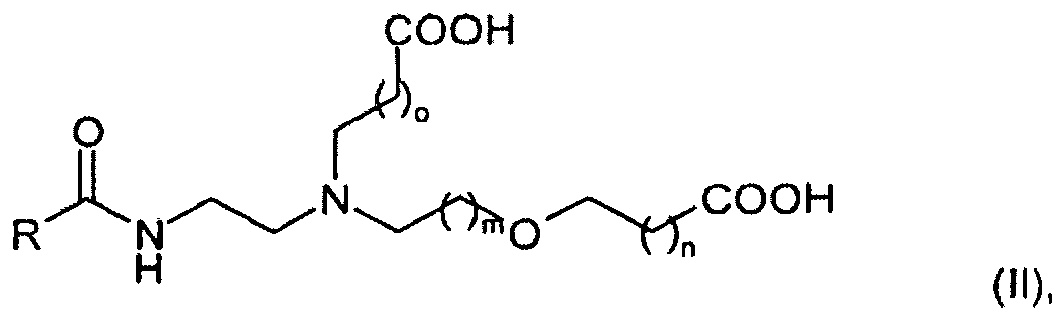
- amphoteric surfactant is a surfactant of the formula (II) and / or its physiologically acceptable salt, wherein R is a linear or branched, saturated or unsaturated C 10 -C 22 alkyl group and m, n and o are each independently an integer 0, 1, 2 or 3 is contained.
- amphoteric surfactants are the INCI name Disodium Cocoamphodipropionate with the trade names Miranol ® C2M SF conc. (Rhodia), Amphoterge ® K-2 (Lonza) and Monateric ® CEM-38 (Unichema) and name Disodium Cocoamphodiacetate with the trade names Dehyton ® (Cognis), Miranol ® C2M (Rhodia) and Ampholak ® XCO 30 (Akzo Nobel) marketed , Most preferred is disodium cocoamphodipropionate.
- composition according to the invention produces an excellent finish, in particular an improved wet combability and an improvement in the color content.
- amphoteric surfactants are preferably contained in the composition according to the invention in an amount of 0.05 to 30 wt .-%, particularly preferably from 0.1 to 20 wt .-%, each based on the weight of the composition.
- the agent according to the invention for changing the color of keratinic fibers contains an additional coloring component.
- the additional coloring component is preferably selected from at least one substantive dye and / or from Oxofarbstoffvor arean and / or from at least one precursor of natural analog dyes.
- Particularly advantageous agents according to the invention are characterized in that they additionally contain at least one substantive dye.
- Direct dyes are dyes that are applied directly to the hair and do not require an oxidative process to form the color. Direct dyes are usually nitrophenylenediamines, nitroaminophenols, azo dyes, anthraquinones or indophenols.
- the substantive dyes are each preferably used in an amount of 0.001 to 20 wt .-%, based on the total application preparation. The total amount of substantive dyes is preferably at most 20% by weight. Direct dyes can be subdivided into anionic, cationic and nonionic substantive dyes.
- Preferred anionic substantive dyes are those under the international designations or trade names Acid Yellow 1, Yellow 10, Acid Yellow 23, Acid Yellow 36, Acid Orange 7, Acid Red 33, Acid Red 52, Pigment Red 57: 1, Acid Blue 7, Acid Green 50, Acid Violet 43, Acid Black 1 and Acid Black 52 known compounds.
- Preferred cationic substantive dyes are cationic triphenylmethane dyes such as Basic Blue 7, Basic Blue 26, Basic Violet 2 and Basic Violet 14, aromatic systems substituted with a quaternary nitrogen group, such as Basic Yellow 57, Basic Red 76, Basic Blue 99, Basic Brown 16 and Basic Brown 17, as well as substantive dyes containing a heterocycle having at least one quaternary nitrogen atom.
- the compounds also known as Basic Yellow 87, Basic Orange 31 and Basic Red 51 are most preferred cationic substantive dyes.
- Suitable nonionic substantive dyes are in particular nonionic nitro and quinone dyes and neutral azo dyes.
- Preferred nonionic substantive dyes HC Yellow 2, HC Yellow 4, HC Yellow 5, HC Yellow 6, HC Yellow 1, HC Orange 1, Disperse Orange 3, HC Red 1, HC Red 3, HC Red 10, HC Red 11, HC Red 13, HC Red BN, HC Blue 2, HC Blue 11, HC Blue 12, Disperse Blue 3, HC Violet 1, Disperse Violet 1, Disperse Violet 4, Disperse Black 9 known compounds, as well as 1,4- Diamino-2-nitrobenzene, 2-amino-4-nitrophenol, 1,4-bis- (2-hydroxyethyl) -amino-2-nitrobenzene, 3-nitro-4- (2-hydroxyethyl) aminophenol, 2- (2- Hydroxyethyl) amino-4,6-dinitrophenol, 4 - [(2-hydroxyethyl) amino] -3-nitro-1-methylbenzene, 1-amino-4- (2-hydroxyeth
- direct dyes also naturally occurring dyes can be used, as for example in henna red, henna neutral, henna black, chamomile flower, sandalwood, black tea, buckthorn bark, sage, bluewood, madder root, catechu and alkano root are included.
- oxo dye precursors can also be used in a further embodiment.
- Oxofarbstoffvor consist are preferred as a combination of at least one compound containing at least one reactive carbonyl group (component (Oxo1)), with at least one compound (component Oxo2) selected from CH-acidic compounds and / or compounds with primary or secondary amino group or Hydroxy group selected from at least one compound of the group formed from primary or secondary aromatic amines, nitrogen-containing heterocyclic compounds and aromatic hydroxy compounds used.
- the color-modifying component is selected from dye precursors of naturally-analogous dyes.
- the dyestuff precursors of naturally-analogous dyes are preferably indoles and indolines which have at least two groups selected from hydroxy and / or amino groups, preferably as a substituent on the six-membered ring. These groups may carry further substituents, e.g. Example in the form of etherification or esterification of the hydroxy group or alkylation of the amino group.
- the colorants contain at least one indole and / or indoline derivative.
- Compositions according to the invention which comprise precursors of naturally-analogous dyes are preferably used as air-oxidative colorants.
- compositions are not added with an additional oxidizing agent.
- the dye precursors of naturally-analogous dyes are each preferably in an amount of 0.001 to 5 wt .-%, based on the entire application preparation used.
- the total amount of substantive dyes is preferably at most 3% by weight.
- Particularly preferred derivatives of indoline are 5,6-dihydroxyindoline, N-methyl-5,6-dihydroxyindoline, N-ethyl-5,6-dihydroxyindoline, N-propyl-5,6-dihydroxyindoline, N-butyl-5,6 dihydroxyindoline and 5,6-dihydroxyindoline-2-carboxylic acid, especially 5,6-dihydroxyindoline.
- Particularly preferred derivatives of indole are 5,6-dihydroxyindole, N-methyl-5,6-dihydroxyindole, N-ethyl-5,6-dihydroxyindole, N-propyl-5,6-dihydroxyindole, N-butyl-5, 6-dihydroxyindole, 5,6-dihydroxyindole-2-carboxylic acid, especially the 5,6-dihydroxyindole.
- oxidation dye precursors, oxo dye precursors, substantive dyes or naturally-analogous dyes it is not necessary for oxidation dye precursors, oxo dye precursors, substantive dyes or naturally-analogous dyes to be each one of the same compounds. Rather, due to the production process for the individual dyes, in minor amounts, other components may be included, as far as they do not adversely affect the dyeing or for other reasons, eg. As toxicological, must be excluded.
- the agent according to the invention is in the form of a flowable preparation.
- the flowable preparations preferably additionally comprise, as surface-active substance, an emulsifier or a further surfactant, surface-active substances being referred to as surfactants or emulsifiers, depending on the field of application, and selected from anionic, cationic, zwitterionic and nonionic surfactants and emulsifiers.
- anionic surfactants are alkyl sulfates, alkyl ether sulfates and ether carboxylic acids having 10 to 18 carbon atoms in the alkyl group and up to 12 glycol ether groups in the molecule.
- agents particularly preferred according to the invention are characterized in that anionic surfactants are present in a total content of less than 1.0% by weight, preferably less than 0.5% by weight, in each case based on the total weight of the application preparation.
- Particularly suitable zwitterionic surfactants are the so-called betaines such as the N-alkyl-N, N-dimethylammonium glycinates, N-acyl-aminopropyl-N, N-dimethylammoniumglycinate, and 2-alkyl-3-carboxymethyl-3-hydroxyethyl-imidazoline and the Kokosacylaminoethylhydroxy-ethylcarboxymethylglycinat.
- a preferred zwitterionic surfactant is the fatty acid amide derivative known by the INCI name Cocamidopropyl Betaine.
- the brightening agents according to the invention contain nonionic surfactants.
- Suitable nonionic surfactants are, in particular, C 8 -C 22 -alkyl mono- and -oligoglycosides and their ethoxylated analogs.
- Other preferred nonionic surfactants are the alkylene oxide addition products to saturated linear fatty alcohols and fatty acids having in each case 2 to 30 moles of ethylene oxide per mole of fatty alcohol or fatty acid. Preparations having excellent properties are also obtained if they contain fatty acid esters of ethoxylated glycerol as nonionic surfactants.
- the nonionic or zwitterionic surfactants are used in amounts of from 0.1 to 45% by weight, preferably from 1 to 30% by weight and very particularly preferably from 1 to 15% by weight, based on the total amount of the ready-to-use agent.
- cationic surfactants of the quaternary ammonium compound type are ammonium halides, in particular chlorides and bromides, such as alkyltrimethylammonium chlorides, dialkyldimethylammonium chlorides and trialkylmethylammonium chlorides.
- Further cationic surfactants which can be used according to the invention are the quaternized protein hydrolysates.
- the alkylamidoamines are usually prepared by amidation of natural or synthetic fatty acids and fatty acid cuts with dialkylaminoamines.
- the products Armocare ® VGH-70, a N, N-bis (2-palmitoyloxyethyl) dimethylammonium chloride, as well as Dehyquart ® F-75, Dehyquart ® C-4046, Dehyquart ® L80 and Dehyquart ® AU-35 are also examples of such esterquats.
- the cationic surfactants are contained in the compositions according to the invention preferably in amounts of 0.05 to 10 wt .-%, based on the total agent. Amounts of 0.1 to 5 wt .-% are particularly preferred.
- agents containing nonionic, zwitterionic and / or cationic surfactants and mixtures thereof may be preferred.
- the effect of the active ingredient according to the invention can be increased by emulsifiers.
- emulsifiers are, for example, adducts of 4 to 30 moles of ethylene oxide and / or 0 to 5 moles of propylene oxide with linear fatty alcohols, with fatty acids and with alkylphenols; C 12 -C 22 fatty acid mono- and diesters of addition products of 1 to 30 moles of ethylene oxide onto polyols, in particular glycerol; Ethylene oxide and polyglycerol addition products to methyl glucoside fatty acid esters, fatty acid alkanolamides and fatty acid glucamides; C 8 -C 22 alkyl mono- and oligoglycosides and their ethoxylated analogs; Mixtures of alkyl (oligo) glucosides and fatty alcohols; Addition products of 5 to 60 moles of ethylene oxide with castor oil and hydrogenated castor oil; Partial esters
- oxidative dyeings the development of the color can in principle be done with atmospheric oxygen.
- a chemical oxidizing agent is used, especially if, in addition to the coloring, a lightening effect on human hair is desired. This lightening effect may be desired regardless of the staining method.
- Suitable oxidizing agents are persulfates, peroxodisulfates, chlorites, hypochlorites and, in particular, hydrogen peroxide or its addition products of urea, melamine and sodium borate.
- Hydrogen peroxide is preferably used as oxidizing agent.
- the amount of hydrogen peroxide in the ready-to-use agent is preferably from 0.5 to 12% by weight, preferably from 1 to 8% by weight, in each case based on the ready-to-use agent.
- Such oxidizer formulations are preferably aqueous, flowable oxidizer formulations.
- Preferred preparations are characterized in that the flowable oxidizing agent preparation - based on their weight - 40 to 90 wt .-%, preferably 50 to 85 wt .-%, particularly preferably 55 to 80 wt .-%, more preferably 60 to 77, 5 wt .-% and in particular 65 to 75 wt .-% water.
- the oxidation colorant can also be applied to the hair together with a catalyst which promotes the oxidation of the dye precursors, e.g. by atmospheric oxygen, activated.
- a catalyst which promotes the oxidation of the dye precursors, e.g. by atmospheric oxygen, activated.
- catalysts are z.
- Suitable enzymes are z.
- peroxidases which can significantly increase the effect of small amounts of hydrogen peroxide.
- Use of certain metal ions or complexes may also be preferred to obtain intense colorations.
- the actual hair dye is expediently immediately before use by mixing the preparation of the oxidizing agent with the preparation containing the Dye precursors and the copolymer of the invention.
- the resulting ready-to-use hair dye preparation should preferably have a pH in the range of 6 to 12. Particularly preferred is the use of the hair dye in a weakly alkaline medium.
- the application temperatures can range between 15 and 40 ° C.
- the hair dye is removed by rinsing of the hair to be dyed. The washing with a shampoo is omitted if a strong surfactant-containing carrier, such as a dyeing shampoo was used.
- compositions according to the invention may also contain blonding and / or bleaching agents and thus be provided as agents which simultaneously have a coloring and lightening effect.
- agents will hereinafter be referred to as “colorants”, as “whitening colorants” or as “colorants and whiteners”.
- peroxodisulfate salts are ammonium peroxodisulfate, potassium peroxodisulfate and sodium peroxodisulfate.
- the peroxodisulfate salts may be contained in an amount of from 0.1 to 25% by weight, in particular in an amount of from 0.5 to 15% by weight, based on the total weight of the ready-to-use agent.
- the actual coloring and / or brightening agent is expediently prepared immediately before use by mixing a preparation according to the invention comprising at least one oxidation dye precursor in a cosmetic carrier and a preparation containing the additional oxidizing agent, in particular hydrogen peroxide.
- a preparation according to the invention comprising at least one oxidation dye precursor in a cosmetic carrier and a preparation containing the additional oxidizing agent, in particular hydrogen peroxide.
- a strong lightening it is preferred according to the invention if, in addition, a bleaching preparation containing at least one inorganic persulfate salt or peroxodisulfate salt is admixed with the oxidizing agent preparation before mixing with the dyeing preparation according to the invention.
- the oxidizing agent preparations contain at least one stabilizer or complexing agent.
- Particularly preferred stabilizers are phenacetin, alkali benzoates (sodium benzoate) and salicylic acid.
- Complex images are substances that can complex metal ions.
- Preferred complexing agents are so-called chelate complexing agents.
- Common and preferred chelating agents in the context of the present invention are, for example, polyoxycarboxylic acids, polyamines, ethylenediaminetetraacetic acid (EDTA), nitrilotriacetic acid (NTA) and hydroxyethanediphosphonic acids or their alkali metal salts.
- complex-forming polymers ie polymers which carry functional groups either in the main chain itself or laterally to it, which can act as ligands and react with suitable metal atoms usually with the formation of chelate complexes, can be used according to the invention.
- Preferred complexing agents according to the invention are nitrogen-containing polycarboxylic acids, in particular EDTA, and phosphonates, preferably hydroxyalkane or aminoalkane phosphonates and in particular 1-hydroxyethane-1,1-diphosphonate (HEDP) or its di- or tetrasodium salt and / or ethylenediamine tetramethylenephosphonate (EDTMP) or its Hexasodium salt and / or Diethylentriaminpentamethylenphosphonat (DTPMP) or its hepta or Octosatriumsalz.
- the complexing agents in the composition according to the invention to 0.05 to 10 wt .-%, preferably 0.5 to 5 wt .-%, each based on the total weight of the ready-to-use agent included.
- the preparation of the colorant according to the invention is subject in principle no restrictions.
- the agents according to the invention are formulated as 1-component agents which, if appropriate, are mixed immediately before use with a second preparation containing, for example, an oxidizing agent.
- a second preparation containing, for example, an oxidizing agent.
- the means according to the invention are therefore made up in such a way that one of the components essential to the invention is packaged separately. According to the invention, it does not initially matter which of the three components according to the invention is packaged separately; however, it may be preferable to package the preparation containing the copolymer according to the invention separately until use.
- the oxidizing agent preparation contains, besides the actual oxidizing agent, other auxiliaries and additives. Thus, it has proved to be preferred according to the invention if the oxidizing agent preparation contains at least one thickener. With regard to these thickeners, there are no fundamental restrictions. Both organic and purely inorganic thickening agents can be used.
- the thickeners selected from cationic polymers, polysaccharides, nonionic, synthetic polymers and / or inorganic thickeners are preferably present in the compositions according to the invention in an amount of from 0.01 to 10% by weight, particularly preferably from 0.1 to 5% by weight. -%, in each case based on the weight of the agent included.
- the agents according to the invention may contain other active ingredients, auxiliaries and additives: nonionic polymers such as vinylpyrrolidinone / vinyl acrylate copolymers, polyvinylpyrrolidinone, vinylpyrrolidinone / vinyl acetate copolymers, polyethylene glycols and polysiloxanes; Silicones, such as volatile or nonvolatile, straight-chain, branched or cyclic, crosslinked or uncrosslinked polyalkylsiloxanes (such as dimethicones or cyclomethicones), polyarylsiloxanes and / or polyalkylarylsiloxanes; cationic polymers such as quaternized cellulose ethers, quaternary group polysiloxanes, dimethyldiallylammonium chloride polymers, acrylamide-dimethyldiallyl-ammonium chloride copolymers, diethyl sulfate quaternized dimethylaminoethylmethacrylate-vin
- bentonite or fully synthetic hydrocolloids such.
- polyvinyl alcohol Structurants such as glucose, maleic acid and lactic acid
- Hair conditioning compounds such as phospholipids, (soybean lecithin, egg lecithin, cephalins and silicone oils); Protein hydrolysates, in particular elastin, collagen, keratin, milk protein, soy protein and wheat protein hydrolysates, their condensation products with fatty acids and quaternized protein hydrolysates;
- Perfume oils dimethyl isosorbide and cyclodextrins; fiber structure improving agents, in particular mono-, di- and oligosaccharides such as glucose, galactose, fructose, fructose and lactose; Dyes for staining the agent; Anti-dand
- the ready-to-use agent has a pH between 5.0 and 11.0, preferably between 6.0 and 10.0, particularly preferably between 8.0 and 9.5.
- the pH is adjusted with pH adjusters.
- the alkalizing agents which can be used for adjusting the pH are preferably selected according to the invention from inorganic salts, in particular the alkali metals and alkaline earth metals, organic alkalizing agents, in particular amines, basic amino acids and alkanolamines, and ammonia.
- Acidifying agents which are preferred according to the invention are pleasure acids, such as, for example, citric acid, acetic acid, malic acid or tartaric acid, and also dilute mineral acids.
- the pH values are pH values which were measured at a temperature of 22 ° C.
- Another object of the present invention is a method in which an agent according to the invention is applied to the hair according to the above specifications, is left on the hair for an exposure time of 2 to 45 minutes, preferably from 5 to 30 minutes, and then rinsed the hair becomes.
- a further preferred embodiment of the method according to the invention for changing the color of keratinic fibers is present when a composition in a cosmetic carrier containing at least one oxidation dye precursor and at least a copolymer according to the invention and at least one amphoteric surfactant, with an oxidizing agent preparation containing hydrogen peroxide, mixed to a homogeneous composition, which is applied to the hair, is left on the hair for an exposure time of 2 to 45 minutes, preferably 5 to 30 minutes, and then the hair is rinsed out.
- the application temperatures in the color and / or permanent change in shape of keratinic fibers according to the invention can be in a range between 15 and 45 ° C.
- the hair dye is removed by rinsing the hair to be dyed.
- the washing with a shampoo can be omitted if a strong surfactant-containing carrier, eg. As a dyeing shampoo was used.
- compositions according to the invention can also be prepared directly before use from two or more separately packaged preparations. This is particularly useful for the separation of incompatible ingredients to avoid premature reaction. Separation into multicomponent systems is particularly suitable where incompatibilities of the ingredients are to be expected or to be feared.
- the ready-to-use agent in such systems is manufactured by the consumer just prior to application by mixing the components.
- a further subject of the present invention is therefore a multi-component packaging unit (kit-of-parts) containing at least two separate prefabricated containers, one container comprising a coloring mixture in a cosmetic carrier containing at least one oxidation dye precursor, at least one non-permanently ionic copolymer which is derived of at least one cationizable monomer of the general formula (I), wherein R 1 and R 2 each independently represent hydrogen or a methyl group, R 3 and R 4 each independently represent alkyl groups of 1 to 4 carbon atoms, Y represents an NH group and p represents an integer of 2 to 5, and at least one amphoteric surfactant, and a container containing an oxidizer composition containing at least one chemical oxidizing agent, in particular hydrogen peroxide.
- kit-of-parts containing at least two separate prefabricated containers, one container comprising a coloring mixture in a cosmetic carrier containing at least one oxidation dye precursor, at least one non-permanently ionic copolymer which
- the inventive multicomponent packaging unit (kit-of-parts) in the form of an optionally dusted powder or a molding pressed into the form as a separately packaged additional component.
- the multi-component packaging unit (kit-of-parts) preferably additionally contains an instruction manual.
- an application aid such as a comb or a brush
- personal protective equipment such as disposable gloves
- Another object of the invention is the use of an agent for dyeing keratinic fibers, in particular human hair, containing in a cosmetic carrier at least one oxidation dye precursor, characterized in that the colorant additionally contains at least one non-permanent ionic copolymer, which is derived from at least one cationizable Monomer of general formula (I), wherein R 1 and R 2 each independently represent hydrogen or a methyl group, R 3 and R 4 each independently represent alkyl groups having 1 to 4 carbon atoms, Y represents an NH group and p represents an integer from 2 to 5, for improving the color content, especially against hair washing after changing the color of human hair.
- R 1 and R 2 each independently represent hydrogen or a methyl group
- R 3 and R 4 each independently represent alkyl groups having 1 to 4 carbon atoms
- Y represents an NH group
- p represents an integer from 2 to 5, for improving the color content, especially against hair washing after changing the color of human hair.
- Another object of the invention is the use of an agent for dyeing keratinic fibers, in particular human hair, containing in a cosmetic carrier at least one oxidation dye precursor, characterized in that the colorant additionally contains at least one non-permanent ionic copolymer, which is derived from at least one cationizable Monomer of general formula (I), wherein R 1 and R 2 each independently represent hydrogen or a methyl group, R 3 and R 4 each independently represent alkyl groups having 1 to 4 carbon atoms, Y represents an NH group and p represents an integer from 2 to 5, to increase the gray coverage.
- R 1 and R 2 each independently represent hydrogen or a methyl group
- R 3 and R 4 each independently represent alkyl groups having 1 to 4 carbon atoms
- Y represents an NH group
- p represents an integer from 2 to 5, to increase the gray coverage.
- Another object of the invention is the use of an agent according to any one of claims 1-9 for improving the color content.
- Another object of the invention is the use of a composition according to any one of claims 1-9 for increasing the gray coverage.
- the dyeing creams E1 and V1 were each mixed before application in a weight ratio of 1: 1 with a developer dispersion composed as follows (Table 2).
- Table 2 raw material Wt .-% dipicolinic 0.10 disodiumpyrophosphate 0.03 HEDP, 60% 1.5 Texapon N 25 2.0
- the hair was treated by subjects with medium blond to light brown initial hair color and a gray content of up to 30% for a contact time of 30 min in the half-side test with the ready-to-use colorants from E1 and V1. Subsequently, the hair was washed with a commercial shampoo and dried with a hair dryer.
- the coloring creams E2 and E3 represent preparations according to the invention, while the agents V2 and V3 represent comparative formulations.
- Dyeing creams E2, E3, V2 and V3 were each mixed with a developer dispersion (see Table 1) in a weight ratio of 1: 1 before use. Mixed pH values of 9.3 to 9.4 were achieved.
- the amount of the finished application mixture was applied to strands of bleached buffalo belly hair of about 0.7 g in weight. After streaks were dyed for 10 minutes at 32 ° C, they were washed with a commercial shampoo and dried with a hair dryer.
- the dyed hair was subjected to a cycle of 1 minute washing with a commercial shampoo and then drying with a hair dryer. This cycle was repeated 6 times.
- the L value stands for the brightness (the lower the L value, the larger the color intensity), while the a value is a measure of the red component of a color (ie, the larger the a value is, the larger is the red part).
- the b value is a measure of the blue component of the color, the blue component being greater, the more negative the b value is.
- the subscript u designates uncolored hair
- the subscript c the colored, unwashed hair
- the subscript g designates the colored, washed hair.
- the dyed and undyed streaks were measured using the Datacolor Spectraflash 450 colorimeter.
- the color difference between colored, white hair (BB) and dyed natural hair (NH) was related to the color difference between undyed, white hair (NS) and dyed natural hair (NH) according to the following formula (gray coverage index GAI in percent).
Landscapes
- Health & Medical Sciences (AREA)
- Life Sciences & Earth Sciences (AREA)
- Animal Behavior & Ethology (AREA)
- General Health & Medical Sciences (AREA)
- Public Health (AREA)
- Veterinary Medicine (AREA)
- Birds (AREA)
- Epidemiology (AREA)
- Cosmetics (AREA)
Claims (15)
- Composition de coloration de fibres kératiniques, en particulier de cheveux humains, contenant dans un support cosmétique au moins un précurseur de colorant d'oxydation et au moins un copolymère non ionique permanent qui est dérivé d'au moins un monomère cationisable de la formule générale (I),

- Composition selon la revendication 1, caractérisée en ce que le copolymère est dérivé d'au moins un monomère cationisable de la formule générale (I) et/ou de l'un de ses dérivés cationisés avec un agent d'alkylation, formule dans laquelle R2 représente un groupe méthyle et p est le nombre 2 ou 3.
- Composition selon l'une des revendications 1 ou 2, caractérisée en ce que le copolymère est dérivé d'au moins un monomère cationisable de la formule générale (I) et/ou d'un de ses dérivés cationisés avec un agent d'alkylation, formule dans laquelle R1 représente un atome d'hydrogène, R2, R3 et R4 représente chacun un groupe méthyle, Y représente un groupe NH, et p est le nombre 3.
- Composition selon l'une des revendications 1 à 3, caractérisée en ce que le copolymère est dérivé en outre, sous la forme d'un autre monomère, d'au moins un N-vinyl-lactame.
- Composition selon l'une des revendications 1 à 4, caractérisée en ce que le copolymère est dérivé, sous la forme d'un autre monomère, d'au moins un N-vinyl lactame choisi parmi N-vinyl-pyrrolidine-2-one et N-vinyl-azépan-2-one.
- Composition selon l'une des revendications 1 à 5, caractérisée en ce que le copolymère est dérivé d'au moins un monomère cationisable de la formule générale (I) dans laquelle R1 représente un atome d'hydrogène, R2, R3 et R4 représentent chacun un groupe méthyle, Y représente un groupe NH et p est le nombre 3, et dérive au moins de la N-vinyl-pyrrolidine-2-one.
- Composition selon l'une des revendications 1 à 6, caractérisée en ce que le copolymère a un poids moléculaire de 100 000 à 500 000 g/mol, en particulier de 250 000 à 350 000 g/mol.
- Composition selon l'une des revendications 1 à 7, caractérisée en ce que le tensioactif amphotère qu'elle contient est un tensioactif de la formule (II) et/ou un de ses sels physiologiquement acceptables,
- Composition selon l'une des revendications 1 à 8, caractérisée en ce qu'elle contient en plus au moins un colorant direct.
- Procédé de teinture de cheveux humains, dans lequel l'on applique sur les cheveux une composition selon l'une quelconque des revendications 1 à 9, on la maintient pendant un temps de réaction de 2 à 45 minutes, de préférence de 5 à 40 minutes sur les cheveux, puis on rince les cheveux.
- Kit d'éléments, comprenant au moins deux récipients fabriqués séparément, un récipient contenant un mélange de colorants d'oxydation selon l'une des revendications 1 à 9 et un récipient contenant une composition d'agent d'oxydation contenant au moins un agent d'oxydation chimique, en particulier du peroxyde d'hydrogène.
- Utilisation d'un agent de coloration de fibres kératiniques, en particulièrement des cheveux humains, contenant dans un support cosmétique au moins un précurseur de colorant d'oxydation, caractérisée en ce que le colorant contient en outre au moins un copolymère ionique non permanent qui est dérivé d'au moins un monomère cationisable de la formule générale (I),

- Utilisation d'une composition selon l'une des revendications 1 à 9 pour améliorer la préservation de la couleur.
- Utilisation d'une composition de coloration de fibres kératiniques, en particulièrement des cheveux humains, contenant dans un support cosmétique au moins un précurseur de colorant d'oxydation, caractérisée en ce que le colorant contient en outre au moins un copolymère ionique non permanent dérivé d'au moins un monomère cationisable de la formule générale (I)

- Utilisation d'une composition selon l'une des revendications 1 à 9 pour augmenter le camouflage des cheveux gris.
Applications Claiming Priority (2)
| Application Number | Priority Date | Filing Date | Title |
|---|---|---|---|
| DE200810036535 DE102008036535A1 (de) | 2008-08-06 | 2008-08-06 | Coloration mit kationisierbaren Polymer |
| PCT/EP2009/057014 WO2010015442A1 (fr) | 2008-08-06 | 2009-06-08 | Coloration au moyen d'un polymère cationisable |
Publications (2)
| Publication Number | Publication Date |
|---|---|
| EP2306967A1 EP2306967A1 (fr) | 2011-04-13 |
| EP2306967B1 true EP2306967B1 (fr) | 2015-07-29 |
Family
ID=41172390
Family Applications (1)
| Application Number | Title | Priority Date | Filing Date |
|---|---|---|---|
| EP09779667.6A Active EP2306967B1 (fr) | 2008-08-06 | 2009-06-08 | Coloration au moyen d'un polymère cationisable |
Country Status (3)
| Country | Link |
|---|---|
| EP (1) | EP2306967B1 (fr) |
| DE (1) | DE102008036535A1 (fr) |
| WO (1) | WO2010015442A1 (fr) |
Cited By (2)
| Publication number | Priority date | Publication date | Assignee | Title |
|---|---|---|---|---|
| CN105377222A (zh) * | 2013-07-19 | 2016-03-02 | 莱雅公司 | 包含特殊的两性表面活性剂和特殊的增稠聚合物的染色组合物 |
| DE102023112748A1 (de) | 2023-05-15 | 2024-11-21 | Jana Strauß | Mittel zur Grauabdeckung keratinischer Fasern |
Families Citing this family (6)
| Publication number | Priority date | Publication date | Assignee | Title |
|---|---|---|---|---|
| DE102009002729A1 (de) * | 2009-04-29 | 2010-11-04 | Henkel Ag & Co. Kgaa | Filmbildner in Haarfarben |
| FR3008614B1 (fr) * | 2013-07-19 | 2015-07-31 | Oreal | Composition de coloration comprenant un tensio actif amphotere particulier et un tensioactif sulfate |
| EP3021826B1 (fr) * | 2013-07-19 | 2018-01-17 | L'oreal | Omposition de colorant comprenant un tensioactif amphotère particulier et un tensioactif d'amide oxyéthyléné ou un tensioactif d'alcool gras oxyéthyléné comprenant moins de 10 unités oe ou un mélange de ces tensioactifs. |
| FR3008613B1 (fr) * | 2013-07-19 | 2015-07-17 | Oreal | Composition de coloration comprenant un tensio actif amphotere particulier et un tensioactif amide oxyethylene |
| FR3008615B1 (fr) * | 2013-07-19 | 2015-08-21 | Oreal | Composition de coloration comprenant un tensio actif amphotere particulier et un polymere epaississant a motif sucre |
| FR3008612B1 (fr) * | 2013-07-19 | 2015-07-17 | Oreal | Composition de coloration comprenant un tensio actif amphotere particulier et un polymere epaississant particulier |
Family Cites Families (8)
| Publication number | Priority date | Publication date | Assignee | Title |
|---|---|---|---|---|
| LU72592A1 (fr) * | 1975-05-28 | 1977-02-10 | ||
| CA1091160A (fr) * | 1977-06-10 | 1980-12-09 | Paritosh M. Chakrabarti | Produit pour traitement capillaire contenant un copolymere de pyrrolidone de vinyle |
| FR2769217B1 (fr) * | 1997-10-03 | 2000-03-17 | Oreal | Composition oxydante et utilisations pour la teinture, pour la deformation permanente ou pour la decoloration des fibres keratiniques |
| FR2785183B1 (fr) | 1998-11-04 | 2002-04-05 | Oreal | COMPOSITION TINCTORIALE CONTENANT UN COLORANT DIRECT CATIONIQUE ET UNE PYRAZOLO-[1,5-a]- PYRIMIDINE A TITRE DE BASE D'OXYDATION, ET PROCEDES DE TEINTURE |
| FR2820032B1 (fr) * | 2001-01-26 | 2003-05-02 | Oreal | Composition de teinture d'oxydation pour fibres keratiniques comprenant un poly(vinyllactame) cationique |
| JP2003342137A (ja) * | 2002-05-29 | 2003-12-03 | Nikko Chemical Co Ltd | 染毛剤組成物 |
| FR2883738B1 (fr) * | 2005-03-31 | 2007-05-18 | Oreal | Composition colorante comprenant un polymere associatif non ionique, procede de coloration de fibres keratiniques la mettant en oeuvre |
| BRPI0821464A2 (pt) * | 2007-12-31 | 2015-06-16 | Isp Investiments Inc | Método de proteção da cor cabelo tingido contra desbotamento ou remoção por lavagem |
-
2008
- 2008-08-06 DE DE200810036535 patent/DE102008036535A1/de not_active Withdrawn
-
2009
- 2009-06-08 EP EP09779667.6A patent/EP2306967B1/fr active Active
- 2009-06-08 WO PCT/EP2009/057014 patent/WO2010015442A1/fr not_active Ceased
Cited By (2)
| Publication number | Priority date | Publication date | Assignee | Title |
|---|---|---|---|---|
| CN105377222A (zh) * | 2013-07-19 | 2016-03-02 | 莱雅公司 | 包含特殊的两性表面活性剂和特殊的增稠聚合物的染色组合物 |
| DE102023112748A1 (de) | 2023-05-15 | 2024-11-21 | Jana Strauß | Mittel zur Grauabdeckung keratinischer Fasern |
Also Published As
| Publication number | Publication date |
|---|---|
| DE102008036535A1 (de) | 2010-02-11 |
| EP2306967A1 (fr) | 2011-04-13 |
| WO2010015442A1 (fr) | 2010-02-11 |
Similar Documents
| Publication | Publication Date | Title |
|---|---|---|
| WO2010022996A1 (fr) | Dérivés cationiques d'acétylpyridine servant d'activateurs d'éclaircissement | |
| EP2306967B1 (fr) | Coloration au moyen d'un polymère cationisable | |
| WO2010022995A1 (fr) | Dérivés cationiques de dihydroisochinoline servant d'activateurs de décoloration | |
| DE102009029043A1 (de) | Intensive, schonende Färbemittel | |
| EP2477701B1 (fr) | Produit de coloration et d'éclaircissement doux ayant une performance d'éclaircissement améliorée | |
| EP2440174B1 (fr) | Post-traitement pour fixer la couleur | |
| DE202009011154U1 (de) | Enzymatisch gestützte Haarfärbung und -aufhellung | |
| EP2356978B1 (fr) | Colorant doté d'acides aminés déterminés | |
| DE102009044920A1 (de) | Verwendung bestimmter Aminosäuren in Färbemitteln keratinischer Fasern zur Farbintensivierung | |
| DE102011085416A1 (de) | Farbintensivierung durch Haarfärbemittel mit Polysaccharid-Kombination | |
| WO2010102928A2 (fr) | Produit de traitement capillaire contenant de la gelée royale | |
| DE102009027678A1 (de) | Färbemittel mit verbessertem Farberhalt | |
| DE102012213251A1 (de) | Pflegende Haarfärbemittel mit Silicon-Blockcopolymeren | |
| DE102009054569A1 (de) | Pflegende Haarbehandlungsmittel zur Farbveränderung | |
| EP2552394B1 (fr) | Agent colorant comprenant un complexe d'acylpyridinium lipophile | |
| DE102011085173A1 (de) | Intensive Haarfärbemittel mit Zuckerzusatz | |
| DE102009001483A1 (de) | Haarbehandlungsmittel mit Kirschkernöl/-blütenextrakt | |
| EP2386288B1 (fr) | Produit de soin pour le traitement des cheveux destiné à la coloration | |
| DE102009029275A1 (de) | Pflegende Haarfarbe | |
| DE102013226144A1 (de) | "Pflegende Färbe- und Blondiermittel mit verbessertem Volumen" | |
| DE102012213250A1 (de) | Pflegende Haarfärbemittel mit Blockcopolymeren | |
| DE102009054493A1 (de) | Schonende Haarbehandlungsmittel zur Farbveränderung | |
| DE102009046917A1 (de) | Pflegende Haarfarbe | |
| DE202009000769U1 (de) | Neue Färbemittel | |
| EP2246099A2 (fr) | Nouveaux colorants |
Legal Events
| Date | Code | Title | Description |
|---|---|---|---|
| PUAI | Public reference made under article 153(3) epc to a published international application that has entered the european phase |
Free format text: ORIGINAL CODE: 0009012 |
|
| 17P | Request for examination filed |
Effective date: 20101126 |
|
| AK | Designated contracting states |
Kind code of ref document: A1 Designated state(s): AT BE BG CH CY CZ DE DK EE ES FI FR GB GR HR HU IE IS IT LI LT LU LV MC MK MT NL NO PL PT RO SE SI SK TR |
|
| AX | Request for extension of the european patent |
Extension state: AL BA RS |
|
| DAX | Request for extension of the european patent (deleted) | ||
| 17Q | First examination report despatched |
Effective date: 20140923 |
|
| GRAP | Despatch of communication of intention to grant a patent |
Free format text: ORIGINAL CODE: EPIDOSNIGR1 |
|
| INTG | Intention to grant announced |
Effective date: 20150210 |
|
| GRAS | Grant fee paid |
Free format text: ORIGINAL CODE: EPIDOSNIGR3 |
|
| GRAA | (expected) grant |
Free format text: ORIGINAL CODE: 0009210 |
|
| AK | Designated contracting states |
Kind code of ref document: B1 Designated state(s): AT BE BG CH CY CZ DE DK EE ES FI FR GB GR HR HU IE IS IT LI LT LU LV MC MK MT NL NO PL PT RO SE SI SK TR |
|
| REG | Reference to a national code |
Ref country code: GB Ref legal event code: FG4D Free format text: NOT ENGLISH |
|
| REG | Reference to a national code |
Ref country code: CH Ref legal event code: EP |
|
| REG | Reference to a national code |
Ref country code: AT Ref legal event code: REF Ref document number: 738710 Country of ref document: AT Kind code of ref document: T Effective date: 20150815 |
|
| REG | Reference to a national code |
Ref country code: IE Ref legal event code: FG4D Free format text: LANGUAGE OF EP DOCUMENT: GERMAN |
|
| REG | Reference to a national code |
Ref country code: DE Ref legal event code: R096 Ref document number: 502009011338 Country of ref document: DE |
|
| REG | Reference to a national code |
Ref country code: LT Ref legal event code: MG4D |
|
| REG | Reference to a national code |
Ref country code: NL Ref legal event code: MP Effective date: 20150729 |
|
| PG25 | Lapsed in a contracting state [announced via postgrant information from national office to epo] |
Ref country code: NO Free format text: LAPSE BECAUSE OF FAILURE TO SUBMIT A TRANSLATION OF THE DESCRIPTION OR TO PAY THE FEE WITHIN THE PRESCRIBED TIME-LIMIT Effective date: 20151029 Ref country code: LV Free format text: LAPSE BECAUSE OF FAILURE TO SUBMIT A TRANSLATION OF THE DESCRIPTION OR TO PAY THE FEE WITHIN THE PRESCRIBED TIME-LIMIT Effective date: 20150729 Ref country code: FI Free format text: LAPSE BECAUSE OF FAILURE TO SUBMIT A TRANSLATION OF THE DESCRIPTION OR TO PAY THE FEE WITHIN THE PRESCRIBED TIME-LIMIT Effective date: 20150729 Ref country code: LT Free format text: LAPSE BECAUSE OF FAILURE TO SUBMIT A TRANSLATION OF THE DESCRIPTION OR TO PAY THE FEE WITHIN THE PRESCRIBED TIME-LIMIT Effective date: 20150729 Ref country code: GR Free format text: LAPSE BECAUSE OF FAILURE TO SUBMIT A TRANSLATION OF THE DESCRIPTION OR TO PAY THE FEE WITHIN THE PRESCRIBED TIME-LIMIT Effective date: 20151030 |
|
| PG25 | Lapsed in a contracting state [announced via postgrant information from national office to epo] |
Ref country code: IS Free format text: LAPSE BECAUSE OF FAILURE TO SUBMIT A TRANSLATION OF THE DESCRIPTION OR TO PAY THE FEE WITHIN THE PRESCRIBED TIME-LIMIT Effective date: 20151129 Ref country code: ES Free format text: LAPSE BECAUSE OF FAILURE TO SUBMIT A TRANSLATION OF THE DESCRIPTION OR TO PAY THE FEE WITHIN THE PRESCRIBED TIME-LIMIT Effective date: 20150729 Ref country code: PL Free format text: LAPSE BECAUSE OF FAILURE TO SUBMIT A TRANSLATION OF THE DESCRIPTION OR TO PAY THE FEE WITHIN THE PRESCRIBED TIME-LIMIT Effective date: 20150729 Ref country code: HR Free format text: LAPSE BECAUSE OF FAILURE TO SUBMIT A TRANSLATION OF THE DESCRIPTION OR TO PAY THE FEE WITHIN THE PRESCRIBED TIME-LIMIT Effective date: 20150729 Ref country code: SE Free format text: LAPSE BECAUSE OF FAILURE TO SUBMIT A TRANSLATION OF THE DESCRIPTION OR TO PAY THE FEE WITHIN THE PRESCRIBED TIME-LIMIT Effective date: 20150729 Ref country code: PT Free format text: LAPSE BECAUSE OF FAILURE TO SUBMIT A TRANSLATION OF THE DESCRIPTION OR TO PAY THE FEE WITHIN THE PRESCRIBED TIME-LIMIT Effective date: 20151130 |
|
| PG25 | Lapsed in a contracting state [announced via postgrant information from national office to epo] |
Ref country code: NL Free format text: LAPSE BECAUSE OF FAILURE TO SUBMIT A TRANSLATION OF THE DESCRIPTION OR TO PAY THE FEE WITHIN THE PRESCRIBED TIME-LIMIT Effective date: 20150729 |
|
| PG25 | Lapsed in a contracting state [announced via postgrant information from national office to epo] |
Ref country code: EE Free format text: LAPSE BECAUSE OF FAILURE TO SUBMIT A TRANSLATION OF THE DESCRIPTION OR TO PAY THE FEE WITHIN THE PRESCRIBED TIME-LIMIT Effective date: 20150729 Ref country code: IT Free format text: LAPSE BECAUSE OF FAILURE TO SUBMIT A TRANSLATION OF THE DESCRIPTION OR TO PAY THE FEE WITHIN THE PRESCRIBED TIME-LIMIT Effective date: 20150729 Ref country code: CZ Free format text: LAPSE BECAUSE OF FAILURE TO SUBMIT A TRANSLATION OF THE DESCRIPTION OR TO PAY THE FEE WITHIN THE PRESCRIBED TIME-LIMIT Effective date: 20150729 Ref country code: SK Free format text: LAPSE BECAUSE OF FAILURE TO SUBMIT A TRANSLATION OF THE DESCRIPTION OR TO PAY THE FEE WITHIN THE PRESCRIBED TIME-LIMIT Effective date: 20150729 Ref country code: DK Free format text: LAPSE BECAUSE OF FAILURE TO SUBMIT A TRANSLATION OF THE DESCRIPTION OR TO PAY THE FEE WITHIN THE PRESCRIBED TIME-LIMIT Effective date: 20150729 |
|
| REG | Reference to a national code |
Ref country code: DE Ref legal event code: R097 Ref document number: 502009011338 Country of ref document: DE |
|
| PG25 | Lapsed in a contracting state [announced via postgrant information from national office to epo] |
Ref country code: RO Free format text: LAPSE BECAUSE OF FAILURE TO SUBMIT A TRANSLATION OF THE DESCRIPTION OR TO PAY THE FEE WITHIN THE PRESCRIBED TIME-LIMIT Effective date: 20150729 |
|
| PLBE | No opposition filed within time limit |
Free format text: ORIGINAL CODE: 0009261 |
|
| STAA | Information on the status of an ep patent application or granted ep patent |
Free format text: STATUS: NO OPPOSITION FILED WITHIN TIME LIMIT |
|
| REG | Reference to a national code |
Ref country code: DE Ref legal event code: R084 Ref document number: 502009011338 Country of ref document: DE Ref country code: FR Ref legal event code: PLFP Year of fee payment: 8 |
|
| 26N | No opposition filed |
Effective date: 20160502 |
|
| PG25 | Lapsed in a contracting state [announced via postgrant information from national office to epo] |
Ref country code: SI Free format text: LAPSE BECAUSE OF FAILURE TO SUBMIT A TRANSLATION OF THE DESCRIPTION OR TO PAY THE FEE WITHIN THE PRESCRIBED TIME-LIMIT Effective date: 20150729 |
|
| PG25 | Lapsed in a contracting state [announced via postgrant information from national office to epo] |
Ref country code: BE Free format text: LAPSE BECAUSE OF NON-PAYMENT OF DUE FEES Effective date: 20160630 |
|
| PG25 | Lapsed in a contracting state [announced via postgrant information from national office to epo] |
Ref country code: MC Free format text: LAPSE BECAUSE OF FAILURE TO SUBMIT A TRANSLATION OF THE DESCRIPTION OR TO PAY THE FEE WITHIN THE PRESCRIBED TIME-LIMIT Effective date: 20150729 |
|
| REG | Reference to a national code |
Ref country code: IE Ref legal event code: MM4A |
|
| PG25 | Lapsed in a contracting state [announced via postgrant information from national office to epo] |
Ref country code: IE Free format text: LAPSE BECAUSE OF NON-PAYMENT OF DUE FEES Effective date: 20160608 |
|
| REG | Reference to a national code |
Ref country code: FR Ref legal event code: PLFP Year of fee payment: 9 |
|
| PG25 | Lapsed in a contracting state [announced via postgrant information from national office to epo] |
Ref country code: HU Free format text: LAPSE BECAUSE OF FAILURE TO SUBMIT A TRANSLATION OF THE DESCRIPTION OR TO PAY THE FEE WITHIN THE PRESCRIBED TIME-LIMIT; INVALID AB INITIO Effective date: 20090608 Ref country code: CY Free format text: LAPSE BECAUSE OF FAILURE TO SUBMIT A TRANSLATION OF THE DESCRIPTION OR TO PAY THE FEE WITHIN THE PRESCRIBED TIME-LIMIT Effective date: 20150729 |
|
| REG | Reference to a national code |
Ref country code: FR Ref legal event code: PLFP Year of fee payment: 10 |
|
| PG25 | Lapsed in a contracting state [announced via postgrant information from national office to epo] |
Ref country code: LU Free format text: LAPSE BECAUSE OF NON-PAYMENT OF DUE FEES Effective date: 20160608 Ref country code: MT Free format text: LAPSE BECAUSE OF FAILURE TO SUBMIT A TRANSLATION OF THE DESCRIPTION OR TO PAY THE FEE WITHIN THE PRESCRIBED TIME-LIMIT Effective date: 20150729 Ref country code: MK Free format text: LAPSE BECAUSE OF FAILURE TO SUBMIT A TRANSLATION OF THE DESCRIPTION OR TO PAY THE FEE WITHIN THE PRESCRIBED TIME-LIMIT Effective date: 20150729 Ref country code: TR Free format text: LAPSE BECAUSE OF FAILURE TO SUBMIT A TRANSLATION OF THE DESCRIPTION OR TO PAY THE FEE WITHIN THE PRESCRIBED TIME-LIMIT Effective date: 20150729 |
|
| PG25 | Lapsed in a contracting state [announced via postgrant information from national office to epo] |
Ref country code: BG Free format text: LAPSE BECAUSE OF FAILURE TO SUBMIT A TRANSLATION OF THE DESCRIPTION OR TO PAY THE FEE WITHIN THE PRESCRIBED TIME-LIMIT Effective date: 20150729 |
|
| P01 | Opt-out of the competence of the unified patent court (upc) registered |
Effective date: 20230530 |
|
| PGFP | Annual fee paid to national office [announced via postgrant information from national office to epo] |
Ref country code: AT Payment date: 20230621 Year of fee payment: 15 |
|
| PGFP | Annual fee paid to national office [announced via postgrant information from national office to epo] |
Ref country code: CH Payment date: 20230702 Year of fee payment: 15 |
|
| REG | Reference to a national code |
Ref country code: CH Ref legal event code: PL |
|
| REG | Reference to a national code |
Ref country code: AT Ref legal event code: MM01 Ref document number: 738710 Country of ref document: AT Kind code of ref document: T Effective date: 20240608 |
|
| PG25 | Lapsed in a contracting state [announced via postgrant information from national office to epo] |
Ref country code: AT Free format text: LAPSE BECAUSE OF NON-PAYMENT OF DUE FEES Effective date: 20240608 Ref country code: CH Free format text: LAPSE BECAUSE OF NON-PAYMENT OF DUE FEES Effective date: 20240630 |
|
| PGFP | Annual fee paid to national office [announced via postgrant information from national office to epo] |
Ref country code: DE Payment date: 20250618 Year of fee payment: 17 |
|
| PGFP | Annual fee paid to national office [announced via postgrant information from national office to epo] |
Ref country code: GB Payment date: 20250618 Year of fee payment: 17 |
|
| PGFP | Annual fee paid to national office [announced via postgrant information from national office to epo] |
Ref country code: FR Payment date: 20250624 Year of fee payment: 17 |