EP2307630B1 - Wandelement - Google Patents
Wandelement Download PDFInfo
- Publication number
- EP2307630B1 EP2307630B1 EP09755078A EP09755078A EP2307630B1 EP 2307630 B1 EP2307630 B1 EP 2307630B1 EP 09755078 A EP09755078 A EP 09755078A EP 09755078 A EP09755078 A EP 09755078A EP 2307630 B1 EP2307630 B1 EP 2307630B1
- Authority
- EP
- European Patent Office
- Prior art keywords
- wall element
- intermediate layer
- element according
- plate
- layers
- Prior art date
- Legal status (The legal status is an assumption and is not a legal conclusion. Google has not performed a legal analysis and makes no representation as to the accuracy of the status listed.)
- Not-in-force
Links
Images

Classifications
-
- E—FIXED CONSTRUCTIONS
- E04—BUILDING
- E04C—STRUCTURAL ELEMENTS; BUILDING MATERIALS
- E04C2/00—Building elements of relatively thin form for the construction of parts of buildings, e.g. sheet materials, slabs, or panels
- E04C2/30—Building elements of relatively thin form for the construction of parts of buildings, e.g. sheet materials, slabs, or panels characterised by the shape or structure
- E04C2/34—Building elements of relatively thin form for the construction of parts of buildings, e.g. sheet materials, slabs, or panels characterised by the shape or structure composed of two or more spaced sheet-like parts
- E04C2/3405—Building elements of relatively thin form for the construction of parts of buildings, e.g. sheet materials, slabs, or panels characterised by the shape or structure composed of two or more spaced sheet-like parts spaced apart by profiled spacer sheets
-
- E—FIXED CONSTRUCTIONS
- E04—BUILDING
- E04C—STRUCTURAL ELEMENTS; BUILDING MATERIALS
- E04C2/00—Building elements of relatively thin form for the construction of parts of buildings, e.g. sheet materials, slabs, or panels
- E04C2/02—Building elements of relatively thin form for the construction of parts of buildings, e.g. sheet materials, slabs, or panels characterised by specified materials
- E04C2/26—Building elements of relatively thin form for the construction of parts of buildings, e.g. sheet materials, slabs, or panels characterised by specified materials composed of materials covered by two or more of groups E04C2/04, E04C2/08, E04C2/10 or of materials covered by one of these groups with a material not specified in one of the groups
- E04C2/284—Building elements of relatively thin form for the construction of parts of buildings, e.g. sheet materials, slabs, or panels characterised by specified materials composed of materials covered by two or more of groups E04C2/04, E04C2/08, E04C2/10 or of materials covered by one of these groups with a material not specified in one of the groups at least one of the materials being insulating
- E04C2/296—Building elements of relatively thin form for the construction of parts of buildings, e.g. sheet materials, slabs, or panels characterised by specified materials composed of materials covered by two or more of groups E04C2/04, E04C2/08, E04C2/10 or of materials covered by one of these groups with a material not specified in one of the groups at least one of the materials being insulating composed of insulating material and non-metallic or unspecified sheet-material
-
- E—FIXED CONSTRUCTIONS
- E04—BUILDING
- E04C—STRUCTURAL ELEMENTS; BUILDING MATERIALS
- E04C2/00—Building elements of relatively thin form for the construction of parts of buildings, e.g. sheet materials, slabs, or panels
- E04C2/30—Building elements of relatively thin form for the construction of parts of buildings, e.g. sheet materials, slabs, or panels characterised by the shape or structure
- E04C2/34—Building elements of relatively thin form for the construction of parts of buildings, e.g. sheet materials, slabs, or panels characterised by the shape or structure composed of two or more spaced sheet-like parts
- E04C2/3405—Building elements of relatively thin form for the construction of parts of buildings, e.g. sheet materials, slabs, or panels characterised by the shape or structure composed of two or more spaced sheet-like parts spaced apart by profiled spacer sheets
- E04C2002/3444—Corrugated sheets
- E04C2002/3466—Corrugated sheets with sinusoidal corrugations
Definitions
- the invention relates to a wall element comprising two outer layers extending at least substantially parallel to each other with at least one intermediate layer present therebetween.
- the object of the invention is to improve the wall element that is known from the aforesaid German patent publication, in the sense that a wall element is provided which has an optimal constructional stiffness for serving as (part of a) wall panel, for example a partition wall etc, and which at the same time is light in weight.
- wall panel is understood to include an element for use in a wall, floor, ceiling, roof etc.
- a wall element of the kind referred to in the introduction wherein the intermediate layer is at least substantially made of a metal plate-shaped material, and wherein a profile is formed in the plane of the plate-shaped material, is according to the invention characterised in that the intermediate layer defines a compartment which contains an insulation material.
- the insulation material is preferably a sound-insulating and/or thermally insulating material.
- opposing edges of the intermediate layer are flanged at least twice, with the insulation material being contained between flanged parts of the edges of the intermediate layer.
- the intermediate layer is connected to one outer layer on its side remote from the insulation material, whilst the intermediate layer is connected to the other outer layer at the flanged parts of the edges of the intermediate layer.
- the intermediate layer is connected to one outer layer on its side remote from the insulation material, whilst the intermediate layer is connected to the other outer layer via another, second intermediate layer.
- the second intermediate layer preferably has an at least substantially U-shaped cross-section, with the second intermediate layer engaging the first intermediate layer with legs of said U-shaped cross-section.
- the second intermediate layer has an at least substantially L-shaped cross-section, with the second intermediate layer engaging the first intermediate layer with legs of said L-shaped cross-section.
- the metal intermediate layer comprising the (thermal) insulation material is resistant to very high temperatures, as high as 1000 °C and higher.
- said experiments have shown that warping of the intermediate layer due to expansion of the metal is hardly possible at the aforesaid temperatures, if at all, since the profile is capable of compensating said expansion in various directions, viz. both in the longitudinal direction and in the transverse direction of the profile.
- the present wall element is for example quite suitable for use as a (part of a) partition wall in a building, for example a hospital, since the metal intermediate layer is capable of stopping electromagnetic radiation that is used in the hospital.
- the profile is a profile of corrugated cross-section formed in the plane of the plate-shaped material.
- corrugations of the profile extend in meandering fashion in the plane of the plate-shaped material.
- the term "in meandering fashion” is understood to mean any manner of meandering (from left to right).
- the corrugations extend in zigzag fashion in the plane of the plate-shaped material, so that corrugations alternately make a more or less acute angle to the left and to the right.
- the corrugations extend in snake-like fashion in the plane of the plate-shaped material.
- the corrugations preferably extend parallel to each other in the plane of the plate-shaped material rather than converge or diverge.
- the profile is in particular provided along at least substantially the entire length of the plate-shaped material and extends over all the first parts of the intermediate layer.
- the corrugations extend sinusoidally in the plane of the plate-shaped material.
- the distance between two adjacent crests of the sine shape preferably ranges between 0.25 and 2 times the amplitude of the sine shape.
- the distance between two adjacent crests of the sine shape at least substantially equals the amplitude of the sine shape. Tests have shown that in this way a construction having an optimum constructional stiffness is obtained, whilst at the same time said construction is light in weight.
- the plate-shaped material is made of a metal selected from the group consisting of iron, steel, copper and aluminium, or of an alloy of one or more of said metals.
- the profile is preferably rolled in the plate-shaped material, as will be explained in more detail yet hereinafter.
- the outer layers are glued together with the intermediate layer/layers.
- the adhesive that is used is preferably a swellable adhesive, in particular a foamable adhesive, more in particular a polyurethane-based foamable adhesive.
- the outer layers are at least substantially made of a material selected from the group consisting of fibre material, plastic, rubber, metal, paper/cardboard and wood.
- plaster boards are used as the outer layers.
- the fibre material in particular contains glass fibres, carbon fibres, mineral fibres and/or synthetic fibres. Fibres of the type known under the trade names "Kevlar” or “Twaron” may for example be used as synthetic fibres.
- the layer of plastic material is preferably selected from the group consisting of PVC-U, PP, PE, ABS, PVC-C and PVDF. It is noted that the material abbreviations used above relate to the following (plastic) materials:
- the rubber layer is in particular selected form the group consisting of EPDM or NBR.
- the outer layers are made of a metal, in particular stainless steel or wood, such as two-ply or three-ply wood.
- the outer layers are at least substantially made of layers of paper/cardboard, each layer at least substantially being made up of a corrugated sub-layer and a flat sub-layer provided on one side thereof, with the paper/cardboard layers being bonded together by means of an adhesive applied to the corrugations of the corrugated sub-layers.
- paper is commonly used for lighter paper types, whilst the term “cardboard” is frequently used for heavier paper types.
- the term "paper” or “cardboard” are used.
- the outer layers are preferably impregnated, in particular with a resinous material, such as polyurethane or polyester resin.
- a resinous material such as polyurethane or polyester resin.
- impregnation with a resinous material not only has the advantage of increasing the constructional stiffness, but also of providing protection against external influences, such as moisture. Because of the additional stiffness, fewer layers of corrugated paper/cardboard are in principle required for imparting the required stiffness to the flat wall panel.
- Impregnation preferably takes place by vapour deposition, spraying or otherwise, with vapour deposition or spraying taking place in a direction parallel to the direction of the "cell structure" of the corrugated paper/cardboard that is used. Impregnation can also take place mechanically, in which case toothed and/or flat rollers are used for forcing the impregnation agent into the paper/cardboard.
- the intermediate layer/layers is/are staggered relative to the outer layers, said wall element being profiled along a first part of the circumferential edge and being provided with at least one outwardly extending lip along a second part of the circumferential edge, with a lip of one wall element being inserted into a corresponding profile of the upper wall element in the connected condition of adjacent wall elements.
- the wall element is profiled along a first part of the circumferential edge at both ends, and the wall element is provided with at least one outwardly extending lip along an adjacent part of the circumferential edge, with a lip of one wall element being inserted into a corresponding profile of the upper wall element in the connected condition of adjacent wall elements.
- said intermediate layer/layers is/are flanged in a direction transversely to the outer layers, parallel to the flanged portions of the intermediate layer/layers, at at least one edge of the wall element.
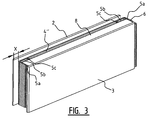
- a wall element 1 according to the invention is shown.
- the wall element 1 is substantially plate-shaped, being built up of two parallel outer layers 2 and 3 of gypsum. Disposed between said outer layers 2 and 3 is an intermediate layer 4, which extends between the outer layers 2 and 3.
- Figure 2 shows part of the wall element 1, seen in the direction II shown in figure 1 .
- the intermediate layer 4 comprises a first intermediate layer 4' consisting of a plate-shaped material which is flanged three times (inter alia) for forming first parts 5a, second parts 5b and third parts 5c.
- the first parts 5a which extend perpendicularly to the outer layers 2 and 3
- the second parts 5b which extend parallel to the outer layers 2 and 3
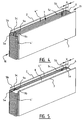
- the plate-shaped material of the second intermediate layer 4'' is flanged once for forming parts 6, which extend perpendicularly to the outer layers 2 and 3.
- the parts 6 of the second intermediate layer 4'' engage round the first intermediate layer 4', viz. at the location of the first parts 5a.
- the intermediate layers 4' and 4'' form a compartment 7, in which strip-shaped sound-insulating and/or thermally insulating material can be contained.
- the material 8 is partially held in place by the third parts 5c of the first intermediate layer 4'.
- the intermediate layers 4' and 4'' are connected, preferably glued, to the outer layers 2 on their sides remote from the insulation material 8.
- Figures 4 and 5 correspond to figures 2 and 3 , with this difference that the second intermediate layer 4'' (which is more or less L-shaped) is flanged twice on one side for forming parts 9a and 9b, part 9a extending perpendicularly to the outer layers 2 a 3 and part 9b extending parallel thereto.
- the part 5c of the first intermediate layer 4' engages the second part 9b of the second intermediate layer 4''.
- the intermediate layer 4 is slightly staggered relative to the outer layers 2 and 3, as is indicated at x.
- a lip 10 can be inserted into a profile 11 of an adjacent wall element. The end of one wall element 1 comes to abut against the end of an adjacent wall element 1 in that case.
- FIG. 1 - 5 show, a profile of corrugated cross-section comprising crests 12 and valleys 13 is formed in the intermediate layers 4' and 4''.
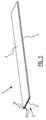
- FIG 6 the plate-shaped material for use in the intermediate layer 4 of figure 7 is shown.
- a profile of corrugated cross-section comprising crests 12 and valleys 13 is formed in the plane of the plate-shaped material, with the corrugations 14 of the profile extending sinusoidally and parallel to each other in the plane of the plate-shaped material.
- Figure 7 corresponds to figure 5 , with this difference that a corrugated profile as shown in figure 6 is formed in the intermediate layers 4' and 4''.
Landscapes
- Engineering & Computer Science (AREA)
- Architecture (AREA)
- Civil Engineering (AREA)
- Structural Engineering (AREA)
- Building Environments (AREA)
- Finishing Walls (AREA)
Claims (26)
- Wandelement, das zwei äußere Schichten (2, 3) umfasst, die sich wenigstens im wesentlichen parallel zueinander erstrecken, mit wenigstens einer Zwischenschicht (4), die dazwischen vorliegt, wobei die Zwischenschicht (4) wenigstens im wesentlichen aus einem metallischen plattenförmigen Material hergestellt ist und wobei ein Profil in der Ebene des plattenförmigen Materials ausgebildet ist, dadurch gekennzeichnet, dass die Zwischenschicht (4) einen Zwischenraum (7) definiert, der ein Isolationsmaterial (8) enthält.
- Wandelement nach Anspruch 1, wobei gegenüberliegende Kanten der Zwischenschicht (4) wenigstens zweimal gebördelt sind und wobei das Isolationsmaterial (8) zwischen gebördelten Teilen der Kanten der Zwischenschicht (4) enthalten ist.
- Wandelement nach Anspruch 1 oder 2, wobei die Zwischenschicht (4) mit einer äußeren Schicht auf ihrer Seite, die vom Isolationsmaterial (8) entfernt liegt, verbunden ist und wobei die Zwischenschicht (4) mit der anderen äußeren Schicht an den gebördelten Teilen der Kanten der Zwischenschicht (4) verbunden ist.
- Wandelement nach Anspruch 1 oder 2, wobei die Zwischenschicht (4) mit einer äußeren Schicht auf ihrer Seite, die vom Isolationsmaterial (8) entfernt ist, verbunden ist und wobei die Zwischenschicht (4) mit der anderen äußeren Schicht über eine weitere, zweite Zwischenschicht (4") verbunden ist.
- Wandelement nach Anspruch 4, wobei die zweite Zwischenschicht (4") einen wenigstens im wesentlichen U-förmigen Querschnitt besitzt und wobei die zweite Zwischenschicht (4") mit der ersten Zwischenschicht (4) mit Schenkeln des U-förmigen Querschnitts in Eingriff steht.
- Wandelement nach Anspruch 4, wobei die zweite Zwischenschicht (4") einen wenigstens im wesentlichen L-förmigen Querschnitt besitzt und wobei die zweite Zwischenschicht (4") mit der ersten Zwischenschicht mit Schenkeln des L-förmigen Querschnitts in Eingriff steht.
- Wandelement nach Anspruch 4, 5 oder 6, wobei die zweite Zwischenschicht (4") wenigstens im wesentlichen aus einem metallischen plattenförmigen Material hergestellt ist, wobei ein Profil in der Ebene des plattenförmigen Materials ausgebildet ist.
- Wandelement nach einem der vorangehenden Ansprüche 1-6, wobei das Profil ein Profil mit gewelltem Querschnitt ist, ausgebildet in der Ebene des plattenförmigen Materials.
- Wandelement nach Anspruch 8, wobei die Wellen des Profils sich in mäandernder Weise in der Ebene des plattenförmigen Materials erstrecken.
- Wandelement nach Anspruch 9, wobei die Wellen sich parallel zueinander in der Ebene des plattenförmigen Materials erstrecken.
- Wandelement nach Anspruch 9 oder 10, wobei die Wellen sich in Zick-Zack-Weise in der Ebene des plattenförmigen Materials erstrecken.
- Wandelement nach Anspruch 9 oder 10, wobei die Wellen sich in schlangenähnlicher Weise in der Ebene des plattenförmigen Materials erstrecken.
- Wandelement nach Anspruch 12, wobei die Wellen sich sinusförmig in der Ebene des plattenförmigen Materials erstrecken.
- Wandelement nach Anspruch 13, wobei der Abstand zwischen zwei benachbarten Maxima der Sinuskurve in einem Bereich zwischen dem 0,25- und 2-fachen der Amplitude der Sinuskurve liegt.
- Wandelement nach Anspruch 14, wobei der Abstand zwischen zwei benachbarten Maxima der Sinuskurve wenigstens im wesentlichen gleich der Amplitude der Sinuskurve ist.
- Wandelement nach einem der vorangehenden Ansprüche 1-15, wobei das Profil entlang wenigstens im wesentlichen der gesamten Länge des plattenförmigen Materials vorgesehen ist.
- Wandelement nach einem der vorangehenden Ansprüche 1-16, wobei das plattenförmige Material aus einem Metall hergestellt ist, das ausgewählt ist aus der Gruppe, bestehend aus Eisen, Stahl, Kupfer und Aluminium, oder aus einer Legierung von einem oder mehreren der Metalle.
- Wandelement nach einem der vorangehenden Ansprüche 1-17, wobei die äußeren Schichten (2, 3) mit der/den Zwischenschicht/-schichten zusammen verklebt sind.
- Wandelement nach einem der vorangehenden Ansprüche 1-18, wobei die äußeren Schichten (2, 3) wenigstens im wesentlichen aus einem Material hergestellt sind, das ausgewählt ist aus der Gruppe, bestehend aus Fasermaterial, Kunststoff, Gummi, Metall, Gips, Papier/Karton und Holz.
- Wandelement nach Anspruch 19, wobei das Fasermaterial Glasfasern, Kohlenstofffasern, Mineralfasern und/oder synthetische Fasern enthält.
- Wandelement nach Anspruch 19, wobei die äußeren Schichten (2, 3) wenigstens im wesentlichen aus Schichten aus Papier/Karton hergestellt sind, wobei jede Schicht wenigstens im wesentlichen aus einer gewellten Unterschicht und einer flachen Unterschicht, die auf einer Seite davon vorgesehen ist, hergestellt ist, wobei die Papier/Kartonschichten mittels eines Klebstoffes miteinander verbunden sind, der auf die Wellen der gewellten Unterschichten aufgebracht ist.
- Wandelement nach Anspruch 21, wobei die äußeren Schichten (2, 3) vorzugsweise imprägniert sind, insbesondere mit einem harzartigen Material.
- Wandelement nach Anspruch 19, wobei die äußeren Schichten (2, 3) wenigstens im wesentlichen aus doppellagigem oder dreilagigem Holz hergestellt sind.
- Wandelement nach einem der vorangehenden Ansprüche 1-23, wobei die Zwischenschicht/-schichten (4, 4") relativ zu den äußeren Schichten (2, 3) versetzt ist/sind, wobei das Wandelement entlang eines ersten Teils der Umfangskante profiliert und mit wenigstens einer sich nach außen erstreckenden Lippe entlang eines zweiten Teils der Umfangskante versehen ist, wobei die Lippe eines Wandelementes in ein entsprechendes Profil des oberen Wandelementes im verbundenen Zustand benachbarter Wandelemente eingeschoben ist.
- Wandelement nach einem der vorangehenden Ansprüche 1-24, wobei die Zwischenschicht/-schichten (4, 4") in einer Richtung quer zu den äußeren Schichten (2, 3) gebördelt ist/sind, parallel zu den gebördelten Abschnitten der Zwischenschicht/-schichten (4, 4"), an wenigstens einer Kante des Wandelementes (1).
- Wandelement nach einem der vorangehenden Ansprüche 1-25, wobei das Wandelement (1) entlang eines ersten Teils der Umfangskante an beiden Enden profiliert ist und das Wandelement (1) mit wenigstens einer sich nach außen erstreckenden Lippe entlang eines benachbarten Teils der Umfangskante versehen ist, wobei eine Lippe (10) eines Wandelementes in ein entsprechendes Profil des oberen Wandelementes im verbundenen Zustand benachbarter Wandelemente eingeschoben ist.
Applications Claiming Priority (2)
| Application Number | Priority Date | Filing Date | Title |
|---|---|---|---|
| NL2001634A NL2001634C2 (nl) | 2008-05-29 | 2008-05-29 | Wandelement. |
| PCT/NL2009/050285 WO2009145621A1 (en) | 2008-05-29 | 2009-05-25 | Wall element |
Publications (3)
| Publication Number | Publication Date |
|---|---|
| EP2307630A1 EP2307630A1 (de) | 2011-04-13 |
| EP2307630B1 true EP2307630B1 (de) | 2012-01-25 |
| EP2307630B9 EP2307630B9 (de) | 2012-09-05 |
Family
ID=40119335
Family Applications (1)
| Application Number | Title | Priority Date | Filing Date |
|---|---|---|---|
| EP09755078A Not-in-force EP2307630B9 (de) | 2008-05-29 | 2009-05-25 | Wandelement |
Country Status (4)
| Country | Link |
|---|---|
| EP (1) | EP2307630B9 (de) |
| AT (1) | ATE542962T1 (de) |
| NL (1) | NL2001634C2 (de) |
| WO (1) | WO2009145621A1 (de) |
Families Citing this family (1)
| Publication number | Priority date | Publication date | Assignee | Title |
|---|---|---|---|---|
| EP3441538A1 (de) * | 2017-08-09 | 2019-02-13 | Unda Maris Holding N.V. | Wandsystem mit metallstützen |
Family Cites Families (2)
| Publication number | Priority date | Publication date | Assignee | Title |
|---|---|---|---|---|
| NO982657L (no) * | 1998-06-09 | 1999-12-10 | Heer As | Konstruksjonsmateriale, fremgangsmåte for fremstilling av dette, samt formet gjenstand fremstilt av dette |
| NL2000060C2 (nl) * | 2006-04-21 | 2007-10-23 | Unda Maris Holding N V | Plaatvormig materiaal. |
-
2008
- 2008-05-29 NL NL2001634A patent/NL2001634C2/nl not_active IP Right Cessation
-
2009
- 2009-05-25 EP EP09755078A patent/EP2307630B9/de not_active Not-in-force
- 2009-05-25 AT AT09755078T patent/ATE542962T1/de active
- 2009-05-25 WO PCT/NL2009/050285 patent/WO2009145621A1/en not_active Ceased
Also Published As
| Publication number | Publication date |
|---|---|
| EP2307630B9 (de) | 2012-09-05 |
| WO2009145621A1 (en) | 2009-12-03 |
| WO2009145621A9 (en) | 2011-03-17 |
| NL2001634C2 (nl) | 2009-02-05 |
| ATE542962T1 (de) | 2012-02-15 |
| EP2307630A1 (de) | 2011-04-13 |
Similar Documents
| Publication | Publication Date | Title |
|---|---|---|
| US10626608B2 (en) | Foam wall structure | |
| EP3331695B1 (de) | Stuckwandstruktur | |
| EP2019885B1 (de) | Plattenförmiges material | |
| US6408594B1 (en) | Reinforced structural insulated panels with plastic impregnated paper facings | |
| US20090266005A1 (en) | Building accessible to persons | |
| RU2715469C2 (ru) | Дистанционная рамка для стеклопакетов | |
| US9297164B2 (en) | VIP roofing insulation | |
| US20120285109A1 (en) | Siding having backer | |
| RU2640229C2 (ru) | Многослойный ламинированный материал для изготовления теплоизоляционных панелей | |
| KR100538079B1 (ko) | 벽구조 | |
| EP2307630B9 (de) | Wandelement | |
| AU2018442679B2 (en) | A building system and method | |
| EA013023B1 (ru) | Фасадная теплоизоляционная панель | |
| EP1522648A1 (de) | Flaches Wandelement aus Zellulose | |
| WO2008133519A1 (en) | Wall element | |
| EP3885505A1 (de) | Bausystem | |
| CA2644212A1 (en) | A pultruded part for use as a frame member for an exterior wall construction for a building | |
| FI119652B (fi) | Seinärakenne | |
| KR101368011B1 (ko) | 벽 구조물 | |
| US20240229543A9 (en) | Barriers cores and assembly thereof | |
| WO2012027846A1 (en) | Prefabricated panels and method of making a roof | |
| CA2752767A1 (en) | Composite panel, a composite panel with an edge band, and method of applying and manufacturing the same | |
| WO2014042554A1 (ru) | Здание из легких металлических конструкций и сэндвич-панель, применяемая при его сооружении |
Legal Events
| Date | Code | Title | Description |
|---|---|---|---|
| PUAI | Public reference made under article 153(3) epc to a published international application that has entered the european phase |
Free format text: ORIGINAL CODE: 0009012 |
|
| 17P | Request for examination filed |
Effective date: 20101129 |
|
| AK | Designated contracting states |
Kind code of ref document: A1 Designated state(s): AT BE BG CH CY CZ DE DK EE ES FI FR GB GR HR HU IE IS IT LI LT LU LV MC MK MT NL NO PL PT RO SE SI SK TR |
|
| AX | Request for extension of the european patent |
Extension state: AL BA RS |
|
| DAX | Request for extension of the european patent (deleted) | ||
| GRAP | Despatch of communication of intention to grant a patent |
Free format text: ORIGINAL CODE: EPIDOSNIGR1 |
|
| RIN1 | Information on inventor provided before grant (corrected) |
Inventor name: SNEL, WILHELMUS JAN REINIER KAREL |
|
| GRAS | Grant fee paid |
Free format text: ORIGINAL CODE: EPIDOSNIGR3 |
|
| GRAA | (expected) grant |
Free format text: ORIGINAL CODE: 0009210 |
|
| AK | Designated contracting states |
Kind code of ref document: B1 Designated state(s): AT BE BG CH CY CZ DE DK EE ES FI FR GB GR HR HU IE IS IT LI LT LU LV MC MK MT NL NO PL PT RO SE SI SK TR |
|
| REG | Reference to a national code |
Ref country code: GB Ref legal event code: FG4D |
|
| REG | Reference to a national code |
Ref country code: CH Ref legal event code: EP |
|
| REG | Reference to a national code |
Ref country code: AT Ref legal event code: REF Ref document number: 542962 Country of ref document: AT Kind code of ref document: T Effective date: 20120215 |
|
| REG | Reference to a national code |
Ref country code: IE Ref legal event code: FG4D |
|
| REG | Reference to a national code |
Ref country code: DE Ref legal event code: R096 Ref document number: 602009004936 Country of ref document: DE Effective date: 20120322 |
|
| REG | Reference to a national code |
Ref country code: NL Ref legal event code: T3 |
|
| LTIE | Lt: invalidation of european patent or patent extension |
Effective date: 20120125 |
|
| PG25 | Lapsed in a contracting state [announced via postgrant information from national office to epo] |
Ref country code: NO Free format text: LAPSE BECAUSE OF FAILURE TO SUBMIT A TRANSLATION OF THE DESCRIPTION OR TO PAY THE FEE WITHIN THE PRESCRIBED TIME-LIMIT Effective date: 20120425 Ref country code: LT Free format text: LAPSE BECAUSE OF FAILURE TO SUBMIT A TRANSLATION OF THE DESCRIPTION OR TO PAY THE FEE WITHIN THE PRESCRIBED TIME-LIMIT Effective date: 20120125 Ref country code: IS Free format text: LAPSE BECAUSE OF FAILURE TO SUBMIT A TRANSLATION OF THE DESCRIPTION OR TO PAY THE FEE WITHIN THE PRESCRIBED TIME-LIMIT Effective date: 20120525 Ref country code: BG Free format text: LAPSE BECAUSE OF FAILURE TO SUBMIT A TRANSLATION OF THE DESCRIPTION OR TO PAY THE FEE WITHIN THE PRESCRIBED TIME-LIMIT Effective date: 20120425 Ref country code: HR Free format text: LAPSE BECAUSE OF FAILURE TO SUBMIT A TRANSLATION OF THE DESCRIPTION OR TO PAY THE FEE WITHIN THE PRESCRIBED TIME-LIMIT Effective date: 20120125 |
|
| PG25 | Lapsed in a contracting state [announced via postgrant information from national office to epo] |
Ref country code: GR Free format text: LAPSE BECAUSE OF FAILURE TO SUBMIT A TRANSLATION OF THE DESCRIPTION OR TO PAY THE FEE WITHIN THE PRESCRIBED TIME-LIMIT Effective date: 20120426 Ref country code: PL Free format text: LAPSE BECAUSE OF FAILURE TO SUBMIT A TRANSLATION OF THE DESCRIPTION OR TO PAY THE FEE WITHIN THE PRESCRIBED TIME-LIMIT Effective date: 20120125 Ref country code: PT Free format text: LAPSE BECAUSE OF FAILURE TO SUBMIT A TRANSLATION OF THE DESCRIPTION OR TO PAY THE FEE WITHIN THE PRESCRIBED TIME-LIMIT Effective date: 20120525 Ref country code: FI Free format text: LAPSE BECAUSE OF FAILURE TO SUBMIT A TRANSLATION OF THE DESCRIPTION OR TO PAY THE FEE WITHIN THE PRESCRIBED TIME-LIMIT Effective date: 20120125 Ref country code: LV Free format text: LAPSE BECAUSE OF FAILURE TO SUBMIT A TRANSLATION OF THE DESCRIPTION OR TO PAY THE FEE WITHIN THE PRESCRIBED TIME-LIMIT Effective date: 20120125 |
|
| REG | Reference to a national code |
Ref country code: AT Ref legal event code: MK05 Ref document number: 542962 Country of ref document: AT Kind code of ref document: T Effective date: 20120125 |
|
| PG25 | Lapsed in a contracting state [announced via postgrant information from national office to epo] |
Ref country code: CY Free format text: LAPSE BECAUSE OF FAILURE TO SUBMIT A TRANSLATION OF THE DESCRIPTION OR TO PAY THE FEE WITHIN THE PRESCRIBED TIME-LIMIT Effective date: 20120125 |
|
| PG25 | Lapsed in a contracting state [announced via postgrant information from national office to epo] |
Ref country code: RO Free format text: LAPSE BECAUSE OF FAILURE TO SUBMIT A TRANSLATION OF THE DESCRIPTION OR TO PAY THE FEE WITHIN THE PRESCRIBED TIME-LIMIT Effective date: 20120125 Ref country code: EE Free format text: LAPSE BECAUSE OF FAILURE TO SUBMIT A TRANSLATION OF THE DESCRIPTION OR TO PAY THE FEE WITHIN THE PRESCRIBED TIME-LIMIT Effective date: 20120125 Ref country code: DK Free format text: LAPSE BECAUSE OF FAILURE TO SUBMIT A TRANSLATION OF THE DESCRIPTION OR TO PAY THE FEE WITHIN THE PRESCRIBED TIME-LIMIT Effective date: 20120125 Ref country code: SE Free format text: LAPSE BECAUSE OF FAILURE TO SUBMIT A TRANSLATION OF THE DESCRIPTION OR TO PAY THE FEE WITHIN THE PRESCRIBED TIME-LIMIT Effective date: 20120125 Ref country code: SI Free format text: LAPSE BECAUSE OF FAILURE TO SUBMIT A TRANSLATION OF THE DESCRIPTION OR TO PAY THE FEE WITHIN THE PRESCRIBED TIME-LIMIT Effective date: 20120125 Ref country code: CZ Free format text: LAPSE BECAUSE OF FAILURE TO SUBMIT A TRANSLATION OF THE DESCRIPTION OR TO PAY THE FEE WITHIN THE PRESCRIBED TIME-LIMIT Effective date: 20120125 |
|
| PG25 | Lapsed in a contracting state [announced via postgrant information from national office to epo] |
Ref country code: SK Free format text: LAPSE BECAUSE OF FAILURE TO SUBMIT A TRANSLATION OF THE DESCRIPTION OR TO PAY THE FEE WITHIN THE PRESCRIBED TIME-LIMIT Effective date: 20120125 Ref country code: IT Free format text: LAPSE BECAUSE OF FAILURE TO SUBMIT A TRANSLATION OF THE DESCRIPTION OR TO PAY THE FEE WITHIN THE PRESCRIBED TIME-LIMIT Effective date: 20120125 |
|
| PLBE | No opposition filed within time limit |
Free format text: ORIGINAL CODE: 0009261 |
|
| STAA | Information on the status of an ep patent application or granted ep patent |
Free format text: STATUS: NO OPPOSITION FILED WITHIN TIME LIMIT |
|
| PG25 | Lapsed in a contracting state [announced via postgrant information from national office to epo] |
Ref country code: MC Free format text: LAPSE BECAUSE OF NON-PAYMENT OF DUE FEES Effective date: 20120531 |
|
| 26N | No opposition filed |
Effective date: 20121026 |
|
| PG25 | Lapsed in a contracting state [announced via postgrant information from national office to epo] |
Ref country code: AT Free format text: LAPSE BECAUSE OF FAILURE TO SUBMIT A TRANSLATION OF THE DESCRIPTION OR TO PAY THE FEE WITHIN THE PRESCRIBED TIME-LIMIT Effective date: 20120125 |
|
| REG | Reference to a national code |
Ref country code: DE Ref legal event code: R097 Ref document number: 602009004936 Country of ref document: DE Effective date: 20121026 |
|
| REG | Reference to a national code |
Ref country code: IE Ref legal event code: MM4A |
|
| PG25 | Lapsed in a contracting state [announced via postgrant information from national office to epo] |
Ref country code: MK Free format text: LAPSE BECAUSE OF FAILURE TO SUBMIT A TRANSLATION OF THE DESCRIPTION OR TO PAY THE FEE WITHIN THE PRESCRIBED TIME-LIMIT Effective date: 20120125 |
|
| PG25 | Lapsed in a contracting state [announced via postgrant information from national office to epo] |
Ref country code: ES Free format text: LAPSE BECAUSE OF FAILURE TO SUBMIT A TRANSLATION OF THE DESCRIPTION OR TO PAY THE FEE WITHIN THE PRESCRIBED TIME-LIMIT Effective date: 20120506 Ref country code: IE Free format text: LAPSE BECAUSE OF NON-PAYMENT OF DUE FEES Effective date: 20120525 |
|
| PG25 | Lapsed in a contracting state [announced via postgrant information from national office to epo] |
Ref country code: MT Free format text: LAPSE BECAUSE OF FAILURE TO SUBMIT A TRANSLATION OF THE DESCRIPTION OR TO PAY THE FEE WITHIN THE PRESCRIBED TIME-LIMIT Effective date: 20120125 |
|
| REG | Reference to a national code |
Ref country code: CH Ref legal event code: PL |
|
| PG25 | Lapsed in a contracting state [announced via postgrant information from national office to epo] |
Ref country code: LI Free format text: LAPSE BECAUSE OF NON-PAYMENT OF DUE FEES Effective date: 20130531 Ref country code: CH Free format text: LAPSE BECAUSE OF NON-PAYMENT OF DUE FEES Effective date: 20130531 |
|
| PG25 | Lapsed in a contracting state [announced via postgrant information from national office to epo] |
Ref country code: LU Free format text: LAPSE BECAUSE OF NON-PAYMENT OF DUE FEES Effective date: 20120525 |
|
| PG25 | Lapsed in a contracting state [announced via postgrant information from national office to epo] |
Ref country code: HU Free format text: LAPSE BECAUSE OF FAILURE TO SUBMIT A TRANSLATION OF THE DESCRIPTION OR TO PAY THE FEE WITHIN THE PRESCRIBED TIME-LIMIT Effective date: 20090525 |
|
| REG | Reference to a national code |
Ref country code: FR Ref legal event code: PLFP Year of fee payment: 7 |
|
| PGFP | Annual fee paid to national office [announced via postgrant information from national office to epo] |
Ref country code: TR Payment date: 20150512 Year of fee payment: 7 Ref country code: GB Payment date: 20150529 Year of fee payment: 7 |
|
| PGFP | Annual fee paid to national office [announced via postgrant information from national office to epo] |
Ref country code: BE Payment date: 20150526 Year of fee payment: 7 Ref country code: FR Payment date: 20150529 Year of fee payment: 7 |
|
| PGFP | Annual fee paid to national office [announced via postgrant information from national office to epo] |
Ref country code: DE Payment date: 20150904 Year of fee payment: 7 |
|
| PG25 | Lapsed in a contracting state [announced via postgrant information from national office to epo] |
Ref country code: BE Free format text: LAPSE BECAUSE OF NON-PAYMENT OF DUE FEES Effective date: 20160531 |
|
| REG | Reference to a national code |
Ref country code: DE Ref legal event code: R119 Ref document number: 602009004936 Country of ref document: DE |
|
| GBPC | Gb: european patent ceased through non-payment of renewal fee |
Effective date: 20160525 |
|
| REG | Reference to a national code |
Ref country code: FR Ref legal event code: ST Effective date: 20170131 |
|
| PG25 | Lapsed in a contracting state [announced via postgrant information from national office to epo] |
Ref country code: DE Free format text: LAPSE BECAUSE OF NON-PAYMENT OF DUE FEES Effective date: 20161201 Ref country code: FR Free format text: LAPSE BECAUSE OF NON-PAYMENT OF DUE FEES Effective date: 20160531 |
|
| PG25 | Lapsed in a contracting state [announced via postgrant information from national office to epo] |
Ref country code: GB Free format text: LAPSE BECAUSE OF NON-PAYMENT OF DUE FEES Effective date: 20160525 |
|
| PGFP | Annual fee paid to national office [announced via postgrant information from national office to epo] |
Ref country code: NL Payment date: 20180526 Year of fee payment: 10 |
|
| REG | Reference to a national code |
Ref country code: NL Ref legal event code: MM Effective date: 20190601 |
|
| PG25 | Lapsed in a contracting state [announced via postgrant information from national office to epo] |
Ref country code: NL Free format text: LAPSE BECAUSE OF NON-PAYMENT OF DUE FEES Effective date: 20190601 |
|
| PG25 | Lapsed in a contracting state [announced via postgrant information from national office to epo] |
Ref country code: TR Free format text: LAPSE BECAUSE OF NON-PAYMENT OF DUE FEES Effective date: 20160525 |