EP2314253A1 - Dispositif et procédé de traitement cosmétique de dents décolorées - Google Patents
Dispositif et procédé de traitement cosmétique de dents décolorées Download PDFInfo
- Publication number
- EP2314253A1 EP2314253A1 EP10188212A EP10188212A EP2314253A1 EP 2314253 A1 EP2314253 A1 EP 2314253A1 EP 10188212 A EP10188212 A EP 10188212A EP 10188212 A EP10188212 A EP 10188212A EP 2314253 A1 EP2314253 A1 EP 2314253A1
- Authority
- EP
- European Patent Office
- Prior art keywords
- light
- teeth
- bleaching
- gel
- mouth
- Prior art date
- Legal status (The legal status is an assumption and is not a legal conclusion. Google has not performed a legal analysis and makes no representation as to the accuracy of the status listed.)
- Withdrawn
Links
- 238000000034 method Methods 0.000 title claims abstract description 24
- 239000002537 cosmetic Substances 0.000 title claims abstract description 6
- 238000011282 treatment Methods 0.000 title claims description 33
- 238000004061 bleaching Methods 0.000 claims abstract description 60
- 238000009826 distribution Methods 0.000 claims abstract description 41
- 230000005855 radiation Effects 0.000 claims abstract description 8
- 238000001816 cooling Methods 0.000 claims description 32
- 238000003491 array Methods 0.000 claims description 28
- 238000010521 absorption reaction Methods 0.000 claims description 19
- 239000000975 dye Substances 0.000 claims description 16
- 239000007844 bleaching agent Substances 0.000 claims description 12
- XLYOFNOQVPJJNP-UHFFFAOYSA-N water Substances O XLYOFNOQVPJJNP-UHFFFAOYSA-N 0.000 claims description 11
- 230000004913 activation Effects 0.000 claims description 10
- 230000006978 adaptation Effects 0.000 claims description 10
- 230000008569 process Effects 0.000 claims description 9
- 230000002087 whitening effect Effects 0.000 claims description 7
- 210000004513 dentition Anatomy 0.000 claims description 5
- 230000036346 tooth eruption Effects 0.000 claims description 5
- 239000012780 transparent material Substances 0.000 claims description 5
- 239000000463 material Substances 0.000 claims description 4
- 238000002161 passivation Methods 0.000 claims description 4
- 238000003776 cleavage reaction Methods 0.000 claims description 3
- 230000001678 irradiating effect Effects 0.000 claims description 3
- 210000003296 saliva Anatomy 0.000 claims description 3
- 230000007017 scission Effects 0.000 claims description 3
- 238000004140 cleaning Methods 0.000 claims description 2
- YCKRFDGAMUMZLT-UHFFFAOYSA-N Fluorine atom Chemical compound [F] YCKRFDGAMUMZLT-UHFFFAOYSA-N 0.000 claims 1
- 229910052731 fluorine Inorganic materials 0.000 claims 1
- 239000011737 fluorine Substances 0.000 claims 1
- 210000000214 mouth Anatomy 0.000 description 37
- MHAJPDPJQMAIIY-UHFFFAOYSA-N Hydrogen peroxide Chemical compound OO MHAJPDPJQMAIIY-UHFFFAOYSA-N 0.000 description 23
- 238000013461 design Methods 0.000 description 8
- 238000010438 heat treatment Methods 0.000 description 8
- 230000008901 benefit Effects 0.000 description 6
- 238000004519 manufacturing process Methods 0.000 description 6
- 239000000126 substance Substances 0.000 description 6
- 239000000306 component Substances 0.000 description 4
- 239000011521 glass Substances 0.000 description 4
- 229910052760 oxygen Inorganic materials 0.000 description 4
- 239000001301 oxygen Substances 0.000 description 4
- 150000002978 peroxides Chemical class 0.000 description 4
- 230000000694 effects Effects 0.000 description 3
- 238000005286 illumination Methods 0.000 description 3
- 230000031700 light absorption Effects 0.000 description 3
- PYWVYCXTNDRMGF-UHFFFAOYSA-N rhodamine B Chemical compound [Cl-].C=12C=CC(=[N+](CC)CC)C=C2OC2=CC(N(CC)CC)=CC=C2C=1C1=CC=CC=C1C(O)=O PYWVYCXTNDRMGF-UHFFFAOYSA-N 0.000 description 3
- 241000282465 Canis Species 0.000 description 2
- CURLTUGMZLYLDI-UHFFFAOYSA-N Carbon dioxide Chemical compound O=C=O CURLTUGMZLYLDI-UHFFFAOYSA-N 0.000 description 2
- 230000000295 complement effect Effects 0.000 description 2
- 238000010276 construction Methods 0.000 description 2
- 210000003298 dental enamel Anatomy 0.000 description 2
- 210000004268 dentin Anatomy 0.000 description 2
- 239000000835 fiber Substances 0.000 description 2
- 125000001153 fluoro group Chemical group F* 0.000 description 2
- 239000013307 optical fiber Substances 0.000 description 2
- -1 peroxide compounds Chemical class 0.000 description 2
- 229920003023 plastic Polymers 0.000 description 2
- 239000001044 red dye Substances 0.000 description 2
- 230000003595 spectral effect Effects 0.000 description 2
- 229920001875 Ebonite Polymers 0.000 description 1
- 241000208125 Nicotiana Species 0.000 description 1
- 235000002637 Nicotiana tabacum Nutrition 0.000 description 1
- 238000005299 abrasion Methods 0.000 description 1
- 239000002253 acid Substances 0.000 description 1
- 230000009471 action Effects 0.000 description 1
- 230000003213 activating effect Effects 0.000 description 1
- 150000001298 alcohols Chemical class 0.000 description 1
- QVGXLLKOCUKJST-UHFFFAOYSA-N atomic oxygen Chemical compound [O] QVGXLLKOCUKJST-UHFFFAOYSA-N 0.000 description 1
- 238000005452 bending Methods 0.000 description 1
- 230000033228 biological regulation Effects 0.000 description 1
- 230000005540 biological transmission Effects 0.000 description 1
- 210000000988 bone and bone Anatomy 0.000 description 1
- 229910002092 carbon dioxide Inorganic materials 0.000 description 1
- 239000001569 carbon dioxide Substances 0.000 description 1
- 150000001735 carboxylic acids Chemical class 0.000 description 1
- 239000003054 catalyst Substances 0.000 description 1
- 230000008859 change Effects 0.000 description 1
- 239000011248 coating agent Substances 0.000 description 1
- 238000000576 coating method Methods 0.000 description 1
- 239000003086 colorant Substances 0.000 description 1
- 238000011109 contamination Methods 0.000 description 1
- 239000002826 coolant Substances 0.000 description 1
- 230000008878 coupling Effects 0.000 description 1
- 238000010168 coupling process Methods 0.000 description 1
- 238000005859 coupling reaction Methods 0.000 description 1
- 238000005115 demineralization Methods 0.000 description 1
- 230000002328 demineralizing effect Effects 0.000 description 1
- 230000001419 dependent effect Effects 0.000 description 1
- 238000011161 development Methods 0.000 description 1
- 230000018109 developmental process Effects 0.000 description 1
- 238000002845 discoloration Methods 0.000 description 1
- 239000013013 elastic material Substances 0.000 description 1
- 238000001962 electrophoresis Methods 0.000 description 1
- 238000005530 etching Methods 0.000 description 1
- 230000005284 excitation Effects 0.000 description 1
- 239000005428 food component Substances 0.000 description 1
- 235000012041 food component Nutrition 0.000 description 1
- 210000003128 head Anatomy 0.000 description 1
- 230000020169 heat generation Effects 0.000 description 1
- 229910052739 hydrogen Inorganic materials 0.000 description 1
- OUUQCZGPVNCOIJ-UHFFFAOYSA-N hydroperoxyl Chemical compound O[O] OUUQCZGPVNCOIJ-UHFFFAOYSA-N 0.000 description 1
- 229910052588 hydroxylapatite Inorganic materials 0.000 description 1
- 210000004283 incisor Anatomy 0.000 description 1
- 229910052500 inorganic mineral Inorganic materials 0.000 description 1
- 238000003780 insertion Methods 0.000 description 1
- 230000037431 insertion Effects 0.000 description 1
- 230000003993 interaction Effects 0.000 description 1
- 150000002500 ions Chemical class 0.000 description 1
- 238000012423 maintenance Methods 0.000 description 1
- 239000011159 matrix material Substances 0.000 description 1
- 238000010297 mechanical methods and process Methods 0.000 description 1
- 230000007246 mechanism Effects 0.000 description 1
- 229910052751 metal Inorganic materials 0.000 description 1
- VUZPPFZMUPKLLV-UHFFFAOYSA-N methane;hydrate Chemical compound C.O VUZPPFZMUPKLLV-UHFFFAOYSA-N 0.000 description 1
- 239000011707 mineral Substances 0.000 description 1
- 230000003287 optical effect Effects 0.000 description 1
- 230000003647 oxidation Effects 0.000 description 1
- 238000007254 oxidation reaction Methods 0.000 description 1
- 230000001590 oxidative effect Effects 0.000 description 1
- XYJRXVWERLGGKC-UHFFFAOYSA-D pentacalcium;hydroxide;triphosphate Chemical compound [OH-].[Ca+2].[Ca+2].[Ca+2].[Ca+2].[Ca+2].[O-]P([O-])([O-])=O.[O-]P([O-])([O-])=O.[O-]P([O-])([O-])=O XYJRXVWERLGGKC-UHFFFAOYSA-D 0.000 description 1
- 239000004033 plastic Substances 0.000 description 1
- 238000005498 polishing Methods 0.000 description 1
- 230000003389 potentiating effect Effects 0.000 description 1
- 238000000746 purification Methods 0.000 description 1
- 238000007789 sealing Methods 0.000 description 1
- 238000001228 spectrum Methods 0.000 description 1
- 238000004659 sterilization and disinfection Methods 0.000 description 1
- 238000009210 therapy by ultrasound Methods 0.000 description 1
- 238000010792 warming Methods 0.000 description 1
Images


Classifications
-
- A—HUMAN NECESSITIES
- A61—MEDICAL OR VETERINARY SCIENCE; HYGIENE
- A61C—DENTISTRY; APPARATUS OR METHODS FOR ORAL OR DENTAL HYGIENE
- A61C19/00—Dental auxiliary appliances
- A61C19/06—Implements for therapeutic treatment
- A61C19/063—Medicament applicators for teeth or gums, e.g. treatment with fluorides
-
- A—HUMAN NECESSITIES
- A61—MEDICAL OR VETERINARY SCIENCE; HYGIENE
- A61C—DENTISTRY; APPARATUS OR METHODS FOR ORAL OR DENTAL HYGIENE
- A61C19/00—Dental auxiliary appliances
- A61C19/06—Implements for therapeutic treatment
- A61C19/063—Medicament applicators for teeth or gums, e.g. treatment with fluorides
- A61C19/066—Bleaching devices; Whitening agent applicators for teeth, e.g. trays or strips
-
- A—HUMAN NECESSITIES
- A61—MEDICAL OR VETERINARY SCIENCE; HYGIENE
- A61N—ELECTROTHERAPY; MAGNETOTHERAPY; RADIATION THERAPY; ULTRASOUND THERAPY
- A61N5/00—Radiation therapy
- A61N5/06—Radiation therapy using light
- A61N5/0601—Apparatus for use inside the body
- A61N5/0603—Apparatus for use inside the body for treatment of body cavities
- A61N2005/0606—Mouth
-
- A—HUMAN NECESSITIES
- A61—MEDICAL OR VETERINARY SCIENCE; HYGIENE
- A61N—ELECTROTHERAPY; MAGNETOTHERAPY; RADIATION THERAPY; ULTRASOUND THERAPY
- A61N5/00—Radiation therapy
- A61N5/06—Radiation therapy using light
- A61N2005/065—Light sources therefor
- A61N2005/0651—Diodes
- A61N2005/0652—Arrays of diodes
Definitions
- the invention relates to a device with which teeth are irradiated in the mouth of a person during tooth whitening by means of a photothermally activated bleaching gel applied to the teeth.
- a device comprises light generating means for generating light for irradiating the teeth, cooling means for cooling the light generating means, light distribution means by which the light generated by the light generating means in a defined area for the simultaneous irradiation of a plurality of the teeth is radiated, means for controlling the on the Teeth directed light dose and adapting means for positioning the device relative to the teeth in the mouth.
- the invention also relates to a process for the cosmetic bleaching of teeth.
- the prior art describes a number of devices and methods for whitening teeth, those for home users and those that are professionally performed by dentists as a rule.
- Professional whitening benefits from the bleaching effect of peroxide compounds or other bleaching substances such as perborates.
- the initially inactive substance is brought into contact with the structure to be bleached, the outwardly facing surface of a tooth, and then activated.
- Such substances that can be used for bleaching for example, in the US 6,387,353 described in the WO 02/22097 , or even in the US Pat. No.
- the activation takes place by heat, which can be generated either directly - for example, by heating resistors - or indirectly by means of a high-frequency alternating field or light, but also by combining these methods.
- heat can be generated either directly - for example, by heating resistors - or indirectly by means of a high-frequency alternating field or light, but also by combining these methods.
- indirect heating are for example in the US 7,320,595 -
- the heating is achieved by means of electrical, electrophoretic or electromagnetic alternating fields - or in the US 2003/0157456 A1 - here light is used - described.
- the mode of action of such peroxide-based brighteners is based on the oxidation of discolored organic components which have formed or deposited in or on the teeth over time.
- the discolorations either originate from chromogens in food components and / or tobacco, or even from functionless chromogens, which have formed or deposited in the organic matrix from the enamel or dentin with increasing age. These unwanted color changes are due to absorption of light by unsaturated chemical donor bonds of the chromogens.
- unsaturated C C electron donor bonds are highly unstable to peroxides and decompose to decompose to form alcohols, carboxylic acids, and under extreme conditions, carbon dioxide and water.
- peroxide per se are in no case harmful - in this case primarily demineralizations and etching - of enamel or dentin. On the contrary, peroxides are completely inert to hydroxyapatite, the mineral component of bones and teeth.
- Hydrogen peroxide in the chemical formula H 2 O 2 can in HO-, O 2 -, HO 2 O disintegrate radicals or ions -, O 2 O-, HOO. These decay products of hydrogen peroxide represent the active bleaching substance. This acts oxidizing on the dyes in the tooth and thereby causes a lightening by splitting these dyes.
- H 2 O 2 is a weak acid that releases more free oxygen radicals (OO) than perhydroxyl radicals (HO 2 O), but at pH values above 9.5 releases more perhydroxyl than oxygen radicals.
- the perhydroxyl radical is more potent than the oxygen radical, the oxygen release can be accelerated by heat, in the presence of suitable catalysts by light or increasing the pH.
- the photothermal heating by activation with light has advantages over photothermal excitation directly with heat, since the heat is generated in the first method only in the gel. If the temperature in the tooth is too high, it becomes insensitive to further bleaching treatments.
- a device for bleaching of teeth in which the heating of the gel for activation via heat and / or via light can take place.
- the device is designed in the manner of a toothbrush, so that it can be used in principle for home consumption, but the bleaching agent may usually be used only in low concentration. For professional use, this device is not suitable.
- the US 2005/002613 A2 as well as in the US 2004/0110111 A1 are devices for home use described, which are used in the mouth of the person to be treated.
- a device has, for example, a cell structure in which the Bleach is included.
- the device intended for single use contains a phosphorescent light source to be activated once, which serves to activate the bleaching components. The light source is activated prior to insertion of the device into the mouth.
- Various devices are known in the market, which use for lighting, for example, UV lamps, white light lamps, or ordinary LEDs.
- the company Britesmile distributes an arrangement in which 400 to 500 white light LEDs are arranged along an arc, but from the radiated light only a blue portion in the range between 400 and 420 nm is filtered out, which is needed to Activate previously applied gel.
- the treatment lasts one hour, the gel must be applied several times.
- the arrangement is very large due to the high number of LEDs, so it must be placed outside the mouth.
- the light of the LEDs is also very bright, so that the person to be treated must wear eye protection.
- LEDs for example in a device from Whitesmile.
- a lamp which is also arranged outside the mouth of the person to be treated, several LEDs are arranged in an arc, of which one part light in a blue wavelength range, another part in the cyan wavelength range, ie in total in a wavelength range between 480 and 510 nm radiates.
- the area power density is 2500 mW / cm 2 .
- This device is placed outside the mouth, the person to be treated must be protected.
- a high proportion of power is lost, also the distance dependence already described is present.
- a complex air cooling is installed. Due to the arrangement outside the mouth and the dependence of the power density of the distance, caused by the wide beam angle of the LEDs, a reproducibility of the results is not guaranteed here, so that the people to be treated must be constantly monitored.
- the invention is therefore based on the object to improve a device of the type described above with respect to the prior art, in particular to the effect that with the arrangement reproducible results can be achieved, in principle, so an unattended treatment is possible.
- the device should also be so small that it can be placed directly in the mouth, the occurrence of disturbing noises and exhaust air streams during treatment should be suppressed as possible.
- the light generating means comprise at least one array arranged in a radiating surface, high-performance light-emitting diodes (also referred to as high-performance LEDs, H-LED), wherein the high-power diodes for emitting light in Abstrahlwellenin Schemee with each having a half-width of up to 100 nm, and the emitting wavelength ranges overlapping with an absorption wavelength range having wavelengths in which the bleaching gel is activatable, and the light-distributing means comprises a light-emitting surface from which the light is directed onto the teeth, the light-emitting surface being one Has curvature that follows the curvature of the dentition substantially, so that when introduced into the mouth device, the light exit surface to the teeth to be irradiated on average has the same distance. By far the shortest distance between the surface of a tooth and the light exit surface is meant.
- the device according to the invention offers several advantages. Since at least one array of high-performance light-emitting diodes, for example 4x4, 5x5 or 6x6 light-emitting diodes, which are arranged in a radiation surface are used as the light source, the required required surface power density of about 200 mW / cm 2 can be achieved relatively easily Bleaching gel is necessary. Since each of the high-power LEDs itself has a high power of 2.5 watts - compared to about 50 mW of normal light-emitting diodes - are required to achieve the power density, only a few light emitting diodes.
- the half-width of the radiation wavelength ranges of the diodes which can vary slightly in position from diode to diode due to manufacturing tolerances of up to about 10 nm, have a rather narrow-band characteristic at a half-width of up to 100 nm.
- the emission wavelength ranges are also selected to overlap with an absorption wavelength region having wavelengths in which the bleaching gel is activatable. Because of these two settings, a very efficient use of the light emitted by the light emitting diodes for the activation of the bleaching gel is possible because, on the one hand, only a small wavelength range is used whose position on the other is chosen such that a large part of the light emitted in this wavelength range is used also absorbed.
- the bleaching gel for example also be marked with a dye whose color is corresponding to the central wavelength - the wavelength at which the intensity of the emitted light is maximum - substantially, ie in a range of a few 10 nm, complementary. If, for example, green light is used for the irradiation, the bleaching gel is preferably marked with a red dye.
- the device of the invention comes with surface power densities of 200 mW / cm 2 , ie about one-tenth of it, from.
- the reason for this is on the one hand in the close arrangement relative to the teeth, ie in the embodiment of the light exit surface, to which the light generated by the light generating means is directed and is emitted by this on the teeth.
- the curvature of the light exit surface follows the curvature of the denture, ie that when introduced into the mouth device, the light exit surface to the teeth to be irradiated in the same distance, more precisely, to the surfaces of the teeth to be irradiated, which thus point outward and at open mouth visible to third parties.
- the person to be treated at least partially takes the irradiation device in the mouth. This is only possible because narrow-band radiating high-performance light-emitting diodes are used whose emission characteristics are adapted to the dye or dyes with which the bleaching gel is added.
- the light exit surface can also be adapted to the size of the dentition, the use of light is very efficient, there is no additional irradiation of non-treated areas, the heat generation is correspondingly low and the person to be treated is not dazzled, so does not need eye protection ,
- the heat of the LED is advantageously generated outside the mouth.
- the cooling means preferably a water cooling with at least a supply and at least one derivative provided. The flow of water can be monitored for example by means of a temperature sensor.
- the half-width of the Abstrahlwelleninn Schemee 30 nm to 50 nm.
- the efficiency is further increased.
- the characteristics of the H-LED can also be adjusted so that the central wavelengths of the emitting wavelength ranges are in a range of 30 nm by a wavelength at which the activation of the bleaching agent is maximum. This too leads to an increase in efficiency.
- the light-generating means comprise three arrays of light-emitting high-power diodes, wherein the emission surface of each array is tilted to the emission surfaces of the respective other arrays by a tilt angle relative to the respective other array.
- the intensity distribution of the light emitted by the light exit surface can be adapted to different needs in this way.
- the geometric focuses of the arrays are preferably on a line, the middle of the arrays can then be used for example for the illumination of the anterior region.
- the two arrays positioned to the right and left thereof are then tilted, for example, by a tilt angle of equal magnitude but with different signs with respect to the center array.
- the light beams are then directed, for example, more towards the posterior region at low tilt angles and at the front or canine area at steep tilt angles.
- Other arrangements in which the light is directed to the posterior region at steep tilt angles to the outside, are conceivable embodiments.
- the two outer arrays - the line on which the arrays lie, lies in the bite plane - are directed outward by said tilt angle, the light being redirected by the light distribution means. It is quite possible to provide means by which the tilt angles can be varied in order to adapt to different needs by varying the intensity distribution.
- the light distribution means preferably comprise, according to the number of arrays, light guide channels with light entry surfaces, which are preferably arranged parallel to the emission surfaces in order to receive the light emitted by the LED as completely as possible.
- the light entry surfaces are arranged as close as possible to the radiating surfaces for the same reason.
- the light entry surfaces also have diameters in the order of the LED arrays, if they are designed around.
- the light guide channels can be designed, for example, of a material which is predominantly transparent to the emission wavelength ranges. In the simplest case, they are then designed as simple glass rods.
- These glass rods may then also be provided, for example, with a reflective layer which prevents light from escaping from the edges of the channels.
- a reflective layer which prevents light from escaping from the edges of the channels.
- the Lichtleitkanäle then consist of hollow tubes, which are then preferably provided with the already mentioned reflection layer with effect inwards.
- Adjacent to the light guide channels is a light distribution space which is bordered by one or more boundary surfaces to the sides where no light is to be emitted and by the light exit surface through which the light is to exit and which is spaced from the light guide channels becomes.
- the light exit surface is therefore usually opposite the light guide channels, these also form a boundary of the light distribution space.
- the boundary surfaces are advantageously designed to be reflective inward into the light distribution space. Light incident in the light distribution space via the light guide channels can thus leave it - except for photons which are scattered back into the light guide channels - only via the light exit surface.
- the reflective boundary surfaces of the light distributor are preferably designed such that the light reflected from the tooth surfaces is at least partially directed back in the direction of the row of teeth. As a result, this light can be used again for the activation of the bleaching process.
- a small part would either come out through the boundary surfaces or, if they are provided with a covering layer, be absorbed by it, for example.
- the design of the light distribution space and the boundary surfaces is carried out in particular in coordination with the tilt angles of the arrays of H-LED, or with the position of the Lichtleitkanäle. If the light from the arrays on the light guide channels directed to the outside, so can be redirected by a corresponding curved configuration of the boundary surfaces, the light on the relevant tooth areas.
- the light distribution space can be configured filled, for example, with a transparent material for the Abstrahlwellenin Kunststoffe.
- a transparent material for the Abstrahlwellenin Schemee This may be, for example, the same material, which can also be used for the Lichtleitkanäle, so that here a one-piece production is possible. A large part of the light is then totally reflected on the sides of the boundary surfaces facing the light distribution space.
- the transparent material may also be provided on the boundary surfaces with a layer which is reflective to the inside, into the light distribution chamber.
- the boundary surfaces are then formed by a corresponding partial enclosure, for example in the form of plastic, here again, a reflective coating of the inner sides, which face the light distribution space may be provided. It must be ensured that the light exit surface remains transparent.
- a materially configured light exit surface which can also be defined as the surface through which the light leaves the light distribution space, without passing through an interface.
- a materially designed light exit surface offers the advantage that the areas behind it are protected against contamination and other external influences.
- the light guide channels can be filled with the above-mentioned transparent material, but they can also be designed as a cavity as well.
- the device is positioned relative to the teeth.
- this means that the lighting device is placed in a more or less fixed distance in front of the person to be treated, or is locked in a fixed position in front of the mouth of the patient, the head of the person to be irradiated usually also fixed on a support.
- the adaptation means have bite pads on which the person bites during the treatment so that the once predetermined position of the device in the mouth is maintained permanently during the treatment.
- the adaptation means also have connections for the connection of suction lines through which saliva can be sucked off during the treatment.
- the device according to the invention in a preferred embodiment, means with which the light output over a time Pulse width modulation is variably adjustable. This allows, for example, constant treatment times with different light outputs, depending on the requirement.
- the device is modular composed of an operator without mechanical aids separable and Lovehegbaren modules.
- a construction of at least three modules has proven to be practical.
- the first module is a base body, which is designed as a handpiece and can be used for example in a corresponding holder outside the mouth. In this body, among other things, the light generating means and the cooling means are integrated. When used correctly, the body is outside of the mouth, so that the resulting heat can not lead to unwanted warming of the oral cavity or the teeth.
- the second module is an attachment body designed as an attachment, which comprises at least part of the light distribution means.
- the Lichtleitkanäle be part of the body.
- the light distribution space with the light exit surface is part of the attachment body.
- the Lichtleitkanäle can be formed as part of the attachment body, so that it completely covers the light distribution means.
- a third module is formed by an adapter, which comprises the adaptation means, but this third module can also be configured fixedly connected to the attachment body.
- This modular design has the advantage that the more complex in the production and maintenance components, such as light generating means and water cooling are all integrated into the body and both the attachment body and the adapter can be designed as wear pieces. This is particularly advantageous insofar as after use always a disinfection of the device must be done. However, as well as the treatment itself, this can impair the quality of the light emission surface, for example by blunting it over time. After about ten treatments it can be expected that an exchange must be made here. A complex disassembly of the entire device with subsequent change of certain parts can be prevented.
- the device according to the invention also has means for controlling the light dose directed to the teeth.
- the light dose is adapted, for example, by the light power in the time average via a pulse width modulation is variably adjustable.
- the light dose is adjustable by the variation of the irradiation time.
- the invention also relates to a process for the cosmetic bleaching of teeth.
- a passive, chromophore-containing and photochemically activatable bleaching gel is applied to the teeth to be treated in a first step.
- the chromophores are capable of absorbing light of wavelengths from a corresponding absorption wavelength range.
- the teeth to be treated are then illuminated simultaneously and substantially equidistant from a light exit surface through which emerges emitted light from a light source, the light having wavelengths from a Abstrahlwellenpenauer Rail whose half-width is not greater than 100 nm and coincides with at least partially overlaps the absorption wavelength range.
- the light efficiently excites the chromophores, which convert the absorbed energy into heat, thus splitting up hydrogen peroxide (H 2 O 2 ) contained in the bleaching gel as a result.
- the cleavage products of hydrogen peroxide oxidize the dyes contained in the tooth and thus bleach the tooth.
- a device can be used, as has been described above.
- the light source used is preferably high-power light-emitting diodes (H-LED).
- a passivation gel can be applied to the gums.
- a cheek and lip spreader can be introduced into the mouth to its permanent opening during treatment.
- another bleaching gel may be applied to the teeth with a lower concentration of hydrogen peroxide and a fluorine moiety than the bleaching gel first used so that the teeth are sealed in a further irradiation.
- the bleaching gel used first has a concentration of 35% H 2 O 2
- the concentration of the bleaching gel used in the sealing need only be about 10%.
- the device can be switched off automatically if, for example, it is determined via sensors that the chromophores are bleached in the bleaching gel. In the context of the method according to the invention, however, it is also to end the activation of the bleaching agent automatically when the chromophores are bleached in the bleaching gel.
- a device for irradiating teeth in a subject's mouth during tooth whitening by means of a photochemically activatable bleaching gel applied to the teeth is divided into several parts.
- a handpiece 1 with which the device can be inserted by a handler into the mouth of a person to be treated, and which at the same time is adapted to be held by a suitably adapted holder during the treatment, there are the central technical means for production of light for irradiation of the teeth and means for cooling the light generating means. From the handpiece 1 goes in the rearward direction - facing away from the person to be treated - a hose 2 from.
- This hose contains, in addition to the electrical lines and optionally data lines for controlling the treatment process, the supply and discharge lines of the coolant, which are configured in the present example as water cooling.
- the control of the treatment process takes place, for example, via the light dose directed onto the teeth, which is determined by the light output and the irradiation duration.
- an attachment body 3 connects on the other side of the handpiece 1, facing the person to be treated.
- this attachment body 3 at least partially light distribution means are integrated, by which the light generated by the light generating means in a defined area for simultaneous Irradiation of a variety of teeth is radiated.
- this adapter body 3 is fitted with an adapter 4, which comprises adaptation means or positioning means for positioning the device relative to the teeth.
- the device may be modular, i. that the handpiece 1, the attachment body 3 and the adapter 4 can be separated and joined by an operator without mechanical aids, if appropriate, the tube 2 can then also be separated from the handpiece 1 in this way.
- This facilitates in particular the replacement of the attachment body 3 and the adapter 4, which may be necessary, for example, if attachment body 3 and adapter 4 are made available for different mouth sizes, or if one of the two parts has to be replaced due to wear or hygiene regulations.
- a device is possible in which the parts are not only positively, but also positively joined together and can be separated from each other, for example, only by loosening screws.
- the handpiece 1 is shown open.
- the technical elements are arranged substantially in the area where the handpiece widens 1.
- a large part of the square takes the water cooling, it includes a heat exchanger 5 and a LED cooling 6.
- the inlets and outlets for the water were not shown.
- the motor providing the flow of water is located outside of the device in an external device which can be remotely located by the person being treated, the cooling is extremely quiet cooling which is also very efficient is and requires little space compared to cooling devices based on fans, even if the design effort is slightly higher.
- Connected to the LED cooling 6 are arrays 7 of arranged in a radiating surface, light-emitting high-power diodes.
- the high-power diodes are designed to emit light in emission wavelength ranges with a half-width of up to 100 nm, the emission wavelength ranges of the LEDs, which may have a certain fluctuation range of up to 10 nm due to manufacturing tolerances, overlap with an absorption wavelength range having wavelengths in which the bleaching gel is activatable. At least one of such arrays 7 with high-performance light-emitting diodes is required, but the irradiation result and the light distribution can be set considerably better if, for example, three arrays are used.
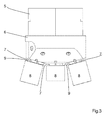
- the light distribution means comprise according to the number of arrays 7 Lichtleitkanäle 8 with light entry surfaces 9, which are preferably arranged parallel to the radiating surfaces.
- the diameters of the light guide channels 8 correspond in size to the size of the arrays 7 and are preferably slightly larger than this, in order to also laterally of the arrays due The construction of the LEDs to capture radiated light and lead into a light distribution space.
- the light generating means including the light guide channels 8 are in Figure 3 shown in more detail.
- the light guide channels 8 are configured in the present example as preferably provided with an inwardly reflective layer glass body, but they can also be designed as cavities.
- three arrays 7 of high-power light-emitting diodes are shown, the emission surface of each of the arrays 7 is tilted to the emission surfaces of the respective other arrays 7 at a specific tilt angle with respect to the other array 7.
- the tilt angle in interaction with the light distribution means there is a certain latitude in the adjustment of the light intensity on the light exit surface 11.
- the tilt angle is 0 and is illuminated by this substantially due to the design of the light distribution means of the anterior region, the two outer arrays 7 are tilted relative to the central array 7 tilted by a magnitude equal tilt angle.
- a stronger tilt angle would lead due to reflections on the boundary surfaces to increased illumination of the anterior region to the canines, at shallower tilt angles, the light is redirected to the sides of the light distribution space and thus directed to the laterally disposed teeth.
- the light is guided via the light entry channels 8 into a light distribution space in the attachment body 3, which is delimited by one or more boundary surfaces 10 and by a light exit surface 11.
- the light exit surface 11 is arranged at a distance from the light guide channels 8.
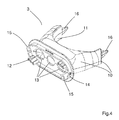
- the attachment body 3 with the light distribution means without the light guide channels 8 is in Figure 4 shown in more detail. It is designed essentially as a hollow body, its walls form the boundary surfaces 10 and the light exit surface 11 of the light exit surface 11, the light is directed to the teeth. It has a curvature which follows substantially the curvature of the dentition, so that when introduced into the mouth device, the light exit surface 11 to the teeth to be irradiated on average has the same distance.
- the boundary surfaces 10 and the light exit surface 11 enclose a cavity 12, which still has inlet openings 13 for the light guide channels 8 on its rear side.
- the light distribution space can also be configured as filled with a transparent material for the Abstrahlwellenin Kunststoffe, but this is more expensive to manufacture.
- the boundary surfaces 10 are designed to be reflective for the deflection of light onto the light exit surface. In this way, it is ensured that the light output provided by the arrays 7 can be utilized as completely as possible.
- the device By using high performance diodes with optimized cooling, it is possible to design the device so compact that it can basically be inserted into the mouth of a person to be treated for tooth whitening.
- the Abstrahlwellenin Kunststoffe the high-power LEDs to the absorption wavelength range of a dye with which the bleaching gel is offset, adapted or vice versa, so that overlap both areas.
- High efficiency can be achieved if the half-width of the emission wavelength ranges from about 30 nm to 50 nm, and additionally or alternatively also the central wavelengths of the emission wavelength ranges in the range of 30 nm around an absorption wavelength of the dye contained in the bleaching gel, at which absorption is maximized is, lie.
- the attachment body 3 On its rear side, the attachment body 3 also still means, with which it can be connected to the base body 1.
- a retaining ring 14 which may be made for example of a hard rubber and with respect to a corresponding circumferential groove in the base body 1 has an interference fit, so that a positive connection can be achieved.
- This can additionally be reinforced by magnetic couplings, wherein magnets can be integrated, for example, in the basic body 1, and in corresponding holders 15 magnetizable metal elements can be introduced.
- the attachment body 3 On the side facing the person to be treated, the attachment body 3 also has connecting pieces 16 which can be inserted into corresponding openings 17 of the adapter 4 and frictionally connect the attachment body with the adapter 4.
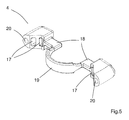
- the adapter 4 is shown in detail in FIG Figure 5 is shown and is preferably also made of an elastic material.
- Adapater 4 has bite pads 18 which the person bites during treatment so that a predetermined position of the device in the mouth is permanently maintained.
- the adapter 4 also has an elastic hinge 19, with which an adaptation to different mouth sizes in a limited scope is possible. In this way it is also possible to use one and the same adapter 4 for different sizes of the attachment body 3.
- the adapter 4 also has a plurality of adjacent ones Openings 17 on. However, the dimensions should not be so great that the adapter in the mouth is perceived as extremely disturbing.
- the adapter 4 also has connections 20 for the connection of suction lines, not shown. With these suction lines, the naturally formed saliva in the mouth of the person can be sucked off during the treatment.
- the device described above has several advantages. Because of their efficient light utilization and efficient cooling, it is possible to place them in the mouth of the patient, which was previously possible only in those devices intended for home use, but which have a much lower efficiency and in which the treatment is not only lasts longer but usually also does not show such good results.
- the device works very quietly due to the water cooling, and due to the modular design, the cost of changing the attachment body 3 and the adapter 4 can be kept within limits.
- a passivation gel is applied to the gum in a first step in order to protect it from contact with the bleaching agent.
- a cheek and lip spreader is placed in the mouth so that it remains permanently open during the treatment and slippage of the device is prevented.
- a passive, chromophore-containing and photochemically activatable bleaching gel is applied to the teeth to be treated.
- the chromophores are designed so that they absorb light with wavelengths from a predetermined absorption wavelength range.
- the device is placed in the mouth, with the person to be treated bites on the B Schoetzlagen 18 of the adapter 4, in this way, the light exit surface 11 is fixed so that it has substantially and on average the same distance from the teeth to be treated. Since the light exit surface 11 follows the curvature of the dentition and is introduced into the mouth, the lateral teeth are also directly irradiated with light, which has hitherto not been possible in the prior art by means of the professional dental bleaching devices. The teeth to be treated are thus illuminated simultaneously and at substantially the same distance from a light exit surface through which light emitted by a light source emerges.
- the above-mentioned arrays are used by the light-emitting high-power light-emitting diodes, the emission characteristics of the light-emitting diodes and the absorption characteristics of the chromophores are matched to one another such that light emitted from the high-power light-emitting diodes has wavelengths from a radiation wavelength range at least equal to the absorption wavelength range partially overlapped so that the light excites the chromophores.
- the chromophores convert the absorbed light energy into heat and thus decompose hydrogen peroxide contained in the bleaching gel.
- the cleavage products of hydrogen peroxide oxidize dyes contained in the tooth and thus whiten the tooth.
- the LEDs emit in the visible spectral range of 400 nm to 800 nm. In this spectral range, the light partially penetrates the tooth.
- bleaching agent which has been applied to the purchase surfaces and penetrates into the fissures, for example, can be activated.
- the treatment which can usually be completed for all teeth within 20 minutes, also runs without the constant presence of a practitioner. Irradiation is automatically terminated when the chromophores in the bleaching gel have faded. Further light is then not absorbed. This can be registered, for example via sensors, so that the device turns off and outputs a signal which can be forwarded to the practitioner.
- This signal can be acoustic or optical, for example.
- a bleaching gel having a lower concentration of hydrogen peroxide than the bleaching gel first used and a fluorine moiety may be applied to the teeth so that the teeth are sealed upon further irradiation.
Landscapes
- Health & Medical Sciences (AREA)
- Oral & Maxillofacial Surgery (AREA)
- Dentistry (AREA)
- Epidemiology (AREA)
- Life Sciences & Earth Sciences (AREA)
- Animal Behavior & Ethology (AREA)
- General Health & Medical Sciences (AREA)
- Public Health (AREA)
- Veterinary Medicine (AREA)
- Dental Tools And Instruments Or Auxiliary Dental Instruments (AREA)
- Radiation-Therapy Devices (AREA)
Applications Claiming Priority (1)
| Application Number | Priority Date | Filing Date | Title |
|---|---|---|---|
| DE200910050440 DE102009050440A1 (de) | 2009-10-21 | 2009-10-21 | Vorrichtung und Verfahren zur kosmetischen Behandlung von verfärbten Zähnen |
Publications (1)
| Publication Number | Publication Date |
|---|---|
| EP2314253A1 true EP2314253A1 (fr) | 2011-04-27 |
Family
ID=43568136
Family Applications (1)
| Application Number | Title | Priority Date | Filing Date |
|---|---|---|---|
| EP10188212A Withdrawn EP2314253A1 (fr) | 2009-10-21 | 2010-10-20 | Dispositif et procédé de traitement cosmétique de dents décolorées |
Country Status (3)
| Country | Link |
|---|---|
| EP (1) | EP2314253A1 (fr) |
| AU (1) | AU2010235870A1 (fr) |
| DE (1) | DE102009050440A1 (fr) |
Cited By (2)
| Publication number | Priority date | Publication date | Assignee | Title |
|---|---|---|---|---|
| CN112566586A (zh) * | 2018-06-08 | 2021-03-26 | 阿尔托大学基金会 | 用于口腔内处理的咬口器及方法 |
| CN113952057A (zh) * | 2021-02-03 | 2022-01-21 | 上海飞象健康科技有限公司 | 电动冲牙器及其自动启停方法、终端及存储介质 |
Citations (12)
| Publication number | Priority date | Publication date | Assignee | Title |
|---|---|---|---|---|
| WO2002022097A1 (fr) | 2000-09-14 | 2002-03-21 | High Tech Laser | Procede et composition pour le blanchiment des dents |
| US6387353B1 (en) | 1997-01-10 | 2002-05-14 | Ultradent Products, Inc. | Light or heat activated dental bleaching compositions |
| US20030157456A1 (en) | 2002-02-21 | 2003-08-21 | Plocharczyk John R. | Fiberoptic dental bleaching device and method of making bleaching device |
| US20040110111A1 (en) | 2002-12-04 | 2004-06-10 | Bryan Wasylucha | Method and apparatus for bleaching teeth |
| US20050002613A1 (en) | 2002-11-25 | 2005-01-06 | Michael Rehberger | LED device |
| US6846182B1 (en) | 1996-11-27 | 2005-01-25 | Jeffrey A. Sibner | Dental bleaching composition and method |
| US20050197681A1 (en) * | 2004-02-06 | 2005-09-08 | Lumiphase Inc. | Method and device for the treatment of mammalian tissues |
| WO2006107362A1 (fr) * | 2005-04-01 | 2006-10-12 | Ajit Khubani | Systeme, appareil et procede de blanchissement des dents active par la lumiere |
| US20070015112A1 (en) | 2003-08-29 | 2007-01-18 | Mark Hochman | Teeth whitening apparatus and method |
| WO2007036290A1 (fr) * | 2005-09-26 | 2007-04-05 | Alfred Konzett | Agent de blanchiment, procede et dispositif pour blanchir des dents grace a l'utilisation dudit agent de blanchiment |
| US20070276455A1 (en) * | 2004-03-09 | 2007-11-29 | Ledeep Llc | Phototherapy Systems And Methods |
| US7320595B2 (en) | 2003-09-24 | 2008-01-22 | Francois Duret | Bleaching device using electro-optical and chemical means, namely in the medical and dental field |
Family Cites Families (4)
| Publication number | Priority date | Publication date | Assignee | Title |
|---|---|---|---|---|
| NZ518224A (en) * | 1999-10-08 | 2006-01-27 | Britesmile Inc | Apparatus for simultaneous illumination of teeth |
| WO2006005049A2 (fr) * | 2004-06-30 | 2006-01-12 | Professional Dental Technologies, Inc. | Dispositif pour blanchir les dents |
| WO2006020128A2 (fr) * | 2004-07-16 | 2006-02-23 | Osborn Joyce A | Lentille a plaque d'occlusion pour le blanchiment des dents |
| US20060134576A1 (en) * | 2004-12-21 | 2006-06-22 | John West | Dental illumination device with single or multiple total internal reflectors (TIR) |
-
2009
- 2009-10-21 DE DE200910050440 patent/DE102009050440A1/de not_active Ceased
-
2010
- 2010-10-15 AU AU2010235870A patent/AU2010235870A1/en not_active Abandoned
- 2010-10-20 EP EP10188212A patent/EP2314253A1/fr not_active Withdrawn
Patent Citations (13)
| Publication number | Priority date | Publication date | Assignee | Title |
|---|---|---|---|---|
| US6846182B1 (en) | 1996-11-27 | 2005-01-25 | Jeffrey A. Sibner | Dental bleaching composition and method |
| US6387353B1 (en) | 1997-01-10 | 2002-05-14 | Ultradent Products, Inc. | Light or heat activated dental bleaching compositions |
| US6391283B1 (en) * | 1997-01-10 | 2002-05-21 | Ultradent Products, Inc. | Methods and apparatus for activating dental compositions |
| WO2002022097A1 (fr) | 2000-09-14 | 2002-03-21 | High Tech Laser | Procede et composition pour le blanchiment des dents |
| US20030157456A1 (en) | 2002-02-21 | 2003-08-21 | Plocharczyk John R. | Fiberoptic dental bleaching device and method of making bleaching device |
| US20050002613A1 (en) | 2002-11-25 | 2005-01-06 | Michael Rehberger | LED device |
| US20040110111A1 (en) | 2002-12-04 | 2004-06-10 | Bryan Wasylucha | Method and apparatus for bleaching teeth |
| US20070015112A1 (en) | 2003-08-29 | 2007-01-18 | Mark Hochman | Teeth whitening apparatus and method |
| US7320595B2 (en) | 2003-09-24 | 2008-01-22 | Francois Duret | Bleaching device using electro-optical and chemical means, namely in the medical and dental field |
| US20050197681A1 (en) * | 2004-02-06 | 2005-09-08 | Lumiphase Inc. | Method and device for the treatment of mammalian tissues |
| US20070276455A1 (en) * | 2004-03-09 | 2007-11-29 | Ledeep Llc | Phototherapy Systems And Methods |
| WO2006107362A1 (fr) * | 2005-04-01 | 2006-10-12 | Ajit Khubani | Systeme, appareil et procede de blanchissement des dents active par la lumiere |
| WO2007036290A1 (fr) * | 2005-09-26 | 2007-04-05 | Alfred Konzett | Agent de blanchiment, procede et dispositif pour blanchir des dents grace a l'utilisation dudit agent de blanchiment |
Cited By (4)
| Publication number | Priority date | Publication date | Assignee | Title |
|---|---|---|---|---|
| CN112566586A (zh) * | 2018-06-08 | 2021-03-26 | 阿尔托大学基金会 | 用于口腔内处理的咬口器及方法 |
| CN112566586B (zh) * | 2018-06-08 | 2023-05-30 | 科伊特健康有限公司 | 用于口腔内处理的咬口器及方法 |
| CN113952057A (zh) * | 2021-02-03 | 2022-01-21 | 上海飞象健康科技有限公司 | 电动冲牙器及其自动启停方法、终端及存储介质 |
| CN113952057B (zh) * | 2021-02-03 | 2023-07-25 | 上海飞象健康科技有限公司 | 电动冲牙器及其自动启停方法、终端及存储介质 |
Also Published As
| Publication number | Publication date |
|---|---|
| DE102009050440A1 (de) | 2011-04-28 |
| AU2010235870A1 (en) | 2011-05-12 |
Similar Documents
| Publication | Publication Date | Title |
|---|---|---|
| DE69626136T2 (de) | Zahnbürste | |
| DE60130995T2 (de) | Gerät zur härtung von materialen mittels lichtstrahlung | |
| EP1379312B1 (fr) | Dispositif d'irradiation, adapte en particulier a la therapie ou au diagnostic photodynamique | |
| DE3719561C2 (de) | Medizinisches Lichtbestrahlungshandstück | |
| EP0880945A2 (fr) | Dispositif de photopolymérisation | |
| CN108066896A (zh) | 光疗装置和方法 | |
| WO2012062884A1 (fr) | Appareil d'irradiation optique pour la dermatologie et la cosmétique | |
| EP0563953B1 (fr) | Dispositif d'application de lumière | |
| WO2008043520A2 (fr) | Dispositif de traitement dermatologique | |
| EP3700461B1 (fr) | Appareil portatif permettant l'excitation de fluorescence et l'irradiation de micro-organismes dans la bouche et la gorge | |
| EP0755662A1 (fr) | Dispositif de photopolymérisation | |
| EP4228744B1 (fr) | Dispositif d'irradiation et système de désinfection photodynamique des dents et des gencives | |
| EP1641533A1 (fr) | Desinfection photo-activee | |
| DE20019703U1 (de) | Vorrichtung zur Akupunktur | |
| DE29908517U1 (de) | Motorisch betriebenes Mundpflegegerät | |
| DE202020101826U1 (de) | Mundsteckstück mit einem Mundhöhlenkörper und mehreren LEDs | |
| EP1281370A2 (fr) | Dispositif d'irradiation | |
| EP2314253A1 (fr) | Dispositif et procédé de traitement cosmétique de dents décolorées | |
| DE102010050962A1 (de) | Optisches Gerät zur therapeutischen oder kosmetischen Behandlung | |
| WO2008019870A1 (fr) | Procédé et dispositif destinés à blanchir les dents | |
| AT12001U1 (de) | Laserzahnbürste | |
| WO2008019869A1 (fr) | Médicament, utilisation d'un agent actif photoréactif pour la fabrication d'un médicament, et instrument de traitement pour traiter, en utilisant un tel médicament, les affections superficielles causées par des virus, des bactéries et des germes | |
| WO2007036290A1 (fr) | Agent de blanchiment, procede et dispositif pour blanchir des dents grace a l'utilisation dudit agent de blanchiment | |
| DE112023000304T5 (de) | Mundhöhlenhygienevorrichtung und -system sowie Verwendungsverfahren davon | |
| EP2528658B1 (fr) | Dispositif à employer pour la thérapie photodynamique antibactérienne |
Legal Events
| Date | Code | Title | Description |
|---|---|---|---|
| PUAI | Public reference made under article 153(3) epc to a published international application that has entered the european phase |
Free format text: ORIGINAL CODE: 0009012 |
|
| AK | Designated contracting states |
Kind code of ref document: A1 Designated state(s): AL AT BE BG CH CY CZ DE DK EE ES FI FR GB GR HR HU IE IS IT LI LT LU LV MC MK MT NL NO PL PT RO RS SE SI SK SM TR |
|
| AX | Request for extension of the european patent |
Extension state: BA ME |
|
| 17P | Request for examination filed |
Effective date: 20111026 |
|
| 17Q | First examination report despatched |
Effective date: 20140526 |
|
| STAA | Information on the status of an ep patent application or granted ep patent |
Free format text: STATUS: THE APPLICATION IS DEEMED TO BE WITHDRAWN |
|
| 18D | Application deemed to be withdrawn |
Effective date: 20170503 |