EP2315837B1 - Production de nanoparticules exemptes de soufre par saccharomyces - Google Patents
Production de nanoparticules exemptes de soufre par saccharomyces Download PDFInfo
- Publication number
- EP2315837B1 EP2315837B1 EP09807787.8A EP09807787A EP2315837B1 EP 2315837 B1 EP2315837 B1 EP 2315837B1 EP 09807787 A EP09807787 A EP 09807787A EP 2315837 B1 EP2315837 B1 EP 2315837B1
- Authority
- EP
- European Patent Office
- Prior art keywords
- yeast
- nanoparticles
- sulfur
- source
- oxidation state
- Prior art date
- Legal status (The legal status is an assumption and is not a legal conclusion. Google has not performed a legal analysis and makes no representation as to the accuracy of the status listed.)
- Not-in-force
Links
- 239000002105 nanoparticle Substances 0.000 title claims description 55
- 241000235070 Saccharomyces Species 0.000 title claims description 6
- 238000004519 manufacturing process Methods 0.000 title description 14
- 240000004808 Saccharomyces cerevisiae Species 0.000 claims description 67
- 235000014680 Saccharomyces cerevisiae Nutrition 0.000 claims description 66
- 239000011669 selenium Substances 0.000 claims description 46
- 229910052711 selenium Inorganic materials 0.000 claims description 26
- 239000001963 growth medium Substances 0.000 claims description 25
- 238000000034 method Methods 0.000 claims description 24
- 239000000203 mixture Substances 0.000 claims description 22
- 239000002609 medium Substances 0.000 claims description 21
- BUGBHKTXTAQXES-UHFFFAOYSA-N Selenium Chemical compound [Se] BUGBHKTXTAQXES-UHFFFAOYSA-N 0.000 claims description 20
- 229910052717 sulfur Inorganic materials 0.000 claims description 19
- 230000003647 oxidation Effects 0.000 claims description 18
- 238000007254 oxidation reaction Methods 0.000 claims description 18
- NINIDFKCEFEMDL-UHFFFAOYSA-N Sulfur Chemical compound [S] NINIDFKCEFEMDL-UHFFFAOYSA-N 0.000 claims description 17
- 239000011593 sulfur Substances 0.000 claims description 17
- WQZGKKKJIJFFOK-GASJEMHNSA-N Glucose Natural products OC[C@H]1OC(O)[C@H](O)[C@@H](O)[C@@H]1O WQZGKKKJIJFFOK-GASJEMHNSA-N 0.000 claims description 14
- 239000008121 dextrose Substances 0.000 claims description 14
- 239000010931 gold Substances 0.000 claims description 14
- BASFCYQUMIYNBI-UHFFFAOYSA-N platinum Chemical compound [Pt] BASFCYQUMIYNBI-UHFFFAOYSA-N 0.000 claims description 14
- KDLHZDBZIXYQEI-UHFFFAOYSA-N Palladium Chemical compound [Pd] KDLHZDBZIXYQEI-UHFFFAOYSA-N 0.000 claims description 9
- 229910052737 gold Inorganic materials 0.000 claims description 8
- 229910052709 silver Inorganic materials 0.000 claims description 7
- 229910052697 platinum Inorganic materials 0.000 claims description 6
- BQCADISMDOOEFD-UHFFFAOYSA-N Silver Chemical compound [Ag] BQCADISMDOOEFD-UHFFFAOYSA-N 0.000 claims description 5
- PCHJSUWPFVWCPO-UHFFFAOYSA-N gold Chemical compound [Au] PCHJSUWPFVWCPO-UHFFFAOYSA-N 0.000 claims description 5
- 229910052763 palladium Inorganic materials 0.000 claims description 5
- 239000004332 silver Substances 0.000 claims description 5
- 241000894007 species Species 0.000 claims description 5
- 239000012138 yeast extract Substances 0.000 claims description 5
- 239000001888 Peptone Substances 0.000 claims description 4
- 108010080698 Peptones Proteins 0.000 claims description 4
- 235000015097 nutrients Nutrition 0.000 claims description 4
- 235000019319 peptone Nutrition 0.000 claims description 4
- 235000013379 molasses Nutrition 0.000 claims description 3
- 239000002245 particle Substances 0.000 claims description 3
- 230000001376 precipitating effect Effects 0.000 claims description 3
- 244000061456 Solanum tuberosum Species 0.000 claims description 2
- 235000002595 Solanum tuberosum Nutrition 0.000 claims description 2
- 229940041514 candida albicans extract Drugs 0.000 claims description 2
- 125000003748 selenium group Chemical group *[Se]* 0.000 claims 1
- 229910052751 metal Inorganic materials 0.000 description 23
- 239000002184 metal Substances 0.000 description 22
- XLYOFNOQVPJJNP-UHFFFAOYSA-N water Substances O XLYOFNOQVPJJNP-UHFFFAOYSA-N 0.000 description 20
- 229940091258 selenium supplement Drugs 0.000 description 19
- 210000004027 cell Anatomy 0.000 description 15
- 239000012153 distilled water Substances 0.000 description 15
- 150000002739 metals Chemical class 0.000 description 15
- IJGRMHOSHXDMSA-UHFFFAOYSA-N Atomic nitrogen Chemical compound N#N IJGRMHOSHXDMSA-UHFFFAOYSA-N 0.000 description 14
- 230000015572 biosynthetic process Effects 0.000 description 14
- RJFAYQIBOAGBLC-BYPYZUCNSA-N Selenium-L-methionine Chemical compound C[Se]CC[C@H](N)C(O)=O RJFAYQIBOAGBLC-BYPYZUCNSA-N 0.000 description 13
- RJFAYQIBOAGBLC-UHFFFAOYSA-N Selenomethionine Natural products C[Se]CCC(N)C(O)=O RJFAYQIBOAGBLC-UHFFFAOYSA-N 0.000 description 13
- 229960002718 selenomethionine Drugs 0.000 description 13
- 239000000126 substance Substances 0.000 description 13
- TWRXJAOTZQYOKJ-UHFFFAOYSA-L Magnesium chloride Chemical compound [Mg+2].[Cl-].[Cl-] TWRXJAOTZQYOKJ-UHFFFAOYSA-L 0.000 description 10
- FAPWRFPIFSIZLT-UHFFFAOYSA-M Sodium chloride Chemical compound [Na+].[Cl-] FAPWRFPIFSIZLT-UHFFFAOYSA-M 0.000 description 10
- SXRSQZLOMIGNAQ-UHFFFAOYSA-N Glutaraldehyde Chemical compound O=CCCCC=O SXRSQZLOMIGNAQ-UHFFFAOYSA-N 0.000 description 9
- 235000010633 broth Nutrition 0.000 description 8
- 238000005119 centrifugation Methods 0.000 description 8
- 239000006228 supernatant Substances 0.000 description 8
- 229910052757 nitrogen Inorganic materials 0.000 description 7
- 239000011573 trace mineral Substances 0.000 description 7
- 235000013619 trace mineral Nutrition 0.000 description 7
- YBJHBAHKTGYVGT-ZKWXMUAHSA-N (+)-Biotin Chemical compound N1C(=O)N[C@@H]2[C@H](CCCCC(=O)O)SC[C@@H]21 YBJHBAHKTGYVGT-ZKWXMUAHSA-N 0.000 description 6
- PVNIIMVLHYAWGP-UHFFFAOYSA-N Niacin Chemical compound OC(=O)C1=CC=CN=C1 PVNIIMVLHYAWGP-UHFFFAOYSA-N 0.000 description 6
- 239000002086 nanomaterial Substances 0.000 description 6
- NLXLAEXVIDQMFP-UHFFFAOYSA-N Ammonia chloride Chemical compound [NH4+].[Cl-] NLXLAEXVIDQMFP-UHFFFAOYSA-N 0.000 description 5
- UXVMQQNJUSDDNG-UHFFFAOYSA-L Calcium chloride Chemical compound [Cl-].[Cl-].[Ca+2] UXVMQQNJUSDDNG-UHFFFAOYSA-L 0.000 description 5
- 229940024606 amino acid Drugs 0.000 description 5
- 235000001014 amino acid Nutrition 0.000 description 5
- 150000001413 amino acids Chemical class 0.000 description 5
- 239000001110 calcium chloride Substances 0.000 description 5
- 229910001628 calcium chloride Inorganic materials 0.000 description 5
- 150000001720 carbohydrates Chemical class 0.000 description 5
- 235000014633 carbohydrates Nutrition 0.000 description 5
- 229910001629 magnesium chloride Inorganic materials 0.000 description 5
- 150000002736 metal compounds Chemical class 0.000 description 5
- 239000008363 phosphate buffer Substances 0.000 description 5
- 150000003839 salts Chemical class 0.000 description 5
- 239000011780 sodium chloride Substances 0.000 description 5
- 229940088594 vitamin Drugs 0.000 description 5
- 229930003231 vitamin Natural products 0.000 description 5
- 235000013343 vitamin Nutrition 0.000 description 5
- 239000011782 vitamin Substances 0.000 description 5
- PMYDPQQPEAYXKD-UHFFFAOYSA-N 3-hydroxy-n-naphthalen-2-ylnaphthalene-2-carboxamide Chemical compound C1=CC=CC2=CC(NC(=O)C3=CC4=CC=CC=C4C=C3O)=CC=C21 PMYDPQQPEAYXKD-UHFFFAOYSA-N 0.000 description 4
- XEEYBQQBJWHFJM-UHFFFAOYSA-N Iron Chemical compound [Fe] XEEYBQQBJWHFJM-UHFFFAOYSA-N 0.000 description 4
- 239000007836 KH2PO4 Substances 0.000 description 4
- HNDVDQJCIGZPNO-YFKPBYRVSA-N L-histidine Chemical compound OC(=O)[C@@H](N)CC1=CN=CN1 HNDVDQJCIGZPNO-YFKPBYRVSA-N 0.000 description 4
- ROHFNLRQFUQHCH-YFKPBYRVSA-N L-leucine Chemical compound CC(C)C[C@H](N)C(O)=O ROHFNLRQFUQHCH-YFKPBYRVSA-N 0.000 description 4
- COLNVLDHVKWLRT-QMMMGPOBSA-N L-phenylalanine Chemical compound OC(=O)[C@@H](N)CC1=CC=CC=C1 COLNVLDHVKWLRT-QMMMGPOBSA-N 0.000 description 4
- AYFVYJQAPQTCCC-GBXIJSLDSA-N L-threonine Chemical compound C[C@@H](O)[C@H](N)C(O)=O AYFVYJQAPQTCCC-GBXIJSLDSA-N 0.000 description 4
- QIVBCDIJIAJPQS-VIFPVBQESA-N L-tryptophane Chemical compound C1=CC=C2C(C[C@H](N)C(O)=O)=CNC2=C1 QIVBCDIJIAJPQS-VIFPVBQESA-N 0.000 description 4
- OUYCCCASQSFEME-QMMMGPOBSA-N L-tyrosine Chemical compound OC(=O)[C@@H](N)CC1=CC=C(O)C=C1 OUYCCCASQSFEME-QMMMGPOBSA-N 0.000 description 4
- KZSNJWFQEVHDMF-BYPYZUCNSA-N L-valine Chemical compound CC(C)[C@H](N)C(O)=O KZSNJWFQEVHDMF-BYPYZUCNSA-N 0.000 description 4
- OAICVXFJPJFONN-UHFFFAOYSA-N Phosphorus Chemical compound [P] OAICVXFJPJFONN-UHFFFAOYSA-N 0.000 description 4
- AUNGANRZJHBGPY-SCRDCRAPSA-N Riboflavin Chemical compound OC[C@@H](O)[C@@H](O)[C@@H](O)CN1C=2C=C(C)C(C)=CC=2N=C2C1=NC(=O)NC2=O AUNGANRZJHBGPY-SCRDCRAPSA-N 0.000 description 4
- 238000004458 analytical method Methods 0.000 description 4
- 239000000872 buffer Substances 0.000 description 4
- 230000008859 change Effects 0.000 description 4
- 150000001875 compounds Chemical class 0.000 description 4
- 238000000724 energy-dispersive X-ray spectrum Methods 0.000 description 4
- OVBPIULPVIDEAO-LBPRGKRZSA-N folic acid Chemical compound C=1N=C2NC(N)=NC(=O)C2=NC=1CNC1=CC=C(C(=O)N[C@@H](CCC(O)=O)C(O)=O)C=C1 OVBPIULPVIDEAO-LBPRGKRZSA-N 0.000 description 4
- 238000001095 inductively coupled plasma mass spectrometry Methods 0.000 description 4
- 235000006109 methionine Nutrition 0.000 description 4
- 229910000402 monopotassium phosphate Inorganic materials 0.000 description 4
- 229960003512 nicotinic acid Drugs 0.000 description 4
- 235000001968 nicotinic acid Nutrition 0.000 description 4
- 239000011664 nicotinic acid Substances 0.000 description 4
- 229910052698 phosphorus Inorganic materials 0.000 description 4
- 239000011574 phosphorus Substances 0.000 description 4
- GNSKLFRGEWLPPA-UHFFFAOYSA-M potassium dihydrogen phosphate Chemical compound [K+].OP(O)([O-])=O GNSKLFRGEWLPPA-UHFFFAOYSA-M 0.000 description 4
- LXNHXLLTXMVWPM-UHFFFAOYSA-N pyridoxine Chemical compound CC1=NC=C(CO)C(CO)=C1O LXNHXLLTXMVWPM-UHFFFAOYSA-N 0.000 description 4
- 239000011655 sodium selenate Substances 0.000 description 4
- 229960001881 sodium selenate Drugs 0.000 description 4
- 235000018716 sodium selenate Nutrition 0.000 description 4
- 238000011179 visual inspection Methods 0.000 description 4
- 210000005253 yeast cell Anatomy 0.000 description 4
- 241000196324 Embryophyta Species 0.000 description 3
- 241000233866 Fungi Species 0.000 description 3
- -1 IVA metals Chemical class 0.000 description 3
- FFEARJCKVFRZRR-BYPYZUCNSA-N L-methionine Chemical compound CSCC[C@H](N)C(O)=O FFEARJCKVFRZRR-BYPYZUCNSA-N 0.000 description 3
- 238000003917 TEM image Methods 0.000 description 3
- 229910052770 Uranium Inorganic materials 0.000 description 3
- 238000007792 addition Methods 0.000 description 3
- 229910052785 arsenic Inorganic materials 0.000 description 3
- RQNWIZPPADIBDY-UHFFFAOYSA-N arsenic atom Chemical compound [As] RQNWIZPPADIBDY-UHFFFAOYSA-N 0.000 description 3
- 229960002685 biotin Drugs 0.000 description 3
- 235000020958 biotin Nutrition 0.000 description 3
- 239000011616 biotin Substances 0.000 description 3
- XUJNEKJLAYXESH-UHFFFAOYSA-N cysteine Natural products SCC(N)C(O)=O XUJNEKJLAYXESH-UHFFFAOYSA-N 0.000 description 3
- 235000018417 cysteine Nutrition 0.000 description 3
- 238000001514 detection method Methods 0.000 description 3
- 238000002149 energy-dispersive X-ray emission spectroscopy Methods 0.000 description 3
- 238000000608 laser ablation Methods 0.000 description 3
- 229930182817 methionine Natural products 0.000 description 3
- 235000000346 sugar Nutrition 0.000 description 3
- 238000003786 synthesis reaction Methods 0.000 description 3
- 229910052714 tellurium Inorganic materials 0.000 description 3
- 238000004627 transmission electron microscopy Methods 0.000 description 3
- GHOKWGTUZJEAQD-ZETCQYMHSA-N (D)-(+)-Pantothenic acid Chemical compound OCC(C)(C)[C@@H](O)C(=O)NCCC(O)=O GHOKWGTUZJEAQD-ZETCQYMHSA-N 0.000 description 2
- ALYNCZNDIQEVRV-UHFFFAOYSA-N 4-aminobenzoic acid Chemical compound NC1=CC=C(C(O)=O)C=C1 ALYNCZNDIQEVRV-UHFFFAOYSA-N 0.000 description 2
- 229930024421 Adenine Natural products 0.000 description 2
- GFFGJBXGBJISGV-UHFFFAOYSA-N Adenine Chemical compound NC1=NC=NC2=C1N=CN2 GFFGJBXGBJISGV-UHFFFAOYSA-N 0.000 description 2
- VHUUQVKOLVNVRT-UHFFFAOYSA-N Ammonium hydroxide Chemical compound [NH4+].[OH-] VHUUQVKOLVNVRT-UHFFFAOYSA-N 0.000 description 2
- 229910021592 Copper(II) chloride Inorganic materials 0.000 description 2
- AUNGANRZJHBGPY-UHFFFAOYSA-N D-Lyxoflavin Natural products OCC(O)C(O)C(O)CN1C=2C=C(C)C(C)=CC=2N=C2C1=NC(=O)NC2=O AUNGANRZJHBGPY-UHFFFAOYSA-N 0.000 description 2
- CKLJMWTZIZZHCS-UHFFFAOYSA-N D-OH-Asp Natural products OC(=O)C(N)CC(O)=O CKLJMWTZIZZHCS-UHFFFAOYSA-N 0.000 description 2
- ZGTMUACCHSMWAC-UHFFFAOYSA-L EDTA disodium salt (anhydrous) Chemical compound [Na+].[Na+].OC(=O)CN(CC([O-])=O)CCN(CC(O)=O)CC([O-])=O ZGTMUACCHSMWAC-UHFFFAOYSA-L 0.000 description 2
- GYHNNYVSQQEPJS-UHFFFAOYSA-N Gallium Chemical compound [Ga] GYHNNYVSQQEPJS-UHFFFAOYSA-N 0.000 description 2
- SQUHHTBVTRBESD-UHFFFAOYSA-N Hexa-Ac-myo-Inositol Natural products CC(=O)OC1C(OC(C)=O)C(OC(C)=O)C(OC(C)=O)C(OC(C)=O)C1OC(C)=O SQUHHTBVTRBESD-UHFFFAOYSA-N 0.000 description 2
- UFHFLCQGNIYNRP-UHFFFAOYSA-N Hydrogen Chemical compound [H][H] UFHFLCQGNIYNRP-UHFFFAOYSA-N 0.000 description 2
- 229910021578 Iron(III) chloride Inorganic materials 0.000 description 2
- CKLJMWTZIZZHCS-UWTATZPHSA-N L-Aspartic acid Natural products OC(=O)[C@H](N)CC(O)=O CKLJMWTZIZZHCS-UWTATZPHSA-N 0.000 description 2
- ODKSFYDXXFIFQN-BYPYZUCNSA-N L-arginine Chemical compound OC(=O)[C@@H](N)CCCN=C(N)N ODKSFYDXXFIFQN-BYPYZUCNSA-N 0.000 description 2
- 229930064664 L-arginine Natural products 0.000 description 2
- 235000014852 L-arginine Nutrition 0.000 description 2
- CKLJMWTZIZZHCS-REOHCLBHSA-N L-aspartic acid Chemical compound OC(=O)[C@@H](N)CC(O)=O CKLJMWTZIZZHCS-REOHCLBHSA-N 0.000 description 2
- AGPKZVBTJJNPAG-WHFBIAKZSA-N L-isoleucine Chemical compound CC[C@H](C)[C@H](N)C(O)=O AGPKZVBTJJNPAG-WHFBIAKZSA-N 0.000 description 2
- 229930182844 L-isoleucine Natural products 0.000 description 2
- 235000019454 L-leucine Nutrition 0.000 description 2
- 239000004395 L-leucine Substances 0.000 description 2
- 229910021380 Manganese Chloride Inorganic materials 0.000 description 2
- GLFNIEUTAYBVOC-UHFFFAOYSA-L Manganese chloride Chemical compound Cl[Mn]Cl GLFNIEUTAYBVOC-UHFFFAOYSA-L 0.000 description 2
- OVBPIULPVIDEAO-UHFFFAOYSA-N N-Pteroyl-L-glutaminsaeure Natural products C=1N=C2NC(N)=NC(=O)C2=NC=1CNC1=CC=C(C(=O)NC(CCC(O)=O)C(O)=O)C=C1 OVBPIULPVIDEAO-UHFFFAOYSA-N 0.000 description 2
- BTGMTHBOODBMHN-SUHMBNCMSA-N N-[3-[1-[[(3S)-2-hydroxy-5-oxooxolan-3-yl]carbamoyl]cyclopropyl]-2,4-dioxo-1-propan-2-ylpyrimidin-5-yl]-2-methyl-4-(naphthalen-2-ylamino)benzamide Chemical compound CC(C)n1cc(NC(=O)c2ccc(Nc3ccc4ccccc4c3)cc2C)c(=O)n(c1=O)C1(CC1)C(=O)N[C@H]1CC(=O)OC1O BTGMTHBOODBMHN-SUHMBNCMSA-N 0.000 description 2
- 229910004619 Na2MoO4 Inorganic materials 0.000 description 2
- PXHVJJICTQNCMI-UHFFFAOYSA-N Nickel Chemical compound [Ni] PXHVJJICTQNCMI-UHFFFAOYSA-N 0.000 description 2
- 108010026552 Proteome Proteins 0.000 description 2
- 241000198071 Saccharomyces cariocanus Species 0.000 description 2
- 241001123227 Saccharomyces pastorianus Species 0.000 description 2
- 241000235343 Saccharomycetales Species 0.000 description 2
- JZRWCGZRTZMZEH-UHFFFAOYSA-N Thiamine Natural products CC1=C(CCO)SC=[N+]1CC1=CN=C(C)N=C1N JZRWCGZRTZMZEH-UHFFFAOYSA-N 0.000 description 2
- 239000004473 Threonine Substances 0.000 description 2
- OPPPRBRETLLZFC-DKWTVANSSA-N [S].SC[C@H](N)C(O)=O Chemical compound [S].SC[C@H](N)C(O)=O OPPPRBRETLLZFC-DKWTVANSSA-N 0.000 description 2
- 229910052768 actinide Inorganic materials 0.000 description 2
- 150000001255 actinides Chemical class 0.000 description 2
- 230000009471 action Effects 0.000 description 2
- 229960000643 adenine Drugs 0.000 description 2
- 229910052787 antimony Inorganic materials 0.000 description 2
- WATWJIUSRGPENY-UHFFFAOYSA-N antimony atom Chemical compound [Sb] WATWJIUSRGPENY-UHFFFAOYSA-N 0.000 description 2
- 229960005261 aspartic acid Drugs 0.000 description 2
- QVGXLLKOCUKJST-UHFFFAOYSA-N atomic oxygen Chemical compound [O] QVGXLLKOCUKJST-UHFFFAOYSA-N 0.000 description 2
- KGBXLFKZBHKPEV-UHFFFAOYSA-N boric acid Chemical compound OB(O)O KGBXLFKZBHKPEV-UHFFFAOYSA-N 0.000 description 2
- 229910052980 cadmium sulfide Inorganic materials 0.000 description 2
- 125000001314 canonical amino-acid group Chemical group 0.000 description 2
- 239000000470 constituent Substances 0.000 description 2
- ORTQZVOHEJQUHG-UHFFFAOYSA-L copper(II) chloride Chemical compound Cl[Cu]Cl ORTQZVOHEJQUHG-UHFFFAOYSA-L 0.000 description 2
- 239000008367 deionised water Substances 0.000 description 2
- 238000004925 denaturation Methods 0.000 description 2
- 230000036425 denaturation Effects 0.000 description 2
- 238000009826 distribution Methods 0.000 description 2
- 238000002330 electrospray ionisation mass spectrometry Methods 0.000 description 2
- 238000005516 engineering process Methods 0.000 description 2
- 229960000304 folic acid Drugs 0.000 description 2
- 235000019152 folic acid Nutrition 0.000 description 2
- 239000011724 folic acid Substances 0.000 description 2
- 229910052733 gallium Inorganic materials 0.000 description 2
- 239000007789 gas Substances 0.000 description 2
- 229910052732 germanium Inorganic materials 0.000 description 2
- GNPVGFCGXDBREM-UHFFFAOYSA-N germanium atom Chemical compound [Ge] GNPVGFCGXDBREM-UHFFFAOYSA-N 0.000 description 2
- 229960002885 histidine Drugs 0.000 description 2
- 238000009616 inductively coupled plasma Methods 0.000 description 2
- 229960000367 inositol Drugs 0.000 description 2
- CDAISMWEOUEBRE-GPIVLXJGSA-N inositol Chemical compound O[C@H]1[C@H](O)[C@@H](O)[C@H](O)[C@H](O)[C@@H]1O CDAISMWEOUEBRE-GPIVLXJGSA-N 0.000 description 2
- 229910052742 iron Inorganic materials 0.000 description 2
- RBTARNINKXHZNM-UHFFFAOYSA-K iron trichloride Chemical compound Cl[Fe](Cl)Cl RBTARNINKXHZNM-UHFFFAOYSA-K 0.000 description 2
- 229960000310 isoleucine Drugs 0.000 description 2
- 229910052747 lanthanoid Inorganic materials 0.000 description 2
- 150000002602 lanthanoids Chemical class 0.000 description 2
- 229960003136 leucine Drugs 0.000 description 2
- 239000011565 manganese chloride Substances 0.000 description 2
- 238000004949 mass spectrometry Methods 0.000 description 2
- 239000000463 material Substances 0.000 description 2
- 125000001360 methionine group Chemical group N[C@@H](CCSC)C(=O)* 0.000 description 2
- 244000005700 microbiome Species 0.000 description 2
- 239000006199 nebulizer Substances 0.000 description 2
- 229910052755 nonmetal Inorganic materials 0.000 description 2
- 229910052760 oxygen Inorganic materials 0.000 description 2
- 239000001301 oxygen Substances 0.000 description 2
- WXHIJDCHNDBCNY-UHFFFAOYSA-N palladium dihydride Chemical compound [PdH2] WXHIJDCHNDBCNY-UHFFFAOYSA-N 0.000 description 2
- 229940014662 pantothenate Drugs 0.000 description 2
- 235000019161 pantothenic acid Nutrition 0.000 description 2
- 239000011713 pantothenic acid Substances 0.000 description 2
- 229960005190 phenylalanine Drugs 0.000 description 2
- 239000013630 prepared media Substances 0.000 description 2
- 230000008569 process Effects 0.000 description 2
- 235000008160 pyridoxine Nutrition 0.000 description 2
- 239000011677 pyridoxine Substances 0.000 description 2
- 229960002477 riboflavin Drugs 0.000 description 2
- 235000019192 riboflavin Nutrition 0.000 description 2
- 239000002151 riboflavin Substances 0.000 description 2
- 238000005070 sampling Methods 0.000 description 2
- CDAISMWEOUEBRE-UHFFFAOYSA-N scyllo-inosotol Natural products OC1C(O)C(O)C(O)C(O)C1O CDAISMWEOUEBRE-UHFFFAOYSA-N 0.000 description 2
- 238000000926 separation method Methods 0.000 description 2
- 239000011684 sodium molybdate Substances 0.000 description 2
- TVXXNOYZHKPKGW-UHFFFAOYSA-N sodium molybdate (anhydrous) Chemical compound [Na+].[Na+].[O-][Mo]([O-])(=O)=O TVXXNOYZHKPKGW-UHFFFAOYSA-N 0.000 description 2
- WPLOVIFNBMNBPD-ATHMIXSHSA-N subtilin Chemical compound CC1SCC(NC2=O)C(=O)NC(CC(N)=O)C(=O)NC(C(=O)NC(CCCCN)C(=O)NC(C(C)CC)C(=O)NC(=C)C(=O)NC(CCCCN)C(O)=O)CSC(C)C2NC(=O)C(CC(C)C)NC(=O)C1NC(=O)C(CCC(N)=O)NC(=O)C(CC(C)C)NC(=O)C(NC(=O)C1NC(=O)C(=C/C)/NC(=O)C(CCC(N)=O)NC(=O)C(CC(C)C)NC(=O)C(C)NC(=O)CNC(=O)C(NC(=O)C(NC(=O)C2NC(=O)CNC(=O)C3CCCN3C(=O)C(NC(=O)C3NC(=O)C(CC(C)C)NC(=O)C(=C)NC(=O)C(CCC(O)=O)NC(=O)C(NC(=O)C(CCCCN)NC(=O)C(N)CC=4C5=CC=CC=C5NC=4)CSC3)C(C)SC2)C(C)C)C(C)SC1)CC1=CC=CC=C1 WPLOVIFNBMNBPD-ATHMIXSHSA-N 0.000 description 2
- 239000000725 suspension Substances 0.000 description 2
- XHGGEBRKUWZHEK-UHFFFAOYSA-L tellurate Chemical compound [O-][Te]([O-])(=O)=O XHGGEBRKUWZHEK-UHFFFAOYSA-L 0.000 description 2
- PORWMNRCUJJQNO-UHFFFAOYSA-N tellurium atom Chemical compound [Te] PORWMNRCUJJQNO-UHFFFAOYSA-N 0.000 description 2
- 235000019157 thiamine Nutrition 0.000 description 2
- KYMBYSLLVAOCFI-UHFFFAOYSA-N thiamine Chemical compound CC1=C(CCO)SCN1CC1=CN=C(C)N=C1N KYMBYSLLVAOCFI-UHFFFAOYSA-N 0.000 description 2
- 229960003495 thiamine Drugs 0.000 description 2
- 239000011721 thiamine Substances 0.000 description 2
- 229960002898 threonine Drugs 0.000 description 2
- 210000001519 tissue Anatomy 0.000 description 2
- 229910052723 transition metal Inorganic materials 0.000 description 2
- 150000003624 transition metals Chemical class 0.000 description 2
- 229960004799 tryptophan Drugs 0.000 description 2
- 229960004441 tyrosine Drugs 0.000 description 2
- DNYWZCXLKNTFFI-UHFFFAOYSA-N uranium Chemical compound [U][U][U][U][U][U][U][U][U][U][U][U][U][U][U][U][U][U][U][U][U][U][U][U][U][U][U][U][U][U][U][U][U][U][U][U][U][U][U][U][U][U][U][U][U][U][U][U][U][U][U][U][U][U][U][U][U][U][U][U][U][U][U][U][U][U][U][U][U][U][U][U][U][U][U][U][U][U][U][U][U][U][U][U][U][U][U][U][U][U][U][U][U][U][U][U][U][U][U][U][U][U][U][U][U][U][U][U][U][U][U][U][U][U] DNYWZCXLKNTFFI-UHFFFAOYSA-N 0.000 description 2
- 229960004295 valine Drugs 0.000 description 2
- 229940011671 vitamin b6 Drugs 0.000 description 2
- 229910052725 zinc Inorganic materials 0.000 description 2
- 239000011701 zinc Substances 0.000 description 2
- 239000011592 zinc chloride Substances 0.000 description 2
- JIAARYAFYJHUJI-UHFFFAOYSA-L zinc dichloride Chemical compound [Cl-].[Cl-].[Zn+2] JIAARYAFYJHUJI-UHFFFAOYSA-L 0.000 description 2
- ZSLUVFAKFWKJRC-IGMARMGPSA-N 232Th Chemical compound [232Th] ZSLUVFAKFWKJRC-IGMARMGPSA-N 0.000 description 1
- WUPHOULIZUERAE-UHFFFAOYSA-N 3-(oxolan-2-yl)propanoic acid Chemical compound OC(=O)CCC1CCCO1 WUPHOULIZUERAE-UHFFFAOYSA-N 0.000 description 1
- 241000235349 Ascomycota Species 0.000 description 1
- 241000894006 Bacteria Species 0.000 description 1
- ZOXJGFHDIHLPTG-UHFFFAOYSA-N Boron Chemical compound [B] ZOXJGFHDIHLPTG-UHFFFAOYSA-N 0.000 description 1
- 229910052684 Cerium Inorganic materials 0.000 description 1
- 241001159781 Kazachstania spencerorum Species 0.000 description 1
- 241000039979 Kazachstania turicensis Species 0.000 description 1
- 241001123232 Kazachstania unispora Species 0.000 description 1
- 241000965982 Kazachstania zonata Species 0.000 description 1
- 241001123224 Naumovozyma dairenensis Species 0.000 description 1
- 229910052779 Neodymium Inorganic materials 0.000 description 1
- 241000737259 Pteris vittata Species 0.000 description 1
- 241000235072 Saccharomyces bayanus Species 0.000 description 1
- 241000877399 Saccharomyces chevalieri Species 0.000 description 1
- 241000877401 Saccharomyces ellipsoideus Species 0.000 description 1
- 241001407717 Saccharomyces norbensis Species 0.000 description 1
- 241001123228 Saccharomyces paradoxus Species 0.000 description 1
- 241000582914 Saccharomyces uvarum Species 0.000 description 1
- 241000235344 Saccharomycetaceae Species 0.000 description 1
- 241000235342 Saccharomycetes Species 0.000 description 1
- 241001326564 Saccharomycotina Species 0.000 description 1
- 241000201895 Salicornia Species 0.000 description 1
- FOIXSVOLVBLSDH-UHFFFAOYSA-N Silver ion Chemical compound [Ag+] FOIXSVOLVBLSDH-UHFFFAOYSA-N 0.000 description 1
- 229910052776 Thorium Inorganic materials 0.000 description 1
- ATJFFYVFTNAWJD-UHFFFAOYSA-N Tin Chemical compound [Sn] ATJFFYVFTNAWJD-UHFFFAOYSA-N 0.000 description 1
- 229930003270 Vitamin B Natural products 0.000 description 1
- 229910052769 Ytterbium Inorganic materials 0.000 description 1
- HCHKCACWOHOZIP-UHFFFAOYSA-N Zinc Chemical compound [Zn] HCHKCACWOHOZIP-UHFFFAOYSA-N 0.000 description 1
- PTFCDOFLOPIGGS-UHFFFAOYSA-N Zinc dication Chemical compound [Zn+2] PTFCDOFLOPIGGS-UHFFFAOYSA-N 0.000 description 1
- 230000002378 acidificating effect Effects 0.000 description 1
- 238000013019 agitation Methods 0.000 description 1
- 230000008901 benefit Effects 0.000 description 1
- 229910052797 bismuth Inorganic materials 0.000 description 1
- JCXGWMGPZLAOME-UHFFFAOYSA-N bismuth atom Chemical compound [Bi] JCXGWMGPZLAOME-UHFFFAOYSA-N 0.000 description 1
- 229910052796 boron Inorganic materials 0.000 description 1
- 229910052793 cadmium Inorganic materials 0.000 description 1
- BDOSMKKIYDKNTQ-UHFFFAOYSA-N cadmium atom Chemical compound [Cd] BDOSMKKIYDKNTQ-UHFFFAOYSA-N 0.000 description 1
- 239000005018 casein Substances 0.000 description 1
- BECPQYXYKAMYBN-UHFFFAOYSA-N casein, tech. Chemical compound NCCCCC(C(O)=O)N=C(O)C(CC(O)=O)N=C(O)C(CCC(O)=N)N=C(O)C(CC(C)C)N=C(O)C(CCC(O)=O)N=C(O)C(CC(O)=O)N=C(O)C(CCC(O)=O)N=C(O)C(C(C)O)N=C(O)C(CCC(O)=N)N=C(O)C(CCC(O)=N)N=C(O)C(CCC(O)=N)N=C(O)C(CCC(O)=O)N=C(O)C(CCC(O)=O)N=C(O)C(COP(O)(O)=O)N=C(O)C(CCC(O)=N)N=C(O)C(N)CC1=CC=CC=C1 BECPQYXYKAMYBN-UHFFFAOYSA-N 0.000 description 1
- 235000021240 caseins Nutrition 0.000 description 1
- 238000004113 cell culture Methods 0.000 description 1
- ZMIGMASIKSOYAM-UHFFFAOYSA-N cerium Chemical compound [Ce][Ce][Ce][Ce][Ce][Ce][Ce][Ce][Ce][Ce][Ce][Ce][Ce][Ce][Ce][Ce][Ce][Ce][Ce][Ce][Ce][Ce][Ce][Ce][Ce][Ce][Ce][Ce][Ce][Ce][Ce][Ce][Ce][Ce][Ce][Ce][Ce][Ce] ZMIGMASIKSOYAM-UHFFFAOYSA-N 0.000 description 1
- 238000011109 contamination Methods 0.000 description 1
- 230000006378 damage Effects 0.000 description 1
- 238000000354 decomposition reaction Methods 0.000 description 1
- 238000011161 development Methods 0.000 description 1
- 230000018109 developmental process Effects 0.000 description 1
- 238000002474 experimental method Methods 0.000 description 1
- 210000001723 extracellular space Anatomy 0.000 description 1
- 238000001914 filtration Methods 0.000 description 1
- 238000009472 formulation Methods 0.000 description 1
- 230000008014 freezing Effects 0.000 description 1
- 238000007710 freezing Methods 0.000 description 1
- 229910021472 group 8 element Inorganic materials 0.000 description 1
- 229910052739 hydrogen Inorganic materials 0.000 description 1
- 239000001257 hydrogen Substances 0.000 description 1
- 238000003384 imaging method Methods 0.000 description 1
- 238000011534 incubation Methods 0.000 description 1
- 229910052738 indium Inorganic materials 0.000 description 1
- APFVFJFRJDLVQX-UHFFFAOYSA-N indium atom Chemical compound [In] APFVFJFRJDLVQX-UHFFFAOYSA-N 0.000 description 1
- 230000003834 intracellular effect Effects 0.000 description 1
- 229910052746 lanthanum Inorganic materials 0.000 description 1
- FZLIPJUXYLNCLC-UHFFFAOYSA-N lanthanum atom Chemical compound [La] FZLIPJUXYLNCLC-UHFFFAOYSA-N 0.000 description 1
- 229910052745 lead Inorganic materials 0.000 description 1
- 229910052981 lead sulfide Inorganic materials 0.000 description 1
- 229940056932 lead sulfide Drugs 0.000 description 1
- 239000007788 liquid Substances 0.000 description 1
- 238000007885 magnetic separation Methods 0.000 description 1
- 239000002069 magnetite nanoparticle Substances 0.000 description 1
- 239000012528 membrane Substances 0.000 description 1
- 229910052752 metalloid Inorganic materials 0.000 description 1
- 150000002738 metalloids Chemical class 0.000 description 1
- 150000002742 methionines Chemical class 0.000 description 1
- 238000002156 mixing Methods 0.000 description 1
- 239000002159 nanocrystal Substances 0.000 description 1
- QEFYFXOXNSNQGX-UHFFFAOYSA-N neodymium atom Chemical compound [Nd] QEFYFXOXNSNQGX-UHFFFAOYSA-N 0.000 description 1
- 229910052759 nickel Inorganic materials 0.000 description 1
- 150000002843 nonmetals Chemical class 0.000 description 1
- 210000000633 nuclear envelope Anatomy 0.000 description 1
- 235000016709 nutrition Nutrition 0.000 description 1
- 230000035764 nutrition Effects 0.000 description 1
- 150000002927 oxygen compounds Chemical class 0.000 description 1
- 230000001175 peptic effect Effects 0.000 description 1
- JTJMJGYZQZDUJJ-UHFFFAOYSA-N phencyclidine Chemical compound C1CCCCN1C1(C=2C=CC=CC=2)CCCCC1 JTJMJGYZQZDUJJ-UHFFFAOYSA-N 0.000 description 1
- 150000003018 phosphorus compounds Chemical class 0.000 description 1
- 238000000918 plasma mass spectrometry Methods 0.000 description 1
- 238000002360 preparation method Methods 0.000 description 1
- 239000002096 quantum dot Substances 0.000 description 1
- 229910052703 rhodium Inorganic materials 0.000 description 1
- 239000010948 rhodium Substances 0.000 description 1
- MHOVAHRLVXNVSD-UHFFFAOYSA-N rhodium atom Chemical compound [Rh] MHOVAHRLVXNVSD-UHFFFAOYSA-N 0.000 description 1
- 229960002181 saccharomyces boulardii Drugs 0.000 description 1
- 238000013341 scale-up Methods 0.000 description 1
- QYHFIVBSNOWOCQ-UHFFFAOYSA-N selenic acid Chemical class O[Se](O)(=O)=O QYHFIVBSNOWOCQ-UHFFFAOYSA-N 0.000 description 1
- 150000003342 selenium Chemical class 0.000 description 1
- 229940065287 selenium compound Drugs 0.000 description 1
- 150000003343 selenium compounds Chemical class 0.000 description 1
- 150000003958 selenols Chemical class 0.000 description 1
- 229910052710 silicon Inorganic materials 0.000 description 1
- 239000010703 silicon Substances 0.000 description 1
- 239000010944 silver (metal) Substances 0.000 description 1
- 239000007787 solid Substances 0.000 description 1
- 239000007921 spray Substances 0.000 description 1
- 150000008163 sugars Chemical class 0.000 description 1
- 150000003463 sulfur Chemical class 0.000 description 1
- 230000009469 supplementation Effects 0.000 description 1
- 229910052715 tantalum Inorganic materials 0.000 description 1
- GUVRBAGPIYLISA-UHFFFAOYSA-N tantalum atom Chemical compound [Ta] GUVRBAGPIYLISA-UHFFFAOYSA-N 0.000 description 1
- 150000003573 thiols Chemical class 0.000 description 1
- 231100000331 toxic Toxicity 0.000 description 1
- 230000002588 toxic effect Effects 0.000 description 1
- 229910021654 trace metal Inorganic materials 0.000 description 1
- 235000019156 vitamin B Nutrition 0.000 description 1
- 239000011720 vitamin B Substances 0.000 description 1
- 238000007704 wet chemistry method Methods 0.000 description 1
- NAWDYIZEMPQZHO-UHFFFAOYSA-N ytterbium Chemical compound [Yb] NAWDYIZEMPQZHO-UHFFFAOYSA-N 0.000 description 1
Images

Classifications
-
- C—CHEMISTRY; METALLURGY
- C12—BIOCHEMISTRY; BEER; SPIRITS; WINE; VINEGAR; MICROBIOLOGY; ENZYMOLOGY; MUTATION OR GENETIC ENGINEERING
- C12P—FERMENTATION OR ENZYME-USING PROCESSES TO SYNTHESISE A DESIRED CHEMICAL COMPOUND OR COMPOSITION OR TO SEPARATE OPTICAL ISOMERS FROM A RACEMIC MIXTURE
- C12P3/00—Preparation of elements or inorganic compounds except carbon dioxide
-
- C—CHEMISTRY; METALLURGY
- C01—INORGANIC CHEMISTRY
- C01B—NON-METALLIC ELEMENTS; COMPOUNDS THEREOF; METALLOIDS OR COMPOUNDS THEREOF NOT COVERED BY SUBCLASS C01C
- C01B19/00—Selenium; Tellurium; Compounds thereof
- C01B19/02—Elemental selenium or tellurium
-
- C—CHEMISTRY; METALLURGY
- C01—INORGANIC CHEMISTRY
- C01P—INDEXING SCHEME RELATING TO STRUCTURAL AND PHYSICAL ASPECTS OF SOLID INORGANIC COMPOUNDS
- C01P2002/00—Crystal-structural characteristics
- C01P2002/80—Crystal-structural characteristics defined by measured data other than those specified in group C01P2002/70
- C01P2002/85—Crystal-structural characteristics defined by measured data other than those specified in group C01P2002/70 by XPS, EDX or EDAX data
-
- C—CHEMISTRY; METALLURGY
- C01—INORGANIC CHEMISTRY
- C01P—INDEXING SCHEME RELATING TO STRUCTURAL AND PHYSICAL ASPECTS OF SOLID INORGANIC COMPOUNDS
- C01P2004/00—Particle morphology
- C01P2004/01—Particle morphology depicted by an image
- C01P2004/04—Particle morphology depicted by an image obtained by TEM, STEM, STM or AFM
-
- C—CHEMISTRY; METALLURGY
- C01—INORGANIC CHEMISTRY
- C01P—INDEXING SCHEME RELATING TO STRUCTURAL AND PHYSICAL ASPECTS OF SOLID INORGANIC COMPOUNDS
- C01P2004/00—Particle morphology
- C01P2004/30—Particle morphology extending in three dimensions
- C01P2004/32—Spheres
-
- C—CHEMISTRY; METALLURGY
- C01—INORGANIC CHEMISTRY
- C01P—INDEXING SCHEME RELATING TO STRUCTURAL AND PHYSICAL ASPECTS OF SOLID INORGANIC COMPOUNDS
- C01P2004/00—Particle morphology
- C01P2004/60—Particles characterised by their size
- C01P2004/61—Micrometer sized, i.e. from 1-100 micrometer
-
- Y—GENERAL TAGGING OF NEW TECHNOLOGICAL DEVELOPMENTS; GENERAL TAGGING OF CROSS-SECTIONAL TECHNOLOGIES SPANNING OVER SEVERAL SECTIONS OF THE IPC; TECHNICAL SUBJECTS COVERED BY FORMER USPC CROSS-REFERENCE ART COLLECTIONS [XRACs] AND DIGESTS
- Y02—TECHNOLOGIES OR APPLICATIONS FOR MITIGATION OR ADAPTATION AGAINST CLIMATE CHANGE
- Y02P—CLIMATE CHANGE MITIGATION TECHNOLOGIES IN THE PRODUCTION OR PROCESSING OF GOODS
- Y02P20/00—Technologies relating to chemical industry
- Y02P20/10—Process efficiency
- Y02P20/133—Renewable energy sources, e.g. sunlight
-
- Y—GENERAL TAGGING OF NEW TECHNOLOGICAL DEVELOPMENTS; GENERAL TAGGING OF CROSS-SECTIONAL TECHNOLOGIES SPANNING OVER SEVERAL SECTIONS OF THE IPC; TECHNICAL SUBJECTS COVERED BY FORMER USPC CROSS-REFERENCE ART COLLECTIONS [XRACs] AND DIGESTS
- Y10—TECHNICAL SUBJECTS COVERED BY FORMER USPC
- Y10T—TECHNICAL SUBJECTS COVERED BY FORMER US CLASSIFICATION
- Y10T428/00—Stock material or miscellaneous articles
- Y10T428/29—Coated or structually defined flake, particle, cell, strand, strand portion, rod, filament, macroscopic fiber or mass thereof
- Y10T428/2982—Particulate matter [e.g., sphere, flake, etc.]
Definitions
- the present invention relates to methods of producing sulfur-free nanoparticles .
- Yeast is one of the most commonly used biological systems for trace element enrichment for human nutrition and animal feed.
- Selenium enriched yeast along with synthetic selenomethionine and inorganic selenium salts are used for Se supplementation.
- the majority of selenium in selenium enriched yeast is selenomethionine a non-canonical amino acid, analog of methionine.
- the chemical form of the remaining 30% of the Se in these yeast formulations are largely unknown.
- ICP MS Inductively couple plasma mass spectrometry is the analytical tool of choice in trace and ultra trace metal analysis.
- ICP MS is usually used for bulk analysis. Typical sample sizes are in the milligram to gram range.
- spatial resolution requires smaller sample sizes the analytical sampling and sample introduction typically moves away from wet chemistry and employs for example lasers for sampling and sample introduction.
- Laser ablation (LA) ICP MS is able to provide spatial resolution in the 5-10 micron range enabling applications such as tissue imaging in the biological realm. Recent developments in near field laser ablation could result in even sub-optical resolutions. However in order to study subcellular distribution of trace elements and potentially nanoparticles, submicron spatial resolution is necessary.
- yeast may be used to produce sulfur-free nanoparticles.
- a method of producing sulfur-free nanoparticles comprising: growing yeast comprising a species from genus Saccharomyces in a growth medium containing a source of an element in a bio-reducible oxidation state; and, precipitating nanoparticles containing the element in a lower oxidation state than the oxidation state of the element in the source.
- Yeasts are eukaryotic microorganisms classified in the kingdom Fungi, with about 1,500 species currently described. Yeasts according to the invention are classified in phylum Ascomycota, in subphylum Saccharomycotina, in the class Saccharomycetes, in the order Saccharomycetales (the budding yeasts), in the family Saccharomycetaceae, and in the genus Saccharomyces, for example, Saccharomyces bayanus.
- a very particularly preferred species is Saccharomyces cerevisiae. Saccharomyces cerevisiae (baker's yeast) is common, inexpensive, easy to grow and provides surprisingly excellent nanoparticle production efficiencies.
- the element exists in an oxidation state that is reducible to a lower oxidation state by action of the yeast. Without being held to any particular mode of action, it is thought that yeast bio-reduces the element from a higher oxidation state to a lower oxidation state, thereby precipitating the element as nanoparticles.
- the precipitated nanoparticles may contain the element in elemental form having a 0 oxidation state or may contain compounds of the element in a lower but positive oxidation state. Nanoparticles containing the element in the 0 oxidation state are particularly observed.
- the nanoparticles may be produced intracellularly or extracellulary, intracellular production is particularly observed.
- the element may be, for example, a metal, a non-metal, a semi-metal or a mixture thereof.
- Metals include main group metals, transition metals, lanthanide series metals and actinide series metals.
- Main group metals include, for example, Group IIIA metals (e.g. gallium, indium, tantalum), Group IVA metals (e.g. tin, lead and Group VA metals (e.g. bismuth).
- Transition metals include, for example, Group VIII metals (e.g. iron, rhodium, nickel, palladium, platinum) and Group IB metals (e.g. copper, silver, gold).
- Lanthanide series metals include, for example, lanthanum, cerium, neodymium and ytterbium. Actinide series metals include, for example, thorium and uranium.
- Non-metals include main groups elements, for example, Group VIA elements like selenium but not sulfur.
- Semi-metals (metalloids) include main group elements, for example, Group IVA elements (e.g. silicon and germanium), Group VA elements (e.g. arsenic and antimony) and Group VIA elements (e.g. tellurium).
- Preferred sources of the element comprise Group VIII elements, Group IB elements, Group VIA elements or mixtures thereof, especially selenium, tellurium, arsenic, gallium, germanium, antimony, gold, silver, palladium, platinum or mixtures thereof. Selenium, gold, silver, platinum, palladium or mixtures thereof are particularly preferred.
- the source is an inorganic source, for example, oxygen, nitrogen and/or phosphorus compounds, especially oxygen compounds.
- Particularly preferred sources include selenates, tellurates, gallates, germinates, antimonates, aurates, argentates, palladinates, platinates or mixtures thereof.
- the source of the element is preferably present in the medium in an amount of about 1 ppm to about 1000 ppm, more preferably about 5-500 ppm, for example about 10-100 ppm.
- the source of the element should not be present in an amount that is too toxic for the yeast.
- a convenient upper limit on the amount of the source of the element is the LD50 of the element.
- the growth medium comprises various compounds necessary for the successful growth of the yeast. Such media are generally well known in the art (Sherman, 2002; Abelovska, 2007). Yeast are generally grown in the laboratory on solid growth media or liquid broths. Broths are preferred. Common, commercially available media used for the cultivation of yeasts include, for example, Sabouraud medium, potato dextrose (PD), Wallerstien Laboratories Nutrient (WLN), Yeast Extract Peptone Dextrose (YEPD), Yeast Mould (YM) and molasses. Many of the commercially available media are based on fungus peptone or yeast extracts, and contain sources of sulfur and possibly selenium.
- PD potato dextrose
- WLN Wallerstien Laboratories Nutrient
- YM Yeast Mould
- Many of the commercially available media are based on fungus peptone or yeast extracts, and contain sources of sulfur and possibly selenium.
- fully defined synthetic media preferably optimized for the yeast in use, may be preferred to control sulfur during yeast growth.
- Such media include many of the nutrients and other compounds present in typical media, but without sulfur or selenium sources or with only controlled amounts of sulfur sources.
- Nutrients and other compounds present in synthetic media include, for example, salts (e.g. H 2 KPO 4 , MgCl 2 , NaCl, CaCl 2 ), nitrogen sources (e.g. NH 4 Cl, amino acids and nitrogen bases), carbohydrate sources (e.g. sugars, for example, dextrose or unsulfured molasses), vitamins (e.g. vitamin B's such as biotin) and trace elements (e.g. boron, zinc, iron). Because some sulfur may be needed for proper growth of the yeast, controlled amounts of a sulfur source (e.g. cysteine) may be added to the otherwise sulfur-free medium in amounts that do not interfere with nanoparticle formation.
- a sulfur source e.g. cysteine
- Yeast may be grown under aerobic or anaerobic conditions. Aerobic conditions are preferred with oxygen preferably maintained in a range of about 8-15 ppm. Temperature is generally maintained in a range of about 10°C to about 37°C, preferably about 25°C to about 37°C, for example about 28°C to about 30°C. The pH is generally slightly acidic, preferably in a range of about 4-6, more preferably in the range of about 4.5-5.5.
- Growth of the yeast may be conducted under batch or continuous conditions, preferably batch conditions, for a sufficient length of time to produce nanoparticles.
- the time may be for example, on the order of hours to months. Several days is a generally suitable length of time.
- the nanoparticles may then be collected by any suitable method, for example, by destruction of the yeast cell membranes followed by one or more of filtration, centrifugation, magnetic separation or other separation technique.
- production efficiency of nanoparticles is very high permitting relatively easy scale-up of the process. Production efficiencies of at least 100 ⁇ g nanoparticles per gram of yeast, even production efficiencies of at least 250 ⁇ g/g, are attainable. Production efficiencies of up to 500 ⁇ g/g have been measured.
- Nanoparticles of the present disclosure may comprise a single element or a mixture of elements (e.g. binary or ternary nanoparticles). While nanoparticles that are formed may be of any shape (e.g. spheres, rods), it is a surprising advantage of the present method that the nanoparticles that are formed can be substantially spherical. Previously in the art, it has been difficult to produce spherical nanoparticles. Average particle diameters in a range of about 1-500 nm, more particularly in a range of about 10-100 nm or about 25-75 nm are achievable in the present invention. Size distribution on the order of about ⁇ 30 nm are typical for bulk samples.
- Sulfur-free nanoparticles advantageously contain less than 0.1 wt% sulfur, for example less than 0.05 wt% sulfur.
- Nanoparticles produced by the method of the present invention may find uses in a variety of applications requiring nanomaterials, for example, in quantum dots or other electronic devices.
- An ELANTM DRC II ICPMS (PE-Sciex, Thornhill, ON, Canada) equipped with a RytonTM spray chamber and cross-flow nebulizer was used for the detection of selenium and sulfur. Hydrogen was used as a collision gas and ICPMS parameters, nebulizer gas flow, rf power, lens voltages, and hydrogen gas flow, were optimized daily to get the best S/N ratio for S and Se.
- a Hewlett-Packard HP 6890 GC (Agilent Technologies Canada Inc., Mississauga, ON, Canada) fitted with a DB-5MS column (Iso-Mass Scientific Inc., Calgary AB, Canada) was used for the separation of methionine (Met) and selenomethionine (SeMet) in the derivatized yeast extracts. Detection was achieved with an HP model 5973 mass-selective detector (MS).
- MS mass-selective detector
- a CEM (Matthews, NC) MDS-2100 microwave digester equipped with TeflonTM vessels was used for closed vessel high pressure decomposition of yeast for total Se and S determination.
- Example 1 Production of Se nanoparticles in synthetically defined growth medium 1
- yeast growth media such as YEPD
- YEPD fungus peptone or yeast extracts
- Salts MgCl 2 , NaCl, CaCl 2
- nitrogen source NH 4 Cl
- phosphorus source KH 2 PO 4
- carbohydrate source dextrose
- This solution was then autoclaved at 121°C for 35 min and stored aseptically.
- previously prepared vitamins, trace elements and amino acid solutions were added with syringes through 0.2 ⁇ m sterile filters to reach the final concentrations detailed in Table 1. The latter were added to the medium through syringes and filters after the media was autoclaved to prevent their denaturation.
- Table 1 Composition of Defined Growth Medium 1 Chemicals Concentration (mg/L) Carbohydrate/Sugar Dextrose 20,000 Nitrogen NH 4 Cl 5000 Salts MgCl 2 500 NaCl 100 CaCl 2 100 Phosphorus KH 2 PO 4 1000 Sulfur L-Cysteine 10 Amino acids Adenine 10 L-Arginine, HCl 50 L-Aspartic acid 80 L-Histidine 20 L-Isoleucine 50 L-Leucine 100 L-Lysine, HCl 50 L-Phenylalanine 50 L-Threonine 100 L-Tryptophan 50 L-Tyrosine 50 Uracil 20 L-Valine 140 Vitamins mix Biotin 0.002 Pantothenate, Ca 0.4 Folic acid 0.002 Inositol 2 Nicotinic acid (niacin) 0.4 PABA 0.2 Pyridoxine, HCl 0.4 Riboflavin 0.2 Thiamine, HCl 0.4 Trace elements mix H
- Yeast cells were stabilized using glutaraldehyde buffer (0.1 M phosphate buffer at pH 6.7 containing 4% glutaraldehyde) for chemical fixation. After incubation (5 min) and centrifugation (1500 g, 4 min), the supernatant is discarded and the cells are re-suspended in 1 mL of glutaraldehyde buffer diluted twice. The cells are incubated overnight at 4°C. After centrifugation, the supernatant is replaced by 1.5 ml of deionised water, incubated in water (10 min) and centrifuged. This re-suspension/centrifugation is repeated 3 times. Finally, the cells are re-suspended in 1 mL of deionised water.
- glutaraldehyde buffer 0.1 M phosphate buffer at pH 6.7 containing 4% glutaraldehyde
- Yeast was grown in batch conditions (an Erlenmeyer flask) in a fully defined synthetic growth medium comprising the medium described above including 0.08 mM cysteine and 0.4 mM sodium selenate or SeMet.
- the growth medium was free of sulfur sources except for the cysteine.
- the temperature was held at 28°C and the flask shaken at 150 rpm for up to five days.
- selenomethionine a non-canonical amino acid
- total Se concentration in the yeast was 2.4 mg/g (as dry weight).
- about 65-70% of the total Se was in the form of selenomethionine, as determined using electrospray and inductively coupled plasma mass spectrometry, replacing about one out of four methionines.
- electrospray and inductively coupled plasma mass spectrometry the remaining 30% of Se could not be accounted for.
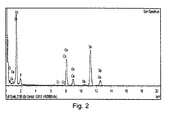
- TEM Transmission electron microscopy
- EDS Energy-dispersive X-ray spectrometry
- Example 2 Production of nanoparticles in synthetically defined growth medium 2
- a second synthetically defined growth medium optimized for S. cerevisiae was prepared to control sulfur during yeast growth. All prepared media had the same chemical constituents except that sources of metal for nanoparticle production were varied.
- Salts MgCl 2 , NaCl, CaCl 2
- nitrogen source NH 4 Cl
- phosphorus source KH 2 PO 4
- carbohydrate source dextrose
- This solution was then autoclaved at 121°C for 45 min and stored aseptically.
- previously prepared vitamins, trace elements and amino acid solutions were added with syringes through 0.2 ⁇ m sterile filters to reach the final concentrations detailed in Table 2. The latter were added to the medium through syringes and filters after the medium was autoclaved to prevent their denaturation.
- Table 2 Composition of Defined Growth Medium 2 Chemicals Concentration (mg/L) Carbohydrate/Sugar Dextrose 4000 Nitrogen NH 4 Cl 5000 Salts MgCl 2 500 NaCl 100 CaCl 2 100 Phosphorus KH 2 PO 4 1000 Sulfur L-Cysteine 10 Amino acids Adenine 10 L-Arginine, HCl 50 L-Aspartic acid 80 L-Histidine 20 L-Isoleucine 50 L-Leucine 100 L-Lysine, HCl 50 L-Phenylalanine 50 L-Threonine 100 L-Tryptophan 50 L-Tyrosine 50 Uracil 20 L-Valine 140 Vitamins mix Biotin 0.002 Pantothenate, Ca 0.4 Folic acid 0.002 Inositol 2 Nicotinic acid (niacin) 0.4 PABA 0.2 Pyridoxine, HCl 0.4 Riboflavin 0.2 Thiamine, HCl 0.4 Trace elements mix H
- Yeast cells were stabilized using glutaraldehyde buffer for chemical fixation. 50 mL of the medium containing the growing yeast is collected and centrifuged (3000 x g) for 3 min. The supernatant is discarded, the cells resuspended in the same volume of doubly distilled water (DDW) and centrifuged again (3000 x g) for 3 min. This resuspension/centrifugation in DDW is repeated 3 times. It is then resuspended in 10 mL DDW. A volume of 100 ⁇ L of the sample is mixed with 900 ⁇ L of a 0.1 M phosphate buffer pH 6.7 containing 4% glutaraldehyde and allowed to incubate for 5 minutes.
- DDW doubly distilled water
- Trial 1 Yeast was grown on 50 ml of defined medium 2 for 26 hours at 150 rpm at a temperature of 28°C or 25°C. Various metal compounds were then added with syringes through a 0.2 ⁇ m sterile filter to different batches of the medium to achieve final concentrations as follows: Ag (I) 10 ppm; Au(III) 10 ppm; Pt(II) 10 ppm; Te(VI) 4 ppm; Se(IV) 4 ppm. After about 60 hours of yeast growth, formation of nanoparticles was confirmed for Ag by visual inspection of a color change in the growth medium. No color changes in the growth media for Au, Pt, Te and Se were observed, probably due to the low concentrations of metals used, but nanoparticle formation was confirmed through microscopic observations.
- Trial 2 Yeast was grown on defined medium 2 for 10 hours at 150 rpm at a temperature of 28°C or 25°C. Various metal compounds were then added to different 50 ml batches of the medium to achieve final concentrations as follows: Ag (I) 10 ppm; Au(III) 10 ppm; Pt(II) 10 ppm; Pd(II) 10 ppm; Se(IV) 5 ppm. The pH of the metal solutions was adjusted to 4 with NH 4 OH, except for Au which was adjusted to 2-3. After about 60 hours of yeast growth, no color changes in the growth media were observed, again probably due to the low concentrations of metals used, but nanoparticle formation was confirmed through microscopic observations.
- Sabouraud dextrose broth is a commercially available growth medium for yeast which comprises 20.00 g/L dextrose and 10.0 g/L of a mixture of peptic of animal tissue and pancreatic digest of casein (1:1).
- the final broth is prepared by suspending 30 grams of the medium in one liter of distilled water and mixing well until a uniform suspension is obtained. The mixture is heated with frequent agitation, boiled for one minute, distributed and sterilized at 118-121°C for 15-45 minutes.
- the final pH is 5.6 ⁇ 0.2 at 25°C.
- Yeast cells were stabilized using glutaraldehyde buffer for chemical fixation. 50 mL of the medium containing the growing yeast is collected and centrifuged (3000 x g) for 3 min. The supernatant is discarded, the cells resuspended in the same volume of doubly distilled water (DDW) and centrifuged again (3000 x g) for 3 min. This resuspension/centrifugation in DDW is repeated 3 times. It is then resuspended in 10 mL DDW. A volume of 100 ⁇ L of the sample is mixed with 900 ⁇ L of a 0.1 M phosphate buffer pH 6.7 containing 4% glutaraldehyde and allowed to incubate for 5 minutes.
- DDW doubly distilled water
- Trial 1 Yeast was grown in Sabouraud dextrose broth for 26 hours at 150 rpm at a temperature of 28°C or 25°C. Various metal compounds were then added with syringes through a 0.2 ⁇ m sterile filter to different 100 ml batches of the medium to achieve final concentrations as follows: Ag (I) 40 ppm; Au(III) 20 ppm; Pt(II) 40 ppm; Te(VI) 20 ppm; Se(IV) 20 ppm. After about 60 hours of yeast growth, formation of nanoparticles was confirmed for all of the metals by visual inspection of a color change in the growth medium and through microscopic observations.
- Trial 2 Yeast was grown in Sabouraud dextrose broth for 10 hours (for Pd, Ag, Au, Pt, U, Se) or for 24.5 hours (for Cd, Zn, Pb) at 150 rpm at a temperature of 28°C or 25°C.
- Various metal compounds were then added to different 100 ml batches of the medium to achieve final concentrations as follows: Pd(II) 50 ppm; Ag (I) 50 ppm; Au(III) 50 ppm; Pt(II) 50 ppm; U(VI) 50 ppm; Se(IV) 20 ppm; Cd(II) 50 ppm; Zn(II) 50 ppm; Pb(IV) 50 ppm.
- the pH of the metal solutions was adjusted to 4 with NH 4 OH, except for Au which was adjusted to 2-3.
- formation of nanoparticles was confirmed for Ag and Au by visual inspection of a color change in the growth medium. No color changes in the growth media for other metals were observed, but nanoparticle formation was confirmed through microscopic observations.
- Trial 3 Two replicates of 0.1 ml of yeast and two replicates of 0.2 ml of yeast were added to four bottles of Sabouraud broth. After growing at 25°C (150 rpm) for 16.5 h, Se (IV) was added to the yeast samples (with syringes through 0.2 ⁇ m sterile filter) to reach final concentrations of 20, 50, 150 ppm, respectively. 52.5 h after addition of Se (IV), samples were collected and freezing dried. Visual inspection of color change in the medium demonstrated that greater quantities of nanoparticles were formed at the higher concentrations compared to the lower concentrations.
Landscapes
- Chemical & Material Sciences (AREA)
- Organic Chemistry (AREA)
- Zoology (AREA)
- Life Sciences & Earth Sciences (AREA)
- Engineering & Computer Science (AREA)
- Wood Science & Technology (AREA)
- Microbiology (AREA)
- General Chemical & Material Sciences (AREA)
- Chemical Kinetics & Catalysis (AREA)
- Biotechnology (AREA)
- Inorganic Chemistry (AREA)
- Health & Medical Sciences (AREA)
- Biochemistry (AREA)
- Bioinformatics & Cheminformatics (AREA)
- General Engineering & Computer Science (AREA)
- General Health & Medical Sciences (AREA)
- Genetics & Genomics (AREA)
- Micro-Organisms Or Cultivation Processes Thereof (AREA)
- Preparation Of Compounds By Using Micro-Organisms (AREA)
Claims (15)
- Procédé de production de nanoparticules exemptes de soufre comprenant les étapes consistant à : faire croître de la levure comprenant une espèce du genre Saccharomyces dans un milieu de croissance contenant une source d'un élément dans un état d'oxydation bio-réductible ; et, précipiter les nanoparticules contenant l'élément dans un état d'oxydation inférieur à l'état d'oxydation de l'élément dans la source.
- Procédé selon la revendication 1, dans lequel la source comprend une source minérale.
- Procédé selon la revendication 2, dans lequel l'élément est le sélénium, l'or, l'argent, le platine, le palladium ou un mélange de ceux-ci.
- Procédé selon la revendication 1, dans lequel la source de l'élément comprend du sélénate, de l'aurate, de l'argentate, du palatinate, du palladinate ou un mélange de ceux-ci.
- Procédé selon l'une quelconque des revendications 1 à 4, dans lequel l'état d'oxydation inférieur est un état d'oxydation 0.
- Procédé selon l'une quelconque des revendications 1 à 5, dans lequel la levure comprend Saccharomyces cerevisiae.
- Procédé selon la revendication 6, dans lequel la levure comprend une souche de type sauvage de Saccharomyces cerevisiae.
- Procédé selon l'une quelconque des revendications 1 à 7, dans lequel le milieu de croissance est un milieu de croissance synthétique totalement défini.
- Procédé selon l'une quelconque des revendications 1 à 8, dans lequel le milieu de croissance est exempt de soufre sauf pour l'addition d'une quantité contrôlée d'une source de soufre.
- Procédé selon l'une quelconque des revendications 1 à 8, dans lequel le milieu de croissance comprend le milieu de Sabouraud, du dextrose de pomme de terre, du Wallerstein Laboratory Nutrient, du Yeast Extract Peptone Dextrose, du Yeast Mould ou de la mélasse.
- Procédé selon l'une quelconque des revendications 1 à 10, dans lequel les nanoparticules sont produites de manière intracellulaire.
- Procédé selon l'une quelconque des revendications 1 à 11, dans lequel les nanoparticules sont produites dans une quantité de 100 - 500 µg de nanoparticules par gramme de levure.
- Procédé selon l'une quelconque des revendications 1 à 12, dans lequel les nanoparticules produites sont d'une forme sphérique.
- Procédé selon l'une quelconque des revendications 1 à 13, dans lequel les nanoparticules produites ont un diamètre moyen de particules dans une gamme de 10 - 100 nm.
- Procédé selon l'une quelconque des revendications 1 à 14, dans lequel les nanoparticules produites comprennent moins de 0,05 % en poids de soufre.
Applications Claiming Priority (2)
| Application Number | Priority Date | Filing Date | Title |
|---|---|---|---|
| US13624508P | 2008-08-21 | 2008-08-21 | |
| PCT/CA2009/001155 WO2010020044A1 (fr) | 2008-08-21 | 2009-08-17 | Production de nanoparticules exemptes de soufre par une levure |
Publications (3)
| Publication Number | Publication Date |
|---|---|
| EP2315837A1 EP2315837A1 (fr) | 2011-05-04 |
| EP2315837A4 EP2315837A4 (fr) | 2012-07-04 |
| EP2315837B1 true EP2315837B1 (fr) | 2014-10-29 |
Family
ID=41706788
Family Applications (1)
| Application Number | Title | Priority Date | Filing Date |
|---|---|---|---|
| EP09807787.8A Not-in-force EP2315837B1 (fr) | 2008-08-21 | 2009-08-17 | Production de nanoparticules exemptes de soufre par saccharomyces |
Country Status (4)
| Country | Link |
|---|---|
| US (1) | US8986975B2 (fr) |
| EP (1) | EP2315837B1 (fr) |
| CA (1) | CA2733951C (fr) |
| WO (1) | WO2010020044A1 (fr) |
Cited By (1)
| Publication number | Priority date | Publication date | Assignee | Title |
|---|---|---|---|---|
| CN104745637A (zh) * | 2015-02-27 | 2015-07-01 | 河南师范大学 | 一种以微生物细胞分泌液为基质制备硒纳米颗粒的方法 |
Families Citing this family (4)
| Publication number | Priority date | Publication date | Assignee | Title |
|---|---|---|---|---|
| CA2723655A1 (fr) * | 2010-12-03 | 2012-06-03 | Queen's University At Kingston | Biosynthese de nanoparticules |
| EP2651834A4 (fr) * | 2010-12-17 | 2014-07-09 | Gen Electric | Procédé biochimique pour la récupération de sélénium à partir d'un effluent ou de boues de biorestauration |
| US10829297B2 (en) * | 2015-05-27 | 2020-11-10 | Conagra Foods Rdm, Inc. | Nut butter spread with sliced nuts and process for making the same |
| US10590438B1 (en) | 2019-05-28 | 2020-03-17 | King Saud University | Biosynthesis of metal nanoparticles |
Family Cites Families (3)
| Publication number | Priority date | Publication date | Assignee | Title |
|---|---|---|---|---|
| US20050013759A1 (en) * | 1996-08-14 | 2005-01-20 | Grow Ann E. | Practical method for preparing inorganic nanophase materials |
| WO2006084276A2 (fr) * | 2005-02-04 | 2006-08-10 | The Regents Of The University Of California | Synthese de nanoparticules metalliques catalysee par uneenzyme |
| AT504618B1 (de) * | 2006-12-05 | 2012-10-15 | Joanneum Res Forschungsgmbh | Verfahren zur herstellung von nanopartikeln und vorrichtung dazu |
-
2009
- 2009-08-17 WO PCT/CA2009/001155 patent/WO2010020044A1/fr not_active Ceased
- 2009-08-17 EP EP09807787.8A patent/EP2315837B1/fr not_active Not-in-force
- 2009-08-17 US US13/058,655 patent/US8986975B2/en not_active Expired - Fee Related
- 2009-08-17 CA CA2733951A patent/CA2733951C/fr active Active
Cited By (1)
| Publication number | Priority date | Publication date | Assignee | Title |
|---|---|---|---|---|
| CN104745637A (zh) * | 2015-02-27 | 2015-07-01 | 河南师范大学 | 一种以微生物细胞分泌液为基质制备硒纳米颗粒的方法 |
Also Published As
| Publication number | Publication date |
|---|---|
| US8986975B2 (en) | 2015-03-24 |
| WO2010020044A1 (fr) | 2010-02-25 |
| EP2315837A1 (fr) | 2011-05-04 |
| EP2315837A4 (fr) | 2012-07-04 |
| CA2733951C (fr) | 2017-04-11 |
| US20110135932A1 (en) | 2011-06-09 |
| CA2733951A1 (fr) | 2010-02-25 |
Similar Documents
| Publication | Publication Date | Title |
|---|---|---|
| EP2315837B1 (fr) | Production de nanoparticules exemptes de soufre par saccharomyces | |
| Bai et al. | Biosynthesis of cadmium sulfide nanoparticles by photosynthetic bacteria Rhodopseudomonas palustris | |
| Debabov et al. | Bacterial synthesis of silver sulfide nanoparticles | |
| Tiquia-Arashiro et al. | Extremophiles: applications in nanotechnology | |
| Cai et al. | Biosynthesis of gold nanoparticles by biosorption using Magnetospirillum gryphiswaldense MSR-1 | |
| Ulloa et al. | Use of acidophilic bacteria of the genus Acidithiobacillus to biosynthesize CdS fluorescent nanoparticles (quantum dots) with high tolerance to acidic pH | |
| US20140220654A1 (en) | Microbially-mediated method for synthesis of non-oxide semiconductor nanoparticles | |
| Moon et al. | Scalable production of microbially mediated zinc sulfide nanoparticles and application to functional thin films | |
| Tichý et al. | Possibilities for using biologically-produced sulphur for cultivation of Thiobacilli with respect to bioleaching processes | |
| Wong-Pinto et al. | Biosynthesis of copper nanoparticles from copper tailings ore–An approach to the ‘Bionanomining’ | |
| Yadav et al. | Generation of selenium containing nano-structures by soil bacterium, Pseudomonas aeruginosa | |
| Tiquia-Arashiro et al. | Nanoparticles synthesized by microorganisms | |
| Jha et al. | Yeast mediated synthesis of silver nanoparticles | |
| Rojas-Chapana et al. | The path of sulfur during the bio-oxidation of pyrite by Thiobacillus ferrooxidans | |
| Durán et al. | Microbial syntheses of metallic sulfide nanoparticles: an overview | |
| US10337030B2 (en) | Microbially-mediated method for synthesis of metal chalcogenide nanoparticles | |
| Senapati et al. | Extracellular biosynthesis of metal sulfide nanoparticles using the fungus Fusarium oxysporum | |
| US6783963B2 (en) | Process for the preparation of metal sulfide nanoparticles | |
| Mohapatra et al. | Nanoparticles—production and role in biotransformation | |
| RU2834415C2 (ru) | Способ получения биогенных наночастиц селена и теллура | |
| Katti et al. | European Nano knowledge that led to Faraday's understanding of gold nanoparticles | |
| Avramenko et al. | Biomanufacturing of nanocrystals using protein biocatalysts | |
| Sanghi et al. | 15 Microbes as green and eco-friendly nanofactories | |
| Sepahei et al. | Tellurite resistance and reduction during aerobic and anaerobic growth of bacteria isolated from Sarcheshme copper mine. | |
| Roy et al. | Mycosynthesized nanoparticles: role in food processing industries |
Legal Events
| Date | Code | Title | Description |
|---|---|---|---|
| PUAI | Public reference made under article 153(3) epc to a published international application that has entered the european phase |
Free format text: ORIGINAL CODE: 0009012 |
|
| 17P | Request for examination filed |
Effective date: 20110321 |
|
| AK | Designated contracting states |
Kind code of ref document: A1 Designated state(s): AT BE BG CH CY CZ DE DK EE ES FI FR GB GR HR HU IE IS IT LI LT LU LV MC MK MT NL NO PL PT RO SE SI SK SM TR |
|
| AX | Request for extension of the european patent |
Extension state: AL BA RS |
|
| DAX | Request for extension of the european patent (deleted) | ||
| A4 | Supplementary search report drawn up and despatched |
Effective date: 20120605 |
|
| RIC1 | Information provided on ipc code assigned before grant |
Ipc: C12P 3/00 20060101AFI20120530BHEP Ipc: C12P 1/02 20060101ALI20120530BHEP Ipc: C01B 19/02 20060101ALI20120530BHEP |
|
| 17Q | First examination report despatched |
Effective date: 20130208 |
|
| GRAP | Despatch of communication of intention to grant a patent |
Free format text: ORIGINAL CODE: EPIDOSNIGR1 |
|
| INTG | Intention to grant announced |
Effective date: 20140523 |
|
| GRAS | Grant fee paid |
Free format text: ORIGINAL CODE: EPIDOSNIGR3 |
|
| GRAA | (expected) grant |
Free format text: ORIGINAL CODE: 0009210 |
|
| AK | Designated contracting states |
Kind code of ref document: B1 Designated state(s): AT BE BG CH CY CZ DE DK EE ES FI FR GB GR HR HU IE IS IT LI LT LU LV MC MK MT NL NO PL PT RO SE SI SK SM TR |
|
| REG | Reference to a national code |
Ref country code: GB Ref legal event code: FG4D |
|
| REG | Reference to a national code |
Ref country code: CH Ref legal event code: EP |
|
| REG | Reference to a national code |
Ref country code: AT Ref legal event code: REF Ref document number: 693634 Country of ref document: AT Kind code of ref document: T Effective date: 20141115 |
|
| REG | Reference to a national code |
Ref country code: IE Ref legal event code: FG4D |
|
| REG | Reference to a national code |
Ref country code: DE Ref legal event code: R096 Ref document number: 602009027490 Country of ref document: DE Effective date: 20141211 |
|
| REG | Reference to a national code |
Ref country code: AT Ref legal event code: MK05 Ref document number: 693634 Country of ref document: AT Kind code of ref document: T Effective date: 20141029 |
|
| REG | Reference to a national code |
Ref country code: NL Ref legal event code: VDEP Effective date: 20141029 |
|
| REG | Reference to a national code |
Ref country code: LT Ref legal event code: MG4D |
|
| PG25 | Lapsed in a contracting state [announced via postgrant information from national office to epo] |
Ref country code: PT Free format text: LAPSE BECAUSE OF FAILURE TO SUBMIT A TRANSLATION OF THE DESCRIPTION OR TO PAY THE FEE WITHIN THE PRESCRIBED TIME-LIMIT Effective date: 20150302 Ref country code: FI Free format text: LAPSE BECAUSE OF FAILURE TO SUBMIT A TRANSLATION OF THE DESCRIPTION OR TO PAY THE FEE WITHIN THE PRESCRIBED TIME-LIMIT Effective date: 20141029 Ref country code: IS Free format text: LAPSE BECAUSE OF FAILURE TO SUBMIT A TRANSLATION OF THE DESCRIPTION OR TO PAY THE FEE WITHIN THE PRESCRIBED TIME-LIMIT Effective date: 20150228 Ref country code: NO Free format text: LAPSE BECAUSE OF FAILURE TO SUBMIT A TRANSLATION OF THE DESCRIPTION OR TO PAY THE FEE WITHIN THE PRESCRIBED TIME-LIMIT Effective date: 20150129 Ref country code: LT Free format text: LAPSE BECAUSE OF FAILURE TO SUBMIT A TRANSLATION OF THE DESCRIPTION OR TO PAY THE FEE WITHIN THE PRESCRIBED TIME-LIMIT Effective date: 20141029 Ref country code: NL Free format text: LAPSE BECAUSE OF FAILURE TO SUBMIT A TRANSLATION OF THE DESCRIPTION OR TO PAY THE FEE WITHIN THE PRESCRIBED TIME-LIMIT Effective date: 20141029 Ref country code: ES Free format text: LAPSE BECAUSE OF FAILURE TO SUBMIT A TRANSLATION OF THE DESCRIPTION OR TO PAY THE FEE WITHIN THE PRESCRIBED TIME-LIMIT Effective date: 20141029 |
|
| PG25 | Lapsed in a contracting state [announced via postgrant information from national office to epo] |
Ref country code: LV Free format text: LAPSE BECAUSE OF FAILURE TO SUBMIT A TRANSLATION OF THE DESCRIPTION OR TO PAY THE FEE WITHIN THE PRESCRIBED TIME-LIMIT Effective date: 20141029 Ref country code: AT Free format text: LAPSE BECAUSE OF FAILURE TO SUBMIT A TRANSLATION OF THE DESCRIPTION OR TO PAY THE FEE WITHIN THE PRESCRIBED TIME-LIMIT Effective date: 20141029 Ref country code: CY Free format text: LAPSE BECAUSE OF FAILURE TO SUBMIT A TRANSLATION OF THE DESCRIPTION OR TO PAY THE FEE WITHIN THE PRESCRIBED TIME-LIMIT Effective date: 20141029 Ref country code: HR Free format text: LAPSE BECAUSE OF FAILURE TO SUBMIT A TRANSLATION OF THE DESCRIPTION OR TO PAY THE FEE WITHIN THE PRESCRIBED TIME-LIMIT Effective date: 20141029 Ref country code: SE Free format text: LAPSE BECAUSE OF FAILURE TO SUBMIT A TRANSLATION OF THE DESCRIPTION OR TO PAY THE FEE WITHIN THE PRESCRIBED TIME-LIMIT Effective date: 20141029 Ref country code: PL Free format text: LAPSE BECAUSE OF FAILURE TO SUBMIT A TRANSLATION OF THE DESCRIPTION OR TO PAY THE FEE WITHIN THE PRESCRIBED TIME-LIMIT Effective date: 20141029 Ref country code: GR Free format text: LAPSE BECAUSE OF FAILURE TO SUBMIT A TRANSLATION OF THE DESCRIPTION OR TO PAY THE FEE WITHIN THE PRESCRIBED TIME-LIMIT Effective date: 20150130 |
|
| REG | Reference to a national code |
Ref country code: DE Ref legal event code: R097 Ref document number: 602009027490 Country of ref document: DE |
|
| PG25 | Lapsed in a contracting state [announced via postgrant information from national office to epo] |
Ref country code: RO Free format text: LAPSE BECAUSE OF FAILURE TO SUBMIT A TRANSLATION OF THE DESCRIPTION OR TO PAY THE FEE WITHIN THE PRESCRIBED TIME-LIMIT Effective date: 20141029 Ref country code: EE Free format text: LAPSE BECAUSE OF FAILURE TO SUBMIT A TRANSLATION OF THE DESCRIPTION OR TO PAY THE FEE WITHIN THE PRESCRIBED TIME-LIMIT Effective date: 20141029 Ref country code: DK Free format text: LAPSE BECAUSE OF FAILURE TO SUBMIT A TRANSLATION OF THE DESCRIPTION OR TO PAY THE FEE WITHIN THE PRESCRIBED TIME-LIMIT Effective date: 20141029 Ref country code: SK Free format text: LAPSE BECAUSE OF FAILURE TO SUBMIT A TRANSLATION OF THE DESCRIPTION OR TO PAY THE FEE WITHIN THE PRESCRIBED TIME-LIMIT Effective date: 20141029 Ref country code: CZ Free format text: LAPSE BECAUSE OF FAILURE TO SUBMIT A TRANSLATION OF THE DESCRIPTION OR TO PAY THE FEE WITHIN THE PRESCRIBED TIME-LIMIT Effective date: 20141029 |
|
| REG | Reference to a national code |
Ref country code: FR Ref legal event code: PLFP Year of fee payment: 7 |
|
| PG25 | Lapsed in a contracting state [announced via postgrant information from national office to epo] |
Ref country code: IT Free format text: LAPSE BECAUSE OF FAILURE TO SUBMIT A TRANSLATION OF THE DESCRIPTION OR TO PAY THE FEE WITHIN THE PRESCRIBED TIME-LIMIT Effective date: 20141029 |
|
| PLBE | No opposition filed within time limit |
Free format text: ORIGINAL CODE: 0009261 |
|
| STAA | Information on the status of an ep patent application or granted ep patent |
Free format text: STATUS: NO OPPOSITION FILED WITHIN TIME LIMIT |
|
| 26N | No opposition filed |
Effective date: 20150730 |
|
| PGFP | Annual fee paid to national office [announced via postgrant information from national office to epo] |
Ref country code: DE Payment date: 20150831 Year of fee payment: 7 Ref country code: GB Payment date: 20150819 Year of fee payment: 7 |
|
| PGFP | Annual fee paid to national office [announced via postgrant information from national office to epo] |
Ref country code: FR Payment date: 20150820 Year of fee payment: 7 |
|
| PG25 | Lapsed in a contracting state [announced via postgrant information from national office to epo] |
Ref country code: SI Free format text: LAPSE BECAUSE OF FAILURE TO SUBMIT A TRANSLATION OF THE DESCRIPTION OR TO PAY THE FEE WITHIN THE PRESCRIBED TIME-LIMIT Effective date: 20141029 |
|
| PG25 | Lapsed in a contracting state [announced via postgrant information from national office to epo] |
Ref country code: LU Free format text: LAPSE BECAUSE OF FAILURE TO SUBMIT A TRANSLATION OF THE DESCRIPTION OR TO PAY THE FEE WITHIN THE PRESCRIBED TIME-LIMIT Effective date: 20150817 Ref country code: MC Free format text: LAPSE BECAUSE OF FAILURE TO SUBMIT A TRANSLATION OF THE DESCRIPTION OR TO PAY THE FEE WITHIN THE PRESCRIBED TIME-LIMIT Effective date: 20141029 |
|
| REG | Reference to a national code |
Ref country code: CH Ref legal event code: PL |
|
| PG25 | Lapsed in a contracting state [announced via postgrant information from national office to epo] |
Ref country code: LI Free format text: LAPSE BECAUSE OF NON-PAYMENT OF DUE FEES Effective date: 20150831 Ref country code: CH Free format text: LAPSE BECAUSE OF NON-PAYMENT OF DUE FEES Effective date: 20150831 |
|
| REG | Reference to a national code |
Ref country code: IE Ref legal event code: MM4A |
|
| PG25 | Lapsed in a contracting state [announced via postgrant information from national office to epo] |
Ref country code: IE Free format text: LAPSE BECAUSE OF NON-PAYMENT OF DUE FEES Effective date: 20150817 |
|
| REG | Reference to a national code |
Ref country code: DE Ref legal event code: R119 Ref document number: 602009027490 Country of ref document: DE |
|
| PG25 | Lapsed in a contracting state [announced via postgrant information from national office to epo] |
Ref country code: MT Free format text: LAPSE BECAUSE OF FAILURE TO SUBMIT A TRANSLATION OF THE DESCRIPTION OR TO PAY THE FEE WITHIN THE PRESCRIBED TIME-LIMIT Effective date: 20141029 |
|
| GBPC | Gb: european patent ceased through non-payment of renewal fee |
Effective date: 20160817 |
|
| REG | Reference to a national code |
Ref country code: FR Ref legal event code: ST Effective date: 20170428 |
|
| PG25 | Lapsed in a contracting state [announced via postgrant information from national office to epo] |
Ref country code: HU Free format text: LAPSE BECAUSE OF FAILURE TO SUBMIT A TRANSLATION OF THE DESCRIPTION OR TO PAY THE FEE WITHIN THE PRESCRIBED TIME-LIMIT; INVALID AB INITIO Effective date: 20090817 Ref country code: BG Free format text: LAPSE BECAUSE OF FAILURE TO SUBMIT A TRANSLATION OF THE DESCRIPTION OR TO PAY THE FEE WITHIN THE PRESCRIBED TIME-LIMIT Effective date: 20141029 Ref country code: SM Free format text: LAPSE BECAUSE OF FAILURE TO SUBMIT A TRANSLATION OF THE DESCRIPTION OR TO PAY THE FEE WITHIN THE PRESCRIBED TIME-LIMIT Effective date: 20141029 |
|
| PG25 | Lapsed in a contracting state [announced via postgrant information from national office to epo] |
Ref country code: GB Free format text: LAPSE BECAUSE OF NON-PAYMENT OF DUE FEES Effective date: 20160817 Ref country code: FR Free format text: LAPSE BECAUSE OF NON-PAYMENT OF DUE FEES Effective date: 20160831 Ref country code: DE Free format text: LAPSE BECAUSE OF NON-PAYMENT OF DUE FEES Effective date: 20170301 |
|
| PG25 | Lapsed in a contracting state [announced via postgrant information from national office to epo] |
Ref country code: TR Free format text: LAPSE BECAUSE OF FAILURE TO SUBMIT A TRANSLATION OF THE DESCRIPTION OR TO PAY THE FEE WITHIN THE PRESCRIBED TIME-LIMIT Effective date: 20141029 |
|
| PG25 | Lapsed in a contracting state [announced via postgrant information from national office to epo] |
Ref country code: BE Free format text: LAPSE BECAUSE OF FAILURE TO SUBMIT A TRANSLATION OF THE DESCRIPTION OR TO PAY THE FEE WITHIN THE PRESCRIBED TIME-LIMIT Effective date: 20141029 |
|
| PG25 | Lapsed in a contracting state [announced via postgrant information from national office to epo] |
Ref country code: MK Free format text: LAPSE BECAUSE OF FAILURE TO SUBMIT A TRANSLATION OF THE DESCRIPTION OR TO PAY THE FEE WITHIN THE PRESCRIBED TIME-LIMIT Effective date: 20141029 |