EP2318209B1 - Procédé de préparation d'un câble - Google Patents
Procédé de préparation d'un câble Download PDFInfo
- Publication number
- EP2318209B1 EP2318209B1 EP09777028.3A EP09777028A EP2318209B1 EP 2318209 B1 EP2318209 B1 EP 2318209B1 EP 09777028 A EP09777028 A EP 09777028A EP 2318209 B1 EP2318209 B1 EP 2318209B1
- Authority
- EP
- European Patent Office
- Prior art keywords
- polymer composition
- polymer
- cable
- carbon
- unsaturated
- Prior art date
- Legal status (The legal status is an assumption and is not a legal conclusion. Google has not performed a legal analysis and makes no representation as to the accuracy of the status listed.)
- Active
Links
Images


Classifications
-
- C—CHEMISTRY; METALLURGY
- C08—ORGANIC MACROMOLECULAR COMPOUNDS; THEIR PREPARATION OR CHEMICAL WORKING-UP; COMPOSITIONS BASED THEREON
- C08F—MACROMOLECULAR COMPOUNDS OBTAINED BY REACTIONS ONLY INVOLVING CARBON-TO-CARBON UNSATURATED BONDS
- C08F210/00—Copolymers of unsaturated aliphatic hydrocarbons having only one carbon-to-carbon double bond
- C08F210/02—Ethene
-
- B—PERFORMING OPERATIONS; TRANSPORTING
- B32—LAYERED PRODUCTS
- B32B—LAYERED PRODUCTS, i.e. PRODUCTS BUILT-UP OF STRATA OF FLAT OR NON-FLAT, e.g. CELLULAR OR HONEYCOMB, FORM
- B32B27/00—Layered products comprising a layer of synthetic resin
- B32B27/32—Layered products comprising a layer of synthetic resin comprising polyolefins
-
- C—CHEMISTRY; METALLURGY
- C08—ORGANIC MACROMOLECULAR COMPOUNDS; THEIR PREPARATION OR CHEMICAL WORKING-UP; COMPOSITIONS BASED THEREON
- C08F—MACROMOLECULAR COMPOUNDS OBTAINED BY REACTIONS ONLY INVOLVING CARBON-TO-CARBON UNSATURATED BONDS
- C08F210/00—Copolymers of unsaturated aliphatic hydrocarbons having only one carbon-to-carbon double bond
- C08F210/16—Copolymers of ethene with alpha-alkenes, e.g. EP rubbers
- C08F210/18—Copolymers of ethene with alpha-alkenes, e.g. EP rubbers with non-conjugated dienes, e.g. EPT rubbers
-
- C—CHEMISTRY; METALLURGY
- C08—ORGANIC MACROMOLECULAR COMPOUNDS; THEIR PREPARATION OR CHEMICAL WORKING-UP; COMPOSITIONS BASED THEREON
- C08L—COMPOSITIONS OF MACROMOLECULAR COMPOUNDS
- C08L23/00—Compositions of homopolymers or copolymers of unsaturated aliphatic hydrocarbons having only one carbon-to-carbon double bond; Compositions of derivatives of such polymers
- C08L23/02—Compositions of homopolymers or copolymers of unsaturated aliphatic hydrocarbons having only one carbon-to-carbon double bond; Compositions of derivatives of such polymers not modified by chemical after-treatment
- C08L23/04—Homopolymers or copolymers of ethene
- C08L23/08—Copolymers of ethene
-
- H—ELECTRICITY
- H01—ELECTRIC ELEMENTS
- H01B—CABLES; CONDUCTORS; INSULATORS; SELECTION OF MATERIALS FOR THEIR CONDUCTIVE, INSULATING OR DIELECTRIC PROPERTIES
- H01B3/00—Insulators or insulating bodies characterised by the insulating materials; Selection of materials for their insulating or dielectric properties
- H01B3/18—Insulators or insulating bodies characterised by the insulating materials; Selection of materials for their insulating or dielectric properties mainly consisting of organic substances
- H01B3/30—Insulators or insulating bodies characterised by the insulating materials; Selection of materials for their insulating or dielectric properties mainly consisting of organic substances plastics; resins; waxes
-
- H—ELECTRICITY
- H01—ELECTRIC ELEMENTS
- H01B—CABLES; CONDUCTORS; INSULATORS; SELECTION OF MATERIALS FOR THEIR CONDUCTIVE, INSULATING OR DIELECTRIC PROPERTIES
- H01B3/00—Insulators or insulating bodies characterised by the insulating materials; Selection of materials for their insulating or dielectric properties
- H01B3/18—Insulators or insulating bodies characterised by the insulating materials; Selection of materials for their insulating or dielectric properties mainly consisting of organic substances
- H01B3/30—Insulators or insulating bodies characterised by the insulating materials; Selection of materials for their insulating or dielectric properties mainly consisting of organic substances plastics; resins; waxes
- H01B3/44—Insulators or insulating bodies characterised by the insulating materials; Selection of materials for their insulating or dielectric properties mainly consisting of organic substances plastics; resins; waxes vinyl resins; acrylic resins
- H01B3/441—Insulators or insulating bodies characterised by the insulating materials; Selection of materials for their insulating or dielectric properties mainly consisting of organic substances plastics; resins; waxes vinyl resins; acrylic resins from alkenes
Definitions
- the invention relates to a process for producing in a continuous vulcanization (CV) line a power cable. Furthermore the invention relates preferably to a process for preparing a crosslinkable cable or wire, as well as to an optional subsequent crosslinking step thereof, as well as to a crosslinkable cable or wire obtainable by said process.
- CV continuous vulcanization
- Crosslinking of polymers e.g. polyolefins, substantially contributes to an improved heat and deformation resistance, creep properties, mechanical strength, chemical resistance and abrasion resistance of a polymer. Therefore crosslinked polymers are widely used in different end applications, such as wire and cable (W&C) applications.
- W&C wire and cable
- Electric cables and wires are generally composed of one or more polymer layers extruded around an electric conductor.
- the electric conductor In medium (between 6 kV to 36kV) and high voltage (higher than 36 kV) power cables, the electric conductor is usually coated first with an inner semi-conducting layer, followed by an insulating layer and an outer semi-conducting layer.
- further layer(s) may be added, such as screen(s) or auxiliary barrier layer(s), e.g. one or more water barrier layer(s) and one or more jacketing layer(s).
- the insulating and semi-conducting layers in a cable are typically made using a crosslinkable polymer composition.
- the polymer composition in the formed layered cable is then crosslinked.
- PE ethylene homo- and/or copolymers
- PP propylene homo- and/or copolymers
- LDPE Crosslinkable low density polyethylene
- Crosslinking can be effected with crosslinking agents which decompose generating free radicals.
- crosslinking agents like peroxides, are conventionally added to the polymeric material prior to or during extrusion of the cable.
- Said crosslinking agent should preferably remain stable during extrusion step performed at a temperature low enough to minimize the early decomposition of the crosslinking agent, but high enough to obtain proper melting and homogenisation. If a significant amount of crosslinking agent, e.g. peroxide, already decomposes in the extruder, thereby initiating premature crosslinking, this will result in the formation of so-called “scorch”, i.e. inhomogeneity, surface unevenness and possibly discolouration in the different layers of the resultant cable.
- any significant decomposition of free radical forming agents during extrusion should be avoided and the crosslinking agent should decompose merely in a subsequent crosslinking step at elevated temperature.
- the elevated temperature increases the decomposition of the crosslinking agent and thus increases both crosslinking speed and crosslinking efficiency.
- melt temperature of the insulation material is of importance.
- a slight increase in the melt temperature leads to a significant reduction in process running time and also increases the risk of scorch formation.
- the melt temperature can be reduced by increasing melt flow rate (MFR) of the polymer material.
- MFR melt flow rate
- a polymer with increased MFR i.e. less viscose with lower viscosity value
- the used cable production line brings limitations to the usable MFR of a polymer layer material.
- An object of the invention is to provide an alternative process for producing a power cable in a continuous vulcanization (CV) line, which process overcomes the above drawbacks, i.e. provides excellent processability properties, including flowability, without causing or increasing sagging problems.
- CV continuous vulcanization
- Another object of the invention is to provide a process for preparing a crosslinkable cable, as well as to an optional subsequent crosslinking step thereof, which enble to produce a cable, preferably power cable, with improved processing conditions or with high out put rates, or both.
- the invention provides a crosslinkable cable obtainable by said process i.a. with good mechanical properties and good dimensional stability (with sufficient degree of crosslinking).
- the invention is directed a process for producing a cable in a horizontal or catenary continuous vulcanization (CV) line, which cable comprises a conductor surrounded by one or more layers, wherein the process comprises the steps of
- the expression Process means herein the process of the invention and the expression Polymer Composition means the polymer composition of the invention.
- conductor means herein above and below that the conductor comprises one or more wires. Moreover, the cable may comprise one or more such conductors. Preferably the conductor is an electrical conductor.
- step (i) the at least one layer of said layers is applied using the Polymer Composition.
- the layers are (i) applied by (co)extrusion.
- (co)extrusion means herein that in case of two or more layers, said layers can be extruded in separate steps, or at least two or all of said layers can be coextruded in a same extrusion step, as well known in the art.
- the b) amount of C-C double bonds means the total amount of C-C double bonds present in the Polymer Composition. It is evident that at least the unsaturated polymer (A) contains said C-C double bonds which contribute to the total amount of C-C double bonds.
- the Polymer Composition may optionally comprise further component(s) containing said C-C double bonds which then also contribute to the total amount of said C-C double bonds. In the first embodiment therefore, the C-C double bond content is thus measured on the composition as a whole not just on the unsaturated polymer component (A) thereof.
- the b) the carbon-carbon double bonds of the Polymer Composition include, preferably originate from, vinyl groups, vinylidene groups or trans -vinylene groups, or from a mixture thereof, which are present in said Polymer Composition.
- the Polymer Composition does not necessarily contain all types of double bonds mentioned above. However, if so, they all contribute to the "b) total amount of carbon-carbon double bonds" as defined above or below.
- the determination method for calculating the amounts of the above carbon-carbon bonds in the above and below definitions is described under "Determination Methods".
- the MFR 2 is determined according to ISO 1133 under 2.16 kg load. The determination temperature is chosen, as well known, depending on the type of the unsaturated polymer used in the Polymer Composition. The MFR 2 is determined at 190°C. Moreover, in this invention in case of a blend of two or more different types of polymers, the MFR 2 and the amount of double bonds is measured from A) the unsaturated polymer of the Polymer Composition. The MFR 2 determination is made in the absence of a crosslinking agent.
- the MFR of the polymer composition can be increased to achieve excellent processability such as extrudability, while not increasing undesirable sagging in the formed article, so that as a result an article with high quality and rigidity can be obtained, which meets e.g. the high demands required in W&C applications.
- the sagging phenomenon can be balanced with enhanced crosslinking reactivity and efficiency via increasing the amount of C-C double bonds in a less viscose polymer composition without increasing the risk for causing premature crosslinking, i.e. scorch formation, when e.g. free radicals forming crosslinking agents, such as peroxides, are present during the preparation of the article.
- the high MFR of the Polymer Composition preferably reduces the melt temperature of the Polymer Composition which together with good flowability and reduced melt pressure further contributes to the production out put and/or favourable processing conditions), if desired. All these benefits also reduce the premature crosslinking, i.e. scorch formation, e.g. in peroxide based crosslinking applications. Due to the advantageous combination also the productivity can be increased, if desired, due to longer running times due to lower risk for scorch or higher out put or improved crosslinking speed and efficiency and any combination thereof. Moreover, the invention enables, if desired, to decrease the amount of crosslinking agent, while still keeping the dimensional stability in the formed article.
- the Polymer Composition contains preferably b) carbon-carbon double bonds in an amount of at least 0.45/1000 carbon atoms, preferably of at least 0.50/1000 carbon atoms. In embodiments were high double bond content is desired the Polymer Composition contains preferably b) carbon-carbon double bonds in an amount of at least 0.6/1000 carbon atoms, or preferably at least 0.8/1000 carbon atoms. In this high double bond content embodiment the MFR 2 is preferably higher.
- the upper limit of the amount of carbon-carbon double bonds present in the Polymer Composition is not limited and may preferably be of less than 5.0/1000 carbon atoms, preferably of less than 3.0/1000 carbon atoms, or more preferably less than 2.5/1000 carbon atoms.
- the Polymer Composition comprises preferably at least vinyl groups as b) said carbon-carbon double bonds, which vinyl groups originate preferably from
- the i) polyunsaturated comonomers and ii) chain transfer agents will be described below in relation to the unsaturated polymer (A) of the Polymer Composition.
- the iii) low molecular weight compound, if present, is added into the Polymer Composition.
- the iii) low molecular weight compound can be preferably a crosslinking booster which is a compound containing at least 1, preferably at least 2, unsaturated groups, such as an aliphatic or aromatic compound, an ester, an ether, or a ketone, which contains at least 1, preferably at least 2, unsaturated group(s), such as a cyanurate, an isocyanurate, a phosphate, an ortho formate, an aliphatic or aromatic ether, or an allyl ester of benzene tricarboxylic acid.
- a crosslinking booster which is a compound containing at least 1, preferably at least 2, unsaturated groups, such as an aliphatic or aromatic compound, an ester, an ether, or a ketone, which contains at least 1, preferably at least 2, unsaturated group(s), such as a cyanurate, an isocyanurate, a phosphate, an ortho formate, an aliphatic or aromatic ether, or an ally
- esters, ethers and ketones are compounds selected from general groups of diacrylates, triacrylates, tetraacrylates, triallylcyanurate, triallylisocyanurate, 3,9-divinyl-2,4,8,10-tetra-oxaspiro[5,5]-undecane (DVS) or triallyl trimellitate (TATM) or any mixtures thereof.
- the crosslinking booster can be added in an amount of such crosslinking less than 2.0 wt%, preferably of less than 1.5 wt%, more preferably of less than 1.0 wt%, and the lower limit thereof is typically at least 0.05 wt%, preferably of at least 0.1 wt%, based on the weight of the polymer compostion.
- scorch retarders (further described below) as said iii) low molecular weight component can also contribute to the total amount of C-C double bonds in the polymer compostion.
- SR examples are unsaturated dimers of aromatic alpha-methyl alkenyl monomers, such as 2,4-di-phenyl-4-methyl-1-pentene, substituted or unsubstituted diphenylethylene, quinone derivatives, hydroquinone derivatives, monofunctional vinyl containing esters and ethers, monocyclic hydrocarbons having at least two or more double bonds, or mixtures thereof.
- the amount of scorch retarder is within the range of 0.005 to 2.0 wt.-%, more preferably within the range of 0.005 to 1.5 wt.-%, based on the weight of the Polymer Composition. Further preferred ranges are e.g. from 0.01 to 0.8 wt%, 0.03 to 0.75 wt%, 0.03 to 0.70 wt%, or 0.04 to 0.60 wt%, based on the weight of the Polymer Composition.
- the C-C double bonds present in the Polymer Composition include vinyl groups and the total amount of said vinyl groups is, in the given preference order, of at least 0.25/1000 carbon atoms, of at least 0.3/1000 carbon atoms, at least 0.4/1000 carbon atoms.
- the total amount of said vinyl groups is, in the given preference order, of at least 0.5/1000 carbon atoms, at least 0.6/1000 carbon atoms, or of at least 0.7/1000 carbon atoms.
- the MFR 2 is preferably higher.
- the upper limit of the total amount of the vinyl groups present in the Polymer Composition is typically, in the given preference order, of up to 3.0/1000 carbon atoms, up to 2.5/1000 carbon atoms, or of up to 2.0/1000 carbon atoms. Accordingly, the total amount the vinyl groups, if present, contributes to the total amount of C-C double bonds present in the Polymer Composition.
- the total amount of vinyl groups can e.g. consist of any the above mentioned vinyl groups (i) to (iv), or, if more than one such vinyl groups (i) to (iv) are present in the Polymer Composition, then the total amount of vinyl groups it is the sum of the amounts of such more than one vinyl groups (i) to (iv).
- the unsaturated polymer (A) of the Polymer Composition is a copolymer of monomer units with units of at least one unsaturated comonomer(s) and optionally of one or more other comonomer(s) and comprises at least vinyl groups which originate from the polyunsaturated comonomer.
- the a) MFR 2 of the Polymer Composition is at least 3.2 g/10 min, when determined according to ISO 1133, under 2.16 kg load.
- the upper limit of MFR 2 of the Polymer Composition is not limited, but may be, in the given preference order, e.g. of up to 20 g/10 min, or up to 15 g/10 min, or, depending on application, up to 10 g/10 min or up to 8 g/10 min, may even be desired, e.g. for an insulation material of a cable without limiting thereto.
- Suitable MFR and C-C double bond range can be chosen depending on the type of the continuous CV line.
- the Polymer Composition may have a viscosity ⁇ 0 , in the given preference order, of at least 3500 Pas, of at least 4000 Pas, of at least 5000 Pas.
- the Polymer Compostion has a viscosity ⁇ 0 , in the given preference order, of at least 3500 Pas, of at least 5000 Pas.
- the upper limit of said viscosity ⁇ 0 may typically be, in the given preference order, of 50 000 Pas or less, of 45 000 Pas or less, or of 40 000 Pas or less.
- the Polymer Composition may have a viscosity ⁇ 0.05 , in the given preference order, of at least 3000 Pas, of at least 3500 Pas, or of at least 4000 Pas.
- the upper limit of said viscosity ⁇ 0.05 may typically be, in the given preference order, of 40 000 Pas or less of 35 000 Pas or less, or of 30 000 Pas or less.
- the Polymer Composition may have a viscosity ⁇ 300 , in the given preference order, of 600 Pas or less, or of 500 Pas or less.
- the lower limit of said viscosity ⁇ 300 may typically be, in the given preference order, of at least 50 Pas, or of at least 100 Pas.
- the Polymer Composition is preferably crosslinkable and is highly suitable in the Process for producing one or more crosslinkable layers of a cable, which are subsequently crosslinked.
- the crosslinkable Polymer Composition contains B) a crosslinking agent.
- Crosslinkable is a well known expression and means that the Polyolefin Composition can be crosslinked, e.g. via radical formation, to form bridges i.a. amongst the polymer chains.
- the B) crosslinking agent is defined herein to be any compound capable to generate radicals which can initiate a crosslinking reaction.
- the crosslinking agent which is preferably a peroxide, is present in an amount of less than 10 wt%, less than 6 wt%, more preferably of less than 5 wt%, less than 3.5 wt%, even more preferably from 0.1 wt% to 3 wt%, and most preferably from 0.2 wt% to 2.6 wt%, based on the total weight of the Polymer Composition.
- the crosslinking agents are organic peroxides, such as di-tert-amylperoxide, 2,5-di(tert-butylperoxy)-2,5-dimethyl-3-hexyne, 2,5-di(tert-butylperoxy)-2,5-dimethylhexane, tert-butylcumylperoxide, di(tert-butyl)peroxide, dicumylperoxide, butyl-4,4-bis(tert-butylperoxy)-valerate, 1,1-bis(tert-butylperoxy)-3,3,5-trimethylcyclohexane, tert-butylperoxybenzoate, dibenzoylperoxide, bis(tert butylperoxyisopropyl)benzene, 2,5-dimethyl-2,5-di(benzoylperoxy)hexane, 1,1-di(tert-butylper
- the peroxide is selected from 2,5-di(tert-butylperoxy)-2,5-dimethylhexane, di(tert-butylperoxyisopropyl)benzene, dicumylperoxide, tert-butylcumylperoxide, di(tert-butyl)peroxide, or mixtures thereof. Most preferably, the peroxide is dicumylperoxide.
- the Polymer Composition may contain also further additive(s).
- Such further additive(s) include:
- the Polymer Composition may additionally comprise further polymer component(s) including further A) unsaturated polymer(s) which are different from A) the at least one unsaturated polymer, and polymer(s) that are not unsaturated.
- the Polymer Composition can be provided to the Process in the form of a powder or pellets in any shape and size including granules.
- Pellets can be produced, e.g. after polymerisation of A) the unsaturated polymer, in a well known manner using the conventional pelletising equipment, such as a pelletising extruder.
- the Polymer Composition is provided in the form of pellets.
- the Process comprises
- the "at least one unsaturated low density polyethylene homopolymer or copolymer produced in a high pressure polymerisation process” means herein both homopolymer, wherein the unsaturation is provided by a chain transfer agent, and a copolymer, wherein the unsaturation is provided by polymerizing a monomer together with at least a polyunsaturated comonomer and optionally in the presence of a chain transfer agent.
- the unsaturated polymer (A) contains preferably b) carbon-carbon double bonds in an amount of at least 0.45/1000 carbon atoms, preferably of at least 0.50/1000 carbon atoms. In embodiments were high double bond content is desired the unsaturated polymer (A) contains preferably b) carbon-carbon double bonds in an amount of at least 0.6/1000 carbon atoms, or preferably at least 0.8/1000 carbon atoms. In this high double bond content embodiment the MFR 2 is preferably higher.
- the upper limit of b) the amount of said carbon-carbon double bonds present in the unsaturated polymer (A) is not limited and may preferably be of less than 5.0/1000 carbon atoms, preferably of less than 3.0/1000 carbon atoms, more preferably of less than 2.5/1000 carbon atoms.
- said carbon-carbon double bonds present in the unsaturated polymer (A) include vinyl groups, which vinyl groups originate preferably from i) a polyunsaturated comonomer, from ii) a chain transfer agent, or from iii) any mixture thereof.
- said C-C double bonds present in the unsaturated polymer (A) include said vinyl groups in a total amount, in the given preference order, of at least 0.25/1000 carbon atoms, of at least 0.3/1000 carbon atoms, at least 0.4/1000 carbon atoms.
- the total amount of said vinyl groups is, in the given preference order, of at least 0.5/1000 carbon atoms, at least 0.6/1000 carbon atoms, or of at least 0.7/1000 carbon atoms.
- the MFR 2 is preferably higher.
- the upper limit of the total amount of said vinyl groups present in A) the unsaturated polymer is not limited and may be, in the given preference order, of less than 3.0/1000 carbon atoms, less than 2.5/1000 carbon atoms, or of less than 2.0/1000 carbon atoms.
- the unsaturated polymer (A) is an unsaturated copolymer which, as already mentioned above, contains one or more unsaturated comonomer(s). More preferably, b) said C-C double bonds present in the unsaturated copolymer include vinyl groups which originate from said polyunsaturated comonomer. Preferably, the total amount of said vinyl groups which originate from the polyunsaturated comonomer is, in the given preference order, of at least 0.20/1000 carbon atoms, at least 0.25/1000 carbon atoms, at least 0.30/1000 carbon atoms, or at least 0.35/1000 carbon atoms.
- the upper limit of the amount of said vinyl groups which originate from the polyunsaturated comonomer and contribute to b) the total amount of said C-C double bonds present in the unsaturated copolymer is not limited and may be, in the given preference order, of less than 3.0/1000 carbon atoms, less than 2.5/1000 carbon atoms, less than 2.0/1000 carbon atoms, less than 1.5/1000 carbon atoms.
- the unsaturated polymer (A) of the Polymer Composition is an unsaturated copolymer containing at least one polyunsaturated comonomer
- the polyunsaturated comonomer is straight carbon chain with at least 8 carbon atoms and at least 4 carbon atoms between the non-conjugated double bonds, of which at least one is terminal.
- the unsaturated polymer (A) is preferably a low density polyethylene (LDPE) copolymer produced in a high pressure polymerisation process, wherein ethylene is copolymerised with at least one polyunsaturated comonomer and optionally with one or more other comonomer(s), optionally in the presence of a chain transfer agent
- LDPE low density polyethylene
- the optional further comonomer(s) present in A) the unsaturated copolymer is different from the "backbone" monomer and may be selected from a higher alphaolefin(s), preferably C 3 -C 20 alpha-olefin(s), such as propylene, 1-butene, 1-hexene, 1-nonene or 1-octene, as well as from polar comonomer(s).
- propylene can be used as a comonomer or as ii) a chain transfer agent (CTA), or both, whereby it can contribute to b) the total amount of the C-C double bonds, preferably to the total amount of the vinyl groups.
- CTA chain transfer agent
- the copolymerised CTA is not calculated to the comonomer content.
- the unsaturated polymer (A) is an unsaturated LDPE copolymer containing at least one comonomer which is a polyunsaturated comonomer (referred below as LDPE copolymer).
- said polyunsaturated comonomer is a diene, preferably 1) a diene which comprises at least 8 carbon atoms, the first carbon-carbon double bond being terminal and the second carbon-carbon double bond being non-conjugated to the first one (group 1 dienes).
- Preferred dienes (1) are selected from C 8 to C 14 non-conjugated dienes or mixtures thereof, more preferably selected from 1,7-octadiene, 1,9-decadiene, 1,11-dodecadiene, 1,13-tetradecadiene, 7-methyl-1,6-octadiene, 9-methyl-1,8-decadiene, or mixtures thereof.
- the diene is selected from 1,7-octadiene, 1,9-decadiene, 1,11-dodecadiene, 1,13-tetradecadiene, or any mixture thereof.
- Preferred polyunsaturated comonomers for said unsaturated copolymer are the dienes from group (1) as defined above.
- the unsaturated copolymer is more preferably a copolymer of ethylene with at least one diene selected from 1,7-octadiene, 1,9-decadiene, 1,11-dodecadiene, 1,13-tetradecadiene, or any mixture thereof, and optionally with one or more other comonomer(s). It is also preferred that said unsaturated copolymer is the above-mentioned unsaturated LDPE copolymer. It may contain further comonomers, e.g. polar comonomer(s), alphaolefin comonomer(s), or any mixture thereof.
- compound(s) containing hydroxyl group(s), alkoxy group(s), carbonyl group(s), carboxyl group(s), ether group(s) or ester group(s), or a mixture thereof can used. More preferably, compounds containing carboxyl and/or ester group(s) are used and still more preferably, the compound is selected from the groups of acrylate(s), methacrylate(s) or acetate(s), or any mixtures thereof.
- the polar comonomer is preferably selected from the group of alkyl acrylates, alkyl methacrylates or vinyl acetate, or a mixture thereof. Further preferably, said polar comonomers are selected from C 1 - to C 6 -alkyl acrylates, C 1 - to C 6 -alkyl methacrylates or vinyl acetate. Still more preferably, said polar copolymer comprises a copolymer of ethylene with C 1 - to C 4 -alkyl acrylate, such as methyl, ethyl, propyl or butyl acrylate, or vinyl acetate, or any mixture thereof.
- the unsaturated polymer (A) of the Polymer Composition of invention can be prepared using i.a. any conventional polymerisation process and equipment, the conventional means as described above for providing unsaturation and any conventional means for adjusting the MFR, in order to control and adjust the process conditions to achieve the desired inventive balance between MFR and C-C double bond content of the polymerised polymer, which balance can be further tailored depending on the desired embodiment.
- the unsaturated LDPE polymer as defined above, preferably the unsaturated LDPE copolymer, of the Polymer Composition is produced in high pressure reactor by free radical initiated polymerisation (referred to as high pressure radical polymerization).
- High pressure polymerisation can be effected in a tubular reactor or an autoclave reactor, preferably in a tubular reactor.
- One preferable HP process is described below for polymerising ethylene optionally together with one or more comonomer(s), preferably at least with one or more polyunsaturated comonomer(s), in a tubular reactor to obtain a LDPE homopolymer or copolymer as defined above.
- the process can be adapted to other polymers as well:
- radical initiator injections points e.g. 1-5 points, usually provided with separate injection pumps.
- ethylene and optional comonomer(s) can be added at any time during the process, at any zone of the tubular reactor and/or from one or more injection points, as well known.
- the reactor is continuously cooled e.g. by water or steam. The highest temperature is called peak temperature and the lowest temperature is called radical initiator temperature.
- the "lowest temperature” means herein the reaction starting temperature which is called the initiation temperature which is "lower” as evident to a skilled person.
- Suitable temperatures range from 80 to 350°C and pressure from 100 to 400 MPa. Pressure can be measured at least in compression stage and after the tube. Temperature can measured at several points during all steps. High temperature and high pressure generally increase output. Using various temperature profiles selected by a person skilled in the art will allow control of structure of polymer chain, i.e. Long Chain Branching and/or Short Chain branching, density, branching factor, distribution of comonomers, MFR, viscosity, Molecular Weight Distribution etc.
- the reactor ends conventionally with a valve.
- the valve regulates reactor pressure and depressurizes the reaction mixture from reaction pressure to separation pressure.
- the pressure is typically reduced to approx 10 to 45 MPa, preferably to approx 30 to 45 MPa.
- the polymer is separated from the unreacted products, for instance gaseous products, such as monomer or the optional comonomer, and most of the unreacted products are recovered. Normally low molecular compounds, i.e. wax, are removed from the gas.
- the pressure can further be lowered to recover and recycle the unused gaseous products, such as ethylene.
- the gas is usually cooled and cleaned before recycling.
- the obtained polymer melt is normally mixed and pelletized.
- additives can be added in the mixer. Further details of the production of ethylene (co)polymers by high pressure radical polymerization can be found in the Encyclopedia of Polymer Science and Engineering, Vol. 6 (1986), pp 383-410 .
- the MFR of the unsaturated LDPE polymer (A), preferably unsaturated LDPE copolymer, can be adjusted by using e.g. chain transfer agent during the polymerisation, or by adjusting reaction temperature or pressure.
- the unsaturated LDPE copolymer of the invention is prepared, then, as well known, the C-C double bond content can be adjusted by polymerising the ethylene e.g. in the presence of one or more polyunsaturated comonomer(s), chain transfer agent(s), or both, using the desired feed ratio between C2 and polyunsaturated comonomer and/or chain transfer agent, depending on the nature and amount of C-C double bonds desired for the unsaturated LDPE copolymer.
- WO 9308222 describes a high pressure radical polymerisation of ethylene with polyunsaturated monomers, such as an ⁇ , ⁇ - alkadienes, to increase the unsaturation of an ethylene copolymer.
- polyunsaturated monomers such as an ⁇ , ⁇ - alkadienes
- the non-reacted double bond(s) thus provides pendant vinyl groups to the formed polymer chain at the site, where the polyunsaturated comonomer was incorporated by polymerization.
- the unsaturation can be uniformly distributed along the polymer chain in random copolymerisation manner.
- WO 9635732 describes high pressure radical polymerisation of ethylene and a certain type of polyunsaturated ⁇ , ⁇ -divinylsiloxanes.
- propylene can be used as a chain transfer agent to provide said double bonds, whereby it can also partly be copolymerised with ethylene.
- the alternative unsaturated LDPE homopolymer may be produced analogously to the process as described above conditions as the unsaturated LDPE copolymer, except that ethylene is polymerised in the presence of a chain transfer agent only.
- the a) MFR 2 of the unsaturated polymer (A), preferably of the unsaturated LDPE copolymer is, in given preference order, at least 3.0 g/10 min, or of at least 3.2 g/10 min, when determined according to ISO 1133, under 2.16 kg load, at 190°C.
- the upper limit of MFR 2 of the unsaturated polymer (A), preferably of the unsaturated LDPE copolymer is not limited, but may, in the given preference order, be of up to 20g/10 min, up to 15g/10 min, or depending on the end application, e.g. for cable applications preferably up to 10g/10 min, or up to 8g/10 min, without limiting thereto.
- the unsaturated polymer (A), preferably the unsaturated LDPE copolymer, may have a viscosity ⁇ 0 , in the given preference order, of at least 5000 Pas, of at least 6000 Pas, of at least 7000 Pas.
- the upper limit of said viscosity ⁇ 0 may typically be, in the given preference order, of 50 000 Pas or less, of 45 000 Pas or less, of 40 000 Pas or less, of 38 000 Pas or less, of 36 500 Pas or less, or of 35 000 Pas or less.
- Preferably said upper limit of the viscosity ⁇ 0 may typically be, in the given preference order, of 45 000 Pas or less, of 40 000 Pas or less, or of 35 000 Pas or less.
- the unsaturated polymer (A), preferably the unsaturated LDPE copolymer, may have a viscosity ⁇ 0.05 , in the given preference order, of at least 3500 Pas, of at least 4000 Pas, or of at least 5000 Pas.
- the upper limit of said viscosity ⁇ 0.05 may typically be, in the given preference order, of 35 000 Pas or less, of 30 000 Pas or less, or of 25 000 Pas or less.
- the unsaturated polymer (A), preferably the unsaturated LDPE copolymer may have a viscosity ⁇ 300 , in the given preference order, 550 Pas or less, or of 450 Pas or less.
- the lower limit of said viscosity ⁇ 300 may typically be, in the given preference order, of at least 100 Pas, or of at least 150 Pas.
- the unsaturated polymer (A) preferably the unsaturated LDPE copolymer, has preferably an MFR 2 as defined above or at least one of the given viscosities, preferably all, as defined above, more preferably an MFR 2 as defined above and at least one, preferably all, of the given viscosities as defined above.
- Said unsaturated polymer (A), preferably of the LDPE copolymer, of the present invention may have a density, in the given preference order, of higher than 0.860, higher than 0.880, higher than 0.900, higher than 0.910, or of higher than 0.915, g/cm 3 .
- said unsaturated polymer (A), preferably of the LDPE copolymer, of the present invention may have a density, in the given preference order, of up to 0.960 g/cm 3 , less than 0.955, less than 0.950, less than 0.945, less than 0.940, less than 0.935, or of less than 0.930, g/cm 3 . Most preferred range is from 0.915 to 0.930 g/cm 3 .
- the unsaturated polymer (A), preferably the LDPE copolymer, of the Polymer Composition contains comonomer(s) in a total amount of up to 45 wt%, e.g. of from 0.05 to 25 wt.-%, or more preferably from 0.1 to 15 wt.-%, based on the amount of said unsaturated polyolefin.
- the preferred A) the unsaturated polymer of the Polymer Composition is crosslinkable.
- the Polymer Composition consists of the at least one unsaturated polymer (A).
- the expression means that the Polymer Composition does not contain further polymer components, but the unsaturated polymer (A) as the sole polymer component.
- the Polymer Composition may comprise further components such as above additives which may be added in a mixture with a carrier polymer, i.e. in so called master batch.
- the Polymer Composition comprises, more preferably consists of, the unsaturated polymer (A) as defined above, together with the crosslinking agent (B), such as peroxide, and optionally together with further additive(s), and is in the form of pellets.
- the crosslinking agent (B) such as peroxide
- the continuous vulcanization (CV) line for preparing a cable includes the steps of forming the cable layer(s) and the optional crosslinking thereof and can be e.g. any type of CV line conventionally used and well known CV line.
- Such lines are horizontal CV line or catenary CV lines which have well known meaning and are well described in the literature.
- Horizontal or catenary refers to the position of the cable in its longitudinal axis direction during the production thereof, particularly before or optionally also during the optional crosslinking step, as evident to a skilled person.
- said at least one layer formed in step i) of the Process is an insulation layer.
- the used Polymer Composition contains a filler e.g. a carbon black
- the amount of a filler is preferably 3 wt% or less. Filler is understood herein as an additive which would decrease the MFR of the Polymer Composition, when used above the given 3 wt%, so that processability is markedly deteriorated. If an insulation layer is produced in said step i) of the Process, then preferably no such filler is present in said layer.
- the Process comprises a further step i 0 ) preceding step i), namely the steps of
- the Polymer Composition may be introduced to step i 0 ) of the Process e.g. in pellet form and mixing, i.e. meltmixing, is carried out in an elevated temperature which melts (or softens) the polymer material to enable processing thereof.
- Meltmixing is well known blending method, wherein the polymer component(s) are mixed in an elevated temperature, which is typically above, preferably 20-25°C above, the melting or softening point of the polymer component(s).
- the layers are i) applied by (co)extrusion.
- (co)extrusion means herein that in case of two or more layers, said layers can be extruded in separate steps, or at least two or all of said layers can be coextruded in a same extrusion step, as well known in the art.
- the crosslinkable Polymer Composition may contain a crosslinking agent (B) before the polymer composition is used for cable production, whereby the unsaturated polymer (A) and the crosslinking agent (B) can be blended by any conventional mixing process, e.g. by addition of the crosslinking agent (B) to a melt of Polymer Composition, e.g. in an extruder, as well as by adsorption of liquid peroxide, peroxide in liquid form or peroxide dissolved in a solvent on a solid Polymer Composition, e.g. the pellets thereof.
- the unsaturated polymer (A) and the crosslinking agent (B) can be blended by any conventional mixing process.
- Exemplary mixing procedures include melt mixing, e.g. in an extruder, as well as adsorption of liquid peroxide, peroxide in liquid form or a peroxide dissolved in a solvent on the polymer or on the pellets thereof.
- the obtained Polymer Composition of components (A) and (B) is then used for the article, preferably cable, preparation process.
- the crosslinking agent may be added e.g. in step i 0 ) during the preparation of the crosslinkable article.
- the crosslinking agent is added during the article preparation process, then it is preferably the crosslinking agent (B) as defined above and may be added in a liquid form at ambient temperature, or is preheated above the melting or glass transition point thereof or dissolved in a carrier medium, as well known in the art.
- the Polymer Composition may contain also further additive(s) or further additive(s) may be blended to the Polymer Composition during a preparation process of an article thereof.
- the Process comprises preferably the steps of
- the Process comprises the steps of
- the preferred embodiment of the Process is a process for preparing a power cable comprising i) applying, preferably by (co)extrusion, on a conductor at least an inner semiconductive layer, an insulation layer and an outer semiconductive layer, in a given order, wherein said Polymer Composition comprises an crosslinkable unsaturated polymer (A) and is used to form at least the insulation layer of the power cable.
- the power cable means herein a cable that transfers energy operating at any voltage.
- the voltage applied to the power cable can be alternating (AC), direct (DC), or transient (impulse).
- the multi-layered article is a power cable operating at voltages higher than 1 kV.
- the i 0 ) meltmixing of the Polymer Composition alone or as a blend with optional further polymer(s) and optional additive(s) is performed in a mixer or an extruder, or in any combination thereof, at elevated temperature and, if crosslinking agent is present, then below the subsequently used crosslinking temperature.
- the resulting meltmixed layer material is then preferably i) (co)extruded on a conductor in a manner very well known in the field.
- Mixers and extruders, such as single or twins screw extruders, that are used conventionally for cable preparation are suitable for the process of the invention.
- the preferred Process for preparing a crosslinkable cable comprises a further step of ii) crosslinking the at least one cable layer obtained from step i) comprising a crosslinkable unsaturated polymer (A) of the Polymer Composition, wherein the crosslinking is effected in the presence of a crosslinking agent more preferably a peroxide.
- Crosslinking can be effected at crosslinking conditions, typically by treatment at increased temperature, e.g. at a temperature above 140°C, more preferably above 150°C, such as within the range of 160 to 350°C, depending on the used crosslinking agent(s) as well known in the field.
- the crosslinking temperature is at least 20°C higher than the temperature used in meltmixing step i 0 ) and can be estimated by a skilled person.
- crosslinking conditions are maintained until the crosslinked Polymer Composition has a hot set elongation value of 175 % or less at 200°C, when measured from crosslinked plaque sample according to IEC 60811-2-1. according to IEC 60811-2-1.
- This method is also called “hot set” and indicates the degree of crosslinking.
- Lower hot set value means less thermal deformation and, consequently, higher degree of crosslinking.
- the hot set elongation value is 120 % or less, even more preferably 100 % or less.
- crosslinking conditions are preferably maintained until the crosslinked Polymer Composition of the invention has a permanent deformation of less than 15 %, even more preferably of less than 10 %. Hot set and permanent deformation is measured as described in the experimental part under "Determination methods". As a result a crosslinked cable is obtained comprising at least one crosslinked layer of the Polymer Composition of the invention.
- the further advantage of the Process is that it can be adjusted to various type of CV lines.
- the Polymer Composition has a) an MFR 2 , of at least 3.0 g/10 min, or of at least 3.2 g/10 min, when determined using ISO 1133, under 2.16 kg load. More preferably, the at least one unsaturated polymer (A), preferably the unsaturated LDPE copolymer, has an a) MFR 2 , in the given preference order, of at least 3.0 g/10 min, or of at least 3.2 g/10 min, when determined using ISO 1133, under 2.16 kg load.
- the Polymer Composition preferably the unsaturated polymer (A), has the total amount of said vinyl groups, in the given preference order, of at least 0.3/1000 carbon atoms, of at least 0.4/1000 carbon atoms, of at least 0.5/1000 carbon atoms, of at least 0.6/1000 carbon atoms, or even of at least 0.7/1000 carbon atoms.
- the at least one unsaturated polymer (A), preferably the unsaturated LDPE copolymer, contains vinyl groups which originate from the polyunsaturated comonomer in a total amount, in the given preference order, of at least 0.20/1000 carbon atoms, at least 0.25/1000 carbon atoms, at least 0.30/1000 carbon atoms or at least 0.35/1000 carbon atoms.
- the Polymer Composition has a viscosity, ⁇ 0.05 , of at least 3000 Pas, preferably of at least 3500 Pas, more preferably of at least 4000 Pas.
- the at least one unsaturated polymer (A) preferably the unsaturated LDPE copolymer, has a viscosity, ⁇ 0.05 , of at least 3500 Pas, preferably of at least 4000 Pas, or more preferably of at least 5000 Pas.
- the continuous vulcanization line of the Process for preparing a cable is selected from a horizontal CV line or catenary CV line.
- the melt flow rate is determined according to ISO 1133 and is indicated in g/10 min.
- the MFR is an indication of the flowability, and hence the processability, of the polymer. The higher the melt flow rate, the lower the viscosity of the polymer.
- the MFR is determined at 190 °C for polyethylenes and may be determined at different loadings such as 2.16 kg (MFR 2 ) or 21.6 kg (MFR 21 ).
- the MFR is determined at 230 °C for polypropylenes.
- the density was measured according to ISO 1183D.
- the sample preparation was executed according to ISO 1872-2.
- This method applies both for the Polymer Composition and for A) the unsaturated polymer. Both are referred below as polymer or a sample (to be analysed).
- the procedure for the determination of the amount of double bonds/1000 C-atoms is based upon the ASTM D3124-98 method. In that method, a detailed description for the determination of vinylidene groups/1000 C-atoms is given based on 2,3-dimethyl-1,3-butadiene. The described sample preparation procedure has also been applied for the determination of vinyl groups/1000 C-atoms, vinylidene groups/1000 C-atoms and trans -vinylene groups/1000 C-atoms in the present invention.
- the total amount of double bonds was analysed by means of IR spectrometry and given as the amount of vinyl bonds, vinylidene bonds and trans -vinylene bonds per 1000 carbon atoms.
- the polymers to be analysed were pressed to thin films with a thickness of 0.5-1.0 mm. The actual thickness was measured.
- FT-IR analysis was performed on a Perkin Elmer 2000. Four scans were recorded with a resolution of 4 cm -1 .
- a base line was drawn from 980 cm -1 to around 840 cm -1 .
- the peak heights were determined at around 888 cm -1 for vinylidene, around 910 cm -1 for vinyl and around 965 cm -1 for trans -vinylene.
- the molar absorptivity (B), i.e.18.24, 13.13 and, respectively, 15.14, in the above calculations was determined as 1•mol -1 •mm -1 via: B A / C x L were A is the maximum absorbance defined as peak height, C the concentration (mol•l -1 ) and L the cell thickness (mm).
- the amount of vinyl groups originating from the polyunsaturated comonomer per 1000 carbon atoms was determined and calculated as follows:
- the molar absorptivity for Compound can be determined according to ASTM D6248-98.
- At least three solutions of the Compound in CS 2 (carbon disulfide) are prepared. The used concentrations of the solutions are close to 0.18 mol/l.
- the solutions are analysed with FTIR and scanned with resolution 4 cm -1 in a liquid cell with path length 0.1 mm. The maximum intensity of the absorbance peak that relates to the unsaturated moiety of the Compound(s) (each type of carbon-carbon double bonds present) is measured.
- the average of the molar absorptivity, B, for each type of double bond is calculated.
- the average molar absorptivity, B, of each type of carbon-carbon double bond can then be used for the calculation of the concentration of double bonds in the reference polymer and the polymer samples to be analysed.
- Rheological parameters such as Shear Thinning Index SHI and Viscosity are determined by using a rheometer, preferably a Anton Paar Physica MCR 300 Rheometer on compression moulded samples under nitrogen atmosphere at 190 °C using 25 mm diameter plates and plate and plate geometry with a 1.5 mm gap.
- the oscillatory shear experiments were done within the linear viscosity range of strain at frequencies from 0.05 to 300 rad/s (ISO 6721-1). Five measurement points per decade were made.
- Shear thinning index (SHI) which correlates with MWD and is independent of Mw, was calculated according to Heino (" Rheological characterization of polyethylene fractions" Heino, E.L., Lehtinen, A., Tanner J., Seppälä, J., Neste Oy, Porvoo, Finland, Theor. Appl. Rheol., Proc. Int. Congr. Rheol, 11th (1992), 1, 360-362 , and " The influence of molecular structure on some rheological properties of polyethylene", Heino, E.L., Borealis Polymers Oy, Porvoo, Finland, Annual Transactions of the Nordic Rheology Society, 1995 .).
- SHI value is obtained by calculating the complex viscosities at given values of complex modulus and calculating the ratio of the two viscosities. For example, using the values of complex modulus of 1 kPa and 100 kPa, then ⁇ *(1 kPa) and ⁇ *(100 kPa) are obtained at a constant value of complex modulus of 1 kPa and 100 kPa, respectively.
- the shear thinning index SHI 1/100 is then defined as the ratio of the two viscosities ⁇ *(1 kPa) and ⁇ *(100 kPa), i.e. ⁇ (1)/ ⁇ (100).
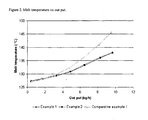
- the processing testing was done on a Göttfert Extrusiometer equipment.
- Output and temperature of the melt were measured at increasing extrusion speeds at 5, 20, 40, 60, 80, 100 and 115 rpm. For some materials, the extruder was unable to reach 115 rpm, in which case data were recorded at the maximum rpm that was possible to obtain.
- the temperature of the melt was recorded by an adiabatic thermocouple placed in the centre of the flow channel, just before the inlet of the die. The value recorded at each extrusion speed was taken after the temperature had been allowed to stabilize.
- the pellets of inventive (Polymer Composition) and comparative polymers were used for the determination.
- Hot set elongation and permanent deformation are determined according to IEC 60811-2-1 using crosslinked plaque samples.
- These plaques are prepared from the test polymer pellets containing peroxide as follows: First, the pellets were melted at 120°C at around 20 bar for 1 minute. Then the pressure was increased to 200 bar, followed by ramping the temperature up to 180°C which takes 4 min. The material was then kept at 180°C for 8 minutes and after that it was cooled down to room temperature at a cooling rate of 15°C/min. The thickness of the obtained crosslinked plaque was around 1.8 mm.
- a circular plaque was pressed at 120 °C, 2 min without pressure followed by 2 min at 5 tons pressure and then the plaque was cooled to room temperature.
- This plaque was then analysed in a Monsanto MDR Equipment (supplier Monsanto) Equipment at the selected temperature and the increase in torque was then monitored as a function of crosslinking/heattreatment time.
- the torque increase data for a reference material were generated as comparison. Then the times needed to reach certain increases in torque were determined and these were then compared with the inventive formulations.
- the Monsanto scorch was determined at 140 °C.
- the time presented in the examples is the time from the start of the test until a torque value of 1 dNm is reached (from the minimum torque value in the torque curve (Torque min + 1 dNm) value is referred to the Monsanto scorch value.. The longer time it takes, the more resistant is the formulation to form scorch. The average value of two measurements is reported.
- the sagging performance was evaluated in a large scale with cable experiments where the centricity of a 30 kV type of cable was evaluated.
- a 30 kV cable was produced on a Maillefer pilot cable line of the Catenary Continuous Vulcanisation (CCV) type.
- the evaluated construction had a conductor area of 50 mm 2 , an inner semiconductive layer of 0.9 mm, an insulation layer of 8-9 mm and an outer semiconductive layer of 1 mm.
- the cable was produced as a 1 + 2 construction (e.g first the inner semiconductive layer was applied onto the conductor and then the remaining two layer were applied via the same extrusion head to the conductor having already the inner semiconductive layer applied).
- the cable cores were produced with a line speed of 1.4-1.6 m/min.
- the centricity was determined on crosslinked 30 kV cables produced on a CCV line according to the description given above.
- the thickness of the insulation layer was determined at four different positions around the cable with 90 inbetween (e.g at the positions 0°, 90°, 180° and 270°) under a microscope.
- the polymers are all low density polyethylenes polymerised in a high pressure reactor
- Ethylene was compressed in a 5-stage precompressor and a 2-stage hyper compressor with intermediate cooling to reach an initial reaction pressure of ca. 2973 bar.
- the total compressor throughput was ca. 30 tons/hour.
- propylene / hour was added as chain transfer agent to maintain an MFR of 3.2g / 10 min.
- 1,7-octadiene was added to the reactor in amount of ca. 57 kg/h.
- the compressed mixture was heated to approximately 165 °C in a preheating section of a front feed three-zone tubular reactor with an inner diameter of ca. 40 mm and a total length of ca. 1200 meters.
- a mixture of commercially available peroxide radical initiators dissolved in isododecane was injected just after the preheater in an amount sufficient for the exothermal polymerization reaction to reach peak temperature of ca. 283 °C after which it was cooled to approx 225 °C.
- the subsequent 2nd and 3rd peak reaction temperatures were ca. 283 °C and ca. 267 °C, respectively, with a cooling in between down to approximately 235 °C.
- the reaction mixture was depressurized by a kick valve, cooled and polymer was separated from unreacted gas.
- Ethylene was compressed in a 5-stage precompressor and a 2-stage hyper compressor with intermediate cooling to reach an initial reaction pressure of ca. 2943 bar.
- the total compressor throughput was ca. 30 tons/hour.
- propylene / hour was added as chain transfer agent to maintain an MFR of 4.2 g / 10 min.
- 1,7-octadiene was added to the reactor in amount of ca. 44 kg/h.
- the compressed mixture was heated to approximately 165 °C in a preheating section of a front feed three-zone tubular reactor with an inner diameter of ca. 40 mm and a total length of ca. 1200 meters.
- a mixture of commercially available peroxide radical initiators dissolved in isododecane was injected just after the preheater in an amount sufficient for the exothermal polymerization reaction to reach peak temperature of ca. 288 °C after which it was cooled to approx 230 °C.
- the subsequent 2nd and 3rd peak reaction temperatures were ca. 272 °C and ca. 267 °C, respectively, with a cooling in between down to approximately 235 °C.
- the reaction mixture was depressurized by a kick valve, cooled and polymer was separated from unreacted gas.
- Ethylene was compressed in a 5-stage precompressor and a 2-stage hyper compressor with intermediate cooling to reach an initial reaction pressure of ca. 2904 bar.
- the total compressor throughput was ca. 30 tons/hour.
- propylene / hour was added as chain transfer agent to maintain an MFR of 1.9 g / 10 min.
- 1,7-octadiene was added to the reactor in amount of ca. 63 kg/h.
- the compressed mixture was heated to approximately 165 °C in a preheating section of a front feed three-zone tubular reactor with an inner diameter of ca. 40 mm and a total length of ca. 1200 meters.
- a mixture of commercially available peroxide radical initiators dissolved in isododecane was injected just after the preheater in an amount sufficient for the exothermal polymerization reaction to reach peak temperature of ca. 289 °C after which it was cooled to approx 210 °C.
- the subsequent 2nd and 3rd peak reaction temperatures were ca. 283 °C and ca. 262 °C, respectively, with a cooling in between down to approximately 220 °C.
- the reaction mixture was depressurized by a kick valve, cooled and polymer was separated from unreacted gas.
- LE4244 used for the centricity (sagging) tests performed on extruded crosslinked cables.
- Example Polymer MFR 2 (g/10 min) ⁇ 0 (Pa s) ⁇ 0.05 (Pa s) ⁇ 0.10 (Pa s) ⁇ 300 (Pa s)
- Inventive Example 1 Polymer 1 3.2 11001 8420 7530 265
- Inventive Example 2 Polymer 2 4.2 7280 6070 5510 280 Comparative Polymer 3 1.9 25408 15100 12400 (0.104 rad/s) 300
- Example 2 Polymer 5 0.8 39769 26000 22200 430 Material Vinyl/1000 C Vinylidene/1000 C Trans- vinylene/1000 C Total carbon-carbon double bonds/1000 C Inv.Example 1 0.87 0.19 0.09 1.15 Inv.Example 2 0.77 0.18 0.08 1.03 Comp.
- Example 3 0.82 0.20 0.10 1.12 Comparative example 1 0.11 0.22 0.04 0.37 Comparative example 2 0.11 0.22 0.04 0.37
- Figure 7 Example of how the insulation thickness in 90° position was determined in a cable core produced of a crosslinked Example 1 polymer.
- Figure 8 Example of how the insulation thickness in 90° position was determined in a cable core produced of a crosslinked Example 1 polymer.
Landscapes
- Chemical & Material Sciences (AREA)
- Health & Medical Sciences (AREA)
- Chemical Kinetics & Catalysis (AREA)
- Medicinal Chemistry (AREA)
- Polymers & Plastics (AREA)
- Organic Chemistry (AREA)
- Physics & Mathematics (AREA)
- Spectroscopy & Molecular Physics (AREA)
- Compositions Of Macromolecular Compounds (AREA)
- Organic Insulating Materials (AREA)
- Processes Specially Adapted For Manufacturing Cables (AREA)
- Heating, Cooling, Or Curing Plastics Or The Like In General (AREA)
Claims (13)
- Processus pour produire un câble dans une ligne de vulcanisation continue horizontale ou caténaire (CV), lequel câble comprend un conducteur entouré par une ou plusieurs couches, dans lequel le processus comprend les étapes dei) application sur un conducteur d'une ou plusieurs couches en utilisant une composition de polymère qui comprendA) au moins un homopolymère ou copolymère de polyéthylène non saturé de faible masse volumique produit dans un processus de polymérisation à haute pression, etB) un agent de réticulation,et dans lequel la composition de polymère aa) un indice de fluidité, MFR2 quand il est déterminé en utilisant ISO 1133 à 190 °C, sous une charge de 2,16 kg, d'au moins 3,0 g/10 minutes, et la composition de polymère contientb) des liaisons doubles carbone-carbone en une quantité d'au moins 0,40 liaisons doubles carbone-carbone / 1 000 atomes de carbone ;pour former au moins une desdites couches de câble entourant le conducteur.
- Processus selon l'une quelconque des revendications précédentes, dans lequel b) lesdites liaisons doubles carbone-carbone présentes dans la Composition de Polymère incluent des groupes vinyle, lesquels groupes vinyle sont originaires i) d'un comonomère polyinsaturé, ii) d'un agent de transfert de chaîne, iii) d'un composé non saturé de faible masse moléculaire qui est un suramplificateur de réticulation ou un retardateur de vulcanisation prématurée, ou iv) de n'importe quel mélange de (i) à (iii).
- Processus selon l'une quelconque des revendications précédentes, dans lequel l'au moins un polyéthylène non saturé de faible masse volumique (A) est un copolymère d'un éthylène avec au moins un comonomère polyinsaturé et de manière facultative avec un ou plusieurs autre(s) comonomère(s) et dans lequel b) lesdites liaisons doubles carbone-carbone présentes dans la Composition de Polymère incluent des groupes vinyle provenant dudit au moins un comonomère polyinsaturé.
- Processus selon l'une quelconque des revendications précédentes, dans lequel b) les liaisons doubles carbone-carbone présentes dans l'au moins un polyéthylène non saturé de faible masse volumique (A) inclurent des groupes vinyle qui proviennent i) d'un comonomère polyinsaturé, ii) d'un agent de transfert de chaîne, ou iii) de n'importe quel mélange de ceux-ci, et dans lequel ledit au moins un polymère non saturé (A) contient b) lesdits groupes de vinyle en une quantité totale d'au moins 0,25/1000 atomes de carbone.
- Processus selon les revendications 3 à 5, dans lequel le comonomère polyinsaturé est une chaîne carbonique droite avec au moins 8 atomes de carbone et au moins 4 atomes de carbone entre les liaisons doubles non conjuguées, dont au moins une est terminale.
- Processus selon les revendications 3 à 5, dans lequel le comonomère polyinsaturé est sélectionné à partir de 1,7-octadiène, 1,9-décadiène, 1,11-dodécadiène, 1,13-tétradécadiène, ou des mélanges de ceux-ci.
- Processus selon l'une quelconque des revendications précédentes, dans lequel ladite au moins une couche de la Composition de Polymère est appliquée dans l'étape i) par (co)extrusion pour former une couche d'isolation.
- Processus selon n'importe laquelle des revendications précédentes comprenant une étape supplémentaire i0) précédant l'étape i), et est caractérisé pari0) mélange en fusion de ladite Composition de Polymère telle que définie dans n'importe laquelle des revendications précédentes de manière facultative en même temps qu'un ou des composant(s) supplémentaire(s), et ensuitei) application du mélange fondu obtenu à partir de l'étape io) sur un conducteur pour former au moins une desdites une ou plusieurs couches de câble.
- Processus selon l'une quelconque des revendications précédentes pour préparer un câble pouvant être réticulé, caractérisé en ce qu'il comprend les étapes de- i00) fourniture à ladite étape io) de ladite Composition de Polymère telle que définie dans n'importe laquelle des revendications précédentes- i0) mélange par fusion de la Composition de Polymère de manière facultative en même temps que des composants supplémentaires, eti) application du mélange fondu obtenu à partir de l'étape i0) sur un conducteur pour former au moins une desdites une ou plusieurs couches de câble.
- Processus selon n'importe laquelle des revendications précédentes pour préparer un câble électrique comprenant i) l'application sur un conducteur d'au moins une couche semi-conductrice intérieure, d'une couche d'isolation et d'une couche semi-conductrice extérieure, dans un ordre donné, dans lequel ladite Composition de Polymère telle que définie dans n'importe laquelle des revendications précédentes est utilisée pour former au moins la couche d'isolation du câble électrique.
- Processus selon n'importe laquelle des revendications précédentes comprenant une étape supplémentaire ii) de réticulation de l'au moins une couche de câble obtenue à l'étape i) comprenant un polyéthylène non saturé de faible masse volumique pouvant être réticulé (A) de la Composition de Polymère telle que définie dans n'importe laquelle des revendications précédentes.
- Processus selon n'importe laquelle des revendications précédentes, dans lequel la Composition de Polymère a une viscosité, η0,05, d'au moins 3 000 Pas.
- Processus selon n'importe laquelle des revendications précédentes, dans lequel l'au moins un polymère non saturé (A) a une viscosité, η0,05, d'au moins 3 500 Pas.
Priority Applications (1)
| Application Number | Priority Date | Filing Date | Title |
|---|---|---|---|
| EP09777028.3A EP2318209B1 (fr) | 2008-07-10 | 2009-07-08 | Procédé de préparation d'un câble |
Applications Claiming Priority (4)
| Application Number | Priority Date | Filing Date | Title |
|---|---|---|---|
| EP08252356 | 2008-07-10 | ||
| EP08252349 | 2008-07-10 | ||
| PCT/EP2009/004929 WO2010003649A1 (fr) | 2008-07-10 | 2009-07-08 | Procédé de préparation d'un câble |
| EP09777028.3A EP2318209B1 (fr) | 2008-07-10 | 2009-07-08 | Procédé de préparation d'un câble |
Publications (2)
| Publication Number | Publication Date |
|---|---|
| EP2318209A1 EP2318209A1 (fr) | 2011-05-11 |
| EP2318209B1 true EP2318209B1 (fr) | 2014-12-24 |
Family
ID=41228424
Family Applications (1)
| Application Number | Title | Priority Date | Filing Date |
|---|---|---|---|
| EP09777028.3A Active EP2318209B1 (fr) | 2008-07-10 | 2009-07-08 | Procédé de préparation d'un câble |
Country Status (6)
| Country | Link |
|---|---|
| US (1) | US20110162869A1 (fr) |
| EP (1) | EP2318209B1 (fr) |
| KR (1) | KR101416332B1 (fr) |
| CN (1) | CN102099191B (fr) |
| EA (1) | EA022103B1 (fr) |
| WO (1) | WO2010003649A1 (fr) |
Families Citing this family (26)
| Publication number | Priority date | Publication date | Assignee | Title |
|---|---|---|---|---|
| EP1923200A1 (fr) * | 2006-11-20 | 2008-05-21 | Borealis Technology Oy | article |
| DE602006009412D1 (de) * | 2006-12-21 | 2009-11-05 | Borealis Tech Oy | Film |
| EP1941999B2 (fr) * | 2006-12-21 | 2014-02-26 | Borealis Technology Oy | Film |
| ES2354383T5 (es) | 2007-08-10 | 2021-06-21 | Borealis Tech Oy | Artículo que comprende una composición de polipropileno |
| EP2067799A1 (fr) * | 2007-12-05 | 2009-06-10 | Borealis Technology OY | Polymère |
| US8866016B2 (en) | 2008-07-10 | 2014-10-21 | Borealis Ag | Crosslinkable polymer composition |
| BRPI0915561B1 (pt) * | 2008-07-10 | 2019-04-24 | Borealis Ag | Processo para a produção de um polímero e polímero para aplicações em cabos e arames |
| AU2010318182B2 (en) | 2009-11-11 | 2014-07-24 | Borealis Ag | Crosslinkable polymer composition and cable with advantageous electrical properties |
| EP2354183B1 (fr) | 2010-01-29 | 2012-08-22 | Borealis AG | Composition de moulage |
| PL2354184T3 (pl) | 2010-01-29 | 2013-01-31 | Borealis Ag | Tłoczywo polietylenowe o ulepszonym stosunku odporność na pękanie /sztywność i ulepszone udarności |
| EP2471949B1 (fr) | 2010-12-31 | 2013-12-25 | Progenika Biopharma, S.A. | Procédé pour l'identification par des techniques moléculaires de variantes génétiques ne codant pas d'antigène D (D-) et qui codent l'antigène C modifié (C+W) |
| KR101891366B1 (ko) * | 2011-05-04 | 2018-08-23 | 보레알리스 아게 | 전기 장치용 중합체 조성물 |
| EP2705087B1 (fr) | 2011-05-04 | 2017-03-01 | Borealis AG | Composition polymère pour dispositifs électriques |
| WO2014040237A1 (fr) * | 2012-09-12 | 2014-03-20 | Dow Global Technologies Llc | Compositions polymères réticulables, leurs méthodes de fabrication, et articles fabriqués à partir de celles-ci |
| US10689502B2 (en) * | 2015-05-22 | 2020-06-23 | Dow Global Technologies Llc | Processes for preparing cables with a crosslinked insulation layer and cables for same |
| CN107771199B (zh) | 2015-06-17 | 2021-05-25 | 陶氏环球技术有限责任公司 | 使用在管式反应器中制得且任选地经支化剂改性的高熔融强度乙烯类聚合物制得交联电缆绝缘材料的方法 |
| WO2019121720A1 (fr) * | 2017-12-18 | 2019-06-27 | Borealis Ag | Câble constitué d'une composition réticulable sans antioxydant et formation de méthane bénéfique avec réticulation réduite |
| WO2019121712A1 (fr) * | 2017-12-18 | 2019-06-27 | Borealis Ag | Composition réticulable sans antioxydant et formation de méthane bénéfique à réticulation réduite |
| WO2019121710A1 (fr) * | 2017-12-18 | 2019-06-27 | Borealis Ag | Composition polymère comprenant un polyéthylène |
| WO2019121716A1 (fr) * | 2017-12-18 | 2019-06-27 | Borealis Ag | Câble fabriqué à partir d'une composition réticulable sans antioxydant et avec formation de méthane bénéfique |
| US11286315B2 (en) | 2017-12-18 | 2022-03-29 | Borealis Ag | Polyethylene with a high vinyl content and with a low MFR |
| WO2019121730A1 (fr) * | 2017-12-18 | 2019-06-27 | Borealis Ag | Polyéthylène à faible mfr et à haute teneur en vinyle |
| CN111566134B (zh) * | 2017-12-18 | 2023-04-25 | 博里利斯股份公司 | 具有高的乙烯基含量和有利的流变性能的聚乙烯 |
| RU2711227C1 (ru) * | 2019-10-09 | 2020-01-15 | Акционерное общество "НПО Пластполимер" | Способ получения терполимеров этилена с винилацетатом и бутилакрилатом |
| KR20240051235A (ko) * | 2021-09-01 | 2024-04-19 | 엑손모빌 케미칼 패턴츠 인코포레이티드 | 가변 온도 관형 반응기 프로파일 및 이로부터 제조된 중밀도 폴리에틸렌 조성물 |
| CN118530522A (zh) * | 2024-05-17 | 2024-08-23 | 北京怀柔实验室 | 聚乙烯组合物及其制备方法、电缆、应用 |
Family Cites Families (19)
| Publication number | Priority date | Publication date | Assignee | Title |
|---|---|---|---|---|
| US3849192A (en) * | 1972-05-12 | 1974-11-19 | Gen Cable Corp Inc | Method of applying and cooling low density polyethylene cable insulation |
| SE415006B (sv) * | 1978-03-07 | 1980-09-01 | Asea Ab | Sett att anbringaen isolering av tverbunden polymer pa en kabelledare |
| JPS606052B2 (ja) * | 1981-06-10 | 1985-02-15 | 株式会社フジクラ | 連続加硫装置 |
| JPS60133042A (ja) * | 1983-12-20 | 1985-07-16 | Nippon Petrochem Co Ltd | 電気絶縁用樹脂組成物 |
| JPS61111311A (ja) * | 1984-07-09 | 1986-05-29 | Mitsubishi Petrochem Co Ltd | エチレン共重合体の製造法 |
| US4994539A (en) * | 1984-10-03 | 1991-02-19 | Nippon Petrochemicals Co., Ltd. | Method for improving impulse destructive stength of electrical insulating materials |
| SE9103077D0 (sv) * | 1991-10-22 | 1991-10-22 | Neste Oy | Omaettad etensampolymer och saett foer framstaellning daerav |
| JPH0652719A (ja) * | 1992-07-31 | 1994-02-25 | Sumitomo Chem Co Ltd | 電線・ケーブル保護被覆用ポリエチレン組成物 |
| US20020039654A1 (en) * | 1997-12-22 | 2002-04-04 | Bill Gustafsson | Electric DC-cable with an insulation system |
| US6686012B1 (en) * | 2000-08-23 | 2004-02-03 | 3M Innovative Properties Company | Multi-layer articles including a fluoroplastic layer |
| US6652943B2 (en) * | 2001-06-04 | 2003-11-25 | Saint-Gobain Performance Plastics Corporation | Multilayer polymeric article with intercrosslinked polymer layers and method of making same |
| WO2003040229A1 (fr) * | 2001-11-02 | 2003-05-15 | Dow Global Technologies Inc. | Matiere fondue moleculaire et procedes de production et d'utilisation de cette matiere fondue moleculaire |
| WO2004014971A1 (fr) * | 2002-07-31 | 2004-02-19 | Exxonmobil Chemical Patents Inc. | Polyethylene reticulable a base de silane |
| ES2605010T3 (es) * | 2003-07-25 | 2017-03-10 | Prysmian S.P.A. | Procedimiento continuo para fabricación de cables eléctricos |
| ES2311181T3 (es) * | 2005-02-28 | 2009-02-01 | Borealis Technology Oy | Composicion polimerica retardante de la combustion. |
| ES2324478T3 (es) * | 2005-06-08 | 2009-08-07 | Borealis Technology Oy | Composicion polimerica reticulable semiconductora. |
| EP1731564B1 (fr) * | 2005-06-08 | 2010-03-10 | Borealis Technology Oy | mélange retardant l'apparition des traces de souillures par humidite |
| US8866016B2 (en) * | 2008-07-10 | 2014-10-21 | Borealis Ag | Crosslinkable polymer composition |
| BRPI0915561B1 (pt) * | 2008-07-10 | 2019-04-24 | Borealis Ag | Processo para a produção de um polímero e polímero para aplicações em cabos e arames |
-
2009
- 2009-07-08 WO PCT/EP2009/004929 patent/WO2010003649A1/fr not_active Ceased
- 2009-07-08 CN CN200980127817.2A patent/CN102099191B/zh active Active
- 2009-07-08 KR KR1020117002680A patent/KR101416332B1/ko not_active Expired - Fee Related
- 2009-07-08 US US13/002,824 patent/US20110162869A1/en not_active Abandoned
- 2009-07-08 EA EA201100082A patent/EA022103B1/ru not_active IP Right Cessation
- 2009-07-08 EP EP09777028.3A patent/EP2318209B1/fr active Active
Also Published As
| Publication number | Publication date |
|---|---|
| KR101416332B1 (ko) | 2014-07-08 |
| KR20110040881A (ko) | 2011-04-20 |
| US20110162869A1 (en) | 2011-07-07 |
| EA201100082A1 (ru) | 2011-08-30 |
| EP2318209A1 (fr) | 2011-05-11 |
| WO2010003649A1 (fr) | 2010-01-14 |
| EA022103B1 (ru) | 2015-11-30 |
| CN102099191A (zh) | 2011-06-15 |
| CN102099191B (zh) | 2014-10-29 |
Similar Documents
| Publication | Publication Date | Title |
|---|---|---|
| EP2318209B1 (fr) | Procédé de préparation d'un câble | |
| EP2318210B1 (fr) | Composition polymère réticulable | |
| CN102666602B (zh) | 具有有利的电性能的可交联的聚合物组合物和电缆 | |
| EP1695992B1 (fr) | Procédé de préparation de polymères réticulés | |
| EP3717526B1 (fr) | Polyéthylène à teneur élevée en vinyle et ayant un faible indice de fluidité (mfr) | |
| JP6646581B2 (ja) | 新規の低mfrポリマー組成物、電力ケーブル絶縁体および電力ケーブル | |
| KR102731870B1 (ko) | 폴리에틸렌을 포함하는 중합체 조성물 | |
| EP3728344B1 (fr) | Polyéthylène à teneur élevée en vinyle et aux propriétés rhéologiques avantageuses | |
| EP3728441B1 (fr) | Composition réticulable sans antioxydant avec formation de méthane reduite et une réticulation favorable | |
| CN111492444A (zh) | 由不含抗氧化剂且具有有利的甲烷形成的可交联组合物制成的电缆 | |
| WO2019121730A1 (fr) | Polyéthylène à faible mfr et à haute teneur en vinyle | |
| EA045796B1 (ru) | Полиэтилен с высоким содержанием винила и ценными реологическими свойствами | |
| WO2019121720A1 (fr) | Câble constitué d'une composition réticulable sans antioxydant et formation de méthane bénéfique avec réticulation réduite |
Legal Events
| Date | Code | Title | Description |
|---|---|---|---|
| PUAI | Public reference made under article 153(3) epc to a published international application that has entered the european phase |
Free format text: ORIGINAL CODE: 0009012 |
|
| 17P | Request for examination filed |
Effective date: 20110209 |
|
| AK | Designated contracting states |
Kind code of ref document: A1 Designated state(s): AT BE BG CH CY CZ DE DK EE ES FI FR GB GR HR HU IE IS IT LI LT LU LV MC MK MT NL NO PL PT RO SE SI SK SM TR |
|
| AX | Request for extension of the european patent |
Extension state: AL BA RS |
|
| DAX | Request for extension of the european patent (deleted) | ||
| 17Q | First examination report despatched |
Effective date: 20130212 |
|
| REG | Reference to a national code |
Ref country code: DE Ref legal event code: R079 Ref document number: 602009028569 Country of ref document: DE Free format text: PREVIOUS MAIN CLASS: B32B0027320000 Ipc: H01B0003440000 |
|
| GRAP | Despatch of communication of intention to grant a patent |
Free format text: ORIGINAL CODE: EPIDOSNIGR1 |
|
| RIC1 | Information provided on ipc code assigned before grant |
Ipc: C08F 210/02 20060101ALI20140917BHEP Ipc: H01B 3/44 20060101AFI20140917BHEP |
|
| INTG | Intention to grant announced |
Effective date: 20141010 |
|
| GRAS | Grant fee paid |
Free format text: ORIGINAL CODE: EPIDOSNIGR3 |
|
| GRAA | (expected) grant |
Free format text: ORIGINAL CODE: 0009210 |
|
| AK | Designated contracting states |
Kind code of ref document: B1 Designated state(s): AT BE BG CH CY CZ DE DK EE ES FI FR GB GR HR HU IE IS IT LI LT LU LV MC MK MT NL NO PL PT RO SE SI SK SM TR |
|
| REG | Reference to a national code |
Ref country code: GB Ref legal event code: FG4D |
|
| REG | Reference to a national code |
Ref country code: CH Ref legal event code: EP |
|
| REG | Reference to a national code |
Ref country code: IE Ref legal event code: FG4D |
|
| REG | Reference to a national code |
Ref country code: AT Ref legal event code: REF Ref document number: 703499 Country of ref document: AT Kind code of ref document: T Effective date: 20150115 |
|
| REG | Reference to a national code |
Ref country code: DE Ref legal event code: R096 Ref document number: 602009028569 Country of ref document: DE Effective date: 20150226 |
|
| REG | Reference to a national code |
Ref country code: NL Ref legal event code: VDEP Effective date: 20141224 |
|
| PG25 | Lapsed in a contracting state [announced via postgrant information from national office to epo] |
Ref country code: LT Free format text: LAPSE BECAUSE OF FAILURE TO SUBMIT A TRANSLATION OF THE DESCRIPTION OR TO PAY THE FEE WITHIN THE PRESCRIBED TIME-LIMIT Effective date: 20141224 |
|
| REG | Reference to a national code |
Ref country code: NO Ref legal event code: T2 Effective date: 20141224 |
|
| REG | Reference to a national code |
Ref country code: LT Ref legal event code: MG4D |
|
| PG25 | Lapsed in a contracting state [announced via postgrant information from national office to epo] |
Ref country code: HR Free format text: LAPSE BECAUSE OF FAILURE TO SUBMIT A TRANSLATION OF THE DESCRIPTION OR TO PAY THE FEE WITHIN THE PRESCRIBED TIME-LIMIT Effective date: 20141224 Ref country code: LV Free format text: LAPSE BECAUSE OF FAILURE TO SUBMIT A TRANSLATION OF THE DESCRIPTION OR TO PAY THE FEE WITHIN THE PRESCRIBED TIME-LIMIT Effective date: 20141224 Ref country code: GR Free format text: LAPSE BECAUSE OF FAILURE TO SUBMIT A TRANSLATION OF THE DESCRIPTION OR TO PAY THE FEE WITHIN THE PRESCRIBED TIME-LIMIT Effective date: 20150325 Ref country code: SE Free format text: LAPSE BECAUSE OF FAILURE TO SUBMIT A TRANSLATION OF THE DESCRIPTION OR TO PAY THE FEE WITHIN THE PRESCRIBED TIME-LIMIT Effective date: 20141224 |
|
| REG | Reference to a national code |
Ref country code: AT Ref legal event code: MK05 Ref document number: 703499 Country of ref document: AT Kind code of ref document: T Effective date: 20141224 |
|
| PG25 | Lapsed in a contracting state [announced via postgrant information from national office to epo] |
Ref country code: NL Free format text: LAPSE BECAUSE OF FAILURE TO SUBMIT A TRANSLATION OF THE DESCRIPTION OR TO PAY THE FEE WITHIN THE PRESCRIBED TIME-LIMIT Effective date: 20141224 |
|
| PG25 | Lapsed in a contracting state [announced via postgrant information from national office to epo] |
Ref country code: SK Free format text: LAPSE BECAUSE OF FAILURE TO SUBMIT A TRANSLATION OF THE DESCRIPTION OR TO PAY THE FEE WITHIN THE PRESCRIBED TIME-LIMIT Effective date: 20141224 Ref country code: ES Free format text: LAPSE BECAUSE OF FAILURE TO SUBMIT A TRANSLATION OF THE DESCRIPTION OR TO PAY THE FEE WITHIN THE PRESCRIBED TIME-LIMIT Effective date: 20141224 Ref country code: EE Free format text: LAPSE BECAUSE OF FAILURE TO SUBMIT A TRANSLATION OF THE DESCRIPTION OR TO PAY THE FEE WITHIN THE PRESCRIBED TIME-LIMIT Effective date: 20141224 Ref country code: RO Free format text: LAPSE BECAUSE OF FAILURE TO SUBMIT A TRANSLATION OF THE DESCRIPTION OR TO PAY THE FEE WITHIN THE PRESCRIBED TIME-LIMIT Effective date: 20141224 Ref country code: CZ Free format text: LAPSE BECAUSE OF FAILURE TO SUBMIT A TRANSLATION OF THE DESCRIPTION OR TO PAY THE FEE WITHIN THE PRESCRIBED TIME-LIMIT Effective date: 20141224 |
|
| PG25 | Lapsed in a contracting state [announced via postgrant information from national office to epo] |
Ref country code: AT Free format text: LAPSE BECAUSE OF FAILURE TO SUBMIT A TRANSLATION OF THE DESCRIPTION OR TO PAY THE FEE WITHIN THE PRESCRIBED TIME-LIMIT Effective date: 20141224 Ref country code: PL Free format text: LAPSE BECAUSE OF FAILURE TO SUBMIT A TRANSLATION OF THE DESCRIPTION OR TO PAY THE FEE WITHIN THE PRESCRIBED TIME-LIMIT Effective date: 20141224 Ref country code: IS Free format text: LAPSE BECAUSE OF FAILURE TO SUBMIT A TRANSLATION OF THE DESCRIPTION OR TO PAY THE FEE WITHIN THE PRESCRIBED TIME-LIMIT Effective date: 20150424 |
|
| REG | Reference to a national code |
Ref country code: DE Ref legal event code: R097 Ref document number: 602009028569 Country of ref document: DE |
|
| PG25 | Lapsed in a contracting state [announced via postgrant information from national office to epo] |
Ref country code: DK Free format text: LAPSE BECAUSE OF FAILURE TO SUBMIT A TRANSLATION OF THE DESCRIPTION OR TO PAY THE FEE WITHIN THE PRESCRIBED TIME-LIMIT Effective date: 20141224 |
|
| PLBE | No opposition filed within time limit |
Free format text: ORIGINAL CODE: 0009261 |
|
| STAA | Information on the status of an ep patent application or granted ep patent |
Free format text: STATUS: NO OPPOSITION FILED WITHIN TIME LIMIT |
|
| 26N | No opposition filed |
Effective date: 20150925 |
|
| PG25 | Lapsed in a contracting state [announced via postgrant information from national office to epo] |
Ref country code: MC Free format text: LAPSE BECAUSE OF FAILURE TO SUBMIT A TRANSLATION OF THE DESCRIPTION OR TO PAY THE FEE WITHIN THE PRESCRIBED TIME-LIMIT Effective date: 20141224 Ref country code: SI Free format text: LAPSE BECAUSE OF FAILURE TO SUBMIT A TRANSLATION OF THE DESCRIPTION OR TO PAY THE FEE WITHIN THE PRESCRIBED TIME-LIMIT Effective date: 20141224 |
|
| REG | Reference to a national code |
Ref country code: CH Ref legal event code: PL |
|
| GBPC | Gb: european patent ceased through non-payment of renewal fee |
Effective date: 20150708 |
|
| PG25 | Lapsed in a contracting state [announced via postgrant information from national office to epo] |
Ref country code: LU Free format text: LAPSE BECAUSE OF FAILURE TO SUBMIT A TRANSLATION OF THE DESCRIPTION OR TO PAY THE FEE WITHIN THE PRESCRIBED TIME-LIMIT Effective date: 20150708 |
|
| REG | Reference to a national code |
Ref country code: IE Ref legal event code: MM4A |
|
| PG25 | Lapsed in a contracting state [announced via postgrant information from national office to epo] |
Ref country code: CH Free format text: LAPSE BECAUSE OF NON-PAYMENT OF DUE FEES Effective date: 20150731 Ref country code: LI Free format text: LAPSE BECAUSE OF NON-PAYMENT OF DUE FEES Effective date: 20150731 Ref country code: GB Free format text: LAPSE BECAUSE OF NON-PAYMENT OF DUE FEES Effective date: 20150708 |
|
| PG25 | Lapsed in a contracting state [announced via postgrant information from national office to epo] |
Ref country code: BE Free format text: LAPSE BECAUSE OF FAILURE TO SUBMIT A TRANSLATION OF THE DESCRIPTION OR TO PAY THE FEE WITHIN THE PRESCRIBED TIME-LIMIT Effective date: 20141224 |
|
| REG | Reference to a national code |
Ref country code: FR Ref legal event code: PLFP Year of fee payment: 8 |
|
| PG25 | Lapsed in a contracting state [announced via postgrant information from national office to epo] |
Ref country code: IE Free format text: LAPSE BECAUSE OF NON-PAYMENT OF DUE FEES Effective date: 20150708 |
|
| PG25 | Lapsed in a contracting state [announced via postgrant information from national office to epo] |
Ref country code: MT Free format text: LAPSE BECAUSE OF FAILURE TO SUBMIT A TRANSLATION OF THE DESCRIPTION OR TO PAY THE FEE WITHIN THE PRESCRIBED TIME-LIMIT Effective date: 20141224 |
|
| PG25 | Lapsed in a contracting state [announced via postgrant information from national office to epo] |
Ref country code: HU Free format text: LAPSE BECAUSE OF FAILURE TO SUBMIT A TRANSLATION OF THE DESCRIPTION OR TO PAY THE FEE WITHIN THE PRESCRIBED TIME-LIMIT; INVALID AB INITIO Effective date: 20090708 Ref country code: BG Free format text: LAPSE BECAUSE OF FAILURE TO SUBMIT A TRANSLATION OF THE DESCRIPTION OR TO PAY THE FEE WITHIN THE PRESCRIBED TIME-LIMIT Effective date: 20141224 Ref country code: SM Free format text: LAPSE BECAUSE OF FAILURE TO SUBMIT A TRANSLATION OF THE DESCRIPTION OR TO PAY THE FEE WITHIN THE PRESCRIBED TIME-LIMIT Effective date: 20141224 |
|
| PG25 | Lapsed in a contracting state [announced via postgrant information from national office to epo] |
Ref country code: CY Free format text: LAPSE BECAUSE OF FAILURE TO SUBMIT A TRANSLATION OF THE DESCRIPTION OR TO PAY THE FEE WITHIN THE PRESCRIBED TIME-LIMIT Effective date: 20141224 |
|
| REG | Reference to a national code |
Ref country code: FR Ref legal event code: PLFP Year of fee payment: 9 |
|
| PG25 | Lapsed in a contracting state [announced via postgrant information from national office to epo] |
Ref country code: MK Free format text: LAPSE BECAUSE OF FAILURE TO SUBMIT A TRANSLATION OF THE DESCRIPTION OR TO PAY THE FEE WITHIN THE PRESCRIBED TIME-LIMIT Effective date: 20141224 |
|
| REG | Reference to a national code |
Ref country code: FR Ref legal event code: PLFP Year of fee payment: 10 |
|
| PG25 | Lapsed in a contracting state [announced via postgrant information from national office to epo] |
Ref country code: PT Free format text: LAPSE BECAUSE OF FAILURE TO SUBMIT A TRANSLATION OF THE DESCRIPTION OR TO PAY THE FEE WITHIN THE PRESCRIBED TIME-LIMIT Effective date: 20141224 |
|
| P01 | Opt-out of the competence of the unified patent court (upc) registered |
Effective date: 20230602 |
|
| PGFP | Annual fee paid to national office [announced via postgrant information from national office to epo] |
Ref country code: TR Payment date: 20230705 Year of fee payment: 15 Ref country code: NO Payment date: 20230721 Year of fee payment: 15 Ref country code: IT Payment date: 20230724 Year of fee payment: 15 Ref country code: FI Payment date: 20230719 Year of fee payment: 15 |
|
| PGFP | Annual fee paid to national office [announced via postgrant information from national office to epo] |
Ref country code: DE Payment date: 20240719 Year of fee payment: 16 |
|
| PGFP | Annual fee paid to national office [announced via postgrant information from national office to epo] |
Ref country code: FR Payment date: 20240729 Year of fee payment: 16 |
|
| PG25 | Lapsed in a contracting state [announced via postgrant information from national office to epo] |
Ref country code: FI Free format text: LAPSE BECAUSE OF NON-PAYMENT OF DUE FEES Effective date: 20240708 |
|
| PG25 | Lapsed in a contracting state [announced via postgrant information from national office to epo] |
Ref country code: NO Free format text: LAPSE BECAUSE OF NON-PAYMENT OF DUE FEES Effective date: 20240731 |
|
| PG25 | Lapsed in a contracting state [announced via postgrant information from national office to epo] |
Ref country code: IT Free format text: LAPSE BECAUSE OF NON-PAYMENT OF DUE FEES Effective date: 20240708 |
|
| REG | Reference to a national code |
Ref country code: DE Ref legal event code: R119 Ref document number: 602009028569 Country of ref document: DE |
|
| PG25 | Lapsed in a contracting state [announced via postgrant information from national office to epo] |
Ref country code: DE Free format text: LAPSE BECAUSE OF NON-PAYMENT OF DUE FEES Effective date: 20260203 |
|
| PG25 | Lapsed in a contracting state [announced via postgrant information from national office to epo] |
Ref country code: FR Free format text: LAPSE BECAUSE OF NON-PAYMENT OF DUE FEES Effective date: 20250731 |