EP2322956A2 - Verfahren zur Vollbandbreitenunterdrückung von Oberflächenreflexionen bei marinen seismischen Streamerdaten - Google Patents
Verfahren zur Vollbandbreitenunterdrückung von Oberflächenreflexionen bei marinen seismischen Streamerdaten Download PDFInfo
- Publication number
- EP2322956A2 EP2322956A2 EP10190897A EP10190897A EP2322956A2 EP 2322956 A2 EP2322956 A2 EP 2322956A2 EP 10190897 A EP10190897 A EP 10190897A EP 10190897 A EP10190897 A EP 10190897A EP 2322956 A2 EP2322956 A2 EP 2322956A2
- Authority
- EP
- European Patent Office
- Prior art keywords
- seismic data
- seismic
- equations
- sct
- domain
- Prior art date
- Legal status (The legal status is an assumption and is not a legal conclusion. Google has not performed a legal analysis and makes no representation as to the accuracy of the status listed.)
- Granted
Links
Images


Classifications
-
- G—PHYSICS
- G01—MEASURING; TESTING
- G01V—GEOPHYSICS; GRAVITATIONAL MEASUREMENTS; DETECTING MASSES OR OBJECTS; TAGS
- G01V1/00—Seismology; Seismic or acoustic prospecting or detecting
- G01V1/38—Seismology; Seismic or acoustic prospecting or detecting specially adapted for water-covered areas
- G01V1/3808—Seismic data acquisition, e.g. survey design
-
- G—PHYSICS
- G01—MEASURING; TESTING
- G01V—GEOPHYSICS; GRAVITATIONAL MEASUREMENTS; DETECTING MASSES OR OBJECTS; TAGS
- G01V1/00—Seismology; Seismic or acoustic prospecting or detecting
- G01V1/28—Processing seismic data, e.g. for interpretation or for event detection
- G01V1/36—Effecting static or dynamic corrections on records, e.g. correcting spread; Correlating seismic signals; Eliminating effects of unwanted energy
- G01V1/364—Seismic filtering
-
- G—PHYSICS
- G01—MEASURING; TESTING
- G01V—GEOPHYSICS; GRAVITATIONAL MEASUREMENTS; DETECTING MASSES OR OBJECTS; TAGS
- G01V2210/00—Details of seismic processing or analysis
- G01V2210/50—Corrections or adjustments related to wave propagation
- G01V2210/56—De-ghosting; Reverberation compensation
Definitions
- This invention relates generally to the field of geophysical prospecting. More particularly, the invention relates to the field of deghosting marine seismic streamer data.
- geophysical prospecting is commonly used to aid in the search for and evaluation of subsurface earth formations.
- Geophysical prospecting techniques yield knowledge of the subsurface structure of the earth, which is useful for finding and extracting valuable mineral resources, particularly hydrocarbon deposits such as oil and natural gas.
- a well-known technique of geophysical prospecting is a seismic survey.
- a seismic signal is generated on or near the earth's surface and then travels downward into the subsurface of the earth.
- the seismic signal may also travel downward through a body of water overlying the subsurface of the earth.
- Seismic energy sources are used to generate the seismic signal which, after propagating into the earth, is at least partially reflected by subsurface seismic reflectors.
- seismic reflectors typically are interfaces between subterranean formations having different elastic properties, specifically sound wave velocity and rock density, which lead to differences in acoustic impedance at the interfaces.
- the reflected seismic energy is detected by seismic sensors (also called seismic receivers) at or near the surface of the earth, in an overlying body of water, or at known depths in boreholes.
- seismic sensors also called seismic receivers
- the seismic sensors generate signals, typically electrical or optical, from the detected seismic energy, which are recorded for further processing.
- the resulting seismic data obtained in performing a seismic survey, representative of earth's subsurface is processed to yield information relating to the geologic structure and properties of the subsurface earth formations in the area being surveyed.
- the processed seismic data is processed for display and analysis of potential hydrocarbon content of these subterranean formations.
- the goal of seismic data processing is to extract from the seismic data as much information as possible regarding the subterranean formations in order to adequately image the geologic subsurface.
- large sums of money are expended in gathering, processing, and interpreting seismic data.
- the process of constructing the reflector surfaces defining the subterranean earth layers of interest from the recorded seismic data provides an image of the earth in depth or time.
- the image of the structure of the earth's subsurface is produced in order to enable an interpreter to select locations with the greatest probability of having petroleum accumulations.
- a well To verify the presence of petroleum, a well must be drilled. Drilling wells to determine whether petroleum deposits are present or not, is an extremely expensive and time-consuming undertaking. For that reason, there is a continuing need to improve the processing and display of the seismic data, so as to produce an image of the structure of the earth's subsurface that will improve the ability of an interpreter, whether the interpretation is made by a computer or a human, to assess the probability that an accumulation of petroleum exists at a particular location in the earth's subsurface.
- the appropriate seismic sources for generating the seismic signal in land seismic surveys may include explosives or vibrators.
- Marine seismic surveys typically employ a submerged seismic source towed by a ship and periodically activated to generate an acoustic wavefield.
- the seismic source generating the wavefield may be of several types, including a small explosive charge, an electric spark or arc, a marine vibrator, and, typically, a gun.
- the seismic source gun may be a water gun, a vapor gun, and, most typically, an air gun.
- a marine seismic source consists not of a single source element, but of a spatially-distributed array of source elements. This arrangement is particularly true for air guns, currently the most common form of marine seismic source.
- seismic sensors typically include particle velocity sensors, particularly in land surveys, and water pressure sensors, particularly in marine surveys. Sometimes particle acceleration sensors or pressure gradient sensors are used in place of or in addition to particle velocity sensors. Particle velocity sensors and water pressure sensors are commonly known in the art as geophones and hydrophones, respectively. Seismic sensors may be deployed by themselves, but are more commonly deployed in sensor arrays. Additionally, pressure sensors and particle velocity sensors may be deployed together in a marine survey, collocated in pairs or pairs of arrays.
- a seismic survey vessel travels on the water surface, typically at about 5 knots, and contains seismic acquisition equipment, such as navigation control, seismic source control, seismic sensor control, and recording equipment.
- the seismic source control equipment causes a seismic source towed in the body of water by the seismic vessel to actuate at selected times.
- Seismic streamers also called seismic cables, are elongate cable-like structures towed in the body of water by the seismic survey vessel that tows the seismic source or by another seismic survey ship.
- a plurality of seismic streamers are towed behind a seismic vessel.
- the seismic streamers contain sensors to detect the reflected wavefields initiated by the seismic source and reflected from reflecting interfaces.
- the seismic streamers contain pressure sensors such as hydrophones, but seismic streamers have been utilized that contain water particle velocity sensors such as geophones or particle acceleration sensors such as accelerometers, in addition to hydrophones.
- the pressure sensors and particle motion sensors are typically deployed in close proximity, collocated in pairs or pairs of arrays along a seismic cable.
- the wave After the reflected wave reaches the streamer cable, the wave continues to propagate to the water/air interface at the water surface, from which the wave is reflected downwardly, and is again detected by the hydrophones in the streamer cable.
- the water surface is a good reflector and the reflection coefficient at the water surface is nearly unity in magnitude and is negative in sign for seismic signals.
- the waves reflected at the surface will thus be phase-shifted 180 degrees relative to the upwardly propagating waves.
- the downwardly propagating wave recorded by the receivers is commonly referred to as the surface reflection or the "ghost" signal. Because of the surface reflection, the water surface acts like a filter, which creates spectral notches in the recorded signal, making it difficult to record data outside a selected bandwidth. Because of the influence of the surface reflection, some frequencies in the recorded signal are amplified and some frequencies are attenuated.
- a vessel tows very long streamers which have many seismic receivers attached, typically hydrophones (although other types of receivers can be employed). These receivers register a portion of a scattered acoustic wavefield originated from the sounding of a seismic source.
- the acoustic wavefield generated by the seismic source is scattered by reflections and refractions in the earth.
- the receivers of the streamer are located in array configurations at a particular depth position below the sea surface. Because of this arrangement, the so-called primary reflection, the direct response from source to subsurface and subsequently to the receivers, is clouded by the ghost reflection, from the wave that travels from source to subsurface and subsequently via the sea surface to the receivers.
- Removing the ghost reflection from marine seismic data is the first stage in pre-processing the data to increase the resolving power. This procedure is known as "deghosting".
- the invention is a method for converting seismic data recorded in marine streamers into deghosted seismic data.
- the seismic data recorded from the marine streamers are obtained, with the seismic data being representative of characteristics of subsurface earth formations.
- the seismic data are acquired by deployment of a plurality of seismic receivers overlying an area of the subsurface earth formations to be evaluated, with the seismic receivers generating at least one of an electrical and optical signal in response to seismic energy.
- a complex Laplace frequency parameter is used to transform the seismic data from a space-time domain to a spectral domain.
- An iterative conjugate gradient scheme using a physically-based preconditioner, is applied to the transformed seismic data, to provide a least squares solution to a normal set of equations for a deghosting system of equations. The solution is inverse-transformed back to a space-time domain to provide deghosted seismic data, which is useful for imaging the earth's subsurface.
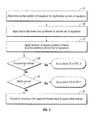
- FIG. 1 is a flowchart illustrating a first embodiment of the invention for deghosting marine seismic streamer data
- FIG. 2 is a flowchart illustrating an initial portion of a second embodiment of the invention for deghosting marine seismic streamer data
- FIG. 3 is a flowchart illustrating a final portion of a second embodiment of the invention for deghosting marine seismic streamer data, begun in FIG. 2 ;
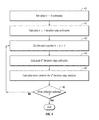
- FIG. 4 is a flowchart illustrating an embodiment of the invention for an iterative preconditioned conjugate gradient scheme used for deghosting marine seismic streamer data.
- One procedure for deghosting marine seismic data is to decompose seismic wavefields to yield an up-going wavefields component.
- One method for the decomposition of seismic wavefields into up-going and down-going wavefield components is to solve a Fourier-type system of equations in which the solution derives from an inversion of a system with a well-defined Fourier kernel.
- the invention will be illustrated as acting on the pressure wavefield p ( x , t ), typically detected by pressure sensors such as hydrophones, although the type of wavefield and the type of sensors employed is not a restriction of the invention.
- the invention may be employed with any type of appropriate seismic sensor and its detected wavefields.
- particle motion wavefields and particle motion sensors could be employed. Modifying the following equations to accommodate other wavefields is straight forward.
- the method of the invention employs a Laplace frequency parameter s that is a complex variable with both real and imaginary parts.
- the term "complex" will be used to designate that the Laplace frequency parameter has both real and imaginary parts, as in Equation (4).
- This complex Laplace frequency parameter s will be used in the Laplace and spectral domain transforms and in the deghosting equations of the invention, as discussed below.
- the real part ⁇ of the complex Laplace frequency parameter s may be a constant.
- the real part ⁇ may vary as a function of a combination such parameters as time, spatial location, or frequency.
- x 1 and x 2 are horizontal spatial coordinates, such as in-line and cross-line directions, respectively
- x 3 is a vertical spatial coordinate, such as depth.
- the invention is a method for deghosting marine seismic streamer data.
- the invention operates without any a priori knowledge of the subsurface.
- the deghosting operation is performed on the recorded data for every shot separately.
- the invention comprises a method for solving a system of deghosting equations. Solution of the system of equations is obtained using a preconditioned conjugate gradient iterative method.
- the preconditioner is based on the physics of the problem at hand, rather than the mathematics (as would be the conventional approach).
- the inverse of the horizontal streamer is employed, since a more general streamer can be treated as a perturbation of the simple regular horizontal streamer.
- the conventional deghosting method using the imaginary Laplace frequency parameter of Equation (3) can still become unstable at the notches in the frequency domain.
- the method of the invention employs the complex Laplace frequency parameter of Equation (4), which provides stability for the deghosting procedure.
- the wavefield decomposition can be applied over the full seismic bandwidth, even in the presence of spectral notches in the seismic data.
- the use of this complex Laplace frequency parameter is described in detail below in the discussion with reference to the flowchart in FIG. 2 .
- FIG. 1 is a flowchart illustrating a first embodiment of the invention for deghosting marine seismic streamer data.
- seismic data recorded from marine streamers are obtained, the seismic data representative of characteristics of subsurface earth formations and acquired by deployment of a plurality of seismic receivers overlying an area of the subsurface earth formations to be evaluated, the seismic receivers generating at least one of an electrical and optical signal in response to seismic energy.
- a complex Laplace frequency parameter is used to transform the seismic data from block 11 from a space-time domain to a spectral domain.
- an iterative conjugate gradient scheme using a physically-based preconditioner, is applied to the transformed seismic data, to provide a least squares solution to a normal set of equations for a deghosting system of equations.
- the seismic data from block 13 are inverse-transformed back to a space-time domain to provide deghosted seismic data.
- FIG. 2 is a flowchart illustrating an initial portion of a second embodiment of the invention for deghosting marine seismic streamer data. The final portion will be discussed below with reference to the flowchart in FIG. 3 .
- seismic data recorded with a marine streamer are obtained.
- the receiver data for each shot (seismic source activation) position, and for all recorded times t is taken as input seismic data.
- the receiver depth x 3 R x 3 R x 1 R ⁇ x 2 R is a single-valued function of the horizontal coordinates x 1 R and x 2 R .
- the streamers are not vertical, but not necessarily horizontal. Otherwise, the positions of the receivers is not intended to be a restriction on the invention.
- a real part ⁇ of the complex Laplace frequency parameter s in Equation (4) is determined.
- the real part ⁇ may be as expressed in the examples given in Equation (5) above, but the invention is not restricted to these examples.
- the stabilization of the inversion in the method of the invention can be varied to provide for further stabilization in solving the system of deghosting equations below.
- recorded seismic data for a shot are obtained from the seismic data obtained in block 21.
- the recorded seismic data for a shot from block 23 are temporally transformed from the space-time domain to the Laplace space-frequency domain.
- p sct is the scattered acoustic wavefield in the space-frequency domain
- x 1 , q R is an in-line receiver coordinate
- q is an in-line receiver number
- x 2 , r R is a cross-line receiver coordinate
- r is a cross-line receiver number, x 3 ,
- q , r R is receiver depth as a function of x 1 , q R and x 2 , r R , and using ⁇ , as determined in block 22 , as the real part of the complex Laplace frequency parameter s.
- This transform of the scattered wavefield p sct at the receiver locations is done for each shot position.
- the transformed seismic data for a frequency from block 25 are transformed from the Laplace space-frequency domain to a spectral domain.
- P n , m sct is the scattered acoustic wavefield in the spectral domain
- n is an in-line spectral number
- m is a cross-line spectral number
- ⁇ ⁇ x 1 R is in-line receiver sampling distance.
- ⁇ ⁇ x 2 R is cross-line receiver sampling distance
- js ⁇ n is an in-line spectral Fourier parameter
- ⁇ ( s ⁇ ) is in-line spectral sampling distance.
- js ⁇ m is a cross-line spectral Fourier parameter
- ⁇ ( s ⁇ ) is cross-line spectral sampling distance
- N is total number of in-line receivers
- M is total number of cross-line receivers.
- the complex Laplace frequency parameter s of the invention is also used in this transform to the spectral domain.
- a system of equations is determined for deghosting the transformed seismic data for a frequency from block 26.
- the system of equations will be defined using the Laplace frequency parameter s of the invention to provide for stability in solving the equations.
- this receiver position information is recorded.
- FIG. 3 is a flowchart illustrating a final portion of a second embodiment of the invention for deghosting marine seismic streamer data. The final portion continues the initial process discussed above with reference to the flowchart in FIG. 2 .
- a normal set of equations is determined from the set of deghosting equations in block 27 of FIG. 2 . Since the known vector p q , r sct is defined in the Laplace space-frequency domain and the unknown vector P n , m dgh is defined in the spectral domain, a least-squares solution in the space-frequency domain is employed in the embodiment of the invention. Both sides of Equation (10) are multiplied by the complex conjugate of the system matrix K q,r,n',m' and the results are summed over all values of the in-line and cross-line receiver numbers q and r , respectively.
- the invention provides a method for providing the solution of this linear set of normal equations in Equation (15) in a stable manner, even in the presence of spectral notches in the seismic data, by using a complex Laplace frequency parameter.
- the geometrical arrangement of the receiver positions is not a restriction of the invention.
- the invention applies to the simple case of regular horizontal streamers as well as to the general case of irregular non-horizontal streamers. The invention will be illustrated first for the simple case and then for the general case.
- the simple case of a conventional marine streamer considered as a strictly horizontal streamer configuration, is just a special case of the general case handled by the invention.
- the receiver depth position x 3 R is constant and the inversion of the system of equations reduces to the standard deghosting procedure.
- the system of equations can be solved by an inverse discrete Fourier transform.
- the deghosting for constant x 3 R can be carried out explicitly in the spectral domain.
- a very efficient iterative solver is a preconditioned conjugate gradient iterative method based on the minimization of the discrepancies between the measured data and the modelled response.
- the normal equations from block 31 are preconditioned with a physically-based preconditioner.
- a preconditioner is often used in conjugate gradient iterative methods to make the equations well-conditioned.
- Standard preconditioners such as multi-level ILU (Incomplete Lower Upper decomposition) types, for example, are usually based on the mathematical structure of the system matrix.
- ILU Incomplete Lower Upper decomposition
- these mathematics-based preconditioners are inefficient.
- a preconditioner is used which is based on the physics of the problem being solved, which is the general case of a streamer, discussed above.
- An irregular non-horizontal streamer can be considered as a perturbation of a regular horizontal streamer, so the inverse of the system matrix of an irregular non-horizontal streamer is approximated by the inverse of the system matrix of a regular horizontal streamer.
- the inverse of the system matrix of an equivalent horizontal streamer is taken as preconditioner. Note that if the streamer is horizontal, then the conjugate gradient iterative scheme terminates within a single iteration with this preconditioner.
- the preconditioner. P ⁇ n , m is a function of the complex Laplace frequency parameter s .
- a preconditioned conjugate gradient iterative scheme is applied to solve the system of equations in Equation (23), the preconditioned normal set of equations from block 32.
- an approximate value of the spectral deghosted wavefield P n dgh k is obtained with a residual error r q k .
- step 35 it is determined if any shots selected in block 23 of FIG. 2 remain. If shots remain, the process returns to block 23 of FIG. 2 . If no shots remain, then the process continues on to step 36. Hence, the solution by conjugate gradient iterations is repeated for each shot.
- the deghosted solutions from block 33 are transformed from the spectral domain back to the space-time domain.
- the deghosted wavefield p dgh is a function of the complex
- FIG. 4 is a flowchart illustrating an embodiment of the invention for an iterative preconditioned conjugate gradient scheme used for deghosting marine seismic streamer data. This is the scheme referred to in block 33 of FIG. 3 , above.
- different choices for the initial estimate of the conjugate gradient scheme may be used.
- the different choices can include, but are not limited to, the solution obtained for a previous frequency or the solution for a different shot position.
- the iteration counter k is increased by 1 .
- an estimate for iteration counter k is calculated, using estimates for iteration counter k - 1 .
- an error criterion is calculated for the current k th iteration estimate of the residual r q k from block 44 .
- this error criterion is: ⁇ q r q k 2 ⁇ q p q sct 2 ⁇ 10 - 3 .
- block 46 it is determined if the error criterion in block 45 is satisfied. If the error criterion is not satisfied, then the iterative process returns to block 43 to continue with another set of estimates. If the error criterion is satisfied, then the iterative process ends.
- the deghosting decomposition method of the invention can be reformulated into different domains, including, but not limited to, the frequency-slowness domain, or the tauslowness domain or the space-time domain.
- the invention has been discussed above as a method, for illustrative purposes only, but can also be implemented as a system.
- the system of the invention is preferably implemented by means of computers, in particular digital computers, along with other conventional data processing equipment.
- data processing equipment well known in the art, will comprise any appropriate combination or network of computer processing equipment, including, but not be limited to, hardware (processors, temporary and permanent storage devices, and any other appropriate computer processing equipment), software (operating systems, application programs, mathematics program libraries, and any other appropriate software), connections (electrical, optical, wireless, or otherwise), and peripherals (input and output devices such as keyboards, pointing devices, and scanners; display devices such as monitors and printers; computer readable storage media such as tapes, disks, and hard drives, and any other appropriate equipment).
- the invention could be implemented as the method described above, specifically carried out using a programmable computer to perform the method.
- the invention could be implemented as a computer program stored in a computer readable medium, with the program having logic operable to cause a programmable computer to perform the method described above.
- the invention could be implemented as a computer readable medium with a computer program stored on the medium, such that the program has logic operable to cause a programmable computer to perform the method described above.
Landscapes
- Life Sciences & Earth Sciences (AREA)
- Physics & Mathematics (AREA)
- Engineering & Computer Science (AREA)
- Remote Sensing (AREA)
- Acoustics & Sound (AREA)
- Environmental & Geological Engineering (AREA)
- Geology (AREA)
- General Life Sciences & Earth Sciences (AREA)
- General Physics & Mathematics (AREA)
- Geophysics (AREA)
- Oceanography (AREA)
- Geophysics And Detection Of Objects (AREA)
Applications Claiming Priority (1)
| Application Number | Priority Date | Filing Date | Title |
|---|---|---|---|
| US12/590,642 US8274858B2 (en) | 2009-11-12 | 2009-11-12 | Method for full-bandwidth deghosting of marine seismic streamer data |
Publications (3)
| Publication Number | Publication Date |
|---|---|
| EP2322956A2 true EP2322956A2 (de) | 2011-05-18 |
| EP2322956A3 EP2322956A3 (de) | 2012-10-03 |
| EP2322956B1 EP2322956B1 (de) | 2019-01-09 |
Family
ID=43618857
Family Applications (1)
| Application Number | Title | Priority Date | Filing Date |
|---|---|---|---|
| EP10190897.8A Active EP2322956B1 (de) | 2009-11-12 | 2010-11-11 | Verfahren zur Vollbandbreitenunterdrückung von Oberflächenreflexionen bei marinen seismischen Streamerdaten |
Country Status (11)
| Country | Link |
|---|---|
| US (1) | US8274858B2 (de) |
| EP (1) | EP2322956B1 (de) |
| CN (1) | CN102062874B (de) |
| AU (1) | AU2010238561B2 (de) |
| BR (1) | BRPI1004588B1 (de) |
| CA (1) | CA2719389C (de) |
| EA (1) | EA018531B1 (de) |
| EG (1) | EG26532A (de) |
| MX (1) | MX2010012428A (de) |
| MY (1) | MY155762A (de) |
| SG (1) | SG171524A1 (de) |
Families Citing this family (17)
| Publication number | Priority date | Publication date | Assignee | Title |
|---|---|---|---|---|
| US9025413B2 (en) * | 2009-12-07 | 2015-05-05 | Pgs Geophysical As | Method for full-bandwidth source deghosting of marine seismic streamer data |
| US10545252B2 (en) * | 2010-01-15 | 2020-01-28 | Westerngeco L.L.C. | Deghosting and interpolating seismic data |
| US9075159B2 (en) * | 2011-06-08 | 2015-07-07 | Chevron U.S.A., Inc. | System and method for seismic data inversion |
| RU2616650C2 (ru) * | 2012-02-03 | 2017-04-18 | Ион Джиофизикал Корпорейшн | Способ и устройство для обработки сейсмических данных |
| US9360576B2 (en) | 2012-04-27 | 2016-06-07 | Pgs Geophysical As | Methods and apparatus for generating deghosted seismic data |
| US20130329520A1 (en) | 2012-06-11 | 2013-12-12 | Pgs Geophysical As | Surface-Related Multiple Elimination For Depth-Varying Streamer |
| US9335430B2 (en) | 2012-07-18 | 2016-05-10 | Pgs Geophysical As | Wave field separation by mixed domain inversion |
| EP2909766B1 (de) * | 2012-10-18 | 2022-07-27 | Services Pétroliers Schlumberger | Deghosting von vermessungsdaten |
| US9405028B2 (en) | 2013-02-22 | 2016-08-02 | Ion Geophysical Corporation | Method and apparatus for multi-component datuming |
| US20140269185A1 (en) * | 2013-03-12 | 2014-09-18 | Westerngeco L.L.C. | Time-lapse monitoring |
| US9322944B2 (en) | 2013-03-15 | 2016-04-26 | Pgs Geophysical As | Wavefield regularization by 3-D wavefield decomposition for geophysical data |
| US10520623B2 (en) * | 2013-05-31 | 2019-12-31 | Westerngeco L.L.C. | Methods and systems for marine survey acquisition |
| CN106324675B (zh) * | 2016-10-09 | 2018-09-07 | 中国石油大学(华东) | 一种宽频地震波阻抗低频信息预测方法及系统 |
| US11892583B2 (en) * | 2019-07-10 | 2024-02-06 | Abu Dhabi National Oil Company | Onshore separated wave-field imaging |
| CN113703050B (zh) * | 2021-08-05 | 2022-06-17 | 青岛海洋地质研究所 | 一种深海地震垂直缆二次定位方法 |
| CN113671574B (zh) * | 2021-08-18 | 2024-04-26 | 西南石油大学 | 基于频域的最小二乘共轭梯度迭代的地震正演模拟方法 |
| CN121703901A (zh) * | 2024-09-20 | 2026-03-20 | 中国石油天然气集团有限公司 | 鬼波压制方法、电子设备、存储介质及程序产品 |
Family Cites Families (20)
| Publication number | Priority date | Publication date | Assignee | Title |
|---|---|---|---|---|
| SU411414A1 (de) | 1971-06-30 | 1974-01-15 | ||
| AU6224380A (en) | 1980-07-24 | 1982-02-16 | Fairfield Industries Inc. | High resolution, marine seismic stratigraphic system |
| SU1223345A1 (ru) | 1983-11-25 | 1986-04-07 | Предприятие П/Я Г-4115 | Цифровой интерполирующий фильтр |
| US4992992A (en) * | 1988-10-21 | 1991-02-12 | Western Atlas International, Inc. | Processing for seismic data from slanted cable |
| JPH0264261U (de) | 1988-11-04 | 1990-05-15 | ||
| US5724306A (en) | 1995-12-29 | 1998-03-03 | Western Atlas International, Inc. | Method for correcting dual sensor data for imperfect geophone coupling using production seismic data |
| US5818795A (en) | 1996-10-30 | 1998-10-06 | Pgs Tensor, Inc. | Method of reduction of noise from seismic data traces |
| DE29618996U1 (de) * | 1996-10-31 | 1997-02-13 | Bosch-Siemens Hausgeräte GmbH, 81669 München | Wärmeisolierendes Gehäuse für ein Haushalts- Kühl- oder Gefriergerät |
| US6094620A (en) | 1999-01-08 | 2000-07-25 | Exxonmobil Upstream Research Company | Method for identifying and removing multiples from seismic reflection data |
| US6477470B2 (en) * | 2000-12-01 | 2002-11-05 | Pgs Americas, Inc. | Method and system for deghosting |
| GB2384068B (en) * | 2002-01-11 | 2005-04-13 | Westerngeco Ltd | A method of and apparatus for processing seismic data |
| US7002350B1 (en) | 2003-11-19 | 2006-02-21 | Telluric Exploration, Llc | Marine oil and gas exploration system using telluric currents as a natural electromagnatic energy source |
| US6996471B2 (en) | 2003-12-02 | 2006-02-07 | Westerngeco, L.L.C. | Adding a signal to seismic data |
| US7423930B2 (en) | 2003-12-10 | 2008-09-09 | Schlumberger Technology Corporation | Methods and systems for detecting arrivals of interest |
| US7791980B2 (en) | 2004-05-21 | 2010-09-07 | Westerngeco L.L.C. | Interpolation and extrapolation method for seismic recordings |
| GB2415040B (en) | 2004-06-12 | 2007-03-21 | Westerngeco Ltd | Three-dimensional deghosting |
| US7526418B2 (en) | 2004-08-12 | 2009-04-28 | Saudi Arabian Oil Company | Highly-parallel, implicit compositional reservoir simulator for multi-million-cell models |
| US7372769B2 (en) | 2005-04-08 | 2008-05-13 | Western Geco L.L.C. | Method and apparatus for adaptive over/under combination of seismic data |
| US7986586B2 (en) * | 2008-04-08 | 2011-07-26 | Pgs Geophysical As | Method for deghosting marine seismic streamer data with irregular receiver positions |
| US9025413B2 (en) * | 2009-12-07 | 2015-05-05 | Pgs Geophysical As | Method for full-bandwidth source deghosting of marine seismic streamer data |
-
2009
- 2009-11-12 US US12/590,642 patent/US8274858B2/en active Active
-
2010
- 2010-10-19 SG SG201007716-2A patent/SG171524A1/en unknown
- 2010-10-28 MY MYPI2010005072A patent/MY155762A/en unknown
- 2010-10-29 CA CA2719389A patent/CA2719389C/en active Active
- 2010-10-29 AU AU2010238561A patent/AU2010238561B2/en active Active
- 2010-11-02 EG EG2010111849A patent/EG26532A/en active
- 2010-11-09 EA EA201001617A patent/EA018531B1/ru not_active IP Right Cessation
- 2010-11-11 EP EP10190897.8A patent/EP2322956B1/de active Active
- 2010-11-11 BR BRPI1004588-0A patent/BRPI1004588B1/pt active IP Right Grant
- 2010-11-12 MX MX2010012428A patent/MX2010012428A/es active IP Right Grant
- 2010-11-12 CN CN201010542363.XA patent/CN102062874B/zh not_active Expired - Fee Related
Non-Patent Citations (1)
| Title |
|---|
| None |
Also Published As
| Publication number | Publication date |
|---|---|
| CN102062874B (zh) | 2017-03-01 |
| US20110110189A1 (en) | 2011-05-12 |
| CA2719389A1 (en) | 2011-05-12 |
| EA201001617A1 (ru) | 2011-06-30 |
| AU2010238561B2 (en) | 2016-01-14 |
| CA2719389C (en) | 2017-08-22 |
| EP2322956B1 (de) | 2019-01-09 |
| MY155762A (en) | 2015-11-30 |
| SG171524A1 (en) | 2011-06-29 |
| EP2322956A3 (de) | 2012-10-03 |
| AU2010238561A1 (en) | 2011-05-26 |
| US8274858B2 (en) | 2012-09-25 |
| CN102062874A (zh) | 2011-05-18 |
| EA018531B1 (ru) | 2013-08-30 |
| BRPI1004588A2 (pt) | 2012-08-28 |
| BRPI1004588B1 (pt) | 2020-07-07 |
| EG26532A (en) | 2014-02-02 |
| MX2010012428A (es) | 2011-05-18 |
Similar Documents
| Publication | Publication Date | Title |
|---|---|---|
| EP2322956B1 (de) | Verfahren zur Vollbandbreitenunterdrückung von Oberflächenreflexionen bei marinen seismischen Streamerdaten | |
| EP2330443B1 (de) | Verfahren zur vollbandbreiten Unterdrückung von Oberflächenreflexionen bei marinen seismischen Streamerdaten | |
| US7986586B2 (en) | Method for deghosting marine seismic streamer data with irregular receiver positions | |
| US8339896B2 (en) | Method for separating seismic sources in marine seismic surveys | |
| US10989825B2 (en) | Method and system for determining source signatures after source ghost removal | |
| US9945972B2 (en) | Method and system for separating seismic sources in marine simultaneous shooting acquisition | |
| US9229123B2 (en) | Method for handling rough sea and irregular recording conditions in multi-sensor towed streamer data | |
| US7646672B2 (en) | Method for wavefield separation in 3D dual sensor towed streamer data with aliased energy in cross-streamer direction | |
| US9448317B2 (en) | Method for swell noise detection and attenuation in marine seismic surveys | |
| US8600680B2 (en) | Method for eliminating spectral constraints of acquisition system and earth filtering effects |
Legal Events
| Date | Code | Title | Description |
|---|---|---|---|
| PUAI | Public reference made under article 153(3) epc to a published international application that has entered the european phase |
Free format text: ORIGINAL CODE: 0009012 |
|
| AK | Designated contracting states |
Kind code of ref document: A2 Designated state(s): AL AT BE BG CH CY CZ DE DK EE ES FI FR GB GR HR HU IE IS IT LI LT LU LV MC MK MT NL NO PL PT RO RS SE SI SK SM TR |
|
| AX | Request for extension of the european patent |
Extension state: BA ME |
|
| PUAL | Search report despatched |
Free format text: ORIGINAL CODE: 0009013 |
|
| AK | Designated contracting states |
Kind code of ref document: A3 Designated state(s): AL AT BE BG CH CY CZ DE DK EE ES FI FR GB GR HR HU IE IS IT LI LT LU LV MC MK MT NL NO PL PT RO RS SE SI SK SM TR |
|
| AX | Request for extension of the european patent |
Extension state: BA ME |
|
| RIC1 | Information provided on ipc code assigned before grant |
Ipc: G01V 1/36 20060101AFI20120828BHEP |
|
| 17P | Request for examination filed |
Effective date: 20130318 |
|
| RAP1 | Party data changed (applicant data changed or rights of an application transferred) |
Owner name: PGS GEOPHYSICAL AS |
|
| REG | Reference to a national code |
Ref country code: DE Ref legal event code: R079 Ref document number: 602010056386 Country of ref document: DE Free format text: PREVIOUS MAIN CLASS: G01V0001360000 Ipc: G01V0001380000 |
|
| GRAP | Despatch of communication of intention to grant a patent |
Free format text: ORIGINAL CODE: EPIDOSNIGR1 |
|
| STAA | Information on the status of an ep patent application or granted ep patent |
Free format text: STATUS: GRANT OF PATENT IS INTENDED |
|
| RIC1 | Information provided on ipc code assigned before grant |
Ipc: G01V 1/36 20060101ALI20180531BHEP Ipc: G01V 1/38 20060101AFI20180531BHEP |
|
| INTG | Intention to grant announced |
Effective date: 20180629 |
|
| GRAS | Grant fee paid |
Free format text: ORIGINAL CODE: EPIDOSNIGR3 |
|
| GRAA | (expected) grant |
Free format text: ORIGINAL CODE: 0009210 |
|
| STAA | Information on the status of an ep patent application or granted ep patent |
Free format text: STATUS: THE PATENT HAS BEEN GRANTED |
|
| AK | Designated contracting states |
Kind code of ref document: B1 Designated state(s): AL AT BE BG CH CY CZ DE DK EE ES FI FR GB GR HR HU IE IS IT LI LT LU LV MC MK MT NL NO PL PT RO RS SE SI SK SM TR |
|
| REG | Reference to a national code |
Ref country code: GB Ref legal event code: FG4D |
|
| REG | Reference to a national code |
Ref country code: CH Ref legal event code: EP Ref country code: AT Ref legal event code: REF Ref document number: 1088004 Country of ref document: AT Kind code of ref document: T Effective date: 20190115 |
|
| REG | Reference to a national code |
Ref country code: DE Ref legal event code: R096 Ref document number: 602010056386 Country of ref document: DE |
|
| REG | Reference to a national code |
Ref country code: IE Ref legal event code: FG4D |
|
| REG | Reference to a national code |
Ref country code: NO Ref legal event code: T2 Effective date: 20190109 |
|
| REG | Reference to a national code |
Ref country code: NL Ref legal event code: MP Effective date: 20190109 |
|
| REG | Reference to a national code |
Ref country code: LT Ref legal event code: MG4D |
|
| PG25 | Lapsed in a contracting state [announced via postgrant information from national office to epo] |
Ref country code: NL Free format text: LAPSE BECAUSE OF FAILURE TO SUBMIT A TRANSLATION OF THE DESCRIPTION OR TO PAY THE FEE WITHIN THE PRESCRIBED TIME-LIMIT Effective date: 20190109 |
|
| REG | Reference to a national code |
Ref country code: AT Ref legal event code: MK05 Ref document number: 1088004 Country of ref document: AT Kind code of ref document: T Effective date: 20190109 |
|
| PG25 | Lapsed in a contracting state [announced via postgrant information from national office to epo] |
Ref country code: FI Free format text: LAPSE BECAUSE OF FAILURE TO SUBMIT A TRANSLATION OF THE DESCRIPTION OR TO PAY THE FEE WITHIN THE PRESCRIBED TIME-LIMIT Effective date: 20190109 Ref country code: LT Free format text: LAPSE BECAUSE OF FAILURE TO SUBMIT A TRANSLATION OF THE DESCRIPTION OR TO PAY THE FEE WITHIN THE PRESCRIBED TIME-LIMIT Effective date: 20190109 Ref country code: ES Free format text: LAPSE BECAUSE OF FAILURE TO SUBMIT A TRANSLATION OF THE DESCRIPTION OR TO PAY THE FEE WITHIN THE PRESCRIBED TIME-LIMIT Effective date: 20190109 Ref country code: PL Free format text: LAPSE BECAUSE OF FAILURE TO SUBMIT A TRANSLATION OF THE DESCRIPTION OR TO PAY THE FEE WITHIN THE PRESCRIBED TIME-LIMIT Effective date: 20190109 Ref country code: PT Free format text: LAPSE BECAUSE OF FAILURE TO SUBMIT A TRANSLATION OF THE DESCRIPTION OR TO PAY THE FEE WITHIN THE PRESCRIBED TIME-LIMIT Effective date: 20190509 Ref country code: SE Free format text: LAPSE BECAUSE OF FAILURE TO SUBMIT A TRANSLATION OF THE DESCRIPTION OR TO PAY THE FEE WITHIN THE PRESCRIBED TIME-LIMIT Effective date: 20190109 |
|
| PG25 | Lapsed in a contracting state [announced via postgrant information from national office to epo] |
Ref country code: HR Free format text: LAPSE BECAUSE OF FAILURE TO SUBMIT A TRANSLATION OF THE DESCRIPTION OR TO PAY THE FEE WITHIN THE PRESCRIBED TIME-LIMIT Effective date: 20190109 Ref country code: RS Free format text: LAPSE BECAUSE OF FAILURE TO SUBMIT A TRANSLATION OF THE DESCRIPTION OR TO PAY THE FEE WITHIN THE PRESCRIBED TIME-LIMIT Effective date: 20190109 Ref country code: LV Free format text: LAPSE BECAUSE OF FAILURE TO SUBMIT A TRANSLATION OF THE DESCRIPTION OR TO PAY THE FEE WITHIN THE PRESCRIBED TIME-LIMIT Effective date: 20190109 Ref country code: IS Free format text: LAPSE BECAUSE OF FAILURE TO SUBMIT A TRANSLATION OF THE DESCRIPTION OR TO PAY THE FEE WITHIN THE PRESCRIBED TIME-LIMIT Effective date: 20190509 Ref country code: BG Free format text: LAPSE BECAUSE OF FAILURE TO SUBMIT A TRANSLATION OF THE DESCRIPTION OR TO PAY THE FEE WITHIN THE PRESCRIBED TIME-LIMIT Effective date: 20190409 Ref country code: GR Free format text: LAPSE BECAUSE OF FAILURE TO SUBMIT A TRANSLATION OF THE DESCRIPTION OR TO PAY THE FEE WITHIN THE PRESCRIBED TIME-LIMIT Effective date: 20190410 |
|
| REG | Reference to a national code |
Ref country code: DE Ref legal event code: R097 Ref document number: 602010056386 Country of ref document: DE |
|
| PG25 | Lapsed in a contracting state [announced via postgrant information from national office to epo] |
Ref country code: EE Free format text: LAPSE BECAUSE OF FAILURE TO SUBMIT A TRANSLATION OF THE DESCRIPTION OR TO PAY THE FEE WITHIN THE PRESCRIBED TIME-LIMIT Effective date: 20190109 Ref country code: AT Free format text: LAPSE BECAUSE OF FAILURE TO SUBMIT A TRANSLATION OF THE DESCRIPTION OR TO PAY THE FEE WITHIN THE PRESCRIBED TIME-LIMIT Effective date: 20190109 Ref country code: CZ Free format text: LAPSE BECAUSE OF FAILURE TO SUBMIT A TRANSLATION OF THE DESCRIPTION OR TO PAY THE FEE WITHIN THE PRESCRIBED TIME-LIMIT Effective date: 20190109 Ref country code: RO Free format text: LAPSE BECAUSE OF FAILURE TO SUBMIT A TRANSLATION OF THE DESCRIPTION OR TO PAY THE FEE WITHIN THE PRESCRIBED TIME-LIMIT Effective date: 20190109 Ref country code: AL Free format text: LAPSE BECAUSE OF FAILURE TO SUBMIT A TRANSLATION OF THE DESCRIPTION OR TO PAY THE FEE WITHIN THE PRESCRIBED TIME-LIMIT Effective date: 20190109 Ref country code: SK Free format text: LAPSE BECAUSE OF FAILURE TO SUBMIT A TRANSLATION OF THE DESCRIPTION OR TO PAY THE FEE WITHIN THE PRESCRIBED TIME-LIMIT Effective date: 20190109 Ref country code: IT Free format text: LAPSE BECAUSE OF FAILURE TO SUBMIT A TRANSLATION OF THE DESCRIPTION OR TO PAY THE FEE WITHIN THE PRESCRIBED TIME-LIMIT Effective date: 20190109 Ref country code: DK Free format text: LAPSE BECAUSE OF FAILURE TO SUBMIT A TRANSLATION OF THE DESCRIPTION OR TO PAY THE FEE WITHIN THE PRESCRIBED TIME-LIMIT Effective date: 20190109 |
|
| PLBE | No opposition filed within time limit |
Free format text: ORIGINAL CODE: 0009261 |
|
| STAA | Information on the status of an ep patent application or granted ep patent |
Free format text: STATUS: NO OPPOSITION FILED WITHIN TIME LIMIT |
|
| PG25 | Lapsed in a contracting state [announced via postgrant information from national office to epo] |
Ref country code: SM Free format text: LAPSE BECAUSE OF FAILURE TO SUBMIT A TRANSLATION OF THE DESCRIPTION OR TO PAY THE FEE WITHIN THE PRESCRIBED TIME-LIMIT Effective date: 20190109 |
|
| 26N | No opposition filed |
Effective date: 20191010 |
|
| PG25 | Lapsed in a contracting state [announced via postgrant information from national office to epo] |
Ref country code: SI Free format text: LAPSE BECAUSE OF FAILURE TO SUBMIT A TRANSLATION OF THE DESCRIPTION OR TO PAY THE FEE WITHIN THE PRESCRIBED TIME-LIMIT Effective date: 20190109 |
|
| PG25 | Lapsed in a contracting state [announced via postgrant information from national office to epo] |
Ref country code: TR Free format text: LAPSE BECAUSE OF FAILURE TO SUBMIT A TRANSLATION OF THE DESCRIPTION OR TO PAY THE FEE WITHIN THE PRESCRIBED TIME-LIMIT Effective date: 20190109 |
|
| REG | Reference to a national code |
Ref country code: DE Ref legal event code: R119 Ref document number: 602010056386 Country of ref document: DE |
|
| REG | Reference to a national code |
Ref country code: CH Ref legal event code: PL |
|
| PG25 | Lapsed in a contracting state [announced via postgrant information from national office to epo] |
Ref country code: LI Free format text: LAPSE BECAUSE OF NON-PAYMENT OF DUE FEES Effective date: 20191130 Ref country code: MC Free format text: LAPSE BECAUSE OF FAILURE TO SUBMIT A TRANSLATION OF THE DESCRIPTION OR TO PAY THE FEE WITHIN THE PRESCRIBED TIME-LIMIT Effective date: 20190109 Ref country code: LU Free format text: LAPSE BECAUSE OF NON-PAYMENT OF DUE FEES Effective date: 20191111 Ref country code: CH Free format text: LAPSE BECAUSE OF NON-PAYMENT OF DUE FEES Effective date: 20191130 |
|
| REG | Reference to a national code |
Ref country code: BE Ref legal event code: MM Effective date: 20191130 |
|
| PG25 | Lapsed in a contracting state [announced via postgrant information from national office to epo] |
Ref country code: DE Free format text: LAPSE BECAUSE OF NON-PAYMENT OF DUE FEES Effective date: 20200603 Ref country code: FR Free format text: LAPSE BECAUSE OF NON-PAYMENT OF DUE FEES Effective date: 20191130 Ref country code: IE Free format text: LAPSE BECAUSE OF NON-PAYMENT OF DUE FEES Effective date: 20191111 |
|
| PG25 | Lapsed in a contracting state [announced via postgrant information from national office to epo] |
Ref country code: BE Free format text: LAPSE BECAUSE OF NON-PAYMENT OF DUE FEES Effective date: 20191130 |
|
| PG25 | Lapsed in a contracting state [announced via postgrant information from national office to epo] |
Ref country code: CY Free format text: LAPSE BECAUSE OF FAILURE TO SUBMIT A TRANSLATION OF THE DESCRIPTION OR TO PAY THE FEE WITHIN THE PRESCRIBED TIME-LIMIT Effective date: 20190109 |
|
| PG25 | Lapsed in a contracting state [announced via postgrant information from national office to epo] |
Ref country code: MT Free format text: LAPSE BECAUSE OF FAILURE TO SUBMIT A TRANSLATION OF THE DESCRIPTION OR TO PAY THE FEE WITHIN THE PRESCRIBED TIME-LIMIT Effective date: 20190109 Ref country code: HU Free format text: LAPSE BECAUSE OF FAILURE TO SUBMIT A TRANSLATION OF THE DESCRIPTION OR TO PAY THE FEE WITHIN THE PRESCRIBED TIME-LIMIT; INVALID AB INITIO Effective date: 20101111 |
|
| PG25 | Lapsed in a contracting state [announced via postgrant information from national office to epo] |
Ref country code: MK Free format text: LAPSE BECAUSE OF FAILURE TO SUBMIT A TRANSLATION OF THE DESCRIPTION OR TO PAY THE FEE WITHIN THE PRESCRIBED TIME-LIMIT Effective date: 20190109 |
|
| P01 | Opt-out of the competence of the unified patent court (upc) registered |
Effective date: 20230516 |
|
| PGFP | Annual fee paid to national office [announced via postgrant information from national office to epo] |
Ref country code: GB Payment date: 20250919 Year of fee payment: 16 |
|
| PGFP | Annual fee paid to national office [announced via postgrant information from national office to epo] |
Ref country code: NO Payment date: 20251020 Year of fee payment: 16 |