EP2323975B1 - Polycyclische antioxidantien mit antiabnutzungseigenschaften - Google Patents
Polycyclische antioxidantien mit antiabnutzungseigenschaften Download PDFInfo
- Publication number
- EP2323975B1 EP2323975B1 EP09790341.3A EP09790341A EP2323975B1 EP 2323975 B1 EP2323975 B1 EP 2323975B1 EP 09790341 A EP09790341 A EP 09790341A EP 2323975 B1 EP2323975 B1 EP 2323975B1
- Authority
- EP
- European Patent Office
- Prior art keywords
- tert
- composition
- compounds
- antioxidant
- oil
- Prior art date
- Legal status (The legal status is an assumption and is not a legal conclusion. Google has not performed a legal analysis and makes no representation as to the accuracy of the status listed.)
- Not-in-force
Links
Classifications
-
- C—CHEMISTRY; METALLURGY
- C10—PETROLEUM, GAS OR COKE INDUSTRIES; TECHNICAL GASES CONTAINING CARBON MONOXIDE; FUELS; LUBRICANTS; PEAT
- C10L—FUELS NOT OTHERWISE PROVIDED FOR; NATURAL GAS; SYNTHETIC NATURAL GAS OBTAINED BY PROCESSES NOT COVERED BY SUBCLASSES C10G OR C10K; LIQUIFIED PETROLEUM GAS; USE OF ADDITIVES TO FUELS OR FIRES; FIRE-LIGHTERS
- C10L1/00—Liquid carbonaceous fuels
- C10L1/10—Liquid carbonaceous fuels containing additives
- C10L1/14—Organic compounds
- C10L1/24—Organic compounds containing sulfur, selenium and/or tellurium
- C10L1/2406—Organic compounds containing sulfur, selenium and/or tellurium mercaptans; hydrocarbon sulfides
- C10L1/2412—Organic compounds containing sulfur, selenium and/or tellurium mercaptans; hydrocarbon sulfides sulfur bond to an aromatic radical
-
- C—CHEMISTRY; METALLURGY
- C07—ORGANIC CHEMISTRY
- C07C—ACYCLIC OR CARBOCYCLIC COMPOUNDS
- C07C323/00—Thiols, sulfides, hydropolysulfides or polysulfides substituted by halogen, oxygen or nitrogen atoms, or by sulfur atoms not being part of thio groups
- C07C323/10—Thiols, sulfides, hydropolysulfides or polysulfides substituted by halogen, oxygen or nitrogen atoms, or by sulfur atoms not being part of thio groups containing thio groups and singly-bound oxygen atoms bound to the same carbon skeleton
- C07C323/18—Thiols, sulfides, hydropolysulfides or polysulfides substituted by halogen, oxygen or nitrogen atoms, or by sulfur atoms not being part of thio groups containing thio groups and singly-bound oxygen atoms bound to the same carbon skeleton having the sulfur atom of at least one of the thio groups bound to a carbon atom of a six-membered aromatic ring of the carbon skeleton
-
- C—CHEMISTRY; METALLURGY
- C09—DYES; PAINTS; POLISHES; NATURAL RESINS; ADHESIVES; COMPOSITIONS NOT OTHERWISE PROVIDED FOR; APPLICATIONS OF MATERIALS NOT OTHERWISE PROVIDED FOR
- C09K—MATERIALS FOR MISCELLANEOUS APPLICATIONS, NOT PROVIDED FOR ELSEWHERE
- C09K15/00—Anti-oxidant compositions; Compositions inhibiting chemical change
- C09K15/04—Anti-oxidant compositions; Compositions inhibiting chemical change containing organic compounds
- C09K15/12—Anti-oxidant compositions; Compositions inhibiting chemical change containing organic compounds containing sulfur and oxygen
- C09K15/14—Anti-oxidant compositions; Compositions inhibiting chemical change containing organic compounds containing sulfur and oxygen containing a phenol or quinone moiety
-
- C—CHEMISTRY; METALLURGY
- C09—DYES; PAINTS; POLISHES; NATURAL RESINS; ADHESIVES; COMPOSITIONS NOT OTHERWISE PROVIDED FOR; APPLICATIONS OF MATERIALS NOT OTHERWISE PROVIDED FOR
- C09K—MATERIALS FOR MISCELLANEOUS APPLICATIONS, NOT PROVIDED FOR ELSEWHERE
- C09K15/00—Anti-oxidant compositions; Compositions inhibiting chemical change
- C09K15/04—Anti-oxidant compositions; Compositions inhibiting chemical change containing organic compounds
- C09K15/28—Anti-oxidant compositions; Compositions inhibiting chemical change containing organic compounds containing nitrogen, oxygen and sulfur
-
- C—CHEMISTRY; METALLURGY
- C10—PETROLEUM, GAS OR COKE INDUSTRIES; TECHNICAL GASES CONTAINING CARBON MONOXIDE; FUELS; LUBRICANTS; PEAT
- C10M—LUBRICATING COMPOSITIONS; USE OF CHEMICAL SUBSTANCES EITHER ALONE OR AS LUBRICATING INGREDIENTS IN A LUBRICATING COMPOSITION
- C10M135/00—Lubricating compositions characterised by the additive being an organic non-macromolecular compound containing sulfur, selenium or tellurium
- C10M135/20—Thiols; Sulfides; Polysulfides
- C10M135/28—Thiols; Sulfides; Polysulfides containing sulfur atoms bound to a carbon atom of a six-membered aromatic ring
- C10M135/30—Thiols; Sulfides; Polysulfides containing sulfur atoms bound to a carbon atom of a six-membered aromatic ring containing hydroxy groups; Derivatives thereof
-
- C—CHEMISTRY; METALLURGY
- C07—ORGANIC CHEMISTRY
- C07C—ACYCLIC OR CARBOCYCLIC COMPOUNDS
- C07C319/00—Preparation of thiols, sulfides, hydropolysulfides or polysulfides
- C07C319/14—Preparation of thiols, sulfides, hydropolysulfides or polysulfides of sulfides
- C07C319/20—Preparation of thiols, sulfides, hydropolysulfides or polysulfides of sulfides by reactions not involving the formation of sulfide groups
-
- C—CHEMISTRY; METALLURGY
- C07—ORGANIC CHEMISTRY
- C07C—ACYCLIC OR CARBOCYCLIC COMPOUNDS
- C07C319/00—Preparation of thiols, sulfides, hydropolysulfides or polysulfides
- C07C319/22—Preparation of thiols, sulfides, hydropolysulfides or polysulfides of hydropolysulfides or polysulfides
-
- C—CHEMISTRY; METALLURGY
- C10—PETROLEUM, GAS OR COKE INDUSTRIES; TECHNICAL GASES CONTAINING CARBON MONOXIDE; FUELS; LUBRICANTS; PEAT
- C10M—LUBRICATING COMPOSITIONS; USE OF CHEMICAL SUBSTANCES EITHER ALONE OR AS LUBRICATING INGREDIENTS IN A LUBRICATING COMPOSITION
- C10M2219/00—Organic non-macromolecular compounds containing sulfur, selenium or tellurium as ingredients in lubricant compositions
- C10M2219/08—Thiols; Sulfides; Polysulfides; Mercaptals
- C10M2219/082—Thiols; Sulfides; Polysulfides; Mercaptals containing sulfur atoms bound to acyclic or cycloaliphatic carbon atoms
- C10M2219/087—Thiols; Sulfides; Polysulfides; Mercaptals containing sulfur atoms bound to acyclic or cycloaliphatic carbon atoms containing hydroxy groups; Derivatives thereof, e.g. sulfurised phenols
-
- C—CHEMISTRY; METALLURGY
- C10—PETROLEUM, GAS OR COKE INDUSTRIES; TECHNICAL GASES CONTAINING CARBON MONOXIDE; FUELS; LUBRICANTS; PEAT
- C10N—INDEXING SCHEME ASSOCIATED WITH SUBCLASS C10M RELATING TO LUBRICATING COMPOSITIONS
- C10N2030/00—Specified physical or chemical properties which is improved by the additive characterising the lubricating composition, e.g. multifunctional additives
- C10N2030/04—Detergent property or dispersant property
-
- C—CHEMISTRY; METALLURGY
- C10—PETROLEUM, GAS OR COKE INDUSTRIES; TECHNICAL GASES CONTAINING CARBON MONOXIDE; FUELS; LUBRICANTS; PEAT
- C10N—INDEXING SCHEME ASSOCIATED WITH SUBCLASS C10M RELATING TO LUBRICATING COMPOSITIONS
- C10N2030/00—Specified physical or chemical properties which is improved by the additive characterising the lubricating composition, e.g. multifunctional additives
- C10N2030/10—Inhibition of oxidation, e.g. anti-oxidants
Definitions
- This invention relates to novel multi-ring compounds and product mixtures having antioxidant and antiwear properties, their preparation, and their uses.
- organic materials are susceptible to oxidative degradation in the presence of air or oxygen, especially when at elevated temperatures.
- organic materials include, for example, gasolines, diesel fuels, burner fuels, gas turbine and jet fuels, automatic transmission fluids, gear oils, engine lubricating oils, thermoplastic polymers, natural and synthetic rubber, and the like.
- gasolines, diesel fuels, burner fuels, gas turbine and jet fuels automatic transmission fluids, gear oils, engine lubricating oils, thermoplastic polymers, natural and synthetic rubber, and the like.
- This invention addresses the foregoing problems and needs.
- the present invention provides a composition which comprises organic material normally susceptible to oxidative degradation in the presence of air or oxygen with which material has been blended a multi-ring antioxidant product in an amount sufficient to inhibit such oxidative degradation, wherein the organic material is an oil of lubricating viscosity or a liquid fuel composition, and wherein the multi-ring antioxidant has the formula of or wherein:
- New compounds and new mixtures of compounds are described herein. These compounds and mixtures of compounds are multi-ring compounds comprising at least one sulfur-bridged aromatic hydrocarbon compound substituted on at least one of the aromatic rings thereof by at least one sterically
- the multi-ring sulfur-bonded aromatic compounds of this invention whether in the form of (i) individual isolated compounds, (ii) mixtures of two or more isolated individual compounds, or (iii) mixtures comprised of products formed by reaction of reactants (a) and (b) and which mixtures after work-up of the reaction product mixture contain no more than about 1 wt% of reaction solvent and catalyst residues, are often referred to hereinafter either as compound of this invention or compounds of this invention, depending upon the context.
- the compounds of this invention are deemed to be effective in inhibiting premature oxidative deterioration of substances normally susceptible to oxidative degradation over time during use or storage.
- these new multi-ring compounds are deemed to serve as antioxidants at elevated temperatures and to contribute antiwear properties to lubricants such as gear oils, transmission fluids, engine oils, and in general, to lubricants operating under friction-producing, heavy-duty, or extreme pressure conditions.
- This invention thus also provides lubricants and other substances normally susceptible to oxidative degradation in the presence of air or oxygen during use or storage, especially at elevated temperatures, with which have been blended or otherwise incorporated these new multi-ring compounds or products.
- Also provided by this invention is a process of blending antioxidant quantities and/or antiwear quantities of the compounds of this invention with substances normally susceptible to oxidative degradation over time, especially when at elevated temperatures, and more especially when operating under friction-producing or extreme pressure conditions.
- the compounds described herein can be produced by a process which comprises bringing together in a liquid reaction medium:
- reaction medium will of course be at a temperature at which formation of the desired compound or compounds of this invention occurs. Typically, temperatures in the range of about 20 to about 120°C are suitable.
- reactant (b) are 2,6-di-tert-butyl-4-methoxymethylphenol and 2,6-di-tert-butyl-4-acetoxyphenol (also called 3,5-di-tert-butyl-4-hydroxybenzylacetate) because of the ease with which they can be produced and the high yields of desired products achievable by their use.
- substituted diarylsulfide product mixtures will have up to about 4 such sterically hindered 3,5-di-tert-butylbenzyl moieties as ring substituents.
- the substituted diarylsulfide product mixtures as formed will typically comprise some unsubstituted diarylsulfides, some monosubstituted diarylsulfides, some disubstituted diarylsulfides, and some trisubstituted diarylsulfides, such substitution being made up of sterically hindered 3,5 -di-tert-butyl-4-hydroxybenzyl moieties. It is contemplated that some tetrasubstituted, some pentasubstituted, and some hexasubstituted diarylsulfides may be produced using excess amounts of compound b) and elevated temperatures during their synthesis.
- aromatic rings, R are preferably 6-membered benzene rings free of alkyl substitution.
- the compounds described herein when in the form of mixtures of two or more individual compounds of formula (I), which mixtures can be formed by mixing together isolated individual compounds of formula (I), can be in any proportions relative to each other.
- the individual components of the compounds can also be in varied proportions relative to each other.
- reactant (a) when using a suitably large molar excess of reactant (a), mixtures can be produced in which the amount of compound(s) of formula (I) substituted by one sterically hindered 3,5-di-tert-butyl-4-hydroxybenzyl moiety is the major product formed in the reaction.
- reactant (a) and (b) typically a mixture is formed in which mono-, di-, and trisubstitution by 3,5-di-tert-butyl-4-hydroxybenzyl moieties are the major components of the mixture and tetra-, penta-, and hexa-substitution by 3,5-di-tert-butyl-4-hydroxybenzyl are the minor components of the product mixture.
- oils of lubricating viscosity From the standpoint of usefulness as antioxidants and antiwear agents in oils of lubricating viscosity, compounds which are in the liquid state at one or more temperatures below 100°C are preferred, as they can be readily blended with the oils.
- Preferred compounds are those of formula (I) having a solubility in most organic solvents of at least 10 grams per liter at 25°C and that (i) is in the liquid state at 25°C, or (ii) is a solid at 25°C and has a melting point below about 100°C.
- Reactant (a) can be one or more diarylsulfides.
- Such compounds can be depicted by the formula: R-(S) n -R (III) wherein the R groups can be the same or different and are phenyl groups which can be either unsubstituted or substituted by one or more substituents selected from C 1-4 alkyl groups.
- n is a number which can be in the range of of 1 to 2, and still more preferably, n is 1.
- Mixtures of two or more arylsulfides of the above Formula (III) can be used in preparing the compounds.
- the arylsulfides for use in preparing the compounds of this invention described herein are diaryl monosulfides or diaryl disulfides in which the two aryl groups are two phenyl groups which may contain one or more C 1-4 alkyl and more preferably C 1-2 alkyl, and still more preferably, methyl substituents, with the proviso that at least one of the phenyl groups of such diarylsulfide reactant has at least one of its ring carbon atoms unsubstituted and sufficiently unhindered by adjacent substituents as to enable alkylation by reactant (b).
- Non-limiting examples of some of the various suitable diarylsulfides for use as reactant (a) include: diphenyl monosulfide; phenyl-2-methylphenyl monosulfide; phenyl-3-methylphenyl monosulfide; phenyl-4-methylphenyl monosulfide; phenyl-2-ethylphenylmono-sulfide; phenyl-3-ethylphenyl monosulfide; phenyl-4-ethylphenyl monosulfide; phenyl-4-butylphenylmono-sulfide; phenyl-2,6-dimethylphenyl monosulfide; bis(2-methylphenyl) monosulfide; bis(3-methylphenyl) monosulfide; bis(4-methylphenyl) monosulfide; bis(2-ethylphenyl)mono-sulfide; bis(3-ethyl
- each R is a phenyl group or a substituted phenyl group. More preferably, each R is an unsubstituted phenyl group.
- Mixtures of two or more poly(arylsulfides) of the above formula (IV) can be used in preparing compounds as described herein.
- At least 20-60% of the molecules of such a mixture will be substituted by at least one 3,5-di-tert-butyl-4-hydroxybenzyl substituent, and more preferably at least 20-40% will be substituted by one 3,5-di-tert-butyl-4-hydroxybenzyl substituent.
- Similar considerations apply to single substituted poly(arylsulfides) and mixtures of substituted poly(arylsulfides).
- substitution by at least one 3,5-di-tert-butyl-4-hydroxybenzyl substituent per molecule will provide some antioxidant and antiwear activity.
- At least 10-95% of the molecules of such a mixture will be substituted by at least one 3,5-di-tert-butyl-4-hydroxybenzyl substituent.
- at least 20-62% of the molecules of such a mixture will be substituted by at least one 3,5-di-tert-butyl-4-hydroxybenzyl substituent and more preferably by 20-40% of such a mixture will be substituted by at least one 3,5-di-tert-butyl-4-hydroxybenzyl substituent.
- sterically hindered compounds are:
- n is 1-2, and more preferably, 1; p is 1-4, more preferably 1-3, and still more preferably, 1-2; and q is, independently, 0-4, more preferably 0-3, and still more preferably 0-2.
- R and R' are substituents that can be the same or different from each other. Such substituents are selected from C 1-4 alkyl groups. Also, in the formulas for Compounds 2) and 3), m is 0-4 and preferably 0-3, and more preferably, 0-2; and n is, independently, 1-4, preferably 1-3, and more preferably 1-2.
- reaction 1 the first product formed in the reaction between the diphenyl monosulfide and the 2,6-2,6-di-tert-butyl-4-methoxymethylphenol depicts the formation of a product having a single 3,5-di-tert-butyl-4-hydroxybenzyl substituent bonded to one of the rings of the diphenyl monosulfide reactant as the major product.
- Reaction 2 illustrates the facts that the arylsulfide reactant can contain more than one sulfur atom in the bridge (in the case illustrated, the disulfide reactant is diphenyl disulfide) and that by use of appropriate proportions both phenyl groups of the diphenylsulfide reactant can be substituted by one or more 3,5-di-tert-butyl-4-hydroxybenzyl substituents.
- Reaction 3 illustrates that the diarylsulfide reactant can react with one or more of the hindered phenolic reactant (b) to produce product mixtures that contain at least mono-substituted, di-substituted, and tri-substituted diphenylsulfide.
- the composition of the final product depends largely upon the mole ratio of reactant (a) and (b) used.
- the compounds described herein can be produced by a process which comprises forming a liquid reaction medium from:
- reaction between reactants (a) and (b) is typically conducted in a reaction solvent.
- suitable solvents include halogenated solvents like dichloromethane, chloroform, and bromochloromethane, ketones like acetone and methyl ethyl ketone, hydrocarbons like toluene and xylene, alcohols like methanol and butanol and carboxylic acids like acetic acid and propanoic acid.
- Mineral acid catalysts such as sulfuric acid or phosphoric acid, or an organic acid such as alkylsulfonic acid, or a solid acid catalyst such as Amberlyst® catalyst or a zeolite is used to catalyze the reaction.
- the makeup of the product depends largely upon the ratio between the moles of reactant (b) to the number of reactive sites on reactant (a), which reactive sites will be readily apparent to one of ordinary skill in the art.
- Conventional work-up procedures can be used for separating and recovering purified product.
- the reaction product when in liquid or oily form, is freed of any solids by use of conventional liquid-solids separation procedures, such as centrifugation, filtration, or by dilution with a liquid diluent followed by liquid phase separation.
- the product can be washed one or more times with an aqueous washing solution or the reaction mixture can be introduced into a body of heated water in order to drive off the solvent and other volatile impurities that may be present.
- the solids are typically introduced into a large body of hot water in order to remove the entrapped solvent.
- the following procedure is used to determine the measurement of deposits and volatiles in a formulated oil using the TEOST MHT instrument test.
- the TEOST MHT instrument should be run according to the ASTM D 7097 method and manufacturer specifications.
- the test involves passing a thin film of test engine oil over a heated wire-wound depositor rod with the aide of a precision pump.
- a test rod is heated at 285°C and the test run for 24 hours.
- the thin film of oil moves evenly down the rod and is collected at the flow out point of the test assembly apparatus.
- Recovered oil is circulated back to the depositor rod via the precision pump.
- volatiles are produced that flash off the hot rod surface and condense on the glass mantle of the test assembly apparatus. These volatiles are recovered at the volatiles out port of the test assembly and are collected in a glass vial.
- deposits are determined by the increase in depositor rod weight and reported in milligrams (mg). The collected volatiles are accurately weighed and reported in grams (g).
- the method requires a number of independent calibrations, including for example, calibrating the air flow rate, the oil pump rate, the temperature controller settings, and the control thermocouple.
- the method also requires running certified reference oils periodically to determine the severity of the test. For example, a certified medium deposit reference oil should produce approximately 40-60 mg of deposits, while a certified high deposit reference oil should produce approximately 70-90 mg of deposits. It is understood that a severe test condition will usually produce heavier deposits and higher levels of volatiles. On the other hand, a mild test condition will usually produce lighter deposits and much lower levels of volatiles. Engine oils that perform well, i.e. low deposits and low volatiles, under a severe test condition are expected to perform even better under a mild test condition.
- a fully formulated oil (about 8-9 g) and antioxidant composition (about 0.06-0.12g) are added to a flask equipped with a Teflon stirring bar and stirred for 20-60 minutes without heating.
- the depositor rod, sample flask, oil inlet, air inlet, and volatiles collection vial are fitted to the TEOST apparatus according to manufacturers specifications.
- the pump is started at a high flow rate and run until the test oil reaches the connection of the pump and oil feed tube, at which point the pump flow is turned to zero.
- the heater switch is turned on and when the depositor rod temperature controller is between 200-210°C, the pump speed increased to achieve a sample delivery of 0.25 ⁇ 0.O2g/min, making sure that the oil is flowing down the depositor rod and is not leaking.
- the temperature is allowed to stabilize at 285 ⁇ 2°C and the test is run under these conditions for 24 hrs.
- test tubes are prepared with cyclohexane or another suitable hydrocarbon solvent for extraction of oil from the depositor rod.
- the test instrument is disassembled as per manufacturer's instructions and the depositor rod is transferred to a weighing boat and kept under cover.
- the depositor rod is placed successively for 10 minutes each in each of the three test tubes prepared with a hydrocarbon solvent.
- the rod is placed in tared weighing boat and allowed to sit for 10 minutes to insure evaporation of the hydrocarbon solvent.
- the rod and the boat are weighed, verifying that a constant mass has been achieved.
- the contents of the three test tubes, along with the lower-end cap deposits and glass mantle deposits are washed into a common container which is then filtered using a glass funnel equipped with a filter cartridge. After completing the filtering, the filter cartridge is dried under vacuum and weighed, until a constant mass is achieved. The total mass of the deposits from the depositor rod and filter deposits is then determined.
- the volatile compounds in the formulated oil that are there originally or those formed during the test are flashed off the depositor rod. These volatiles condense on the glass mantle and are collected on a continuous basis in a small, weighed vial. The vial and volatiles are measured at the end of the 24 hour test period and the amount of volatiles is calculated by subtracting the original weight of the vial.
- the antioxidant effectiveness of the compounds or composition of the invention was shown by use of a standardized oxidation induction test procedure (ASTM D 6186) in which a lubricating oil containing a specified amount of an additive is subjected to oxidation in a heated pressure-resistant vessel at a temperature of 160°C charged with oxygen under an initial elevated pressure of 500 psig.
- ASTM D 6186 standardized oxidation induction test procedure
- OIT induction time
- antioxidant compositions were blended with EHC 60 oil (a mineral base oil having a kinematic viscosity at 100°C of 6.1 cSt, a viscosity index of 114, and a Noack volatility of 8 wt%; ExxonMobil) and the resultant blend was subjected to the above oxidation induction test procedure.
- EHC 60 oil a mineral base oil having a kinematic viscosity at 100°C of 6.1 cSt, a viscosity index of 114, and a Noack volatility of 8 wt%; ExxonMobil
- the Oxidation Induction Time (OIT) determination for product of this Example was conducted as follows: Three lubricant formulations were prepared as by blending 0.25 wt%, 0.50 wt % and 0.75 wt% of the product of Example 1 in EHC 60 oil as described earlier. These blends were subjected to the test conditions of ASTM D 6186, except that a temperature of 160°C was used. The oxidation induction times were 78, 101, and 113 minutes, for 0.25 wt%, 0.50 wt%, and 0.75 wt% blends, respectively.
- Analysis of the crude showed unreacted diphenyl sulfide (9%), mono-substituted product (27%), di-substituted product (31%), tri-substituted product (8%), 4,4'-methylenebis(2,6-di-tert-butylphenol) (19%).
- PDSC showed OIT of 96 minutes (0.25 wt%), 110 minutes (0.5 wt%), and 126 minutes (0.75 wt%).
- the products formed in the above Examples comprised (a) diphenyl monosulfide substituted at least by one 3,5-di-tert-butyl-4-hydroxybenzyl moiety, (b) diphenyl monosulfide substituted by two 3,5-di-tert-butyl-4-hydroxybenzyl moieties, and (c) diphenyl monosulfide substituted by three 3,5-di-tert-butyl-4-hydroxybenzyl moieties and (d) diphenyl monosulfide substituted by more than three 3,5-di-tert-butyl-4-hydroxybenzyl moieties.
- 2,6-Di-tert-butyl-4-methoxymethylphenol (0.1 g) was dissolved in diphenyl disulfide (1 g) at room temperature under nitrogen. One drop of methanesulfonic acid was added and stirred at room temperature. Analysis showed more than 90% of the mono-substituted product.
- Diphenyl sulfide (0.1 mol, 18.6 g) and half of the total amount of 2,6-di-tert-butyl-4- methoxymethylphenol (0.25 mol, 69.4 g) to be used were mixed in acetic acid (180 g) at room temperature under nitrogen. Sulfuric acid (2.94 g, 98%) was added to the mixture at room temperature, and then the mixture was heated to 80°C. After one-half hour at these conditions, the rest of 2,6-di-tert-butyl-4-methoxymethylphenol was added and heating continued at 80°C for another 5.5 hours.
- the resulting orange glassy solid was analyzed by GPC, which showed 6.4% unreacted diphenyl sulfide, 24.5% mono-substituted, 36.2% di-substituted, 9.6% tri-substituted diphenyl sulfide, 3.3% of 4,4'-methylenebis(2,6-di-tert-butylphenol), and 18.8% of oligomeric unidentified products.
- TEOST-MHT Two lubricant formulations were prepared by blending 0.75 wt% and 1.25 wt% of product of Example 6 in a fully formulated base oil. These formulations were subjected to the test conditions described above. An average deposit of 49.0 mg and 43.9 mg were measured for 0.75 wt% and 1.25 wt% blends, respectively.
- the compounds of this invention can be utilized as antioxidants (oxidation inhibitors) for a wide variety of substrates normally susceptible to oxidative degradation over time, especially when exposed to elevated temperatures.
- the compounds of this invention can be utilized as multifunctional additives for lubricant compositions, in that the compounds of this invention can serve both as antioxidants and as antiwear agents.
- they are well suited for use as additives to natural and synthetic engine oils, gear oils, automatic transmission fluids, machine lubricants, and similar oils of lubricating viscosity which are subjected to extreme pressures during use.
- the compounds of this invention whether in the form of (i) individual isolated compounds, (ii) mixtures of two or more isolated individual compounds, or (iii) mixtures comprised of products formed by reaction of reactants (a) and (b) and which mixtures after work-up of the reaction product mixture contain no more than about 1 wt% of reaction solvent and catalyst residues -- can be made available for use or sale as "neat" compositions for use as an antioxidant in any organic substrate material normally susceptible to oxidative deterioration in the presence of air or oxygen.
- an antioxidant quantity of a compound of this invention can be blended with the substrate such as, for example, a lubricating oil; a liquid fuel; a thermoplastic polymer, resin or oligomer; or a natural or synthetic rubber or elastomer.
- Additive compositions of this invention constitute another way of protecting such organic material against premature oxidative deterioration in the presence of air or oxygen.
- one or more compounds of this invention whether in the form of (i) individual isolated compounds, (ii) mixtures of two or more isolated individual compounds, or (iii) mixtures comprised of products formed by reaction of reactants (a) and (b) and which mixtures after work-up of the reaction product mixture contain no more than about 1 wt% of reaction solvent and catalyst residues -- can be partially diluted or dissolved in a base oil or process oil, or can be blended with other components that are commonly used in a wide variety of lubricants.
- base oils examples include Group I, II, and III mineral oils, poly-alpha-olefins, synthetic esters, gas to liquid derived oils and bio-based oils.
- additives that may be used to produce new and useful lubricant additive blends with the compounds of this invention include, but are not limited to, dispersants, detergents, anti-wear additives, extreme pressure additives, corrosion inhibitors, rust inhibitors, friction modifiers, pour point depressants, viscosity index modifiers, emulsifiers, demulsifiers, seal swell agents, solubilizing agents, antifoam agents, acid scavengers, metal deactivators, and other antioxidants or stabilizers. Combinations of one or more of these components can be used to produce additive blends with one or more of the compounds of this invention.
- additive compositions for use in internal combustion engine oils, railroad and marine lubricants, natural gas engine oils, gas turbine oils, steam turbine oils, aviation turbine oils, rust and oxidation oils, hydraulic fluids, compressor fluids, slideway oils, quench oils, manual and automatic transmission fluids, gear oils, greases, etc. can be formed by blending one or more of the compounds of this invention with a diluent, solvent, or carrier fluid and/or one or more other suitable additives.
- the additive compositions of this invention adapted for use in oils can contain in the range of 5 wt% to 95 wt% based on the total weight of the antioxidant composition of an antioxidant product of this invention, the specific amount used depending upon such factors as the number and type of other components in the blend, and the use to which the blend is to be put.
- Finished lubricating oils of this invention will contain an antioxidant quantity of a compound of this invention, which amount typically is at least about 0.1 wt%, preferably at least about 1 wt%, and more preferably at least about 3 wt%, based on the total weight of the finished lubricating oil.
- the amount of the compound of this invention blended therein either as a sole additive or as an additive composition containing one or more other components will typically be no more than about 15 wt%, on the same basis.
- the lubricating oil used in these embodiments of the present invention can be mineral, synthetic, or a blend of mineral and/or synthetic lubricating oils. These oils are typical industrial or crankcase lubrication oils for gas or steam turbines, transmission or hydraulic fluids, spark-ignited and compression-ignited internal combustion engines, for example natural gas engines, automobile and truck engines, marine, and railroad diesel engines. Mineral lubricating oils can be refined from aromatic, asphaltic, naphthenic, paraffinic or mixed base crudes. The lubricating oils can be distillate or residual lubricating oils, such as for example, bright stock, or blends of the oils to give a finished base stock of desired properties.
- Synthetic base oils used can be (i) alkyl esters of dicarboxylic acids, polyglycols and alcohols, (ii) poly-alpha-olefins, including polybutenes, (iii) alkyl benzenes, (iv) organic esters of phosphoric acids, or (v) polysilicone oils.
- the base oil typically has a viscosity of about 2 to about 15 cSt and preferably about 2.5 to about 11 cSt at 100°C.
- Additive compositions adapted for use in forming liquid fuel compositions of this invention can be formed by blending therewith or providing therein an antioxidant quantity of one or more of the compounds of this invention in the form of an additive composition of this invention comprising at least one novel compound of this invention together with one or more other additives, such as detergents, carrier fluids, demulsifiers, corrosion inhibitors, metal deactivators, lubricity agents, pour point depressants, cetane or octane improvers, antiknock agents, anti-icing agents, etc.
- the substrate fuels can be derived from petroleum or can be synthetic fuels, or they can be blends of both such types of materials.
- the amount of these new compositions in an additive blend of this invention can vary from 5 wt% to 95 wt%, based on the total weight of the additive blend, depending on the type and number of other components in the blend.
- Liquid fuel compositions of this invention are typically formed by blending an antioxidant quantity of at least one of the compounds of this invention with the fuel, either as a single additive composition (i.e., containing no other type(s) of fuel additive) or as an additive concentrate comprised of at least one of the compounds of this invention together with at least one other type of fuel additive.
- the additive concentrates of this invention thus can contain in the range of about 5 to about 95 wt% of at least one of the compounds of this invention, with the balance to 100 wt% being one or more other additives and optionally, a diluent, solvent or carrier fluid, all based on the total weight of the additive concentrate.
- the finished fuel compositions typically contain an antioxidant quantity in the range of about 0.0001 to about 0.1 wt%, and preferably in the range of about 0.001 to about 0.05 wt% of at least one of the compounds of this invention, all based on the total weight of the finished fuel composition.
- the compounds of this invention may no longer exist in exactly the same composition and form as they were upon addition to such substrate fuel or oil. For example, they may interact with one or more of the other components in the fuel or oil and/or they may complex with or otherwise change by virtue of becoming dissolved in the substrate fuel or oil.
- the finished fuel or lubricant possess antioxidant properties because of the addition thereto of the one or more compounds of this invention, the possibility of such transformations upon dilution in the substrate matters not. What matters pursuant to this invention is that whatever is formed upon such dilution is effective as an antioxidant. Consequently, expressions such as "containing in the range of', "in”, etc. with reference to at least one of the compounds of this invention are to be understood as referring to the at least one of the compounds of this invention as it existed just prior to being blended or mixed with any liquid fuel or base oil and/or with any other component.
- the amount of the compounds of this invention in a finished lubricant will vary depending upon the lubricant type, the identity of the one or more compounds of this invention being used, and the desired level of performance required.
- levels of the product(s) of this invention often vary from about 0.05 to about 1.0 wt%, based on the total weight of the finished turbine oil.
- levels typically vary from about 0.2 to about 2 wt%, based on the total weight of the engine oil.
- levels may vary from about 0.3 to about 3 wt%, based on the total weight of the low phosphorus engine oil.
- phosphorus-free engine oils levels may be as high as about 4 or 5 wt%, based on the total weight of the phosphorus-free engine oil. It will be understood that all wt.% are based on the total weight of the finished oil containing all additives, etc. When used properly the compounds of this invention serve as antioxidant compositions.
- this invention also provides novel improved methods of reducing oxidation, reducing viscosity increase and polymerization, reducing acid formation and retaining lubricant basicity (TAN and TBN), reducing varnish and deposit formation, reducing friction and wear, reducing dependence on zinc dialkyldithiophosphate (ZDDP) and phosphorus for oxidation and deposit control, extending the usable life of all lubricant mentioned above, and reducing oil changes and vehicle maintenance.
- a lubricant composition of this invention comprising an oil of lubricating viscosity with which has been blended an antioxidant quantity of at least one novel compound of this invention is utilized as the lubricant.
- Still another method of this invention is a method of improving the oxidation stability of a lubricating oil, wherein said method comprises blending with a lubricating oil an oxidation stability improving amount of at least one compound of this invention. In this way the oxidation stability of the oil is significantly improved, as compared to the same oil devoid of a compound of this invention.
Landscapes
- Chemical & Material Sciences (AREA)
- Organic Chemistry (AREA)
- Engineering & Computer Science (AREA)
- Oil, Petroleum & Natural Gas (AREA)
- Materials Engineering (AREA)
- Chemical Kinetics & Catalysis (AREA)
- General Chemical & Material Sciences (AREA)
- Lubricants (AREA)
- Organic Low-Molecular-Weight Compounds And Preparation Thereof (AREA)
- Anti-Oxidant Or Stabilizer Compositions (AREA)
Claims (11)
- Zusammensetzung, die organisches Material umfasst, das normalerweise empfänglich gegenüber einem oxidativen Abbau in Gegenwart von Luft oder Sauerstoff ist, wobei mit diesem Material ein Antioxidationsprodukt mit mehreren Ringen in einer Menge vermischt wurde, die ausreichend ist, um einen solchen oxidativen Abbau zu hemmen, wobei das organische Material ein Öl mit schmierender Viskosität oder eine flüssige Kraftstoffzusammensetzung ist und wobei das Antioxidans mit mehreren Ringen die folgende Formel aufweist:

 R und R' aus Wasserstoff und C1-4-Alkyl ausgewählt sind;m = 0-4 ist; undn jeweils unabhängig 1-4 ist.
 - Zusammensetzung nach Anspruch 1, in der das Antioxidans die folgende Formel aufweist:
 worin R und R' aus Wasserstoff und C1-4-Alkyl ausgewählt sind;m = 0-4 ist; undn jeweils unabhängig 1-4 ist.
 - Zusammensetzung nach Anspruch 1, in der das Antioxidans die folgende Formel aufweist:
 worin R und R' aus Wasserstoff und C1-4-Alkyl ausgewählt sind;m = 0-4 ist; undn jeweils unabhängig 1-4 ist.
 - Zusammensetzung nach einem der Ansprüche 1-3, wobei m = 0-2 ist.
- Zusammensetzung nach einem der Ansprüche 1-4, wobei n = 1-2 ist.
- Zusammensetzung nach einem der Ansprüche 1-5, in der das Antioxidans bei einer oder mehreren Temperaturen unter 100 °C flüssig ist.
- Verfahren, das das Bilden einer Zusammensetzung nach Anspruch 1 umfasst, wobei das Verfahren das Zusammenbringen der folgenden Komponenten in einem flüssigen Reaktionsmedium umfasst:a) zumindest eine Verbindung der folgenden Formel:
 b) 2,6-Di-tert-butylphenol, das an der 4-Position eine Methoxymethylgruppe, eine Carboxymethylgruppe oder eine Hydroxymethylgruppe aufweist, um ein Antioxidationsprodukt mit mehreren Ringen zu bilden, gefolgt vom Mischen des Antioxidationsprodukts mit mehreren Ringen mit einem Öl mit schmierender Viskosität oder einer flüssigen Kraftstoffzusammensetzung.
 - Verfahren nach Anspruch 7, wobei das 2,6-Di-tert-butylphenol an der 4-Position eine Carboxymethylgruppe aufweist, wobei die Verbindung in situ unter Verwendung Essigsäure, enthaltend eine starke mineralische Säure in einer Menge von bis zu 10 Gew.-%, als flüssiges Reaktionsmedium und Zusetzen von 2,6-Di-tert-butyl-4-methoxymethylphenol zu dem flüssigen Reaktionsmedium gebildet wird.
- Zusammensetzung nach Anspruch 1, wobei das organische Material ein Öl mit schmierender Viskosität ist.
- Zusammensetzung nach Anspruch 1, wobei das organische Material eine flüssige Kraftstoffzusammensetzung ist.
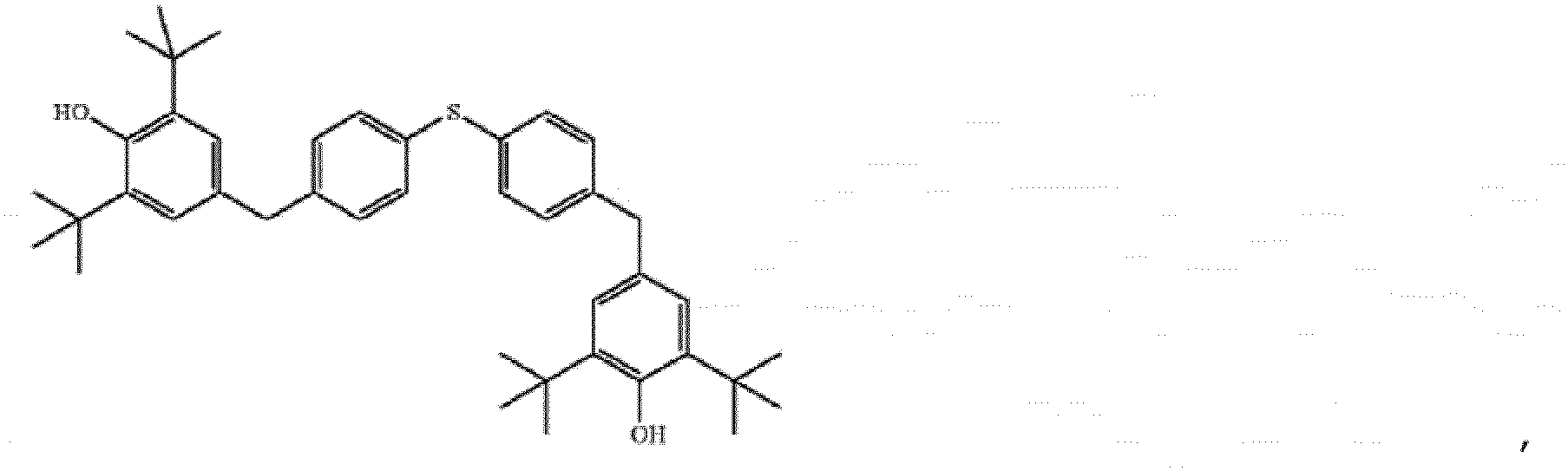
- Zusammensetzung nach Anspruch 1, wobei das Antioxidans mit mehreren Ringen die folgende Formel aufweist:


Applications Claiming Priority (2)
| Application Number | Priority Date | Filing Date | Title |
|---|---|---|---|
| US8244608P | 2008-07-21 | 2008-07-21 | |
| PCT/US2009/050410 WO2010011523A2 (en) | 2008-07-21 | 2009-07-13 | Multi-ring antioxidants with antiwear properties |
Publications (2)
| Publication Number | Publication Date |
|---|---|
| EP2323975A2 EP2323975A2 (de) | 2011-05-25 |
| EP2323975B1 true EP2323975B1 (de) | 2019-04-24 |
Family
ID=41327963
Family Applications (1)
| Application Number | Title | Priority Date | Filing Date |
|---|---|---|---|
| EP09790341.3A Not-in-force EP2323975B1 (de) | 2008-07-21 | 2009-07-13 | Polycyclische antioxidantien mit antiabnutzungseigenschaften |
Country Status (5)
| Country | Link |
|---|---|
| US (2) | US8580718B2 (de) |
| EP (1) | EP2323975B1 (de) |
| ES (1) | ES2730076T3 (de) |
| TW (1) | TWI466986B (de) |
| WO (1) | WO2010011523A2 (de) |
Families Citing this family (1)
| Publication number | Priority date | Publication date | Assignee | Title |
|---|---|---|---|---|
| CN116685663B (zh) | 2020-12-23 | 2025-07-25 | 路博润公司 | 作为润滑组合物的抗氧化剂的苯并氮杂䓬化合物 |
Citations (2)
| Publication number | Priority date | Publication date | Assignee | Title |
|---|---|---|---|---|
| SU391124A1 (ru) * | 1972-01-03 | 1973-07-25 | Способ получения пространственно-затрудненных гексафенолов | |
| EP0811631A2 (de) * | 1996-06-03 | 1997-12-10 | Ethyl Corporation | Schwefelhaltige phenolische Antioxidationszusammensetzung, Verfahren zu ihrer Herstellung, sowie sie enthaltende Erdölprodukten |
Family Cites Families (13)
| Publication number | Priority date | Publication date | Assignee | Title |
|---|---|---|---|---|
| BE626672A (de) * | 1961-12-30 | |||
| US3489804A (en) * | 1967-02-23 | 1970-01-13 | Uniroyal Inc | Sulfur containing bis-phenolic compounds |
| US3673091A (en) * | 1970-07-16 | 1972-06-27 | Shell Oil Co | Lubricants containing oxidation inhibitors |
| US3843614A (en) * | 1973-08-22 | 1974-10-22 | Dow Chemical Co | Aromatic polysulfide polymer |
| US4089790A (en) * | 1975-11-28 | 1978-05-16 | Chevron Research Company | Synergistic combinations of hydrated potassium borate, antiwear agents, and organic sulfide antioxidants |
| JPS6354424A (ja) | 1986-08-22 | 1988-03-08 | Sumitomo Chem Co Ltd | ポリフェニレンオキシドの製造方法 |
| DE3639374A1 (de) * | 1986-11-18 | 1988-05-19 | Huels Chemische Werke Ag | Ester von 3-tert.-butyl- bzw. 3-tert.-butyl-5-alkyl-4-hydroxyphenyl-(alkan)-carbonsaeuren mit oxethylaten von bis-(4- bzw. 2-hydroxyphenyl)-alkanen, -oxiden, -sulfiden und -sulfonen von tris-(4-hydroxyphenyl)-alkanen und von 1,3,5-tris-(4-hydroxyphenyl-isopropyliden)-arylen, verfahren zu ihrer herstellung und ihre verwendung als stabilisatoren |
| WO1990014396A1 (en) | 1989-05-23 | 1990-11-29 | Exxon Chemical Patents Inc. | Adhesive compositions containing low molecular weight polyphenylene oxides |
| US4946610A (en) * | 1989-08-03 | 1990-08-07 | Ethyl Petroleum Additives, Inc. | Sulfur-bridged phenolic antioxidants |
| WO1997044310A1 (fr) * | 1996-05-22 | 1997-11-27 | Yoshitomi Fine Chemicals, Ltd. | Nouveaux composes phenoliques et leur utlisation |
| JPH1097075A (ja) * | 1996-06-07 | 1998-04-14 | Fuji Photo Film Co Ltd | ポジ型フォトレジスト組成物 |
| US7704931B2 (en) * | 2004-12-10 | 2010-04-27 | Chemtura Corporation | Lubricant compositions stabilized with multiple antioxidants |
| JP4702294B2 (ja) | 2007-01-23 | 2011-06-15 | 三菱マテリアル株式会社 | パワーモジュール用基板の製造方法およびパワーモジュール用基板並びにパワーモジュール |
-
2009
- 2009-07-13 EP EP09790341.3A patent/EP2323975B1/de not_active Not-in-force
- 2009-07-13 ES ES09790341T patent/ES2730076T3/es active Active
- 2009-07-13 US US13/003,745 patent/US8580718B2/en not_active Expired - Fee Related
- 2009-07-13 WO PCT/US2009/050410 patent/WO2010011523A2/en not_active Ceased
- 2009-07-20 TW TW98124362A patent/TWI466986B/zh not_active IP Right Cessation
-
2013
- 2013-10-08 US US14/048,560 patent/US9796939B2/en not_active Expired - Fee Related
Patent Citations (2)
| Publication number | Priority date | Publication date | Assignee | Title |
|---|---|---|---|---|
| SU391124A1 (ru) * | 1972-01-03 | 1973-07-25 | Способ получения пространственно-затрудненных гексафенолов | |
| EP0811631A2 (de) * | 1996-06-03 | 1997-12-10 | Ethyl Corporation | Schwefelhaltige phenolische Antioxidationszusammensetzung, Verfahren zu ihrer Herstellung, sowie sie enthaltende Erdölprodukten |
Non-Patent Citations (2)
| Title |
|---|
| DATABASE WPI Derwent World Patents Index; AN 1974-34098V, "Novel sterically hindered hexaphenols - by boiling alkylene, thio-or dithio-bisphenols with 3,5-tert-butyl-4-hydroxybenzyl alcohol with p-toluenesulphonic acid as catalyst" * |
| R BENDA ET AL: "Synthetics Basics Polyalphaolefins -Base Fluids for High-Perform- ance Lubricants", JSL, 1 January 1996 (1996-01-01), pages 41 - 57, XP055292985, Retrieved from the Internet <URL:http://onlinelibrary.wiley.com/doi/10.1002/jsl.3000130105/pdf> [retrieved on 20160802] * |
Also Published As
| Publication number | Publication date |
|---|---|
| ES2730076T3 (es) | 2019-11-08 |
| TW201012901A (en) | 2010-04-01 |
| US9796939B2 (en) | 2017-10-24 |
| WO2010011523A2 (en) | 2010-01-28 |
| WO2010011523A3 (en) | 2010-04-15 |
| US20140038871A1 (en) | 2014-02-06 |
| TWI466986B (zh) | 2015-01-01 |
| EP2323975A2 (de) | 2011-05-25 |
| US20110124540A1 (en) | 2011-05-26 |
| US8580718B2 (en) | 2013-11-12 |
Similar Documents
| Publication | Publication Date | Title |
|---|---|---|
| EP2662351B1 (de) | Als Antioxidantien verwendbare alkylierte heterozyklische Reaktionsprodukte | |
| US4946610A (en) | Sulfur-bridged phenolic antioxidants | |
| KR101947437B1 (ko) | 트리틸화된 에테르 | |
| US9796939B2 (en) | Multi-ring antioxidants with antiwear properties | |
| KR940008391B1 (ko) | 내연기관용 윤활조성물 | |
| EP0909755A1 (de) | Mercapto-Derivate und ihre Anwendung als Antioxidationsadditive | |
| US5166439A (en) | Composition containing a mannich base of a partially sulfurized hindered phenol mixture | |
| US5004481A (en) | Fuel compositions containing sulfur-bridged phenolic antioxidants |
Legal Events
| Date | Code | Title | Description |
|---|---|---|---|
| PUAI | Public reference made under article 153(3) epc to a published international application that has entered the european phase |
Free format text: ORIGINAL CODE: 0009012 |
|
| 17P | Request for examination filed |
Effective date: 20110215 |
|
| AK | Designated contracting states |
Kind code of ref document: A2 Designated state(s): AT BE BG CH CY CZ DE DK EE ES FI FR GB GR HR HU IE IS IT LI LT LU LV MC MK MT NL NO PL PT RO SE SI SK SM TR |
|
| AX | Request for extension of the european patent |
Extension state: AL BA RS |
|
| DAX | Request for extension of the european patent (deleted) | ||
| RAP1 | Party data changed (applicant data changed or rights of an application transferred) |
Owner name: SI GROUP, INC. |
|
| 17Q | First examination report despatched |
Effective date: 20160809 |
|
| STAA | Information on the status of an ep patent application or granted ep patent |
Free format text: STATUS: EXAMINATION IS IN PROGRESS |
|
| GRAP | Despatch of communication of intention to grant a patent |
Free format text: ORIGINAL CODE: EPIDOSNIGR1 |
|
| STAA | Information on the status of an ep patent application or granted ep patent |
Free format text: STATUS: GRANT OF PATENT IS INTENDED |
|
| INTG | Intention to grant announced |
Effective date: 20181112 |
|
| GRAS | Grant fee paid |
Free format text: ORIGINAL CODE: EPIDOSNIGR3 |
|
| GRAA | (expected) grant |
Free format text: ORIGINAL CODE: 0009210 |
|
| STAA | Information on the status of an ep patent application or granted ep patent |
Free format text: STATUS: THE PATENT HAS BEEN GRANTED |
|
| AK | Designated contracting states |
Kind code of ref document: B1 Designated state(s): AT BE BG CH CY CZ DE DK EE ES FI FR GB GR HR HU IE IS IT LI LT LU LV MC MK MT NL NO PL PT RO SE SI SK SM TR |
|
| REG | Reference to a national code |
Ref country code: GB Ref legal event code: FG4D |
|
| REG | Reference to a national code |
Ref country code: CH Ref legal event code: EP |
|
| REG | Reference to a national code |
Ref country code: AT Ref legal event code: REF Ref document number: 1123970 Country of ref document: AT Kind code of ref document: T Effective date: 20190515 Ref country code: IE Ref legal event code: FG4D |
|
| REG | Reference to a national code |
Ref country code: DE Ref legal event code: R096 Ref document number: 602009058042 Country of ref document: DE |
|
| REG | Reference to a national code |
Ref country code: NL Ref legal event code: MP Effective date: 20190424 |
|
| REG | Reference to a national code |
Ref country code: LT Ref legal event code: MG4D |
|
| PG25 | Lapsed in a contracting state [announced via postgrant information from national office to epo] |
Ref country code: NL Free format text: LAPSE BECAUSE OF FAILURE TO SUBMIT A TRANSLATION OF THE DESCRIPTION OR TO PAY THE FEE WITHIN THE PRESCRIBED TIME-LIMIT Effective date: 20190424 |
|
| PG25 | Lapsed in a contracting state [announced via postgrant information from national office to epo] |
Ref country code: FI Free format text: LAPSE BECAUSE OF FAILURE TO SUBMIT A TRANSLATION OF THE DESCRIPTION OR TO PAY THE FEE WITHIN THE PRESCRIBED TIME-LIMIT Effective date: 20190424 Ref country code: NO Free format text: LAPSE BECAUSE OF FAILURE TO SUBMIT A TRANSLATION OF THE DESCRIPTION OR TO PAY THE FEE WITHIN THE PRESCRIBED TIME-LIMIT Effective date: 20190724 Ref country code: PT Free format text: LAPSE BECAUSE OF FAILURE TO SUBMIT A TRANSLATION OF THE DESCRIPTION OR TO PAY THE FEE WITHIN THE PRESCRIBED TIME-LIMIT Effective date: 20190824 Ref country code: SE Free format text: LAPSE BECAUSE OF FAILURE TO SUBMIT A TRANSLATION OF THE DESCRIPTION OR TO PAY THE FEE WITHIN THE PRESCRIBED TIME-LIMIT Effective date: 20190424 Ref country code: HR Free format text: LAPSE BECAUSE OF FAILURE TO SUBMIT A TRANSLATION OF THE DESCRIPTION OR TO PAY THE FEE WITHIN THE PRESCRIBED TIME-LIMIT Effective date: 20190424 Ref country code: LT Free format text: LAPSE BECAUSE OF FAILURE TO SUBMIT A TRANSLATION OF THE DESCRIPTION OR TO PAY THE FEE WITHIN THE PRESCRIBED TIME-LIMIT Effective date: 20190424 |
|
| PGFP | Annual fee paid to national office [announced via postgrant information from national office to epo] |
Ref country code: DE Payment date: 20190729 Year of fee payment: 11 Ref country code: ES Payment date: 20190801 Year of fee payment: 11 Ref country code: FR Payment date: 20190705 Year of fee payment: 11 |
|
| REG | Reference to a national code |
Ref country code: ES Ref legal event code: FG2A Ref document number: 2730076 Country of ref document: ES Kind code of ref document: T3 Effective date: 20191108 |
|
| PG25 | Lapsed in a contracting state [announced via postgrant information from national office to epo] |
Ref country code: BG Free format text: LAPSE BECAUSE OF FAILURE TO SUBMIT A TRANSLATION OF THE DESCRIPTION OR TO PAY THE FEE WITHIN THE PRESCRIBED TIME-LIMIT Effective date: 20190724 Ref country code: PL Free format text: LAPSE BECAUSE OF FAILURE TO SUBMIT A TRANSLATION OF THE DESCRIPTION OR TO PAY THE FEE WITHIN THE PRESCRIBED TIME-LIMIT Effective date: 20190424 Ref country code: GR Free format text: LAPSE BECAUSE OF FAILURE TO SUBMIT A TRANSLATION OF THE DESCRIPTION OR TO PAY THE FEE WITHIN THE PRESCRIBED TIME-LIMIT Effective date: 20190725 Ref country code: LV Free format text: LAPSE BECAUSE OF FAILURE TO SUBMIT A TRANSLATION OF THE DESCRIPTION OR TO PAY THE FEE WITHIN THE PRESCRIBED TIME-LIMIT Effective date: 20190424 |
|
| REG | Reference to a national code |
Ref country code: AT Ref legal event code: MK05 Ref document number: 1123970 Country of ref document: AT Kind code of ref document: T Effective date: 20190424 |
|
| PG25 | Lapsed in a contracting state [announced via postgrant information from national office to epo] |
Ref country code: IS Free format text: LAPSE BECAUSE OF FAILURE TO SUBMIT A TRANSLATION OF THE DESCRIPTION OR TO PAY THE FEE WITHIN THE PRESCRIBED TIME-LIMIT Effective date: 20190824 |
|
| PGFP | Annual fee paid to national office [announced via postgrant information from national office to epo] |
Ref country code: GB Payment date: 20190730 Year of fee payment: 11 |
|
| REG | Reference to a national code |
Ref country code: DE Ref legal event code: R097 Ref document number: 602009058042 Country of ref document: DE |
|
| PG25 | Lapsed in a contracting state [announced via postgrant information from national office to epo] |
Ref country code: CZ Free format text: LAPSE BECAUSE OF FAILURE TO SUBMIT A TRANSLATION OF THE DESCRIPTION OR TO PAY THE FEE WITHIN THE PRESCRIBED TIME-LIMIT Effective date: 20190424 Ref country code: RO Free format text: LAPSE BECAUSE OF FAILURE TO SUBMIT A TRANSLATION OF THE DESCRIPTION OR TO PAY THE FEE WITHIN THE PRESCRIBED TIME-LIMIT Effective date: 20190424 Ref country code: EE Free format text: LAPSE BECAUSE OF FAILURE TO SUBMIT A TRANSLATION OF THE DESCRIPTION OR TO PAY THE FEE WITHIN THE PRESCRIBED TIME-LIMIT Effective date: 20190424 Ref country code: AT Free format text: LAPSE BECAUSE OF FAILURE TO SUBMIT A TRANSLATION OF THE DESCRIPTION OR TO PAY THE FEE WITHIN THE PRESCRIBED TIME-LIMIT Effective date: 20190424 Ref country code: DK Free format text: LAPSE BECAUSE OF FAILURE TO SUBMIT A TRANSLATION OF THE DESCRIPTION OR TO PAY THE FEE WITHIN THE PRESCRIBED TIME-LIMIT Effective date: 20190424 Ref country code: SK Free format text: LAPSE BECAUSE OF FAILURE TO SUBMIT A TRANSLATION OF THE DESCRIPTION OR TO PAY THE FEE WITHIN THE PRESCRIBED TIME-LIMIT Effective date: 20190424 |
|
| PG25 | Lapsed in a contracting state [announced via postgrant information from national office to epo] |
Ref country code: SM Free format text: LAPSE BECAUSE OF FAILURE TO SUBMIT A TRANSLATION OF THE DESCRIPTION OR TO PAY THE FEE WITHIN THE PRESCRIBED TIME-LIMIT Effective date: 20190424 Ref country code: IT Free format text: LAPSE BECAUSE OF FAILURE TO SUBMIT A TRANSLATION OF THE DESCRIPTION OR TO PAY THE FEE WITHIN THE PRESCRIBED TIME-LIMIT Effective date: 20190424 Ref country code: MC Free format text: LAPSE BECAUSE OF FAILURE TO SUBMIT A TRANSLATION OF THE DESCRIPTION OR TO PAY THE FEE WITHIN THE PRESCRIBED TIME-LIMIT Effective date: 20190424 |
|
| PLBE | No opposition filed within time limit |
Free format text: ORIGINAL CODE: 0009261 |
|
| REG | Reference to a national code |
Ref country code: CH Ref legal event code: PL |
|
| STAA | Information on the status of an ep patent application or granted ep patent |
Free format text: STATUS: NO OPPOSITION FILED WITHIN TIME LIMIT |
|
| PG25 | Lapsed in a contracting state [announced via postgrant information from national office to epo] |
Ref country code: TR Free format text: LAPSE BECAUSE OF FAILURE TO SUBMIT A TRANSLATION OF THE DESCRIPTION OR TO PAY THE FEE WITHIN THE PRESCRIBED TIME-LIMIT Effective date: 20190424 |
|
| 26N | No opposition filed |
Effective date: 20200127 |
|
| REG | Reference to a national code |
Ref country code: BE Ref legal event code: MM Effective date: 20190731 |
|
| PG25 | Lapsed in a contracting state [announced via postgrant information from national office to epo] |
Ref country code: LU Free format text: LAPSE BECAUSE OF NON-PAYMENT OF DUE FEES Effective date: 20190713 Ref country code: SI Free format text: LAPSE BECAUSE OF FAILURE TO SUBMIT A TRANSLATION OF THE DESCRIPTION OR TO PAY THE FEE WITHIN THE PRESCRIBED TIME-LIMIT Effective date: 20190424 Ref country code: BE Free format text: LAPSE BECAUSE OF NON-PAYMENT OF DUE FEES Effective date: 20190731 Ref country code: LI Free format text: LAPSE BECAUSE OF NON-PAYMENT OF DUE FEES Effective date: 20190731 Ref country code: CH Free format text: LAPSE BECAUSE OF NON-PAYMENT OF DUE FEES Effective date: 20190731 |
|
| PG25 | Lapsed in a contracting state [announced via postgrant information from national office to epo] |
Ref country code: IE Free format text: LAPSE BECAUSE OF NON-PAYMENT OF DUE FEES Effective date: 20190713 |
|
| REG | Reference to a national code |
Ref country code: DE Ref legal event code: R119 Ref document number: 602009058042 Country of ref document: DE |
|
| GBPC | Gb: european patent ceased through non-payment of renewal fee |
Effective date: 20200713 |
|
| PG25 | Lapsed in a contracting state [announced via postgrant information from national office to epo] |
Ref country code: FR Free format text: LAPSE BECAUSE OF NON-PAYMENT OF DUE FEES Effective date: 20200731 Ref country code: GB Free format text: LAPSE BECAUSE OF NON-PAYMENT OF DUE FEES Effective date: 20200713 |
|
| PG25 | Lapsed in a contracting state [announced via postgrant information from national office to epo] |
Ref country code: DE Free format text: LAPSE BECAUSE OF NON-PAYMENT OF DUE FEES Effective date: 20210202 Ref country code: CY Free format text: LAPSE BECAUSE OF FAILURE TO SUBMIT A TRANSLATION OF THE DESCRIPTION OR TO PAY THE FEE WITHIN THE PRESCRIBED TIME-LIMIT Effective date: 20190424 |
|
| PG25 | Lapsed in a contracting state [announced via postgrant information from national office to epo] |
Ref country code: MT Free format text: LAPSE BECAUSE OF FAILURE TO SUBMIT A TRANSLATION OF THE DESCRIPTION OR TO PAY THE FEE WITHIN THE PRESCRIBED TIME-LIMIT Effective date: 20190424 Ref country code: HU Free format text: LAPSE BECAUSE OF FAILURE TO SUBMIT A TRANSLATION OF THE DESCRIPTION OR TO PAY THE FEE WITHIN THE PRESCRIBED TIME-LIMIT; INVALID AB INITIO Effective date: 20090713 |
|
| REG | Reference to a national code |
Ref country code: ES Ref legal event code: FD2A Effective date: 20211230 |
|
| PG25 | Lapsed in a contracting state [announced via postgrant information from national office to epo] |
Ref country code: ES Free format text: LAPSE BECAUSE OF NON-PAYMENT OF DUE FEES Effective date: 20200714 |
|
| PG25 | Lapsed in a contracting state [announced via postgrant information from national office to epo] |
Ref country code: MK Free format text: LAPSE BECAUSE OF FAILURE TO SUBMIT A TRANSLATION OF THE DESCRIPTION OR TO PAY THE FEE WITHIN THE PRESCRIBED TIME-LIMIT Effective date: 20190424 |
|
| P01 | Opt-out of the competence of the unified patent court (upc) registered |
Effective date: 20230511 |