EP2325876A2 - Formulations de résine époxy pour applications de sous-remplissage - Google Patents
Formulations de résine époxy pour applications de sous-remplissage Download PDFInfo
- Publication number
- EP2325876A2 EP2325876A2 EP10192039A EP10192039A EP2325876A2 EP 2325876 A2 EP2325876 A2 EP 2325876A2 EP 10192039 A EP10192039 A EP 10192039A EP 10192039 A EP10192039 A EP 10192039A EP 2325876 A2 EP2325876 A2 EP 2325876A2
- Authority
- EP
- European Patent Office
- Prior art keywords
- underfill
- composition
- present
- filler
- substrate
- Prior art date
- Legal status (The legal status is an assumption and is not a legal conclusion. Google has not performed a legal analysis and makes no representation as to the accuracy of the status listed.)
- Withdrawn
Links
Images
Classifications
-
- C—CHEMISTRY; METALLURGY
- C08—ORGANIC MACROMOLECULAR COMPOUNDS; THEIR PREPARATION OR CHEMICAL WORKING-UP; COMPOSITIONS BASED THEREON
- C08G—MACROMOLECULAR COMPOUNDS OBTAINED OTHERWISE THAN BY REACTIONS ONLY INVOLVING UNSATURATED CARBON-TO-CARBON BONDS
- C08G59/00—Polycondensates containing more than one epoxy group per molecule; Macromolecules obtained by polymerising compounds containing more than one epoxy group per molecule using curing agents or catalysts which react with the epoxy groups
- C08G59/02—Polycondensates containing more than one epoxy group per molecule
- C08G59/027—Polycondensates containing more than one epoxy group per molecule obtained by epoxidation of unsaturated precursor, e.g. polymer or monomer
-
- C—CHEMISTRY; METALLURGY
- C09—DYES; PAINTS; POLISHES; NATURAL RESINS; ADHESIVES; COMPOSITIONS NOT OTHERWISE PROVIDED FOR; APPLICATIONS OF MATERIALS NOT OTHERWISE PROVIDED FOR
- C09D—COATING COMPOSITIONS, e.g. PAINTS, VARNISHES OR LACQUERS; FILLING PASTES; CHEMICAL PAINT OR INK REMOVERS; INKS; CORRECTING FLUIDS; WOODSTAINS; PASTES OR SOLIDS FOR COLOURING OR PRINTING; USE OF MATERIALS THEREFOR
- C09D163/00—Coating compositions based on epoxy resins; Coating compositions based on derivatives of epoxy resins
-
- C—CHEMISTRY; METALLURGY
- C09—DYES; PAINTS; POLISHES; NATURAL RESINS; ADHESIVES; COMPOSITIONS NOT OTHERWISE PROVIDED FOR; APPLICATIONS OF MATERIALS NOT OTHERWISE PROVIDED FOR
- C09J—ADHESIVES; NON-MECHANICAL ASPECTS OF ADHESIVE PROCESSES IN GENERAL; ADHESIVE PROCESSES NOT PROVIDED FOR ELSEWHERE; USE OF MATERIALS AS ADHESIVES
- C09J163/00—Adhesives based on epoxy resins; Adhesives based on derivatives of epoxy resins
-
- H—ELECTRICITY
- H10—SEMICONDUCTOR DEVICES; ELECTRIC SOLID-STATE DEVICES NOT OTHERWISE PROVIDED FOR
- H10W—GENERIC PACKAGES, INTERCONNECTIONS, CONNECTORS OR OTHER CONSTRUCTIONAL DETAILS OF DEVICES COVERED BY CLASS H10
- H10W72/00—Interconnections or connectors in packages
- H10W72/071—Connecting or disconnecting
- H10W72/073—Connecting or disconnecting of die-attach connectors
-
- H—ELECTRICITY
- H10—SEMICONDUCTOR DEVICES; ELECTRIC SOLID-STATE DEVICES NOT OTHERWISE PROVIDED FOR
- H10W—GENERIC PACKAGES, INTERCONNECTIONS, CONNECTORS OR OTHER CONSTRUCTIONAL DETAILS OF DEVICES COVERED BY CLASS H10
- H10W74/00—Encapsulations, e.g. protective coatings
- H10W74/01—Manufacture or treatment
- H10W74/012—Manufacture or treatment of encapsulations on active surfaces of flip-chip devices, e.g. forming underfills
-
- H—ELECTRICITY
- H10—SEMICONDUCTOR DEVICES; ELECTRIC SOLID-STATE DEVICES NOT OTHERWISE PROVIDED FOR
- H10W—GENERIC PACKAGES, INTERCONNECTIONS, CONNECTORS OR OTHER CONSTRUCTIONAL DETAILS OF DEVICES COVERED BY CLASS H10
- H10W74/00—Encapsulations, e.g. protective coatings
- H10W74/10—Encapsulations, e.g. protective coatings characterised by their shape or disposition
- H10W74/15—Encapsulations, e.g. protective coatings characterised by their shape or disposition on active surfaces of flip-chip devices, e.g. underfills
-
- H—ELECTRICITY
- H10—SEMICONDUCTOR DEVICES; ELECTRIC SOLID-STATE DEVICES NOT OTHERWISE PROVIDED FOR
- H10W—GENERIC PACKAGES, INTERCONNECTIONS, CONNECTORS OR OTHER CONSTRUCTIONAL DETAILS OF DEVICES COVERED BY CLASS H10
- H10W74/00—Encapsulations, e.g. protective coatings
- H10W74/40—Encapsulations, e.g. protective coatings characterised by their materials
- H10W74/47—Encapsulations, e.g. protective coatings characterised by their materials comprising organic materials, e.g. plastics or resins
-
- H—ELECTRICITY
- H10—SEMICONDUCTOR DEVICES; ELECTRIC SOLID-STATE DEVICES NOT OTHERWISE PROVIDED FOR
- H10W—GENERIC PACKAGES, INTERCONNECTIONS, CONNECTORS OR OTHER CONSTRUCTIONAL DETAILS OF DEVICES COVERED BY CLASS H10
- H10W70/00—Package substrates; Interposers; Redistribution layers [RDL]
- H10W70/60—Insulating or insulated package substrates; Interposers; Redistribution layers
- H10W70/67—Insulating or insulated package substrates; Interposers; Redistribution layers characterised by their insulating layers or insulating parts
- H10W70/68—Shapes or dispositions thereof
- H10W70/681—Shapes or dispositions thereof comprising holes not having chips therein, e.g. for outgassing, underfilling or bond wire passage
-
- H—ELECTRICITY
- H10—SEMICONDUCTOR DEVICES; ELECTRIC SOLID-STATE DEVICES NOT OTHERWISE PROVIDED FOR
- H10W—GENERIC PACKAGES, INTERCONNECTIONS, CONNECTORS OR OTHER CONSTRUCTIONAL DETAILS OF DEVICES COVERED BY CLASS H10
- H10W72/00—Interconnections or connectors in packages
- H10W72/01—Manufacture or treatment
- H10W72/012—Manufacture or treatment of bump connectors, dummy bumps or thermal bumps
- H10W72/01221—Manufacture or treatment of bump connectors, dummy bumps or thermal bumps using local deposition
- H10W72/01223—Manufacture or treatment of bump connectors, dummy bumps or thermal bumps using local deposition in liquid form, e.g. by dispensing droplets or by screen printing
-
- H—ELECTRICITY
- H10—SEMICONDUCTOR DEVICES; ELECTRIC SOLID-STATE DEVICES NOT OTHERWISE PROVIDED FOR
- H10W—GENERIC PACKAGES, INTERCONNECTIONS, CONNECTORS OR OTHER CONSTRUCTIONAL DETAILS OF DEVICES COVERED BY CLASS H10
- H10W72/00—Interconnections or connectors in packages
- H10W72/01—Manufacture or treatment
- H10W72/012—Manufacture or treatment of bump connectors, dummy bumps or thermal bumps
- H10W72/01231—Manufacture or treatment of bump connectors, dummy bumps or thermal bumps using blanket deposition
- H10W72/01233—Manufacture or treatment of bump connectors, dummy bumps or thermal bumps using blanket deposition in liquid form, e.g. spin coating, spray coating or immersion coating
- H10W72/01235—Manufacture or treatment of bump connectors, dummy bumps or thermal bumps using blanket deposition in liquid form, e.g. spin coating, spray coating or immersion coating by plating, e.g. electroless plating or electroplating
-
- H—ELECTRICITY
- H10—SEMICONDUCTOR DEVICES; ELECTRIC SOLID-STATE DEVICES NOT OTHERWISE PROVIDED FOR
- H10W—GENERIC PACKAGES, INTERCONNECTIONS, CONNECTORS OR OTHER CONSTRUCTIONAL DETAILS OF DEVICES COVERED BY CLASS H10
- H10W72/00—Interconnections or connectors in packages
- H10W72/01—Manufacture or treatment
- H10W72/012—Manufacture or treatment of bump connectors, dummy bumps or thermal bumps
- H10W72/01251—Changing the shapes of bumps
- H10W72/01257—Changing the shapes of bumps by reflowing
-
- H—ELECTRICITY
- H10—SEMICONDUCTOR DEVICES; ELECTRIC SOLID-STATE DEVICES NOT OTHERWISE PROVIDED FOR
- H10W—GENERIC PACKAGES, INTERCONNECTIONS, CONNECTORS OR OTHER CONSTRUCTIONAL DETAILS OF DEVICES COVERED BY CLASS H10
- H10W72/00—Interconnections or connectors in packages
- H10W72/071—Connecting or disconnecting
- H10W72/072—Connecting or disconnecting of bump connectors
-
- H—ELECTRICITY
- H10—SEMICONDUCTOR DEVICES; ELECTRIC SOLID-STATE DEVICES NOT OTHERWISE PROVIDED FOR
- H10W—GENERIC PACKAGES, INTERCONNECTIONS, CONNECTORS OR OTHER CONSTRUCTIONAL DETAILS OF DEVICES COVERED BY CLASS H10
- H10W72/00—Interconnections or connectors in packages
- H10W72/071—Connecting or disconnecting
- H10W72/072—Connecting or disconnecting of bump connectors
- H10W72/07231—Techniques
- H10W72/07236—Soldering or alloying
-
- H—ELECTRICITY
- H10—SEMICONDUCTOR DEVICES; ELECTRIC SOLID-STATE DEVICES NOT OTHERWISE PROVIDED FOR
- H10W—GENERIC PACKAGES, INTERCONNECTIONS, CONNECTORS OR OTHER CONSTRUCTIONAL DETAILS OF DEVICES COVERED BY CLASS H10
- H10W72/00—Interconnections or connectors in packages
- H10W72/071—Connecting or disconnecting
- H10W72/073—Connecting or disconnecting of die-attach connectors
- H10W72/07331—Connecting techniques
- H10W72/07337—Connecting techniques using a polymer adhesive, e.g. an adhesive based on silicone or epoxy
- H10W72/07338—Connecting techniques using a polymer adhesive, e.g. an adhesive based on silicone or epoxy hardening the adhesive by curing, e.g. thermosetting
-
- H—ELECTRICITY
- H10—SEMICONDUCTOR DEVICES; ELECTRIC SOLID-STATE DEVICES NOT OTHERWISE PROVIDED FOR
- H10W—GENERIC PACKAGES, INTERCONNECTIONS, CONNECTORS OR OTHER CONSTRUCTIONAL DETAILS OF DEVICES COVERED BY CLASS H10
- H10W72/00—Interconnections or connectors in packages
- H10W72/071—Connecting or disconnecting
- H10W72/073—Connecting or disconnecting of die-attach connectors
- H10W72/07341—Controlling the bonding environment, e.g. atmosphere composition or temperature
-
- H—ELECTRICITY
- H10—SEMICONDUCTOR DEVICES; ELECTRIC SOLID-STATE DEVICES NOT OTHERWISE PROVIDED FOR
- H10W—GENERIC PACKAGES, INTERCONNECTIONS, CONNECTORS OR OTHER CONSTRUCTIONAL DETAILS OF DEVICES COVERED BY CLASS H10
- H10W72/00—Interconnections or connectors in packages
- H10W72/20—Bump connectors, e.g. solder bumps or copper pillars; Dummy bumps; Thermal bumps
- H10W72/221—Structures or relative sizes
- H10W72/222—Multilayered bumps, e.g. a coating on top and side surfaces of a bump core
-
- H—ELECTRICITY
- H10—SEMICONDUCTOR DEVICES; ELECTRIC SOLID-STATE DEVICES NOT OTHERWISE PROVIDED FOR
- H10W—GENERIC PACKAGES, INTERCONNECTIONS, CONNECTORS OR OTHER CONSTRUCTIONAL DETAILS OF DEVICES COVERED BY CLASS H10
- H10W72/00—Interconnections or connectors in packages
- H10W72/20—Bump connectors, e.g. solder bumps or copper pillars; Dummy bumps; Thermal bumps
- H10W72/221—Structures or relative sizes
- H10W72/225—Bumps having a filler embedded in a matrix
-
- H—ELECTRICITY
- H10—SEMICONDUCTOR DEVICES; ELECTRIC SOLID-STATE DEVICES NOT OTHERWISE PROVIDED FOR
- H10W—GENERIC PACKAGES, INTERCONNECTIONS, CONNECTORS OR OTHER CONSTRUCTIONAL DETAILS OF DEVICES COVERED BY CLASS H10
- H10W72/00—Interconnections or connectors in packages
- H10W72/20—Bump connectors, e.g. solder bumps or copper pillars; Dummy bumps; Thermal bumps
- H10W72/241—Dispositions, e.g. layouts
-
- H—ELECTRICITY
- H10—SEMICONDUCTOR DEVICES; ELECTRIC SOLID-STATE DEVICES NOT OTHERWISE PROVIDED FOR
- H10W—GENERIC PACKAGES, INTERCONNECTIONS, CONNECTORS OR OTHER CONSTRUCTIONAL DETAILS OF DEVICES COVERED BY CLASS H10
- H10W72/00—Interconnections or connectors in packages
- H10W72/20—Bump connectors, e.g. solder bumps or copper pillars; Dummy bumps; Thermal bumps
- H10W72/251—Materials
- H10W72/252—Materials comprising solid metals or solid metalloids, e.g. PbSn, Ag or Cu
-
- H—ELECTRICITY
- H10—SEMICONDUCTOR DEVICES; ELECTRIC SOLID-STATE DEVICES NOT OTHERWISE PROVIDED FOR
- H10W—GENERIC PACKAGES, INTERCONNECTIONS, CONNECTORS OR OTHER CONSTRUCTIONAL DETAILS OF DEVICES COVERED BY CLASS H10
- H10W72/00—Interconnections or connectors in packages
- H10W72/20—Bump connectors, e.g. solder bumps or copper pillars; Dummy bumps; Thermal bumps
- H10W72/251—Materials
- H10W72/253—Materials not comprising solid metals or solid metalloids, e.g. polymers or ceramics
-
- H—ELECTRICITY
- H10—SEMICONDUCTOR DEVICES; ELECTRIC SOLID-STATE DEVICES NOT OTHERWISE PROVIDED FOR
- H10W—GENERIC PACKAGES, INTERCONNECTIONS, CONNECTORS OR OTHER CONSTRUCTIONAL DETAILS OF DEVICES COVERED BY CLASS H10
- H10W72/00—Interconnections or connectors in packages
- H10W72/20—Bump connectors, e.g. solder bumps or copper pillars; Dummy bumps; Thermal bumps
- H10W72/29—Bond pads specially adapted therefor
-
- H—ELECTRICITY
- H10—SEMICONDUCTOR DEVICES; ELECTRIC SOLID-STATE DEVICES NOT OTHERWISE PROVIDED FOR
- H10W—GENERIC PACKAGES, INTERCONNECTIONS, CONNECTORS OR OTHER CONSTRUCTIONAL DETAILS OF DEVICES COVERED BY CLASS H10
- H10W72/00—Interconnections or connectors in packages
- H10W72/30—Die-attach connectors
- H10W72/321—Structures or relative sizes of die-attach connectors
- H10W72/325—Die-attach connectors having a filler embedded in a matrix
-
- H—ELECTRICITY
- H10—SEMICONDUCTOR DEVICES; ELECTRIC SOLID-STATE DEVICES NOT OTHERWISE PROVIDED FOR
- H10W—GENERIC PACKAGES, INTERCONNECTIONS, CONNECTORS OR OTHER CONSTRUCTIONAL DETAILS OF DEVICES COVERED BY CLASS H10
- H10W72/00—Interconnections or connectors in packages
- H10W72/30—Die-attach connectors
- H10W72/351—Materials of die-attach connectors
-
- H—ELECTRICITY
- H10—SEMICONDUCTOR DEVICES; ELECTRIC SOLID-STATE DEVICES NOT OTHERWISE PROVIDED FOR
- H10W—GENERIC PACKAGES, INTERCONNECTIONS, CONNECTORS OR OTHER CONSTRUCTIONAL DETAILS OF DEVICES COVERED BY CLASS H10
- H10W72/00—Interconnections or connectors in packages
- H10W72/30—Die-attach connectors
- H10W72/351—Materials of die-attach connectors
- H10W72/353—Materials of die-attach connectors not comprising solid metals or solid metalloids, e.g. ceramics
-
- H—ELECTRICITY
- H10—SEMICONDUCTOR DEVICES; ELECTRIC SOLID-STATE DEVICES NOT OTHERWISE PROVIDED FOR
- H10W—GENERIC PACKAGES, INTERCONNECTIONS, CONNECTORS OR OTHER CONSTRUCTIONAL DETAILS OF DEVICES COVERED BY CLASS H10
- H10W72/00—Interconnections or connectors in packages
- H10W72/30—Die-attach connectors
- H10W72/351—Materials of die-attach connectors
- H10W72/353—Materials of die-attach connectors not comprising solid metals or solid metalloids, e.g. ceramics
- H10W72/354—Materials of die-attach connectors not comprising solid metals or solid metalloids, e.g. ceramics comprising polymers
-
- H—ELECTRICITY
- H10—SEMICONDUCTOR DEVICES; ELECTRIC SOLID-STATE DEVICES NOT OTHERWISE PROVIDED FOR
- H10W—GENERIC PACKAGES, INTERCONNECTIONS, CONNECTORS OR OTHER CONSTRUCTIONAL DETAILS OF DEVICES COVERED BY CLASS H10
- H10W72/00—Interconnections or connectors in packages
- H10W72/90—Bond pads, in general
- H10W72/951—Materials of bond pads
- H10W72/952—Materials of bond pads comprising metals or metalloids, e.g. PbSn, Ag or Cu
-
- H—ELECTRICITY
- H10—SEMICONDUCTOR DEVICES; ELECTRIC SOLID-STATE DEVICES NOT OTHERWISE PROVIDED FOR
- H10W—GENERIC PACKAGES, INTERCONNECTIONS, CONNECTORS OR OTHER CONSTRUCTIONAL DETAILS OF DEVICES COVERED BY CLASS H10
- H10W90/00—Package configurations
- H10W90/701—Package configurations characterised by the relative positions of pads or connectors relative to package parts
- H10W90/721—Package configurations characterised by the relative positions of pads or connectors relative to package parts of bump connectors
- H10W90/724—Package configurations characterised by the relative positions of pads or connectors relative to package parts of bump connectors between a chip and a stacked insulating package substrate, interposer or RDL
-
- H—ELECTRICITY
- H10—SEMICONDUCTOR DEVICES; ELECTRIC SOLID-STATE DEVICES NOT OTHERWISE PROVIDED FOR
- H10W—GENERIC PACKAGES, INTERCONNECTIONS, CONNECTORS OR OTHER CONSTRUCTIONAL DETAILS OF DEVICES COVERED BY CLASS H10
- H10W90/00—Package configurations
- H10W90/701—Package configurations characterised by the relative positions of pads or connectors relative to package parts
- H10W90/731—Package configurations characterised by the relative positions of pads or connectors relative to package parts of die-attach connectors
- H10W90/734—Package configurations characterised by the relative positions of pads or connectors relative to package parts of die-attach connectors between a chip and a stacked insulating package substrate, interposer or RDL
Definitions
- the present invention relates to epoxy resin formulations useful for the manufacture of semiconductor electronic packaging materials, and more specifically, capillary underfill encapsulants.
- Epoxy resins are commonly used in the electronics industry for making semiconductor packaging materials.
- Current epoxy resin formulations used in semiconductor packaging materials include, for example, high purity diglycidyl ether of bisphenol F or diglycidyl ether of bisphenol A along with high performance or multifunctional resins such as the digylcidyl ether of naphthalene diol or the triepoxide of para-aminophenol.
- the known epoxy resins suffer from balancing key attributes required for acceptable processability and downstream reliability.
- These attributes include viscosity, total chloride content, filler loading (for coefficient of thermal expansion (CTE) and modulus modification), adhesion, flux compatibility, toughness, dispense-ability, flow, and package level reliability performance including preconditioning, temperature cycle or shock, highly accelerated stress testing (HAST).
- CTE coefficient of thermal expansion
- HAST highly accelerated stress testing
- Typical capillary underfill formulations incorporate the digycidyl ethers of bisphenol A or bisphenol F along with modifiers to improve the thermomechanical properties, such as the glass transition temperature (Tg), of the cured system.
- Tg glass transition temperature
- U.S. Patent No. 7,482,201 teaches the use of Epon® 862 and Epon® 828 (Hexion Specialty Chemicals), along with Araldite® MY-0510 (Huntsman Advanced Materials) for nano-filled underfill encapsulants.
- the Epon® 862 is a bisphenol F based epoxy resin.
- the Epon® 828 is a bisphenol A based epoxy resin
- the Araldite® MY-0510 is 4-(oxiran-2-ylmethoxy)-N,N-bis(oxiran-2-ylmethyl)aniline.
- U.S. Patent No. 7,279,223 discloses a number of aliphatic, cycloaliphatic, and aromatic epoxy resins. The use of conventional cycloaliphatic resins with low to no chloride content is limited by suitable curing chemistries which are primarily anhydride or Lewis acid hardeners.
- U.S. Patent No. 7,351,784 teaches the use of cycloaliphatic amines and carbenes for capillary and no flow underfill formulations. Specific aliphatic amine structures cited are 4-(2-aminopropan-2-yl)-l-methylcyclohexanamine and 4,4'-methylenebis(2-methylcyclohexanamine).
- epoxy resins are manufactured utilizing epichlorohydrin which is reacted with the phenolic hydroxyl group, or in the case of an aromatic amine, with the amino group resulting in the epoxy resin. During the coupling process, incomplete ring closure can occur resulting in bound or hydrolyzable chloride.
- the hydrolyzable chloride content of the resin can have negative impact on the performance of the device or component during reliability testing, especially high humidity and high temperature testing such as pressure cooker exposure (PCT) 121 °C / 15 psi steam.
- PCT pressure cooker exposure
- the hydrolyzable chloride can be extracted from the cured polymer and form highly acidic species causing corrosion within the device. Therefore, base resins that are useful in underfill applications and that do not use epichlorohydrin or other halogenated reactants to manufacture the epoxy resin are highly desirable.
- an electronic packaging material for capillary underfill that is a highly filled material with low viscosity and improved thermomechanical properties (CTE, Tg, modulus, and in some cases, thermal conductivity) as compared to conventional underfill materials.
- Such material should preferably have improved processability and downstream package reliability. Further, such materials should have a total chloride content of less than 100 ppm, and more preferably less than 5 ppm.
- one objective of the present invention is to develop epoxy underfill compositions with low viscosity even when they contain a relatively high level of filler, and which can be cured with a wide range of epoxy curing agents. It is preferred that such underfill compositions have very low to no total chloride content.
- One embodiment of the present invention is directed to an epoxy resin formulation for the manufacture of electronic packaging materials such as semiconductor packaging materials, more specifically capillary underfill encapsulants comprising a divinylarene dioxide, such as 1,4-di(oxiran-2-yl)benzene / 1,3-di(oxiran-2-yl)benzene (collectively divinylbenzene dioxide or DVBDO), as one component in the formulation.
- a divinylarene dioxide such as 1,4-di(oxiran-2-yl)benzene / 1,3-di(oxiran-2-yl)benzene (collectively divinylbenzene dioxide or DVBDO)
- DVBDO divinylbenzene dioxide
- the utilization of DVBDO enables a unique combination of material properties for both improved processability and downstream reliability performance, which are unable to be achieved with current state of the technology monomers and epoxy formulation strategies.
- This invention provides a method of making an electrical assembly including providing an electronic component and a substrate, wherein one of the electronic component and the substrate has a plurality of solder bumps and the other has a plurality of electrical bonding pads, electrically connecting the electronic component and the substrate, forming an underfill composition between the electronic component and the substrate, and curing the underfill composition, wherein the underfill composition includes a divinylarene diepoxide.
- the use of the divinylarene dioxide, such as divinylbenzene dioxide, resin enables high filler loading, high Tg values, and very low to no total chloride contamination imparted by the resin.
- divinylarene dioxide resin enables a number of different hardeners to be used, unlike conventional low viscosity cycloaliphatic epoxy resins.
- the presence of the cured underfill between the electronic component and the substrate reinforces the solder joints and helps reduce solder joint failures during thermal cycling.
- an electronic assembly including an electronic component electrically connected to a substrate with an underfill composition between the electronic component and the substrate, wherein the underfill composition includes a reaction product of a divinylarene diepoxide.
- the present invention provides an underfill composition including a divinylarene diepoxide, a curing agent, and a filler, wherein the composition has a viscosity of 0.005 to 100 Pa-s at 25 °C when the filler is present in an amount of 1 to 70 vol%, based on the total volume of the composition.
- Another embodiment of the present invention is directed to a process for preparing the above epoxy resin formulation.
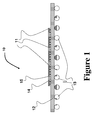
- Figure 1 shows a cross section of an electronic assembly of the present invention, such as a flip chip package.
- Electrical assemblies may be prepared according to the present method including the steps of: providing an electronic component and a substrate, wherein one of the electronic component and the substrate has a plurality of solder bumps and the other has a plurality of electrical bonding pads; electrically connecting the electronic component and the substrate; forming an underfill composition between the electronic component and the substrate; and curing the underfill composition, wherein the underfill composition includes a divinylarene diepoxide.
- the present method may be used to attach a variety of electronic components to a variety of substrates.
- Suitable electronic components include, but are not limited to, dies, capacitors, resistors and the like.
- the term "die” refers to a workpiece that is transformed by various processes into a desired integrated circuit device. Dies are usually singulated from a wafer which may be made of a semiconducting material, a non-semiconducting material, or combinations thereof.
- Suitable substrates include, without limitation, printed circuit boards and flexible circuits. Electrical assemblies prepared by the present invention also include a package bonded to a substrate.
- a "package” refers to an integrated circuit placed on a thin circuit board and encapsulated. The package typically contains solder balls on the bottom of the board to allow connection to the substrate.
- solder bumps includes solder bumps, solder balls, pins and pillars such as copper pillars. Solder bumps include ball grid arrays and pin grid arrays. Solder bumps may be composed of any suitable solderable material, such as, but not limited to, tin, tin-lead, tin-bismuth, tin-silver, tin-silver-copper, tin-indium and copper.
- solder bumps are those composed of tin, tin-lead, tin-silver and tin-silver-copper.
- the tin-alloy solder bumps are typically eutectic mixtures.
- a suitable tin-silver solder bump has the composition of 96.5% tin and 3.5% silver.
- Solder bumps may be deposited by any conventional means, such as a paste or by electroplating.
- Solder bumps composed of alloys may be deposited directly as an alloy, such as by electroplating a Sn-Ag solder bump, or by sequentially depositing a first metal such as tin and then depositing a second metal, such as silver, on the first metal followed by reflowing the metal to form an alloy.
- Suitable electrical bonding pads may be any suitable pad and may be flush with the surface of the substrate or the electronic component or may be surface of the substrate of the electronic component. Suitable bonding pads may be copper, silver, gold or any other suitable metal.
- solder bumps and bonding pads are fluxed to ensure good solderability. Any suitable flux may be used and is within the ability of those skilled in the art.
- the electronic component and the substrate are positioned such that the solder bumps and bonding pads are aligned.
- the assembly is then heated to reflow the solder and electrically connect (that is, solder) the electronic component and the substrate.
- solder solder
- the particular solder reflow temperature depends on the solder bump composition and is well known to those skilled in the art.
- the underfill composition is flowed between the electronic component and the substrate.
- the underfill composition also flows around the solder joints.
- the underfill composition may be applied via a number of methods depending on the end application. For example, typical application methods include syringe or cartridge dispensing for underfill applications. Suitable dispensing machines are manufactured by Asymtek, A Nordson Company, or Speedline Technologies.
- the dispense valve design can include positive displacement, time-pressure, jet dispense, or alternate valve design with precise volume control. While generally not necessary for the present underfill compositions, a vacuum may be used to help draw the underfill composition between the electronic component and the substrate and around the solder joints.
- the underfill composition fills the space between the electronic component and the substrate, the underfill composition is then cured.
- the curing of the composition may be carried out at a predetermined temperature and for a predetermined period of time sufficient to cure the composition.
- the particular curing conditions may be dependent on the hardeners used in the underfill composition.
- the curing temperature may be generally from 10 °C to 200 °C; preferably from 100 °C to 190 °C; and more preferably from 125 °C to 175 °C.
- Suitable curing times may be from 1 minute to 4 hours, preferably from 5 minutes to 2 hours, and more preferably from 10 minutes to 1.5 hours. Below a period of time of 1 minute, the time may be too short to ensure sufficient reaction under conventional processing conditions; and above 4 hours, the time may be too long to be practical or economical.
- the present underfill composition is cured by heating the underfill composition at a first temperature of 75 to 100 °C for 2 to 90 minutes, and then heating the underfill composition at a second temperature of 125 to 200°C for 2 to 180 minutes.
- the first temperature is from 80 to 95 °C, and more preferably from 80 to 90 °C.
- the underfill composition is preferably subjected to the first temperature for a period of 5 to 90 minutes, and more preferably from 15 to 60 minutes.
- the second temperature is preferably in the range of 135 to 200 °C, and more preferably from 150 to 180°C.
- the underfill composition is subjected to the second temperature for a period of 10 to 150 minutes, more preferably from 20 to 150 minutes, and still more preferably from 30 to 120 minutes.
- an electronic assembly such as a flip chip package, generally indicated by numeral 10, including substrate 12 having optional solder balls 13 on a lower surface of substrate 12.
- the electronic assembly 10 includes an electronic component 14, such as a die, electrically connected to substrate 12 through solder joint 15 (formed from a solder bump on electronic component 14 and a bonding pad on substrate 12) having cured underfill composition 11 disposed between electronic component 14 and substrate 12, wherein cured underfill composition 11 includes a reaction product of a divinylarene diepoxide.
- the present invention includes a curable epoxy resin composition or formulation for use in underfill encapsulants comprising (a) a divinylarene dioxide; (b) a hardener; and (c) optionally, a catalyst.
- the epoxide compositions or formulations of the present invention include as embodiments (1) polymerizable, curable compositions comprising divinylarene dioxide; (2) partially cured compositions comprising divinylarene dioxide; and (3) cured compositions comprising divinylarene dioxide resulting from (1) and (2) above.
- the present invention also relates to the curing (that is polymerization) of compositions containing divinylarene dioxide. In addition, some level (less than about 50%) of impurities in the divinylarene dioxide are expected and can be present with little impact on final performance.
- the underfill compositions of the present invention are advantageously low-viscosity, homogeneous liquids at room temperature, such as for example, less than 5.0 Pa-s at 25 °C.
- Solid, particulate materials such as fillers, may be incorporated in the underfill compositions for providing various modifications to the physical properties of the uncured or cured polymer. With or without such added solid materials, the compositions fill small gaps (for example, less than 20 ⁇ m) without the necessity of applying high pressures, vacuum assist, or heating to high temperatures, although such measures can be employed, if desired.
- the underfill compositions can be utilized to protect fragile electronic components, wherein the composition exhibits a low total chloride content of less than 5 ppm, and preferably less than 3 ppm. "Total" chloride content includes both bound chloride and hydrolysable chloride content.
- the divinylarene dioxide, component (a) may comprise, for example, any substituted or unsubstituted arene nucleus bearing two vinyl groups in any ring position.
- the arene portion of the divinylarene dioxide may comprise benzene, substituted benzenes, ring-annulated benzenes, substituted ring-annulated benzenes, homologously bonded benzenes, substituted homologously bonded benzenes, or mixtures thereof.
- the divinylarene portion of the divinylarene dioxide may be ortho, meta, or para isomers or any mixture thereof.
- Additional substituents may consist of H 2 O 2 -resistant groups including saturated alkyl, aryl, halogen, nitro, isocyanate, or RO-(where R may be a saturated alkyl or aryl).
- Ring-annulated benzenes may comprise for example naphthlalene, tetrahydronaphthalene, and the like.
- Homologously bonded (substituted) benzenes may comprise for example biphenyl, diphenylether, and the like.
- the divinylarene dioxide used for preparing the composition of the present invention may be illustrated generally by chemical Structures I-IV as follows:
- each R 1 , R 2 , R 3 and R 4 individually may be hydrogen, an alkyl, cycloalkyl, an aryl or an arylalkyl group; or a H 2 O 2 -resistant group, including for example a halogen, a nitro, an isocyanate, or an RO group, wherein R may be an alkyl, aryl or arylalkyl; x is an integer of 0 to 4; y is an integer greater than or equal to 2; x+y is an integer less than or equal to 6; z is an interger of 0 to 6; and z+y is an integer less than or equal to 8; and Ar is an arene fragment including, for example, 1,3-phenylene group.
- R 4 can be a reactive group(s) including epoxide, isocyanate, or any reactive group and Z is an integer from
- the divinylarene dioxide used in the present invention may be produced, for example, by the process described in International Patent Application WO 2010/077483 , incorporated herein by reference.
- the divinylarene dioxide compositions that are useful in the present invention are also disclosed in, for example, U.S. Patent No. 2,924,580 , incorporated herein by reference.
- the divinylarene dioxide useful in the present invention may comprise, for example, divinylbenzene dioxide, divinylnaphthalene dioxide, divinylbiphenyl dioxide, or divinyldiphenylether dioxide, and mixtures thereof.
- the divinylarene dioxide used in the underfill composition includes divinylbenzene dioxide (DVBDO).
- the divinylarene dioxide component is a divinylbenzene dioxide as illustrated by the following chemical formula of Structure V:
- the chemical formula of the above DVBDO compound is C 10 H 10 O 2 ; the molecular weight of the DVBDO is 162.2; and the elemental analysis of the DVBDO is: C, 74.06; H, 6.21; and O, 19.73 with an epoxide equivalent weight of 81 g/mol.
- the present invention includes a DVBDO illustrated by any one of the above Structures individually or as a mixture thereof.
- Structures VI and VII above show the meta (1,3-DVBDO) and para isomers of DVBDO, respectively.
- the ortho isomer is rare; and usually DVBDO is mostly produced generally in a range of from 9:1 to 1:9 ratio of meta (Structure VI) to para (Structure VII) isomers.
- the present invention preferably includes as one embodiment a range of from 6:1 to 1:6 ratio of Structure VI to Structure VII, and in other embodiments the ratio of Structure VI to Structure VII may be from 4:1 to 1:4 or from 2:1 to 1:2.
- the divinylarene dioxide may contain quantities (such as for example less than 20 wt%) of substituted arenes.
- the amount and structure of the substituted arenes depend on the process used in the preparation of the divinylarene precursor to the divinylarene dioxide.
- divinylbenzene prepared by the dehydrogenation of diethylbenzene (DEB) may contain quantities of ethylvinylbenzene (EVB) and DEB.
- EVB ethylvinylbenzene
- EVB ethylvinylbenzene monoxide while DEB remains unchanged.
- the presence of these compounds can increase the epoxide equivalent weight of the divinylarene dioxide to a value greater than that of the pure compound but can be utilized at levels of 0 to 99 % of the epoxy resin portion.
- the divinylarene dioxide useful in the present invention comprises, for example, divinylbenzene dioxide (DVBDO), a low viscosity liquid epoxy resin.
- the viscosity of the divinylarene dioxide used in the process of the present invention ranges generally from 0.001 Pa-s to 0.1 Pa-s, preferably from 0.01 Pa-s to 0.05 Pa-s, and more preferably from 0.01 Pa-s to 0.025 Pa-s, at 25 °C.
- the concentration of the divinylarene oxide used in the present invention as the epoxy resin portion of the formulation may depend on the fractions of the other formulation ingredients, however, in general the epoxy resin portion ranges from 0.5 wt% to 100 wt%, preferably, from 1 wt% to 99 wt%, more preferably from 2 wt% to 98 wt%, and even more preferably from 5 wt% to 95 wt%.
- the concentration of DVBDO in the formulation will depend on other formulation ingredients, however in general, the concentration of the DVBDO is from 1 wt% to 99 wt%, preferably from 5 wt% to 90 wt%, and most preferably from 7 wt% to 60 wt% based on the weight of the total composition.
- DVBDO is the epoxy resin component and the DVBDO is used in a concentration of from 20 wt% to 80 wt% based on the weight of the total composition.
- a hardener (curing agent or crosslinker) or curing agent blend (mixture of hardeners) is used in the underfill composition of the present invention.
- any hardener known in the art which is appropriate for curing (polymerizing) epoxy resins may be used.
- the hardener of choice may depend on the application requirements.
- the hardener useful in the present underfill composition may include, but is not limited to, dicyandiamide, substituted guanidines, phenolic, amino, benzoxazine, anhydrides, amido amines, polyamides, polyamines, aromatic amines, polyesters, polyisocyanates, polymercaptans, urea formaldehyde and melamine formaldehyde resins, and mixtures thereof.
- the present underfill compositions are substantially free of anhydrides, and are preferably free of anhydrides.
- concentration of the hardener but will depend on stoichiometric considerations (molar ratio).
- a typical molar ratio of epoxy to hardener is 0.25 to 4, more preferably, 0.5 to 2, and most preferably 0.9 to 1.1.
- a catalyst may optionally be used in the present underfill compositions.
- any homogeneous or heterogeneous catalyst known in the art which is appropriate for facilitating the reaction between an epoxy resin and a hardener may be used.
- the catalyst may include, but is not limited to, imidazoles, tertiary amines, phosphonium complexes, Lewis acids, or Lewis bases, transition metal catalysts, and mixtures thereof.
- the underfill compositions are substantially free of Lewis acid catalysts and are preferably free of Lewis acid catalysts.
- the catalyst useful in the present invention may include for example a Lewis acid such as boron triflouride complexes, Lewis bases such as tertiary amines like diazabicycloundecene and 2-phenylimidazole, quaternary salts such as tetrabutyphosphonium bromide and tetraethylammonium bromide, and organoantimony halides such as triphenylantimony tetraiodide and triphenylantimony dibromide; and mixtures thereof.
- a Lewis acid such as boron triflouride complexes
- Lewis bases such as tertiary amines like diazabicycloundecene and 2-phenylimidazole
- quaternary salts such as tetrabutyphosphonium bromide and tetraethylammonium bromide
- organoantimony halides such as triphenylantimony tetraiodide
- the concentration of the catalyst is generally from 0.05 wt% to 10 wt%, preferably from 0.1 wt% to 5 wt%, and most preferably from 0.15 wt% to 1 wt% based on the total weight of the underfill composition.
- the catalyst level can be adjusted to allow adequate processing in the final application.
- a filler may be added to the present underfill composition to improve thermomechanical properties of the cured system imparting better component reliability performance.
- the presence of the filler increases the modulus of the cured underfill and reduces the CTE of the adhesive (cured underfill) in order to better match the CTE of the electronic component and the substrate.
- the formulation may include one or more optional functional or non-functional fillers such as for example, fused silica, natural silica, synthetic silica, natural aluminum oxide, synthetic aluminum oxide, hollow fillers, aluminum trihydroxide, aluminum hydroxide oxide, boron nitride, silicon carbide, mica, aluminum powder, zinc oxide, silver, graphite, aluminum nitride, mullite, gold, carbon, carbon nanotubes, graphene, glass fibers/sheets, carbon fibers, or other organic or inorganic particulate filler, either added into the formulation in their end state or formed in-situ.
- Silica whether fused, natural or synthetic, is a preferred filler.
- the surface of the fillers may optionally be treated to improve filler and polymer interaction.
- the addition of silica filler to DVBDO blends used in underfill compositions may increase the fracture toughness of the final cured underfill material.
- the acceptable particle size of the filler material generally may range from nano to conventional micro size.
- the particle size of the filler may be in the range of from 0.0005 ⁇ m to 500 ⁇ m, preferably from 0.100 ⁇ m to 100 ⁇ m, and more preferably from 0.01 ⁇ m to 30 ⁇ m.
- Acceptable filler morphologies include, but are not limited to, platelet, fibrous, spherical, needle, amorphous or any combination thereof. Fillers with different size and different shape may be combined to have a synergistic effect on coefficient of thermal expansion , modulus, electrical and / or heat conductivity.
- the fillers utilized in the present invention may optionally be surface treated either before incorporation into the underfill composition, or in-situ, during the compounding of the formulation.
- surface treatments include fatty acids, silane coupling agents, titanates, zirconates or silazane compounds.
- Filler loadings useful in the present invention may vary.
- the concentration of the filler is generally from 0 wt% to 99 wt%, preferably from 0.1 wt% to 95 wt%, more preferably from 10 wt% to 90 wt%, and most preferably from 50 wt% to 80 wt% based on the weight of the solids in the composition.
- Volumetric loadings can range from 0 to 90 vol%, more preferably from 0.1 to 90 vol%, still more preferably up to 85 vol%, yet more preferably from 0.1 to 85 vol%, still more preferably from 1 to 85 vol% and most preferably from 1 to 70 vol%, depending on the desired properties.
- the present invention provides a composition including a divinylarene diepoxide, a curing agent, and a filler, wherein the composition has a viscosity of from 0.005 to 100 Pa-s at 25 °C when the filler is present in an amount of 1 to 70 vol%, based on the total volume of the composition.
- the composition has a viscosity of from 0.01 to 25 Pa-s at 25 °C, and more preferably from 0.01 to 10 Pa-s at 25 °C, when the filler is present in an amount of 1 to 70 vol%.
- the composition has a viscosity of from 0.005 to 1 Pa-s at 25 °C when the filler is present in an amount of 50 to 70 vol%. It is preferred that in such composition the divinylarene diepoxide is divinylbenzene dioxide.
- a further advantage of the present underfill composition sis that they can be applied at or near room temperature, which is significantly lower than conventional underfill compositions.
- the underfill compositions of the present invention advantageously may use a wide array of hardeners and the composition allows more choices of fillers, such as nano fillers than conventional underfill compositions, thus the formulation options of the present compositions are broadened.
- the present underfill compositions also have low (for example, less than 5 ppm) to no total halides.
- the underfill compositions can achieve lower CTE (for example less than 30 ppm/°C below the Tg) or better thermal conductivity (for example, greater than 1.0 W/mK) at the same flow rate during application or better flow rate at same CTE or heat conductivity.
- the optional components may comprise compounds that can be added to the composition to enhance application properties (for example, surface tension modifiers or flow aids), reliability properties (for example, adhesion promoters) the reaction rate, the selectivity of the reaction, and/or the catalyst lifetime.
- application properties for example, surface tension modifiers or flow aids
- reliability properties for example, adhesion promoters
- compositions of the present invention including for example, other resins such as epoxy resins that are different from the divinylarene dioxide, component (a), diluents, stabilizers, fillers, plasticizers, catalyst deactivators, toughening agents, and the like; and mixtures thereof.
- other resins such as epoxy resins that are different from the divinylarene dioxide, component (a), diluents, stabilizers, fillers, plasticizers, catalyst deactivators, toughening agents, and the like; and mixtures thereof.
- additives useful in the formulation of the present invention include for example, a halogen containing or halogen-free flame retardant; a synergist to improve the performance of the flame extinguishing ability such magnesium hydroxide, zinc borate, or metalocenes; a solvent for processability including for example acetone, methyl ethyl ketone, a Dowanol PMA; adhesion promoters such as modified organosilanes (epoxidized, methacryl, amino), acytlacetonates, or sulfur containing molecules; wetting and dispersing aids such as modified organosilanes, Byk 900 series and Byk W-9010, modified fluorocarbons; air release additives such as Byk-A 530, Byk-A 525, Byk-A 555, Byk-A 560; surface modifiers such as slip and gloss additives (a number of which are available from Byk-Chemie); a reactive or nonreactive thermoplastic resin such as polyphenyls
- the concentration of the optional additives used in the present invention may range generally from 0 wt% to 99 wt%, preferably from 0.001 wt% to 95 wt%, more preferably from 0.01 wt% to 60 wt%, and most preferably from 0.05 wt% to 50 wt%.
- the underfill formulation may contain the following ingredients in their respective amounts: DVBDO (The Dow Chemical Company) 20-30 wt% Kyahard AA pt (Nippon Kayaku) 10-20 wt% Denka FB-1SDX Silica (Denka Corporation) 45-75 wt% Byk W-9010 (Byk Chemie) 0.5 wt% Silwet 7608 (GE Silicones) 0.5 wt% Byk A-530 (Byk-Chemie) 0.5 wt% Silane Z-6040 (Dow Coming) 0.7 wt%
- the process for preparing a low viscosity (for example, less than 3.0 Pa-s at 25 °C, low total chloride containing (for example, less than 5 ppm) epoxy resin formulation useful for the manufacture of semiconductor packaging materials includes blending (a) a divinylbenzene dioxide; (b) a hardener; (c) optionally, a catalyst; and (d) optionally, other ingredients as needed.
- the preparation of the curable epoxy resin formulation of the present invention is achieved by blending with or without vacuum in a Ross PD Mixer (Charles Ross), the divinylbenzene dioxide, a curing agent, a catalyst, and optionally any other desirable additives.
- Any of the above-mentioned optional assorted formulation additives, for example fillers, may also be added to the composition during the mixing or prior to the mixing to form the composition.
- All the components of the epoxy resin formulation are typically mixed and dispersed at a temperature enabling the preparation of an effective epoxy resin composition having a low viscosity for the desired application.
- the temperature during the mixing of all components may be generally from 20 °C to 80 °C and preferably from 25 °C to 35 °C. Lower mixing temperatures help to minimize reaction of the resin and hardener components to maximize the pot life of the formulation.
- the blended compound is typically stored at sub-ambient temperatures to maximize shelf life.
- Acceptable temperature ranges are for example from -100 °C to 25 °C, more preferably, from -70 °C to 10 °C, and even more preferably at from -50 °C to 0 °C.
- the temperature may be -40 °C.
- the divinylbenzene dioxide (DVBDO), the epoxy resin of the present invention may be used as the sole resin to form the epoxy matrix in the final formulation; or the divinylbenzene dioxide resin may be used as one of the components in the final formulation.
- the epoxy resin may be used as an additive diluent.
- the use of divinylbenzene dioxide imparts improved properties to the curable composition and the final cured product over conventional glycidyl ether, glycidyl ester or glycidyl amine epoxy resins. Specifically, the use of DVBDO allows for relatively high filler loading while maintaining a relatively low viscosity at 25 °C.
- halogen content such as chlorine content
- the halogen content is generally less than 500 ppm; preferably less than 100 ppm, and more preferably less than 5 ppm.
- the cured underfill composition (that is, the cross-linked product made from the curable composition) of the present invention shows several improved properties over cured conventional, epoxy-based underfills.
- the cured underfill of the present invention may have a glass transition temperature (Tg) of from -55 °C to 300 °C.
- Tg glass transition temperature
- the Tg of the resin is higher than -60 °C, preferably higher than 0 °C, more preferably higher than 10 °C, more preferably higher than 25 °C, and most preferably higher than 50 °C.
- the technology described in this application does not provide any further significant advantage versus the conventional technology described in the prior art; and above 200 °C, the technology described in the present application generally would lead to a very brittle network without the inclusion of toughening technologies which is not suitable for the applications within the scope of the present application and could also cause significant warpage of the device at low temperatures (for example, less than 0 °C).
- the cured underfill composition of the present invention exhibits a glass transition temperature of from 25 to 300 °C, more preferably from 50 to 250 °C and most preferably from 50 to 225 °C via ASTM D 3418.
- the present underfill composition exhibits a hydrolyzable chloride content via ion chromatography after Parr bomb extraction of approximately 60 mesh particles at 120 °C for 24 hours of from 0.00001 and 5000 ppm, preferably from 0.00001 and 100 ppm and most preferably less than 5 ppm.
- the cured underfill composition of the present invention exhibits a fracture toughness measured by ASTM D 5045 (at room temperature) value higher than 1.0 MPa.m 1/2 , preferably higher than 1.7 MPa.m 1/2 , and more preferably higher than 2.0 MPa.m 1/2 (megaPascals per meter).
- the cured underfill composition of the present invention exhibits a flexural modulus below the Tg of higher than 1 GPa, preferably higher than 2 GPa and more preferably between 3.5 MPa and 15 GPa via ASTM D 790.
- the cured underfill of the present invention exhibits a CTE below the Tg of 65 ppm/°C, and preferably lower than 50 ppm/°C via ASTM D 5335.
- underfill compositions of the present invention exhibit a weight loss during cure of less than 10 percent via thermogravimetric analysis according to ASTM E 1131.
- the epoxy resin formulations of the present invention may be used as capillary underfill encapsulant for semiconductor packaging materials.
- the use of the epoxy resin formulation enables relatively high filler loading (for example, 30% by volume, such as from 30 to 85 vol%), high Tg values after cure (for example, 90 °C), and very low to no total chloride contamination for example, ⁇ 5 ppm) imparted by the resin.
- this resin enables a number of different hardeners to be used, unlike conventional low viscosity cycloaliphatic epoxy resins.
- the comparatively low chloride contamination results from the synthetic route to manufacture the molecule which does not utilize halogenated intermediates, for example epichlorohydrin.
- Comparative Examples A and B and Examples 1 through 3 were prepared according to the following procedure:
- Ethacure 100 is DETDA commercially available from Albemarle Corporation
- Byk-A 530 is a polysiloxane defoaming aid produced by Byk-Chemie, GmbH, Germany
- Byk W996 is a wetting aid that is a copolymer with acidic groups (acid value of 71 mg KOH/g) produced by Byk-Chemie, GmbH, Germany
- Silane Z-6040 is a epoxy functional silane coupling agent produced by Dow-Corning
- Modaflow is a surface tension modifier / flow aid produced by Ctyec Surface Specialties
- Denka FB-1SDX is a fused, synthetic spherical silica powder with a mean particle size of about 1.5 microns produced by Denka Co JP, Japan.
- Coat O Sil 2810 is an epoxy terminated polydimethylsiloxane from Momentive.
- Jeffamine ® D230 is a polyetheramine from Hunstman Corporation.
- Amicure PACM is a cycloaliphatic amine from Air Products®.
- MP15EF and MP8FS are silica fillers available from Tatsumori.
- Regal 400 R is a grade of carbon black from Cabot Corporation.
- Silwet L-7608 is an organosilicone surface tension modifier from Momentive Performance Materials. Table I - Formulations Comparative Example A Comparative Example B Example 1 Example 2 Example 3 D.E.R.
- the analysis procedure consisted of one element; ramp at 10 °C/minute from room temperature (about 25 °C) to 275 °C with a nitrogen purge of 50 mL/minute at a force of 0.05 N.
- Universal Analysis data analysis software (commercially available from TA Instruments) was then utilized to determine the glass transition temperature (Tg) (onset) and the CTE below the Tg ( ⁇ 1 CTE) for the sample analyzed.
- Viscosity versus temperature of the blended samples was measured using a TA Instruments ARES Analyzer (TA Instruments) fitted with a 35 mm upper plate and a 50 mm lower plate.
- the test procedure consisted of a dynamic temperature ramp from 25 °C to 250 °C at 5 °C/minute ramp rate.
- Table II below contains a summary of the data collected on model underfill formulations. Of note is the combination of high Tg and low viscosity.
- the Tg via TMA of the DVBDO based samples are about 70 °C higher than those made with D.E.R. TM 354.
- the minimum viscosity of the DVBDO sample at 65 % filler loading is 20 % of the sample made with D.E.R. 354.
- D.E.R. 354 Bisphenol-F epoxy) D.E.R. 354 D.E.R. 354 50:50 (D.E.R. 354: DVBDO) DVBDO DVBDO Minimum Viscosity, Pa-s (ARES, 5°C/minute ramp) 0.0461 0.4139 0.0316 0.0129 0.0863 Minimum Viscosity, °C (ARES, 5 °C/minute ramp) 128 119 128 105 108 Tg, °C (TMA, 10 °C/minute ramp) 113 112 151 186 189 ⁇ 1 CTE, ppm/°C (TMA, 10 °C/minute ramp) 64 38 52 50 32
- Examples 4 through 10 were carried out using the same procedure as described in Examples 1-3; and included the following raw materials: DVBDO, a dioxide, available from The Dow Chemical Company; Ancamide ® 506, a polyamide hardener, commercially available from Air Products; Jeffamine ® D230, a polyetheramine, commercially available from Huntsman Corporation; Silazane Z-6079 (hexamethyldisilazane) commercially available from Dow Coming; MP-15EF - Silica filler commercially available from Tatsumori Ltd, Japan; and Silane Z-6040, an epoxy silane, commercially available from Dow Coming.
- DVBDO a dioxide, available from The Dow Chemical Company
- Jeffamine ® D230 a polyetheramine, commercially available from Huntsman Corporation
- Silazane Z-6079 hexamethyldisilazane
- MP-15EF - Silica filler commercially available from Tatsumori Ltd, Japan
- samples of the formulations were analyzed using a TA Instruments AR2000 rheometer.
- the rheometer was fitted with a 60 mm, 1 degree cone.
- the test procedure consisted of a pre-shear at 10 sec -1 for 30 seconds followed by a 120 second hold at 10 sec -1 both steps at 25 °C and data points recorded every 2 seconds.
- the viscosity value reported is the average of the last 10 data points.
- a TA Instruments 2920 Dual Cell DSC was used to determine the Tg of the samples after cure. The procedure consisted of a singe ramp from 25 °C to 300 °C at a 10 °C/min ramp rate with a nitrogen purge of 50 mL/minute. The Tg was determined using the extrapolated tangents method in the TA Instruments Universal Analysis software. A small piece (approximately 15 mg) was cut from each cured sample and analyzed according to the preceding method.
- Example 10 Viscosity, Pa-s (10 sec-1, 25 °C) 0.081 0.071 0.252 0.140 0.455 0.515 0.180 Tg After Cure, °C (DSC, 10 °C/minute ramp) 143 125 126 146 152 134 139 CTE Below Tg, ppm/°C (TMA, 5 °C/minute ramp) 42 37 26 39 38 51 74 CTE Above Tg, ppm/°C (TMA, 5 °C/minute ramp) 102 98 63 93 78 81 112
Landscapes
- Chemical & Material Sciences (AREA)
- Organic Chemistry (AREA)
- Health & Medical Sciences (AREA)
- Materials Engineering (AREA)
- Wood Science & Technology (AREA)
- Engineering & Computer Science (AREA)
- Life Sciences & Earth Sciences (AREA)
- Chemical Kinetics & Catalysis (AREA)
- Medicinal Chemistry (AREA)
- Polymers & Plastics (AREA)
- Epoxy Resins (AREA)
- Structures Or Materials For Encapsulating Or Coating Semiconductor Devices Or Solid State Devices (AREA)
- Compositions Of Macromolecular Compounds (AREA)
- Wire Bonding (AREA)
Applications Claiming Priority (1)
| Application Number | Priority Date | Filing Date | Title |
|---|---|---|---|
| US26345909P | 2009-11-23 | 2009-11-23 |
Publications (2)
| Publication Number | Publication Date |
|---|---|
| EP2325876A2 true EP2325876A2 (fr) | 2011-05-25 |
| EP2325876A3 EP2325876A3 (fr) | 2016-04-20 |
Family
ID=43513936
Family Applications (1)
| Application Number | Title | Priority Date | Filing Date |
|---|---|---|---|
| EP10192039.5A Withdrawn EP2325876A3 (fr) | 2009-11-23 | 2010-11-22 | Formulations de résine époxy pour applications de sous-remplissage |
Country Status (7)
| Country | Link |
|---|---|
| US (1) | US20110122590A1 (fr) |
| EP (1) | EP2325876A3 (fr) |
| JP (1) | JP5698500B2 (fr) |
| KR (1) | KR20110060823A (fr) |
| CN (1) | CN102163563B (fr) |
| SG (1) | SG171555A1 (fr) |
| TW (1) | TWI503340B (fr) |
Families Citing this family (19)
| Publication number | Priority date | Publication date | Assignee | Title |
|---|---|---|---|---|
| JP5390444B2 (ja) * | 2010-03-23 | 2014-01-15 | 新日鉄住金化学株式会社 | 耐アンモニア性エポキシ樹脂組成物およびその成形硬化物 |
| CN102906148A (zh) * | 2010-05-21 | 2013-01-30 | 陶氏环球技术有限责任公司 | 可固化组合物 |
| KR20130039760A (ko) * | 2010-06-25 | 2013-04-22 | 다우 글로벌 테크놀로지스 엘엘씨 | 경화성 에폭시 수지 조성물 및 이로부터 제조된 복합체 |
| JP2013534367A (ja) * | 2010-08-02 | 2013-09-02 | アトテツク・ドイチユラント・ゲゼルシヤフト・ミツト・ベシユレンクテル・ハフツング | 基板上にはんだ堆積物および非溶融バンプを形成する方法 |
| US20140079953A1 (en) * | 2011-05-13 | 2014-03-20 | Dow Global Technologies Llc | Insulation formulations |
| WO2013043363A2 (fr) * | 2011-09-21 | 2013-03-28 | Dow Global Technologies Llc | Compositions de résine à fonction époxy |
| CN104170070B (zh) * | 2012-08-06 | 2017-11-10 | 积水化学工业株式会社 | 半导体装置的制造方法及倒装片安装用粘接剂 |
| US9716299B2 (en) * | 2012-10-25 | 2017-07-25 | The Regents Of The University Of California | Graphene based thermal interface materials and methods of manufacturing the same |
| EP2926368B1 (fr) * | 2012-11-30 | 2020-04-08 | Sirrus, Inc. | Ensemble électronique |
| US10224258B2 (en) * | 2013-03-22 | 2019-03-05 | Applied Materials, Inc. | Method of curing thermoplastics with microwave energy |
| US9321245B2 (en) * | 2013-06-24 | 2016-04-26 | Globalfoundries Inc. | Injection of a filler material with homogeneous distribution of anisotropic filler particles through implosion |
| US9441070B2 (en) | 2013-09-11 | 2016-09-13 | Rohm And Haas Electronic Materials Llc | Divinylarene dioxide compositions having reduced volatility |
| TWI491683B (zh) * | 2014-02-24 | 2015-07-11 | 石墨烯複合塗層 | |
| US10141197B2 (en) * | 2016-03-30 | 2018-11-27 | Stmicroelectronics S.R.L. | Thermosonically bonded connection for flip chip packages |
| WO2021050660A1 (fr) | 2019-09-10 | 2021-03-18 | Countertrace Llc | Benzènes hexasubstitués, surfaces modifiées au moyen de ceux-ci, et procédés associés |
| EP4028767A4 (fr) | 2019-09-10 | 2023-11-08 | Countertrace LLC | Analyses de fluide et constructions de capteurs utilisant des benzènes hexasubstitués |
| US12355000B2 (en) * | 2020-11-10 | 2025-07-08 | Qualcomm Incorporated | Package comprising a substrate and a high-density interconnect integrated device |
| US12469811B2 (en) | 2021-03-26 | 2025-11-11 | Qualcomm Incorporated | Package comprising wire bonds coupled to integrated devices |
| JP2024040024A (ja) * | 2022-09-12 | 2024-03-25 | パナソニックIpマネジメント株式会社 | 補強用樹脂組成物、及び実装構造体 |
Citations (5)
| Publication number | Priority date | Publication date | Assignee | Title |
|---|---|---|---|---|
| US2924580A (en) | 1957-08-08 | 1960-02-09 | Union Carbide Corp | Divinyl benzene dioxide compositions |
| US7279223B2 (en) | 2003-12-16 | 2007-10-09 | General Electric Company | Underfill composition and packaged solid state device |
| US7351784B2 (en) | 2005-09-30 | 2008-04-01 | Intel Corporation | Chip-packaging composition of resin and cycloaliphatic amine hardener |
| US7482201B2 (en) | 2002-05-23 | 2009-01-27 | 3M Innovative Properties Company | Nanoparticle filled underfill |
| WO2010077483A1 (fr) | 2008-12-30 | 2010-07-08 | Dow Global Technologies Inc. | Procédé de synthèse de dioxydes de divinylarène |
Family Cites Families (10)
| Publication number | Priority date | Publication date | Assignee | Title |
|---|---|---|---|---|
| US6724091B1 (en) * | 2002-10-24 | 2004-04-20 | Intel Corporation | Flip-chip system and method of making same |
| US7022410B2 (en) * | 2003-12-16 | 2006-04-04 | General Electric Company | Combinations of resin compositions and methods of use thereof |
| US20040101688A1 (en) * | 2002-11-22 | 2004-05-27 | Slawomir Rubinsztajn | Curable epoxy compositions, methods and articles made therefrom |
| US7047633B2 (en) * | 2003-05-23 | 2006-05-23 | National Starch And Chemical Investment Holding, Corporation | Method of using pre-applied underfill encapsulant |
| US7446136B2 (en) * | 2005-04-05 | 2008-11-04 | Momentive Performance Materials Inc. | Method for producing cure system, adhesive system, and electronic device |
| US20060275952A1 (en) * | 2005-06-07 | 2006-12-07 | General Electric Company | Method for making electronic devices |
| US20060275608A1 (en) * | 2005-06-07 | 2006-12-07 | General Electric Company | B-stageable film, electronic device, and associated process |
| US20070004871A1 (en) * | 2005-06-30 | 2007-01-04 | Qiwei Lu | Curable composition and method |
| JP2007258207A (ja) * | 2006-03-20 | 2007-10-04 | Three M Innovative Properties Co | バンプ付きチップもしくはパッケージの実装方法 |
| WO2009119513A1 (fr) * | 2008-03-27 | 2009-10-01 | 新日鐵化学株式会社 | Composition de résine époxy et produit durci correspondant |
-
2010
- 2010-11-22 EP EP10192039.5A patent/EP2325876A3/fr not_active Withdrawn
- 2010-11-22 US US12/951,291 patent/US20110122590A1/en not_active Abandoned
- 2010-11-22 SG SG201008557-9A patent/SG171555A1/en unknown
- 2010-11-22 JP JP2010259972A patent/JP5698500B2/ja not_active Expired - Fee Related
- 2010-11-23 KR KR1020100116890A patent/KR20110060823A/ko not_active Ceased
- 2010-11-23 CN CN2010106249895A patent/CN102163563B/zh not_active Expired - Fee Related
- 2010-11-23 TW TW099140304A patent/TWI503340B/zh not_active IP Right Cessation
Patent Citations (5)
| Publication number | Priority date | Publication date | Assignee | Title |
|---|---|---|---|---|
| US2924580A (en) | 1957-08-08 | 1960-02-09 | Union Carbide Corp | Divinyl benzene dioxide compositions |
| US7482201B2 (en) | 2002-05-23 | 2009-01-27 | 3M Innovative Properties Company | Nanoparticle filled underfill |
| US7279223B2 (en) | 2003-12-16 | 2007-10-09 | General Electric Company | Underfill composition and packaged solid state device |
| US7351784B2 (en) | 2005-09-30 | 2008-04-01 | Intel Corporation | Chip-packaging composition of resin and cycloaliphatic amine hardener |
| WO2010077483A1 (fr) | 2008-12-30 | 2010-07-08 | Dow Global Technologies Inc. | Procédé de synthèse de dioxydes de divinylarène |
Also Published As
| Publication number | Publication date |
|---|---|
| TW201139492A (en) | 2011-11-16 |
| CN102163563B (zh) | 2013-03-27 |
| CN102163563A (zh) | 2011-08-24 |
| JP5698500B2 (ja) | 2015-04-08 |
| EP2325876A3 (fr) | 2016-04-20 |
| TWI503340B (zh) | 2015-10-11 |
| US20110122590A1 (en) | 2011-05-26 |
| SG171555A1 (en) | 2011-06-29 |
| JP2011176278A (ja) | 2011-09-08 |
| KR20110060823A (ko) | 2011-06-08 |
Similar Documents
| Publication | Publication Date | Title |
|---|---|---|
| EP2325876A2 (fr) | Formulations de résine époxy pour applications de sous-remplissage | |
| EP2504394B1 (fr) | Formulations de résine époxy renforcée | |
| US6893736B2 (en) | Thermosetting resin compositions useful as underfill sealants | |
| TWI480326B (zh) | 用於含低k介電質之半導體裝置中作為底填密封劑之可固化樹脂組合物 | |
| WO2007066763A1 (fr) | Composition de resine liquide pour composant electronique et dispositif electronique | |
| CN110168016A (zh) | 液状环氧树脂密封材料及半导体装置 | |
| JP6233441B2 (ja) | 液状エポキシ樹脂組成物及び電子部品装置 | |
| JP7167912B2 (ja) | 液状封止樹脂組成物、電子部品装置及び電子部品装置の製造方法 | |
| JP3411164B2 (ja) | ダイアタッチペースト | |
| US9441070B2 (en) | Divinylarene dioxide compositions having reduced volatility | |
| JP6686433B2 (ja) | アンダーフィル用樹脂組成物、電子部品装置及び電子部品装置の製造方法 | |
| JP2009057575A (ja) | 液状エポキシ樹脂組成物及び電子部品装置 | |
| JP5708666B2 (ja) | 液状エポキシ樹脂組成物及び電子部品装置 | |
| JP2006008888A (ja) | 液状エポキシ樹脂組成物 | |
| JP3953827B2 (ja) | 液状樹脂組成物、半導体装置の製造方法及び半導体素子 | |
| WO2006022693A1 (fr) | Matière de remplissage fondante sans écoulement sous faible vide pour dispositifs électroniques | |
| KR102873055B1 (ko) | 페놀 수지 혼합물, 경화성 수지 조성물 및 그의 경화물 | |
| KR102872153B1 (ko) | 페놀 수지 혼합물, 경화성 수지 조성물 및 그의 경화물 | |
| JP5924443B2 (ja) | 液状エポキシ樹脂組成物及び電子部品装置 | |
| JP5929977B2 (ja) | 液状エポキシ樹脂組成物及び電子部品装置 | |
| JP2013107993A (ja) | 半導体封止用液状樹脂組成物とそれを用いた半導体装置 | |
| KR101329697B1 (ko) | 전자재료용 반도체 다이 접착제 조성물 | |
| JP5804479B2 (ja) | 樹脂封止型半導体装置の製造方法及び樹脂封止型半導体装置 |
Legal Events
| Date | Code | Title | Description |
|---|---|---|---|
| PUAI | Public reference made under article 153(3) epc to a published international application that has entered the european phase |
Free format text: ORIGINAL CODE: 0009012 |
|
| 17P | Request for examination filed |
Effective date: 20101122 |
|
| AK | Designated contracting states |
Kind code of ref document: A2 Designated state(s): AL AT BE BG CH CY CZ DE DK EE ES FI FR GB GR HR HU IE IS IT LI LT LU LV MC MK MT NL NO PL PT RO RS SE SI SK SM TR |
|
| AX | Request for extension of the european patent |
Extension state: BA ME |
|
| PUAL | Search report despatched |
Free format text: ORIGINAL CODE: 0009013 |
|
| AK | Designated contracting states |
Kind code of ref document: A3 Designated state(s): AL AT BE BG CH CY CZ DE DK EE ES FI FR GB GR HR HU IE IS IT LI LT LU LV MC MK MT NL NO PL PT RO RS SE SI SK SM TR |
|
| AX | Request for extension of the european patent |
Extension state: BA ME |
|
| RIC1 | Information provided on ipc code assigned before grant |
Ipc: H01L 23/29 20060101ALI20160317BHEP Ipc: C09J 163/00 20060101ALI20160317BHEP Ipc: H01L 21/56 20060101AFI20160317BHEP Ipc: C08G 59/02 20060101ALI20160317BHEP Ipc: C09D 163/00 20060101ALI20160317BHEP |
|
| 17Q | First examination report despatched |
Effective date: 20160406 |
|
| STAA | Information on the status of an ep patent application or granted ep patent |
Free format text: STATUS: THE APPLICATION IS DEEMED TO BE WITHDRAWN |
|
| 18D | Application deemed to be withdrawn |
Effective date: 20160817 |