EP2326714B1 - Verfahren zur herstellung eines futtermittelzusatzes zum sauerstoffunabhängigen, enzymatischen abbau von mykotoxinen sowie futtermittelzusatz und verwendung desselben - Google Patents
Verfahren zur herstellung eines futtermittelzusatzes zum sauerstoffunabhängigen, enzymatischen abbau von mykotoxinen sowie futtermittelzusatz und verwendung desselben Download PDFInfo
- Publication number
- EP2326714B1 EP2326714B1 EP09775637.3A EP09775637A EP2326714B1 EP 2326714 B1 EP2326714 B1 EP 2326714B1 EP 09775637 A EP09775637 A EP 09775637A EP 2326714 B1 EP2326714 B1 EP 2326714B1
- Authority
- EP
- European Patent Office
- Prior art keywords
- sequence
- enzyme
- feed additive
- fumonisin
- seq
- Prior art date
- Legal status (The legal status is an assumption and is not a legal conclusion. Google has not performed a legal analysis and makes no representation as to the accuracy of the status listed.)
- Not-in-force
Links
- 239000003674 animal food additive Substances 0.000 title claims description 19
- QVGXLLKOCUKJST-UHFFFAOYSA-N atomic oxygen Chemical compound [O] QVGXLLKOCUKJST-UHFFFAOYSA-N 0.000 title claims description 12
- 229910052760 oxygen Inorganic materials 0.000 title claims description 12
- 239000001301 oxygen Substances 0.000 title claims description 12
- 230000002255 enzymatic effect Effects 0.000 title claims description 6
- 238000004519 manufacturing process Methods 0.000 title claims description 6
- 231100000678 Mycotoxin Toxicity 0.000 title description 11
- 239000002636 mycotoxin Substances 0.000 title description 11
- 238000000034 method Methods 0.000 title description 9
- 238000000354 decomposition reaction Methods 0.000 title 1
- 239000003008 fumonisin Substances 0.000 claims description 50
- 102000004190 Enzymes Human genes 0.000 claims description 47
- 108090000790 Enzymes Proteins 0.000 claims description 47
- 241001465754 Metazoa Species 0.000 claims description 24
- 102000013392 Carboxylesterase Human genes 0.000 claims description 23
- 108010051152 Carboxylesterase Proteins 0.000 claims description 23
- 210000001035 gastrointestinal tract Anatomy 0.000 claims description 15
- 108090000623 proteins and genes Proteins 0.000 claims description 13
- 102000003929 Transaminases Human genes 0.000 claims description 9
- 108090000340 Transaminases Proteins 0.000 claims description 9
- 150000004716 alpha keto acids Chemical class 0.000 claims description 7
- 230000001681 protective effect Effects 0.000 claims description 4
- 230000007515 enzymatic degradation Effects 0.000 claims description 3
- 235000019730 animal feed additive Nutrition 0.000 claims 3
- 241000643741 Sphingopyxis sp. Species 0.000 description 23
- 239000000758 substrate Substances 0.000 description 15
- 230000015556 catabolic process Effects 0.000 description 14
- 108020004414 DNA Proteins 0.000 description 13
- 230000000694 effects Effects 0.000 description 11
- UVBUBMSSQKOIBE-DSLOAKGESA-N fumonisin B1 Chemical compound OC(=O)C[C@@H](C(O)=O)CC(=O)O[C@H]([C@H](C)CCCC)[C@@H](OC(=O)C[C@@H](CC(O)=O)C(O)=O)C[C@@H](C)C[C@H](O)CCCC[C@@H](O)C[C@H](O)[C@H](C)N UVBUBMSSQKOIBE-DSLOAKGESA-N 0.000 description 11
- QZIADBYRQILELJ-UHFFFAOYSA-N fumonisin B1 Natural products CCCCC(C)C(OC(=O)CC(CC(=O)O)C(=O)O)C(C)(CC(C)CC(O)CCCCC(O)CC(O)C(C)N)OC(=O)CC(CC(=O)O)C(=O)O QZIADBYRQILELJ-UHFFFAOYSA-N 0.000 description 10
- 238000006731 degradation reaction Methods 0.000 description 9
- 238000001784 detoxification Methods 0.000 description 8
- 101150028420 fumC gene Proteins 0.000 description 8
- 239000000872 buffer Substances 0.000 description 7
- 235000013305 food Nutrition 0.000 description 7
- 108091008053 gene clusters Proteins 0.000 description 7
- 239000000203 mixture Substances 0.000 description 5
- 150000007523 nucleic acids Chemical group 0.000 description 5
- LCTONWCANYUPML-UHFFFAOYSA-N Pyruvic acid Chemical compound CC(=O)C(O)=O LCTONWCANYUPML-UHFFFAOYSA-N 0.000 description 4
- 101100281835 Sphingopyxis macrogoltabida fumI gene Proteins 0.000 description 4
- 230000001580 bacterial effect Effects 0.000 description 4
- 230000001925 catabolic effect Effects 0.000 description 4
- 238000006243 chemical reaction Methods 0.000 description 4
- 101150086840 fumD gene Proteins 0.000 description 4
- 235000013311 vegetables Nutrition 0.000 description 4
- MYMOFIZGZYHOMD-UHFFFAOYSA-N Dioxygen Chemical compound O=O MYMOFIZGZYHOMD-UHFFFAOYSA-N 0.000 description 3
- 108700026244 Open Reading Frames Proteins 0.000 description 3
- 108090000854 Oxidoreductases Proteins 0.000 description 3
- 102000004316 Oxidoreductases Human genes 0.000 description 3
- 235000013339 cereals Nutrition 0.000 description 3
- 229910001882 dioxygen Inorganic materials 0.000 description 3
- 238000002474 experimental method Methods 0.000 description 3
- 239000003517 fume Substances 0.000 description 3
- 238000000589 high-performance liquid chromatography-mass spectrometry Methods 0.000 description 3
- 239000013642 negative control Substances 0.000 description 3
- 239000013641 positive control Substances 0.000 description 3
- 125000002924 primary amino group Chemical group [H]N([H])* 0.000 description 3
- 238000012545 processing Methods 0.000 description 3
- 239000000047 product Substances 0.000 description 3
- 235000018102 proteins Nutrition 0.000 description 3
- 102000004169 proteins and genes Human genes 0.000 description 3
- 239000002994 raw material Substances 0.000 description 3
- 239000000126 substance Substances 0.000 description 3
- 239000003053 toxin Substances 0.000 description 3
- 231100000765 toxin Toxicity 0.000 description 3
- 108700012359 toxins Proteins 0.000 description 3
- 241001631457 Cannula Species 0.000 description 2
- 241000863013 Caulobacter sp. Species 0.000 description 2
- LCTONWCANYUPML-UHFFFAOYSA-M Pyruvate Chemical compound CC(=O)C([O-])=O LCTONWCANYUPML-UHFFFAOYSA-M 0.000 description 2
- 240000008042 Zea mays Species 0.000 description 2
- 235000002017 Zea mays subsp mays Nutrition 0.000 description 2
- 239000000654 additive Substances 0.000 description 2
- 239000007864 aqueous solution Substances 0.000 description 2
- 230000002457 bidirectional effect Effects 0.000 description 2
- 230000015572 biosynthetic process Effects 0.000 description 2
- 230000003197 catalytic effect Effects 0.000 description 2
- 230000000593 degrading effect Effects 0.000 description 2
- 238000011161 development Methods 0.000 description 2
- 210000001198 duodenum Anatomy 0.000 description 2
- 235000013399 edible fruits Nutrition 0.000 description 2
- 230000014509 gene expression Effects 0.000 description 2
- 230000000968 intestinal effect Effects 0.000 description 2
- 210000001630 jejunum Anatomy 0.000 description 2
- 244000144972 livestock Species 0.000 description 2
- 230000000813 microbial effect Effects 0.000 description 2
- 244000005700 microbiome Species 0.000 description 2
- 229940076788 pyruvate Drugs 0.000 description 2
- 229940107700 pyruvic acid Drugs 0.000 description 2
- 230000000384 rearing effect Effects 0.000 description 2
- 230000014493 regulation of gene expression Effects 0.000 description 2
- 238000007086 side reaction Methods 0.000 description 2
- 238000010561 standard procedure Methods 0.000 description 2
- 238000012360 testing method Methods 0.000 description 2
- 238000013518 transcription Methods 0.000 description 2
- 230000035897 transcription Effects 0.000 description 2
- XLYOFNOQVPJJNP-UHFFFAOYSA-N water Substances O XLYOFNOQVPJJNP-UHFFFAOYSA-N 0.000 description 2
- 101150084750 1 gene Proteins 0.000 description 1
- 241000894006 Bacteria Species 0.000 description 1
- BTBUEUYNUDRHOZ-UHFFFAOYSA-N Borate Chemical compound [O-]B([O-])[O-] BTBUEUYNUDRHOZ-UHFFFAOYSA-N 0.000 description 1
- 108091003079 Bovine Serum Albumin Proteins 0.000 description 1
- 101100174521 Bradyrhizobium diazoefficiens (strain JCM 10833 / BCRC 13528 / IAM 13628 / NBRC 14792 / USDA 110) fumC2 gene Proteins 0.000 description 1
- KRKNYBCHXYNGOX-UHFFFAOYSA-K Citrate Chemical compound [O-]C(=O)CC(O)(CC([O-])=O)C([O-])=O KRKNYBCHXYNGOX-UHFFFAOYSA-K 0.000 description 1
- 101100335628 Dictyostelium discoideum fumH gene Proteins 0.000 description 1
- 241000196324 Embryophyta Species 0.000 description 1
- 241000701832 Enterobacteria phage T3 Species 0.000 description 1
- 241000588724 Escherichia coli Species 0.000 description 1
- 101100174518 Escherichia coli (strain K12) fumB gene Proteins 0.000 description 1
- 241000235058 Komagataella pastoris Species 0.000 description 1
- QNAYBMKLOCPYGJ-REOHCLBHSA-N L-alanine Chemical compound C[C@H](N)C(O)=O QNAYBMKLOCPYGJ-REOHCLBHSA-N 0.000 description 1
- 108091028043 Nucleic acid sequence Proteins 0.000 description 1
- 229910019142 PO4 Inorganic materials 0.000 description 1
- 241000209504 Poaceae Species 0.000 description 1
- 240000004808 Saccharomyces cerevisiae Species 0.000 description 1
- 235000005824 Zea mays ssp. parviglumis Nutrition 0.000 description 1
- 235000016383 Zea mays subsp huehuetenangensis Nutrition 0.000 description 1
- 239000002253 acid Substances 0.000 description 1
- 230000009471 action Effects 0.000 description 1
- 230000004913 activation Effects 0.000 description 1
- 230000000996 additive effect Effects 0.000 description 1
- 230000002411 adverse Effects 0.000 description 1
- 238000001042 affinity chromatography Methods 0.000 description 1
- 235000004279 alanine Nutrition 0.000 description 1
- 125000003277 amino group Chemical group 0.000 description 1
- 244000052616 bacterial pathogen Species 0.000 description 1
- 230000008901 benefit Effects 0.000 description 1
- 238000006065 biodegradation reaction Methods 0.000 description 1
- 229940098773 bovine serum albumin Drugs 0.000 description 1
- 230000001488 breeding effect Effects 0.000 description 1
- 239000006227 byproduct Substances 0.000 description 1
- 239000000969 carrier Substances 0.000 description 1
- 230000006652 catabolic pathway Effects 0.000 description 1
- 239000007795 chemical reaction product Substances 0.000 description 1
- 238000011109 contamination Methods 0.000 description 1
- 235000005822 corn Nutrition 0.000 description 1
- 235000005911 diet Nutrition 0.000 description 1
- 230000037213 diet Effects 0.000 description 1
- 108010061814 dihydroceramide desaturase Proteins 0.000 description 1
- 238000004090 dissolution Methods 0.000 description 1
- 230000000816 effect on animals Effects 0.000 description 1
- 230000007717 exclusion Effects 0.000 description 1
- 239000002778 food additive Substances 0.000 description 1
- 235000013373 food additive Nutrition 0.000 description 1
- 235000012631 food intake Nutrition 0.000 description 1
- 238000009472 formulation Methods 0.000 description 1
- 101150015348 fumE gene Proteins 0.000 description 1
- 210000003736 gastrointestinal content Anatomy 0.000 description 1
- 230000002068 genetic effect Effects 0.000 description 1
- 230000036541 health Effects 0.000 description 1
- 238000011534 incubation Methods 0.000 description 1
- 230000003993 interaction Effects 0.000 description 1
- 239000000543 intermediate Substances 0.000 description 1
- 210000000936 intestine Anatomy 0.000 description 1
- 125000000468 ketone group Chemical group 0.000 description 1
- 235000009973 maize Nutrition 0.000 description 1
- 230000037353 metabolic pathway Effects 0.000 description 1
- 230000004048 modification Effects 0.000 description 1
- 238000012986 modification Methods 0.000 description 1
- 238000002703 mutagenesis Methods 0.000 description 1
- 231100000350 mutagenesis Toxicity 0.000 description 1
- 231100000252 nontoxic Toxicity 0.000 description 1
- 230000003000 nontoxic effect Effects 0.000 description 1
- 235000016709 nutrition Nutrition 0.000 description 1
- 230000035764 nutrition Effects 0.000 description 1
- 235000014571 nuts Nutrition 0.000 description 1
- 230000008520 organization Effects 0.000 description 1
- KHPXUQMNIQBQEV-UHFFFAOYSA-N oxaloacetic acid Chemical compound OC(=O)CC(=O)C(O)=O KHPXUQMNIQBQEV-UHFFFAOYSA-N 0.000 description 1
- 230000036961 partial effect Effects 0.000 description 1
- NBIIXXVUZAFLBC-UHFFFAOYSA-K phosphate Chemical compound [O-]P([O-])([O-])=O NBIIXXVUZAFLBC-UHFFFAOYSA-K 0.000 description 1
- 239000010452 phosphate Substances 0.000 description 1
- 229920001184 polypeptide Polymers 0.000 description 1
- 230000002028 premature Effects 0.000 description 1
- 238000002360 preparation method Methods 0.000 description 1
- 230000008569 process Effects 0.000 description 1
- 102000004196 processed proteins & peptides Human genes 0.000 description 1
- 108090000765 processed proteins & peptides Proteins 0.000 description 1
- 230000009467 reduction Effects 0.000 description 1
- 239000013558 reference substance Substances 0.000 description 1
- 230000000241 respiratory effect Effects 0.000 description 1
- 230000000717 retained effect Effects 0.000 description 1
- 230000002441 reversible effect Effects 0.000 description 1
- 238000005070 sampling Methods 0.000 description 1
- 239000004460 silage Substances 0.000 description 1
- 239000012064 sodium phosphate buffer Substances 0.000 description 1
- 238000000527 sonication Methods 0.000 description 1
- 230000004137 sphingolipid metabolism Effects 0.000 description 1
- 239000007858 starting material Substances 0.000 description 1
- 210000002784 stomach Anatomy 0.000 description 1
- 239000010414 supernatant solution Substances 0.000 description 1
- 231100000331 toxic Toxicity 0.000 description 1
- 230000002588 toxic effect Effects 0.000 description 1
- 230000009466 transformation Effects 0.000 description 1
- 230000009261 transgenic effect Effects 0.000 description 1
- KQTIIICEAUMSDG-UHFFFAOYSA-N tricarballylic acid Chemical group OC(=O)CC(C(O)=O)CC(O)=O KQTIIICEAUMSDG-UHFFFAOYSA-N 0.000 description 1
- 238000007039 two-step reaction Methods 0.000 description 1
Images


Classifications
-
- C—CHEMISTRY; METALLURGY
- C12—BIOCHEMISTRY; BEER; SPIRITS; WINE; VINEGAR; MICROBIOLOGY; ENZYMOLOGY; MUTATION OR GENETIC ENGINEERING
- C12N—MICROORGANISMS OR ENZYMES; COMPOSITIONS THEREOF; PROPAGATING, PRESERVING, OR MAINTAINING MICROORGANISMS; MUTATION OR GENETIC ENGINEERING; CULTURE MEDIA
- C12N9/00—Enzymes; Proenzymes; Compositions thereof; Processes for preparing, activating, inhibiting, separating or purifying enzymes
Definitions
- the present invention relates to and a feed additive for the oxygen-independent, enzymatic degradation of fumonisins, in feed or in the digestive tract of animals and the use thereof.
- mycotoxins occur very frequently on agricultural products and, depending on the nature of the mycotoxins, cause serious economic damage, in particular in the food produced from the agricultural products and also in animals and humans, who consume such foods, whereby such damage is extremely diverse. Numerous methods have been developed to try to detoxify or degrade such mycotoxins in order to reduce the damage caused by mycotoxins in the areas of animal and human nutrition, livestock, livestock, feed and food processing, and the like Like.
- mycotoxins are a variety of mutually structurally related mycotoxins, such as the fumonisins, of which fumonisin B 1 is the most abundant toxin in the group.
- fumonisins are almost omnipresent contamination on maize, which also has a strong adverse effect on animal health and performance on other cereals, nuts and vegetables.
- the invention now aims to provide a feed additive with which it is possible safely and reliably to safely or reliably degrade or detoxify fumonisins in the feed and / or the digestive tract of animals independently of oxygen.
- Hiebei be understood as vegetable raw materials cereals or cereals, grasses, fruits or vegetables and intermediates containing these raw materials for the production of food and feed, such as silage, fruit mash or the like.
- additives are mainly understood feed additives or food additives.
- nucleic acid sequences used for the degradation of the fumonisins or the enzymes which are catalytically active in oxygen-independent medium by means of these nucleic acid sequences and expressed in bacterial and eukaryotic host cells in an oxygen-independent medium are listed below.
- the enzyme has a carboxylesterase sequence ID-Nr. 9, fumonisins in particular can be degraded completely and independently of oxygen.
- the gene cluster of the nucleic acid sequence with the ID no. 1 expressed open reading frames expressed in prokaryotic or eukaryotic host cells for expression.
- the transcription of the genes in the gene cluster with the sequence ID no. 1 included open reading frames are controlled by a bidirectional promoter between fumA and fumI, as is Fig. 1 is removable, is arranged.
- the genes encode proteins involved in the regulation of gene expression, such as FumB and FumC, in substrate recognition, transport, and substrate catabolism, such as FumD or FumI.
- the genes which are responsible for the substrate catabolism were selected according to a preferred development of the method according to the invention, whereby the corresponding enzymes formed can completely catabolize the substrate, namely fumonisins.
- Table 1 shows the designation of the genes of the fumonisin catabolic gene cluster, where O is the orientation, namely f forward and r reverse.
- Table 1 gene Sequence ID O begin The End length description fumD 8th f 8294 9916 1623 carboxylesterase Fumi 18 r 5063 3795 1269 aminotransferase
- such a feed additive is essentially characterized in that the enzyme of the sequence ID no. 9 and 1 and optionally additionally at least one enzyme of sequence ID no. 19, a co-substrate for at least one or some of the enzymes used and an inert carrier are contained.
- a feed additive in which at least one enzyme and optionally additionally at least one cosubstrate for at least one of the enzymes used and an inert carrier are present, is characterized by the fact that it purposely degrades mycotoxins, in particular fumonisins in the digestive tract of animals and thus detoxified.
- a feed additive according to the invention which consists essentially of isolated enzymes and optionally their cosubstrates and carriers, has the advantage that they maintain their catalytic activity in an environment and under conditions in which, for example, complete microorganisms would not or only slightly active , wherein at the same time a significantly higher, specific activity can be achieved, and defined reactions can be catalyzed while avoiding unwanted side reactions.
- feed additives which comprise only isolated enzymes have both a better formulation capability for targeted and controlled activation, ie For example, at a certain point of the digestive tract, as well as the avoidance of unwanted, increased substrate consumption.
- the feed additive according to the present invention may be further developed such that enzymes modified by molecular genetic methods, mutagenesis or molecular evolution are used.
- the enzyme is coated with a protective sheath used, it can be ensured that the enzyme is protected against premature loss of activity and safe and reliable at the intended location of the stomach Intestinal tract unfolds its effect.
- the enzyme By encapsulating the enzyme in a protective sheath, it is possible to transport the enzyme without modification, in particular without degradation and damage to its place of use, in particular in the digestive tract of animals, so that only after dissolution of the protective sheath, for example in the gastrointestinal tract of Animals, the enzyme begins to act, whereby an even more targeted, faster and complete degradation of mycotoxins in the oxygen-independent or anaerobic environment of the gastrointestinal tract of animals can be achieved.
- the enzyme has a carboxylesterase sequence ID-No. 9
- the enzyme capable of substrate catabolism is used, so that in addition to a smaller amount of enzyme to be used it can also be ensured that no undesired side reactions occur in the gastrointestinal tract of animals.
- the feed additive is formed so that a carboxylesterase sequence ID no. 9, an aminotransferase sequence ID-No. 19, an ⁇ -keto acid as cosubstrate and an inert carrier are contained.
- the fumonisins contained in the feedstuffs are first hydrolysed by cleaving tricarballyl acid residues from the fumonisins with the aid of a carboxylesterase, and further reacting the hydrolyzed fumonisin thus formed under the action of the aminotransferase and the ⁇ -keto acid as cosubstrate, in this case preferably pyruvic acid, by replacing an amino group of the hydrolyzed fumonisin molecule with a keto group, so that a completely harmless for animals 2-keto-hydrolysed fumonisin is formed, which can be excreted unchanged, and as a byproduct alanine is formed, which is completely harmless and also exerts no negative properties on the organism, so that a complete degradation of Fu monisinen to harmless substances is ensured.
- the present invention aims at the use of a gene with the sequences ID no. 8 for the expression of the enzyme sequence ID no. 9 off.
- the invention also aims at the use of the enzyme of the sequence ID no. 9 and optionally the enzyme sequence ID no. 19, and a co-substrate for the production of a feed additive for animals. With such prepared feed additives succeeds a complete and reliable degradation of fumonisins in the digestive tract of animals, for such degradation in the In contrast to genes known from the prior art, no molecular oxygen is required.
- a cosubstrate which is an ⁇ -keto acid
- an inert carrier with which use fumonisins can be safely and reliably degraded in the digestive tract of animals in their entirety into harmless components
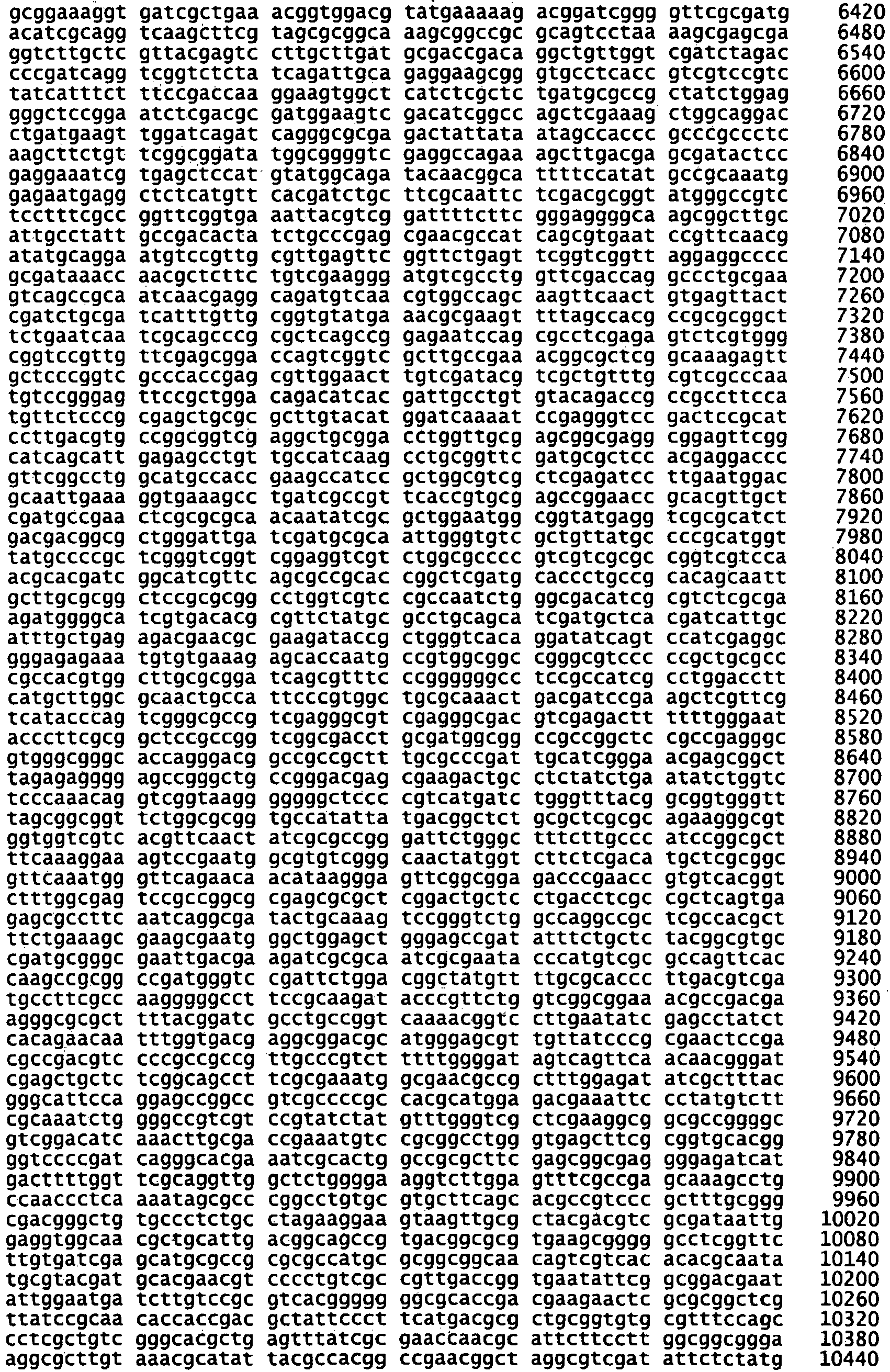
- a fumonisin catabolic gene cluster is shown as a partial sequence of 15420 base pairs of a microbial strain having the accession number DSM 16254.
- DSM 16254 transcription of the open reading frames is controlled by a bidirectional promoter located between fumA and fumI .
- the cluster encodes proteins involved in the regulation of gene expression, such as FumB and FumC, in substrate recognition and transport, such as FumJ, FumA and FumG and in a substrate catabolism such as FumD, FumE, FumF, FumH, FumI and FumK are involved.
- Example 1 The enzyme kinetics of fumonisin carboxylesterase
- the fumD gene (Sequence ID No. 8), which encodes a fumonisin carboxylesterase, was cloned and expressed in Pichia pastoris using standard methods. The his-tagged enzyme was recovered and purified from the supernatant solution of the culture by affinity chromatography. The enzyme concentration was determined and the enzyme kinetic parameters were determined with seven different substrate concentrations ranging between 50 ⁇ g to 25 mg FB 1 per liter and an enzyme concentration of 0.33 ng / ml. The reactions were buffered in 20 mM Tris-Cl (pH 8.0) buffer containing 0.1 mg / ml bovine serum albumin and incubated at 30 ° C.
- Fig. 2 Figure 4 shows the Michaelis-Menten curve for the transformation of fumonisin B1 (FB1) by fumonisin carboxylesterase FumD, which was determined at an enzyme concentration of 0.33 ng / ml in Tris-Cl buffer (pH 8.0) Enzyme velocities were plotted against the substrate concentration.
- the Michaelis-Menten curve shows a decrease at higher substrate concentrations since the enzyme rate was calculated based on the product, ie hydrolyzed FB 1 formation.
- Fig. 2 shows that fumonisins can be hydrolyzed rapidly and completely with the carboxylesterase in the relevant concentration ranges.
- Example 2 The catalytic activity of hydrolysed fumonisin aminotransferase
- Sequence ID no. 18 was cloned using standard methods and expressed in E. coli under the control of a bacteriophage T7 promoter. The bacterial cells were collected in 50 mM sodium phosphate buffer, resuspended and lysed by sonication. Hydrolyzed fumonisin was added and the samples were incubated at 25 ° C. Samples were taken at time intervals and analyzed by HPLC-MS / MS. No reduction of the hydrolyzed FB 1 concentration was observed.
- Teorell-Stenhagen buffer was used. This buffer can be adjusted by the combination of citrate, phosphate and borate over a range of 10 pH units with the same buffer capacity. FUM carboxylesterase was incubated at a concentration of 3.3 ng / ml with 10 ppm fumonisin B1 at various pHs in this buffer at 25 ° C. The highest activity was found at pH 8.0, but activity could be detected throughout the range of pH 5 to pH 10. The activity in this broad pH range enables the technological use of the enzyme as a feed additive or in the processing of food and feed.
- Example 6 Feeding experiment with piglets
- the experiment was carried out in a test house with 12 bays for every 10 animals.
- the stable was equipped with slatted floor, shell drinkers and a computer-controlled feeding system.
- the machines were arranged along the bay walls.
- the barn climate was automatically recorded daily and the temperature was set according to the standard recommendations for piglet rearing.
- the piglets were fed for 2 days with a starter feed, after this acclimatization phase, the switch to the experimental feed. Feeding took place in two phases: weaning phase on day 1 - 14, rearing phase on day 15 - 42.
- the test fodder was mixed individually on the spotmix feeding system and allocated dry twice a day depending on the number of piglets, weight development and food consumption. Water was available for ad libitum.
Landscapes
- Life Sciences & Earth Sciences (AREA)
- Chemical & Material Sciences (AREA)
- Health & Medical Sciences (AREA)
- Genetics & Genomics (AREA)
- Organic Chemistry (AREA)
- Engineering & Computer Science (AREA)
- Bioinformatics & Cheminformatics (AREA)
- Zoology (AREA)
- Wood Science & Technology (AREA)
- Molecular Biology (AREA)
- Microbiology (AREA)
- Biotechnology (AREA)
- Biomedical Technology (AREA)
- Biochemistry (AREA)
- General Engineering & Computer Science (AREA)
- General Health & Medical Sciences (AREA)
- Medicinal Chemistry (AREA)
- Enzymes And Modification Thereof (AREA)
- Micro-Organisms Or Cultivation Processes Thereof (AREA)
Description
- Die vorliegende Erfindung bezieht sich auf und einen Futtermittelzusatz zum sauerstoffunabhängigen, enzymatischen Abbau von Fumonisinen, in Futtermitteln bzw. im Verdauungstrakt von Tieren sowie die Verwendung desselben.
- Verschiedenste Mykotoxine treten auf landwirtschaftlichen Produkten sehr häufig auf und verursachen je nach Art der Mykotoxine schwere wirtschaftliche Schäden, insbesondere in den aus den landwirtschaftlichen Produkten hergestellten Nahrungsmitteln und auch bei Tieren und Menschen, welche derartige Nahrungsmittel verzehren, wobei derartige Schäden äußerst vielfältig sind. Es wurden bereits zahlreiche Methoden entwickelt, um zu versuchen, derartige Mykotoxine zu entgiften bzw. abzubauen oder unschädlich zu machen, um die durch die Mykotoxine verursachten Schäden in den Bereichen von tierischer und menschlicher Ernährung, der Tierzucht, Viehwirtschaft, Verarbeitung von Futter und Lebensmittel und dgl. hintanzuhalten.
- Unter den bekannten Mykotoxinen existiert eine Vielzahl von untereinander strukturell verwandten Mykotoxinen, wie beispielsweise die Fumonisine, von welchen Fumonisin B1 das am häufigsten vorkommende Toxin der Gruppe ist. Jedoch sind zahlreiche Derivate und verwandte Moleküle bekannt, welche ebenfalls giftige Wirkungen bei Tieren aufweisen, wie beispielsweise im Zusammenhang mit der Fütterung von kontaminiertem Mais. Fumonisine sind in diesem Zusammenhang eine nahezu allgegenwärtige Kontamination auf Mais, welche aber auch auf anderen Getreiden, Nüssen und Gemüse einen stark negativen Effekt in Bezug auf die Tiergesundheit und Leistung darstellen.
- Der mikrobielle Abbau von Fumonisinen wurde bereits in der
EP 1 860 954 beschrieben, gemäß welcher Mikroorganismen zur Entgiftung von Fumonisinen und Fumonisinderivaten eingesetzt werden, bei welchen die detoxifizierenden Bakterien oder Hefen, gewählt aus genau definierten Stämmen zur Entgiftung von Fumonisinen Futtermitteln zugesetzt werden. - Auch wurden bereits katabolische Stoffwechselwege für den biologischen Abbau von Fumonisinen und die hiefür verantwortlichen Gene und Enzyme beschrieben. So beschreibt beispielsweise die
EP 0 988 383 Fumonisin entgiftende Zusammensetzungen und Verfahren, wobei die eingesetzten, Fumonisin abbauenden Enzyme in erster Linie in transgenen Pflanzen produziert werden, bei welchen die Entgiftung von Fumonisinen mit Hilfe einer Aminooxidase, welche für ihre enzymatische Aktivität molekularen Sauerstoff benötigt, erfolgt. - Des Weiteren beschreibt die
WO 2004/085624 Transaminasen, Deaminasen und Aminomutasen und Zusammensetzungen und Verfahren zur enzymatischen Detoxifizierung, wobei insbesondere aminierte Toxine, beispielsweise Fumonisine, entgiftet werden. In diesem Zusammenhang werden Polypeptide, welche eine Deaminaseaktivität besitzen, zur Entgiftung eingesetzt. - Aus der
WO 00/04158 - Bisher bekannten Verfahren ist jedoch gemeinsam, dass sie für eine Detoxifizierung der Mykotoxine molekularen Sauerstoff für die beschriebenen, katabolischen Stoffwechselwege benötigen, wobei die insbesondere erforderlichen Aminooxidasen unter sauerstoffunabhängigen Bedingungen nicht arbeiten können. Ein Einsatz von derartigen Genen und Enzymen zur Detoxifizierung von Futtermitteln, beispielsweise im Verdauungstrakt von Tieren, ist aufgrund des im wesentlichen sauerstofffreien Milieus in dem Verdauungstrakt von Tieren nicht möglich bzw. zeigen die bekannten Gene oder Enzyme keinerlei Wirkung.
- Die Erfindung zielt nun darauf ab, einen Futtermittelzusatz zur Verfügung zu stellen, mit welchem es sicher und zuverlässig gelingt, Fumonisine im Futtermittel und/oder dem Verdauungstrakt von Tieren unabhängig von Sauerstoff sicher und zuverlässig abzubauen bzw. zu detoxifizieren.
- Als pflanzliche Rohstoffe werden hiebei Getreide bzw. Getreideprodukte, Gräser, Obst oder Gemüse sowie Zwischenprodukte, die diese Rohstoffe zur Herstellung von Nahrungs- und Futtermittel enthalten, wie beispielsweise Silage, Obstmaische oder dgl. verstanden.
- Als Zusatzstoffe werden vor allem Futtermittelzusätze oder Nahrungsmittelzusätze verstanden.
- Die für den Abbau der Fumonisine eingesetzten Nukleinsäuresequenzen bzw. die mittels dieser Nukleinsäuresequenzen in bakteriellen und eukaryotischen Wirtszellen exprimierten, in sauerstoffunabhängigem Milieu sauerstoffunabhängig katalytisch wirkenden Enzyme sind nachfolgend aufgelistet.
-
- >Seq ID 1 (fum (Fumonisinkatabolismus) Gencluster, 15.420 bp)


- >Seq ID 8 (fumD)
>Seq ID 18 (fumI)


-
- >Seq ID 9 (FumD)

- >Seq ID 19 (FumI)

- Indem hierbei das Enzym eine Carboxylesterase Sequenz ID-Nr. 9 ist, können insbesondere Fumonisine vollständig und sauerstoffunabhängig abgebaut werden. In diesem Fall werden aus dem Gencluster der Nukleinsäuresequenz mit der ID-Nr. 1 ausgewählte offene Leserahmen in prokaryotischen oder eukaryotischen Wirtszellen zur Expression gebracht. Im bakteriellen Stamm mit der Hinterlegungsnummer DSM 16254 erfolgt die Transkription der im Gencluster mit der Sequenz ID-Nr. 1 enthaltenen offenen Leserahmen gesteuert bzw. geregelt durch einen bidirektionalen Promotor, der zwischen fumA und fumI, wie dies
Abb. 1 entnehmbar ist, angeordnet ist. Die Gene codieren für Proteine, welche in der Regulierung der Genexpression, wie beispielsweise FumB und FumC, bei der Substraterkennung, dem Transport und im Substratkatabolismus, wie beispielsweise FumD oder FumI involviert sind. Aus den entsprechenden Nukleinsäuresequenzen, welche für spezielle Proteine codieren, wurden gemäß einer bevorzugten Weiterbildung des Verfahrens gemäß der Erfindung die Gene ausgewählt, welche für den Substratkatabolismus verantwortlich sind, wodurch die entsprechenden gebildeten Enzyme das Substrat, nämlich Fumonisine vollständig katabolisieren können. - In der nachfolgenden Tabelle 1 ist die Bezeichnung der Gene des fumonisinkatabolischen Genclusters aufgeführt, wobei O die Orientierung, nämlich f forward und r reverse bedeuten.
Tabelle 1 Gen Sequenz ID O Start Ende Länge Bezeichnung fumD 8 f 8294 9916 1623 Carboxylesterase fumI 18 r 5063 3795 1269 Aminotransferase - Zur Lösung dieser Aufgabe ist ein derartiger Futtermittelzusatz im wesentlichen dadurch gekennzeichnet, dass das Enzym der Sequenz ID-Nr. 9 und 1 sowie gegebenenfalls zusätzlich wenigstens ein Enzym der Sequenz ID-Nr. 19, ein Cosubstrat für wenigstens eines bzw. einige der eingesetzten Enzyme und ein inerter Träger enthalten sind. Ein derartiger Futtermittelzusatz, in dem wenigstens ein Enzym sowie gegebenenfalls zusätzlich wenigstens ein Cosubstrat für wenigstens eines der eingesetzten Enzyme und ein inerter Träger enthalten sind, zeichnet sich dadurch aus, dass er zielgerichtet Mykotoxine, insbesondere Fumonisine im Verdauungstrakt von Tieren abbaut und somit detoxifiziert. Durch den Einsatz eines erfindungsgemäßen Futtermittelzusatzes, welcher im wesentlichen aus isolierten Enzymen sowie gegebenenfalls deren Cosubstraten und Trägern bestehen, ergibt sich der Vorteil, dass diese ihre katalytische Aktivität in einer Umgebung und unter Bedingungen beibehalten, in welchem beispielsweise komplette Mikroorganismen nicht oder nur wenig aktiv wären, wobei gleichzeitig eine bedeutend höhere, spezifische Aktivität erzielt werden kann, sowie definierte Reaktionen unter Vermeidung von unerwünschten Nebenreaktionen katalysiert werden können. Darüber hinaus können Probleme, welche gemäß dem Stand der Technik durch den Einsatz vermehrungsfähiger Keime in den Futtermitteln entstanden sind, mit Sicherheit hintangehalten werden und überdies weisen Futtermittelzusätze, welche nur isolierte Enzyme enthalten, sowohl eine bessere Eignung zur Formulierung für gezielte und kontrollierte Aktivierung, d.h. beispielsweise an einer bestimmten Stelle des Verdauungstrakts, als auch die Vermeidung von unerwünschtem, erhöhtem Substratverbrauch auf. Um die Spezifität noch weiter zu erhöhen, kann der Futtermittelzusatz gemäß der vorliegenden Erfindung dahingehend weitergebildet sein, dass durch molekulargenetische Methoden, Mutagenese oder molekulare Evolution veränderte Enzyme eingesetzt sind.
- Mit einem derartigen Zusatzstoff gelingt es weiterhin, den Sphingolipidstoffwechsel, der durch eine Wechselwirkung der Fumonisine mit dem Enzym Ceramidsynthase behindert wird, aufrecht zu erhalten und gleichzeitig die Fumonisine biologisch zu nicht toxischen Substanzen abzubauen, welche von dem Tier ohne Schädigung ausgeschieden werden können.
- Schließlich können technologische Anwendungen der Detoxifizierung erzielt werden, da dieser Futtermittelzusatz auch im größeren technischen Maßstab anwendbar ist, so dass sicher und zuverlässig die Fumonisine im sauerstoffunabhängigen Milieu enzymatisch abgebaut werden können.
- Indem der Futtermittelzusatz so ausgebildet ist, wie dies einer bevorzugten Weiterbildung der Erfindung entspricht, dass das Enzym mit einer Schutzhülle ummantelt eingesetzt ist, kann sichergestellt werden, dass das Enzym vor einem vorzeitigen Aktivitätsverlust gesichert ist und sicher und zuverlässig an der vorgesehenen Stelle des Magen-Darm-Trakts ihre Wirkung entfaltet.
- Durch Verkapseln des Enzyms in einer Schutzhülle gelingt es, das Enzym ohne Veränderung, insbesondere ohne Abbau und Schädigung an ihren Einsatzort, insbesondere in den Verdauungstrakt von Tieren, zu transportieren, so dass erst nach Auflösung der Schutzhülle, beispielsweise im Magen-Darm-Trakt von Tieren, das Enzym zu wirken beginnt, wodurch ein noch gezielterer, rascherer und vollständiger Abbau der Mykotoxine im sauerstoffunabhängigen bzw. anaeroben Milieu des Magen-Darm-Trakts von Tieren erzielt werden kann.
- Indem der Futtermittelzusatz so ausgebildet ist, dass das Enzym eine Carboxylesterase Sequenz ID-Nr. 9 ist, wird im wesentlichen das zum Substratkatabolismus befähigte Enzym zum Einsatz gebracht, so dass neben einer geringeren Menge an einzusetzendem Enzym auch sichergestellt werden kann, dass keine unerwünschten Nebenreaktionen im Magen-Darm-Trakt von Tieren auftreten.
- Gemäß einer bevorzugten Weiterbildung der Erfindung ist der Futtermittelzusatz so ausgebildet, dass eine Carboxylesterase Sequenz ID-Nr. 9, eine Aminotransferase Sequenz ID-Nr. 19, eine α-Ketosäure als Cosubstrat und ein inerter Träger enthalten sind. Indem der Futtermittelzusatz eine Carboxylesterase, eine Aminotransferase und eine α-Ketosäure als Cosubstrat neben einem inerten Träger aufweist, gelingt es insbesondere, Fumonisine, welche in den Futtermitteln enthalten sind, zuerst zu hydrolysieren, indem von den Fumonisinen Tricarballylsäurereste mit Hilfe einer Carboxylesterase abgespalten werden, und das so gebildete hydrolysierte Fumonisin in weiterer Folge unter Einwirkung der Aminotransferase und der α-Ketosäure als Cosubstrat, im vorliegenden Fall bevorzugt Brenztraubensäure, weiter umzusetzen, indem eine Aminogruppe von dem hydrolysierten Fumonisinmolekül durch eine Ketogruppe ersetzt wird, so dass ein für Tiere völlig ungefährliches 2-Keto-hydrolysiertes Fumonisin entsteht, welches unverändert ausgeschieden werden kann, und als Nebenprodukt Alanin gebildet wird, welches vollständig unschädlich ist und ebenfalls keinerlei negative Eigenschaften auf den Organismus ausübt, so dass ein vollständiger Abbau von Fumonisinen zu unschädlichen Substanzen sichergestellt ist.
- Schließlich zielt die vorliegende Erfindung auf die Verwendung eines Gens mit der Sequenzen ID-Nr. 8 zur Expression der Enzymsequenz ID-Nr. 9 ab. Auch zielt die Erfindung auf die Verwendung des Enzyms der Sequenz ID-Nr. 9 sowie gegebenenfalls des Enzyms Sequenz ID-Nr. 19, sowie einem Cosubstrat zur Herstellung eines Futtermittelzusatzes für Tiere ab. Mit derartig hergestellten Futtermittelzusätzen gelingt ein vollständiger und zuverlässiger Abbau von Fumonisinen im Verdauungstrakt von Tieren, wobei für einen derartigen Abbau im Gegensatz zu aus dem Stand der Technik bekannten Genen keinerlei molekularer Sauerstoff erforderlich ist.
- In bevorzugter Weise werden gemäß der vorliegenden Erfindung ein Cosubstrat, das eine α-Ketosäure ist, und ein inerter Träger eingesetzt, mit welcher Verwendung Fumonisine sicher und zuverlässig im Verdauungstrakt von Tieren zur Gänze zu unschädlichen Bestandteilen abgebaut werden können.
- Die Erfindung wird nachfolgend anhand von Ausführungsbeispielen sowie Figuren näher dargestellt. In diesen zeigt:
-
Fig. 1 den Fumonisin-katabolischen Gencluster, -
Fig. 2 die Michaelis-Menten-Kurve für Fumonisin-Carboxylesterase FumD, und -
Fig. 3 eine Abbaukurve von hydrolysiertem Fumonisin B1. - In
Fig. 1 ist ein Fumonisin katabolischer Gencluster als Teilsequenz von 15420 Basenpaaren eines mikrobiellen Stammes mit der Hinterlegungsnummer DSM 16254 dargestellt. In dem fum-Gencluster des bakteriellen Stammes DSM 16254 wird die Transkription der offenen Leserahmen durch einen bidirektionalen Promotor gesteuert bzw. geregelt, welcher zwischen fumA und fumI angeordnet ist. Der Cluster codiert Proteine, welche in der Regulierung der Genexpression, wie beispielsweise FumB und FumC, in der Substraterkennung und dem Transport, wie beispielsweise FumJ, FumA und FumG und in einem Substratkatabolismus, wie beispielsweise FumD, FumE, FumF, FumH, FumI und FumK involviert sind. - Das fumD Gen (Sequenz ID-Nr. 8), welches eine Fumonisin-Carboxylesterase codiert, wurde kloniert und in Pichia pastoris unter Verwendung von Standardverfahren exprimiert. Das his-getaggte Enzym wurde rückgewonnen und aus der überstehenden Lösung der Kultur durch Affinitätschromatographie gereinigt. Die Enzymkonzentration wurde bestimmt und die enzymkinetischen Parameter wurden mit sieben unterschiedlichen Substratkonzentrationen im Bereich zwischen 50 µg bis 25 mg FB1 pro Liter und einer Enzymkonzentration von 0,33 ng/ml bestimmt. Die Reaktionen wurden in 20 mM Tris-Cl (pH 8,0) Puffer mit 0,1 mg/ml Rinderserumalbumin gepuffert und bei 30 °C inkubiert. Proben wurden nach 0, 30, 60 120 und 240 Minuten Inkubation genommen und durch HPLC-MS/MS analysiert. Fumonisin B1 (FB1) und hydrolysiertes Fumonisin B1 wurden quantifiziert basierend auf einer Kalibrierung mit den gereinigten Referenzsubstanzen und einem vollständig 13C markierten, internen FB1 Standard.
-
Fig. 2 zeigt die Michaelis-Menten-Kurve für die Transformation von Fumonisin B1 (FB1) durch Fumonisin-Carboxylesterase FumD, welche bei einer Enzymkonzentration von 0,33 ng/ml in Tris-Cl-Puffer (pH 8,0) bestimmt wurde, wobei anfängliche Enzymgeschwindigkeiten gegen die Substratkonzentration aufgetragen wurden. Die Michaelis-Menten-Kurve zeigt einen Abfall bei höheren Substratkonzentrationen, da die Enzymgeschwindigkeit basierend auf dem Produkt, d.h. hydrolysierter FB1-Bildung berechnet wurde. Da hydrolysiertes FB1 aus FB1 in einer zweistufigen Reaktion über partiell hydrolysiertes FB1 mit lediglich einer Tricarballylsäure-Seitenkette, die zurückbehalten wurde, und einer Seitenkette ausgebildet wird, die abgespalten wurde, war die Endproduktbildung bei hohen Substratkonzentrationen verzögert. Die Michaelis-Menten-Konstante KM wurde als 0,90 µmol/l berechnet, was 650 ppb äquivalent ist, und die Umwandlungszahl war 900 pro Sekunde. - Aus
Fig. 2 ergibt sich, dass Fumonisine mit der Carboxylesterase in den relevanten Konzentrationsbereichen rasch und vollständig hydrolysiert werden können. - Sequenz ID-Nr. 18 wurde unter Verwendung von Standardverfahren kloniert und in E. coli exprimiert unter Steuerung bzw. Regelung eines Bakteriophagen T7 Promotors. Die Bakterienzellen wurden gesammelt in 50 mM Natriumphosphatpuffer, neuerlich suspendiert und durch Ultraschall lysiert. Hydrolysiertes Fumonisin wurde hinzugefügt und die Proben wurden bei 25 °C inkubiert. Proben wurden in Zeitintervallen genommen und durch HPLC-MS/MS analysiert. Es wurde keine Reduktion der hydrolysierten FB1 Konzentration beobachtet. Wenn ein Cosubstrat, wie beispielsweise eine α-Ketosäure, wie Brenztraubensäure oder Oxalacetat zu der Reaktion hinzugefügt wurde, konnte ein vollständiger Abbau des hydrolysierten Fumonisins zu 2-Keto-HFB1 beobachtet werden, wie dies in
Fig. 3 dargestellt ist. Diese Substanz ist für Tiere vollständig unschädlich. - Zur Überprüfung der enzymatischen Aktivität von FUM-Carboxylesterase im Verdauungstrakt wurden schlachtfrische Schweinedärme verwendet und unter Ausschluss von Sauerstoff ins Labor transportiert und in einer anaeroben Sterilwerkbank untersucht. Etwa 10cm lange Stücke von Duodenum und Jejunum wurden abgebunden und herausgeschnitten. Mit Kanülen wurde Fumonisin B1 in konzentrierter wässriger Lösung auf eine Endkonzentration von etwa 10 ppm eingespritzt und mit Darminhalt vermischt. Anschließend wurden 5 µg Fumonisin-Carboxylesterase in wässriger Lösung, bzw. dasselbe Volumen Wasser in den Negativkontrollen, eingespritzt und eingemischt. Die Darmabschnitte wurden bei 39 °C inkubiert. Mit Hilfe von Kanülen wurden Proben gezogen und durch HPLC-MS/MS analysiert. Dabei zeigte sich, dass Fumonisin B1 im Duodenum und Jejunum zum Zeitpunkt der ersten Probenahme nach zwei Stunden bereits vollständig hydrolysiert war.
- Zur Ermittlung des Temperaturbereichs, in dem Fumonisin-Carboxylesterase aktiv ist, wurden 1,6 ng/ml FUM-Carboxylesterase in 20 mM Tris-Cl Puffer, pH 7,0, mit 0,1 mg/ml BSA und 10 ppm Fumonisin B1 bei unterschiedlichen Temperaturen inkubiert. Dabei zeigte sich, dass das Temperaturoptimum für das Enzym bei 30 °C lag. Auch bei 40 °C und sogar 50 °C wurde enzymatische Aktivität noch eindeutig festgestellt. Somit ist diese FUM-Carboxylesterase zur Anwendung unter den Temperaturbedingungen wie im Verdauungstrakt, oder im Zuge von Prozessschritten der Lebens- oder Futtermittelherstellung, die bei erhöhter Temperatur stattfinden, geeignet.
- Zur Bestimmung des pH-Bereichs, in dem Fumonisin-Carboxylesterase aktiv ist, wurde Teorell-Stenhagen-Puffer verwendet. Dieser Puffer lässt sich durch die Kombination von Citrat, Phosphat und Borat über einen Bereich von 10 pH Einheiten mit gleicher Pufferkapazität einstellen. FUM-Carboxylesterase wurde in einer Konzentration von 3,3 ng/ml mit 10 ppm Fumonisin B1 bei verschiedenen pH-Werten in diesem Puffer bei 25 °C inkubiert. Die höchste Aktivität zeigte sich bei pH 8,0, aber es konnte im gesamten Bereich von pH 5 bis pH 10 Aktivität festgestellt werden. Durch die Aktivität in diesem breiten pH-Bereich wird die technologische Anwendung des Enzyms als Futtermittelzusatz bzw. in Zuge der Verarbeitung von Lebens- und Futtermitteln ermöglicht.
- Der Versuch wurde in einem Versuchsstall mit 12 Buchten für jeweils 10 Tiere durchgeführt. Der Stall war ausgestattet mit Spaltenboden, Schalentränkern und einem computergesteuerten Fütterungssystem. Die Automaten waren entlang der Buchtenwände angeordnet. Das Stallklima wurde täglich automatisch aufgezeichnet und die Temperatur nach den Standardempfehlungen zur Ferkelaufzucht eingestellt.
- 120 gemischt-geschlechtliche Absetzferkel (Alter: ca. 4 Wochen, durchschnittliches Einstellgewicht 8,21 kg) wurden für diesen Versuch eingesetzt. Jedes Ferkel wurde mit einer Ohrmarke versehen und einzeln gewogen. Die 120 Ferkel wurden auf 12 Buchten zufällig verteilt. Alle Ferkel entstammten dem österreichischen Zuchtprogramm ÖHYB (= (Edelschwein x Landrasse) x Pietrain).
- Direkt nach dem Absetzen wurden die Ferkel für 2 Tage mit einem Starterfutter gefüttert, nach dieser Eingewöhnungsphase erfolgte die Umstellung auf das Versuchsfutter. Die Fütterung erfolgte 2-phasig: Absetzphase Tag 1 - 14, Aufzuchtphase Tag 15 - 42. Das Versuchsfutter wurde buchtenindividuell über die Spotmix-Fütterungsanlage gemischt und je nach Anzahl der Ferkel, Gewichtsentwicklung und Futterverzehr zweimal täglich trocken zugeteilt. Wasser stand zur Aufnahme ad libitum zur Verfügung. Die 12 Buchten wurden in vier verschiedene Applikationsgruppen zu je drei Wiederholungen geteilt und erhielten die folgenden Einmischungen ins oben beschriebene Futter:
Gruppe Negativ-Kontrolle Keine Toxine, kein Enzymzusatz Positiv-Kontrolle 4 - 5,5 ppm Fumonisin B1 Versuchsgruppe 1 4 - 5,5 ppm Fumonisin B1 + Enzymmix 1 (Carboxylesterase, Aminotransferase, Pyruvat) 0,5 kg/t Futter Versuchsgruppe 2 4 - 5,5 ppm Fumonisin B1 + Enzymmix 1 (Carboxylesterase, Aminotransferase, Pyruvat, inerter Carrier) 1 kg/t Futter - In der Positiv-Kontrolle wurden bei fast der Hälfte der Tiere respiratorische Probleme beobachtet, wobei es auch zu einem Ausfall kam. Alle anderen Gruppen erschienen gesund.
-
Gruppe Anzahl der Tiere Anfangsgewicht (Durchschnitt, kg) Endgewicht (Durchschnitt, kg) Ausfälle Negativ-Kontrolle 30 8,34 26,82 Positiv-Kontrolle 30 8,17 24,77 1 Versuchsgruppe 1 30 8,08 26,69 Versuchsgruppe 2 30 8,25 27,03 -
Organization Applicant
- Street : Industriestraße 21
- City : Herzogenburg
- State :
- Country : Austria
- PostalCode : 3130
- PhoneNumber :
- FaxNumber :
- EmailAddress :
- <110> OrganizationName : Biomin Holding GmbH
Application Project - <120> Title : verfahren zur Herstellung eines Futtermittelzusatzes zum sauerstoffunabhängigen, enzymatischen Abbau von Mykotoxinen sowie Futtermittelzusatz und Verwendung desselben
- <130> AppFileReference : P04568
- <140> CurrentAppNumber :
<141> CurrentFilingDate : __-_-_
Earlier Applications - <150> PriorAppNumber : AT GM502/2008
<151> PriorFilingDate : 2008-09-18 - Sequence
- <213> OrganismName : Sphingopyxis sp.
- <400> PreSequenceString :




- <212> Type : DNA
- <211> Length : 15420
SequenceName : sequence 1
SequenceDescription :
Feature - Sequence: sequence 1:
- <221> FeatureKey : Seq ID 1 (fum) <222> LocationFrom : 1
- <222> LocationTo : 15420
Other Information :
CDSJoin : No - Sequence
- <213> OrganismName : Sphingopyxis sp.
- <400> PreSequenceString :

- <212> Type : DNA
- <211> Length : 1182
SequenceName : sequence 2
SequenceDescription : - Feature
- Sequence: sequence 2:
- <221> FeatureKey : Seq ID 2 (fumA)
- <222> LocationFrom : 1
- <222> LocationTo : 1182
Other Information :
CDSJoin : No - Datebase
- Sequence: sequence 2:
- <308> DBAccessionNumber : FJ426269
- <309> DBEntryDate : 2009-06-11
- <313> From : 1
- <313> To : 1182
- Sequence
- <213> OrganismName : Sphingopyxis sp.
- <400> PresequenceString :

- <212> Type : PRT
- <211> Length : 393
SequenceName : sequence 3
SequenceDescription : - Feature
- Sequence: sequence 3:
- <221> FeatureKey : Seq ID 3 (FumA)
- <222> LocationFrom : 1
- <222> LocationTo : 393
Other Information :
CDSJoin : No - Datebase
- Sequence: sequence 3:
- <308> DBAccessionNumber : FJ426269
- <309> DBEntryDate : 2009-06-11
- <313> From : 1
- <313> To : 393
- Sequence
- <213> OrganismName : Sphingopyxis sp.
- <400> PreSequenceString :

- <212> Type : DNA
- <211> Length : 651
SequenceName : sequence 4
SequenceDescription : - Feature
- Sequence: sequence 4:
- <221> FeatureKey : Seq ID 4 (fumB)
- <222> LocationFrom : 1
- <222> LocationTo : 651
Other Information :
CDSJoin : No - Datebase
- Sequence: sequence 4:
- <308> DBAccessionNumber : FJ426269
- <309> DBEntryDate : 2009-06-11
- <313> From : 1
- <313> To : 651
- Sequence
- <213> OrganismName : Sphingopyxis sp.
- <400> PreSequenceString :

- <212> Type : PRT
- <211> Length : 216
SequenceName : sequence 5
SequenceDescription : - Feature
- Sequence: sequence 5:
- <221> FeatureKey : Seq ID 5 (FumB)
- <222> LocationFrom : 1
- <222> LocationTo : 216
Other Information :
CDSJoin : No - Datebase
- Sequence: sequence 5:
- <308> DBAccessionNumber : FJ426269
- <309> DBEntryDate : 2009-06-11
- <313> From : 1
- <313> To : 216
- Sequence
- <213> OrganismName : Sphingopyxis sp.
- <400> PreSequenceString :
- <212> Type : DNA
- <211> Length : 945
SequenceName : sequence 6
SequenceDescription : - Feature
- Sequence: sequence 6:
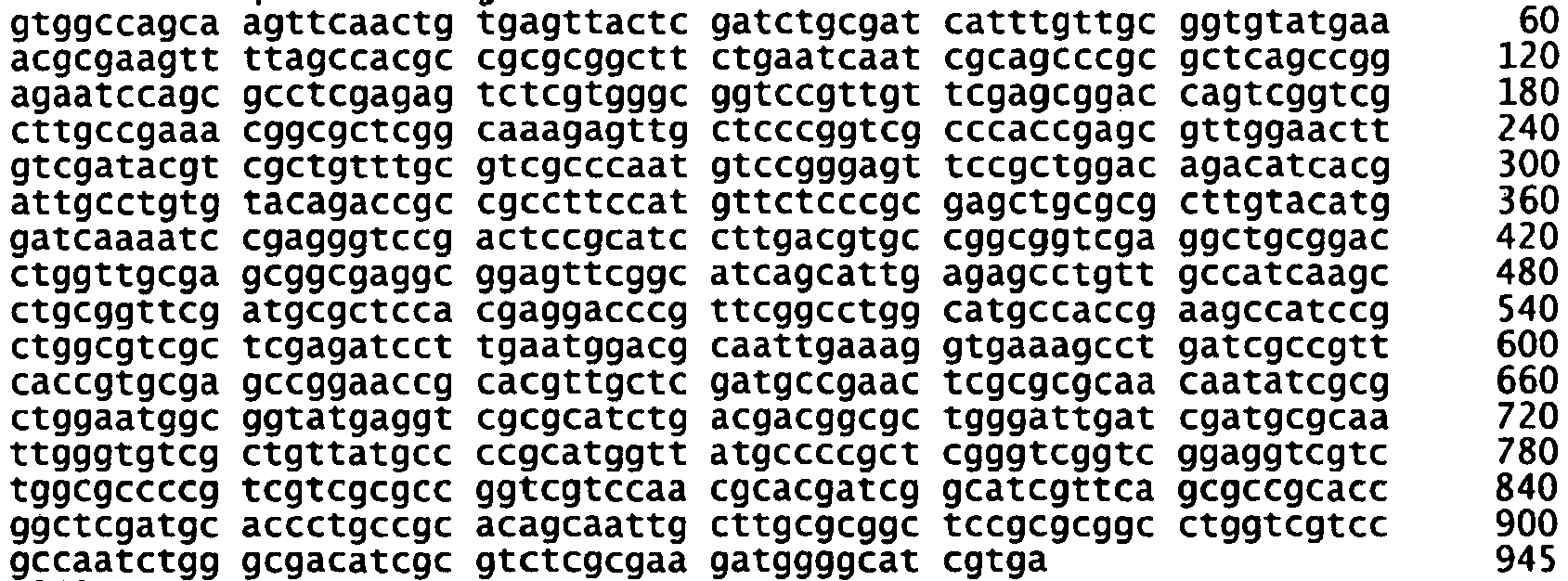
- <221> FeatureKey : seq ID 6 (fumC)
- <222> LocationFrom : 1
- <222> LocationTo : 945
Other Information :
COSJoin : No - Datebase
- Sequence: sequence 6:
- <308> DBAccessionNumber : FJ426269
- <309> DBEntryDate : 2009-06-11
- <313> From : 1
- <313> To : 945
- Sequence
- <213> OrganismName : Sphingopyxis sp.
- <400> PreSequenceString :

- <212> Type : PRT
- <211> Length : 314 SequenceName : sequence 7 SequenceDescription :
- Feature
- Sequence: sequence 7:
- <221> FeatureKey : Seq ID 7 (FumC)
- <222> LocationFrom : 1
- <222> LocationTo : 314
Other Information :
CDSJoin : No - Datebase
- Sequence: sequence 7:
- <308> DBAccessionNumber : FJ426269
- <309> DBEntryDate : 2009-06-11
- <313> From : 1
- <313> To : 314
- Sequence
- <213> OrganismName : Sphingopyxis sp.
- <400> PreSequenceString :


- <212> Type : DNA
- <211> Length : 1623
SequenceName : sequence 8
SequenceDescription : - Feature
- Sequence: sequence 8:
- <221> FeatureKey : Seq ID 8 (fumD)
- <222> LocationFrom : 1
- <222> LocationTo : 1623
Other Information :
CDSJoin : No - Datebase
- Sequence: sequence 8:
- <308> DBAccessionNumber : FJ426269
- <309> DBEntryDate : 2009-06-11
- <313> From : 1
- <313> To : 1623
- Sequence
- <213> OrganismName : Sphingopyxis sp.
- <400> PreSequenceString :

- <212> Type : PRT
- <211> Length : 540
SequenceName : sequence 9
SequenceDescription : - Feature
- Sequence: sequence 9:
- <221> FeatureKey : Seq ID 9 (FumD)
- <222> LocationFrom : 1
- <222> LocationTo : 540
Other Information
CDSJoin : No - Datebase
- Sequence: sequence 9:
- <308> DBAccessionNumber : FJ426269
- <309> DBEntryDate : 2009-06-11
- <313> From : 1
- <313> To : 540
- Sequence
- <213> OrganismName : Sphingopyxis sp.
- <400> PreSequenceString :

- <212> Type : DNA
- <211> Length : 1503
SequenceName : sequence 10
SequenceDescription : - Feature
- Sequence: sequence 10:
- <221> FeatureKey : Seq ID 10 (fumE)
- <222> LocationFrom : 1
- <222> LocationTo : 1503
Other Information :
CDSJoin : No - Datebase
- Sequence: sequence 10:
- <308> DBAccessionNumber : FJ426269
- <309> DBEntryDate : 2009-06-11
- <313> From : 1
- <313> To : 1503
- Sequence
- <213> OrganismName : Sphingopyxis sp.
- <400> PreSequenceString :

- <212> Type : PRT
- <211> Length : 500
SequenceName : sequence 11
SequenceDescription : - Feature
- Sequence: sequence 11:
- <221> FeatureKey : Seq ID 11 (FumE)
- <222> LocationFrom : 1
- <222> LocationTo : 500
Other Information :
CDSJoin : No - Datebase
- Sequence: sequence 11:
- <308> DBAccessionNumber : FJ426269
- <309> DBEntryDate : 2009-06-11
- <313> From : 1
- <313> To : 500
- Sequence
- <213> OrganismName : Sphingopyxis sp.
- <400> PreSequenceString :

- <212> Type : DNA
- <211> Length : 1173
SequenceName : sequence 12
SequenceDescription : - Feature
- Sequence: sequence 12:
- <221> FeatureKey : Seq ID 12 (fumF)
- <222> LocationFrom : 1
- <222> LocationTo : 1173
Other Information :
CDSJoin : No - Datebase
- Sequence: sequence 12:
- <308> DBAccessionNumber : FJ426269
- <309> DBEntryDate : 2009-06-11
- <313> From : 1
- <313> To : 1173
- Sequence
- <213> OrganismName : Sphingopyxis sp.
- <400> PreSequenceString :

- <212> Type : PRT
- <211> Length : 390 SequenceName : sequence 13 SequenceDescription :
- Feature
- Sequence: sequence 13:
- <221> FeatureKey : Seq ID 13 (FumF)
- <222> LocationFrom : 1
- <222> LocationTo : 390
Other Information :
CDSJoin : No - Datebase
- Sequence: sequence 13:
- <308> DBAccessionNumber : FJ426269
- <309> DBEntryDate : 2009-06-11
- <313> From : 1
- <313> To : 390
- Sequence
- <213> OrganismName : Sphingopyxis sp.
- <400> PreSequenceString :

- <212> Type : DNA
- <211> Length : 1296
SequenceName : sequence 14
SequenceDescription : - Feature
- Sequence: sequence 14:
- <221> FeatureKey : Seq ID 14 (fumG)
- <222> LocationFrom : 1
- <222> LocationTo : 1296
Other Information :
CDSJoin : No - Datebase
- Sequence: sequence 14:
- <308> DBAccessionNumber : FJ426269
- <309> DBEntryDate : 2009-06-11
- <313> From : 1
- <313> To : 1296
- Sequence
- <213> OrganismName : Sphingopyxis sp.
- <400> PreSequenceString :

- <212> Type : PRT
- <211> Length : 431
SequenceName : sequence 15
SequenceDescription : - Feature
- Sequence: sequence 15:
- <221> FeatureKey : Seq ID 15 (FumG)
- <222> LocationFrom : 1
- <222> LocationTo : 431
Other Information :
CDSJoin : No - Datebase
- Sequence: sequence 15:
- <308> DBAccessionNumber : FJ426269
- <309> DBEntryDate : 2009-06-11
- <313> From : 1
- <313> To : 431
- Sequence
- <213> OrganismName : Sphingopyxis sp.
- <400> PreSequenceString :

- <212> Type : DNA
- <211> Length : 1071
SequenceName : sequence 16
SequenceDescription : - Feature
- Sequence: sequence 16:
- <221> FeatureKey : Seq ID 16 (fumH) <222> LocationFrom : 1
- <222> LocationTo : 1071
Other Information :
CDSJoin : No - Datebase
- Sequence: sequence 16:
- <308> DBAccessionNumber : FJ426269
- <309> DBEntryDate : 2009-06-11
- <313> From : 1
- <313> To : 1071
- Sequence
- <213> OrganismName : Sphingopyxis sp.
- <400> PreSequenceString :

- <212> Type : PRT
- <211> Length : 356
SequenceName : sequence 17
SequenceDescription : - Feature
- Sequence: sequence 17:
- <221> FeatureKey : Seq ID 17 (FumH)
- <222> LocationFrom : 1
- <222> LocationTo : 356
Other Information :
CDSJoin : No - Datebase
- Sequence: sequence 17:
- <308> DBAccessionNumber : FJ426269 <309> DBEntryDate : 2009-06-11
- <313> From : 1
- <313> To : 356
- Sequence
- <213> OrganismName : Sphingopyxis sp.
- <400> PreSequenceString :


- <212> Type : DNA
- <211> Length : 1269
SequenceName : sequence 18
SequenceDescription : - Feature
- Sequence: sequence 18:
- <221> FeatureKey : Seq ID 18 (fumI)
- <222> LocationFrom : 1
- <222> LocationTo : 1269
Other Information :
CDSJoin : No - Datebase
- Sequence: sequence 18:
- <308> DBAccessionNumber : FJ426269 <309> DBEntryDate : 2009-06-11
- <313> From : 1
- <313> To : 1269
- Sequence
- <213> OrganismName : Sphingopyxis sp.
- <400> PreSequenceString :

- <212> Type : PRT
- <211> Length : 422
SequenceName : sequence 19
SequenceDescription : - Feature
- Sequence: sequence 19:
- <221> FeatureKey : Seq ID 19 (FumI)
- <222> LocationFrom : 1
- <222> LocationTo : 422
Other Information :
CDSJoin : No - Datebase
- Sequence: sequence 19:
- <308> DBAccessionNumber : FJ426269
- <309> DBEntryDate : 2009-06-11
- <313> From : 1 <313> To : 422
- Sequence
- <213> OrganismName : Sphingopyxis sp.
- <400> PreSequenceString :

- <212> Type : DNA
- <211> Length : 2835
SequenceName : sequence 20
SequenceDescription : - Feature
- Sequence: sequence 20:
- <221> FeatureKey : Seq ID 20 (fumJ)
- <222> LocationFrom : 1
- <222> LocationTo : 2835
Other Information
CDSJoin : No - Datebase
- Sequence: sequence 20:
- <308> DBAccessionNumber : FJ426269
- <309> DBEntryDate : 2009-06-11
- <313> From : 1
- <313> To : 2835
- Sequence
- <213> OrganismName : Sphingopyxis sp.
- <400> PreSequenceString :

- <212> Type : PRT
- <211> Length : 944
SequenceName : sequence 21
SequenceDescription : - Feature
- Sequence: sequence 21:
- <221> FeatureKey : Seq ID 21 (FumJ)
- <222> LocationFrom : 1
- <222> LocationTo : 944
Other Information :
CDSJoin : No - Datebase
- Sequence: sequence 21:
- <308> DBAccessionNumber : FJ426269
- <309> DBEntryDate : 2009-06-11
- <313> From : 1
- <313> To : 944
- Sequence
- <213> OrganismName : Sphingopyxis sp.
- <400> PreSequenceString :

- <212> Type : DNA
- <211> Length : 417
SequenceName : sequence 22
SequenceDescription : - Feature
- Sequence: sequence 22:
- <221> FeatureKey : Seq ID 22 (fumK)
- <222> LocationFrom : 1
- <222> LocationTo : 417
Other Information :
CDsJoin : No - Datebase
- Sequence: sequence 22:
- <308> DBAccessionNumber : FJ426269
- <309> DBEntryDate : 2009-06-11
- <313> From : 1
- <313> To : 417
- Sequence
- <213> OrganismName : Sphingopyxis sp.
- <400> PreSequenceString :

- <212> Type : PRT
- <211> Length : 139
SequenceName : sequence 23
sequenceDescription : - Feature
- Sequence: sequence 23:
- <221> FeatureKey : Seq ID 23 (FumK)
- <222> LocationFrom : 1
- <222> LocationTo : 139
Other Information :
CDSJoin : No - Datebase
- Sequence: sequence 23:
- <308> DBAccessionNumber : FJ426269
- <309> DBEntryDate : 2009-06-11
- <313> From : 1
- <313> To : 139
- Sequence
- <213> OrganismName : Caulobacter sp.
- <400> PreSequenceString :


- <212> Type : DNA
- <211> Length : 1272
SequenceName : sequence 24
SequenceDescription : - Feature
- Sequence: sequence 24:
- <221> FeatureKey : Seq ID 24
- <222> LocationFrom : 1
- <222> LocationTo : 1272
Other Information :
CDSJoin : No - Datebase
- Sequence: sequence 24:
- <308> DBAccessionNumber : FJ426269
- <309> DBEntryDate : 2009-06-11
- <313> From : 1
- <313> To : 1272
- Sequence
- <213> OrganismName : Caulobacter sp.
- <400> PreSequenceString :

- <212> Type : PRT
- <211> Length : 423
SequenceName : sequence 25
SequenceDescription : - Feature
- sequence: sequence 25:
- <221> FeatureKey : Seq ID 25
- <222> LocationFrom : 1
- <222> LocationTo : 423
Other Information :
CDSJoin : No - Datebase
- Sequence: sequence 25:
- <308> DBAccessionNumber : FJ426269
- <309> DBEntryDate : 2009-06-11
- <313> From : 1
- <313> To : 423
Claims (6)
- Futtermittelzusatz geeignet zum sauerstoffunabhängigen, enzymatischen Abbau von Fumonisinen, in Futtermitteln bzw. im Verdauungstrakt von Tieren, dadurch gekennzeichnet, dass ein Enzym der Sequenz ID-Nr. 9 sowie gegebenenfalls zusätzlich ein Enzym der Sequenz ID-Nr. 19, ein Cosubstrat für das eingesetzte Enzym und ein inerter Träger enthalten sind.
- Futtermittelzusatz nach Anspruch 1, dadurch gekennzeichnet, dass das Enzym in einer Schutzhülle verkapselt einigesetzt ist.
- Futtermittelzusatz nach Anspruch 1 oder 2, dadurch gekennzeichnet, dass eine Carboxylesterase der Sequenz ID-Nr. 9, eine Aminotransferase der Sequenz ID-Nr. 19, eine α-Ketosäure als Cosubstrat und ein inerter Träger enthalten sind.
- Verwendung eines Gens mit der Sequenz ID-Nr. 8 zur Expression einer Enzymsequenz der Sequenz ID-Nr. 9.
- Verwendung des Enzyms der Sequenz ID-Nr. 9 sowie gegebenenfalls des Enzyms der Sequenz ID-Nr. 19 und eines Cosubstrates zur Herstellung eines Futtermittelzusatzes für Tiere.
- Verwendung nach Anspruch 5, dadurch gekennzeichnet, dass das Cosubstrat eine α-Ketosäure ist und ein inerter Träger eingesetzt wird.
Applications Claiming Priority (2)
| Application Number | Priority Date | Filing Date | Title |
|---|---|---|---|
| AT5022008 | 2008-09-18 | ||
| PCT/AT2009/000363 WO2010031100A1 (de) | 2008-09-18 | 2009-09-18 | Verfahren zur herstellung eines futtermittelzusatzes zum sauerstoffunabhängigen, enzymatischen abbau von mykotoxinen sowie futtermittelzusatz und verwendung desselben |
Publications (3)
| Publication Number | Publication Date |
|---|---|
| EP2326714A1 EP2326714A1 (de) | 2011-06-01 |
| EP2326714B1 true EP2326714B1 (de) | 2015-11-25 |
| EP2326714B8 EP2326714B8 (de) | 2016-01-06 |
Family
ID=42038994
Family Applications (1)
| Application Number | Title | Priority Date | Filing Date |
|---|---|---|---|
| EP09775637.3A Not-in-force EP2326714B8 (de) | 2008-09-18 | 2009-09-18 | Verfahren zur herstellung eines futtermittelzusatzes zum sauerstoffunabhängigen, enzymatischen abbau von mykotoxinen sowie futtermittelzusatz und verwendung desselben |
Country Status (2)
| Country | Link |
|---|---|
| EP (1) | EP2326714B8 (de) |
| WO (1) | WO2010031100A1 (de) |
Cited By (1)
| Publication number | Priority date | Publication date | Assignee | Title |
|---|---|---|---|---|
| WO2024144351A1 (ko) * | 2022-12-29 | 2024-07-04 | 씨제이제일제당 (주) | 활성이 개선된 푸모니신 분해 효소 및 그의 용도 |
Families Citing this family (2)
| Publication number | Priority date | Publication date | Assignee | Title |
|---|---|---|---|---|
| CA2976514C (en) * | 2015-02-24 | 2022-08-16 | Erber Aktiengesellschaft | Fusarium toxin-cleaving polypeptide variants, additive containing the same, and use of the same, and method for cleaving fusarium toxins |
| KR102945156B1 (ko) * | 2022-12-29 | 2026-03-30 | 씨제이제일제당 주식회사 | 신규 푸모니신 분해 효소 및 그의 용도 |
Family Cites Families (5)
| Publication number | Priority date | Publication date | Assignee | Title |
|---|---|---|---|---|
| PT988383E (pt) | 1997-07-07 | 2003-02-28 | Pioneer Hi Bred Int | Composicoes e metodos para eliminar a toxicidade da fumonisina |
| WO2000004160A1 (en) * | 1998-07-15 | 2000-01-27 | Pioneer Hi-Bred International, Inc. | Amino polyol amine oxidase polynucleotides and related polypeptides and methods of use |
| US6538177B1 (en) | 1998-07-15 | 2003-03-25 | Pioneer Hi-Bred International, Inc. | Compositions and methods for fumonisin detoxification |
| WO2004085624A2 (en) | 2003-03-24 | 2004-10-07 | Diversa Corporation | Transaminases, deaminases and aminomutases and compositions and methods for enzymatic detoxification |
| AT501359B1 (de) | 2004-11-16 | 2007-10-15 | Erber Ag | Verfahren und mikroorganismus zur entgiftung von fumonisinen sowie verwendung und futtermittelzusatz |
-
2009
- 2009-09-18 EP EP09775637.3A patent/EP2326714B8/de not_active Not-in-force
- 2009-09-18 WO PCT/AT2009/000363 patent/WO2010031100A1/de not_active Ceased
Cited By (1)
| Publication number | Priority date | Publication date | Assignee | Title |
|---|---|---|---|---|
| WO2024144351A1 (ko) * | 2022-12-29 | 2024-07-04 | 씨제이제일제당 (주) | 활성이 개선된 푸모니신 분해 효소 및 그의 용도 |
Also Published As
| Publication number | Publication date |
|---|---|
| EP2326714B8 (de) | 2016-01-06 |
| EP2326714A1 (de) | 2011-06-01 |
| WO2010031100A1 (de) | 2010-03-25 |
Similar Documents
| Publication | Publication Date | Title |
|---|---|---|
| EP2326713B1 (de) | Verfahren zur herstellung eines zuatzstoffes für den enzymatischen abbau von mykotoxinen sowie zusatzstoff und verwendung desselben | |
| EP3039135B1 (de) | Polypeptid zur hydrolytischen spaltung von zearalenon und/oder zearalenon-derivaten, isoliertes polynukleotid davon sowie einen zusatzstoff enthaltendes polypeptid, verwendung desselben sowie verfahren | |
| AT413540B (de) | Mikroorganismus, welcher ochratoxine sowie ochratoxine und zearalenone entgiftet, sowie verfahren und verwendung hiefür | |
| EP1860954B1 (de) | Mikroorganismus zur entgiftung von fumonisinen sowie verwendung desselben, verfahren zum entgiften von fumonisinen und futtermittelzusatz, enthaltend den mikroorganismus | |
| EP2790527B1 (de) | Zusatzstoff für selen-haltige futtermittel | |
| EP2312955B1 (de) | Verfahren zur behandlung von futtersilage für wiederkäuer sowie futtersilagezusatz | |
| EP3273802B1 (de) | Verwendung einer trichothecene transformierenden alkoholdehydrogenase, verfahren zur transformation von trichothecenen sowie trichothecene transformierender zusatzstoff | |
| EP2326714B1 (de) | Verfahren zur herstellung eines futtermittelzusatzes zum sauerstoffunabhängigen, enzymatischen abbau von mykotoxinen sowie futtermittelzusatz und verwendung desselben | |
| AT513473B1 (de) | Enzyme zur Transformation von Ergopeptinen sowie Verfahren hierfür | |
| DE10105306A1 (de) | Futtermittel für die Nutztieraufzucht enthaltend Sorbinsäure und Enzyme | |
| AT512259B1 (de) | Zusatzstoff für Selen-haltige Futtermittel | |
| LV12340B (en) | SUPPLEMENTARY FEEDBACK, METHOD OF APPLICATION AND APPLICATION \ t | |
| CN113749187A (zh) | 含过氧化氢酶的葡萄糖氧化酶饲料添加剂的生产方法 | |
| AT507364B1 (de) | Verfahren zur herstellung eines futtermittelzusatzes zum sauerstoffunabhängigen, enzymatischen abbau von mykotoxinen sowie futtermittelzusatz und verwendung desselben | |
| AT507363B1 (de) | Verfahren zur herstellung eines zusatzstoffes für den enzymatischen abbau von mykotoxinen sowie zusatzstoff und verwendung desselben | |
| KR20220013138A (ko) | 아미노산-미네랄 복합제 및 그 제조방법 |
Legal Events
| Date | Code | Title | Description |
|---|---|---|---|
| PUAI | Public reference made under article 153(3) epc to a published international application that has entered the european phase |
Free format text: ORIGINAL CODE: 0009012 |
|
| 17P | Request for examination filed |
Effective date: 20110413 |
|
| AK | Designated contracting states |
Kind code of ref document: A1 Designated state(s): AT BE BG CH CY CZ DE DK EE ES FI FR GB GR HR HU IE IS IT LI LT LU LV MC MK MT NL NO PL PT RO SE SI SK SM TR |
|
| AX | Request for extension of the european patent |
Extension state: AL BA RS |
|
| DAX | Request for extension of the european patent (deleted) | ||
| 17Q | First examination report despatched |
Effective date: 20120709 |
|
| GRAP | Despatch of communication of intention to grant a patent |
Free format text: ORIGINAL CODE: EPIDOSNIGR1 |
|
| INTG | Intention to grant announced |
Effective date: 20150610 |
|
| RIN1 | Information on inventor provided before grant (corrected) |
Inventor name: SCHATZMAYR, GERD Inventor name: MOLL, WULF-DIETER Inventor name: BINDER, EVA MARIA Inventor name: HEINL, STEFAN Inventor name: GRIESSLER, KARIN Inventor name: HARTINGER, DORIS Inventor name: GRABHERR, REINGARD |
|
| GRAS | Grant fee paid |
Free format text: ORIGINAL CODE: EPIDOSNIGR3 |
|
| GRAA | (expected) grant |
Free format text: ORIGINAL CODE: 0009210 |
|
| AK | Designated contracting states |
Kind code of ref document: B1 Designated state(s): AT BE BG CH CY CZ DE DK EE ES FI FR GB GR HR HU IE IS IT LI LT LU LV MC MK MT NL NO PL PT RO SE SI SK SM TR |
|
| REG | Reference to a national code |
Ref country code: GB Ref legal event code: FG4D Free format text: NOT ENGLISH |
|
| REG | Reference to a national code |
Ref country code: CH Ref legal event code: EP |
|
| REG | Reference to a national code |
Ref country code: AT Ref legal event code: REF Ref document number: 762626 Country of ref document: AT Kind code of ref document: T Effective date: 20151215 |
|
| RAP2 | Party data changed (patent owner data changed or rights of a patent transferred) |
Owner name: ERBER AKTIENGESELLSCHAFT |
|
| REG | Reference to a national code |
Ref country code: IE Ref legal event code: FG4D Free format text: LANGUAGE OF EP DOCUMENT: GERMAN |
|
| REG | Reference to a national code |
Ref country code: DE Ref legal event code: R096 Ref document number: 502009011868 Country of ref document: DE |
|
| REG | Reference to a national code |
Ref country code: DE Ref legal event code: R082 Ref document number: 502009011868 Country of ref document: DE Representative=s name: BECKER-KURIG-STRAUS PATENTANWAELTE PARTNERSCHA, DE Ref country code: DE Ref legal event code: R082 Ref document number: 502009011868 Country of ref document: DE Representative=s name: BECKER & KURIG PARTNERSCHAFT PATENTANWAELTE MB, DE Ref country code: DE Ref legal event code: R082 Ref document number: 502009011868 Country of ref document: DE Representative=s name: BECKER & KURIG PARTNERSCHAFT PATENTANWAELTE PA, DE Ref country code: DE Ref legal event code: R082 Ref document number: 502009011868 Country of ref document: DE Representative=s name: BECKER, KURIG, STRAUS, DE |
|
| REG | Reference to a national code |
Ref country code: LT Ref legal event code: MG4D |
|
| REG | Reference to a national code |
Ref country code: NL Ref legal event code: MP Effective date: 20160225 |
|
| PG25 | Lapsed in a contracting state [announced via postgrant information from national office to epo] |
Ref country code: NO Free format text: LAPSE BECAUSE OF FAILURE TO SUBMIT A TRANSLATION OF THE DESCRIPTION OR TO PAY THE FEE WITHIN THE PRESCRIBED TIME-LIMIT Effective date: 20160225 Ref country code: HR Free format text: LAPSE BECAUSE OF FAILURE TO SUBMIT A TRANSLATION OF THE DESCRIPTION OR TO PAY THE FEE WITHIN THE PRESCRIBED TIME-LIMIT Effective date: 20151125 Ref country code: LT Free format text: LAPSE BECAUSE OF FAILURE TO SUBMIT A TRANSLATION OF THE DESCRIPTION OR TO PAY THE FEE WITHIN THE PRESCRIBED TIME-LIMIT Effective date: 20151125 Ref country code: NL Free format text: LAPSE BECAUSE OF FAILURE TO SUBMIT A TRANSLATION OF THE DESCRIPTION OR TO PAY THE FEE WITHIN THE PRESCRIBED TIME-LIMIT Effective date: 20151125 Ref country code: ES Free format text: LAPSE BECAUSE OF FAILURE TO SUBMIT A TRANSLATION OF THE DESCRIPTION OR TO PAY THE FEE WITHIN THE PRESCRIBED TIME-LIMIT Effective date: 20151125 Ref country code: IS Free format text: LAPSE BECAUSE OF FAILURE TO SUBMIT A TRANSLATION OF THE DESCRIPTION OR TO PAY THE FEE WITHIN THE PRESCRIBED TIME-LIMIT Effective date: 20160325 |
|
| PG25 | Lapsed in a contracting state [announced via postgrant information from national office to epo] |
Ref country code: FI Free format text: LAPSE BECAUSE OF FAILURE TO SUBMIT A TRANSLATION OF THE DESCRIPTION OR TO PAY THE FEE WITHIN THE PRESCRIBED TIME-LIMIT Effective date: 20151125 Ref country code: SE Free format text: LAPSE BECAUSE OF FAILURE TO SUBMIT A TRANSLATION OF THE DESCRIPTION OR TO PAY THE FEE WITHIN THE PRESCRIBED TIME-LIMIT Effective date: 20151125 Ref country code: PL Free format text: LAPSE BECAUSE OF FAILURE TO SUBMIT A TRANSLATION OF THE DESCRIPTION OR TO PAY THE FEE WITHIN THE PRESCRIBED TIME-LIMIT Effective date: 20151125 Ref country code: PT Free format text: LAPSE BECAUSE OF FAILURE TO SUBMIT A TRANSLATION OF THE DESCRIPTION OR TO PAY THE FEE WITHIN THE PRESCRIBED TIME-LIMIT Effective date: 20160325 Ref country code: LV Free format text: LAPSE BECAUSE OF FAILURE TO SUBMIT A TRANSLATION OF THE DESCRIPTION OR TO PAY THE FEE WITHIN THE PRESCRIBED TIME-LIMIT Effective date: 20151125 Ref country code: GR Free format text: LAPSE BECAUSE OF FAILURE TO SUBMIT A TRANSLATION OF THE DESCRIPTION OR TO PAY THE FEE WITHIN THE PRESCRIBED TIME-LIMIT Effective date: 20160226 |
|
| PG25 | Lapsed in a contracting state [announced via postgrant information from national office to epo] |
Ref country code: CZ Free format text: LAPSE BECAUSE OF FAILURE TO SUBMIT A TRANSLATION OF THE DESCRIPTION OR TO PAY THE FEE WITHIN THE PRESCRIBED TIME-LIMIT Effective date: 20151125 Ref country code: IT Free format text: LAPSE BECAUSE OF FAILURE TO SUBMIT A TRANSLATION OF THE DESCRIPTION OR TO PAY THE FEE WITHIN THE PRESCRIBED TIME-LIMIT Effective date: 20151125 |
|
| REG | Reference to a national code |
Ref country code: DE Ref legal event code: R097 Ref document number: 502009011868 Country of ref document: DE |
|
| PG25 | Lapsed in a contracting state [announced via postgrant information from national office to epo] |
Ref country code: SM Free format text: LAPSE BECAUSE OF FAILURE TO SUBMIT A TRANSLATION OF THE DESCRIPTION OR TO PAY THE FEE WITHIN THE PRESCRIBED TIME-LIMIT Effective date: 20151125 Ref country code: EE Free format text: LAPSE BECAUSE OF FAILURE TO SUBMIT A TRANSLATION OF THE DESCRIPTION OR TO PAY THE FEE WITHIN THE PRESCRIBED TIME-LIMIT Effective date: 20151125 Ref country code: RO Free format text: LAPSE BECAUSE OF FAILURE TO SUBMIT A TRANSLATION OF THE DESCRIPTION OR TO PAY THE FEE WITHIN THE PRESCRIBED TIME-LIMIT Effective date: 20151125 Ref country code: DK Free format text: LAPSE BECAUSE OF FAILURE TO SUBMIT A TRANSLATION OF THE DESCRIPTION OR TO PAY THE FEE WITHIN THE PRESCRIBED TIME-LIMIT Effective date: 20151125 Ref country code: SK Free format text: LAPSE BECAUSE OF FAILURE TO SUBMIT A TRANSLATION OF THE DESCRIPTION OR TO PAY THE FEE WITHIN THE PRESCRIBED TIME-LIMIT Effective date: 20151125 |
|
| REG | Reference to a national code |
Ref country code: FR Ref legal event code: PLFP Year of fee payment: 8 |
|
| PLBE | No opposition filed within time limit |
Free format text: ORIGINAL CODE: 0009261 |
|
| STAA | Information on the status of an ep patent application or granted ep patent |
Free format text: STATUS: NO OPPOSITION FILED WITHIN TIME LIMIT |
|
| 26N | No opposition filed |
Effective date: 20160826 |
|
| PG25 | Lapsed in a contracting state [announced via postgrant information from national office to epo] |
Ref country code: SI Free format text: LAPSE BECAUSE OF FAILURE TO SUBMIT A TRANSLATION OF THE DESCRIPTION OR TO PAY THE FEE WITHIN THE PRESCRIBED TIME-LIMIT Effective date: 20151125 |
|
| PG25 | Lapsed in a contracting state [announced via postgrant information from national office to epo] |
Ref country code: BE Free format text: LAPSE BECAUSE OF NON-PAYMENT OF DUE FEES Effective date: 20160930 |
|
| PG25 | Lapsed in a contracting state [announced via postgrant information from national office to epo] |
Ref country code: MC Free format text: LAPSE BECAUSE OF FAILURE TO SUBMIT A TRANSLATION OF THE DESCRIPTION OR TO PAY THE FEE WITHIN THE PRESCRIBED TIME-LIMIT Effective date: 20151125 |
|
| REG | Reference to a national code |
Ref country code: CH Ref legal event code: PL |
|
| GBPC | Gb: european patent ceased through non-payment of renewal fee |
Effective date: 20160918 |
|
| REG | Reference to a national code |
Ref country code: IE Ref legal event code: MM4A |
|
| PG25 | Lapsed in a contracting state [announced via postgrant information from national office to epo] |
Ref country code: GB Free format text: LAPSE BECAUSE OF NON-PAYMENT OF DUE FEES Effective date: 20160918 Ref country code: LI Free format text: LAPSE BECAUSE OF NON-PAYMENT OF DUE FEES Effective date: 20160930 Ref country code: IE Free format text: LAPSE BECAUSE OF NON-PAYMENT OF DUE FEES Effective date: 20160918 Ref country code: CH Free format text: LAPSE BECAUSE OF NON-PAYMENT OF DUE FEES Effective date: 20160930 |
|
| PG25 | Lapsed in a contracting state [announced via postgrant information from national office to epo] |
Ref country code: LU Free format text: LAPSE BECAUSE OF NON-PAYMENT OF DUE FEES Effective date: 20160918 |
|
| REG | Reference to a national code |
Ref country code: FR Ref legal event code: PLFP Year of fee payment: 9 |
|
| REG | Reference to a national code |
Ref country code: AT Ref legal event code: MM01 Ref document number: 762626 Country of ref document: AT Kind code of ref document: T Effective date: 20160918 |
|
| REG | Reference to a national code |
Ref country code: BE Ref legal event code: MM Effective date: 20160930 |
|
| PG25 | Lapsed in a contracting state [announced via postgrant information from national office to epo] |
Ref country code: AT Free format text: LAPSE BECAUSE OF NON-PAYMENT OF DUE FEES Effective date: 20160918 |
|
| PG25 | Lapsed in a contracting state [announced via postgrant information from national office to epo] |
Ref country code: CY Free format text: LAPSE BECAUSE OF FAILURE TO SUBMIT A TRANSLATION OF THE DESCRIPTION OR TO PAY THE FEE WITHIN THE PRESCRIBED TIME-LIMIT Effective date: 20151125 Ref country code: HU Free format text: LAPSE BECAUSE OF FAILURE TO SUBMIT A TRANSLATION OF THE DESCRIPTION OR TO PAY THE FEE WITHIN THE PRESCRIBED TIME-LIMIT; INVALID AB INITIO Effective date: 20090918 |
|
| PG25 | Lapsed in a contracting state [announced via postgrant information from national office to epo] |
Ref country code: MT Free format text: LAPSE BECAUSE OF FAILURE TO SUBMIT A TRANSLATION OF THE DESCRIPTION OR TO PAY THE FEE WITHIN THE PRESCRIBED TIME-LIMIT Effective date: 20151125 Ref country code: TR Free format text: LAPSE BECAUSE OF FAILURE TO SUBMIT A TRANSLATION OF THE DESCRIPTION OR TO PAY THE FEE WITHIN THE PRESCRIBED TIME-LIMIT Effective date: 20151125 Ref country code: MK Free format text: LAPSE BECAUSE OF FAILURE TO SUBMIT A TRANSLATION OF THE DESCRIPTION OR TO PAY THE FEE WITHIN THE PRESCRIBED TIME-LIMIT Effective date: 20151125 |
|
| PG25 | Lapsed in a contracting state [announced via postgrant information from national office to epo] |
Ref country code: BG Free format text: LAPSE BECAUSE OF FAILURE TO SUBMIT A TRANSLATION OF THE DESCRIPTION OR TO PAY THE FEE WITHIN THE PRESCRIBED TIME-LIMIT Effective date: 20151125 |
|
| REG | Reference to a national code |
Ref country code: FR Ref legal event code: PLFP Year of fee payment: 10 |
|
| PGFP | Annual fee paid to national office [announced via postgrant information from national office to epo] |
Ref country code: FR Payment date: 20200826 Year of fee payment: 12 Ref country code: DE Payment date: 20200909 Year of fee payment: 12 |
|
| REG | Reference to a national code |
Ref country code: DE Ref legal event code: R119 Ref document number: 502009011868 Country of ref document: DE |
|
| PG25 | Lapsed in a contracting state [announced via postgrant information from national office to epo] |
Ref country code: FR Free format text: LAPSE BECAUSE OF NON-PAYMENT OF DUE FEES Effective date: 20210930 Ref country code: DE Free format text: LAPSE BECAUSE OF NON-PAYMENT OF DUE FEES Effective date: 20220401 |