EP2328251A2 - Boucle de verrouillage de phase avec filtre de suivi pour la synchronisation d'un réseau électrique - Google Patents
Boucle de verrouillage de phase avec filtre de suivi pour la synchronisation d'un réseau électrique Download PDFInfo
- Publication number
- EP2328251A2 EP2328251A2 EP10193093A EP10193093A EP2328251A2 EP 2328251 A2 EP2328251 A2 EP 2328251A2 EP 10193093 A EP10193093 A EP 10193093A EP 10193093 A EP10193093 A EP 10193093A EP 2328251 A2 EP2328251 A2 EP 2328251A2
- Authority
- EP
- European Patent Office
- Prior art keywords
- voltage
- electric grid
- phase
- frequency
- pll
- Prior art date
- Legal status (The legal status is an assumption and is not a legal conclusion. Google has not performed a legal analysis and makes no representation as to the accuracy of the status listed.)
- Withdrawn
Links
Images



Classifications
-
- H—ELECTRICITY
- H02—GENERATION; CONVERSION OR DISTRIBUTION OF ELECTRIC POWER
- H02J—ELECTRIC POWER NETWORKS; CIRCUIT ARRANGEMENTS OR SYSTEMS FOR SUPPLYING OR DISTRIBUTING ELECTRIC POWER; SYSTEMS FOR STORING ELECTRIC ENERGY
- H02J3/00—Circuit arrangements for AC mains or AC distribution networks
- H02J3/04—Arrangements for connecting networks of the same frequency but supplied from different sources
- H02J3/08—Synchronisation of networks
Definitions
- the invention relates generally to electrical networks, and more specifically, to methods of synchronizing input signals into the electrical networks.
- Electric devices may be connected or organized in a network to enable the transmission of power to the devices, or communication between the devices.
- a network of interconnected devices may be described as a grid.
- an electric grid may be an interconnected network for delivering electricity from one or more power generators to the connected devices (e.g., customers of the utility company).
- a power grid may transmit AC power at a synchronized frequency, amplitude, and/or phase angle to efficiently connect a large number of power generators and devices. Synchronized operation of a grid, or portions of a grid, may enable a pooling of power generation, as well as a pooling of loads to result in lower operating costs.
- main disturbances may include voltage imbalances, angular frequency variations, and voltage harmonic distortions.
- voltage imbalances may be common in a power grid, as single phase loads of a grid may not be evenly distributed between the phases of the supplied power, and may be continuously connected and disconnected.
- the configuration of a typical power system may be inherently asymmetrical.
- Imbalanced currents may stress grid devices, such as AC-DC converters, cycloconverters, active filters, induction motors, and other energy storage systems which function to convert and/or transfer power through the grid to the connected electric devices. Imbalanced current may also stress grid link inductors and capacitors, and imbalanced current in one end device of a grid may introduce a torque ripple through the grid. Methods of decreasing the effects of voltage and/or imbalance may improve the performance and synchronous operation of a grid.
- One embodiment relates to a method for synchronizing to an electric grid.
- the method includes receiving the phase voltages of the grid and determining a disturbance frequency in the phase voltage using one or more tracking filters.
- the method further includes removing the disturbance frequency to produce clean phase voltages, and performing a phase-locked-loop operation on the clean phase voltage to determine a phase angle of the phase voltage of the grid.
- a phase-locked-loop including circuitry and a tracking filter.
- the circuitry is configured to receive one or more input voltage vectors from an electric grid and determine the phase angle and frequency of the electric grid voltage.
- the tracking filter may determine a frequency of the disturbance in the electric grid voltage, which may be contributing to voltage imbalance in the grid. In one embodiment, the tracking filter may also remove the frequency of the disturbance.
- the circuitry may then use the grid voltage with removed disturbance frequency to determine a phase angle of the grid voltage.
- a phase angle generator may include a phase-locked-loop configured to receive an electric grid voltage and determine a phase angle and/or frequency of the voltage.
- the phase angle generator may also include a tracking filter configured to estimate a disturbance frequency in the electric grid voltage, and may remove the disturbance frequency.
- the phase-locked-loop may output a phase angle of the electric grid voltage to synchronize to the electric grid.
- FIG. 1 is a block diagram illustrating a typical industrial power grid, in accordance with one embodiment of the present techniques
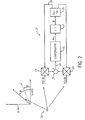
- FIG. 2 is a block diagram representing how a phase-locked-loop may estimate a phase angle of an electric grid voltage
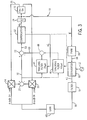
- FIG. 3 is a block diagram representing a phase-locked-loop configured to output a synchronized voltage when the voltage inputs are unbalanced;
- FIGS. 4A and 4B are graphs depicting current unbalance in an electric grid current having three phases
- FIG. 5 is a graph depicting a reference frequency, a frequency estimate output from a phase-locked-loop with no disturbance tracking, and a frequency estimate output from a phase-locked-loop with disturbance tracking when the electric grid voltages are unbalanced;
- FIG. 6 is a graph depicting a reference frequency, and a frequency estimate output from a phase-locked-loop with disturbance tracking and removal, when the electric grid voltages are unbalanced.
- a grid may refer to a network of loads (e.g., motors, end devices, etc.) which may be interconnected to enable communication between the loads and/or the transmission of power to the loads.
- loads e.g., motors, end devices, etc.
- One example of a grid is a power grid, which may be a network of power generators, distributers, and customers.
- One or more power plants may generate power, which may be converted and distributed to customers of the utility company.
- an industrial grid may be another example of a grid, where power generators may generate power to be distributed to various motors or other devices powered via the grid.
- An electric grid may include alternating current (AC) power sources operating in parallel.
- Power generated and distributed by various sources may be synchronized in frequency, amplitude, and/or phase angle. Synchronization of AC power may result in the efficient transmission and/or distribution of power.
- disturbances such as voltage imbalance, angular frequency variations, and/or voltage harmonic distortion may disrupt the synchronization of AC power transmission.
- voltage imbalance may be common in a power grid, as single phase loads of a grid may not be evenly distributed between the phases of the supplied power, and may be continuously connected and disconnected.
- the configuration of a typical power system may be inherently asymmetrical.
- an electric grid 10 may be illustrated in FIG. 1 , where a generator 12 may deliver power through the grid 10 to the motors 18 of different devices.
- an electric grid 10 may operate with a three-phase AC power source.
- the grid 10 may include a three-phase transformer 14, which may control the values of the three-phase voltage used in a typical power-delivering grid.
- the grid 10 may also include adjustable speed drives (ASDs) 16 configured to adjust the operating speed of the motors 18 for each device.
- ASSDs adjustable speed drives
- a typical electric grid may not be symmetrical, as the loads (e.g., the devices connected to the motors 18) may not be evenly distributed between phases.
- the connection or disconnection of any motor 18 may also affect the three-phase signals distributed by the generator 12 and the three-phase transformer 14.
- voltage imbalance at one motor 18 may affect the synchronization of other motors 18 coupled to the unbalanced motor 18.
- voltage imbalance at a motor 18 coupled to ASD1 may also result in voltage imbalance at a motor 18 coupled to ASD2 or ASD3, as there is no impedance between the motors 18 to prevent the voltage imbalance from propagating through commonly coupled motors 18 of the grid 10.
- such imbalance i.e., discrepancies in the amplitudes, frequencies, and/or phase angles
- the two coupled voltages may cause a large current imbalance, which may damage both systems.
- a phase-locked loop (PLL) technique may be used to control phase synchronization of the grid by regulating to zero the difference between the PLL output ⁇ ' and the phase ⁇ of the two measured inputs A sin ⁇ and A cos ⁇ .
- PLL phase-locked loop
- FIG. 2 One example of a synchronization technique using a PLL 22 may be illustrated in FIG. 2 . While a grid typically supplies voltage in three phases, these three phases may be depicted as a two-phase equivalent for the example of FIG. 2 .
- the three-phase voltages may be balanced 120° out of phase with each other.
- the two phase voltage inputs may be sinusoidal waveforms which are 90° out of phase, rotating in steady state, and at the frequency of the grid voltage.
- the instantaneous angular position ⁇ of the equivalent vector to the phase voltages 10 may be regulated to a feedback loop which ideally regulates the voltage in the d-axis (V d 30), or the sum of the inputs via adder 28, to the value of the reference signal frequency (e.g., zero in this case).
- the feedback loop may regulate the voltage in the q-axis to a reference value of one if a per-unit value is considered.
- the detected d-component of the voltage vector V d 30 may also be referred to as an error signal.
- V d 30 may be transmitted to a compensator 32 which determines a frequency estimate ⁇ ' e of the grid voltage.
- the frequency estimate ⁇ 'e may then be integrated by an integrator 34 to determine a phase angle estimate ⁇ ' of the grid voltage.
- the phase angle ⁇ ' may be used by another transformation 36 to output a sinusoid and a cosinusoid 38, which may be fed back and multiplied with the original inputs A sin ⁇ and A cos ⁇ (which is depicted as having an amplitude of 1 after normalization of the gain 68) to generate, when subtracted, a new error signal V d 30.
- a high bandwidth PLL may detect the phase angle and amplitude of the voltage vector to maintain grid synchronization.
- harmonic distortion e.g., the voltage is distorted with high-order harmonics
- the bandwidth of the PLL may be reduced to reject and eliminate the effect of the harmonics on the output.
- bandwidth reduction may not eliminate imbalanced grid voltages.
- the voltage imbalance may cause abnormal current conditions which may damage the power source and/or devices connected to the power grid.
- phase lock loop configured to determine a phase angle of the grid voltage, to compensate for phase imbalance, and synchronize to the grid
- the phase lock loop may have imbalanced inputs, which may be imbalanced in the phase and/or amplitude.
- the phase lock loop 40 may have imbalanced inputs, as depicted by the voltage vectors A sin ⁇ and B cos ⁇ having different voltage amplitudes A and B.
- the normalization of the coefficients for A sin ⁇ and B cos ⁇ by the gain 68 may result in the magnitude being 1.
- the two inputs A sin ⁇ and B cos ⁇ may be transformed by the multipliers 24 and 28 to obtain V d 30, or an estimate of the imbalance in the voltage vectors of the grid 10.
- the phase lock loop 40 may transmit V d 30 to one or more tracking filters 44 and 46.
- V d 30 may be direct current (DC).
- the V d 30 may be a non-DC signal with a complex frequency spectrum, having a dominant second harmonic of the grid 10.
- the tracking filter 44 may be configured to determine the disturbance 50 in V d 30, which may represent twice the fundamental frequency of the error signal V d 30, or the voltage imbalance in the input signals A sin ⁇ and B cos ⁇ . Determining the disturbance 50 may be based on inputs into the tracking filters 44 and 46 from the compensator 32, which outputs a frequency estimate ⁇ ' e of the grid voltage.
- the output of the tracking filter 44 may be an estimate of twice the fundamental frequency of V d 30.
- u(KT) + u(K-I)T may be obtained by adding a time delayed sample of the synchronized frequency estimate ⁇ e input from the compensator 32.
- Matrix A may be a 2x2 matrix
- matrix B may be a 2x 1 matrix, both defined below:
- a phase lock loop 40 of the present techniques may also include another tracking filter 46 for tracking any other frequency component which may be in V d 30 and contributing to voltage imbalance.
- the tracking filter 46 may be tunable, as depicted by the nX ⁇ e , where n may be set to a value which estimates harmonic disturbances, or the alternate current (AC) component of the signal V d 30.
- the PLL may include a tracking filter set to the second harmonic disturbance, a tracking filter set to the third harmonic disturbance, etc.
- the outputs of the tracking filters 44 and 46 which may include the frequency estimate of the error signal V d 30, and/or any other disturbance contributing to voltage imbalance (e.g., the third harmonic, the fifth harmonic, the DC component, etc.), and may be added in the adder 48 to generate the disturbance 50.
- the second tracking filter 46 and the adder 48 are represented by dotted lines.
- the tracked disturbance 50 may be subtracted from the signal V d 30 at the adder-subtractor 52, such that a "clean" voltage signal 54 may be transmitted to the compensator 32.
- the clean signal 54 may be a signal V d 30 where the tracked disturbances 50 have been removed (e.g., subtracted at the adder-subtractor 52).
- the compensator 32 may include a system of amplifiers and integrators which may determine a phase angle ⁇ ' based on the frequency estimate ⁇ ' e of the grid voltage.
- the integrator 34 may output the phase angle ⁇ ', which may be an estimate of the phase angle ⁇ of the grid 10.
- the compensator 32 may also output the frequency estimate ⁇ ' e to the tracking filters 44 and 46, such that the tracking filters may apply one or more algorithms to estimate the disturbance 50 based on current and time delayed frequencies estimate ⁇ ' e of the grid phase voltages.
- the estimated phase angle ⁇ ' output by the compensator 32 may be transformed by 36 before it is output back to the multipliers 24 and 26 in the PLL 40.
- the frequency estimate ⁇ ' e and/or the phase angle ⁇ ' may also be output back to the grid 10.
- the frequency estimate ⁇ ' e may first be modulated by the pulse width modulator 56, and the modulated signal 58, which may be a control signal for the grid 10, may be used by the converter 60, which may be connected to the grid 10, to control the flow of energy in the grid 10.
- the converter may be connected to a generator 12 (as in FIG. 1 ) of the grid 10.
- the transformed measured voltages (e.g., normalized V q and V d ) 62 may be filtered by the filter 64, which may include, for example, a low pass analog filter 64 to filter out any remaining noise components, which may include higher frequency components.
- the filtered signal 66 which may now be synchronized to the operating frequency of the grid 10, may further be normalized by the gain 68 to complete the phase lock loop 40.
- the PLL 40 of the present techniques may be configured to maintain synchronization with the grid even when voltages are imbalanced. Mitigating the effects of voltage imbalance may enable the grid to operate synchronously, and may also protect devices powered by the grid 10 from the adverse affects of current unbalance.
- the configuration of embodiments of the present techniques of tracking and/or removing a disturbance is not limited to the configuration illustrated in the PLL 40 of FIG. 3 .
- the compensator 32 may output an estimated phase angle ⁇ ' to devices external to the PLL 40, or the estimated phase angle ⁇ ' may be further processed and/or filtered before it is returned to the grid 10.
- an integrator may be separate from or coupled to the compensator 32.
- FIGS. 4A - 6 The data corresponding to one example simulation of an effect of one embodiment of the PLL 40 when voltage inputs into the PLL 40 are imbalanced is illustrated in FIGS. 4A - 6 .
- the graph 70 depicts unbalanced input currents. As appreciated, the unbalanced currents may behave similarly to unbalanced voltages for this simulation.
- the graph 70 shows the three-phases of the current vectors i u , i v , and i w in the time domain.
- the graph 72 of FIG. 4B illustrates the magnitude 74 of the three-phases of the current vectors i u , i v , and i w in the frequency domain.
- the frequency response of the unbalanced input currents is represented as a spike 76 in the current amplitude of currents i u , i v , and i w , at 50 Hz.
- the graph 78 of FIG. 5 may depict the effect of applying a typical PLL and applying the present techniques to synchronize the grid having imbalanced voltages.
- the graph 78 depicts the angular speed (rad/s) 82 of the reference angular frequency ⁇ ref 84 (representing the angular frequency of the grid voltage) and the output angular frequency estimate of a PLL ⁇ e 86, over time 80.
- the output angular frequency estimate ⁇ e 86 may fluctuate around the reference angular frequency ⁇ ref 84, which has been set to 314.16 rad/s (50 Hz) in this data.
- the output estimate ⁇ e 86 may fluctuate substantially in the portion of the graph marked "disabled,” which is approximately from 0 to 2.6 seconds.
- the output estimate ⁇ e 86 may fluctuate less, as shown in the portion of the graph marked "enabled,” which is approximately from 2.6 to 4.5 seconds. Remaining fluctuations may result from other harmonics which are outside the bandwidth of the tracking filter.
- the frequency estimate ⁇ e 86 may be substantially closer to the reference angular frequency ⁇ ref 84.
- One embodiment of the present techniques, or implementing a tracking filter with the PLL 40 may output an angular frequency estimate ⁇ e that is synchronized with the frequency of the grid voltage (reference angular frequency ⁇ ref ).
- the graph 88 of FIG. 6 displays the reference angular frequency ⁇ ref 84 and the output ⁇ e , before 92 of a typical PLL, and the output ⁇ e after 94 of a PLL 40 adapted to synchronize when voltages are imbalanced.
- the angular frequencies (rad/s) 90 of ⁇ ref 84, ⁇ e , before 92, and ⁇ e after 94 are displayed over frequency (Hz) 72.
- the output of a typical PLL may result in a fluctuation at twice the fundamental frequency of 50 Hz of the second harmonic disturbance (the spike at 100 Hz).
- the output of the PLL 40 after the present tracking techniques are applied are seen in ⁇ e after 94, which shows no significant fluctuation at 100 Hz, as the frequencies of the second harmonic disturbance have been removed by tracking and removing the frequency of the disturbance, as seen in one embodiment of the PLL 40 in FIG. 3 .
- the PLL 40 may include any combination or configuration of tracking filters (e.g., tracking filter 44 and tracking filter 46). While the data illustrated in the graphs 70, 78, and 88 in FIGS. 4-6 depict a removal of the second harmonic disturbance, the PLL 40 may include additional tracking filters which track other disturbances. Other tracked disturbances may all be removed in the PLL 40 to compensate for voltage imbalance while synchronizing the grid. Further, while the graphs 70, 78, and 88 display the present techniques in terms of angular frequency 90, it should be noted that determining angular frequency ⁇ e and/or a phase angle ⁇ ' may enable a PLL 40 to synchronize a grid when voltage imbalance is present.
- tracking filters e.g., tracking filter 44 and tracking filter 46
Landscapes
- Engineering & Computer Science (AREA)
- Power Engineering (AREA)
- Inverter Devices (AREA)
- Power Conversion In General (AREA)
Applications Claiming Priority (1)
| Application Number | Priority Date | Filing Date | Title |
|---|---|---|---|
| US12/627,472 US20110128054A1 (en) | 2009-11-30 | 2009-11-30 | Phase lock loop with tracking filter for synchronizing an electric grid |
Publications (2)
| Publication Number | Publication Date |
|---|---|
| EP2328251A2 true EP2328251A2 (fr) | 2011-06-01 |
| EP2328251A3 EP2328251A3 (fr) | 2016-04-06 |
Family
ID=43827358
Family Applications (1)
| Application Number | Title | Priority Date | Filing Date |
|---|---|---|---|
| EP10193093.1A Withdrawn EP2328251A3 (fr) | 2009-11-30 | 2010-11-30 | Boucle de verrouillage de phase avec filtre de suivi pour la synchronisation d'un réseau électrique |
Country Status (3)
| Country | Link |
|---|---|
| US (1) | US20110128054A1 (fr) |
| EP (1) | EP2328251A3 (fr) |
| CN (1) | CN202034965U (fr) |
Cited By (3)
| Publication number | Priority date | Publication date | Assignee | Title |
|---|---|---|---|---|
| EP2843787A1 (fr) * | 2013-08-07 | 2015-03-04 | Siemens Aktiengesellschaft | Générateur de turbine éolienne isochrone capable d'un fonctionnement autonome |
| CN104852378A (zh) * | 2015-05-06 | 2015-08-19 | 西安交通大学 | 一种基于瞬时虚拟无功功率检测的锁相方法 |
| CN116316728A (zh) * | 2023-03-14 | 2023-06-23 | 上海正泰电源系统有限公司 | 一种基于双边锁相的自动离网转并网相位追踪方法 |
Families Citing this family (9)
| Publication number | Priority date | Publication date | Assignee | Title |
|---|---|---|---|---|
| DE102009043530A1 (de) * | 2009-09-30 | 2011-04-07 | Siemens Aktiengesellschaft | Elektrische Antriebswelle und Fahrzeug mit einer derartigen elektrischen Antriebswelle |
| KR101829829B1 (ko) * | 2011-10-04 | 2018-02-20 | 에스케이하이닉스 주식회사 | 필터링 회로 및 그를 포함하는 반도체 집적 회로 |
| US8964427B2 (en) | 2012-06-29 | 2015-02-24 | Rockwell Automation Technologies, Inc. | Adaptive online filter for DC offset elimination |
| CN103235184B (zh) * | 2013-04-28 | 2015-05-27 | 东方电气集团东方汽轮机有限公司 | 一种双馈风力发电变流器电网电压矢量角度检测算法 |
| CN104865952B (zh) * | 2013-05-02 | 2017-05-24 | 东南大学 | 网格频率设定双椭圆拟合方法 |
| CN104731086B (zh) * | 2013-05-02 | 2017-05-03 | 东南大学 | 网格频率设定双椭圆拟合方法及其应用 |
| EP2955812B1 (fr) * | 2014-06-09 | 2022-07-27 | General Electric Technology GmbH | Réseau de transmission de puissance |
| US9270286B2 (en) * | 2014-06-30 | 2016-02-23 | Rockwell Automation Technologies, Inc. | Phase lock loop with cascade tracking filters for synchronizing an electric grid |
| DK3118960T3 (da) | 2015-01-30 | 2021-06-14 | Ingeteam Power Tech Sa | Synkroniseringssystem til en elproduktionsenhed og fremgangsmåde til denne |
Family Cites Families (1)
| Publication number | Priority date | Publication date | Assignee | Title |
|---|---|---|---|---|
| CA2425496C (fr) * | 2002-04-04 | 2012-06-05 | Chunlin Li | Synchronisation de phase rapide et extraction de composantes de sequence dans les reseaux triphases |
-
2009
- 2009-11-30 US US12/627,472 patent/US20110128054A1/en not_active Abandoned
-
2010
- 2010-11-30 CN CN2010206457319U patent/CN202034965U/zh not_active Expired - Lifetime
- 2010-11-30 EP EP10193093.1A patent/EP2328251A3/fr not_active Withdrawn
Non-Patent Citations (1)
| Title |
|---|
| None |
Cited By (5)
| Publication number | Priority date | Publication date | Assignee | Title |
|---|---|---|---|---|
| EP2843787A1 (fr) * | 2013-08-07 | 2015-03-04 | Siemens Aktiengesellschaft | Générateur de turbine éolienne isochrone capable d'un fonctionnement autonome |
| US9593672B2 (en) | 2013-08-07 | 2017-03-14 | Siemens Aktiengesellschaft | Isochronous wind turbine generator capable of stand-alone operation |
| CN104852378A (zh) * | 2015-05-06 | 2015-08-19 | 西安交通大学 | 一种基于瞬时虚拟无功功率检测的锁相方法 |
| CN116316728A (zh) * | 2023-03-14 | 2023-06-23 | 上海正泰电源系统有限公司 | 一种基于双边锁相的自动离网转并网相位追踪方法 |
| CN116316728B (zh) * | 2023-03-14 | 2024-03-29 | 上海正泰电源系统有限公司 | 一种基于双边锁相的自动离网转并网相位追踪方法 |
Also Published As
| Publication number | Publication date |
|---|---|
| CN202034965U (zh) | 2011-11-09 |
| US20110128054A1 (en) | 2011-06-02 |
| EP2328251A3 (fr) | 2016-04-06 |
Similar Documents
| Publication | Publication Date | Title |
|---|---|---|
| US20110128054A1 (en) | Phase lock loop with tracking filter for synchronizing an electric grid | |
| US8704571B2 (en) | Phase-locked-loop with quadrature tracking filter for synchronizing an electric grid | |
| US9270286B2 (en) | Phase lock loop with cascade tracking filters for synchronizing an electric grid | |
| US8816729B2 (en) | Phase-locked-loop with quadrature tracking filter for synchronizing an electric grid | |
| US8988060B2 (en) | Power control system and method | |
| KR101494453B1 (ko) | 전력변환장치의 고조파전류억제장치 및 고조파전류억제방법 | |
| CN101617234B (zh) | 先进实时电网监控系统 | |
| EP2566035B1 (fr) | Commande robuste d'un onduleur raccordé au réseau aussi pendant des pannes de réseau | |
| JP6043543B2 (ja) | インバータ回路を制御する制御回路、および、当該制御回路を備えたインバータ装置 | |
| KR20100137549A (ko) | 직류 버스 전압 고조파 저감 | |
| JP3822910B2 (ja) | 方形波インバータとdcバス制御とを備えたハイブリッド並列能動/受動フィルタシステムによる電力線高調波の低減 | |
| Nian et al. | Direct power control of doubly fed induction generator without phase-locked loop under harmonically distorted voltage conditions | |
| He et al. | An ultra-fast inrush-current-free startup method for grid-tie inverter without voltage sensors | |
| Chedjara et al. | A novel robust PLL algorithm applied to the control of a shunt active power filter using a self tuning filter concept | |
| EP3101487A1 (fr) | Dispositif de commande de suppression de perturbation externe périodique | |
| CN113039696A (zh) | 电力变换装置 | |
| Freijedo et al. | Frequency tracking of digital resonant filters for control of power converters connected to public distribution systems | |
| KR101380380B1 (ko) | 전력계통의 상태에 따른 적응형 위상추종 방법 및 시스템 | |
| CN104518525B (zh) | 交直流混合电网功率变流器的保护控制系统及其控制方法 | |
| Klaes et al. | Immunity of grid-forming control without energy storage to transient changes of grid frequency and phase | |
| Berzoy et al. | Non-linear droop control of parallel split-phase inverters for residential nanogrids | |
| CN107251361A (zh) | 用于发电单元的同步系统及关联方法 | |
| US7778053B2 (en) | Power system having a voltage regulator with a notch filter | |
| Lizhen et al. | Decentralized control approach for voltage unbalance compensation in islanded microgrid | |
| JP6368456B2 (ja) | 電力動揺成分出力抑制装置 |
Legal Events
| Date | Code | Title | Description |
|---|---|---|---|
| PUAI | Public reference made under article 153(3) epc to a published international application that has entered the european phase |
Free format text: ORIGINAL CODE: 0009012 |
|
| AK | Designated contracting states |
Kind code of ref document: A2 Designated state(s): AL AT BE BG CH CY CZ DE DK EE ES FI FR GB GR HR HU IE IS IT LI LT LU LV MC MK MT NL NO PL PT RO RS SE SI SK SM TR |
|
| AX | Request for extension of the european patent |
Extension state: BA ME |
|
| PUAL | Search report despatched |
Free format text: ORIGINAL CODE: 0009013 |
|
| AK | Designated contracting states |
Kind code of ref document: A3 Designated state(s): AL AT BE BG CH CY CZ DE DK EE ES FI FR GB GR HR HU IE IS IT LI LT LU LV MC MK MT NL NO PL PT RO RS SE SI SK SM TR |
|
| AX | Request for extension of the european patent |
Extension state: BA ME |
|
| RIC1 | Information provided on ipc code assigned before grant |
Ipc: H02J 3/08 20060101AFI20160226BHEP |
|
| 17P | Request for examination filed |
Effective date: 20161006 |
|
| RBV | Designated contracting states (corrected) |
Designated state(s): AL AT BE BG CH CY CZ DE DK EE ES FI FR GB GR HR HU IE IS IT LI LT LU LV MC MK MT NL NO PL PT RO RS SE SI SK SM TR |
|
| STAA | Information on the status of an ep patent application or granted ep patent |
Free format text: STATUS: EXAMINATION IS IN PROGRESS |
|
| 17Q | First examination report despatched |
Effective date: 20200116 |
|
| STAA | Information on the status of an ep patent application or granted ep patent |
Free format text: STATUS: THE APPLICATION IS DEEMED TO BE WITHDRAWN |
|
| 18D | Application deemed to be withdrawn |
Effective date: 20240601 |