EP2328363B1 - Tonklassifikationssystem für Hörgeräte - Google Patents
Tonklassifikationssystem für Hörgeräte Download PDFInfo
- Publication number
- EP2328363B1 EP2328363B1 EP10251579.8A EP10251579A EP2328363B1 EP 2328363 B1 EP2328363 B1 EP 2328363B1 EP 10251579 A EP10251579 A EP 10251579A EP 2328363 B1 EP2328363 B1 EP 2328363B1
- Authority
- EP
- European Patent Office
- Prior art keywords
- sound
- classification
- features
- classifying
- hearing aid
- Prior art date
- Legal status (The legal status is an assumption and is not a legal conclusion. Google has not performed a legal analysis and makes no representation as to the accuracy of the status listed.)
- Active
Links
Images



Classifications
-
- G—PHYSICS
- G10—MUSICAL INSTRUMENTS; ACOUSTICS
- G10L—SPEECH ANALYSIS TECHNIQUES OR SPEECH SYNTHESIS; SPEECH RECOGNITION; SPEECH OR VOICE PROCESSING TECHNIQUES; SPEECH OR AUDIO CODING OR DECODING
- G10L25/00—Speech or voice analysis techniques not restricted to a single one of groups G10L15/00 - G10L21/00
- G10L25/78—Detection of presence or absence of voice signals
-
- H—ELECTRICITY
- H04—ELECTRIC COMMUNICATION TECHNIQUE
- H04R—LOUDSPEAKERS, MICROPHONES, GRAMOPHONE PICK-UPS OR LIKE ACOUSTIC ELECTROMECHANICAL TRANSDUCERS; ELECTRIC HEARING AIDS; PUBLIC ADDRESS SYSTEMS
- H04R25/00—Electric hearing aids
- H04R25/50—Customised settings for obtaining desired overall acoustical characteristics
- H04R25/505—Customised settings for obtaining desired overall acoustical characteristics using digital signal processing
-
- G—PHYSICS
- G10—MUSICAL INSTRUMENTS; ACOUSTICS
- G10L—SPEECH ANALYSIS TECHNIQUES OR SPEECH SYNTHESIS; SPEECH RECOGNITION; SPEECH OR VOICE PROCESSING TECHNIQUES; SPEECH OR AUDIO CODING OR DECODING
- G10L15/00—Speech recognition
- G10L15/08—Speech classification or search
- G10L15/14—Speech classification or search using statistical models, e.g. Hidden Markov Models [HMMs]
- G10L15/142—Hidden Markov Models [HMMs]
-
- G—PHYSICS
- G10—MUSICAL INSTRUMENTS; ACOUSTICS
- G10L—SPEECH ANALYSIS TECHNIQUES OR SPEECH SYNTHESIS; SPEECH RECOGNITION; SPEECH OR VOICE PROCESSING TECHNIQUES; SPEECH OR AUDIO CODING OR DECODING
- G10L25/00—Speech or voice analysis techniques not restricted to a single one of groups G10L15/00 - G10L21/00
- G10L25/78—Detection of presence or absence of voice signals
- G10L2025/783—Detection of presence or absence of voice signals based on threshold decision
-
- H—ELECTRICITY
- H04—ELECTRIC COMMUNICATION TECHNIQUE
- H04R—LOUDSPEAKERS, MICROPHONES, GRAMOPHONE PICK-UPS OR LIKE ACOUSTIC ELECTROMECHANICAL TRANSDUCERS; ELECTRIC HEARING AIDS; PUBLIC ADDRESS SYSTEMS
- H04R25/00—Electric hearing aids
- H04R25/50—Customised settings for obtaining desired overall acoustical characteristics
- H04R25/505—Customised settings for obtaining desired overall acoustical characteristics using digital signal processing
- H04R25/507—Customised settings for obtaining desired overall acoustical characteristics using digital signal processing implemented by neural network or fuzzy logic
Definitions
- This document relates generally to hearing aids and more particularly to a sound classification system for hearing aids.
- Hearing aid users are typically exposed to a variety of listening situations, such as speech, music or noisy environment.
- the behavior of the instrument for instance the activation of a directional microphone, or the compression/expansion parameters, should adapt to the currently engaged environment. This indicates the need for sound classification algorithms functioning as a front end to the rest of the signal professing scheme housed in the instruments [1].
- WO 01/76321 A1 relates to automatic identification or classification of a listening environment by applying one or several predetermined Hidden Markov Models to process acoustic signals obtained from the listening environment, and using the results to control parameter values of a predetermined signal processing algorithm.
- European Patent Application No. EP 2 136 358 A1 relates to sound analysis including judging, based on a number of partial audio signals in each environmental sound category determined in at least a most recent judgment target section, an environment that surrounds a sound analysis device in at least the most recent judgment target section.
- Büchler, M. et al: "Sound classification in hearing aids inspired by auditory scene analysis", EURASIP Journal of Applied Signal Processing, Hindawi Publishing Co., Cuyahoga Falls, OH, US, vol. 2005, no. 18, 15 October 2005, pages 2991-3002 relates to evaluation of sound classifiers of low to moderate complexity for use in sound classification in hearing aids where it is crucial to keep the need for computing time and memory low.
- EP 1 835 785A discloses environmental detection and adaptation in hearing assistance devices, using two-stage environment classification.
- the invention is the hearing aid and method of claims 1 and 10.
- a hearing aid includes a sound classification module to classify environmental sound sensed by a microphone.
- the sound classification module executes an advanced sound classification algorithm.
- the hearing aid then processes the sound according to the classification.
- Sound classification has been studied under different contexts, such as speech/music discrimination [2, 3], environment sounds classification [4], and content-based audio classification [5, 6]. Compared with these applications, sounds classification in hearing aids is more challenging due to the limited power consumption, the real time operation and the great varieties of sounds encountered in the real life. So far, a couple of simple features and classifier schemes, such as a threshold-based classifier, have been implemented in hearing aids to identify speech, noise and speech in noise [7]. When more kinds of sounds need to be classified, advanced classifiers and features are needed to achieve a satisfactory performance. The present sound classification system provides a hearing aid with such advanced classifiers and features.
- results of a systemic evaluation of the present sound classification system including the impact of sophisticated features and classifiers on the classification rate, computational cost and classification delay are presented.
- the classification system which is intended to detect speech, music and several kinds of noises is constructed.
- the performance of two feature sets including both low level features and Mel-scale Frequency cepstral coefficients (MFCC) are compared by applying Gaussian classifiers, Hidden Markov Model (HMM), and Gaussian Mixture Model (GMM) individually.
- HMM Hidden Markov Model
- GMM Gaussian Mixture Model
- FIG. 1 is a block diagram illustrating an embodiment of a hearing aid 100.
- Hearing aid 100 includes a microphone 102, a processor 104, and a receiver 106.
- Microphone 102 senses an environmental sound.
- Processor 104 includes a sound classification module that classifies the sensed sound by executing an advanced classification algorithm. Examples of the advanced classification algorithm include HMM and GMM.
- Processor 104 processes the sound using an outcome of the classification of the sound for specified hearing assistance functions.
- Receiver 106 transmits the processed sound for perception by the hearing aid user.
- the sound classification module uses a two-stage environment classification scheme.
- the signal is first classified as music, speech or non-speech.
- the non-speech sounds are further characterized as machine noise, wind noise or other sounds.
- the classification performance and the associated computational cost are evaluated along three dimensions: the choice of classifiers, the choice of feature sets and number of features within each feature set. Each component is further discussed below.
- the sound classification module includes one of two feature groups, specifically a low level feature set, and MFCCs.
- the former consists of both temporal and spectral features, such as zero crossing rate, short time energy, spectral centroid, spectral bandwidth, spectral roll-off, spectral flux, high/low energy ratio, etc.
- the logarithms of these features are included in the set as well.
- the first 12 coefficients are included in the MFCC set [9].
- the evaluation of the sound classification module is performed on a database composed of sounds from five classes: music, speech, wind noise, machine noise and others.
- the music content is taken from a database collected by Scheirer and Slaney [3], which contains 80 15-seconds long audio music samples covering different genres, such as classical music, rock and pop songs, folk music, etc.
- the remaining samples are recordings made by the authors.
- the acoustic signals from a variety of auditory scenes are picked up by a microphone located in a BTE hearing aid first and then are stored in a Sony TCD-D8 DAT recorder with a 16-bit resolution and a 48 kHz sampling frequency.
- the recordings are manually divided according to recording environment and then segmented using a short-term energy detector, followed by manual verification and adjustment of the segment boundaries. The resulting segments are used for training and testing the classification system.
- the class "speech” includes both clean and noisy speech.
- the clean speech comprise of speech spoken by different peoples at different reverberation situations, such as a living room or a cafeteria.
- the noisy speech is generated by mixing randomly selected files from the clean speech class with noise at three levels of SNR: -6dB, 0dB and 6 dB.
- the class "machine noise” contains the noise generated by various machineries, such as automobile, vacuum and blender.
- the class “others” is the most varying category comprising any sounds that are not suitably described by the other three classes, for instance the sounds from water running, foot stepping, etc.
- the duration of the samples of each class is listed in Table 1. Table 1: list of the recorded sound types and their length of durations. Sound Type Music Speech Machine Noise Wind Noise Others Duration 14 40 73 12 22
- Computational cost is a critical constraint concerning the application of various classification algorithms in hearing aids, mainly due to the limitation on power consumption and real time operation.
- the cost of a classification algorithm consists of two parts, feature evaluation and classification. The former is related with the length of analysis window and the resolution of the Fourier Frequency Transform (FFT), while the latter is mainly determined by the number of sound classes, the dimension of the employed feature vector. For a GMM and HMM classifier, the number of components and states affect the computational cost as well. At each classification stage, the computational cost is measured in terms of number of operations and evaluated along three dimensions: choice of models, choice of feature sets, and number of selected features, just as in the performance evaluation.
- FFT Fourier Frequency Transform
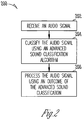
- FIG. 2 is a block diagram illustrating an embodiment of a method 200 for operating a hearing aid including an advanced sound classification function. In one embodiment, method 200 is applied to operate hearing aid 100.
- an environmental sound is sensed.
- the sensed sound is classified by executing an advanced classification algorithm.
- the sound is processed using an outcome of the classification of the sound for specified hearing assistance functions.
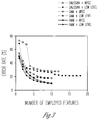
- FIG. 3 is a graph showing error rates each plotted as a function of the number of employed features.
- the performance is evaluated over two feature sets (low level and MFCC) and three models (Gaussian, GMM and HMM).
- the error rate obtained at each iteration of the forward sequential feature selection process is plotted.
- the various classifiers and feature sets are indicated by line styles and marker styles, respectively.
- FIG. 4 is a graph showing performance of sound classification including computational costs each plotted as a function of the number of employed features.
- the performance is evaluated over advanced models (GMM and HMM) and low level.
- the recommended number of features is indicated in FIG. 4 by a gray patch. It is noteworthy that when combining the computational cost from the two stages, some features are identified as optimal features on both stages but need only be calculated once. Thus the overall cost is less than the direct summation over the two stages.
- FIG. 3 shows that the increased number of features results both decreased error rates and increased associated computational costs, thus indicating a conflict between performance and computational complexity. It seems that choosing five to seven features is a reasonable comprise between the two factors. Using this number of features, the error rate is about 10% and the computational cost is still manageable. On the other hand, using more than seven features only slightly improves the performance but incurs great computational cost.
- the impact of the test sequence length on performance when using low level features and advanced models is also examined.
- the error rates are each plotted as a function of the test sequence length in FIG. 5 .
- the performance is evaluated over advanced models and low level feature set. As expected, increasing the length of test sequence improves the classification performance.
- An approximate 20% decrease of error rate is obtained by increasing the test sequence from 128 ms to 256 ms. This benefit is diminished with further increase in the length of the test sequence. The overall pattern of the rate of decrease seems to be consistent across classifiers.
- FIG. 6 shows error rates each plotted as a function of the structures of classification system. The performance is evaluated over a hierarchy structure and a flat structure. A low level feature set is used with both structures. For each case the low level features are employed in the feature selection process and the lowest error rate are presented. It seems that the flat classification scheme has a slight advantage over the two-stage one, at the expense of the flexibility and computational complexity.
Landscapes
- Engineering & Computer Science (AREA)
- Physics & Mathematics (AREA)
- Signal Processing (AREA)
- Health & Medical Sciences (AREA)
- Acoustics & Sound (AREA)
- Audiology, Speech & Language Pathology (AREA)
- Human Computer Interaction (AREA)
- Computational Linguistics (AREA)
- Multimedia (AREA)
- General Health & Medical Sciences (AREA)
- Neurosurgery (AREA)
- Otolaryngology (AREA)
- Information Retrieval, Db Structures And Fs Structures Therefor (AREA)
- Circuit For Audible Band Transducer (AREA)
Claims (17)
- Hörgerät, umfassend:ein Mikrofon, das dafür konfiguriert ist, einen Umgebungston zu erfassen; undeinen Prozessor, der ein Tonklassifizierungsmodul aufweist, das mit dem Mikrofon gekoppelt und dafür konfiguriert ist, den Ton durch Ausführen eines Klassifizierungsalgorithmus zu klassifizieren, wobei der Prozessor dafür konfiguriert ist, den Ton unter Verwendung eines Ergebnisses der Klassifizierung des Tons für festgelegte Hörhilfefunktionen zu verarbeiten, wobei das Tonklassifizierungsmodul ein Umgebungsklassifizierungsprinzip mit zwei Stufen verwendet, die Folgendes aufweisen: Klassierer, die aus Klassierern ausgewählt werden, die ein Hidden-Markov-Modell oder ein Gauß-Mischverteilungsmodell verwenden, Merkmalsmengen, die jeweils für einen gewählten Klassierer der Klassierer spezifisch sind, und Merkmale innerhalb jeder der Merkmalsmengen, wobei die Klassierer, die Merkmalsmengen und die Anzahl der Merkmale innerhalb der jeden der Merkmalsmengen auf der Grundlage der Bewertung des Leistungsvermögens der Klassifizierung und des damit verbundenen Rechenaufwandes gewählt werden.
- Hörgerät nach Anspruch 1, worin das Tonklassifizierungsmodul dafür konfiguriert ist, den Ton durch Ausführen eines Klassifizierungsalgorithmus zu klassifizieren, der einen Klassierer aufweist, der das Hidden-Markov-Modell verwendet.
- Hörgerät nach Anspruch 1, worin das Tonklassifizierungsmodul dafür konfiguriert ist, den Ton durch Ausführen eines Klassifizierungsalgorithmus zu klassifizieren, der einen Klassierer aufweist, der das Gauß-Mischverteilungsmodell verwendet.
- Hörgerät nach einem der vorhergehenden Ansprüche, worin das Tonklassifizierungsmodul dafür konfiguriert ist, den Ton als eines von Folgendem zu klassifizieren: Musik, Sprache und ohne Sprache.
- Hörgerät nach Anspruch 4, worin das Tonklassifizierungsmodul dafür konfiguriert ist, den Ton ohne Sprache als eines von Folgendem weiter zu klassifizieren: Maschinengeräusch, Windgeräusch und andere Töne.
- Hörgerät nach einem der vorhergehenden Ansprüche, worin das Tonklassifizierungsmodul eine Merkmalsmenge mit einem Umfang von Merkmalen zur Tonklassifizierung umfasst, der auf der Grundlage des Leistungsvermögens und des Rechenaufwandes der Tonklassifizierung bestimmt wird.
- Hörgerät nach Anspruch 6, worin die Merkmalsmenge 5 bis 7 Merkmale umfasst.
- Hörgerät nach Anspruch 7, worin die Merkmalsmenge Merkmale niederer Ebene umfasst.
- Hörgerät nach Anspruch 7, worin die Merkmalsmenge Frequenz-Cepstrum-Koeffizienten der Mel-Skala umfasst.
- Verfahren zum Betreiben eines Hörgeräts, umfassend:Erfassen eines Umgebungstons;Klassifizieren des Tons durch Ausführen eines Klassifizierungsalgorithmus mit zwei Stufen, die jeweils Folgendes aufweisen: Klassierer, die aus Klassierern ausgewählt werden, die ein Hidden-Markov-Modell oder ein Gauß-Mischverteilungsmodell verwenden, Merkmalsmengen, die jeweils für einen gewählten Klassierer der Klassierer spezifisch sind, und Merkmale innerhalb jeder der Merkmalsmengen, wobei die Klassierer, die Merkmalsmengen und die Anzahl der Merkmale innerhalb der jeden der Merkmalsmengen auf der Grundlage der Bewertung des Leistungsvermögens der Klassifizierung und des damit verbundenen Rechenaufwandes gewählt werden; undVerarbeiten des Tons unter Verwendung eines Ergebnisses der Klassifizierung des Tons für festgelegte Hörhilfefunktionen.
- Verfahren nach Anspruch 10, worin das Klassifizieren des Tons umfasst:Klassifizieren des Tons durch Verwenden eines Klassierers, der das Hidden-Markov-Modell verwendet.
- Verfahren nach Anspruch 10, worin das Klassifizieren des Tons umfasst:Klassifizieren des Tons durch Verwenden eines Klassierers, der das Gauß-Mischverteilungsmodell verwendet.
- Verfahren nach Anspruch 12, worin das Klassifizieren des Tons umfasst:Klassifizieren des Tons als eines von Folgendem: Musik, Sprache und ohne Sprache.
- Verfahren nach Anspruch 13, worin das Klassifizieren des Tons umfasst:Klassifizieren von Ton ohne Sprache als eines von Folgendem: Maschinengeräusch, Windgeräusch und andere Töne.
- Verfahren nach einem der Ansprüche 10 bis 14, umfassend: Auswählen eines bestimmten Klassifizierungsalgorithmus auf der Grundlage des Leistungsvermögens und des Rechenaufwandes zum Klassifizieren des Tons.
- Verfahren nach einem der Ansprüche 10 bis 15, umfassend: Auswählen einer Merkmalsmenge zum Klassifizieren des Tons als Funktion des Leistungsvermögens und des Rechenaufwandes zum Klassifizieren des Tons.
- Verfahren nach einem der Ansprüche 10 bis 16, umfassend: Identifizieren von Merkmalen als optimale Merkmale für die zwei Stufen des Umgebungsklassifizierungsprinzips.
Applications Claiming Priority (1)
| Application Number | Priority Date | Filing Date | Title |
|---|---|---|---|
| US24173509P | 2009-09-11 | 2009-09-11 |
Publications (2)
| Publication Number | Publication Date |
|---|---|
| EP2328363A1 EP2328363A1 (de) | 2011-06-01 |
| EP2328363B1 true EP2328363B1 (de) | 2016-05-18 |
Family
ID=43827374
Family Applications (1)
| Application Number | Title | Priority Date | Filing Date |
|---|---|---|---|
| EP10251579.8A Active EP2328363B1 (de) | 2009-09-11 | 2010-09-10 | Tonklassifikationssystem für Hörgeräte |
Country Status (3)
| Country | Link |
|---|---|
| US (2) | US20110137656A1 (de) |
| EP (1) | EP2328363B1 (de) |
| DK (1) | DK2328363T3 (de) |
Cited By (3)
| Publication number | Priority date | Publication date | Assignee | Title |
|---|---|---|---|---|
| WO2019077443A1 (en) * | 2017-10-17 | 2019-04-25 | Cochlear Limited | HIERARCHICAL ENVIRONMENTAL CLASSIFICATION IN A HEARING PROSTHESIS |
| US11722826B2 (en) | 2017-10-17 | 2023-08-08 | Cochlear Limited | Hierarchical environmental classification in a hearing prosthesis |
| US12538082B2 (en) | 2022-06-07 | 2026-01-27 | Starkey Laboratories, Inc. | Capture of context statistics in hearing instruments |
Families Citing this family (29)
| Publication number | Priority date | Publication date | Assignee | Title |
|---|---|---|---|---|
| CN102982804B (zh) * | 2011-09-02 | 2017-05-03 | 杜比实验室特许公司 | 音频分类方法和系统 |
| US20130070928A1 (en) * | 2011-09-21 | 2013-03-21 | Daniel P. W. Ellis | Methods, systems, and media for mobile audio event recognition |
| US9384272B2 (en) | 2011-10-05 | 2016-07-05 | The Trustees Of Columbia University In The City Of New York | Methods, systems, and media for identifying similar songs using jumpcodes |
| TWI591620B (zh) | 2012-03-21 | 2017-07-11 | 三星電子股份有限公司 | 產生高頻雜訊的方法 |
| US9124981B2 (en) | 2012-11-14 | 2015-09-01 | Qualcomm Incorporated | Systems and methods for classification of audio environments |
| US8958586B2 (en) | 2012-12-21 | 2015-02-17 | Starkey Laboratories, Inc. | Sound environment classification by coordinated sensing using hearing assistance devices |
| KR102052153B1 (ko) | 2013-02-15 | 2019-12-17 | 삼성전자주식회사 | 보청기를 제어하는 휴대 단말 및 방법 |
| US9406313B2 (en) * | 2014-03-21 | 2016-08-02 | Intel Corporation | Adaptive microphone sampling rate techniques |
| US9763016B2 (en) * | 2014-07-31 | 2017-09-12 | Starkey Laboratories, Inc. | Automatic directional switching algorithm for hearing aids |
| WO2017001611A1 (de) * | 2015-06-30 | 2017-01-05 | Fraunhofer-Gesellschaft zur Förderung der angewandten Forschung e.V. | Verfahren und vorrichtung zum zuordnen von geräuschen und zum analysieren |
| US10631101B2 (en) * | 2016-06-09 | 2020-04-21 | Cochlear Limited | Advanced scene classification for prosthesis |
| US10522169B2 (en) | 2016-09-23 | 2019-12-31 | Trustees Of The California State University | Classification of teaching based upon sound amplitude |
| US10284969B2 (en) | 2017-02-09 | 2019-05-07 | Starkey Laboratories, Inc. | Hearing device incorporating dynamic microphone attenuation during streaming |
| CN107066365B (zh) * | 2017-02-20 | 2021-01-01 | 创新先进技术有限公司 | 一种系统异常的监测方法及装置 |
| CN111712183A (zh) | 2017-10-27 | 2020-09-25 | 高等工艺学校 | 耳内非语言音频事件分类系统和方法 |
| US11100918B2 (en) * | 2018-08-27 | 2021-08-24 | American Family Mutual Insurance Company, S.I. | Event sensing system |
| CN111027453B (zh) * | 2019-12-06 | 2022-05-17 | 西北工业大学 | 基于高斯混合模型的非合作水中目标自动识别方法 |
| US12035107B2 (en) | 2020-01-03 | 2024-07-09 | Starkey Laboratories, Inc. | Ear-worn electronic device employing user-initiated acoustic environment adaptation |
| WO2021138647A1 (en) | 2020-01-03 | 2021-07-08 | Starkey Laboratories, Inc. | Ear-worn electronic device employing acoustic environment adaptation |
| US12302084B2 (en) | 2020-05-29 | 2025-05-13 | Starkey Laboratories, Inc. | Hearing device with multiple neural networks for sound enhancement |
| EP4209016A1 (de) | 2020-09-01 | 2023-07-12 | Starkey Laboratories, Inc. | Mobile vorrichtung zur bereitstellung von klangverbesserung für hörgerät |
| US12563340B2 (en) | 2020-12-28 | 2026-02-24 | Starkey Laboratories, Inc. | Ear-wearable electronic hearing device incorporating microphone array with enhanced wind noise suppression |
| US20220360909A1 (en) * | 2021-05-10 | 2022-11-10 | Kieran REED | Prosthesis automated assistant |
| EP3996390A1 (de) * | 2021-05-20 | 2022-05-11 | Sonova AG | Verfahren zur auswahl eines hörprogramms in einem hörgetät, basierend auf einer detektion der eigenen stimme |
| GB202112306D0 (en) | 2021-08-27 | 2021-10-13 | Earzz Ltd | A method for identifying an audio signal |
| US12604148B2 (en) | 2022-02-11 | 2026-04-14 | Starkey Laboratories, Inc. | Audio processing using ear-wearable device and wearable vision device |
| US12477267B2 (en) | 2022-03-15 | 2025-11-18 | Starkey Laboratories, Inc. | Hearing device |
| CN115334349B (zh) * | 2022-07-15 | 2024-01-02 | 北京达佳互联信息技术有限公司 | 音频处理方法、装置、电子设备及存储介质 |
| US20260059245A1 (en) | 2024-08-20 | 2026-02-26 | Starkey Laboratories, Inc. | Hearing device adaptation based on inferences from user interaction and use context |
Citations (1)
| Publication number | Priority date | Publication date | Assignee | Title |
|---|---|---|---|---|
| EP1835785A2 (de) * | 2006-03-14 | 2007-09-19 | Starkey Laboratories, Inc. | Umgebungserkennung und Anpassung in Hörgeräten |
Family Cites Families (19)
| Publication number | Priority date | Publication date | Assignee | Title |
|---|---|---|---|---|
| US5727072A (en) * | 1995-02-24 | 1998-03-10 | Nynex Science & Technology | Use of noise segmentation for noise cancellation |
| US6067517A (en) * | 1996-02-02 | 2000-05-23 | International Business Machines Corporation | Transcription of speech data with segments from acoustically dissimilar environments |
| US6570991B1 (en) * | 1996-12-18 | 2003-05-27 | Interval Research Corporation | Multi-feature speech/music discrimination system |
| US6708146B1 (en) * | 1997-01-03 | 2004-03-16 | Telecommunications Research Laboratories | Voiceband signal classifier |
| US6240386B1 (en) * | 1998-08-24 | 2001-05-29 | Conexant Systems, Inc. | Speech codec employing noise classification for noise compensation |
| US6182036B1 (en) * | 1999-02-23 | 2001-01-30 | Motorola, Inc. | Method of extracting features in a voice recognition system |
| ATE331417T1 (de) * | 2000-04-04 | 2006-07-15 | Gn Resound As | Eine hörprothese mit automatischer hörumgebungsklassifizierung |
| US6862359B2 (en) * | 2001-12-18 | 2005-03-01 | Gn Resound A/S | Hearing prosthesis with automatic classification of the listening environment |
| US7082394B2 (en) * | 2002-06-25 | 2006-07-25 | Microsoft Corporation | Noise-robust feature extraction using multi-layer principal component analysis |
| US7509259B2 (en) * | 2004-12-21 | 2009-03-24 | Motorola, Inc. | Method of refining statistical pattern recognition models and statistical pattern recognizers |
| US20060182295A1 (en) * | 2005-02-11 | 2006-08-17 | Phonak Ag | Dynamic hearing assistance system and method therefore |
| EP1932389B1 (de) * | 2005-09-01 | 2021-06-16 | Widex A/S | Verfahren und vorrichtung zur steuerung von bandaufteilungs-kompressoren in einem hörgerät |
| AU2005232314B2 (en) * | 2005-11-11 | 2010-08-19 | Phonak Ag | Feedback compensation in a sound processing device |
| ATE534243T1 (de) * | 2006-04-01 | 2011-12-15 | Widex As | Hörgerät und verfahren zur signalverarbeitungssteuerung in einem hörgerät |
| US8019593B2 (en) * | 2006-06-30 | 2011-09-13 | Robert Bosch Corporation | Method and apparatus for generating features through logical and functional operations |
| US8948428B2 (en) * | 2006-09-05 | 2015-02-03 | Gn Resound A/S | Hearing aid with histogram based sound environment classification |
| US8478587B2 (en) * | 2007-03-16 | 2013-07-02 | Panasonic Corporation | Voice analysis device, voice analysis method, voice analysis program, and system integration circuit |
| US7693806B2 (en) | 2007-06-21 | 2010-04-06 | Microsoft Corporation | Classification using a cascade approach |
| US8165877B2 (en) * | 2007-08-03 | 2012-04-24 | Microsoft Corporation | Confidence measure generation for speech related searching |
-
2010
- 2010-09-10 EP EP10251579.8A patent/EP2328363B1/de active Active
- 2010-09-10 US US12/879,218 patent/US20110137656A1/en not_active Abandoned
- 2010-09-10 DK DK10251579.8T patent/DK2328363T3/en active
-
2020
- 2020-01-13 US US16/741,114 patent/US11250878B2/en active Active
Patent Citations (1)
| Publication number | Priority date | Publication date | Assignee | Title |
|---|---|---|---|---|
| EP1835785A2 (de) * | 2006-03-14 | 2007-09-19 | Starkey Laboratories, Inc. | Umgebungserkennung und Anpassung in Hörgeräten |
Cited By (5)
| Publication number | Priority date | Publication date | Assignee | Title |
|---|---|---|---|---|
| WO2019077443A1 (en) * | 2017-10-17 | 2019-04-25 | Cochlear Limited | HIERARCHICAL ENVIRONMENTAL CLASSIFICATION IN A HEARING PROSTHESIS |
| US11337011B2 (en) | 2017-10-17 | 2022-05-17 | Cochlear Limited | Hierarchical environmental classification in a hearing prosthesis |
| US11722826B2 (en) | 2017-10-17 | 2023-08-08 | Cochlear Limited | Hierarchical environmental classification in a hearing prosthesis |
| US12273685B2 (en) | 2017-10-17 | 2025-04-08 | Cochlear Limited | Hierarchical environmental classification in a hearing prosthesis |
| US12538082B2 (en) | 2022-06-07 | 2026-01-27 | Starkey Laboratories, Inc. | Capture of context statistics in hearing instruments |
Also Published As
| Publication number | Publication date |
|---|---|
| US20110137656A1 (en) | 2011-06-09 |
| DK2328363T3 (en) | 2016-08-22 |
| US11250878B2 (en) | 2022-02-15 |
| US20200152227A1 (en) | 2020-05-14 |
| EP2328363A1 (de) | 2011-06-01 |
Similar Documents
| Publication | Publication Date | Title |
|---|---|---|
| US11250878B2 (en) | Sound classification system for hearing aids | |
| US8462969B2 (en) | Systems and methods for own voice recognition with adaptations for noise robustness | |
| CN101529929B (zh) | 具有基于直方图的声环境分类的助听器 | |
| US8428945B2 (en) | Acoustic signal classification system | |
| Zelinka et al. | Impact of vocal effort variability on automatic speech recognition | |
| US20150228277A1 (en) | Voiced Sound Pattern Detection | |
| US20170061978A1 (en) | Real-time method for implementing deep neural network based speech separation | |
| US8036884B2 (en) | Identification of the presence of speech in digital audio data | |
| May et al. | Requirements for the evaluation of computational speech segregation systems | |
| Kiktova et al. | Comparison of different feature types for acoustic event detection system | |
| JP5050698B2 (ja) | 音声処理装置およびプログラム | |
| Allegro et al. | Automatic sound classification inspired by auditory scene analysis | |
| Xiang et al. | Evaluation of sound classification algorithms for hearing aid applications | |
| CN119629543A (zh) | 声道校正方法、装置、设备及存储介质 | |
| Clemins et al. | Application of speech recognition to African elephant (Loxodonta Africana) vocalizations | |
| US20030046069A1 (en) | Noise reduction system and method | |
| Uhle et al. | Speech enhancement of movie sound | |
| JP5109050B2 (ja) | 音声処理装置およびプログラム | |
| Sose et al. | Sound source separation using neural network | |
| Tchorz et al. | Classification of environmental sounds for future hearing aid applications | |
| McKinney et al. | Evaluation of sound classification algorithms for hearing aid applications | |
| Manoj et al. | Novel approach for detecting applause in continuous meeting speech | |
| Wrigley et al. | Feature selection for the classification of crosstalk in multi-channel audio | |
| Patil et al. | Identification of speakers from their hum | |
| Singh et al. | A novel algorithm using MFCC and ERB gammatone filters in speech recognition |
Legal Events
| Date | Code | Title | Description |
|---|---|---|---|
| PUAI | Public reference made under article 153(3) epc to a published international application that has entered the european phase |
Free format text: ORIGINAL CODE: 0009012 |
|
| 17P | Request for examination filed |
Effective date: 20101007 |
|
| AK | Designated contracting states |
Kind code of ref document: A1 Designated state(s): AL AT BE BG CH CY CZ DE DK EE ES FI FR GB GR HR HU IE IS IT LI LT LU LV MC MK MT NL NO PL PT RO SE SI SK SM TR |
|
| AX | Request for extension of the european patent |
Extension state: BA ME RS |
|
| 17Q | First examination report despatched |
Effective date: 20130621 |
|
| GRAP | Despatch of communication of intention to grant a patent |
Free format text: ORIGINAL CODE: EPIDOSNIGR1 |
|
| RIC1 | Information provided on ipc code assigned before grant |
Ipc: G10L 25/00 20130101ALI20151030BHEP Ipc: G10L 15/14 20060101ALN20151030BHEP Ipc: G10L 25/78 20130101ALN20151030BHEP Ipc: H04R 25/00 20060101AFI20151030BHEP |
|
| INTG | Intention to grant announced |
Effective date: 20151203 |
|
| GRAS | Grant fee paid |
Free format text: ORIGINAL CODE: EPIDOSNIGR3 |
|
| GRAA | (expected) grant |
Free format text: ORIGINAL CODE: 0009210 |
|
| AK | Designated contracting states |
Kind code of ref document: B1 Designated state(s): AL AT BE BG CH CY CZ DE DK EE ES FI FR GB GR HR HU IE IS IT LI LT LU LV MC MK MT NL NO PL PT RO SE SI SK SM TR |
|
| REG | Reference to a national code |
Ref country code: GB Ref legal event code: FG4D |
|
| REG | Reference to a national code |
Ref country code: CH Ref legal event code: EP |
|
| REG | Reference to a national code |
Ref country code: IE Ref legal event code: FG4D Ref country code: AT Ref legal event code: REF Ref document number: 801343 Country of ref document: AT Kind code of ref document: T Effective date: 20160615 |
|
| REG | Reference to a national code |
Ref country code: DE Ref legal event code: R096 Ref document number: 602010033439 Country of ref document: DE |
|
| REG | Reference to a national code |
Ref country code: CH Ref legal event code: NV Representative=s name: MARKS AND CLERK (LUXEMBOURG) LLP, CH |
|
| REG | Reference to a national code |
Ref country code: DK Ref legal event code: T3 Effective date: 20160819 |
|
| REG | Reference to a national code |
Ref country code: NL Ref legal event code: FP |
|
| REG | Reference to a national code |
Ref country code: LT Ref legal event code: MG4D Ref country code: FR Ref legal event code: PLFP Year of fee payment: 7 |
|
| PG25 | Lapsed in a contracting state [announced via postgrant information from national office to epo] |
Ref country code: LT Free format text: LAPSE BECAUSE OF FAILURE TO SUBMIT A TRANSLATION OF THE DESCRIPTION OR TO PAY THE FEE WITHIN THE PRESCRIBED TIME-LIMIT Effective date: 20160518 Ref country code: NO Free format text: LAPSE BECAUSE OF FAILURE TO SUBMIT A TRANSLATION OF THE DESCRIPTION OR TO PAY THE FEE WITHIN THE PRESCRIBED TIME-LIMIT Effective date: 20160818 Ref country code: FI Free format text: LAPSE BECAUSE OF FAILURE TO SUBMIT A TRANSLATION OF THE DESCRIPTION OR TO PAY THE FEE WITHIN THE PRESCRIBED TIME-LIMIT Effective date: 20160518 |
|
| REG | Reference to a national code |
Ref country code: AT Ref legal event code: MK05 Ref document number: 801343 Country of ref document: AT Kind code of ref document: T Effective date: 20160518 |
|
| PG25 | Lapsed in a contracting state [announced via postgrant information from national office to epo] |
Ref country code: SE Free format text: LAPSE BECAUSE OF FAILURE TO SUBMIT A TRANSLATION OF THE DESCRIPTION OR TO PAY THE FEE WITHIN THE PRESCRIBED TIME-LIMIT Effective date: 20160518 Ref country code: HR Free format text: LAPSE BECAUSE OF FAILURE TO SUBMIT A TRANSLATION OF THE DESCRIPTION OR TO PAY THE FEE WITHIN THE PRESCRIBED TIME-LIMIT Effective date: 20160518 Ref country code: GR Free format text: LAPSE BECAUSE OF FAILURE TO SUBMIT A TRANSLATION OF THE DESCRIPTION OR TO PAY THE FEE WITHIN THE PRESCRIBED TIME-LIMIT Effective date: 20160819 Ref country code: PT Free format text: LAPSE BECAUSE OF FAILURE TO SUBMIT A TRANSLATION OF THE DESCRIPTION OR TO PAY THE FEE WITHIN THE PRESCRIBED TIME-LIMIT Effective date: 20160919 Ref country code: ES Free format text: LAPSE BECAUSE OF FAILURE TO SUBMIT A TRANSLATION OF THE DESCRIPTION OR TO PAY THE FEE WITHIN THE PRESCRIBED TIME-LIMIT Effective date: 20160518 Ref country code: LV Free format text: LAPSE BECAUSE OF FAILURE TO SUBMIT A TRANSLATION OF THE DESCRIPTION OR TO PAY THE FEE WITHIN THE PRESCRIBED TIME-LIMIT Effective date: 20160518 |
|
| PG25 | Lapsed in a contracting state [announced via postgrant information from national office to epo] |
Ref country code: IT Free format text: LAPSE BECAUSE OF FAILURE TO SUBMIT A TRANSLATION OF THE DESCRIPTION OR TO PAY THE FEE WITHIN THE PRESCRIBED TIME-LIMIT Effective date: 20160518 |
|
| PG25 | Lapsed in a contracting state [announced via postgrant information from national office to epo] |
Ref country code: SK Free format text: LAPSE BECAUSE OF FAILURE TO SUBMIT A TRANSLATION OF THE DESCRIPTION OR TO PAY THE FEE WITHIN THE PRESCRIBED TIME-LIMIT Effective date: 20160518 Ref country code: CZ Free format text: LAPSE BECAUSE OF FAILURE TO SUBMIT A TRANSLATION OF THE DESCRIPTION OR TO PAY THE FEE WITHIN THE PRESCRIBED TIME-LIMIT Effective date: 20160518 Ref country code: RO Free format text: LAPSE BECAUSE OF FAILURE TO SUBMIT A TRANSLATION OF THE DESCRIPTION OR TO PAY THE FEE WITHIN THE PRESCRIBED TIME-LIMIT Effective date: 20160518 Ref country code: EE Free format text: LAPSE BECAUSE OF FAILURE TO SUBMIT A TRANSLATION OF THE DESCRIPTION OR TO PAY THE FEE WITHIN THE PRESCRIBED TIME-LIMIT Effective date: 20160518 |
|
| REG | Reference to a national code |
Ref country code: DE Ref legal event code: R097 Ref document number: 602010033439 Country of ref document: DE |
|
| PG25 | Lapsed in a contracting state [announced via postgrant information from national office to epo] |
Ref country code: SM Free format text: LAPSE BECAUSE OF FAILURE TO SUBMIT A TRANSLATION OF THE DESCRIPTION OR TO PAY THE FEE WITHIN THE PRESCRIBED TIME-LIMIT Effective date: 20160518 Ref country code: PL Free format text: LAPSE BECAUSE OF FAILURE TO SUBMIT A TRANSLATION OF THE DESCRIPTION OR TO PAY THE FEE WITHIN THE PRESCRIBED TIME-LIMIT Effective date: 20160518 Ref country code: BE Free format text: LAPSE BECAUSE OF NON-PAYMENT OF DUE FEES Effective date: 20160518 Ref country code: AT Free format text: LAPSE BECAUSE OF FAILURE TO SUBMIT A TRANSLATION OF THE DESCRIPTION OR TO PAY THE FEE WITHIN THE PRESCRIBED TIME-LIMIT Effective date: 20160518 |
|
| PLBE | No opposition filed within time limit |
Free format text: ORIGINAL CODE: 0009261 |
|
| STAA | Information on the status of an ep patent application or granted ep patent |
Free format text: STATUS: NO OPPOSITION FILED WITHIN TIME LIMIT |
|
| 26N | No opposition filed |
Effective date: 20170221 |
|
| PG25 | Lapsed in a contracting state [announced via postgrant information from national office to epo] |
Ref country code: MC Free format text: LAPSE BECAUSE OF FAILURE TO SUBMIT A TRANSLATION OF THE DESCRIPTION OR TO PAY THE FEE WITHIN THE PRESCRIBED TIME-LIMIT Effective date: 20160518 |
|
| REG | Reference to a national code |
Ref country code: NL Ref legal event code: MM Effective date: 20161001 |
|
| GBPC | Gb: european patent ceased through non-payment of renewal fee |
Effective date: 20160910 |
|
| PG25 | Lapsed in a contracting state [announced via postgrant information from national office to epo] |
Ref country code: SI Free format text: LAPSE BECAUSE OF FAILURE TO SUBMIT A TRANSLATION OF THE DESCRIPTION OR TO PAY THE FEE WITHIN THE PRESCRIBED TIME-LIMIT Effective date: 20160518 |
|
| REG | Reference to a national code |
Ref country code: IE Ref legal event code: MM4A |
|
| PG25 | Lapsed in a contracting state [announced via postgrant information from national office to epo] |
Ref country code: NL Free format text: LAPSE BECAUSE OF NON-PAYMENT OF DUE FEES Effective date: 20161001 |
|
| PG25 | Lapsed in a contracting state [announced via postgrant information from national office to epo] |
Ref country code: GB Free format text: LAPSE BECAUSE OF NON-PAYMENT OF DUE FEES Effective date: 20160910 Ref country code: IE Free format text: LAPSE BECAUSE OF NON-PAYMENT OF DUE FEES Effective date: 20160910 |
|
| REG | Reference to a national code |
Ref country code: FR Ref legal event code: PLFP Year of fee payment: 8 |
|
| PG25 | Lapsed in a contracting state [announced via postgrant information from national office to epo] |
Ref country code: LU Free format text: LAPSE BECAUSE OF NON-PAYMENT OF DUE FEES Effective date: 20160910 |
|
| PG25 | Lapsed in a contracting state [announced via postgrant information from national office to epo] |
Ref country code: HU Free format text: LAPSE BECAUSE OF FAILURE TO SUBMIT A TRANSLATION OF THE DESCRIPTION OR TO PAY THE FEE WITHIN THE PRESCRIBED TIME-LIMIT; INVALID AB INITIO Effective date: 20100910 Ref country code: CY Free format text: LAPSE BECAUSE OF FAILURE TO SUBMIT A TRANSLATION OF THE DESCRIPTION OR TO PAY THE FEE WITHIN THE PRESCRIBED TIME-LIMIT Effective date: 20160518 |
|
| PG25 | Lapsed in a contracting state [announced via postgrant information from national office to epo] |
Ref country code: MT Free format text: LAPSE BECAUSE OF NON-PAYMENT OF DUE FEES Effective date: 20160930 Ref country code: MK Free format text: LAPSE BECAUSE OF FAILURE TO SUBMIT A TRANSLATION OF THE DESCRIPTION OR TO PAY THE FEE WITHIN THE PRESCRIBED TIME-LIMIT Effective date: 20160518 Ref country code: TR Free format text: LAPSE BECAUSE OF FAILURE TO SUBMIT A TRANSLATION OF THE DESCRIPTION OR TO PAY THE FEE WITHIN THE PRESCRIBED TIME-LIMIT Effective date: 20160518 Ref country code: IS Free format text: LAPSE BECAUSE OF FAILURE TO SUBMIT A TRANSLATION OF THE DESCRIPTION OR TO PAY THE FEE WITHIN THE PRESCRIBED TIME-LIMIT Effective date: 20160518 |
|
| PG25 | Lapsed in a contracting state [announced via postgrant information from national office to epo] |
Ref country code: BG Free format text: LAPSE BECAUSE OF FAILURE TO SUBMIT A TRANSLATION OF THE DESCRIPTION OR TO PAY THE FEE WITHIN THE PRESCRIBED TIME-LIMIT Effective date: 20160518 |
|
| REG | Reference to a national code |
Ref country code: FR Ref legal event code: PLFP Year of fee payment: 9 |
|
| PG25 | Lapsed in a contracting state [announced via postgrant information from national office to epo] |
Ref country code: AL Free format text: LAPSE BECAUSE OF FAILURE TO SUBMIT A TRANSLATION OF THE DESCRIPTION OR TO PAY THE FEE WITHIN THE PRESCRIBED TIME-LIMIT Effective date: 20160518 |
|
| P01 | Opt-out of the competence of the unified patent court (upc) registered |
Effective date: 20230610 |
|
| PGFP | Annual fee paid to national office [announced via postgrant information from national office to epo] |
Ref country code: CH Payment date: 20231001 Year of fee payment: 14 |
|
| REG | Reference to a national code |
Ref country code: CH Ref legal event code: PL |
|
| PG25 | Lapsed in a contracting state [announced via postgrant information from national office to epo] |
Ref country code: CH Free format text: LAPSE BECAUSE OF NON-PAYMENT OF DUE FEES Effective date: 20240930 |
|
| PGFP | Annual fee paid to national office [announced via postgrant information from national office to epo] |
Ref country code: DK Payment date: 20250814 Year of fee payment: 16 Ref country code: DE Payment date: 20250819 Year of fee payment: 16 |
|
| PGFP | Annual fee paid to national office [announced via postgrant information from national office to epo] |
Ref country code: FR Payment date: 20250909 Year of fee payment: 16 |