EP2330574A1 - Système de caisses - Google Patents
Système de caisses Download PDFInfo
- Publication number
- EP2330574A1 EP2330574A1 EP09015030A EP09015030A EP2330574A1 EP 2330574 A1 EP2330574 A1 EP 2330574A1 EP 09015030 A EP09015030 A EP 09015030A EP 09015030 A EP09015030 A EP 09015030A EP 2330574 A1 EP2330574 A1 EP 2330574A1
- Authority
- EP
- European Patent Office
- Prior art keywords
- data
- cash register
- unit
- key
- encryption
- Prior art date
- Legal status (The legal status is an assumption and is not a legal conclusion. Google has not performed a legal analysis and makes no representation as to the accuracy of the status listed.)
- Withdrawn
Links
Images
Classifications
-
- G—PHYSICS
- G06—COMPUTING OR CALCULATING; COUNTING
- G06Q—INFORMATION AND COMMUNICATION TECHNOLOGY [ICT] SPECIALLY ADAPTED FOR ADMINISTRATIVE, COMMERCIAL, FINANCIAL, MANAGERIAL OR SUPERVISORY PURPOSES; SYSTEMS OR METHODS SPECIALLY ADAPTED FOR ADMINISTRATIVE, COMMERCIAL, FINANCIAL, MANAGERIAL OR SUPERVISORY PURPOSES, NOT OTHERWISE PROVIDED FOR
- G06Q20/00—Payment architectures, schemes or protocols
- G06Q20/38—Payment protocols; Details thereof
- G06Q20/383—Anonymous user system
-
- G—PHYSICS
- G06—COMPUTING OR CALCULATING; COUNTING
- G06Q—INFORMATION AND COMMUNICATION TECHNOLOGY [ICT] SPECIALLY ADAPTED FOR ADMINISTRATIVE, COMMERCIAL, FINANCIAL, MANAGERIAL OR SUPERVISORY PURPOSES; SYSTEMS OR METHODS SPECIALLY ADAPTED FOR ADMINISTRATIVE, COMMERCIAL, FINANCIAL, MANAGERIAL OR SUPERVISORY PURPOSES, NOT OTHERWISE PROVIDED FOR
- G06Q20/00—Payment architectures, schemes or protocols
- G06Q20/08—Payment architectures
- G06Q20/20—Point-of-sale [POS] network systems
-
- G—PHYSICS
- G06—COMPUTING OR CALCULATING; COUNTING
- G06Q—INFORMATION AND COMMUNICATION TECHNOLOGY [ICT] SPECIALLY ADAPTED FOR ADMINISTRATIVE, COMMERCIAL, FINANCIAL, MANAGERIAL OR SUPERVISORY PURPOSES; SYSTEMS OR METHODS SPECIALLY ADAPTED FOR ADMINISTRATIVE, COMMERCIAL, FINANCIAL, MANAGERIAL OR SUPERVISORY PURPOSES, NOT OTHERWISE PROVIDED FOR
- G06Q20/00—Payment architectures, schemes or protocols
- G06Q20/38—Payment protocols; Details thereof
- G06Q20/382—Payment protocols; Details thereof insuring higher security of transaction
- G06Q20/3823—Payment protocols; Details thereof insuring higher security of transaction combining multiple encryption tools for a transaction
-
- G—PHYSICS
- G07—CHECKING-DEVICES
- G07G—REGISTERING THE RECEIPT OF CASH, VALUABLES, OR TOKENS
- G07G1/00—Cash registers
- G07G1/12—Cash registers electronically operated
Definitions
- the present invention relates to a cash register system, set up for carrying out a cashless payment transaction by means of a cashless payment means, with a cash register as well as with a reading unit for the cashless payment means connected to the cash register via a communication connection.
- the invention further relates to a method for cashless payment at a checkout of a cash register system, wherein a reading device for a cashless payment means communicates with the cash register, the reading unit communicates with the cashless payment means in order to carry out a payment transaction, data is read from the means of payment and to the cash register.
- a generic POS system comprises one or more cash registers.
- the cash register is used to carry out a payment transaction using a credit card or debit card, whereby a user buys a good and / or a service against payment of a purchase price. With the payment transaction, the user pays the purchase price.
- a reader is adapted to receive the credit card in a receiving slot and to capture transaction-relevant data of the credit card or debit card. The reader communicates via a communication cable with the cash register of the POS system and transmits the transaction-relevant data to the cash register of the POS system.
- the cash register itself has a telephone connection with a Credit card center or EC card center in communication.
- the cash register carries out the payment transaction and transmits transaction-relevant data to the central office.
- the central office checks the validity of the credit card or debit card based on the transmitted data and returns a corresponding message to the POS system via the telephone line. If the credit card or the debit card is valid and the payment transaction to be carried out is permitted, the payment transaction is concluded on the basis of a corresponding message from the central office to the cash register. If the credit card or debit card or also the payment transaction reported by the cash register is invalid or inadmissible, a corresponding message is sent via the telephone line to the cash register of the cash register system. The further execution of the payment transaction is then aborted.
- Cash registers that are suitable for a credit card payment or a debit card payment therefore require a separate authorization.
- the cash register system may only have approved cash registers. This is to ensure the security of payment by credit card or debit card.
- the approval of the cash register or POS system is standardized in accordance with PCI DSS (Payment Card Industry Data Security Standard of the PCI Data Security Standard Council, USA).
- the cash register system In order for a payment to be made on the basis of a transaction such as a purchase of a good or service and a payment made to a payee, usually the supplier of the good or service providers, the cash register system must comply with this standard for cashless payment be admitted. Otherwise, the paying institution may refuse payment to the detriment of the payee.
- the Payment Card Industry Data Security Standard is a set of rules for payment transactions that relates to the processing of, in particular, credit card-based payment transactions and is supported by all major credit card organizations.
- the rules include requirements for the cash register systems of the above-mentioned users, such as companies.
- An approved POS system can usually be achieved by allowing the components used in the POS system, such as the cash register or the like.
- the approved POS system is thus preferably formed from approved components.
- the invention has the object of developing a generic cash register system or method for cashless payment such that the flexibility can be increased in particular with regard to customized versions of a cash register.
- the invention proposes a solution that the POS system an encryption unit, by means of the reading unit to the cash register to transmitting data to be encrypted, so that the data in the cash register are at least partially protected in terms of information technology, as well as having a decryption unit, are decrypted by the encrypted, to be forwarded by the cashier to a central data.
- the data can be completely or at least partially encrypted or decrypted.
- the exact data encrypted to the cash register is decrypted during forwarding.
- a credit card can be provided that the PAN (Primary Account Number) is encrypted.
- PAN Primary Account Number
- the encryption of the name of the cardholder, a service code and / or the expiration date can also be provided if these are to be stored with the PAN.
- the invention can also be used with an approved cash register.
- the cash register of the cash register system can be one in conventional Be way manually operable cash register and set up both for cash payment and for cashless payment.
- the cash register is used in particular to collect the purchase price, that is to take this preferably for the operator, owner, users of the cash register system or the like of the cash in reception.
- the cash register can also be an automatic cash register, as used for example in vending machines.
- the approval of the cash register system - unlike in the prior art - is not affected if the cash register does not have its own license. Namely, it can be ensured by the encryption unit that the data, in particular the part of the data to be protected, can be processed correspondingly in compliance with the prescribed standardization. Therefore, the fund does not need to be set up for cashless payments in the invention, which is why they do not require approval or certification.
- the POS system is preferably of modular construction, so that individual units such as, in particular, individual or multiple cash registers, reading units and / or the like can be assembled essentially as desired with respect to the POS system.
- the reading unit may be formed separately from the cash register, whereby the cash register system of the invention is particularly suitable for retrofitting in a previously not approved POS system. In this case, the reading unit is simply connected to a cash register of the cash register system with the interposition of the encryption unit.
- the encryption unit can be designed as part of the communication connection.
- the communication connection can be a wireless communication connection, in particular a radio connection, preferably a local radio connection, a wired communication connection, for example also a telephone connection, or also a combination thereof.
- the communication connection can also have a preferably mobile memory, for example a data carrier such as CD-ROM, magnetic tape or the like.
- the encryption unit may, for example, be arranged at one of the ends of the communication connection. However, it can also be arranged in the reading unit or at a connection of the communication connection at the cash register itself be.
- the encryption unit can be formed by a separate module which can be interposed at the desired location. For example, the encryption unit may be looped into a wired communication link.
- the encryption unit may have its own housing for this purpose. But it can also be integrated in a housing of the cash register or the reader.
- the encryption unit can also be supplied with electrical energy from the cash register and / or the reading unit, so that an encryption unit arranged in the encryption unit can be operated as intended.
- the encryption unit may also include its own power supply, for example in the form of a power supply, a battery or the like.
- Encryption in the sense of the invention means a process in which a readable information, for example a string, preferably digital data, is converted into a not easily interpretable string.
- the encryption itself can be performed by a mathematical method which uses a so-called key.
- the scientific field of research that deals with the question of encryption is cryptography.
- the reverse process of converting the non-easily interpretable string back into a readable string, or readable information, is called decryption.
- the decryption can also be carried out using a mathematical method, for example with the aid of a key.
- the mathematical methods can be realized by means of algorithms that can be implemented as hardware logic, computer program, combinations thereof or the like. For the encryption as well as for a decryption same or different keys can be used.
- the same key is used for encryption and decryption, then it is a symmetric encryption method. If different keys are used for encryption and decryption, this is an asymmetric encryption method.
- Decryption means that an authorized recipient of the encrypted information with the help of a key in his possession can convert the encrypted information into readable information.
- deciphering refers to the process of an unauthorized third party who does not possess the associated key attempting to convert the encrypted information back into readable information.
- the Encryption of information thus serves the purpose of information security, so that the information to be transmitted can preferably only be read by an authorized recipient, so that only he becomes aware of the actual information. In particular, the receiver should be able to determine if the information has been altered after its generation.
- the term key thus does not refer to the key of the same name, which is used to actuate a lock, but to a string or information with which a Verluster decryption protected information or even protected information can be made readable or unprotected.
- the encryption or decryption is fundamentally different from coding methods, as they are used in telecommunications for source or channel coding.
- this type of coding does not serve to make the information security information initially unreadable, but rather to be able to transmit information over a given information transmission channel.
- the source coding undertakes a fundamental adaptation of the source to a source medium, whereas the channel coding serves to adapt an optionally source-coded information by further coding, namely the channel coding, to the information channel in such a way that it can be transmitted via the information channel.
- the highest possible channel capacity should be able to be used.
- the information always remains readable for third parties.
- a key, in particular a secret key, which is only available to authorized information recipients is not provided for in these coding methods (see Steinbuch, Rupprecht, septtechnik, Volume II, 3rd edition, Springer-Verlag, 1982 ).
- the key according to the invention contains the information required to convert the information to be transmitted into a not easily interpretable information or character string or to convert it back again.
- the key may thus comprise data, for example digital data, which is applied according to a predetermined method to the information to be encrypted or decrypted.
- the key may also contain information about procedures to be used in encryption, respectively Decryption included.
- the invention thus makes it possible to protect the data transmitted by the reading unit to the cash register by security in the cash register. Therefore, in contrast to the prior art, the cash register may also be formed by an unauthorized cash register because, due to the encryption of the data transmitted by the reading unit, access to this data can be largely avoided.
- the data security required for authorization or certification is thus ensured by the encryption unit.
- the central office is, for example, the credit card center and / or the EC card center.
- the central office can be formed by several card-specific institutes.
- the center may check the validity of the cashless payment means and, upon request, return a validity signal or an invalidation signal.
- the validity signal or the invalidation signal can be evaluated by the cash register and used for the release or non-release of a payment transaction by means of the cashless payment means.
- the central office can initiate the payment to the payee, preferably at the expense of a holder or user of the cashless payment means.
- the encryption unit and / or the decryption unit may be a separate assembly.
- the separate module may have its own housing. But it can also be arranged integrated in a housing of the cash register or optionally the reading unit.
- the separate module is looped into a communication link between the reading unit and the cash register or between the cash register and the central office. It may have its own power supply, for example in the form of a power supply, a battery, combinations thereof or the like.
- the encryption unit and the decryption unit can also be arranged in a common housing,
- the encryption unit in the cash or in the Reading unit is arranged.
- the encryption unit can thus be arranged as a separate module in a housing of the cash register or the reading unit.
- the encryption unit is located in the cash register or in the reading unit at the point at which the data is fed into the communication connection or obtained from the communication connection.
- the encryption unit has a connection for the communication connection, for example a communication cable or the like, in a reading unit.
- the encryption unit is arranged in the cash register, it can also be provided that it is designed to connect the communication connection. This ensures the protected traffic.
- Data may include, but is not limited to, card-related user data such as the PAN of a credit card, the name of the cardholder, the expiration date of the card, or the like.
- selected data can also be generated, created and / or linked with encrypted data, at least partially as a hash value.
- a hash value can preferably be a unique, non-backward algorithm which can be generated on the basis of the data, in particular the user data.
- data fields can be generated or created during encryption in which masked user data can be stored. In this way, it is possible to achieve that the masked user data are so far unrecognizable that an abusive use can be largely avoided. Thus it can be provided that, for example, only the last four digits of a credit card number are stored as masked data.
- the POS system can have a decryption unit.
- the decryption unit is used to convert the encrypted data or information back into a readable or unprotected form. These can then be transmitted in a conventional manner, for example via a telephone connection or the like to a central office to perform a payment transaction.
- the decryption unit in the communication link from the cash register to the central office or even in the center itself is arranged.
- privacy can be further increased, at least in part, in the communication connection between the cash register and the central office.
- the communication connection can be designed like that between the reading unit and the cash register.
- the decryption unit is arranged in the cash register.
- it is arranged such that the communication connection to the control center can be connected to it. It can thereby be achieved that within the cash register the data are essentially present only in encrypted form, so that unauthorized manipulations and / or misuse of the data can be largely avoided.
- the encryption unit and / or the decryption unit can have a data carrier with a key.
- the data carrier can be formed, for example, by a memory card, a smart card, a chip card or the like.
- the data carrier carries the key for carrying out the encryption or decryption.
- the data carrier is exchangeable, so that the key can be changed at regular, in particular predeterminable time intervals.
- the encryption unit and / or the decryption unit can, for example, have a card reader for a card-shaped data carrier which has an insertion slot for the data carrier.
- the encryption unit and / or the decryption unit has a communication device.
- the communication device may, for example, be a wired communication connection, for example a telephone connection or the like. However, it can also be formed by a radio connection, for example a mobile radio connection in the GSM network or the like.
- This makes it possible to connect the encryption unit or decryption unit with a key delivery point, which can specify a key for encryption or decryption.
- the key dispenser can also renew or change the key at predeterminable times or events.
- a key that contains a criterion for expiration for example, a certain period of use or a certain frequency of use, preferably automatically renewed as needed becomes.
- a generic method is further proposed, wherein the data passed encrypted to the cash register and decrypted when forwarding from the cash register to a central, so that the data in the cash register are at least partially protected information technology.
- the transfer is preferably carried out by the reading unit.
- the encrypted transfer of data to the cash register allows the cash register itself to be unable to make changes to the data.
- the data are essentially exclusively protected in the cash register. This makes it possible that for the implementation of a cashless payment, a cash register without authorization for the implementation of card-based payment transactions can be used, which is not usually allowed for this application.
- the encryption of the data can for example already take place in the reading unit.
- the encryption can be done on the receiving side at the cash register, preferably at the point where the data reaches the cash register.
- An allocation of the encrypted data can be achieved via hash values which were generated from user data but can not be traced back.
- the encrypted data is transmitted decrypted to the center by means of a decryption unit.
- the decryption unit can be looped into a communication connection between the cash register and the central office.
- it can also be arranged in the cash register, for example at the point at which the communication connection to the control center is connected.
- the information security can be ensured with respect to the cash register.
- it is possible to arrange the decryption unit at the headquarters. As a result, the communication connection is also included in terms of safety.
- An embodiment of the method provides that a key of the encryption unit and / or the decryption unit is updated.
- the update can be done by replacing or adding or changing the key.
- the key can, for example, by means of a data carrier be updated, for example by the disk of the encryption unit and / or the decryption unit is exchanged.
- the data carriers of the encryption unit and / or the decryption unit are exchanged jointly.
- the key can also be updated remotely, for example by a key issuing office via a communication link feeds a current key in the encryption unit or decryption unit.
- the previous key can then be discarded, for example.
- different updating methods can also be combined.
- Multiple keys may be used in the encryption unit and / or the decryption unit.
- a multilevel encryption is provided.
- the encryption unit encrypts the data and additionally encrypts the key encrypting the data, for example in an asymmetric key method, and together with the encrypted data. This has the advantage that the decryption unit does not need to be updated regarding the key.
- the decryption unit can determine the key from the data obtained and use it to decrypt the received data.
- the decryption unit issues a so-called public key for encryption, which is used by the encryption unit in order to encrypt the data. Decryption can then be done only by a secret key of the decryption unit.
- a cascading of encryption methods with different keys can also be provided.
- the keys are changed.
- the change of the keys can be achieved, for example, by changing the data carrier.
- the change merely involves the use of another key.
- a key can be blocked. This can be advantageous, for example, if there is a serious risk that the key for encrypting the data could have become known to unauthorized third parties.
- a lock of the key after a predetermined number of use or be given by timing.
- a locked key can only be locked for encryption, so that encrypted data can still be decrypted with the locked key.
- the blocking of the key for the encryption unit or decryption unit can take place differently.
- a further embodiment provides that the key is transmitted from the central office and / or a key dispenser to the encryption unit and / or the decryption unit.
- a separate communication channel can be provided.
- the transmission of the key can also be carried out by the key issuing office.
- the key issuing office may be a trust center or the like which can ensure reliable issuance of a secret key.
- the transmission can be wireless, using data carriers and / or wired.
- An advantageous development provides that the key is transmitted from the encryption unit or the decryption unit to the respective other unit. As a result, it can be achieved that the key is only to be maintained at the encryption unit or the decryption unit. The corresponding other unit receives the currently valid key from the serviced unit. This allows partial automation of the key update.
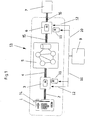
- a cash register system 13 can be seen, which for the implementation of a cashless payment transaction by means of a credit card 14 is set up as a cashless payment means.
- the credit card contains, among other things, card and user-specific data as part of transaction-relevant data, referred to below as user data.
- the transaction-relevant data in this embodiment also include data such as purchase price, bonuses and / or the like.
- the cash register system 13 has as cash register a data processing unit 5 and a card reader 1 connected to the data processing unit 5 via a communication connection 2, 4 as a reading unit for the credit card 14.
- the communication link 2, 4, which is designed here as a data connection between the card reader 1 and the data processing unit 5, is in the present case in two parts as a line-bound communication connection. In the present case, data cables are provided for this purpose.
- the two data links 2, 4 are coupled by communication technology via a security module 3 for encryption of the user data as an encryption unit. Consequently, the user data transmitted by the data connection 2 are in plain text, that is to say readable or unprotected, and in the data connection 4 encrypted or protected user data are transmitted which are unreadable for third parties.
- the user data read out from the credit card 14 by the card reader 1 are transmitted via the data connection 2 in clearness to the security module 3 for encryption of the user data, encrypted by the security module 3 and transmitted via the data connection 4 in encrypted form to the data processing unit 5.
- An extent of the encryption can be determined by the security module 3. All user data read from the credit card 14 or a subset thereof can be provided for encryption.
- the data processing unit 5 are thus at least partially, or exclusively encrypted user data.
- the user data are thus transmitted encrypted to the data processing unit 5.
- the data processing unit 5 processes the user data and the data required for the payment transaction and transmits them via a data connection 15, 16 to an authorization point 7 as a center.
- the data connection 15, 16 is also formed in two parts as a wired communication link.
- the two parts of the data connection 15, 16 are via a security module 6 for decrypting the user data as a decryption unit with each other in communication technology connection.
- Encrypted user data provided by the Data processing unit 5 are transmitted to the authorization point 7, first arrive via the data connection with encrypted or protected user data 15 to the security module for decrypting the user data 6, where they are decrypted. From there they are transmitted in decrypted or unprotected version via the data connection with user data in plain text 16 to the authorization point 7.
- the authorization center 7 thus receives the user data in plain text and can thus make the authorization in the intended manner.
- the data connection 15, 16 is presently formed by a telephone connection.
- a cash register system 13 is the card reader 1 for the credit card 14 with the data processing unit 5 in communication connection, the card reader 1 in order to carry out a payment transaction in communication with the credit card 14th occurs, data is read from the credit card 14 and transmitted to the data processing unit 5.
- the data is transferred encrypted to the data processing unit 5 by being encrypted by means of the security module 3 before being transferred to the data processing unit 5.
- the encrypted data are transmitted decrypted after the central office 7 by means of the security module 6 for decrypting the user data.
- the key for encrypting or decrypting the user data is alternatively provided in the security modules 3, 6 via two paths.
- One way is formed by the security modules 3, 6 communicating via an online connection 12 to a trust center 9 as a key issuing office.
- An alternative communication connection is formed in that a chip card 11 is provided as a data carrier with the key from the trust center 9 and the security modules 3, 6 is coupled for the purpose of reading the key.
- a non-illustrated reading unit of the security module 3, 6 serve.
- the chip card 11 it is provided here that the key itself remains on the chip card 11 during the process of encryption or decryption. Thus, access to the key for third parties can be difficult.
- the key is updated either via the online connection 12 or by changing the smart card 11.
- a symmetrical or asymmetrical key can be provided.
- the chip cards 11 of the security modules 3, 6 have different keys, or different keys are transmitted to the security modules 3, 6.
- the system of the invention is particularly suitable for cashless payment by means of a payment card, a credit card or the like, as is the case, for example, at petrol stations, car parks, leisure facilities, ticket vending machines or the like.
- the cash register system 13 is not limited to the use of conventional, manually operable cash registers, but it can also be used in particular in vending machines.
- the cash register may be formed by a data processing unit as described above.
- the method of the invention ensures that sensitive card data can be processed without the cash register or data processing unit being required or subject to certification.
- the POS system can be adapted particularly flexibly to a customer requirement without the need for separate approval or certification for such a customer-specific POS system.
- approval or certification would be required if card data were processed in plain text by the fund.
- the encryption and decryption unit advantageously obtain their keys from providers as key issuers such as so-called trust centers.
- the keys can be present on chip-card-shaped data carriers, so-called SAM modules.
- SAM modules are considered a secure repository for a key.
- the import of new keys into the encryption or decryption unit can be done both by exchanging SAM modules and online.
- a user of the cash register system 13 for example a customer, now wishes to make a payment with his credit card, this can be done both at a serviced cash register and at a vending machine.
- the customer uses the card reader 1.
- This card reader 1 then normally sends payment-relevant, sensitive user data via the data connection 2, 4 to the data processing unit 5 or cash register, which are processed there and to an authorization point 7 are sent.
- the security module 3 By the security module 3, these data are detected and encrypted or decrypted by the security module 6 again.
- the data processing unit 5 or cash register can process payment transactions without usable, sensitive user data being available at any time within the data processing unit 5 or cash register which enabled unauthorized transactions or even access to the data.
- the chip cards 11 are data carriers which contain the keys necessary for encryption and are procured by the trust center 9. These remain in the security modules 3, 6 for the intended use of the cash register system 13. They do not belong to the user of the cash register system 13. In the case of a key updates, the existing chip cards 11 can be exchanged for new smart cards.
- the invention it is not absolutely necessary to completely encrypt the data to be transferred from the reading unit to the cash register or from the cash register to the center or vice versa. It can be provided that only part of the data is encrypted or decrypted.
- the parts of the data to be transferred to be encrypted or decrypted can be provided with a designation which allows a simple identification for the security modules when encryption or decryption is to be performed.
- the part of the data may be formed, for example, by personal data.
Landscapes
- Business, Economics & Management (AREA)
- Accounting & Taxation (AREA)
- Physics & Mathematics (AREA)
- General Physics & Mathematics (AREA)
- Engineering & Computer Science (AREA)
- Finance (AREA)
- Strategic Management (AREA)
- General Business, Economics & Management (AREA)
- Theoretical Computer Science (AREA)
- Computer Security & Cryptography (AREA)
- Cash Registers Or Receiving Machines (AREA)
Priority Applications (1)
| Application Number | Priority Date | Filing Date | Title |
|---|---|---|---|
| EP09015030A EP2330574A1 (fr) | 2009-12-04 | 2009-12-04 | Système de caisses |
Applications Claiming Priority (1)
| Application Number | Priority Date | Filing Date | Title |
|---|---|---|---|
| EP09015030A EP2330574A1 (fr) | 2009-12-04 | 2009-12-04 | Système de caisses |
Publications (1)
| Publication Number | Publication Date |
|---|---|
| EP2330574A1 true EP2330574A1 (fr) | 2011-06-08 |
Family
ID=42026121
Family Applications (1)
| Application Number | Title | Priority Date | Filing Date |
|---|---|---|---|
| EP09015030A Withdrawn EP2330574A1 (fr) | 2009-12-04 | 2009-12-04 | Système de caisses |
Country Status (1)
| Country | Link |
|---|---|
| EP (1) | EP2330574A1 (fr) |
Cited By (1)
| Publication number | Priority date | Publication date | Assignee | Title |
|---|---|---|---|---|
| CN119091547A (zh) * | 2024-08-12 | 2024-12-06 | 深圳市智盈嘉科技有限公司 | 一种自助收银终端远程状态安全管理方法、系统及介质 |
Citations (7)
| Publication number | Priority date | Publication date | Assignee | Title |
|---|---|---|---|---|
| US5623637A (en) * | 1993-12-06 | 1997-04-22 | Telequip Corporation | Encrypted data storage card including smartcard integrated circuit for storing an access password and encryption keys |
| EP1128339A2 (fr) * | 2000-02-09 | 2001-08-29 | Sony Corporation | Système et terminal pour monnaie électronique |
| EP1369829A2 (fr) * | 2002-06-05 | 2003-12-10 | NTT DoCoMo, Inc. | Méthode et système de communication de données électroniques de valeur entre cartes à puce |
| WO2006038776A1 (fr) * | 2004-10-06 | 2006-04-13 | Samsung Electronics Co., Ltd. | Appareil et procede permettant de stocker des donnees de maniere securisee |
| US20060118615A1 (en) * | 2004-12-07 | 2006-06-08 | Giovanni Dominelli | System and method for secure transmission of electronic information |
| US20080109372A1 (en) * | 2006-11-03 | 2008-05-08 | Microsoft Corporation | Securing payment data |
| US20080189214A1 (en) * | 2006-10-17 | 2008-08-07 | Clay Von Mueller | Pin block replacement |
-
2009
- 2009-12-04 EP EP09015030A patent/EP2330574A1/fr not_active Withdrawn
Patent Citations (7)
| Publication number | Priority date | Publication date | Assignee | Title |
|---|---|---|---|---|
| US5623637A (en) * | 1993-12-06 | 1997-04-22 | Telequip Corporation | Encrypted data storage card including smartcard integrated circuit for storing an access password and encryption keys |
| EP1128339A2 (fr) * | 2000-02-09 | 2001-08-29 | Sony Corporation | Système et terminal pour monnaie électronique |
| EP1369829A2 (fr) * | 2002-06-05 | 2003-12-10 | NTT DoCoMo, Inc. | Méthode et système de communication de données électroniques de valeur entre cartes à puce |
| WO2006038776A1 (fr) * | 2004-10-06 | 2006-04-13 | Samsung Electronics Co., Ltd. | Appareil et procede permettant de stocker des donnees de maniere securisee |
| US20060118615A1 (en) * | 2004-12-07 | 2006-06-08 | Giovanni Dominelli | System and method for secure transmission of electronic information |
| US20080189214A1 (en) * | 2006-10-17 | 2008-08-07 | Clay Von Mueller | Pin block replacement |
| US20080109372A1 (en) * | 2006-11-03 | 2008-05-08 | Microsoft Corporation | Securing payment data |
Cited By (1)
| Publication number | Priority date | Publication date | Assignee | Title |
|---|---|---|---|---|
| CN119091547A (zh) * | 2024-08-12 | 2024-12-06 | 深圳市智盈嘉科技有限公司 | 一种自助收银终端远程状态安全管理方法、系统及介质 |
Similar Documents
| Publication | Publication Date | Title |
|---|---|---|
| EP0992025B1 (fr) | Procédé de transaction utilisant un élément d'identification portatif | |
| DE69215501T2 (de) | Werttransfersystem | |
| DE69019037T2 (de) | Mehrebenen-Sicherheitsvorrichtung und -verfahren mit persönlichem Schlüssel. | |
| DE3886623T2 (de) | Transaktionssystem mit einer oder mehreren zentralen Schnittstellen und mit einer Anzahl von verteilten Endstationen, welche an jede zentrale Schnittstelle über ein Netzwerk gekoppelt werden können; Concentrator und Endstation, geeignet für den Gebrauch in solch einem Transaktionssystem und Bedieneridentifizierungselement für den Gebrauch in einer solchen Endstation. | |
| DE69022610T2 (de) | Verfahren zum Chiffrieren von übertragenen Daten, das einen Einheitsschlüssel anwendet. | |
| DE69830993T2 (de) | Elektronische transaktion und chipkarte für eine elektronische transaktion | |
| DE69913929T2 (de) | Gesichertes Bezahlungsverfahren | |
| DE69900169T2 (de) | Kreditkartensystem und verfahren | |
| DE69521156T2 (de) | Verfahren zum Authentisieren eines Schalterterminals in einem System zur Durchführung von Überweisungen | |
| DE69312965T2 (de) | Kombiniertes geheimnummereingabe- und endgerät | |
| DE69735166T2 (de) | Verfahren und einrichtung zur sicherung der ferndienstleistungen der finanzinstitute | |
| DE60133542T2 (de) | Authentifizierungsverfahren | |
| DE102011100144A1 (de) | Sicheres drahtloses Zahlungssystem und Verfahren zu dessen Anwendung | |
| WO2001059725A1 (fr) | Procede de controle de l'identite d'un utilisateur | |
| DE69829635T2 (de) | Schützen von Transaktionsdaten | |
| DE102011116489A1 (de) | Mobiles Endgerät, Transaktionsterminal und Verfahren zur Durchführung einer Transaktion an einem Transaktionsterminal mittels eines mobilen Endgeräts | |
| DE10003875A1 (de) | Zahlungsausführungsvorrichtung zur bargeldlosen Zahlung und Verfahren zur Ausführung einer bargeldlosen Zahlung | |
| DE19718547C2 (de) | System zum gesicherten Lesen und Ändern von Daten auf intelligenten Datenträgern | |
| DE60122912T2 (de) | Verfahren zum liefern von identifikationsdaten einer bezahlkarte an einen anwender | |
| DE102004039365A1 (de) | Datenträger zur kontaktlosen Übertragung von verschlüsselten Datensignalen | |
| DE102005005378A1 (de) | Vorrichtung zur Eingabe und Übertragung von verschlüsselten Signalen | |
| EP2330574A1 (fr) | Système de caisses | |
| DE102005014194B4 (de) | Lesegerät mit integrierter Kryptographieeinheit | |
| WO1992004694A1 (fr) | Procede et dispositif de teletransmission confidentielle de donnees | |
| EP1047028A1 (fr) | Système et méthode de communication pour traiter efficacement des transactions électroniques dans des réseaux de communication mobile |
Legal Events
| Date | Code | Title | Description |
|---|---|---|---|
| PUAI | Public reference made under article 153(3) epc to a published international application that has entered the european phase |
Free format text: ORIGINAL CODE: 0009012 |
|
| AK | Designated contracting states |
Kind code of ref document: A1 Designated state(s): AT BE BG CH CY CZ DE DK EE ES FI FR GB GR HR HU IE IS IT LI LT LU LV MC MK MT NL NO PL PT RO SE SI SK SM TR |
|
| AX | Request for extension of the european patent |
Extension state: AL BA RS |
|
| STAA | Information on the status of an ep patent application or granted ep patent |
Free format text: STATUS: THE APPLICATION HAS BEEN WITHDRAWN |
|
| 18W | Application withdrawn |
Effective date: 20110610 |