EP2332017B1 - Estimation de l'état d'au moins une cible - Google Patents
Estimation de l'état d'au moins une cible Download PDFInfo
- Publication number
- EP2332017B1 EP2332017B1 EP09785562.1A EP09785562A EP2332017B1 EP 2332017 B1 EP2332017 B1 EP 2332017B1 EP 09785562 A EP09785562 A EP 09785562A EP 2332017 B1 EP2332017 B1 EP 2332017B1
- Authority
- EP
- European Patent Office
- Prior art keywords
- measurement
- sensor
- target
- target measurement
- regression model
- Prior art date
- Legal status (The legal status is an assumption and is not a legal conclusion. Google has not performed a legal analysis and makes no representation as to the accuracy of the status listed.)
- Not-in-force
Links
Images


Classifications
-
- G—PHYSICS
- G01—MEASURING; TESTING
- G01S—RADIO DIRECTION-FINDING; RADIO NAVIGATION; DETERMINING DISTANCE OR VELOCITY BY USE OF RADIO WAVES; LOCATING OR PRESENCE-DETECTING BY USE OF THE REFLECTION OR RERADIATION OF RADIO WAVES; ANALOGOUS ARRANGEMENTS USING OTHER WAVES
- G01S7/00—Details of systems according to groups G01S13/00, G01S15/00, G01S17/00
- G01S7/003—Transmission of data between radar, sonar or lidar systems and remote stations
-
- G—PHYSICS
- G01—MEASURING; TESTING
- G01S—RADIO DIRECTION-FINDING; RADIO NAVIGATION; DETERMINING DISTANCE OR VELOCITY BY USE OF RADIO WAVES; LOCATING OR PRESENCE-DETECTING BY USE OF THE REFLECTION OR RERADIATION OF RADIO WAVES; ANALOGOUS ARRANGEMENTS USING OTHER WAVES
- G01S13/00—Systems using the reflection or reradiation of radio waves, e.g. radar systems; Analogous systems using reflection or reradiation of waves whose nature or wavelength is irrelevant or unspecified
- G01S13/66—Radar-tracking systems; Analogous systems
- G01S13/72—Radar-tracking systems; Analogous systems for two-dimensional [2D] tracking, e.g. combination of angle and range tracking, track-while-scan radar
- G01S13/723—Radar-tracking systems; Analogous systems for two-dimensional [2D] tracking, e.g. combination of angle and range tracking, track-while-scan radar by using numerical data
- G01S13/726—Multiple target tracking
-
- G—PHYSICS
- G01—MEASURING; TESTING
- G01S—RADIO DIRECTION-FINDING; RADIO NAVIGATION; DETERMINING DISTANCE OR VELOCITY BY USE OF RADIO WAVES; LOCATING OR PRESENCE-DETECTING BY USE OF THE REFLECTION OR RERADIATION OF RADIO WAVES; ANALOGOUS ARRANGEMENTS USING OTHER WAVES
- G01S13/00—Systems using the reflection or reradiation of radio waves, e.g. radar systems; Analogous systems using reflection or reradiation of waves whose nature or wavelength is irrelevant or unspecified
- G01S13/86—Combinations of radar systems with non-radar systems, e.g. sonar, direction finder
Definitions
- the present invention relates to estimating a state of at least one target.
- US4860216 discloses a multi-sensor system using multi-sensor data fusion for estimating target position measurements.
- a known sensing technique that involves multiple sensors is a distributed sensor fusion network.
- the sensors in the network operate a Decentralised Data Fusion (DDF) algorithm (DDF is described in J. Manyika and H.F. Durrant-Whyte, Data Fusion and Sensor Management: A Decentralised Information-Theoretic Approach, Ellis Horwood, 1994 ), where data based on measurements taken by each sensor in the network are transmitted to the other sensors.
- DDF Decentralised Data Fusion
- Each sensor then performs a fusing operation on the data it has received from the other sensors as well as data based on its own measurements in order to predict the states (typically locations and velocities) of the targets.
- a problem associated with distributed sensor fusion networks is inadequate sensor registration.
- each sensor makes measurements of target positions in the survey volume and the measurements are integrated over time and combined using statistical data fusion algorithms to generate target tracks (a track typically comprises a position and velocity estimate and its calculated error).
- Sensor measurement errors are composed of two components: a random component (“noise”) and a systematic component (“bias”).
- Sensor measurement errors can be constant or time-varying (“drift”).
- drift time-varying
- Sensor registration can be considered to be the process of estimating and removing a sensor's systematic errors, or "registration errors”.
- FIG. 1 An example of registration errors resulting from sensor pointing biases is illustrated in Figure 1 .
- Two sensors 102A, 102B each track a target 104. Due to the pointing biases (e.g. the processors of the sensors have an inaccurate record of the sensors bearing measurement origins).
- the first sensor 102A outputs a measurement of the target being at location 106A, whilst the second sensor 102B outputs a measurement of the target at location 106B.
- Other examples of registration errors include clock errors, tilt errors, and location errors (see M.P. Dana, "Registration: A pre-requisite for multiple sensor tracking". In Y. Bar-Shalom (Ed.), Multitarget-Multisensor Tracking: Advanced Applications. Artech House, 1990, Ch. 5 , for example).
- registration errors can be described by a simple model (e.g. fixed offsets) and the parameters of that model are estimated as part of the data fusion process.
- registration errors exhibit spatial variations (due to environmental or other conditions) and it is unreasonable to assume all sources of registration error are known. New sources of errors may also arise as sensor technology develops.
- registration errors can change over time, due to sensor wearing, changes in environmental conditions, etc. It is usually very difficult to accurately model such errors as they are caused by natural phenomenon and can vary very slowly.
- Embodiments of the present invention are intended to address at least some of the problems outlined above.
- a method of estimating a target measurement relating to at least one target position including:
- the first sensor may be part of a Distributed Data Fusion (DDF) network including at least one further sensor.
- the method may further include fusing the updated target measurement with at least one further target measurement obtained from the least one further sensor in the distributed sensor fusion network to generate a fused measurement or measurements relating to the at least one target.
- the step of applying the Gaussian Process technique can include performing a learning process based on the at least one target measurement and the fused measurement or measurements to generate a training set for use with the regression model.
- the learning process may involve calculating a covariance matrix and a Cholesky factor of the covariance matrix, where the Cholesky factor is used with the regression model for computational efficiency.
- the training set may initially include a measurement value known or assumed to represent an error-free measurement taken by the first sensor.
- the GP regression model may be a non-linear, non-parametric regression model.
- a sensor configured to estimate a target measurement relating to at least one target position, the sensor including:
- the processor may be integral with the sensor, or may be remote from it.
- a computer program product comprising computer readable medium, having thereon computer program code means, when the program code is loaded, to make the computer execute a method of estimating a target measurement relating to at least one target position including:
- a method of estimating a state of at least one target tracked by a plurality of sensors within a distributed sensor fusion network wherein at least one of the sensors within the network has been registered using a technique involving a Gaussian Process.
- a local sensor 302 obtains a measurement z k , where k is an index which refers to a discrete set of measurement times.
- the measurement will typically represent the location and velocity of the target, but other features, e.g. bearing, could be used.
- the measurement is passed to a registration process 304 (described below) that produces a corrected measurement value that compensates for any bias that is calculated to be present in the sensor, i.e. the corrected measurement value ( z ⁇ k ) is a revised record of the position of the sensor within the sensor network.
- the correction is applied "virtually" in software, but it is also possible to apply the correction in hardware, i.e. physically reconfigure the sensor.
- the registration process may be executed by a processor integral with the sensor 302, or by a remote processor that receives data relating to the measurement taken by the sensor.
- the senor is part of a DDF network of sensors and the updated measurement, which is intended to correct the bias in the original measurement taken by the sensor, is used in a fusion process along with measurements taken from the other sensors (all or some of which may also be executing a registration process 304), although it will be understood that calculating the updated/improved measurement can be of value for improving the accuracy of a measurement taken from a single sensor.
- the original measurement z k and the corrected measurement z ⁇ k are passed to a data fusion process 306.
- the process 306 may comprise a conventional data fusion algorithm such as the Kalman filter or extended Kalman filter.
- At least one further measurement ( z k n in the example) from at least one other sensor n in the network 308 is also passed to the data fusion process 306.
- the process 306 produces a state estimate of mean x ⁇ k and error covariance P k that will normally have improved accuracy because errors resulting from incorrect sensor registration have been eliminated or mitigated.
- the ⁇ z k value (that represents a calculated bias for the measurement z k taken by the sensor) resulting from the data fusion process 306 is passed to a training data selection and learning process 310.
- FIG. 4 illustrates schematically steps involved in a learning procedure of the data selection and learning process 310 shown in Figure 3 .
- a Gaussian Process framework is used as a non-linear, non-parametric regression model.
- a training set of registration errors is used, which is built from the differences between unregistered and registered measurements, or their estimates.
- estimates of registration errors can be derived from the state estimates of the target observed by the subset of registered sensors. If the target can provide its own (true) state, even sporadically, it can be used to derive the registration error of a sensor and added to the training set.
- the main advantages of Gaussian Processes over other non-parametric estimation techniques are:
- the state estimate of the target x ⁇ k and its error covariance P k (which is an indication of the likely error of the state estimate) are received from the data fusion process 306, as well as the biased measurement z k from the local sensor 302.
- a training data selection algorithm at step 402 decides whether the new biased measurement should be added to the training set.
- An example of a suitable decision algorithm, based on the comparison of the estimate covariance with and without the new training point, is described in the abovementioned Osborne and Roberts article under the name "Active Data Selection”.
- Another possible selection algorithm is to use the true state of the target, when it is provided intermittently by the target.
- an estimate of the unbiased measurement is calculated by using the observation matrix used by the data fusion process 306.
- the bias ⁇ z k is then calculated by taking the difference between the actual measurement z k and the estimation of the unbiased measurement.
- the calculated bias ⁇ z k and the original measurement z k are added to the training set at step 406.
- the training set is formed of a set of the original measurements Y and a set of the biases ⁇ Y (where M in the equations shown at 406 in the Figure represents the number of data points, i.e. the number of biased measurement and bias estimate data pairs, in the training set).
- This regression model uses a Gaussian Process of covariance function k(x,y) with hyperparameters w to fit the training data.
- the covariance function is a squared exponential function, whose hyperparameters are the characteristic length-scales, one for each dimension of the measurement vector (see Gaussian Processes for Machine Learning Carl Edward Rasmussen and Christopher K. I. Williams The MIT Press, 2006. ISBN 0-262-18253-X, Chapter 4 for further details).
- the hyperparameters of the covariance function are recalculated at 408 to fit the Gaussian Process model of the new training set.
- the fitting process maximizes the marginal likelihood of the data set based on the Gaussian Process of covariance k(x,y).
- the Gaussian assumptions allow the use of efficient optimization methods (as described in Section 5.4.1 of the abovementioned Rasmussen and Williams reference).
- the covariance matrix is then calculated at step 410 by simply applying the covariance function at the training points, with the optimized hyperparameters. Since the regression process 304 uses the inverse of the covariance matrix it is more computationally efficient to calculate the Cholesky decomposition of the covariance matrix once for all and then reuse the Choleksy factor L YY (lower factor in this example) to perform the regression.
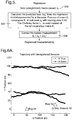
- FIG. 5 a regression procedure that uses values calculated during the learning procedure of Figure 4 is outlined.
- the learning procedure is normally executed only if the data selection algorithm 402 is performed.
- the regression procedure of Figure 5 is always executed following the reception of a new measurement from the sensor, resulting in an "online" registration procedure.
- the biased measurement z k from the local sensor 302 is received.
- the Gaussian Process is modelled by the covariance matrix K YY but the regression actually uses its Cholesky factor L YY calculated at 410 for computational efficiency.
- the equations of the regression model, including the use of the Cholesky factor, are discussed in Section 2.2 of the abovementioned Rasmussen and Williams reference).
- the biased measurement z k is corrected by adding the bias ⁇ z k * calculated at step 504. This corrected value z ⁇ k is then output by the registration process 304.
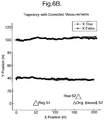
- Figures 6A and 6B illustrate the results of a simulation of two sensors configured to execute the method described above tracking one target.
- Each sensor provides the range and bearing of the target from its position.
- the target motion follows a random walk model and the tracker is based on an Unscented Kalman Filter.
- One of the sensors is not correctly registered and its position is reported to be 10 m west and 10 m south of its real position.
- the target is tracked for 200 m and the experiment is repeated 2 times with different initial positions.
- the training set for the registration algorithm is composed of 20 randomly distributed training points. In a real world application, those training points can be derived from the state information sent by the target at regular intervals.
- the accuracy of the tracking is compared using the Root Mean Squared Error of the position estimate and the true position of the target.
- Figure 6A is a graph showing example 2D coordinates of each target trajectory as measured by the sensor without running the registration process.
- Figure 6B is a similar graph showing the 2D trajectory with both sensors running the registration process described above (with 20 training points).
- the results are summarised in the following table: Situation Tracking error (RMSE) With registered sensors 0.4 m With unregistered sensors 8.3 m After correction with GP 0.8 m
- RMSE Situation Tracking error
Landscapes
- Engineering & Computer Science (AREA)
- Radar, Positioning & Navigation (AREA)
- Remote Sensing (AREA)
- Computer Networks & Wireless Communication (AREA)
- Physics & Mathematics (AREA)
- General Physics & Mathematics (AREA)
- Length Measuring Devices With Unspecified Measuring Means (AREA)
- Testing Or Calibration Of Command Recording Devices (AREA)
Claims (9)
- Procédé d'estimation d'une mesure de cible associée à au moins une position de cible, le procédé comprenant les étapes consistant à :obtenir au moins une mesure de cible (zk ) auprès d'un premier capteur, etappliquer une technique de Processus Gaussien (GP) à une dite mesure de cible dans le but d'obtenir une mesure de cible actualisée estimée (z̃k ) en calculant un biais prédit (Δzk *) pour la mesure (zk ) à partir d'un modèle de régression représenté par le GP et en utilisant le biais prédit pour produire la mesure de cible actualisée estimée (z̃k ).
- Procédé selon la revendication 1, dans lequel le premier capteur fait partie d'un réseau de fusion de capteurs réparti comportant au moins un autre capteur.
- Procédé selon la revendication 2, comportant en outre l'étape consistant à fusionner la mesure de cible actualisée estimée avec au moins une autre mesure de cible (zk " ) obtenue auprès d'au moins un autre capteur dans le réseau de fusion de capteurs réparti dans le but de générer une ou plusieurs mesures fusionnées (x̂k , Pk ) associées à ladite au moins une cible.
- Procédé selon la revendication 3, dans lequel l'étape consistant à appliquer la technique de Processus Gaussien (GP) comporte l'étape consistant à exécuter un processus d'apprentissage sur la base de ladite au moins une mesure de (zk ) et de la ou des mesures fusionnées (x̂k , Pk ) dans le but de générer une base d'apprentissage destinée à être utilisée avec le modèle de régression.
- Procédé selon la revendication 4, dans lequel le processus d'apprentissage met en jeu le calcul d'une matrice de covariance (KYY ) et d'un facteur de Cholesky (LYY ) de la matrice de covariance, le facteur de Cholesky étant utilisé avec le modèle de régression à des fins d'efficacité calculatoire.
- Procédé selon la revendication 4 ou 5, dans lequel la base d'apprentissage comporte initialement une valeur de mesure dont on sait ou suppose qu'elle représente une mesure sans erreur effectuée par le premier capteur.
- Procédé selon l'une quelconque des revendications précédentes, dans lequel le modèle de régression du GP est un modèle de régression non paramétrique et non linéaire.
- Capteur configuré pour estimer une mesure de cible associée à au moins une position de cible, le capteur comportant :un dispositif configuré pour obtenir au moins une mesure de cible, etle capteur étant caractérisé en ce qu'il comporteun processeur configuré pour appliquer une technique de Processus Gaussien (GP) à une dite mesure de cible dans le but d'obtenir une mesure actualisée estimée en calculant un biais prédit (Δzk *) pour la mesure (zk ) à partir d'un modèle de régression représenté par le GP et en utilisant le biais prédit pour produire la mesure de cible actualisée estimée (z̃k ).
- Produit-programme d'ordinateur comprenant un support lisible par ordinateur sur lequel figurent des moyens formant code de programme d'ordinateur destinés, une fois le code de programme chargé, à faire exécuter, par l'ordinateur, un procédé d'estimation d'une mesure de cible associée à au moins une position de cible comportant les étapes consistant à :obtenir au moins une mesure de cible auprès d'un premier capteur, etappliquer une technique de Processus Gaussien (GP) à une dite mesure de cible dans le but d'estimer une mesure de cible actualisée en calculant un biais prédit (Δzk *) pour la mesure (zk ) à partir d'un modèle de régression représenté par le GP et en utilisant le biais prédit pour produire la mesure de cible actualisée estimée (z̃k ).
Priority Applications (1)
| Application Number | Priority Date | Filing Date | Title |
|---|---|---|---|
| EP09785562.1A EP2332017B1 (fr) | 2008-09-03 | 2009-09-02 | Estimation de l'état d'au moins une cible |
Applications Claiming Priority (4)
| Application Number | Priority Date | Filing Date | Title |
|---|---|---|---|
| GB0816040A GB0816040D0 (en) | 2008-09-03 | 2008-09-03 | Estimating a state of at least one target |
| EP08275048A EP2161634A1 (fr) | 2008-09-03 | 2008-09-03 | Estimation de l'état d'au moins une cible |
| PCT/GB2009/051103 WO2010026417A1 (fr) | 2008-09-03 | 2009-09-02 | Estimation d’un état d’au moins une cible |
| EP09785562.1A EP2332017B1 (fr) | 2008-09-03 | 2009-09-02 | Estimation de l'état d'au moins une cible |
Publications (2)
| Publication Number | Publication Date |
|---|---|
| EP2332017A1 EP2332017A1 (fr) | 2011-06-15 |
| EP2332017B1 true EP2332017B1 (fr) | 2016-03-30 |
Family
ID=41397524
Family Applications (1)
| Application Number | Title | Priority Date | Filing Date |
|---|---|---|---|
| EP09785562.1A Not-in-force EP2332017B1 (fr) | 2008-09-03 | 2009-09-02 | Estimation de l'état d'au moins une cible |
Country Status (7)
| Country | Link |
|---|---|
| US (1) | US20120030154A1 (fr) |
| EP (1) | EP2332017B1 (fr) |
| AU (1) | AU2009289008B2 (fr) |
| BR (1) | BRPI0915941A2 (fr) |
| CA (1) | CA2735787A1 (fr) |
| IL (1) | IL211520A0 (fr) |
| WO (1) | WO2010026417A1 (fr) |
Families Citing this family (24)
| Publication number | Priority date | Publication date | Assignee | Title |
|---|---|---|---|---|
| EP2184681A1 (fr) * | 2008-10-31 | 2010-05-12 | HSBC Holdings plc | Contrôle de capacité |
| US8825456B2 (en) * | 2009-09-15 | 2014-09-02 | The University Of Sydney | Method and system for multiple dataset gaussian process modeling |
| US9070285B1 (en) * | 2011-07-25 | 2015-06-30 | UtopiaCompression Corporation | Passive camera based cloud detection and avoidance for aircraft systems |
| US9363154B2 (en) * | 2012-09-26 | 2016-06-07 | International Business Machines Corporaion | Prediction-based provisioning planning for cloud environments |
| US10295662B2 (en) * | 2014-03-17 | 2019-05-21 | Bae Systems Plc | Producing data describing target measurements |
| EP2921878A1 (fr) * | 2014-03-17 | 2015-09-23 | BAE Systems PLC | Production des données décrivant les états cibles |
| US10031221B2 (en) * | 2016-03-03 | 2018-07-24 | Raytheon Company | System and method for estimating number and range of a plurality of moving targets |
| US10606266B2 (en) * | 2016-11-04 | 2020-03-31 | The Boeing Company | Tracking a target moving between states in an environment |
| US10942029B2 (en) | 2016-11-04 | 2021-03-09 | The Boeing Company | Tracking a target using multiple tracking systems |
| JP6759130B2 (ja) * | 2017-03-03 | 2020-09-23 | 株式会社東芝 | センサネットワークシステム、データ融合システム、センサバイアス推定装置、センサバイアス推定方法及びセンサバイアス推定プログラム |
| WO2018168182A1 (fr) * | 2017-03-17 | 2018-09-20 | 日本電気株式会社 | Dispositif de détection de corps mobile, procédé de détection de corps mobile et programme de détection de corps mobile |
| CN107944115A (zh) * | 2017-11-17 | 2018-04-20 | 中国科学院、水利部成都山地灾害与环境研究所 | 生态参量地面无线联网观测中的不确定性综合测度方法 |
| US10977110B2 (en) * | 2017-12-27 | 2021-04-13 | Palo Alto Research Center Incorporated | System and method for facilitating prediction data for device based on synthetic data with uncertainties |
| US11651244B2 (en) * | 2018-10-04 | 2023-05-16 | Here Global B.V. | Method and apparatus for predicting sensor error |
| US11521063B1 (en) * | 2019-12-17 | 2022-12-06 | Bae Systems Information And Electronic Systems Integration Inc. | System and method for terminal acquisition with a neural network |
| US11710181B1 (en) * | 2020-01-10 | 2023-07-25 | Cboe Exchange, Inc. | Exchange risk controls |
| CN111843626B (zh) * | 2020-07-16 | 2021-11-30 | 上海交通大学 | 基于高斯模型的气驱动执行器迟滞建模方法、系统及介质 |
| US11900457B2 (en) * | 2020-08-24 | 2024-02-13 | Leonid Chuzhoy | Methods for prediction and rating aggregation |
| CN113687143B (zh) * | 2021-08-12 | 2024-04-05 | 国网上海市电力公司 | 一种电磁波信号幅值衰减与传播距离关系曲线的拟合方法 |
| US12333612B2 (en) * | 2022-05-31 | 2025-06-17 | As0001, Inc. | Systems and methods for dynamic valuation of protection products |
| US12100048B1 (en) * | 2022-08-31 | 2024-09-24 | Robert D. Arnott | System, method and computer program product for constructing a capitalization-weighted global index portfolio |
| US12423691B1 (en) * | 2022-11-04 | 2025-09-23 | Wells Fargo Bank, N.A. | Systems and methods for issuing blockchain tokens for property rights |
| US12530677B2 (en) * | 2023-03-23 | 2026-01-20 | Bank Of America Corporation | Machine learning based system for processing device telemetry in a distributed computing environment |
| US12423714B2 (en) * | 2023-11-22 | 2025-09-23 | Provenance Technology Corporation | Method and device for authenticating provenance of wines and spirits |
Family Cites Families (5)
| Publication number | Priority date | Publication date | Assignee | Title |
|---|---|---|---|---|
| US4860216A (en) * | 1986-11-13 | 1989-08-22 | The United States Of America As Represented By The Secretary Of The Air Force | Communication adaptive multi-sensor system |
| SE510844C2 (sv) * | 1997-11-03 | 1999-06-28 | Celsiustech Syst Ab | Automatisk kompensering av systematiska fel vid målföljning med flera sensorer |
| US6225942B1 (en) * | 1999-07-30 | 2001-05-01 | Litton Systems, Inc. | Registration method for multiple sensor radar |
| US6801662B1 (en) * | 2000-10-10 | 2004-10-05 | Hrl Laboratories, Llc | Sensor fusion architecture for vision-based occupant detection |
| US7583815B2 (en) * | 2005-04-05 | 2009-09-01 | Objectvideo Inc. | Wide-area site-based video surveillance system |
-
2009
- 2009-09-02 BR BRPI0915941A patent/BRPI0915941A2/pt not_active IP Right Cessation
- 2009-09-02 CA CA2735787A patent/CA2735787A1/fr not_active Abandoned
- 2009-09-02 WO PCT/GB2009/051103 patent/WO2010026417A1/fr not_active Ceased
- 2009-09-02 US US13/062,096 patent/US20120030154A1/en not_active Abandoned
- 2009-09-02 EP EP09785562.1A patent/EP2332017B1/fr not_active Not-in-force
- 2009-09-02 AU AU2009289008A patent/AU2009289008B2/en not_active Ceased
-
2011
- 2011-03-02 IL IL211520A patent/IL211520A0/en unknown
Also Published As
| Publication number | Publication date |
|---|---|
| AU2009289008A1 (en) | 2010-03-11 |
| IL211520A0 (en) | 2011-05-31 |
| WO2010026417A1 (fr) | 2010-03-11 |
| AU2009289008B2 (en) | 2014-02-13 |
| EP2332017A1 (fr) | 2011-06-15 |
| US20120030154A1 (en) | 2012-02-02 |
| CA2735787A1 (fr) | 2010-03-11 |
| BRPI0915941A2 (pt) | 2015-11-03 |
Similar Documents
| Publication | Publication Date | Title |
|---|---|---|
| US20120030154A1 (en) | Estimating a state of at least one target | |
| CN111178385B (zh) | 一种鲁棒在线多传感器融合的目标跟踪方法 | |
| CN109901153B (zh) | 基于信息熵权和最近邻域数据关联的目标航迹优化方法 | |
| CN106443622B (zh) | 一种基于改进联合概率数据关联的分布式目标跟踪方法 | |
| CN110889862B (zh) | 一种网络传输攻击环境中多目标跟踪的组合测量方法 | |
| CN106772353B (zh) | 一种适用于闪烁噪声的多目标跟踪方法及系统 | |
| CN110849372A (zh) | 一种基于em聚类的水下多目标轨迹关联方法 | |
| CN111262556B (zh) | 一种同时估计未知高斯测量噪声统计量的多目标跟踪方法 | |
| CN108519595A (zh) | 联合多传感器配准与多目标跟踪方法 | |
| Attari et al. | An SVSF-based generalized robust strategy for target tracking in clutter | |
| CN106021194A (zh) | 一种多传感器多目标跟踪偏差估计方法 | |
| CN103955600A (zh) | 一种目标跟踪方法及截断积分卡尔曼滤波方法、装置 | |
| CN104504728A (zh) | 多机动目标跟踪方法、系统及其广义联合概率数据关联器 | |
| Yang et al. | Variational approximation for adaptive extended target tracking in clutter with random matrix | |
| CN108226887B (zh) | 一种观测量短暂丢失情况下的水面目标救援状态估计方法 | |
| CN116680500A (zh) | 水下航行器在非高斯噪声干扰下的位置估计方法及系统 | |
| EP2161634A1 (fr) | Estimation de l'état d'au moins une cible | |
| Yang et al. | Linear minimum‐mean‐square error estimation of Markovian jump linear systems with stochastic coefficient matrices | |
| CN115857559B (zh) | 一种纯角度目标跟踪方法及系统 | |
| Mohammadi et al. | Distributed posterior Cramér-Rao lower bound for nonlinear sequential Bayesian estimation | |
| CN111665495B (zh) | 一种基于vsmm-gmphd的多目标跟踪方法 | |
| CN104050686A (zh) | 一种新型的密集空间目标跟踪方法 | |
| Dubois et al. | Performance evaluation of a moving horizon estimator for multi-rate sensor fusion with time-delayed measurements | |
| CN112581616B (zh) | 基于序贯分块滤波的最近邻ukf-slam方法 | |
| Jing et al. | Process noise identification based particle filter: an efficient method to track highly manoeuvring targets |
Legal Events
| Date | Code | Title | Description |
|---|---|---|---|
| PUAI | Public reference made under article 153(3) epc to a published international application that has entered the european phase |
Free format text: ORIGINAL CODE: 0009012 |
|
| 17P | Request for examination filed |
Effective date: 20110331 |
|
| AK | Designated contracting states |
Kind code of ref document: A1 Designated state(s): AT BE BG CH CY CZ DE DK EE ES FI FR GB GR HR HU IE IS IT LI LT LU LV MC MK MT NL NO PL PT RO SE SI SK SM TR |
|
| AX | Request for extension of the european patent |
Extension state: AL BA RS |
|
| DAX | Request for extension of the european patent (deleted) | ||
| REG | Reference to a national code |
Ref country code: DE Ref legal event code: R079 Ref document number: 602009037330 Country of ref document: DE Free format text: PREVIOUS MAIN CLASS: G05B0013000000 Ipc: G01S0007000000 |
|
| GRAP | Despatch of communication of intention to grant a patent |
Free format text: ORIGINAL CODE: EPIDOSNIGR1 |
|
| RIC1 | Information provided on ipc code assigned before grant |
Ipc: G01S 13/72 20060101ALI20150923BHEP Ipc: G01S 7/00 20060101AFI20150923BHEP Ipc: G01S 13/86 20060101ALI20150923BHEP |
|
| INTG | Intention to grant announced |
Effective date: 20151020 |
|
| GRAS | Grant fee paid |
Free format text: ORIGINAL CODE: EPIDOSNIGR3 |
|
| GRAA | (expected) grant |
Free format text: ORIGINAL CODE: 0009210 |
|
| AK | Designated contracting states |
Kind code of ref document: B1 Designated state(s): AT BE BG CH CY CZ DE DK EE ES FI FR GB GR HR HU IE IS IT LI LT LU LV MC MK MT NL NO PL PT RO SE SI SK SM TR |
|
| REG | Reference to a national code |
Ref country code: GB Ref legal event code: FG4D |
|
| REG | Reference to a national code |
Ref country code: CH Ref legal event code: EP |
|
| REG | Reference to a national code |
Ref country code: AT Ref legal event code: REF Ref document number: 785958 Country of ref document: AT Kind code of ref document: T Effective date: 20160415 |
|
| REG | Reference to a national code |
Ref country code: IE Ref legal event code: FG4D |
|
| REG | Reference to a national code |
Ref country code: DE Ref legal event code: R096 Ref document number: 602009037330 Country of ref document: DE |
|
| REG | Reference to a national code |
Ref country code: NL Ref legal event code: FP |
|
| REG | Reference to a national code |
Ref country code: LT Ref legal event code: MG4D |
|
| PG25 | Lapsed in a contracting state [announced via postgrant information from national office to epo] |
Ref country code: HR Free format text: LAPSE BECAUSE OF FAILURE TO SUBMIT A TRANSLATION OF THE DESCRIPTION OR TO PAY THE FEE WITHIN THE PRESCRIBED TIME-LIMIT Effective date: 20160330 Ref country code: GR Free format text: LAPSE BECAUSE OF FAILURE TO SUBMIT A TRANSLATION OF THE DESCRIPTION OR TO PAY THE FEE WITHIN THE PRESCRIBED TIME-LIMIT Effective date: 20160701 Ref country code: FI Free format text: LAPSE BECAUSE OF FAILURE TO SUBMIT A TRANSLATION OF THE DESCRIPTION OR TO PAY THE FEE WITHIN THE PRESCRIBED TIME-LIMIT Effective date: 20160330 Ref country code: NO Free format text: LAPSE BECAUSE OF FAILURE TO SUBMIT A TRANSLATION OF THE DESCRIPTION OR TO PAY THE FEE WITHIN THE PRESCRIBED TIME-LIMIT Effective date: 20160630 |
|
| REG | Reference to a national code |
Ref country code: AT Ref legal event code: MK05 Ref document number: 785958 Country of ref document: AT Kind code of ref document: T Effective date: 20160330 |
|
| PG25 | Lapsed in a contracting state [announced via postgrant information from national office to epo] |
Ref country code: LV Free format text: LAPSE BECAUSE OF FAILURE TO SUBMIT A TRANSLATION OF THE DESCRIPTION OR TO PAY THE FEE WITHIN THE PRESCRIBED TIME-LIMIT Effective date: 20160330 Ref country code: SE Free format text: LAPSE BECAUSE OF FAILURE TO SUBMIT A TRANSLATION OF THE DESCRIPTION OR TO PAY THE FEE WITHIN THE PRESCRIBED TIME-LIMIT Effective date: 20160330 Ref country code: LT Free format text: LAPSE BECAUSE OF FAILURE TO SUBMIT A TRANSLATION OF THE DESCRIPTION OR TO PAY THE FEE WITHIN THE PRESCRIBED TIME-LIMIT Effective date: 20160330 |
|
| REG | Reference to a national code |
Ref country code: FR Ref legal event code: PLFP Year of fee payment: 8 |
|
| PG25 | Lapsed in a contracting state [announced via postgrant information from national office to epo] |
Ref country code: IS Free format text: LAPSE BECAUSE OF FAILURE TO SUBMIT A TRANSLATION OF THE DESCRIPTION OR TO PAY THE FEE WITHIN THE PRESCRIBED TIME-LIMIT Effective date: 20160730 Ref country code: PL Free format text: LAPSE BECAUSE OF FAILURE TO SUBMIT A TRANSLATION OF THE DESCRIPTION OR TO PAY THE FEE WITHIN THE PRESCRIBED TIME-LIMIT Effective date: 20160330 Ref country code: EE Free format text: LAPSE BECAUSE OF FAILURE TO SUBMIT A TRANSLATION OF THE DESCRIPTION OR TO PAY THE FEE WITHIN THE PRESCRIBED TIME-LIMIT Effective date: 20160330 |
|
| PG25 | Lapsed in a contracting state [announced via postgrant information from national office to epo] |
Ref country code: CZ Free format text: LAPSE BECAUSE OF FAILURE TO SUBMIT A TRANSLATION OF THE DESCRIPTION OR TO PAY THE FEE WITHIN THE PRESCRIBED TIME-LIMIT Effective date: 20160330 Ref country code: RO Free format text: LAPSE BECAUSE OF FAILURE TO SUBMIT A TRANSLATION OF THE DESCRIPTION OR TO PAY THE FEE WITHIN THE PRESCRIBED TIME-LIMIT Effective date: 20160330 Ref country code: ES Free format text: LAPSE BECAUSE OF FAILURE TO SUBMIT A TRANSLATION OF THE DESCRIPTION OR TO PAY THE FEE WITHIN THE PRESCRIBED TIME-LIMIT Effective date: 20160330 Ref country code: SK Free format text: LAPSE BECAUSE OF FAILURE TO SUBMIT A TRANSLATION OF THE DESCRIPTION OR TO PAY THE FEE WITHIN THE PRESCRIBED TIME-LIMIT Effective date: 20160330 Ref country code: PT Free format text: LAPSE BECAUSE OF FAILURE TO SUBMIT A TRANSLATION OF THE DESCRIPTION OR TO PAY THE FEE WITHIN THE PRESCRIBED TIME-LIMIT Effective date: 20160801 Ref country code: SM Free format text: LAPSE BECAUSE OF FAILURE TO SUBMIT A TRANSLATION OF THE DESCRIPTION OR TO PAY THE FEE WITHIN THE PRESCRIBED TIME-LIMIT Effective date: 20160330 Ref country code: AT Free format text: LAPSE BECAUSE OF FAILURE TO SUBMIT A TRANSLATION OF THE DESCRIPTION OR TO PAY THE FEE WITHIN THE PRESCRIBED TIME-LIMIT Effective date: 20160330 |
|
| PG25 | Lapsed in a contracting state [announced via postgrant information from national office to epo] |
Ref country code: IT Free format text: LAPSE BECAUSE OF FAILURE TO SUBMIT A TRANSLATION OF THE DESCRIPTION OR TO PAY THE FEE WITHIN THE PRESCRIBED TIME-LIMIT Effective date: 20160330 Ref country code: BE Free format text: LAPSE BECAUSE OF FAILURE TO SUBMIT A TRANSLATION OF THE DESCRIPTION OR TO PAY THE FEE WITHIN THE PRESCRIBED TIME-LIMIT Effective date: 20160330 |
|
| REG | Reference to a national code |
Ref country code: DE Ref legal event code: R097 Ref document number: 602009037330 Country of ref document: DE |
|
| PG25 | Lapsed in a contracting state [announced via postgrant information from national office to epo] |
Ref country code: DK Free format text: LAPSE BECAUSE OF FAILURE TO SUBMIT A TRANSLATION OF THE DESCRIPTION OR TO PAY THE FEE WITHIN THE PRESCRIBED TIME-LIMIT Effective date: 20160330 |
|
| PLBE | No opposition filed within time limit |
Free format text: ORIGINAL CODE: 0009261 |
|
| STAA | Information on the status of an ep patent application or granted ep patent |
Free format text: STATUS: NO OPPOSITION FILED WITHIN TIME LIMIT |
|
| 26N | No opposition filed |
Effective date: 20170103 |
|
| PG25 | Lapsed in a contracting state [announced via postgrant information from national office to epo] |
Ref country code: MC Free format text: LAPSE BECAUSE OF FAILURE TO SUBMIT A TRANSLATION OF THE DESCRIPTION OR TO PAY THE FEE WITHIN THE PRESCRIBED TIME-LIMIT Effective date: 20160330 |
|
| REG | Reference to a national code |
Ref country code: CH Ref legal event code: PL |
|
| PG25 | Lapsed in a contracting state [announced via postgrant information from national office to epo] |
Ref country code: SI Free format text: LAPSE BECAUSE OF FAILURE TO SUBMIT A TRANSLATION OF THE DESCRIPTION OR TO PAY THE FEE WITHIN THE PRESCRIBED TIME-LIMIT Effective date: 20160330 |
|
| REG | Reference to a national code |
Ref country code: IE Ref legal event code: MM4A |
|
| PG25 | Lapsed in a contracting state [announced via postgrant information from national office to epo] |
Ref country code: LI Free format text: LAPSE BECAUSE OF NON-PAYMENT OF DUE FEES Effective date: 20160930 Ref country code: IE Free format text: LAPSE BECAUSE OF NON-PAYMENT OF DUE FEES Effective date: 20160902 Ref country code: CH Free format text: LAPSE BECAUSE OF NON-PAYMENT OF DUE FEES Effective date: 20160930 |
|
| PG25 | Lapsed in a contracting state [announced via postgrant information from national office to epo] |
Ref country code: LU Free format text: LAPSE BECAUSE OF NON-PAYMENT OF DUE FEES Effective date: 20160902 |
|
| REG | Reference to a national code |
Ref country code: FR Ref legal event code: PLFP Year of fee payment: 9 |
|
| PG25 | Lapsed in a contracting state [announced via postgrant information from national office to epo] |
Ref country code: CY Free format text: LAPSE BECAUSE OF FAILURE TO SUBMIT A TRANSLATION OF THE DESCRIPTION OR TO PAY THE FEE WITHIN THE PRESCRIBED TIME-LIMIT Effective date: 20160330 Ref country code: HU Free format text: LAPSE BECAUSE OF FAILURE TO SUBMIT A TRANSLATION OF THE DESCRIPTION OR TO PAY THE FEE WITHIN THE PRESCRIBED TIME-LIMIT; INVALID AB INITIO Effective date: 20090902 |
|
| PG25 | Lapsed in a contracting state [announced via postgrant information from national office to epo] |
Ref country code: TR Free format text: LAPSE BECAUSE OF FAILURE TO SUBMIT A TRANSLATION OF THE DESCRIPTION OR TO PAY THE FEE WITHIN THE PRESCRIBED TIME-LIMIT Effective date: 20160330 Ref country code: MT Free format text: LAPSE BECAUSE OF NON-PAYMENT OF DUE FEES Effective date: 20160930 Ref country code: MK Free format text: LAPSE BECAUSE OF FAILURE TO SUBMIT A TRANSLATION OF THE DESCRIPTION OR TO PAY THE FEE WITHIN THE PRESCRIBED TIME-LIMIT Effective date: 20160330 |
|
| PG25 | Lapsed in a contracting state [announced via postgrant information from national office to epo] |
Ref country code: BG Free format text: LAPSE BECAUSE OF FAILURE TO SUBMIT A TRANSLATION OF THE DESCRIPTION OR TO PAY THE FEE WITHIN THE PRESCRIBED TIME-LIMIT Effective date: 20160330 |
|
| REG | Reference to a national code |
Ref country code: FR Ref legal event code: PLFP Year of fee payment: 10 |
|
| PGFP | Annual fee paid to national office [announced via postgrant information from national office to epo] |
Ref country code: NL Payment date: 20230822 Year of fee payment: 15 |
|
| PGFP | Annual fee paid to national office [announced via postgrant information from national office to epo] |
Ref country code: GB Payment date: 20230823 Year of fee payment: 15 |
|
| PGFP | Annual fee paid to national office [announced via postgrant information from national office to epo] |
Ref country code: FR Payment date: 20230822 Year of fee payment: 15 Ref country code: DE Payment date: 20230822 Year of fee payment: 15 |
|
| REG | Reference to a national code |
Ref country code: DE Ref legal event code: R119 Ref document number: 602009037330 Country of ref document: DE |
|
| REG | Reference to a national code |
Ref country code: NL Ref legal event code: MM Effective date: 20241001 |
|
| GBPC | Gb: european patent ceased through non-payment of renewal fee |
Effective date: 20240902 |
|
| PG25 | Lapsed in a contracting state [announced via postgrant information from national office to epo] |
Ref country code: NL Free format text: LAPSE BECAUSE OF NON-PAYMENT OF DUE FEES Effective date: 20241001 |
|
| PG25 | Lapsed in a contracting state [announced via postgrant information from national office to epo] |
Ref country code: DE Free format text: LAPSE BECAUSE OF NON-PAYMENT OF DUE FEES Effective date: 20250401 |
|
| PG25 | Lapsed in a contracting state [announced via postgrant information from national office to epo] |
Ref country code: GB Free format text: LAPSE BECAUSE OF NON-PAYMENT OF DUE FEES Effective date: 20240902 |
|
| PG25 | Lapsed in a contracting state [announced via postgrant information from national office to epo] |
Ref country code: FR Free format text: LAPSE BECAUSE OF NON-PAYMENT OF DUE FEES Effective date: 20240930 |