EP2332894A1 - Procédé et fabrication de matières explosives - Google Patents
Procédé et fabrication de matières explosives Download PDFInfo
- Publication number
- EP2332894A1 EP2332894A1 EP09179006A EP09179006A EP2332894A1 EP 2332894 A1 EP2332894 A1 EP 2332894A1 EP 09179006 A EP09179006 A EP 09179006A EP 09179006 A EP09179006 A EP 09179006A EP 2332894 A1 EP2332894 A1 EP 2332894A1
- Authority
- EP
- European Patent Office
- Prior art keywords
- raw material
- explosive raw
- explosive
- isostatic pressing
- gelatinizing
- Prior art date
- Legal status (The legal status is an assumption and is not a legal conclusion. Google has not performed a legal analysis and makes no representation as to the accuracy of the status listed.)
- Withdrawn
Links
- 239000002360 explosive Substances 0.000 title claims abstract description 91
- 238000000034 method Methods 0.000 title claims description 46
- 238000004519 manufacturing process Methods 0.000 title abstract description 6
- 239000000463 material Substances 0.000 title abstract description 6
- 238000000462 isostatic pressing Methods 0.000 claims abstract description 28
- 239000002994 raw material Substances 0.000 claims description 60
- 230000008569 process Effects 0.000 claims description 20
- OKTJSMMVPCPJKN-UHFFFAOYSA-N Carbon Chemical compound [C] OKTJSMMVPCPJKN-UHFFFAOYSA-N 0.000 claims description 12
- 239000000203 mixture Substances 0.000 claims description 8
- 238000010008 shearing Methods 0.000 claims description 8
- RTZKZFJDLAIYFH-UHFFFAOYSA-N Diethyl ether Chemical compound CCOCC RTZKZFJDLAIYFH-UHFFFAOYSA-N 0.000 claims description 6
- 229910052799 carbon Inorganic materials 0.000 claims description 5
- 239000002041 carbon nanotube Substances 0.000 claims description 5
- 229910021393 carbon nanotube Inorganic materials 0.000 claims description 5
- CSCPPACGZOOCGX-UHFFFAOYSA-N Acetone Chemical compound CC(C)=O CSCPPACGZOOCGX-UHFFFAOYSA-N 0.000 claims description 4
- LFQSCWFLJHTTHZ-UHFFFAOYSA-N Ethanol Chemical compound CCO LFQSCWFLJHTTHZ-UHFFFAOYSA-N 0.000 claims description 4
- 229910002804 graphite Inorganic materials 0.000 claims description 4
- 239000010439 graphite Substances 0.000 claims description 4
- 239000002904 solvent Substances 0.000 claims description 4
- 238000001816 cooling Methods 0.000 claims description 3
- 239000006229 carbon black Substances 0.000 claims description 2
- 238000012545 processing Methods 0.000 description 17
- 229920001220 nitrocellulos Polymers 0.000 description 14
- 239000000020 Nitrocellulose Substances 0.000 description 13
- 239000008187 granular material Substances 0.000 description 10
- 239000000843 powder Substances 0.000 description 10
- 239000000499 gel Substances 0.000 description 6
- SNIOPGDIGTZGOP-UHFFFAOYSA-N Nitroglycerin Chemical compound [O-][N+](=O)OCC(O[N+]([O-])=O)CO[N+]([O-])=O SNIOPGDIGTZGOP-UHFFFAOYSA-N 0.000 description 5
- 230000008901 benefit Effects 0.000 description 5
- 239000003380 propellant Substances 0.000 description 5
- IJGRMHOSHXDMSA-UHFFFAOYSA-N Atomic nitrogen Chemical compound N#N IJGRMHOSHXDMSA-UHFFFAOYSA-N 0.000 description 4
- 238000005096 rolling process Methods 0.000 description 4
- XTFIVUDBNACUBN-UHFFFAOYSA-N 1,3,5-trinitro-1,3,5-triazinane Chemical compound [O-][N+](=O)N1CN([N+]([O-])=O)CN([N+]([O-])=O)C1 XTFIVUDBNACUBN-UHFFFAOYSA-N 0.000 description 3
- UQXKXGWGFRWILX-UHFFFAOYSA-N ethylene glycol dinitrate Chemical compound O=N(=O)OCCON(=O)=O UQXKXGWGFRWILX-UHFFFAOYSA-N 0.000 description 3
- 230000006872 improvement Effects 0.000 description 3
- 238000003825 pressing Methods 0.000 description 3
- 230000008961 swelling Effects 0.000 description 3
- IDCPFAYURAQKDZ-UHFFFAOYSA-N 1-nitroguanidine Chemical compound NC(=N)N[N+]([O-])=O IDCPFAYURAQKDZ-UHFFFAOYSA-N 0.000 description 2
- XMWRBQBLMFGWIX-UHFFFAOYSA-N C60 fullerene Chemical class C12=C3C(C4=C56)=C7C8=C5C5=C9C%10=C6C6=C4C1=C1C4=C6C6=C%10C%10=C9C9=C%11C5=C8C5=C8C7=C3C3=C7C2=C1C1=C2C4=C6C4=C%10C6=C9C9=C%11C5=C5C8=C3C3=C7C1=C1C2=C4C6=C2C9=C5C3=C12 XMWRBQBLMFGWIX-UHFFFAOYSA-N 0.000 description 2
- 230000015572 biosynthetic process Effects 0.000 description 2
- 238000005422 blasting Methods 0.000 description 2
- 238000007796 conventional method Methods 0.000 description 2
- 239000000835 fiber Substances 0.000 description 2
- 229910003472 fullerene Inorganic materials 0.000 description 2
- 238000001879 gelation Methods 0.000 description 2
- 239000003349 gelling agent Substances 0.000 description 2
- 229960003711 glyceryl trinitrate Drugs 0.000 description 2
- 238000005469 granulation Methods 0.000 description 2
- 230000003179 granulation Effects 0.000 description 2
- 229910052757 nitrogen Inorganic materials 0.000 description 2
- 239000004033 plastic Substances 0.000 description 2
- 229920003023 plastic Polymers 0.000 description 2
- 238000002360 preparation method Methods 0.000 description 2
- 238000001878 scanning electron micrograph Methods 0.000 description 2
- 238000004904 shortening Methods 0.000 description 2
- 239000000126 substance Substances 0.000 description 2
- POCJOGNVFHPZNS-ZJUUUORDSA-N (6S,7R)-2-azaspiro[5.5]undecan-7-ol Chemical compound O[C@@H]1CCCC[C@]11CNCCC1 POCJOGNVFHPZNS-ZJUUUORDSA-N 0.000 description 1
- XEUCQOBUZPQUMQ-UHFFFAOYSA-N Glycolone Chemical compound COC1=C(CC=C(C)C)C(=O)NC2=C1C=CC=C2OC XEUCQOBUZPQUMQ-UHFFFAOYSA-N 0.000 description 1
- 239000000028 HMX Substances 0.000 description 1
- BSPUVYFGURDFHE-UHFFFAOYSA-N Nitramine Natural products CC1C(O)CCC2CCCNC12 BSPUVYFGURDFHE-UHFFFAOYSA-N 0.000 description 1
- 239000000006 Nitroglycerin Substances 0.000 description 1
- TZRXHJWUDPFEEY-UHFFFAOYSA-N Pentaerythritol Tetranitrate Chemical compound [O-][N+](=O)OCC(CO[N+]([O-])=O)(CO[N+]([O-])=O)CO[N+]([O-])=O TZRXHJWUDPFEEY-UHFFFAOYSA-N 0.000 description 1
- 239000004698 Polyethylene Substances 0.000 description 1
- FJWGYAHXMCUOOM-QHOUIDNNSA-N [(2s,3r,4s,5r,6r)-2-[(2r,3r,4s,5r,6s)-4,5-dinitrooxy-2-(nitrooxymethyl)-6-[(2r,3r,4s,5r,6s)-4,5,6-trinitrooxy-2-(nitrooxymethyl)oxan-3-yl]oxyoxan-3-yl]oxy-3,5-dinitrooxy-6-(nitrooxymethyl)oxan-4-yl] nitrate Chemical compound O([C@@H]1O[C@@H]([C@H]([C@H](O[N+]([O-])=O)[C@H]1O[N+]([O-])=O)O[C@H]1[C@@H]([C@@H](O[N+]([O-])=O)[C@H](O[N+]([O-])=O)[C@@H](CO[N+]([O-])=O)O1)O[N+]([O-])=O)CO[N+](=O)[O-])[C@@H]1[C@@H](CO[N+]([O-])=O)O[C@@H](O[N+]([O-])=O)[C@H](O[N+]([O-])=O)[C@H]1O[N+]([O-])=O FJWGYAHXMCUOOM-QHOUIDNNSA-N 0.000 description 1
- 238000010923 batch production Methods 0.000 description 1
- 229920002301 cellulose acetate Polymers 0.000 description 1
- PZIMIYVOZBTARW-UHFFFAOYSA-N centralite Chemical compound C=1C=CC=CC=1N(CC)C(=O)N(CC)C1=CC=CC=C1 PZIMIYVOZBTARW-UHFFFAOYSA-N 0.000 description 1
- 239000007795 chemical reaction product Substances 0.000 description 1
- 238000005520 cutting process Methods 0.000 description 1
- 229910003460 diamond Inorganic materials 0.000 description 1
- 239000010432 diamond Substances 0.000 description 1
- 238000001125 extrusion Methods 0.000 description 1
- 239000012467 final product Substances 0.000 description 1
- 239000012530 fluid Substances 0.000 description 1
- 239000000446 fuel Substances 0.000 description 1
- POCJOGNVFHPZNS-UHFFFAOYSA-N isonitramine Natural products OC1CCCCC11CNCCC1 POCJOGNVFHPZNS-UHFFFAOYSA-N 0.000 description 1
- 230000007774 longterm Effects 0.000 description 1
- 230000004048 modification Effects 0.000 description 1
- 238000012986 modification Methods 0.000 description 1
- 230000006855 networking Effects 0.000 description 1
- 238000006396 nitration reaction Methods 0.000 description 1
- UZGLIIJVICEWHF-UHFFFAOYSA-N octogen Chemical compound [O-][N+](=O)N1CN([N+]([O-])=O)CN([N+]([O-])=O)CN([N+]([O-])=O)C1 UZGLIIJVICEWHF-UHFFFAOYSA-N 0.000 description 1
- 125000005498 phthalate group Chemical class 0.000 description 1
- 239000004014 plasticizer Substances 0.000 description 1
- -1 polyethylene Polymers 0.000 description 1
- 229920000573 polyethylene Polymers 0.000 description 1
- 229920000642 polymer Polymers 0.000 description 1
- 238000004886 process control Methods 0.000 description 1
- 230000009467 reduction Effects 0.000 description 1
- 230000008646 thermal stress Effects 0.000 description 1
- 238000012546 transfer Methods 0.000 description 1
- 238000011144 upstream manufacturing Methods 0.000 description 1
- 238000004804 winding Methods 0.000 description 1
Images

Classifications
-
- C—CHEMISTRY; METALLURGY
- C06—EXPLOSIVES; MATCHES
- C06B—EXPLOSIVES OR THERMIC COMPOSITIONS; MANUFACTURE THEREOF; USE OF SINGLE SUBSTANCES AS EXPLOSIVES
- C06B21/00—Apparatus or methods for working-up explosives, e.g. forming, cutting, drying
- C06B21/0033—Shaping the mixture
- C06B21/0041—Shaping the mixture by compression
-
- C—CHEMISTRY; METALLURGY
- C06—EXPLOSIVES; MATCHES
- C06B—EXPLOSIVES OR THERMIC COMPOSITIONS; MANUFACTURE THEREOF; USE OF SINGLE SUBSTANCES AS EXPLOSIVES
- C06B25/00—Compositions containing a nitrated organic compound
- C06B25/18—Compositions containing a nitrated organic compound the compound being nitrocellulose present as 10% or more by weight of the total composition
- C06B25/24—Compositions containing a nitrated organic compound the compound being nitrocellulose present as 10% or more by weight of the total composition with nitroglycerine
-
- C—CHEMISTRY; METALLURGY
- C06—EXPLOSIVES; MATCHES
- C06B—EXPLOSIVES OR THERMIC COMPOSITIONS; MANUFACTURE THEREOF; USE OF SINGLE SUBSTANCES AS EXPLOSIVES
- C06B25/00—Compositions containing a nitrated organic compound
- C06B25/34—Compositions containing a nitrated organic compound the compound being a nitrated acyclic, alicyclic or heterocyclic amine
Definitions
- the invention relates to a process for the production of explosives.
- explosive is to be understood as explosive and / or explosive substances and mixtures of substances which are used for the purpose of explosives, fuels, igniters or pyrotechnic compositions or for the production thereof.
- Explosives, and in particular propellants, are required for numerous applications, such as blasting or propulsion.
- this requires that the explosive in a certain form, for example as a powder or granules, as a cube or in a compact form of different sizes, but from the explosiveness of the explosive raw material, such as nitrocellulose and / or Nitroglycerinbasis, a special Problem with regard to the processing of the same results.
- the preparation of the propellant charge powder without solvent is based on a conventional process control of a water-wet nitrocellulose / blasting oil mixture. This is dehydrated and gelatinised on heated rolling mills. This is done manually or semi-automatically with very elaborate equipment, wherein at the end of the rolling process, a fur is produced, which is rolled into a roll and extruded in a hydraulic press to a desired geometry.
- DE 36 35 296 A1 a process for producing propellant charge powder in a solvent-free process, wherein a water-wet powder raw material is processed at elevated temperature in a shear roller.
- the powder raw material is fed continuously, taken off continuously as a gelatinized mass at the end of the shear roller and granulated continuously immediately thereafter.
- the resulting granules are then fed continuously to an extruder, by means of which it is pressed into powder strands, which are processed by cutting or other finishing to the finished powder.
- this process represents a significant improvement of the former POL process, whereby the processing of the granules in an extruder could not be ensured in a safe manner, since high mass pressures are produced in the press during the pressing of the granulate, which is considerable safety concerns and problems.
- the granules were therefore mixed with original water-moist raw material and only then rolled out on a roller to a fur and processed. The rolling into a winding and the pressing to a desired geometry is carried out according to the conventional method already described above.
- the object is achieved by a method according to claim 1.
- An important point of the invention is that the explosive raw material is first subjected to an isostatic pressing before gelatinization.
- thermo-induced gels of pressure-induced gels differ significantly in their physical and structural properties.
- pressure-induced gels have a lower modulus of elasticity, which facilitates later extrusion.
- the isostatic pressing of the explosive raw material thus leads to a certain gelatinization of the explosive raw material, which significantly improves the processability of the explosive raw material treated in this way.
- the isostatic pressing is carried out at a pressure of 1 to 10,000 bar, in particular from 1000 to 7500 bar.
- the isostatic pressing is carried out at a temperature elevated from room temperature.
- a thermo-induced gel formation is initiated, which improves the pre-plasticization of the explosive raw material.
- the isostatic pressing is carried out at a temperature of 30 to 100 ° C, in particular from 50 to 90 ° C.
- the explosive raw material mass should be subjected to isostatic pressing for a certain residence time. Residence times of from 1 to 20 minutes, in particular from 5 to 10 minutes, have proved to be particularly advantageous.
- the isostatic pressing downstream gelatinization of the explosive is carried out in a gelatinizer comprising a shear roller at a temperature in the range of 30 ° C to 130 ° C, preferably at a temperature in the range of 50 ° C to 110 ° C , and more preferably carried out in a range of 70 ° C to 95 ° C.
- the swelling of the explosive raw material caused by the isostatic pressing significantly improves the initial adhesion of the explosive to the shear roller during further processing on a shear roller, which significantly improves the gelatinization process at the shear roller.
- the gelatinizer of a preferred embodiment comprises a rotating drum with lifting internals on the inside of the drum and backward-feeding internals at the drum exit. Due to the lifting internals on the inside of the drum not immediately adhering, fallen explosive raw material is automatically abandoned. The backward-promoting internals at the drum exit prevent the material from escaping.
- the gelatinization of the explosive raw material by means of a gelatinizer comprising a roller at a temperature in the range of 30 ° C to 130 ° C, preferably at a temperature in the range of 50 ° C to 110 ° C, and particularly preferred a range of 70 ° C to 95 ° C performed.
- the resulting during isostatic pressing warm explosives body has a rubber elasticity, which is very advantageous for further processing. It is therefore preferable to immediately subject the explosive body obtained by isostatic pressing without further cooling to further processing by gelatinization.
- the further processing of the gelatinized explosive can, for example, as in the WO 03/035580 described described.
- a typical procedure of a process to the final product is shown in the process scheme attached as Figure 1.
- the explosive is immediately granulated after exiting the gelatinizer and the granules are formed into a block immediately after granulation by means of an isostatic press. It is preferred that the granules of the isostatic press is supplied in a warm, in particular plastic state.
- the further processing of the block thus obtained can be carried out in a conventional manner, in particular by means of a hydraulic press.
- the explosive raw material comprises at least one gelatinizable component and at least one gel-forming component.
- the gelatinatable component of the explosive raw material preferably comprises nitrocellulose.
- the explosive raw material may also include gelatinizable components which are not explosives themselves. Examples of such gelatinizable components are cellulose acetates.
- the gel-forming component of the explosive raw material preferably comprises glycerol trinitrate and / or ethylene glycol dinitrate and / or nitramine.
- the explosive raw material may also comprise gel-forming components which are not explosives themselves. Examples of such gelling components are typical plasticizers such as phthalates.
- the explosive raw material may also include explosives that are neither gelatinizable nor gel-forming. Examples of such explosives are hexogen, octogen, nitropenta and nitroguanidine.
- An explosive which can be used particularly advantageously for the process according to the invention comprises one or more of the following components: nitrocellulose, glycerol trinitrate, Ethylene glycol dinitrate, one or more nitramines, hexogen, nitroguanidine.
- a water-moist solvent-free explosive raw material is used as the explosive raw material.
- a solvent-moist explosive raw material is used as the explosive raw material.
- the solvent-moist explosive raw material preferably comprises acetone, diethyl ether, ethanol or mixtures of the solvents mentioned.
- the explosive raw material comprises carbon in the form of carbon black or graphite, in particular in an amount of 0.1 to 1% by weight.
- the explosive raw material comprises carbon nanotubes, in particular in an amount of 0.05 to 1% by weight.
- carbon nanotubes represent an allotopic modification of carbon.
- graphite lattices are arranged in a tubular shape and terminated with a fullerene half-cap at the ends.
- the method according to the invention has a number of advantages.
- isostatic pressing as described above, a onset of gelation of the explosive raw material mass.
- the subsequent further processing under gelatinization is significantly simplified.
- it has been found that when using a shear roller for gelatinizing the initial adhesion of the explosive raw material to the roller as well as the heat transfer from the roller to the isostatically compacted explosive raw material mass are greatly improved. This allows the use of less expensive shearing devices and the shortening of the process times, resulting in lower investment costs and higher throughput.
- the reduced thermal stresses on the material due to the shorter process times lead to increased long-term stability of the end product.
- Another surprising advantage of the method according to the invention is the possibility of processing explosive raw materials which were difficult or impossible to process by the previous methods.
- explosive raw materials based on nitrocellulose and glycerol trinitrate / ethylene glycol dinitrate can only be processed for certain compositions at certain nitrogen contents of the nitrocellulose (degree of nitration). Outside of this "window", the gelatinization of the explosive raw material does not succeed according to the conventional methods.
- the inventive method allows by the upstream step of isostatic pressing the gelatinization of such explosive raw materials that are outside of this window. This significantly increases the flexibility of the process with respect to the use of nitrocellulose of various nitrogen contents.
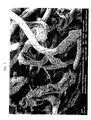
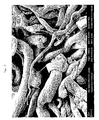
- Example 1 Examination of an explosive mass treated by isostatic pressing by SEM images
- An explosive raw material based on nitrocellulose and nitroglycerin was subjected to isostatic pressing for 5 minutes at 80 ° C and 3500 bar.
- FIG. 2 shows the raw explosive mass before the isostatic pressure treatment while FIG. 3 shows the explosive raw material mass after isostatic pressing.
- FIG. 3 shows the explosive raw material mass after isostatic pressing.
- An explosive raw material (37% nitrocellulose, 37% nitroglycerine, 1% centralite, 25% hexogen) was charged into a polyethylene tube. After evacuation of the tube, it was closed and inserted into the isostatic press. The temperature of the hydraulic fluid was 85 ° C, the applied pressure 5000 bar and the residence time 8 minutes. After removal and demolding, the formed body was placed on a shear roller with a heated crushing / dosing device so that no cooling took place.
- the explosive raw material pretreated by isostatic pressing as described above has excellent properties for further processing on the shearing roll.
Landscapes
- Chemical & Material Sciences (AREA)
- Organic Chemistry (AREA)
- Health & Medical Sciences (AREA)
- Emergency Medicine (AREA)
- Processing And Handling Of Plastics And Other Materials For Molding In General (AREA)
Priority Applications (1)
| Application Number | Priority Date | Filing Date | Title |
|---|---|---|---|
| EP09179006A EP2332894A1 (fr) | 2009-12-14 | 2009-12-14 | Procédé et fabrication de matières explosives |
Applications Claiming Priority (1)
| Application Number | Priority Date | Filing Date | Title |
|---|---|---|---|
| EP09179006A EP2332894A1 (fr) | 2009-12-14 | 2009-12-14 | Procédé et fabrication de matières explosives |
Publications (1)
| Publication Number | Publication Date |
|---|---|
| EP2332894A1 true EP2332894A1 (fr) | 2011-06-15 |
Family
ID=42691145
Family Applications (1)
| Application Number | Title | Priority Date | Filing Date |
|---|---|---|---|
| EP09179006A Withdrawn EP2332894A1 (fr) | 2009-12-14 | 2009-12-14 | Procédé et fabrication de matières explosives |
Country Status (1)
| Country | Link |
|---|---|
| EP (1) | EP2332894A1 (fr) |
Cited By (3)
| Publication number | Priority date | Publication date | Assignee | Title |
|---|---|---|---|---|
| CN109438143A (zh) * | 2018-10-25 | 2019-03-08 | 山西北方兴安化学工业有限公司 | 一种反向浇铸包覆模具 |
| CN109438142A (zh) * | 2018-10-25 | 2019-03-08 | 山西北方兴安化学工业有限公司 | 一种用于包覆层制备的反向浇铸装置 |
| CN109485528A (zh) * | 2018-10-25 | 2019-03-19 | 山西北方兴安化学工业有限公司 | 一种包覆层制备装置 |
Citations (6)
| Publication number | Priority date | Publication date | Assignee | Title |
|---|---|---|---|---|
| US3057012A (en) * | 1959-05-27 | 1962-10-09 | Du Pont | Process of preparing dense non-fibrous nitrocellulose |
| DE1233310B (de) * | 1964-08-25 | 1967-01-26 | Wolff & Co Ag | Verfahren zur Herstellung verdichteter, rieselfaehiger Nitrocellulose |
| EP0084153A1 (fr) * | 1982-01-04 | 1983-07-27 | WNC NITROCHEMIE GmbH | Procédé pour la préparation de la nitrocellulose à haute fluidité ayant une plus grande masse volumique apparente |
| WO1988002743A1 (fr) * | 1986-10-16 | 1988-04-21 | Wnc-Nitrochemie Gmbh | Procede pour fabriquer de la poudre de charge propulsive |
| EP0296099A1 (fr) * | 1987-06-17 | 1988-12-21 | Schweizerische Eidgenossenschaft vertreten durch die Eidg. Munitionsfabrik Thun der Gruppe für Rüstungsdienste | Procédé de pressage quasi-isostatique de charges explosives formées avec précision, ainsi que dispositif de fabrication de ces charges |
| WO2003035580A2 (fr) * | 2001-10-24 | 2003-05-01 | BOWAS AG für Industrievertrieb | Fabrication d'une charge propulsive sous forme pulverulente et exempte de solvants |
-
2009
- 2009-12-14 EP EP09179006A patent/EP2332894A1/fr not_active Withdrawn
Patent Citations (7)
| Publication number | Priority date | Publication date | Assignee | Title |
|---|---|---|---|---|
| US3057012A (en) * | 1959-05-27 | 1962-10-09 | Du Pont | Process of preparing dense non-fibrous nitrocellulose |
| DE1233310B (de) * | 1964-08-25 | 1967-01-26 | Wolff & Co Ag | Verfahren zur Herstellung verdichteter, rieselfaehiger Nitrocellulose |
| EP0084153A1 (fr) * | 1982-01-04 | 1983-07-27 | WNC NITROCHEMIE GmbH | Procédé pour la préparation de la nitrocellulose à haute fluidité ayant une plus grande masse volumique apparente |
| WO1988002743A1 (fr) * | 1986-10-16 | 1988-04-21 | Wnc-Nitrochemie Gmbh | Procede pour fabriquer de la poudre de charge propulsive |
| DE3635296A1 (de) * | 1986-10-16 | 1988-04-28 | Nitrochemie Gmbh | Verfahren zum herstellen von treibladungspulver |
| EP0296099A1 (fr) * | 1987-06-17 | 1988-12-21 | Schweizerische Eidgenossenschaft vertreten durch die Eidg. Munitionsfabrik Thun der Gruppe für Rüstungsdienste | Procédé de pressage quasi-isostatique de charges explosives formées avec précision, ainsi que dispositif de fabrication de ces charges |
| WO2003035580A2 (fr) * | 2001-10-24 | 2003-05-01 | BOWAS AG für Industrievertrieb | Fabrication d'une charge propulsive sous forme pulverulente et exempte de solvants |
Non-Patent Citations (4)
| Title |
|---|
| BAUER B A ET AL: "The impact of pressure, temperature and treatment time on starches: pressure-induced starch gelatinisation as pressure time temperature indicator for high hydrostatic pressure processing", JOURNAL OF FOOD ENGINEERING, BARKING, ESSEX, GB LNKD- DOI:10.1016/J.JFOODENG.2004.06.007, vol. 68, no. 3, 1 June 2005 (2005-06-01), pages 329 - 334, XP004729421, ISSN: 0260-8774 * |
| CARTER R E ET AL: "EXTRUSION STRESSES, DIE SWELL, AND VISCOUS HEATING EFFECTS IN DOUBLE-BASE PROPELLANTS.", JOURNAL OF RHEOLOGY 1987 FEB, vol. 31, no. 2, February 1987 (1987-02-01), pages 151 - 173, XP008126853, DOI: 10.1122/1.549921 * |
| CROFTON DEREK J ET AL: "DIELECTRIC STUDIES OF CELLULOSE AND ITS DERIVATIVES - 2. EFFECTS OF PRESSURE AND TEMPERATURE ON RELAXATION BEHAVIOUR.", POLYMER 1982 OCT, vol. V 23, no. N 11, October 1982 (1982-10-01), pages 1609 - 1614, XP002601212 * |
| OH H E ET AL: "Effect of high-pressure treatment on normal rice and waxy rice starch-in-water suspensions", CARBOHYDRATE POLYMERS, APPLIED SCIENCE PUBLISHERS, LTD. BARKING, GB LNKD- DOI:10.1016/J.CARBPOL.2007.11.038, vol. 73, no. 2, 19 July 2008 (2008-07-19), pages 332 - 343, XP022589725, ISSN: 0144-8617, [retrieved on 20071214] * |
Cited By (6)
| Publication number | Priority date | Publication date | Assignee | Title |
|---|---|---|---|---|
| CN109438143A (zh) * | 2018-10-25 | 2019-03-08 | 山西北方兴安化学工业有限公司 | 一种反向浇铸包覆模具 |
| CN109438142A (zh) * | 2018-10-25 | 2019-03-08 | 山西北方兴安化学工业有限公司 | 一种用于包覆层制备的反向浇铸装置 |
| CN109485528A (zh) * | 2018-10-25 | 2019-03-19 | 山西北方兴安化学工业有限公司 | 一种包覆层制备装置 |
| CN109438142B (zh) * | 2018-10-25 | 2021-03-30 | 山西北方兴安化学工业有限公司 | 一种用于包覆层制备的反向浇铸装置 |
| CN109485528B (zh) * | 2018-10-25 | 2021-03-30 | 山西北方兴安化学工业有限公司 | 一种包覆层制备装置 |
| CN109438143B (zh) * | 2018-10-25 | 2021-03-30 | 山西北方兴安化学工业有限公司 | 一种反向浇铸包覆模具 |
Similar Documents
| Publication | Publication Date | Title |
|---|---|---|
| DE2461646C2 (de) | Verfahren zur Herstellung von Treibladungspulvern | |
| US5487851A (en) | Composite gun propellant processing technique | |
| EP0288505B2 (fr) | Procede pour fabriquer de la poudre de charge propulsive | |
| CA1084272A (fr) | Methode d'extrusion de composes pyrotechniques, et extrudeuse a vis | |
| EP4072813B1 (fr) | Procédé de dévulcanisation d'une composition de caoutchouc vulcanisé et procédé de préparation et d'utilisation d'une composition de caoutchouc | |
| EP2723700B1 (fr) | Utilisation d'une matière solide pour la fabrication d'une poudre de charge propulsive, procédé pour la fabrication d'une poudre de charge propulsive et poudre de charge propulsive | |
| EP0424490B1 (fr) | Procede et dispositif pour produire une poudre de charge propulsive tribasique | |
| DE2316538C3 (de) | Verfahren zur Herstellung von Gudol- Pulver | |
| DE2323709C3 (de) | Verfahren zur Herstellung gehäusefreier Treibsätze | |
| DE19528052C2 (de) | Verfahren zur kontinuierlichen, lösungsmittelfreien Herstellung pyrotechnischer Composit-Produkte | |
| DE10152397B4 (de) | Herstellung von lösungsmittelfreiem Treibladungspulver | |
| DE102008059740B3 (de) | Verfahren zur Herstellung von Explosivstoffen | |
| CH644831A5 (de) | Verfahren zur herstellung eines mehrbasigen treibladungspulvers. | |
| US3989776A (en) | Process for preparing double base propellants containing ballistic modifier | |
| CA2688696A1 (fr) | Procede de fabrication d'explosifs | |
| DE2141408C3 (de) | Sprengstoff | |
| DE102005037017B4 (de) | Pulvervorkonzentrat und dessen Verwendung | |
| DE4012294C1 (fr) | ||
| DE3523580C2 (fr) | ||
| US20110140293A1 (en) | Method of manufacturing explosives | |
| DE2458834C2 (de) | Verfahren zum Herstellen von doppelbasigen Treibsätzen für Raketen, Ausstoßladungen und dergleichen | |
| KR20110067351A (ko) | 폭발물의 제조방법 | |
| RU2800298C1 (ru) | Способ получения блочного топлива по "гибридной" технологии | |
| JP2011121844A (ja) | 爆薬の製造方法 | |
| ZA200908913B (en) | Method of manufacturing explosives |
Legal Events
| Date | Code | Title | Description |
|---|---|---|---|
| PUAI | Public reference made under article 153(3) epc to a published international application that has entered the european phase |
Free format text: ORIGINAL CODE: 0009012 |
|
| AK | Designated contracting states |
Kind code of ref document: A1 Designated state(s): AT BE BG CH CY CZ DE DK EE ES FI FR GB GR HR HU IE IS IT LI LT LU LV MC MK MT NL NO PL PT RO SE SI SK SM TR |
|
| AX | Request for extension of the european patent |
Extension state: AL BA RS |
|
| 17P | Request for examination filed |
Effective date: 20111215 |
|
| 17Q | First examination report despatched |
Effective date: 20140220 |
|
| STAA | Information on the status of an ep patent application or granted ep patent |
Free format text: STATUS: THE APPLICATION IS DEEMED TO BE WITHDRAWN |
|
| 18D | Application deemed to be withdrawn |
Effective date: 20140703 |