EP2333697B1 - Appareil de traitement d'informations, procédé et programme de traitement d'informations - Google Patents
Appareil de traitement d'informations, procédé et programme de traitement d'informations Download PDFInfo
- Publication number
- EP2333697B1 EP2333697B1 EP10189513.4A EP10189513A EP2333697B1 EP 2333697 B1 EP2333697 B1 EP 2333697B1 EP 10189513 A EP10189513 A EP 10189513A EP 2333697 B1 EP2333697 B1 EP 2333697B1
- Authority
- EP
- European Patent Office
- Prior art keywords
- evaluator
- processing
- unit
- image data
- data
- Prior art date
- Legal status (The legal status is an assumption and is not a legal conclusion. Google has not performed a legal analysis and makes no representation as to the accuracy of the status listed.)
- Not-in-force
Links
Images
















Classifications
-
- G—PHYSICS
- G06—COMPUTING OR CALCULATING; COUNTING
- G06T—IMAGE DATA PROCESSING OR GENERATION, IN GENERAL
- G06T5/00—Image enhancement or restoration
- G06T5/70—Denoising; Smoothing
-
- G—PHYSICS
- G06—COMPUTING OR CALCULATING; COUNTING
- G06F—ELECTRIC DIGITAL DATA PROCESSING
- G06F18/00—Pattern recognition
- G06F18/20—Analysing
- G06F18/21—Design or setup of recognition systems or techniques; Extraction of features in feature space; Blind source separation
- G06F18/211—Selection of the most significant subset of features
- G06F18/2111—Selection of the most significant subset of features by using evolutionary computational techniques, e.g. genetic algorithms
-
- G—PHYSICS
- G06—COMPUTING OR CALCULATING; COUNTING
- G06T—IMAGE DATA PROCESSING OR GENERATION, IN GENERAL
- G06T5/00—Image enhancement or restoration
- G06T5/60—Image enhancement or restoration using machine learning, e.g. neural networks
-
- G—PHYSICS
- G06—COMPUTING OR CALCULATING; COUNTING
- G06V—IMAGE OR VIDEO RECOGNITION OR UNDERSTANDING
- G06V10/00—Arrangements for image or video recognition or understanding
- G06V10/70—Arrangements for image or video recognition or understanding using pattern recognition or machine learning
- G06V10/77—Processing image or video features in feature spaces; using data integration or data reduction, e.g. principal component analysis [PCA] or independent component analysis [ICA] or self-organising maps [SOM]; Blind source separation
- G06V10/771—Feature selection, e.g. selecting representative features from a multi-dimensional feature space
-
- G—PHYSICS
- G06—COMPUTING OR CALCULATING; COUNTING
- G06T—IMAGE DATA PROCESSING OR GENERATION, IN GENERAL
- G06T2207/00—Indexing scheme for image analysis or image enhancement
- G06T2207/20—Special algorithmic details
- G06T2207/20081—Training; Learning
-
- G—PHYSICS
- G10—MUSICAL INSTRUMENTS; ACOUSTICS
- G10H—ELECTROPHONIC MUSICAL INSTRUMENTS; INSTRUMENTS IN WHICH THE TONES ARE GENERATED BY ELECTROMECHANICAL MEANS OR ELECTRONIC GENERATORS, OR IN WHICH THE TONES ARE SYNTHESISED FROM A DATA STORE
- G10H2210/00—Aspects or methods of musical processing having intrinsic musical character, i.e. involving musical theory or musical parameters or relying on musical knowledge, as applied in electrophonic musical tools or instruments
- G10H2210/031—Musical analysis, i.e. isolation, extraction or identification of musical elements or musical parameters from a raw acoustic signal or from an encoded audio signal
- G10H2210/036—Musical analysis, i.e. isolation, extraction or identification of musical elements or musical parameters from a raw acoustic signal or from an encoded audio signal of musical genre, i.e. analysing the style of musical pieces, usually for selection, filtering or classification
Definitions
- the present invention relates to an information processing apparatus, an information processing method, and a program.
- a method is gaining attention that is for automatically extracting, from an arbitrary data group for which it is difficult to quantitatively determine a feature, a feature quantity of the data group.
- a method of taking arbitrary music data as an input and automatically constructing an algorithm for automatically extracting the music genre to which the music data belongs is known.
- the music genres such as jazz, classics and pops, are not quantitatively determined according to the type of instrument or performance mode. Accordingly, in the past, it was generally considered difficult to automatically extract the music genre from music data when arbitrary music data was given.
- feature quantity extractor an algorithm for extracting such feature.
- JP-A-2009-48266 an algorithm for extracting such feature.
- the genetic algorithm is an algorithm that mimics the biological evolutionary process and takes selection, crossover and mutation into consideration in the process of machine learning.
- a feature quantity extractor for extracting, from arbitrary music data, a music genre to which the music data belongs can be automatically constructed.
- the feature quantity extractor automatic construction algorithm described in the patent document is highly versatile and is capable of automatically constructing a feature quantity extractor for extracting, not only from the music data but also from arbitrary data group, a feature quantity of the data group. Accordingly, the feature quantity extractor automatic construction algorithm described in the patent document is expected to be applied to feature quantity analysis of artificial data such as music data and image data and feature quantity analysis of various observation quantities existing in nature.
- the feature quantity extractor automatic construction algorithm described in the patent document has been developed to be used for analysis of a feature quantity of arbitrary data.
- creation of new data having the same feature as the existing data is also desired.
- creation, from certain image data, of new image data with higher image resolution is desired.
- creation, from image data having a certain type of feature, of new image data having another feature is desired.
- creation of new data with changed property or feature is desired not only for the image data but also for music data, arbitrary time-series data and the like.
- Input data which is a target issue and single output data which is an answer to that target issue have to be given, as data for learning used for automatic construction of feature quantity extractor, to the feature quantity extractor automatic construction algorithm described in the patent document. Accordingly, it is difficult with the feature quantity extractor automatic construction algorithm described in the patent document to construct a feature quantity extractor for solving a target issue whose answer is not uniquely determined and extracting a feature quantity. Thus, when using machine learning based on the genetic algorithm, it is also difficult, as with the feature quantity extractor automatic construction algorithm described in the patent document, to automatically construct an algorithm for solving a target issue whose answer is not uniquely determined.
- a motion prediction algorithm for predicting motion of a living thing is constructed based on data for learning having, as input data, motion of the living thing observed at a certain time point and having, as output data, motion of the living thing observed at the next time point.
- motion of a living thing has a random nature, and thus it is difficult to say that the output data for learning is correct.
- a pattern creation algorithm for creating a beautiful pattern is constructed based on data for learning having, as input data, certain image data and having, as output data, image data with a beautiful pattern obtained by processing the certain image data.
- what kind of pattern is a beautiful pattern is not uniquely determined. That is, there are a plurality of types of correct output data.
- output data that can be used for learning by the feature quantity extractor automatic construction algorithm described in the patent document is limited to a scalar quantity.
- an image quality enhancement algorithm for increasing image quality of image data is constructed based on data for learning having, as input data, low-resolution image data and having, as output data, high-resolution image data.
- the low-resolution image data can be easily created by changing the resolution of the high-resolution image data, and thus the output data (high-resolution image data) can be uniquely given.
- the output data is given by pixel values of a plurality of pixels forming image data.
- a parameter to be optimized by the image quality enhancement algorithm is not uniquely determined. That is, whether a mean error between output data created by the image quality enhancement algorithm and the output data given for learning is to be minimized, or whether the maximum error is to be minimized, or whether an error of average pixel values is to be minimized is not automatically determined. If a criterion for image quality is set to the mean error and an image quality enhancement algorithm that minimizes the mean error is constructed, the mean error will surely be small for the output data output from the image quality enhancement algorithm. However, that output data will not infallibly be image data that a person perceives as high image quality.
- an information processing apparatus an information processing method and a program, which are new and improved, and which are capable of obtaining an answer to a target issue whose correct answer is not uniquely determined or an answer to a target issue whose answer is not a scalar quantity.
- an automatic composer construction system according to a third embodiment of the present invention will be described with reference to FIG. 27 .
- an image/video automatic creator construction system according to a fourth embodiment of the present invention will be described with reference to FIG. 28 .
- an example of a hardware configuration capable of realizing functions of the systems according to the first to fourth embodiments of the present invention will be described with reference to FIG. 29 .
- the algorithm automatic construction method described in Document 1 mentioned above is not capable of automatically constructing an algorithm whose output data is not a scalar quantity.
- a noise removal filter as shown in FIG. 1 can be cited as an example of such algorithm.
- This noise removal filter is an image processing filter for removing noise from image data that is input.
- the noise removal filter is constructed by preparing multiple pieces of data of image for learning and multiple pieces of data of noise-added image for learning obtained by adding noise to the image for learning and inputting these pieces of data to a learning algorithm. At this time, the pixel value of each pixel forming the noise-added image for learning is made to be input data, and the pixel value of each pixel forming the image for learning is made to be output data.
- the learning algorithm combines a plurality of image processing filters 1 to n prepared in advance, and creates a filter synthesis formula. At this time, the learning algorithm creates an optimal filter synthesis formula by changing types of image processing filters to be combined, a parameter of each image processing filter and the like so as to minimize the error between output data obtained by inputting the noise-added image for learning to the filter synthesis formula and the image for learning.
- the filter synthesis formula created in this manner constructs the noise removal filter.
- image quality is not increased for all the image data after noise removal obtained by inputting arbitrary noise-added image data to this noise removal filter.
- the noise removal filter is constructed in the above-described process of creating the optimal filter synthesis formula such that the mean error between the output data obtained by inputting the noise-added image for learning to the filter synthesis formula and the image for learning is minimized, the mean error between the both becomes small.
- the image quality of the noise-removed image that is actually output from the noise removal filter described above appears, to the human eye, to be not increased.
- an index for example, a mean error, a maximum error, a difference between average pixel values
- the algorithm automatic construction method according to Document 1 mentioned above is not capable of automatically constructing an algorithm, such as the noise removal filter, whose output data is not a scalar quantity.
- the reason that an optimal noise-removed image is not created by the noise removal filter created by specifying an optimization index such as the mean error is that optimization regarding an index is not optimization to visual characteristics of human beings. Therefore, to automatically construct an algorithm whose output data is not a scalar quantity, a new method of correctly evaluating the quality of the output data becomes necessary.
- the technology of an embodiment described later relates to a technology for enabling to correctly perform such evaluation.
- the algorithm automatic construction method described in Document 1 mentioned above is not capable of automatically constructing an algorithm whose correct output data (correct answer) is not uniquely determined.
- a time-series prediction algorithm shown in FIG. 2 can be cited as an example of such algorithm.
- This time-series prediction algorithm is an algorithm for predicting, from time-series data of observation value observed in the past, time-series data of observation value which will be observed in the future.
- the time-series prediction algorithm is constructed by preparing multiple observation values observed before a predetermined time and multiple observation values observed after the predetermined time and inputting these observation values in a learning algorithm. At this time, the observation values observed before the predetermined time are made to be input data, and the observation values observed after the predetermined time are made to be output data. In this case, the output data for learning is a scalar quantity. However, the feature of the time-series data of observation value is not uniquely determined.
- time-series data of observation value obtained by observing motion of a living thing will considered.
- Motion of a living thing has a random nature (featureless motion). Therefore, even if an attempt is made to observe movement of position of a living thing and capture a feature of time-series data of the position, featureless motion is included, and thus a time-series prediction algorithm that copies the motion is not constructed. That is, it is not possible to express probabilistic motion by a deterministic algorithm.
- a target to be mimicked for example, whether to mimic in time domain or in frequency domain
- a new method of uniquely evaluating the quality of the output data becomes necessary.
- the technology of an embodiment described later relates to a technology for enabling to correctly perform such evaluation.
- the algorithm automatic construction method described in Document 1 is not capable of constructing an algorithm capable of obtaining appropriate output data.
- the inventor of the present invention has devised a method of automatically constructing or obtaining an evaluator for determining an appropriate evaluation criterion and automatically creating an algorithm whose output data is not a scalar quantity or an algorithm whose correct answer is not uniquely determined by using the evaluator.
- a noise removal filter capable of obtaining a desirable output, a desirable time-series prediction algorithm and the like can be automatically constructed, for example.
- the present embodiment relates to a construction method of an oil painting filter.
- an explanation will be sequentially given on an overview of an oil painting filter automatic construction system according to the present embodiment, functional configurations of information processing apparatuses 100, 150 capable of realizing a function of the oil painting filter automatic construction system and a creation method of an oil-painting-like image by an oil painting filter.
- an oil painting filter is taken as an example here, extension is possible to an automatic construction method of an arbitrary algorithm whose output data is not a scalar quantity and a creation method of output data by the algorithm.
- FIG. 3 is an explanatory diagram showing an overview of a function of the oil painting filter automatic construction system according to the present embodiment.
- the oil painting filter automatic construction system is a system for automatically constructing an oil painting filter.
- the oil painting filter automatic construction system automatically creates an evaluator that outputs "likeness to an oil painting (hereinafter, oil painting likeness)" by using multiple data sets for learning including an oil painting image, a non-oil-painting image and correct answer information indicating "oil painting” or "not oil painting” and performing machine learning based on a genetic algorithm.
- the oil painting filter automatic construction system creates a first generation oil painting filter by randomly combining image processing filters. Then, the oil painting filter automatic construction system creates an oil-painting-like image by inputting an image to the first generation oil painting filter. Then, the oil painting filter automatic construction system calculates an evaluation value by inputting the created oil-painting-like image to the evaluator. Then, the oil painting filter automatic construction system creates a second generation oil painting filter from the first generation oil painting filter based on the genetic algorithm such that the evaluation value will be high (generation change).
- the oil painting filter automatic construction system repeats the generation change until the evaluation value calculated by the evaluator satisfies a predetermined terminating condition, and outputs an oil painting filter of a last generation that satisfied the predetermined terminating condition. Also, the oil painting filter automatic construction system converts an image which is a conversion target into an oil-painting-like image by using the constructed oil painting filter, and outputs the oil-painting-like image.
- the oil painting filter automatic construction system creates an evaluator by machine learning based on the genetic algorithm, and evaluates the oil painting likeness by using the evaluator. Then, the oil painting filter automatic construction system automatically constructs an oil painting filter for which evaluation by the evaluator will be high. According to such configuration, even if an optimization index is not specified by a user, an oil painting filter whose output data is not a scalar quantity can be appropriately constructed.
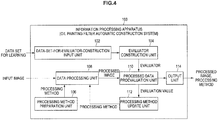
- FIG. 4 is an explanatory diagram showing an example of a functional configuration of the information processing apparatus 100 according to the present embodiment.
- FIG. 5 is an explanatory diagram showing an example of a functional configuration of the information processing apparatus 150 according to the present embodiment. Additionally, structural elements of the information processing apparatuses 100, 150 having substantially the same function are denoted with the same reference numerals so as to clearly indicate the correspondence relationship between the structural elements.
- the information processing apparatus 100 mainly includes a data-set-for-evaluator-construction input unit 102, an evaluator construction unit 104, a processing method preparation unit 106, a data processing unit 108, a processed data evaluation unit 110, a processing method update unit 112, and an output unit 114.
- a function of each structural element will be described along a flow of automatic construction processing for evaluator, a flow of automatic construction processing for oil painting filter and a flow of processing for input image.
- a genetic algorithm is assumed to be used for the process by the processing method update unit 112 described later.
- any method such as local search and simulated annealing, may be used as long as the method is capable of optimizing an element.
- the data-set-for-evaluator-construction input unit 102 acquires a data set for learning (hereinafter, a data set for evaluator construction) and inputs the same to the evaluator construction unit 104.
- the data-set-for-evaluator-construction input unit 102 may acquire the data set for evaluator construction from an external device via a network or may acquire the data set for evaluator construction from a recording device (not shown) installed in the information processing apparatus 100.
- the data-set-for-evaluator-construction input unit 102 may also be connected to an input device for a user to manually input correct answer information.
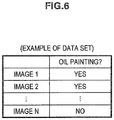
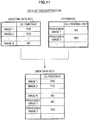
- the data set for evaluator construction is formed from a plurality of images for learning and pieces of correct answer information indicating whether the images for learning are an oil painting or not.
- the evaluator construction unit 104 constructs an evaluator by machine learning based on the genetic algorithm. Additionally, details of a construction algorithm for the evaluator will be described later.
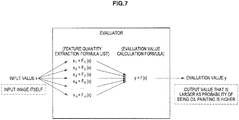
- FIG. 7 an overview of the construction algorithm for the evaluator will be briefly described with reference to FIG. 7 .
- the evaluator is constructed by combination (for example, linear combination) of feature quantity extraction formulae created by combinations of a plurality of processing functions prepared in advance.
- a contribution rate to the evaluation formula for each feature quantity extraction formula.
- the evaluator construction unit 104 calculates, for each feature quantity extraction formula, a contribution rate to the evaluation formula, based on a combination coefficient of each feature quantity extraction formula. Then, the evaluator construction unit 104 makes a decision regarding a terminating condition based on the contribution rate to the evaluation formula, and in the case the terminating condition is satisfied, outputs the evaluation formula as the evaluator.
- the evaluator construction unit 104 takes the feature quantity extraction formulae included in the evaluation formula as second generation feature quantity extraction formulae, and creates, by the genetic algorithm, a second generation feature quantity extraction formula list from the second generation feature quantity extraction formulae in such a manner that elements of feature quantity extraction formulae whose contribution rates are high will tend to be maintained.
- the evaluator construction unit 104 uses the second generation feature quantity extraction formula list and creates a second generation evaluation formula as in the case of the first generation. Also, the evaluator construction unit 104 calculates a contribution rate of each feature quantity extraction formula to the second generation evaluation formula. Then, the evaluator construction unit 104 makes a decision regarding a terminating condition based on the contribution rate to the evaluation formula, and in the case the terminating condition is satisfied, outputs the evaluation formula as the evaluator. On the other hand, in the case the terminating condition is not satisfied, the evaluator construction unit 104 takes the feature quantity extraction formulae included in the evaluation formula as third generation feature quantity extraction formulae, and creates a third generation evaluation formula as in the case of the second generation. In this manner, generation change is repeated until the terminating condition is satisfied, and, at the time point the terminating condition is satisfied, the evaluation formula of the last generation is output as the evaluator.
- the evaluator constructed by the evaluator construction unit 104 in this manner is input to the processed data evaluation unit 110.
- This evaluator outputs a value which is larger as the probability of an input image being an oil painting is higher and a value which is smaller as the probability of the input image being an oil painting is lower.
- the processing method preparation unit 106 creates a processing method by combining a plurality of operators.
- An operator is a smallest unit of a processing method for processing an image.
- a function, a filter or the like as follows is used, for example.
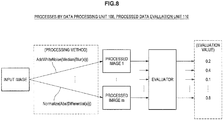
- the processing method preparation unit 106 first creates a plurality of processing methods by randomly combining the operators. For example, the processing method preparation unit 106 creates AddWhiteNoise(Median(Blur(x))). This processing method means that a Blur filter (blur processing) is applied to input value x, a Median filter (Median filter processing) is applied to the output of the Blur filter, and a white noise is added to the output of the Median filter.
- the processing method preparation unit 106 creates a plurality of such processing methods and inputs them to the data processing unit 108.
- the data processing unit 108 creates a processed image by processing an input image by the processing method created by the processing method preparation unit 106. As shown in FIG. 8 , in a case m processing methods (for example, AddWhiteNoise(Median(Blur(x))), ..., Normalize(Abs(Differential(x))) are created by the processing method preparation unit 106, the data processing unit 108 processes the input image by the m processing methods and creates m processed images 1 to m. Then, the data processing unit 108 inputs the processed images 1 to m to the processed data evaluation unit 110.
- m processing methods for example, AddWhiteNoise(Median(Blur(x))
- ... Normalize(Abs(Differential(x))
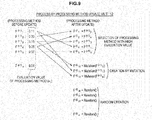
- the processed data evaluation unit 110 inputs, to the evaluator, the processed images 1 to m input from the data processing unit 108 and calculates m evaluation values. Then, the processed data evaluation unit 110 inputs the evaluation values calculated for the respective processing methods to the processing method update unit 112. As shown in FIG. 9 , the processing method update unit 112 uses the evaluation values calculated for the respective processing methods and updates the processing methods 1 to m based on the genetic algorithm.
- processing method 1 before update is expressed by F (t-1) 1 , ..., and processing method m before update by F (t-1) m .
- an evaluation value of processing method F (t-1) 1 is expressed by v 1 , ..., and an evaluation value of processing method F (t-1) m by v m .
- processing method 1 after update is expressed by F (t) 1 , ..., and processing method m after update by F (t) m .
- the processing method update unit 112 selects a predetermined number of processing methods with a high evaluation value among processing methods before update F (t-1) 1 to F (t-1) m .
- F (t-1) 2 , F (t-1) 4 , F (t-1) 3 , F (t-1) 1 , F (t-1) 5 , and the like are selected in a descending order of evaluation value.
- the processing method update unit 112 sets the selected processing methods as the processing methods after update. In the example of FIG.
- the processing method update unit 112 creates new processing methods by mutating a predetermined number of processing methods among processing methods before update F (t-1) 1 to F (t-1) m . Then, the processing method update unit 112 sets the new processing methods as the processing methods after update.
- mutation is expressed by a function Mutation(). Also, in the example of FIG. 9 , F (t-1) 3 , F (t-1) 1 , F (t-1) 4 , and the like are selected as the target of mutation, and are set as processing methods after update F (t) 10 , F (t) 11 , F (t) 12 , and the like.
- the processing method update unit 112 creates a predetermined number of new processing methods by randomly combining the operators.
- random creation of a processing method is expressed by a function Random().
- the new processing methods that have been randomly created are set as processing methods after update F (t) 30 , F (t) 31 , F (t) 32 , ..., F (t) m .
- the processing method update unit 112 creates the processing method after update from the processing method before update based on the genetic algorithm. Then, the processing method update unit 112 inputs the processing methods after update to the data processing unit 108.
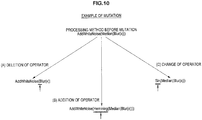
- FIG. 10 is an explanatory diagram showing an example of processing of mutation.
- the processing of mutation includes three types, i.e. (A) deletion of an operator, (B) addition of an operator and (C) change of an operator, and a combination of these.
- the processing method update unit 112 may, as a mutation process, delete operator Median() (A).
- the processing method after mutation will be AddWhiteNoise(Blur(x)).
- the processing method update unit 112 may, as a mutation process, add operator Hemming() (B).
- the processing method after mutation will be AddWhiteNoise(Hemming(Median(Blur(x)))), for example.
- there is no limit to the types of operators to be added but if input of an operator to be added is invalid or if input to an operator to be performed next is made invalid due to addition of an operator, such addition is to be prohibited.
- the processing method update unit 112 may, as a mutation process, change operator AddWhiteNoise() to Sin() (C).
- the processing method after mutation will be Sin(Median(Blur(x))), for example.
- there is no limit to the types of operators to be the operator after change but if input of an operator to be the operator after change is invalid or if input to an operator to be performed next is made invalid due to a change of an operator, change to such operator is to be prohibited.
- a new processing method is created by a part of a processing method being modified by addition, deletion, change or the like of an operator.
- the data processing unit 108 processes an input image by the processing method after update and creates a processed image. Then, the data processing unit 108 inputs the created processed image to the processed data evaluation unit 110.
- the processed data evaluation unit 110 inputs the processed images 1 to m input from the data processing unit 108 and calculates m evaluation values. Then, the processed data evaluation unit 110 inputs the evaluation value calculated for each processing method to the processing method update unit 112.
- the processes by the processing method update unit 112, the data processing unit 108 and the processed data evaluation unit 110 are repeatedly performed in this manner. This repeating process is continued until a predetermined terminating condition is satisfied, and is ended when the predetermined terminating condition is satisfied.
- the terminating condition is satisfied in a case a user performs an end operation, in a case an evaluation value has exceeded a predetermined threshold value, in a case the repeating process has been performed a predetermined number of times, in a case the repeating process has been continuously performed for a predetermined period of time, or in a case corresponding to combination of the above cases.
- a processed image created by the data processing unit 108 and a processing method created by the processing method update unit 112 in the last repeating process are output to the output unit 114. Then, the output unit 114 outputs these processed image and processing method. Additionally, the output unit 114 outputs one or both of the processed image and the processing method. In this manner, by the repeating process being performed based on the genetic algorithm, a processing method with a higher evaluation value is calculated, and the likeness to an oil painting of a processed image created by using the processing method increases.
- the processed image and the processing method output from the output unit 114 are presented to the user. Then, in a case a feedback relating to a degree of satisfaction to the processed image is obtained from the user, the information processing apparatus 100 updates the evaluator by using the feedback.
- the data-set-for-evaluator-construction input unit 102 adds information on the feedbacks to the existing data set for evaluator construction and reconstructs a new data set for evaluator construction. Then, the data-set-for-evaluator-construction input unit 102 inputs the new data set for evaluator construction obtained by reconstruction to the evaluator construction unit 104.
- the evaluator construction unit 104 reconstructs the evaluator by machine learning based on the genetic algorithm described above. Then, the evaluator construction unit 104 inputs the reconstructed evaluator to the processed data evaluation unit 110.
- the functional configuration of the information processing apparatus 100 has been described. Additionally, the processing method that is eventually output from the output unit 114 in the above explanation is the oil painting filter.
- the information processing apparatus 150 mainly includes a processing method preparation unit 106, a data processing unit 108, a processed data evaluation unit 110, a processing method update unit 112, and an output unit 114.
- the difference to the information processing apparatus 100 shown in FIG. 4 is that the information processing apparatus 150 does not construct an evaluator by itself but acquires the evaluator from the outside. Accordingly, the difference to the information processing apparatus 100 lies in the acquisition source of the evaluator to be used by the processed data evaluation unit 110. Additionally, the configuration and the construction method of the evaluator to be used by the processed data evaluation unit 110 is the same for the information processing apparatus 150.
- the information processing apparatus 150 is a modified example of the information processing apparatus 100 with regard to an acquisition method of the evaluator. Therefore, the function of each structural element of the information processing apparatus 150 is substantially the same with the function of a corresponding structural element of the information processing apparatus 100. Accordingly, an explanation on the details of the function of each structural element of the information processing apparatus 150 will be omitted.
- FIG. 12 is an explanatory diagram showing a flow of processing relating to a creation method of an oil-painting-like image according to the present embodiment. Note that the example of FIG. 12 relates to processing by the information processing apparatus 100 described above.
- the data-set-for-evaluator-construction input unit 102 acquires a data set for evaluator construction, and inputs the same to the evaluator construction unit 104 (S102).
- the evaluator construction unit 104 automatically constructs an evaluator (S104). Additionally, the process of step S104 will be described later in detail.
- the processing method preparation unit 106 randomly combines operators and creates processing methods (S106). Then, the data processing unit 108 processes an input image by the processing methods created by the processing method preparation unit 106 and creates a process image (processed data) for each processing method (S108). Then, the processed data evaluation unit 110 calculates, by using the evaluator constructed by the evaluator construction unit 104, an evaluation value of each piece of processed data created by the data processing unit 108 (S110).
- the processed data evaluation unit 110 decides, based on the calculated evaluation value, a user operation, or the like, whether a terminating condition is satisfied or not (S112). In the case the terminating condition is satisfied, the processed data evaluation unit 110 inputs the processed data and the processing method to the output unit 114. Then, the information processing apparatus 100 proceeds with the process to step S114. On the other hand, when the terminating condition is not satisfied, the processed data evaluation unit 110 inputs the evaluation values of respective processing methods to the processing method update unit 112. Then, the information processing apparatus 100 proceeds with the process to step S118.
- the output unit 114 outputs the processed data and the processing method and presents the same to the user (S114). Then, whether the user is satisfied with the processing result or not is decided (S116), and in the case the user is satisfied, the series of processes is ended. On the other hand, if the user is not satisfied with the processing result and the feedback is input, the information processing apparatus 100 reconstructs a data set for evaluator construction that reflects the feedback, and performs again the processes of step S102 and subsequent steps based on the data set for evaluator construction.
- the processing method update unit 112 updates the processing methods based on the genetic algorithm (S118). Then, the processing method update unit 112 inputs the processing methods after update to the data processing unit 108. Then, the information processing apparatus 100 returns the process to step S108 and performs again the processes of step S108 and subsequent steps. Eventually, the series of processes is ended when the satisfaction of the user is obtained in the decision at step S116.
- the creation method of an oil-painting-like image according to the present embodiment has been described. Additionally, the processing method that is eventually output from the output unit 114 in the above explanation is the oil painting filter.
- an evaluator is automatically constructed by the genetic algorithm, and also, a creation process of a processing method based on the genetic algorithm is performed by using the evaluator. Accordingly, it becomes possible to automatically construct an algorithm (oil painting filter) whose output data is not a scalar quantity.
- the oil painting filter can be modified to an arbitrary algorithm whose output data is not a scalar quantity.
- the input image is changed to input data that matches the input form of the algorithm.
- the image is changed to data also for the data set for evaluator construction.
- the mechanisms of the automatic construction method of an evaluator and the automatic construction method of an algorithm according to the present embodiment described above are not modified. Accordingly, such modification is, of course, also within the technical scope of the present embodiment.
- the present embodiment relates to a construction method of an algorithm (pseudo-motion creator) that mimics motion of a living thing in a pseudo manner.
- an explanation will be sequentially given on an overview of a pseudo-motion creator automatic construction system, functional configurations of information processing apparatuses 200, 250 capable of realizing a function of the pseudo-motion creator automatic construction system, and a pseudo-motion creation method by a pseudo-motion creator.
- a pseudo-motion creator is taken as an example here, extension is possible to an automatic construction method of an arbitrary algorithm whose correct answer is not uniquely determined and a creation method of output data by the algorithm.
- FIG. 13 is an explanatory diagram showing an overview of a function of the pseudo-motion creator automatic construction system according to the present embodiment.
- the pseudo-motion creator automatic construction system is a system for automatically constructing a pseudo-motion creator.
- the pseudo-motion creator automatic construction system automatically creates an evaluator that outputs "likeness to a movement track of a specific living thing (hereinafter, specific living thing likeness)" by using multiple data sets for learning including a movement track indicating motion of a certain living thing (hereinafter, specific living thing), a movement track of a different moving body (non-specific living thing) and correct answer indicating "a movement track of the specific living thing” or "not a movement track of the specific living thing” and performing machine learning based on a genetic algorithm.
- the movement track may be extracted from video data by using a motion recognition technology, or time-series coordinate data may be input as the movement track.
- the pseudo-motion creator automatic construction system creates a first generation pseudo-motion creator by randomly combining processing functions. Then, the pseudo-motion creator automatic construction system creates a movement track by inputting an initial value to the first generation pseudo-motion creator. Then, the pseudo-motion creator automatic construction system calculates an evaluation value by inputting the created movement track to the evaluator. Then, the pseudo-motion creator automatic construction system creates a second generation pseudo-motion creator from the first generation pseudo-motion creator based on the genetic algorithm such that the evaluation value will be high (generation change).
- the pseudo-motion creator automatic construction system repeats the generation change until the evaluation value calculated by the evaluator satisfies a predetermined terminating condition, and outputs a pseudo-motion creator of a last generation that satisfied the predetermined terminating condition. Also, the pseudo-motion creator automatic construction system outputs a movement track that mimics, in a pseudo manner, the movement track of the specific living thing by using the constructed pseudo-motion creator.
- the pseudo-motion creator automatic construction system creates an evaluator by machine learning based on the genetic algorithm, and evaluates the specific living thing likeness of a movement track by using the evaluator. Then, the pseudo-motion creator automatic construction system automatically constructs an pseudo-motion creator for which evaluation by the evaluator will be high. According to such configuration, a pseudo-motion creator whose correct answer is not uniquely determined can be appropriately constructed.
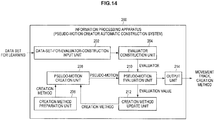
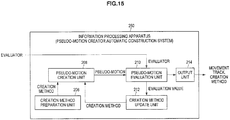
- FIG. 14 is an explanatory diagram showing an example of a functional configuration of the information processing apparatus 200 according to the present embodiment.
- FIG. 15 is an explanatory diagram showing an example of a functional configuration of the information processing apparatus 250 according to the present embodiment.
- structural elements of the information processing apparatuses 200, 250 having substantially the same function are denoted with the same reference numerals so as to clearly indicate the correspondence relationship between the structural elements.
- an explanation will be given here on an automatic construction algorithm for a pseudo-motion creator that reproduces, in a pseudo manner, motion of a butterfly.
- the information processing apparatus 200 mainly includes a data-set-for-evaluator-construction input unit 202, an evaluator construction unit 204, a creation method preparation unit 206, a pseudo-motion creation unit 208, a pseudo-motion evaluation unit 210, a creation method update unit 212, and an output unit 214.
- a function of each structural element will be described along a flow of automatic construction processing for an evaluator, a flow of automatic construction processing for a pseudo-motion creator and a flow of creation processing for a movement track of a specific living thing.
- the genetic algorithm is assumed to be used for the process by the creation method update unit 212 described later. However, any method, such as local search and simulated annealing, may be used as long as the method is capable of optimizing an element.
- the data-set-for-evaluator-construction input unit 202 acquires a data set for learning (hereinafter, a data set for evaluator construction) and inputs the same to the evaluator construction unit 204.
- the data-set-for-evaluator-construction input unit 202 may acquire the data set for evaluator construction from an external device via a network or may acquire the data set for evaluator construction from a recording device (not shown) installed in the information processing apparatus 200.
- the data-set-for-evaluator-construction input unit 202 may also be connected to an input device for a user to manually input correct answer information.
- the data set for evaluator construction is formed from a plurality of pieces of motion data formed from coordinate data at each time point as shown in FIG. 16 and pieces of correct answer information indicating whether each motion data is that of a butterfly or not.
- the evaluator construction unit 204 constructs an evaluator by machine learning based on the genetic algorithm. Additionally, details of a construction algorithm for the evaluator will be described later.
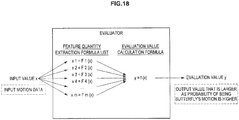
- FIG. 18 an overview of the construction algorithm for the evaluator will be briefly described with reference to FIG. 18 .
- the evaluator is constructed by combination (for example, linear combination) of feature quantity extraction formulae created by combinations of a plurality of processing functions prepared in advance.
- a contribution rate to the evaluation formula for each feature quantity extraction formula.
- the evaluator construction unit 204 calculates, for each feature quantity extraction formula, a contribution rate to the evaluation formula, based on a combination coefficient of each feature quantity extraction formula. Then, the evaluator construction unit 204 makes a decision regarding a terminating condition based on the contribution rate to the evaluation formula, and in the case the terminating condition is satisfied, outputs the evaluation formula as the evaluator.
- the evaluator construction unit 305 takes the feature quantity extraction formulae included in the evaluation formula as second generation feature quantity extraction formulae, and creates, by the genetic algorithm, a second generation feature quantity extraction formula list from the second generation feature quantity extraction formulae in such a manner that elements of feature quantity extraction formulae whose contribution rates are high will tend to be maintained.
- the evaluator construction unit 204 uses the second generation feature quantity extraction formula list and creates a second generation evaluation formula as in the case of the first generation. Also, the evaluator construction unit 204 calculates a contribution rate of each feature quantity extraction formula to the second generation evaluation formula. Then, the evaluator construction unit 204 makes a decision regarding a terminating condition based on the contribution rate the evaluation formula, and in the case the terminating condition is satisfied, outputs the evaluation formula as the evaluator. On the other hand, in the case the terminating condition is not satisfied, the evaluator construction unit 204 takes the feature quantity extraction formulae included in the evaluation formula as third generation feature quantity extraction formulae, and creates a third generation evaluation formula as in the case of the second generation. In this manner, generation change is repeated until the terminating condition is satisfied, and, at the time point the terminating condition is satisfied, the evaluation formula of the last generation is output as the evaluator.
- the evaluator constructed by the evaluator construction unit 204 in this manner is input to the pseudo-motion evaluation unit 210.
- This evaluator outputs a value which is larger as the probability of a movement track being that of a butterfly is higher and a value which is smaller as the probability of the movement track being that of a butterfly is lower.
- the creation method preparation unit 206 creates a creation method by combining a plurality of operators.
- An operator is a smallest unit of a creation method for creating a movement track.
- a processing element as follows is used, for example.
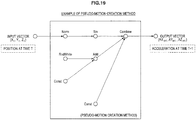
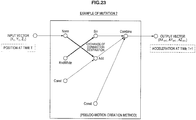
- the creation method preparation unit 206 first creates a plurality of creation methods by randomly combining the operators. For example, as shown in FIG. 19 , the creation method preparation unit 206 creates a creation method that outputs, in a case a position vector (X t , Y t , Z t ) at a time t is input, an acceleration vector (AX t+1 , AY t+1 , AZ t+1 ) at a time t+1.
- the creation method illustrated in FIG. 19 includes norm calculation Norm, sine function Sin, vector combination Combine, white noise generation RndWhite, constant Const, and addition Add.
- the creation method shown in FIG. 19 is expressed by a node representing each operator and an arrow between the nodes indicating the order of processing.
- the arrow of an input vector is connected to the node of norm calculation Norm. Accordingly, norm calculation Norm is performed on the input vector.
- an arrow is connected from the node of norm calculation Norm to the node of sine function Sin, and thus operation by sine function Sin is performed on the output of norm calculation Norm.
- an arrow is connected from the node of sine function Sin to the node of vector combination Combine, and thus a process of vector combination Combine is performed on the output of sine function Sin.
- the processing of vector combination Combine is to couple outputs of nodes connected to the node in a vector format.
- three input arrows are connected to the node of vector combination Combine. Accordingly, the outputs of nodes connected to the three input arrows are coupled in a vector format.
- One of the nodes connected to the node of vector combination Combine is the node of sine function Sin mentioned above. Another is the node of addition Add. The last one is the node of constant Const. An arrow extending from the node of white noise generation RndWhite and an arrow extending from the node of constant Const are connected to the node of addition Add. Accordingly, white noise generated at the node of white noise generation RndWhite and a constant output from the node of constant Const are added at the node of addition Add.
- the added value at the node of addition Add is coupled in a vector format at the node of vector combination Combine.
- the constant output at the node of constant Const is coupled in a vector format at the node of vector combination Combine.
- the creation method preparation unit 206 creates a plurality of such creation methods and inputs them to the pseudo-motion creation unit 208.
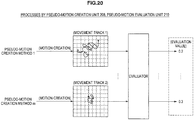
- the pseudo-motion creation unit 208 creates movement tracks by using the creation methods created by the creation method preparation unit 206. As shown in FIG. 20 , in a case m creation methods are created by the creation method preparation unit 206, the pseudo-motion creation unit 208 creates m movement tracks 1 to m by using the m creation methods. Then, the pseudo-motion creation unit 208 inputs the movement tracks 1 to m to the pseudo-motion evaluation unit 210.
- the pseudo-motion evaluation unit 210 inputs the movement tracks 1 to m input from the pseudo-motion creation unit 208 to the evaluator and calculates m evaluation values. Then, the pseudo-motion evaluation unit 210 inputs the evaluation values calculated for the respective creation methods to the creation method update unit 212. As shown in FIG. 21 , the creation method update unit 212 uses the evaluation values calculated for the respective creation methods and updates the creation methods 1 to m based on the genetic algorithm.
- creation method 1 before update is expressed by F (t-1) 1 , ..., and creation method m before update by F (t-1) m .
- an evaluation value of creation method F (t-1) 1 is expressed by v 1 , ..., and an evaluation value of creation method F (t-1) m by v m .
- creation method 1 after update is expressed by F (t) 1 , ..., and creation method m after update by F (t) m .
- the creation method update unit 212 selects a predetermined number of creation methods with a high evaluation value among creation methods before update F (t-1) 1 to F (t-1) m .
- F (t-1) 2 , F (t-1) 4 , F (t-1) 3 , F (t-1) 1 , F (t-1) 5 , and the like are selected in a descending order of evaluation value.
- the creation method update unit 212 sets the selected creation methods as the creation methods after update. In the example of FIG.
- the creation method update unit 212 creates new creation methods by mutating a predetermined number of creation methods among creation methods before update F (t-1) 1 to F (t-1) m . Then, the creation method update unit 212 sets the new creation methods as the creation methods after update.
- mutation is expressed by a function Mutation(). Also, in the example of FIG. 21 , F (t-1) 3 , F (t-1) 1 , F (t-1) 4 , and the like are selected as the target of mutation, and are set as creation methods after update F (t) 10 , F (t) 11 , F (t) 12 , and the like.
- the creation method update unit 212 creates a predetermined number of new creation methods by randomly combining the operators.
- random creation of a creation method is expressed by a function Random().
- the new creation methods that have been randomly created are set as creation methods after update F (t) 30 , F (t) 31 , F (t) 32 , ..., F (t) m .
- the creation method update unit 212 creates the creation method after update from the creation method before update based on the genetic algorithm.
- the creation method update unit 212 inputs the creation methods after update to the pseudo-motion creation unit 208.
- FIGS. 22 to 24 are explanatory diagrams showing examples of processing of mutation.
- FIG. 22 shows, as an example of mutation, processing relating to deletion of an operator included in a creation method, insertion of an operator, and change of an operator.
- the node of sine function Sin which was included in the original creation method (example of FIG. 19 ) is deleted.
- the node of cosine function Cos is inserted between the node of white noise generation RndWhite and the node of addition Add.
- the node of constant Const is changed to the node of sine wave oscillation OscSin.
- FIG. 23 shows, as an example of mutation, processing relating to crossover of operators included in a creation method.
- the crossover here means to exchange connection destinations of arrows connecting nodes.
- the arrow that connected the node of norm calculation Norm and the node of sine function Sin in the original creation method is changed to an arrow that connects the node of norm calculation Norm and the node of addition Add.
- the arrow that connected the node of white noise generation RndWhite and the node of addition Add in the original creation method is changed to an arrow that connects the node of white noise generation RndWhite and the node of sine function Sin.
- FIG. 24 shows, as an example of mutation, processing of randomly creating a part of operators included in a creation method.
- the pseudo-motion creation unit 208 creates movement tracks by using the creation methods after update. Then, the pseudo-motion creation unit 208 inputs the created movement tracks to the pseudo-motion evaluation unit 210.
- the pseudo-motion evaluation unit 210 inputs movement tracks 1 to m input from the pseudo-motion creation unit 208 to the evaluator and calculates m evaluation values. Then, the pseudo-motion evaluation unit 210 inputs the evaluation values calculated for respective creation methods to the creation method update unit 212.
- the processes by the creation method update unit 212, the pseudo-motion creation unit 208 and the pseudo-motion evaluation unit 210 are repeatedly performed in this manner. This repeating process is continued until a predetermined terminating condition is satisfied, and is ended when the predetermined terminating condition is satisfied.
- the terminating condition is satisfied in a case a user performs an end operation, in a case an evaluation value has exceeded a predetermined threshold value, in a case the repeating process has been performed a predetermined number of times, in a case the repeating process has been continuously performed for a predetermined period of time, or in a case corresponding to combination of the above cases.
- a movement track created by the pseudo-motion creation unit 208 and a creation method created by the creation method update unit 212 in the last repeating process are output to the output unit 214. Then, the output unit 214 outputs these movement track and creation method. Additionally, the output unit 214 outputs one or both of the movement track and the creation method. In this manner, by the repeating process being performed based on the genetic algorithm, a creation method with a higher evaluation value is calculated, and the likeness to a butterfly of a movement track created by using the creation method increases.
- the movement track and the creation method output from the output unit 214 are presented to the user. Then, in a case a feedback relating to a degree of satisfaction to the movement track is obtained from the user, the information processing apparatus 200 updates the evaluator by using the feedback.
- the data-set-for-evaluator-construction input unit 202 adds information on the feedbacks to the existing data set for evaluator construction and reconstructs a new data set for evaluator construction. Then, the data-set-for-evaluator-construction input unit 202 inputs the new data set for evaluator construction obtained by reconstruction to the evaluator construction unit 204.
- the evaluator construction unit 204 reconstructs the evaluator by machine learning based on the genetic algorithm described above. Then, the evaluator construction unit 204 inputs the reconstructed evaluator to the pseudo-motion evaluation unit 210.
- the functional configuration of the information processing apparatus 200 according to the present embodiment has been described. Additionally, the creation method that is eventually output from the output unit 214 in the above explanation is the pseudo-motion creator.
- the information processing apparatus 250 mainly includes a creation method preparation unit 206, a pseudo-motion creation unit 208, a pseudo-motion evaluation unit 210, a creation method update unit 212, and an output unit 214.
- the difference to the information processing apparatus 200 shown in FIG. 14 is that the information processing apparatus 250 does not construct an evaluator by itself but acquires the evaluator from the outside. Accordingly, the difference to the information processing apparatus 200 lies in the acquisition source of the evaluator to be used by the pseudo-motion evaluation unit 210. Additionally, the configuration and the construction method of the evaluator to be used by the pseudo-motion evaluation unit 210 is the same for the information processing apparatus 250.
- the information processing apparatus 250 is a modified example of the information processing apparatus 200 with regard to an acquisition method of the evaluator. Therefore, the function of each structural element of the information processing apparatus 250 is substantially the same with the function of a corresponding structural element of the information processing apparatus 200. Accordingly, an explanation on the details of the function of each structural element of the information processing apparatus 250 will be omitted.
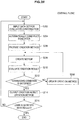
- FIG. 26 is an explanatory diagram showing a flow of processing relating to a creation method of a pseudo-motion according to the present embodiment. Note that the example of FIG. 26 relates to processing by the information processing apparatus 200 described above.
- the data-set-for-evaluator-construction input unit 202 acquires a data set for evaluator construction, and inputs the same to the evaluator construction unit 204 (S202).
- the evaluator construction unit 204 automatically constructs an evaluator (S204). Additionally, the process of step S204 will be described later in detail.
- the creation method preparation unit 206 randomly combines operators and creates creation methods (S206). Then, the pseudo-motion creation unit 208 creates movement tracks (pseudo-motions) by using the creation methods created by the creation method preparation unit 206 (S208). Then, the pseudo-motion evaluation unit 210 calculates, by using the evaluator constructed by the evaluator construction unit 204, an evaluation value of each movement track created by the pseudo-motion creation unit 208 (S210).
- the pseudo-motion evaluation unit 210 decides, based on the calculated evaluation value, a user operation, or the like, whether a terminating condition is satisfied or not (S212). In the case the terminating condition is satisfied, the pseudo-motion evaluation unit 210 inputs the movement track and the creation method to the output unit 214. Then, the information processing apparatus 200 proceeds with the process to step S214. On the other hand, when the terminating condition is not satisfied, the pseudo-motion evaluation unit 210 inputs the evaluation values of respective creation methods to the creation method update unit 212. Then, the information processing apparatus 200 proceeds with the process to step S218.
- the output unit 214 outputs the movement track and the creation method and presents the same to the user (S214). Then, whether or not the user is satisfied with the movement track created in a pseudo manner is decided (S216), and in the case the user is satisfied, the series of processes is ended. On the other hand, if the user is not satisfied with the creation result of the movement track and the feedback is input, the information processing apparatus 200 reconstructs a data set for evaluator construction that reflects the feedback, and performs again the processes of step S202 and subsequent steps based on the data set for evaluator construction.
- the creation method update unit 212 updates the creation methods based on the genetic algorithm (S218). Then, the creation method update unit 212 inputs the creation methods after update to the pseudo-motion creation unit 208. Then, the information processing apparatus 200 returns the process to step S208 and performs again the processes of step S208 and subsequent steps. Eventually, the series of processes is ended when the satisfaction of the user is obtained in the decision at step S216.
- the creation method of a pseudo-motion has been described. Additionally, the creation method that is eventually output from the output unit 214 in the above explanation is the pseudo-motion creator.
- an evaluator is automatically constructed by the genetic algorithm, and also, a creation process of a creation method based on the genetic algorithm is performed by using the evaluator. Accordingly, it becomes possible to automatically construct an algorithm (butterfly's motion prediction (pseudo-motion creation) algorithm)) whose correct answer is not uniquely determined.
- the pseudo-motion creator can be modified to an arbitrary algorithm whose correct answer is not uniquely determined.
- the motion data in the data set for evaluator construction is changed to other appropriate data.
- the mechanisms of the automatic construction method of an evaluator and the automatic construction method of an algorithm according to the present embodiment described above are not modified. Accordingly, such modification is, of course, also within the technical scope of the present embodiment.
- the present embodiment relates to a construction method of an automatic composer. Furthermore, a configuration of an automatic composer construction system according to the present embodiment is expressed as FIG. 27 . Note that the operation of the automatic composer construction system is similar to the operation of the information processing apparatus 200 according to the above-described second embodiment shown in FIG. 26 . The difference between them lies in the configuration of the data set for evaluator construction and the configuration of an output vector output by a creation method.
- the data set for evaluator construction is changed to a combination of music data, non-music data (combination of random sounds, or the like) and correct answer information indicating "music" or "not music”.
- the output vector of the creation method created in step S206 of FIG. 26 is changed from the acceleration vector to a combination of parameters relating to music, such as resonance, sound source and scale.
- FIG. 28 a fourth embodiment of the present invention will be described with reference to FIG. 28 .
- the present embodiment relates to a construction method of an image/video automatic creator. Furthermore, a configuration of an image/video automatic creator construction system according to the present embodiment is expressed as FIG. 28 . Note that the operation of the image/video automatic creator construction system is similar to the operation of the information processing apparatus 200 according to the second embodiment shown in FIG. 26 . The difference between the two lies in the configuration of the data set for evaluator construction and the configuration of an output vector output by a creation method.
- the data set for evaluator construction is changed to a combination of video/image data, non-video/non-image data (a combination of random pixel values, or the like) and correct answer information indicating "video/image” or "not video/image”.
- the output vector of the creation method created in step S206 of FIG. 26 is changed from the acceleration vector to a combination of parameters relating to an image/video.
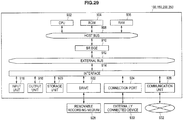
- each structural element of the information processing apparatus 100 described above can be realized by using the hardware configuration of an information processing apparatus shown in FIG. 29 , for example. That is, the function of each of the structural elements is realized by controlling the hardware shown in FIG. 29 by using a computer program.
- this hardware mainly includes a CPU 902, a ROM 904, a RAM 906, a host bus 908, and a bridge 910. Furthermore, this hardware includes an external bus 912, an interface 914, an input unit 916, an output unit 918, a storage unit 920, a drive 922, a connection port 924, and a communication unit 926.
- the CPU is an abbreviation for Central Processing Unit.
- the ROM is an abbreviation for Read Only Memory.
- the RAM is an abbreviation for Random Access Memory.
- the CPU 902 functions as an arithmetic processing unit or a control unit, for example, and controls entire operation or a part of the operation of each structural element based on various programs recorded on the ROM 904, the RAM 906, the storage unit 920, or a removal recording medium 928.
- the ROM 904 is means for storing, for example, a program to be loaded on the CPU 902 or data or the like used in an arithmetic operation.
- the RAM 906 temporarily or perpetually stores, for example, a program to be loaded on the CPU 902 or various parameters or the like arbitrarily changed in execution of the program.
- the host bus 908 capable of performing high-speed data transmission.
- the host bus 908 is connected through the bridge 910 to the external bus 912 whose data transmission speed is relatively low, for example.
- the input unit 916 is, for example, a mouse, a keyboard, a touch panel, a button, a switch, or a lever.
- the input unit 916 may be a remote control that can transmit a control signal by using an infrared ray or other radio waves.
- the output unit 918 is, for example, a display device such as a CRT, an LCD, a PDP or an ELD, an audio output device such as a speaker or headphones, a printer, a mobile phone, or a facsimile, that can visually or auditorily notify a user of acquired information.
- a display device such as a CRT, an LCD, a PDP or an ELD
- an audio output device such as a speaker or headphones, a printer, a mobile phone, or a facsimile, that can visually or auditorily notify a user of acquired information.
- the CRT is an abbreviation for Cathode Ray Tube.
- the LCD is an abbreviation for Liquid Crystal Display.
- the PDP is an abbreviation for Plasma Display Panel.
- the ELD is an abbreviation for Electro-Luminescence Display.
- the storage unit 920 is a device for storing various data.
- the storage unit 920 is, for example, a magnetic storage device such as a hard disk drive (HDD), a semiconductor storage device, an optical storage device, or a magneto-optical storage device.
- the HDD is an abbreviation for Hard Disk Drive.
- the drive 922 is a device that reads information recorded on the removal recording medium 928 such as a magnetic disk, an optical disk, a magneto-optical disk or a semiconductor memory, or writes information in the removal recording medium 928.
- the removal recording medium 928 is, for example, a DVD medium, a Blu-ray medium, an HD-DVD medium, various types of semiconductor storage media, or the like.
- the removal recording medium 928 may be, for example, an electronic device or an IC card on which a non-contact IC chip is mounted.
- the IC is an abbreviation for Integrated Circuit.
- the connection port 924 is a port such as an USB port, an IEEE1394 port, a SCSI, an RS-232C port, or a port for connecting an externally connected device 930 such as an optical audio terminal.
- the externally connected device 930 is, for example, a printer, a mobile music player, a digital camera, a digital video camera, or an IC recorder.
- the USB is an abbreviation for Universal Serial Bus.
- the SCSI is an abbreviation for Small Computer System Interface.
- the communication unit 926 is a communication device for connecting to a network 932, and is, for example, a communication card for a wired or wireless LAN, Bluetooth (registered trademark), or WUSB, an optical communication router, an ADSL router, or various communication modems.
- the network 932 connected to the communication unit 926 is configured from a wire-connected or wirelessly connected network, and is the Internet, a home-use LAN, infrared communication, visible light communication, broadcasting, or satellite communication, for example.
- the LAN is an abbreviation for Local Area Network.
- the WUSB is an abbreviation for Wireless USB.
- the ADSL is an abbreviation for Asymmetric Digital Subscriber Line.
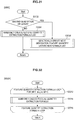
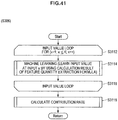
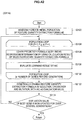
- FIGS. 30 to 43 are explanatory diagrams showing flows of automatic construction processing for an evaluator.
- the automatic construction processing for an evaluator described here is performed by the functions of the evaluator construction units 104 and 204.
- the evaluator construction unit 104 or 204 first creates a feature quantity extraction formula list by randomly combining processing functions (S302). Next, the evaluator construction unit 104 or 204 calculates a feature quantity by using a data set for evaluator construction and each feature quantity extraction formula included in the feature quantity extraction formula list (S304). Then, the evaluator construction unit 104 or 204 creates an evaluation formula created by combining feature quantity extraction formulae, by using the feature quantities and correct information in the data set for evaluator construction and by machine learning based on a genetic algorithm (S306).
- the evaluator construction unit 104 or 204 calculates a contribution rate of the feature quantity extraction formula (second generation feature quantity extraction formula) included in the evaluation formula to the evaluation formula and a reliability of the evaluation formula based on the contribution rate, and determines a terminating condition based on the reliability (S308). In a case the terminating condition is satisfied in step S308, the evaluator construction unit 104 or 204 outputs the evaluation formula as an evaluator (S310). On the other hand, in a case the reliability did not satisfy the terminating condition, the evaluator construction unit 104 or 204 creates a second feature quantity extraction formula list from the second generation feature quantity extraction formulae based on the genetic algorithm (S302).
- the evaluator construction unit 104 or 204 creates an evaluation formula by performing the processes of steps S304 to S310 based on the second generation feature quantity extraction formula list, and calculates its reliability (S304 to S310). In a case the reliability satisfied the terminating condition, the evaluator construction unit 104 or 204 outputs the evaluation formula as an evaluator. On the other hand, in a case the reliability did not satisfy the terminating condition, the evaluator construction unit 104 or 204 performs again the processes of steps S302 to S306, as in the case of the second generation feature quantity extraction formula. In this manner, generation change is repeated until the reliability of the evaluation formula satisfies the terminating condition. The evaluation formula is output as the evaluator at the time point the reliability of the evaluation satisfied the terminating condition.
- steps S302, S304 and S306 will be described in greater detail. Additionally, the terminating condition mentioned above is that an end operation is performed by a user or that the evaluator of the last generation is sufficiently accurate (that the reliability is sufficiently above a predetermined value).
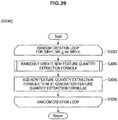
- step S302 will be described in greater detail with reference to FIGS. 31 to 39 .
- the evaluator construction unit 104 or 204 decides whether a feature quantity extraction formula list to be created in step S302 is that of the second generation or later (S3002). In the case of creating a feature quantity extraction formula list of the second generation or later, the evaluator construction unit 104 or 204 proceeds with the process to step S3006. On the other hand, in the case of creating a first generation feature quantity extraction formula list, the evaluator construction unit 104 or 204 proceeds with the process to step S3004.
- the evaluator construction unit 104 or 204 creates a feature quantity extraction formula list by randomly combining processing functions (a processing target axis and an operator described later) prepared in advance (S3004).
- the evaluator construction unit 104 or 204 creates a next generation feature quantity extraction formula list by inputting next generation feature quantity extraction formulae to a genetic algorithm (S3006). Then, the evaluator construction unit 104 or 204 proceeds with the process to step S306.
- step S3004 the process according to step S3004 mentioned above will be described in greater detail with reference to FIG. 32 . Additionally, it is assumed that the number of feature quantity extraction formulae included in the feature quantity extraction formula list is set in advance to m.
- step S3004 the evaluator construction unit 104 or 204 repeats m times a creation process of a feature quantity extraction formula that is obtained by randomly combining processing functions (S3012, S3016). That is, the evaluator construction unit 104 or 204 repeatedly performs the process of step S3014 while incrementing a parameter M from 1 to m.
- the evaluator construction unit 104 or 204 sets parameter M to 0 (S3012), and creates a feature quantity extraction formula by randomly combining processing functions (S3014).
- the evaluator construction unit 104 or 204 increments parameter M by 1 and performs again the process of step S3014 (S3016).
- the evaluator construction unit 104 or 204 ends the process of step S3004.
- processing target axis here means a coordinate axis to be the target of operation, such as time, frequency, position or the type of observation value. That is, information on along what coordinate axis operation by an operator is to be performed (direction of operation) is specified by the processing target axis.
- a feature quantity extraction formula can be constructed by using various types of operators such as differential operation, maximum value output, a low-pass filter, a high-pass filter, an unbiased variance, a fast Fourier transform or absolute value output. Additionally, depending on the type of the operator, a parameter for operation is specified as the operator. For example, in the case of a low-pass filter or a high-pass filter, a parameter for specifying a stopband or a passband is specified. Furthermore, besides the processing functions, information indicating the type of data to be a processing target (hereinafter, type information) may be included in the feature quantity extraction formula.
- type information may be included in the feature quantity extraction formula.
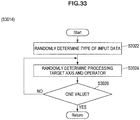
- step S3014 the evaluator construction unit 104 or 204 randomly determines the type (type information) of input data (S3022). However, in a case where the type of input data is one, the process of step S3014 may be skipped.
- the evaluator construction unit 104 or 204 randomly determines a combination of a processing target axis and an operator (processing functions) for constructing a feature quantity extraction formula (S3024). Then, the evaluator construction unit 104 or 204 creates a feature quantity extraction formula by combining the processing functions that have been randomly determined, and decides whether or not the output of the feature quantity extraction formula will be one value (scalar quantity) (S3028).
- step S3028 the evaluator construction unit 104 or 204 proceeds with the process to step S3016 in FIG. 32 .
- the evaluator construction unit 104 or 204 returns the process to step S3024, and again creates a feature quantity extraction formula by randomly determining the processing functions.
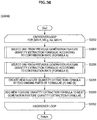
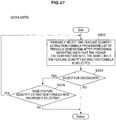
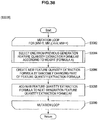
- step S3006 mentioned above will be described in greater detail with reference to FIG. 34 .
- the feature quantity extraction formulae of a g-th (g ⁇ 2) generation are the feature quantity extraction formulae of the previous generation.
- the number of feature quantity extraction formulae to be created by a selection operation performed in step S3006 is ms
- the number of feature quantity extraction formulae to be created by a crossover operation is mx
- the number of feature quantity extraction formulae to be created by mutation is mm
- the number of feature quantity extraction formulae to be randomly created is mr.
- the number of feature quantity extraction formulae to be included in a feature quantity extraction formula list is m.
- the evaluator construction unit 104 or 204 selects ms feature quantity extraction formulae with the highest contribution rates from the g-th generation feature quantity extraction formulae and adds them to the feature quantity extraction formula list (S3034). Next, the evaluator construction unit 104 or 204 exchanges a part of the processing functions between the g-th generation feature quantity extraction formulae, creates mx new feature quantity extraction formulae, and adds them to the feature quantity extraction formula list (S3036).
- the evaluator construction unit 104 or 204 selects mm feature quantity extraction formulae from the g-th generation feature quantity extraction formulae, randomly changes a part of the processing functions structuring the feature quantity extraction formulae, and adds the feature quantity extraction formulae after change to the feature quantity extraction formula list (S3038).
- the evaluator construction unit 104 or 204 randomly creates mr feature quantity extraction formulae, and adds them to the feature quantity extraction formula list (S3040).
- the processes of steps S3032 to S3040 are complete, the evaluator construction unit 104 or 204 proceeds with the process to step S304.
- step S3034 selection process
- the process according to step S3034 is one of characteristic processes of a genetic algorithm corresponding to the mechanism of, when taking a feature quantity extraction formula as a living body and processing functions as genes, a living body with superior genes surviving with high probability in the evolutionary process.
- the evaluator construction unit 104 or 204 arranges the g-th generation feature quantity extraction formulae in the descending order of contribution rate described later (S3042).
- the evaluator construction unit 104 or 204 adds, to the feature quantity extraction formula list, top ms feature quantity extraction formulae in the descending order of contribution rate (S3044).
- the evaluator construction unit 104 or 204 proceeds with the process to step S3036.
- step S3036 crossover process
- the crossover process performed here is one of characteristic processes of a genetic algorithm corresponding to the mechanism of, when taking a feature quantity extraction formula as a living body and processing functions as genes, genes of a living body being partially exchanged in the evolutionary process and a living body with a new combination of genes being born.
- the evaluator construction unit 104 or 204 repeatedly performs the processes of step S3054 to S3060 mx times while changing, from 1 to mx, index MX for specifying a feature quantity extraction formula to be created by the crossover process (S3052, S3062).
- the evaluator construction unit 104 or 204 sets index MX to 1, and proceeds with the process to step S3054 (S3052).
- the evaluator construction unit 104 or 204 selects one feature quantity extraction formula (formula A) from the g-th generation feature quantity extraction formulae based on the contribution rate (S3054).
- the evaluator construction unit 104 or 204 selects one feature quantity extraction formula (formula B) from the g-th generation feature quantity extraction formulae based on the contribution rate (S3056). Then, the evaluator construction unit 104 or 204 creates a new feature quantity extraction formula by exchanging a part of the processing functions included in formula A selected in step S3054 and a part of the processing functions included in formula B selected in step S3056 (S3058). Then, the evaluator construction unit 104 or 204 adds the new feature quantity extraction formula created in step S3058 to the feature quantity extraction formula list (S3060).
- the evaluator construction unit 104 or 204 increments index MX by 1, and performs again the processes of steps S3054 to S3060.
- the evaluator construction unit 104 or 204 repeats the processes of steps S3054 to S3060 until index MX reaches mx, and creates mx feature quantity extraction formulae. Then, the evaluator construction unit 104 or 204 proceeds with the process to step S3038.
- the evaluator construction unit 104 or 204 first weights selection probability for each feature quantity extraction formula such that the higher the contribution rate of a feature quantity extraction formula, the higher the probability of the feature quantity extraction formula being selected, and then randomly selects one feature quantity extraction formula from the g-th generation feature quantity extraction formulae (S3072). Then, the evaluator construction unit 104 or 204 decides whether the selected feature quantity extraction formula is one that has already been selected for the crossover process or not (S3074).
- step S3076 the evaluator construction unit 104 or 204 proceeds with the process to step S3076.
- the evaluator construction unit 104 or 204 proceeds with the process to the next processing step (S3056 (in the case of S3054) or S3058 (in the case of S3056)) forming step S3036.
- the evaluator construction unit 104 or 204 decides whether the same feature quantity extraction formula has already been selected or not (S3076). In a case the same feature quantity extraction formula has already been selected, the evaluator construction unit 104 or 204 returns the process again to step S3072, and newly selects one feature quantity extraction formula (S3072). On the other hand, in a case the same feature quantity extraction formula has not already been selected, the evaluator construction unit 104 or 204 proceeds with the process to the next processing step (S3056 (in the case of S3054) or S3058 (in the case of S3056)) forming step S3036.
- S3056 in the case of S3054
- S3058 in the case of S3056
- step S3038 (mutation process) mentioned above will be described in greater detail with reference to FIG. 38 .
- the mutation process performed here is one of characteristic processes of a genetic algorithm corresponding to the mechanism of, when taking a feature quantity extraction formula as a living body and processing functions as genes, genes of a living body being partially mutated in the evolutionary process and a living body with a new combination of genes being born.
- the evaluator construction unit 104 or 204 repeatedly performs the processes of steps S3084 to S3088 while incrementing index MM from 1 to mm, and creates mm feature quantity extraction formulae (S3082, S3090).
- the evaluator construction unit 104 or 204 sets index MM to 1 (S3082), and selects one feature quantity extraction formula (formula A) from the g-th generation feature quantity extraction formulae (S3084).
- the evaluator construction unit 104 or 204 performs the same process as the process of step S3054 shown in FIG. 37 and selects one feature quantity extraction formula (formula A) based on the contribution rates of the feature quantity extraction formulae.
- the evaluator construction unit 104 or 204 changes a part of the processing functions included in the feature quantity extraction formula to randomly selected processing functions, and creates a new feature quantity extraction formula (S3086). Then, the evaluator construction unit 104 or 204 adds the new feature quantity extraction formula created in step S3086 to the feature quantity extraction formula list (S3088). Then, the evaluator construction unit 104 or 204 increments index MM by 1, and performs again the processes of steps S3084 to S3088 (S3090).
- the evaluator construction unit 104 or 204 repeatedly performs the processes of steps S3084 to S3088 until index MM reaches mm, and creates mm feature quantity extraction formulae. Then, the evaluator construction unit 104 or 204 proceeds with the process to step S3040.
- step S3040 random creation process
- the evaluator construction unit 104 or 204 repeatedly performs the processes of steps S3094 to S3096 while incrementing index MR from 1 to mr, and creates mr feature quantity extraction formulae (S3092, S3098). First, the evaluator construction unit 104 or 204 sets index MR to 1 (S3092), and creates a new feature quantity extraction formula by randomly combining the processing functions (S3094).
- the evaluator construction unit 104 or 204 adds the new feature quantity extraction formula created in step S3092 to the feature quantity extraction formula list (S3096). Then, the evaluator construction unit 104 or 204 increments index MR by 1, and performs again the processes of steps S3094 and S3096 (S3098). Then, the evaluator construction unit 104 or 204 repeatedly performs the processes of steps S3094 and S3096 until index MR reaches mr, and creates mr feature quantity extraction formulae. Additionally, each feature quantity extraction formula is created such that the output will be a scalar quantity.
- step S3040 When the process of step S3040 is complete, the process of step S3006 is complete.
- a feature quantity extraction formula list including total m feature quantity extraction formulae is created by steps S3034, S3036, S3038 and S3040, the evaluator construction unit 104 or 204 proceeds with the process to step S304.
- step S304 will be described in greater detail with reference to FIG. 40 . Additionally, it is assumed that a feature quantity extraction formula list is created in step S3004 or S3006. It is also assumed that this feature quantity extraction formula list includes m feature quantity extraction formulae.
- the evaluator construction unit 104 or 204 repeatedly performs the processes of steps S3104 to S3108 while updating index M from 1 to m (S3102, S3110). Also, the evaluator construction unit 104 or 204 repeatedly performs the process of step S3106 while updating index q from 1 to d (S3104, S3108).
- the evaluator construction unit 104 or 204 sets index M to 1 and proceeds with the process to step S3104 (S3102).
- the evaluator construction unit 104 or 204 sets index q to 1 and proceeds with the process to step S3106 (S3104).
- the evaluator construction unit 104 or 204 inputs evaluation target data Dq to feature quantity extraction formula [M] and calculates a feature quantity (S3106).
- feature quantity extraction formula [M] means the M-th feature quantity extraction formula among feature quantity extraction formulae included in the feature quantity extraction formula list. Then, the evaluator construction unit 104 or 204 returns the process to step S3104 (S3108), increments index q by 1 (S3104), and proceeds with the process again to step S3106.
- step S3110 the evaluator construction unit 104 or 204 proceeds with the process to step S3110, and returns the process to step S3102 (S3110). Then, the evaluator construction unit 104 or 204 increments index M by 1 (S3102), proceeds with the process again to step S3104, and repeatedly performs the processes of steps S3104 to S3108.
- the evaluator construction unit 104 or 204 repeatedly performs the process of step S3114 while incrementing index x from 1 to K (S3112, S3116).
- the evaluator construction unit 104 or 204 sets index x to 1 (S3112), and proceeds with the process to step S3114.
- the evaluator construction unit 104 or 204 performs machine learning by using feature quantity [M][q] and correct answer information Dq corresponding to observation value x, and calculates an evaluation formula for observation value x (S3114). In a case of creating an evaluation formula by linearly combining a plurality of feature quantity extraction formulae, each combination coefficient is calculated in step S3114.
- the evaluator construction unit 104 or 204 returns the process to step S3112 (S3116), increments index x by 1 (S3112), and performs the process of step S3114. Furthermore, the evaluator construction unit 104 or 204 repeatedly performs the process of step S3114 until index x reaches K, and creates an evaluation formula for each of observation values 1 to K.
- the evaluator construction unit 104 or 204 calculates a contribution rate of each feature quantity extraction formula to the evaluation formula constructed in steps S3112 to S3116 (S3118). At this time, the evaluator construction unit 104 or 204 calculates, based on a combination coefficient of each feature quantity extraction formula included in the evaluation formula, the contribution rate of each feature quantity extraction formula to the evaluation formula. Then, the evaluator construction unit 104 or 204 proceeds with the process to step S308.
- step S3114 mentioned above will be described in greater detail with reference to FIG. 42 .
- the evaluator construction unit 104 or 204 randomly selects, from a feature quantity extraction formula list, feature quantity extraction formulae to be used for creation of an evaluation formula, and creates an initial population (first generation genes) (S3122).
- the number of feature quantity extraction formulae forming the initial population is assumed to be set to p in advance.
- the evaluator construction unit 104 or 204 repeatedly performs the processes of steps S3126 and S3128 while updating index P from 1 to p (S3124, S3130).
- the evaluator construction unit 104 or 204 sets index P to 1, and proceeds with the process to step S3126 (S3124). Then, the evaluator construction unit 104 or 204 creates an evaluation formula for each of observation values 1 to K by performing linear regression and determination based on a feature quantity calculated by a feature quantity calculation unit 134 for a feature quantity extraction formula included in the initial population and prediction-basis data (S3126). Next, the evaluator construction unit 104 or 204 evaluates the evaluation formulae created in step S3126 by using AIC (S3128).
- step S3124 returns the process to step S3124 (S3130), increments index P by 1 and proceeds with the process to step S3126 (S3124). Then, the evaluator construction unit 104 or 204 performs again the processes of steps S3126 and S3128. Then, the evaluator construction unit 104 or 204 repeats the processes of steps S3126 and S3128 until index P reaches p, and proceeds with the process to step S3132.
- the evaluator construction unit 104 or 204 uses AIC as the reliability, and changes a combination of feature quantity extraction formulae used for creation of an evaluation formula by selection, crossover and mutation (S3132). That is, in step S3132, the evaluator construction unit 104 or 204 creates second generation genes from the first generation genes.
- the evaluator construction unit 104 or 204 decides whether the reliability of the best gene is not updated for over a predetermined number of generations (S3134). In a case it is not a state where the reliability of the best gene is not updated for over a predetermined number of generations, the evaluator construction unit 104 or 204 returns the process to step S3124, and performs again the processes of steps S3124 to S3134.
- step S3116 the evaluator construction unit 104 or 204 proceeds with the process to step S3116. Furthermore, when the repeating process of steps S3112 to S3116 is complete, the evaluator construction unit 104 or 204 proceeds with the process to step S3118.
- step S3118 mentioned above will be described in greater detail with reference to FIG. 43 .
- the evaluator construction unit 104 or 204 initializes total contribution rate Cont[M] to 0 (S3142). Next, the evaluator construction unit 104 or 204 repeatedly performs the processes of steps S3146 to S3150 while updating index x from 1 to K (S3144, S3152). Also, in the case the process proceeded to step S3146, the evaluator construction unit 104 or 204 repeatedly performs the process of step S3148 while updating index M from 1 to m (S3146, S3150).
- step S3148 the evaluator construction unit 104 or 204 first calculates, with regard to observation value x, a contribution rate of feature quantity extraction formula [M] to an evaluation formula.
- This contribution rate is calculated based on a combination coefficient of feature quantity extraction formula [M] calculated for each observation value at the time of creating an evaluation formula. For example, the contribution rate is a value that includes a square of the combination coefficient. Additionally, the contribution rate of a feature quantity extraction formula not included in the evaluation formula is 0.
- step S3118 the total contribution rate Cont[M] of each feature quantity extraction formula to the observation values 1 to K will be calculated for all the feature quantity extraction formulae included in the feature quantity extraction formula list.
- the total contribution rate Cont[M] of each feature quantity extraction formula calculated in step S3118 will be used as reliability for the evaluation formula.
- FIG. 44 is an explanatory diagram showing a method of extension to a time-series prediction algorithm.
- the algorithm automatic construction method is realized by modifying the configuration of data and correct answer information in a data set for evaluator construction and the configuration of input data. For example, as shown in FIG. 44 , in a case time-series data is obtained for a plurality of observation values, prediction-basis data of a predetermined time width w and predicted data observed at a time following the prediction-basis data are extracted. Then, for each time, the prediction-basis data is set to the data in the data set for evaluator construction and the predicted data is set to the correct answer information.
- an evaluator is constructed by using the data set for evaluator construction set in this manner and by machine learning based on a genetic algorithm. Then, a creation method of creating the predicted data from the prediction-basis data is prepared, and a prediction value of the predicted data is created by using the creation method. Next, the prediction value is input to the evaluator and an evaluation value is calculated, and the creation method is repeatedly updated by using the genetic algorithm in such a manner that the evaluation value will be higher. Then, in the case a terminating condition is satisfied, the creation method and the evaluation value are output.
- the creation method output here is the prediction algorithm for time-series data.
- the prediction algorithm for time-series data described here is an application example of the first embodiment described above. By adopting this application example, it becomes possible to automatically create a prediction algorithm for predicting a prediction value of a data amount changing over time.
- the functional configuration of the information processing apparatus described above can be expressed as follows.
- the information processing apparatus includes a processing method preparation unit that prepares a processing method for data, an evaluation unit that calculates an evaluation value of output data obtained in a case data is processed by the processing method prepared by the processing method preparation unit, by using an evaluator for calculating the evaluation value from the data, the evaluator being automatically created by using a plurality of data sets including data and an evaluation value of the data and performing a learning process based on a genetic algorithm, a processing method update unit that repeatedly updates, based on the genetic algorithm, the processing method and calculates a processing method by which the evaluation value to be calculated by the evaluation unit will be higher, and an output unit that outputs, in a case the evaluation value of output data obtained in a case data is processed by the processing method calculated by the processing method update unit satisfies a predetermined condition, the output data, a combination of the output data and the processing method, or the processing method.
Landscapes
- Engineering & Computer Science (AREA)
- Theoretical Computer Science (AREA)
- General Physics & Mathematics (AREA)
- Physics & Mathematics (AREA)
- Computer Vision & Pattern Recognition (AREA)
- Evolutionary Computation (AREA)
- Artificial Intelligence (AREA)
- General Health & Medical Sciences (AREA)
- Data Mining & Analysis (AREA)
- Health & Medical Sciences (AREA)
- Computing Systems (AREA)
- Life Sciences & Earth Sciences (AREA)
- Bioinformatics & Computational Biology (AREA)
- Multimedia (AREA)
- Physiology (AREA)
- Medical Informatics (AREA)
- Databases & Information Systems (AREA)
- Bioinformatics & Cheminformatics (AREA)
- Software Systems (AREA)
- Evolutionary Biology (AREA)
- General Engineering & Computer Science (AREA)
- Image Analysis (AREA)
- Image Processing (AREA)
- Complex Calculations (AREA)
- Management, Administration, Business Operations System, And Electronic Commerce (AREA)
- Processing Or Creating Images (AREA)
Claims (5)
- Appareil de traitement d'informations pour construire automatiquement un procédé de traitement pour traiter des données d'image d'entrée pour générer de nouvelles données d'image ayant une caractéristique prédéterminée ou pour générer les nouvelles données d'image sur la base dudit procédé de traitement :
comprenant :
une unité d'entrée d'ensemble de données (102) qui entre un ensemble de données d'apprentissage comprenant des données d'image d'apprentissage et des informations d'étiquette indiquant si chaque instance de données d'image d'apprentissage a la caractéristique prédéterminée :une unité de création d'évaluateur (104) qui crée automatiquement un évaluateur pour calculer une valeur d'évaluation indiquant une probabilité que des données d'image entrées dans l'évaluateur ont la caractéristique prédéterminée, par réalisation d'un processus d'apprentissage sur la base d'un algorithme génétique à l'aide de l'entrée d'ensemble de données d'apprentissage provenant de l'unité d'entrée d'ensemble de données ;une unité de préparation de procédé de traitement (106) qui prépare une pluralité de procédés de traitement pour traiter les données d'image d'entrée pour générer les nouvelles données d'image, chaque procédé de traitement comprenant une combinaison de filtres de traitement d'image ;une unité de traitement de données (108) qui traite les données d'image d'entrée à l'aide de la pluralité de procédés de traitement préparés par l'unité de préparation de procédé de traitement (106) pour générer les nouvelles données d'image ;une unité d'évaluation (110) qui calcule des valeurs d'évaluation pour les nouvelles données d'image générées par l'unité de traitement de données (108) à l'aide de la pluralité de procédés de traitement préparés par l'unité de préparation de procédé de traitement, à l'aide de l'évaluateur créé par l'unité de création d'évaluateur (104) ;une unité de mise à jour de procédé de traitement (112) qui met à jour de manière répétée les procédés de traitement en sélectionnant un nombre prédéterminé des procédés de traitement ayant les valeurs d'évaluation les plus élevées générées par l'unité d'évaluation (110) et en générant, en fonction des procédés de traitement sélectionnés, un nouvel ensemble de procédés de traitement devant être utilisés par l'unité de traitement de données (108) pour générer de nouvelles données d'image à évaluer par l'unité d'évaluation (110) au cours d'une itération ultérieure d'un processus de répétition par l'unité de traitement de données (108), l'unité d'évaluation (110) et l'unité de mise à jour de procédé de traitement (112),ledit nouvel ensemble de procédés de traitement comprenant les procédés de traitement sélectionnés, un nombre prédéterminé de nouveaux procédés de traitement créés par combinaison aléatoire des filtres de traitement d'image, et un nombre prédéterminé de procédés de traitement mutés, chacun étant créé par modification de la combinaison de filtres de traitement d'image de l'un de ladite pluralité de procédés de traitement ; etune unité de sortie (114) qui fournit en sortie, lorsqu'une condition prédéterminée est satisfaite suite à une itération du processus de répétition, l'un parmi :les nouvelles données d'image de la dernière itération à partir du processus de répétition,une combinaison des nouvelles données d'image et un procédé de traitement à partir de la dernière itération du processus de répétition, ouun procédé de traitement à partir de la dernière itération du processus de répétition. - Appareil de traitement d'informations selon la revendication 1, comprenant en outre :une unité d'acquisition de rétroaction (102) qui reçoit une rétroaction par un utilisateur des nouvelles données d'image ou de la combinaison des nouvelles données d'image et du procédé de traitement délivrés en sortie par l'unité de sortie,l'unité de création d'évaluateur créant automatiquement l'évaluateur en ajoutant, à l'ensemble de données d'apprentissage, la rétroaction acquise par l'unité d'acquisition de rétroaction à partir de l'utilisateur, et les nouvelles données d'image correspondant à la rétroaction par l'utilisateur, et en réalisant à nouveau le processus d'apprentissage sur la base de l'algorithme génétique.
- Appareil de traitement d'informations selon la revendication 2 :
les données d'image d'entrée traitées par l'unité de traitement de données (108) comprenant des données d'image d'entrée entrées par un utilisateur. - Procédé de traitement d'informations pour construire automatiquement un procédé de traitement pour traiter des données d'image d'entrée pour générer de nouvelles données d'image ayant une caractéristique prédéterminée ou pour générer les nouvelles données d'image sur la base dudit procédé de traitement ;
comprenant les étapes consistant à :l'entrée (S102) d'un ensemble de données d'apprentissage comprenant des données d'image d'apprentissage et des informations d'étiquette indiquant si chaque instance de données d'image d'apprentissage a la caractéristique prédéterminée ; etla création automatique (S104) d'un évaluateur pour calculer une valeur d'évaluation indiquant une probabilité que des données d'image entrées dans l'évaluateur ont la caractéristique prédéterminée, par réalisation d'un processus d'apprentissage sur la base de l'algorithme génétique à l'aide de l'ensemble de données d'apprentissage ;la préparation (S106) d'une pluralité de procédés de traitement pour traiter les données d'image d'entrée pour générer les nouvelles données d'image, chaque procédé de traitement comprenant une combinaison de filtres de traitement d'image ;le traitement (S108) des données d'image d'entrée à l'aide de la pluralité de procédés de traitement préparée par l'étape de préparation pour générer les nouvelles données d'image ;le calcul (S110) de valeurs d'évaluation pour les nouvelles données d'image générées à l'aide de la pluralité de procédés de traitement préparés au cours de l'étape de préparation (S106), à l'aide de l'évaluateur créé au cours de l'étape de création automatique (S104) :la mise à jour répétée (S118) des procédés de traitement par sélection d'un nombre prédéterminé des procédés de traitement ayant les valeurs d'évaluation les plus élevées générées par l'étape de calcul (S110) et en générant, en fonction des procédés de traitement sélectionnés, un nouvel ensemble de procédés de traitement devant être utilisés par l'étape de traitement (S108) pour générer de nouvelles données d'image à évaluer par l'étape de calcul (S110) au cours d'une itération ultérieure d'un processus de répétition par l'étape de traitement (S108), l'étape de calcul (S110) et l'étape de mise à jour répétée (S118),ledit nouvel ensemble de procédés de traitement comprenant les procédés de traitement sélectionnés, un nombre prédéterminé de nouveaux procédés de traitement créés par combinaison aléatoire des filtres de traitement d'image, et un nombre prédéterminé de procédés de traitement mutés, chacun étant créé par modification de la combinaison de filtres de traitement d'image de l'un de ladite pluralité de procédés de traitement ; etl'émission (S114), lorsqu'une condition prédéterminée est satisfaite suite à une itération du processus de répétition, de l'un parmi :les nouvelles données d'image à partir de la dernière itération du processus de répétition,une combinaison des nouvelles données d'image et d'un procédé de traitement à partir de la dernière itération du processus de répétition, ouun procédé de traitement à partir de la dernière itération du processus de répétition. - Programme pour amener un ordinateur à réaliser le procédé selon la revendication 4.
Applications Claiming Priority (1)
| Application Number | Priority Date | Filing Date | Title |
|---|---|---|---|
| JP2009277083A JP5446800B2 (ja) | 2009-12-04 | 2009-12-04 | 情報処理装置、情報処理方法、及びプログラム |
Publications (3)
| Publication Number | Publication Date |
|---|---|
| EP2333697A2 EP2333697A2 (fr) | 2011-06-15 |
| EP2333697A3 EP2333697A3 (fr) | 2014-09-24 |
| EP2333697B1 true EP2333697B1 (fr) | 2018-10-17 |
Family
ID=43608246
Family Applications (1)
| Application Number | Title | Priority Date | Filing Date |
|---|---|---|---|
| EP10189513.4A Not-in-force EP2333697B1 (fr) | 2009-12-04 | 2010-10-29 | Appareil de traitement d'informations, procédé et programme de traitement d'informations |
Country Status (4)
| Country | Link |
|---|---|
| US (1) | US8694447B2 (fr) |
| EP (1) | EP2333697B1 (fr) |
| JP (1) | JP5446800B2 (fr) |
| CN (1) | CN102147865B (fr) |
Families Citing this family (12)
| Publication number | Priority date | Publication date | Assignee | Title |
|---|---|---|---|---|
| JP2013033376A (ja) * | 2011-08-02 | 2013-02-14 | Sony Corp | 情報処理装置、情報処理方法、および、プログラム |
| US20130066452A1 (en) * | 2011-09-08 | 2013-03-14 | Yoshiyuki Kobayashi | Information processing device, estimator generating method and program |
| JP6098498B2 (ja) * | 2013-12-19 | 2017-03-22 | ソニー株式会社 | 情報処理装置、情報処理方法、並びにプログラム |
| EP3018512A1 (fr) | 2014-11-05 | 2016-05-11 | Corning Optical Communications LLC | Architectures de centre de données bidirectionnel utilisant un câble de jonction sans enveloppe |
| US9542646B1 (en) * | 2016-01-27 | 2017-01-10 | International Business Machines Corporation | Drift annealed time series prediction |
| US11222404B2 (en) | 2016-03-25 | 2022-01-11 | Koninklijke Philips N.V. | Image reconstruction |
| WO2019028472A1 (fr) | 2017-08-04 | 2019-02-07 | Outward, Inc. | Techniques de traitement d'images sur la base d'un apprentissage machine |
| CN108648158A (zh) * | 2018-05-08 | 2018-10-12 | 广州大学 | 基于遗传算法的小波图像去噪方法和装置 |
| US20210117828A1 (en) * | 2018-06-27 | 2021-04-22 | Sony Corporation | Information processing apparatus, information processing method, and program |
| EP3629240B1 (fr) * | 2018-09-07 | 2023-08-23 | Panasonic Intellectual Property Corporation of America | Réseaux adversaires génératifs pour l'élimination du bruit local d'une image |
| CN111796840A (zh) * | 2019-04-09 | 2020-10-20 | Oppo广东移动通信有限公司 | 算法模型更新方法、装置、存储介质及电子设备 |
| JP7419787B2 (ja) * | 2019-12-16 | 2024-01-23 | 東洋製罐グループホールディングス株式会社 | 時系列データ解析装置 |
Family Cites Families (12)
| Publication number | Priority date | Publication date | Assignee | Title |
|---|---|---|---|---|
| US5946673A (en) * | 1996-07-12 | 1999-08-31 | Francone; Frank D. | Computer implemented machine learning and control system |
| JPH11259522A (ja) * | 1998-03-13 | 1999-09-24 | Mitsubishi Electric Corp | 連続値感性データベースを用いたコンテンツ作成装置 |
| JP2004326200A (ja) * | 2003-04-21 | 2004-11-18 | Mitsubishi Heavy Ind Ltd | 自動機械、機械の自動運転システム、及び、機械の自動運転方法 |
| US7356518B2 (en) * | 2003-08-27 | 2008-04-08 | Icosystem Corporation | Methods and systems for multi-participant interactive evolutionary computing |
| US7308418B2 (en) * | 2004-05-24 | 2007-12-11 | Affinova, Inc. | Determining design preferences of a group |
| CN1295615C (zh) * | 2004-12-20 | 2007-01-17 | 华中科技大学 | 具有时间约束的分布式软件可靠性评估系统 |
| CN101218647B (zh) * | 2005-07-06 | 2011-02-02 | 皇家飞利浦电子股份有限公司 | 用于生成元素序列的方法和装置 |
| US7979365B2 (en) * | 2006-01-31 | 2011-07-12 | The Board Of Trustees Of The University Of Illinois | Methods and systems for interactive computing |
| US20080154808A1 (en) * | 2006-10-20 | 2008-06-26 | Genalytics, Inc. | Use and construction of time series interactions in a predictive model |
| JP4392620B2 (ja) * | 2007-08-14 | 2010-01-06 | ソニー株式会社 | 情報処理装置、情報処理方法、演算装置、演算方法、プログラム、および記録媒体 |
| EP2110784A1 (fr) * | 2008-04-14 | 2009-10-21 | INFORM Institut für Operations Research und Management GmbH | Procédé et système expert destinés à évaluer un objet |
| JP2009277083A (ja) | 2008-05-15 | 2009-11-26 | Fuji Xerox Co Ltd | 印刷システム及びそのプログラム |
-
2009
- 2009-12-04 JP JP2009277083A patent/JP5446800B2/ja not_active Expired - Fee Related
-
2010
- 2010-10-29 EP EP10189513.4A patent/EP2333697B1/fr not_active Not-in-force
- 2010-11-24 US US12/954,145 patent/US8694447B2/en not_active Expired - Fee Related
- 2010-11-26 CN CN201010573715.8A patent/CN102147865B/zh not_active Expired - Fee Related
Non-Patent Citations (1)
| Title |
|---|
| None * |
Also Published As
| Publication number | Publication date |
|---|---|
| CN102147865A (zh) | 2011-08-10 |
| JP2011118785A (ja) | 2011-06-16 |
| EP2333697A3 (fr) | 2014-09-24 |
| CN102147865B (zh) | 2017-04-12 |
| EP2333697A2 (fr) | 2011-06-15 |
| US8694447B2 (en) | 2014-04-08 |
| JP5446800B2 (ja) | 2014-03-19 |
| US20110137837A1 (en) | 2011-06-09 |
Similar Documents
| Publication | Publication Date | Title |
|---|---|---|
| EP2333697B1 (fr) | Appareil de traitement d'informations, procédé et programme de traitement d'informations | |
| CN105706161B (zh) | 基于音高分布的自动音频协调 | |
| CN112700791B (zh) | 电子设备及其控制方法 | |
| CN109478204A (zh) | 非结构化文本的机器理解 | |
| JP5573443B2 (ja) | 情報処理装置、情報処理方法、及びプログラム | |
| JP4392620B2 (ja) | 情報処理装置、情報処理方法、演算装置、演算方法、プログラム、および記録媒体 | |
| CN116034425B (zh) | 人声音符识别模型的训练方法、人声音符识别方法及设备 | |
| KR20210066807A (ko) | 정보 처리 장치 및 방법, 그리고 프로그램 | |
| JP6701478B2 (ja) | 映像生成装置、映像生成モデル学習装置、その方法、及びプログラム | |
| Ianigro et al. | Plecto: a low-level interactive genetic algorithm for the evolution of audio | |
| Yang et al. | A plugin for neural audio synthesis of impact sound effects | |
| Chappell et al. | Analysis of two-player quantum games in an EPR setting using clifford's geometric algebra | |
| Verma et al. | A review of multimedia processing and its application in MIDI | |
| Balabanov | Distributed evolutional model for music composition by human-computer interaction | |
| JP2018033093A (ja) | 合成パラメータ最適化装置、その方法、及びプログラム | |
| CN113345394B (zh) | 音频数据的处理方法、装置、电子设备及存储介质 | |
| Frisson et al. | Multimodal guitar: Performance toolbox and study workbench | |
| Unemi | Automated Daily Production of Evolutionary Audio Visual Art-An Experimental Practice. | |
| US20260037775A1 (en) | Signal processing apparatus, signal processing method, and program | |
| Mohamed et al. | Prediction of trumpet performance descriptors using machine learning | |
| WO2025062636A1 (fr) | Dispositif de traitement d'informations, procédé de traitement d'informations et programme | |
| Çimen | A robust longitudinal model for song popularity: a cross-cultural study | |
| Sanchez-Spinola et al. | Musical Instrument Classification Using k-Nearest Neighbors | |
| Martin et al. | Understanding Musical Predictions With an Embodied Interface for Musical Machine Learning. Front | |
| Xu | DSP iOS Application Development |
Legal Events
| Date | Code | Title | Description |
|---|---|---|---|
| PUAI | Public reference made under article 153(3) epc to a published international application that has entered the european phase |
Free format text: ORIGINAL CODE: 0009012 |
|
| 17P | Request for examination filed |
Effective date: 20101125 |
|
| AK | Designated contracting states |
Kind code of ref document: A2 Designated state(s): AL AT BE BG CH CY CZ DE DK EE ES FI FR GB GR HR HU IE IS IT LI LT LU LV MC MK MT NL NO PL PT RO RS SE SI SK SM TR |
|
| AX | Request for extension of the european patent |
Extension state: BA ME |
|
| PUAL | Search report despatched |
Free format text: ORIGINAL CODE: 0009013 |
|
| AK | Designated contracting states |
Kind code of ref document: A3 Designated state(s): AL AT BE BG CH CY CZ DE DK EE ES FI FR GB GR HR HU IE IS IT LI LT LU LV MC MK MT NL NO PL PT RO RS SE SI SK SM TR |
|
| AX | Request for extension of the european patent |
Extension state: BA ME |
|
| RIC1 | Information provided on ipc code assigned before grant |
Ipc: G06T 5/00 20060101ALI20140820BHEP Ipc: G10H 1/00 20060101ALI20140820BHEP Ipc: G06K 9/62 20060101AFI20140820BHEP |
|
| 17Q | First examination report despatched |
Effective date: 20150811 |
|
| GRAP | Despatch of communication of intention to grant a patent |
Free format text: ORIGINAL CODE: EPIDOSNIGR1 |
|
| STAA | Information on the status of an ep patent application or granted ep patent |
Free format text: STATUS: GRANT OF PATENT IS INTENDED |
|
| INTG | Intention to grant announced |
Effective date: 20180508 |
|
| GRAS | Grant fee paid |
Free format text: ORIGINAL CODE: EPIDOSNIGR3 |
|
| GRAA | (expected) grant |
Free format text: ORIGINAL CODE: 0009210 |
|
| STAA | Information on the status of an ep patent application or granted ep patent |
Free format text: STATUS: THE PATENT HAS BEEN GRANTED |
|
| AK | Designated contracting states |
Kind code of ref document: B1 Designated state(s): AL AT BE BG CH CY CZ DE DK EE ES FI FR GB GR HR HU IE IS IT LI LT LU LV MC MK MT NL NO PL PT RO RS SE SI SK SM TR |
|
| REG | Reference to a national code |
Ref country code: GB Ref legal event code: FG4D |
|
| REG | Reference to a national code |
Ref country code: CH Ref legal event code: EP |
|
| REG | Reference to a national code |
Ref country code: IE Ref legal event code: FG4D |
|
| REG | Reference to a national code |
Ref country code: DE Ref legal event code: R096 Ref document number: 602010054360 Country of ref document: DE Ref country code: AT Ref legal event code: REF Ref document number: 1054854 Country of ref document: AT Kind code of ref document: T Effective date: 20181115 |
|
| REG | Reference to a national code |
Ref country code: NL Ref legal event code: MP Effective date: 20181017 |
|
| REG | Reference to a national code |
Ref country code: LT Ref legal event code: MG4D |
|
| REG | Reference to a national code |
Ref country code: AT Ref legal event code: MK05 Ref document number: 1054854 Country of ref document: AT Kind code of ref document: T Effective date: 20181017 |
|
| PG25 | Lapsed in a contracting state [announced via postgrant information from national office to epo] |
Ref country code: NL Free format text: LAPSE BECAUSE OF FAILURE TO SUBMIT A TRANSLATION OF THE DESCRIPTION OR TO PAY THE FEE WITHIN THE PRESCRIBED TIME-LIMIT Effective date: 20181017 |
|
| PG25 | Lapsed in a contracting state [announced via postgrant information from national office to epo] |
Ref country code: ES Free format text: LAPSE BECAUSE OF FAILURE TO SUBMIT A TRANSLATION OF THE DESCRIPTION OR TO PAY THE FEE WITHIN THE PRESCRIBED TIME-LIMIT Effective date: 20181017 Ref country code: IS Free format text: LAPSE BECAUSE OF FAILURE TO SUBMIT A TRANSLATION OF THE DESCRIPTION OR TO PAY THE FEE WITHIN THE PRESCRIBED TIME-LIMIT Effective date: 20190217 Ref country code: AT Free format text: LAPSE BECAUSE OF FAILURE TO SUBMIT A TRANSLATION OF THE DESCRIPTION OR TO PAY THE FEE WITHIN THE PRESCRIBED TIME-LIMIT Effective date: 20181017 Ref country code: PL Free format text: LAPSE BECAUSE OF FAILURE TO SUBMIT A TRANSLATION OF THE DESCRIPTION OR TO PAY THE FEE WITHIN THE PRESCRIBED TIME-LIMIT Effective date: 20181017 Ref country code: BG Free format text: LAPSE BECAUSE OF FAILURE TO SUBMIT A TRANSLATION OF THE DESCRIPTION OR TO PAY THE FEE WITHIN THE PRESCRIBED TIME-LIMIT Effective date: 20190117 Ref country code: NO Free format text: LAPSE BECAUSE OF FAILURE TO SUBMIT A TRANSLATION OF THE DESCRIPTION OR TO PAY THE FEE WITHIN THE PRESCRIBED TIME-LIMIT Effective date: 20190117 Ref country code: LT Free format text: LAPSE BECAUSE OF FAILURE TO SUBMIT A TRANSLATION OF THE DESCRIPTION OR TO PAY THE FEE WITHIN THE PRESCRIBED TIME-LIMIT Effective date: 20181017 Ref country code: FI Free format text: LAPSE BECAUSE OF FAILURE TO SUBMIT A TRANSLATION OF THE DESCRIPTION OR TO PAY THE FEE WITHIN THE PRESCRIBED TIME-LIMIT Effective date: 20181017 Ref country code: LV Free format text: LAPSE BECAUSE OF FAILURE TO SUBMIT A TRANSLATION OF THE DESCRIPTION OR TO PAY THE FEE WITHIN THE PRESCRIBED TIME-LIMIT Effective date: 20181017 Ref country code: HR Free format text: LAPSE BECAUSE OF FAILURE TO SUBMIT A TRANSLATION OF THE DESCRIPTION OR TO PAY THE FEE WITHIN THE PRESCRIBED TIME-LIMIT Effective date: 20181017 |
|
| PG25 | Lapsed in a contracting state [announced via postgrant information from national office to epo] |
Ref country code: SE Free format text: LAPSE BECAUSE OF FAILURE TO SUBMIT A TRANSLATION OF THE DESCRIPTION OR TO PAY THE FEE WITHIN THE PRESCRIBED TIME-LIMIT Effective date: 20181017 Ref country code: AL Free format text: LAPSE BECAUSE OF FAILURE TO SUBMIT A TRANSLATION OF THE DESCRIPTION OR TO PAY THE FEE WITHIN THE PRESCRIBED TIME-LIMIT Effective date: 20181017 Ref country code: GR Free format text: LAPSE BECAUSE OF FAILURE TO SUBMIT A TRANSLATION OF THE DESCRIPTION OR TO PAY THE FEE WITHIN THE PRESCRIBED TIME-LIMIT Effective date: 20190118 Ref country code: PT Free format text: LAPSE BECAUSE OF FAILURE TO SUBMIT A TRANSLATION OF THE DESCRIPTION OR TO PAY THE FEE WITHIN THE PRESCRIBED TIME-LIMIT Effective date: 20190217 Ref country code: RS Free format text: LAPSE BECAUSE OF FAILURE TO SUBMIT A TRANSLATION OF THE DESCRIPTION OR TO PAY THE FEE WITHIN THE PRESCRIBED TIME-LIMIT Effective date: 20181017 |
|
| REG | Reference to a national code |
Ref country code: CH Ref legal event code: PL |
|
| REG | Reference to a national code |
Ref country code: BE Ref legal event code: MM Effective date: 20181031 |
|
| PG25 | Lapsed in a contracting state [announced via postgrant information from national office to epo] |
Ref country code: LU Free format text: LAPSE BECAUSE OF NON-PAYMENT OF DUE FEES Effective date: 20181029 |
|
| REG | Reference to a national code |
Ref country code: DE Ref legal event code: R097 Ref document number: 602010054360 Country of ref document: DE |
|
| REG | Reference to a national code |
Ref country code: IE Ref legal event code: MM4A |
|
| PG25 | Lapsed in a contracting state [announced via postgrant information from national office to epo] |
Ref country code: CZ Free format text: LAPSE BECAUSE OF FAILURE TO SUBMIT A TRANSLATION OF THE DESCRIPTION OR TO PAY THE FEE WITHIN THE PRESCRIBED TIME-LIMIT Effective date: 20181017 Ref country code: IT Free format text: LAPSE BECAUSE OF FAILURE TO SUBMIT A TRANSLATION OF THE DESCRIPTION OR TO PAY THE FEE WITHIN THE PRESCRIBED TIME-LIMIT Effective date: 20181017 Ref country code: DK Free format text: LAPSE BECAUSE OF FAILURE TO SUBMIT A TRANSLATION OF THE DESCRIPTION OR TO PAY THE FEE WITHIN THE PRESCRIBED TIME-LIMIT Effective date: 20181017 |
|
| PLBE | No opposition filed within time limit |
Free format text: ORIGINAL CODE: 0009261 |
|
| STAA | Information on the status of an ep patent application or granted ep patent |
Free format text: STATUS: NO OPPOSITION FILED WITHIN TIME LIMIT |
|
| PG25 | Lapsed in a contracting state [announced via postgrant information from national office to epo] |
Ref country code: SM Free format text: LAPSE BECAUSE OF FAILURE TO SUBMIT A TRANSLATION OF THE DESCRIPTION OR TO PAY THE FEE WITHIN THE PRESCRIBED TIME-LIMIT Effective date: 20181017 Ref country code: LI Free format text: LAPSE BECAUSE OF NON-PAYMENT OF DUE FEES Effective date: 20181031 Ref country code: RO Free format text: LAPSE BECAUSE OF FAILURE TO SUBMIT A TRANSLATION OF THE DESCRIPTION OR TO PAY THE FEE WITHIN THE PRESCRIBED TIME-LIMIT Effective date: 20181017 Ref country code: CH Free format text: LAPSE BECAUSE OF NON-PAYMENT OF DUE FEES Effective date: 20181031 Ref country code: EE Free format text: LAPSE BECAUSE OF FAILURE TO SUBMIT A TRANSLATION OF THE DESCRIPTION OR TO PAY THE FEE WITHIN THE PRESCRIBED TIME-LIMIT Effective date: 20181017 Ref country code: MC Free format text: LAPSE BECAUSE OF FAILURE TO SUBMIT A TRANSLATION OF THE DESCRIPTION OR TO PAY THE FEE WITHIN THE PRESCRIBED TIME-LIMIT Effective date: 20181017 Ref country code: SK Free format text: LAPSE BECAUSE OF FAILURE TO SUBMIT A TRANSLATION OF THE DESCRIPTION OR TO PAY THE FEE WITHIN THE PRESCRIBED TIME-LIMIT Effective date: 20181017 Ref country code: BE Free format text: LAPSE BECAUSE OF NON-PAYMENT OF DUE FEES Effective date: 20181031 |
|
| 26N | No opposition filed |
Effective date: 20190718 |
|
| PG25 | Lapsed in a contracting state [announced via postgrant information from national office to epo] |
Ref country code: IE Free format text: LAPSE BECAUSE OF NON-PAYMENT OF DUE FEES Effective date: 20181029 Ref country code: SI Free format text: LAPSE BECAUSE OF FAILURE TO SUBMIT A TRANSLATION OF THE DESCRIPTION OR TO PAY THE FEE WITHIN THE PRESCRIBED TIME-LIMIT Effective date: 20181017 |
|
| PG25 | Lapsed in a contracting state [announced via postgrant information from national office to epo] |
Ref country code: MT Free format text: LAPSE BECAUSE OF NON-PAYMENT OF DUE FEES Effective date: 20181029 |
|
| PGFP | Annual fee paid to national office [announced via postgrant information from national office to epo] |
Ref country code: FR Payment date: 20191028 Year of fee payment: 10 |
|
| PG25 | Lapsed in a contracting state [announced via postgrant information from national office to epo] |
Ref country code: TR Free format text: LAPSE BECAUSE OF FAILURE TO SUBMIT A TRANSLATION OF THE DESCRIPTION OR TO PAY THE FEE WITHIN THE PRESCRIBED TIME-LIMIT Effective date: 20181017 |
|
| PGFP | Annual fee paid to national office [announced via postgrant information from national office to epo] |
Ref country code: GB Payment date: 20191021 Year of fee payment: 10 |
|
| PG25 | Lapsed in a contracting state [announced via postgrant information from national office to epo] |
Ref country code: HU Free format text: LAPSE BECAUSE OF FAILURE TO SUBMIT A TRANSLATION OF THE DESCRIPTION OR TO PAY THE FEE WITHIN THE PRESCRIBED TIME-LIMIT; INVALID AB INITIO Effective date: 20101029 Ref country code: MK Free format text: LAPSE BECAUSE OF NON-PAYMENT OF DUE FEES Effective date: 20181017 Ref country code: CY Free format text: LAPSE BECAUSE OF FAILURE TO SUBMIT A TRANSLATION OF THE DESCRIPTION OR TO PAY THE FEE WITHIN THE PRESCRIBED TIME-LIMIT Effective date: 20181017 |
|
| PGFP | Annual fee paid to national office [announced via postgrant information from national office to epo] |
Ref country code: DE Payment date: 20201022 Year of fee payment: 11 |
|
| GBPC | Gb: european patent ceased through non-payment of renewal fee |
Effective date: 20201029 |
|
| PG25 | Lapsed in a contracting state [announced via postgrant information from national office to epo] |
Ref country code: FR Free format text: LAPSE BECAUSE OF NON-PAYMENT OF DUE FEES Effective date: 20201031 |
|
| PG25 | Lapsed in a contracting state [announced via postgrant information from national office to epo] |
Ref country code: GB Free format text: LAPSE BECAUSE OF NON-PAYMENT OF DUE FEES Effective date: 20201029 |
|
| REG | Reference to a national code |
Ref country code: DE Ref legal event code: R079 Ref document number: 602010054360 Country of ref document: DE Free format text: PREVIOUS MAIN CLASS: G06K0009620000 Ipc: G06V0030190000 |
|
| REG | Reference to a national code |
Ref country code: DE Ref legal event code: R119 Ref document number: 602010054360 Country of ref document: DE |
|
| PG25 | Lapsed in a contracting state [announced via postgrant information from national office to epo] |
Ref country code: DE Free format text: LAPSE BECAUSE OF NON-PAYMENT OF DUE FEES Effective date: 20220503 |