EP2333884A1 - Batterie AI/H202 - Google Patents
Batterie AI/H202 Download PDFInfo
- Publication number
- EP2333884A1 EP2333884A1 EP09177150A EP09177150A EP2333884A1 EP 2333884 A1 EP2333884 A1 EP 2333884A1 EP 09177150 A EP09177150 A EP 09177150A EP 09177150 A EP09177150 A EP 09177150A EP 2333884 A1 EP2333884 A1 EP 2333884A1
- Authority
- EP
- European Patent Office
- Prior art keywords
- acid
- aluminium
- negative electrode
- group
- battery according
- Prior art date
- Legal status (The legal status is an assumption and is not a legal conclusion. Google has not performed a legal analysis and makes no representation as to the accuracy of the status listed.)
- Withdrawn
Links
Images



Classifications
-
- H—ELECTRICITY
- H01—ELECTRIC ELEMENTS
- H01M—PROCESSES OR MEANS, e.g. BATTERIES, FOR THE DIRECT CONVERSION OF CHEMICAL ENERGY INTO ELECTRICAL ENERGY
- H01M6/00—Primary cells; Manufacture thereof
- H01M6/04—Cells with aqueous electrolyte
- H01M6/06—Dry cells, i.e. cells wherein the electrolyte is rendered non-fluid
-
- H—ELECTRICITY
- H01—ELECTRIC ELEMENTS
- H01M—PROCESSES OR MEANS, e.g. BATTERIES, FOR THE DIRECT CONVERSION OF CHEMICAL ENERGY INTO ELECTRICAL ENERGY
- H01M4/00—Electrodes
- H01M4/02—Electrodes composed of, or comprising, active material
- H01M4/06—Electrodes for primary cells
-
- H—ELECTRICITY
- H01—ELECTRIC ELEMENTS
- H01M—PROCESSES OR MEANS, e.g. BATTERIES, FOR THE DIRECT CONVERSION OF CHEMICAL ENERGY INTO ELECTRICAL ENERGY
- H01M4/00—Electrodes
- H01M4/02—Electrodes composed of, or comprising, active material
- H01M4/36—Selection of substances as active materials, active masses, active liquids
-
- H—ELECTRICITY
- H01—ELECTRIC ELEMENTS
- H01M—PROCESSES OR MEANS, e.g. BATTERIES, FOR THE DIRECT CONVERSION OF CHEMICAL ENERGY INTO ELECTRICAL ENERGY
- H01M4/00—Electrodes
- H01M4/02—Electrodes composed of, or comprising, active material
- H01M4/36—Selection of substances as active materials, active masses, active liquids
- H01M4/38—Selection of substances as active materials, active masses, active liquids of elements or alloys
-
- H—ELECTRICITY
- H01—ELECTRIC ELEMENTS
- H01M—PROCESSES OR MEANS, e.g. BATTERIES, FOR THE DIRECT CONVERSION OF CHEMICAL ENERGY INTO ELECTRICAL ENERGY
- H01M4/00—Electrodes
- H01M4/02—Electrodes composed of, or comprising, active material
- H01M4/36—Selection of substances as active materials, active masses, active liquids
- H01M4/38—Selection of substances as active materials, active masses, active liquids of elements or alloys
- H01M4/46—Alloys based on magnesium or aluminium
-
- H—ELECTRICITY
- H01—ELECTRIC ELEMENTS
- H01M—PROCESSES OR MEANS, e.g. BATTERIES, FOR THE DIRECT CONVERSION OF CHEMICAL ENERGY INTO ELECTRICAL ENERGY
- H01M4/00—Electrodes
- H01M4/02—Electrodes composed of, or comprising, active material
- H01M4/36—Selection of substances as active materials, active masses, active liquids
- H01M4/48—Selection of substances as active materials, active masses, active liquids of inorganic oxides or hydroxides
-
- H—ELECTRICITY
- H01—ELECTRIC ELEMENTS
- H01M—PROCESSES OR MEANS, e.g. BATTERIES, FOR THE DIRECT CONVERSION OF CHEMICAL ENERGY INTO ELECTRICAL ENERGY
- H01M4/00—Electrodes
- H01M4/02—Electrodes composed of, or comprising, active material
- H01M4/62—Selection of inactive substances as ingredients for active masses, e.g. binders, fillers
-
- H—ELECTRICITY
- H01—ELECTRIC ELEMENTS
- H01M—PROCESSES OR MEANS, e.g. BATTERIES, FOR THE DIRECT CONVERSION OF CHEMICAL ENERGY INTO ELECTRICAL ENERGY
- H01M6/00—Primary cells; Manufacture thereof
- H01M6/04—Cells with aqueous electrolyte
- H01M6/06—Dry cells, i.e. cells wherein the electrolyte is rendered non-fluid
- H01M6/12—Dry cells, i.e. cells wherein the electrolyte is rendered non-fluid with flat electrodes
-
- H—ELECTRICITY
- H01—ELECTRIC ELEMENTS
- H01M—PROCESSES OR MEANS, e.g. BATTERIES, FOR THE DIRECT CONVERSION OF CHEMICAL ENERGY INTO ELECTRICAL ENERGY
- H01M6/00—Primary cells; Manufacture thereof
- H01M6/22—Immobilising of electrolyte
-
- H—ELECTRICITY
- H01—ELECTRIC ELEMENTS
- H01M—PROCESSES OR MEANS, e.g. BATTERIES, FOR THE DIRECT CONVERSION OF CHEMICAL ENERGY INTO ELECTRICAL ENERGY
- H01M6/00—Primary cells; Manufacture thereof
- H01M6/24—Cells comprising two different electrolytes
-
- H—ELECTRICITY
- H01—ELECTRIC ELEMENTS
- H01M—PROCESSES OR MEANS, e.g. BATTERIES, FOR THE DIRECT CONVERSION OF CHEMICAL ENERGY INTO ELECTRICAL ENERGY
- H01M4/00—Electrodes
- H01M4/02—Electrodes composed of, or comprising, active material
- H01M2004/023—Gel electrode
-
- H—ELECTRICITY
- H01—ELECTRIC ELEMENTS
- H01M—PROCESSES OR MEANS, e.g. BATTERIES, FOR THE DIRECT CONVERSION OF CHEMICAL ENERGY INTO ELECTRICAL ENERGY
- H01M2300/00—Electrolytes
- H01M2300/0002—Aqueous electrolytes
- H01M2300/0005—Acid electrolytes
-
- H—ELECTRICITY
- H01—ELECTRIC ELEMENTS
- H01M—PROCESSES OR MEANS, e.g. BATTERIES, FOR THE DIRECT CONVERSION OF CHEMICAL ENERGY INTO ELECTRICAL ENERGY
- H01M2300/00—Electrolytes
- H01M2300/0002—Aqueous electrolytes
- H01M2300/0005—Acid electrolytes
- H01M2300/0008—Phosphoric acid-based
-
- H—ELECTRICITY
- H01—ELECTRIC ELEMENTS
- H01M—PROCESSES OR MEANS, e.g. BATTERIES, FOR THE DIRECT CONVERSION OF CHEMICAL ENERGY INTO ELECTRICAL ENERGY
- H01M2300/00—Electrolytes
- H01M2300/0002—Aqueous electrolytes
- H01M2300/0005—Acid electrolytes
- H01M2300/0011—Sulfuric acid-based
-
- H—ELECTRICITY
- H01—ELECTRIC ELEMENTS
- H01M—PROCESSES OR MEANS, e.g. BATTERIES, FOR THE DIRECT CONVERSION OF CHEMICAL ENERGY INTO ELECTRICAL ENERGY
- H01M2300/00—Electrolytes
- H01M2300/0017—Non-aqueous electrolytes
- H01M2300/0065—Solid electrolytes
- H01M2300/0082—Organic polymers
-
- H—ELECTRICITY
- H01—ELECTRIC ELEMENTS
- H01M—PROCESSES OR MEANS, e.g. BATTERIES, FOR THE DIRECT CONVERSION OF CHEMICAL ENERGY INTO ELECTRICAL ENERGY
- H01M2300/00—Electrolytes
- H01M2300/0085—Immobilising or gelification of electrolyte
-
- H—ELECTRICITY
- H01—ELECTRIC ELEMENTS
- H01M—PROCESSES OR MEANS, e.g. BATTERIES, FOR THE DIRECT CONVERSION OF CHEMICAL ENERGY INTO ELECTRICAL ENERGY
- H01M4/00—Electrodes
- H01M4/02—Electrodes composed of, or comprising, active material
- H01M4/36—Selection of substances as active materials, active masses, active liquids
- H01M4/38—Selection of substances as active materials, active masses, active liquids of elements or alloys
- H01M4/46—Alloys based on magnesium or aluminium
- H01M4/463—Aluminium based
-
- H—ELECTRICITY
- H01—ELECTRIC ELEMENTS
- H01M—PROCESSES OR MEANS, e.g. BATTERIES, FOR THE DIRECT CONVERSION OF CHEMICAL ENERGY INTO ELECTRICAL ENERGY
- H01M4/00—Electrodes
- H01M4/02—Electrodes composed of, or comprising, active material
- H01M4/64—Carriers or collectors
- H01M4/66—Selection of materials
- H01M4/663—Selection of materials containing carbon or carbonaceous materials as conductive part, e.g. graphite, carbon fibres
-
- H—ELECTRICITY
- H01—ELECTRIC ELEMENTS
- H01M—PROCESSES OR MEANS, e.g. BATTERIES, FOR THE DIRECT CONVERSION OF CHEMICAL ENERGY INTO ELECTRICAL ENERGY
- H01M50/00—Constructional details or processes of manufacture of the non-active parts of electrochemical cells other than fuel cells, e.g. hybrid cells
- H01M50/10—Primary casings; Jackets or wrappings
- H01M50/102—Primary casings; Jackets or wrappings characterised by their shape or physical structure
- H01M50/109—Primary casings; Jackets or wrappings characterised by their shape or physical structure of button or coin shape
Definitions
- the present invention relates to a primary battery (i.e. non-rechargeable) for the production of electric energy provided with an aluminium or aluminium alloy electrode as negative electrode and a positive electrode containing hydrogen peroxide.
- aluminium batteries have the problem of self discharge. It as been described that for basic electrolyte, i.e. when manganese for negative electrode is used, there is no solution to aluminium corrosion (c.f. Muller S. et col., Journal of Applied Electrochemistry 26 (1996) 1217 - 1223 ).
- Hydrogen peroxide is a strong oxidant which is extremely unstable in strongly alkaline solutions and very quickly reacts with anode materials of current interest, such as aluminium alloys.
- US 5445905 relates to a battery comprising an aqueous hydrogen peroxide catholyte, an aqueous alkali, seawater or a mixture of aqueous alkali and seawater as an anolyte, a porous solid electrocatalyst capable of reducing said hydrogen peroxide and separating said anolyte from catholyte to prevent hydrogen peroxide poisoning of the aluminium anode, and an aluminium anode.
- aluminium/hydrogen peroxide electrochemical semi-fuel cells for undersea vehicle propulsion are described.
- the aluminium/hydrogen peroxide semi-fuel cells described use alkaline medium both in anode and cathode.
- the use of several electrocatalysts that enhance effective and efficient electrochemical reduction of hydrogen peroxide is also described, thus shifting the predilection of the peroxide from parasitic decomposition to desired high rate electrochemical reduction.
- the hydrogen peroxide presents a problem not typically associated with solid cathode materials such as silver oxide; specifically, unless isolated with a separator, the solution phase peroxide is in contact with both the aluminium anode and the cathode.
- the peroxide can create non-electrochemical energy producing chemical pathways for the consumption of reactive anode and cathode materials. Particularly relevant are:
- a primary battery comprising a negative electrode containing aluminium, an aluminium alloy or mixture of aluminium alloys with an acid electrolyte; a positive electrode containing hydrogen peroxide or any other peroxide or mixture of peroxides with an acid electrolyte; and a polymer cation exchange membrane as separator.
- a first aspect of the invention relates to an acid primary aluminium battery comprising:
- a second aspect of the invention relates to a positive electrode for a primary aluminium battery comprising:
- the negative electrode contains at least one kind of active material selected from the group consisting of aluminium metal, an aluminium alloy or a mixture of aluminium alloys as current collector.
- the purity of aluminium metal is equal or higher than 99.5 %, preferably equal or higher than 99.8 %.
- the aluminium alloys considered in the present invention are aluminium alloys which contain as major alloying elements an element selected from the group consisting of indium, gallium, zinc, magnesium, manganese, tin, calcium, zirconium, titanium, lead, phosphorous, and silicon and mixtures thereof, plus the unavoidable impurities.
- the concentration of indium in the alloy is between 0.025-0.2 % w/w.
- the concentration of gallium in the alloy is between 0.001-0.05 % w/w.
- the aluminium alloys contain as major alloying elements indium and gallium.
- the concentration of zinc in the alloy is between 0.5-5 % w/w.
- the concentration of magnesium in the alloy is between 0.1 - 5% w/w.
- the concentration of manganese in the alloy is between 0.02-0.2 % w/w.
- the concentration of tin in the alloy is between 0.05 - 0.1 % w/w.
- the concentration of calcium in the alloy is between 0.005-0.45 % w/w.
- Zirconium and titanium have the effect of grain refiners in the alloy, and their presence increases the coulombic efficiency.
- the concentration of zirconium in the alloy is between 0.01 -1 % w/w.
- the concentration of titanium in the alloy is between 0.01 -1 % w/w.
- the concentration of lead in the alloy is between 0.01-0.2 % w/w.
- the concentration of phosphorous in the alloy is between 0.1-1 % w/w
- the concentration of silicon in the alloy is between 0.01-1 % w/w
- Those negative electrodes containing an aluminium-zinc-indium alloy are preferred. Particularly preferred are those wherein the aluminium-zinc-indium alloy containing between 0.5-5 % w/w of zinc, and 0.025-0.2 % w/w of indium.
- the negative electrode acid gel comprises at least one organic or inorganic acid as defined below or salts thereof, or mixtures thereof to provide ionic conductivity; halogen ions to prevent aluminium surface passivation; and at least one corrosion inhibitor and at least one thickener.
- the organic acid of the negative electrode acid gel is a carboxylic acid selected from the group consisting of oxalic acid and a carboxylic acid having a general structure of R[COOH]n wherein R is a radical selected from the group consisting of:
- the organic acid of the negative electrode acid gel is selected from acetic acid, formic acid, glycolic acid, glyoxalic acid, oxalic acid, malonic acid, maleic acid, fumaric acid, mesoxalic acid, citric acid. Particularly preferred is oxalic acid.
- the negative electrode acid gel contains an inorganic acid or salt thereof which is selected from aluminium sulphate, zinc sulphate, aluminium nitrate, zinc nitrate, sulfuric acid, nitric acid or mixtures thereof.
- the halogen ions present in the negative electrode acid gel come from a source of chlorine, iodine, fluorine or bromine.
- the source of halogen ions is selected from hydrogen chloride, hydrogen bromide, hydrogen iodide, hydrogen fluoride.
- the source of halogen ions is hydrogen chloride.
- corrosion inhibitors different compounds can be used, for example
- the corrosion inhibitor is selected from methyl alcohol, ethyl alcohol, propyl alcohol, butyl alcohol, phenol, salicyc acid, sulfosalycic acid, glycerol, ethylene glycol, nitromethane, sulfobenzoic acid, sulfoaniline, vinyl sulfonate, polyvinyl alcohol, polystyrene sulfonic acid, polyvinyl sulfonic acid, amino-tris (methylenephosphonic acid), diethylenetriamine-penta-methylene phosphonic acid, etidronic acid, 2-hydroxy phosphono acetic acid, formaldehyde, benzaldehyde, butyraldehyde, glyoxal, acetone, methylethylketone, cyclohexanone, diacetone alcohol, acetophenone, propargyl alcohol, hexynol, dimethylhexynol, dimethyl
- the thickener is selected from carboxymethylcellulose, starch, acrylic acid polymers, polyurethane thickeners, and fumed silica.
- the positive electrode comprises an acid gel and a collector which is electrically contacted with this acid gel, and a positive electrode comprising as current collector a carbonaceous material, preferably selected from graphite, carbon black, activated carbon or mixtures thereof.
- a carbonaceous material preferably selected from graphite, carbon black, activated carbon or mixtures thereof.
- the positive electrode is a carbon rod.
- the positive electrode current collector comprises a mixture of graphite powder and carbon black taken in ratio from 4:1 to 1:4, more preferably 1:1 to 3:1. Particularly preferred 2.5:1.
- the positive electrode acid gel comprises
- the positive electrode acid gel comprises a conductive agent which is selected from graphite, carbon black, activated carbon and mixtures thereof.
- the content of the conductive agent in the positive electrode acid gel is preferably between 0-40 % w/w.
- the content of the hydrogen peroxide or any other peroxide or mixture of peroxides in the positive electrode acid gel is between 5-30 mole/litre, preferably between 10-20 mol/litre, more preferred15 mole/litre. Being the peroxide particularly preferred hydrogen peroxide.
- the stabilizer is selected from metal cations which are selected from tin, zirconium, tantalum, and niobium cations.
- the stabilizer is selected from organic complexing agents which are organic compounds containing carboxylic group, nitrogen, phosphonic acid group, phenolic hydroxyl.
- the organic complexing agents are selected from citric acid, tartaric acid, ethylenediamine-tetraacetic acid, diethylenetriamine pentacetic acid, salicylic acid, sulfosalycilic acid, oxyquinoline, dipyridyl, 8-anilino-1-naphthalenesulfonic acid, nitrilotri-(methylphosphonic acid), etidronic acid, diethylenetriamine-penta-(methylphosphonic acid) (DTPMP), hexamethylenediamine-tetra-(methylenephosphonic acid), and 1,4,7,10-tetraazacyclododecane-1,4,7,10-tetra-(methylenephosphonic acid).
- the stabilizer is selected from inorganic complexing agents which are acid anions, preferably selected from ion phosphate, ion pyrophosphate, ion polyphosphate, and ion silicate.
- the stabilizer is a mixture of potassium stannate and DTPMP
- the radical scavenger is a water soluble derivative of a sterically hindered phenol derivative of formula (A) or a sterically hindered iminoxyl stable free radical of formula (B) or salts thereof or mixtures thereof wherein R 6 and R 7 in the phenol derivative of formula (A) are as defined below:
- a preferred sterically hindered phenol derivative of formula (A) is 3,5-di-tertbutyl, 4-hydroxy benzenesulfonic acid potassium salt (BHBS-K).
- R 8 -R 11 and X in the iminoxyl radical of formula (B) are as defined below:
- the radical scavenger is a water soluble derivative of a sterically hindered phenol derivative selected from the group consisting of 2,6-di-tert-butyl-phenol-4-sulfonic acid (BHBS-K), 2,6-ditert-butyl-phenol-3-sulfonic acid 2,6-di-tert-butyl-phenol-4-methyl-3-sulfonic acid, 2,6-di-tert-butyl-phenol-4-ethyl-3-sulfonic acid, 2,6-di-tert-pentyl-phenol-4-sulfonic acid, and 2,6-di-tert-pentyl-phenol-4-methyl-3-sulfonic acid, and salts thereof.
- BHBS-K 2,6-di-tert-butyl-phenol-4-sulfonic acid
- BHBS-K 2,6-ditert-butyl-phenol-3-sulfonic acid 26-di-tert-butyl-
- another radical scavenger is a water soluble derivative of stable iminoxyl radical selected from the group consisting of 4-hydroxy-2,2,6,6-tetramethylpiperidine 1-oxyl (4-OH-TEMPO), 4-carboxy-2,2,6,6-tetramethylpiperidine 1-oxyl, 4-phosphonooxy-2,2,6,6-tetramethyl-1-piperidine 1-oxyl.
- the surfactant is selected from non-ionic surfactants, cationic surfactants and amphoteric surfactants.
- the surfactant is selected from:
- the proton exchange membrane positioned to separate said negative electrode acid gel from said positive electrode acid gel is selected from a pure polymer and a non woven polymer separator impregnated by proton exchange membrane (PEM).
- the separator is selected from a sulfonated tetrafluoroethylene based fluoropolymer-copolymer (Nafion type co-polymer), a sulfonated polysulfone optionally blended with polivinilidenofluoruride (PVDF), polysulfostyrene grafted to polivinilidenofluoruro (PVDF-HFP), sulfonated poly(arylene ether sulfone), sulfonated naphthalenic polyimide, imidazole-terminated ethylene oxide oligomer, sulfonated polybenzimidazoles, and sulfonated polyphosphazene and the
- the PEM is a Nafion type co-polymer such as Nafion 212.
- the thickness of the PEM should preferably be confined within the range of 1 to 200 ⁇ m, more preferably from 10 to 150 ⁇ m.
- the primary battery could be produced in two main shapes: cylindrical type or coin type.
- packaging tube possibly current collector
- packaging tube when packaging tube is made from plastics it will include aluminium alloy as current collector; anode acid gel; proton exchange membrane as separator; cathode acid gel; cathode graphite rod current collector; and an internal pressure release device to provide safety operation at high current (for example such as shown in US patent 7,273,675 B2 ).
- the packaging tube also could be made from rigid material such as stainless steel and covered by graphite or protective plastic such as polyolefin or fluoropolymer or PVC or polysulfone or reinforced plastic.
- Electrical charge of cathode and anode half-cells should be preferably equal thus providing maximum energy density.
- the cathode/anode volume ration is from 0.5 to 0.6, preferably from 0.53 to 0.58; more preferred 0.550 to 0.570.
- cathode gel Different examples of cathode gel were prepared as follows.
- Coin shape electrochemical cell is assembled from graphite plate cathode current collector, layer of Cathode gel 1, cation exchange membrane, layer of Anode gel and plate of anode alloy stacked together in an appropriate cylindrical casing having internal diameter of 21 mm, and thus effective area of anode, cathode current collector and membrane equal to 3.46 cm 2 .
- Electrochemical cell was assembled in the same manner as in Example 1 but with Cathode gel 2.
- Electrochemical cell was assembled in the same manner as in Example 1 but with Cathode gel 3. Table 1. The effect of carbon type on cell internal resistance. OCV, V Cell voltage, V at 150 mA / g cathode Example 4.1 1.55 0.65 Example 4.2 1.58 0.88 Example 4.3 1.58 0.86
- Preferable carbon type is a mixture of graphite powder and carbon black taken in ratio 2.5:1.
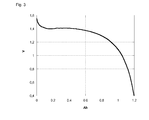
- Figure 3 shows the discharge curve of an AA cell using the Al/H 2 0 2 system of example 4.3.
- Cathode gel materials were subjected to accelerated stability study at 70°C. Assuming hydrogen peroxide decomposition rate to increase by factor 2.2 each 10°C, time spent at 70°C is equivalent to 60.34 of time spent at 18°C.
- Unstabilized electrolyte prepared from having 15 mole/L of Hydrogen peroxide and 250 g/L of ortho-phosphoric acid.
- Electrode positive (cathodic electrolyte) C Electrode positive (cathodic electrolyte) C. Electrolyte 1 C. Electrolyte 2 C.
- Electrode negative acid gel compositions (A. Electrolyte 1-3) were prepared according to the invention. Table 3 shows the composition thereof. Table 3.- Electrode negative acid gel A. Electrolyte 1 A. Electrolyte 2 A. Electrolyte 3 Electrolyte Sulphuric acid 3 mol/L 19,2%w/w 19,2 %w/w Antipassivation agent Hydrogen chloride 0,05 mol/L 0,12 %w/w 0,12 %w/w Corrosion inhibitor 2,2'-bipyridyl 0,05 mol/L 0,52 %w/w 0,52 %w/w Surfactant SDS 0.003 % w/w 0.003 % w/w 0.003 % w/w Organic acid Oxalic acid --------- 25 %w/w 25%w/w
- Figure 4 shows the comparative discharge curves obtained. A higher potential and more capacity is clearly obtained when Al/H 2 0 2 system is used.
Landscapes
- Chemical & Material Sciences (AREA)
- Chemical Kinetics & Catalysis (AREA)
- Electrochemistry (AREA)
- General Chemical & Material Sciences (AREA)
- Engineering & Computer Science (AREA)
- Manufacturing & Machinery (AREA)
- Inorganic Chemistry (AREA)
- Primary Cells (AREA)
Priority Applications (1)
| Application Number | Priority Date | Filing Date | Title |
|---|---|---|---|
| EP09177150A EP2333884A1 (fr) | 2009-11-26 | 2009-11-26 | Batterie AI/H202 |
Applications Claiming Priority (1)
| Application Number | Priority Date | Filing Date | Title |
|---|---|---|---|
| EP09177150A EP2333884A1 (fr) | 2009-11-26 | 2009-11-26 | Batterie AI/H202 |
Publications (1)
| Publication Number | Publication Date |
|---|---|
| EP2333884A1 true EP2333884A1 (fr) | 2011-06-15 |
Family
ID=42028099
Family Applications (1)
| Application Number | Title | Priority Date | Filing Date |
|---|---|---|---|
| EP09177150A Withdrawn EP2333884A1 (fr) | 2009-11-26 | 2009-11-26 | Batterie AI/H202 |
Country Status (1)
| Country | Link |
|---|---|
| EP (1) | EP2333884A1 (fr) |
Cited By (8)
| Publication number | Priority date | Publication date | Assignee | Title |
|---|---|---|---|---|
| CN111430741A (zh) * | 2020-04-13 | 2020-07-17 | 中国地质大学(武汉) | 一种碱性电解液复合缓蚀剂和铝空气电池 |
| CN111653798A (zh) * | 2020-06-22 | 2020-09-11 | 武汉瑞科美新能源有限责任公司 | 一种金属空气电池阴极及其制备方法、应用和电池 |
| CN113178550A (zh) * | 2021-04-30 | 2021-07-27 | 桂林理工大学 | 一种铝复合电极及其制备方法、应用、双离子电池 |
| CN115023844A (zh) * | 2020-06-17 | 2022-09-06 | 广东省皓智科技有限公司 | 复合物的剥离方法 |
| CN116190764A (zh) * | 2023-02-24 | 2023-05-30 | 北京科技大学 | 一种一体化半固态双反应区铝离子电池及其制备方法 |
| CN116288365A (zh) * | 2023-03-14 | 2023-06-23 | 南京时拓能源科技有限公司 | 一种碱性铝空气电池用电解液复合缓蚀剂 |
| CN117164643A (zh) * | 2023-08-31 | 2023-12-05 | 中国科学院上海硅酸盐研究所 | 一种有机-无机杂化材料及其制备方法和应用 |
| WO2026005024A1 (fr) * | 2024-06-28 | 2026-01-02 | 住友化学株式会社 | Composition, matériau actif d'électrode négative, électrode négative pour batterie secondaire au lithium, batterie secondaire au lithium et procédé de production de composition |
Citations (3)
| Publication number | Priority date | Publication date | Assignee | Title |
|---|---|---|---|---|
| GB2056754A (en) * | 1979-07-25 | 1981-03-18 | Varta Batterie | Galvanic primary cell |
| US5445905A (en) | 1993-11-30 | 1995-08-29 | The United States Of America As Represented By The Secretary Of The Navy | Dual flow aluminum hydrogen peroxide battery |
| US7273675B2 (en) | 2002-12-27 | 2007-09-25 | Kabushiki Kaisha Toshiba | Aqueus electrolytic solution primary battery |
-
2009
- 2009-11-26 EP EP09177150A patent/EP2333884A1/fr not_active Withdrawn
Patent Citations (3)
| Publication number | Priority date | Publication date | Assignee | Title |
|---|---|---|---|---|
| GB2056754A (en) * | 1979-07-25 | 1981-03-18 | Varta Batterie | Galvanic primary cell |
| US5445905A (en) | 1993-11-30 | 1995-08-29 | The United States Of America As Represented By The Secretary Of The Navy | Dual flow aluminum hydrogen peroxide battery |
| US7273675B2 (en) | 2002-12-27 | 2007-09-25 | Kabushiki Kaisha Toshiba | Aqueus electrolytic solution primary battery |
Non-Patent Citations (4)
| Title |
|---|
| E.G. DOW ET AL.: "Enhanced electrochemical performance in the development of the aluminum/hydrogen peroxide semi-fuel cell", JOURNAL OF POWER SOURCES, vol. 65, no. 1, 1 March 1997 (1997-03-01), pages 207 - 212, XP004059650, ISSN: 0378-7753 * |
| JOURNAL OF POWER SOURCES, vol. 65, 1997, pages 207 - 212 |
| MULLER S., JOURNAL OF APPLIED ELECTROCHEMISTRY, vol. 26, 1996, pages 1217 - 1223 |
| O. HASVOLD ET AL.: "The alkaline aluminium/hydrogen peroxide power source in the Hugin II unmanned underwater vehicle", JOURNAL OF POWER SOURCES, vol. 80, no. 1-2, 1 July 1999 (1999-07-01), pages 254 - 260, XP004172836, ISSN: 0378-7753 * |
Cited By (9)
| Publication number | Priority date | Publication date | Assignee | Title |
|---|---|---|---|---|
| CN111430741A (zh) * | 2020-04-13 | 2020-07-17 | 中国地质大学(武汉) | 一种碱性电解液复合缓蚀剂和铝空气电池 |
| CN115023844A (zh) * | 2020-06-17 | 2022-09-06 | 广东省皓智科技有限公司 | 复合物的剥离方法 |
| CN111653798A (zh) * | 2020-06-22 | 2020-09-11 | 武汉瑞科美新能源有限责任公司 | 一种金属空气电池阴极及其制备方法、应用和电池 |
| CN113178550A (zh) * | 2021-04-30 | 2021-07-27 | 桂林理工大学 | 一种铝复合电极及其制备方法、应用、双离子电池 |
| CN116190764A (zh) * | 2023-02-24 | 2023-05-30 | 北京科技大学 | 一种一体化半固态双反应区铝离子电池及其制备方法 |
| CN116288365A (zh) * | 2023-03-14 | 2023-06-23 | 南京时拓能源科技有限公司 | 一种碱性铝空气电池用电解液复合缓蚀剂 |
| CN117164643A (zh) * | 2023-08-31 | 2023-12-05 | 中国科学院上海硅酸盐研究所 | 一种有机-无机杂化材料及其制备方法和应用 |
| CN117164643B (zh) * | 2023-08-31 | 2026-04-14 | 中国科学院上海硅酸盐研究所 | 一种有机-无机杂化材料及其制备方法和应用 |
| WO2026005024A1 (fr) * | 2024-06-28 | 2026-01-02 | 住友化学株式会社 | Composition, matériau actif d'électrode négative, électrode négative pour batterie secondaire au lithium, batterie secondaire au lithium et procédé de production de composition |
Similar Documents
| Publication | Publication Date | Title |
|---|---|---|
| EP2333884A1 (fr) | Batterie AI/H202 | |
| Xu et al. | Rechargeable Zn-air batteries: Progress in electrolyte development and cell configuration advancement | |
| EP2721037B1 (fr) | Synthèse de composés hétéro-ioniques à l'aide de quaternarisation de dialkylcarbonates | |
| Wang et al. | Trielectrolyte aluminum-air cell with high stability and voltage beyond 2.2 V | |
| EP3117476B1 (fr) | Batterie redox tout cuivre aqueuse | |
| JP2014520372A (ja) | イオン交換材料を有する金属−空気セル | |
| EP1381107B1 (fr) | Electrolyte polymère solide conducteur de protons | |
| Surendran et al. | Understanding the Engineering Tactics to Achieve the Stabilized Anode in Next‐Generation Zn‐Air Batteries | |
| US10811690B2 (en) | Voltage and reduced polarization within mercury free zinc air cells | |
| KR20240031590A (ko) | 알루미늄 공기전지용 전해액 및 이를 포함하는 알루미늄 공기전지 | |
| US20250286173A1 (en) | Air battery in which metallic copper or alloy thereof serves as oxygen reducing air electrode | |
| US12476269B2 (en) | Rechargeable liquid fuel cell system and method | |
| EP4500602A2 (fr) | Procédé d'alimentation en métal pour piles à combustible métal-air | |
| EP3627604B1 (fr) | Membrane de séparation échangeuse d'ions et batterie à circulation la comprenant | |
| KR102277093B1 (ko) | 출력용량 특성이 우수한 흐름전지 | |
| Yu et al. | Dual‐Electrode Stabilization of Aqueous Zinc‐Iodide Batteries Enabled by an Amino‐Functional Imidazolium Bromide Additive | |
| EP3190649A1 (fr) | Accumulateur lithium-ion | |
| US20250253325A1 (en) | Battery cell and related methods | |
| KR102769322B1 (ko) | 레독스 흐름전지 시스템 | |
| CN113078390A (zh) | 一种具有对称结构的环醚在水系碱性电解液中的应用 | |
| KR20250177647A (ko) | 알루미늄 전기화학 에너지 전지 | |
| HK40110589A (zh) | 具有经由双电层电容器的电子传导功能的电池 | |
| CN119542573A (zh) | 一种水系锌碘电池的电解液及其制备方法和宽温域、高容量的水系锌碘电池 | |
| KR20240133444A (ko) | 브롬화 암모늄염 기능기를 가지는 전기화학 활성 물질과, 하이드로트로프 지지 전해질을 이용한 전기화학 활성 수용액 | |
| CN119361857A (zh) | 一种水系电解液及其制备方法及水系电池 |
Legal Events
| Date | Code | Title | Description |
|---|---|---|---|
| PUAI | Public reference made under article 153(3) epc to a published international application that has entered the european phase |
Free format text: ORIGINAL CODE: 0009012 |
|
| AK | Designated contracting states |
Kind code of ref document: A1 Designated state(s): AT BE BG CH CY CZ DE DK EE ES FI FR GB GR HR HU IE IS IT LI LT LU LV MC MK MT NL NO PL PT RO SE SI SK SM TR |
|
| AX | Request for extension of the european patent |
Extension state: AL BA RS |
|
| STAA | Information on the status of an ep patent application or granted ep patent |
Free format text: STATUS: THE APPLICATION IS DEEMED TO BE WITHDRAWN |
|
| 18D | Application deemed to be withdrawn |
Effective date: 20111216 |